Home Blog Page 481

Indian Farmers: Leaderless and Powerless

In the absence of a strong and credible leadership, sporadic farmers’ marches will not let agrarian crisis become a powerful political agenda

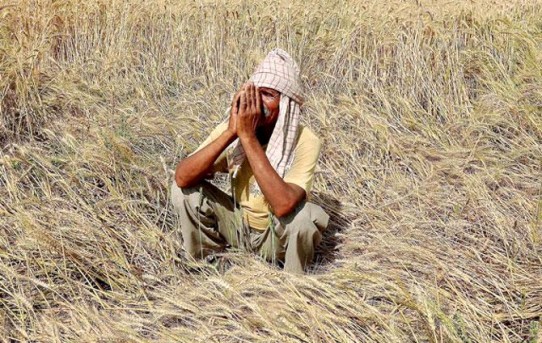
Our food producers, throughout the country, are in severe distress, and thousands of farmers have been on the roads – to make their urban countrymen and government, understand their plight. In the last few months three protest marches have been organized by farmers. Far from the stability of self-sufficient village economy, today a complete collapse of Indian agriculture system seems imminent. There is little doubt, this has happened, majorly, because of the callous neglect of successive governments.

To put the grim scenario in perspective, while Indian farmers were ghastly exploited during the British period but even then, suicidal tendency among farmers was not prevalent to this extent, as we see today in ‘free’ India. From the often used slogan of ‘Jai Jawan, Jai Kisan’ to the altogether absence of kisan from the vocabulary of Indian democracy, it has been a downward journey of several decades for generations of farmers. This is despite the fact that agriculture contributes nearly 16 % to India’s $2 trillion economy and employs about two-thirds of its 1.25 billion people! The extremely disdainful attitude of successive governments and the continued severe economic distress in our fields is a worrying sign not just for the economy but for Indian democracy as well, where a large population of people remain unheard.

However, despite the recent protest marches, farmers have not been able to make a strong political statement or exert sufficient pressure on the government. Infact, they have never been able to do that in the last one decade or so. The latest protest march in Delhi was organized under the umbrella body of All India Kisan Sangharsh Coordination Committee (AIKSCC), which, though claims to have support of 207 organizations of farmers and agricultural workers – but seems to have little achievement as a pressure group. As a result, the latest march of farmers at Ramlila Maidan ended in a jamboree of political leaders, from various opposition parties, joining hands for a photo-op, with no concrete plan or road map to address this issue politically. Also, sadly and Ironically, none of them have any credentials to speak or represent farmers of the country, as they have done little for them when they were in power.

Given the acute nature of crisis, we need strong policy measures and a clear road-map for implementation in a time bound manner. In a democratic system, it is only possible when ‘agrarian crisis’ becomes a strong ‘political agenda’ and Parliamentarians prioritise to take it up in the Parliament. What is required is ‘mainstreaming’ of the farmers’ issues, which has been on the periphery for decades now.

There is a need for large-scale public discussions and debates on issues pertaining to agrarian issues and rural India at large, both – inside and outside the Parliament. Due to lack of seriousness given by our elected representatives to rural India, mainstream Indian media, will continue to report with its deeply ingrained urban bias and India as a nation cannot expect to have a functioning democracy, if such a huge population continues to be a silent victim of apathy, double standards and mis-governance.

Lack of strong and credible leadership is a major hurdle in farmers’ protests transforming into a farmers’ movement. What Mahendra Singh Tikait could do at Delhi’s Boat Club lawns in 1988, when nearly five lakh farmers from western Uttar Pradesh occupied the entire stretch from Vijay Chowk to India Gate and forced Rajiv Gandhi government to accede to his 35-point charter of demands, no political leader can even think of doing that now. Delhi’s power elite, even those claiming to be from rural backgrounds, simply lack that trust and respect among farmers. Moreover, in the last one-decade there have been attempts to pacify farmers by focusing on their non-farms demands, and flaming demands and protests on the lines of Jat quota agitation and others, thus deviating from the larger issue of introducing more fundamental changes in the agrarian sector.

Indian democracy has too many distractions, and to bring its focus on agrarian crisis – it need to become a powerful political agenda. A sustained farmers’ movement – demanding deep-rooted changes in the agrarian ecosystem of the country, is what we need today and not just sporadic marches.


Fiery Elon Musk has “no respect” for US regulator

Tech entrepreneur Elon Musk has said that he has “no respect” for the Securities and Exchanges Commission (SEC) of the United States. Musk said this during an interview with the news channel CBS—the BBC reported.

In September this year, the SEC had decided to sue him for alleged securities fraud which came after Musk’s rather infamous tweet. In this tweet Musk had written that he had secured funding to take Tesla (his electric car manufacturing firm) off the stock markets and turn it into a private company.

The SEC had termed Musk’s claim as “false and misleading”.

Musk clarified that he and Tesla had chosen to pay the $20m (Rs 145 crore) settlement fine as he believed in the justice system. In the same breath Musk added that he did not respect SEC, the regulator. Musk had to step down as Tesla’s chairman as part of the settlement package and was told that his tweets should be monitored.

Resident Indian Missions in Africa to increase from 29 to 47 by 2021

0

In a significant move, which will further strengthen the growing India-Africa diplomatic ties, India has decided to open 18 new Missions in Africa. The Union Cabinet chaired by the Prime Minister Narendra Modi had approved the opening of new Indian Missions in Africa earlier this year and the work will be completed during the period from 2019 to 2021.

The 18 new Indian Missions in Africa will be opened in Burkina Faso, Cameroon, Cape Verde, Chad, Republic of the Congo, Djibouti, Equatorial Guinea, Eritrea, Guinea, Guinea Bissau, Liberia, Mauritania, Rwanda, Sao Tome & Principe, Sierra Leone, Somalia, Swaziland and Togo, thereby increasing the number of Resident Indian Missions in Africa from 29 to 47. The decision will enhance India’s diplomatic outreach in the African continent and allow India to engage with Indian diaspora in African countries. Opening of new Missions is also a step towards implementing the vision of enhanced co-operation and engagement with Africa.

The Prime Minster had also made a historic visit to Republic of Rwanda (23-24 July, 2018) and Republic of Uganda (24-25 July, 2018). This was the first ever visit by an Indian Prime Minister to Rwanda and the first visit by the Indian Prime Minister to Uganda in over 20 years. Prime Minister’s official engagement in Rwanda and Uganda included bilateral meetings with the Presidents, delegation level talks and meetings with the business and the Indian communities. In Rwanda, Prime Minister also visited the Genocide Memorial and participated in an event on “Girinka” (one cow per family), a national social protection scheme of Rwanda personally initiated by President Paul Kagame.

In Uganda, Prime Minister delivered a Keynote address at the Parliament of Uganda – the first Indian Prime Minister to address the Ugandan Parliament and also addressed the Indian Community in Uganda. The event in Kampala was also attended by President Museveni of Uganda. In his address, the Prime Minister said he felt a sense of belonging with the Indian Community in Uganda. He said the presence of President Museveni at the event shows his love for the people of India, and the Indian Community in Uganda. He also thanked President Museveni and the people of Uganda, for the honour to address the Parliament of Uganda. The Prime Minister said that the relationship between India and Uganda is centuries old. He recalled the historical links between the two countries, including the struggle against colonialism, and the railway construction work in Uganda.

Over the last few years, there has been a significant intensification of our engagement in various fields with African countries and there have been as many as 23 outgoing visits to Africa at the level of President, Vice President and Prime Minister in the last four years. Africa has been the top priority of India’s Foreign Policy. The visit of Prime Minister to Rwanda, Uganda and South Africa further strengthened India’s relations with the African continent.

London court orders extradition of Vijay Mallya to India

A London court has given its nod to extradite fugitive businessman Vijay Mallya to India. The disgraced liquor baron and former boss of the now-defunct Kingfisher Airlines is wanted in India on charges of fraud and money laundering that amount to Rs 9,000 crore ( $1.25 billion).

“We hope to bring him soon and conclude the case. CBI has its own inherent strengths. We worked hard on this case. We are strong on Law and facts and we were confident while pursuing extradition process,” said CBI (Central Bureau of Investigation) spokesperson on Vijay Mallya’s extradition to India.

As Indian public sector banks pressurized Vijay Mallya to repay the loaned amounthe fled the country for London on March 2, 2016. He had been partially successful in evading his extradition to India after the dilution of a CBI lookout notice against him. The latest ruling Monday by the Westminster Magistrates’ Court, London to send him back to India is a shot in the arm for Narendra Modi government that is facing criticism for economic woes and its inability to bring in fugitive businessmen to India.

Just a week ago, Modi had sought “active cooperation” with member nations at the G-20 meet in Argentina to nab high profile economic offenders.

RBI Governor Urjit Patel resigns

Reserve Bank of India Governor Urjit Patel has resigned. Patel’s resignation comes in the backdrop of ongoing rift of the central bank with the Narendra Modi government.

“On account of personal reasons, I have decided to step down from my current position effective immediately. It has been my privilege and honour to serve in the Reserve Bank of India in various capacities over the years. The support and hard work of RBI staff, officers and management has been the proximate driver of the Bank’s considerable accomplishments in recent years. I take this opportunity to express gratitude to my colleagues and Directors of the RBI Central Board, and wish them all the best for the future,” Urjit Patel said in a statement that has been put up by the Reserve Bank of India on its website.

Since 1990, Patel is the first governor to step down before his term ends. Patel’s three-year term was to end in September 2019.

PM Modi on Urjit Patel’s resignation as RBI Governor: Dr Urjit Patel is an economist of a very high calibre with a deep&insightful understanding of macro-economic issues. He steered the banking system from chaos to order. He leaves behind a great legacy. We’ll miss him immensely pic.twitter.com/sWHkfZh8v3
— ANI (@ANI) December 10, 2018

Finance Minister Arun Jaitley: Govt acknowledges with deep sense of appreciation the services rendered by Dr Urjit Patel to this country, both in his capacity as Governor & Deputy Governor of RBI. I wish Dr Patel all the very best and many more years of public service. (File pic) pic.twitter.com/o7W5OwG9Ah— ANI (@ANI) December 10, 2018

RBI central board member S Gurumurthy: Surprised at news that RBI Guv resigned. Previous meeting was held in such cordial atmosphere that it comes as a shock. All directors said media had created a wrong perception while inside it was different. That makes it even more surprising— ANI (@ANI) December 10, 2018

Relax. Actor Shahid Kapoor is not suffering from cancer

Indian actor Shahid Kapoor dismissed all reports that claimed he was suffering from stomach cancer. Kapoor took to the micro-blogging site, Twitter, to post his health update. “Guys I’m totally fine please don’t believe random stuff,” Shahid Kapoor announced on Twitter.

Guys I’m totally fine pl don’t believe random stuff.— Shahid Kapoor (@shahidkapoor) December 10, 2018

Shahid Kapoor on Twitter

Over the last week, grapevine in the Hindi film industry was rife with rumours that Shahid was suffering from stomach cancer. Several news and media companies had also reported about his cancer. The rumour of Shahid Kapoor’s stomach cancer had come as a severe blow to the Hindi film fraternity that’s still digesting news about cancer ailments of actors Irrfan Khan and Sonali Bendre.

As Shahid dismissed the caner rumours the film fraternity and millions of Hindi film fans across the world can now heave a sigh of relief.

Shahid is currently busy shooting for the Hindi remake of Arjun Reddy, which is titled Kabir Singh. Kabir Singh will hit the screens on June 21, 2019.

Jason Momoa dives underwater as the superhero Aquaman

Aquaman is the first DC Film that features Jason Momao since the last year’s debacle of Justice League. The last DC film ‘Justice League’ that also featured Momoa was an expensive disaster. DC Films is an American motion picture label based at the Warner Bros. Studios in Burbank, California.
Aquaman is directed by James Wan and also has Amber Heard, Willem Dafoe, Patrick Wilson, Dolph Lundgren, Yahya Abdul-Mateen II and Nicole Kidman. Jason Momoa is in the lead role of Arthur Curry aka the Aquaman.

Rani Mukerji to return as cop in Mardaani 2

Actor Rani Mukerji will be soon act in Mardaani 2, which is a sequel to her 2014 critically acclaimed hit. Mardaani, the earlier film, revolved around child trafficking and Rani played the part of Shivani Shivaji Roy, senior inspector, crime branch. This film was directed by Pradeep Sarkar. The sequel Mardaani 2 will be produced by Aditya Chopra and Yash Raj Films will start the Mardaani franchise with the project. 

Mardaani 2, will be directed by Gopi Puthran, who is also the writer of the first Mardaani.

“Mardaani is and will always be extremely close to my heart. Right since its release, everyone has asked me time and again when I would be doing Mardaani 2 and I’m sure this announcement will come as a pleasant surprise to them all. Gopi has written an extraordinary script that we all love and I can’t wait to start shooting this film soon,” Rani said in a statement.

Rani added that Shivani, her character in Mardaani 2, will face a merciless and cold villain. “Shivani will face a cold, merciless villain who has no empathy, no fear of God and is pure evil. The character has been written superbly and I’m excited to find out who the actor will be,” she said. Mardaani 2 is set to go on floors in 2019 and will release in the latter part of the year.

Militants must stop the murder of innocent Kashmiri youth. Now.

0

On November 15 this year, 17-year-old Nadeem Ahmad, a high school student, was abducted by militants from Shopian in South Kashmir, a hotbed of militancy in the Himalayan valley. Next day, the teenager’s bullet-ridden body was found in an orchard in a village close to where he lived. Hours after the body was discovered, a video surfaced on social media showing gunmen firing a volley of bullets into the victim. Another video showed Nadeem, shortly before his death, confessing that he had shared information about two insurgents with the Indian army.

A similar video showing a militant slitting the throat of another young man sent shock waves across the region. The pictures showed the blood-soaked face of the victim, identified as 19-year-old Huzaif Ashraf Kuttay, also a resident of southern Kashmir. Huzaif, a baker by profession, was abducted on November 16 2018,by armed men along with his two cousins. His cousins were later released, but Huzaif was killed.

At his two-storey home in Safangari village in Shopian, Manzoor Ahmad Bhat, 50, is devastated. Bhat’s son Nadeem was the first whose execution was posted on social media.  In another village in the nearby district Kulgam, the family of 19-year-old Huzaif Ashraf — the other victim — is also in a shock.  “We do not know why he was killed, we want to know the truth,” Huzaif’s uncle Muhammad Amin Ganai said.

“We saw a video of my son’s dead body on the internet,” Huzaif’s father Mohammed Ashraf said, adding, “Those who killed my son, I want to ask them, why was he killed. We deserve an answer, at least.”

The incidents are undoubtedly a gross violation of human rights and barbaric in nature. Kashmir’s largest armed group, Hizbul Mujahedeen, which claimed responsibility for the murders, justified its stance shortly after the incidents took place. “From today, we’ll only be exposing videos of death.And whoever betrays our movement will face the same consequences,” Riyaz Naikoo, Hizbul Mujahedeen’s commander said in a clear warning to the so-called “informers,”adding that the group’s “do or die” squad had executed the men.

According to police, the execution videos released by insurgents were a new phenomenon in Kashmir’s two-decade-long insurgency and have been made with the aim to frighten local people. “I think this is part of a media blitzkrieg strategy to instil terror. Also, they [the militants] are trying to copy Islamic State’s strategy of beheading and other means of brutal killings,” a top police official said. “These crimes are gruesome,” he said and added that propaganda related to the same was also a criminal activity. “The cases have already been registered. There are some [social media] handles from where such content is propagating. I am sure that with the help of service providers, we will be able to nail them,” he explained further.

Earlier data suggests that militants have abducted 12 people, killing four of them, including a former police officer. The rest were set free. Similar incidents occurred in August, when armed gunmen abducted several policemen,threatening to kill them if they didn’t quit their jobs.

Ajai Sahni, an expert on counter-insurgency and the executive director of the Institute for Conflict Management in New Delhi, said that the number of such killings has increased over the past two years. “They (militants) have always targeted people sympathetic to state agencies, from the beginning of the militancy. The difference this time is that they have put the videos on social media,” he said.

“When militants come under a lot of security force pressure in narrowly targeted operations, they turn to people. The narrowly targeted operations are always intelligence-based. This is to spread fear in a totally chaotic situation. I think, in these cases, social media is being used negatively. During the current government’s rule in India, videos of the lynching of Muslims were being circulated on social media and that was just to create fear among the population in a similar way,” he explained.

Shopian has been riddled with tension since 2016, when Burhan Wani, a 21-year-old commander of the Hizbul Mujahedeen was killed by forces, prompting several months of civil unrest and an increase in armed combat between security forces and militant groups. According to a recent report, the number of people killed in the region in 2018 is the highest in the last nine years. The number included 144 civilians, 234 militants and 142 security personnel. Earlier,forces launched an operation ‘All out’ to kill militants to bring normalcy in the region.

“The barbaric policy of militants abducting and killing innocent civilians that has been witnessed in recent times is something to be worried about. It,undoubtedly, is being pursued on orders from across the border. The intention is to create an aura of fear among the common people who are no longer providing to militancy the kind of support that is required for its sustenance,”said Jaibans Singh, a reputed defence and security expert. “There is a need fora joint effort by the people and security forces to negate this challenge.Vigilance has to be increased and efforts to root out militancy intensified.Effort has to be made to wean the Kashmir youth away from the path of militancy,” he added.

Kashmiris a pending dispute between India and Pakistan. The two countries have fought two of their three wars since independence in 1947 over the region, which they both claim in full but rule in part. Kashmir has witnessed heavy unrest since 1989, with some separatist groups demanding a sovereign nation and others calling for a merger with Pakistan. Pakistan has been training and arming the militants and sending them to Kashmir where they have spread debilitating levels of violence. The protracted unrest in the region has claimed tens of thousands of lives in the last three decades. It is time for all stakeholders to join hands and save the innocent people, especially the youth, from being brutalised and killed.

‘People buy People, not Products & Services’

This story dates back to 1996, when I was part of the Automotive tyres industry. As a branch head then, I used to toy with ideas, which many would not have agreed with me. Also, I used to be part of a company which was really not in the ‘encouraging mode’ as far as independent thinking is concerned.

During these days, I came across this very enterprising dealer, a retailer aka the channel partner, who wasn’t appreciated much amongst the echelons of decision makers as he was too very blunt. Straight-forward, maybe, not a sycophant. Not too very educated and by no stretch of imagination someone who could trade discussions about management and neo-marketing techniques, which these neo MBA converts were in the habit of appreciating. Nevertheless, when I took over, I ran through my distribution base, and identified this one channel partner to mould into an asset.

I sat with him one day at the office (remember, there were no mobile phones to intrude into conversations) and had a frank chat on expectations. I spelt out my expectations, and he spelt out his aspirations, professional and personal goals and his preferred way forward. As was the practice about three Ws (wine, women & wealth) in that sector, I spelt out my aversion for all of the above three, or even the need ever for any kind of reciprocity, in return for professional decisions taken by me.

Nevertheless, I had mentioned the subject of this post to this particular agent and had advised him to continually work on his own brand name, parallel to building the corporate or product brand of his principals.

My thought was – “People buy People, not Products & services”. Essentially, what I really wanted to convey was that principles might change, product lines may move over, business entities might change course, but, in a small town, people go to people to buy products, rather than the brand pull of products making the ‘people meeting people’ incidental.

I was in this city for about two years, and then I moved on. During my stay I tried to intersperse the management and statistical tools to think through the market dynamics and formulate strategies. While my team was clocking 100% year-on-year growth, this particular agency (mentioned above) was clocking double than this.

This particular gentleman has been in touch with me, off and on, since my exit from the city. I have been supplying him with some acquired and realized thoughts on how he could consolidate his personal and retail outlet brand. Re-affirming my thoughts that “People buy people, not brands“.

I received a call from him a few days back. He mentioned how this brand is one of the foremost in the country and how people recognize their family name in the city. Also, he has been able to secure the future of his family as most reputable institutions and families want to associate their brand name with his.

Another fact to peruse is our individual shopping traits. Most often when we enter an apparel store, a multi-brand one, the individual courtesy and demeanour of the salesperson determines our duration of the stay in that store, and this in turn determines how much money we splurge. Consider this, it is our money, and we are spending on ourselves. Even the products offered in these stores are not unique in nature. It is available in every branded store. Haven’t we bought the “People, not the Product?”

Let me give you another example. Most of us spend 2-3 days a week in some of the upmarket restaurants, five-star hotels and rendezvous points for work or for pleasure. Is there a quantum of tip defined? Is there a benchmark of how much do we sign on the dotted line? Don’t we like to be pampered by the waiting staff? Would we not welcome the chef venturing out of the confines of the kitchen and trade our ‘ill-informed’ pretence about Somali or Mongolian or even Nawabi food? Let’s admit it, most often, we are governed by the pleasant demeanour of the staff and that determines about how much we leave as a tip. Another re-affirmation that “people by people, not products”.

In my line of work, which is real estate in India, there are hundreds of real estate developers operating across Delhi-NCR. Each of them makes similar products, at different prices, with cosmetic changes. When clients approach us they want us to certify what to invest into. More often than not, many would place their trust in us to invest their life’s savings in a product recommended by us. Are they not buying people, rather than the product?

Don’t our colleagues and team mates buy us as people, rather than consider our designations and positions before accepting us as their leaders?

Our surrounding always buy and sell. They buy people and sell people. But whatever the product, service or story one might be marketing, we need to remember that “People buy people, not Products”. The underlying management principle should be: “Sell yourselves, sell your service ability and then sell the product.”