Home Blog Page 78

Deadly shooting near mosque in Oman kills four,injures many

In Oman, four individuals have been killed and multiple others wounded in a shooting near a mosque, according to a statement released by The Royal Oman police on Tuesday.

The attack, which occurred in Wadi al-Kabir, located in the governorate of Muscat, marks a rare breach of security in one of the Middle East’s most stable countries.

Omani authorities have assured the public that they are taking all necessary measures to address the situation. “All security measures and procedures have been taken to deal with the situation, and procedures for gathering evidence and investigation are being completed,” the police statement declared.

They also expressed condolences to the families of the deceased and extended their deepest sympathies to those affected by this tragedy

The U.S. Embassy in Muscat has issued an advisory to American citizens in the area, urging them to “remain vigilant, monitor local news and heed directions of local authorities.” The embassy confirmed that it is closely following reports of the incident.

This violence stands in stark contrast to Oman’s reputation as a neutral mediator in regional disputes, including those between the United States and Iran. The country has long been regarded as an oasis of stability in an often-turbulent region.

Stay tuned for updates on this developing story.

Radical Islamists abduct and forcibly convert another Hindu woman to Islam in Sindh

A 25-year-old Hindu woman named Sunita was abducted from Zubaida Heights Apartments in Sindh, Pakistan, where she worked as a domestic helper. The next day, she was forcibly converted to Islam in Hyderabad.

Sunita managed to contact her elder sister from Hyderabad’s Chandni Chowk, revealing that an unknown Muslim woman, assisted by several men, had kidnapped her at gunpoint under the pretense of securing a job. They transported her to Hyderabad and coerced her into reciting the Kalma loudly.

Further details from Sunita’s niece indicated that a Muslim woman on the sixth floor of Zubeida Heights, where Sunita worked, had persistently pressured her to recite the Kalma and planned to take her to Karachi without her parents’ knowledge.

Recently, a ten year old girl named Jamuna, daughter of a local Hindu labourer Channu Kohli, was kidnapped, rape & converted to Islam.

This incident highlights the precarious situation for Hindu citizens in Pakistan. They face widespread marginalization, denied access to jobs, education, and healthcare. Many live in slums, their temples vandalized, and their dead exhumed from cemeteries. Derogatory terms like “kafir” (infidel) are commonplace, reinforcing their status as unwelcome.

Pakistan’s treatment of its Hindu minority is a “slow-motion ethnic cleansing.” Legal safeguards are lacking, and laws against forced conversion are routinely blocked by religious hardliners. This pervasive discrimination leaves Hindus, especially women and girls, vulnerable to abduction and forced conversion.

Terrorist group Jaish-e-Fursan-e-Muhammad bombs Bannu Cantonment in Khyber-Pakhtunkhwa

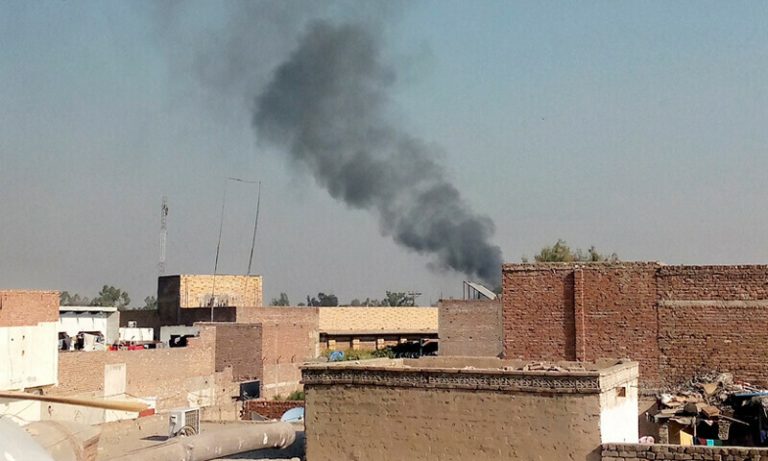
A series of powerful explosions and gunfire rocked the city of Bannu in Khyber Pakhtunkhwa province early this morning, as terrorist launched a complex attack on the Army cantonment. The assault, which began around 4:50 AM, has resulted in casualties and significant damage to the area.

Initial reports suggest that an explosive-laden vehicle was detonated at the cantonment gate, followed by at least two suicide bombers who reportedly entered the military compound. The intensity of the first explosion caused the collapse of a nearby house, resulting in the death of a woman and injuries to several others.

Local residents report ongoing heavy gunfire near the cantonment, with Pakistan Military helicopters circling overhead. The Army has sealed off the area, making it difficult to ascertain the full extent of the situation. Several buildings and shops in Bannu city have suffered damage from the blast waves.

Terrorist group, Jaish-e-Fursan-e-Muhammad, a faction of the Hafiz Gul Bahadur group, has claimed responsibility for the attack, describing it as a “fidayeen” (suicide) mission. Social media accounts linked to the group have released the names of eight Pakistani soldiers, including a major killed in the ongoing conflict.

As of 8:14 AM, smoke was still rising from the cantonment, with gunship helicopters continuing to circle and sporadic gunfire being heard.

Khyber Pakhtunkhwa (KP) witnessed a significant increase in terrorist incidents in 2024. Such horrific events are happening under the watch of Pak Army and its generals. They harbour terror, fear in the region and the cost is paid by the Pashtun population

The situation of Pashtuns remain precarious as they face multifaceted challenges, both from Punjabi Pak Army and other terrorist elements. On the other hand, Punjabi Pak Army uses these incidents to project itself as a victim. 

POB: Pak Army increases military presence in Buleda

Reportedly, a significant military presence has been observed in Tehsil Buleida of District Kech in Pak-occupied-Balochistan.

Over forty trucks and various other military vehicles, laden with weapons and equipment, are advancing towards Buleda. This substantial movement of military personnel and hardware has raised concerns among the local population.

As of now, authorities have not issued any statement regarding this development.

Unfortunately, military operations have been a common occurrence in various regions of PoB over the past two decades. Recently, following the announcement of Operation Zarb-e-Istehkam, increased military activity and equipment deployment have been particularly noted in areas such as Mastung, Noshki, and Kalat.

The Army’s operations in PoB have always resulted in mass killings, enforced disappearances, mass destruction, and the relocation of entire populations.

In Pak-occupied-Balochistan innocent Baloch community are living in fear and atrocity since the forceful occupation in 1948.

Nepali Prime Minister Prachanda resigns after losing confidence vote

In Nepal, K P Sharma Oli on Monday was sworn in as Nepal’s Prime Minister for the fourth time to lead a new coalition government. On Sunday, President Ram Chandra Paudel appointed the leader of Nepal’s largest communist party as prime minister to lead a coalition government with the Nepali Congress (NC), the largest party in Parliament, alongside other smaller parties.

Prime Minister Pushpa Kamal Dahal, also known as Prachanda, resigned from his position on Friday. He failed to secure a vote of confidence in Parliament. He could only remain Prime Minister for 1 year and 6 months.

In the floor test, he received the support of only 63 out of 275 members of Parliament. 194 members of Nepal’s National Assembly voted against him. He needed the support of 138 members to save his government.

Actually, earlier this month, the China-backed KP Sharma Oli’s party, CPN-UML, broke its alliance with Prime Minister Prachanda’s Communist Party of Nepal. After that, his government fell into a minority. According to Article 100(2) of Nepal’s constitution, he had to prove his majority within a month, which he failed to do.

Oli’s party, CPN-UML, has decided to form an alliance with Sher Bahadur Deuba’s Nepali Congress, the largest party in the country. It is worth noting that Sher Bahadur Deuba is considered pro-India, while Oli is regarded as close to China.

It is estimated that KP Sharma Oli will become the Prime Minister in the new government for one and a half years. After that, Deuba will take over as Prime Minister for the remaining term. KP Oli will return to the PM position after four years. He previously served as Prime Minister from 2018 to 2021.

Oli’s tense relationship with India

Former Prime Minister KP Sharma Oli is considered a supporter of China. During Oli’s tenure as Prime Minister, the disputes over Kalapani, Limpiyadhura, and Lipulekh became quite serious. Oli claimed these areas, which are part of India, as Nepal’s territory. Hence, it is believed that Oli’s return to power could again cause tension between the two countries over this issue.

Pak Army abducts Baloch youths from Quetta

Reports from Quetta indicate that local police have arrested several Baloch youths, with some released after overnight detention. However, two individuals, identified as Jawad Baloch and Akbar Baloch, remain in custody and are facing severe torture.

Earlier in Kalat, four individuals were forcibly disappeared after being taken into custody by the Pakistan Army.

These events are part of a worrying pattern of enforced disappearances in Pakistan-occupied Balochistan. These abductions and disappearances are the tactics employed by the Army in the region since 1948, when it forcefully captured it.

https://twitter.com/fatima_bal0ch/status/1812074287076872553?s=46

The area’s resources have been exploited, while the local population faces human rights abuses. Enforced disappearances, marginalization, and extrajudicial killings are used as means of control over the Baloch community.

These recent incidents have reignited concerns about the human rights situation in POB, with calls for transparency and accountability from local and international observers.

POB: BLA executes Pak Army informant in Mach

In a statement released to the media, Jeeyand Baloch, spokesperson for the Baloch Liberation Army (BLA), announced that freedom fighters have killed Lal Jan Marri, an informant for the Pak Army, during an operation in the Mach and Geshtri areas of Bolan.

According to the spokesperson, Lal Jan Marri had been working as an informant for Military Intelligence (MI), the secret agency of the Pakistan Army, since 2017. In December 2023, BLA fighters detained Asmani alias Uthe, the son of Tango Marri, another informant, during an operation in the Daranjin area of Mach. During interrogation, Asmani revealed that Lal Jan Marri was part of their network and had been providing intelligence in the area.

The spokesperson further stated that Lal Jan Marri had been directly assisting enemy forces in military operations and was involved in the forced disappearances of people in Geshtri and other parts of Bolan. He was also accused of coercing others in the area to work as informants for MI.

The BLA said that the killing of Lal Jan Marri as a punishment for national treason, emphasizes that such actions serve as a warning. The BLA declared that it will not forgive those who betray their nation, and that similar consequences await anyone who commits national treason.

Pro-independence groups like BLA have long been active, resisting and seeking revenge against the forceful control of the Army, which commits numerous atrocities on a daily basis since it occupied the region in 1948.

Sniper fires shots at Donald Trump during rally in Pennsylvania

A shooting incident at a Donald Trump rally in Butler, Pennsylvania has raised serious questions about security protocols and prompted calls for swift investigations from Republican lawmakers.

According to early reports, a sniper managed to evade Secret Service agents and climb onto the roof of a building near the rally venue. The shooter fired multiple shots before being killed. At least one attendee claims to have alerted police and Secret Service to the apparent sniper, but his warnings went unheeded.

The incident has drawn sharp criticism of the Secret Service, which is primarily responsible for protecting Trump as a former U.S. president. Elon Musk, a prominent Trump ally, called for the agency’s leadership to resign.

https://twitter.com/WatcherGuru/status/1812251989759418579?t=fCqH1iVspvL5YWQLnOSP5g&s=08

Republican House Speaker Mike Johnson announced plans for an immediate hearing, stating on social media that Secret Service Director Kimberly Cheatle and officials from the Department of Homeland Security and FBI will be called to testify before congressional committees.

The Secret Service has initiated an investigation and briefed President Biden on the situation. They also stated that additional protective resources had recently been allocated to Trump’s security detail, though specifics were not provided.

Security experts predict a thorough review of Trump’s protection protocols. Joseph LaSorsa, a former Secret Service agent, suggested that Trump may now receive security measures more akin to those of a sitting president.

The incident occurred despite typically stringent security measures at Trump rallies, which include metal detectors, bag searches, and a secured perimeter. Paul Eckloff, another former agent, noted that the shooter must have either concealed themselves until becoming a threat or only revealed their weapons at the last moment.

In the aftermath of the shooting, Secret Service agents quickly formed a human shield around Trump, while armed personnel secured the stage. The former president was swiftly evacuated to a local hospital.

Imran Khan’s PTI set to emerge as single largest party in Pakistan

The Pakistan Tehreek-i-Insaf (PTI) is poised to become the single largest party in the National Assembly, while the ruling coalition appears likely to lose its two-thirds majority following the Supreme Court’s judgment declaring PTI eligible for reserved seats, according to a report by Pakistan-based daily, The Dawn.

The Supreme Court of Pakistan has ruled that PTI is entitled to a share of reserved seats in both national and provincial assemblies. This landmark judgment, delivered on Friday by a 13-member bench in an 8-5 ruling, represents a significant setback for the coalition government.

The case was initially filed by the Sunni Ittehad Council (SIC), a political party with PTI-backed candidates who joined after the February 8 general election, which they were compelled to contest as independents due to PTI being barred from using its electoral symbol, a cricket bat, because of alleged electoral law violations. Despite this, PTI candidates ran as independents and secured 93 seats in the National Assembly, surpassing all other parties.

The Pakistan Muslim League-Nawaz (PML-N) followed with 75 seats, while the Pakistan People’s Party (PPP) secured 54 seats. Imran Khan’s refusal to ally with any rival party led the PML-N and PPP to form a coalition government with smaller parties.

PTI

PTI-backed candidates, having won as independents, later aligned with SIC to form a coalition. The Supreme Court’s decision on Friday overturned the Peshawar High Court’s (PHC) ruling and nullified the Election Commission of Pakistan’s (ECP) decision, declaring it unconstitutional.

PTI members have praised the Supreme Court’s decision.

The issue of reserved seats gained prominence after over 80 PTI-backed independent candidates emerged victorious in the February 8 elections. The SIC then approached the ECP on February 21 seeking the allocation of reserved seats. However, the ECP, citing PTI’s failure to submit its list of candidates, denied the allocation of reserved seats to the SIC in a 4-1 majority verdict on March 4.

BNM Chairman condemns Pak Army brutality on protestors in Quetta

Dr. Naseem Baloch, Chairman of the Baloch National Movement, has issued a strong statement condemning escalating brutality by Pak Army forces across Pak-occupied-Balochistan. In his remarks, Dr. Baloch said that the Army is implementing a “terrible and horrific military strategy of collective punishment” against the Baloch people.

According to Dr. Baloch, the situation in POB has deteriorated to the point where forcible disappearances, extrajudicial killings, and violence against peaceful protesters have become commonplace. He specifically highlighted recent incidents in Quetta, where the protesters were met with gunfire, baton charges, and tear gas when demonstrating against the abduction of Zaheer Baloch.

The Baloch leader drew parallels between Pakistan’s actions and those of “uncivilized colonial powers,” asserting that the Army relies solely on military force to suppress dissent. However, he expressed confidence in the resilience of the Baloch movement, saying that “historical facts have repeatedly proven that no power in the world today can defeat any movement based on truth and rights.”

Dr. Baloch also criticized Pakistan’s approach to history, suggesting that the Army has failed to learn from past events, including the separation of Bangladesh. He emphasized the role of collective memory in shaping national character and warned that the Baloch people would not forget the violence inflicted upon them, particularly against women and elders.

The statement paid special tribute to Baloch women, describing them as “symbols of determination and courage” whose struggle has gained international recognition. In contrast, Dr. Baloch portrayed Pakistan as diplomatically isolated, relying on its “extremist jihadi Army and nuclear weapons” for leverage on the world stage.

Concluding his remarks, Dr. Baloch predicted the eventual success of the Baloch freedom movement, claiming that Pakistan’s fate has been “written on the wall based on historical truth.”