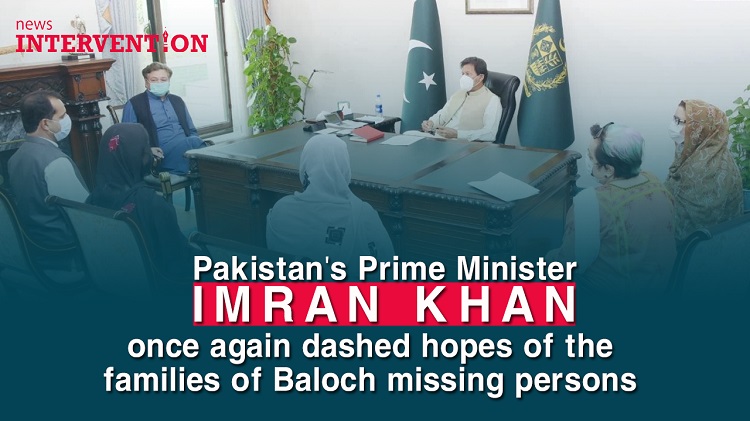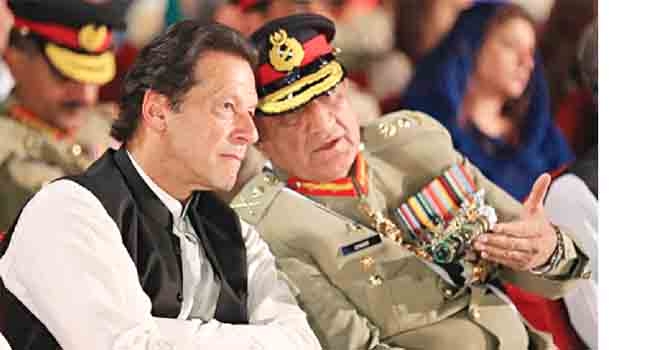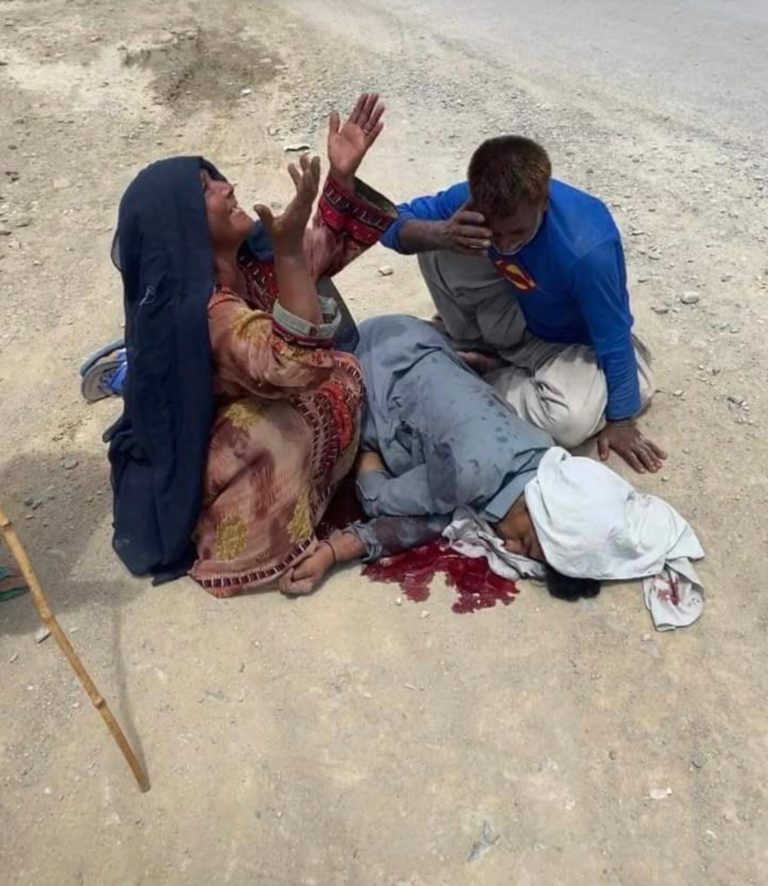
Pakistan’s Prime Minister Imran Khan continues with the policy of earlier Pak regimes to fool the family members of Baloch Missing Persons.
Watch this video report to understand the whole issue.
Pakistani regime continues to fool families of Baloch Missing Persons
Truth behind BLA attack on Pak Army’s Kotri Post in Balochistan
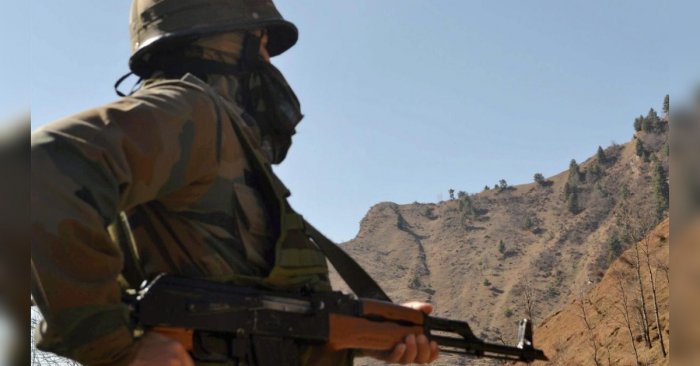
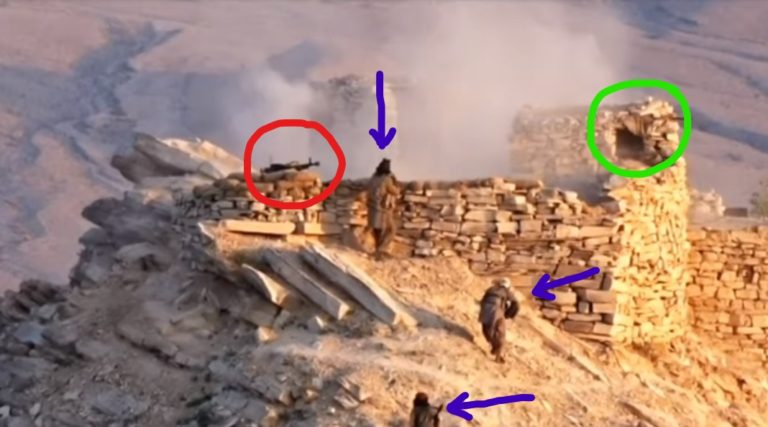
A recently published article [‘Inter Services Public Relations’ Not So Subtle Art Of Story Telling’, News Intervention, 17 March 12, 2021, convincingly exposed Pakistan Army’s media wing Inter Services Public Relations [ISPR] proclivity for peddling lies. The incident in question relates to a press release of 27 December, which mentions that the Frontier Corps [FC] post in Sharig, Harnai, Balochistan had been subjected to a “fire raid” the previous night in which seven Frontier Corps soldiers were killed while “repulsing raiding terrorists”. However, a video of this incident subsequently released by Baloch Liberation Army [BLA] reveals that this post was physically overrun by Baloch freedom fighters and many Pakistani soldiers could be seen abandoning the post after it came under attack.
In the last week of February, a few news portals published the news of Pakistan Army’s Kotri post in Kahan area of Balochistan being attacked by BLA freedom fighters. This news item was based on statement issued by BLA, [which took responsibility for this attack and shared information of the same], and ISPR’s inexplicable failure to reject this claim obviously raised suspicions. As there is no mention of this incident in ISPR’s official ‘Army Press Release Archive ascertaining veracity of this news became difficult because while on the one hand the BLA was making very specific claims, on the other hand, ISPR was maintaining a stoic silence.
However, since armies are considered to be the epitome of credibility, so it could be natural for many to assume that BLA spokesperson Jeeyand Baloch is making fantastic claims about their fighters “capturing the Kotri post entirely”, and that “seven Pakistani soldiers were killed and five wounded in the attack, while several personnel of the cowardly army dropped their weapons and fled”, as some kind of fabrication. Similarly, the Pakistan Army would like the world to believe that BLA spokesperson’s revelation that “seven Pakistani soldiers were killed and five wounded in the attack, while several personnel of the cowardly army dropped their weapons and fled,” is too farfetched.
So let’s first give the benefit of doubt to Pakistanis. Firstly, the Pakistanis would say that the very mention of a security force post being overrun by BLA sounds downrightly absurd. Secondly, they would claim that well-armed and trained soldiers protected by formidable field fortifications fleeing the scene on being attacked by a ragtag force of irregulars, seems ridiculous. Thirdly, they would point out that seven soldiers being killed in a single action during peacetime is no mundane occurrence. Hence, it’s inconceivable that Pakistan Army would be so inconsiderate to brush this humungous human tragedy under the carpet and thereby deprive fallen soldiers the honour and respect they rightly deserve. However, there’s also a flip side to this line of thought.
For a minute one may be tempted to think that BLA is guilty of exaggerating the number of casualties inflicted on Pakistani security forces, but it’s certainly not known for making out rightly fallacious claims. However, the same can’t be said about Pakistan Army because it has a proven history of delving in untruth ever since its very inception. After all, didn’t it try to pass-off army personnel as “tribals” during the 1947 invasion of Kashmir [Operation Gulmarg], as “razakars” (civil volunteers) during the 1965 war in Kashmir [Operation Gibraltar] and “mujahideen” during Kargil intrusions in 1999 [Operation Badr]? Is it not a fact that just in order to prevent loss of face, Rawalpindi went as far as disowning dead bodies of its soldiers killed during the 1999 Kargil war? So, to take the ISPR’s words [or even silence] on its face value, just because it is part and parcel of the army, would be a grave misnomer.
But even before the ink on the Sharig, Harnai post attack exposé could dry, BLA uploaded another video on social media on 13 March 2021, containing graphic details of a daring daylight attack on the Kotri post. Titled “Baloch Attack on Pakistan Army post, 7 Pakistan army casualty, Balochistan (BLA),”, it mentions the date of attack as 17 February 2021 and time, “about 5.15 PM.”
The Kotri post attack video, not only exposes ISPR’s obsession with falsehood but also reveals some very disturbing facets:
- 4.51 minutes into the video, a BLA fighter can be seen confidently walking right upto the protective stone wall of the post and after placing his rifle on the ground, taking out a grenade and pulling its pin. That this fighter [who being in the open is fully exposed] is in a perilously situation becomes evident at 5.01 minutes when a Pakistani soldier appears from behind the wall, just above the place where the BLA fighter is standing and starts firing. However, rather than running for safety, the BLA fighter maintains his composure and lobs the grenade at the soldier firing at the attackers.
- From 5.41 minutes onwards, BLA fighters can be seen swarming the post and at 5.49 minutes, a BLA fighter can be seen approaching a heavy machine gun, which despite being an extremely potent weapon to neutralise attackers, is surprisingly unmanned.
- Though BLA fighters can been seen firing and lobbing grenades, but from their confident body language and the calm demeanour, it appears that resistance offered by the soldiers in the post isn’t very effective, which is by any account, baffling.
Based on the vast extent and defensive layout of Kotri post as seen in the video, as well as the huge cache of weapons seized by BLA [nine Heckler & Koch G3 rifles, one Dragunov sniper rifle, one Rheinmetall MG 3 machine gun, one 81 mm mortar and one 12.7 mm heavy machine gun and even a type 63 rocket launcher whose 107 mm rocket has devasting effects], a conservative assessment is that this post was manned by atleast 20 soldiers.
So, with BLA claiming that seven soldiers were killed and five injured in the attack, eight soldiers [out of the 20 soldiers present in the post] remain unaccounted for, and this lends credence to BLA’s claim that “several personnel of the cowardly army dropped their weapons and fled”. In fact, overall lack of aggressiveness displayed by those present at the post [as evident from the video] could well be the result of the determined lot expectedly being demoralised after seeing their comrades abandon their battle stations and flee!
Videos of both the Harnai and Kotri post attacks [on December 26 and February 17 respectively] clearly establishes the fact that contrary to ISPR’s portrayal of them as cowards, Baloch fighters appear to be highly motivated and extremely courageous. On the other hand, a perceptible lack of aggressiveness on the part of Pakistani soldiers is evident from their reactions when attacked by Baloch fighters– a view that Rawalpindi may publicly reject but cannot afford to overlook.
ISPR may keep trying to obfuscate reality by claiming that Baloch fighters are working at the behest of India for pecuniary benefits. However, it can’t conceal the fact that it’s the Pakistan Army’s excesses in Balochistan that has motivated its people to retaliate in an attempt at self-preservation, even at grave risk to their lives and limbs. This is exactly what BLA has once again reiterated by saying, “Today, the way the occupying enemy [Pakistan Army] is burning houses and shelters of innocent Baloch citizens, making our mothers and sisters weep in the streets, is further increasing hatred against the enemy among our youths”!
Pak gambit to maintain disquiet across Indian subcontinent
Three countries of the Indian sub-continent — India, Pakistan, and Afghanistan —- are bogged with grim disquiet whose roots lie in the exclusivist beliefs of the Islamic State of Pakistan. After actively stoking the embers of theo-fascism for more than three decades, the Pakistani deep state finds that at the end of the day the flames are engulfing it.
Kashmir, the proverbial jugular vein of Pakistani rhetoric has now turned into her Achilles heel. But that is of her choosing and no external manipulation. For quite some time Pakistani Prime Minister has been talking of third party mediation, a tantrum of peace in the region and of bilateral talks with India.
Suddenly, Islamabad agreed to a ceasefire along the LoC in Jammu and Kashmir and the two DGMOs talked to each other on the hotline and agreed to restore the 2003 peace agreement from 25 February 2021 after the lapse of eighteen years. Losses in terms of human resource on both sides are extremely painful. Lt Governor Manoj Sinha has met with the Defence Minister in New Delhi on March 10 and told him that there was no violation of the ceasefire agreement ever since agreed upon on 25 February. The border people all along the ceasefire line have heaved a sigh of relief that they can return to their homes and attend to crop cultivation in their fields without the fear of being shelled and fired at. Hopefully, the same will be true of the people on the other side.
The question very frequently asked in political and academic circles is what can be the compulsions for Pakistan to have agreed to a ceasefire so abruptly? Given the objectives and the strategy of the GHQ and its agencies, the development is somewhat bizarre and unexpected. It, therefore, merits a dispassionate analysis.
Currently, Pakistan is obliged to fight on numerous fronts, financial being the crucial one. Distressed by escalating financial stringency and the burgeoning interest in loans borrowed from different sources, GHQ is eager to buy time to minimize the pressure. FATF will not let her off the hook and the Covid-19 is mercilessly devouring Pakistan’s limited resources.
Contrary to Pak’s expectations, President Biden hasn’t given any indication of disturbing the multi-faceted Indo-US cooperation process in which Indo-Pacific security arrangement remains a priority. Biden called the first summit of the Quad on 12 March and has spoken of “the importance that we (the US) place on close cooperation with our allies and partners in Indo-Pacific” wrote the Dawn of 12 March.
A few Democrat Congressmen whom Islamabad had cultivated to counterbalance pro-India lobbies have not proved effective in taking Pak out of the fire. Pakistan had some expectations that Washington would compliment her on what she considers her positive role in Afghanistan taking into view how Islamabad had successfully managed to bring the Afghan Taliban to the negotiating table in Doha. Islamabad’s disappointment is not only that the Biden administration has given cursory recognition to her self-styled “positive” role in Afghanistan but also it has dampened her resolve of fighting for the Kashmir cause indefinitely.
The cast-iron determination and stellar resolution with which India stood with an eyeball to eyeball stance against Chinese expansionist designs in Eastern Ladakh, and finally a negotiated resolution of the issue that made the Chinese forces dismantle their illegally raised camps and return to pre-conflict positions, has come as a big blow to Islamabad’s Kashmir utopia. It has opened their eyes to the military might of India. GHQ somehow began to believe in its lie that India was going to launch a blitzkrieg on PoK and Gilgit-Baltistan to redeem the pledge of India. That is why Pakistan had deployed missiles across its border with India.
Pakistan had raised the Kashmir mediation tantrum during the Trump administration. India had rejected it outright. Pakistan’s hope that Biden might reopen the subject and bring pressure on India has proved a damp squib. Rather the entire Kashmir narrative has taken a different direction. Moeed Yusuf, Imran Khan’s Security Advisor has been pressing into service his Washington clout for the resolution of the Kashmir tangle. He had visited India in 2015 and was reported to be silently carrying forward the Track II diplomacy.
Knowledgeable circles believe that Moeed Yusuf expects Pakistani leadership and the deep state both to be realistic and forget the utopia that it has built around Kashmir. Breaking the protocol of international diplomacy, Yusuf asked the media person whether a ceasefire along the LoC could come from a vacuum. Precisely such big decisions do not fall from the sky, he had added. It has now trickled down the columns of print media that Moeed Yusuf and his Indian counterpart Ajit Doval had met in a third country and talked at length on Kashmir and Indo-Pak relations. They would not do so without remote consultations and guidance from home governments.
The cryptic remarks by Ned Price, the spokesman of the State Department, and also what Yusuf told a press reporter, sum up how the Biden administration aims at a comprehensive outreach to the Kashmir issue. To the US think tanks, Kashmir terrorism and Afghan Taliban combat, both have roots in Pakistan’s jihadist ideology. The jihadist superstructure raised by Pakistan has become the main source of disruption of peace and normal life in the entire Indian sub-continent. That is the reason why both Price, US State Department spokesman and Moeed Yusuf, Security Advisor to the Pak Prime Minister stated in no ambiguous words that Pakistan has to put an end to cross-border infiltration, be it Afghanistan or Kashmir, and adheres to the universally accepted norms of good neighbourly relationship. It has also to be noted that both of them have hinted that after the ceasefire stabilizes, talks will be carried forward to address other aspects of the Kashmir issue so that a resolution to the satisfaction of the stakeholders is found.
Pakistan agreed to a ceasefire with definite purposes. The first is to monitor whether this goodwill gesture (ceasefire) will have a salutary impact on the Democrats in Washington and ultimately on the Biden administration. The second is that Pakistan would like to play the double game with China. Pakistan accepted ceasefire only after the Sino-Indian logjam in Ladakh ended. By doing so, she would want to convey a message to China that Pakistan will have to rethink her dependence on China in the areas of military and strategic planning. What has prompted Islamabad to bring in the China element is what the grapevine says about India and China engaged in a behind-the-curtain dialogue aimed at reducing border tensions and continue the dialogue for a lasting solution to the border dispute. Ladakh episode has forced Pakistan to concede the futility of solving the Kashmir issue through muscle power. The immediate impact of the ceasefire in Kashmir will be twofold: The funding sources will dry up faster and so will the manpower that sustained insurgency in Kashmir all these years.
In the wide-ranging strategic scenario summarized above, the Pakistan Army feels that a respite in firing and shelling along the LoC in J&K could become the prelude for its face-saving. At the same time, adhering to peace initiative in the sub-continent would convince Washington of Pakistan’s “honest” intentions about the return of peace in Afghanistan. Thus, if Pakistan is the epicentre of unrest and turmoil in the Indian sub-continent, there is no better chance for her than the one in hand to reconstruct her relations with her neighbours on the east and the west, and through that process begin a new chapter of relationship with the western and the Islamic world. That is the way how a disquiet Indian sub-continent will turn a new leaf in its contemporary history and become strategically crucial to intentional peace and tranquility.
Pakistan’s peace talk means a change in its war strategy against India
General Bajwa says India and Pakistan must live in peace and dialogue is the only way. In recent months this is the third time he has spoken of peace in the region. It sounds bizarre. Pakistan Army that initiated three wars with India with the fourth an ongoing proxy war believing that it has to inflict a thousand cuts on the body of India. And now Gen Bajwa wants to abandon war and seeks peace. Is this posture real or fake?
The Pakistani Prime Minister also speaks the same language. Pakistani press gives it wide coverage. The foreign press is excited about the “peace around the corner”. Even some Indian national papers exuded mirth over a prospect in which border dwellers along LoC (Line of Control) and IB (International Border) in J&K would return to their habitats and resume the normal activity of life without the fear of bullets being fired and shells dropped to destroy their homes and crops and cattle.
Peace idiom from the other side of the border has become repetitive. The behaviour is unprecedented and, therefore, merits in-depth analysis. Columnists have written copiously on how come Pakistan has agreed to a ceasefire after keeping it broken for nearly 17 years. The baseline of dealing with Pakistan is that for seven long decades Pakistani think tanks have brainwashed the masses so deep that they cannot think about India as anything other than a deadly enemy of Islam and Muslims. They are not told that the population of Muslims in India outnumbers those in Pakistan and how can India be an enemy of the Muslims or Islam?
The truth behind accepting ceasefire is that ISI is now convinced that it has fully established the base headquarter of Kashmir-centric Theo-fascist outfits in parts of the valley, particularly in South Kashmir where locals have been fully brainwashed and trained in hidden camps in deep recesses of forests. They have established a secure and dependable line of communication besides deep-rooted moles in the local population. They are regularly briefed on the location, movement and manoeuvring of the security forces’ communication facility whom they take on conveniently and of their choosing. They are provided with necessary logistics like food, night shelter, intelligence, roadmap, mobiles and communication facility etc.
The terrorists have spread out over other parts of the valley like Baramulla, Sopor, Uri, Rafiabad, Hamal, Handwara, Kupwara and the Shamsbari slopes and habitats. The ever-increasing number of OGW (over ground workers) shows that the insurgent movement has become widespread. Kashmir Valley leaders have been insisting on India-Pakistan talks but never even once appealed to the terrorists to lay down their arms and join the massive effort of reconstruction of Kashmir.
Both Imran Khan and Gen Bajwa have asserted that the initiative for peace in the region and Indo-Pak meltdown should come from India. This one sentence exposes their claim to peace and tranquility in the region. It is so strange that Pakistan, the country that launched a well-calculated attack on India in October 1947 wants India, the aggrieved country, to take the initiative. Again Pakistan, the country that launched Operation Topac in 1990, asks India to take the initiative. Surprisingly Pakistan, whose intelligence agencies have been instrumental in planning and implementing the so-called freedom movement in Kashmir and simultaneously subjecting the valley to massive ethnic cleansing should ask India to initiate peace talks.
Why does not General Bajwa tell the ringmasters of the world’s most dreaded terrorist organization stalwarts to disband their organizations, handover arms to security forces of Pakistan, dismantle their camps and return to their homes to run normal life and let the people of Pakistan, nay the entire sub-continent, live a life of peace and comfort? How can there be peace in the sub-continent as long as these cobras and scorpions lay hidden in the grass? Terror and peace talks don’t go together.
By accepting ceasefire along the LoC, Pakistan wants to convey a message to the international community and organizations, particularly the FATF (Financial Action Task Force) that she has taken a major step in curbing terrorist and radicalist funding. It will be noted that incidents of terrorist attacks in Kashmir are showing an upward graph. This is what suits Pakistan the most. Pakistan goes around the world propagating that she cannot be falsified in asserting that in Kashmir there is an indigenous freedom movement fought by the Kashmiris, and Pakistan has no hand in it. India can no more accuse Pakistan of sending jihadists clandestinely across the border under the cover of fire. Acceptance of ceasefire by Pakistan is clear and irrefutable proof that she has built up a very strong terrorist superstructure in the valley and has involved a large chunk of the local population in their designs. Unfortunately, this aspect has not been taken care of by the Indian policy planners when they decided to agree to the ceasefire along the LoC. Pakistan is very shrewdly making international capital out of it.
What is the way forward? This is the vital question we should deal with. Signing of ceasefire agreement whether by the DGMOs of the two sides or by seniors in the government on both sides is meaningless and untenable because it is nothing beyond eyewash. The hardcore jihadist outfits on Pakistani soil are intact. Scores of jihadist camps along the LoC remain fully functional. Radical jihadist leaders of these armed groups are enjoying the freedom of movement, speech and action. The army and ISI are not only in close liaison with them but are their patrons and prime fundraising agencies. And they never make a secret of the aims and objectives of their mission in which they are working in cahoots with known Theo-fascist movements like ISIS and the Islamic Caliphate, Islamic Brotherhood, Al Qaeda etc.
Peace in Kashmir means resolution of Kashmir issue. The issues are (a) restoration of PoK and Gilgit-Baltistan to India, the rightful country and, (b) homeland for the victims of ethnic cleansing in Kashmir valley.
India has been trapped in signing a ceasefire. It is now learnt from reliable sources that Turkey and her secret agencies have taken over from ISI the mission of Islamization and radicalization of Kashmir Valley. Indian intelligence agencies should issue a statement that exposes the full activities of Turkey in creating an anti-India atmosphere in Kashmir through a subtle mechanism in which the Turkish embassy in New Delhi is directly involved. The sooner these anti-India designs are exposed the better.
Lastly, India should convey to Islamabad in no ambiguous terms that ceasefire becomes sanctimonious only when the outfits of Theo-fascism in Pakistan are dismantled under international supervision and the most wanted terrorist leaders like Hafiz Saeed, Masood Azhar and Rahman Lakhvi are handed over to India where they will be prosecuted under Indian law for the crimes of genocide that they have not only committed but also accepted. If these conditions are not met, no guarantee of sticking to a fragile, uneven and unjust ceasefire can be given.
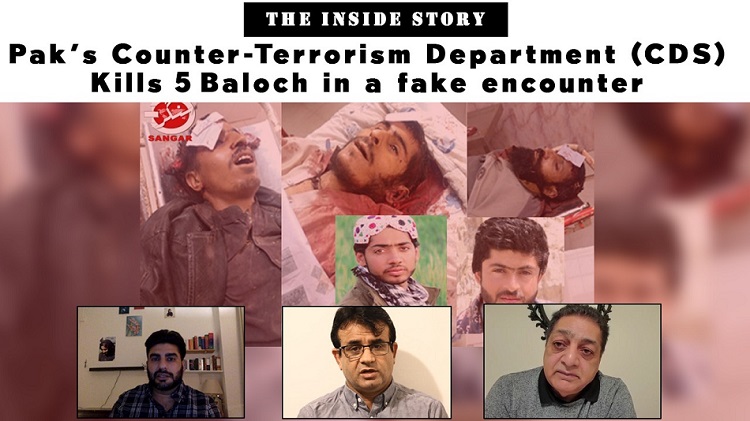
Why did Pak’s Counter-Terrorism Department (CTD) kill 5 Baloch youth in a fake encounter?
Pakistan’s Counter-Terrorism Department (CTD) killed 5 Baloch youth in a fake encounter in Balochistan. These hapless Baloch youth were already in the custody of Pakistani security forces for the last several weeks before their fake encounter. Their family members had already reported about the enforced disappearance and feared that the Baloch youth might be killed. Their fears turned true when the Counter-Terrorism Department (CTD) staged a fake encounter on March 7, 2021.
Click on the YouTube link below to watch our news analysis to know the inside story.
Why is the government silent on the big copper crisis?
Is there a genuine reason for India to shy away from the war of resource nationalism? The question is gaining grounds in Delhi where the government is routinely asked about its stand, or it’s peculiar silence, on copper.
What exactly is the crisis?
Goldman Sachs International has estimated that the prices will touch $10,000 a tonne by 2022, reported Bloomberg last December. The prices of refined copper could be in the range of $6,500-6,800 per tonne in FY2021 as compared to $5,923 in FY2020,
India, a major exporter of refined copper till a few years ago, is now a net importer. And it has been happening for almost three years at a stretch, right after one of the world’s largest copper plants in Tamil Nadu’s Thoothukudi operated by Vedanata was shut due to environmental concerns. In 2017-18, India was among the top five exporters of copper cathodes. Copper is as important as aluminium and steel because of its widespread use in sectors such as construction, telecommunications, transportation, consumer durables, and automobiles.
The plant was operated by Sterlite Copper, Vedanta’s subsidiary. It had a production capacity of 4 lakh tonnes. It was closed in May 2018 by the Tamil Nadu government after the state’s pollution control board demanded a shutdown following violent protests by locals living close to the plant that the plant posed a health hazard to those living close by.
Independent investigations done by journalists have proved otherwise. Only a handful of locals had breathing problems, a probe by a television channel revealed in 2018. The probe also found effluents released from the plant not impacting the sea waters as claimed by the locals, who were backed by a host of NGOs.
So what has been the outcome of the plant shutdown? There has been a huge, huge fall in India’s copper exports which has helped next door Pakistan. Islamabad, expectedly, has increased its exports to China. In short, it is a very bad signal for New Delhi and its copper economy.

Exasperated domestic copper manufacturers, it is reliably learnt, have petitioned the Ministry of Mines, seeking government’s immediate intervention to check the huge surge in copper prices in the country. In routine meetings with the bureaucrats, officials of these companies have highlighted how copper prices are now controlled by Chinese smelters, which have gained a solid grip on global supplies of copper concentrate and stocking up the metal.
The officials, it is reliably learnt, highlighted a host of things, the most crucial point being how important copper is for the nation. Copper is badly required for electric vehicles — India aspires to be a global manufacturing hub of electric vehicles — for superior battery efficiency. For the records, an electric vehicle uses 400 per cent more copper than a fossil fuel-run vehicle.
It is not immediately known how the ministry reacted. Till date, the government has not issued any notification relating to copper.
“Domestic copper industry has been operating at almost half of its capacity since the last two financial years due to closure of Vedanta’s 400 thousand tonnes copper smelter at Tuticorin,” said Care Ratings in an 18 February report. It added that India will continue to be a net importer of copper in FY21, pending the resumption of Vedanta’s copper smelting facility.
Copper is crucial for wiring, cable, transformers and power generation. In solar power alone, 5.5 tonnes of copper is needed per MW, for cabling, wiring and setting up heat exchangers. India’s electricity network will be due for upgradation because of rising electricity demand. And if India does not have enough copper, infrastructural developments will take a back seat.
How serious is the crisis for India? As per data available, nearly 43 percent of global copper production was consumed by China in 2019-20. A report by Care Ratings — issued in February 2021 — raised an interesting point. It says the following: “Chinese monopoly over copper is two pronged: firstly locking in long-term supply agreements to ensure its copper needs are met adequately, and secondly by leveraging high import levels to dictate the price at which copper is sourced globally.”
As a result, copper prices are shooting up in anticipation of increased demands, touching its highest point in nine years.
The comparison between India and China is all but obvious. Boosted by the rally of copper prices, most of Chinese mines kept high operating rates last year. Some of the mines, which had even suspended production for environmental, safety, or financing issues, recently resumed production.
In contrast, Indian copper manufacturers continue to grapple with increased dumping and low quality output saturating the market. India, for the first time in almost two decades has become a net importer of copper, New Delhi is importing more copper than export.
What is a very worrying factor is that the London Metal Exchange copper prices touched a nine year high in January 2021 to average $7,961 per tonne. The on-going concentrate supply issues and strong demand, particularly from China, is expected to keep copper prices elevated over the next quarter before the supply issues get resolved in 2021.
The recent Budget deepened the crisis by lowering tariffs on copper scrap, thereby allowing low quality copper to flood the market. New Delhi’s copper imports have touched an all-time high of ₹14,000 crore.
This is one side of the coin.
It stems from the burgeoning impact of Indo-Japan free trade agreement (FTA) on the domestic copper industry. Japanese copper manufacturers enjoy very low rates of interest due to the “Zero Interest Rate Policy” implemented by Tokyo. But Indian companies face some of the highest interest rates in comparison to other countries.
Now, due to the high value intrinsic in copper, interest costs for Indian smelters comprise a significant portion of their total cost and adversely impact the domestic industry’s overall competitiveness. Removal of tariff barriers under the current Indo-Japan CEPA (signed way back in 2011) have also opened a floodgate of imports which Indian industries are unable to compete with.
The current customs duty on refined copper products from Japan is 0.5 percent, significantly lower than that of the domestic industry’s basic raw material, i.e. copper concentrate, which attracts an import duty of 2.5 percent.
So let’s put this in a focussed context: Japan currently allows its copper manufacturers to import copper concentrate at no import duty, and the Indo-Japan CEPA allows these companies to then export the refined copper to India at a minimal 0.5 percent duty. The amount paid them as tax is therefore negligible. Contrast this with the 2.5 percent duty levied simply on importing copper concentrate by Indian manufacturers, and the dichotomy becomes apparent.
Now, this very inverted duty will progressively get worse when the duty under the treaty becomes zero by the year 2021. In 2019, the duty was levied at 0.9 percent, and has already come down to its current rate of 0.5 percent in 2020, and is heading towards 0 percent this April. There is a concessional custom duty on copper concentrate from Japan, but it is irrelevant as they do not produce the copper concentrate themselves and instead import it from other countries for refining.
As a result, there is a huge imbalance which is dealing a crippling blow to the domestic custom smelters as well as the downstream industries dependent on their products. As a result, domestic customers of refined copper are finding it cheaper to import the material rather than purchase it from domestic manufacturers. Copper imports will continue to rise on account of the gradual reduction of the import duty. In short, it spells a foreboding future for the domestic copper industry at a time when ensuring ample access to this metal is critical for improving technology and making economic progress.
But that is not happening and India could spend up to 30-35 percent more just to import the same level of refined copper it does today. And consequential effects on forex levels is going to be significant.
If the plant in Tamil Nadu was operational and production doubled, planned expansion and doubling of production capacity by Sterlite Copper had gone ahead, New Delhi would have been in a position to collectively bargain for improved copper prices. Three years have lapsed without any solution in sight from either the Central or the Tamil Nadu government. Sterlite Copper had a 400,000MT of annual copper production that could meet India’s needs for the next decade. Why not push environment protection protocols and open the plant?
India has all but given up control over copper, considered a powerful enabler metal. Everyone agrees that India needs to produce more copper.
Except, the government.
(The author was a part of a television crew which probed the alleged environment issues at the plant and conducted interviews with all the stakeholders. Everyone was on the record that the crisis at the plant was manageable and could have been easily rectified but blown out of proportion by a section of the protestors. Recently, demands are mounting on the Tamil Nadu government to open the plant. The matter is now in the Supreme Court.)
Pak Army’s desperation to save face after BLA attack
For public relations (PR) agencies, ‘dressing-up’ unpleasant news through a mix of euphemisms, emotional rhetoric and even a bit of white lies is understandable, but to mislead the public by grossly fudging facts is unpardonable, especially if this is done by a respected organisation like the army. However, Pakistan Army’s media wing Inter Services Public Relations (ISPR) has no qualms in blatantly peddling falsehoods, even though this has severely eroded its credibility. Where else in the world would you find an army’s media wing trying to justify enforced disappearances by using the irrational ‘All is fair in love and war’ logic
Through its press release [No PR-256/2020-ISPR, dated December 27, 2020], ISPR had once again treated us to yet another of its patent big-fat-lie. It reads, “Terrorists fire raid on Frontier Corps Balochistan post in Sharig, Harnai, Balochistan late last night. During intense exchange of fire, 7 brave soldiers embraced shahadat while repulsing raiding terrorists. Area has been cordoned off and escape routes have been blocked to apprehend fleeing miscreants. A large scale search and clearance operation is in progress. Such cowardly acts by inimical elements backed by anti state forces will not be allowed to sabotage hard earned peace and prosperity in Balochistan. Security forces are determined to thwart their nefarious designs at all costs [sic].”
From the contents of this press release, three important facts related to this attack emerge. One, it was a “fire raid,” implying that the assailants had targeted the post from a distance. Two, the firing took place during ‘late…night’ and three, that security personnel manning the post had succeeded in “repulsing [the] raiding terrorists”. So, since the attackers apparently didn’t have courage to come close to the checkpost due to the fear of getting killed and instead chose to carry out a “fire raid” and that too in the dead of night, ISPR has rightly called this attack a “cowardly act”.However, if the details of this incident as stated by ISPR are indeed true, then the fact that the Frontier Corps (FC) personnel within the checkpost suffered seven fatalities is rather intriguing for more than one reason.
Firstly, security forces establish check-posts at sites affording good visibility and natural defensibility, so that they can’t be surprised by attackers. Secondly, security check posts have a well-planned defensive perimeter interspersed with field fortifications that not only afford adequate protection to soldiers, but are so sited as to provide ‘interlocking fields of fire’ that ensure the entire frontage around the post and all approaches to it can be engaged by two or more weapon systems. Defiladed positions [areas providing protection from direct gunfire] are ‘covered’ by indirect fire through high trajectory weapons like rifle grenades and mortars. Thirdly, accuracy of direct firing weapons is inversely proportional to the distance between the firer and the target as well as prevailing visibility conditions. So, it’s virtually impossible for any attacker firing from long distance at night to inflict such heavy casualties to troops who were protected by field fortifications.
Hence, from the military point of view, Baloch freedom fighters succeeding in killing seven soldiers during a “fire raid” carried out in the dead of night is indeed a stupendous achievement, which even the best equipped and most professional armies in the world can’t boast of. This raises suspicions that there was something weird in ISPR’s narrative- a hunch was proved right by a video of this attack released by Baloch Liberation Army [BLA] on YouTube titled “Baloch fighters (BLA) capturing Pakistan Army base.11 Pakistan army soldiers killed,” last month. While viewing this video, the first thing that strikes the viewer is that this attack took place in broad daylight and not during ‘late night’ as is being claimed by ISPR. The second noticeable thing in the video is that the post being attacked is perched on a high ridgeline with a defensive wall all around as well as pill boxes and ‘crawl trenches’ to facilitate safe movement of soldiers from bunker to bunker when under attack.
The video shows BLA fighters moving in the open and exposing themselves to fire while closing-in with the post on a bright and sunny day, exposing ISPR’s lie that it was a “fire raid,” and 6:22 minutes into the tape, Frontier Corps soldiers can be seen abandoning the post one by one. How many did so isn’t clear but in the video, at least six Frontier Corps (FC) soldiers can be seen shamelessly running away and leaving their comrades to fend for themselves. Similarly, anyone who has been associated with the profession of arms cannot but admire the determination and valour exhibited by BLA fighters because those who have faced bullets know how perilous it is to engage in close combat with an opponent who has the dual advantage of being both well-armed and well entrenched!
With the video showing a large number of weapons and massive amount of ammunition seized by the BLA from the Harnai post, it’s clear that the FC post wasn’t overrun due to lack of wherewithal to thwart the BLA attack, but only because a large number of soldiers chose to desert it. So, it clearly emerges that rather that being a “fire raid”, which took place ‘late night’ and was ‘repulsed’ by FC personnel, [as the ISPR wants the world to believe], the truth as clearly revealed by the BLA video is that Harnai post was physically overrun by BLA fighters in broad daylight.
So, while this incident is definitely a “cowardly act”, (as mentioned by the ISPR), but after seeing this video it is amply clear as to which side is guilty of pusillanimous conduct! ISPR may claim that BLA fighters are an unprincipled lot, solely motivated to fight the establishment for money which Indian intelligence agency Research and Analysis Wing [R&AW] provides them. However, ask any neutral observer who has seen this video and you’ll be told that the phenomenal grit and determination displayed by BLA fighters indicates a very high level of unconditional dedication to a cause, which can’t be replicated by lucre of money. In fact, despite having all the possible military advantages, the fact that at least half a dozen FC soldiers’ chose to flee rather than fight reflects the moral ascendency Baloch fighters enjoy over security forces due to their superior motivation!
There can be no two views that Balochis are fighting for the legitimate cause against denial of the basic rights, excesses by security forces and exploitation of the region’s mineral resources. So, those who consider them to be ‘soldiers of fortune’, need to ask themselves a simple question-even though there are hundreds of mercenary groups in the world, but can anyone cite a parallel of cadres belonging to any such outfit putting the lives in line of fire in the determined way BLA fighters did by charging and capturing a well-fortified security force post in broad daylight?
Tailpiece: On April 5, 2019, the then DGISPR Maj Gen Asif Ghafoor had preceded his “Time for India to speak truth” tweet with the time-tested “truth always prevails” adage. So, will the present DGISPR care to spare some time and ponder upon his predecessor’s sagacious advice- or will ISPR continue to make a fool of itself by vending lies as hitherto fore?
Book Review: Terror in Islamabad
A brilliant book on real life incidents in Pakistan and why the nation should never be taken seriously when it says it is tackling terror.
Inside Pakistan, Inside Terror Land
Every time you walk into Pakistan, suspicion follows you like your shadow. There would, of course, be bonhomie, the usual banter, Biryani joints and the late night dancing soirees in the backstreets. Still, you will feel the heat.
And more so if you are an intelligence agent from India, an official of the Research and Analysis Wing (RAW). Terror in Islamabad from Harper Collins is a brilliant one penned by Amar Bhushan who worked with the Intelligence Bureau (IB), BSF Intelligence, State Special Branch and most importantly, in RAW for nearly a quarter of a century. And that he oversaw working in Islamabad is both crucial and important, ostensibly because he closely observed a nation that is mired in terrorism but on face, remains calm and says it has fought and eradicated the menace of terrorism from its soil by carrying out arrests, seizing property and freezing bank accounts of groups designated as terrorists by the United States and the United Nations.

But in reality, Islamabad routinely makes these announcements hoping it will help the nation get off a global blacklist for financing terrorism and money laundering. Bhushan knew all about Pakistan’s history of supporting militants. He also knew even if Pakistan were to be blacklisted, the country’s financial transactions would be subject to greater scrutiny, a move that could discourage investment and further isolate its struggling economy.
But like a leopard that doesn’t change its spots, Pakistan will not change its colours. Pakistan would continue to foment trouble in India (read Kashmir) and trigger tensions in other parts of India. The Trump administration pressured Pakistan to crack down on terrorism within its borders as US negotiators work to finalize a peace deal with the Taliban in Afghanistan that would pave the way for the withdrawal of thousands of American troops. That is something that happened recently, not when Amit Munshi, Bhushan’s protégé worked in that terror-prone country.
Barring a few cricket matches and some diplomatic conversations, India and Pakistan have never been on the same page, Munshi learnt it the day he walked into Pakistan, he knew he will have to handle people who do terrorism financing and money laundering as if they were buying milk for the household.
The book is gripping, it opens up the realities of Islamabad — the zone for plotting terror — and cities like Rawalpindi and Lahore, where each move of the government officials in Pakistan are superficial, where they openly blame Washington for overstating Pakistan’s role in encouraging the Taliban to strike attacks against US soldiers in next door Afghanistan.
Terror in Islamabad highlights Pakistan’s reputation at a time when the country was looking to the international community for loans and foreign investment. Bhushan narrates very grippingly how dangerous it is for an Indian operative to work in Pakistan where the counterintelligence forces keep everyone in the Indian embassy on the hotlist. During meetings, Indian diplomats tell their Pakistani counterparts that what India is looking for is for Pakistan to not only arrest militants, arrest their leaders, put the leaders on trial, but also shut down the entire infrastructure of these financing networks. Once the meetings are over, the Pakistani officials laugh their hearts out and get into their vehicles, some carrying stickers saying Crush India.
Bhushan narrates the fear of working in Pakistan, a land of scenic beauty and horrifying incidents of assassinations and blasts. I picked up some of the portions from the book which is already on the social media and worth reproducing here. So the book’s central character is a person named Amit Munshi who, actually, is Veer Singh. He is in the Indian High Commission as a cultural attaché but working for RAW.
Select excerpts from Terror in Islamabad
Amit Munshi figured in the Indian embassy’s diplomatic list as cultural attaché, but that was his cover job. He was actually an officer of India’s external intelligence agency and his real name was Veer Singh. Living a duplicitous life, he had been functioning in Pakistan overtly as an officer from the Ministry of Culture on deputation to the Ministry of External Affairs and covertly as an intelligence operative under an assumed name. The stress of carrying Amit Munshi’s guise proved at times unbearable, but he had managed to carry it flawlessly. In fact, within two months of his arrival in Islamabad, he began enjoying his interactions with artists from both India and Pakistan as well as his meetings with sources. He found it fun, playing hide-and-seek with watchers from Pakistan’s Inter-Services Intelligence (ISI), the Pakistan Intelligence Bureau and the Islamabad Capital Territory Police.
Amit, however, had one regret. He had to leave his wife Bhama and his kids in Delhi. There were times when he desperately longed for their company, especially when the pressure of work hemmed him in from all sides and he returned to his huge bungalow after a long day at the office, tired and forlorn. He also missed Bhama being at his side when he had to make social calls on prospective sources. But it did not take him long to realize that he had made a wise decision by not bringing her and the children to Islamabad, subjecting them to the hostility and the aggressive restrictions of the counterintelligence bullies on their movements. From day one, the counter-intelligence team had severely curtailed his liberty. He could neither leave the embassy unescorted by the surveillance team nor move around freely in the neighbourhood markets. Visiting shops to buy groceries was an unfailing pain, with watchers literally breathing down his neck, pushing and shoving him and elbowing him deliberately whenever he bent to pick up an item from a vendor or stopped to bargain with a shopkeeper. However, the static surveillance post that was stationed permanently in front of his house was a pleasant exception. Altaf, Akmal and Jehangir, who manned the post, never harassed him.
What kept Amit going despite the annoying surveillance was the appreciation he received regularly from Ambassador Vinay Suri and the Agency’s officers at the Delhi headquarters for his work. Moreover, his assignment was only for two years. By the time he finished even identifying potential Pakistanis for subversion, his tenure would end and he would be back with his wife, kids, friends and colleagues in Delhi, to be known once again as Veer Singh.
Now fully awake, Amit went to the kitchen to make tea. He opened the window facing the front gate and noticed, in the diffused glow of the street light that was continuously blinking, a car and a jeep belonging to the surveillance unit. They were parked outside his sprawling bungalow in Sector F-7, with their lights switched off. Since none of the street lights barring one had been working for the past twenty days, there was not enough light for him to make out whether Altaf, Akmal and Jehangir had left their post and were keeping their nightly vigil over the house from the vehicles or they had been replaced by a new set of watchers, who were perhaps more alert, unfriendly and aggressive. He wanted to find out because a contact in the Capital Territory Police had hinted last week that Amit could be subjected to more intense surveillance to confirm the ISI’s suspicion that he was an officer of the Agency. The source had further claimed that following the detention and interrogation of an ISI employee of the Pakistan high commission by the Intelligence Bureau in Delhi, ISI and other counterintelligence units had been instructed to step up their efforts to identify all Agency officers posted in the Indian embassy.
However, Amit had not observed any reinforcement of the surveillance around him until spotting the car and jeep this morning. Usually, a patrol car would come by every two or three hours and park briefly in front of his house during the night. Then, a few people would come out of the car to chit-chat with Altaf and his friends before leaving. Of late, even these visits had been discontinued.
Terror in Islamabad is a great read, it highlights why terrorists can’t be easily released after arrest and groups once shut down can easily be replaced by another group in Pakistan operating under a new name. And why Islamabad works under the thumb of the ISI, the all powerful body, and the Pakistan Army and why Pakistan is just not designed to dismantle complex terrorist networks.
For the records, Hafiz Saeed, the high-profile terrorist convicted by Pakistan, lived openly for years, despite the offer of $10 million from Washington. He was arrested only on the eve of Pakistani Prime Minister Imran Khan’s visit to the White House. And then, Ehsanullah Ehsan, a notorious Pakistani Taliban member with links to the attempted assassination of education activist Malala Yousafzai, escaped Pakistani custody. The book also highlights how ineffective the government’s response to terrorism in Pakistan is. The book is based on true events, so no one is cooking up any Hans Christian Andersen fairy tales here. A must read.
Pakistani regime kills 5 ‘Missing’ Baloch in fake encounter
Pakistan regime’s saga of fake encounters and target killing of innocent Baloch people continues unabated across occupied Balochistan. Almost every week there’s a news of targeted killing and forced abduction by the Pakistani security forces. Just last week the Pakistani security forces shot dead five Baloch citizens in a fake encounter.
Local reports within Balochistan say that all these five Baloch persons had been forcibly disappeared and were already in the custody of Pakistani security forces. Pakistani security forces then labelled these Baloch as members of armed, pro-independence organizations and then shot them dead in a fake encounter.
Baloch National Movement (BNM) confirmed this fake encounter in a media statement, saying that “…the Counter-Terrorism Department staged a fake encounter to liquidate the five Baloch nationals that were already under its custody.” Two of the five persons – Jameel Ahmad Pirkani and Sami Ullah Pirkani – were reportedly detained by the Eagle Force, a tactical attack unit of the Pakistani military, from Quetta in January this year. The Eagle Force blamed the two detainees for carrying grenades and handed them over to the CTD.
The other two were identified as cousins Yousaf Marri and Arif Marri. The former was reportedly detained while he was working in his fields at Sibi, and the latter was detained from the Hazar Ganji area of Quetta. The fifth individual was identified as Shah Nazar, another victim of enforced disappearance.
According to reports, the Pakistani security forces accused these five Baloch citizens of being members of an armed group and gunned them down in a “fake” encounter. And this is not a unique or isolated incident. A similar incident also occurred in Rajan Pur in August 2020, where the police killed five individuals in a staged confrontation claiming that they were members of a “pro-independence” group. The Baloch political groups subsequently repudiated the claims.
Another similar incident occurred in 2015 when two Baloch nationals were accused of being associates of a “pro-independence” organization, hastily indicted and then killed in a fake encounter.
The Baloch National Movement (BNM) said that this incident is a gruesome demonstration of Pakistan’s barbarity before the world. Pakistani forces have killed thousands of Baloch youth in similar incidents and then thrown their dead bodies in the wilderness.