Home Blog Page 338

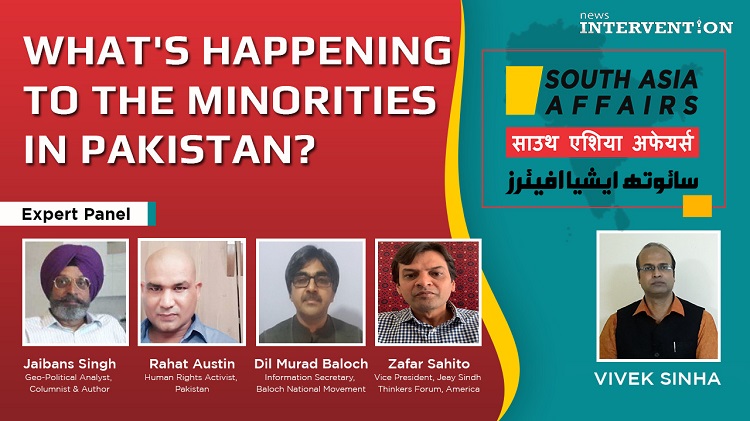
What’s happening to the minorities in Pakistan?

South Asia Affairs — the weekly news program on News Intervention.

In this first episode of South Asia Affairs, Vivek Sinha, Founder & Editor-in-Chief News Intervention is discussing about the minorities in Pakistan. The panelists include: Jaibans Singh, Geo-political Analyst, Author & Columnist Rahat Austin, Human Rights Activist, Pakistan Zafar Sahito, Vice President Jeay Sindh Thinkers Forum, America Dil Murad Baloch, Information Secretary, Baloch National Movement (BNM). Please click on the YouTube link below to watch.

Click on the YouTube link (above) to watch the 1st Episode of South Asia Affairs — “What’s happening to the Minorities in Pakistan?”


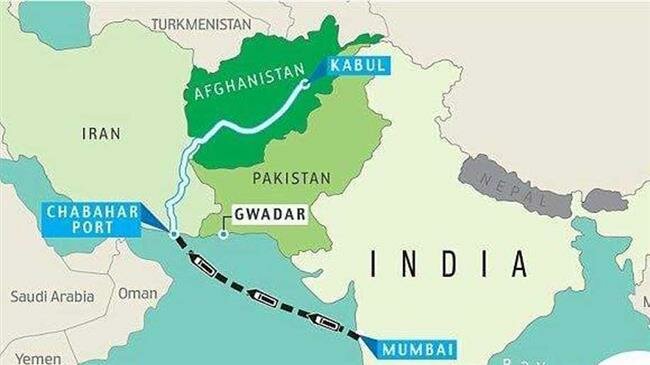
Iran’s insistence to involve Islamic Revolutionary Group firm at Chabahar has strained ties with India

Iran has not officially announced dropping of India from Chabahar’s three-fold project. The buzz emanating from The Hindu newspaper is actually attributed to two middle rank Iranian officers but not to any senior official spokespersons. Hence, till date the buzz remains only a quasi-official rumour.

Why should Iran think of punishing a third country (India) at its own cost for failure to mend fence with the US? If that is the parameter of Iranian policy then India will look for available option to meet her oil requirements. And if Iran is willing to embrace the dragon who is hanging a US$ 400 billion carrot to her for taking over Chabahar and the ancillaries, well, it is her choice.

For long years Iran has been tenaciously defending her sovereign right over the waters of the strategic Persian Gulf, which Arabs call Arabian Gulf. Ever since Iran-US spat in the aftermath of Iranian Islamic Revolution of 1979, Iran has raised her voice of protest whenever an American naval ship made even a casual appearance in Gulf area.

But now Iran is reportedly reconciling to the massive presence of Chinese navy at her doorstep. It will be a matter of concern for India no doubt given the Chinese hostility towards India but more than that Chinese naval presence will be of greater concern to the littoral states, which, by and large, are under the protective umbrella of the US. As such, Iran will be inviting the two strongest navies of the world to fight a decisive battle for winning control over the Gulf from where two-third of world’s oil requirement passes in gigantic tankers.

The real reason for India to soft paddle over Chabahar is neither the American pressure nor India’s delayed funding. In fact India has completed part one of the Chabahar project and wheat consignments for Afghanistan were also routed through it sometimes back. The real reason is that Tehran insisted on getting Khatam al-Anbiya Constructions, belonging to Iran’s Islamic Revolutionary Guard Corps involved in the project. New Delhi expressed its reluctance to expose its own entities to the US sanctions because US has designated the Revolutionary Guard Corps (Pasdaran) of Iran a terrorist organization. This has resulted in the deadlock. Even China has been cautious in getting in the crosshairs of American sanctions. The common sense is that India’s acceptance of participation of Khatam al-Anbiya would mean legitimizing the notorious Iranian terrorist organization involved in conflicts within and outside Iran. The focus of the US’ allegation that Iran is promoting terrorism is precisely the militant organization called Pasdaran-i-Inqilab (Revolutionary Guard Corps) whose commander Osman Suleimani was killed in a missile attack in Baghdad some months bank.  

India is known throughout the world as a country that is fighting terrorism in all its forms and manifestation. As such, India will never lend any kind of legitimacy to the Iranian militant organization which is fighting in some spots in West Asian conflict zones. No democratic country in the world will be prepared to make a compromise with Iran on that issue.

Another irritant in Indo-Iran relations is India’s good relationship with Israel. Iran has been openly declaring her ultimate aim of destroying Israel and restoring the land to Palestinians. This is more a propaganda stunt than any symbol of real politics. A dispassionate analysis of Iran’s animosity towards Israel shows that Iran wants to extract political mileage from an emotive issue which is devoid of a cognizable basis. Arab countries including Saudi Arabia have always avoided being harshly critical of the State of Israel, obviously for political reasons. Israel has strong support of the US Congress where the Jewish lobby is usually predominant. This is the main reason why Iran pretends to be anti-US. Iran wants to show down the Arabs asserting that it is only Iran that is trying to accomplish the scriptural commandment of destroying Israel. As such, Iran thinks she has a better claim to be the leader of the Muslim world and not the Saudis. This is the typical Iranian clerical mindset which, evidently, betrays neither pragmatism nor logic.

India has been strictly following the internationally acknowledged policy of non interference in the internal affairs of Iran. Not only that, India even tried to help mend fences between Iran and the US during Obama administration. But Iran, swayed by revolutionary fervor and assuming that she is ordained by divine dispensation to speak for “the oppressed” (mustaz’afeen), has been interfering in the internal affairs of India. For example, only some months back Supreme Iranian religious leader President Khamenei issued a statement on Kashmir in which he criticized the Indian government for what he called “mishandling” of Kashmir issue. Our foreign office had to summon the Iranian mission in-charge and hand over to him a note of protest. Iran has been covertly and overtly trying to play the role of godfather to the Indian Shia population and particularly the Shia community in Kargil, J&K. We are aware that anti-India sentiments are allowed to be vented even loudly at times in the course of an interaction between Indian Shia leadership and Iranian mission functionaries in India. Indian government did not take any preventive measures as she would not want to give any cause of unhappiness to Iran.

It will be noted that during several skirmishes between the Pakistan border force with Jundullah Sunni terrorist activists in the vanguard with the Iranian border force in Balochistan-Sistan border, India never spoke a word. But Iran has not been desisting from charging Indian security forces of “overdo” in Kashmir. Needless to remind that during India-Pakistan war of 1971, Iran had allowed Pakistani Air Force to take off from East Iranian airports with a mission of bombing Indian targets.

Chabahar and the two ancillary projects are of vital importance to India. By falling in the lap of the dragon, Iran is inviting concern of the stakeholders in the region. Iran is under the wrong notion that she has a strong navy to police the Gulf. With China in the driving seat, Iranian navy, whatever it is, will pale into insignificance and additionally other big navies will put up their presence in a strong way at the mouth of the Persian Gulf, the sea route from where two-third of the world oil requirement passes.

Iran’s dream for nuclear weapon has become her Achilles heel. Nobody denies her right to self-defence. But much before beginning a search for nuclear weapon Iran has been exporting Islamic revolution to some of the countries in the region. What is the agenda of Hamas and Hizbollah active in West Asia. What role is Iranian Pasdaran playing in Yemen, Bahrain, Syria and elsewhere? Iran may try to hide their activities but in modern technology nothing remains hidden. Osama bin Laden could be liquidated while in hiding and Osman Suleimani could be finished while travelling in a running vehicle.

Iran has three main targets against which she could think of using the nuclear bomb, the US, Saudi Arabia and Israel. Forget about the US and Israel. But before Iran decides to target Saudi Arabia, Pakistan will be forced to deter her. This is the understanding between the Saudi monarchy and Pakistan government. Iran thinks that she has won the confidence of Pakistan by writing off the Shia population of Pakistan that has become the recurring target of anti-Shia frenzy in Pak polity. Iran neither protests against the recurring massacre of the Pakistani Shia community nor demands a ban on Lashkar-e-Jhangvi, a terrorist organization of Pakistan with its declared agenda of destroying the Shias in Pakistan. Saner elements in Iran must revisit the nuclear policy of the theocratic regime. They need to be pragmatic and not emotional.

Finally, Iran the frontline non-Semitic Muslim state is a victim of split personality. No Muslim country denies her the right to be truly Islamic but no Muslim country will concede her the option of aspiring to be the leader of ummah. Even in the comity of non-Semitic Islamic nations, Iran does not enjoy the trust of other actors because of the history of factional feuds within the Islamic communities.

Indian foreign office is right in not making any comment on disquieting Indo-Iran relations. Iran is in deep turmoil and the voice of freedom is stifled in that country. Let Iranians first settle the score among themselves. Till then we need to wait and watch the saner voice prevailing in that country.

Indian Army’s Capture of Hajipir Pass is a Saga of Guts and Glory

0

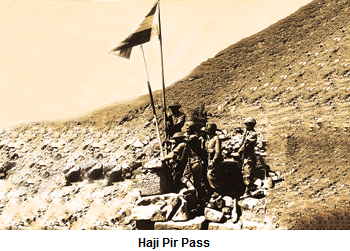
Much has been spoken and written about the capture of Hajipir Pass in Pakistan-occupied Kashmir (PoK) during the 1965 Indo-Pak conflict and rightly so, because this was indeed a stupendous victory that taught Pakistan Army a lesson on the grave consequences of messing up with the Indian armed forces. In fact, the Pakistan Army was so badly humiliated in this conflict that it was forced to change its narrative that this war being waged for “liberation” of Kashmir to an apologetic reasoning of it being necessitated for the “defence of Pakistan.”

The aim of Pakistan’s unprovoked aggression in 1965 was military dictator Gen Ayub Khan’s far-fetched belief that the Pakistan Army would be able “liberate” Kashmir by a three phased war plan. The initial stage included surreptitious infiltration of heavily armed soldiers into Kashmir disguised as ‘razakars’ (civilian volunteers). In the second phase, they would mingle with the locals and incite a resurrection by appealing to religious sentiments of the majority community. In the final phase, the infiltrators with help from locals would target Indian Army posts and destroy defence installations and cut-off lines of communications, thereby forcing Indian Army to leave Kashmir. 

Pakistan Army’s stratagem envisaged use of local population to camouflage its military actions to give it an impression of a local uprising and not an unprovoked aggression. It was (from purely the theoretical point of view), a brilliant plan. The fact that it was named ‘Operation Gibraltar’ in reference to the Islamic conquest of Spain that commenced from Gibraltar in medieval ages, gives an insight into Pakistan’s utterly misplaced sense of optimism. But when executed, it turned out to be a dismal failure and also a grim reminder of Santayana’s famous aphorism that “Those who cannot remember the past are condemned to repeat it.”

Pakistan Army’s war plan of 1965 was doomed to fail because it was in essence nothing but a shoddy ‘copy-paste’ of its earlier abortive attempt to annex Kashmir through a similar military action in 1947 that was code named ‘Operation Gulmarg’. The only variation between the two was that while Pakistan Army used the ‘tribal invasion’ ploy to conceal its 1947 involvement in Kashmir, in 1965, it unsuccessfully tried to disguise its military adventurism by trying to pass it off as a local uprising.

But while evolving its 1947 and 1965 war plan to annex Kashmir, Pakistan Army made two humongous mistakes. One, it grossly overestimated the capability of its own soldiers (which is evident from its inability to overwhelm the courage and tenacity of the Indian Army, both in 1947 as well as 1965); two, it went completely wrong by underestimating the nationalistic feelings of Kashmiris and the proof of this is evident from the refusal of locals to cooperate with the so-called ‘tribals’ in 1947 and ‘razakars’ in 1965 by revolting against their own motherland.

Since Hajipir Pass was the main route of infiltration that was being used by Pakistan Army to send its soldiers into Kashmir, Indian Army decided to capture it to block ingress. Located at an imposing altitude of more than 8,500 feet, this pass as well as the approaches leading to it were very well guarded by Pakistan Army units. Therefore, while the capture of this formidable pass in itself is an undoubtedly momentous military victory, this phenomenal achievement also bears testimony to Indian Army’s indomitable courage and exemplary tenacity, which on this occasion was aptly displayed by First Battalion, The Parachute Regiment (Punjab).

Commonly referred to as 1 Para, this battalion was part of 68 Infantry Brigade and was tasked to capture the forward enemy positions of Hajipir defences at Sank, Sawan Pathri and Lediwali Gali. Once these enemy positions were captured, another battalion would use the area secured by 1 Para to attack and capture Hajipir Pass. During war, while defenders are static and enjoy protection of field fortifications, the attackers have to perforce move in the open in order to close-in and either physically kill or evict the defender. Hence, troops in attacking role are much more vulnerable than the defenders and this is why they usually suffer more casualties than the latter.

The initial attack of 1 Para on Sank during the intervening night of 25/26 August 1965 was unsuccessful and resulted in 18 casualties. But rather than being demoralised, this reverse further reinforced the battalion’s determination to avenge its fallen comrades and so the very next night, 1 Para attacked Sank with such fury that convinced of complete annihilation, the enemy wisely chose to retreat. Giving the enemy no respite, the daredevils of 1 Para pressed on their attacks with full fury and captured both Sawan Pathri and Lediwali Gali.

After two nights of heavy fighting, 1 Para had achieved the task assigned and the exhausted rank and as per plans, the file of this battalion could well have rested on their laurels by staying put at the positions that had been captured. But, since enemy positions at Rustan and Badori were still holding out despite being attacked four times by other units, Major (later Lt Gen) Ranjit Singh Dayal, second-in-command of 1 Para volunteered to lead his troops and capture Hajipir Pass. 

With nothing but shakarparas (a food preparation made by frying sweetened wheat dough pieces in oil) and biscuits to sustain themselves, 1 Para moved speedily along Hyderabad nullah, but they were spotted and fired upon by the enemy. Yet, as the old saying goes that ‘fortune favours the brave’, help came to Major Dayal’s column from two rather unexpected quarters — nature and the enemy!

While an unexpected heavy shower obscured observation and hence rendered enemy firing on Maj Dayal’s column ineffective, during its approach march to Hajipir Pass, 1 Para came across a hut full of Pakistani soldiers. After disarming these soldiers, 1 Para ‘gainfully’ used them to ferry their battle loads uphill and this considerably speeded up their advance.

Needless to say, the sudden appearance of Indian soldiers took the enemy guarding Hajipir Pass by complete surprise and after a brief fight the enemy fled the scene in complete disorder. What is even more commendable is that the rank and file of 1 Para had pressed on continuously for three days, moving uphill across country under enemy fire and fighting him without any meaningful rest or proper food. 1 Para displayed nerves of steel and was rewarded by the honour of unfurling the Tricolour over Hajipir Pass — a defensive position which was considered so impregnable that the Pakistan Army even refused to acknowledge its loss till journalists visited the site and nailed Pakistan Army’s lie!

Tailpiece: India may have handed over Hajipir Pass to Pakistan under the Tashkent Agreement, but the Battle of Hajipir Pass shall continue to serve as a source of inspiration for the Indian Army and so, on the 55th anniversary of the capture of Hajipir Pass, let’s salute all those who fought and fell there!

China: Nursing a bloody nose and a terribly bruised ego

The Chinese leadership and its chief land mafia, the People’s Liberation Army (PLA) are presently nursing a bloody nose and a terribly bruised ego. Their belligerent plans in Eastern Ladakh have been demolished by the Indian Army that has proved its tactical and operational superiority. PLA stands exposed as being nothing more than a bully, full of bluster but totally shallow when push comes to shove.

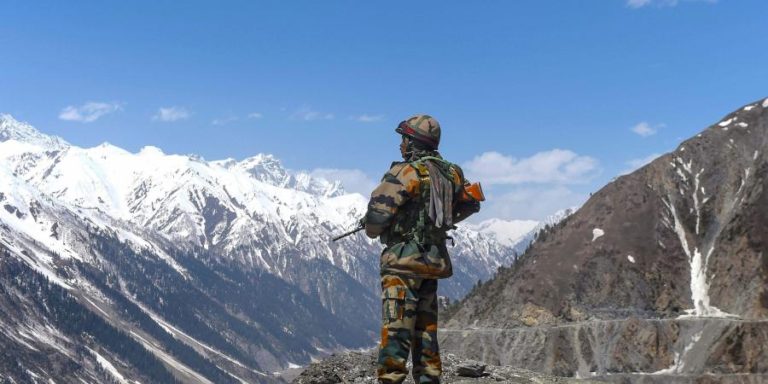
In the course of the last few days, China once again attempted to implement its, by now, outdated tactics of trying to grab territory by leveraging the inherent contradictions of a tenuous Line of Actual Control (LAC), under the shadow of ongoing talks. While speaking a conciliatory language, PLA attempted to intrude further across the perceived LAC in the Pangong Tso lake sector.

The Indian Chief of Defense Staff (CDS), General Bipin Rawat, a few days earlier had said, “If dialogue does not persuade Beijing to withdraw its troops from Indian territory in Ladakh, a military option remained on the table.” The Chinese may well have planned this latest and foiled intrusion as a reaction to the strong statement made by the CDS. A bully normally reacts in this manner  when he feels that his power is being challenged.

The Indian Army, this time round, had not only appreciated the Chinese perfidy but was well prepared for the same. It used a special force to gain dominating control of the mountain spurs along the southern tip of the Pangong Tso lake in a manner that has left the Chinese deployment totally vulnerable.

According to media reports, the present Indian position east of Chushul and along the southern tip of the Pangong Tso lake includes complete domination of the Thakung post and Renchin La located close to the Spanggur Gap. This position affords a clear view of the Chinese deployment in the sensitive Moldo area.

This feat has been accomplished by an elite unit of the Indo Tibetan Border Police (ITBP) called the Special Frontier Forces (SFF) or Force VIKAS. SFF comprises of troops from the Tibetan community in exile in India. The Chinese Army had deployed advanced cameras and surveillance equipment to monitor Indian movement; the SFF neutralised the sophisticated electronic equipment, removed it and occupied the heights.

This would probably be the first occasion that a VIKAS establishment has  been put into action for an operation of this magnitude since its raising in 1962. The resounding victory is a validation of both the training and high morale of the elite unit. The unit has, in the course of the operation, lost one soldier, Company Leader Myima Tenzin, who died a hero’s death while fighting for the cause of his occupied land of Tibet. The success achieved by the unit indicates the high operational value of this establishment.

Chinese despair and unrestrained anger at this absolute turning of the tables can be fathomed from its swift and vicious reaction in the information domain. The PLA Western Theater Command, which is responsible for the entire Sino-Indian border, has accused India of “illegally crossing the line.” “India has blatantly provoked and caused tension on the border and undermined the consensus reached at the diplomatic and military talks,” said the statement.

The Chinese Communist Party mouthpiece, Global Times, further adds, “India’s reckless intention is a very dangerous miscalculation. India should have a clear understanding that China is much stronger militarily than India. If New Delhi continues such provocative rhetoric, or launches large-scale attacks at the border region, it would face severe consequences.” The reality however, is that the PLA is so overwhelmed with the notion that India will not respond despite all provocation that it failed to appreciate the preparedness of the Indian Army and now it has egg on its face.

As is usual in Indian media circles, some so-called defense analysts and media houses preferred to downplay the strong move by India and instead dwelled on perceived Chinese consolidation in the northern side of the Pangong Tso Lake. They have specifically quoted occupation by China of two mountain peaks called Helmet Top and Black Top which they say facilitates “tracking of Indian movements across the Pangong lake and as far away as India’s tactically vital Chushul garrison.” One wonders as to what “tracking advantage” through physical line of sight China would require given its boast of having the best technology and satellite imagery for carrying out such tasks? Be that as it may, as this article is being written, there are reports of some Indian special troops having occupied dominating heights in the Northern side of the Pangong Tso Lake along Finger-4 also and hence, the Indian tactical advantage on ground is complete.

It is better, of course, to go with reports in foreign media. The UK-based daily, The Telegraph has stated, “on Saturday evening, around 500 Chinese troops had tried to cross into Spanggur, a narrow valley near the village of Chushul and three hours of hand-to-hand combat ensued. The attack had been repulsed and a retaliatory special operations battalion seized a Chinese camp in the surrounding hills of Pangong Tso Lake in the early hours of this morning.”

India too has acknowledged the incident. “On the night of 29/30 August, PLA troops violated the consensus arrived at during military and diplomatic engagements and carried out provocative military movements to change the status quo. Indian troops preempted this PLA activity….. and undertook measures to strengthen our positions and thwart Chinese intentions…,” said a statement from the Government of India.

Two Brigade Commander level meetings have been held to resolve the impasse but with no results. The India Army is scrupulously ensuring that the  status of the LAC remains sacrosanct and yet the Chinese are showing anger.  The PLA has been provoking the Indian troops all along the LAC with movement of vehicles and troops.  It is quite apparent that India has now chosen to pursue a proactive response to Chinese obduracy. This also reflects the impatience among the Indian soldiers to teach a lesson to the PLA. 

India has taken a stand that is righteous, justifiable and matched with more than adequate military strength on ground. Notwithstanding its bluster the Chinese military position in the region of conflict is not as strong as it wants the world to believe. In terms of manpower and weaponry both armies are evenly matched. The Indian Army has an huge advantage in terms of better tactical deployment, professionalism and most importantly the courage of the Indian soldier.  These are force multipliers that China simply cannot match.

China wants India to blink first, but, it is not feasible any more. As a result, the situation is escalating at the behest of China to a level that is very critical for world peace and stability. It is time for China to look closely at the writing on the wall and understand that it is not faced by a weak Indian political leadership or a weak Indian Army that would succumb to belligerent posturing. If it does not pursue the path of moderation, it will pay a very heavy price in the resultant conflict.

5 terrorists of Islamic State JK held in Kashmir

0

Srinagar/ September 4: Jammu and Kashmir Police on Friday said that they have arrested five “uncategorised” terrorists of Islamic State JK  (ISJK) who they said helped in the execution of Pandach terrorist attack in which two BSF personnel were killed in May this year.

The J&K Police said they have arrested five “uncategorized militants” of ISJK who helped in transporting, logistics, planning and executing the attack.

An FIR under sections 302 and 395 of the IPC, sections 7/25, 7/ 27 of the Arms Act, sections 16, 18, 19, 23 ULAP Act have been registered at Police Station Soura, Srinagar. “During further investigation, four vehicles were detained which includes two private ambulances functioning at the Srinagar Medical College, a motorbike and a scooty. Accordingly approval for seizure of the above vehicles was sought from the DGP JKP Dilbagh Singh,” the J&K Police said in a statement.

Ambulance used by the Islamic State JK terrorists in Kashmir. (Photo: News Intervention)

Following the approval from the DGP, both the vehicles were seized. “The ambulance, bearing registration number JK-01 AD 0915 was used to transport the militants from Bijbehara to Pandach, Srinagar. Bike no. JK-01 AH 2989 and Scooty bearing number JK-01 V 8288 were used to carry out the attack and escape after looting weapons from the injured jawans,” read the statement.

“Ambulance JK-01 AF 9417 was used to transport the militants back to Bijbehara from Srinagar.”

Categorized terrorists of the ISJK involved in the attack have been killed in two separate encounters at Zadibal, Srinagar and Hatigam, Bijbehara and looted weapons of BSF personnel have been recovered.

10 Baloch youth arrested 2 yrs ago from Noshki remain “Missing”

Ten “missing persons” who were arrested two years ago from Zangi Nawar, a picnic spot in Noshki district of occupied Balochistan remain missing even today and their whereabouts are unknown. As in the earlier cases of “missing persons” these ten Baloch youth were also arrested by the Pakistani security forces and their whereabouts are not known

This unfortunate incident occurred two years ago on August 31, 2018 when the Pakistani forces arrested Mir Ahmed Sami (son of Rehmatullah), Abdul Rab (son of Haji Abdul Majeed), Bilal Ahmed (son of Mir Ahmed Baloch), Abdul Rashid (son of Abdul Razzaq) and Muhammad Asif (son of Muhammad) and five other Baloch youth when they had gone to the picnic spot at Noshki in occupied Balochistan.

It may be recalled that arrest of two of these ten youth was reported a couple of days later from Hazar Ganji area of ​​Quetta by several Pakistani TV channels but no information was received about them later. On the same day, a young Nizam (son of Pir Muhammad Sasoli) was shot dead by the Pakistani security forces.

The relatives of all these abductees have been protesting in front of the Quetta Press Club in the camp of Voice for Baloch Missing Persons (VBMP) for release of their loved ones.

Recently, Bilal Ahmed’s family told in a press conference at Quetta that after his arrest, Bilal Ahmed was not handed over to the police and no FIR was lodged against him, nor was he produced in any court of law. While the Pakistani forces had confirmed his arrest and the news of the arrest was also published in the Daily Jung newspaper and pictures of other detainees including Bilal Ahmed in the custody of Pakistani forces also came to light but later no reference was made to them.

Bilal Ahmed’s family also told in the press conference said that after the arrest, Bilal was not transferred to a jail or produced in any court as per law.

Sami Baloch, another arrested youth was a social and political activist and people from different walks of life have been expressing concerns over his “enforced disappearance”.

During the last two years, Sami Baloch’s father had died along with his youngest daughter. Sami Baloch’s family members are in deep distress due to his enforced disappearance.

According to the VBMP, data of these persons has been collected and is being provided to national and international organizations. On August 31, 2020 the VBMP’s protest for the release of “missing persons” completed its 4,055 days in front of the Quetta Press Club.

Sindhi Baloch Forum protests against ‘Enforced Disappearances’ in Pakistan

London/ August 30: The representatives and supporters of Sindhi Baloch Forum held a protest demonstration on Sunday outside the Houses of Parliament in London to highlight the unresolved issues of “enforced disappearances” in Pakistan. The protesters who had gathered to voice their concerns on the occasion of International Day of the Victims of Enforced Disappearances provided disturbing accounts of victims of enforced disappearances in Sindh and Balochistan and of the various challenges faced by their families whom Pakistan’s judiciary has failed to offer any remedy.

According to Dr Hidayat Bhutto, a representative of the Sindhi Baloch Forum, the criminal practice of enforced disappearances by the military establishment of Pakistan has been employed against the Sindhi and Baloch political activists to contain their legal right to exercise their right to self-determination. 

“The enforced disappearances of Sindhi and Baloch nationalists is a routine practice in Pakistan. The security forces of Pakistan forcibly disappear the victims, often in the presence of eyewitnesses, and detain them incommunicado. They are not charged or tried in the court, instead, the military acting outside its constitutional ambit keeps them in detention for an indefinite period of time, and in most cases, torture the victims and dump their mutilated dead bodies in desolated areas to terrorize the entire population with impunity,” said Dr Bhutto.

The Protesters also chanted slogans against the practice of “enforced disappearances” and demanded the release of Baloch and Sindhi activists who have been subjected to enforced disappearance by the Pakistani military.

Philosophy of Economics Crash Course 9 – Finer Details of Discourse

0

Dr. Alexander X. Douglas‘s biography states: “I am a lecturer in philosophy in the School of Philosophical, Anthropological, and Film Studies at the University of St. Andrews. I am a historian of philosophy, interested in the philosophy of the human sciences, particularly from the early modern period. I am interested in theories of human reasoning, desire, choice, and social interaction – particularly work that questions the foundations of formal theories in logic and economics from a humanistic perspective. I am particularly interested in the thought of Benedict de Spinoza, which continues to inspire alternatives to the dominant paradigm in economics and social science. My first book, Spinoza and Dutch Cartesianism, proposed a new interpretation of Spinoza, situating him in the context of debates within the Dutch Cartesian tradition, over the status of philosophy and its relation to theology. I am completing a book manuscript, which aims to introduce and develop Spinoza’s theory of beatitude. This is the culmination of Spinoza’s theory of desire, since it describes the condition of ultimate satisfaction. Although Spinoza saw the revelation of true beatitude as the ultimate goal towards which his philosophy reached, there are few interpretative works devoted primarily to this theme. Spinoza’s theory of beatitude is, in my view, the keystone that holds together diverse parts of his philosophy – his theory of desire and the emotions, his metaphysics of time, his theory of human sociability, and his philosophy of religion. These are often studied separately; my introduction to beatitude aims at helping readers understand Spinoza’s philosophy as a unified whole. I have also published a book examining the concept of debt from the perspective of language, history, and political economy. I’m interested in the philosophy of macroeconomics, which receives considerably less attention from philosophers than microeconomics. I am a member of the Centre for Ethics, Philosophy, and Public Affairs, the Executive Committee of the Aristotelian Society, the Management Committee of the British Society for the History of Philosophy, and a Research Scholar at the Global Institute for Sustainable Policy.”

In this series, we discuss the philosophy of economics. For this session, we come back after some time with session 9 on finer details on the symptomatology of pseudoscience, “precision” in economics, the copying of the style of the sciences in economics without the content or character of the sciences truly, the idea of rationality or rational choice, assumptions about the applicability of mathematics to behaviours, and utility-maximization as an idea.

Scott Douglas Jacobsen: I decided to make some modifications to the series moving forward since the collapse of Conatus News and the reduced activity and the original recommendation from Dr. Stephen Law while acknowledging the due appreciation to the work in skepticism and humanism of Dr. Law and the recommendation for the collaboration with you. Now, with the transfer and renaming of the series to Philosophy of Economics Crash Course from Q&A on the Philosophy of Economics with Dr. Alexander Douglas, we have 8 parts in total, which, in a manner of speaking, provide a reasonable idea as to some of the boundaries and borders of the discipline of philosophy of economics. What I will aim with the educational series into the future is an appreciation of the finer details of the discipline and some of the radical notions inherent in its work, for example, part 8 examined how the term “pseudoeconomics” does not seem like a useful term at this time. You stated, “I don’t think ‘pseudoeconomics’ is a particularly useful category. To show why, let me say something about pseudoscience in general. Engaging in pseudoscience means aping the concepts and terminology of the sciences without taking on the critical methods that make them reliable. On this definition, to put it bluntly, much of economics is pseudoscience.” In the further analysis, you showed the advanced inclusion of and advancement of mathematics within the discipline of economics does not, by necessity, lead to more accurate predictive capacities of economics as a field. In fact, you make the painful comparison to Intelligence Design with reference to a particular leader in this theological field with “Michael Behe” based on “irrelevant probability equations,” as a “symptom of pseudoscience.” What are some other symptoms, the “finer details,” of economics leading to a symptomatology of pseudoscience?

Dr. Alexander Douglas: I think there is a lot of work going on in economics departments and think tanks that is useful and productive for society – especially empirical studies that simply gather useful data. It’s very helpful, for instance, to know how many people are really struggling to find work and why the headline unemployment figures are misleading in this regard. It’s useful to know how people in different economic categories are at different risks of illness and other problems. But this is, it seems to me, mostly research that anyone with a statistical background could carry out: medical researchers, for instance. I’m dubious about how connected that work really is with what a philosopher of science might call the ‘research programme’ of economics. The research programme involves using very complicated mathematical models to predict the outcomes of various social interventions, based on strong assumptions about human behaviour. These assumptions are either axiomatic: derived from a certain conception of rationality that then became encrusted within the discipline, or based on studies of people under clinical conditions, with probably no more relevance to behaviour in the real activities of human life. In any case, I’ve shared my reasons for believing that there’s no real way to scientifically test any of these assumptions, even in a clinical setting.

Jacobsen: You remarked on Alexander Rosenberg’s analysis of economics as ‘lacking predictive precision.’ What is defined as “precise” within the remit of economics? How does this definition of “precise” compare to other notions of precision seen in other fields, as a contrast justifying the aforementioned “lack of predictive precision” described by Rosenberg in 1994?

Douglas: Rosenberg’s book uses research by Leontieff from the 1980s, which showed that economists could at best only predict the direction of a trend: e.g., will the price of something go up or down following this change? Natural scientists can usually do much better: they can estimate how quickly something will change and how long the change will last. But that’s old research, of course. Noah Smith wrote a reply to a more recent piece by Rosenberg and Tyler Curtain, arguing that economics does have some predictive power. He gave two examples; one of them is as follows:

My favorite example is the story of Daniel McFadden and the BART. In 1972, San Francisco introduced a new train: the Bay Area Rapid Transit (BART). The authorities predicted that 15 percent of area commuters would use the system. But, using money from a grant provided by the National Science Foundation, University of California, Berkeley, economist McFadden and his team of researchers predicted that usage would be only 6.3 percent.

The actual number? 6.2 percent.

Of course it’s bad data science to infer too much from one or two examples. Also, from what I can tell McFadden’s more successful model basically took existing data and ran it through an algorithm to make predictions. His algorithm was described in economists’ terms: preferences, choice, utility, etc. But McFadden himself later pointed out that the algorithm is itself a ‘black box’: it doesn’t matter what it implies about human psychology or choice, it just needs to output the right results mathematically. So was his model really a success for economics, or just for applied mathematics? That’s to say, McFadden certainly chanced upon a good algorithm, but did the economic theory of preferences, utility-maximizing, and so on really help, or could a non-economist with a decent maths background have managed just as well? I’m not in a position to say, but I certainly don’t think Smith’s couple of examples are typical of the level of predictive precision found in economics, otherwise McFadden wouldn’t have got so famous for getting so close to the true value in this case.

Jacobsen: With the ‘copy of the style and not the substance’ of the sciences in economics, is this reflected in not only the inflated mathematical language and models but also the forms of verbiage or patois found within the field of economics?

Douglas: Yes, I think so, definitely. You might remember the outrage around White House advisor Kevin Hassett using the term ‘human capital stock’. People took him to be referring to workers, but ‘human capital’ generally refers to the skills and abilities of workers. Hassett was perhaps trying, in a hamfisted way, to make the point that those skills were spare capacity that had been laid aside and it was time to reactivate them. But you see these sorts of terms everywhere in valuation statements. Key financial decisions are made on the basis of these careful calculations of value, and finance people have to record everything as an asset: even goodwill is an asset with a numerical value. This makes the valuations seem so much more scientific and precise than they are: if you think a company should be more valuable than whatever you get by counting up the normal assets, you can always stick a bit more into the goodwill. So long as shareholders are willing to invest in the company at a certain value, that justifies the assignment of goodwill value, and, circularly, the full valuation including the goodwill assignment affects what people are willing to pay for the company.

The false precision is doing some crucial work here, and this terminology always originates in economic theories. Economics and finance amount to a sort of metaphysical theory: an ontology that divides the world into assets and liabilities with definite values to be estimated. The ordinary world as it appears to us doesn’t really fit into that model, so I do think this a sort of metaphysical theory that ‘cleans up’ reality to fit it into a form that allows capitalism to work. It’s different, I think, from a particle physicist’s model, which admittedly doesn’t match reality as it really is but is close enough to track some real phenomena. When a pension fund enters a valuation, people think it’s a valuation of the pension fund, not some abstract model of a pension fund.

Jacobsen: When speaking of utility, utility functions, utilitarianism, etc., there seems to be a premise of some objective trait of human nature assumed in the framework. As you note about Joan Robinson, does this seem to reflect a trend of superficiality, reification, circularity, and subjectivity within the fundamental concepts and lever points of economics? An attempt to grope towards the objective while lacking the “substance” to do such a maneuver.

Douglas: Yes, absolutely. Economists generally say these days that by ‘utility’ they only mean the maximization of preferences – people choose what they most prefer, given known constraints. And how do we know what they prefer? By observing their choices! At this level the theory is, of course, trivial: it tells you that people choose what they are observed to choose. But you can add some other assumptions about preferences: for instance, people’s preferences don’t change, so you can infer what they’ll choose from their previous choices. That gives you predictive power; it also strikes me as an obviously false psychological theory. Economists can only avoid having it falsified by adding so much noise into the environmental factors that any apparent change in preferences can by some subtle difference in the situation. I know that there is work, by Herbert Gintis and others, proposing that we might one day use evolutionary science to get better data on how people’s preferences actually form and change. It’s hard to judge that before any data has really been gathered. But I’ve explained in previous interviews why I think this might be misguided in any case: preferences range over objects under certain descriptions; the things that scientists – even evolutionary scientists – can study are only the objects. If I hold out an apple and an orange to you, are you choosing between an apple and an orange, or a red object and an orange object, or what is in your left hand and what is in your right hand, or what it is polite to take in China and what it is polite to take in the UK, or… I just don’t see how straightforward observation, even accompanied by evolutionary theory, can pin this down in a strong enough way to make good predictions.

Jacobsen: What is a “rational choice” or “rationality” in these aforementioned senses in economics with the apparency of pseudoscience built into it?

Douglas: Yes, rationality is just the name for the behavioural model that’s meant to output actions from choices. It’s pseudoscientific because it’s never been tested. It couldn’t be less like the Standard Model in particle physics, for instance. Anyway, the Standard Model is a model of things that really do seem to react fairly algorithmically to measurable changes. Human behaviour doesn’t even seem like that.

Economists are sometimes vague on whether they want us to accept their theory of rationality as an instrumental aid to prediction, a ‘black box’, as McFadden put it, which somehow outputs accurate predictions, or something that we really recognise as governing our behaviour. I find that the scholarly literature often presents it as a ‘black box’ whereas textbooks suggest that we really do think and act according to the economist’s definition of rationality. Itzhak Gilboa has a textbook in which he defines rationality in terms of choices that you wouldn’t be embarrassed to have made even if the reasoning behind them was explicitly explained. Technically this seems circular to me: you’d need to be rational, in the way described, to be embarrassed by reasoning that doesn’t follow that way. But I think it reveals something important: rationality, on the economist’s conception, seems to involve some normative element. Being rational is something to be proud of; being irrational is something to be ashamed of. There is a hint here of what Joan Robinson said many times: ostensibly scientific economics is often ideology in disguise.

Jacobsen: You stated, “Simply assuming that the results of a branch of applied mathematics have any relevance to the behaviour of a physical system – that’s pseudoscience rather than science. It has the outward elements of much modern science – mathematics and observation. But it fails to connect them together in the manner of a proper science.” Why do economists, very likely, consistently make these ‘assumptions’ about the application of a branch of mathematics to the “behaviour of a physical system”?

Douglas: Quite simply, the behaviour of physical systems can be predicted and therefore manipulated. It’s highly significant that Optimal Control Theory – a branch of mathematics developed to help engineers control physical systems – was reborn as a foundation of modern macroeconomics after it reached its limitations in physical engineering. Economists are largely funded by people who want their help in controlling human systems: to engineer certain social results for political purposes or for pure private gain. If economists conducted themselves like anthropologists I doubt they’d have the ear of politicians and businesses, and so they would lack their social standing.

Of course academic anthropology developed in the context of control as well: the colonial powers wanted to understand the peoples they colonized so as to better ‘manage’ them. But the disconnect between what anthropologists were learning and what those in power could use became apparent pretty quickly. Its approach to understanding human behaviour gave only a feeble promise of control. Economics, by contrast, promises something very appealing: it represents human reality as system of computations – agents solving mathematical optimization problems, computational units solving arbitrage equations – in short, a giant computer. Computers can be programmed by those who understand their operating systems, and that’s a very enticing promise to those who can afford the services of the programmers.

Jacobsen: Does this “utility-maximization” conceptualization of human behaviour simply fall apart because of the noted subjectivity of the concepts and the futile, unnecessary complexity and use of mathematics in its models?

Douglas: Yes, I think so. The theory is always trying to walk the tightrope between falsity and triviality. Economics textbooks often go for the ‘wow’ moment when introducing utility theory: ‘Here’s how your son picking a fight with your daughter can be explained in terms of utility-maximization!’ At first you’re impressed, then you start to wonder how a theory so consistent with everything we observe can really help with prediction. Humans seem to be capable of just about anything, so if utility theory explains everything they do then it can hardly help us to know which of the many things they can do they will do.

Jacobsen: Dr. Douglas, thanks for your time today.

Douglas: Thank you, again – always a pleasure.

Previous sessions:

Philosophy of Economics Crash Course 1

Philosophy of Economics Crash Course 2

Philosophy of Economics Crash Course 3

Philosophy of Economics Crash Course 4

Philosophy of Economics Crash Course 5

Philosophy of Economics Crash Course 6

Philosophy of Economics Crash Course 7

Philosophy of Economics Crash Course 8


Indian Army busts terror hideouts near LOC in north Kashmir

1

Srinagar/ August 30: The Indian Army busted multiple terrorist hideouts along the LOC in north Kashmir’s Baramulla district on Tuesday and recovered huge cache of arms that were meant to be delivered to other terrorists. Defence spokesman in Srinagar Rajesh Kalia said that the alert Indian troops detected movement of suspicious persons along the Line of Control (LOC) in Rampur Sector, Baramulla district on August 30 and then took necessary action.

“The movement was from a village close to the Line of Control and the suspects crossed into Indian territory. Due to terrain of thick foliage and weather condition an alert of likely infiltration attempt was sounded,” said Colonel Rajesh Kalia, adding that “…the Surveillance Grid was beefed up all across the area and along the likely infiltration routes; ambushes were sighted to thwart any attempt of infiltration. Surveillance continued throughout the night.” He said that subsequently, next morning at around 5 AM a search of the area was carried out.

Terrorist hideouts (encircled) near LOC at Baramulla, north Kashmir. (Photo: News Intervention)

“After extensive search of seven hours, a huge cache of arms and ammunition were recovered from well concealed locations in two hideouts in Rampur Sector (of Uri area of Baramulla. “The cache of arms recovered comprises of five AK Series Rifles (along with six magazines and two sealed boxes with 1,254 rounds of AK ammunition), six pistols (with nine magazines and six rounds), twenty one grenades, two UBGL grenades and two Kenwood Radio sets with one antenna,” said the Defence spokesman.

Terrorist hideout near LOC at Baramulla, north Kashmir. (Photo: News Intervention)

He further added that the area has villages ahead of the anti-infiltration fence. “The suspected modus operandi is to drop war like stores in caches near the Line of Control, subsequently OGWs (Over Ground Workers) or terrorists would pick the same for further transportation into the hinterland for militant activities,” said Colonel, adding that “…as reported earlier, similar attempts were made on July 22, 2020 when inputs were received regarding likely weapons drop along the Line of Control ahead of the anti-infiltration fence. During the search operation along the Line of Control in Rampur Sector, Baramulla, 1 AKS-74U with magazines, 5 pistols (one with Chinese markings) and magazines, 24 grenades and other warlike stores were recovered.”

Arms and ammunition recovered by the Indian Army from terrorist hideout near LOC at Baramulla. (Photo: News Intervention)

The Army spokesman said that the modus operandi shows desperate attempts by Pakistan-based terrorist groups to infiltrate weapons into J&K for terror activities, with active connivance of Pakistan Army. “Robust surveillance and Line of Control domination activities will continue to deny all such misadventures,” the defence spokesman said.

Grenades and explosives recovered by the Indian Army near LOC at Baramulla. (Photo: News Intervention)

Pastor Bob Cottrill on Christianity, Faith, and Intuition

0

Pastor Bob Cottrill is the Pastor at Port Kells Church in Surrey, British Columbia, Canada. Here we talk about the Christian faith.

Scott Douglas Jacobsen: What is your family background?

Pastor Bob Cottrill: My folks were working class folks from British background. It was 100% Caucasian. I, often, think about the elementary school that I grew up in, which was about 500 kids with only a couple Japanese students or students of Japanese ancestry. The interesting thing, my sister stayed in the community, in the suburb of Toronto. When the children went through the same school a generation later. It was 80% ethnic. People from South Asia. People from Africa. It is so interesting how the face of Canada has changed. Their experience, completely different from mine. We were completely isolated from the world, this bubble. My parents and the social structures that we were involved were very closed, Christian, conservative. I would even say, perhaps, fundamentalist. In this sense, the narrative that we experienced was probably more connected to a North American narrative of the 40s and 50s, of fundamentalist, isolationist view. Our particular read of the King James Version of the Bible was the only historical one given by Jesus and the Apostles. Everyone from Catholicism through to liberal Christianity, even elements of Evangelical movement. These were all aberrant expressions, but the true Christian faith was held by our small little church. One of the really informative moments for me. It was in high school.

There was a Christian club [Laughing]. I went to it. At the club, I met these other students from my high school. I thought I was the only other Christian in the high school. I met a guy on the hockey team, musicians. These were just normal kids who were experiencing and living out Christian faith in their life, in a real and vibrant way. We weren’t alone. I thought that we were huddled in the basement. I went back to my church, of course, of 80 or 100 people, who held this fundamentalist view. I thought, “Wow! Wait until they hear this, other Christian people.” [Laughing] I was very naïve, as you can tell. They weren’t impressed at all. When I graduated from school, I looked for an opportunity to broaden my experience of people who were wrestling with and living out the Christian experience. This idea of integrating the reality of God and Jesus with culture and relationships in this world. I asked my high school counsellor, “I would like to go to a Christian university.” He said, “That doesn’t exist in Canada. You can’t go to the U.S. because it is too complicated.” A couple of weeks later in Grade 12, he saw me in the halls. He said, “Hey! Are you the kid who was asking about Christian universities?” I said, “Yes.” He said, “I got this package of information about this place in B.C. I was about o throw it out, but then I thought of you.”

It was a formative time for me. I got exposure to people from across the culture and around the world who came from societal and denominational different structures, but had the common idea of God at work in culture and in society. The ethos and presence of Jesus were real. It really expanded my mind. I left behind a lot of the confines that I grew up with. I am blathering on. Does this give an inkling? [Laughing]

Jacobsen: Yes, your time at Trinity Western University. Your degree, what was it? Were there further studies?

Cottrill: I enrolled in Business Studies. A lot of my original intent in coming to university as a young person was more social than it was educational. So, when I enrolled in Business Studies, it was a lot of interaction. I enjoyed it. I think somewhere along the way. I thought about being an accountant. It seemed like a good career. I did all my accounting studies. I graduated with a degree in Business Administration. When I first graduated, I pursued some business interests for about 3 or 4 years. My heart drew me into more traditional pastoral work. Because I think I have always been committed to community, to relationships, to understanding the experience of God and values and a deep love of that whole experience. So, inadvertently, I was drawn to that. It wasn’t intentional. Certainly, I never had that intention through early education. I graduated and worked in the business world for 4 or 5 years. I was very involved in volunteer work through church and youth work. A church leader challenged me with an opportunity. So, I enrolled in seminary. I took a full-time position at a church as a pastoral leader, eventually. I have been doing that for 30 years or more.

Jacobsen: Same church?

Cottrill: No, I served for 7 or 8 years as a youth pastor at one church, providing leadership to high school students. Then I was, for 5 years, serving as a pastor in a Mennonite church in Mission. Even though, I have no cultural background with the Mennonite. I served as an associated pastor at a number of larger churches overseeing public services. For the past 4 years, I have been back here at Port Kells Church, which is a non-denominational, independent church. It has been in the community since 1888. Interesting story, it started in 1888 on 88th avenue, not far from where it is now. It was Methodist settlers who came to participate in the founding of Port Kells, which was originally meant to rival Vancouver as a seaport. I think in about the early 1900s, after about a decade or two; they constructed a building that was right by the corner of where 176th street meets the freeway. You know the historic schoolhouse there. They met there and built a church there, which they eventually disassembled and moved to the corner of Harvey Rd. and 88th Ave.

Eventually, in 1941, someone gave them a piece of property. They put it in rollers and rolled it down the street.

Jacobsen: [Laughing].

Cottrill: That particular structure burned down years ago, but it has been rebuilt. We are on the same property. Like many Methodists, in 1925, the Methodists, Presbyterians, and Congregationalists rolled together to become the United Church. The Port Kells Church was part of that, until about 1985 when, in the face of changing politics and direction, a number of churches departed the United Church. Port Kells Church being one of them. For a while, it was part of a group that left the Congregational Church of Canada. That partnership has fragmented a bit. The churches didn’t have a lot in common. Many departed for theology. Others were traditionalists and didn’t like new things. Others were mad about other stuff. It was hard to build a coalition. It is diminished, but still exists. The Port Kells Church hasn’t participated in that for many years. It is a rally independent church and holds to a historic Christian understanding of faith. So, there we are; a little country church right in the heart of Surrey that has been there since 1888.

Jacobsen: When you’re there since 2016, what are you seeing in terms of some of the differences between non-denominational church service and your example of pastoring to youth, or in a Mennonite context?

Cottrill: There are fewer differences among denominational churches. There are some broad differences. Liturgical type churches, Catholic, Anglican churches, some Presbyterian, Lutheran, churches, they would share a lot more in common in terms of the life of the congregation than evangelical or charismatic churches regardless of the name on the door. They would have a similar experience of congregational life. So, our particular church experience, of our congregation, is more connected with an Evangelical or Charismatic, or independent, thing. If you were to move from here in B.C. from a Baptist to a Mennonite to a Non-Denominational to an Alliance church, many of the big flagship churches or even some of the little ones. The differences would be more about the size and proficiency of the people leading it, as opposed to the ethics or the intent of it. There’s been a real breaking down of a lot of barriers. You notice the newest churches do not have a non-denominational label. It may be in the fine print, maybe on a back page, or in one of the dusty corners of the pastor’s mind. But, as far as the people in the pews, there’s a real uniformity to most of the Evangelical churches or the non-liturgical churches.

Jacobsen: A lot of online resources exist online for modern Christians, especially young singles and couples. So, I do note when watching some of these. There will be the presentation. But before that, stating, “Don’t forget, this is only supplementary to the church that you’re with, stay plugged in with your local church and your local pastor.” Do some of your congregation take advantage of some of these resources?

Cottrill: That’s a good question. I don’t really know. For about 13 years, I was part of a megachurch, as you would call here in Canada. It would get 2,000 a week in multiple services. We had a radio show. You have people coming to take advantage of your resources. We realized along the way. The people who attended on a weekly basis also belonged to a small church, committed to the small church, but would chime up. It may be a thing. I’m not sure it is a particularly healthy or helpful model. A lot of the value of having churches is that it is a community; it is a family; it is a commitment. It is people who walk alongside you and love you, and work together with you, even when you’re not doing well. Even in the kind of relationship people have with an online resource, an online church, it is, essentially, in the end, artificial. It is like watching porn. You don’t have a relationship; they’re not going to be there in the morning. An online church thing may be all airbrushed. They may be incredibly talented. They may be right and smarter than your local teacher or leader, but they are not going to be there when you are in a crisis. In the end, I think it is an artificial relationship. A couple of years ago, I had a medical issue. I looked online. I figured, “I am done for.” My doctor said, “No, it’s really nothing. Go buy this over the counter thing, you’ll be good in a couple of days.” He was right. We had the same information. But my doctor had the information and knew my need, environment, symptoms, and was able to make sense of that in a way that I can’t. It is not just restricted to Christian belief but applicable to all elements of life. There is this artificial element to information technology, which I think is leading people astray. In the same way, I am very committed to educated in a structured environment. Essentially, you could probably build a nuclear bomb based on information that you find in the internet, in theory. Nobody is because there’s something about the structure. That’s a terrible example [Laughing]. There’s something about the structure of caring, mentoring, and personalizing and understanding people that can’t be done online.

Jacobsen: It sounds like taking into account human beings are living organisms and the brain is a part of the living organism and requires an environment built around it.

Cottrill: I think it is more than it is a living organism.Although, that is one way of expressing it. There is something more to being human. There is this element of consciousness. Maybe, it is the image of God. There is this social aspect, which is, maybe, more important than facts.

Jacobsen: Take some of the comments of some Christian educators, they will not focus on the education alone, but on a level above. The education as a means by which to inculcate virtuous ideas, and virtuous habits, to then have virtue. It is a character form of education rather than knowledge-based education.

Cottrill: As you said, holding out this idea that there’s virtue, there’s morality. There are universal values that transcend just facts and figures. It is, again, an indication of believing that there is something bigger in the universe. This is really outdated. When I went to Trinity Western University, one of their bylines was ‘Turning out fully developed students’ or something.

Jacobsen: How vague is that?

Cottrill: I know. There was this idea not just educated students. It was this idea of students who maturity and development in all aspects of life, whether a spiritual element, emotional growth, as well as academic. I think one of the big challenges coming full circle again to what you began the question with; the kind of relationship that you have with information technology is not real. It is information, but it is not relational. I think the churches. I think of even little church like mine, 100 people. It is a community; it is a family. Together, we experience the hurts and the successes. We experience the presence of God in the community. As part of that, it impacts us, as people.

Jacobsen: How are you differentiating community, family, as terms?

Cottrill: I am seeing them as descriptive terms to describe the types of relationships that we have. We are like an extended family. As with family, we have people who are sometimes not happy, who are introverted, who find it difficult to participate as fully. It is people who are connected.

Jacobsen: What are some of the difficulties in church life?

Cottrill: Difficulties in church life are people, who are people. You have people who struggle with emotional crises. You have people who struggle with mental issues. You have a lot of different views on peripheral issues. Politics is a great example. I know for a lot of Americans. Coming through the Christmas season and Thanksgiving, you will see a lot of news feeds, “How to talk politics at the Thanksgiving table?”

Jacobsen: [Laughing].

Cottrill: We have a lot of the same things. There are a lot of ways to thoroughly address Christian issues in society. I am one person who believes how to deal with economic issues is trickle-down economics is through wealth redistribution. Others say the government should intrude. I may personal favour one or the other, but those views have integrity in and of themselves. It is the same in a dinner table chat or a church environment. Like any social structure, we have to work through those challenges. So, those are some of the challenges that we face. Also, I think a big issue for a lot of churches in the Lower Mainland is the cost of real estate. We have been in the same place in 1941 and the church structure was built well and a lot by volunteers, which has given us a leg up on a lot of folks. It is still a leg up to pay staff in the community. There are other pressures as well.

Jacobsen: What brings individuals and families to church?

Cottrill: There are probably a couple of different reasons. I think would like you to think it is a deep need to connect with their Creator with this internal spiritual need. I’ll come back to that. Realistically, I think people want community, are lonely, have social expectations still. So, there’s some of that. But I would say that for an awful lot of folks. The things that keep them there are that many people, and I say this from my own experience, have this compelling sense, intuitive sense even; we try to rationalize and justify it, and rightfully so. The intuitive core of a lot of people – and I don’t know if I can say it is universal, but this sense of there being more to life than what we see on the surface. That communities and resources like churches explore the whole idea. It gives a framework to try and understand not just power here, and not just what we’re needing today, but why we are here. Why we exist? Why we have a consciousness going beyond instinctual reactions to what we do? It is this sense that there’s something more. We’re trying to make sense of it. Churches and Christians in particular feel that the best explanation or the explanation, perhaps, is that there is a Creator behind this; that there is a presence behind this beyond molecules, which is out there. We understand it as being a god. It is not only a presence, but a benevolent presence and a personal presence. Our expressions of worship and community and study are in trying to make sense of it, making connections, with that part of us, which calls us out. It is almost cliché now. Augustine or someone talked about this missing part of our heart. I think it is attributed to Luther along the way, a God-shaped hole. This idea that intuitively we want something more and strive for it. Communally, we work towards that. Of course, we find structure and whatever through Scripture, through mystery and tradition and understandings of theology. But I think the whole thing is driven in the first place – and we can’t make people come, in our culture at least – that we are more than just molecules. That’s, at least, what I attribute it to.

Jacobsen: When we are having the different types of theology on the ground in pastoral life, how does this tie into the trainings. You were at Regent College. Who were prominent people who taught you?

Cottrill: I took courses with Dr. Alistair McGrath. Someone who I deeply admire. It sounds as if I am overwhelmed by his knowledge of things. It was really a profound thing to study under him and realize. It is not just him. It is the whole tradition of deeply understanding and wrestling with and committing yourself to understand a topic. Another professor who I had was Eugene Peterson, who is known in Evangelical circles for his translation of the Bible called The Message. It is a particular translation of the entire Bible from original languages. He passed away, recently. He was a Presbyterian, I believe, who has been uniquely influential in Evangelical circles. I found them very inspiring for different reasons. Regent seminary at UBC is a very inspiring place, actually. I didn’t graduate from there. I graduated from Trinity Western Seminary, even though I went to Regent. It is part of the ACTS consortium of seminaries, which are 3 to 5 Evangelical denominations that share some facilities, even share some classroom space and courses together on the campus of Trinity Western University. I graduated with a Master of Theological Studies in 1996.

Jacobsen: As you’re working at Port Kells Church, which is non-denominational, and as you’re graduating from the ACTS consortium of seminaries in 1996, what is the orientation when you have the Evangelical ACTS consortium training, in terms of seminary, and then translating this into a non-denominational context?

Cottrill: To a large degree, the divisions people see in the popular conception of how Christian faith and churches are divided up; it is artificial and more social constructs or ways that communities come together because I would say within the big picture called historical Christian faith or historic orthodox Christian faith. I am not talking about the Orthodox, Eastern Orthodox, Church. I am talking about those who adhere to creeds and statements of faith that have been in place since the 2nd century. In the big picture, there would not be a whole lot of difference. If I was to pick up a Baptist confession of faith or a statement of faith, and if I was to actually pick up the Catechism of the Roman Catholic Church, and discarding all of the cultural paraphernalia, and getting down to what are the key elements of faith, not argue about peripheral stuff, I don’t think you’d see a whole lot of difference.

Jacobsen: What are the core aspects of faith or Christian religion?

Cottrill: Since 7th century, or so, they have been defined by about 7 or 8 key elements of faith. I don’t know if this is a test. I didn’t study for this.

Jacobsen: Something impressionistic to provide an idea.

Cottrill: As a non-denominational church, this is what we have tried to define, this is what places us in the stream of Christian faith. We hold to these 7 or 8 things. The others, we aren’t saying they are not important, but are sort of secondary. One is God exists (primary). He is good, personal, cares about us, and has revealed Himself to us, personally. Two is not only God exists, but the unique form in which he has revealed Himself in three different personalities. We would call this the Trinity. It is always an imperfect way of expressing. The Catholics would call it a mystery. I would call it complicated. But the fact that God has revealed Himself as God the Father, God the Son in Jesus, and the Holy Spirit. So, God exists, revealed Himself in these ways, and Jesus has specifically revealed Himself in this world to reveal Himself and connect with people and bring about forgiveness. That would the third and fourth one. Third is Jesus is, in fact, God. Fourth is coming to the world and leading the way to a life that extends beyond that. The fifth one is the Holy Spirit revealed itself in the world. The sixth would have to do with God revealing Himself through Scripture. Seventh would be that God will, at some time, wind up the affairs of this world and bring people to account. There will be a reckoning by God. When I say those 7 points, those creedal doctrines of understanding extend from the most conservative fundamentalist groups right to Catholicism, Orthodoxy, Coptic Church in Egypt, whatever. They would all hold those same 7 or 8 creedal understandings. Now, how they spin out them, the last one, for instance, of God winding things up at The End. Some fundamentalist Americans may adhere to a Dispensationalist view of 70 years, etc. I don’t quite understand it, as opposed to a different group. Those would be the distinctive, unique understandings of historic Christian faith that hundreds of millions of people have adhered to since the 7th century.

Jacobsen: Who would be outside of that remit?

Cottrill: I guess whoever doesn’t hold to those.

Jacobsen: What denominations would be outside of it?

Cottrill: When we talk about Christian denominations, we talk about people who are within that. There are not “denominations per se, but there are other faiths who don’t hold to that. I think a lot of groups that sprang up in the 19th century, mid-1850s there seemed to be an explosion of American-based ones. I don’t know if this comes out of the entrepreneurial American spirit of right your own ticket. There came the Jehovah’s Witnesses who did not hold to the creedal stances of Christi, of how faith in Christ brings about relationship with God, Mormonism, Christian Science. There are some that straddle the line who are mostly in. Depending on what day you catch them…

Jacobsen: [Laughing].

Cottrill: It doesn’t sound like it. This sounds like a tangent now. But Oneness Pentecostalism, they appear to be fully in the mainstream of Christian faith, but they have questions about how we express the identity of Christ or in understanding of those creedal things; you must be baptised in a certain way, in our church, to somehow become right with God. So, those people are mostly in. But you say, “How committed are you to these basic understandings?” I would say most of them are committed to those basic understandings. So, some people, if you interpret it too tightly, have excluded Catholicism because they would say, “Not only do they hold to those creedal things. They have extra parts. I am not sure about those.” For example, Catholics would depart from Protestants because they would give authority to apostolic tradition, which finds its expression in the faith. In the sense, the Vatican has this authority in speaking on faith. We just accept scripture, agree on the creedal things, and disagree on a few extra lines on the bottom. It is splitting hairs in the end. Because if we agree on primary things, it’s like a marriage relationship. If you’re on the same page on most things, we can continue for even a lifetime. If there is a disagreement, maybe, we can work it out. Perhaps, it is a little pragmatic.

Jacobsen: What about individual tenets?

Cottrill: I think any of those creedal tenets. If God has revealed Himself in Jesus, if the spiritual realm, if someone was to discard the testimony of Scripture, if someone was to question if we can be in a right relationship with God through Jesus, if someone was to disregard that there is a calling to account for our actions, I think any of those things would remove people from a historic orthodox view of Christian faith. Socially, people can function as Christians, but practically and in a belief structure; they don’t believe it. Then I would think that they can’t call themselves Christians or a follower of Jesus. You hold to the historic beliefs, the ethos and values of Christ. I don’t know why they bother calling themselves Christian.

Jacobsen: When you’re pastoring, what is the difference between a youth pastor, a lead pastor, etc.? How can we make distinctions between these labels being thrown around?

Cottrill: Right, I think they’re functional job type things, descriptions. Pastor means shepherd or leader. Somebody who helps makes sense of the community and to guide it. When the community gets bigger, the tendency is needing help for the leader. It is not healthy. It is not practical for one person to do it. It is easier to divide responsibilities. It is saying a leader with emphasis with one particular dimension of emphasis. For instance, when I was a youth pastor, it was that my primary responsibility was with a certain age segment, youth leadership. When my job description was worship pastor, one of my primary roles was to provide structure and support for the community’s public expression of worship. I think it is just recognizing, especially in large environments, that you will have to divide the work to get it done. Right now, when I am in a small environment community, they call me “Pastor.”

Jacobsen: What are some of the difficulties members of the congregation bring to you?

Cottrill: The most difficult issues, at all, are the human condition. We struggle with disappointment, with hurt, with loss. We have to make sense of that. We have these hurts. We have losses. We want to know why. We want to know how to make it through, make sense of it. Whether someone is going through a divorce, or someone has passed away, or they are lonely, or they are disappointed in something that has happened in their life, those are all big challenges that. Sometimes, people struggle with faith. If all these creedal understandings that God is real, in good, and cares about me, and wants to have a relationship with us, why is my life so bad? Why do I live in despair? These are hard questions. They are the things that we work together to understand, to experience, and to make sense out of it. Specifically, when I was a youth pastor, I remember running these mid-week and Sunday programs. Someone brought this kid. I didn’t know the family. He came a couple of times. I said, “Can I get your mom’s phone number and name, and to touch base? To let her know what we do here and to answer any questions.” He said, “My mom is dead.” I said, “I am so sorry. I am sorry to heat that. What about your dad?” He said, “My dad’s dead.” I said, “Who do you live with? I would like to talk to her.” He said, “She is in the hospital, pregnant with twins. She fell and broke her collar bone and is in the hospital.” I said, “Does she live with the boyfriend or father?” He said, “No, she doesn’t know the father or met him at a bar one time.” I said, “Well, you’re living by yourself?” He said, “Yes, until she gets out of the hospital.” I said, “Do you have any siblings?” He said, “One of them fell over a waterfall and died, and the other committed suicide.”

Jacobsen: This is awful.

Cottrill: It sounds like you’re making this up.

Jacobsen: It sounds too bad to be true.

Cottrill: In fact, it is true. He came from a First Nations background, which is a complicated, tragic, and seemingly impossible story. That was 30 years ago. I still know him. He is a good friend of mine. I think he has gone on to live a very fulfilled and happy life, married with a happy family, and successful in business. Taking advantage of the resources, finding a reason to live, believing that we were meant for something worthwhile, and in spite of tragedy and sin, and error, there is a reason and a hope for our lives. That’s the challenge of Christian faith.

Jacobsen: What is “sin” to you?

Cottrill: Traditional theological definition, I hold to it. Sin is anything falling short of God’s standards.

Jacobsen: What are God’s standards?

Cottrill: God is the essence of Good. He is the ultimate moral standard. Anything that falls short of that, whether death, hurt, betrayal, or any of those selfish things like pride. Any of those kinds of things that find expression in this world are sin. So, lying, for example, or hurting somebody or betraying somebody, those are sinful. They are an expression of this departure from this standard of good that somehow God holds to.

Jacobsen: How are the Evangelical ACTS consortium training theologians at the time and potentially now? Within the non-denominational frameworks of modern science, things like evolutionary theory, things like Big Bang cosmology, and so on.

Cottrill: I think that theology like, perhaps, a lot of things in life are a lot different in academic circles than they are at street level. So, for example, I would say, “Questions about the origins of the universe.” In theological academic circles, I would say may prominent, even Evangelical, seminary settings like Wheaton College in the Eastern United States, the heartland of Evangelicalism. It would have very broad views on the origins of the universe. They would not be confined to or even entertaining 7-day creationism. If you were to go down to street level, the same pastors and seminary professors would be influential in; you would find many people hold those views. It is interesting. If you go around the world, this scientific – I don’t want to say, “Denialism,” or this literalism is mainly confined to the U.S. and to a certain flavour of Christian culture in the U.S. So, you have the fun park like Disney.

Jacobsen: The Ken Ham Petersburg, Kentucky, Ark and museum.

Cottrill: You wouldn’t find that hardly anywhere else in the world. Many places with a long tradition. The Coptic Church in Egypt is unbroken back to the 2nd century or the Catholic Church understanding, or the Orthodox (Eastern), or the Anglican, or in Australia or Canada. You look across the centuries. It is only a small sliver of culture that has, for some reason, been really fixated on a particular idea. I think it comes out of the American experience of from the 1850s onward strongly influenced by a few strident voices. If you go to key seminaries or teaching focus, whether TWU Seminary or Wheaton, or numerous other places, you wouldn’t find a fixation on scientific facts. I think you would find people looking at the biblical text and saying, “This is more of an explanation of why things exist and how God has revealed Himself to us and why God has Himself to us. It is not a scientific textbook. It is not descriptive of the geographic events. But I think it was something attributed to C.S. Lewis, who said, ‘I take Scriptures far too seriously to take them literally.’ That’s a thoroughly Christian thing to understand that these are sacred texts, and not necessarily scientific descriptions of how things happen. There happens to be historical overlaps. In the New Testament account, if you read about certain historical figures or accounts, history does coincide with that. But the story of the intent isn’t necessarily to teach science or even history. It’s to teach us why we exist. So, I would say coming full circle. In the context of Trinity Western, for example, I think that you would find that the prevailing ethos would not be a commitment to a scientific interpretation of the origins of the world, at least not in their theological training. I don’t know about their science department. I don’t know how they muddle through origins, whether multiverses, Big Bang, or otherwise. I have no idea. So, I think it is very easy to get bogged down in a very strident, very loud tiny sliver in the expression of American Christian faith and, somehow, think that that is a prevailing thought over the centuries, or even over the world.

Jacobsen: What demographics are at Port Kells Church, even impressionistic?

Cottrill: I would say that we have gone through a transition like many social structures. We tend to be set in certain social patterns that move their way through, which go into sunset and move their way through. I think we are in transition. I would suspect half of the people in the church are 60 and up. But we have intentionally had conversations about that. In the last couple of years, we have transitioned some of the activities of our community to make room for new generations. So, it is a rebalancing and emerging of newer families into our community. For example, getting down to the facts and figures, our Sunday school for children, two years ago, had two kids in it, which [Laughing] is not a good sign for the future. Whereas, we currently have 20 kids. It is an intentional focusing on that and deploying resources to say, “Yes, we are not just a club for older adults who are moving into sunset years. Our mission statement talks about being a multigenerational community. So, periodically, you have to rebalance things and say that we are open to those things. We are rebalancing. In two years, I would hope to see a broader representation of the generations in our church.

Jacobsen: How do you plan a service? How do you implement a service?

Cottrill: Our worship service in Sunday are about an hour. An hour and a half of people’s time, what we want to do is make room for people to have community time to connect with each other, to have time to communally express their commitment, we make sure there is a teaching time, a time to explore the Scriptures together. We make sure there are elements of participation for all levels. On a practical level, what happens is that we, usually, have about 20 minutes of singing and musical participation spread across that time, I preach a typical sermon about 30 minutes, which take apart a passage of Scripture and talk about the significance of it, how this impacts our life, how we understand it, what its context is. We have an element where children participate in the service. We make sure that as we gather; we have some element of prayer. This idea that we believe God is present with us, and is interested, and responds to our communication. So, we pray together. Sometimes, it is one person. Also, this year, each time, I am taking five minutes in each service to interview a person. I ask them one of about four questions, “Tell us about yourself,” “How did your life intersect with Christian faith?”, “How did you understand Jesus? How did you become a part of this community?”, “What is a significant way God influenced your life in this community?” It gives people and opportunity to experience community. About 80 people come on a Sunday morning in our church. Also, we receive an offering each week. We have bills to pay. I am paid a salary. We have a mortgage to pay. We have someone else we pay. We pay our worship director, the person who leads the music, a custodian, and someone who coordinates “Family Ministries.” He volunteers at the schools and runs children’s programs. We pass an offering plate each week. People voluntarily contribute to the upkeep of the community in that way.

Jacobsen: How do atheist, agnostic, humanist, freethought people of Canadian society not understand, or misrepresent about, Christians and Christian community?

Cottrill: One is, I think they tend to gravitate to the stereotypes to strident voices, which don’t necessarily represent a deep, thoughtful experience of Christian faith. It would be like if I engage Islam only in terms of a terrorist who has blown themselves up. That’s the only image. If I engage with Christians of the faith, and people who have not thought it through or who only represent a tiny fragment of what it is, it goes both ways, too. For example, being a Christian, if I paint a picture of an atheist, and immediately go to the most extreme of this is a hateful, hurting person who is only interested in tearing down everything that’s good and right, and is probably an extreme socialist-totalitarian Stalinist, Satanist…

Jacobsen: [Laughing] I have seen this.

Cottrill: So often, I think people think that they are one thing. Partly, it is that they have not experienced it. The second thing I would protest here. I think a lot of people are looking for an identity. This goes or cuts both ways. It cuts the Christian thing as well. I am looking to get behind something. So, if the atheists get to me before the Christians, then I going to be a Born Again Atheist and will sign onto it. I want to belong to something.

Jacobsen: Is this most people?

Cottrill: A lot of the most strident, obnoxious Christians as well as the strident, obnoxious atheists are people looking for an argument. It is like, “Pick your side, I will fight you. I like the fighting. I don’t care, actually. It is not because of a deep commitment.” It is so funny. I remember being about 14 or 15 years old and being very argumentative. It was a phase in my life. I am the stereotype of the angsty teenager. I am going to get into an argument. I think for a lot of people in life. They are looking for an argument. People take them seriously. There’s a lot of very talented people looking for an argument and who are looking to use the structures of debate and information technology, and whatever else, to create tension and meaning in themselves. I am not always so sure that they are as committed as they might. It is a night like I feel above the fray in one way or another. Maybe, it is a part of discovering who you are and finding truth, which is to argue for positions and realize, “Maybe, I am not as committed to these things as I thought.” So, the misunderstandings of Christians towards secular people; people assume Christians are anti-intellectual, anti-science, anti-human rights, when, in fact, I think it has been, certainly, in the Western world, that these values have been built upon. I think there is a fad of assuming Christians are against human rights or against valuing all aspects of society, whether it’s women, gender minorities, whatever it might be. That, in fact, Christian values subjugate those people instead of looking at history in a broader sense and realizing it is Christian values that allowed those things to thrive and become a conversation in Western culture. I think there are a lot of popular myths about Western culture in general, in freedoms, in civil discourse, in commitment to intellectualism. It is like Christians aren’t a part of it, when they are a part of it. I think part of this comes from the fact that the most strident voices in engagement has been with a stratum of popularism, which doesn’t necessarily have a lot of intellectual validity. It is like take survey and thinking this is a national trend. As I said, I think it flows both ways. It is anecdotal as opposed to, a great example, in the U.S., when someone wants to get a soundbite of a prominent Christian leader. They go to Franklin Graham, who is an ‘Evangelical,’ but more represents a fundamentalist 1940s Christian Protestant faith as opposed to a 21st century Evangelical. They go to Joel Osteen.

Jacobsen: [Laughing].

Cottrill: Or Benny Hinn. I am not even sure if they have a seminary education. They would, certainly, be rejected by the majority of Evangelicals as leaders. It is really easy to stereotype. I understand why. The critique flows both ways. Christianity in general is a kind of fluid target. In this sense, you can’t go to the president. It is not like there is one Pope who represents all Christians and then his word is the final deal.

Jacobsen: Even Catholics will ignore and the Pope and Eastern Orthodox will ignore Patriarch Bartholomew.

Cottrill: Absolutely.

Jacobsen: This is obviously a perennial issue that will exist well past our lifetimes because dialogue is such a perennial issue.

Cottrill: I think dialogue, education, and modelling of civil discourse. Because when we converse, earlier, I was talking about how my growing up experience in a very isolated environment lead me to very unhealthy and untrue expectations of people who, for instance, were from different cultures, but when I, actually, came into relationship with them. I realized that all of my expectations were completely wrong or going to the doctor with the things that I read without understanding the context and experience of it. I think it is the same way. When people have dialogue, have civil discourse, a lot of this other stuff gets pushed aside. It doesn’t mean that we disagree; it means that we are disagreeing things that do not matter rather than preconceptions that may not even be true.

Jacobsen: So, maybe, an open mind with reaching out to change preconceived notions.

Cottrill: I think any time that you’re in discussion. That, in and of itself, exhibits an open mind if it is a discussion. I could preach it without having an open mind.

Jacobsen: [Laughing] We call this “rebuking.”

Cottrill: Right. If we are having a discussion, hopefully, you will learn something from me. I will learn something from you. Hopefully, it will help us come to a new understanding of truth, the universe, God, and what is happening in this world. Again, we talked about education, including online education, which is one of the challenges anything [Ed. Off-tape discussion over meal.] and is constricted, confined, and doesn’t have the room to have the whole vista. If I was only to know you through five interviews that you’ve written; I wouldn’t know you at all. If I were to know you through this one conversation, then I wouldn’t you at all. If you research me through the internet, then you wouldn’t understand me at all. However, if people have conversations and learn about one another, then they learn about one another and a whole lot more about life. One of the challenges, again, is the political landscape, and everything else, in which everyone retreats to enclosed camps, as you said. Another great example of this is the debate about climate change. It is about how people can have access to the same facts, the same experience; yet, they come to completely opposite conclusions, live in a closed community, where they are bombarded with the same take on things. They don’t really evaluate what is actually happening. When I say, “Education,” it is this idea of being exposed to ideas and information and context, and wisdom. You know when you meet someone. They have been around for a while. They have had the chance to wrestle with things, look at it from a different angle, and understand that, maybe, they are not in it to convince you. They are committed to it because they have found some aspect of truth or hope, or future in it.

Jacobsen: You mentioned central tenets before. What is God to you?

Cottrill: I was thinking about this last night. Not in the context of our conversation, “Am I convinced that God exists because of theological or factual, or scientific, reasons?” I don’t think so. It is this intuitive sense. I don’t know if I was born with it or whatever. Somehow, my existence, and my life, and my being here, has a connection that’s bigger than just living for 50 or 60 or 80 years. There’s something else out there mystical, and good, and powerful. Something that transcends our human existence. In the Christian faith, the understanding of God is there is this presence in the universe that is good, powerful, and benevolent. That’s God. It transcends our existence in this dimension. I think people have pursued that philosophically and come up with philosophical arguments for the existence of God. There are people who pursue it in terms of the natural realm. They talk about natural theology. There are people who experience that in Charismatic Christianity. God reveals Himself to us in mystical ways. To me, it was this intuitive sense; I was born knowing God exists. I think many, many people have that sense. I would like to think everybody has that sense.

Jacobsen: Most Canadians probably do, given the demographics.

Cottrill: I would say, “Most Africans do.”

Jacobsen: What do you mean by that?

Cottrill: I would say most Africans have a commitment to the supernatural world. They know from the time that they are born. In fact, most cultures know that there is something greater than the flesh and blood experience. I think only the Christian faith is a refinement, “Not only is it true. It makes sense. God has revealed Himself in this Christian structure.” Here is the thing, maybe, I am not right in this. I think many people who dispute that: If they are walking by a graveyard at 2 in the morning and the moon shines through the branches, and if they hear a wolf howl in the distance, a shiver runs down their back. Intuitively, something is telling them. There is something more out there. I am not trying to attribute some superstitious presence at that very moment. But something in us tells us that there has got to be more meaning to this world than organic material decaying in the grave; I am just on my way home.

Jacobsen: What about failures of intuition?

Cottrill: Yes, that’s the tricky part. Intuition is an indication that something is there. We don’t always understand what it is telling us. When intuition fails, it is our interpretation of intuition. In other words, one person has an intuition. This, perhaps, leads them into Satanism. Another person, myself, it has lead me to this deep commitment to the Christian faith. Clearly, one of our intuitions has failed. But I don’t think it is the intuition itself. How do you make sense of that? I think that sometimes – and I can’t speak for atheists or agnostics – people aren’t being complete honest, “Yes, in my honest moments with myself, I think there might be something more to this universe. I might disagree with Christians about what it is, but I don’t know.”

Jacobsen: Would that be the compliment to the idea alluded to before? Christians having moments of serious doubt as per the experience of coming across the First Nations now-friend of yours: the mother is dead, the father is dead, one brother committed suicide, another brother fell and died in an accident, and his sister is pregnant with a back injury on the farm. In this sense, these present serious reasons for further reflection and doubt to the believing Christian as those other moments cause reasons to believe for the non-Christian.

Cottrill: I did get side tracked. I have such an abiding trust of God as a presence in the universe. As to why the Christian expression of faith makes the most sense, those are different questions along the way. I have always had a sense of a deep abiding trust of God in the universe. I attribute it to this intuition. I have studied, to some degree, theology, apologetics, etc., but that’s not why I believe in God. I have just always known. I do believe most people do know there is something out there. I do not want to speak for everyone. Even most people who do not agree with me on the Christian view, we do talk about there being more than a naturalism, more than scientific evolution of social mores. There is something else that life is about. That’s what I am about.

Jacobsen: Thank you, Pastor Cottrill.

Photo by Karl Fredrickson on Unsplash