
During the era of Cold War, India professed a non-aligned foreign policy. It worked because there were two clear cut poles (US versus USSR) and New Delhi could gain substantially from both. Post Cold War, unipolarity emerged in the 1990s and NAM (non-aligned movement) lost its relevance. There was a marked shift towards US, without formally getting allied. Now, with emergence of multipolarity, surge in India’s growth story and rise of strong, aspirational leadership of Modi, Russia-Ukraine conflict and rise of middle powers, India sees an increased maneuver space to show case its economic, technological and military prowess. Belt and Road Initiative (BRI), border clashes of Doklam (2017), Depsang, Chumar, and Galwan changed the security dynamics and India needed new partners. It led to India joining Quad, Indo-Pacific Partnership and mini-laterals with Japan-Australia-US.
Moreover, sensing that the power game has shifted to semiconductors, AI, Space, Clean Energy, telecom, and advance defense systems, which are not the fiefdom of any one power, it had no choice but to explore multiple partners. Resultantly, India engaged US for ICET & Jet Engines; Russia for energy security; France for Rafael and Space; and Japan for supply chains. Perhaps, time for NAM (non-aligned movement) style partnership was up and ‘multi-alignment’ was the flavour of the season. Building overlapping coalitions such as Quad, I2U2, BRICS+, G20, SCO, etc. were need of the time. In current times, India is looking for solution to two risks –unresolved border with China including the collusive threat and episodic friction with US, particularly in Trump times.
Major Transformations in India’s Foreign Policy
* Multi-Alignment: India forged associations with Western, African, Eurasian and Southeast Asian groupings. Consensus declaration of G20 is a pointer towards success of this strategy. IMEC (India Middle East Europe Economic Corridor) was proposed as a counter to BRI (Belt and Road Initiative) and Joe Biden had to acknowledge it as “real big deal.”
* Joint Development & Co-production: US-India iCET agenda, GE-HAL F414 jet engine deal and efforts in semiconductors, telecom, space and aviation are key to self-reliance, which in turn is key to the Strategic Autonomy.
* Mini-laterals in West Asia and Europe: I2U2 and IMEC, though facing a pause due to Gaza war, are big ticket projects waiting to be revived.
* Maritime Power: India’s partnership for extending its influence in the Indo-Pacific and Indian Ocean regions is meant to secure Sea Lanes of Communications (SLOCs), logistics chain and HADR. Experts also see these initiatives as acts of balancing China at sea.
* Trade Crafts: The UAE-India CEPA for non-oil trades, the EFTA-India TEPA ensures tariff opening of over $100 billion. Add to this, the FTA with UK and one with EU, India would overcome the punitive actions of West against India’s multilateralism. These agreements are also meant to anchor manufacturing, skills, and value chains. It is these measures that are enabling India to achieve a GDP growth of 7.8% in the first quarter of 2025-26 at a time when most of the developed economies are battling with less that 3 to 4% growth rates.
* Voice of the Global South: India positioned itself at the core of expansion dynamics of G20 and BRICS+. India was instrumental in induction of African Union into these organizations, making India the automatic leader of the Global South.
SCO Summit: Real Handshake, not just the Optics
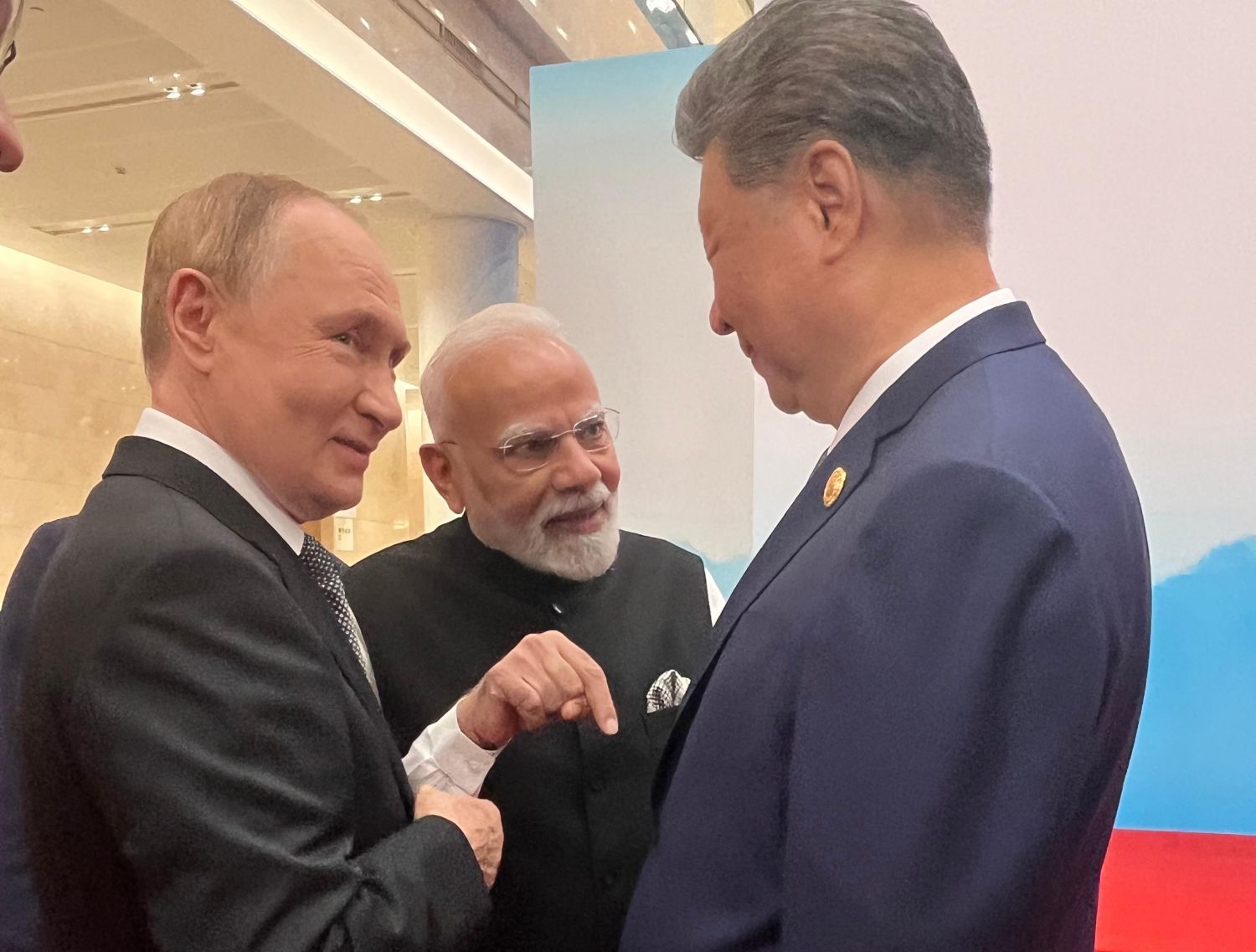
At the Shanghai Cooperation Organization (SCO) summit in Tianjin, PM Modi met Xi Jinping on Chinese soil first time after seven years. Timing was crucial due to the no holds bar bombardment by Trump and his advisors with narratives such as “Modi’s War” and “Brahmins profiteering from Russia-Ukraine War.” The winning edge of the summit was visible sidelining of Pakistan, inclusion of Terrorism in the declaration and commitment towards border resolution.
Striking show of solidarity between Modi-Putin- Xi Jinping and special expressions between Modi-Putin were unmissable. The postures, gestures and embraces caught the eyes of the world. The declaration adopted new development strategy with energy cooperation, establishment of new centers (cyber security, anti-terrorism, and more) and creation of SCO development bank. Unified condemnation of Pahalgam terror attack became a rare text of solidarity within a group, infrastructure with sovereignty (direct counter to CPEC model) and invocation of “One Earth, One Family, One Future” were the most commendable achievements of PM Modi.
Other highlights of the geostrategic indicators were India’s continuation of import of Russian oil despite US offensives against India, dismissal of the summit as largely “performative” by US Treasury Secretary Scott Bessent and tirades by others were
deliberately ignored giving a shut up call to those who matter in Trump administration. While India never challenged the US actions, silent manoeuvres said a lot.
India’s Foreign Policy Challenges
* Managing US Friction while Protecting Tech Ties: It requires a fine balancing the relations with Washington at a time when US is professing the philosophy of “with US or against US.” Recent tariff spikes to 25% and additional 25% in the form of sanctions due to import of Russian oil need compartmentalization of relations so that iCET, defense co-production and critical minerals can be protected.
* Deterrence against China: Back in 2014, with emergence of Mr Narendra Modi in the national scene, China hoped to extend its BRI to India and push the products of China’s enhanced manufacturing capacities into Indian markets. China attempted to coerce India through series of border skirmishes starting from Doklam in 2017 and going upto Galwan in 2020. India stood firm in responses and in strength. Likewise, India has to build maritime capacity and supply chains in a sustained manner. Hence, moving from de-risking to achieving credible deterrence, is the way forward.
* Re-activation of IMEC: IMEC (India Middle East Europe Economic Corridor) has to be re-activated as soon as Gaza situation stabilizes and different segments and components of the corridor have to be put on fast track. Once, these are in place, the corridor will provide leverage in Gulf as well as Europe.
* BRICS+ to Develop without Anti-West Perceptions: BRICS+ is a major platform for widening India’s South-South connect. It should be restricted to financial and standards grouping without being viewed as anti-west.
Key Takeaway
India’s foreign policy is on the right track for the emerging multi-polar world. India has developed adequate economic, military and partnership heft. New Delhi has carefully navigated the tough terrain of geostrategy ensuring strategic autonomy, multilateralism, diversified partnership and selective issue-based coalitions. India has so far ensured that it doesn’t challenge hegemonic approaches and falsehood of US rudely. Alongside, India is also pursuing bilateralism based on win-win scenarios and mutual respect. India does not believe in demanding respect but in commanding respect, and very soon the world will
realize India’s rise and openly acknowledge it too.