Home Blog Page 145

Pashtuns join Baloch movement against Pak Army’s atrocities on Baloch & Pashtuns

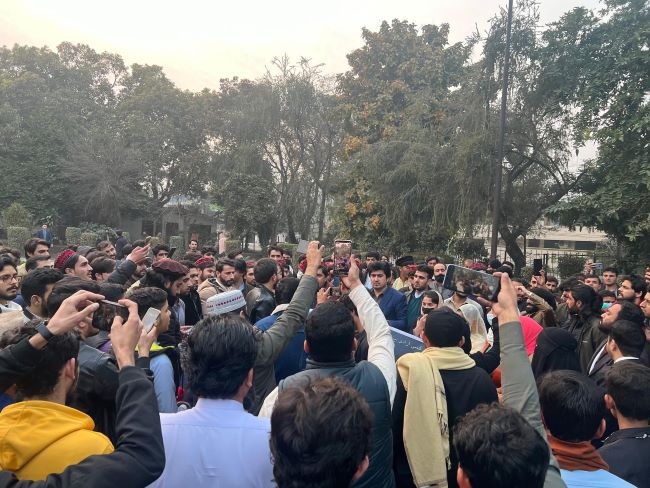
Noor Bacha, a prominent member of The Pashtun Tahafuz Movement, has joined forces with the Baloch movement. At the Grand National Gathering in Shawani Stadium, Quetta, he expressed concerns about ongoing human rights violations in Pak-occupied Balochistan and KPK.

The Pashtun Nation has faced prolonged genocide, with a history marred by bloodshed. The Pak Army, establishing bases in Pashtun land, led to a dire situation with terrorists on one side and the Pak Army on the other. This resulted in widespread human rights violations, including extra-judicial arrests, disappearances, abductions, and indiscriminate killings.


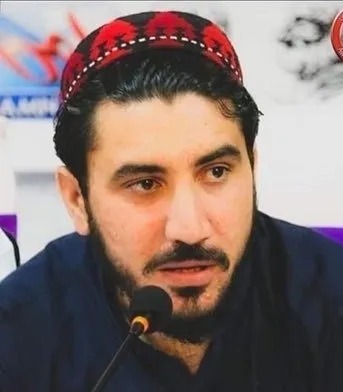
Pashtun and human rights activists not only face abductions but also arbitrary killings. An alarming case is that of PTM Chief Manzoor Pashteen, abducted after a deadly attack on his convoy. He was on his way to participate in a protest against extrajudicial killings organized by Baloch Yekjehti Committee. Despite obtaining bail, he is continuously implicated in unrelated cases at different locations, highlighting the oppression against activists advocating for rights and peace.


This incident underscores the violent suppression of dissent and ethnic communities in Pakistan. The collaboration between the Pashtuns movement and Baloch movement holds the potential to end the genocide of these ethnic communities through unity and resistance.

Two injured during bomb attacks at election offices in Pak-occupied Balochistan

In a recent turn of events, two separate bomb attacks targeted offices of major political parties in Kalat and Mastung, Pak-occupied Balochistan. While no fatalities were reported, two individuals sustained injuries in the blasts.

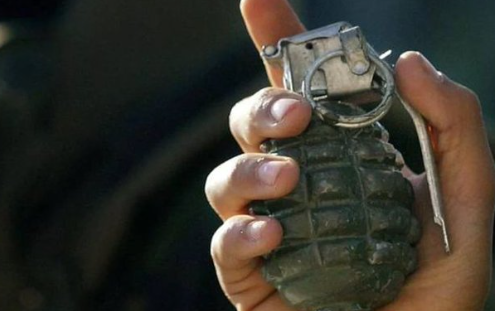
In Mastung, a hand grenade was hurled at the election camp office of the National Party. The explosion injured Ghulam Maheedi and Abdul Aziz, who were subsequently rushed to DHQ Hospital. Police responded cordoning off the area and launching a search operation.
Meanwhile, in the Kalat district’s tehsil of Manchhar, an unidentified group targeted the Pakistan Peoples Party’s election office with a similar hand grenade attack. No casualties were reported at this location as well.

These bomb attacks come amidst heightened tensions in the lead-up to Pakistan’s upcoming general elections. Pak-occupied-Balochistan, long plagued by violence by the Pak Army, has witnessed calls from some nationalist and freedom-fighters to boycott the polls. These groups have urged the public to abstain from participating in the electoral process.
Therefore, these incidents show the attempt of the freedom fighters to remove the facade of Pak Army by conducting rigged elections in Pak-occupied- Balochistan.

Iran-Pakistan standoff and Pakistan’s Jaish-ul-Adl connection

A Faustian Deal

In 2004, the then Pakistani President Gen Pervez Musharraf made a secret deal with the US allowing the Special Activities Division of Central Intelligence Agency [CIA] to use Pakistani airspace for its covert drone programme of targeting top ranking Al Qaeda terrorists. When Washington appeared apprehensive that details of this repugnant programme being compromised, Gen Musharraf allayed its fear by telling the CIA officer handling this issue that “in Pakistan, things fall out of the sky all the time.” 

Bending backwards to please Washington, Musharraf even went as far as agreeing that in order to conceal US involvement, the Pakistani military would take responsibility for the CIA drone attacks, but not without extracting his pound of flesh. He demanded that Washington should also target those whom the military dictator turned president felt were a threat to Pakistan or a personal embarrassment to him. And the first name of such a person that came to Musharraf’s mind was that of Afghan Taliban commander Nek Muhammad Wazir.

As the Afghan Taliban was Pakistan’s ally and Wazir had signed the famous Shakai peace agreement with the Pakistan Army in April 2004, Musharraf’s request for his elimination must have come as a big surprise for Washington. However, since this Taliban commander had vowed that despite this peace deal his ‘jihad’ [Holy war] against the US would continue, Washington gladly obliged. In less than two months after he had signed the peace agreement with the Pakistan Army, Wazir was ‘droned’ by the CIA and his blood sealed the secret US –Pak drone deal.

An Unpublicised Pakistani Airspace Violation

Little would Musharraf have known that his off-the-cuff remark about things falling out of the sky in Pakistan would prove prophetic, and in addition to the US and India, even Iran would carry out aerial strikes against terrorists and their facilities existing on Pakistani soil- with the January 16 Iranian air strike in  occupied Balochistan’s Panjgur district being the latest. While this attack has shocked many as well as generated a lot of discussion and debate, it’s not the first time that Tehran has carried out an aerial attack against terrorists based on Pakistani soil.

In November 2013, Pakistani media reported that a “rocket” fired from Iran territory had hit three houses in Kulahu village of Kech District, Pak-occupied Balochistan. While one of the targeted houses belonged to Mullah Omar Irani, a commander of the anti-Iran Sunni terrorist group Jaish-ul-Adl [JuA] or ‘army of justice’, the other two were owned by his close relatives. Though Tehran didn’t mention anything about this strike, but since JuA had claimed responsibility for the dastardly killing of 15 Iranian Pasdaran [Border Guards] just two months earlier, it’s obvious that Irani was the prime target of this rocket attack.

While one of his nieces was killed and six other relatives injured in this attack, Irani and his two sons survived this assassination attempt. Islamabad played down this brazen violation of its airspace by Tehran as is evident from the news report on this incident. Dawn merely mentions that “Balochistan Chief Minister Dr Abdul Malik Baloch took notice of the rocket attack from the Iranian side on a Pakistani area and said the provincial government had informed the federal government about it,” adding that the Balochistan Chief Minister had asked the Interior Minister to “take up the border violation with Iranian officials.”

An Elusive Fugitive

After its unsuccessful attempt to assassinate Irani, Tehran repeatedly demanded that Islamabad should apprehend the JuA commander and his fighters living in hideouts on Pakistani soil and hand them over to Iran, but Islamabad didn’t oblige. Some maintain that ever since he was targeted by Tehran, Irani had become extremely cautious due to which tracking his movements and ‘fixing’ his location had become virtually impossible. The pro-Pakistan lobby also contends that as Islamabad gains nothing by sponsoring terrorist activities in Iran, there’s no reason for it to provide safe sanctuaries to anti-Iran terrorist groups on its soil.

While this may well be true to some extent, it’s certainly not the only reason. There are numerous indications which endorse the view that Washington has been using JuA to wage asymmetric war against its arch-enemy Tehran. There are also convincing reports that since direct financing of this terrorist group would require congressional approval which besides being an uphill task portended the potential risk of being uncovered by the media, the CIA is instead routing funds to JuA through ISI.

This arrangement put Rawalpindi in a win-win situation. One, it earns Islamabad the goodwill of Washington; two, it allows ISI to siphon part of funds meant for JuA towards its proxy war in J&K. Lastly, it gives the Pakistan army a good degree of control over this terrorist group and makes it a ‘strategic asset’ that can conveniently be used against Iran as and when required. So, acting as a conduit for US funding of JuA makes much sense and is a good enough reason for Rawalpindi to patronise JuA.

Irani’s End

JuA commander Mullah Omar Irani and his two sons were gunned down by Pakistani security forces in an alleged encounter in Turbat Pak-occupied Balochistan district on November 17, 2020, and this should have silenced those claiming that he and his fighters were being sponsored by the Pakistan Army. It should also have drawn Tehran’s gratitude and appreciation as this JuA commander had the blood of many Iranians on his hands. However both things didn’t happen and instead, these killings only raised several more questions on the incident, which Rawalpindi hasn’t yet answered.

The first question is that when he knew that the Iranian security forces were baying for his blood and so was its Pakistani counterpart, why had he thrown caution to the wind by travelling in a single vehicle together with his two sons? Secondly, being a top level commander, why was Irani moving in a single vehicle without any escorts? Thirdly, even if he felt that movement of a single vehicle was a sound decision from the security point of view as it wouldn’t attract attention of the security forces, why didn’t Irani at least utilise the services of a driver?

Lastly, JuA is very particular when it comes to avenging the deaths of its fighters. Hence, its failure to even announce that it would seek retribution for the killing of their commander and his sons is rather surprising-unless of course the JuA leadership was afraid that it could face eviction from its safe sanctuaries on Pakistani soil if it antagonised Rawalpindi.

Decoding Irani’s Killing

It doesn’t require rocket science to deduce that Irani was able to evade arrest by Iranian security forces all along just because he was a protégé of the Pakistan Army.  It’s also no secret that he was the one who carried out the 2016 abduction of retired Indian Navy officer Kulbhushan Jadav from Chabahar area of Iran and handed him over to Pakistan Army’s spy agency Inter Services Intelligence [ISI] for an undisclosed sum of money.

Rawalpindi supporters would argue that why should the Pakistan Army have eliminated an ‘asset’ who has served it so well? The answer isn’t too hard to find.

Irani undoubtedly gave ISI the best ever ‘catch’ in its history. However, being planners and executors of this ‘black operation’, he and his sons were privy to the entire abduction process and the whole deal, which made them high security risks for the Pakistan Army’s spy agency. So, following Benjamin Franklin’s famous dictum that “three may keep a secret, if two of them are dead,” the elimination of Irani and his sons was inevitable. 

The deceased JuA commander and his sons should have known that they signed their own death warrant the day they abducted Jadhav on ISI’s orders! 

Public pressure forces partial revocation of wheat price hike in POGB as protest continues

In a significant development, the occupying Pakistan Occupied Gilgit-Baltistan (POGB) government has yielded to public pressure and revoked the controversial order to increase the price of wheat. The decision, initially imposed through a notification on December 26, led to widespread protests and condemnation of the Islamabad’s pawn government in POGB.

This decision comes on the heels of a statement by the Awami Action Committee, highlighting the government’s negligence and declaring that the protests, ongoing for a month, have entered a second phase. The demonstrators are not only demanding the reinstatement of the wheat subsidy but also calling for the fulfillment of a 15-point charter of demands.

Copy of order revoking December 26th order (Photo: Social Media)

Redressal of deception!

The protestors outrightly rejected any possibility of ending the protest solely on the reinstatement of the wheat subsidy. Additionally, the occupying government’s move to revert to the previous price of PKR 22 per kilogram, which was in force prior to December 26 does not fulfil the demands of protestors on wheat subsidy either. Awami Action Committee, since very beginning, has made it clear that want the reinstatement of subsidised wheat price which was in force in 2022, i.e., PKR 7.5 per KG.

So, while the Pakistani regime would portray this deception as redressal, the protestors demands are far from being met. Consequently, there seems to be little possibility of the protest ending in the near future.

Simultaneously, reports indicate that residents of Hunza, Nagar, Skardu, Ghizer, and Yasin have initiated a long march towards Gilgit. Trains from various regions of Gilgit-Baltistan are also converging at Gilgit, signifying a united front against the government’s policies.

Heated protest in chilling winters over wheat price

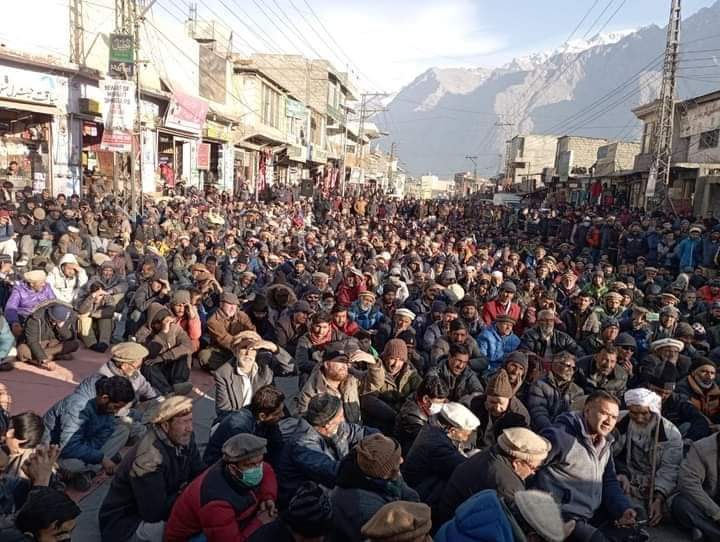
Continuous protests have marked the region for the past month, with Skardu witnessing demonstrations for 32 consecutive days. The situation escalated on January 26 and 27 when the entire region observed a shutdown, with protestors blocking traffic. The shutdown extended to the third day on January 28. Large demonstrations and rallies took place across the district, reflecting the residents’ dissatisfaction with the current state of affairs. In one such rally yesterday, Advocate Ehsan Ali, the leader of Awami Action Committee lambasted Islamabad and reaffirmed that the struggle for the rights will continue and the rights that have been snatched from the people of POGB since past 75 years will be achieved by the ongoing protest.

The strike and shutdown, primarily against the increased subsidized wheat prices and other grievances, led to closures of shops, markets, restaurants, and various areas in Gilgit, Skardu, Diamar, Astore, Ghanche, Kharming, Hunza, and Nagar. The closure of business centres paralyzed normal life, and the non-availability of transport resulted in reduced attendance in private and government offices, as well as educational institutions.

The appointed representatives emphasized their commitment to the cause, stating that they will remain until the grievances of the past 76 years are addressed. Their demands include the restoration of the state subject role, their own flag, Prime Minister, and constitution, ultimately seeking an autonomous Gilgit-Baltistan. Large-scale rallies are converging on Gilgit city from various locations, where extensive protest demonstrations are anticipated. The Public Action Committee has announced a two-day wheel jam and shutter-down strike in the 10 districts of Gilgit-Baltistan.

Pak Army forcibly disappears 10 Pak-occupied Balochistan residents despite massive protests

In a distressing turn of events, Pak-occupied Balochistan is grappling with ten cases of forced disappearances from Dera Bugti, while protests against the abduction of a youth in Kech district intensify for the second day.

Pakistan Army, in collaboration with its agencies, conducted sweeping house-to-house searches in Sui town, leading to the forced disappearance of ten people during separate raids. Among those missing is Master Ghaus Bakhsh, GTA District President and Jamhoori Watan Party activist, seized during a raid in Zafar Colony.

Rahim Dad and Swali Bugti, sitting at Musa Hotel in Tehsil Bazar of Sui, were also forcibly disappeared by Counter Terrorism Department (CTD) and Army officials. Atifullah, taken from his home in Jokra Morh area, and three unidentified youths from Shahzain Pump area of Sui are reported missing.

Additionally, Faisal and Shah Hussain faced CTD detention in the Labor Quarter of Sui Field Fence but were later released.

Sit-in against enforced disappearances

Meanwhile, the family of Bahadur Chakar from Tejaban area in Kech district persists in a sit-in protest against the forced disappearance of their relative by the Pakistan Army. A raid on Bahadur Chakar’s residence prompted the family and locals to block the M-8 CPEC highway, underscoring their anguish and demand for justice.

In the last 24 hours alone, seven more Baloch students have been detained from two districts and shifted to unknown locations, by Pakistan “establishment”, adding to the anguish of affected families. The plight of the affected families continues, emphasizing the urgent need for attention and intervention.

The distressing reality of forced disappearances in Pak-occupied Balochistan, spanning decades, continues to unfold. Since March 27, 1948, Balochistan has been forcibly occupied and subjected to a systematic assault on humanity by the oppressive Pak Army. Since then, the Baloch people have faced frequent home invasions, torture, enforced disappearances, kidnappings for ransom and target killings.

International Court of Justice calls on Israel to prevent genocidal acts in Gaza

In a landmark decision, the International Court of Justice (ICJ) has called on Israel to take immediate measures to prevent genocidal acts amid the ongoing conflict in Gaza. However, the court refrained from demanding a ceasefire in the case filed by South Africa.

One of the judges, Joan E Donoghue acknowledged that some acts and omissions alleged by South Africa fall within the provisions of the Genocide Convention. The court ruled in favour of South Africa’s request for provisional measures against Israel, rejecting Israel’s plea not to entertain the application.

The judges at the Hague determined that Palestinians are a protected group under the Genocide Convention. They noted that “at least some of the rights claimed by South Africa and for which it is seeking protection are plausible,” emphasizing the right of Palestinians to be protected from genocide.

Subsequently, Israel has been directed to implement measures ensuring its military refrains from engaging in genocidal acts and to prosecute any incitement of such behaviour. The ICJ also demanded that Israel take measures to punish public solicitations to genocide and allow humanitarian aid into Gaza.

ICJ has also instructed Israel to report back to the ICJ within a month. Furthermore, the UN body mandated that Israel preserve evidence of actions impacting the Genocide Convention.

While the ICJ’s verdict carries legal weight, the practical implementation of these measures poses a complex challenge, especially given the geopolitical complexities surrounding the Israel-Gaza conflict. Also, the final judgement that would decide whether Israel committed genocide or not will take years. The decision marks a crucial step in addressing allegations of genocidal acts and violations of the Genocide Convention, emphasizing the need for accountability and protection of human rights in the region.

Baloch Human Rights advocates discuss Baloch genocide with UN Special Rapporteur on Human Rights Defenders

Recently, human rights activists from Pak-occupied Balochistan met virtually with Mary Lawlor, the UN Special Rapporteur on Human Rights Defenders. Participants in an open discussion discussed the various challenges, threats, and attacks they faced from the Pak establishment as a result of their advocacy work.

The Special Rapporteur, Mary Lawlor, emphasized how urgent it is for the human rights situation in Pak-occupied Balochistan to receive more international attention. She underscored the importance of acknowledging and resolving the difficulties the advocates of human rights face in the region. She also acknowledged the leadership of Baloch women in resistance efforts, noting that it has garnered global attention.

The participants in the virtual session stressed how important it was for the United Nations to help the Baloch people from the genocide act committed by the Pak establishment and called for continued support to ensure accountability and justice.

This meeting served as a platform to raise awareness of the issues faced in Pak-occupied Balochistan and share their experiences fighting for justice and human rights in the region. It is hoped that the conversation will help raise international awareness of the pressing humanitarian issues in the area and encourage more action on that front.

Baloch unity supporters against Pak regime gear up for Grand Jalsa in Quetta

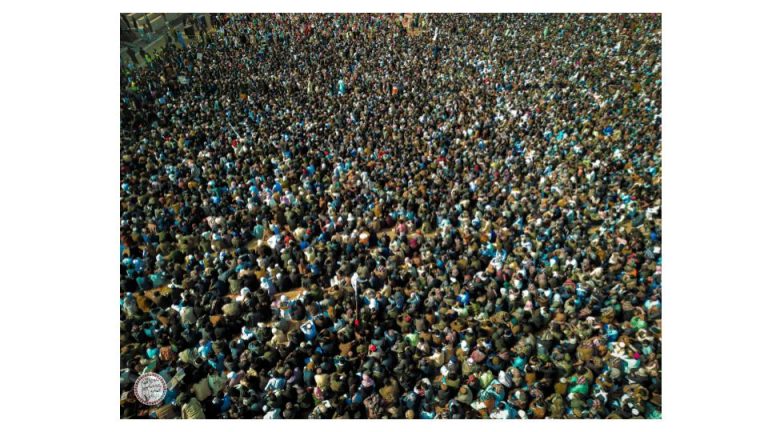
Recently, Baloch people can be seen travelling in caravans from all over Pak-occupied Balochistan to attend tomorrow’s grand Jalsa at Shahwani Stadium in Kechi Baag, Saryab Quetta. In the recent post by the Baloch Yakjehti Committee (BYC), the caravans from the Kow-E-Suleman can be seen coming for the Quetta Jalsa.

In response to BYC’s request tens of thousands of people, including women and children, have rallied in different areas of Pak-occupied Balochistan. These large-scale demonstrations help the Baloch community raise their voices and promote unity and solidarity.

It is important to note that since March 27, 1948, Balochistan has been forcibly occupied and subjected to a systematic assault on humanity by the oppressive Pak Army. Since then, the Baloch people have faced frequent home invasions, torture, enforced disappearances, kidnappings for ransom and target killings.

BYC requests people to sign the petition to help them end the Baloch genocide and urges the international community to investigate the egregious genocide occurring in Pak-occupied Balochistan and guarantee the safety of the Baloch people worldwide. The Baloch nation has been forced to take to the streets in protest for their people as a result of the indiscriminate killings and enforced disappearances.

Pakistan files sedition case against Sindhi nationalists over Sain GM Syed’s birthday celebration

Leaders of the Jeay Sindh Freedom Movement (JSFM) are facing a sedition case filed by the Pakistani establishment, including figures such as Shoban Lashari, Adil Hameed Sargani, Jameel Ahmed Shoro, and other nationalist political workers, including women. The action comes in the aftermath of the celebration of the 120th birthday of Sain GM Syed, a revered Sindhi leader who proposed the idea of independent Sindh nation.

Sain GM Syed’s birth anniversary was on January 17 which JSFM celebrated by carrying out a rally in Sann city, SIndh. Pakistan imposed Section 144 in the city to stop the rally, however, Sindhi nationalists defied the occupying administration’s order and held a successful rally. Frustrated by this, now Pakistan has filed a sedition charge against the JSFM leaders.

Fake sedition case against JSFM

JSFM, known for its longstanding advocacy for an independent Sindhudesh through peaceful and democratic means, strongly criticized what it perceives as an unwarranted and oppressive move by the Pakistani terrorist regime. Despite the movement’s commitment to non-violence, its leaders have been consistently targeted by Pakistan and the fake case against its leaders is a conspicuous example of that.

The filing of the sedition case raises concerns about the shrinking space for freedom of expression and political dissent in Pakistan occupied territories. JSFM leaders and their supporters argue that Pakistan’s actions aim to suppress their legitimate demands for an independent Sindhudesh.

The celebration of Sain GM Syed’s 120th birthday, intended as a moment of remembrance and unity, has instead become a focal point for authorities seeking to curtail political activities. Evidently, Sain GM Syed, an iconic figure among Sindhis, represents a symbol of inspiration, and attempts to hinder celebrations in his honour are viewed by JSFM as an infringement on cultural and political rights.

JSFM remains steadfast in its commitment to pursuing its cause through peaceful and democratic means. The movement perceives the sedition case as a blatant attempt to stifle their voices and undermine their constitutional right to express their aspirations.

Russia can rely on India and it’s leadership: Vladimir Putin

Russian President Vladimir Putin has recently praised Indian Prime Minister Narendra Modi’s leadership and India’s commitment to an independent foreign policy during a noteworthy speech to university students in the Kaliningrad Region on “Russian Student Day.”

https://twitter.com/TimesAlgebraIND/status/1750892137204658666?s=20

“India has one of the highest rates of economic development and growth in the world, and that too is due to the leadership qualities of the incumbent Prime Minister. It was during his leadership that India reached such a pace,” said President Putin. He further said that “Russia can rely on India and its leadership because it is assured that New Delhi won’t play ‘games’ against them at the international stage.”

“India is pursuing an independent foreign policy, which is not easy in today’s world. But, India with a population of 1.5 billion has the right to do so. And under the leadership of the Prime Minister, that right is being realised. This is not just a statement, it is important from the point of organising joint work because it allows us to forecast the actions of our partners in the medium and long term,” said President Putin.

“In practical work, this is important, President Putin continued. Can we rely on a nation and its leaders to work together, or will they make choices that do not even correspond to its national interest? With India, such games don’t exist.”

The Russian President praised India’s “Make in India” initiative as well and stated that Russia is one of the biggest investors in India and continues to look forward to making huge investments there.

“India has made huge steps in development, under the leadership of Prime Minister Narendra Modi. His campaign ‘Make in India’ has been heard by many including Russia. And we are trying with our Indian friends to bring to life all these plans…the largest foreign investment in India has come from Russia. USD 23 billion was invested by our company Roseneft, acquisition of an oil refinery, a network of gas stations, a port and so on,” President Putin said.

He also talked about India’s diverse culture and Indian movie popularity in Russia. “India is a great culture. It’s diverse and colourful. Russia is probably the few places around the world where Indian movies are broadcast on national television,” the Russian President added.

Recently, S. Jaishankar, the External Affairs Minister, visited Russia from December 25 to 29 last year, as part of the ongoing high-level exchanges between the two nations. During his visit to Moscow, the EAM called on Russian President Vladimir Putin and held discussions with several top leaders. He signed three documents relating to the Kudan Kulam Nuclear Power Plants, an MoU on cooperation in pharmaceuticals and healthcare and a protocol on Foreign Office Consultation, the Minister of External Affairs said.