Home Blog Page 146

Pak-occupied Gilgit-Baltistan observes complete shutdown as protests against Pak regime intensifies

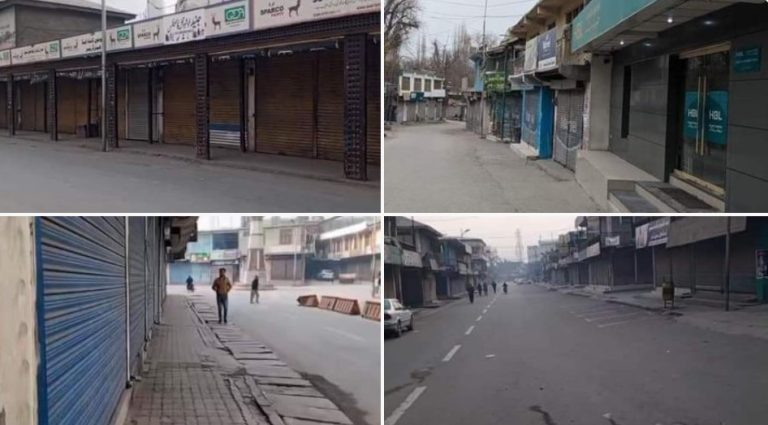
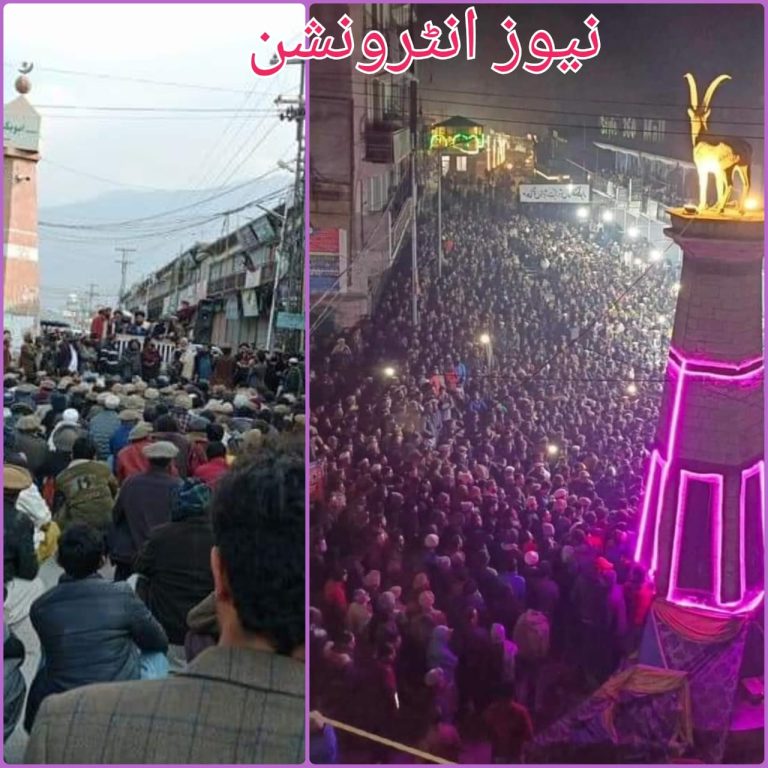
After a month of persistent protests across Pakistan-Occupied Gilgit Baltistan (POGB), the region is now witnessing a comprehensive shutdown. District headquarters, multiple towns, and villages in POGB have ground to a halt, with Gilgit, Skardu, Diamer, Ghizer, Astore, Shighar, Ghanche, Khar¬mang, Hunza, and Nagar all participating in the shutdown on January 26 and 27.

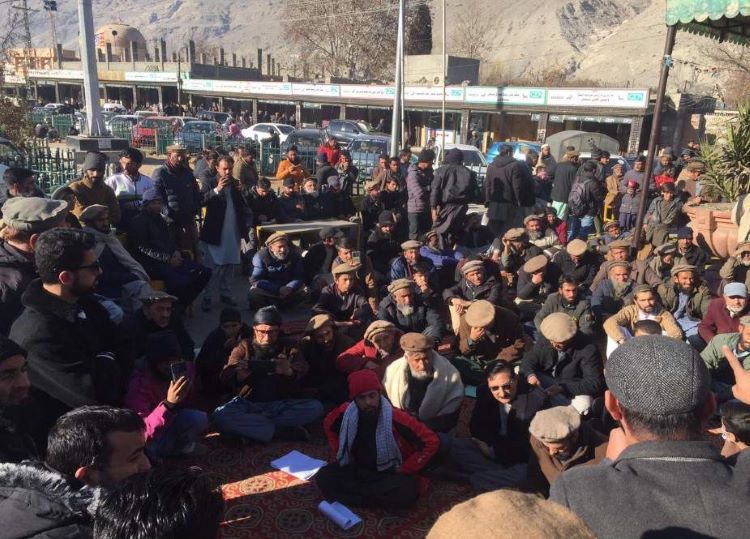
Protest sites such as Yadgar-i-Shuhada Chowk in Skardu and Garibagh in Gilgit, which have been focal points of the demonstrations, saw a substantial influx of protestors. Common people from all corners of POGB took to the streets, participating in sit-ins and demonstrations against the recent increase in wheat prices. Meanwhile, numerous convoys, involving tens of thousands of people from various districts, are en route to Gilgit and Skardu, marking a more unified and determined phase of the protest.

In a groundbreaking move, convoys from Yasin and Gojal valley have already departed for Gilgit, symbolizing the expanding geographical scope of the protest movement.

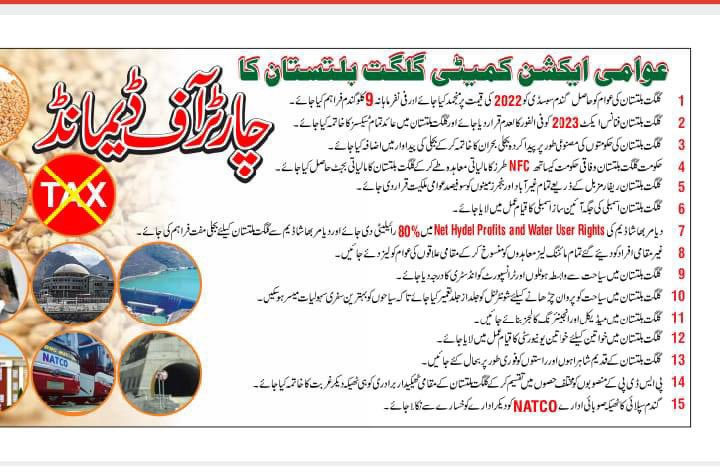
It’s noteworthy that the protest intensity in POGB has escalated. Initially centered around the reinstatement of the wheat subsidy, the protest now encompasses a broader spectrum of demands. The Awami Action Committee has declared 15 demands, emphasizing their non-negotiable stance, stating that the protests will only cease when each demand is met.

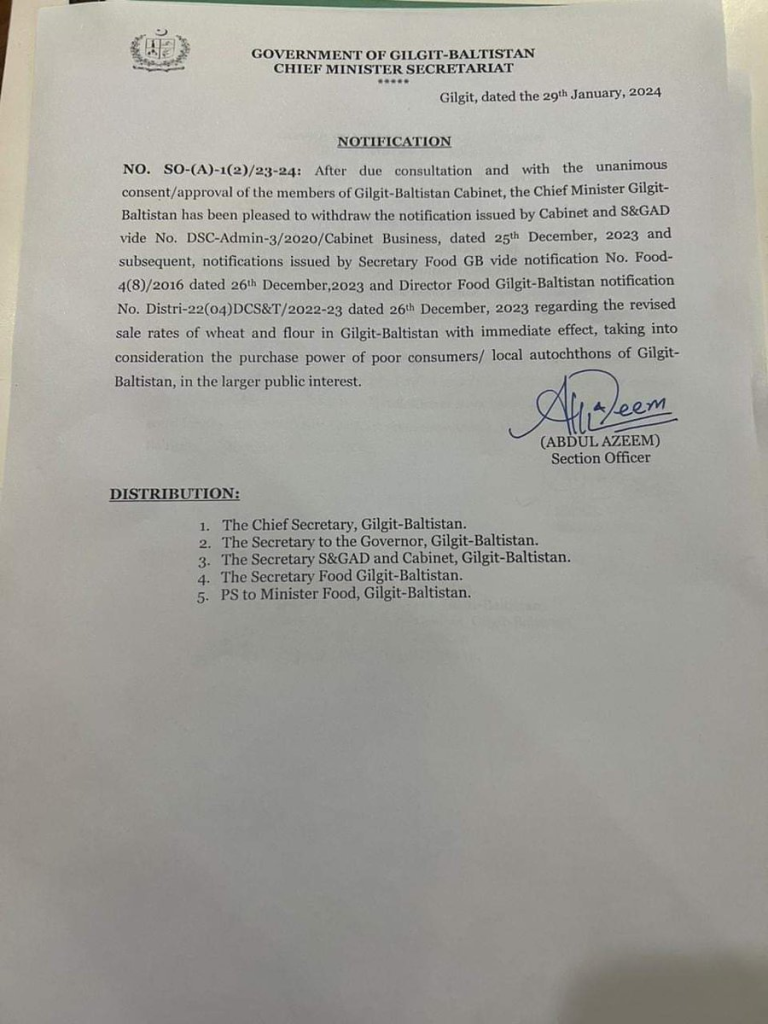
POGB Awami Action Committee’s Charter of Demands (Photo: News Intervention)

15 Demands of Awami Action Committee

  • Reinstate the wheat subsidy to its 2022 levels, providing 9 kg of wheat per month.
  • Abolish the Gilgit Baltistan Finance Act 2023 and all taxes levied in the region.
  • Increase pulse production, ending the crisis created by the occupying governments.
  • Establish an NFC-style financial agreement between the occupying POGB government and the Pakistani establishment.
  • Declare all uninhabited and barren lands as 100% public property.
  • Establish a Constituent Assembly in place of the Gilgit-Baltistan puppet Assembly.
  • Allocate 80% of Net Hydel Profits and Water User Rights of Diamer Bhasha Dam to Gilgit Baltistan, free of charge.
  • Cancel mining leases granted to non-indigenous persons and lease them to local people.
  • Grant industry status to tourism-related hotels and transport in POGB.
  • Build a Twitter account to promote tourism and provide efficient travel facilities.
  • Establish Medical and Engineer War Lodges in POGB.
  • Establish a Women’s University for women in POGB.
  • Restore ancient highways and roads in Gilgit-Baltistan immediately.
  • Divide PSDP projects, award contracts to the local contracting community of POGB, and focus on poverty eradication.
  • Assign the wheat supply contract to the provincial organization NATCO to recover the organization from losses.


Nonetheless, in response to the escalating protests and shutdown, Pakistan and its puppet government in POGB are resorting to power. Reports suggest that Section 144 has been imposed for one month on any form of protest on the Siachen highway as well as internet services provided by the Pakistan Army-controlled SCO have been also deactivated

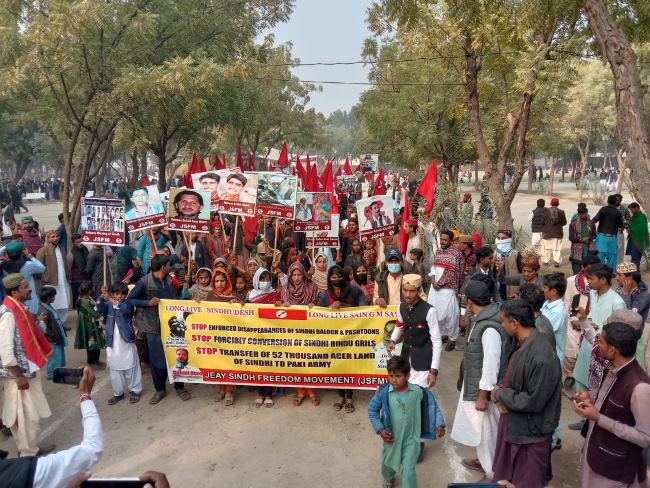
Islamabad to witness protest in solidarity with demands of Pak-occupied Gilgit-Baltistan

In a powerful demonstration of solidarity with the protestors of Pakistan-occupied Gilgit Baltistan (POGB), AWP-GB leader Baba Jan has issued an urgent call for a protest scheduled for tomorrow, January 28. The demonstration, set to take place at 3 p.m. in front of the National Press Club in Islamabad, aims to amplify the voices of the oppressed and draw attention to their demands for fundamental rights.

Residents of Pak occupied Gilgit-Baltistan have been protesting for over a month against the recent abolition of wheat subsidies as well as health cards along with the imposition of the Finance Act 2023, and persistent issues like load shedding. Despite weeks of peaceful demonstrations, the Islamabad-backed puppet government in POGB has failed to address the core concerns of the people.

The Awami Action Committee, under whose aegis the protest is ongoing, has now declared 15 demands from the Pakistani regime. These demands include the restoration of essential subsidies, reinstatement of health cards, and the repeal of the Finance Act 2023.

As the protests intensify, the residents are determined to make their grievances known, taking their calls for justice and fairness directly to the heart of the authoritarian regime.

Sindh police arrests Karachi university students protesting against fee hike

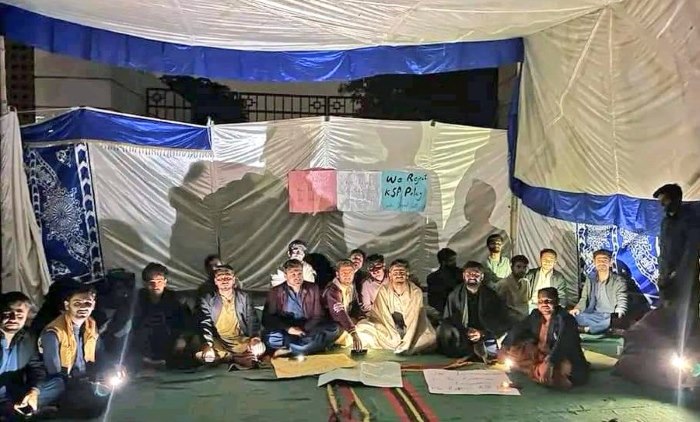
In a concerning turn of events, the Sindh Police intervened in the ongoing student protests at Karachi University, arresting hunger-striking students who were demanding justice and fairness in the university’s policies. The arrests come in the wake of a series of protests against an indiscriminate fee hike and other pressing issues faced by the student body.

Students at Karachi University have been protesting against several grievances, including the implementation of the KSP-POLICY, discriminatory practices, and cultural heritage concerns. The administration’s alleged indifference to these concerns led to an escalation of the protests, with students resorting to a hunger strike as a last-ditch effort to draw attention to their demands.

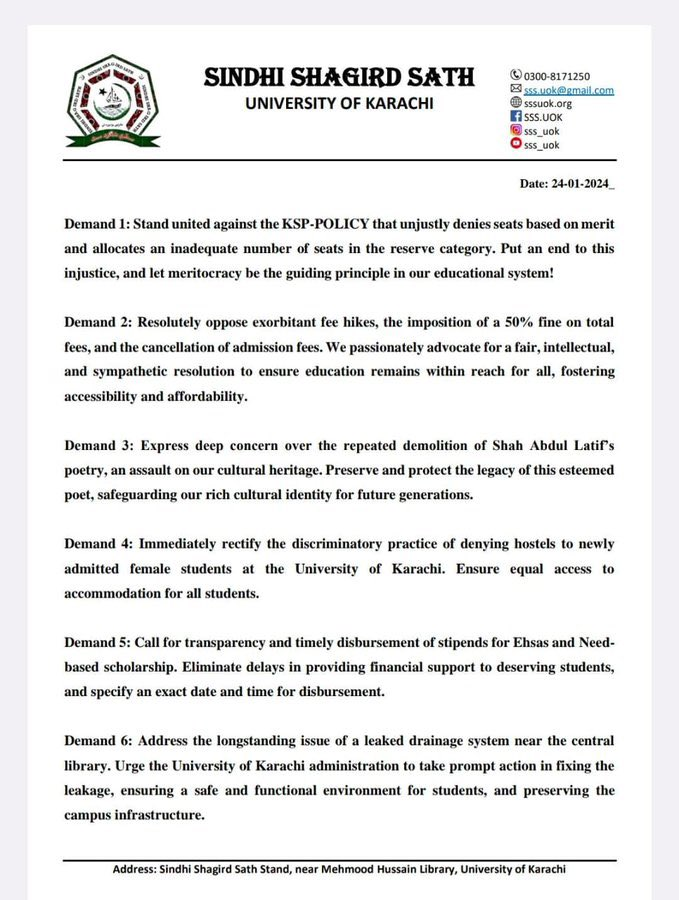
Demands of Karachi University students

  • Merit-Based Admissions: Opposing the KSP-POLICY that allegedly denies seats based on merit, students call for an end to injustice and the promotion of meritocracy in the educational system.
  • Affordable Education: Protesters vehemently oppose exorbitant fee hikes and advocate for a fair and sympathetic resolution to ensure education remains accessible and affordable.
  • Cultural Preservation: Expressing concern over the demolition of Shah Abdul Latif’s poetry, students demand the preservation of cultural heritage.
  • Equal Accommodation: Urging the rectification of discriminatory practices, students call for equal access to hostels for all newly admitted female students.
  • Transparency in Scholarships: Demanding transparency and timely disbursement of stipends for scholarships, students seek an end to delays in financial support.
  • Infrastructure Concerns: Addressing a longstanding drainage issue near the central library, students call on the administration to take prompt action in ensuring a safe and functional environment.
Copy of Karachi university students’ demand (Photo: Social Media)

Disturbing condition of students in Pakistan

The Sindh Police’s involvement in arresting hunger-striking students has sparked outrage, with many condemning the use of force against peaceful protesters. Earlier, a police officer threatened students with more force if they did not end their hunger strike, raising concerns about the suppression of legitimate voices.

https://twitter.com/SarmanBrohi/status/1750614779159335025

This incident follows a disturbing trend in Pakistan, where student protests are met with force rather than open dialogue. The authoritarian approach by university administrations, often aligned with the government and military, raises questions about the stifling of dissenting voices.

India Army adopts Pir Topa village in J&K under Project Sadhbhavana

0

A non descript village in the Poonch district of the Union Territory [UT] of J&K, Pir Topa has only about 30-35 houses with a population of approximately 250-300. Its residents belong to the traditional grazier Gujjar and Bakkarwal community and their main source of income is from livestock. This area is remote and lacks road connectivity with the Deera ki Gali [DKG] – Bafliaz Road [also known as the ‘Mughal Road’]. In addition, Pir Topa doesn’t have any hospital or dispensary, primary school, electricity or water storage facilities.

Like people in other remote areas, the older generations of Pir Topa may have adjusted themselves to a primitive way of life as well as lack of basic amenities and opportunities. However, the present generation is more aware and aspires for better educational facilities and access to other civic conveniences. With the center along with state and UT administrations working on a war footing to provide basic amenities and infrastructure, such expectations from the impoverished people of Pir Topa is but natural.

Appreciating the legitimate aspirations of its residents, Udhampur based Northern Command of the Indian Army has taken the considered decision of ‘adopting’ and making the frontier Pir Topa a model village as part of its Sadhbhavana project. Working in close coordination with the UT and district administrations, the army plans to undertake various projects to make Pir Topa a model village in the region.

Accordingly, this village will see a host of developmental initiatives in the next three years in the field of infrastructural development, health, education, human resource and skill development. While construction of a road to connect Pir Topa with the DKG-Bafliaz Mughal Road will greatly improve accessibility, provision of water storage facilities and execution of a solar energy project will provide running water and reliable source of electricity to the villagers.

The setting up of a vocational training centre will be an invaluable asset that will provide the youth with the basic competence to acquire requisite skills and thereby enhance their employment prospects. Regular conduct of medical and veterinary camps will facilitate timely medical attention to the villagers and their livestock respectively while a community centre with indoor recreational facilities will provide an opportunity for people of all ages to congregate and interact with each other.

‘Adoption’ of Pir Topa by the Indian Army for making it a model village isn’t the first such initiative. On the contrary, it’s part of an ongoing process of the Indian army’s untiring and multifaceted outreach to improve the habitat and quality of life of locals living in remote areas.

The deluge of success stories reported by highly reputed and independent sources recounting how thousands of people living in far-flung areas in both the UT of J&K and Ladakh have benefitted from the Sadhbhavana project speaks for itself and as such this public oriented welfare project deserves due appreciation.

Baloch National Assembly to discuss fight against Pak atrocities on mothers & daughters of Balochistan

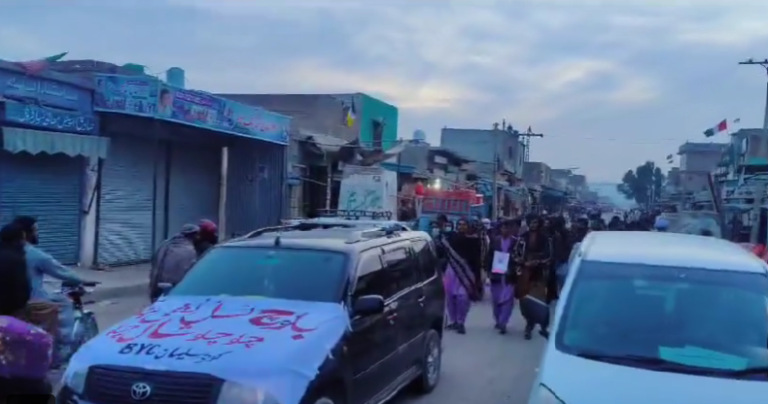
A grand assembly is going to be held in the provincial capital of Pak-occupied Balochistan, Quetta on January 27, 2024, in Shahwani Stadium, Kech Bagh Sirayab, as the fifth phase of the movement for the rights of Baloch mothers and sisters against the atrocities of the Pak Army, enforced disappearances, and demands for long marches initiated in Islamabad against Baloch genocide.

The assembly will address speeches from political figures, movement leaders, and the families of the missing people. Caravans will gather in Quetta to take part in the assembly from all over Balochistan.

Baloch mothers and sisters in Islamabad who attended the assembly reaffirmed their dedication to the fight against the Pak establishment’s violence, humiliation, and murderous and plundering policies. The only thing that can stop the establishment of murders and genocide in Balochistan is a well-organized, dynamic, and powerful political movement.

PTM-US reaches out to Amnesty International for the release of Manzoor Pashteen

The Pashtun Tahafuz Movement (PTM) in the United States has issued an urgent plea to Amnesty International, demanding action following the arrest of prominent leader Manzoor Pashteen and other PTM activists in Pakistan. Pashteen, a vocal advocate for Pashtun rights, is being held without clear charges or due process, raising concerns about his safety and wellbeing.

Accordingly, PTM-US emphasizes Pashteen’s unwavering commitment to human rights and peaceful solutions for the Pashtun community, making him a symbol of hope for many. And therefore, his arbitrary detention, along with disturbing reports of torture in custody, has sparked outrage and calls for intervention.

PTM’s four demands from Amnesty International

Furthermore, the petition urges Amnesty International to:

  • Demand the immediate and unconditional release of Pashteen and all detained PTM activists.
  • Condemn their unlawful arrest and detention for peaceful human rights advocacy.
  • Investigate the reports of torture and hold those responsible accountable.
  • Call for an impartial and transparent investigation into the circumstances surrounding their arrests, ensuring any charges adhere to international legal standards.

Moreover, PTM-US believes Amnesty International’s intervention can be crucial in securing the safety of Pashteen and other PTM activists. Considerably, this case adds to the existing tension between the Pakistani establishment and the Pashtun community, highlighting concerns about human rights and rule of law in the region.

Notably, PTM Chief Manzoor Pashteen was abducted from Chaman on the night of December 3 after a deadly attack on his convoy. He was enroute to participate in the Turbat protest organised by Baloch Yekjehti Committee against the extrajudicial killings of Baloch youth by the Pakistan CTD. Since then he remains in custody and each time he gets a bail, he is implicated in some other case at some other location, where he has not even visited in his lifetime. So, this speaks in itself about the oppression faced by the activists voicing for rights and peace. The voice of dissent has always been curbed violently in Pakistan and Manzoor Pashteen’s case is the latest reminder of that.

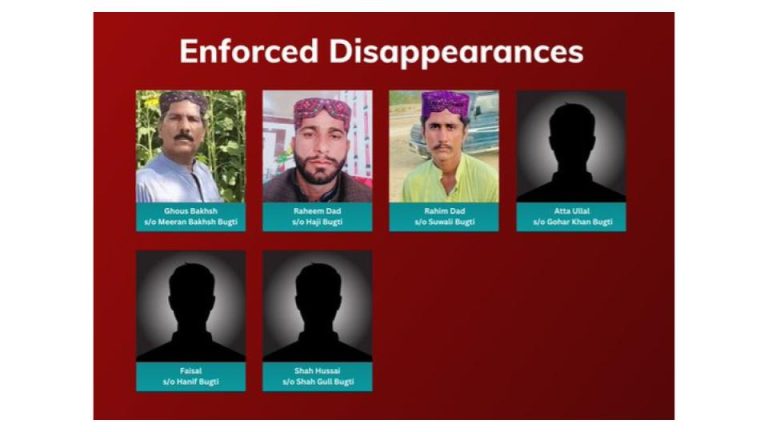
Yet again Pak Army forcibly disappears two residents of Jhal Magsi, Pak-occupied Balochistan

Another incident of enforced disappearance by the oppressive Pak Army has been recorded in Jhal Magsi, where two individuals have been detained by the Pak Army and subsequently moved to an undisclosed location. The individuals are identified as Akbar, son of Nawab Khan and Jamil Ahmed son of Imam Bakhsh.

Reportedly, Akbar had previously been detained by the Pak Army along with his brother Yusuf. But tragically Yusuf was killed by the CTD which was a nefarious staged encounter in Dera Murad Jamali. Though Akbar was initially released, he has once again fallen victim to the hands of the Pak Army.


The tale of brutality one endures in the hands of the Pak Army can be seen when Akbar was released from their custody, he was in a handicapped state with full legs paralyzed. Despite his condition, he is once again detained by the merciless Pak Army. His anguished family members have expressed their concern over Akbar’s abduction and have urged human rights organisations for his safe recovery.
It is pertinent to note that since March 27, 1948, Balochistan has been forcibly occupied and subjected to a systematic assault on humanity by the oppressive Pak Army. Since then, the Baloch people have faced frequent home invasions, torture, enforced disappearances, kidnappings for ransom and target killings.


Protests against enforced disappearances have been going on for at least decades across Pak-occupied Balochistan and the Baloch Yakjehti Committee (BYC) has been holding a sit-in in Islamabad for the past two months, which they ended today and moved on to Quetta.

Pak-occupied Gilgit-Baltistan: Awami Action Committee to escalate wheat protest

Awami Action Committee in Pakistan occupied Gilgit Baltistan (POGB) is completing its one-month agitation on January 26, which it started over the abolition of wheat subsidy by the Pakistani regime. Now the committee has confirmed that its protest will continue and would actually intensify with the upcoming Plan B. In just a month the protest took the form of a movement which saw participations from not only the non-government organisations but also the common people including women and children. It is of immense significance to note that these protests endured the chilling winters with a temperature as low as -50 C. Despite this bone chilling season, the protestors’ determination remained undeterred.

Unfortunately, this struggle for the rights and basic amenities by the people was completely ignored by the occupying government and Islamabad. In fact, it was on the orders of Islamabad that this wheat subsidy along with health cards was abolished. To the worse,  a new Finance Act 2023 was introduced to impose irrationally increased taxes over the people of POGB. In one month, the protestors used every platform to call for the solution of their problems, failing which, they warned, strong initiative would be taken.

But since Pakistan ignored the calls considering them to be hollow rhetoric, the populace of POGB had no option but to intensify the protests. In line with that, a convoy of tens of thousands of people  with vehicles from Nagar started a long march to Gilgit, the visuals of which are thought provoking. In its 76 years of captivity history, Gilgit Baltistan has never saw such a huge number of people coming out of their house in chilling winters to get their righteous heard.

Awami Action Committee preparing Plan B

While the long march from Nagar is reaching Gilgit headquarters, the Awami Action Committee has extended full support to the long march and explained its further course of action. Talking about the first increase in wheat price in 2023, the leaders of Awami Action Committee have referred to the decision as equivalent to dropping the bomb over the innocent people.

Nonetheless, as per the current program, the protest from the Gilgit division, Ashtore and Diamer would reach Gilgit while the four districts of Baltistan region namely, Shigar, Kharmang, Ghanche and Skardu will reach Skardu headquarters. Accordingly, the committee is in contact with its coordinators in every district and other stakeholders like transporters association. Moreover, the committee has reaffirmed its decision of holding a complete shutdown on January 26th and 27th and stated that after the shutdown, a comprehensive Plan B for further action would be declared with a proper charter.

Pakistan occupied Gilgit Baltistan (POGB) which is under the illegal occupation of Pakistan has been grappling with the existential challenges. While Pakistan always propagated that they are free, their condition be it political or financial, has only deteriorated. In the age of social media, when the information transcends the border with unadulterated accuracy, people of POGB have came to know that they have only been plundered on the pretext of freedom, while they still live in captivity where their righteous demands are not even addressed.  

Unknown assailants abduct five Punjab (Pak) residents from Kech, Pak-occupied Balochistan

Recently on Wednesday, in the Kech district of Pak-occupied Balochistan, at least five people from the Punjab province of Pakistan were abducted.

Reportedly, in Dandar village, on the outskirts of the Hoshap sub-tehsil of Kech, five people from Punjab province have been abducted by unidentified gunmen. Nazir Ahmed, Muhammad Tariq, Safdar Ali, Farooq, and Hasnain are the detainees who have been identified.

The detainees were installing a new tower for Ufone, a “state-run” telecom company, according to local sources who spoke with TBP correspondent.

As per the local administration, Assistant Commissioner Turbat has dispatched a team of Levies forces to the area, following Deputy Commissioner Kech’s instructions. However, no more information regarding the kidnappees has surfaced.

Baloch people have faced regular home invasions, kidnappings for ransom, target killings, forced disappearances, and torture from the Pak Army since 1948. This exploitation has been directed towards the resource-rich provinces of Pakistan-occupied Balochistan, where the Pak Army is executing an evil plan to loot the region’s wealth.

Pakistan trying to revive terrorism in J&K: DGP RR Swain

In a high-level joint security meeting convened to assess preparedness in the Kashmir Zone ahead of Republic Day, Director General of Police R.R Swain revealed on Wednesday that Pakistan and its agencies persist in their efforts to reignite terrorism in parts of Jammu and Kashmir. Expressing concerns over serious attempts by external handlers to infiltrate terrorists into the region, Swain urged for heightened security measures and the reinforcement of security grids.

Highlighting the urgency posed by cross-border handlers to create disturbances in the region, the DGP emphasized the need for field formations to thoroughly examine intelligence inputs from various agencies. He urged for decisive actions to thwart subversive attempts, urging a reassessment of security measures at vulnerable locations and for individuals.

Swain directed the bolstering of the human intelligence system and the strategic use of modern tools to track down terrorists. He also stressed on the identification of technologies employed by terrorists, calling for the development of counter-strategies. Additionally, the DGP emphasized the identification and dismantling of new forms of terror modules, all within the confines of the law.

Strict vigilance before Republic Day

Officers were instructed to conduct detailed reviews of terrorism threat scenarios in their respective areas, with an emphasis on fixing responsibility within the hierarchy. Swain underscored the importance of comprehensive briefings by senior officers to on-field personnel to ensure the peaceful conduct of Republic Day celebrations.

Strict monitoring and subsequent action against the terror support system were highlighted, with a directive to create special monitoring teams to identify any elements providing support to terrorists. Swain further directed officers to implement optimal security arrangements at all venues across Kashmir, leveraging all available resources.

The meeting, held at the Police Control Room Kashmir, saw the participation of officers from Police, Army, CRPF, BSF, SSB, CISF, and other sister agencies. Discussions during the meeting delved into the security of vulnerable areas, individuals, and places, with a focus on intelligence gathering, area domination, Naka checking, and the security of sensitive locations.