Home Blog Page 169

Karakoram University announces temporary closure neglecting student’s protest

0

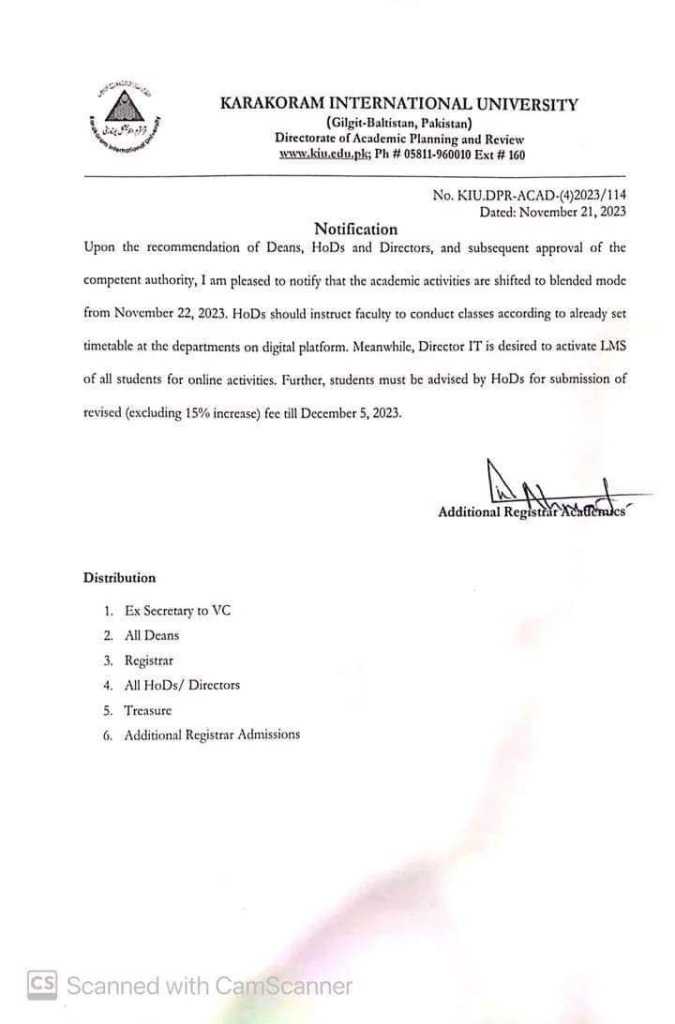
While students protest at the Karakoram International University in Pak occupied Gilgit Baltistan, against the indiscriminate fee hike by the administration, the University has turned a blind eye towards their demand. In the latest development, the University Additional Academics Registrar has ordered a temporary closure of the university for an indefinite period on 21st of October. The Additional Academic Registrar also directed to conduct the classes as per preset routine using online mode.

Order Of Temporary Closure Of University (Photo: News Intervention)

This raises serious questions over the intention of the university administration as it is the university students who are protesting, and it is their obligation to listen and provide solutions to their grievances. Still, there has been no deliberation from the university site. Instead, the administration has closed the university rendering the protesting students in disarray. Evidently, this shows that the administration that is running on the directions of Pakistan is busy licking the boots of the Pakistan Army with no attention towards education and students’ reasonable demands.  

Students have been protesting against the lack of facilities and fee hike in the University for more than a year now. The university’s decision of indiscriminate fee hike is hurting more as the region is already grappling with lots of challenges like hike in electricity prices, wheat prices and capturing of crucial parts of land.

Meanwhile, a couple of days ago, the Gilgit Baltistan Students Council students of Quaid-e-Azam University registered their protest in favour of KIU student sit-in. They also extended support to the ongoing protests against the removal of wheat subsidy in the region.

Nevertheless, the commitment of the KIU students remains unwavering as they continue their sit-in  demonstration at Nad-e-Ali chowk irrespective of the abrupt closure of the university campus.  

Pakistan occupied Gilgit-Baltistan to soon witness major protest against wheat price hike

Rejecting the occupying government’s decision to increase the price of wheat and targeted subsidy, Tehrik-Insaaf (PTI) and Majlis-e-Unity Muslim Gilgit-Baltistan (MWM) announced they would start a major agitation soon. According to local media report, a consultation meeting of Pakistan Movement was held in a local hotel in Skardu, which was chaired by Mohammad Taqi Akhonthada, in which concern was expressed over the recent increase in the price of wheat and this increase was attributed to the drone attack on the people.

It was also decided in the consultation meeting of PTI to launch a big public movement in Pakistan-occupied Gilgit-Baltistan soon against the increase in wheat prices and targeted subsidy and in this regard PTI leaders should contact other political, religious, social and nationalist parties and suggestions will be sought from them to make the movement effective.

On the other hand, an emergency meeting of MWM was held under the chairmanship of Agha Ali Rizvi, in which the sudden increase in the price of wheat and targeted subsidy was rejected, terming it as a cruel decision.

Agha Ali Razvi said that the government is taking wrong decisions, the sudden increase in the price of wheat and targeted subsidy is a big attack on our people, we cannot remain silent on this. If silence is maintained, the price of wheat per bag will be increased to Rs 12,000 in one to two years. The government is checking the public, it wants to know to what extent the public will react, if the public remains silent. If the government will create more atrocities, we have decided that we will go to any extent for the people.

Families in Pak-occupied Balochistan protest against continued enforced disappearances by Pak Army

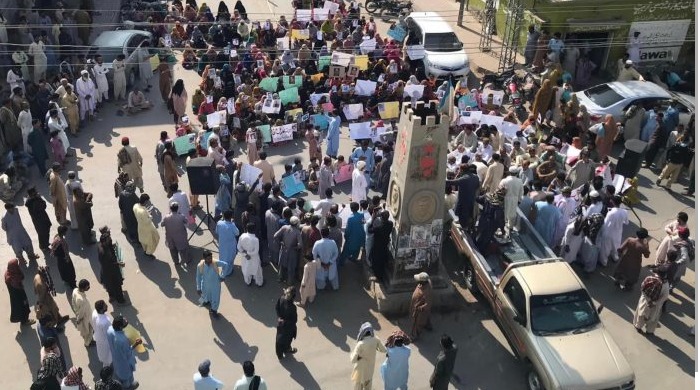
The families of the victim of enforced disappearances from different areas of Turbat protested by taking out a rally on Friday and organized a demonstration at Shahid Fida Chowk demanding the recovery of all the missing persons.

In the demonstration, regional coordinator of the Human Rights Commission, Professor Ghani Vravaz and founding head of the Balochistan Rights Movement, Maulana Hidayat Rahman, along with leaders of all parties and civil society participated and addressed.

The rally was organized by social personality and leader of the rights movement Yakub Jowski.

For the recovery of victims of enforced disappearances , women and children from different areas came and participated under the leadership of Yakub Joski. The rally was started from Turbat Press Club, which was led by the female family members of the missing persons. Apart from this, the Regional Secretary of HRPC Balochistan Rights Movement coordinator Syed Jan Gichki, BNP’s central leader Dr. Ghafur, Khan Muhammad Jan, Turbat Soul Society coordinator Gulzar Dost, and others also participtated.

The participants, holding banners and placards with pictures of missing persons and slogans on them, reached Shahid Fida Chowk and held a rally.

Haq Do Movement joins

While speaking at the gathering, Haq Do Movement leader Maulana Hidayat Rahman said that forced disappearance of Baloch youth is not a good decision for Pakistan, it will increase hatred and create distance. The people who are doing this are the people of Pak occupied Balochistan.

He said that kidnapping, murder and torture of innocent Baloch youth is not acceptable. “If we are not allowed to live with dignity by abandoning this policy, then complaining against us is also unjustified.”

HRCP’s Regional coordinator Professor Ghani Prawaaz addressed the rally and said that kidnapping and torture of civilians and dumping of dead bodies inside the state is not a good omen nor is there any scope for such a thing in the Constitution and law if disappearances are seen in the state. This is a crime under the laws, therefore, to avoid this, all forced missing persons should be immediately produced before the courts or courts and they should be dealt with as per the legal procedure.

He said that if any of the missing persons has committed any crime then they should be punished as per the laws, kidnapping or forced disappearance of someone is a crime against humanity and the courts should take action against it. Take action because the institutions of justice are the courts. If the courts do not play a role in preventing forced disappearances, then it is the worst injustice to the people.

He said that we will not give up on every kind of peaceful and democratic struggle for the recovery of missing persons.

The curious case of Pakistan’s Mianwali Air Base terror attack

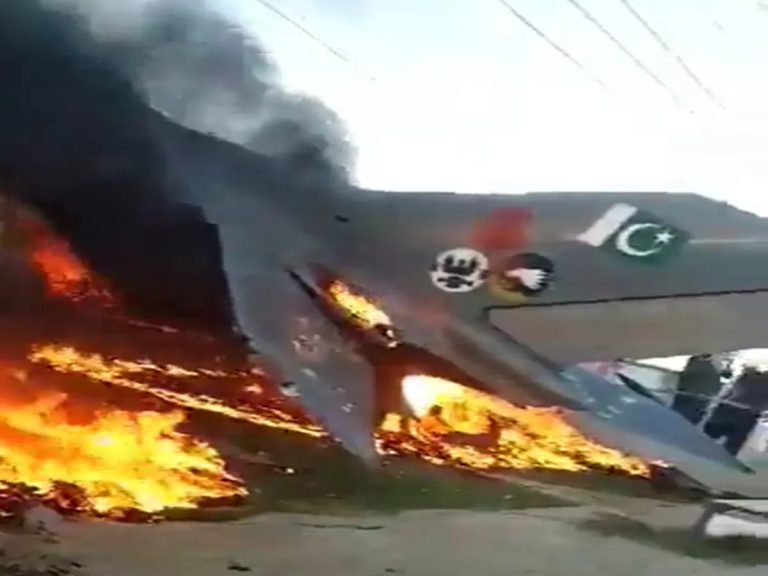
In its statement on last Saturday’s terrorist attack on the Mianwali Pakistan Air Force [PAF] training base, Pakistan Army’s media wing Inter Services Public Relations [ISPR] mentioned that “3 terrorists were neutralised while entering the base, while remaining 3 terrorists have been cornered/isolated due to timely and effective response by the troops.” It also went on to add that “during the attack, some damage to three already grounded aircraft and a fuel bowser [tanker] also occurred.” 

Skeptics may contend that since air force bases house aircrafts and extremely costly aviation equipment, comprehensive measures are instituted in such facilities to ensure safety of these valuable assets, both through all-weather surveillance devices as well as boots on the ground and hence, there’s nothing unusual about a terror attack on this air force base being foiled.

Nevertheless, foiling a terrorist attack is no mean achievement and those who thwarted it rightly deserve due appreciation for [to borrow ISPR’s words], “demonstrating exceptional courage, while delivering a timely and effective response.” What’s even more commendable is that as per ISPR, only some damage was done to three already phased out non-operational aircraft during the attack,” and that “No damage has been done to any of the PAF’s functional operational assets.”

A dispassionate examination of ISPR’s narrative on this incident however throws up several questions. By stating that terrorists were able to inflict “some damage to three already grounded aircraft and a fuel bowser [tanker],” ISPR has acknowledged that some terrorists were not only able to successfully breach multiple surveillance and security layers gaining access to the most sensitive aircraft hangar area, but also managed to damage three of them- and this is where doubts start arising about ISPR’s narrative of this incident.

ISPR mentioning that 3 terrorists were neutralised while entering the base” indicates that terrorists had lost the element of surprise [essential for a successful raid] right at the beginning while they were attempting to enter the air force base. This would have given timely early warning of the impending attack and provided adequate time for the security grid to be fully activated and facilitate suitable deployment of ‘quick reaction teams’ [QRTs]  to prevent terrorists from reaching the aircraft hangar area.

It doesn’t require rocket science to discern that aircrafts parked in hangers/on the tarmac and command and control facilities in its vicinity are the natural targets of any attack on an air base and thus, there’s no scope for those responsible for security of the air base to be confused about the terminal objective of the terrorist strike. Hence, those conversant with air base security arrangements will agree that once the warning alarms go off while an intrusion is being attempted, there’s no way a group of six heavily armed terrorists could make their way to aircraft hangers/ parking areas unmolested.

Accordingly, terrorists successfully reaching the hangar/ aircraft parking area would have been possible only in two scenarios. One, if security arrangements at the air base were inadequate and the personnel on duty slack; two, if terrorists had intimate knowledge regarding the security arrangements that enabled them to exploit the ‘blind spots’ and reach their targets easily.

‘Home grown’ terrorism is a live issue in Pakistan and terrorists have targeted airports in the past [Karachi’s PNS Mehran air base on May 22, 2011, Kamra’s Minhas air base on August 16, 2012, Peshawar’s Bacha Khan International airport on December 15, 2012, Karachi’s Jinnagh international airport on June 8, 2014]. Hence, to conclude that it was complacency on the part of PAF that allowed terrorists to intrude into its air base at Mianwali and damage aircrafts on ground doesn’t sound very convincing.

Therefore, it’s most likely that some insider[s] may have passed on security related information to terrorists that assisted them in managing to reach the most secure zone with ease. While this may sound outrageous, but fundamentalist ideology propagated by terrorist groups like Tehreek-e-Taliban Pakistan [TTP] and its affiliate Tehreek-i- Jihad Pakistan [TJP] which has taken responsibility for the Mianwali air base attack has taken roots within the Pakistani armed forces. An example is official acceptance of the fact that attackers involved in the 2011 Pakistan naval air base [PNS Mehran] terror attack, had support from within the Pakistan navy.

The next curious issue is the sheer coincidence concerning PAF assets destroyed by the attackers. As per ISPR, all that the sizeable group of six terrorists  who reached the hangar area could achieve during this strike was to cause “some damage to three already grounded aircraft and a fuel bowser.” Though completely unfamiliar with the probability theory, I still reckon that the chances of terrorists targeting three aircrafts, and all of them turning out to be obsolete machines that had already been “grounded” and were only of scrap value, are pretty slim and nothing less than a miracle!.

That’s why doesn’t specific mention that “No damage has been done to any of the PAF’s functional operational assets, while only some damage was done to three already phased out non-operational aircraft during the attack” [Emphasis added] read as something straight out of Ripley’s ‘Believe it or not’?

Similarly, while all the nine terrorists involved in this attack [in the words of Pakistan Army’s media wing Inter Services Public Relations [ISPR] “were sent to hell,” the PAF personnel involved in this operation emerged totally unscathed- no deaths, no injuries. Though theoretically possible, incurring zero casualties during such a terrorist attack is indeed a rarity. So if true, this may well be the only terrorist attack on an air force base in history during which the attackers could damage aircrafts but inflict no casualties on the security detail specifically nominated to thwart such an attempt. 

Lastly and most importantly, ISPR initially claimed that six terrorists were involved in the Mianwali air base attack but then raised their number to nine. In the heat of the moment, error in assessing the strength of terrorists is not uncommon and to make matters worse, numbers seem to be ISPR’s particular weak spot. Remember how on February 27, 2019, DG ISPR pompously claimed that Pakistan had two Indian Air Force pilots in its custody, but within hours ‘revised’ this number to only one!

In the meantime, TJP has released photos and names of its fighters who took part in the Mianwali air base attack. However, contrary to ISPR’s claim of nine attackers being involved, TJP’s list contains details of only seven participants, and this glaring disparity certainly raises eyebrows. TJP holding back details of two fighters doesn’t make any sense- au contraire, by not glorifying their purported  ‘martyrdom’ is tantamount to officially disregarding the so called ‘sacrifice’, which being a highly de-motivating factor  is something TJP will never do. Incidentally, TJP has also released a five minutes video showing hangars ablaze, and though not very clear, it does appear that substantial damage has been caused to aircrafts and that possibly one or two security force personnel have also been killed.

So, could it be that after its initial declaration of there being only six terrorists involved and ISPR’s claim that half of them were killed while trying to enter the airbase, ISPR realised that just 3-4 terrorists managing to damage three aircrafts [as claimed] didn’t convey a positive image of PAF’s professional acumen, and so the figure of terrorists involved was ‘padded-up’ to nine? Similarly, isn’t it likely that ISPR’s claim that only “phased out non-operational aircraft” were damaged by terrorists is a puerile attempt to downplay the actual losses, which could well be substantial? 

Given ISPR’s brazen proclivity for manipulating facts, wouldn’t it be fair to say that its statements on the Mianwali air base terrorist attack needs to be taken, not with a pinch but a handful of salt? 

Quetta Police kills Pashtun leader Naseebullah Achakzai after a week of abduction

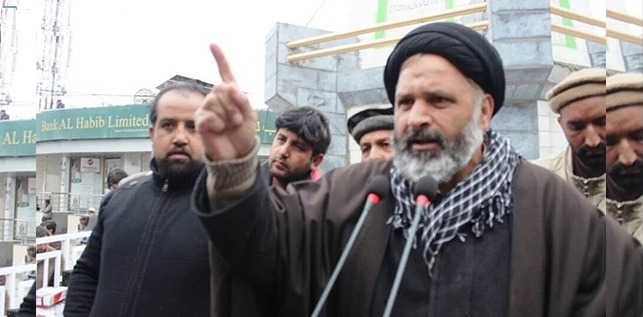
Hundreds of protesters, along with family members and supporters, initiated a demonstration in front of the Governor’s House in Quetta’s Red Zone, demanding an inquiry into the abduction and subsequent killing of Naseebullah Achakzai. The uproar follows the latest development revealing his demise three days ago, at the hands of the Quetta Police.

The sequence of events dates back to the night of November 10 when the prominent figure, a business magnate of Pakistan occupied Balochistan and a political leader affiliated with the Pashtoonkhwa Milli Awami Party (PkMAP), was abducted by unidentified individuals. Initial reports suggested that armed men intercepted Achakzai in the Baleli area on the outskirts of Quetta while he was en route from Chaman to Quetta.

Naseebullah Khan Achakzai buried in front of Governor’s house

Reports indicate that the armed men forcibly took Naseebullah Achakzai from his vehicle at the Quetta-Chaman national highway, taking him away to an undisclosed location. However, the recent revelation points to his killing by the Quetta Police in what they termed an encounter, raising suspicions and fueling the ongoing protests.

Amid the chaos, his grieving relatives proceeded to bury his body in the Red Zone, near the Governor’s House, as a symbolic gesture of their profound anguish and protest against the suspected injustices surrounding his demise.

The demonstration amassed significant momentum as numerous protestors, including influential leaders from the Pashtun Tahafuz Movement (PTM) at both central and provincial levels, joined forces, amplifying the demand for a thorough investigation into the circumstances leading to Achakzai’s abduction and subsequent encounter.

Discrepancies in official accounts

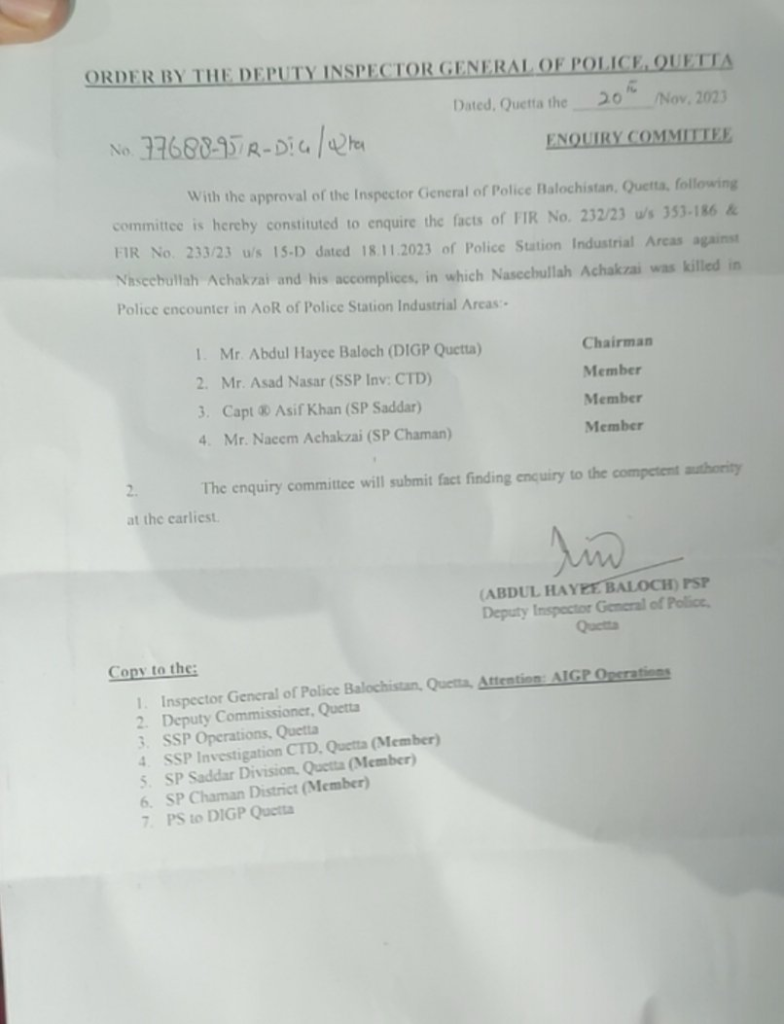
Following the fervent protests, authorities were compelled to respond, leading to the formation of an inquiry committee by the Deputy Inspector General (DIG) of Quetta. Interestingly, the order copy acknowledged a fact that Naseebullah Achakzai was indeed killed in an encounter. However, discrepancies emerged between official statements, with the Caretaker Information Minister of occupied Balochistan, Jan Achakzai initially claiming awareness of the abduction only through social media.

Orde Copy Of The Formation Of Enquiry Committee (Photo: News Intervention)

These discrepancies and contradictions between official accounts have substantiated the protestors’ assertions of a potential conspiracy behind Achakzai’s untimely demise. The suspicions cast a shadow on the sequence of events, hinting at the possibility of a deliberate abduction and staged encounter orchestrated by the Quetta Police.

All Pakistan Paramedical Staff Federation lambasts Pakistan Army over abduction of doctors

The All Pakistan Paramedical Staff Federation, through its representatives, has expressed deep apprehension regarding the recent abduction of doctors, particularly highlighting the case of Dr. Ismail. Dr. Ismail, undergoing orthopedic training at Jinnah Postgraduate Medical Center in Karachi, was forcibly taken from his home on November 11, 2023, by unidentified individuals and has since remained missing.

In response to this distressing incident, The All Pakistan Paramedical Staff Federation President Jamal Shah Kakar, General Secretary Hafiz Muhammad Usman Zehri, and Chairman Karim Agha conveyed their serious concerns. They emphasized that while healthcare professionals dedicate their lives to combating life-threatening illnesses like Congo and Corona, they are unfortunately becoming targets of abductions.

President Jamal Shah Kakar underscored that the government must not turn a blind eye to such abductions targeting doctors and healthcare providers. He warned the government operating in Pakistan and occupying governments in Sindh and Balochistan, stating that immediate action to rescue and ensure the safe return of Dr. Muhammad Ismail is imperative. Failure to do so may prompt the Paramedics Federation to initiate a countrywide protest, including a boycott of services, holding the occupying government of Sindh accountable for the consequences.

The federation’s statement also urged the Caretaker Chief Minister of Pakistan occupied Balochistan to take decisive steps at the provincial level to facilitate Dr. Ismail’s recovery. Additionally, they emphasized the urgency of establishing contact with the occupying government in Sindh to expedite the safe retrieval of Dr. Ismail.

The abduction of doctors has been a long persistent issue in Pakistan. Even the doctors have been abducted on the indications of Pakistan Army that runs the country from backdoor. While it is still a matter of question that who abducted Dr. Ismail, the expectation of his return, especially in a country where army operates like goons, remain minimal.

Sindh witnesses abduction and forceful conversion of a Hindu mother of four children

A chilling incident has struck Shahdadpur city of the Sanghar district in Sindh, where Pangla Bheel, a Hindu mother of four children, was forcibly abducted from her home.

The situation took a dire turn as Pangla, along with her four kids, became a victim of forced conversion to Islam against her will. Even more alarming, she was purportedly married off to a Muslim man. What makes the case worse is the confession of the person whom she has been married.

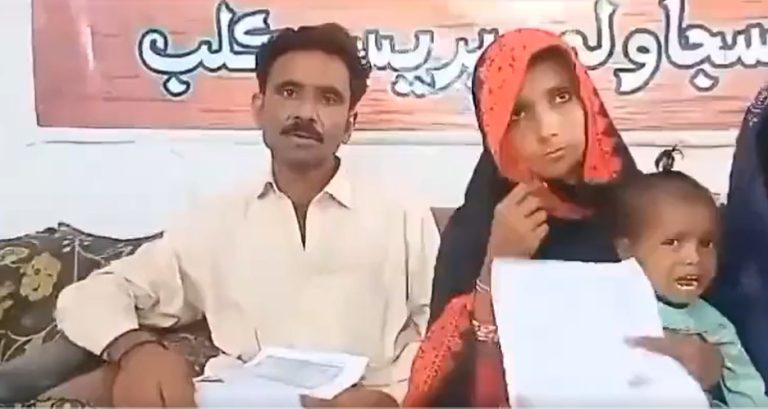
In a viral video on social media, the man (speaking in Sindhi) tells his name Sai Baksh and claims that he didn’t even knew Pangla before he got married to her. As per him, some people abducted her and then converted her. Later she was brought to him and he married her. This shocking revelation highlights the looming condition of Hindu women, as they neither have rights, security and a choice to marry someone.

This incident isn’t isolated; tragically, it adds to a series of similar cases where Hindu girls and women are forcibly converted to Islam before being married off to radical Islamists. The plight of the Hindu community in Pakistan remains a deeply concerning issue, exacerbated by the lack of protection and justice.

Amidst this turmoil, the Islamic clerics often lend their support to radical Islamists who orchestrate these illegal conversions, while the authorities, including the police, often turn a blind eye. Worse still, a nexus of anti-minority factions utilizes falsified documents to depict these coercive actions as voluntary choices.

This distressing reality of Hindus in Pakistan remains largely unnoticed by international human rights organizations. The voices of those affected by these atrocious acts as echo in the silence of indifference, highlighting a grave disregard for basic human rights and religious freedoms.

Attack on Pak police vehicle in Nasirabad of Pak-occupied Balochistan

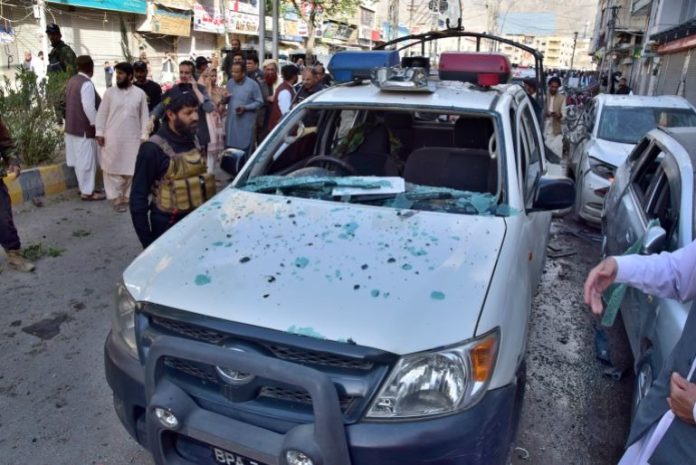
In a recent incident, a police vehicle in the Nasirabad region of Pak-occupied-Balochistan was attacked by an improvised explosive device (IED). The targeted police vehicle, stationed near Chandiya Depot within the jurisdiction of Manjho Shori Police Station, suffered damage in the blast.

While the extent of casualties remains undisclosed, authorities report damage to the police vehicle. Pak security forces and intelligence personnel swiftly responded, reaching the site to initiate thorough investigations. Checkpoints have been established in the vicinity as part of heightened security measures.

The attack is the latest in a series of violence in Pak-occupied Balochistan, which has been plagued by unrest in recent years. Pak Army have frequently targeted innocent baloch youths and commits atrocities through daily home raids, disappearances, staged encounters, target killings, torture, humiliation at checkpoints, and kidnappings for ransom. 

Pak-occupied Gilgit-Baltistan: Students of Karakoram International University protest against fee hike

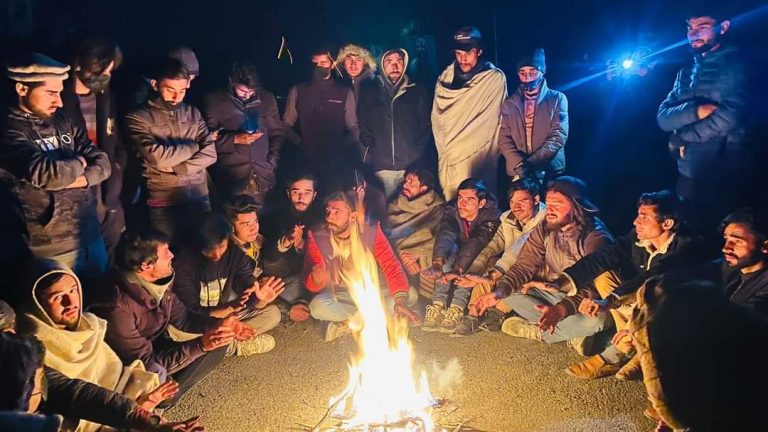
Students of Karakoram International University (KIU) in Gilgit district of Pakistan-Occupied Gilgit-Baltistan staged a fierce protest in front of the university in sub-zero temperatures at night against the increase in university fees.

The protesting students have demanded from the government that due to the increase in fees, there is severe anxiety among the students and to immediately resolve the issue and reduce the fees to meet the demands of the students.

The students are protesting for acceptance of their demands for over a year. They had said that the university administration had been increasing the semester fees against Higher Education Commission (HEC)’s policy.

It is well established fact that Pakistan uses its subversive policies to keep the Kashmiris away from education. The sole purpose for this is to ensure that no individual gets the required education that makes them vocal for their rights. The fee hike when the region is already grappling with the issues of price hike in wheat and other basic amenities.

Similar protests were held in the past also. On October 6, a protest was carried out by blocking the Karakoram International University Road for hours against the indiscriminate and unjustified fee hike. They also raised concern over the mismanagement in the University. Interestingly, the protest, at that time, was supported by the parents also. Not only did the university, but students of schools had also protested against the indiscriminate fee hikes in the past. Notably, Pakistan, which has illegally occupied Gilgit Baltistan for more than 75 years, is making efforts to acquire and exploit the land but does not want to give its reasonable share to the native people who have the right over the resources.

Struggle for “employment rights” in Pak-occupied Jammu and Kashmir

0

The rulers of Pakistan-occupied Jammu and Kashmir (POJK) have not been able to solve even one basic problem of the workers and youth, nor do they have any compunction in creating problems. They place the blame for all issues on government employees while failing to provide free education, healthcare, infrastructure development, and employment. The government is talking about depriving the government employees of all basic human rights through the Special Power Act. Instead of creating new employment opportunities, they are trying to dismiss employed youths to support unemployed youth.

The army-based government of 27 ministers is sacking thousands of temporary employees who have been working for many years in the name of merit in competitive exams. After November 30, the extension and salaries of temporary employees have been terminated, and hardworking individuals are being forcibly dismissed from employment.

Most appointments in POJK have been made on a temporary basis for a long time. The sword of unemployment hangs over the heads of the employees by making contracts of three and six months, preventing them from speaking up for their rights due to fear. Attempts are being made to terminate the contract employees after 15 to 20 years of service without pension and other benefits. After laborers have toiled for a lifetime for meager wages, when they are no longer able to work, they are left helpless to die of old age, disease, and hunger—sobbing and dying.

Law abolished

Three months after coming to power, the Tehreek-e-Insaf government in the region announced the abolition of the law on permanent ad-hoc employees in a cabinet meeting on October 28, as a result of which more than 4,000 employees could be fired. This ad-hoc act was passed by PML-N in the last year of his rule, according to which all temporary employees were made permanent, and ad-hoc appointments were banned. The Tehreek-e-Insaaf government apparently scrapped the act to restore merit, but the motives behind it were the same as those of previous occupying governments of POJK. By abolishing this act, the government took away the right of permanent employment from the employees, but there was no change in the policy of ad-hoc appointments; rather, the occupied government continued to make ad-hoc appointments of its favorite individuals.

The responsibility of governments in this region is not to provide employment to all citizens but to provide employment to a certain number of workers of their respective political parties. According to them, the one who is not related to the ruling party is not fit for the job; he should be dismissed from the job. The parasitic ruling elite of this region has completely failed to provide employment to the youth here.

The occupying government has not been able to provide employment to even 10 percent of the people. There is no manufacturing sector here. Services are the only sector that employs one lakh people. The region’s economy is largely dependent on foreign exchange remittances from overseas workers. There are 100,000 jobs in a population of 4.6 million, which all the members of the local elite try hard to co-adjust their close ones. They have no program to create new employment.

The question of distributive justice

It is said that ad hoc employees do not meet merit. If they do not meet merit, why were they employed for so long without unionization and job security? The policy of ad hoc appointments was made by the rulers in this assembly or by the employees? Those who clamor for merit forget that in a class system not every human being has equal opportunities for education. Basically the question is of a palace and a hut-dweller cannot compete, with different standards of food and education. The environment at home is different. The elimination of the class system is also necessary for the examination of transparent competition, where human beings are given equal opportunities to advance. Even if education alone is considered as the standard, the outdated education system is killing the creativity of students instead of harboring it.

In a capitalist system, workers have no choice but to sell their labor to survive. If labor is not sold and employment is not found, life cannot continue. Today, all avenues of life for the youth and workers of POJK are being blocked. Employment is a fundamental right of every human being, which is also recognized in the state constitution. Instead of providing employment, the promotion of merit restoration by taking away existing employment reflects the hypocritical thinking of the ruling class.

Noise of merit to cover up failure

The ruling class makes a noise of merit and ability to cover up its failure to provide employment to the unemployed youth, so as to convince the unemployed that it is not the system nor the state that is responsible for your unemployment. Already unemployed people are responsible for your unemployment.

Don’t those young people of this region live up to their merit who are selling their labor all over the world and burning in the hot desert of Arabia? Fed up with the humiliation of unemployment, those who try to get to Europe illegally, fall into the hands of human traffickers and lose their lives.

All the temporary employees have to reject the propaganda of the rulers that the temporary workers are not eligible for employment. They are not unqualified workers; it is the rulers who cannot provide employment for all the youth. 40 out of 4000 vacancies. If 1,000 unemployed youths are dealt with, it does not mean that 36,000 youths who have not found employment are ineligible. Permanent employment is a right, for which permanent employment is given to temporary employees and employment or unemployment allowance to unemployed youth. Struggle will have to be fought. If the temporary workers wait trusting relations with the rulers and the bureaucracy, defeat will be their destiny. Unity and protest of the workers is the strength by which the onslaught of the rulers can be resisted