Home Blog Page 171

Pakistan Army disallows Diwali sweet exchange between Kashmiris in POJK

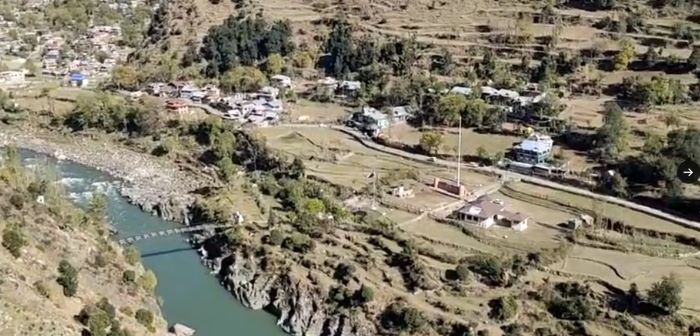
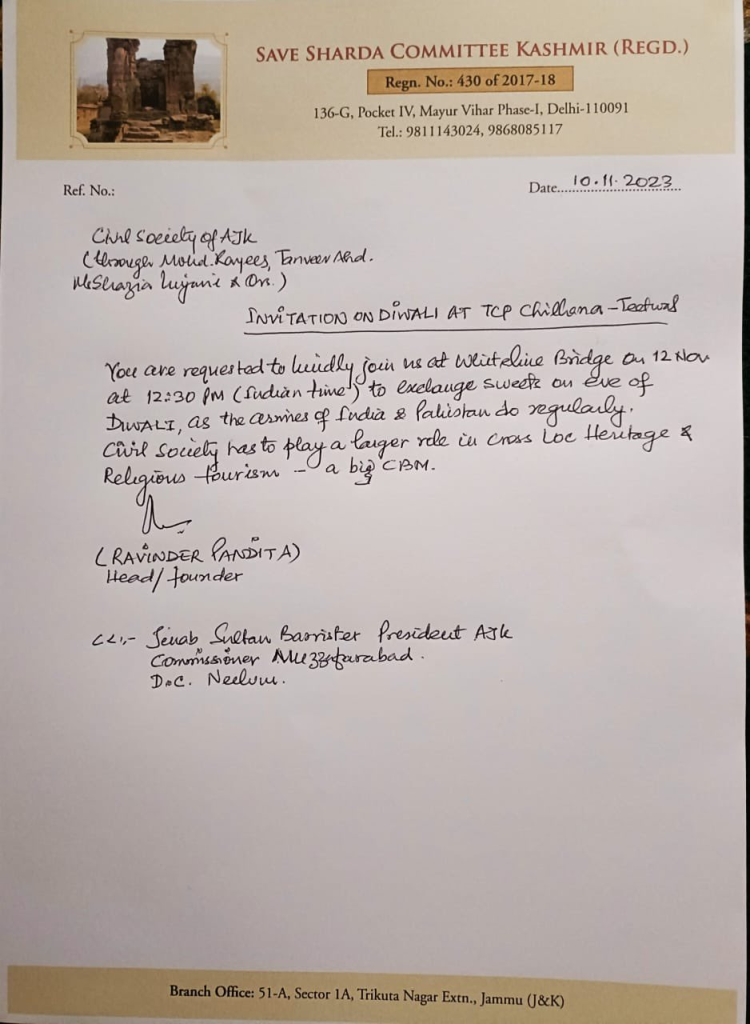
Pakistan Army denied Diwali sweet exchange between civil societies of Indians across LOC. Ravindar Pandita, the founder of Save Sharda Committee Kashmir invited civil society of POJK to join them at Whiteline Bridge at Teetwal on Diwali (November 12) and exchange sweets. The idea behind it was the people-to-people connectivity on the line of same exchanges happening between the Indian army and the Pakistan Army on Diwali and Eid.

Invitation Letter For Diwali Exchange By Save Sharda Committee Kashmir (Photo: Social Media)

In regard to this , the civil society in POJK sought permission from the occupying Pakistan Army, only to face disappointment as the occupying army denied such exchanges between people across LOC. On the contrary, Indian Army allowed the civilians from this side of Kashmir for the exchange.

Disappointed by this, Mr. Pandita outlined the discrimination of the Pakistan Army. He took to the X (formerly twitter) saying, “While our army does allow us to whiteline under proper protocol, you (Pakistan Army) don’t allow ordinary state subjects, but you allow your army families – a clear discrimination ! We had finally to come back from crossing bridge to acknowledge hard efforts of our fellow riyasatees by waving white cloth (peace symbol) who started 6 hour journey in icy winds to meet & greet us at Chilhana – Teetwal crossing point.”

Deliberations for opening of Sharda Peeth

It is worth noting that after 75 years, Sharda Devi temple in Kupwara celebrated Diwali. This happened along with the persisting calls for opening a corridor for Sharda Peeth, a revered Shakti Peeth of Hinduism in POJK. Accordingly, Save Sharda Committee Kashmir is raising the voice on behalf of fellow Kashmiris and Hindus to open a corridor similar to Kartarpur.

Therefore, it is unfortunate that, Pakistan Army denied Diwali sweet exchange, probably, because of their fear of increasing cohesiveness between the Kashmiris on both sides of LOC. Nonetheless, since 2021, it is the nineth time that the members of civil societies have not been allowed to go down to Whiteline bridge to meet the fellow Kashmiris, which is the official crossing point. Last time, on Sharda Divas- annual Sharda Yatra Day (September 23) also, Pakistan Army denied such an exchange of wishes in person at Teetwal.

J&K DGP to encourage surrender and mainstreaming of misguided youth

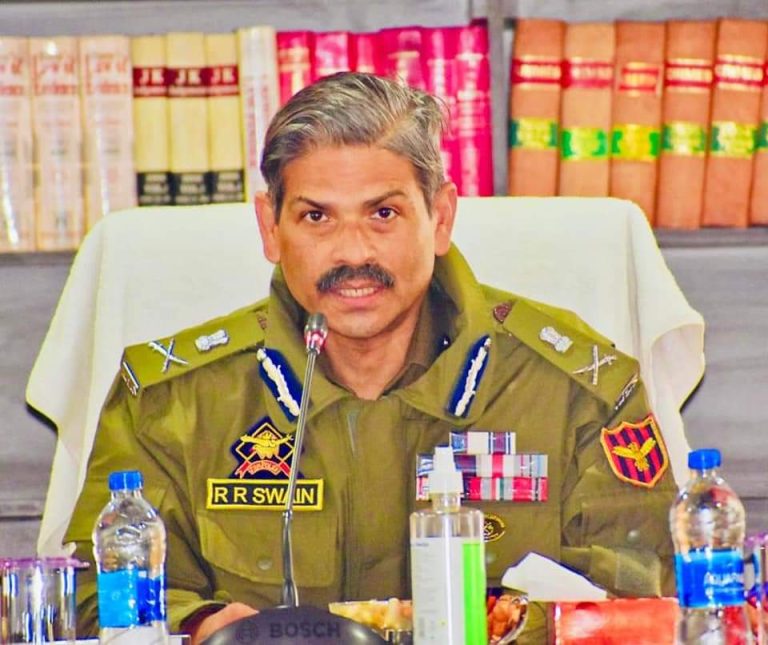
In a groundbreaking move, R.R Swain, DGP of J&K has unveiled a multifaceted strategy to eliminate terrorism in the region. The initiative involves a dual approach of encouraging local militants to surrender their arms and launching major anti-terror operations. Reports suggest that the agencies are also focusing on disrupting the factors that lead to the recruitment of local youth into militancy.

Acknowledging the need for a nuanced approach, security forces are contemplating a plan to halt the recruitment of young individuals into militant groups. Central to this strategy is a deep understanding of the emotional and psychological influences that drive youth to join militant ranks. Additionally, efforts are underway to disrupt the social and cultural support for militancy, aiming to reduce or eliminate local recruitment.

Declining militancy and terrorism in Kashmir

Recent years have witnessed a significant decline in the lifespan of militants in Kashmir, with 70% of insurgents surviving less than a year after joining militant groups. This trend is attributed to improved coordination among security forces, a robust intelligence network, and the inadequate training of militants.

The newly appointed J&K DGP, R R Swain, in a high-level security review meeting in Anantnag, has affirmed the force’s commitment to preventing terrorist recruitment and ensuring the safety of the local population. Swain stated, “We will reach out to the misguided youth and motivate them to return. If they choose to return, we will receive them with love and hand them over to their parents.” However, he issued a stern warning to those who have made up their minds not to return or are motivated by financial gains, stating that they will face strict action.

Swain, emphasized that any communication or interaction with Pakistan-based handlers would be considered a crime, and the Jammu and Kashmir police would act rigorously against such individuals. In the pursuit of ending the militancy, the hit would be made to the core while ensuring minimal collateral damage. In the meeting it was also discussed that there would be a deep investigation as to who motivated the youth to join terrorist gang, who provided arms and ammunition, which madrasa or school did he go to, who were his friends and teachers, who helped him to contact the handler and which handler is responsible for putting his future to darkness.

The issue of recruitment of juveniles and sub-adults was also discussed in the meeting.

Previous surrender policies

The Jammu and Kashmir Police and the Army had previously initiated a surrender policy for local youth, where parents were called to encounter sites to persuade trapped militants to surrender. Local militants were often given opportunities to renounce arms and surrender during encounters.

The first surrender policy was introduced in 1995 during the peak of militancy, offering incentives such as a fixed deposit of Rs 1.5 lakh, a monthly stipend of Rs 1,800, and vocational training. In 2004, a revised policy applicable to both known and dreaded militants was approved, providing similar incentives. Despite these efforts, authorities have recognized the need for strategic changes to effectively deter local youth from joining militant ranks in the initial stages.

J&K government asks over 990 officials to verify their appointments

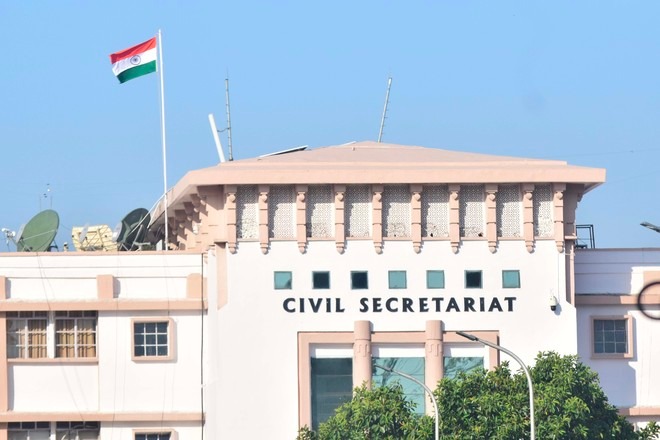
In a significant move, the Jammu and Kashmir government has requested all administrative departments to provide ‘supporting documents’ for the verification of appointments to a committee headed by the principal secretary of the finance department before November 15 for Jammu and Kashmir Human Resource Management System (JKHRMS). This development has raised eyebrows, particularly with the inclusion of two judicial officers in the list, whose records were previously verified by the High Court during their induction into service. Notably, the government appears not to have consulted the High Court regarding these appointments. On the other hand, the unavailability of the appointment documents sparks concerns over potential discrepancies and bypassing of procedures, particularly pre-2019 when Article 370 was in effect.

This initiative comes on the heels of the withholding of salaries for over 990 officials since the implementation of the Jammu and Kashmir Human Resource Management System (JKHRMS) in October 2022. The General Administration Department (GAD) has issued an office memo dated October 31, urging employees to submit ‘supporting documents’ to establish the genuineness of their appointments.

The breakdown of affected officials reveals that 541 employees from the Health and Medical Education Department, 128 from Irrigation and Flood Control, and 83 from the Education Department are among those facing salary issues. Other impacted departments include Industries and Commerce, Home, Jal Shakti, Public Health Engineering, Agriculture Production, Consumer Affairs and Public Distribution, Finance, Forests, General Administration, PWD, and Hospitality & Protocol.

Supporting Documents

The required ‘supporting documents’ encompass various records such as the first page of service books, recommendations of Service Selection Board (SSB)/Public Service Commission (PSC) in case of direct recruitment, muster roll entries, and documents related to contractual or ad-hoc employment. All documents must be submitted to the GAD by November 15 for further review by the committee headed by the principal secretary of the finance department.

The JK-HRMS, launched in October 2022, aims to streamline employee services, including the maintenance of digital service records, postings and promotions, GP Fund, income tax statements, and performance monitoring. The decision to disburse October 2022 salaries exclusively to employees registered on the JK-HRMS underscores the government’s commitment to digitizing governance and restructuring the administration.

A senior officer in the Union Territory administration justified the decision, stating that the GAD has already received supporting documents for a significant number of affected employees. The resolution of issues concerning the remaining employees, reduced to 600-700, is anticipated in the coming days.

This development not only reflects the government’s commitment to addressing potential irregularities but also underscores the broader agenda of mainstreaming the Union Territory and enhancing accessibility for efficient governance. The HRMS implementation is poised to play a pivotal role in modernizing administrative processes, ensuring transparency, and fostering a more responsive government.

Pak-occupied Gilgit Baltistan: ‘Targeted Subsidy’ on wheat sparks political turmoil

Pakistan-Occupied Gilgit-Baltistan (POGB) region is witnessing a surge in political tensions following the occupying government’s decision to implement a “targeted subsidy” on wheat prices. The move, aimed at restructuring the subsidy system, has ignited fresh waves of discontent in a region already grappling with political complexities.

Illegally occupied and administered by Pakistan and entwined in the broader POJK issue, POGB has long experienced a sense of political disempowerment. The latest trigger for discontent stems from the occupying POGB government’s resolution to introduce a “targeted subsidy” on wheat prices, a decision met with skepticism and resistance.

Subsidy withdrawal is violating international law

Until now, the federal government in Islamabad had been providing subsidized wheat to the people of POGB as the territory is disputed and is under its control. However, faced with national financial constraints, Islamabad has been contemplating the withdrawal of this subsidy, which is a sheer violation of UN rules. The regional government, which is a puppet at the hands of the Pakistan Army in POGB, also views the subsidy as a hindrance to development projects, as approximately 10 billion rupees are allocated annually for providing subsidized wheat.

A recent announcement by a cabinet member of the occupying POGB government revealed that henceforth, only individuals earning below a specified income threshold will qualify for subsidized wheat. While the announcement came recently, the deliberation to do so were ongoing for past many months.

The occupying POGB government defended its decision of targeted subsidy, asserting that the cost dynamics of wheat procurement are becoming unsustainable. According to official statements, a 40kg bag of wheat grain costs the government around 4,900 rupees, while imported wheat stands at approximately 6,200 rupees per bag. In contrast, the local populace in POGB has been accustomed to acquiring a 40kg bag of wheat grain for nearly 1,100 rupees. The government contends that the rising cost of wheat has strained its ability to meet the demand.

In response to the decision, government officials above Basic Pay Scale 17, including those in constitutional positions, will no longer receive subsidized wheat. Moreover, subsidized quotas for government departments, dignitaries, and special institutions have been rescinded.

Concerns of people in POGB

The decision has encountered fierce opposition from the Awami Action Committee, a coalition of civil society organizations and political parties. They have announced plans for mass agitation if the decision is not reversed. Opponents argue that POGB, classified as a disputed territory has a limited per capita landholding. The situation is more aggravated as Pakistan Army has illegally acquired large portion of land of the inhabitants using Land Reform Act, leaving inadequate cultivable land. And so after illegal occupation of region and illegal land capturing, it is solely the duty of Pakistan to provide subsidized wheat and other basic amenities.

Also due to political and constitutional disempowerment, Pakistan has a duty to provide wheat subsidies to the region. The subsidy serves as a crucial support system for a population grappling with poverty and a lack of constitutional rights. And in case Pakistan is incapable to provide the subsidized wheat to the people of POGB while thriving on its resources, it should vacate the region with immediate effect.

Pakistan has, time and again, withdrawn the subsidy in the past, resulting in organizations like the Awami Action Committee mobilizing significant protests and compelling the federal government to reconsider its decisions. Through consistent withdrawals, Pakistan tests the situation so that the burden of subsidies can be eliminated once and for all, rendering POGB a mute spectator of its own deterioration, similar to other states in Pakistan.

Police arrests Ali Wazir for his participation in the Chaman protest, Pakistan

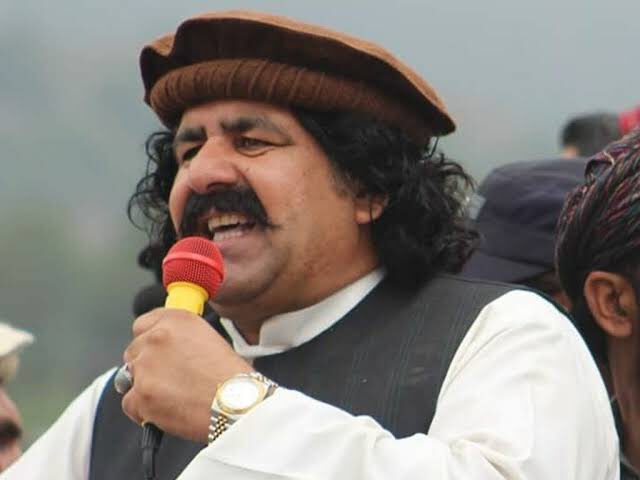
Ali Wazir, the former member of the National Assembly and a member of the Pashtun Tahafuz Movement (PTM), has once again been arrested by the Khyber Pakhtunkhwa Police. The police apprehended Wazir at the Daraban checkpoint on the orders of the Pakistan Army after he returned from the Chaman protest. It has been 25 days since thousands of Pashtuns have been staging a protest at the Chaman border against the new rule of mandatory passport checks at the Pakistan-Afghan border.

On November 13th, Ali Wazir visited the site and actively participated in the protest. During his address, Wazir stated, “I don’t accept Durand; I don’t accept this passport, and I don’t accept this state.” The arrest has been highly secretive, and no police station in Dera Ismail Khan is confirming his presence in custody.

This is not the first time he has been arbitrarily arrested. Pakistan Army had previously detained him multiple times, and each arrest was deemed illegal. The primary motive behind these arrests by the Pakistan Army and its puppet administration has consistently been to suppress his voice, which brings attention to the issues faced by Pashtuns and their precarious situation. As a former parliamentarian and a vocal Pashtun leader, Wazir’s voice amplifies the concerns of Pashtuns that often go unnoticed under an authoritarian regime.

In Chaman, the voices of hundreds of thousands of Pashtuns have been unheard for the past 25 days, with minimal global attention. The government has taken no measures to address their genuine issues; instead, it is attempting to quell their voices. Ali Wazir’s participation in the protest and his stance on the passport issue has elicited a strong reaction from the Pakistani establishment, leading to his apprehension by the nervous Pakistan Army.

Diwali marks a historic return to Sharda Devi Temple in J&K after 75 Years

In a historic event, the Mata Sharda Devi temple in Jammu and Kashmir’s Kupwara district witnessed the celebration of Diwali for the first time in 75 years on Sunday (November 12). The temple, reconstructed on the Line of Control (LoC), saw the lighting of earthen lamps and the performance of prayers, marking a significant milestone since 1948.

Post the completion of Diwali rituals, jubilant crowds gathered outside the temple, joyously bursting crackers. Ravinder Pandita, Head and founder of the Save Sharda Committee, expressed happiness, stating that the festivities mirrored those from 75 years ago, following the temple’s renovation and inauguration on March 22.

Calling attention to the government, Pandita appealed for the opening of the Sharda Peeth, drawing a parallel with the Kartarpur Sahib corridor inaugurated in November 2019. He emphasized the importance of reviving the pilgrimage to Sharda Peeth, an ancient temple in Pakistan-occupied Jammu and Kashmir (POJK), which holds historical and cultural significance as one of the 18 revered Shakti Peeths in South Asia.

Sharda Peeth across POJK

The Save Sharda Committee played a pivotal role in the reconstruction of the temple and a Sikh gurdwara in the same vicinity. The reconstruction aimed at restoring the centuries-old pilgrimage route to Sharda Peeth, an abandoned temple along the Neelum River that was a prominent center of learning.

“The inauguration of this Sharda Devi temple took place on March 22 after its renovation, as it had been demolished during past attacks. Before the tribal raids in 1947, a dharmshala and a Sikh gurdwara stood at the same plot, both destroyed during the raids,” Pandita explained. Teetwal, a traditional pilgrimage route to Sharda Peeth, had been discontinued since 1948 due to tribal raids and partition.

Meanwhile, Diwali was celebrated with enthusiasm in Jammu and Kashmir, with the local Hindu population and security forces participating in the festivities. Major temples in Srinagar City and across the valley were illuminated, and the iconic Clock Tower in Srinagar became a focal point for both tourists and locals to join in the celebration. The Kashmir Valley has undergone significant changes since the abrogation of Article 370 and 35A from the Constitution in August 2019.

‘Baloch people seem to have been denied the status of being human’: Mama Qadeer Baloch, VBMP protest

A demonstration camp against enforced disappearances, organized by the Voice for Baloch Missing Persons (VBMP), continued its protest in front of the Quetta Press Club on the 5229th day (14 years). On this occasion, Mohammad Akbar Baloch, Noor Mohammad Baloch, and other men and women gathered to express solidarity.

Mama Qadeer Baloch, the organization’s Vice Chairman, stated that while institutions worldwide actively address grave human rights violations, including forced disappearances and ethnic cleansing, Baloch people seem to have been denied the status of being human. He pointed out that the Baloch community’s struggle against enforced disappearances and human rights abuses, akin to war crimes, is met with silence and indifference from institutions responsible for promoting peace and justice.

UN loses relevance

Mama Qadeer Baloch at VBMP protest highlighted that the United Nations, having lost its impartiality, seems confined to dancing to the tunes of imperial powers and their puppet rulers. Despite the staggering figure of 60,000 Baloch individuals illegally disappeared, thousands of whom were brutally killed and their bodies dumped in desolate areas, international organizations and champions of human rights turn a blind eye to this inhumane tragedy.

He emphasized that despite the relentless and heart-wrenching struggle of the families of forcibly disappeared Baloch individuals, the authorities remain unmoved. The families persist in their peaceful and unwavering efforts to recover their loved ones, demanding that if their dear ones are criminals, they should be presented in courts to face legal proceedings.

Mama Qadeer Baloch concluded by expressing the families’ repeated demand for justice and urged the international community to acknowledge the plight of the Baloch people, who continue their peaceful struggle for the recovery of their missing loved ones.

Notably, Pakistan Army, since its illegal occupation of Balochistan, has wrecked havoc over the Baloch people. To continue its occupation, the imperialist force has employed various tactics including the killings and enforced disappearances. Pakistan Army has installed check posts in each district and at each sub-district in the name of security, however, their main motive is to screen Baloch. The one with a voice of dissent or having the potential to raise the voice for their rights is marked and later abducted by the Army. This precarious condition has continued for the past few decades. In cases, the disappeared individual never return or their mutilated dead body is found. To raise voice against this Pak-sponsored atrocity VBMP is protesting in front of the Quetta Press Club since the past 14 years.

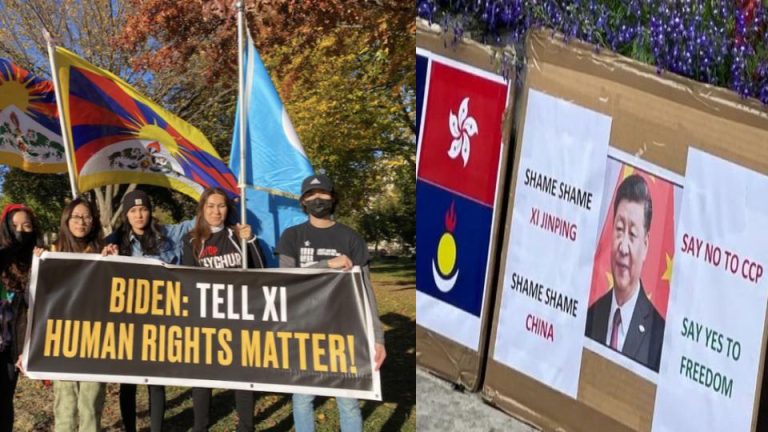
“Dictator Xi Jinping, Your Time is Up! Free Tibet”: Students for a Free Tibet

In a demonstration of support for Chinese-occupied Tibet, activists unfurled a banner condemning Chinese President Xi Jinping as a “dictator” on the roof of San Francisco’s Moscone Center just before the Asia-Pacific Economic Cooperation summit. The group responsible, Students for a Free Tibet, asserted that three of its members orchestrated the event.

The banner, boldly stating “Dictator Xi Jinping, Your Time is Up! Free Tibet”, was displayed briefly over the entrance to Moscone North around noon on (10 Nov) Friday. Witnesses, including a Moscone Center employee, reported the activists shouting “Free Tibet” for about a minute before voluntarily retracting the banner.

The action was taken to draw attention to the Chinese government’s repression of Tibetans and to demand an end to China’s occupation of Tibet.

Xi Jinping as “Dictator”

Law enforcement confirmed that no activists were detained, with an officer stating, “It was there for two minutes, as soon as we saw it, they rolled it up.” Tenzin Namgyal, a 17-year-old Tibetan-American activist involved in the protest, expressed the group’s desire for President Biden to address concerns about the Tibetan issue, citing attacks on language, religion, and culture under President Xi’s rule.

The APEC summit is set to commence on 12th Nov and features leaders such as Xi and President Biden. Activists, addressing issues like climate change, trade policy, and the Israel-Hamas conflict, plan multiple protests during the summit, anticipated to draw a significant crowd to San Francisco.

Free Tibet Advocates

Students for a Free Tibet advocate for the independence of Tibet from China, emphasizing Tibet’s historical status as an independent country. China, however, maintains that Tibet is an integral part of its territory.

Tibetans have been resisting Chinese occupation for centuries. In 1959, the Dalai Lama, Tibet’s spiritual leader, fled Tibet after the Chinese army invaded the country. Since then, Tibetans have been fighting for their independence. However, the Chinese government has brutally suppressed Tibetan dissent.

In recent years, the Chinese government has cracked down on Tibetan culture and religion. The government has also imposed restrictions on travel and communication in Tibet. The Tibetan activists’ action is a reminder that the Chinese government’s repression of Tibetans is a global issue that deserves the attention of the international community.

Thousands of Afghans go into hiding in Pakistan to avoid forced eviction from the country

Human rights activists have said that after the government’s decision to deport undocumented people, thousands of Afghans living in Pakistan for years have gone into hiding because they are facing oppression and persecution under the Taliban administration in their native country. Afraid of facing it.

A 23-year-old Afghan woman while talking to a news agency online from an undisclosed location said, ‘Her door is locked from outside, we are confined inside, we cannot turn on the lights, even we can talk loudly. Can’t even do it’.

Others said that local supporters had locked the doors to assure neighbors that the house was empty.

The woman from Kabul said that she was afraid that if she returned to Afghanistan, she would be prosecuted by the Taliban administration because in 2019 she had left Islam and converted to Christianity and had renounced the Islamic faith. This is a serious crime under the Taliban’s strict laws.

Human rights activists believe they are among the thousands of people who have gone into hiding in Pakistan to avoid eviction as the government pressures undocumented migrants to leave the country.

The administration has initiated action to capture the Afghans living in Pakistan after the November 1st deadline to voluntarily leave the country was passed.

Sijal Shafiq, a 30-year-old human rights activist based in Karachi who has helped many vulnerable Afghans find residency before the government’s policy, is among other petitioners asking the Supreme Court to stop implementation of the government’s deportation decision. is one of the.

Pakistan deports first group of Afghan civilians from POJK back to Afghanistan

Amidst undocumented Afghan civilian repatriation, 245 Afghan civilians from Pakistan occupied Jammu and Kashmir (POJK) are poised to be deported through the Torkham border, as outlined in recent official statements. The initial convoy, comprising 24 individuals from Muzaffarabad and Kotli areas of Pakistani-occupied Jammu & Kashmir, has successfully reached Khyber-Pakhtunkhwa.

This marks the first repatriation from Jammu and Kashmir via the Torkham route. The temporary suspension of the migration of illegal immigrants from Islamabad and Pakistani-occupied Gilgit-Baltistan via Torkham has been announced by a senior official.

In addition to this, 15 undocumented Afghan prisoners, held for minor offenses, have been included in the deportation efforts, being sent back to Afghanistan. The cumulative count of foreigners repatriated from Punjab through Torkham stands at 288, with an additional 17 individuals deported just last Wednesday.

Wednesday saw a significant surge in repatriations, with a total of 4,119 illegal immigrants sent back to Afghanistan, including 1,236 men, 1,184 women, 1,650 children, and 49 prisoners.

These intensified repatriation measures align with the government’s directive, instructing 1.7 million Afghan nationals living illegally in the country to depart promptly or face legal consequences.