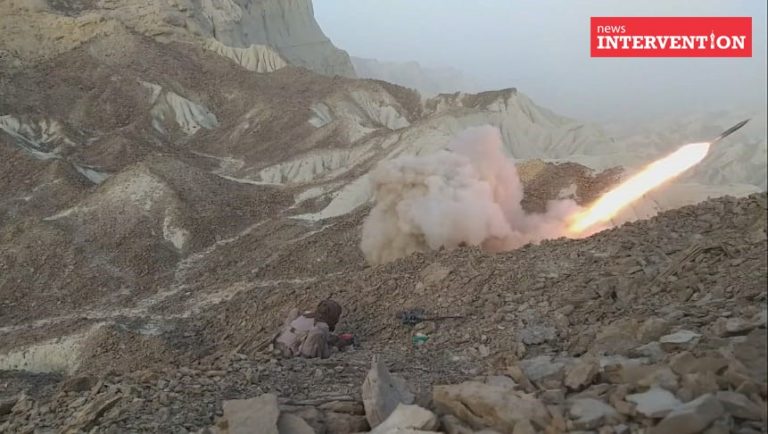
The Balochistan Liberation Front (BLF) fired two BM-12 rockets at the Gwadar International Airport on Friday which landed right in the middle of under construction airport causing serious damages and halting all development activities. This is a new International Airport at Gwadar that’s being constructed by a Pakistani company FW in collaboration with Chinese firms. Baloch sarmachaars (freedom fighters) have been fighting against blatant Chinese colonization of Gwadar coastal area and have attacked Chinese installations at Gwadar in the recent past too.
Local Gwadar police have reported a few casualties due to BLF’s BM-12 rocket attack but the Pakistan Army is yet to acknowledge the deaths of its soldiers. Interestingly, Pakistan Army has now sealed the entire area and the local administration and local police are not being allowed inside the under-construction Gwadar International Airport that bore the brunt of BLF’s rocket attack.
BLF spokesman Major Gwahram Baloch said in a statement that their sarmachaars (freedom fighters) fired two BM-12 rockets at the Airport in the Gurandani area of Gwadar at 6PM (local time) on Friday. “Both rockets landed inside the construction site at Gwadar International Airport.”
Since early morning on Saturday Pakistan Army’s gunship helicopters have been conducting search operations around Dasht mountains, from where the BM-12 rockets were fired by BLF sarmachaars at the Gwadar International Airport.
This new Gwadar International Airport is being built on an area of around 4,800 acres that after completion would have the operational capabilities to cater to jumbo-sized cargo aircrafts. The new Gwadar International Airport after completion will also double up as the air base for Chinese fighter jets.
Major Gwahram Baloch warned that all these schemes are part of the China-Pakistan Economic Corridor (CPEC) project. The current Gwadar Airport is very small and is unsuitable for Chinese air base and also for CPEC’s imperialist loot of Balochistan’s resources. “BLF will continue its operations against these evil designs which are carried out without the will and intention of the Baloch nation on their motherland,” said Major Gwahram Baloch. He added that attacks on the occupying army and such imperialist designs would continue till the independence of occupied Balochistan.
Two years ago, while speaking on the occasion to mark 100 days of his government in office, Prime Minister Imran Khan made many a boast and promises. Besides waxing eloquent on turning Pakistan into a “model Islamic welfare state,” he also hit out at his Indian counterpart by saying, “We will show the Modi government how to treat minorities.”Unfortunately, despite this bold assurance, instances of atrocities against minorities in Pakistan have increased many fold under Khan’s watch.
US Ambassador-at-Large for International Religious Freedom, Samuel Brownback has made things embarrassing for Khan by making it clear that as far as Pakistan was concerned, “a lot of their actions (against religious freedom) are done by the government.” So, it’s not at all surprising that Washington has designated Pakistan a ‘country of serious concern’ for engaging in or tolerating “systematic, ongoing, egregious violations of religious freedom.” To make matters even more humiliating, Khan’s “how to treat minorities” barb directed at Modi boomeranged when US State Department summarily rejected US Commission for International Religious Freedom’s recommendation to designate India a ‘country of serious concern’!
Khan wants everyone to believe that his “Naya [new] Pakistan is Quaid’s [Jinnah’s] Pakistan” in which “minorities are treated as equal citizens, unlike what is happening in India” but this claim has hardly any takers. Au contraire, in its ‘World Report 2020’, Human Right Watch [HRW] has noted that along with women and transgender people, religious minorities in Pakistan “continued to faceviolence, discrimination, and persecution, withauthorities often failing to provide adequate protection or hold perpetrators accountable.” Even Human Right Commission of Pakistan (HRCP) has been extremely critical about the PTI-led government’s abysmal failure in protecting minorities, which it rightly feels are “doubly vulnerable”!
Islamabad dismisses widespread international criticism for failing to institute adequate safeguards to prevent religious persecution of its minorities by terming it an ‘opinion based on disinformation’. However, in its annual ‘State of Human Rights in 2019’ report [released in 2020], HRCP has noted that “Religious minorities remained unable to enjoy the freedom of religion or belief guaranteed to them under the constitution” adding that “Both the Hindu and Christian communities in Sindh and Punjab continued to report cases of forced conversion.” It also confirms that:
“In Punjab, girls as young as 14 were forcibly converted and coerced into marriage.”
“In Sindh, the case of two Hindu girls whose families claimed they had been kidnapped for marriage and converted forcibly, drew widespread attention when the Islamabad High Court ruled that the girls were not minors at the time of marriage and allowed them to return to their spouses.”
“For the Ahmadiyya community in Punjab, this (religious persecution) included the desecration of several sites of worship.”
Contrary to Imran Khan’s promise to ensure “that our minorities are treated as equal citizens,” the year 2020 saw an alarming swell in incidents of persecution of minority communities. The most common being the repugnant practice of Hindu, Christian and Sikh girls (some as young as 12 to 13 years) being abducted and after being converted, being forced into marriage. Even Pakistani NGOs estimate that about 1,000 such incidents occur every year and this is why no one takes Khan’s assurance of minorities in Pakistan being “treated as equal citizens” seriously!
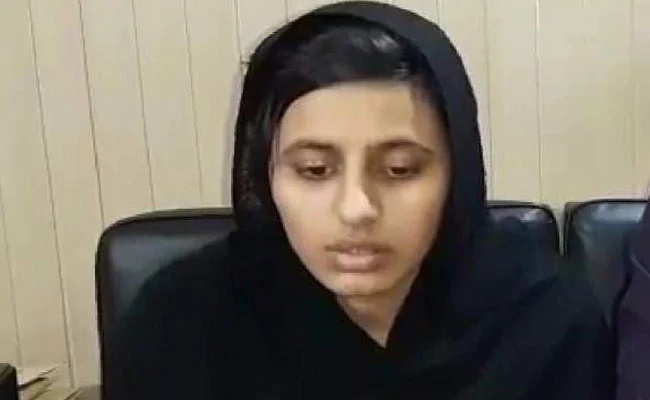
Jagjit Kaur, daughter of a local Sikh Granthi (religious teacher) was abducted at gun point in September last year from Nankana Sahib in Pakistan. Jagjit Kaur was then forcibly converted to Islam and married to Mohammad Hasan.
Another issue of concern is brazen desecration of holy sites of worship belonging to the minority communities. On January 3, 2020 a mob attempted to vandalise the historic Nankana Sahib Gurdwara and the entire incident was captured on video. However, Pakistan’s Foreign Office (FO) played down this incident by calling it a “scuffle” between two Muslim groups over a “minor incident” at a tea stall. In reference to New Delhi’s complaint against desecration of this holy Sikh shrine, the Pakistani Foreign Office stated that “Attempts to paint this incident as a communal issue are patently motivated.” Whereas one would have really loved to believe that this incident had no communal angle, but following facts belie the Foreign Office’s assertion:
If the incident was merely a minor scuffle between two Muslim groups, then how come the Gurudwara became the target of their ire?
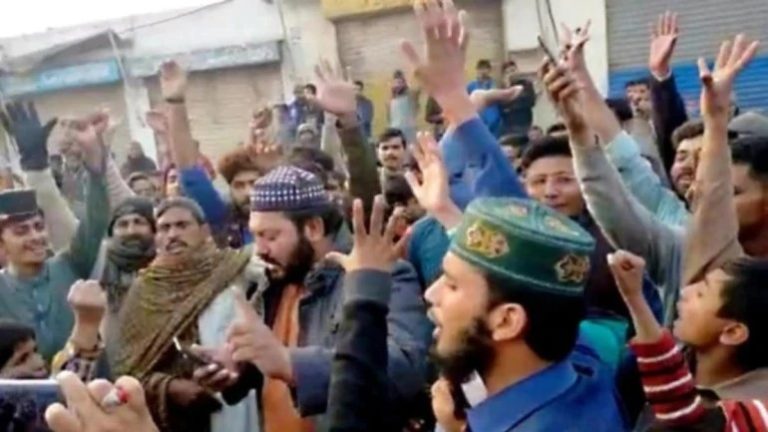
In the video, a mob can be heard cheering lustily as a speaker tells them that “We will ensure that there is not a single Sikh left in Nankana. And the name of this place will soon be changed from Nankana to Ghulam-e-Mustafa”. So, if this incident was just a row between two Muslim groups, then what explains the rabid anti-Sikh tirade of the speaker and its frenzied endorsement by the crowd?
Lastly, if it was genuinely a minor and inconsequential incident as the Foreign Office claims, then why did Khan term this incident as “condemnable’ and take all the trouble of downplaying its distinctly communal character by saying that there’s a “major difference between the condemnable Nankana incident and the ongoing attacks across India on Muslims and other minorities”?
Besides Nankana Sahib Gurudwara, places of worship belonging to other minority communities in Pakistan were also subjected to vandalism last year. On May 9, 2020, a mob damaged the main gate and boundary wall of a church in Hakeempura area of Shekhupura district in Pakistan’s Punjab district and desecrated the Church’s Holy Cross. Once again, the authorities tried to brush this patently communal act under the carpet by terming it a property related dispute. In February, three Pakistani Christians who were constructing a church in Punjab’s Sahiwal district were assaulted and just two months later, a Pastor, his wife and son were attacked for building a wall on their own land. Once again, these incidents of intimidation of minority community members were passed off as instances of personal rivalry!
The year 2020 also saw multiple incidents of Hindu religious shrines being either destroyed or desecrated. On January 26, idols of the deities in Mata Deval Bhittani temple in Tharparkar district of Pakistan’s Sindh province were desecrated and holy texts kept inside were burnt. The police claimed that the perpetrators were minors and had broken into the temple just to steal money. What the police didn’t explain is that if their motive was only robbery, then why did the juveniles waste their time and energy in defacing idols and burning holy books?
On October 10, idols of deities inside Shri Ramdev Temple in
Kario Ghanwar area of Badin district, Sindh, were destroyed, and the police once
again ruled out communal angle by saying that the culprit was of unsound mind
and a drug addict! Just two weeks later, a mob vandalised Nagarparkar Temple
in Sindh province, damaging the idol of Goddess Durga during the holy
‘Navratri’ period. No one has been arrested. On November 2, a huge mob
descended on Sheetal Temple in Karachi’s Lee Market area and destroyed idols of
deities and other holy relics. This time the police sought to justify this
highly communal act by terming it public reaction to blasphemous statements
made by a Hindu boy!
On December 27, a mob not only vandalised and set ablaze a 100-year-old shrine housing samadhi [memorial] of a revered Hindu saint in the Karak district of Khyber Pakhtunkhwa. Dawn News TV quoted an eyewitness saying that the incident of desecration and arson occurred after “More than a thousand people led by some local elders of a religious party held a protest and demanded the removal of the Hindu place.” Two developments make official apathy (or tacit complicity?) obvious. One, according to news reports, “The locals also revealed that residents of the nearby villages had announced a protest demonstration with demands of removal of the Hindu shrine, adding that the police totally ignored it”and two, it was Chief Justice of Pakistan and not Prime Minister Imran Khan who was first to take official cognisance of this sacrilegious incident.
Once again, the police tried to obfuscate reality. The District Police Officer (DPO) refused to acknowledge that the shrine had been vandalised and instead told media that a mob “attacked and demolished the under-construction building(within temple premises).” But Federal Minister for Human Rights Shireen Mazari graciously acknowledged reality by tweeting- “Strongly condemn the burning of a Hindu temple by a mob in Karak, Khyber-Pakhtunkhwa” – which is clearly visible in videos of this incident.
But desecration of religious shrines and abduction of girls
followed by their forced conversion and marriages aren’t the only problem
minorities face in Khan’s ‘Naya’ Pakistan. Even their settlements are being
illegally demolished, often with official patronage. In May, a HRCP tweet
mentioned that “HRCP is gravely concerned at reports that houses
belonging to the Hindu and Christian communities of Yazman in Bahawalpur have
been demolished, allegedly by local authorities with political influence.”
It also stated that “evictions, the demolition of people’s
houses, and land grabbing, esp. [especially] when such communities are doubly
vulnerable, are highly condemnable.”
But if the administration is to be believed, then all’s well in Pakistan as far as minorities are concerned. Girls from minority communities aren’t being abducted but are of their own accord, eloping with their beaus (who at times are almost double their age). Vandalism of holy shrines belonging to minorities isn’t due to the prevailing communal frenzy but the handiwork of petty thieves, drug addicts, mentally deranged persons, or consequences of some land dispute and occasionally, ‘justified’ collective punishment of a minority community for some alleged blasphemous utterance by one of its members. Coupled with this, since Khan keeps harping on how “minorities are treated as equal citizens,” in his “Naya Pakistan,” why worry or lose sleep over this issue?
Is this selective outrage not hurting India’s geo-political ambitions?
The Adani Group is back in the news again. The last time it was hauled over the coals was when agitating farmers protesting on the borders of the Indian Capital had blamed the Ahmedabad-based group and Ambani for their woes.
This time, the news is trickling from across the eastern borders.
So let’s delve a bit into history. In May 2019, the Adani Group announced that it would build and operate a new container terminal along Myanmar’s Yangon river. This was confirmed to be a 50-year deal that would enable India to gain significant strategic geo-political advantage in the region in a fitting response to similar Chinese investments in lieu of its long-standing Belt and Road Initiative (BRI).
In 2010, APSEZ won the Yangon international terminal project through a global competitive bid, the spokesperson said. “The project, fully owned and developed by APSEZ is an independent container terminal with no joint venture partners.”
The land acquisition for the project was facilitated by the Myanmar Investment Commission led by U Thaung Tun, its chairman and Minister of Investment and Foreign Economic Relations under the guidance of Her Excellency President Aung San Suu Kyi”s National League for Democracy government.
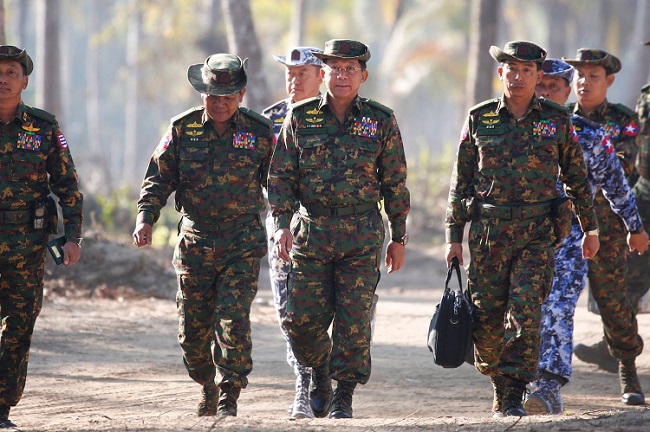
Myanmar military commander-in-chief General Min Aung Hlaing (centre) and senior military commanders arrive for the ‘Sin Phyu Shin’ joint military exercises in the Irrawaddy Delta region on February 3, 2018. (File photo: AFP)
New Delhi had hailed the decision as momentous, it had triggered breaking headlines. The democratic Myanmar government, then led by Aung San Suu Kyi, facilitated the venture through Myanmar Investment Commission (MIC), a government body responsible for verifying and approving investment proposals in Myanmar. This included identification and approval of land to be leased for the new container terminal at Yangon being developed by the Adani Group. For any aspiring economy, a stable and efficient port is the precursor to any development and investment proposal, and accordingly, MIC facilitated land through Myanmar Economic Corporation Co Ltd (MEC).
So what is happening to the project today?
It, actually, stands on very shaky grounds. But what is surprising — and missing from the headlines in India — is that the troubled status of the project is not because of the recent military coup in Myanmar. Rather, it stems from the selective outrage that singles out the integrated infrastructure conglomerate for engaging with and indirectly financing MEC.
As fabricated and out of context narratives by various detractors continue to sling mud on a top Indian corporate giant, one must ask a very simple question: Who stands to suffer the most?
The Adani Group has denied engaging with Myanmar’s military leadership over the Yangon port deal.
But it has not stopped the outrage against Adani.
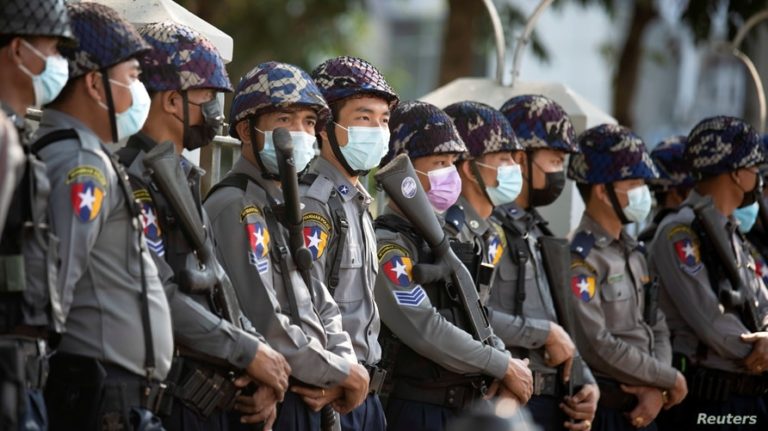
A set of videos and photographs circulating on the social show Adani Ports’ top officials meeting with Myanmar’s top general, Min Aung Hlaing in July 2019. Photographs also showed the general’s visit to the Adani-owned Mundra Port in Gujarat, the media has easily made two and two four. It is easy mathematics.
But here’s the whole truth.
The above-mentioned photos and videos are from the Myanmar general’s visit to India hosted by the Indian government – the purpose being enhancing cooperation between India and Myanmar in the areas of counter-insurgency, capacity building, military-to-military-ties and maritime collaboration. In the same trip, General Min Aung Hlaing also travelled to Vishakhapatnam to visit Eastern Naval Command headquarters, as well as the National Defence Academy in Maharashtra.
Therefore, Mundra Port was only one of the multiple locations on the general’s visit to the country.
This is not all. It has also been confirmed that the visiting delegation held a rendezvous with the Chairman Chiefs of Staff Committee and Chief of Air Staff, Air Chief Marshal B.S. Dhanoa, Chief of Army Staff General Bipin Rawat and Chief of Naval Staff Admiral Karambir Singh. For India, this was a great opportunity to counter the threat of China which had taken over as the largest supplier of weapons equipment to the south-east Asian nation in lieu of the sanctions imposed on Myanmar’s supplies from the West.
Minister of External Affairs, Dr. S. Jaishankar, also confirmed the nature of the visit in a tweet, terming it as ‘foreign policy focussed that would advance our national security’.
As for the images depicting ‘gifts’ being presented by Adani officials to the visiting dignitaries, it is the customary practice of exchanging mementos. Isn’t it routine?
Now, let’s focus on the issue of the sum of investment that the Adani Group is obliged to pay to MEC, who have leased them 54 acres of land for the development of the Ahlone International Port Terminal 2 (AIPT 2).
As per leaked documents published by Australian news broadcast company, ABC, Adani Ports is paying $30 million in ‘land lease fees’ and $22 million in ‘land clearance fee’. This is being touted as a significant boost to Myanmar military’s finances to ‘conduct international crimes’.
Now, pause for a while.
If this amount is so significant, then why is no one talking about the foreign oil and gas companies in Myanmar that end up paying approximately $1 billion per month in royalty payments to Myanmar Oil and Gas Enterprise (MOGE) – the major funding source of the country’s military government? Oil majors like Chevron, PTT Thailand, PETRONAS Malaysia and Woodside Australia continue to operate and control main oil and gas blocks in the country at a far bigger scale than Adani, yet haven’t come under the scanner as much.
Despite US sanctions, American companies like Coca Cola and GE also remain active in the Myanmar landscape. Japanese companies like Nissan, Mitsubishi, Marubeni and Toyota continue to pay huge taxes to the new regime in Myanmar. Yet, while Adani Ports gets called out for paying a nominal fee for utilizing land in a foreign country, the fact that oil and gas veterans and other MNCs from countries with long-standing interests in the volatile nation have flown under the radar points towards hypocrisy at play.
This is not all.
No one is talking about how critical the Adani Yangon project is for getting Myanmar’s ravaged economy back on track. By the end of its second phase, the terminal will be equipped with the capacity to handle over 800,000 TEUs. In fact, 90 percent of Myanmar’s exports & imports will be handled by the Yangon ports cluster. Adani Group also plans to build a maritime university for community skill development and strengthen local transport and civic infrastructure to cater to the region’s socio-economic growth.
As the Adani Port’s Yangon terminal port faces unjustified flak and selective outrage from vested interests, could there be a bigger political game in play here to destabilize India’s strategic policy in the South East Asia region?
With tough countermeasures and sanctions against Myanmar’s military government on the rise, there’s a fear that the regime will be driven even closer to China. India’s highly sensitive North East region is already in a fix, thanks to China’s expansionist stance and encouragement of cross-border disputes.
Hence, India’s Yangon terminal project is, above all, a vital step towards keeping Beijing’s growing dominance in check – as the latter looks to further build upon its critical investments in Sri Lanka’s Hambantota and Colombo ports and Pakistan’s Gwadar port. Any lapse in the Adani project, therefore, would come at a great cost to India’s strategic cooperative relations with Myanmar while also posing a threat to national security in the event of the latter allying with China against India.
At the end of the day, one must question whether those who’re taking up arms to spread misinformation against the Adani Group and the Yangon port project have the best interests of India at heart.
As the above evidence suggests, the answer is quite obvious.
Unknown people raided the house of Kashmir’s leader Habib-ur-Rehman at midnight on 24-25 March at around 2 AM. Habib-ur-Rehman and his family members were not at the residence during this unwarranted raid. The unknown assailants broke the grills of his house and successfully entered his residence located in the Qandeel Colony Garden area of Pakistan-occupied Kashmir (POK). The assailants broke open several cupboards and took away many files and books.
These raiders searched the whole house and scattered books, files and other necessary papers but they did not take away any other chattels with them.
According to local sources, this untoward incident point towards a search operation conducted at the behest of some powerful authorities. It needs to be remembered that a year ago in this same house Habib-ur-Rehman’s family was interrogated and harassed by unknown persons who inquired about Habib-ur-Rehman. The district branch of Jammu and Kashmir People’s National Party had lodged a report with S.P. Bagh thereafter.
It also needs to be noted that in the past similar kind of people had raided the house of missing senior Kashmiri journalist Tanveer Ahmed and had confiscated all of his research work material and personal belongings.
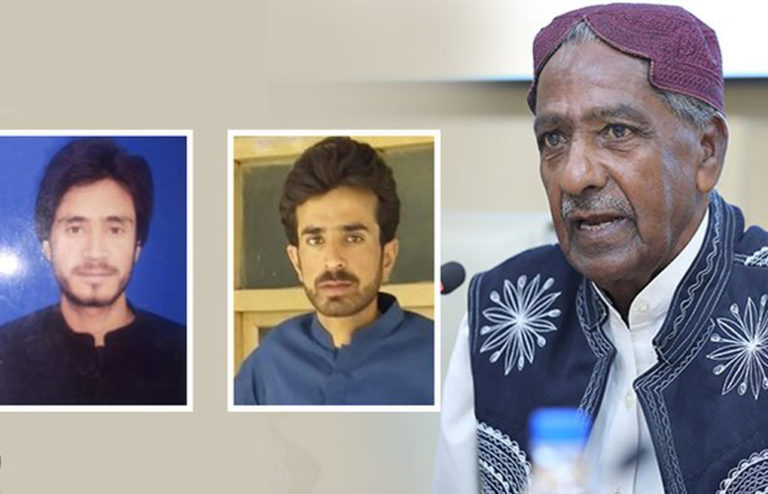
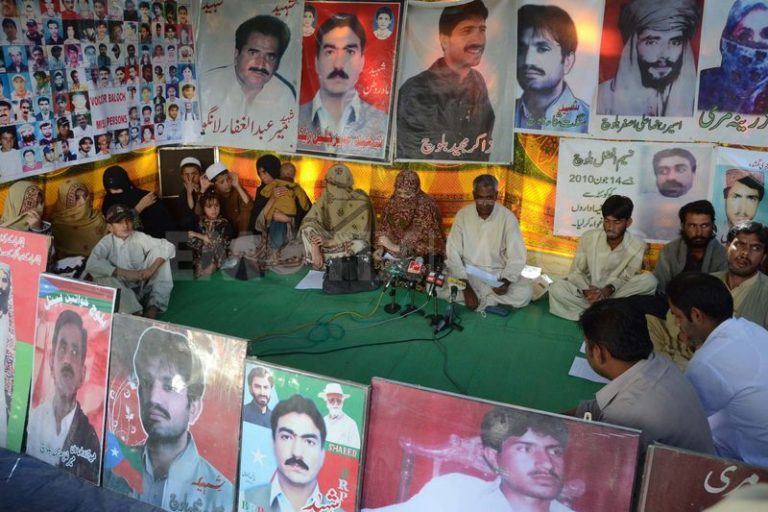
Kabir Baloch, Mushtaq Baloch and Attaullah Baloch went missing from district Khuzdar of Pakistan-occupied Balochistan (POB) in March 2009. Twelve years later, their families still await for their arrival. And to mark the 12th year of the disappearance of Kabir, Mushtaq and Attaullah, their family members held a press conference at the Quetta Press Club and said that they have knocked on every door in search of justice in this long excruciating period, but to no avail.
Mama Qadeer Baloch, Vice-Chairman of the Voice for Baloch Missing Persons (VBMP), was also present at the conference. The family members said that the Pakistani commission on enforced disappearances is just a charade that has been established to mislead the international human rights groups.
Click on the YouTube link to watch our report
Addressing the gathering, one of the speakers said that the past twelve years have been an agonizing period for her and her entire family. She said that members of her family have not just been “abducted”, but also killed. Her brother Waheed Baloch was shot dead along with his friend Salman Baloch in Khuzdar in the February of 2012. She said that her other brother Kabeer Baloch and two of his friends, Mushtaq Baloch and Attaullah Baloch, were “forcibly disappeared” from Khuzdar in March 2009, exactly twelve years ago.
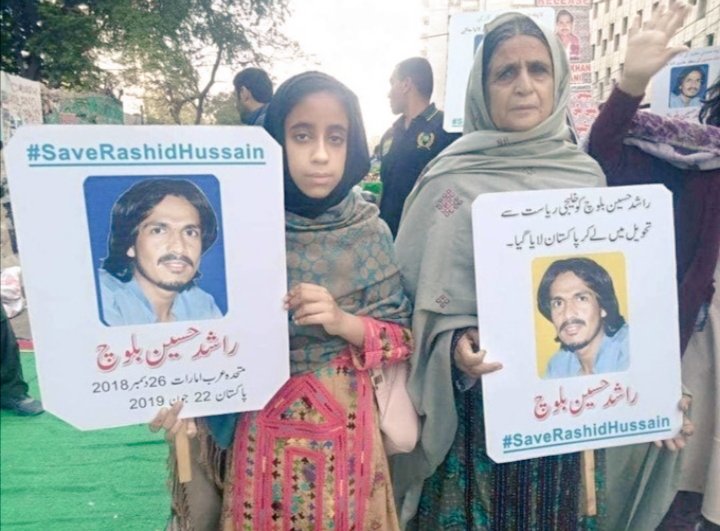
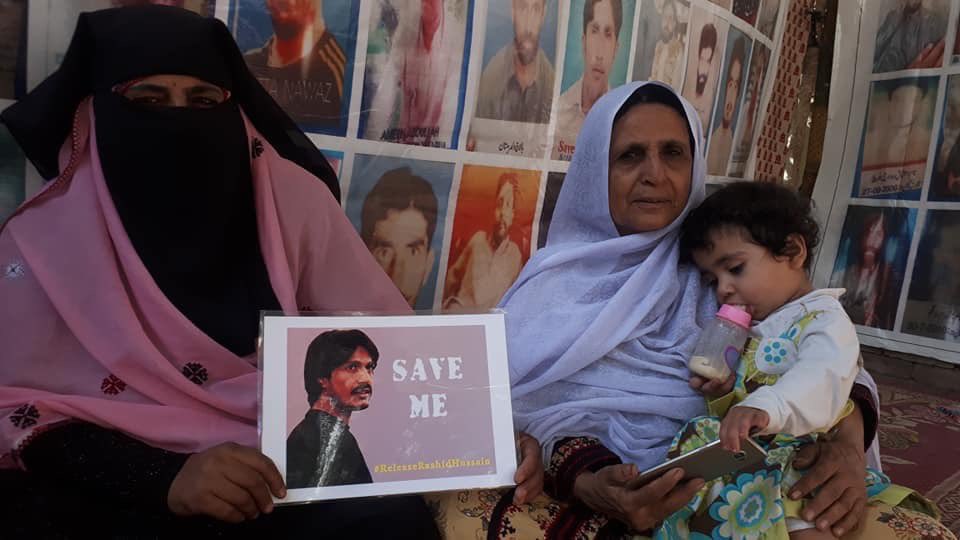
The Counter-Terrorism Department (CTD) of Pakistan reportedly tried to coerce the family of “missing” Rashid Hussain into signing a misleading and false statement regarding the “enforced disappearance” of Rashid Hussain from the United Arab Emirates. The family were reportedly locked up in a room and threatened that if they did not sign the statement, their loved ones will be hunted down and harmed.
According to the family members of Rashid Hussain, they were recently summoned to the Airport Police Station in Karachi by the Pakistani forces and pressurized to sign a false and misleading statement. The statement, concocted by the Counter-Terrorism Department (CTD) of Pakistan, declared that Rashid Hussain had not been forcibly disappeared in UAE – as all the available evidence shows – but rather sent back to Dalbandin, Balochistan, by the company that employed him. He had then gone “missing” in Dalbandin.
The family members have presented the mendacious statement which was supposed to be signed by the mother of “missing” Rashid Hussain. The contrived statement reads on behalf of Rashid Hussain’s mother that her son had gone missing in Dalbandin – and not in UAE – and that her lawyer had “accidentally” written Karachi instead of Dalbandin due to her “disfluency” in Urdu.
Pakistani regime continues to keep Baloch human rights activist Rashid Hussain in illegal detention. (Photo: News Intervention)
The statement also declares on behalf
of Rashid Hussain’s mother that she had given this same statement before the
missing person commission earlier.
The family members have claimed that they have substantial evidence in their possession to prove that Rashid Hussain had been arrested in UAE and subsequently extradited at the behest of Pakistan. But the behavior of Pakistani authorities shows that they want to whitewash his arrest in a veneer of false accusations.
The family members added that they are alarmed after Monday’s incident that the life of Rashid Hussain might be in danger. Their apprehension is not misplaced: Counter-Terrorism Department (CTD) of Pakistan recently killed 5 Baloch missing persons in a fake encounter, labelling them as ‘terrorists.’
The family members have repudiated
the statement, saying that they demand the safe recovery of Rashid
Hussain.
Since his disappearance, Rashid Hussain’s family has been struggling for his safe recovery. His family members have knocked on many doors in search of their loved one but to no avail. Hussain’s mother and his young niece Mahzeb Shafiq were also among the families of the Baloch missing persons who staged a sit-in at Islamabad earlier in February, demanding the release of their missing family members.
Gwarjak, is the area of General Akhtar Nadeem Baloch. Akhtar Nadeem Baloch was a General of the Balochistan Liberation Front (BLF). He had been fighting against the Pakistani occupation on Balochistan for the last twenty years. Ajaz Baloch was the commander of that area (Gwarjak). He had come there after quitting his studies in Quetta. He was a young leader and a brave soldier.
When we talk about Balochistan, the word “war” comes into our minds. There are war crimes as well. War crimes are committed by Pakistan in the form of enforced disappearances, bombardment, killing and dumping, etc.
Baloch people are fighting against these brutalities ever since the occupation of Balochistan. We have been aware of how our brave soldiers are fighting, sacrificing themselves for the Baloch nation. When it comes to freedom fighters, we know so many brave Baloch fighters who have given their blood for freedom of the people of Balochistan. Ajaz Baloch is among those brave martyrs of Balochistan.
Today, Gwarjak has been named after Akhtar Nadeem Baloch who is a symbol of leadership and a living legend due to his intellect, courage and sacrifices. Ajaz Baloch got his primary education in his hometown. After matriculation, he continued his education in Quetta. He was aware of his nation, his motherland and the brutalities of Pakistan over the Baloch people. This was enough to convince him to quit his studies and go back to his hometown.
He was also active in BSO (Baloch Students Organisation) from where he distributed books to the students to read and be aware of what Pakistan is doing to our nation. He worked in the BSO for a long time and later on he chose armed struggle and joined BLF in 2008.
He worked day and night for the BLF (Balochistan Liberation Front). He became in-charge of the BLF of his hometown Gwarjak. Ajaz Baloch was a young charming problem solver who was aware of how to lead a town. He was revered as the young “Meer” of our town by all.
In 2009, one of Akhtar Nadeem’s brothers Asif Nadeem got martyred. He was the first martyr of the town. Cries of “freedom ” were heard in the town. There was always a war going on. A few years later, there was an earthquake in Mashkay. Many people died and many houses collapsed. The Pakistan Army took advantage of the earthquake and sent troops in the name of earthquake rescue. This way the Pakistan Army captured Mashkay.
After this the Pakistan Army spread everywhere and started burning our houses. They asked about Akhtar Nadeem and Ajaz. Luckily they were not in the town. A Pakistani colonel sent a message to Ajaz Baloch and gave an ultimatum of four months to him to surrender and be forgiven.
Surrendering to the enemy forces of Pakistan was not even an option in Ajaz Baloch’s mind. He chose death. He said, “I will not surrender, you can kill me for that. I’m ready to die for my nation. I am fighting and will fight till the freedom.” This was soon followed by attacks by the Pakistanis on our town on a daily basis.
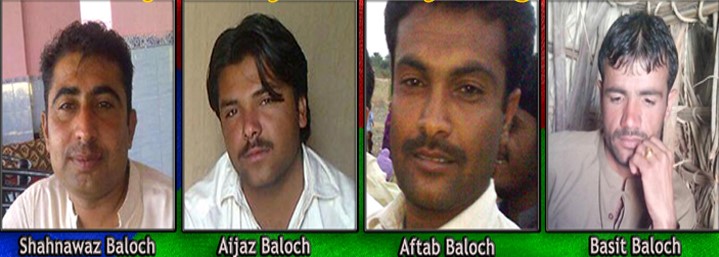
Soon there was news that Ajaz Baloch is getting married along with his two other friends Basit Nadeem and Shah Nawaz. The families started preparing for the wedding. The wedding was scheduled for the night of 21 April 2015. As the night drew closer sound of bullets being shot could be heard. There were screams. Pakistan Army had attacked the marriage ceremony. The women of the family begged saying, “leave them, this is their marriage.” However, those shameless Pakistan Army men beat the family members, not even sparing the small children. All were beaten up and abused the family and the guests. Ajaz Jan, Aftab Jan, Shah Nawaz Jan, and Basit Jan were among four other guests who were arrested by the Pakistan Army. They killed them early in the morning, and later, handed over their bodies to the family.
Ajaz Baloch’s brother Aftab Baloch was also a BLF soldier. He also used to fight against the Pakistan Army. He was Akhtar Nadeem Baloch’s special soldier. He was married in 2011. He had two children. He too was fighting for the independence of Balochistan, for about ten years. He was also martyred along with his brother and other two grooms Basit and Shah Nawaz.
In a single day, we lost four of our gems; Aftab Baloch, Basit Baloch, Shah Nawaz Baloch, and the very young gentleman Ajza Baloch. Gwarjak came under the control of the Pakistan Army and we were forced to leave Gwarjak. But we firmly believe that one day, we will go back and liberate Gwarjak. Surely, we will liberate Balochistan.
Pakistani Prime Minister Imran Khan recently met with a three-member representative committee of the families of Baloch missing persons in Islamabad. On the face of it Imran Khan asked his ministers to ascertain the status of missing persons and assured the family members that they will be kept informed on the matter. He also promised to criminalize enforced disappearances. The Baloch families, however, said that Imran Khan only gave them blank assurances and promises, and nothing else.
According to the details, a three-member representative committee of the families of Baloch missing persons who staged a week-long sit-in at D-Chowk in federal capital Islamabad in February met the Pakistani Prime Minister. The committee comprised of Nasrullah Baloch, Sammi Deen Baloch and Seema Baloch, three of the most active voices in the struggle to end enforced disappearances in Balochistan.
Click on the YouTube link to watch full news video report
Pakistan’s Human Rights Minister Shireen Mazari was also present in the meeting along with the Minister for Defense Production Zubaida Jalal.
Mazari shared some of the details of the meeting on social media, saying that the PM Imran Khan directed the Principal Secretary to “ascertain quickly the exact status of the missing family members.” He also assured the family members that they will be kept informed about the status of their loved ones.
On the other hand, the families of the Baloch missing persons were not quite satisfied with the meeting with the Pakistani PM. They said that the prime minister gave them assurance and promises and nothing more. They said that they have handed over the list of the missing persons of Balochistan to Khan.
According to the family members, Khan told them that the government is taking the issue of enforced disappearance seriously and is committed to working “sincerely” on the issue. He also assured them that he will summon the Pakistan Army chief and the ISI chief to ensure the recovery of the Baloch missing persons.
Sammi Deen Baloch, one of the three
members of the committee, said on social media that the families of the Baloch
missing persons had ended their sit-in protest in Islamabad after the assurance
that the prime minister will inform them about the condition of their loved
ones in the meeting, but that did not happen.
Seema Baloch, another member of the committee, said on Twitter that they had gone to the meeting with the hopes of countless Baloch families on their shoulders, but were “saddened” to learn that they were only given promises and assurances and nothing more. “We once again presented the list of Baloch missing persons [to the PM],” she said.
Click on the YouTube link to watch news video report
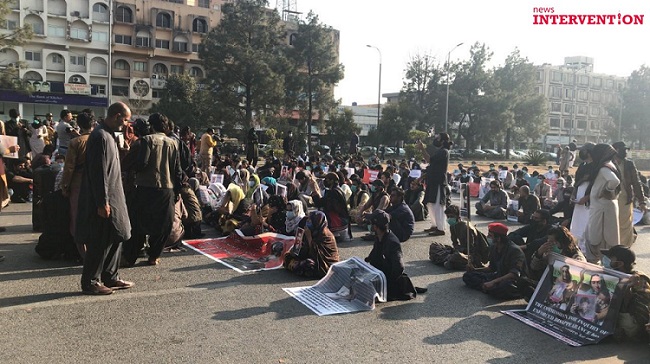
In the month of February, the families of Baloch missing persons held a week-long sit-in protest in the federal capital Islamabad, demanding the release of their loved ones and an end to enforced disappearances in Balochistan. The families had asked the Pakistani prime minister to personally visit and assure them that their demands will be met, otherwise they would not end their protest.
Several prominent politicians and human rights activists visited the protestors in Islamabad. PTM leaders Manzoor Pashteen, Mohsin Dawar and Afrasiab Khattak visited the families to express solidarity with them. Members of the Pakistan Democratic Movement, including PML-N Vice-President Maryam Nawaz also visited the protestors to share their grief. Interior Minister of Pakistan Sheikh Rasheed also met with the protestors and requested them to end the protest, but the protestors remained undeterred.
The Pakistani Human Rights Minister Shireen Mazari met with the Baloch families and conveyed a message from Imran Khan that he will personally meet with the protestors in March. With this promise, the Baloch families ended their protest and returned home, waiting for the time to meet with the prime minister.
The Human Rights Council of Balochistan revealed the details of “enforced disappearances” and “extrajudicial killings” that were carried out in Balochistan in 2020. The numbers are shocking – 480 individuals were “forcibly disappeared” and 177 were killed and their dead bodies were thrown in the wilderness. The rights group added that these “conservative” numbers were derived from the information accessible to them from various areas of Balochistan. The actual toll might be higher.
The rights group said that 2020 was
no different than any other year in Balochistan – human rights violations were
carried out as usual. As the pandemic raged on, academic institutions
throughout Pakistan were shut off and the Baloch students studying in these
institutions had to travel back home. Many of these students were either
“forcibly disappeared” or shot dead in broad daylight.
The speakers then detailed the story of several individuals who were subjected to the “cruelty” of the Pakistani forces. Hayat Baloch, a young student at the University of Karachi, was shot dead in front of his parents in broad daylight in Turbat by the Frontier Corps (FC) soldiers. Murad Jan, a resident of Mashkay, was beaten to death by the security forces for his inability to communicate in Urdu. Javed Gohram, a native of Mand, was detained by the Pakistani forces and subsequently beaten to death.
The speakers said that 2020 was also
not a particularly good year for women. In May of that year, a gang of bandits
breached into a house for the purposes of a robbery. The materfamilias of the
house – Malik Naz – was shot dead when she resisted the burglars. Her
four-year-old daughter Bramsh was wounded in the attack. One of the burglars
was cornered by the neighbours who then found a military card in his pocket. He
confessed that his gang abducts and kills political activists on the behest of
the Frontier Corps. In return, the FC has given them a free hand in the area.
Another woman named Kulsoom Baloch
was killed by two burglars in front of her children. The culprits were later
identified but never apprehended. In October of 2020, a woman named Asiya Bibi
was shot dead by police personnel – the culprit is yet to be prosecuted.
Shaheena Baloch, a journalist, artist
and women’s rights activist, was killed by her husband Mehrab Gichki in Turbat
in the name of honour. Despite the heavy presence of the Pakistani security
forces in almost every city of Balochistan, Mehrab somehow managed to escape
and has not been arrested since. The forces have not even tried to trace him
down and apprehend him.
The rights group also mentioned
several incidents where minors were killed by the security forces. 14-year-old
Hamza was among the seven people who lost their lives to a devastating air
operation in Panjgoor. In Turbat, the forces fired several shots on a vehicle,
and a 17-year-old boy named Imam Sher was shot twice. He was dragged to a
nearby check post and left on the road to bleed to death. Haneef Mehran and
Ameer Baksh – 7 and 16 years old respectively – were abducted when they were on
their way to Turbat. Their mutilated dead bodies were found a day later.
The speakers said that Baloch
dissidents and activists, who had fled Balochistan after threats on their
lives, were hunted down and killed in foreign countries. Sajid Hussain, a
Baloch journalist and writer, went missing in Sweden in March of 2020. A month
later, his dead body was hauled out of a river. A similar fate befell Karima
Baloch, a human rights activist and the former chairperson of the BSO-Azad, who
went missing in Toronto and her dead body was found in a river a day later.
The rights group said that per the
information accessible to them, 480 individuals went missing and 177 were
killed in Balochistan in 2020 alone. 17 of the missing 480 were women who were
later released and a considerable number of them are students.
The speakers said that some missing persons were also released during that period, but the rate of disappearance vastly outstripped the rate of recoveries. The security forces conducted numerous large-scale operations during the year throughout Balochistan. As a result of these operations, hundreds of individuals have whisked away, houses were set ablaze and possessions were looted. Countless Baloch families had to relocate as a result of these atrocities.
The rights group said that human
rights violations have not ceased in 2021. Only a few days ago the
Counter-Terrorism Department of Pakistan executed five Baloch missing persons
in a fake encounter, labelling them as “terrorists.” The CTD also tried to
coerce the elderly mother of the missing Rashid Hussain to sign a false and
misleading statement, and when she refused to comply, the forces locked her up
in a room.
The speakers concluded by saying that
for the past several years, Balochistan has become a hotbed of the grave human
rights violations of the Pakistani state. They said that if these “oppressive”
policies are not repealed or replaced, the violence and conflict will only
increase in Balochistan.
When the Baloch nation gained its independence from British colonial rule and was keenly maintaining the independence of their nation state at all costs, Jinnah turned towards Balochistan for the fulfilment of his evil intentions.
On February 5, 1948, Jinnah met Khan of Kalat in Dhadar and tried to persuade him to merge Balochistan into the unnatural and corrupt Pakistani federation. Meanwhile, Mir Ahmadiyar Khan informed Jinnah of the opinion of the Parliament as both the Houses of Parliament of Kalat (Balochistan) had rejected the proposal of the annexation of Balochistan with Pakistan by an overwhelming majority.
On February 21, 1948, the Parliament of Balochistan held another session to discuss the issue of annexation with Pakistan, but the proposal of the annexation was once again rejected unanimously. Disappointed, Jinnah handed over the affairs of Kalat State to the Foreign Office and informed Khan Kalat about this in a letter dated March 9, 1948.
However, Jinnah succeeded in deceiving Jam Ghulam Qadir (Jam of Lasbela), Nawab Ghulam Khan Gichki (a member of the upper house) and Nawab of Kharan, Mir Habibullah Noshirwani (a member of the upper house) on 17th March 1948, after which they announced accession to Pakistan by neglecting the will of the majority.
No law in the world endorses the fact that a country can forcibly occupy another nation by violating their laws, constitution and bypassing their democratic institutions. But Pakistan committed this illegal and offensive act with the collaboration of British generals and Jinnah.
The Baloch state opposed this illegal move and wrote remonstrance letters to the Pakistani state, but the Islamabad’s government run by Punjabi elite overwhelmed with power was not willing to listen to any complains what so ever.
The world kept silence on this illegal act of Pakistan, and on March 26, 1948 the Pakistan Army marched on district Kech and Panjgur. On the other side, the Pakistani navy took control of the coastal areas. And Pakistan finally completed its occupation of Balochistan through various tricks, excuses, greed and coercion.
Meantime, Khan Ahmadiyar Khan was in Karachi to raise his voice against this illegal move, where he was forced to sign the Kalat State accession with Pakistan. Despite this the Pakistan Army invaded and seized control of Kalat city, the capital of Kalat state on March 27, 1948 by use of brutal force. And since March 27, 1948 Balochistan continues to be under illegal occupation of Pakistan.
The month of March is significant in Baloch history, on March 27, 1948 the Pakistani state occupied the Baloch land and subjugated the Baloch nation. The 73 years of slavery has seen the blood of thousands of Baloch people, thousands of Baloch innocent civilians have been disappeared at the hands of Pakistani security forces. These disappeared Baloch people have remained missing for decades, and millions of Baloch became IDPs (internally displaced persons). But 73 years of slavery could not subdue the Baloch nation and couldn’t obstruct it from the dream of obtaining an independent Balochistan.
As the political and armed struggle against occupier Pakistani forces have intensified, thousands of Baloch have been targeted and killed in custody. There were thousands of enforced disappearances and more than 200,000 people have been forced to flee from their homeland and become IDPs (internally displaced persons).
During this 73 years struggle against subjugation, the Baloch nation has faced many up and downs. After 2002, for the first time, the struggle for independence of Balochistan began to take shape on a permanent and organizational basis.
The Baloch nation has long fought and struggled against slavery, sacrificed its generations and continues to do so to gain its national identity. This is why the Baloch nation is known today as a living nation.
Earlier, full details of Pakistan’s occupation of Balochistan had not reached the general public, though the educated and political activists were aware of the importance of this day.
Today, 73 years of long slavery has consolidated the Baloch struggle on an ideological and political basis, a sign of the survival of any nation. This day is considered every year all over Balochistan as a Black Day. This 27th day of March reminds the young generation about how Pakistan forcibly occupied Balochistan at the behest of the British government.
We use cookies on our website to give you the most relevant experience by remembering your preferences and repeat visits. By clicking “Accept All”, you consent to the use of ALL the cookies. However, you may visit "Cookie Settings" to provide a controlled consent.
This website uses cookies to improve your experience while you navigate through the website. Out of these, the cookies that are categorized as necessary are stored on your browser as they are essential for the working of basic functionalities of the website. We also use third-party cookies that help us analyze and understand how you use this website. These cookies will be stored in your browser only with your consent. You also have the option to opt-out of these cookies. But opting out of some of these cookies may affect your browsing experience.
Functional cookies help to perform certain functionalities like sharing the content of the website on social media platforms, collect feedbacks, and other third-party features.
Performance cookies are used to understand and analyze the key performance indexes of the website which helps in delivering a better user experience for the visitors.
Analytical cookies are used to understand how visitors interact with the website. These cookies help provide information on metrics the number of visitors, bounce rate, traffic source, etc.
Advertisement cookies are used to provide visitors with relevant ads and marketing campaigns. These cookies track visitors across websites and collect information to provide customized ads.
Necessary cookies are absolutely essential for the website to function properly. These cookies ensure basic functionalities and security features of the website, anonymously.
Cookie
Duration
Description
cookielawinfo-checkbox-analytics
11 months
This cookie is set by GDPR Cookie Consent plugin. The cookie is used to store the user consent for the cookies in the category "Analytics".
cookielawinfo-checkbox-functional
11 months
The cookie is set by GDPR cookie consent to record the user consent for the cookies in the category "Functional".
cookielawinfo-checkbox-necessary
11 months
This cookie is set by GDPR Cookie Consent plugin. The cookies is used to store the user consent for the cookies in the category "Necessary".
cookielawinfo-checkbox-others
11 months
This cookie is set by GDPR Cookie Consent plugin. The cookie is used to store the user consent for the cookies in the category "Other.
cookielawinfo-checkbox-performance
11 months
This cookie is set by GDPR Cookie Consent plugin. The cookie is used to store the user consent for the cookies in the category "Performance".
viewed_cookie_policy
11 months
The cookie is set by the GDPR Cookie Consent plugin and is used to store whether or not user has consented to the use of cookies. It does not store any personal data.