Home Blog Page 324

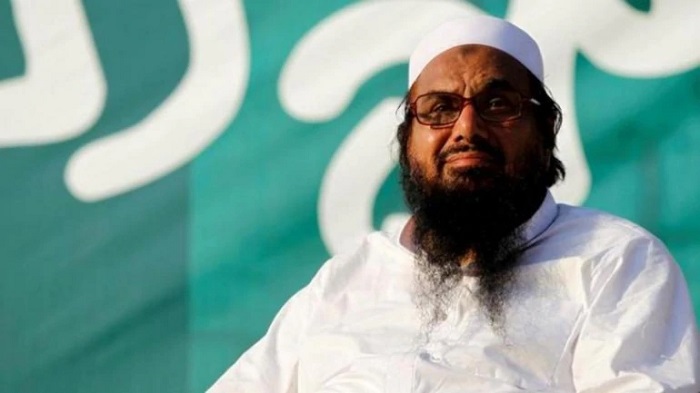
26/11: Hafiz Saeed is guest of honour at Pakistan jail

Bleed India with a thousand cuts is a military doctrine followed by the Pakistani intelligence agency ISI. The 2008 Mumbai attacks were a series of terrorist attacks that took place on November 26, 2008, when 10 members of the LeT (Lashkar-e-Taiba), an extremist Islamist organisation based in Pakistan, carried out 12 coordinated shooting and bombing attacks that lasted for four days across Mumbai. This attack was just one cut, out of the thousands of cuts inflicted by Pakistan on India over the last 70 years.

Why only 70 years? Let’s also take into account the attacks carried out by Ghaznavi, Ghauri, Babur, Aurangzeb and all those Islamist invaders along with their “peaceful” followers? The 26/11 Mumbai terrorist attacks carried out by Pakistan against India was a continuation of the invasion by these extremist Islamist butchers. Pakistanis proudly propagate this as the “thousand years war”. So from the days of initial coup in Pakistan for military to rule over this unnatural country called Pakistan, an enemy was required and eventually Indian became that enemy.

I remember those sorrowful days after the tragic 26/11 attacks in 2008 when my neighbor from Mumbai at Sharjah in United Arab Emirates (UAE) was scared and worried. “Zafar Bhai why is Pakistan is doing this with us? You are also from Pakistan can you explain to me what are the reasons behind these attacks?” he asked me. I told him that I am not from Pakistan I am from occupied Sindh. “We are also under suppression of Pakistan and its state sponsored terrorism. I condemn these brutal attacks and killing of innocent people in India,” I explained to my Indian friend.

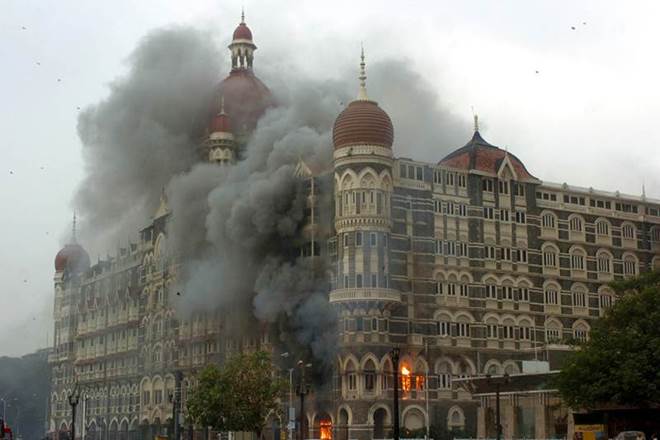
The Taj Mahal Hotel in Mumbai after the terrorist attack on 26/11/2008.

Unfortunately India has always been attacked or invaded through the Sindh. Persians, Arabs and Greeks entered Hindustan from Sindh because Sindh is the gateway to India. Even this time for the 26/11 Mumbai terrorist attacks in 2008, Karachi in Sindh was used.

India always had soft policies towards Pakistan, but Pakistan’s existence is on enmity with India. India must take strong decisions and must liberate Sindh, Balochistan and Khyber Pakhtunkhwa. Until and unless Pakistan is disintegrated and weakened, India will not be safe. Strong Sindh and Balochistan will play a key role for a strong India.

History repeats itself from time to time. I remember Timur from Central Asia invaded Delhi in 1398. Timur himself recorded the invasions in his memoirs, collectively known as Tuzk-i-Timuri. In this, he vividly described the massacre at Delhi: “In a short space of time all the people in the Delhi Fort were put to the sword, and in the course of one hour the heads of 10,000 infidels were cut off. The sword of Islam was washed in the blood of the infidels, and all the goods and effects, the treasure and the grain which for many a long year had been stored in the fort became the spoil of my soldiers. They set fire to the houses and reduced them to ashes, and they razed the buildings and the fort to the ground. All these infidel Hindus were slain, their women and children, and their property and goods became the spoil of the victors. I proclaimed throughout the camp that every man who had infidel prisoners should put them to death, and whoever neglected to do so should himself be executed and his property given to the informer. When this order became known to the Ghazis of Islam, they drew their swords and put their prisoners to death. One hundred thousand infidels, impious idolaters, were on that day slain. Maulana Nasiruddin Umar, a counselor and man of learning, who, in all his life, had never killed a sparrow, now, in execution of my order, slew with his sword fifteen idolatrous Hindus, who were his captives, on the great day of battle these 100,000 prisoners could not be left with the baggage, and that it would be entirely opposed to the rules of war to set these idolaters and enemies of Islam at liberty no other course remained but that of making them all food for the sword.”

The 26/11 Mumbai attack was carried out by Pakistan-sponsored Jihadis with this same mentality. These Islamist groups can’t rest until a single “infidel” is alive on earth. It’s in their nature to attack and even the ideology supports them for these cruel acts. However, at the same time ignorance and poverty also plays its role for such brutal actions. It is a fact that militant factions recruit and brainwash impressionable minds and then use them as pawns to kill innocent people. Most people are shown golden dreams of being granted a palatial mansion in the heavens for persecuting Indians, Jews, Christians, Muslim minorities and other non-Muslims. What remains unfathomable is how can the slaughter of innocent men, women and children help anyone to achieve heights of piety? God created life to be appreciated. Most of us know that such fundamentalist groups only serve one God and that’s “money and power” for themselves. Pakistani generals and their cultivated maniac mobs of Jihadis are destroying peace and humanity in the world.

Till today Pakistan is denying its involvement in the 26/11 attacks even after being provided with a large quantum of evidence and statements. Pakistani establishment and its state-controlled media is playing the dubious role to convince people of Pakistan that these Mumbai attacks were fake and are a ploy to defame Pakistan. It’s for this reason that 75% Pakistanis still believe that 9/11 or 26/11 was an inside job done by US/Israeli and Indian governments to give a bad name to peaceful Islam and to the Muslims. Even the Pakistani intellectuals (so called) say the same.

An emboldened Pakistan has now resorted to playing the same old tricks. A few days before Pakistan “sentenced” Hafiz Mohammad Saeed, the mastermind of 26/11 Mumbai serial attacks and chief of Lashkar-e-Taiba (LeT) & Jamaat- ud-Dawa (Jud). Hafiz Saeed has been “sentenced” for ten years by Pakistan not on charges of Mumbai terror attacks but for terrorist financing. This is merely eyewash meant only to save Hafiz Saeed the ‘asset’ of Pakistan. Pakistan is concerned for Hafiz Saeed’s safety and wouldn’t let any thing happen to him, and so he is currently enjoying at his second home (Haweli) in Kot Lakhpat Jail, Lahore. For the world Pakistan is seen as taking measures against terrorist Haifz Saeed, but what about Dawood Ibrahim and Masood Azhar and the hundreds of thousands Taliban roaming freely in Pakistan.

The fact of the matter is that Pakistan has become a hub of global terrorism and such extremist organizations could not have survived in Pakistan without the tacit support of government and some sections of the society. Pakistanis have to live with the fact that the entire world is pointing fingers at them. My sympathies are always with the relatives and families of all the Indians, Americans, Canadians, Europeans, Israelis and other victims who lost their lives in this tragic act of terrorism. We Sindhis are also victims of Pakistan-sponsored terrorism. We stand with India.

Minimalist Evidence Philosophy – Or, Striving Against And Worshiping The Maximal

0

To me it seems that those sciences are vain and full of error which are not born of experience, mother of all certainty, first-hand experience which in its origins, or means, or end has passed through one of the five senses. And if we doubt the certainty of everything which passes through the senses, how much more ought we to doubt things contrary to these senses — ribelli ad essi sensi — such as the existence of God or of the soul or similar things over which there is always dispute and contention. And in fact it happens that whenever reason is wanting men to cry out against one another, which does not happen with certainties. For this reason we shall say that where the cry of controversy is heard, there is no true science, because the truth has one single end and when this is published, argument is destroyed for ever. — Leonardo Da Vinci

I have found no confession of faith to which I could ally myself without reservation. — Johann Wolfgang von Goethe (Near the end of life)

Faith: not wanting to know what the truth is. — Friedrich Nietzsche

I had no need of that hypothesis. — Pierre-Simon Laplace

“Do you believe in a god?” “No.” Atty. Connolly then asked the court what God he meant, whereupon Judge Hayden replied, God Almighty. Here Sidis said that the kind of a God that he did not believe in was the “big boss of the Christians,” adding that he believed in something that is in a way apart from a human being. — About William James Sidis with the negation, the “No,” coming from Sidis

Theology is the study of God, in particular, or of the divine, in general. The most prominent discipline fractionation of theology is Christian theology. A common notion within the Christian faith throughout its sects comes in the assertion of the Virgin Birth of Christ. In fact, this gets taken as a proof of the divinity of Christ, of Yeshua, as the Son of God or God made flesh.

The idea comes from Christian theology with the Son of Man, Son of God, emergent as a source of both divinity and full humanity. As in Christian Humanism, Christ is the only fully human human being.

By mainstream Christian standards, Christian Humanism, certainly, comes as a surprise to many secular people, and many religious people, if they know about it. Most will not know about it. In fact, if people know about anything, they know about Christianity first, Humanism second, and Christian Humanism third.

A Christianity of “civilization,” of “human nature,” of “kindness,” of humanitas; in this sense, a self-understanding of oneself and others would be a source of paideia or (deep) education. A self-understanding of oneself and others through the personhood, the identity, of Christ, the anointed one, or through the flesh-made God identity of existence itself, or Jesus Christ as identified with the ground of being itself.

Any formulation of a Christian Humanism would bias an understanding of Humanism or bind it within the confines of Christian narrative, or metanarrative rather, where this would restrict conceptualizations by a limit of possible options and constraining that which could be considered virtuous to the tales of one era, one person, one tribe.

We are becoming human, while Christ was fully human. In this manner, we come to existence as Christ-like, in degrees, with the aim of a Christian life to become like Christ or as Christ without ever reaching the apex of humanity, Christ as the Son of God.

God creates human beings in this Christian Humanism incompletely human, commands them to be fully human, while inherently, by the laws of existence or God’s Law, coming to life with the inability to become fully human. A form of inveterate, in perpetuity, cruelty.

These theological issues or concerns grounded in theology stand tall, firm, fixed, and proud in the mantle of the study of God with the premise as the assumption of a god and then working from second principles to define such an entity. A being as a person, as eternal, omnipresent, a creator, as omnipotent, omniscient, self-existent (aseitous), and a sustainer with simple assertions of this as the fact of the matter, so working from second ‘principles,’ not first.

Theological concerns while not modern issues, though contemporary through inertia of historical processes of intellectual stagnation motioning towards the present due to the repetition of one male parrot to another male parrot, sluggishly burdening advancements around them, as if the divine enforcers of the Archangel of Boredom.

Theology, as the study of God, the Logos itself, or the divine Cogito, appears in so many formulations as to boggle the mind. Similarly, one finds this in the principled and detached-reality thought surrounding the Resurrection of Christ.

A God-man who died on a cross, or the Cross, for the Sins of Mankind who brought forth the Kingdom of God to the earthly dimensions of Man for a forgiveness of Sins forever and always for whoever shall submit themselves to the sacrificial witness of God Himself.

Flesh cages, prisons, of meat, bone, blood, brain, and skin, confining the reality of God written on the hearts of men and experienced in the soul of every human being. These forms of language tap into the orientation of the minds beholden to ancient mythology.

Capitalizations for effect. Signifiers repeated for impact. Strings of ungrounded concepts for both further effect and impact, or for pseudo-profundity. All this within the remit of significant portions of the global population, including the wealthy and powerful leaders around the world over many eras. One can recall the Divine Right of Kings so as to further entrench this political tool.

Every turn of phrase and punch of word triggering deeply unconscious, powerful and sincere emotions, sensitivities, within god-based sensibilities. That which is hoped for and remains unseen. The virgin birth of Jesus and the resurrection of Christ are significant theological issues in Christianity.

As with Nietzsche, and more powerfully, they have been written and read in blood. Not only this, and beyond the good and evil of Nietzsche’s “good” and “evil,” as in a trans-transvaluation of values, simply as a factual matter in other words, they have lead to blood, in the tonnage. Even there, it may be an inadequate descriptor, as such.

It’s a blood faith, a bloody religion, build on the sacrifice of a human being akin to animal sacrifices of old, while, within the framework of the theology, considered both a sacrifice of half of a god and half of a man in one being, while, at the same time, the sacrifice of God as a whole as a particular rather than a general point of existence with a specific worldline, such is the arithmetic of godhood.

Although, Nietzsche, had some piercing and negative commentary, succinct, on the looking at reproduction as sinful, as an act, at life as a works-project for an afterlife, and the valuation of death over life, or a death-oriented religion, as Cornel West notes, “Learning how to die,” a devout Christian himself in the prophetic and anti-Constantinian strain.

Most biblical historians, secular and religious, appear to take in the idea of Christ, Ben Yosef, as a real figure, charismatic, intelligent, and revolutionary, while disagreeing on supernatural powers, healing abilities, ability to prophesy, and divinity as in an incarnate form or flesh-form of the God of the Bible or the God of Abraham (and Isaac).

In the more modern comprehension of the world, the supernatural properties, the magic tricks with import and impact on individual health. Science or modern empiricism comes to the tentative conclusion of a natural world of objects and subjects, not a supernatural world of object and subjects, and then supernaturalistic, transcendental subjects acting in a supernormal manner on the natural subjects and objects.

Leaving the claims of magic to the side, in the dust, on the side of the highway, even in the ICU on life support, awaiting the grim reaper to come and take them kindly as the gate continues to close asymptotically, the world of nature is the world of the natural, while the world of the natural appears the world of the possible and impossible as the probabilistic and improbabilistic.

Laws of the universe set boundaries on the world, as such, as in the sphere of that which exists. The claim of the supernatural in regards to the workings of the world remain possible while forever unverified and, therefore, not infinitely but gargantuan-sized finite levels of the improbable if not the outright meaningless. Echoes of “colorless green ideas” in this hall of ancients.

By this natural deduction, we come to the idea of the claims of faith as not truly faith-based claims, where the discourse foundational to and on the nature of faith itself becomes a hall of mirrors reflecting a single aperture of the False. A mirage-like effect covering that which exists right outside if one would brave the cold.

Verity! Too bright for too many centuries, one might assume. Faith requires no evidence, while claims exist about reality and, therefore, pertain to that which exists, and so become something of the evident or about the empirical.

Because the ideas about the real contain implicit information or structural knowledge about the rules and contents of the real, so as to constrain the claims. It’s not that faith exists, but that faith exists only to the Empty Set Mind, of which no minds exist and no mind coincides (or all minds are co-extensive in a meaningless sense, or both).

Faith-based, or religious communities, amount more to minimalist evidence communities, properly defined and understood, instead of the long-term and common — several generations and eras — wrong definition of that belief held without evidence.

Religious beliefs, including the Christian and the Christian humanist, worldviews belong to a properly denominated category of minimalist belief structures in terms of informational content. Hence, they amount to low-information, or low-evidence, low-fidelity viewpoints, which becomes a common qualifying metric of the ignorant, not idiotic as many of the brightest lights belonged to the earthly armies of God Almighty while failing mightily, and sets the stage for the insane or the nonsensical, as in no sense or minimal sensory information taken into account.

In turn, this better explains the Christian psychology, as based on a logic of irrationality. One devised and designed within the framework of minimal information connected to the properly defined real, as opposed to the unreal, given by the scientific method.

Its antithesis in the unreal does not become maximal information, as information implies that which pertains to content, of which the unreal does not have, and of which the Christian worldview deals by the barrels and the Christian humanist perspective dishes out merely by buckets.

Theology, as well, its bases in the unreal, as in that which defines the real by the properly deemed unreal, statistically so, equates to a grounding in the idea of the opposition to reality, or unreality equates to reality in theological terms because of the claimed super-natural, truly the extranatural, as in not necessary, as equitable with the natural. However, it’s “extra-.” It is not needed; it adds nothing (or little).

Theology as an inversion of the way to know the world, as the study of God; the discipline of theology, as the study of the unreal claimed as the real, becomes a field of minimalist evidence belief structures or the metaphysics of (mostly) nothing claimed as everything, Q.E.D. In turn, theology fails; or, theology adds nothing, while claims to deliver everything and, in some cases, to deliver us, in turn.

It’s not that no god existed in the corners to be discovered in reality or a god existed and retreated, or was here once and then disappeared; it’s that the gods, as such, aren’t here, as they never left, because they were never here.

Magical thinking has been one term set to encapsulate the idea of religious ideologies and beliefs as the fundamental basis of human irrationality exhibited in religious ideologies, or dogmatic ones perceived in the state-based worships based on low-information or minimalist evidence belief structures.

Minimalist evidence communities asserting minimalist evidence worldviews as the highest valued, most virtuous, views with the maximal evidence perspective only inhered in the very presence of God Himself, as the entity of omniscience or perfect knowledge (and potentially foreknowledge) in which that which exists, the self-evident and the evident, is contained perfectly and only in the mind of God.

The mind of God as that which one will want to worship, or the worship of the maximal, through the minimalist evidence philosophy. That which one strives against, individually, evidence, for a minimal evidence worldview, is the opposite of that which one wants to worship, that which inheres with property omniscience or the maximal mind in terms of the evident and the self-evident, or God Himself, a strange counter-union. Perhaps, opposites attract; lovers by repulsion.

Individuals worship God on the basis of “faith,” as defined by an absence of evidence, more accurately means minimalist evidence propositions or premises, as in looking to the reduction of constraints of evidence to the lowest reasonable levels in which the gap may be perceived for the, rather massive, “leap of faith.”

Even “reasonable faith,” it means a mostly minimalist evidence worldview, while utterly within some of the arguments, in which arguments constrained little by the evidence become proposed, even the most popular arguments hinging on contingency with the idea of the unmoved mover, first principle, prime mover, final form or first form, the non-contingent, or the aseitous or the being with property aseity.

If contingent things exist, then a non-contingent thing exists; contingent things exist; therefore, a non-contingent thing exists, as every contingent thing depends on other contingent things until one comes to the non-contingent. To some, the greatest discovery ever or the most important argument in a theological arsenal in defense of the divine.

This poverty of intellect and wealth in effort for generation after generation; this empty flappers ball comprised of interlocutors looking at a nicely dressed suit on display and talking to it as if there’s a man present, when, in fact, there’s no there there, i.e., simply the nice exterior suit on display with nary the man in it to be seen.

It’s not using supernaturalism, except at the endpoint by definition and not by fact, but, rather, logic deduced from minimalist evidence because the world appears constructed in such a manner as to contain a series of contingent spatiotemporal events with some called objects and others deemed subjects. Each and every one with particular worldlines through reality.

Each running back to some eventuation of the start of everything, where the “start of everything” is God or “the unmoved mover, first principle, prime mover, final form or first form, the non-contingent, or the aseitous or the being with property aseity.” Not a helpful argument, however, it takes the facts of reality first, as a tip of the proverbial hat, without helping explain them that much.

One can run the course with these in terms of the “faith” arguments, the “reasonable faith” arguments, and the like; the presentation seems evidently clear as not “faith” formulations of arguments, but, instead, the arguments by minimalist evidence, i.e., theology. What are the smallest possible pieces of evidence presentable for the arguments towards or for, while not in closure of explanation of, the theity?

By minimalist evidence philosophy, this means the constructs informing mind, including words for no things, or imagery expanded to come to define a nothing, require some minimal evidence or sensory-based impressions for the thought, where thought is motion without motion and comes equipped with some informational content to come to claims even faith-premised ones in which faith, by this derivation, become minimalist evidence arguments and not no evidence arguments.

The Theity of Abraham and Isaac, of Noah and Methuselah, of Mary and Joseph, of the New Testament and the Old Testament, or the God of maximal comprehension of the evidence of existence. It’s one of the strange connections of the believers, the leaders, and the hypothesis of the divine.

Both former basing their worldviews on the arguments from minimalist evidence or low-information perspectives for worship of the maximally knowledgeable, the omniscient, or that with maximally evidenced comprehension.

A divergent self-negation in the form of bringing information for oneself to the lowest while worship of a hypothetical being claimed as having information to the highest. Something that one worships collectively and individually, while striving against an evidential framework individually to the utmost.

Perhaps, this could be seen as one of the sin-states as striving to be like God is sinful, so working to having the Empty Set Mind as one’s own vacuous mind becomes the highest ideal in the worship of the Totality of Knowledge and Foreknowledge called “God.”

The unreal, the low information views, faith arguments, the reasonable faith arguments, the minimalist evidenced worldviews, these remain all of a piece. All of a tapestry teleo-tropically— with teleo-tropism — oriented towards the fixedness of the god(s) concept, or, more properly, oriented towards the cultural, era, and people group, orbits and rotations of the god(s) concept.

The god(s) idea is differentiated in such a large finite as if to seem infinite because the god(s) idea is a poorly defined idea. Some concept more or less defining human lack in particular capacities made infinite, claimed as fundamental rather than derivative in some transcendental being, and divinizing human needs in this psychologically anthropomorphic entity (or entities), a thirst never quenched, except in the objectification of the self through an inversion of human limitations converted into the external where the lacks and needs are objectified, personified as external, and made omni-infinite (“eternal, omnipresent, a creator, as omnipotent, omniscient, self-existent (aseitous), and a sustainer”).

It is human psychology inverted and then externalized, and then claimed as the base of existence. An apparent objective argument for divine attributes as some abstract God is an anthropomorphic entity, too, in the aforementioned manner of inversion-externalization made the ‘ground of being’ or some such item. Similarly, claims of a virgin birth reflect the minimal evidence worldviews mentioned above. The Resurrection of Christ within the same mode of thinking.

In that, both stand as the highest claimed evidence for the divinity of Christ, as foundational to the Christian worldview, in fact ethic, while violating known processes in biology with reproduction, in physics with thermodynamics, in biology with cessation of physiological processes leading inextricably to the physical, as the boundary between life and non-life or the physiological and the physical is only them, i.e., the physiological lead to the physical or set the boundary between the living and the dead, the biological and the material.

The lowest forms of reasoning raised as the highest, and given the aura of the holy or the divine to reduce proper scrutiny and clarity on the empty claims asserted as the basis for entire philosophical systems to make for those who strive against evidence in matters deemed of first-rate importance as bases for the existence of the omniscient, i.e., theology as a means by which the sentient strive, diligently so, for the a-scient while worshipping the omni-scient. The lowest deemed the highest, the real seen as the unreal, unreality claim as reality, this is the legacy and telos of theology.

Its final destination of the abode of Thanatos, of itself; the teleology of theology is death, always has been: Theology is a form of self-thanatology played to the tune of history, as the words of the Word are claimed as the “Spirit who gives life” and, in fact, once more invert the real as truly the unreal, because the ‘Spirit,’ as Jesus, as YHWH, as the Word, brings death unto itself, eventually.

Photo by Davide Cantelli on Unsplash

ISPR: The Self-Appointed ‘Guardians’ of Pakistan History

In a democracy, whenever the military jumps into a political squabble, it becomes ‘breaking news’; and the moment an army General suddenly appears on TV, diplomatic hotlines between foreign embassies and their respective countries start buzzing frantically. But it is not so when these things happen in Pakistan, because such occurrences are quite normal here. In fact, Pakistan is one country where the army isn’t at all apologetic about either the extra-constitutional powers that it has unashamedly usurped, or the extensive control that it exercises over various state institutions.

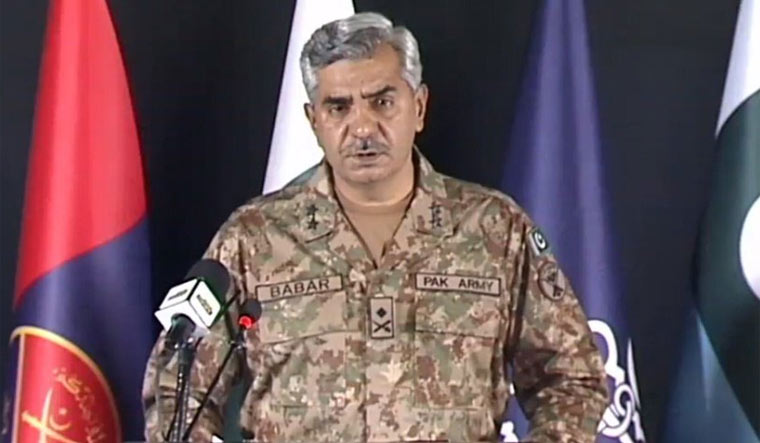
So, when Director General Inter Services Public Relations [DGISPR] Major General Babar Iftikhar suddenly appeared on TV and commented on the statement made by a senior leader of the opposition in National Assembly [NA] it rattled no one. Whereas he didn’t take any names, but by saying ‘A statement was given yesterday which tried to distort the history of issues associated with national security’, he didn’t have to- because it was obvious that the subject of his ire was what senior PML[N] legislature Sardar Ayaz Sadiq had spoken in NA the previous day.

What the DGISPR opined to be an attempt to ‘distort history’, was actually nothing more than a bid by a political party in the opposition to put the government down by accusing it of indecisiveness. This is something that happens very frequently in democracies all over the world and is inconsequential. However, the PML[N] leader crossed the redline when he mentioned that the army chief had displayed signs of nervousness and panic and probably that’s why Gen Bajwa considered the army’s immediate intervention necessary and deputed his media chief Maj Gen Iftikhar to hold an unscheduled televised press conference post haste.

In this presser, DGISPR said that the statement in question was both ’disappointing’ as well as ‘misleading’ and his one-point agenda was to ‘correct the record’ as Sadiq had attempted to ‘distort history’. However, a fundamental question arises in a democracy. Since when has it become the army’s job to set the country’s historical records straight? With the DGISPR going all-out to justify the army’s intervention on a politician’s statement by citing a plethora of reasons clearly it is apparent that Rawalpindi was well aware that by intervening on this issue it was overreaching its mandate!

So, the DGISPR virtually used every trick in the book to make this interference appear to be an inescapable requirement of critical importance and in national interests, which made it incumbent on Rawalpindi to take things into its own hands. The first thing he did was term what the PML[N] leader said to be a brazen attempt to ‘distort the history of issues associated with national security’. On the face of it, this contention may sound worthy of the army’s intervention, but a dispassionate analysis raises a very basic question- can national security really be endangered by ‘distortion’ of just one single event and that too by a relatively insignificant person who hasn’t supported his assertions with any proof?

All that Sajid said in NA was that in the aftermath of IAF pilot Wing Commander Abhinandan Varthaman’s arrest, a meeting had been called, but while the Prime Minister chose not to attend it, the Foreign Minister was in a state of panic and the army chief’s legs were shaking and he was perspiring’. So, what actually emerges is that the PML[N] leader had only expressed his own impressions regarding the physical and mental condition of those present at the meeting. So, being only personal perceptions that didn’t involve leakage of any state secrets or divulging any sensitive information, how does this become an issue ‘associated with national security’ defies logic!

However, just like his predecessors, Maj Gen Iftikhar too has relied heavily on arousing public emotions by saying, ‘This [Sadiq’s statement] is in fact equivalent to making controversial the Pakistani nation’s clear supremacy and victory over India, and I think this is not acceptable to any Pakistani’. DGISPR seems to have overlooked the fact that having had lived through far more embarrassing incidents precipitated by the army, the common Pakistani has become not only far more resilient but also even more discerning today and gone are the days when the army could get away with anything by playing the nationalism or patriotism card!

The common Pakistani who grew up hearing of how Inter Services Intelligence [ISI] of Pakistan Army is the foremost intelligence agency in the world, was greatly embarrassed when it emerged that Al-Qaida founder and 9/11 mastermind Osama Bin Laden was living in Abbottabad along with his family, while ISI was allegedly clueless that the world’s ‘most wanted’ was residing just a stone’s throw away from Pakistan Military Academy. The common Pakistani also suffered unspeakable humiliation when despite Pakistan being Washington’s closest ally in the global war on terror, the US still didn’t share this information with Islamabad and instead, nonchalantly went ahead to hunt him down by violating Pakistan’s airspace!

The common Pakistanis who always believed that Pakistan army officers are the epitomes of patriotism and integrity had to hang their heads in shame when very senior army officers [Lt Gen (retd) Javed Iqbal and Brig (retd) Raja Rizwan] were found guilty of being involved in espionage activities and passing sensitive information to foreign intelligence agencies. The common Pakistani was appalled when despite being exposed for having amassed wealth far beyond his known means of income and declared the same, Lt Gen [retd] Asim Bajwa has still been retained as head of the $62 Billion CPEC [China Pakistan Economic Corridor] Authority.

The common Pakistani who looked upon the army as the foremost unifying force in the country being devoid of any radical or fundamentalistic influences, is indignant when Brig Ali Khan and four Majors are found guilty of having links with Hizbut Tahrir, a fundamentalist terrorist organisation. The common Pakistani is also extremely furious when it emerged that the PNS Mehran terrorist attack that left 18 military personnel dead and 16 injured was the result of failed negotiations secretly held between Naval authorities and Al Qaida representatives over release of arrested Al Qaida sympathisers serving in Pakistan Navy, and that this attack was facilitated by serving Naval ratings with Al Qaida affiliations!

But what defies explanation is Pakistan Army’s renewed push to playdown the effectiveness of the IAF Balakot airstrikes and this definitely betrays a deep sense of uneasiness. What else explains the requirement of DGISPR to waste ‘air time’ by talking about the Balakot airstrikes by IAF when the PML[N] leader’s statement in NA that prompted his unscheduled presser had no mention about or reference to this incident at all? Yet Maj Gen Iftikhar spoke about how ‘The enemy [IAF] planes that had come to drop the explosives on the Pakistani people escaped while dropping their payload on empty mountains in panic after seeing our Shaheens [hawks, here a reference to PAF]’.

Readers would recall that immediately after the Balakot airstrike that took place on 26 February 2019, Maj Gen Asif Ghafoor who was the then DGISPR had made a similar claim and even offered to take the media to this site as soon as weather conditions improved. However, even though the weather cleared in a couple of days, the media was finally taken to the target location only on 29 March which rightly fuelled speculations that this visit had been delayed by more than one month because there was something that Pakistan Army wanted to hide!

It’s a documented fact that a Reuters team which attempted to visit this site for independently ascertaining the veracity of contradictory claims being made by India and Pakistan wasn’t allowed to do so, and instead was turned back not once or twice, but three times by Pakistan Army officials citing ‘security concerns’. Since the otherwise hyper-vocal DGISPR gave no further reasons or explanations as to why this area was placed ‘out of bounds’ for media persons immediately after the IAF strike, or what compelled Pakistan Army to delay taking the media to this site for 43 days, the ISPR has itself let the cat out of the bag!

But the most irrefutable evidence to prove that DGISPR was being economical with the truth regarding the Balakot airstrikes are the three craters which the media was told had been created by the armament fired by IAF. Since media persons who visited the attack site wouldn’t have been aware that each type of armament and explosive has a ‘signature’ crater profile, the journos readily believed whatever was told to them. However, anyone with even ‘YouTube acquired’ knowledge will tell you that craters created by an air delivered ‘bunker burster’ munitions [like the 1000 k.g. Spice bombs used by IAF] characteristically have a very small surface spread but are at least 2-3 m. deep as they are specifically designed to penetrate concrete roofs and thereafter detonate, killing the occupants therein.

However, photographs of the craters [which DGISPR claimed had been created by IAF missiles] that were taken by the visiting media persons have just no similarity whatsoever with what an air delivered bunker penetrating missile would have made. The craters shown to media were quite wide and comparatively very shallow- a clear indication that these were intentionally created by controlled conventional high explosive explosions. Furthermore, that the Pakistan Army couldn’t even produce a single bomb fragment recovered from these three craters to support their claim, reads more like pulp fiction!

Similarly, when Maj Gen Iftikhar spoke about how the PAF ‘shot down their [IAF’s] two jets [and] Wing Commander Abhinandan was captured’, he raked up yet another issue that once again bared ISPR’s proclivity for falsehood. On 27 February  2019, Pakistan Army’s former DGISPR tweeted that two Indian aircrafts had been shot down inside Pakistani airspace and while one pilot [Wing Commander Abhinandan] had been arrested, two others were in the area. An hour later, while addressing a press conference, he spoke about a second IAF pilot being in Pakistan army’s custody adding that he was ‘injured and has been taken to Combined Military Hospital and will be given proper care’.

But by evening, the second IAF pilot who DGISPR had himself confirmed as being in Pakistan Army ‘custody’ and was undergoing treatment in a military hospital, suddenly vanished from the face of earth without any trace. It was only then that it became apparent that this injured pilot actually belonged to PAF and was flying the F16 which was brought down by Wing Commander Abhinandan. Though he bailed out safely, this unfortunate pilot was roughed up so mercilessly by locals [who mistook him to be an IAF pilot] that he lost consciousness by the time he was rescued by Pak security personnel. Stripped off his flying overalls by the mob, he was erroneously presumed to be an IAF pilot and this explains DGISPR’s claim of a second IAF pilot being in Pakistan Army’s custody!

So, rather than setting the record straight, by mentioning Balakot air strike and the air combat incident of 27 February, DGISPR Maj Gen Iftikhar has opened a can of worms and ended up exposing how Pakistan Army has itself been twisting facts all along to conceal it’s failing, whether it was the failure of Operation Gulmarg [attempt to annex J&K in the garb of a tribal invasion in 1947], Operation Gibraltar [annex J&K by inciting a local insurrection in 1965], Operation Koh Paima [Kargil intrusions of 1999, in an attempt to change the alignment of Line of Control], not to mention the Hamoodur Rahman Commission Report [on loss of East Pakistan in 1971], which hasn’t officially  yet seen the light of day.

With PML [N] leader Sardar Ayaz Sadiq standing by what he had said and refusing to apologise, things have become much murkier and that’s why DGISPR’s unsolicited intervention to ‘correct the record’ is simply just an attempt to debunk the PML[N] leader’s mortifying revelations about the army chief so that the ‘tough’ public image of the military isn’t compromised!

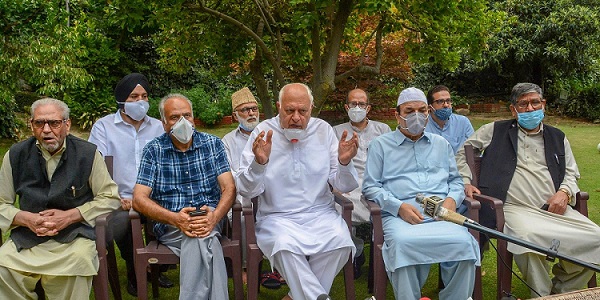
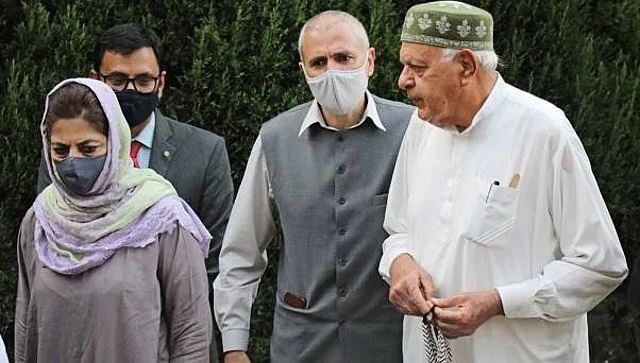
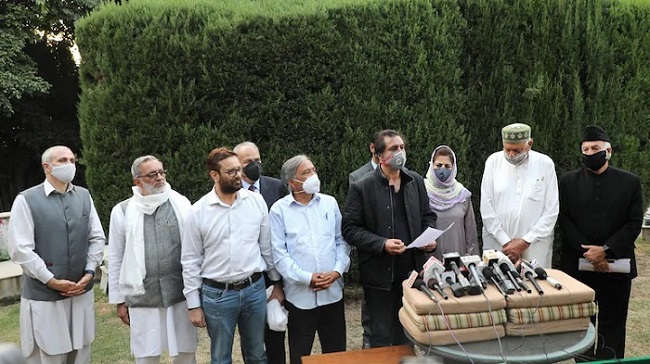
Gupkar Alliance is an unholy union to revive dynasty rule in J&K

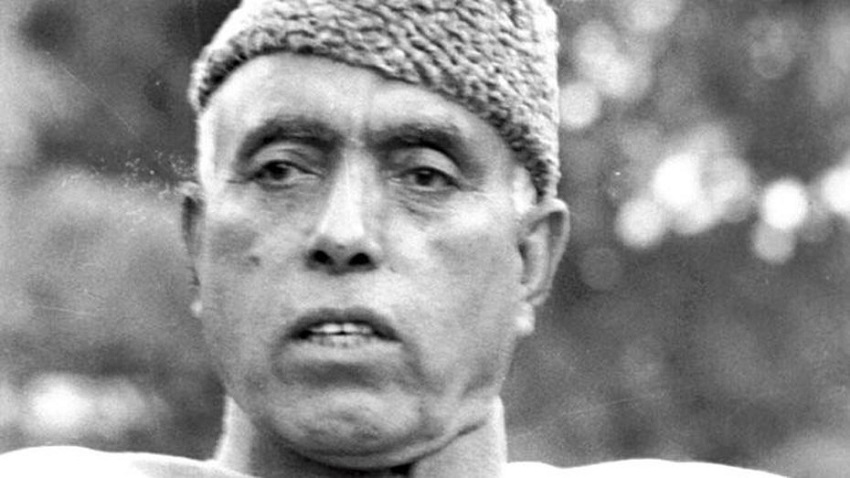
The People’s Alliance for Gupkar Declaration (PAGD), an alliance of seven parties in Jammu and Kashmir that is seeking the restoration of the erstwhile state’s special status, revoked by the Centre in 2019, is in effect an elegy for the demise of dynastic rule and power. The dynamics of history reflects the transition of an old order paving way for a new system – this holds true for both Abdullahs and Singhs (read Sheikh Abdullah and Maharaja Hari Singh). Monarchy and dynastic rule can’t be a permanent feature of a nation.

However, by coming up with this Gupkar alliance, former J&K chief minister and National Conference chief Farooq Abdullah presumes that he can undo the universal truth by a show of mob movement. But his popularity is an enigma.  It has come to him essentially from being the son of late Sheikh Muhammad Abdullah, though many Kashmiris are strongly apathetic to dynastic rule.  Dispassionately speaking, his contribution to Kashmir history is only a plethora of whims and eccentricities, all bandied in self-aggrandizement.  Yet, he delights when told that he has a method in the madness.

His ideology of no accession to Pakistan, bequeathed to him by his illustrious father, is neither a whim nor an eccentricity.  It does not mean either hate for Pakistan or love for India. He never supported the option of Kashmir for Pakistan because he knows very well how Pakistan would treat them- nothing more than hewers of wood and drawers of water. He has spent days in the UK living and interacting with Pakistanis and PoK diaspora.  There are no takers of his bluff in Pakistan, but unfortunately in India, there is no dearth of them, and the Sheikh dynasty survived because its bluff worked with the Indians.

After grabbing power — offered on a platter in October 1947— “doublespeak” became an obvious political culture and tactical idiom of National Conference (NC) leadership, particularly Sheikh Abdullah and his lineal successors. Since in its early days, the NC had gathered momentum through mosque politics — now an encrypted tradition of Kashmir politicos — and the Sheikh had assiduously fathomed the naivety of Congress leadership- the “doublespeak” became almost a lethal instrument very deftly handled by the Valley leadership for seven long decades.  Valley political heavyweights ensured that the bluff percolated down to the Kashmir feudalists, elites and the local bureaucratic segments, and finally to the unsuspecting plebeians.  Interestingly, even other political groups pronouncedly differing with the NC in their political or ideological viewpoint, also found this Goebelian propaganda convenient and serviceable option to further their game plan. The Congress in power at the Centre was complacent with the doublespeak of the Valley leadership, as it considered it as short cut to good riddance. However, it was oblivious of the fact that it was inadvertently allowing the strong nationalist predisposition in Jammu region.

As Kashmir polity was rife with doublespeak, it revealed the duplicity of intentions and willful abandonment of conviction on the part of local leadership. The most disastrous outcome of this phenomenon was the widespread corruption in almost all facets of society that ingrained into the system. The civil society in general and the administrative structure in particular, began to believe that perpetuating a general loot of public assets was its birthright because Kashmir “an Islamic territory was occupied by a non-Islamic power”. The loot of the property raised by a non-Islamic ruling structure was permitted by faith as “mal-i- ghaneem” meaning enemy property meant for general loot. Therefore, whenever the ulema preached honesty, they added, the property of the non-Islamic entity was permitted to be looted. What the Indian Enforcement Department today calls scams, embezzlement, misappropriation, money laundering, hawala, illegal transactions; narcotic trade etc. was alien to the ears of Kashmiri leadership and the public, for their religion allowed it in the name of mal-i-ghaneem.

The Gupkar Alliance is not an alliance that has the welfare and development of Kashmir as its primary objective. Development of Kashmir along democratic, secular and egalitarian lines has neither been the objective of any political party nor the cementing force for unity among them. Even today, the alliance is the result of the lament for the loss of power and hegemony of one or two ruling houses and their ignominious auxiliaries, all pursuing the lone agenda of self-aggrandizement.  

A look at the major partners of this alliance will substantiate this theory.

A case in point is the People’s Democratic Party (PDP). When late Mufti Mohammed Saeed formed the PDP, he publicly announced of getting rid of dynastic rule from J&K’s political landscape as one of the important agendas of his party. In fact, his daughter Mehbooba made it a major election plank, campaigned on its basis and won the election riding on it. Ironically, today she is one of the major partners of this alliance.

Similarly, Farooq’s one-time finance minister,  a close associate in the Gupkar alliance, has a dubious record, albeit in his son’s name, who is alleged to have manhandled 170 crore rupees bank loan by purchasing properties in western countries and the Gulf in the name of setting up industries in J&K.

More importantly, the Roshni scandal through which more than two lakh kanals of forest lands were allegedly granted to the political leaders, bureaucrats, corporate houses, etc, at throw away price, causing a loss of billions to the state exchequer is a case in point. The scandal under the Roshni Act, which has been declared null and void by the high court, happened during the reign of Ghulam Nabi Azad, when he was the CM of J&K. It is alleged that the conspiracy was hatched in collaboration with Abdullah.

All these cases are an indication that the only aim of the Gupkar camaraderie is to reinstate dynastic rule in Jammu and Kashmir.

It may be noted that during its long stints in power, the NC did more harm to Kashmiriyaat than good. The citizens got alienated, thanks to the corrupt system that strengthened the hands of the creamy class of Kashmir at the cost of local entrepreneurs. The development schemes financed by the Centre were either siphoned off or abandoned, while the corrupt thrived.

Unfortunately, over the last few decades, major political parties in J&K pursued only a single track policy of blackmailing the Centre with falsehoods, canards and fabricated stories. The simple formula, which the Kashmir Valley leadership adopted in the course of insurgency beginning in 1989-90, was “Pakistan se bandook Hindustan se sandooq” (get arms from Pakistan to get funds from India).

Prime Minister Modi has understood the implications of Kashmir doublespeak. He has taken strong measures to contain blackmailing the central government and agencies. The easy flow of billions of rupees has stopped and the pockets of Valley leadership are going dry. Accountability has been initiated and the skeletons are crumbling one by one out of the cupboards of the leaders. Their involvement in monetary scams, in militancy empathy, in providing backdoor entries to government jobs to kith and kin, in looting the state exchequer, in corrupting society and services and in spreading falsehood and canards against India, are among their contribution to the development of Kashmir.

These stern measures by the Centre has hassled the Abdullahs and the Sayeeds. Now, they want Kashmir to return to the same old order so that their path to perfidy and scandal is thrown open. That, in short, is what the Gupkar Alliance is fighting for. They want people of the Valley to remain confined to straight-jacketed orthodoxy, allowing no liberal ideas to grow and flow within the society. Progress and development of Kashmir is a distant cry and what sustains the unholy alliance is anti-India proclivities at a time when even in Pakistan saner voices are asking Pakistani government to understand and appreciate the nation-building ideology pursued by Prime Minister Modi.

The NC leadership is now preparing to invite China to help them get rid of democracy and return to 14 centuries- old tribal social order to tell the world they are pure Muslims.  If China can help Farooq recover the Kashmir Sultanate based on his religion, then Farooq should pay a visit to Yarkand, Kashghar, Khotan, Urumchi etc. and visit hundreds of concentration camps for the Uighur Muslims of Xinjiang to know what type of life they are living. Kashmiris have a long history of inviting foreigners to come and rule over them. Farooq is meticulously preserving the tradition laid down by Sarfi and his team way back in the closing days of the 16th century.

Implications of rising Xenophobia and Islamophobia in Europe

The multi-polar world today is increasingly characterized by authoritarian states/rulers/dictators, rising nationalism and religious fundamentalism, growing economic asymmetry, a thousand mutinies mainly regional, chronic instability like in the Middle East, Afghanistan, and an increasing confrontationist clash between the democratic liberal world order and illiberal, non-conformist nations/regimes who want to follow their own pathways. Nations are compelled to constantly engage in 24X7 internal and external strategic balancing in a continuous phase of cooperation, competition, confrontation or even conflict if national aspirations are threatened. This transformation is fed by internal and external societal/cultural/historical/religious strife. Europe which was historically built on a shared belief in democracy, individual freedom, commitment to human rights, gender equality, freedom of speech and importantly religion, and right to migration/asylum has also been affected by the changing world.

There was a time when Muslim scientists, astronomers, surgeons and mathematicians were at the cutting edge of their disciplines. Muslims were then seen as representing a powerful, sophisticated and rich world civilization. Islamic mathematicians such as Al-Khwarizmi, Avicenna and Jamshīd al-Kāshī made advances in algebra, trigonometry, geometry and Arabic numerals. Islamic doctors described diseases like smallpox and measles and challenged classical Greek medical theory. Today, ironically, Muslims are seen as destitute refugees escaping mad and autocratic Muslim rulers.[i] In this guise it is understandable that Europeans will not see Islam as a part of European civilization. Therefore, it is necessary that they peep into their own history, when Muslims were very much part of the European culture/history and impacted the Renaissance, Scientific Revolution and Enlightenment. While many people talk of a ‘Judeo-Christian’ Europe, the fact is that it is the Judeo, Christian and Islamic religions, i.e. the Abrahamic faiths that came together, while engaging with Greek philosophy, to create and nourish what we now know as the European civilization. Chancellor Merkel’s welcoming of some million migrants was an act of compassion for which the world, have applauded her. The friction between a Europe that wishes to preserve its historic identity, and newcomers who wish to escape their own countries and move to Europe is real, not a delusion. There is unfortunately an alarming rise in xenophobia in which islamophobia is the pivotal constituent in Europe. At the outset, comprehensive statistical inputs indicate that contrary to presumptions and assumptions which a nationalist/original citizen feels/perceives the immigrants (from past and present wave of migrations in last 5/6 years) have indeed integrated with European nations well.

Xenophobia connotes ‘dislike of or prejudice against people from other countries’ and Islamophobia refers to ‘unreasonable dislike/hatred or fear of, and prejudice against, Muslim or Islam’. Many experts feel that the real danger to European unity and future, is neither economy, history, nationalism, or extreme political affiliations but rising xenophobia in which Islamophobia is the overriding factor. We have become accustomed to the word Islamophobia, but the ‘phobia’ part softens the meaning as if it was a medical condition deserving of tolerance. EU legislation classifies anti-Muslim as racism, which throws up its ominous characteristic starkly. Racism is not a temporary or transitional phenomenon; it is a social pandemic that burrows into the structures of society, infiltrating and disintegrating all areas of life. Another popular term commonly used today is ‘Political Islam’. Political Islam is any interpretation of Islam as a source of political identity and action. It can refer to a wide range of individuals and/or groups who advocate the formation of state and society according to their understanding of Islamic principles. This is not strictly applicable in Europe, at least for the present.

Common factors that trigger xenophobia in general are differences in cultural and social perception and the rejection of any alterations within the social environment and a lack of education. This has got cemented by highly publicized Islamic fundamentalism and dramatic visuals of terrorism globally, which unfortunately has cost many lives. Without pulling punches, another main cause is the Politicians’ effect.[ii]Experts of behavioral sciences and international relations accept that politicians have a clear effect on the people, urging them to participate in xenophobic movements while fueling their ideologies with hateful rhetoric. ‘Politicians affect society. The stronger their words, the more effect they have, as they polarize people’, said Özdemir (Mahinur Özdemir, former member of the Belgian Parliament). Soytekin (Serkan Soytekin, the press secretary of the DENK Party, first political party in the Netherlands established by migrants) endorses it and says, ‘For instance, in Holland I suffer the same problems as my neighbor, but they create an artificial difference between us based on race and religion,”. He adds “Our first aim is to make people recognize the fact that there is xenophobia; then, to find the main causes of this issue and see if there are enough measures against it’.

European History of Migrants Assimilation             

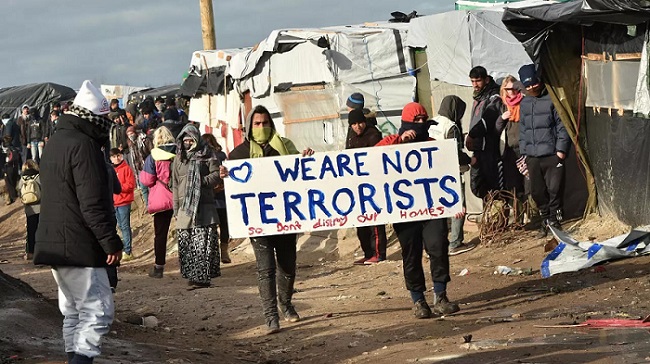
Europe has historically been able to cope well with large influxes of refugees. Throughout the Cold War, for example, millions of people moved from Eastern to Western Europe, fleeing communism. Europe then resettled hundreds of thousands of Vietnamese refugees in the 1980s and 90s. It even took large numbers of migrants from Bosnia and Kosovo in the 1990s, including many Muslims, but this was before Islam became politically toxic. There has been far greater political skepticism towards those fleeing conflicts in Afghanistan, Iraq, and now Syria. Concurrently, much of the Muslim world seems to be turning away from the liberal values that have defined Europe since 1945. A visible change can be seen in Turkey, which once was a candidate that wanted to enter the European Union, now an increasingly authoritarian and religiously chauvinist state. Interestingly, Europe of 44/51 (7 transcontinental nations) nations shares responsibility for a smaller number of refugees than is currently in Lebanon alone. Ironically, all European countries without exception desperately need immigrant labour. The elephant in the room[iii] is an underlying Islamophobia. The simple fact is that European member states don’t really want Muslim immigrants. The liberal political elites of western Europe have steered clear of admitting that the biggest single barrier to coherent asylum and immigration policies is public anxiety about Islam. The anti-Muslim bias is omnipresent not only geographically but also across the political spectrum.

Stereotyping Islam/Muslims

Broad and overlapping categories within Islam/ Muslims are available:

  • One source classifies them under three categories. Literalist Islam; those Muslims who believe that to be a good Muslim should mean to adhere to the letter and spirit of Islamic law; the mystics, those who believe in a warm, inclusive embrace of humanity which reflects the love of the divine for all creation; and finally, the modernists, those who believe in balancing faith with modernity. Those in this final category believed that modernity, with its characteristics of democracy and accountability and Islam were compatible. It is this category that is under threat directly from the literalists. It is the failure of the modernist category that creates a backlash and gives space for the emergence of the Taliban, ISIS and so on.
  • Another method is to view them as ‘contextualists’[iv], who believe that the policies and practices of Islamist movements are driven less by ideology than by events, and are reactive and adaptive. The groups’ main goal is to survive as coherent organizations and political actors. Their use of religious rhetoric is often little more than ‘Muslim-speak’. Whereas the ‘the essentialist’ view holds that Islamists are fundamentally ideological and that any concessions they make to secularist principles or institutions are purely tactical: their participation in electoral politics hardly precludes them from calling for violent jihad, as well. In other words, Islamists see the ballot box as little more than a path to power; once there, they would replace democracy with theocracy.
  • The mistake could be in stereotyping/characterizing people who come from across the Middle East, North Africa, South Asia, and Southeast Asia as ‘Muslims’ rather than as immigrants from different ethnicities or nationalities. Many Muslims actually wish to escape from being categorized as fundamentalist/ too religious. In each European country the relationship of the Muslim minority to the host country is different and depends on the historical relationship with their country of origin and the circumstances of their arrival. After 9/11, especially in the US and Europe they were seen simply as Muslims. While earlier in Europe they were known as Turks, Kurds, Pakistanis and also by their ethnicity and profession, now they are clubbed in people’s perception. The young generation of Muslim immigrants born as citizens in the US or Europe feel the full backlash of the prejudice against Muslims, and it is from here that some young men and women are susceptible to the preaching and get allured to the more extreme literalists who argue that there can be no coexistence between Islam and the West.
  • Policies have emerged across Europe that fundamentally contradict liberal values. A familiar pattern seen is; a negative incident occurs that implicates refugees (Muslim), the media pounces, the far right mobilizes, and the center-right shifts inches closer toward tightening borders. Prejudices difficult to break is that centrist politics has declined in Europe. Centrist politicians have seen their vote share collapse.

Security Sit: The security threats that Europe faces are real. The self-proclaimed Islamic State (also known as ISIS) and other terrorist groups threaten lives and values. Many of the refugees coming to Europe are themselves fleeing ISIS-related violence. The way to address security challenges is through better intelligence and criminal justice, not through restrictions on the right to asylum. The US and UK have avoided a mainland terrorist attack over the past decade because of its superior intelligence services and not because of its immigration policies. Bolstering those services, rather than undermining liberal values, is the response to terror.

Statistical Inputs: Statistically, there is no greater likelihood that refugees will be involved in terrorism or crime than the general populations. Have their numbers created as much havoc as many politicians claim? In fact, although their integration has been incremental and costly, the refugees have not, as right-wingers and others have charged, swamped the welfare system, overwhelmed the schools and public budgets, or deprived native citizens of employment. The refugees’ cultures and religions (mostly Islam) have not impeded integration or undermined social cohesion (degree varies from nation to nation with Germany being best at integration despite accepting maximum immigrants). The 2018, Islamophobia report of the SETA Foundation shows that there have been hundreds of thousands of Islamophobia attacks recorded in Europe in that year alone. The greatest number of incidents occurred in Germany, with 678 attacks on German Muslims, followed by France and Austria, with 676 and 540, respectively. When attacks on mosques and various discrimination cases are included, the numbers escalate even more. The report also shows that compared to the previous year, there has been a remarkable rise in the number of attacks. In 2019, research conducted for the Bertelsmann Stiftung’s Religion Monitor confirmed widespread mistrust towards Muslims across Europe. In Germany and Switzerland, every second respondent said they perceived Islam as a threat. In the UK, two in five share this perception. In Spain and France, about 60 per cent are of the opinion that Islam is incompatible with the ‘West’. In Austria, one in three doesn’t want to have Muslim neighbours.

Muslims in India, Europe can Learn: In India, after the 1857 uprisings that almost toppled British rule in the subcontinent, the British consciously left religion alone. This allowed Hindus, Muslims, and Sikhs to maintain their religious identity and even nourish it. However, the British did use religion to sow the seeds of partition for their geo-strategic interests. In  India the Indian Muslim community is well integrated into the Indian society.  The 195 million Muslim population of India make up 15 per cent  of the Indian population, 10.3 per cent of the world, three times the population of France today, yet, only 18 Indian Muslims were found joining ISIS. Compare this with France, which has only 10 million Muslims but has more than 2000 ISIS fighters who are of French nationality. Muslims excel in every field of human activity. The big moment of Indian Muslims came, when, in the wake of the deadliest and most famous Mumbai terror attack in 2008, the Muslim Council decided not to allow the burial of the bodies of the 9 Jihadists killed during the Taj siege. Islam, to Muslims in India, is not at all about killing innocent civilian people. This act drew international headlines.

Way Forward           

The starting point must be a clearheaded articulation and reassertion of liberal values. Özdemir (Mahinur Özdemir, former member of the Belgian parliament) said that as long as rising Islamophobia is not accepted by European countries, but clubbed loosely with xenophobia, a solution was not likely to occur. Despite the overwhelming increase in Islamophobic attacks, most European countries refuse to include Islamophobia as a separate category of hate crimes, an essential first step to uncovering the real scale of this problem, as is the case regarding anti-Semitism. The good news is that, thanks to the Black Lives Matter protests, the ground is now fertile in Europe for anti-xenophobic activism and policies. Soon after the killing of George Floyd in police custody and the Black Lives Matter campaign that spilled into Europe, it galvanised continent-wide protests, forcing EU in appointing its first ever anti-racism coordinator.[v] Concurrently, people who migrate to Europe must adhere to its laws and social norms. But people should be judged and punished as individuals. Second, Europe should not waver in its commitment to freedom of religion. In a liberal community, people must be allowed to believe what they choose. Third, Europe would have to do a better job upholding freedom of speech. Finally, Europe must protect the right to asylum.

Challenges and Recommendations

The physical, emotional and psychological impact and effects on anti-Muslim discrimination include[vi]:

  • Fear of attending worship services, entering mosques or wearing distinguishing religious or traditional attire or symbols that negatively affects the rights of individuals and communities to manifest their religion or beliefs.
  • A sense of requirement to abstain from identifying publicly as Muslim, expressing their cultural and religious identity or attending religious, cultural or other events, which can exclude them from public life.
  • A feeling or necessity to self-censor, which could cause Muslims to be reticent to express empathy or support for countries that have a Muslim majority in order to avoid being stigmatized.

What can European (or any) governments do? They can take a range of measures to address the problem of intolerance against Muslims. A secular, multi-dimensional democratic country like India must also pay heed. Governments can:

  • Acknowledge the presence of intolerance and prejudice against Muslims which poses a threat to social cohesion, security and stability and the need for this to be addressed institutionally and systemically.
  • Raise awareness of the phenomenon of anti-Muslim hatred, and reinforce values based on the protection of human rights for all.
  • Assess risk and prevent attacks by enhancing co-operation between police and intelligence agencies and Muslim communities through formal communication, transparency, joint planning and action, including regular meetings with mosques and Islamic institutions.
  • Build trust by developing and institutionalizing working partnerships with Muslim communities, civil society organizations and individuals.
  • Improve protection for Muslim communities, institutions and sites, with focus on special/religious holidays, as also days when anti-Muslim protests are on.
  • Consider and incorporate expertise within Muslim communities (diverse including women) when conducting threat assessment, security planning and/or development of crisis management systems.
  • Recognize and record any anti-Muslim bias motivation when investigating and prosecuting criminal acts or sensitizing police agencies to the specific features of hate crimes against Muslims.  
  • Reassure Muslim communities of the state’s commitment to protect.
  • Provide support to victims and assist communities.
  • Support research by academics and civil society groups on the narratives and ideology of hate groups and individuals promoting intolerant rhetoric.
  • Ensure that public messaging recognizes hate crime as not only a threat to the dignity and integrity of an individual, but also to entire communities.

Rising Xenophobia of which Islamophobia is the main ingredient is a ground reality in Europe. If unchecked it can pose a grave danger to the unity and stability of Europe and EU. India, a diverse multi-religion/ ethnic/ cultural/ nation is proud of its secular fabric and way of life, and enjoys genuine awe, respect and reputation globally. However, these are challenging times with rising majoritarianism and nationalism and with almost 200 million Muslims (15 per cent of the population), we must watch events in Europe closely, and ensure that our secular fabric remains intact. The implications directly impact the integrity of the nation. For Europe and India there is much to learn from each other.


[i] ‘Competing Visions of Islam Will Shape Europe in the 21st Century’; The Atlantic; https://www.theatlantic.com/international/archive/2018/05/akbar-ahmed-islam-europe/559391/

[ii] Xenophobia: Biggest threat to Europe’s future by  ŞEYMA NAZLI GÜRBÜZ, DEC 06, 2019, Daily Sabah, Link – https://www.dailysabah.com/politics/2019/12/06/xenophobia-poses-greatest-threat-to-europes-future

[iii] The Elephant in the Room: Islam and the Crisis of Liberal Values in Europe, by Alexander Betts,Foreign Affairs, 02 Feb 2016

[iv] Political Islam After the Arab Spring: Between Jihad and Democracy, BY Oliver Roy, Nov/Dec 2017; Link- https://www.foreignaffairs.com/reviews/review-essay/2017-10-16/political-islam-after-arab-spring

[v] ‘There’s a social pandemic poisoning Europe: hatred of Muslims’ by Patricja Sasnal and Yasemin El Menouar, 28 Sep 20, The Guardian, Link- https://www.theguardian.com/commentisfree/2020/sep/28/europe-social-pandemic-hatred-muslims-blm

[vi] ‘Understanding Anti-Muslim Hate Crimes: A Practical Guide’, OSCE Office of Democratic Institutions and Human Rights (ODHIR), 2020, Link- https://www.osce.org/files/f/documents/9/0/448696.pdf

Rise in journalist deaths due to Coronavirus pandemic

Geneva/Guwahati:  Yet another journalist died in this ongoing Covid-19 pandemic as cases in the National Capital saw an upward surge in recent weeks. Noida-based journalist Pankaj Shukla, 50, died of Covid-19 complications on November 20.

Shukla, who hailed from Bareilly, Uttar Pradesh, was admitted at JP Hospital, Noida, following complications, where he succumbed to the aggravations caused due to Covid-19 infection.

An enterprising journalist, Shukla studied at Allahabad University and started his journalism career with popular Hindi newspapers like ‘Amar Ujala and Dainik Jagaran. Later, he shifted to electronic platforms like Janmat TV, KhabarBharti, News 30, NewsExpress, etc. Recently, he launched his own YouTube channel ‘Rajsatta Express’ and worked as its editor-in-chief.

On November 16, Haryana- based journalist Rakesh Taneja (51), who worked for Zee News, Amar Ujala, Dainik Bhaskar etc also died due to Coronavirus.

In recent months, several journalists have died of Covid complications.

Prabir Kumar Pradhan, 35, an Odisha TV scribe succumbed to the virus infection on November 5. Tripura-based journalist Jitendra Debbarma, 46 lost his battle against the corona infection on October 20. Debbarma worked for a Kakborok language cable channel named Chini Khorang and succumbed to Covid-19 complications at Khumulwng hospital.

Patna- based photojournalist Krishna Mohan Sharma (63), who worked for
The Times of India, died of corona complications on October 15, while undergoing treatment at the AIIMS, New Delhi. Same day, veteran cricket journalist and commentator Kishore Bhimani (81), died after contracting the Coronavirus at a hospital in Kolkata.

In September, at least 12 journalists died of the pandemic. The pandemic has affected thousands of journalists and media employees in India, as they are playing the role of corona-warriors along with the doctors, nurses, sanitation workers, police personnel.

The insensitive attitude of the editors and management towards their employees, while engaging them and subsequent lack of adequate precautions is one of the causes of the rise in casualties among the media persons due to Covid.

“India has lost 50 working journalists to Covid-19 complications, with the number of casualties rising to 469 in 56 countries,” said Blaise Lempen, general-secretary of Press Emblem Campaign (www.pressemblem.ch), an international media rights body based in Switzerland. In fact, India has emerged as the second most affected country among media persons after Peru, followed by Brazil, Bangladesh, Mexico, USA, Pakistan, UK, Afghanistan, Russia, France, Spain, Italy, Egypt, Nepal etc,” he added.

The Covid- induced pandemic has taken a toll on the media industry globally. Several print media have closed their print editions and shifted to the digital version. Some print management have even closed down their editions in different places, reduced pages, cut salaries and have laid off their staff, including senior journalists, citing shrinking advertisement revenues.

Why is Monsieur Macron facing music from Islamic Radicals?

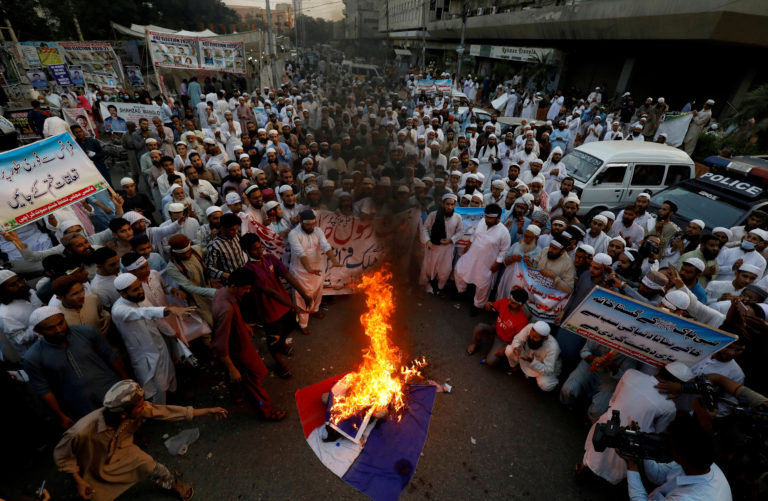
French President Emmanuel Macron drew the ire of many Muslim countries recently, following his statement on Islamic terrorism. In countries like Pakistan, the mobs after Friday prayers became uncontrollable and turned violent so much so that the authorities had to deploy riot force to control the unruly mobs.

The leaders of the protesting nations lost no time in denouncing President Macron for what they call “disrespecting the Prophet and humiliating Islamic religion”. When Pakistani Prime Minister, the Turkish President, Malaysia’s ex-Prime Minister and other senior leaders orchestrated this allegation, their masses took the cue and staged huge demonstrations, pledging to protect their faith at the cost of their lives.

Turkish President Recep Tayyip Erdogan, who had earlier snubbed the French President over the Charlie Hebdo and its caricatures, went a step ahead by saying that President Macron should undergo a mental health checkup, after he announced a plan to reform Islam to make it compatible with French values.

In Islamabad, the National Assembly passed a resolution demanding the suspension of relations with France, boycott of French goods and withdrawal of Pakistani Ambassador from Paris (interestingly, no Pakistani Ambassador has been appointed to France).

In Afghanistan, the Taliban leadership issued a warning to take action, if France did not apologize. At many places, the effigies of the French President were burnt and photographs trampled under feet by rowdy crowds to express deep hatred against the French President.

In India, Muslim majority areas witnessed protests and demonstrations as well. Munawwar Rana, a poet in Lucknow and Farhan Zubair, President, Aligarh Students Union, in Aligarh, have been arrested by the police and FIRs have been lodged against them for spreading hatred. Farhan had said that anybody disrespecting the Prophet will be beheaded.

Surprisingly, no leader except the Saudi monarch drew the attention towards the actual words uttered by the French President and also the context in which he said it.

“France was faced with the threat from Islamist terrorists… we respect all the religion”, the French President, said, reiterating that his country upholds the freedom of speech and expression.

A look at Macron’s speech suggests that there was no derogatory remark either against Islamic faith or the Prophet of Islam as has been alleged by the protesting masses with surcharged emotions and their leaders. Macron never said France faces a threat from Islam, but from Islamic terrorists, which is a reality. It has now become proverbial with the political commentators to say that every Muslim is not a terrorist but every terrorist is a Muslim. That is precisely what Macron meant. He disparaged neither the Islamic religion nor was disrespectful of the Prophet.

It may be recalled that even Pakistan has, at various world forums, including at the United Nations, raised its concerns on Islamist terrorists and threats posed by religious extremists. Moreover, the Zarb-e-azab campaign against Islamic extremists in North Waziristan, resulting in the killing of more than 70,000 people, is also a case in point. In fact, at the Financial Action Task Force (FATF), Islamabad had announced that it has put curbs on the radicals on its soil and even banned their organizations. So, how was Macron wrong?

Talking of Charlie Hebdo and the caricatures, let us not forget that France is a democratic country, where freedom of expression is given utmost respect. Now, if the magazine Charlie Hebdo, drew a caricature that hurt the feelings of a section of people, the proper way to seek justice is to lodge a complaint with the police and take the case to the French judiciary. Nobody has a right to take the law into his hands. Unfortunately, the law was taken into hand by those who want to be known as Islamic radicals.

The large scale propaganda and tirade against President Macron and France appears to be part of a larger conspiracy of the terrorist elements among the French population. As far as protests in Islamic countries are concerned, each has its own motive. Turkey is nursing rivalry against France in the backdrop of trade and commerce in African countries, where France has a strong clout. Pakistan is upset with France over its friendly relationship with New Delhi, especially over the Rafale deal, which has boosted India’s air capability. Besides, the fact that France had supported New Delhi during the Sino-India standoff in Ladakh hasn’t gone well in the power corridors of Islamabad. The Charlie Hebdo episode provided Islamabad the opportunity to square off with Paris, who in turn indirectly instigated mob outburst against the French President.

Let us now take a look at the context of the protests. Islamic terrorists have been active in France. On January 7 2015, two Islamist gunmen forced their way into the Paris headquarters of Charlie Hebdo and opened fire, killing 12 staff cartoonists. The gruesome attack surged the demand for the next issue of the news magazine, and no fewer than five million copies of Charlie Hebdo were published. The money collected from the issue was given to the victims. The French government also offered a sum of one million Euros help to the magazine. On September 25, 2020, weeks after the caricature republications, two people were critically injured by an assailant during a stabbing attack outside the magazine’s former headquarters. A day later, the perpetrator was identified as Zaheer Hassan Mehmood, a 25-year-old allegedly from Pakistan, who claimed to have arrived as an unaccompanied minor refugee in France in 2018. He confessed of his actions and said that he had acted in vengeance for the caricature republications. Recently, a French teacher showing the Hebdo caricature to students was beheaded by an 18-year old Chechen refugee Muslim carrying a knife.

These incidents pose a bigger debate on the right to freedom of expression and religious sensitivity. Remember, democracy is no democracy if it cannot ensure the right to freedom of expression. Millions of Muslims escaped their original countries and sought asylum in France just because they did not find the right of expression in their countries of origin. Today, France is suffering for its sin of generosity and humane treatment to the asylum seekers. Among all the countries in Europe, France has offered maximal largesse to the Muslim refugees, asylum seekers, immigrants and illegal intruders from the Middle East and North African countries not imposing any restriction on them in regard to education and pursuit of an economic prospectus. French judiciary is known for its just and humane treatment and nobody is denied justice if he or she approaches the court of law instead of taking the law into their hands. France will protect and uphold its democratic traditions in any case and no power can derail the country from what it stands for. This great country has been the model of freedom and liberty for entire Europe and the world.

Gupkar Gang’s U-turn on DDC elections

The angst expressed by the originators of Gupkar Declaration I and II need to thin out and become perceptional. Leaders long in seats of power tend to become an institution by default for good or mundane reasons. The Gupkar Gang, as their detractors would like to call them, belong to that specie of humanity.

Reconsidering the blunder of boycotting panchayat elections previously, the opposition parties have changed the course of their approach to the ongoing political scenario in Kashmir. This we presume is a healthy sign because what can be achieved through the normal democratic process cannot be achieved through unleashing of violence.

We consider it a good move by the Gupkar Alliance to jump into the mainstream and strengthen the democratic process. This also means that the militants will be forced to re-assess their line of action and come to the table for talks.

We consider it a healthy sign for the Indian democracy and especially for Kashmir where democracy and secularism have received a strong setback owing to militancy. Participation in the DDC elections would pave the way for further political interaction in the Union Territory and possibly the chances may open up for the restoration of the historical State of Jammu and Kashmir. Though one cannot predict whether the special status will be restored, nevertheless, the state will certainly work in a much improved political environment. It is likely to reduce corruption that has so venomously crept into the vitals of society.

When will the State be restored its previous status is not easy to predict but one thing is clear that the administration, development, law and order situation and security dimensions will get a new facelift. In particular, tourism will attain new dimensions if we consider the plans and programmes of the government.

However, the incumbent civilian government in the restored State will have to cut its cloth according to its size. Delivery will be the key and final proof of its performance. The days of dynastic and arbitrary rule are gone forever and can never return. Those used to the general look of the State Exchequer will find their perfidy coming to nought.

If these ideals are what the Gupkar Alliance intends to pursue, its policy will certainly receive accolades. But the question is will the elected civilian government have the courage to take on the militants and their threats and intimidation? Though of course, the security forces will cow them down everywhere and every time. The local leadership has a great responsibility of steering the ship of the state through disturbed waters. Fortunately for them, the central government is forthcoming with funds and plans that bring about a revolution in the economic life of the state.

The element of self-abnegation, expected of politicos seldom gets back benched. Ultimately, the connection between them and the demos they represent shrinks to a small coterie whose members tend to turn aggressive, worshippers of personality cult and finally goons and cronies with invidious influence the power structure.

Kashmir Valley leaders are usually obsessed with local partisan politics and a narrow prism to look at the far-reaching consequences of being an entity of the world’s largest secular democracy. How amusing that Kashmir’s most popular leader Sheikh Muhammad Abdullah understood the benefits of a secular democracy for a region in which the Muslims formed as big a minority as to pass for almost an overwhelming group in the sense of adult franchise arrangement. But on the other hand, he erroneously concluded that his popularity, power knob and ego would remain secured and intact only if he pandered guardedly to premier community support in narrow parameters. It meant that he was trying to have the best of both the worlds without making conspicuous sacrifices for the advantages he was seeking. The undisclosed agenda of 1952 Nehru-Sheikh Accord became the catalyst to the sordid narrative of August 1953.

Sheikh Abdullah, founder of the political outfit National Conference that has a presence in certain pockets of the Kashmir Valley. (File Photo)

Thereafter, the gradual downslide of state-centre relations emerged as a new gamut on J&K political platform. In the beginning, Kashmir Valley masses did not make out the real cause of the Sheikh’s simmering estrangement with New Delhi in the early 1950s although sporadic incidents of limited civilian dissatisfaction could be felt. Bakhshi Ghulam Muhammad, who succeeded the Sheikh in 1953 AD, entreated himself to the masses of people in the valley and could also handle New Delhi with requisite dexterity. He proved himself to be the man of the masses and his unforgettable contribution towards the development of J&K, subscribing to nationalist politics and abiding secularist ideology.

But alas! The Kamaraj-ing of Bakhshi proved such a Himalayan blunder as makes Kashmir bleed ever since. The truth is that India lost Kashmir the day when the Bakhshi was removed more by caprice than by essential political pragmatism and statesmanship.

A big fissure developed in the state-centre relationship. No chief minister, thereafter, nor even Ghulam Muhammad Sadiq, could restore the crucial and expanded link because he posed as an icon of the Leftists bereft of the quality of mass leadership which was the domain of his predecessor. With Leftists playing the very unimpressive class and sectarian role in the country, they influenced Nehru who ousted some more popular contemporary regional leaders in whom he saw the potential of upstaging their popularity. Bakhshi was trapped.

Second stint of the Sheikh (1975-82), contrived through gross manipulation of democratic procedure was a different story. His fake secularism had vanished altogether; he got bogged with international Islamic politics; he established liaison with the Saudis through Pakistani conduits and brushed aside local issues essentially of development, of streamlining relations with New Delhi and of reforming the ideological assault led by Jamaat-e-Islami of Kashmir. He could not control the aggressive rather militant cadres of Plebiscite Front from indulging in hooliganism and public disorder just because in his physical absence from the scene owing to incarceration, his bigoted lieutenant Mirza Afzal Baig left no stone unturned to cement the link between Jamaat-e-Islami and the Plebiscite Front essentially based in Pulwama district of South Kashmir and Sopor town in North Kashmir at whose hinterland borders touched PoK via Kupwara.

After the Sheikh’s demise in 1982, the National Conference remained the premier mainstream political party in Kashmir with Farooq Abdullah, the second son of Sheikh at the driver’s seat. I will not go into the details of the sordid role of Farooq and his party in deliberately overlooking or underestimating the dangers of parochial politics in a sensitive border state torn by internal conflicts or political myopia and looming external threats. Although Farooq did not overtly socialize with the Jamaat-e-Islami of Kashmir, yet he knew them and declined to cut them to their size.  To alley their misconception about him, he regularized thousands of darsgahs meaning exclusive Jamaat seminaries and absorbed thousands of their teachers into government school education department without realizing how effective they would be in polarizing Kashmiri society vertically and subverting the social fabric and administrative functionality. Most of the bureaucrats who rose to senior administrative positions were in one way or the other the products of these seminaries that had done successful brainwashing experiments on them.

The situation became alarming for Farooq and his party when the political wing of the Jamaat-e-Islami known as Muslim United Front (MUF) actively participated in the assembly elections in 1986 and stunned the National Conference by leading in some constituencies in Srinagar especially the Magarmal Bagh. How National Conference goons under instructions from party echelons misbehaved and manhandled the winning MUF candidates and intimidated the returning officers as well, was attributed by the politically conscious Kashmiri Muslim voters as the underhand game of New Delhi in which it showed reluctance to popularize Kashmir’s political play game. This was the alienation point for them which did not look back any more. Therefore, after the MUF episode, Kashmir politics went through a sea change. ISI of Pakistan had won the first round. Farooq became fully conscious that his political survival had to be more reliant on support from the local influential Jammat rather than New Delhi.  

It was sheer political shortsightedness of New Delhi (Congress) to have allowed the critical situation in Kashmir drift to a dangerous course. But Congress had from very early days of Kashmir’s accession to India begun to feel that its interests were safe in the Kashmir proxy (the Sheikh dynasty). That ultimately proved the fundamental cause of exasperation for the valley-based populace and continues till date.

The dynastic rule in Kashmir focused on its primary objective of retaining power and self-aggrandizement and the camp followers leaving no stone unturned to promote its narrow-minded objective by means fair or foul. The bureaucracy understood how much Kashmir politics got personalized, spread out their fangs and hence the general loot in which the politicians, ministers and other beneficiaries flourished day and night. Their arrogance rose to the level that they refused submitting utilization certificates for the huge funds sanctioned by the centre under various central schemes and there was no action for dereliction of duty. Highly controversial laws that sullied rights and interests of the general public were enacted like the ‘Roshni Act’ which benefitted a small group of feudal lords but ignored the rights of the common man. Corruption became much more rampant during the tenure of Farooq’s son. That is what usually happens under the dynastic rule!

Gupkar Alliance is the new age separatists’ gambit for DDC elections in J&K

1

Elections in Jammu and Kashmir, regardless of the level at which they are being held, have a tendency of heating up the political environment. All parties bare their claws and go to each other throats with the worst form of name calling and trading of barbs/insults. In the melee, important issues are skirted as attention remains focused on mundane matters that are high on emotion.

The aforementioned scenario is being witnessed in full measure as the elections for the District Development Council (DDC) approach. The DDC is a new unit of governance introduced on 17 October 2020  by the Government of India by amending the J&K Panchayati Raj Act, 1989 and J&K Panchayati Raj Rules, 1996. It aims to strengthen grassroot democracy and the Panchayati Raj system by replacing the bureaucratic District Planning and Development Boards (DDBs) with the DDCs. In the new dispensation the planning process will be handled directly by the elected representatives of the people. While the DDBs functioned under a cabinet minister, the DDC will be headed by the local Member of Parliament as chairman and other locally elected representatives as members. The Councils will oversee the functions of the Panchayats and of the Block Development Councils as well.

As expected, the Peoples Democratic Party (PDP) was vociferous in its criticism of the progressive amendment and termed it as a mere tokenism. ‘The aim is to sub-divide, overlap, create layer after layer, so that nobody would know who is in charge. In such a scenario, the ultimate arbiter would be the bureaucrats and the security set-up’, said a spokesperson of the PDP. The other political parties of Kashmir also did not shy away from criticising the move of the government.

These parties, now in alliance as the People’s Alliance for Gupkar Declaration (PAGD) and comprising of the National Conference (NC), PDP, People’s Conference (PC), Communist Party (CPI-M), Awami National Conference (ANC) have taken on the separatist mantle with consistent calls for disruption and divisiveness by demanding restoration of Article 370. They have not taken long to comprehend the political isolation that they would face by not participating in the DDC polls. Hence, they have decided to fight the election together.

The adage, “politics makes strange bedfellows” most aptly denotes the PAGD. It’s constituents are bitter political enemies who have been at each other’s throats for decades; now they are coming together for a small grassroot election. Furthermore, most constituents had sworn publically that they would not fight any election till Article 370 is not restored and have now retracted. This is a reprehensible show of political opportunism. One has to agree with the definition of ‘Unholy Gathbandan (Alliance)’ given to this set up by Home Minister Amit Shah.

The Congress party, unsure of favourable result in the DDC elections has joined the PAGD bandwagon deftly sidelining the fact that it also rooted for the abrogation of Article 370 but could not garner the will to revoke it. Now it is associating with elements that seek restoration of the Article! India and the whole world are watching this double-faced opportunism of the Congress which is bound to negatively impact the party’s already diminishing reputation. However, the Congress seems to have realised the blunder and is attempting to make amends. The state level leadership gave a clarification that it “may pursue a state level electoral alliance” but would not be signatories of the proclamations. The central Congress leadership claimed that there was no alliance at all. It is very unfortunate to see a national party of the stature of the Congress stooping to such low levels.

PAGD is set to fight the DDC election on the platform of “restoration of Article 370.” How will it fulfil this dream through victory in a grassroot poll? Quite obviously, they are contesting on a flawed agenda. In any case, the fissures in the ‘unholy Gathbandan’ are already visible with most constituents expressing dissatisfaction over the seat sharing formula made by the National Conference. How can these people be relied upon to work for the welfare of the people?

There are some who wish to create an impression that the Bharatiya Janata Party (BJP) will come under pressure and stress by this ‘Gathbandan’ coming into play. This, experts feel, is a faulty argument. The BJP will definitely fight the election but its main interest is to ensure free and fair polls and smooth political movement to pave the way for state level elections. The PAGD has, in fact, played into the hands of the BJP by agreeing to fight the election and giving an indication that its anti-polls rhetoric was a fallacy. The NDA Government has, thus, moved a step nearer to its assurance to the people that assembly polls in the Union Territory will be held soon.

A point for concern is the manner in which the PAGD constituents are looking for support from across the border for their political survival. The PAGD chairman, Farooq Abdullah has led the alliance in seeking support from both China and Pakistan. This policy has grave security consequences. Pakistan has already taken cognizance of the statements and drastically increased its nefarious activity along the Line of Control (LOC). The recent exchange of fire all along the LOC and the killing of terrorists being transported from Jammu to Kashmir are indicators of the enhanced activity by Pakistan. The response by the Indian Army and other security forces has been strong and decisive, but that does not condone the anti-national bias of the PAGD constituents.

The new age separatists want the DDC election to become their political playground for their battle on the issue of Article 370. The stark reality is that abrogation of Article 370 is complete and irrevocable. India and the entire world have accepted it. Politics in the Union Territory have to be conducted within the ambit of this reality. Also, the existing set of politicians and their agendas are outdated and as such a new leadership needs to be given a chance by the people. (

Defence Sector Reforms & Corporatisation of Ordnance Factory Board

Prelude          
In Part I, we looked at the historical background and colonial legacy of Ordnance Factory Board and the many challenges it faces leading to sub-optimal functioning of an institution which should have been a prime component of our ‘Atmanirbharata’, and vital for our strategic autonomy and comprehensive national power (CNP). Accordingly, one major component of the special economic package of Rs. 20 lakh crores announced by PM Modi on 14 May 2020 to revive the Indian Economy from the fallout of COVID, are key structural reforms in the defence sector.

Soon after a day, on 16 May the Finance Minister revealed the ingredients of the reforms, one being the ‘Corporatisation of the OFB’. Defence Minister Rajnath Singh followed up and announced on August 9, 2020 a list of 101 types of military equipment, weapons and ammunition which will be progressively barred from being imported starting December 2020. The ‘Negative Import List’ of 101 embargoed items comprises not just simple parts, but also some high technology weapon systems like artillery guns, assault rifles, warships, sonar systems, submarines, light transport aircraft, light combat helicopters (LCHs), radars and light combat aircraft. Any item on the ‘negative list’ can now only be sourced from the domestic industry. MoD will place orders worth Rs. 4 lakh crore with the domestic industry over the next 5-7 years by cutting down on these imports. For now, India remains a top importer of weapons and equipment.

Reforms Announced in Defence Sector
The key highlights of the announcements for the defence sector as given out in the press release issued by the Government of India are enumerated[i] as follows:

Policy Reforms in Defence Production

  • FDI limit in the defence manufacturing under automatic route[ii] will be raised from 49 to 74 per cent. This could well be a game changer as tweeted by the FM.
  • There will be time-bound defence procurement process and faster decision making will be ushered in by setting up of a Project Management Unit (PMU) to support contract management; Realistic setting of General Staff Qualitative Requirements (GSQRs) of weapons/platforms and overhauling Trial and Testing procedures.
  • Enhancing Self Reliance in Defence Production
  • ‘Make in India’ for self-reliance in Defence Production will be promoted by notifying a list of weapons/platforms for ban on import with year wise timelines, and indigenisation of imported spares, and separate budget provisioning for domestic capital procurement as brought earlier; resulting in reduction of huge defence import bill.
  • Improve autonomy, accountability and efficiency in Ordnance Supplies by Corporatisation of Ordnance Factory Board.

Industry Reactions:  The reforms announced by the government to boost indigenous defence production have been welcomed by the Confederation of Indian Industries (CII) and various private defence companies operating in the country[iii], as they are of the opinion that these reforms will provide a boost to domestic manufacturing in the defence sector.

Increase in FDI from 49 to 74 Percent: Will it be a Game Changer?

Private sector was permitted to enter the defence industry from May 2001 up to 26 per cent[iv] and raised to 49 per cent later in 2015.[v] Many studies including the ones conducted by the government showed dthat any FDI below 51 per cent ( FDI up to 100 per cent was also offered in case of state of the art technologies, after government approval[vi]) will not attract investment in India, mainly due to inability to participate in decision making. A few JVs were set up, but indigenisation efforts did not take off.

National Payoffs by Increasing FDIs:Few obvious advantages which accrue by increasing FDI to 74 per cent are broad basing of defence industrial base; induction of niche technologies; will encourage foreign defence conglomerates to set up subsidiaries specially under the ‘Buy Global-Manufacture in India’; create an eco-system to procure spares and parts from the local manufacturers to cut down on the cost of the equipment further cementing ‘Make in India’ during crisis situations; catalyst for making India as an ‘Export Hub’ for defence equipments, especially when nations are looking for alternative destinations to China; boost to our economy in terms of foreign exchange, create sensitive infrastructure and provide employment. Some of the challenges and concerns in raising the FDI limit are; valid concerns on threat to national security if foreign nations/company intervenes/interferes in the functioning; challenge to our indigenous industry to grow (rules allow JV in niche technology/when we don’t have the tech); however, the overall benefits override any negatives.

Corporatisation of OFB

A Move Long Time Coming: The corporatisation of OFB announced by the Government was incorporated in Modi 2.0 manifesto as part of their ‘167 transformation ideas’ but has been debated since a long time. The corporatisation was first suggested by the Nair Committee in 2000 and thereafter by Kelkar Committee in 2005 and Raman Puri Committee in 2015.[vii] Despite stiff opposition from the trade unions who are calling it ‘arbitrary illegal and unjustified’, the government appears determined to implement it. The rationale for doing so has been covered in Part I.  

Overview of Corporisation

The Corporatisation of OFB will put it at par with other DPSUs managed by its own board of directors with broad guidelines from the government.[viii] The growth envisaged is a turnover of Rs. 30,000 crore by 2024-25 annually against exiting Rs. 12,000 crore. A high level committee under Vice Admiral Raman Puri Committee recommended grouping existing ordnance factories under three or four verticals with core competencies. A likely structure categorising factories into four verticals of Ammunition, Weapons, Explosives and Combat Vehicles is shown in Fig. 1 below:

Corporate OFB will be allowed to forge partnerships with the private sector as per the MoD’s approved policy and will continue to receive orders from the country’s security forces. It will also be granted a special preference of 15 per cent  above L1 price for “Make” and “Buy and Make” category products. The Centre will support OFB in case of losses, by way of loan for 30 per cent  of the total shortfall and by way of equity investment for balance 70 per cent  of the amount. The working capital for the next five years will be provided by the Department of Defence Production (DDP) as a one-time corpus fund. Capital investment for ongoing and sanctioned projects will also be provided.[ix]

Benefits of Corporatisation: Some important benefits which will accrue post corporatisation are; improved efficiency leading to increased production capacity, greater autonomy and faster decision making; competitive pricing as competing with the private industry; induction of niche technology from the best sources/nations; increasing flexibility and financial independence; earnings through exports; and most importantly benefits to Armed Forces who will get more ‘bang for the buck’ for modernisation and procurement of latest systems improving capability and capacity. Some of the concerns of the employees and critics have been highlighted in Part I.

Separate Budget Provisioning for Domestic Capital Procurement:To boost indigenization and private defence sector, the government has promised to set up a separate budget for internal capital procurement. This ideally should be over and above the Defence Budget, with provision for R&D which is the hallmark of all growing powers. One thought which needs further study and analysis is to place Department of Defence Production (DDP) under the Department of Military Affairs (DMA), and Corporate OFB under the Ministry of Industry for optimal functioning.

Conclusion

We live in a multi-polar, multi-domain world which is currently going through a turbulent, violent phase forcing nations to carry out strategic balancing to retain/enlarge exploit strategic space. Nations are concurrently carrying our cooperation, competition, confrontation and engaging even in conflict if national sovereignty dictates so. India believes in ‘strategic autonomy’ and one of the vital ingredients to attain it is by becoming self-reliant in defence, in terms of forces, munitions and equipment, including niche technology. Corporatisation of OFB is likely to be a decisive step and a game changer towards self-reliance in defence production. Hopefully, it will transform ordnance factories into a modern, state of the art facility with flexible and better decision making in its functioning. It will make them more competitive and hopefully convert it to a profit earning organisation within next few years. However, the more important part will be the execution of these reforms on ground. The exact contours and timelines for implementation is still to be released by the government and is eagerly awaited by the Indian and foreign defence companies. Corporation of OFB is a defining step towards a ‘Aatmanirbhar Bharat’.

———————————————

[i]‘Finance Minister announces new horizons of growth; structural reforms across Eight Sectors paving way for ‘Aatmanirbhar Bharat’, Ministry of Finance, 16 May 20

[ii] The entry of Foreign Direct Investment by non residents into India is regulated through two routes –automatic route and approval route. Under the Automatic Route, the foreign investor or the Indian company does not require any approval from the Reserve Bank or Government of India for the investment.But, in the case of approval route, government agencies regulate and scrutinises foreign investment while approving it.

[iii] Piyush Pandey, ‘Confederation of Indian Industries lauds defence initiatives’, The Hindu, 16 May 2020

[iv] Revision of existing sectoral guidelines and equity cap on Foreign Direct Investment (FDI)’, Department of Industrial Policy and Promotion (DIPP) Press Note No 4, 21 May 2001,  available at https://dipp.gov.in/sites/default/files/press4_01.pdf

[v] ‘Review of FDI policy on various sectors’,  Department of Industrial Policy and Promotion (DIPP) Press Note No 12, 24 Nov 2015,  available at https://dipp.gov.in/sites/default/files/pn12_2015%20%281%29.pdf

[vi] ‘Review of FDI policy on various sectors’,  Department of Industrial Policy and Promotion (DIPP) Press Note No 5, 24 Jun 2016,  available at https://dipp.gov.in/sites/default/files/pn5_2016.pdf

[vii] ‘Committee for Corporatisation of Ordnance Factory Board’, Press Information Bureau of India, 02 Dec 2019, available at https://pib.gov.in/Pressreleaseshare.aspx?PRID=1594520

[viii] Laxman Kumar Behera, ‘In Favour of Corporatisation of Ordnance Factory Board’, IDSA, 21 Aug 2019, available at https://idsa.in/idsacomments/in-favour-corporatisation-ordnance-factory-lkbehera-210819

[ix] ‘Corporatization of Ordnance Factory Board (OFB)’, Defence ProAc, available at https://defproac.com/?p=9550