Home Blog Page 349

Interview with Himanshi Upadhyay of “My Home is a Suitcase”

My Home is a Suitcase” is a play by Rzgar Hama about individuals who sought new lives as immigrants. It is based out of Vancouver, British Columbia, Canada. These are real stories. The next few interviews will be from some of the individual readers of their stories of beginning new lives in Canadian society. Hama is known for several plays, including “Soldierland” with some professional commentary by Dr. Marvin Westwood and Dr. George Belliveau of The University of British Columbia in “Dr. Marvin Westwood & Dr. George Belliveau on SOLDIERLAND a play Written and Directed by Rzgar Hama.” Here I speak with Himanshi Upadhyay on “My Home is a Suitcase.”

Scott Douglas Jacobsen: We’ll keep this focused on an initiative by Sky Theatre Group under Rzgar, “My Home is a Suitcase.” How did you find the Sky Theatre Group?

Himanshi Upadhyay: I saw an advertisement on Facebook.

Jacobsen: How did you become involved with “My Home is a Suitcase”?

Upadhyay: When I first contacted Rzgar, frankly speaking, I didn’t know what it was going to be. I attended the meeting with other participants. Everything he said was so interesting for me because I always wanted to be a part of something creative and meaningful. So, at first, we started to write something about our lives and shared with each other. Then we wrote some of the key moments of our lives. After that, whole stories like when, why, and how we migrated to Canada and how our lives were before that decision to immigrate, etc. During all those meetings Rzgar, Hila, and Lenora also taught us some acting exercises and some writing skills. Overall, it was a long journey that we all did together and developed a bond with each other and the project “My Home is a Suitcase.”

Jacobsen: What was the experience of telling the story – without telling your story – to some of the public and peers who made a new life for themselves?

Upadhyay: At first, it was scary :). Everybody was a complete stranger to me. I didn’t want those unknown people to judge me. But then, I realized that everybody has something to say here. I saw that no one is judging anyone. Everyone had their own set of problems or struggles in their lives, but there was a mutual respect for each other. So with time, I became comfortable sharing the story, in sharing my life, with all the participants.

But again, the moment came when I was in front of the public to share my story with no control about how they were going to judge me or think about me, I got goosebumps. Then I just imagined that the whole room is filled with my friends and they are curious about my life and after that, it was an amazing experience. People were so good. After the reading, two of the ladies came to me said, “We can totally relate to your story. We are so proud that you made a decision for yourself.

Jacobsen: What was working with a seasoned, veteran playwright and director like for you?

Upadhyay: It is really a learning experience. I am using “is” because the project is still going on. I have learnt so many things so far about theatre and public reading. Rzgar gave some acting classes before Covid-19 hit and that time I thought, “Wow, acting is not so easy. It’s exhausting,” but, yet, you have to show what you are doing is effortless. One more thing I liked about Rzgar. He imagines the whole play so well that you are just left amazed by his creativity.

Jacobsen: What are you hoping some of the audience takes home with them when the final production comes out?

Upadhyay: Respect for their lives. Because that’s what happened to me. I just realized after listening to others’ stories that we should respect what God is giving us because many people are seeing us as the lucky ones. Also, they will see that “immigrant” is not just a word. It has a whole story of a living soul behind it.

Jacobsen: Thank you for the opportunity and your time, Himanshi.

Upadhyay: Thank you so much, Scott, I am glad we are taking “My Home is a Suitcase” to the next level.

Photo by Emanuela Picone on Unsplash

Image Credit: Soran Mardookhi, and Rzgar Hama/Sky Theatre Group.

Chinese gimmicks that turned Line of Actual Control into Line of No Control

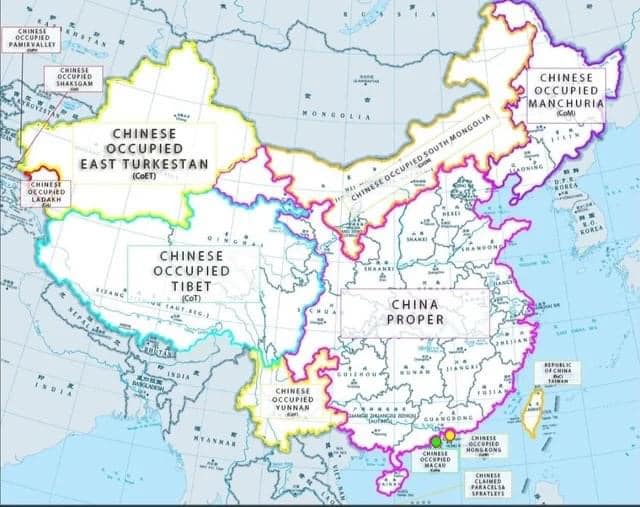
India has a 3,488 km long frontier with China along Xinjiang, Ugyur, Zizhiqu and Tibet. Of this, 1,597 km is in Ladakh, 200 km in Himachal Pradesh, 345 km in Uttrakhand, 220 km in Sikkim and 1126 km in Arunachal Pradesh. Interestingly, Xinjiang and Tibet regions are under forcible occupation of China and should actually be called China Occupied East Turkestan (COET) and China Occupied Tibet (COT), respectively. The second interesting point is that the Chinese Communist Party (CCP) was not even born when these boundaries were firmed by the British and the existing governments of these regions on the principle of watershed and crest from Karakoram pass in Ladakh to Kibitu in East ArunachaI Pradesh.

In Ladakh, the border was well defined by the Dogra Dynasty rulers and was accepted by independent India on October 26, 1947 when Maharaja Hari Singh of Jammu and Kashmir signed the Instrument of Accession to join the Indian Union. The boundary coincided with the “Johnson-Ardagh Line” of British India that had been accepted by the princely state of Jammu and Kashmir and Tibet. 

Johnson Ardagh Line   

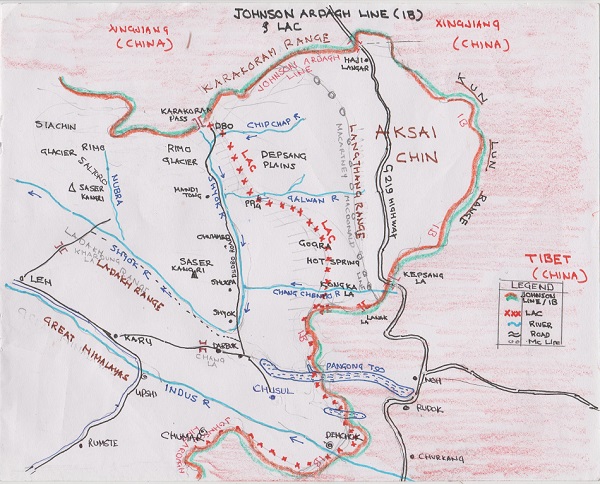
British India wanted a clear demarcation line on Tibet/Xinjiang and Ladakh frontiers as a precaution against expansionist Russia. In 1865, Sir W.H. Johnson, the then Surveyor General of India was given the responsibility to carry out the survey in Ladakh. He endorsed that the border of Khotan, an ancient Kingdom now a part of Xinjiang, was till the Kun Lun mountain range and the Karakash Valley was within Jammu and Kashmir. The boundary of Jammu and Kashmir stretched from Sanju Pass in the west to Eastern most edge of Chang Chenmo Valley along Kun Lun mountain range.

The proposal was finally approved by Major General John Ardagh, Chief of Military Intelligence at London in 1897. The legal boundary between India and East Turkmenistan was thus based all along the Kun Lun Range and was called the “Johnson Ardagh Line.”

Map depicting the Johnson Ardagh Line

In 1893, Hung Ta Chen, a top Chinese official, provided to the Russians a map marked with frontiers coinciding with the Johnson Ardagh Line. An Atlas published by the Government of China in 1933 showed the Johnson Ardagh Line as a border between Xinjiang and India. Peking University Atlas also confirmed Aksai Chin as part of India. It was thus accepted by all parties as a frontier.

The government of India, post independence, fixed the official boundary in the state of Jammu and Kashmir along the Kun Lun mountain range as defined by Johnson Ardagh Line.

McCartney McDonald  Line 

The Chinese, in 1896, on instigation by the Russians, submitted a map to Mr George McCartney, the British Counsel in Kashgar, that proposed another boundary line in this region. The proposal was developed by Sir Claude Mcdonald, British Envoy in China and approved by Lord Elgin, Governor General of India in 1899. The boundary line was shifted due South West of Johnson Line along Lakstang Mountain Range. It placed Lingzi Plains in India but Aksai Chin which was North of Lakstang range was shown as part of Tibet. This line was not ratified by any government, but CCP, in 1959, proposed to India to consider McCartney Line as the new frontier. CCP was ready to drop its claim on NEFA (North-East Frontier Agency) in return; the then Congress party led government in India did not agree.

McMahon Line

A treaty had been signed between Russia and Britain in 1907, accepting Chinese Suzerainty on Tibet. Tibetan rulers were not happy and refused to endorse the treaty but under pressure and military coercion by the British, the terms were accepted.

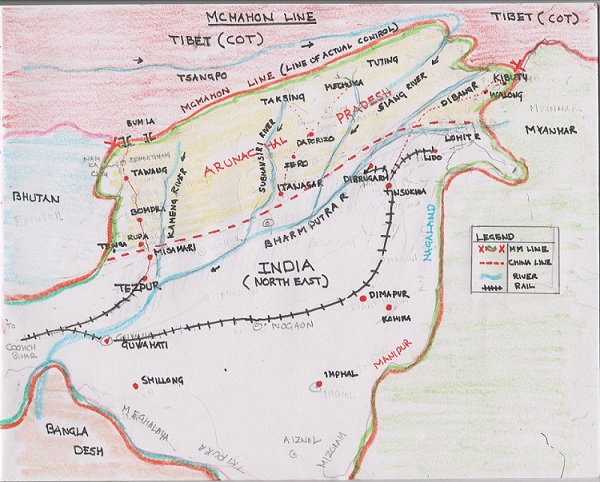
A tripartite conference was held at Shimla (Himachal Pradesh) on April 27, 1914. The British representative was Sir Henry McMahon, Tibet was represented by Lanchen Shatara and nationalist China by Ivan Chen. The finalised map and proceeding (called the McMahon Line) were signed by Tibet and India on July 3, 1914. This was done in the absence of a Chinese representative and was later objected by China. Tibet had also wanted Tawang to be its part. In 1937, the Shimla Convention was approved by British India and Survey of India published maps showing McMahon Line as the legal International border between Tibet and India.

Map depicting the McMohan Line

After the collapse of the Qing dynasty, Tibet declared itself as an independent nation in 1915 under the 13th Dalai Lama, Thubten Gyasto.

Tawang was occupied in April 1938 by a special force led by Captain G S Lightfoot. When the force left, the Tibetans again moved into Tawang and occupied it till 1951. Post independence, the North-Eastern region was called the North East Frontier Tract (NEFT).  A column of 2 Assam Rifles led by Major Bob Khathing (A Tangkhul Naga) liberated Tawang on April 20, 1951 and unfurled the Tricolour at Bum la. Thus, McMahon Line became the legal frontier and the region was renamed North East Frontier Agency (NEFA). Later, in 1972, it became the Union Territory of Arunachal Pradesh and a full-fledged state of India on February 20, 1987.

The situation changed when the communists came to power in China in October, 1949. At that time, India, under Jawaharlal Nehru, was aspiring leadership of the Non-Aligned Movement and following a foreign policy of “Peace and Tranquility” with its neighbours. India was one of the first countries to recognise Communist China in 1949. Nehru further sponsored China to the United Nations and helped the country get a permanent seat in the Security Council. The Indian government signed the Panchsheel Agreement with China. It was based on five principles of peaceful coexistence. Accordingly, there was very thin military deployment on the northern frontier by India.

Independent India, post-1947, was absolutely clear that the International Border remained distinctly marked in East as McMahon Line in Sikkim , Uttrakhand  and Himachal Pradesh as the present line, and in Ladakh as the Johnson Ardagh  Line.

Nehru was shocked when, in August 1950, Chinese troops annexed Tibet and made it a part of China. The 14th Dalai Lama, Tenzin Gyatso, signed a 17 point treaty with China in 1951. The Indian Government recognised Tibet as part of the People’s Republic of China. In 1956-57, there was an uprising in Tibet by CIA trained guerrillas who ambushed PLA convoys. The Chinese inducted several divisions and suppressed the rebellion. The Dalai Lama escaped in 1959 with his followers to Tawang and settled permanently in India.

China then contended that Tibet had never been a sovereign nation and had no power to execute the treaty with India which created the McMahon Line. It claimed the whole of NEFA (North-East Frontier Agency) as South Tibet. In the northern frontier too, Chinese forces clandestinely occupied Aksai Chin in 1956 and made a 185 km long Highway G-219 joining  Xinjiang and Tibet. A delayed action by a sleeping India was the adoption of the “Forward Policy” which resulted in the Sino-India War of 1962.

China launched a surprise attack across the McMahon Line and reached till Rupa Post on the foothills of the Himalayas overlooking the River Brahmaputra. This was the point of the Chinese claim and was almost 200 km into Indian Territory from Bum la, overrunning garrisons of Tawang, Se La and Bomdi la. 

Post the 1962 debacle, the Chinese did retreat but continued to occupy almost 38,000 sq km of Indian territory that they wanted. Zhau Enlai, in a  polite letter to Nehru christened the new boundary as the Line of Actual  Control (LAC), a loose ad hoc frontier based on the Actual Ground Position Line.

Line of Actual Control (Line of No Control)

The LAC runs from Karakoram Pass in the North West to Chumar camp  across River Indus on a frontage of approximately 450 km. There are a few important features and river junctions on the LAC. First is the Daulat Beg Oldie (DBO), an old camp site and village just below the Karakoram Pass that has a functional Air strip and is now linked with a Class 40 all weather 255 km long road (DSDBO Road) from the Darbuk Cantonment. Second is the Chip Chap River Valley that originates from the Karakoram range. Third is the Despang Plains where the LAC runs along a 25 km long open area. Fourth, the Galwan River that is about 80 km long and originates from Samzunglin in Kun Lun mountains and joins the Shyok River. Fifth, Chang Chenmo Valley in the south that touches Gogra camp and goes further 3 km to the east at Hot Springs police memorial point; Hot Springs is a hot Sulphur spring with a temperature of 107 degree Fahrenheit even under sub-zero conditions. Another 6 km to the East is Kongka La held by India. Sixth, Pangong Lake where LAC crosses near Finger 8 and approaches Rezang La, East of Chusul. Seventh, Village Demchok, in Nyoma Tehsil, an old British Military camp site on the Indus River, also called Demochang.  Lastly, Chumar Camp, a Border outpost and meeting point located at an elevation of 16,700 feet overlooking Himachal Pradesh.

Thus, was created a new border which was not well defined, marked or based on a watershed and continues to create confusion. Despite all agreements, the Chinese keep declaring a new claim line to irritate India. They carry out illegal activities in buffer zones in the form of temporary intrusions. It has happened several times after the 1962 war. The Chinese were given a bloody nose at the battles in Nathu La and Cho La at Sikkim in 1967. Indian forces further checkmated them at Sumdorong Chu Valley, Twang in 1986/1987. They were stopped at DBO (Daulat-Beg Oldie) in 2000 and Shubansiri sector in Arunachal Pradesh in 2003; again at DBO in 2013.

In the present context they attempted an intrusion at Naku La on May 5/6 2020, and again at Patrolling Point 14 in Galwan Valley on June 15 where they were forced back in a major clash with the Indian forces.

India has been trying to defend the points on LAC as marked on a handmade map. Sadly, the situation is such that due to Chinese irascibility that the Line of actual Control has become a Line of No Control. What is definite here is that the Indian nation and particularly the Indian Army will not allow China to get away with its expansionist designs. The necessary national resolve and military power to ensure this is available with India.  The sooner China realises this the better it will be.

DWDC – Fundraising Goal Has Been Met at More Than $80,000

Dying With Dignity Canada (DWDC), with its 40th anniversary celebrated, has been on a successful streak in its fundraising efforts with the question arising about the need to make calls for more funding.

On the one hand, many secular organizations need finances more because of the tighter purses with the coronavirus pandemic ongoing. On the other hand, it becomes an issue having to ask for more money as an organization.

The issue with secular organizations is that they do not necessarily have the formalized infrastructure of zakat or tithing, which makes donations, grants, etc., important for closing the secular and religious organizational financial gap.

With such gaps, many of the secular organizations are forced into precarious situations of requesting funding while having to double down on said requests in times of organizational or cultural crisis. C-19 is one such time.

Nonetheless, many organizations have happily, been pulling through for improved functionality in regard to the fundraising. With DWDC, it is one of those organizations.

The organization has reported several positive and encouraging messages in spite of the pandemic. They have been met with “best wishes and congratulations” for the 40 years of service as an organization.

There were some in reference to specific great successes of the organizations including the Carter v. Canada Supreme Court of Canada decision influencing the right to die movement in Canadian society.

The supporters who were giving the aforementioned best wishes and congratulations were providing some personal stories based on the decision of the highest court in Canadian jurisprudence.

“Throughout the last two weeks, these communications have fueled me and my team — and so clearly confirmed that we have an incredibly generous community who is willing to go the extra mile when asked,” Helen Long, CEO of DWDC stated, “But before I say anything else, I must say: thank you, thank you, thank you. Thank you for taking the time to engage with our blog posts, petitions, social media posts, webinars — and, yes, donation requests.”

In particular, she was greatful for members and others utilizing the resources, educational and otherwise, online, as well as the Advance Care Planning Kits of DWDC. As Long reported to the community, they reached the total fundraising goal of $40,000 with an anonymous donor matching the funds for a total $80,000 in additional finances for them.

For the rest of the Summer and the Fall, DWDC, based on the new funding, will be working on the following projects, as reported by Long:

  • Coordinate with federal legislators to make sure Bill C-7 is passed into law;
  • Engage Canadians across the country as part of Canada’s five-year legislative review process for our medical assistance in death law;
  • Connect patients, independent witnesses and clinicians to improve access to assisted dying, particularly in more remote regions;
  • Promote our Advance Care Planning Kits and other educational resources to new supporters across the country; and
  • Hold a range of webinars and other virtual engagement opportunities to share stories, experiences and actions that further our growing movement.

This fundraising and the projects ongoing for 2020 in the midst of the pandemic remain a win for the secular movements on the right to die movement.

Photo by Loren Cutler on Unsplash

NCSE – Climate Change Assembly Bill 1922 (California)

California State is known as one of the more science-friendly and technologically savvy states in the union. ​One bill, Assembly Bill 1922, passed away in its slumber on June 19 of 2010, according to Glenn Branch of the National Center for Science Education (NCSE). This was the last day possible for Assembly Bill 1922 to pass within the legislative session.

With acceptance or approval of the bill, Californa would have adopted its coursework from grades 1 through 12 for an addition on the “causes and effects of climate change.” Unfortunately, since it was not ‘accepted,’ but, rather, rejected, this defeated the possibility of this bill becoming a reality. 

​Glenn Branch, deputy director of the NCSE, reported, “Additionally, at least one of the two courses required for graduation from high school would have had to include such material.​”​

There were 18 active bills in ten state legislations in 2020 seeking to promote a change in the educational curricula of the states for the inclusion of climate change from kindergarten through to grade 12. None have been passed.

​”…​ two bills in New Jersey (Assembly Bill 2767 and Senate Bill 1970) and five bills in New York (Assembly Bills 9831 and 9886 and Senate Bills 6837, 6877, and 7341) are apparently still active, while the remainder have died​,” Branch concluded.​

Photo by Micah Tindell on Unsplash

Christian Sorensen on the High-Range and Moving Forward

Christian is a Philosopher that comes from Belgium. What identifies him the most and above all is simplicity, for everything is better with “vanilla flavour.” Perhaps, for this reason, his intellectual passion is criticism and irony, in the sense of trying to reveal what “hides behind the mask,” and give birth to the true. For him, ignorance and knowledge never “cross paths.” What he likes the most in his leisure time, is to go for a walk with his wife.

Scott Douglas Jacobsen: Let’s focus a tad on some of the most exclusive high-IQ groups known: The Giga Society, the Mega Society, the OLYMPIQ Society, etc. The Giga Society known membership of Thomas R. A. Wolf, Matthew Scillitani, Andreas Gunnarsson, Scott Ben Durgin, Dany Provost, Rolf Mifflin, Paul Johns, Evangelos G. Katsioulis, and Rick Rosner. The Mega Society membership listing semi-known. The OLYMPIQ Society membership to date: Dr. Evangelos G. Katsioulis, MD, MSc, PhD, Bart Miles, Laura N. Kochen, D.X.J., Christophe Dodos, Steve Schuessler, George Ch. Petasis, A.F., Jonas Högberg, Mari Takishita, J. W., Thomas B., Jan Willem Versluis, Alexander Prata Maluf, Dr. Christopher Philip Harding, Oliver Q., Wayne Zhang, Martin Tobias Lithner, Miguel Angel Soto-Miranda, M.D., Hever Horacio Arreola Gutierrez, Wang Peng, Takahiro Kitagawa, Andreas Andersson, Lee HanKyung, M.D., Julio Machado, Misaki Ota, Erik Hæreid, Santanu Sengupta, Qiao Hansheng, Dr. Benoit Desjardins, MD, PhD, Wen-Chin Sui, Yaron Mirelman, JMoriarty, Fan Yiwen, Zhibin Zhang (张智彬), Chen Anping, Dr. Yasunobu Egawa, Ph.D., Raymond Walbrecq, Junlong Li(李俊龙, Prof. Vernon M. Neppe MD, PhD, Nth Bar-Fields, Susumu Ota, Li Shimin, Marios Prodromou, Rickard Sagirbay, Dan Liu (刘丹), YoungHoon Bryan Kim (김영훈), W. C., Jo Christopher Montalban Resquites, and Entemake Aman. Some were simply listed as anonymous, but these come from straight from the website for OLYMPIQ. Pars Society of Baran Yönter looks defunct. PolymathIQ Society seems defunct. Sigma V seems functional while old in its setup with 12 open members, including Hindemburg Melão Jr., Petri Widsten, Alexandre Prata Maluf, Rauno Lindström, Peter David Bentley, Bart Lindekens, Joachim Lahav, Marc Heremans, Staffan Svensson, Will Fletcher, Guilherme Marques dos Santos Silva, and Lloyd King. Sigma V seems functional while old in its setup with 12 open members, including Hindemburg Melon Jr., Petri Widsten, Alexandre Prata Maluf (Prospective member), and Peter David Bentley (Prospective member). The Unicorn Society seems like or merged with the Sigma Society (one of them), and largely paralyzed if not defunct. Ultima Society seems functional while mainly based on the personality, tests, and opinions of Ivan Ivec. Ivec lists Steve Fell’s artwork, World Famous IQ scores, etc. Nano Society seems defunct. One in Five Society of Huck Nembelton appears defunct. PolymathIQ Society of Ron Altmann looks defunct. Universal Genius Society of Brennan Martin seems defunct. Omega seems to have some members with Adam Kisby, Angell O. de la Sierra, Brian M. Schwartz, Brian Wiksell, Dany Provost, David Michael Fabian, David Smith, John Fahy, Kemin Tsung, Patrick J. Maitland, Richard May, a.k.a. May-Tzu, Robert S. Munday, and Ken Shea. Grail Society of Paul Cooijmans appears functional, but open to applicants so to speak. GenerIQ of Mislav Predavec appears functional. Pi Society of Nikos Lygeros appears open and active. Maybe, in another article, I can provide comprehensive research on the various societies for those with an interest, but I see this as tedious even with this minor presentation of the research. How accurate are measurements at the 1 in a 1,000,000 level or more?

Christian Sorensen: In my opinion it is possible to achieve accurate, reliable and valid measurements, up to a certain limit, below as well as above this rarity. The latest, as long as the utilized tests are applied by professionals, since they are the only ones, that besides being normalized, and standardized, actually have a solid scientific support. Under this perspective, at least the Wechsler Scale of Intelligence for Adults, in its R form, and because it integrates a concept denominated deterioration coefficient, regarding the age range of 75 years or more, is able to measures an IQ score up to 179 with 15 standard deviations, which would be equivalent to a rarity of 1 in 14,000,000.

Jacobsen: Also, there are test creators: Mislav Predavec, Robert Lato, Ivan Ivec, Pablo Fernández González, Ladislav Dubravský, Christoffer Collin, Jérôme-Olivier Billet, Bill Bultas, ‘Rottus,’ Nik Lygeros, Peter Schmies, Tommy Smith, Nicolas-Elena, Michael Dickheiser, Laurent Dubois, Dillon, Jason Betts, Kevin Langdon, Jeff Leonard, LiangTian, Ronald Hoeflin, Ivan Ivec, Paul Cooijmans, Iakovos Koukas, Xavier Jouve, Jonathan Wai, Zoran Bijac, Theodosis Prousalis, Gianluigi Lombardi, Brennan Martin, Miroslav Radojević, Andre Gangvik, Dawid Skyrzos, Gabriel Garofalo, Nitish Joshi, Gaetano Morelli, Beatrice Rescazzi, Jim Lorrimore, T. Hobstrom, Naoki Kouda, Christopher Harding, Leela Pappadioti, Anthony Lawson, Christian Backlund, James Dorsey, Tonny Sellen, Julien Arpen, Nikolaos U. Soulious, Paul Laurent, Andre Gangvik, Jonathan Wai, Yukun Wang, Benjamin Noh, Guillermo Alejandro Escarcega Pliego, Marc-Andre Nydegger, Randy Myers, Tor Arne Jorgenson, John Culkin, Valeria Lanari, Alexi Edin, Lunardini, Prettini, Sjoberg, Logan Smith, Gordon, Lunardini, Prettini, and many others. Any test creators who stand out here?

Sorensen: Actually no, because beyond the names mentioned within this list, and though there may be professional psychometrists such as Xavier Jouve, mathematicians like Ivan Ivec and Marco Ripa, or members of the high-IQ community, who try to work seriously as James Dorsey and Jason Betts indeed do… It may be sustained, that all the aforementioned qualifications, even if they’re taken together, they are not enough, since for a psychometric instrument, to really measure what it intends to measure, and not something else, or in other words, for being consistent and accurate with their measurements, when these must be repeated over time, inevitably a scientific refutation and empirical-experimental criticism is going to be contingently demanded. The latest, implies among other factors, a prolonged process of permanent revisions, as has occurred for example with Wechsler and Stanford-Binet scales, who have had more than 70 years of periodic updates. Therefore, in my opinion, and based on this context, none of those who are or is not here enlisted, seems to actually stand out, due to the fact, that I believe according to the parameters before indicated, that they lack the most fundamental methodological and experimental means, in order to be capable to hold demonstratively any of their jobs.

Jacobsen: What are some of the important considerations in reflection of the highest levels of ability?

Sorensen: I think that when speaking of IQ scores, which ultimately what they purport, is to be objective indicators of intelligence, what is essential, under any point of view, is that they manage to measure validly and reliably, its three main areas, that is to say the numeric, verbal and spatial ones, and in turn that IQ scores could be differential representatives, depending if whether they partially refer to one or another, or to the sum of these, in order to ultimately objectify a partial or general intelligence index. Likewise, as the infinitesimal percentage extreme of the general population is reached, along the highest capacity measurements, and therefore the probability of error increases, it is plausible to conclude since the probability of error is less, that if quantitative ranges of IQs with qualitative distinctions, instead of scores associated with discrete characteristics, are accurately defined, that then exceptionally high IQ measurements can be alluded and inferable with a reasonably acceptable level of reliability.

Jacobsen: What high scorers really impress you?

Sorensen: Mine.

Jacobsen: What are the various aspects of the WAIS deserving serious scrutiny and replication in alternative intelligence tests in the future to make them more robust?

Sorensen: On the one hand, to sustain a strict empirical methodology, that follows their developments and reviews, in order to give them enough predictive capacity. The fact that they should be reliably covering, the main areas of general intelligence, by being able to provide not only general IQ scores, but also partial calculations regarding each type of intelligence. And ultimately, to successfully and consistently approve the empirical refutations, through which science will surely confront them extensively over time.

Jacobsen: What subtest of the WAIS is the most predictive as a singular metric of general intelligence?

Sorensen: I think that the cubes subtest, since it is not interfered by cultural conditionings, and measures abstraction, analysis and synthesis capacities, which in my opinion, are the more reliable indicators, and therefore the best predictors of general intelligence.

Jacobsen: Mr. Sorensen, thank you for the chance to delve further into this topic much more, your experience and intelligence are much appreciated.

Sorensen: Thank you for this opportunity, and I hope that my citronic criticism, will serve to develop other professional tests, that can be more than mere games to hypertrophy the egos.

Image Credit: Christian Sorensen.

USCIRF – Anti-Cult Movement and Religious Regulation Report

The United States Commission on International Religious Freedom (USCIRF) released a report on regulations of religion and an anti-cult movement ongoing. The Soviet Union era lives with us. Its impact, more precisely, lives on within the lives and communities of today’s Russians because of the impacts on the freedom of religion

As has been reported before, there is a dual-issue implicated here. There is internal repression of the Jehovah’s Witness membership by the Watchtower. While, at the same time, the freedom of religion would stipulate a freedom to practice religion, which the Russian and other governments violate via not respecting this, because of the various forms of legislative restrictions and governmental authorities’ crackdowns on these various groups.

The report from the USCIRF proposes some means by which to combat the violations to the rights of the Jehovah’s Witnesses to practice religion freely. One was recommending that the United States government state “RussiaTajikistan, and Turkmenistan as ‘countries of particular concern’ for their ongoing, systematic, and egregious religious freedom violations, and include Kazakhstan and Uzbekistan on its Special Watch List.”

Photo by Alexander Smagin on Unsplash

China’s Blitzkrieg: What’s the real intent?

The East Ladakh LAC (Line of Actual Control) imbroglio has been written about and discussed threadbare in the digital, print and TV with a range of emotions moving from despair a la ‘repeat of 1962’ to jubilation of an ‘all-powerful New India’, ready to ‘give a bloody nose’ to China.

Pragmatic Analysis and Overview of Chinese Actions along the LAC in East Ladakh

There has obviously been an intelligence and military oversight, either in terms of interpretation of Chinese intentions or of carrying out suitable counter measures like moving up formation reserves, forward posturing of artillery and mechanised forces, increasing patrolling and surveillance activities, strengthening of posts, and deploying mobile reserves to fill in the gaps. I would like to add, that hindsight is always easy to predict! Unlike the methodology followed every summer by China and India, this time the Chinese PLA exercised closer than usual to the LAC, and stayed put, which allowed the Chinese troops normally deployed in Tibet, to move forward and occupy the previously un-held areas. On the other hand, Indian troops including some formations from outside Ladakh region, ostensibly due to COVID-19 did not carry out corresponding exercises, which normally acted as a countervailing force to prevent exactly such a situation from happening.

One must accept that intentions of Chinese movement forward from their exercise areas to the LAC (to some extent it would have been camouflaged under the garb of regular border troops affiliated to those areas) should have been identified as unusual and alarming. Misreading Chinese intentions and initial hesitant response added to the confusion. China’s greatest strength in TAR (Tibet Autonomous Region) lies in its infrastructure in terms of rail link to Lhasa from mainland, numerous airfields, multiple roads of entry from hinterland to forward locations/LAC, its logistical stamina and smooth supply chain, providing capability to deploy large quantum of formations ranging from mechanized/motorized, artillery, army aviation, engineers, air defence, rocket forces, communication and surveillance units and most importantly logistic supply chains, in an operationally quick time frame.

To sum up, China’s wherewithal to mobilise is truly impressive and vast in scale. Notwithstanding the above, we acted with great alacrity by our expeditious commensurate mirror deployment, mobilization of the IAF (Indian Air Force), combat hardened formations and troops, terrain familiarization and altitude acclimatisation, and mobilization of additional reserves. Tactically and operationally in East Ladakh our Army and IAF is fully confident and capable of handling all challenges without getting militarily embarrassed. By all accounts China’s well laid out plans to gain valuable strategic territory and embarrass the Indian Armed Forces and India has been stalled at least temporarily. In fact, China would risk embarrassment if it continues the misadventure, as even a stalemate by India will indicate China’s loss of face, to which they hold tremendous importance.

The Emerging Operational Story of PLA in Ladakh

Starting late January/February 2020, the PLA began what was viewed as routine mobilisation for annual exercises in Xinjiang, which borders Ladakh. As brought out earlier, this year in a major departure from the earlier annual exercises, PLA troops for the first time moved closer to the border, while border frontier troops remained in forward areas. There was sufficient visibility and knowledge about PLA moving into TAR (Tibet Autonomous Region). In January 2020, President Xi Jinping issued a new Training Mobilisation Order (TMO) for strengthening military training in real combat conditions and “to maintain a high level of readiness”. The new order updated the 2019 TMO, which was the first such order to be signed by Pres Xi, and had called for implementing new military training guidelines announced by him in 2018 to improve combat readiness.

This dramatically altered the pattern of annual exercises and China’s forward deployment posture, not just with India but also in other theatres, where tensions have flared this summer including Japan, Taiwan and in the South and East China Sea (SCS and ECS). It called for confrontational training to assess commanders in real-time combat situations and deal with a multi-front situation. This TMO (Training Mobilisation Order) is likely to be in place till at least 2021. And if this input is true, it is extremely bold and in keeping with President Xi’s hurry to achieve the ‘China Dream’, and partially explains the goings on. Their aim is to deliberately cause disruption, but emerge with strategic gains whilst showcasing its rising CNP (Comprehensive National Power) to the world. India especially the Armed Forces needs to prepare for a new normal urgently, and has to plan, equip and play accordingly.

The Why?

China’s military operational movement along LAC is just one vertical of its plan and it has a larger aim. Explanations offered about Chinese apprehensions of our LAC infrastructure build up specially the Darbuk-Shyok-DBO road and our probing actions, for its aggressive actions in East Ladakh are tactical at best and miss the larger strategic picture. China has moved everywhere near simultaneously, from Taiwan, Japan, Vietnam, to even Philippines (against Duarte who was willing to be China’s lackey), Nepal, Bhutan and even Russia. China is indicating its willingness to take on the so called liberal democratic world order established by USA and her allies especially in Asia which China considers as its strategic playground.

China’s actions also intend to showcase its CNP (Comprehensive National Power) and demonstrate its domination of Asia; any other power including the superpower USA will need to deal with China. China is showcasing its capability and capacity to move on from COVID-19 and simultaneously engage militarily and provocatively (belligerent actions against 27 immediate and near continental and maritime neighbours) in South China Sea and East China Sea, and India, and economical and diplomatic coercion elsewhere.

This is no ‘off the cuff measure’, but a planned and thought out strategic manoeuvre. China plans to resolve the turbulence created, after making strategic gains/inroads at the time of its choosing indicating its growing stature and Comprehensive National Power (CNP) to the world. Incidentally, China is not going to implode, as a very large population of middle income citizens support this regime as it has brought them prosperity for the price of sacrificing some freedom.

Specifically, China’s raison d’être to move against India is due to India being a direct competitor for strategic space and possible impediment to China’s aspirations to become a superpower. Also, India’s continued opposition to BRI (Belt and Road Initiative) and CPEC (China-Pakistan Economic Corridor) which is nothing less than existential for CCP (Chinese Communist Party) that has invested billions of dollars into it, and China sees it as being the gateway to multi-lateral trade and influence. Another reason for China’s move against India is to coerce her into accepting the BRI or at best not oppose it, because China fears losing access to the Gwadar Port that reduces its dependence on Malacca Straits. Further, India’s abrogation of Article 370 and her justifiable seeking and announcing its resolve to get back the entire sovereign territory of erstwhile J&K which includes Gilgit-Baltistan and Aksai Chin; and the high probability of India becoming the main beneficiary of economic, manufacturing and trade pullout from China; putting India down as also to create an unstable security environment will dissuade other countries from re-locating to India.

China’s Aggressive Posturing

While the World is battling COVID-19 and its effects in other domains, China (Chinese Communist Party to be more precise) led by Xi Jinping is changing the global status quo. Like a high-stakes gambler, China has rolled the dice, to see what it can win on the security and geo-political front. Muscle flexing has been impressive; intimidating or sinking fishing vessels (Vietnam, Malaysia, Philippines, even Japan); threatening SE Asia naval ships by locking missiles; conducting exercises to intimidate and develop specific skills needed to invade Taiwan; use of belligerent language at all adversaries including stating intent of “reunifaction of Taiwan” openly; activities in exclusive economic zones of neighbours Japan included; changing status quo along LAC, an already tense unresolved land boundary with India and finally the ‘wolf diplomacy’ a recent phenomenon knowing its adverse impact (perhaps that is the point!).

International Reactions

Aggrieved and angry about COVID-19, which added to the frustration and growing realization of a challenger in the global order, USA followed by her allies mainly from the Western World have reacted with alacrity and alarm at China’s belligerent actions which threaten to change the global power equation. Many other nations are watching from the sidelines as China’s CNP (Comprehensive National Power), and economic might (considerable) and hold on their sovereignty could get strengthened if China gets away relatively unscathed. US Secretary of State Mike Pompeo has stated that China’s pursuit of offshore resources in parts of the South China Sea is “completely unlawful”.

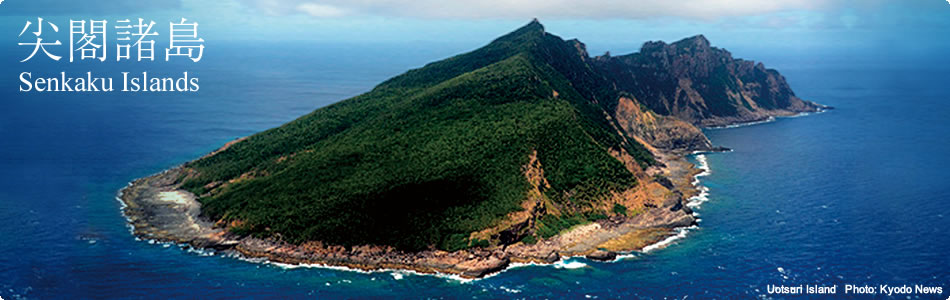
In its latest Annual Defence Report/White paper, Japanese Prime Minister Shinzo Abe’s government criticized Beijing for “relentlessly” attempting to undermine Tokyo’s administration of the Senkaku Islands in the ECS (East China Sea), even at a time when international coordination is required to contain the virus. The document rebuked China over its persistent attempts to “unilaterally change the status quo” in the ECS. The white paper also referred to China’s unilateral creation of two administrative districts in the SCS (South China Sea), in which Beijing has overlapping claims with Brunei, Malaysia, the Philippines, Vietnam and Taiwan. The two districts are named Xisha and Nansha, using the Chinese names for the disputed Paracel and Spratly Islands, respectively.

Aerial view of the Senkaku Islands of Japan. China’s claim over Senkaku Islands has increased its tensions with Tokyo.

Concurrently, a comprehensive Pacific Deterrence Initiative is being formulated. US has announced and is currently rebalancing and redeploying its forces to counter future threats emanating from China, which includes increasing ‘freedom of navigation’ patrols in Taiwan Straits, more military and economic aid to Taiwan, and deploying two aircraft carrier battle groups to the South China Sea. Aligned countries are coalescing either bilaterally or through groupings like QUAD (and Plus) to meet the Chinese challenge.

Chinese strengths in IT, hardware, manufacturing, infrastructure are being weakened using multiple fronts. India’s ban on 59 Chinese apps, as also resolve to ban Chinese participation in sensitive sectors (including Huawai and ZTE) has been applauded and has acted as a catalyst for others to emulate. China will be justified if it feels it is ‘strategically isolated by the liberal democratic West’. The jury however, is still out regarding the outcome, as most nations are finding out to their dismay, that China has considerable economic and political clout and has enmeshed itself so intimately into others nations economic fabric, that it will be very difficult to exorcise it, and it will come at a great cost.

The Indian Elephant through Chinese Eyes                    

India’s resolve and response, coupled with the June 15 bloody clash between Indian and PLA troops appears to have surprised the Chinese strategic community. Their utterances/debates instead of bringing consensus has widened the differences on ‘how to deal with a more confident India and a professional battle hardened Armed Forces’.

The Hawk School in China

This school headed by India watchers Lin Minwang and Zhang Jiadong, from Fudan University, and Li Hongmei from the Shanghai Institutes for International Studies (SIIS) among others, believe that the present conflict is an “inevitable result” of what they perceive as “India’s long-standing speculative strategy on the China-India border”. Beijing getting wary of India’s pronouncements (abrogation of Article 370, taking erstwhile J&K back including Aksai Chin), growing alliances and infrastructure surge all along Northern borders had “fed up” and China “had to teach India a lesson”.

They feel our growing alignment with USA and China’s adversaries (Japan, Australia, Vietnam etc) is taking India further away from rapprochement, becoming a ‘quasi ally of USA with no reversal, and possibility of border settlement getting grimmer. Within this unstable global security environment and a paranoid USA, the earlier system of effective management of bilateral differences has crumbled beyond control, periodic violent conflicts, they predict, are the “new normal” in China-India ties. To deal with a resurgent India, Chinese hardliners suggest a policy of “three nos”: “no weakness, no concession and no defensive defence”. In other words, China should take all opportunities to crack down on India, take the initiative to hit it hard whenever possible. This, they feel will make relations more stable like after 1962. They interpolate that China must be ready for belligerent moves across the entire LAC, from the McMahon Line in the east to the Aksai Chin area in the west; take the initiative to attack and seize territories under India’s control from Kashmir to Arunachal Pradesh, and weaken India internally, by supporting the cause of Maoists, Naga separatists and Kashmiris.

The Moderate School in China

This school which has political thinkers and professors such as Zheng Yongnian and Yu Longyu among others, have opined that Chinese actions and reactions in places like Galwan have remained mostly tactical/reactive and without any clear strategic intent. This has stoked nationalism in India and united the otherwise divided nation against China, harming China’s interests and might even draw China into an untimely military conflict. If China-India ties are damaged beyond repair, they warn, India alone or in association with other countries will cause “endless trouble for China”. For instance, an openly hostile India will use every possible means to prevent China from reaching the Indian Ocean. They feel that strategically, it is not advisable to launch proactive military conflict against India, “a big country with comparable military strength”, at this point in time. While China enjoys superiority in most fields like weapon systems and logistical strength, India too enjoys some strengths in war experience, acclimatization, shorter supply lines, and terrain familiarity. They predict that if the conflict ends in a short period of time, it will benefit China. But if it is prolonged, China will be disadvantaged.

What China may eventually try to achieve

I agree with Antara Singh who concluded in her article in The Hindu, that China would aim at attaining a comprehensive and overwhelming geo-political and strategic advantage vis-à-vis India, which cannot be altered by war.

Anticipating Round Two

It will be wise to acknowledge that China’s moves along the LAC (even in Sikkim) is part of a larger strategic game plan. China has mobilized a large force, and possibly had more devious designs of altering the status quo permanently along the LAC in its favour. For this China may have been willing to use limited force with a very effective and formidable non-kinetic campaign prior, during and after the larger tactical actions. China would have employed its fairly new Strategic Support Force for conducting information and psychological, network-centric, electronic and electo-magnetic spectrum operations while concurrently using its CNP (Comprehensive National Power) to provide a legal, economic, diplomatic narrative. As stated earlier, while our robust tactical response by our brave soldiers at the tactical level and expeditious mirror deployments by Army and IAF at operational level has surprised and stymied the Chinese temporarily, we MUST plan for the worst case contingency ranging from a localized conflict to a full scale war. The trust built up over decades by abiding by the CBMs (confidence building measures) and border management agreements (barring the odd one-off incidents) has been permanently broken.

India’s Future Roadmap

The Chinese respect strength and resolve. It is time to build our National Multi Domain capabilities as that is how China will fight a larger scale war. You can ignore China’s asymmetric superiority in comprehensive national power (CNP), infrastructure capacities, military capabilities, cunning and deceit, diplomatic and political clout at your own peril. Numerous China watchers have rightly asserted that China has managed to alienate the youth of new India, which is a very large percentage of Indian population. While we continue strengthening and cementing other domains of diplomacy, economy, strategic balancing through alliances and bilateral agreements and increase our CNP (comprehensive national power), our focus must be ‘atma nirbharta’ and ensuring a potent, visible, modern, multi-domain operations capable armed forces including strategic forces command (full spectrum capability).

For this; expeditious raising of Theatre commands; placing all forces (ITBP) along LAC under Indian Army; rapid growth of our Navy to manage our ‘Maritime Policy’ of dominating the Indian Ocean Region (the domain of vital importance); IAF capability for a multi-front role; re-energised mountain strike corps; strategic lift capability; potent C5ISTAR system (Command, Control, Communication, Computer, Cyber, Intelligence, Surveillance, Target Acquisition and Reconnaissance); are the main ingredients. We must build our deterrence capabilities to ensure fulfillment of our national vision and goals.

To conclude, the LAC imbroglio will serve as a defining moment in our country’s history, and India will emerge as strong, resilient, resurgent and confident to take its natural place as the pivotal balancing power amongst the comity of nations in the world.

Ideas Beyond Borders – Humanitarian Efforts for the Middle East

Faisal Saeed Al Mutar is an interesting person, and a friend and colleague. He founded Ideas Beyond Borders, which is a 501(c)3 nonprofit organization. Its purpose is to empower and improve the initiatives in the Middle East devoted to dispelling various forms of misinformation in the region.

One of the major barriers for the Middle East and North Africa region has to do with language. There simply and purely is a gap in international literacy because much of the West is grounded in the English language and much of the Middle East and North Africa region is in Arabic. This can create a barrier for international entry for the minds of the non-bilingual or non-English speaking in the Middle East and North Africa. Other works of Ideas Beyond Borders are humanitarian efforts.

Lisa Pirovano, Communications Director at Ideas Beyond Borders, on one recent effort, stated, “This effort includes working with local distribution partners to deliver 15,000 N95 masks to public hospitals facing dire PPE shortages, as well as 100,000 surgical masks and more than 50,000 meals to communities in need.”

Many areas are in poverty, lack education, and are wracked with sectarian violence. This is the context of life for other human beings throughout the Middle East and North Africa region. While these areas are dealing with life and death issues, a compound on top of these aforementioned, potentially a multiplier, is the issue of proper information and then the coronavirus.

“The COVID-19 pandemic is being exploited by extremists and authoritarians alike, both digitally and offline. I’ve seen it before when my own community was taken over by extremist groups; they hand out blankets, they give water bottles on severely hot days in Baghdad, and in the case of COVID-19, they hand out masks and food to build trust,” Ideas Beyond Borders Founder, Faisal Saeed Al Mutar, stated, “When the pandemic is over, that’s what people remember, and it makes them even more vulnerable to believing extremist ideas. Ideas Beyond Borders is beating extremists to it. We’re handing out food and masks simply because it’s the right thing to do, and we ask nothing in return.”

The name of this new effort is the Stop the Spread (of coronavirus and misinformation) campaign, so as to provide a counter push from the rather large amounts of public health misinformation available in the region. This effort can provide a means by which the public can develop a healthier possibility of survival as communities and peoples in the Middle East and North Africa region.

Not only misinformation, but there are also deliberate spreading of bad information, disinformation, via the common means of conspiracy theories. Many in North America are familiar with the common sources including Alex Jones, Breitbart, Louis Farrakhan, and others.  The program or intiative launched in March with distribution to 4.5 million Middle East and North Africa region youth.

Ideas Beyond Borders stated, “It… includes dozens of videos, infographics, and articles on the virus. The recent campaign expansion also expands these efforts, including translation of mental health resources, as well as a significant increase in video production.”

This is one among a large number fo efforts by Ideas Beyond Borders to provide “a positive alternative to the extremism, authoritarianism, censorship, and violence that plagues the Middle East.” Many of their efforts are for translation from English into Arabic and the sharing around the world with the intent to foster some critical thought, as well as the advancement of civil and human rights, pluralism, and science, in the Middle East, primarily, and the Middle East and North Africa region in general.

Some provide to the populations for the development of the critical communities by the local populations.

Photo by Yulia Agnis on Unsplash

Courage, Conviction & Righteousness will prevail in India China dispute

In the Mahabharata, the Kauravas had better warriors and generals than the Pandavas; their forces were also much larger and better trained. It was on this strategic calculation that Prince Duryodhana decided to fight against the Pandavas. The Pandavas won because they had Dharma (Righteousness) on their side. The Kaurava generals were not convinced about the righteousness and justification of the claims made by Prince Duryodhana; they were fighting more due to pledged loyalty than a conviction for the cause. This weakness led to their destruction and that of the entire Kaurava Army.

If we apply the same template to the situation between India and China we can conclude that the Chinese are going through the paces with a distinct lack of conviction. To move from mainland China through thousands of kilometres of China-Occupied Tibet (COT) and China-Occupied East Turkestan (COET) and then lay claim on territory that has been a part of another country for millenniums is neither righteous nor justified. There is also no support for the cause coming from the Chinese people. Such a misadventure, therefore, distinctly lacks courage of conviction and has left the Chinese soldiers confused and scared; their resolve to fight stands seriously eroded. Their situation, therefore, is the same as that of the Kaurava Army – the numerical strength is present but courage of conviction is lacking.

Indian Army, on the other hand, is fighting for a cause that is absolutely righteous, justified and close to the heart of all Indians who are backing their forces completely. Ladakh is a region which our noble ancestors gave their lives to defend in 1962. There is no way that the present generation of Indian soldiers will let down their ancestors. Indian Army, therefore, is in the same situation as the Pandava Army.

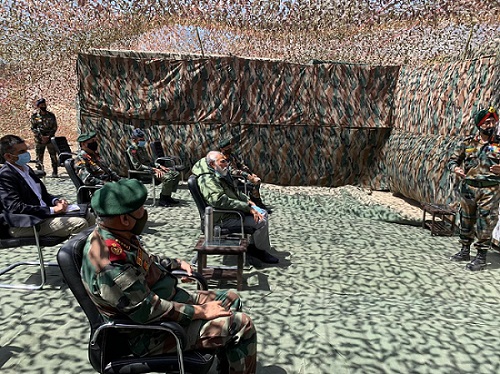
The morale of the nation received a considerable boost when Prime Minister Narendra Modi visited Ladakh on July 3. He met the injured soldiers in the hospital and then gave a very motivating speech to the troops deployed in the region. “Our enemies have seen your fire and also your fury,” he said. “Your courage is higher than the heights where you are serving today… Not only me, the entire nation believes in you. We all are proud of you,” he added. More significantly, the Prime Minister quoted a Bhagwad Gita Shlok (verse) “Veer Bhogya Vasundhara” which means “the brave shall inherit the world” and in an oblique reference to Chinese perfidy said, “This is the era of development. The whole world has made up its mind against expansionism.”  

Earlier, a lucid insight was given by Ram Madhav, National General Secretary of the Bhartiya Janata Party, in the course of a discussion with prominent domain experts through a webinar. He said that China is pursuing the military doctrine of “victory without war” as advocated by their legendary strategist Sun Tsu. The attempt is to register nibbling land grab victories against India without firing a bullet. This is the reason behind China not agreeing to the demarcation of the LAC and yet not firing a single bullet over the last many decades.

Ram Madhav went on to very emphatically maintain that India, under the ruling NDA government, has adopted a counter policy of claiming ownership of the LAC as perceived by her. The circumstances have made untenable the nibbling policy that China had so successfully applied for decades and which saw them, in 2013, coming 19 kms into Indian territory in Depsang and pitching tents. The government of India, under the BJP, will always strive for peace, but with self respect. India will not accept humiliating compromises anymore and if this makes China prone to misadventures then India will respond adequately and assertively. An application of this policy and posture has been witnessed in Doklam earlier and in Eastern Ladakh now. “We do not want war, but, we will not settle for the peace of the graveyard,” said Ram Madhav very categorically. He further added that India is improving infrastructure in Ladakh at a very rapid pace and will continue to do so.

There is absolute truth in what Ram Madhav has said and in what the whole of India believes. Ladakh has been a part of India since millenniums. It came under Sikh rule in 1834. After the first Anglo-Sikh War (1845-46), the British, in accordance with the Treaty of Amritsar, sold the territories of Kashmir, Gilgit-Baltistan and Ladakh to Gulab Singh, the Dogra Rajah (King) of Jammu for a sum of Rupees 7.5 million. Thus was created the state of Jammu and Kashmir with the title of Maharaja bestowed upon Gulab Singh by the British.

Jammu and Kashmir remained a princely state all through the British rule and the Dogras administered Ladakh as a Wazarat (principality). When India gained independence, Maharaja Hari Singh signed the Instrument of Accession on October 26, 1947, effective October, 27 1947, making Jammu and Kashmir an integral part of India. Hence, there remains no doubt about Ladakh being a part of India.

The Chinese Communist Party (CCP) was created in 1921 and came to power in 1949 much after the boundary between Tibet and Ladakh had already been finalised by the British through the Simla Convention of 1914. CCP has forcefully annexed its own mainland and so many adjoining regions like Tibet, East Turkestan, Mongolia etc.  It definitely has no claims on these annexed territories what to talk of Ladakh or any other Indian territory.

Even if one concedes to a small edge in military capacity of China, it is the professionalism of the Indian Army, its commitment to the nation and its noble legacy that will prevail. The PLA is a politicised force used more for keeping the iron control of the CCP on the subjugated people, especially COT and COET.

Citizens of India have every reason to have faith in and feel pride for the government and the Army of the nation who are taking all necessary actions to safeguard national interest and sovereignty and are achieving great success in their endeavours. The need of the hour is to stand by them and boost their morale.

Pak’s oppressed provinces disillusioned with ruling coterie and Pakistan Army

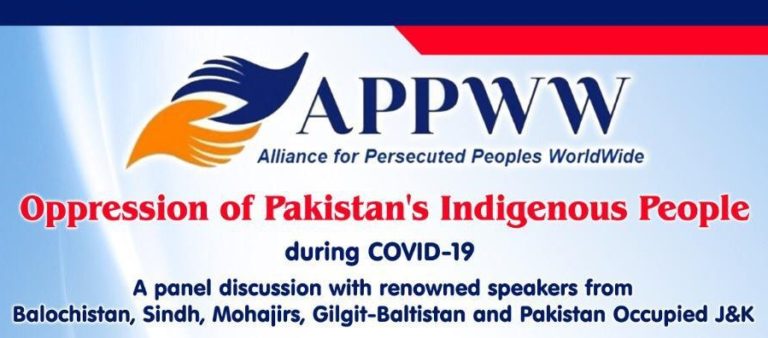
An international NGO “Alliance for Persecuted People Worldwide” (APPWW) recently organised a panel discussion on “Oppression of Pakistan’s Indigenous People.” The discussion was held in the backdrop of COVID-19 pandemic. Eminent persons representing the many oppressed regions of Pakistan and their people through various political parties, organisations and institutions were invited to speak in the discussion. The views give a deep insight into the very critical state of affairs within Pakistan as aggravated by the COVID-19 crisis.

The situation in Gilgit-Baltistan was explained by Senge Hasnan Sering, Director of Institute of Gilgit-Baltistan Studies and an international activist for the cause of freedom of his people from occupation and oppression by Pakistan. He said that since Gilgit-Baltistan is not a constitutional part of Pakistan there is a deeply embedded mindset of treating it as a colony. Now, the colonisation process has become two fold with China also getting involved in exploitation of the natural resources and the people of the region.

The situation created by the COVID-19 pandemic has given an opportunity to the exploitative forces to go for massive land grab. There has been a huge movement of troops in the region at a time when people need medicines and yet armed forces are being sent in. In fact, COVID-19 quarantine centres for Pakistan Army personnel have been set up in Gilgit-Baltistan to keep them away from the media glare in Punjab, and these facilities are not open to the locals.

As it is, the region is short of medical facilities like hospitals and medical institutions and is now grappling with critical shortage in supply of medicines. For cash strapped Pakistan, Gilgit-Baltistan holds no priority whatsoever, hence, the feeble infrastructure has been stretched to breaking point. Spread of Coronavirus through China-Pakistan Economic Corridor (CPEC) is also overwhelming the people. The Pakistan government is mulling over the feasibility of opening the region to tourists which will further enhance the risk factor. Senge Sering concluded with a demand for the justified amalgamation of the region with India.

The situation in Balochistan, another province forcefully amalgamated into Pakistan and witnessing a violent independence struggle as a consequence, was explained by Nabi Baksh Baloch, US Representative of the Baloch National Movement (BNM). He particularly emphasised the distressing lack of Personal Protective Equipment (PPE) for the doctors which leaves them very vulnerable to infection. Those from within the medical fraternity who agitated for PPE were jailed by the authorities. This insensitive act by the authorities is the only instance of its kind in the world where a government is arresting and harassing doctors during a medical emergency of such huge proportions.

As in the case of Gilgit-Baltistan, in Balochistan also, the Pakistan Army is leveraging the situation to strengthen its occupation of the region and suppress the legitimate aspirations of the people.

Zafar Sahito, representing Jeay Sindh Muttahida Mahaz (JSMM) spoke of the historical significance of Sindh in the context of overall Indian civilisation. In this ageless region the famed and legendary Saraswati River once flowed and the Vedas were written. It finds mention in both Ramayana and Mahabharta. In the modern context, Sindh was the first province to financially uplift Pakistan with its industrial and commercial expertise. Now the proud and civilised people of Sindh have been made subservient to the Pakistan’s Punjabi elite which has no regard for their economic potential or civilisational roots.

Rehan Ibadat, central organiser of the Muttahida Qaumi Movement (MQM) a Sindh-based political party that represents the Mohajirs (Muslims from India who opted to go to Pakistan) said that his people are facing lack of education opportunities, lack of job opportunities and are being persecuted. Quite emotionally he said, “this is not what the Mohajirs came to Pakistan for.”

With regards to the COVID-19 situation both emphasised that the federal government has not  shown any keenness to impose a lockdown on the cash cow region of the country which led to a rapid spread of the pandemic. Ultimately, it fell upon the provincial government to put its foot down and impose the lockdown. By then a lot of damage had been done; thousands of cases with a huge spike in deaths in the region have gone unreported.

Tarek Fatah, a Canada-based senior journalist of Pakistani origin opined in the webinar that Pakistan died as a nation in 1971 when 60% of its population and the complete eastern segment chose to seek independence, leading to the creation of Bangladesh. What is now left of Pakistan had nothing to do with the movement that led to the partition of the country, North-West Frontier Province, Sindh, Balochistan, and territories of Pakistan-Occupied Jammu and Kashmir did not make any demands for a separate Muslim nation. The concept was thrust upon them by the partition. The aforementioned provinces do not subscribe to the concept even today and are agitating to break the shackles of West Punjab imposed over them through blatant use of military might.

The second catastrophe, according to Tarek Fatah, was the imposition of Urdu as an official language of the new country. The language came from central India and to an extent from Punjab, the remainder of so-called Pakistan has no affinity with the language. It has over time created a cultural schism in the entire region. Tarek Fatah concluded by saying that internal contradictions in Pakistan are so intense that a breakup of the so-called nation is inevitable; it is only a question of time.

The world has changed manifold but the problems in Pakistan do not change. It is so because all provinces of Pakistan should be separate nations in their own right but are being forcefully subjugated and exploited by the Punjabi rulers. Sadly, until the breakup foretold by Tarek Fatah does not become reality inhumane suppression accompanied by gross human rights violations will continue. The world leaders should step in to help free the people from the shackles of de-facto military rule, supported by terrorists and fundamentalist militant warlords.