Home Blog Page 352

Sindhudesh Revolutionary Army eliminates Pak Ranger in Karachi

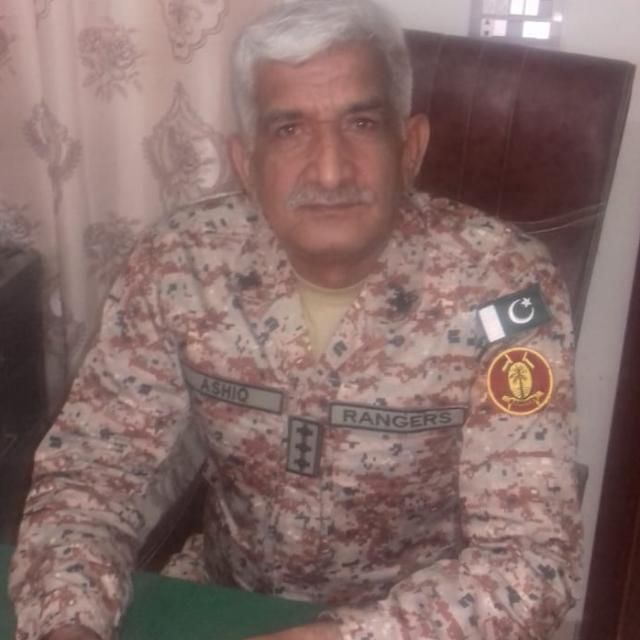
Sindhudesh Revolutionary Army (SRA) eliminated one Pakistan Rangers officer in a grenade attack at Sachal area in Karachi on Wednesday. The Pak Rangers officer named Ashiq was the main informer and facilitator of barbaric Rangers’ operations in Karachi, the SRA said in a statement.

This attack was meant to record the serious reaction of Sindhi nation against Punjab’s imposed illegal hold over Sindh and the ongoing state offensive operation against Sindhi nationalists.

“SRA (Sindhudesh Revolutionary Army) will eliminate all those local facilitators and informers of Pakistani forces,who are involved in state operation against the National Freedom Movement of Sindh and the genocide of Sindhi people,” said Sodho Sindhi, spokesperson Sindhudesh Revolutionary Army (SRA).

Ashiq, Pakistan Rangers officer who was eliminated by the Sindhudesh Revolutionary Army (SRA) at Karachi

Pakistan’s armed forces along with its intelligence institutions have unleashed a barbaric rein of terror on Sindhi nationalists. Pakistani forces have enhanced the rate of “enforced disappearances” of Sindhi nationalists and have started abusing Sindhi women and children through forcefully entering their homes.

“We are receiving the tortured dead bodies of our nationalist members. We had received the highly tortured and ill-treated dead body of JSQM (Jeay Sindh Qaumi Mahaz) worker Shaheed Niyaz Lashari, and recently we have received a severely tortured dead body of another JSQM (Jeay Sindh Qaumi Mahaz) leader Shaheed Masood Shah’s brother Shaheed Masroor Shah,” elaborated the SRA spokesperson.

This is the impact of forceful hold that Pakistan’s Punjabi establishment has over Sindhi resources, over Indus River, the Arabian sea and the trade hub of Karachi.

China is the co-partner of Pakistan’s Punjab province’ in exploiting Sindh that has tried to fulfill its own vested economic interests through the highly exploitative CPEC (China-Pakistan Economic Corridor). “We highly condemn all these vested acts and we will not let them allow to fulfill their vested interests in Sindh. SRA vows to continue its struggle till complete freedom and sovereignty of Sindhudesh,” said Sodho Sindhi, spokesperson Sindhudesh Revolutionary Army.

Occupied Balochistan under undeclared martial law: Dil Murad Baloch

Undeclared martial law is in force across occupied Balochistan and all state administration is in the hands of Pakistan Army, said Dil Murad Baloch, Central Information Secretary Baloch National Movement (BNM) while releasing the June 2020 report about Pakistan’s atrocities in Balochistan.

Dil Murad Baloch said that the military operations, killings and atrocities by the occupying state of Pakistan continued during June. He explained that there have been 70 operations and raids, 42 people were forcibly disappeared and transferred to unknown locations. Eight people were martyred, two of them in direct firing by the Coast Guards in Gwadar. “In Dazin, a woman, Kulsoom Baloch, was martyred by state-backed Death Squads for resisting their robbery when they attacked her house. Four youths were martyred in Karachi. A sister of an ‘enforced disappeared’ person committed suicide after waiting painfully for years about any news of her brother. Such incidents have already taken place in different parts of Balochistan. The list of missing persons does not include those who were released within days of being detained by the military. In other incidents, seven people were killed, including four who were called by Sanaullah Zehri, the former Chief Minister of Balochistan, at his home and killed,” elaborated Dil Murad Baloch.

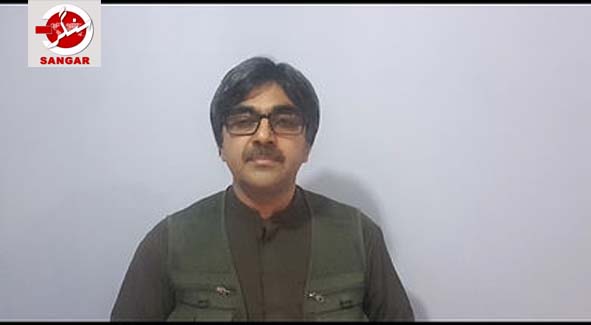
Dil Murad Baloch, Central Information Secretary of the Baloch National Movement (BNM)

Dil Murad Baloch further added that during the month of June, most areas of Jhaoo, Awaran, Mashkay, Geeshkor, Kolwah and Buleda Zamuran were targets of military aggression. “In addition to the ground forces, gunship helicopters shelled the area, killing hundreds of cattle and setting more than 50 homes on fire. The Pakistani Army and its local allies looted more than 300 cattle from various parts of Washuk district, Mashkay and Jhaoo. The Pakistani Army has also forcibly displaced inhabitants of several villages in different parts of Jhaoo and Zamuran in June. Pakistan’s military have evicted many villagers from their ancestral lands in the mountainous ranges across Balochistan and forced them to live near military camps and outposts in rural or urban areas. This trend continues to this day,” he added.

“An undeclared martial law is enforced in Balochistan. All state administration is in the hands of the military. There is a complete ban on political activities and the political process. The price of a political voice always has to be paid in the form of imprisonment, murder and barbarism. This has been happening for twenty years. Restrictions on political freedom can only be gauged by the fact that Baloch students are imprisoned for their demands of basic rights such as the restoration of the Internet. One can imagine, what could be the punishment for speaking out for national liberation?,” asked Dil Murad Baloch.

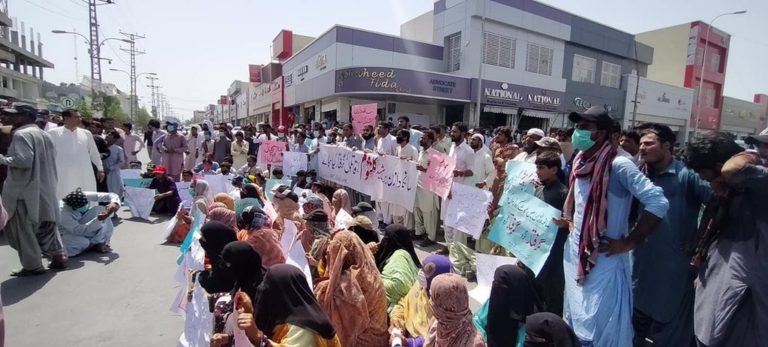
Last month police in riot gear stormed a rally, detained and removed hundreds of protesters by truck loads. The protesters only demanded the resumption of the internet in Balochistan to make online classes possible, as colleges and universities were closed due to the Coronavirus pandemic and internet access in most parts of Balochistan has either been completely shut or continues to remain extremely limited for several years.

Kulsoom Baloch was stabbed to her death during a robbery at Tump Dazin area of Kech and the robbers fled after looting all her belongings. A similar incident took place on May 26 in the Dannuk area of Kech, where Malik Naz was martyred and her daughter Bramsh was injured. Pakistan has formed hundreds of Death Squads by organizing petty criminals in Balochistan to crush the national movement. They are playing with the dignity and lives of the people.

Dil Murad Baloch added that Pakistan’s war crimes have created a human tragedy in Balochistan. “We can see different tactics of it. There are enforced disappearances. The tears of the bereaved are shaking the throne for the recovery of loved ones on the streets but for Pakistani state the cries of the occupied people and the tears of their daughters are meaningless. An incident took place in Kech where Fatima, a woman from Dasht Mazanband, committed suicide by hanging herself in her house in Gokdan area of Turbat. She was the mother of three children. Her brother, Imam Ishaq, was abducted two years ago by Pakistan Army from his home in Dasht and is still missing. Fatima had been suffering from mental stress for a long time due to her brother’s abduction and disappearance. Eventually, she could not bear the pain and grief and committed suicide.”

Burhan Wani was a terrorist, spin doctors branding him as Kashmir’s mascot

Oftentimes perceptions are contrary to the truth. This happens, when systematic efforts are made to create a smokescreen to hide the real picture and then dole out camouflage as reality. Nowhere is this more visible than in the Kashmir Valley. Over the years a ‘perception’ has been assiduously built that local Kashmiri, especially the youth of Jammu & Kashmir, is alienated with India and they support and endorse terrorist attacks on India and the Indian Army in Kashmir.

This ‘perception management’ has been going on for several years, thanks to the well-oiled network of spin doctors and opinion managers across media houses in the Kashmir Valley and in Delhi. The arrangement works in such a way that opinion, especially the Kashmiri Separatists’ viewpoint, is passed upon as news from the Valley. It is hardly reported that these Pakistan sympathiser Kashmiri Separatists are a mere handful and they do not enjoy the support of the masses.

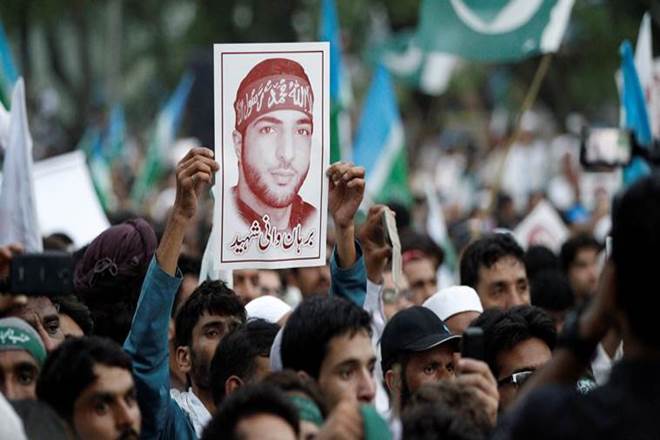
This misinformation campaign reached a crescendo after the killing of Hizbul Mujahideen terrorist Burhan Wani on July 8, 2016. It has to be borne in mind that these perception managers know about Pakistan’s weaknesses and their lack of support in the Kashmir Valley, so they do not expose the chinks in Pakistan’s armour, instead, they deflect the public perception. They drum up the propaganda about Kashmiri youth’s alienation after every terrorist encounter and the negative fallout of a nuclear war with Pakistan whenever India gets tough on Islamabad. Indian security forces neutralise terrorists across Jammu and Kashmir and that includes shooting any terrorist, who threatens peace and national integrity. Burhan Wani’s encounter was one of these operations. But, the ‘perception managers’ of Kashmir Valley and their cousins in Delhi sniffed an opportunity in Burhan Wani’s death.

So what happened immediately after Wani’s encounter? News breaks from Kashmir-Valley newspapers (read Pakistan sympathisers) reported that Burhan Wani was a ‘militant commander’ of Hizbul Mujahideen, who was killed by Indian security forces in cold blood. He was hailed as a ‘martyr’. This reportage from Kashmir was immediately followed by a section of mainstream media houses from Delhi. Soon, international media groups started referring to Burhan Wani as ‘commandant’ or ‘militant commander’. Over the years these perception managers have deftly shifted the public discourse to Burhan Wani’s hobbies, passion for cricket, and love for Facebook, Twitter, etc. etc.

The terrorist Burhan Wani, who was an anti-national, who supported radical Islam, and who preached violence in the name of Islam was shrewdly brushed aside. Discussions and debates shifted towards the use of pellet guns by Indian security forces and AFSPA (Armed Forces Special Powers Act). Several media houses from Delhi, Kashmir Valley and the international media still do not report that Burhan Wani was a radical Islamic terrorist rather they continue to refer him as a ‘commander’.

Well, Burhan Wani was a terrorist and he should be referred as a terrorist. Calling him as the slain commander, who represented Kashmir’s youth is akin to referring Osama bin Laden as the commander-in-chief of poor Afghan people. Radical Islamist newspapers may refer to Osama bin Laden with whatever name they fancy, but American and European media organisations prefix the word “terrorist” with Osama bin Laden. Ditto for Burhan Wani. He was a radical Islamic terrorist, who used his cyber prowess to preach the Wahabi ideology in Kashmir, which has always been known for its Sufi tradition.

Even a cursory glance at some of Burhan Wani’s tweets are enough to prove that he was a terrorist, who was simply furthering the violent ambitions of his handlers in Pakistan. Consider this: “There is only One solution Gun solution Gun Solution — Burhan Bhai” posted on Wani’s twitter handle @Gazi_Burhan2 on July 2, 2016. Days later his another tweet says “Support Zakir Naik or Time Will Come When Qur’an Recitation will be Banned— Burhan Bhai”. Wani’s aim was to “unfurl the flag of Islam on Delhi’s Red Fort”.

There are several other tweets from Burhan Wani that prove that he had adopted the path of radical Islam and was a tool into the hands of Pakistani terrorists like Hafeez Saeed and Hizbul Majahiddin chief Syed Salahuddin. In fact, none of the armchair reporters from Delhi bother to actually visit the Kashmir Valley and talk to real people on the ground before reporting on the developments in Kashmir. Even if they do, they go as embedded journalists, where their entire trip is planned and executed by Separatist sympathisers. Their visits are planned to the last detail that includes travel and boarding arrangements. So, where the ‘Delhi journalist’ would stay and whom will (s)he interview are all scripted well in advance. It’s precisely for this reason that a large section of mainstream media houses of Delhi and the separatist media of the Kashmir Valley sing the same tune.

Unfortunately, this is the smokescreen, which has been successfully created by these spin doctors for a long time. There is absolutely no widespread support for Wani among the Muslims living in the Kashmir Valley. Yes, you read it right. There is no widespread support, either emotional or logistical among the Muslims for terrorists like Burhan Wani or terrorist organisations such as Hizbul Mujahideen. The obvious question that could be asked is: What about large gathering of people in processions and hordes of stone pelters in Kashmir Valley?

Several Sunni Muslim families with whom I have had detailed discussions denied extensive support for the likes of Burhan Wani. They explained that there were only a bunch of sangh baaz (stone pelters), who had created the mayhem. These anti-social elements, who are otherwise relegated to the margins of the society sense an opportunity whenever a terrorist killed in an encounter. These anti-social types then wander through the villages ordering everyone to come out for the processions and for stone pelting. They earmark those households who defy their diktat.

The names of these families and their children are then handed over to terrorist groups across the border, who later on take revenge for their defiance. “It is the fear factor that forces an ordinary Kashmiri to come out, when these bunch of stone pelters gave their clarion call for protests. We know that these are anti-social elements and have direct links with the terrorist groups,” a Kashmiri Sunni Muslim explained. He spoke strictly on the condition of anonymity. The instructions from terrorist organisations such as Hizbul Mujahideen are very clear that whoever does not come out of their homes for the protest or at the funeral procession of the slain terrorists would be deemed as informers of security forces. And once the informer tag is pasted onto a family, then the miscreants get a free hand to conduct any kind of atrocity on them. The women in the family are raped, children abducted, and men are killed.

Yet another villager said that in order to create the perception that we are for the ‘Kashmiri cause’ the family members, especially young boys are forced to come out and be a part of sangh baazi– stone pelting whenever security forces cordon off an area to arrest a terrorist. He added that they are afraid to report the mater to Jammu and Kashmir police because this is taken as an act of war by terrorists and their sympathizers. The women in these families are then raped and men killed by the terrorists.

An average Kashmiri then quietly passes on the information of a terrorist’s whereabouts to the security forces. And it’s due to these pin pointed information about a terrorist’s location that Indian security forces have been able to hunt them down across the Kashmir Valley. But then the perception managers remain blinded in their love for anti-national forces. Even after the valley’s clean up of terrorists and a return of normalcy post the abrogation of Article 370 and Article 35A they continue with their anti-India tirade.

None of these armchair propagandists and perception managers have any realisation of the ground reality in Kashmir or have any genuine concern for the Kashmiri people. A common Kashmiri is more concerned about the well-being of his/her family and education of their children. They know that adherents of Wahabi ideology have become school teachers across Kashmir Valley, who urge school children to become sangh baaz (stone pelter).

The parents in Kashmir are well aware of these tactics and insist on de-radicalization of school teachers across the Kashmir Valley. This, they say, can be done by identifying and deporting teachers, who adhere to and instil Wahabi ideology in the impressionable minds of school children.

The need of the hour is to begin objective reporting from Kashmir Valley, such that perception managers and spin doctors are not able to camouflage truth about Jammu and Kashmir. It is time journalists stop choosing to be spoon-fed by the Pakistani sympathisers for information; they need to step out of their air-conditioned offices and visit Kashmir Valley—not as embedded journalists, but as honest reporters. They should talk to real people, understand the ground reality and then report.

Batang La to Chorten La: A narrative on Sikkim

Sikkim, the beautiful 22nd State of Indian Union in the lap of mighty Himalayas, hit headlines on May 9, 2020 when  Indian Army troops clashed with a Patrol of the Chinese People’s Liberation Army (PLA) at the Naku La post in the Northern District of the state near Dongkung village, at the dizzying height of 16,500 feet. This location is not very far from the Eastern Tri-junction between India, Chinese-Occupied Tibet (COT) and Nepal.

A Chinese patrol was challenged by alert sentries of the Indian Army as it approached the pass. Troops from both sides, numbering approximately 120 on each side, got into an argument with gestures since they could not understand each other’s language and showed banners, as is the norm under such a situation on the Line of Actual Control (LAC) with China. Matters got heated up and a fist fight started in which seven Chinese and four Indian soldiers were reportedly injured. Peace prevailed after discussion at the local commander’s level the next day after which the Chinese troops returned to base. 

However, alarm bells rang in New Delhi since this region has remained peaceful since the famous Nathu La clash in September 1967 in East Sikkim. In the 1967 clash, the Chinese were given a befitting reply for their transgressions by 2 Grenadiers with full support coming from Major General Sagat Singh who was commanding the holding Division at that time. 

Later, Chinese attempted to occupy Jeplang La, but the holding infantry unit, 10 J&K Rifles, repelled the attack on October 1, 1967 at Cho La, North of Nathu La.

Notably, even in May 2017, after almost 50 years of the Nathu La clash, there was another 73 days standoff in adjoining Dok La or Doklam Plateau where also exists a Tri-junction between India, COT and Bhutan. After some tension and bad blood the PLA retreated. Today, the focus is on Ladakh but we should also remain on high alert in Sikkim and Arunachal Pradesh.

Vedic literature suggests that the ancient name of Sikkim was Indrakil, meaning “Evergreen garden of the King of Gods, Lord Indra;” Limbu clan called it “Su Khyim” (New Palace); Tibetan monks call it “Drenjong;” Bhutias called it “Hidden valley of Rice” and Lepcha, the original inhabitants called it “Paradise on Earth.” The celebrated Buddhist sage, Padmasambhava (Guru Rinphoche), visited this area in the 6th Century.

The beautiful erstwhile Kingdom was founded by the Namgyal Dynasty. Later, it was ruled by Buddhist priest Kings known as Chogyal. It faced number of invasions. Bhutan forces attacked Sikkim in 1700, but the monarchy was saved by Tibet. From 1717 to 1733, it was attacked and occupied by Nepal. Sikkim was annexed by British imperial lndia in 1890 and ultimately it became a Protectorate of independent India on November 1, 1950 around the same time when the Red Army overran Tibet. It was, thus, saved from suppression by Red China.

Sikkim–COT (China-occupied Tibet) border is seen to be settled on the basis of the historical Sikkim-Tibet convention of 1890. The treaty was based on the Principle of Watershed. Article-1 of the record stated that the frontiers between Sikkim and Tibet will be based on the crest of the mountain range separated by water flowing down to River Teesta and its tributaries in the South and Tibet Monchu Rivers in the North till it met the Nepal border. The Gazetteer of Sikkim, 1894 described Sikkim-Tibet border as running along Chorten La to Batang La in the East till the present day Tri-junction. All maps and records clearly identify watershed as the border. There exists no ambiguity. 

Sikkim then got embroiled in an anti-Royalist agitation that continued till 1975. Ultimately the monarchy was deposed and a referendum conducted. 95.5% voted in favour of amalgamation with India. Thus, on May 16, 1975 Sikkim became the 22nd state of the Indian Union.

In 2003, during the course of an important summit between the then Chinese Premier Wen Jiabo and Indian Prime Minister Atal Bihari Vajpayee, Beijing recognised Sikkim as an integral part of India and accepted the watershed as principle of boundary demarcation in COT-Sikkim Frontier. As a goodwill gesture, China opened Nathu La pass on July 6, 2006 for cross-border trade and the Mansarovar pilgrimage. This pass had remained closed till 1967.

Sikkim holds great strategic importance for India. It is the gateway to the narrow Siliguri corridor, a narrow strip of land located in West Bengal, approximately 180 km long and 22 km wide, which connects the rest of India with the 7 sisters (seven states) of North-East. At the Northern side of corridor are Nepal and Bhutan and towards the south is Bangladesh. This link has to be protected at all cost as a broad gauge railway line running here is joining New Jalpaiguri to Guwahati. Also, National Highway-31 that joins Kolkatta and Guwahati also passes through the Corridor.

Sikkim has approximately 300 km border with China-occupied Tibet (COT). There are a total of 14 Passes on Sikkim-COT border, some are known and manned and others are unknown to outside world except for the locals and the Indian Army. After Batang La in East, the other passes are Jelep La, Nathu La, Cho La, Tangkar La, Gora La, Khungyami La, Sese La, Karang La, Bamcha La Chulung La, Kongra La, Naku La, and Chorten La.

India is rapidly developing the required infrastructure to protect all important Sikkim heartland. 309 km of National highway and 3,700 km state road network connect all subdivisions. The main Airport linking Sikkim to the rest of India is Bagdogra where even fighter aircrafts can land. A new greenfield airport has been recently inaugurated at Pakyong where ATR turboprop aircrafts can land. There is regular Helicopter service from Bagdogra to Gangtok and Helipads are available for all towns and remote areas.

A new 53 km long railway project between Sevoke town in North Bengal to Rangpo in Sikkim has been approved; it will be connected to Gangtok in Phase-2 and will have 13 Tunnels through mountains and valleys of Teesta. The project is likely to be completed in 2021. It will be a marvel of Railway engineering and will provide the first rail link from mainland to Sikkim.

India has deployed sufficient troops to protect Sikkim frontiers. When Indian Tanks crossed Gangtok to go North, Sikkim masses cheered and children gifted bouquets to armoured crews. Infantry formations are well poised to counter any intrusion of Red Army in India through any of 14 passes on the Sikkim Frontiers. India must continue to ensure balanced development of Sikkim with due respect to culture and traditions while keeping military imperatives central in all policy matters concerning the state.

India must thwart the Dragon’s ambition

Now that China has firmly established itself as a formidable economic and military power, it seems to be more anxious to emerge from the shadows and secure what it feels is its rightful place in the international arena. Under normal circumstances, the global community would not have denied giving China its due, but it’s approach of spreading its influence by following a ‘debt-trap’ policy is unfair. It first extends generous loans to poor countries that it knows won’t be able to repay and then takes control over key assets belonging to the borrower like harbours and airports in lieu of outstanding payments. This unethical strategy being used by Beijing to increase its sphere of influence has rightly drawn very sharp criticism from the international community.

Beijing is ruthless when it comes to recovering outstanding loan payments. In 2017, China took over the Hambantota port in Sri Lanka for a lease period of 99 years after Colombo was unable to repay billions of dollars in loans. The very next year, Zambia had to hand over Kenneth Kaunda International Airport to China as it defaulted in debt repayment. Currently, the government of Kenya risks losing Mombasa port, which is considered to be the gateway to East and Central Africa on account of its inability to repay the massive loan extended by China. And though Islamabad is extremely bullish about the CPEC project, several financial organisations and experts of international repute have expressed the fear that Pakistan too will end up going the Sri Lanka or Zambia way!

Besides its despicable ‘debt trap’ strategy, Beijing’s response to its expected commitments too has been pathetic. By introducing laws that violate the provisions of its Hong Kong handover agreement with the UK as well as brutalising and confining those protesting against these black laws, Beijing has demonstrated that it has scant regards for honouring international conventions on treaties. But what has irked the entire world is Beijing’s irresponsible approach after outbreak of the Covid-19 pandemic. It kept the enormity of the crisis under wraps and put a very strict quarantine and lockdown regime in place internally, but allowed its citizens to travel abroad freely without any checks on their health conditions.

In the month of May, China moved a sizeable number of troops into areas of Eastern Ladakh and started laying claims on Indian territory, forcing India to take necessary steps to deal with the situation. In an unprecedented move, without any sort of provocation, PLA (People’s Liberation Army) attacked and killed Indian Army Commanding Officer and twenty soldiers of the Indian Army in Galwan Valley who had gone to monitor withdrawal of forces as agreed to by both sides. Even the reinforcements sent were ambushed by a huge PLA contingent armed with lethal implements, but yet our soldiers gave a befitting reply to the attackers and made us proud. Humiliated by the ferocity of Indian Army’s bold response which led to large scale casualties, the PLA is now trying to save face by putting up a strong front and reiterating its claim.

If Beijing had thought that India could be subdued into submission by its offensive approach and massive buildup of troops along the LAC, then it was sadly mistaken. While New Delhi has picked up the gauntlet, but unlike Beijing, it has exhibited great maturity by not resorting to any provocative action that could further aggravate the already tense situation. The Indian Army has built up its force levels along the LAC to counter any Chinese misadventure and by going ahead with the road construction activity, New Delhi has sent out a clear signal to Beijing that it won’t make any territorial compromises.

Situation on the LAC is tense but the general consensus of political experts and defence analysts is that the chances of an all-out Sino-Indian war breaking out are remote. The positive side of this standoff for India is that the murderous Chinese attack on Indian soldiers in Galwan Valley has ignited a public campaign calling for an end to the use of Chinese products. While this may not have an appreciable impact on the overall exports of Chinese products, but the movement to stop using Chinese products will offer a good chance to Indian manufacturers to tap the huge domestic market.

According to data from the commerce ministry, India’s bilateral trade with China was worth nearly $80 billion in 2019. Data posted on India’s Beijing embassy website, which it sourced to China’s customs department, showed total bilateral trade between January and November 2019 at $84.3 billion, a drop of nearly 3.2% from the previous year’s $ 95.7 billion. With the government reviewing the participation of Chinese companies in public sector projects, this figure could further drop.

US has been trying to woo India to become part of its ‘pivot’ against China and may try to exploit the current situation in order to further this aim through some sort of defence related gesture. In fact, reports that the White House is reviewing the global deployment of its forces to counter the threat posed by China to India, Malaysia, Indonesia, and the Philippines is one such move. Whereas this is a positive development, but New Delhi should not rush into Washington’s arms because past experience has proved that America isn’t a reliable ally. During Bangladesh’s liberation war of 1971, it had assured assistance to Pakistan and even though it dispatched its 7th fleet to the Indian Ocean, Washington didn’t come to Pakistan’s rescue.

Beijing is trying to use psychological pressure to prevent India from building its strategic roads along the LAC. It already has Islamabad on its side, but since Pakistan’s animosity towards India has always been there, New Delhi has effectively countered Islamabad’s intentions and thus, the situation on this front isn’t alarming. China has also manipulated the Oli government of Nepal into claiming its stake over Lipulekh, Kalapani and Limpiyadhura areas of Uttarakhand. However, since China has also encroached on Nepal territory and so, New Delhi should use this unbecoming Chinese action to wean away Nepal from Beijing’s influence.

The current situation looks like a repeat of the Doklam standoff or even the 1999 Kargil incursions by Pakistan where they occupied strategic heights and refused to leave. Nothing concrete emerged from the army level talks between the two countries and India must quickly get China on the table and resolve the matter before it flares-up, experts have warned. Most importantly, the pacifists should realise that when it comes to defence of the country, India has no other choice but to be ‘atmanirbhar’ (self-dependent)!

HI – “Humanists at Risk: Action Report 2020” Available Now

Humanists International publishes some of the best international coverage on the rights violations and abuses of the humanist population in the world. The main or flagship report is the Freedom of Thought Report each year. Another put out this year is the Humanists at Risk: Action Report 2020 covering some of the gaps in the secularism principle for governments, or the separation of religion and government.

Nations highlighted in the reportage on the Humanists at Risk: Action Report 2020 were Colombia, India, Indonesia, Malaysia, Nigeria, Pakistan, the Philippines, and Sri Lanka. Humanists International covered a wide range of tactics used by start actors to restrict freedom of conscience, religion, and thought, or association, assembly, and expression of atheists, humanists, and non-religious people.

Some of the privileges for the religious or limits on rights for the humanists included various legal provisions in the form of blasphemy and apostasy laws, a variety of injuries, attacks, and killings based on social reprisals, the discrimination by the state to limit access to certain public services and positions, and the well-known and thoroughly documented bullying, discrimination, social isolation, and ostracism.

Even in online spaces, many humanists and atheists fear arrest, intimidation, prosecution, and threats based on posts to various social media. The protection of the lives, the attainment of respect and acknowledgment, and the change of legislation for more equitable status for the secular around the world are some of the main items needing doing now – for the sake of generations of humanists and atheists after us.

Humanists international stated, “Stories from India portray the most brutal form for violence humanists and rationalists face. Narendra Dabholkar, Govind Pansare, M.M. Kalburgi and H Farook were all shot and killed for opposing superstition, criticizing idol worship or religion (read about more cases on page 24 to 26). Failures in the investigation and prosecution of such cases leads to a climate of fear, which may stifle the voices of otherwise outspoken individuals.”

With an assessment of the eight target countries, Humanists International, they have put (Humanists International) have put forward a series of recommendations for each country regarding the things that they can do to improve the situation and the contexts for “humanists and non-religious people.” Tied to this, they aim for the furtherance of the protection of the freedom of conscience, religion, and thought, or association, assembly, and expression.

Based on the assessment made on the eight target countries, Humanists International has put forward recommendations for each country intending to improve the situation for humanists and non-religious people and to protect the freedom of thought, conscience, and religion and the right to freedom of expression, association and assembly.

“For too long humanists and other non-religious people have been invisible in the eyes of their own governments and international organizations,” Chief Executive of Humanists International, Gary McLelland, stated, “This report shines a light on the targeted violence, continued harassment and social discrimination faced by humanists in many countries and opens the door to conversations on how best to protect humanists worldwide. What is clear is that all laws and policies which criminalize ‘blasphemy’ should be repealed.”

Full report: https://humanists.international/get-involved/campaigns/humanists-at-risk-report/.

With files from Humanists International.

Photo by Hrayr Movsisyan on Unsplash

HI – Respect Freedom of Expression and Tackle Disinformation

Humanists International emphasized the importance of OSCE states to repeal laws criminalizing the proliferation of ‘fake news’ and misinformation and to respect the fundamental right to the freedom of expression.

They made the call at the OSCE Supplementary Human Dimension Meeting II (SHDM) on Freedom of Expression, Media and Information held online from June 22 to 23.  Advocacy Officer for Humanists International, Lillie Ashworth, took the time to explain the importance of freedom of expression in moments of crisis and extremity in which governments should, as Humanists International reported, “ensure transparency and access to quality, diverse and independent sources of information as a precondition to protecting public health.”

Repressive laws criminalizing the spread of fake news have been used to arbitrarily detain, arrest, and harass critics of governments, health professionals, and journalists. All this is in violation of the fundamental right to freedom of expression on the part of state forces who should be the first forces to protect and enshrine the rights rather than oppress individual citizens using them.

Most of the cases have been false accusations of individuals accused of “spreading panic” while, in fact, they were at the forefront of reporting on the failures to contain the spread of the coronavirus by state actors or heads of government. They could point out a lack of ventilators, or PPE and intensive care beds.

Within the OSCE region, Armenia, Hungary, Kazakhstan, Romania, Russia, Turkey, and other state actors have been rather oppressive in these domains, for these reasons, in restriction of the fundamental human right to freedom of expression. Humanists International released a statement on the issue covering the idea that criminal law is not an appropriate manner in which to combat “rumours and misinformation,” while these merely serve to revoke the freedom of speech rights from individual speakers (akin to the aforementioned); thus, this keeps the wider population in a struggle to maintain verbal autonomy and expression of popular and unpopular opinions equally.

 “Only by upholding an environment free from punitive censorship laws are individuals empowered to think critically and practice safe self-governance in a manner consistent with public health,” Humanists International stated, “When it comes to fighting fake news and misinformation narratives during the Covid-19 crisis, Humanists International’s approach has consistently been to emphasise access to clear and accurate information, and to encourage critical thinking and a healthy degree of scepticism when encountering information online.”

Indeed, at the Closing Session for the SHDM, Humanists International’s call was taken up, as a discussion on the construction of OSCE guidelines was put forward for tackling disinformation with concomitant respect for the freedom of expression.

Full Humanists International statement here.

With files from Humanists International.

Photo by Daniel Sandvik on Unsplash

CSJO – Further Protections for LGBTQ Members of the Public

The Cultural and Secular Jewish Organizations reported on the news coming out of the Supreme Court.

The Civil Rights Act of 1964 prohibited workplace discrimination and then protected the rights of lesbian, gay, and transgender workers. Justice Gorsuch wrote for a majority 6 to 3 ruling.

“Today, we must decide whether an employer can fire someone simply for being homosexual or transgender. The answer is clear,” Gorsuch stated. The language from the 1964 law banned any discrimination in employment on the following factors: national origin, race, religion, and/or sex.

There are protections for American citizens based on the advancement in these domains of identification. The ruling protects them in an important livelihood context in which discrimination negatively impacts life prospects and income. Indeed, there is discrimination and harassment in the areas of education, hours, and healthcare too. The Equality Act from 2019 codified civil rights protections for the LGBTQ citizens of the United States.

The Senate has not acted on this so far.

With files from Cultural and Secular Jewish Organizations.

Photo by BETZY AROSEMENA on Unsplash

DWDC – Fundraiser and 40th Anniversary a Success

Dying With Dignity Canada has been celebrating its 40th anniversary as one of the premier secular and human rights organizations in Canada. It’s premised on the idea of the right to choose when and how we die in a dignified manner, e.g., in the cases of some incurable or inoperable disease.

As a mostly secular oriented organization, its premise differs from some in the religious communities founded on different principles and ideas. One of those is the idea of the god owning the body of the individual, i.e., the individual does not own their own body.

Within this, the idea of a suicide, or, rather, a rational suicide, becomes anathema to the states of faith in much of the country. To take one’s own life in its end into one’s own hand is to take that which, ultimately, does not belong to you, the individual, your life belongs to the deity.

On its 40th anniversary or in the wake of its celebration, Dying With Dignity Canada had a fundraising goal and is celebrating reaching over the $20,000 target for the raising of funds. Based on an anonymous donor, it is going to be matched dollar for dollar.

The donor will be matching, now, up to $40,000 until July 8. The Dying With Dignity Canada community of supporters is stated to span as far as 65,000 supporters in Canada.

The Dying With Dignity Canada CEO, Helen Long, stated, “Actually, our team had been in conversation about cutting back on some of our plans for 2020, since COVID-19 related disruptions have unfortunately had a negative impact on our recent fundraising. But this overwhelming response from supporters like you means we can be even more ambitious in the next six months.”

They want to utilize this boost in what was expected to be a fundraising downturn for “province-specific Advance Care Planning Kits.” The funding would permit the kits to be used more widely. The informational kits can give factual information to Canadians to ensure their knowledge of the rights and the end of life options for them.

“Additional funding would also make it possible to share our message about fairer access to assisted dying with new supporters, and advance some of our urgent campaigns that seek to break down barriers and fix flaws in the current legislation,” Long stated, “Even after 40 years, and some very significant advancements, I know we can — and must — have even more impact on expanding the right to a peaceful death. We are confident that these additional funds will enable us to go even further, faster.”

With files from Dying With Dignity Canada.

Photo by Hermes Rivera on Unsplash

NCSE – Idaho Revised Science Curriculum Standards

According to the National Center for Science Education, Idaho’s state science education standards are going to be revised again. They report this from Idaho Education News. As with other educational curricula updates noted by the NCSE, there has been a focus on a singular topic of the time in climate change.

There are counter moves to the proper education of the public. Some include the Intelligent Design movement. Others involve constructions including the Ark Encounter of young-earth creationists found in the likes of Ken Ham and others.

The Idaho House of Representatives between 2016 and 2018 had some legislators who “attempted to block the adoption” of updates to the science standards, based on the treatment of climate change. They failed.

In 2020, there were further efforts to try this, as reported by the NCSE. With the failure, yet again, there was another call for a revision to the standards in which there would be a “balance in standards” that became “politicized” when discussing “positive and negative aspects” of the various energy sources. This is based on documentation from Idaho Education News. 

 A legislator of the revision committee, Dorothy Moon (R-District 8), opposed the science standards because these placed the businesses of Idaho in a negative light. The standards came from a recognition and concern over anthropogenic climate change.

The NCSE concluded, “A revised version of the standards is expected to be evaluated by the state board of education in October 2021. If the board votes to adopt the new standards, they will still be submitted to the legislature for its approval in 2022.”

With files from the National Center for Science Education.

Photo by Jeremy Bishop on Unsplash