Home Blog Page 364

The Message of William Marrion Branham: Responses Commentary

Touching Base, Resources, and Extension of Critique

There were some interesting and thoughtful responses to “Cases of Abuse and Cults – William Branham.” Based on the feedback, some of the article has been updated on May 27, 2020. Other factors will be covered here. Future pieces will cover the Casting Pearls Project of Jennifer Hamilton and the William Branham Historical Research of John Collins in more depth in individual pieces with the interviews provided by the two of them with me, as well as building networks for women to acquire help and how to identify abuse in a church setting. Altogether, these can provide a sufficient resource for individual members of The Message.

You can find many other writings on the formerly or the non-religious at Canadian Atheist[1] with insightful and thoughtful content from Derek Gray, Diane Bruce, Ian Bushfield, Indi or Mark A. Gibbs, Heidi Loney, or Shawn the Humanist, or external voices brought in to build an internationalist sensibility or more varied national sense of the freethought community with the “Ask” series, whether Melissa Story, Reverend Gretta Vosper, Autumn Reinhardt-Simpson, Professor Jeffrey S. Rosenthal, and Joyce Arthur from Canada, Takudzwa Mazwienduna, Alton Mungani, and Shingai Rukwata Ndoro from Zimbabwe, Annie Laurie Gaylor, Herb Silverman, Mandisa Thomas, Faye Girsh, Terry Waslow, Dr. David L. Orenstein/Dave Orenstein/David Orenstein, Rob Boston, Kim Newton, M.Litt., Shirley Rivera, Minister Amanda Poppei, and Justin Scott from the United States of America, Omar Shakir (in Jordan) on Israel and Palestine, Mubarak Bala and Dr. Leo Igwe from Nigeria, Jani Schoeman, Rick Raubenheimer, and Wynand Meijer from South Africa, Nsajigwa I Mwasokwa (Nsajigwa Nsa’sam) from Tanzania, and Kwabena “Michael” Osei-Assibey from Ghana.

Other great Canadian content, as noted in “And now, a word from our sponsors…,” can be seen in orbiting critical voices, including Eiynah or Eiynah Mohammed-Smith of “Polite Conversations” and Nice Mangoes (Facebook and Twitter), Laurence A. Moran of Sandwalk, the Brainstorm Podcast (FacebookTwitter, and YouTube), Left at the Valley (Facebook and Twitter), Ashlyn Noble Gem Newman, Ian James, Lauren Bailey, and Laura Creek Newman at Life, the Universe & Everything Else (Facebook), Cristina “JUNO and Platinum award winning music publicist” Roach, Adam “fighting evil by moonlight” Gardner, Darren “crash from Krypton” McKee, and “the engine that keeps TRC going” Producer Pat of The Reality Check (FacebookTwitterYouTube, and Instagram), and Bad Science Watch (Facebook and Twitter), British Columbia Humanist Association (FacebookTwitterInstagram, and MeetUp), and more.

The series of articles on William Branham emerge in the context of letters sent to me (from believers – even a deacon and a police chaplain). I took the liberty of parsing some of the contents and contexts into some digestable segmentations for the purposes of critical examination in a wider series of considerations of The Message theology of the late William Branham while connecting these concerns with responses provided by modern reason, rights, and science considerations. These will separate into Positive Life Experiences, Eyewitness Accounts, Opinions of Others, Women’s Rights, and Science. The coverage will proceed in that ordering.

Positive Life Experiences

One of the themes in the letters sent as a reaction to “Cases of Abuse and Cults – William Branham” was the sense of a life or a period after conversion of perpetual or mostly positive experiences within The Message churches and, therefore, reflective of the moral rightness of Branham and the correctness/inerrancy of both the Bible and the verbal delivery of Branham. This is a claim and, in a sense, a tight argument, which is good. Its framework seems relatively well-defined and made as a subjective claim appearing as if objective as to the transcendental truths of Branham and the Bible. One of the simpler ideas can come in the form of fantasy ideas accepted as fantasy by most adults in a North American sociocultural context while handed to children as a truism in the figure of Santa Claus in a full white beard, diabetes-inducing belly, rosy cheeks, pale North Pole face, red hat and suit edged by fuzzy white poofs and a big black belt. All equipped with flying reindeer (wings not necessary), a sleigh, and an infinitely bottomed present sac with the Christmas gifts made by the loyal elves of the North Pole factories. One hopes they get a living wage.

A fantasy idea in the lives of many North American children with associations of family, parents, maybe siblings, presents, candy, and more. All for a young child’s fantasy surprise. However, as we know, Santa Claus, if claimed as real, and if believed, can lead to an individual holding false beliefs and harbouring false knowledge about the world while having mostly positive experiences as a result. Even though, these bring positive experiences to the lives of the child. In no way does this substantiate the claim, thus, on the basic claim of a positive life experience under the theology of Branham, this fails to support the strength of the claim. Otherwise, one would have the ability to claim the same about the Santa Claus in a fantasy example as opposed to a non-fantasy example in the case of William Branham. This amounts to an argument against positive experiences leading to truth claims about a worldview rather than truth claims about the positive experience. To the positive experiences expressed by members of The Message community to me, I believe the claims wholeheartedly; however, I cannot extend the truth of positive experiences for some select individual members of the community into the illegitimate extrapolation to truth claims about the Bible or The Message from the late William Branham.

Eyewitness Accounts

On eyewitness accounts of the individuals within The Message, this can be a trickier or murkier subject matter for members within The Message diaspora around the world or under the banner of a common theology of Branham’s interpretation of the Bible because science can be seen as something of the devil and science of eyewitness testimony, i.e., the psychological science of individual observation, advanced to a sufficient point to make eyewitness claims extremely uncertain at best, unreliable at a minimum. In that, Drs. Daniel M. Bernstein/Daniel Bernstein, Cristina Atance, Geoffrey R. Loftus, Andrew Meltzoff, and generations of others have been influenced in the cognitive sciences by the pioneering and sociopolitically consequential work of Professor Elizabeth Loftus at the University of California, Irvine on research into eyewitness testimony. Professor Elizabeth Loftus showed a lot of ways in which eyewitness testimony can be (and is) unreliable because human beings cannot process information in an adequate manner. We evolved; thus, we’re good enough for some ancestral environment for the passing of genes into the next generation, not to maximize intelligence, fidelity and comprehensiveness of memory.

Any examination of the list of cognitive biases can provide an insight into the evolved biases in human thought.[2] Quite naturally, any evolved trait will have subsequent limits to provide some new capacity – can do some things and not other things. In this new capacity, we come to the functionality for some tasks. If cognitive tasks, then this becomes a limitation in cognition as a result, which leads to all sorts of strange phenomena. With some research, you can see some of the fascinating work on Hindsight Bias by Dr. Daniel Bernstein/Dr. Daniel Bernstein at Kwantlen Polytechnic University, especially Auditory Hindsight Bias. More to the point, and based on the expert association statements on eyewitness testimony, it is unreliable. Any claims of miracles, of performances, of claimed historical events and the like, can be taken within the light of modern psychological science on eyewitness testimony.

Duly note, if the Synoptic Gospels of Matthew, Mark, Luke, and John, and other books or sacred texts comprising the Bible or the biblical accounts rely on eyewitness testimony, and if this became the basis for theology, hermeneutics, biblical exegesis, or some base textual analysis of the purported eyewitness accounts or statements recorded in a script for future generations to read, then these would become empirical questions bound by the modern psychological science of eyewitness testimony. This fact (and argument) should be getting far more attention. It is a freethought view on the biblical accounts. Individuals like Professor Francesca Stavrakopoulou have been in the public eye in a similar way, especially in Europe, as a prominent freethinker voice for Bible scholars. Because she is a Bible scholar who loves the text, in and of itself, while taking a rational and empirical approach to the claims within the Bible.[3] Anyhow, more to the central point of eyewitness testimony and psychological science, the associations devoted to psychological science have been highly critical of the colloquial claims about eyewitness testimony, as noted in several statements by leading organizations or publications, even a bibliography is on board. Psychological Science states:

Memory doesn’t record our experiences like a video camera. It creates stories based on those experiences. The stories are sometimes uncannily accurate, sometimes completely fictional, and often a mixture of the two; and they can change to suit the situation. Eyewitness testimony is a potent form of evidence for convicting the accused, but it is subject to unconscious memory distortions and biases even among the most confident of witnesses. So memory can be remarkably accurate or remarkably inaccurate. Without objective evidence, the two are indistinguishable.

Scientific American states:

The uncritical acceptance of eyewitness accounts may stem from a popular misconception of how memory works. Many people believe that human memory works like a video recorder: the mind records events and then, on cue, plays back an exact replica of them. On the contrary, psychologists have found that memories are reconstructed rather than played back each time we recall them. The act of remembering, says eminent memory researcher and psychologist Elizabeth F. Loftus of the University of California, Irvine, is “more akin to putting puzzle pieces together than retrieving a video recording.” Even questioning by a lawyer can alter the witness’s testimony because fragments of the memory may unknowingly be combined with information provided by the questioner, leading to inaccurate recall.

American Psychological Association states:

Iowa State University experimental social psychologist Gary Wells, PhD, a member of a 1999 U.S. Department of Justice panel that published the first-ever national guidelines on gathering eyewitness testimony, says Loftus’s model suggests that crime investigators need to think about eyewitness evidence in the same way that they think about trace evidence.

“Like trace evidence, eyewitness evidence can be contaminated, lost, destroyed or otherwise made to produce results that can lead to an incorrect reconstruction of the crime,” he says. Investigators who employ a scientific model to collect, analyze and interpret eyewitness evidence may avoid incidents like Olson’s potentially flawed identification of the Fairbanks suspects, he notes.

In fact, Wells says that other evidence techniques, such as police lineups, are similar to scientific experiments. In lineups, the police have a hypothesis, they provide instructions, collect responses and interpret the results. As such, the same factors that can bias the results of an experiment can bias an eyewitness’s performance in picking suspects out of a lineup, he says.

Oxford Bibliographies states:

Eyewitness testimony is critically important to the justice system. Indeed, it is necessary in all criminal trials to reconstruct facts from past events, and eyewitnesses are commonly very important to this effort. Psychological scientists, however, have challenged many of the assumptions of the legal system and the general public regarding the accuracy of eyewitness accounts. Particularly dominant in the psychological science literature are the views that memory reports are malleable (i.e., changed by suggestive questioning), that witnesses can be made to be extremely confident in inaccurate memories, and that police lineups should follow a careful protocol in order to avoid high rates of mistaken identification. The principal methods used by psychological scientists for examining the accuracy of eyewitnesses involve creating events that unsuspecting people witness and then collecting their reports about what they saw. Because the events were created by the researchers, these reports can be scored for their accuracy and completeness. In this way, researchers can systematically manipulate various factors (such as stress, view, the use of misleading questions, the instructions given prior to a lineup) to determine what variables influence accuracy and completeness. This body of research has its programmatic origins in the mid- to late 1970s, but it received a large boost to its credibility in the 1990s, when forensic DNA testing began to uncover convictions of innocent people. Over 75 percent of these exonerations are cases involving mistaken eyewitness identification. The discovery of these mistaken identifications and resulting wrongful convictions has been a jarring event for the legal system and threatens public faith in the criminal justice system. Accordingly, eyewitness research today is having a larger impact on the legal system as the legal system recognizes that eyewitness errors are leading to faulty trial outcomes. 

With these statements, since the 1970s and due to the beginning (and ongoing) work of Professor Elizabeth Loftus, we will see, and continue to see, the erosion of the eyewitness as a high standard in courtrooms, in other legal settings, and in the psychological science, in particular cognitive science, literature. In short, the claim of William Branham as a mortal, though a Prophet, or a mortal and a fraud, make the same claim as an individual who lives, breathes, poops, pees, and yells at crowds about the blessings of Christ and of the heavenly rewards of the righteous. A man with oratory skills and a man of his time, who spoke in the manner of the culture, of his constituency, of the ordinary American fundamentalist believer. We cannot trust eyewitness accounts in the case of Branham or others purporting to witness other miracles as a rule of psychological science, modern cognitive science, with the basis in human beings as the metric, and humans stink at measurement; we’re unreliable, hence why eyewitness testimony is unreliable.

Opinions of Others

There were some other points about the personal opinion or the opinion of others about Branham, even on a surface level. Individuals who have left The Message theology due to abuse realize the nature of an ordinary man proclaiming himself as God. Others who do not leave The Message theology can see the man as one of the time, of the era. Message believers in the churches throughout the world consider this man the last Prophet of God Almighty who shall bring forth righteous unto God (The Message believers).

However, if we examine the simple nature of individual beliefs inside of the structure of The Message, and outside of The Message, there are some important considerations about character analysis, as reflected through a prism of The Message believers and those without this belief structure. These, simply and fundamentally, come back down to the basis of opining or personal opinion giving in which individual opinions do not change the fact of the matter, whether prominent religious believers or not. Indeed, many Christians do not accept The Message of William Branham, which becomes an aspect of this entire endeavour.

As a small point, in my country of Canada, whether Cloverdale Bibleway, Edmonton Living Word Assembly, Grace And Truth Message Tabernacle, Bible Believer’s Fellowship, Manifested Word Fellowship, or the End Time Message Tabernacle, one can be certain of the high praise of Branham within those churches, fellowships, or tabernacles. Even with these opinions, they would not change the facts of the matter about a large number of things, including eyewitness testimony, positive life experiences, or the science (incoming). (This isn’t a larger claim here, but this is a smaller claim oriented around unified theology, differentiation in practice, and opinions as an insufficient basis for substantiation of theology, including all the various testimonies.)

Women’s Rights

Women’s rights remain foundational to the entire endeavour to the secular movements around the world and the instantiation of a more just and equitable world around us. When the framing of human rights naturally incorporates women’s rights, as women are humans (as Margaret Atwood notes or strongly cautions against any separation), the developments for further equality in the modern world found themselves on human rights and humanitarian law rather than transcendental law espoused by particular religions. The former, human rights and humanitarian law, incorporates the freedom to believe for the secular and the religious on equal footing while the latter, transcendental law espoused by religions, permits the rights for the “righteous” (the right religion religious) and not for the non-religious.

Any secular advancement and equality for all religions will be developed through the international institutions developed since the end of the Second World War, as noted by individuals as luminous as Albert Einstein noted some of these ideas when speaking of a “supranational” authority. Something akin to this idea would involve an international set of institutions developed for the inclusion of every actor, minor or major, with rules for everyone, as created in the international human rights and humanitarian law frameworks guiding the international systems today. These are the rules of the game. When it comes to rights, women’s rights have a particular stature. I have been going through many of the relevant documents for rights today at The Good Men Project under the stellar leadership of Lisa Hickey, Lisa Blacker, and Wilhelm Cortez. You can find the stipulations or buttresses on many aspects of the international community devoted to women’s rights here:

Documents

Strategic Aims

Celebratory Days

Guidelines and Campaigns

All these stipulate an ongoing and several decades-long formal (and longer informal) effort to provide some level of equality for women, naturally, with men. All of the stipulations cover either general or particular aspects of equality for women with men, whether by age so girls with boys or women with men, by war status so non-combatants murdered disproportionately by combatants and being mostly women and children, by economics and social status and so SES equality or parity with men based on different definitions, and so on. One member of The Message community stated Branham supported women’s rights in a number of ways. However, when I reviewed the idea of “rights” within The Message, it, in matter of fact, reflected the opposite of the rights stipulated in even the most basic documents or ideas celebrated in the events and days devoted to them. Take, for example, “The Universal Declaration of Human Rights in the Preamble, Article 16, and Article 25(2),” as the listed document and parts of the foundational United Nations rights text, there are clear statements of universality, as follows:

Preamble

Whereas recognition of the inherent dignity and of the equal and inalienable rights of all members of the human family is the foundation of freedom, justice and peace in the world…

…human beings shall enjoy freedom of speech and belief and freedom from fear and want has been proclaimed as the highest aspiration of the common people…

…human rights should be protected by the rule of law…

…Whereas the peoples of the United Nations have in the Charter reaffirmed their faith in fundamental human rights, in the dignity and worth of the human person and in the equal rights of men and women and have determined to promote social progress and better standards of life in larger freedom…

Whereas Member States have pledged themselves to achieve, in co-operation with the United Nations, the promotion of universal respect for and observance of human rights and fundamental freedoms…

…Now, Therefore THE GENERAL ASSEMBLY proclaims THIS UNIVERSAL DECLARATION OF HUMAN RIGHTS as a common standard of achievement for all peoples… to the end that every individual and every organ of society… shall strive by teaching and education to promote respect for these rights and freedoms and by progressive measures, national and international, to secure their universal and effective recognition and observance, both among the peoples of Member States themselves and among the peoples of territories under their jurisdiction…

Article 16.

(1) Men and women of full age, without any limitation due to race, nationality or religion, have the right to marry and to found a family. They are entitled to equal rights as to marriage, during marriage and at its dissolution.
(2) Marriage shall be entered into only with the free and full consent of the intending spouses.
(3) The family is the natural and fundamental group unit of society and is entitled to protection by society and the State.

Article 25.

(2) Motherhood and childhood are entitled to special care and assistance. All children, whether born in or out of wedlock, shall enjoy the same social protection.

Each part above in the Preamble, Article 16, and Article 25(2), take seriously the idea of the equality of women with men in an environment in which women have not had equal access to opportunities, resources, leisure, or education and work, while this remains a continually improving facet of global culture and ethics. In Canadian society, we see a wide range of organizations taking different ideological stances while standing firm on the fundamentals of women’s equality including the Abortion Rights Coalition of Canada, CARE Canada, REAL Women of Canada, Canadian Women’s Foundation, Manitoba Political Equality League, Vancouver Rape Relief & Women’s Shelter, Canadian Women’s Press Club, Vancouver Women’s Caucus, Local Council of Women of Halifax, Canadian Federation of University Women, the Almas Jiwani Foundation (formerly UN Women Canada), Dominion Women’s Enfranchisement Association, Canadian Advisory Council on the Status of Women, Fédération des femmes du Québec, National Council of Women of Canada, Canadian Association of Elizabeth Fry Societies, Canadian Women’s Suffrage Association, Oxfam Canada, The MATCH International Women’s Fund, Nobel Women’s Initiative, Equal Voice, LEAF, Department for Women and Gender Equality, Royal Commission on the Status of Women, National Action Committee on the Status of Women, and Pauktuutit.

Yet, even with this external sense, whether national organizations or international rights documents, of women’s rights, the internal to The Message sense of rights become highly peculiar. For example, William Branham, the ‘Prophet’ himself, viewed women as “human garbage,” “the lowest of all animals that God put on the Earth,” “the very lowest creature on the Earth,” “filthy,” some women should be shot, women can’t drive, women should stay in the home, and that Satan or the devil made women, and more. Please see below for some remarks from the late Mr. William Marion Branham, the Founder of The Message:

  • Excuse this, young ladies. She is nothing but a human garbage can, a sex exposal. That’s all she is, an immoral woman, is a human sexual garbage can, a pollution, where filthy, dirty, ornery, low-down filth is disposed by her. What is she made this way for? For deception. Every sin that ever was on the earth was caused by a woman.
  • When, in God’s sight, the Word, she is the lowest of all animals that God put on the earth.
  • This was my remark then, “They’re not worth a good clean bullet to kill them with it.” That’s right. And I hated women. That’s right. And I just have to watch every move now, to keep from still thinking the same thing.
  • When I was a little, bitty, ol’ boy, up there, I’d see them women come up there on the road, and their… know their husband was out working, them up there with some guy, drunk; on the side of the road, and they’d walk them up and down the road, sober them up enough to get them home, cook their husband’s supper. I said they ain’t worth a clean bullet to go through them. That’s right. I said they’re lower than animals, would do a thing like that. And I… When I was seventeen, eighteen years old, I’d see a—a girl coming down the street, I’d cross over on the other side, I said, “That stinking viper.” See? And I would have been a real hater, but when I received God in my heart, God let me know that He’s got some jewels out there, He’s got some real ladies. They’ll not all defile themselves like that; thank God for that.
  • Now, you can take some of these little two-by-fours if you want to, but that’s what God said. That’s what Christ said. Now, that’s the truth. Oh, God be merciful. What must the great Holy Spirit think when He comes before the Father? You say, “Why you picking on us women?” All right, men, here you are. Any man that’ll let his wife smoke cigarettes and wear them kind of clothes, shows what he’s made out of. He’s not very much of a man. That’s exactly right. True. He don’t love her or he’d take a board and blister her with it. You know that’s the truth. Now, I don’t say that to be smart. I’m telling you the truth. That’s right.
  • Women, there was only one woman in the Bible that ever painted her face, and that was Jezebel. And God fed her to the dogs. So if you see a woman wearing that, you can say, “How do you do, Miss Dogmeat?” That’s exactly what God called her. He fed her to the dogs. Exactly right.
  • You may question me about Satan being her designer, but that’s the Truth.
  • That’s what they were doing in Sodom and Gomorrah. The natural use our bodies… The men become so plain to women today, there’s not even respect. They’ll hardly take off their hat, men will in front of women, and they have no respect for them at all. What did it? The women done it theirself. And you all talking about juvenile delinquency and things. I think it’s parent delinquency. Some of you let your girls go out and run around all night with a cigarette-smoking, cocktail-drinking party. Come in the next morning with her clothes half off her, old make-up all over her face and that, And you call the Kentucky mothers ignorant. Write her patch down with those Dogpatch, Lil’ Abner, and make fun of the Kentucky mothers. That’s some of my people up in there. Let one of them girls…?… it up there and, brother, I’ll tell you, she wouldn’t get out of bed for six months. She’d take a hickory limb and beat what clothes she had left on her off. And if you had something like that back in the church today, you’d have better. Amen. God give us the old time mothers. I’ve got two girls coming. I don’t know what they’ll be.
  • And I’ve see them laying out on the beaches half naked before man stretching themselves out there, say they get a sun-tanning. Brother, I — I may not live. But if God lets me live and keep my right mind, if one of mine does it, she’ll get a son-tanning. It’ll be Mr. Branham’s son with a barrel slat behind her. She’ll be tanned all right. She’ll know where it come from too. Yes, sir.
  • And now, some of you talk about the illiteracy of the hillbillies up in Kentucky there. But how the old grandmas with their long bonnets and things on… You know what? They could teach some of you city people how to behave yourself. That’s right. Your little Martha Ann come in of a nighttime, and mess-up all over her face, and half drunk, and smoking a cigarette, and blowing it through her nose, and the stomp her foot, and scream at you. Let her do that to one of them old Kentucky mammys one time. She’d top a hickory, boy, or take something, or a barrel slat. When she got through, she’d know who was mammy around there. If you’d do that, you wouldn’t have so many wrong men, and boys and girls in the world tonight. Let one of them strip theirselves in some these old dirty clothes like you let your kids wear out here, little old shorts, and ever what they call them. And let them one time. Uh-huh. You would find out how illiterate they were. She’d beat her till she’d be so full of welts, you couldn’t get the clothes over the top of them. That’s what needs to be done tonight. That’s right.
  • And we, not knowing it, turns right straight back to heathen worship again, to Women, the very lowest creature on the earth.
  • Well, the other day some crazy woman driver drove right in front of me, come pretty near killing two of my children. I said, “Lady.” She said, “Now, you shut your mouth; I’m the one that’s driving.” And before I got back, twenty-six women driver’s almost caused us to be killed. We kept count of it. They made a mistake when they give her a driver’s license. They put her out here to voting. They put her out here to these public works. And during the time of the war, right in New York City, more illegitimate children was born in the city of New York, of prostitute women, and their husbands overseas, than there was soldiers killed in the four years of war.
  • Notice, there is nothing designed to stoop so low, or be filthy, but a woman. A dog can’t do it, a hog can’t do it, a bird can’t do it. No animal is immoral, nor it can be, for it is not designed so it can be. A female hog can’t be immoral, a female dog can’t be immoral, a female bird can’t be immoral. A woman is the only thing can do it.
  • I predicted that women would keep demoralizing and the nation would keep falling, and they’d keep hanging to mother, or like mother like that, till they become, a woman become an idol. And after a while, that America would be ruled by a woman. Mark it and see if it’s not right. A woman will take the place of a President or something, of great, some high power in America. When… I say this with respect, ladies. When a woman gets out of the kitchen, she’s out of her place. That’s right. That’s where she belongs. Outside of that, she has no place. And now, I’m not hard on them, but I just tell what’s the Truth and what the Bible. Used to be the man was the head of the house, but that was in Bible days. He isn’t no more. He’s the puppet, or he’s the—or the babysitter or something. And now… No, they want to take care of a dog, practice birth control, and pack a little old dog around in their arms all the time, so you can run around all night.
  • Today, women is so brassy! Every… Their husband can’t even talk. They got to stick right out there, a cigarette in their hand, a pair of shorts on, doing all the talking. How a perverted race of people, she’s got to be chief cook and bottle washer, everything else! When she leaves the kitchen, she leaves her place of duty, right, as a mother. Now we find out, women then stayed back and behaved theirself, acted like ladies, their head was the one who did the decisions and things.

Please sit and reflect on the nature of the quotations and the ways in which the man compared to gentle Jesus meek and mild makes violent statements and extensive commentary one can deem as gender inegalitarianism external to The Message, while, to some who sent sincere letters to me, the espousal inside of The Message would deem these as gender equal statements.

Commonly, as in the Beijing Declaration or in the United Nations/World Health Organization, the main forms of violence against women taken into account are physical, sexual, and psychological (including emotional). In a minimal comparison, I would argue many of these statements would fall in the line with some of them. Even a glance at “lowest of all animals that God put on the earth” or as “human garbage” seems unequal to men to me, if we take this in a strictly Christian theological logic sense, this seems consistent as inequality. Unless, the men are the co-equal lowest of all animals that God put on the earth, which would be logically untenable as human beings, in Christian theology, stand above the rest of Creation as the pinnacle of God’s excellence as a crafter of mud/dirt and rib. If Mr. Branham harboured women’s rights defender status within The Message, then his stature would exist completely at odds with most or all meanings accepted as “women’s rights” outside of The Message established in an international context and taken as a consensus. Do women deserve living under such a theology proclaimed as building lives of equality of women with said assertions of “women’s rights” while in opposition to widely accepted standards at odds with the proclamations of the international community, or even with other denominations of Christianity with liberal theological leanings? The churches may function independently; although, if they didn’t function under The Message theology, then they would not exist as The Message churches.

There are a number of confirmed cases through reportage by the Casting Pearls Project. I would hope members and leaders in The Message would commend the bravery and the honesty of these women coming forward rather than shunning or denying them, i.e., churches in North America should praise the work of the Casting Pearls Project and give explicit positive coverage to it, whether in media, on church websites, in public statements, local news, or elsewhere. If not, then they’d merely confirm the tentative diagnosis of a destructive cult.[4] I would hope to see that in church and ministry videos and writing in Canada and elsewhere in the future. Perhaps, you, individual believer, can encourage this in the relevant locale. I leave this section with the final word to women who reported stories in the Casting Pearls Project:

Anna-Lisa A. in “Turning Pain Into Power”:

If you are reading this and have questions or doubts about leaving this cult that has you bound, do NOT let those fears hinder you from accepting your truth. Ask questions. Research. Never stop finding your truth. You know what your truth is, and only you can make that first step. I won’t lie to you. It is very scary having the entire foundation of your belief/relationship with God crumble before your very eyes. But I promise you, if you just hold on to the truth that you deserve so much more, it WILL be worth it.

You are a queen, a survivor, a warrior. You possess strength that you haven’t even tapped into yet. I want you to know that in a sea of doubters, haters, and unfortunately, family and friends who will make you their enemy, I believe in you. Darling, just make that first step towards your truth, and watch your life become everything you have ever desired it to be. This is not the end.

This is your comeback.

Christine H. in “Breaking The Chains”:

I married at a very young age (barely 17). It was expected that we marry young and not risk making “mistakes” before marriage. I went from being in a very controlling home, to being married and becoming a submissive wife. I was always raised with the idea that a man was to have the say in the home and that my place was to make him happy (in my mind, at all costs). This wasn’t how my childhood home worked, but it was what I was taught. I already had “pleaser” type of personality. This came from trying to please everyone in hopes of them being proud of me, and the dire need to be good enough. Both sides of the family were very controlling; my family would try to control what I wore and what I did even as a married woman. I never dreamed my life would turn out the way it did. It wasn’t long before the stress of life grabbed our young home, and I found myself in an abusive marriage. After almost 11 years and two children, we ended in a divorce. I felt destroyed, knowing I was committing the forbidden sin. Once again, more hurt and abuse by people that were supposed to love me the most. The pain felt unbearable. Why was I so unlovable? Why could people physically and mentally hurt me, knowing they were causing me pain, but still say they loved me?

The spiral began. My family could only see that their daughter was now divorced and how that was going to look to everyone in the “Message”. I was told I had no rights, but no one wanted to know my story. 

Joyce A. Lefler in “From Miracle to Murder”:

Branham taught that women are Satan’s partners in bringing down the morality of all men. He preached sexual discrimination, belittling, and sexual objectification of women. He believed women were “nothing but a garbage can” and “dog meat.” Branham admonished men to beat their wives “with oak slats until their clothes and skin peeled off” for the transgression of sunbathing. Men had permission to divorce their wives if they cut their hair. Instead of being treated as a precious jewel and partner in life, a woman was to be treated as a slave – good for breeding and for maintaining a home but nothing else. Education was now of the devil, especially for a woman. I graduated salutatorian of my high school class, but my dream of becoming a physician was broken. I was forced to say NO to scholarships that would have allowed me to attend college and eventually support myself.

Dating led to sin, so very young girls and boys were told to marry. Wives were expected to shut up, obey their husbands, and have babies. They had no right to ask for more. I became engaged without going on a single date. Within two weeks of marriage, my “Message” husband humiliated, cursed, raped, and beat me. His behavior became a habit. I often had bruises on my face, arms, and legs. Even with the modest cover-up clothes I wore, the bruises were not easy to ignore. When I cried out for help to my “Message” parents and my “Message” pastor and church, they ignored the bruises, turned their backs on me, and advised me to obey my husband. I was told to stop being stubborn so he wouldn’t have to beat me. 

Science

On science, this becomes a slightly easier item to tackle in the queue because of the robust nature of the findings of modern science now. Fundamentalist communities all over the world have cosmogonies and philosophies of life. One from The Message appears to differ with the expert consensus of modern cosmology. One individual, in a letter, stated Branham supported science. I disagree for some reasons. If we take the fundamental view of the biological world given by evolution via natural selection, then evolution via natural selection is a given, whether for the biological sciences or the medical sciences.

Let’s conclude on a straightforward example, we have the presentation of a real historical Adam and Eve. No evidence for this theological hypothesis has ever come forward, insofar as I know, with wide acceptance amongst the individuals most qualified to make the assessment, i.e., the scientific communities with relevant training and academic background. Now, this extends into the doctrine entitled the Serpent Seed Doctrine. In the basic idea, Branham claimed the offspring of Cain, rather than Abel, resulted from intercourse between a snake/serpent and a human female, Eve. This is anti-scientific. Cain’s descendants known as “a big religious bunch of illegitimate bastard children.” This means a “serpent” claimed as the gap between chimpanzee and man. Chimpanzees, bonobos, gorillas, and homo sapiens are cousins with a common ancestry, common descent, not human beings coming from chimpanzees. Even on this fundamental doctrine to The Message theology, the claims fail to stack up.

He misunderstood science. Branham made outrageous claims on basic principles of evolutionary theory, and science. He would assert infallible visions. However, in a matter of fact, this stance stands in precise opposition to the attitude, spirit, and process of science. An attitude of skepticism, a spirit of empiricism, and a process of hypothesizing, testing, tentative confirmation/failed confirmation, followed by more testing/re-hypothesizing, and repeat. Indeed, if science is of the devil (“Knowledge, science, Education, is the greatest hindrance that God ever had. It is of the devil,” “…knowledge and science, and Christianity, has no fellowship at all. One is of the devil, and the other one is of God,” or “Education, science and civilization, is of the devil. That’s right. It isn’t of God. It is of the devil.”), and if Mr. Branham supported science as per some supporters of him, then Mr. Branham, the man of God, in fact roundly supports that which he claims was of the devil. Is Mr. Branham supportive of God, in his theology, or of that process of science, which he deemed the work of the devil? He rejected foundations of science, claimed occasional infallible visions, and called science the work of the Devil. He was anti-science.

Oh, and I don’t much care or don’t take seriously claims of the supernatural for the photograph with the ‘halo,’ either, but that’s another story.


[1] Other listed organizations at the end of each article in Canadian Atheist circa May 27, 2020:

Canadian Atheist Associates: Godless Mom, Nice Mangoes, Sandwalk, Brainstorm Podcast, Left at the Valley, Life, the Universe & Everything Else, The Reality Check, Bad Science Watch, British Columbia Humanist Association, Dying With Dignity Canada, Canadian Secular AllianceCentre for Inquiry CanadaKelowna Atheists, Skeptics, and Humanists Association.

Other National/Local Resources: Association humaniste du QuébecAtheist FreethinkersCentral Ontario Humanist AssociationComox Valley HumanistsGrey Bruce HumanistsHalton-Peel Humanist CommunityHamilton HumanistsHumanist Association of LondonHumanist Association of OttawaHumanist Association of TorontoHumanists, Atheists and Agnostics of ManitobaOntario Humanist SocietySecular Connextions SeculaireSecular Humanists in CalgarySociety of Free Thinkers (Kitchener-Waterloo/Cambridge/Guelph)Thunder Bay HumanistsToronto OasisVictoria Secular Humanist Association.

Other International/Outside Canada Resources: Allianz vun Humanisten, Atheisten an AgnostikerAmerican AtheistsAmerican Humanist AssociationAssociação Brasileira de Ateus e AgnósticoséééBrazilian Association of Atheists and AgnosticsAtheist Alliance InternationalAtheist Alliance of AmericaAtheist CentreAtheist Foundation of AustraliaThe Brights MovementCenter for Inquiry (including Richard Dawkins Foundation for Reason and Science), Atheist IrelandCamp Quest, Inc.Council for Secular HumanismDe Vrije GedachteEuropean Humanist FederationFederation of Indian Rationalist AssociationsFoundation Beyond BeliefFreedom From Religion FoundationHumanist Association of IrelandHumanist InternationalHumanist Association of GermanyHumanist Association of IrelandHumanist Society of ScotlandHumanists UKHumanisterna/Humanists SwedenInternet InfidelsInternational League of Non-Religious and AtheistsJames Randi Educational FoundationLeague of Militant AtheistsMilitary Association of Atheists and FreethinkersNational Secular SocietyRationalist InternationalRecovering From ReligionReligion News ServiceSecular Coalition for AmericaSecular Student AllianceThe Clergy ProjectThe Rational Response SquadThe Satanic TempleThe Sunday AssemblyUnited Coalition of ReasonUnion of Rationalist Atheists and Agnostics.

[2] A school of philosophical thought exists called Scientific Realism. Prominent thinkers in the line of scientific realism, with the mind as a product of evolution as the brain in operation through time, include Johnstone Family Professor in the Department of Psychology at Harvard University, Steven Pinker, and Dr. Rebecca Newberger Goldstein/Professor Rebecca Goldstein, who when I last talked in 2016 with her was visiting Professor of Philosophy and English at New York University and Visiting Professor of Philosophy at the New College of the Humanities. It posits an affirmation of the world as described by the observed and inferred-and-unobserved discovered in the various domains of the sciences. One subdiscipline, if you will, of the endeavour of Scientific Realism is the application of the science of evolution via natural selection to the human organism in body and brain, so as to discover truths about the species in a naturalistic manner for a knowledge of the universal aspects of the species in a deep and superficial sense. Thus, the mind, or the conscious output of the brain in operation through time, becomes subject to natural laws, nature, and the processes of evolution, as a product of said, including the types of systems of perception and memory involved in the construction and reconstruction of memories for eventual eyewitness reports. This research on eyewitness testimony will revolutionize any religious claims and textual analysis including eyewitness testimonies attempting to make historical, factual claims from them.

[3] If you may recall with the Chief Skugaid & Immanuel Velikovsky (June 10, 1895, Vitebsk, Russia to Nov. 17, 1979, New Jersey, United States) example, as an instructive and educational moment, there was an important reflection with the Velikovsky Cosmology. This becomes an important example in the demarcation between science and non-science, and the prevention of both critical thought and scientific methodology from intervening in one’s comprehension of the cosmos, where biblical mythology and world mythology become reified into claims of objective fact grounded in catastrophist views. As stated by Encyclopedia Britannica:

After examining legends of the ancient Jews and other eastern Mediterranean peoples, he concluded that some tales described actual occurrences and were not mere myths or allegories. In the United States from 1939, he expanded the geographic scope of his study of ancient documents. In his first book, Worlds in Collision (1950), he hypothesized that in historical times an electromagnetic derangement of the solar system caused Venus and Mars to approach the Earth closely, disturbing its rotation, axis inclination, and magnetic field. His later works are Ages in Chaos (1952), revising the chronology of the pre-Christian Middle East; Earth in Upheaval (1955), adducing geologic and paleontological evidence supporting his belief that catastrophes have overwhelmed the Earth; Oedipus and Akhnaton (1960), linking Egyptian history with Greek mythology; and Peoples of the Sea (1977), identifying Ramses III with Nectanebo, pharaohs otherwise dated 800 years apart.

The animosity of the American scientific community toward Worlds in Collision caused the original publisher, threatened with a boycott of its scientific-textbook division, to turn Velikovsky’s work over to a firm not involved in textbook publishing.

Obviously, the attempts of some of the American scientific community to boycott, silence, and ban Velikovsky was academically and morally wrong, as this goes against the spirit of science, but existed within a journalistic culture in the United States based, often, on anti-intellectualism and tabloid-ism; however, this does not then provide a basis to consider the contents of the mythos and the arguments as true based on a controversy. Indeed, if a truth was preceded by a controversy in every case, then the fear of demons, ghosts, Uri Geller, and Chuckie would be true too. Every new controversial idea flushed down the toilet could have the sailor on the way down screeching “persecution!” all the while swirling in ever-tighter circles into oblivion.

Another part of the issue is the extensive scientific ignorance of the American public, then and now, and the ease with which creative and incorrect theories can be taken as fact in a rapid manner. We can imagine the cases of theistic evolutionists, progressive creationists, Intelligent Design advocates, young earth creationists, and old earth creationists seen in a variety of manifestations at Trinity Western University in the Township of Langley, British Columbia, Canada, under President Mark Husbands, or Liberty University in Lynchburg, Virginia, United States under President Jerry Falwell, Jr. You may recall some international news about the Township of Langley with the Council – Mayor Jack Froese and Cllrs. Petrina Arnason, David Davis, Steve Ferguson, Margaret Kunst, Bob Long, Kim Richter, Blair Whitmarsh, and Eric Woodward – having to deal with the case of Jessica Yaniv (formerly Jonathan Yaniv) or “a male individual who identifies as a woman, filed complaints with the British Columbia Human Rights Tribunal,” as reported in Uncommon Ground Media. It’s that Township of Langley.

Most of the private universities in Canada are Christian and the creationist strands (at least the five mentioned above) amount to theological frameworks asserted as science, while only one scientific theory gets taken seriously by over 95% or more of practicing, professional biologists today: evolution via natural selection. Darwin was right. If Columbia Bible College, Heritage College & Seminary, Horizon College & Seminary, Prairie, Providence University College, Redeemer University College, Rocky Mountain College, St. Stephen’s University, Trinity Western University, Tyndale University College, Tyndale University College & Seminary, and Vanguard College as a whole, or individual members of faculty, staff, and administration, do not accept the theory of evolution, then the problem exists with the theology, not the science. The response of the American scientific community, not a bloc as Velikovskyan mythologist-cosmologists do not amount to a bloc, probably came from an acknowledgement of most Americans believing scientifically dubious and unsupportable ideas about the natural world, whether in the core sciences or in areas of medicine with health.

In this, the purpose was similar to a doctor preventing bad treatments and ideas being sent off into the public space, as we see in the important and pioneering work of Professor Gordon Guyatt at McMaster University with Evidence-Based Medicine (EBM) or in the lesser-known skeptic community adaptations in Science-Based Medicine (SBM) as espoused by Steven Novella, M.D., David H. Gorski, M.D, Ph.D., Kimball C. Atwood IV, M.D., and Harriet Hall, M.D. Some select members of the public have been appropriately trained in medicine; most of the public has not been properly trained in medicine. Hence, the attempt to provide counters to misinformation in the areas of health becomes particularly consequential for the individuals within the general public because health remains at risk there. Similarly with correct, i.e., modern and scientifically accurate, theoretical frameworks of the world, the public deserves better information, so as to better arm themselves against creative psychiatrist pseudoscientists one can find in Velikovsky. With Velikovsky, it has become the last in the line of failed catastrophist hypotheses about the world, and ended, more or less, as a catastrophe to this day, where RationalWiki stated, “Meanwhile academic consensus remained firm in almost unilaterally rejecting Velikovsky’s work as impossible woo,” especially to a mono-vorous biblical American public looking for any justification of the Old Testament mythology as a literal history of the world.

[4] Once more, I recommend Robert Jay Lifton, Steven Hassan, and Rick Alan Ross, and the late Margaret Singer.  

Photo by Stefano Zocca on Unsplash

India must take proactive steps to resolve the conflicts in Syria

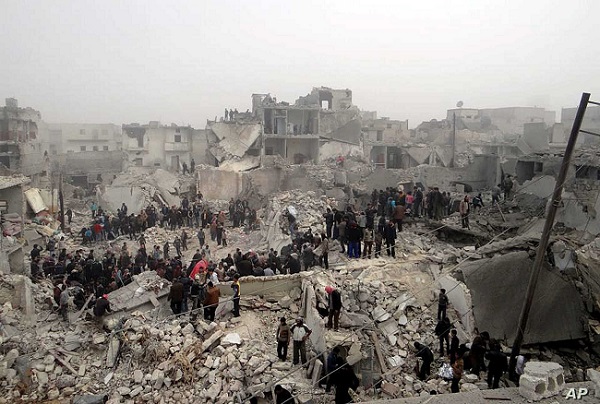
We live in a multi-polar world of persistent engagement, with rising nationalism, authoritarianism and bilateralism and diminishing trends of globalization that’s leading to increasing intervention and multiple ‘Great Games’. Every nation is forced to carry out dynamic strategic balancing by shifting alliances to cope, maintain and retain their sovereignty, independence and strategic space. Nowhere is this more evident than the shifting sands of the Middle East, where a humanitarian tragedy of gargantuan proportions has unfolded in Syria. With the arrival of the pandemic COVID-19, this suffering has further exacerbated, but the world sleeps on. India can and must act as the conscience keeper.

Syria– its background

Syria is an ancient land (10,000 BC; centre of pre-pottery Neolithic culture), and a culturally rich civilization. It is considered a secular state, being home to diverse ethnic groups including Syrian, Arabs, Kurds, Turkememens, Assyrians, Armenians, Greeks and others who follow the Sunni, Shia, Christianity, Alawites, Druze, Isma’ilis, Salafis, Yazidis and Jewish faiths. Syria became an independent republic in 1946 following French rule after World War-II. Democratic rule ended with a takeover in March 1949 and from 1958 to 1961, a brief union with Egypt replaced Syria’s parliamentary system with a centralized presidential government. The secular Ba’ath Syrian Regional Branch government came to power through a successful takeover in 1963. In March 1971, Hafez al-Assad, an Alawite, declared himself President, a position that he held until his death in 2000. His son Bashar al-Assad took over as President and he runs a dictatorial regime till date.

Genesis of Conflict

The Syrian Civil War which officially started on 15 Mar 2011 is an ongoing multi-sided armed conflict fought by several factions: The Syrian government and its allies, against a loose alliance of Sunni Arab rebel groups (including the Free Syrian Army), the Kurdish Syrian Democratic Forces (SDF), Salafi jihadist groups (including al-Nusra Front) and the Islamic State of Iraq and the Levant (ISIL). Outside intervention adds to the complexity. The unrest in Syria, formed part of a wider wave of 2011 Arab Spring protests, and grew out of discontent with the Assad government and escalated to an armed conflict after protests calling for his removal were violently suppressed. Syria was ranked last on the Global Peace Index from 2016 to 2018, making it the most violent country in the world due to the civil war.

Map of Middle East

Current Security and Humanitarian Crisis

Based on numerous official (including the last UNSC May 2020 Monthly Forecast) and journalistic reports; since the war began in 2011, at least 5,86,100 people have been killed, nearly 13 million people have been displaced (the largest number displaced by any conflict in the world) including 6.7 million Syrian refugees. An estimated 12 million Syrians need humanitarian assistance. In Northern Syria where severe fighting continues, during the two months of December 19 — January 2020 alone, over one million people have been displaced and living in squalid refugee camps. Turkey has officially announced a direct confrontation with Syria with its attendant power games. Russian President Vladimir Putin and Turkish President Recep Tayyip Erdoğan met in Moscow on 5 March 2020, agreeing to a cessation of all military actions effective 6 March 2020.The cease fire is holding very precariously with frequent breakdowns, and most security experts predict a grim future. On 8 May 2020, the UNHRC Chief stated: “As civilian casualties mount across Syria and human rights violations continue unabated, some parties to the conflict, including ISIL terrorist fighters, may be using the COVID-19 pandemic as “an opportunity to regroup and inflict violence on the population”. Concurrently, the risk of COVID-19 pandemic having a devastating impact on war-torn Syria is intensifying, due to a combination of the violence and living conditions that make people particularly vulnerable to the deadly virus.

Overview of the Middle East Security Situation and Syrian Conundrum

Just a glance at the political map of the Middle East provides a flavour of the complex strategic and geo-political environment. It obviously has a direct bearing on events in Syria. A unique phenomenon of Middle East is that paradoxically it is one of the most integrated intertwined regions and also the most polarized. The politico-socio-economic (oil and gas reserves) and security environment dictates that except for purely localised events all events become regionalised (and internationalised by intervention of big powers), due to conflicting interests and alliances. To this, add weak state structures, powerful nonstate actors (including terrorist organisations like Hezbollah, IS, al-Qaeda, multiple ethnic alliances), multiple transitions and religion (Sunni Vs Shia, Sunni Vs Sunni), different sects and practices making it a highly combustible mixture.

These elements do not get resolved easily but form layers of acrimony and discontent, with some issues temporarily taking precedence. Yemen is a typical example; intrinsically a conflict between a weak central government and Houthis (an obscure rebel group) has become a focal point for the Iranian-Saudi rivalry, a cold war arena with other regional players jumping in whenever it suits them.

Syria is similar, but situation gets even more convoluted. The major parties supporting the Syrian government are Iran, Russia and the Lebanese Hezbollah, while Syrian rebel groups receive political, logistic and military support from the United States, Turkey, Saudi Arabia, Qatar, Britain, France, Israel (which routinely targets Iranian and Hezbollah troops and infrastructure in Syria, fanning the existing turbulence) and Netherlands. The complexity of the conflict situation in Syria can be gauged by the fact that at one stage, the US was supporting two groups bitterly opposed to one another; Syrian opposition and Sunni groups and the Syrian Democratic Force (SDF- comprising mainly of elements of Kurdish People’s Protection Group (YPG) from both Turkey and Northern Syria; which Turkey has proclaimed as a terrorist organization putting USA and Turkey at cross purposes!

Ironically, US backed rebel groups are fighting both the Assad regime and ISIS but claim not to be pursuing regime change (despite supporting forces that wanted exactly that), not to be seeking a regional rebalance (despite clear impact that Assad’s downfall would have on Iran’s influence), not to be boosting Turkey’s foes (despite supporting a Kurdish movement affiliated with Turkey’s mortal enemy), and not to be seeking to weaken Russia (despite Moscow’s affinity for Assad). How do you support a group but not their objectives? It would be termed as a comic situation, if it was not so tragic for the innocent people of Syria caught in the crossfire of the conflict and now the added dimension of COVID-19.

The Indian Connection

Relations between India and Syria goes back to ancient civilizational ties. Events leading to partition, necessity to enjoy good relations with Muslims specially Arab countries, Syria’s consistent stand to support our views on Kashmir (the only Middle Eastern nation to consistently support), stability in the region which impacts our developmental and economic prospects and concerns about spread of terrorism and Islamic jihad, compelled India to support Syria’s legitimate right to the Golan Heights and opposition to foreign intervention as an important step to resolve the conflict (this stance given Assad’s rule has drawn much flak and ire from the international community). With limited trade to the tune of $200 million totally skewed in favour of India (90%), and geographical realities, there is very little influence India has on the ground. India’s oil and energy interests in Kurdish Autonomous Region and Syria need to be factored in, and it is in India’s interest to have a stable region. Specifically regarding the conflict, India has stayed neutral except to condemn violation of human rights. With increasing clout and status in the international arena, India can play a balancing or conflict resolution role especially given its soft power and equations with all the international and regional players involved. India must take it upon itself to bring focus and a definitive diplomatic and humanitarian surge followed with action to alleviate the human tragedy in Syria (this will enhance India’s status and geo-strategic role). With India’s enhanced role in WHO, it will be very interesting to watch how events unfold and India’s response.    

Prognosis

The situation in Northern Syria specially along the Turkish border remains precarious with more than a million civilians pincered. The Russia-Turkey agreement is being challenged on a daily basis both by the Syrian government forces and Turkish troops. The resolution of the conflict leading to long term stability and peace is totally contingent on the ‘Outside Players’ (especially global powers USA, Russia and China) stopping their interference.

A negotiated settlement between the government of Syrian President Bashar al-Asad and Syrian opposition forces in accordance with U.N. Security Council Resolution 2254, which calls for the drafting of a new constitution and UN supervised elections, appears impractical for now. As long as it’s a playground for power-play regionally and internationally, the conflict will simmer on in varying tempos, with tragic and humanitarian consequences for the people.

Unfortunately, it is a very low-cost option for the players because they don’t invest with their own troops but with negligible economic, military and political support to the warring factions. That is the tragedy of a dynamic multi-polar, multi-domain ‘real politik’ world we live in. The harsh and bitter truth is that with COVID-19 further putting Syria in the backburner, and diminishing political and economic power of international institutions like the UN (including sparring Security Council members), WHO, UNHCR, there is little hope of alleviation for the people of Syria in the near future.

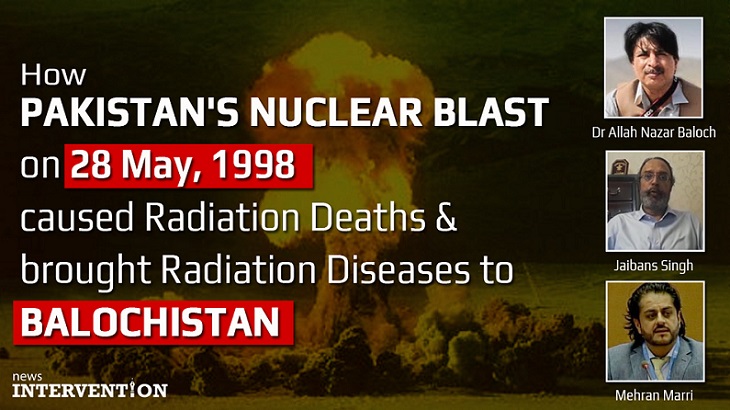
How Pakistan’s Nuclear Blast caused Radiation Deaths & brought Radiation Diseases in Balochistan

Pakistan conducted Nuclear Blasts on 28 May, 1998 at Chagai in occupied Balochistan. Nuclear Radiation due to these blasts has poisoned the environment and caused numerous radiation-related diseases in Baloch people. Even after twenty two years of this nuclear blast, the ground water remains poisoned, droughts have become a regular feature and the Baloch people still suffer from nuclear radiation related diseases.

Click on the YouTube link to watch this video report.

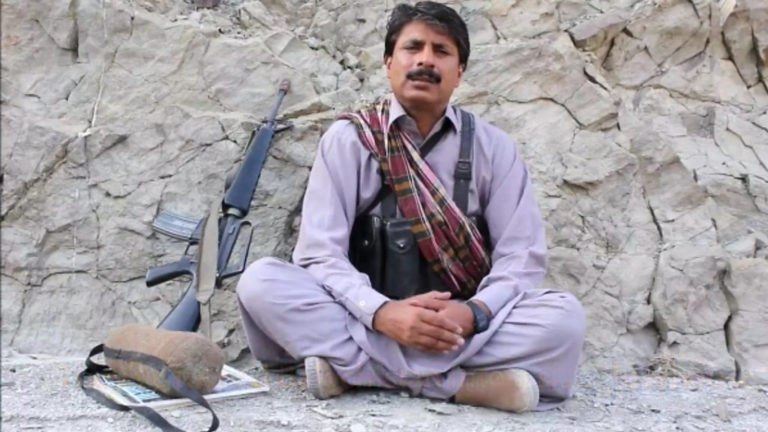
Pak ‘Death Squads’ kill a woman in Dannuk. Dr Allah Nazar calls it an attack on Baloch honour

Dr. Allah Nazar Baloch, Chief of Balochistan Liberation Front (BLF) condemned, in very strong words, the Turbat Dannuk incident in which an innocent woman was killed and and her four-year child seriously inured.
Death Squad members working under guidance and patronage of Pakistan’s Military Intelligence had raided Jassim’s house at Turbat Dannuk for robbery. However, during this robbery a woman was martyred and a child was seriously injured during the resistance.

The Turbat Dannuk incident came to light due to the resistance and bravery of locals. “We have repeatedly pointed out that behind most of the social evils and looting in Balochistan are the occupying Pakistani forces and its instruments of war which also have the patronage of parliamentary parties,” said Dr Allah Nazar. He added that these type of incidents have become commonplace in occupied Balochistan where innocent Baloch people are killed by Pakistan-backed ‘Death Squad’ members.

In different parts of Balochistan such Death Squad groups are involved in murder, theft, robbery, rapes and other crimes but they enjoy support of the Pakistan Army and intelligence agencies so the parliamentary parties are ready to defend them. After these crimes these people often take refuge in military camps, which are their permanent sanctuaries.

The BLF Chief said that the attack and shooting at the house in Turbat Dannuk, which resulted in the martyrdom of a woman and the wounding of a four-year-old child, was highly reprehensible and heinous crime. At the same time, it is a continuation of the events that have become a daily occurrence in Balochistan.

“These are the hallmarks of slavery. We can certainly find such attitudes towards enslaved nations in the pages of history, but in this modern age, enslaving a country by colonizing is against the human cultural attitudes and values ​​of the 21st century. Even in this modern age, the atrocities that Pakistan is carrying out by occupying and colonizing Balochistan are hardly found in today’s world,” Dr Allah Nazar Baloch said emphatically.

He explained that as the world has progressed in science and technology, many organizations have come into existence to preserve human values ​​and are trying to give human life the highest value. “Despite all these developments, Pakistan has not only maintained colonialism by crushing global values ​​under its military boots, but has also pursued a policy of oppression, violence, and self-harm of the Baloch, by the Baloch in the same way that was meted out to privately-owned slaves,” Dr Allah Nazar added further.

In fact, Dannuk incident is one of the many examples. The attackers were directly linked to Pakistan’s Military Intelligence. They were running various criminal gangs headed by the slain Major Nadeem of Pakistan Army. Major Nadeem was killed in an attack by Baloch freedom fighters. However, as long as the Pakistani occupation remains in Balochistan, its army will not stop using these tools. Using the Death Squads as a weapon in Balochistan will continue to result in violation of Baloch values ​​and traditions of honor and respect.

Dr. Allah Nazar Baloch further added that in the Turbat incident, family members, neighbors and relatives showed courage and bravery and arrested the Pakistani goons. Immediately after the incident, pictures of the attackers and other members of the gang brandishing guns with a Pakistani minister went viral on social media. These elements take refuge in the homes of puppet ministers and military camps after all kinds of criminal activities. “This is an attack on Baloch culture, an attack on our dignity and our honor, and is the genocide of Baloch people,” he added.

Conversation with Daniel Lomax on Topical Magazine

Daniel Lomax is an Editor for Topical Magazine. Here we talk about some of the contexts, history, and aims of it.

Scott Douglas Jacobsen: Topical Magazine has been slowly developing for a couple of years. What are its origins?

Daniel Lomax: Topical Magazine was founded by Benjamin David, whose previous project, Conatus News, branched out in two directions. Others ran with political activism while Topical Magazine emphasizes philosophical reflection. As the name of the magazine implies, we turn the microscope on contemporary events. But we look through it from the other side, aiming to put these issues into a wider historical and intellectual context.

Jacobsen: With academics, activists, and commentators as part of the team, there will be a wide range of views in addition to style of commentary. I have contributed to the publication too. Let’s take a shift into some discussion on the story for you, how did you become involved in Topical Magazine?

Lomax: The gift of nepotism brought me here. Benjamin, our editor-in-chief and founder, is an old friend of mine. He was looking for some fresh input for the magazine and so he got in touch, perhaps on account of my tendency to get into debates online (sorry/not sorry – I am one of those people).

As a contributing editor I think it’s important to allow each writer their own voice. A good editor is often a hands-off one. The magazine has a broadly left-libertarian perspective but the wide range of approaches is our virtue. It’s important for a magazine to be a magazine and not a church.

Jacobsen: What has been the writing and intellectual background for you, e.g., the influences and formal education?

Lomax: My formal education is actually in music and sound technology. During those years, I found my interests turning to philosophy, and returned to my childhood aspiration to write. I’ve run a lively philosophy forum online for some years and spent more time engaging with philosophy, politics and literature than with my formal area of study.

But my real education was a brief spell of homelessness followed by years of poverty. As a pure intellectual it can be difficult to make your mind up – Marx (for example) is persuasive, and so is Hayek. But with these sorts of experiences you go through the looking glass. For better and for worse you get a real glimpse of society, and individuals, and the government, and the economy, and yourself: and at the end of it you find you’ve developed a new clarity and confidence in your values and principles. If this sounds like I’m saying I studied at the University of Life, shoot me.

Jacobsen: The current team includes Benjamin David (Senior Editor), Daniel Lomax (Editor), Raghen Lucy (Editor), Tom Adamson, Ian Bellis, Jude Bernard, Ryan Faulkner-Hogg, Bryce Harper, Race Huchdorf, Dino Jelčić, Khadija Khan Eleanor Paisley, Benjamin Studebaker, Jeremiah Tabb, Emile Yusupoff, and myself. When we look at the team, what is the first thing that comes to mind for you?

Lomax: We have a strong international team of independent thinkers and fierce intellectuals, each with different areas of interest and different approaches to writing and analysis. It’s always interesting to see the different takes these contributors give on an issue, and they’re a pleasure to work with. We’re always open for further recruitment of course, and we hope to continue to grow and build on our foundations.

Jacobsen: What is the importance of the individuals at the helm now? Those who take particular editorial stances, orient themselves within a specific frame, and provide coverage on a variety of topics for the readership.

Lomax: Benjamin’s a gifted promoter, organizer and people-manager, with a good work rate, and he’s sort of the spine that holds the pages together. Raghen’s a strikingly intelligent young editor with a keen eye for detail. I’m extremely awkward and pedantic which, I like to think, keeps the others on their toes. The importance of that can’t be underestimated, of course.

Jacobsen: Knowing the social and intellectual circles, and networks, many publications arose in a similar manner with different emphases and orientation while having some core values around “Freedom of Speech”/freedom of expression. For example, the team at Areo Magazine began under Malhar Mali in November, 2016 (until June, 2018) with the current editorial team as Helen Pluckrose (Editor), Iona Italia (Sub-Editor), and Gauri Hopkins (Administrator), and some others who I know stipulating particular positions for themselves within the publication. They have expanded into LetterWiki. However, I remain unsure as to the current full roster. Quillette only a short time before in 2015 without much notoriety, except in the last, maybe, two or two-and-a-half years. Its team consists of Claire Lehmann (Editor-in-Chief), Jamie Palmer (Senior Editor), Paulina Neuding (European Editor), Jonathan Kay (Canadian Editor), Toby Young (Associate Editor), Andy Ngo (Sub-Editor), Greg Ellis (Voice of Quillette Narrated), Asher Honickman (Legal Advisor), Carol Horton, Jeffrey Taylor, Matthew Blackwell, Debra W. Soh, Michael Shellenberger, Spencer Case, Terry Newman, Chloe Valdary, Imran Shamsunahar, Bradley Campbell, Brad Cran, Coleman Hughes, Bo Winegard, Jonathan Anomaly, Rosalind Arden, John R. Wood, Jr., Neema Parvini, Clay Routledge, Helen Dale, and Sumantra Maitra. So, each covering some different facets of modern culture and emergent within a couple of years of one another. There are others. What is the importance of publications like these?

Lomax: We’re not the first publication to have noted with concern that freedom of expression has declined as a value among “Western” society. I’m accustomed by now to seeing and hearing historically ignorant arguments for this new authoritarianism, posed by people who should know better. Our demand is not just to protect a thing which is valuable in itself – although it is – but to preserve the liberty upon which all other liberties are built.

Jacobsen: Following from the previous question, how has Topical Magazine filled out a niche for itself?

Lomax: It’s edifying to watch the growing resistance to the authoritarian trend, but it risks being monopolized by people who obsess over gender and Islam. The civil rights movement in the US couldn’t have happened without the First Amendment and the Ottoman Empire’s ban on the printing press is one of the reasons most of the region is strangulated by hierarchical and reactionary regimes. Our position is that a seat must be kept warm for free speech on the political Left of the house.

Jacobsen: What are the goals of Topical Magazine?

Lomax: We hope to inform, educate and reason – and in an age in which so many disenfranchised people think of politics as Something For Other People, associating it with dispatches from boring men in anoraks, standing in the rain looking dour outside the halls of Westminster or sitting in a bland studio offering dry, meaningless PowerPoint infographics on “the economy”: make it interesting.

Jacobsen: What is the ethos of Topical Magazine?

Lomax: We write with clarity so as not to exclude. Integrity and strictness about the facts are not negotiable: the public’s trust in the journalistic profession is at a low point, and it’s incumbent on every writer to take some responsibility for that. With that said: don’t believe this piffle about “unbiased journalism.” Bias is ineradicable. The key thing is that your readers know from the outset what your biases are. We treat our readership like grown-ups.

Jacobsen: What are some of the main topics covered in Topical Magazine?

Lomax: We’ve written repeatedly about freedom of speech issues and technology (both of which topics you’ve made insightful contributions to yourself). We have pieces on the environment, nuclear energy, political rifts, feminism, mental health, combat sports, social media and much more. There isn’t a topic we’re afraid to touch.

Thanks for having me, Scott.

Jacobsen: You’re very welcome, Daniel.

Photo by Rhema Kallianpur on Unsplash

Humanist Canada Essay Contest is Live

Humanist Canada[1] is hosting an essay contest through its Humanist Canada Essay Contest Committee in collaboration with the Association humaniste du Québec is working to provide a voice for high school level humanist students or pupils with humanistic tendencies. The essay contest was rebooted in 2019 as a joint adventure too. The theme for 2020, as a consensus decision of the Humanist Canada Essay Contest Committee, is “Religion and Humanism in Education” in a Canadian context.

As with 2019, the prize money will be $8,000 (CAD), which, in essence, funds two competitions under one contest with an English competition and a French competition. The first place prize will be $1,000 for students with the most outstanding submissions. Within the theme, there are no predefined topics for the students. However, the content would preferably be in alignment with the values of Humanism and the humanist community throughout Canada.

As the Vice-President of Humanist Canada said, “We are once again pleased to be able to host this forum for young writers interested in humanist themes. This forum promotes a defence of science and reason from those who would attack it.”

Humanism, if you do not know, is a non-theistic view of life and the world. Its means of understanding the world are critical thinking, logical reasoning, and science. It affirms the worth and dignity of every individual human being while striving for the ethical principles of compassion, fairness, and truth. These guide a worldview aiming for the maintenance of the good in the world and working to make things even better in material and human terms. Some of the topics students may want to entertain are abortion, discrimination based on sexual orientation, concerns over the environment, freedom of thought and expression, medically assisted dying, and poverty.

As a Board Member of Humanist Canada representing British Columbia and as the Chair of the Humanist Canada Essay Contest Committee, this is a rare opportunity for the presentation of the best and brightest young freethought minds the country’s high schools have to offer, in a formal academic-based competition with written essays. Any inculcation of values comes from the passing of them and providing a space for the next generations to evaluate, present, and live them. The Humanist Canada Essay Contest is one opportunity for young freethinkers to shine, as I noted in the press release entitled “Student Essay Contest, Hosted By Humanist Canada, Call for Submissions.” The full information for the essay contest can be found here: https://www.humanistcanada.ca/programs/essay-contest/.

About Humanist Canada

Humanist Canada (HC) promotes education and awareness of humanism. We are a resource for secular groups and causes across Canada. We support the advancement of scientific, academic, medical, and human rights efforts.


[1] Humanist Canada is connected directly or indirectly to a number of humanist and freethought organizations including: British Columbia Humanist Association, Humanist Association of Ottawa, Humanist Association of Toronto, Toronto Oasis, Grey Bruce Humanists, Ontario Humanist Society, Central Ontario Humanist Association, Association humaniste du Québec, Humanists, Atheists and Agnostics of Manitoba, Comox Valley Humanists, Toronto Oasis, Grey Bruce Humanists, Ontario Humanist Society, Halton-Peel Humanist Community, Thunder Bay Humanists, Humanist International, American Humanist Association, Humanists UK, Humanist Society of Scotland, Humanist Association of Ireland, Humanist Association of Germany, and European Humanist Federation, Secular Humanists in Calgary, Victoria Secular Humanist Association, Humanist Association of London, Society of Free Thinkers (Kitchener-Waterloo/Cambridge/Guelph), Dying with Dignity, Secular Connexion Séculière, Centre for Inquiry, Canadian Secular Alliance, Humanist International, American Humanist Association, Humanists UK, Humanist Society of Scotland, Humanist Association of Ireland, Humanist Association of Germany, and European Humanist Federation.

Photo by Anderson W Rangel on Unsplash

Christian Asia Bibi’s brother-in-law killed in Pakistan

Younus, the brother-in-law of Asia Bibi, a Christian woman convicted of blasphemy by a Pakistani court, was killed in Sheikhupura city of Punjab province in Pakistan on Monday. Younus was also a Christian. Minorities in Pakistan are treated like dirt.

According to the FIR, Younus had gone to his farms on May 24 and did not return home at night. His dead body with a slit throat was traced to the farm the next morning.

Local sources in Pakistan said that since Younus hailed from the minority Christian community he was bound to be killed. This is not the first time that somebody associated with Asia Bibi has been murdered in cold blood.

In 2011, Salman Taseer, the influential governor of Punjab was assassinated after he made headlines by appealing for the pardon of Asia Bibi, who had been sentenced to death for allegedly insulting Prophet Muhammad. A month after Taseer was killed, Religious Minorities Minister Shahbaz Bhatti, a Christian who spoke out against the laws, was shot dead in Islamabad underlining the threat faced by critics of the law.

Asia Bibi is now living in exile after the Supreme Court of Pakistan acquitted her based on insufficient evidence presented before it in October 2018. Recounting the severe inhuman conditions of eight years spent on death row for false blasphemy charges and about the pain of exile, Asia Bibi recently broke her silence to give her first personal insight into an ordeal that caused international outrage.

French journalist Anne-Isabelle Tollet, who has co-written a book about her, was once based in the country where she led a support campaign for her. “You already know my story through the media,” she said in the book. “But you are far from understanding my daily life in prison or my new life,” she said. “I became a prisoner of fanaticism,” she said. In prison, “tears were the only companions in the cell.”

Asia Bibi described the horrendous conditions in squalid jails in Pakistan where she was kept chained and jeered at by other detainees. Pakistan’s blasphemy laws carry a potential death sentence for anyone who insults Islam. This dubious blasphemy laws have been used to persecute minority faiths and unfairly target minorities.

Pakistan’s Prime Minister Imran Khan Niazi defended the country’s strict blasphemy laws during his election campaigns. The status quo is still in place. No government in Pakistan is ready to make changes to the blasphemy law due to fears of a backlash from radical Wahhabi Islamists.

CPEC power projects are robbing Pakistan on a daily basis

Islamabad has been bandying the China-Pakistan Economic Corridor (CPEC) as the ultimate panacea that will solve all financial woes of Pakistan. And since it dubs CPEC as a “game changer for the region,” it doesn’t take very kindly, any contrarian views on this issue. Islamabad’s extreme sensitivity to any comments describing the unfavourable terms and conditions of CPEC project as a ‘sell-off’ is understandable as no nation would like to be told that it is being taken for a royal ride by another country that’s not only an “all weather friend,” but also the sole neighbour out of four with whom Islamabad has no problems. But Islamabad’s decision to keep the contract details of this project under wraps to avoid criticism has only ended up attracting more attention.

The general consensus about CPEC is that Pakistan has chewed off more than it can swallow and since Beijing has a history of being a ruthless enforcer, it would not make any allowances when it comes to extracting its pound of flesh. Within a year of the CPEC agreement being signed, World Bank in its Global Economic Prospects 2016 report had warned that “Sovereign guarantees associated with CPEC could pose substantial fiscal risks over the medium term.” In the same year, International Monetary Fund (IMF) had also warned that once Chinese investors commence repatriating profits, “Pakistan will need to manage increasing CPEC-related outflows,” as this “could add up to a significant level given the magnitude of the FDI.”

IMF also stressed on “a need to ensure transparency and accountability in project management and monitoring,” with its mission chief for Pakistan, Harold Finger adding that “We believe it’s important that information on contracts should be provided transparently as soon as it emerges so that we can factor it in.” Even the Asian Development Bank Country Director Xiaohong Yang (who is incidentally a Chinese national) warned Islamabad that Main Line 1 project (upgradation of railway from Peshawar to Karachi and construction of Havelian Dry Port) estimated at a whopping $8.2 billion “is a very expensive mega project and the government needs to explore all possible ways to make sure that the project is financially sustainable.”

It seems that Islamabad did take some notice of this advice because in October 2018, Railways Minister Sheikh Rasheed announced that after re-negotiations, the cost of this project had been brought down to $6.2 billion because “Pakistan is a poor country that cannot afford huge burden of the loans,” and that he wished to further reduce it to $4 billion. How did Rasheed manage to bring down the loan estimate by more than 24% remains unknown, but it would be naïve to expect that this was due to his “Pakistan is a poor country” plea. Such a substantial reduction could only have been possible if the scope of the project was reduced, its technical specifications lowered or the profit margin slashed significantly.

Since there has been no formal announcement regarding any downgrading the scope of CPEC or lowering its specifications, the only conclusion is that Beijing trimmed its profit margin on the request of Islamabad. Whereas one way of looking at the $2 billion cost reduction is in line with Pakistan’s oft expressed “all weather friendship” relations with China and so China, for its part, has turned itself into the biblical ‘Good Samaritan’ and waived off this amount. But if this is the case, then a very disturbing question arises- should a rich “all weather friend” exploit the financial vulnerability of his poor counterpart by fleecing him through abnormally inflated profit margins? Something is certainly fishy as far as CPEC financing is concerned!

The CPEC isn’t even complete, yet skeletons have already started tumbling out of Beijing’s closet. As per ‘Profit Pakistan Today’, which broke this story, a high-powered nine-member committee from different organisations (including one from Pakistan Army’s spy agency ISI) was constituted by Prime Minister Imran Khan to examine the unusually heavy losses that were occurring in the power sector. In its 278-page long report titled ‘Committee for Power Sector Audit, Circular Debt Reservation, and Future Roadmap’, this committee is believed to have discovered that the exchequer had lost a staggering amount of about 100 billion Pakistani rupees. The losses were attributed to “violation of the Standard Operating Procedures (SOPs) that include the cost of the installation of Independent Power Producers (IPPs), government agreements, alleged embezzlement in fuel consumption, power tariff, guaranteed profit in dollars, and certain conditions of power purchase.” The culprits: Chinese private power producers.

Though the report has (for obvious reasons) carefully avoided any mention of CPEC , its ‘fingerprints’ are all over because corruption at such a massive scale in CPEC related projects isn’t possible without some institutional connivance, more so in China’s case were corruption can make you end up staring at the gun muzzles of an execution squad! Some of the committee’s findings that vindicate the international financial institutions and organisations’ concerns regarding the unacceptably high levels of opaqueness in CPEC contracts are as follows:

  • Though National Electric Power Regulatory Authority (NEPRA) has set a 15% upper limit on annual profits, Independent Power Producers (IPPs) have been earning as much as 50 to 70%. How?
  • “IPP (Independent Power Producers) owners showed the extra cost to get extra tariff at the time of the contract, with NEPRA (National Electric Power Regulatory Authority) failing to check the veracity of the cost. The cost of the power plant prepared by the companies was also accepted by the authorities.” Why?
  • As per the committee report, IPPs have illogically pocketed 350 billion Pakistani rupees since 1994 by altering actual costs by Rs 2 to Rs 15 billion and one “owner of a coal power plant offered a cost which was Rs 30 billion more than the actual cost in order to obtain higher power tariff.” Where’s the checks and balances?
  • The committee’s report reveals that IPPs even earned “unjust” profits in fuel consumption because NEPRA never ascertained the efficiency of fuel consumption- how negligent! To make problems worse, the owners had also resisted signing the agreement for regular audit. How arrogant!
  • The government and power consumers are forced to pay billions of rupees annually even if the power plants are closed or produce low electricity due to a cut in power demand. While the government is bound to pay billions of Pakistani rupees to power plants under the head capacity payments, it will have to pay a capacity payment of 1500 billion Pakistani rupees by 2025 according to the agreement. In addition, NEPRA has also grossly violated the four to five years period for the guaranteed profit clause to a whopping 25 years. No wonder the committee reports notes that “These lop-sided agreements caused unbearable loss to the exchequer. The prevalent practice also led to a hike in power tariffs.” How irresponsible!

A country that’s literally surviving on dole doesn’t have the luxury to be penny wise and pound foolish. Similarly, it can’t consider sobriquets like “all weather friends” used by Beijing and its own poetic reciprocation of “sweeter than honey” to quantify this friendship as an open and indefinite ticket for free lunches. The power sector scam unearthed is just the tip of the iceberg and it won’t be long before a deluge of skeletons come tumbling out of the CPEC cupboard. So, while Islamabad may rubbish international concerns regarding the inevitable consequences of reckless CPEC spending by blaming a ‘jealous’ India or a ‘spurned’ Washington of spreading misinformation, not losing touch with reality would do Islamabad some good.

Tailpiece: In 2017, the Sri Lankan government had to hand over Hambantota port to China on a 99 years lease after failing to repay billions of dollars in loans. The very next year, Zambia lost control over Kenneth Kaunda International Airport due to debt repayment failure. Last year, China started to tighten its grip over Kenyan government and is eyeing to take over Mombasa port due to unpaid loans. Yet, having been very fond of fairy tales and a staunch believer in the ‘lived happily ever after’ endings as a child, the ‘all weather’ and ‘sweeter than honey’ friendship stuff gives a feeling of déjà vu and so, may this association (the only one of its type) flourish by leap and bounds, but more importantly, also survive when the fateful day of clearing dues finally arrives. Amen!

Inside story of stone pelting during terrorist encounters in Kashmir

It’s very easy for activists and intelligentsia who safely sit in the confines of their homes to decry temporary suspension of mobile and internet services in Jammu and Kashmir where an encounter is on between terrorists and the security forces. For such ‘concerned’ champions of human rights, these actions is tantamount to “restrictions” on the right to freedom of expression and some of them get so paranoid that they start drawing parallels of India with Nazi Germany or fascist Italy of yesteryear. While everyone is entitled to have his or her own views as well as express the same, but for our extremely discerning activists to outrightly reject any counter argument without assigning any reasons is indeed both intriguing and unfortunate. 

Nawakadal in Down Town area of the old city of Srinagar is a popular locality for terrorists to hide for many reasons. Firstly, being a very congested locality, it’s easy to shake off ‘spies’ trailing them by simply slipping in and out of the myriad bylanes. Secondly, since the houses in many localities are ‘hugging’ each other, at times it becomes humanly impossible to effectively ‘seal-off’ a house in which terrorists have taken refuge. Thirdly, the proximity of houses with each other makes it easy for trapped terrorists to escape by jumping from house to house and through the numerous passageways. Lastly, the labyrinth of alleys makes it easy for crowds to reach the encounter site from all directions and disrupt the activities of security forces by diverting their attention through violent acts like stone pelting and setting their vehicles ablaze.

It’s perhaps the dense population and closely built homes that raise concerns of collateral damage to life and property, due to which operations by security forces against terrorists in the old city area of Srinagar have been comparatively less as compared to other areas. The last time an operation was carried out here was more than six months ago when four Lashkar-e-Toiba terrorists were killed. Probably its comparative safety was the very reason why Hizbul Mujahideen’s (HM) self-styled ‘district commander’ Junaid Sehrai and his associate Tariq Sheikh decided to take refuge in this locality that also provided the best of facilities. How exactly did intelligence agencies get inputs that this duo was hiding in Nawakadal area is not known, but there are many rumours and one is that this was an ‘inside job’.

But the undeniable fact is that on 19 May 2020, someone did provide intelligence agencies with such compelling evidence about his whereabouts that security forces decided to launch an operation in the crammed Nawakadal area of Srinagar. The security forces proved their mettle because despite the numerous advantages provided by this congested locality, Junaid and his compatriot were unable to make good their escape. After the duo were trapped, security forces managed to intercept a mobile call made by Junaid’s aide Tariq to an ‘Over Ground Worker’ (OGW) named Shahid and its contents are quite illuminating as it reveals the reality of stone pelting mobs congregating at encounter sites.

In this audio, a heavily panting Tariq Sheikh can be heard talking to Shahid in Kashmiri and the transliteration of the monologue is as follows:

Roman Urdu:
Aslam o Aliekum Shahid sahib, Tariq Sheikh bol reha hoon. Hum Nawakadal mein fhus gaye hain. Wahin se bande bejna jo pathrao karein; joh pechhli wali road se pathrao karein aur humey bahar nikale. Meray sath Junaid hai -Sehrai ka beta. Jaldi karo. Yeh akhri ghadi hai, jaldi karo – humey bachao!

English:

Peace be on you Shahid sir, Tariq Sheikh speaking. We are trapped in Nawakadal. Send guys from there who should pelt stones; stone pelting should be done from the road behind and we should be extricated. I have Junaid with me (who is) the son of (Ashraf) Serhai. This is the last moment (chance), so be quick and save us!

This mobile call from Tariq Sheikh shatters two myths that have been woven by those with vested interests in an attempt to glorify the ‘last stand’ of terrorists. Firstly, it dispels the belief that once they are trapped, terrorists don’t try to escape but instead fight valiantly to embrace ‘martyrdom’. Secondly, that crowds don’t converge automatically onto the encounter site after hearing gunshots and start pelting stones at security personnel on their own in order to express their anguish. The truth is that trapped terrorists use every trick in the book to escape the security force dragnets but to be fair to them there’s nothing wrong in seeking self-preservation. However, putting unarmed crowds to grave risk by using them as ‘human shields’ in order to escape the dragnet is a despicable act but unfortunately this is exactly what trapped terrorists do; as is clearly evident from Tariq’s mobile call.

Terrorist sympathisers, the separatist camp as well as many activists argue that crowds voluntarily congregate at the site of encounters and this reflects the public outrage against security forces. But this isn’t true, because gathering crowds is done through subtle intimidation. The separatists and terrorists have established a wide network of OGWs in each ‘mohalla’ (segment) of every village in Kashmir. They assist terrorists by organising their logistical support and like the hated commissars of erstwhile Soviet Union they keep a close watch on the activities and ‘loyalties’ of the people. When terrorists are trapped in a village, the concerned OGWs give a call for all men to reach the encounter site immediately and the large turnout is not because the people are anxious, but only because the OGWs keep a mental note of absentees.

Names of those who disregard the call to congregate at encounter site are promptly passed on to the terrorists who in turn pay the absentees a nocturnal ‘visit’ and mete out punishments that could range from a severe beating to being shot in the leg or much worse, being executed. So, rather than facing the muzzle of a terrorist’s gun for being absent, locals choose the comparatively easier and psychologically less traumatising option of joining a crowd as the numbers give people a sense of security.

Stone pelting at encounter sites pays rich dividends since it exploits the security forces’ hesitation to take firm action against mobs and the resultant high prospects of protesters’ not being harmed makes the OGWs task much easier. However, there are occasions when mobs come so dangerously close to soldiers engaged in the ongoing gunfight with trapped terrorists that they imperil safety of troops and in such cases, use of force becomes inevitable.

But even in this eventuality, the OGWs ‘win’ since the security forces’ action against a violent and menacing mob is still billed as use of ‘disproportionate’ force against ‘unarmed’ people and our hallowed activists echo the same sentiment despite the fact that stones pelted by crowds in Kashmir have taken many a life, be it that of the locals, security force personnel and even a young tourist!

Another often heard complaint of parents is that even though their child had not been part of the protesting crowd but had either gone on an errand, was working or playing in the area or simply returning home after meeting a friend or attending tuition ended up being shot or injured when the police fired on a protesting mob. In such cases, the parents aren’t telling lies but what they don’t know is that even though their ward may not have been part of the mob, but the moment his (or her) path crossed that of the mob, that person had no option but to join and become part of the crowd.

One such tragic incident occurred in 2018, when an MBA returnee from Indonesia named Abid Hussain was killed when police fired on an unruly mob that had gone out of control. Abid had left his home in Karimabad village of South Kashmir’s Pulwama to fetch milk for his 3-month-old daughter born to him from his Indonesian wife when he was forced to join a crowd and ended up being shot! The OGWs and activists had a field day making this tragic incident look like a ‘targeted’ killing, not realising that no one would buy their story because when even the locals in the crowd didn’t know who this person was, how could the security forces have singled him out?

So, the next time you see a crowd at an encounter site, don’t get carried away by romantic notions of people voluntarily coming out and exposing themselves to danger out of pure love and affection for trapped terrorists. Because if this was really the case, then why did United Jihad Council chief Syed Salahuddin himself recently admit that 80 ‘mujahideens’ had been gunned down by security forces during this year alone. An inordinately high monthly attrition rate of 16 terrorists (or one terrorist being killed on every alternate day continuously for five months) doesn’t reflect a very high degree of public adoration for these so called “freedom fighter” mujahideens.

Eid-ul-Fitr: Kashmir shows the way with restrained yet spirited celebrations

Eid-ul-fitr has a special significance as a befitting celebration and thanksgiving to mark the culmination of the holy month of Ramadan. Ramadan is a month-long fast observed by Muslims across the world. The activity is regarded as one of the five pillars of Islam. The holy fast or Roza is observed from sunrise to sunset. During this month, Muslims are decreed by Allah to adhere to acts of “Deen” (religion) rather than worldly matters. Ramadan is not only about fasting; it is also about being humble, modest and above all, free of all animosities; it is about discipline, self control, self reflection and reformation. After Ramadan, Eid is celebrated on the first day of Shawwal, the 10th month of the Islamic lunar calendar.

This year, in Jammu and Kashmir, Eid-ul-Fitr is being celebrated on May 24. The restrictions and precautions imposed due to the spread of Coronavirus have not dampened the spirit of the people. The inability to meet has been replaced by passing of messages in social media and communication on mobile with video calls etc. By all means, the brotherhood and love which marks the Eid celebrations is visible in ample measure. When markets were opened in a phased manner, several people stepped out of their houses to buy food items but were seen abiding by the social distancing norm as a precautionary measure to halt the spread of the virus.

While the Jammu region has, till now, witnessed limited impact of the Corona pandemic, its rapid spread in Kashmir has been a cause of worry. Kashmiri people have dealt with the crisis with exemplary resilience and patience; they have responded to a call by the government to maintain precautions with great discipline and have followed all directions in letter and spirit. Officials and doctors have been working tirelessly to overcome the challenge, even during Ramadan. Volunteers, mostly students, are at the forefront of relief measures, distributing food to the needy during Ramadan.

Under normal circumstances in Jammu and Kashmir, thousands of people attend congregational Eid prayers in Eidgahs, Masjids on a daily basis. The biggest gathering of devotees is at Jamia Masjid in Srinagar and at the Hazratbal Shrine. This year, people have voluntarily chosen restraint. They are praying mostly at home; smaller congregations at Mosques are conducted as per a preset schedule with strict observance to all precautions.

Kashmir’s Grand Mufti Nasir-ul-Islam, while felicitating the people of Jammu and Kashmir on the auspicious occasion of Jumat-ul-Vida (last Friday of Ramadan) and Laitul-Qadr the night of blessings, extolled them to offer prayers in their homes. “On the eve of Shab-e-Qadr, people must offer night long prayers and prayers for repentance at their respective homes. Same should be followed on Jumat-ul-Vida—instead of two Fardh Rakahs, people should offer Zuhr prayers as has been the practice in the fasting month due to the pandemic,” he said. He added that people should refrain from unnecessary spending and instead celebrate Eid in a very austere manner. The practical directive from the highest religious authority had its impact and the celebration, though conducted, were of a nature that did not cause any increase in the virus spread.

The end result of the patience shown is that the deadly virus, that started spreading very fast in Kashmir has been contained in a manner that could set an example for the rest of the country and the world. Broadly speaking there have been about 1300 cases reported in Kashmir of which almost half have already recovered. A little more than 21 people have died due to Coronavirus infection in the Union Territory. While the unfortunate deaths are deeply mourned, it is necessary to admit that the numbers have remained very less as compared to the national and international average. It is so mainly due to the efforts put in by the administration, the medical fraternity and the people. Timely quarantine contained the spread; those who did get infected received excellent medical treatment.

In adherence to the sacred values, what the Muslims of Jammu and Kashmir could not do in the form of celebrations, they did in the form of charity. We want to give the most to charity and focus on prayers that will resist us from wrongdoings. We all are hoping and praying for the best,” said Farooq Ahmed, chairman for an Islamic seminary in Baramulla. People are lavishly contributing to charitable trusts and even at the individual level helping all to celebrate Eid in a joyous manner.

Jammu and Kashmir Lieutenant Governor Girish Chandra Murmu, while felicitating the people of the Union Territory on the auspicious occasion of ‘Eid-ul-Fitr has said, “The festival is one of many examples of India’s multi-dimensional culture. May this festival promote and maintain inter-religious understanding and co-existence and instill the spirit of brotherhood, harmony, and amity among the people of all faiths.”

Lt. Gen. YK Joshi, Army Commander, Northern Command has also extended warm greetings on this auspicious occasion to the “Awaam of Jammu and Kashmir and Ladakh.” Similar greetings to the people have also emanated from the Srinagar-based Chinar Corps.

There is a prayer on all lips that this auspicious occasion becomes the harbinger of peace, progress, prosperity and happiness and strengthens the bonds of communal harmony, brotherhood and amity, which are the hallmarks of the glorious pluralistic traditions of Jammu and Kashmir.

The spirit behind the observance of Eid-ul-Fitr, is to express our thanks to Almighty Allah for giving us courage to observe fast in the month of Ramadan and rededicate ourselves to truthfulness, sincerity, self-control, and patience showing complete obedience to Allah. On the auspicious occasion of Eid-ul-Fitr, our fervent prayer to the Almighty is to come to the aid of the humanity and completely eradicate the menace of COVID-19.