An old
Chinese story titled “The Wolf of Zhongshan,” talks about a wolf which had been
shot by a hunter. As it was running away injured, it met a kind-hearted person
who saved the wolf from the hunter. After the hunter left, the wolf said to the
kind-hearted person, “You have saved me. Now I am hungry. Since you have
come this far helping me, let me eat you.”
Why has China, the second largest economy of the world, has suddenly started to flex its muscles? Why are they opening so many flanks with so many countries simultaneously? There is an economic, political or territorial issue that has been raised with several countries, almost simultaneously. What does China hope to accomplish when its own economy has been ravaged by the Wuhan Virus?
From times immemorial, world leaders, under pressure because of a weak economy or a weak political position, have waved the flag of ‘National Security’ and indulged in sabre rattling to divert attention from their internal challenges. Are we seeing the same in China today?
Let us look at the challenges China is facing:
Credibility Challenge: China has a serious credibility issue with the rest of the world, reeling under the impact of Coronavirus pandemic. Political leaders around the world have started blaming China for not being transparent about the origin of this virus. What should worry China is that the average individual in each country is angry with China and the first reaction will come against “Made in China” goods. This is an emotional and a sentimental reaction and once deep-rooted, will be difficult to change in a short time. Calls to stop buying Chinese products and even to uninstall Chinese apps should be a cause for serious concern in China.
Diplomatic Challenge: When there is pressure diplomacy normally comes to the rescue.
Chinese officials have been reacting with threats as can be seen in their stopping imports from Australia.
They have been threatening Taiwan and there is cause for worry in Taiwan in case China decides to unilaterally take military action.
The recent amendment of the National Security law to govern Hong Kong is another case in point.
Racist comments against African people in parts of China has resulted in a reaction from Africa.
Finally, the Chinese government officials are aware that US elections are round the corner and therefore understandably rhetoric will be high and loud. This is the time when they need to keep quiet and wait for the elections to be over. Instead Chinese officials are issuing threats of retaliation to America when they comment or support Hong Kong or Taiwan.
Geographical and Territorial Challenge: China has always wanted to expand its boundaries by attempting to take over lands of other countries that it claims.
Gathering a number of military personnel on the border of India and raising territorial and boundary issues at this point of time is one more flank that China could have avoided opening. After encroaching into Indian territory, the Chinese found that unlike in the past, Indian political resolve was strong, and the Indian Army pushed back. This resulted in some fisticuffs though no damage was done other than to the Chinese ego. Soon thereafter, the Chinese leadership started to wave the peace flag.
The Spratly Islands is a contentious issue in the South China Sea.
The China-Pakistan Economic Corridor (CPEC) that goes through Indian territory will be the first casualty.
The One Belt One Road (OBOR) project has also become a question mark in most countries. Citizens of these countries were expecting large investments into their country, but they can see that they will get nothing. China is sending its own equipment, its own people and its own material for these roads. Even the food their workers’ eat comes from China!
Economic Challenge: China has powered its way into every nation given its financial might and during this pandemic its companies, supported by state institutions, are looking for cheap acquisition of lucrative companies around the world. This has been picked up by most countries and restrictions are being imposed to ensure that good companies are not sold because of the pandemic.
The financial cost of the Coronavirus to the world economy varies between US$ 5 trillion to US$ 9 trillion. Some countries are threatening to recover this from China. While it is unlikely that any compensation will ever be paid, the sentiment behind these claims is more important.
Most international companies in China are starting to evaluate how they will re-engineer their supply chains so that they are less dependent on manufacture of their products within China. This will have serious impact on China which relies on mass production.
China has launched a trial of digital yuan in Shenzhen, Suzhou and Chengdu, and the Xiong’an New Area. It will be interesting to see the reaction of the US government as it will see this move as a threat to the US Dollar, the only global currency. The only other person who had challenged the US Dollar when he started trading oil in Euros was Saddam Hussain.
No one likes a bully, and no one likes to be threatened.
Trade and commerce are always a two-way street. There could be trade imbalances
between countries and these can be corrected. No country can stop buying from
another and assume that there will not be a reaction from the other country.
China is powerful because the world started to buy its products putting money in the hands of the Chinese citizens thus powering their own economy. If the factory of the world stops selling its goods, the impact on the country will be clear and obvious.
President Xi Jinping has asked his country “to make mental and material preparations for changes in the external environment that will last a relatively long period of time.” This could mean that China will be more aggressive and confront its challenges with retaliation rather than conciliation and cooperation.
Has China got caught up with its own hype of having a
large economy (which is slowing down), of having a large well-fed and satisfied
army (which could be reluctant to get into a fight) and an invincible leader
(who could be facing serious challenges from within)?
Balochistan Liberation Front spokesman Major Gwahram Baloch told media from an undisclosed location that Baloch freedom fighters (Sarmachaars) stopped and checked seven local vehicles on the main road in Awaran, Peerandar on Saturday, May 30, after receiving secret information.
After arrest of three local vehicles that were carrying rations for the Pakistan Army, the goods in them were seized and the drivers were released with a final warning. These vehicles were carrying rations from Awaran to Manguli Mashkai military camp of the Pakistan Army. “We once again appeal to the vehicle owners to refrain from supporting the Pakistani Army involved in the Baloch genocide,” said Major Gwahram Baloch.
Major Gwahram Baloch further added that the transporters should refrain from assisting the Pakistan Army, otherwise they would be responsible for all the losses.
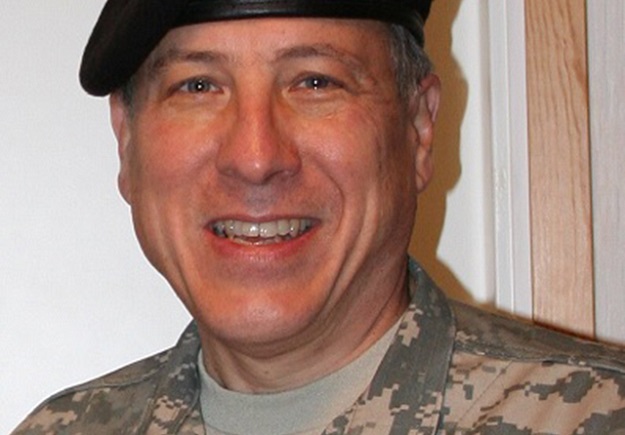
Lawrence Sellin, Ph.D. is a retired US Army Colonel, who previously worked at the US Army Medical Research Institute of Infectious Diseases and conducted basic and clinical research in the pharmaceutical industry. He is a veteran of Afghanistan, Iraq and West Africa and trained in Arabic & Kurdish. In this interview with News Intervention and Sangar Media Group Lawrence Sellin demystified the origins of Coronavirus and also explained the geostrategic undercurrents in South Asia.
Vivek Sinha / Dosten Baloch: You have been quite vocal in saying that novel Coronavirus is man-made and it has been made in the labs of China. What makes you so sure about the origins of Coronavirus?
Lawrence Sellin: The narrative that the COVID-19 pandemic was the result of a naturally-occurring disease outbreak was never a scientifically viable conclusion. The argument was that a precursor of SAR-CoV-2, the Coronavirus responsible for the COVID-19 pandemic, while circulating in a bat population, mutated, acquiring the ability to infect humans. It was then transmitted to people either visiting or working in the Wuhan Seafood Market, perhaps through an intermediate animal host, like pangolins, the scaly anteater. It was, however, already known by the end of January 2020, that the initial patients hospitalized between December 1st to December 10th, 2019 had not visitedthe market and bats were not sold there. It has also been found that pangolins were not the intermediate host animals. The theory that the Wuhan’s Huanan Seafood Wholesale Market was the first source for animal–human viral transmission is now totally discredited, even by the Chinese Centers for Disease Control and Prevention. Furthermore, the structure of SAR-CoV-2 is different in some very significant ways from any of the close Coronavirus relatives so far identified. Much of the scientific inquiry related to the origin of SAR-CoV-2 has centered on a particular component of Coronavirus structure called the spike glycoprotein, which carries the ability for the virus to bind itself to a human cell and gain entry. Although the scientific consensus says that SARS-CoV-2 came from bats, the binding component appears more closely related to pangolins, which likely explains the initial claim that pangolins acted as an intermediate host. There exists another structure in SARS-CoV-2 called a furin polybasic cleavage site that is not found in any of the closely related bat Coronaviruses. The probability of those two structural components evolving together in nature is very low. In contrast, experiments artificially inserting such components into Coronaviruses have long been done by Chinese scientists. Given the significant differences between the structure of SAR-CoV-2 and naturally-evolving bat Coronaviruses, the burden of proof is now on China to prove it was a natural outbreak.
Vivek Sinha / Dosten Baloch: Experts cite various research papers published in reputed journals such as ‘Nature’ to buttress their claim that Coronavirus was not synthesized by humans in any Chinese laboratory. Your comments.
Lawrence Sellin: If you exclude the massive amounts of Chinese propaganda, the argument that SAR-CoV-2 is naturally-occurring is based largely on a single, but widely-cited, Nature Medicine article entitled “The Proximal Origin of SAR-CoV-2,” supported by a few Western scientists with possible vested interests in the outcome and linked to a nearly endless regurgitation of the same argument by the mainstream media. Although it is simply stated as a conclusion, no one has provided any credible evidence that SARS-CoV-2 evolved naturally. It appears to be same formula that has been used for creating the politically-motivated “wide scientific consensus” of climate science or the now discredited COVID-19 epidemiological models, all efforts meant to stifle debate by labeling any contrary views as conspiracy theories.
Vivek Sinha / Dosten Baloch: Anyone who synthesizes a bio-weapon prepares the antidote first. So if COVID-19 is all man-made then why haven’t we seen its vaccine yet?
Lawrence Sellin: I have never said that SARS-CoV-2 is a bio-weapon. No doubt the Chinese military is interested in such work, but I think SARS-CoV-2 was more likely the product of risky experimentation that accidentally leaked out of the laboratory.
Vivek Sinha / Dosten Baloch: How will the crisis in Hong Kong, China’s tensions with Taiwan and its strained relations with the US affect geo-political scenario in South Asia?
Lawrence Sellin: There will be global diplomatic and economic retribution against China. China is intentionally raising the tension in areas where it already has significant leverage like in Hong Kong and Taiwan. They will be used as bargaining chips to reduce the effectiveness of any coming retribution. The US trade relationship with China will change significantly, which will create opportunities for new trading partners or an increase in trade with traditional partners, like India. China’s position is South Asia is primarily affected by progress of the China-Pakistan Economic Corridor (CPEC) and China’s relationship with India, both of which are in bad shape. It is likely that an unofficial anti-China block will emerge in the Asia-Pacific region focused more strongly on countering Chinese economic and military hegemony.
Vivek Sinha / Dosten Baloch: Why is China taking up aggressive postures around its neighborhood? Is China’s transgression into Ladakh a strategic move by Beijing to shift world’s attention from Wuhan’s virus labs?
Lawrence Sellin: Chinese aggression in Ladakh is one element in the strategy I described, to raise the stakes in nearby regions where it has greater influence and reduce the number of concessions it will be required to make, obliging the global community to settle for less retribution.
Vivek Sinha / Dosten Baloch: Baloch revolutionaries have ensured that China’s dream project CPEC remains practically defunct. What impact will this have on Balochistan’s freedom struggle?
Lawrence Sellin: The coming backlash against China for which there will be a trickle-down effect on Pakistan, creates a window of opportunity for the international community to increase its support for Balochistan independence, which would be a regional strategic game-changer. An independent, secular and democratic Balochistan would reduce Islamic extremism, constrain drug trafficking and provide a friendly neighbor for Afghanistan with access to the sea.
Vivek Sinha / Dosten Baloch: Do you think the coalition government in Afghanistan will be able to bring peace in the war-torn country? How much (and in what form) will the Pashtun unrest in Waziristan affect the internal politics of Afghanistan?
Lawrence Sellin: I do not think the Taliban will settle for anything less than total control of Afghanistan, making civil war likely even in the absence of the US and NATO forces. Pakistan will maintain its support of the Taliban in order to make Afghanistan a Pakistani-client state. Pakistan will also continue to promote extremism and use terrorism as an instrument of its foreign policy, which will only increase regional instability. So, Pakistan will continue on the road to destabilizing itself. Pashtun unrest will remain a factor in the internal politics of Afghanistan and may be a center for Taliban resistance and an anti-Pakistan insurgency, especially if those elements link up with the Balochistan independence fighters. Pakistan’s international position will be significantly weakened having tied its future so closely to China.
Vivek Sinha/ Dosten Baloch: What are the possible factors behind Pakistan’s recent military escalation across Balochistan?
Lawrence Sellin: The COVID-19 pandemic has diverted the world’s attention away from the human right abuses Pakistan is committing in Balochistan. Islamabad has used the distraction to increase its subjugation of the Baloch and crush their aspirations for independence. No doubt Pakistan is trying to consolidate its stranglehold on Balochistan in preparation for a possible collapse of the China-Pakistan Economic Corridor (CPEC) and to seal off Afghanistan as the withdrawal of US and NATO forces approaches.
The National Women’s Museum is launching a Women Writing History: A Coronavirus Journaling Project. Reported from Alexandria, Vermont, the Women Writing History: A Coronavirus Journaling Project is a project to ensure women’s voices are not left out of the Covid-19 melodrama seen all around the world.
It is a project featuring women from all
over the world. There are women and girls from all over who can participate in
this initiative. The main goal would be the recording of daily thoughts and
experiences of women during the coronavirus pandemic. Here we come to women’s
lives as assumed excluded from the historical record, it depends on the era,
but this has happened in the past if we take into account the farther back in
history moments in time.
Holly Hotchner, the President and CEO of
the National Women’s History Museum, stated, “Despite being more than 50% of
the population, women have largely been left out of the history books. When
they’re included at all, their stories are often episodic components woven into
a larger narrative centered on the experience and accomplishments of men… Sociologists
and economists warn us that the COVID-19 pandemic is and will
disproportionately affect women’s lives more so than men, and we want to ensure
that women’s stories are recorded and shared, so that future history books are
informed by women’s experiences during this global health crisis. This project
really speaks to who we are as an institution. There’s an urgency to record
women’s history as it unfolds.”
Women Writing History: A Coronavirus Journaling Project is a project not confined to particular demographics or people. It is intended for and will include women from all backgrounds, cultures, ages, and social and economic circumstances as a living history for including in keeping a journal. The increments for the journaling have been listed as 30, 60, 90, and 120-day increments, while “any longer or shorter increments” being fine as well. In this, we can see the importance of the journalistic efforts of women and the importance of maintaining historical records from a once in a century event.
“Journals can be written, orally recorded, video recorded, a series of photographs, or original artworks—the primary goal of this project is to capture the female voice and how the pandemic has impacted daily lives and perspectives.” The National Women’s Museum said, “Journal entries might provide a summary of one’s day, descriptions of the ‘new normal,’ coping techniques, explorations of challenges or even moments of joy, or inside views of how learning and working routines have altered.”
The particularly important and seminal aspects
of this history for the future generations will be the essential and healthcare
workers who have been encouraged to contribute their journal entries for future
generations. These journals are intended to be used as part of a living archive
of the Covid-19 lives of women for presentation “online and physical exhibits,
articles, publications, and scholarly research.”
The National Women’s History Museum was founded in 1996 as the only women’s history museum in the United States devoted to the diverse contributions of women to the history of America (Facebook, Twitter and Instagram).
Widespread deaths and killings in Balochistan have become normal. There’s hardly any discussion about the deaths in Balochistan. But on May 26, something, rather unusual, happened even in the context of Balochistan that sent shock waves throughout the population of Makran.
Disturbing news of a woman’s violent death and her 4-year old daughter’s injury emerged from Turbat, the largest city of Makran. It was apparently a case of armed robbery. During the incident, a woman Malik Naz was shot upon and her 4-year old daughter, Bramsh, was seriously injured when a bullet ripped through her collar bone. In the scuffle, one of the so called “robbers” was captured by the local residents.
In Balochistan, locals enjoy sleeping in front of their homes
under open sky, especially during the summers. Several Baloch people insist on
having a large open compound in front of their house which is then marked by
outer walls. Malik Naz’s house was also like this, and she was sleeping in the compounded
of her house under open sky, which is quite usual for a hot place like Turbat
on a seemingly normal night.
“It was at around 3 AM when some armed men jumped in, woke us
and ordered all the men to step aside away from the women,” said an eye witness
of the incident. “I disobediently ran quickly inside the house. The so called ‘robbery’
had all the hallmarks of the usual operations carried out by the (Pakistan) Army
to forcibly ‘disappear’ people. So, thinking that I would be kidnapped, I
jumped out of the window to the other side of the house and ran for life. In
the meant time I also shouted for help.”
Locals of Dannuk then quickly responded to the call of young
men and gathered near the house. Local Baloch people then surrounded the house
from three different directions and called for the armed men to surrender as
they had no chance of fleeing the scene.
“We were still confused whether these men were there for the
sole purpose of committing robbery or to forcefully ‘disappear’ a person,” said
a relative of deceased analysing the connections between the killers and
Pakistan Military intelligence. “Malik Naz was also one of the ones who did not
take commands from the armed men and resisted them which made them fire point-blank
at her,” said the uncle of deceased Malik Naz.
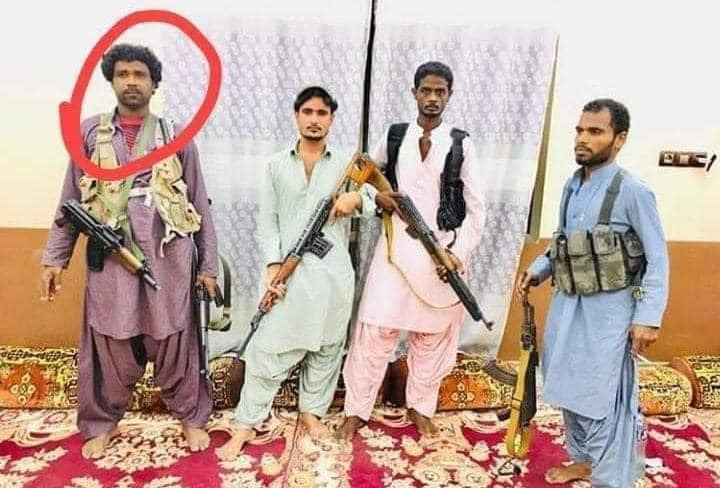
After gun shots were fired the Baloch locals surrounding the house jumped inside the compound and successfully captured one of the ‘robbers’ while others managed to flee from the scene. The captured man was identified as Altaf Mazar.
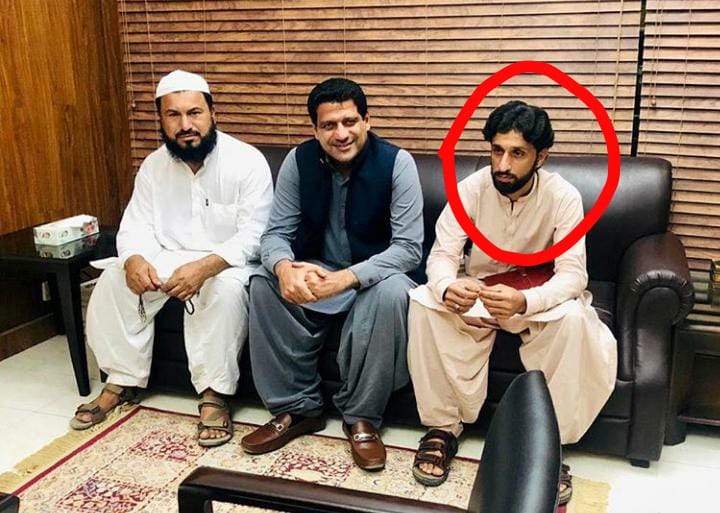
Death Squad member Altaf Mazar (extreme left) who killed Bramsh’s mother Malik Naz at Turbat, Balochistan
Later, after being arrested the confessions of Altaf Mazar to the locals revealed the link between Altaf and his group of ‘Death Squads’. Death Squads in Balochistan is the term used for groups which are supported by the Pakistan Army. The army and its intelligence agencies are now increasingly outsourcing their job of killing and abduction to these criminal groups. They are often paid well and are allowed to carry heavy weapons and terrorize local people. They are also used as tools during the election manipulation to force locals to vote for the Pakistan Army’s henchmen, who then end up in Balochistan’s Parliament.
According to Altaf Mazar, he was working under Sameer Sabzal, who is also a member of the Balochistan Awami Party and during the last elections did the army´s job of forcing locals to vote for Zahoor Buledi, the current Minister of Finance of Balochistan. He can be seen in various pictures and videos with this Minister Zahoor Buledi. The minister denies knowing him.
Head of Death SquadSameer Sabzal (extreme right) with Zahoor Buledi (centre), Balochistan’s Minister of Finance
Within a few days of this incident Sameer Sabzal posted an Instagram
story in which he shared a seeming threat from ISI. Translated into English, Sameer
Sabzal’s post reads: “All Pakistanis are requested to keep a close watch on
their sons and daughters and to check whether they are being lured into a conspiracy
against the state of Pakistan and it’s security forces or not. All people are
herewith warned that everyone who uses social media to share posts deemed
against the state of Pakistan and its security forces are under close watch and
will face extreme repercussions because for the safety and peace of the state
no one will be forgiven.”
On the other hand, Bramsh, the four year old child of deceased Malik Naz was rushed to a hospital in Karachi. Turbat city with a population of more than one million still lacks quality medical services.
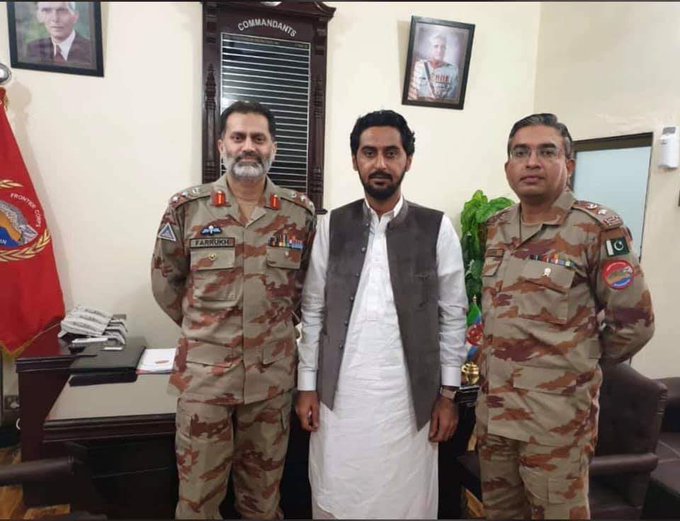
Sameer Sabzal (centre), Head of the Death Squad, with Pakistan Army officers
The police have registered a case against two perpetrators
namely, Altaf Mazar and Basit Faiz.
Balochistan has been plagued by this present wave of armed conflict
that has been going on for the last 20 years, but this continues to be ignored
outside Balochistan.
Human rights organizations report of more than 8000 extra
judicial killings, and another 45,000 plus Baloch people have been made victims
of “enforced disappearance”. Thousands are internally displaced and still several
brutal human rights violations continue to be committed by the Pakistan military
and its contractors. But nothing of these gets reported either in the international
media or the local media.
In fact, Balochistan is one of the world’s most violent
conflict zones that continues to remain in the grip of Pakistani troops,
allegedly in far greater numbers than ever.
The Balochistan conflict seems to be too complex and
labyrinthine to be fully comprehended by the world, which it seems to have grown
weary of conflicts and wars that do not affect it directly. But for those Baloch
locals who continue to live with this horror day in and day out, this conflict
takes a different shape.
World has no answer to 4-year old Bramsh’s question that why
she has a bullet in her chest and why her mother had to die at the hands of
Pakistani Death Squads.
What a time to be alive watching the United States of America have NASA and SpaceX (of Elon Musk) jointly launch the first astronauts to the International Space Station since 2011, where some of the largest protests in American history for women’s rights and protection of civilian people of colour’s lives in recent years happen and then followed by massive and nation-wide protests over the murder of George Floyd and others, and all the while over 40,000,000 Americans are unemployed, and more than 100,000 are dead from the coronavirus, an interesting dichotomy marking much of the thematic interplays of American history harkening back to the first Black president sketch of the late Richard Pryor, “I feel it’s time Black people went to space. White people have been going to space for years, and spacing out on us, as you might say.” [Emphasis added.]
Dr. Sikivu
Hutchinson is a brilliant writer and a decent human being, who
writes articulately with moral force while working in and supporting
underserved communities in which she lives in South Los Angeles. Hutchinson is
a black woman sexual violence survivor (as a girl at the time) and a parent of
a non-binary child, granddaughter of Earl Hutchinson Sr., and daughter of
Yvonne Divans Hutchinson and Earl Ofari
Hutchinson. She earned a Ph.D. in Performance Studies in 1999
from New York University.
As seems implicit in the works, any social, economic, and political progress for the godless will come in ethical form, as immoral acts in attempts to force or coerce an overarching ethical movement will provide ammunition for demagogues who wish to – so to speak – crush a neck with a knee or silence citizens who wish to protest by taking a knee. In short, she reads not only what comes in the academic volumes in intellectual interests for her, but she acts as a positive humanist agent in South Los Angeles, in particular, and America, in general, with a number of initiatives, including the First in the Family Humanist scholarship. Both personal attributes of intellectual rigour and community work come together in the written works for her. Humanists in the Hood becomes another manifestation of the universalist ink of Hutchinson.
In many ways, Hutchinson stands intellectually
alone, as happens with many Black humanists in the global diaspora of Humanism.
This is not to deny or neglect the reality of organizational and media buttresses,
at times, for, or by, Black humanists. Certainly, supports have begun to grow,
in part. However, in the cases of supports developed externally to the Black
humanist community, how much sentiment is not overweening, affected, and simply
nakedly fake? A woman in interviews having to define for the public even the
meaning of atheism or agnosticism, as when on the “On The 7 With Dr. Sean”
show. Chavonne Taylor and Hutchinson spent a not-insignificant amount of time
on the basic definitions of agnosticism and atheism followed by further
clarification. If you’re wondering, this was aired in 2020. However, there
exists a history of writings with, for example, A. Philip Randolph who sponsored
an essay contest entitled “Is Christianity a Menace to the Negro?” Naturally,
Hutchinson loved the title.
Our first interaction occurred on
December 20, 2016 with the publication of “Interview with Sikivu Hutchinson – Feminist, Humanist,
Novelist, Author“ in Conatus News. Someone with identities
disliked by racists as a Black or an African American citizen of the United
States of America, by misogynists for feminist writings, women’s leadership
organizational work, and lived egalitarian values, and by religious
fundamentalists for rejections of supernatural claims of sacred texts and
disbelief in the authority of purported holy figures, i.e., as a humanist or,
naturally, a ‘heretic.’ Hence, the reason for the full title of Humanists in
the Hood: Unapologetically Black, Feminist, and Heretical (2020). To add
icing to the cake, Hutchinson advocates for socialist economic policy, which,
in the United States, is heard as or translated by the culture into
“antidemocratic” or “communistic,” as she notes.
The “Humanists” in the main title
comes from fundamental humanist values lived out in ‘hoods’ in South L.A. while
engraved with the flavors, the sounds, the emotions, and the patois, and the
pains and the tragedies and the triumphs as humanists in hoods. Also, “Hood”
comes from lived experience for Hutchinson. She grew up at the tail-end of
COINTELPRO (COunter INTELligence PROgram) in which a program of the Federal
Bureau of Investigation was destroying or decimating African American
communities and political organizations. Hutchinson understands the contexts of
state violence and its organized manifestations. One of her earliest moments of
political protest was in hearing about the murder of Eulia Love/Eulia Mae
Love/Eula Love by two LAPD officers in her own residence in 1979.
It was a first moment, even as a
child for Hutchinson, of the issues around “use of force” by police. Or the Darrel
Gates argument of African Americans responding differently to chokeholds.
Similar forms of violence and subsequent political and social protests seen
with the case of George Floyd and others to this day, where protests have been
breaking out in Boston, New York City, Atlanta, Los Angeles, Chicago, D.C.,
Minneapolis/St. Paul, Louisville, Dallas, Sacramento, Bakersfield, and San
Jose, and probably elsewhere. Both come to a context in which home is neither
“safe space” nor “private sanctuary.” A deep history where African American
bodies are not theirs except in service to White slaveholders with Black women
in America as sub-human and not really women. These cultural bigotries rooted
in a proper definition of White supremacy, as domination of Black bodies and
lives.
Certainly, progress has been made, but legacies live into the present with African American, Native American, Latin American, Asian American, and working class European American women getting the shit end of the shorter stick more often. Even with prominent African American figures such as Steve Harvey, Hutchinson was correct in identifying the core issue in the blanket statements by Harvey making the argument of the amorality of African Americans who become atheists and the treasonous relation to the ‘race’ when non-religious. In other words, if you leave religion while Black, you have become a traitor to the ethnicity and lack morals, especially condemnable and criminal to community for Black women who leave communal faith.
The text covers some of these
contexts, but the book represents a larger intellectual environment for
Hutchinson. Don’t take this second-hand from a young Canadian humanist, the
reviews on the book represent similar sentiments and thoughts, and praise, of
the book. Bridgette Crutchfield of Black Nonbelievers of Detroit said, “Humanists
in the Hood is an acute reminder of the struggle we as Black women
have and still experience. It has documented in one place, our travels and
travails.” Crutchfield makes the concise and insightful point of the amnesiac
nature of American memory of the crimes of old wreaking havoc on the lives of
the present generations and planting seeds of potential disproportionate
despair for the generations who come after us. Humanists can act in such a manner
so as to provide a space to air grievances for compassionate understanding,
strategize on solutions, organize relevant resources, and mobilize for the
better chances of the next generations.
“Humanists in the Hood is
a must read for everyone, but especially anyone who considers themselves
progressive and supportive of marginalized people,” Mandisa
Thomas, Founder and President, Black Nonbelievers, Inc., stated, “With her
in-depth analysis, Sikivu has issued yet another challenge — to take a long,
hard look historically, institutionally, and, most important, internally, into
the often complex world of feminism and how humanist/secular values have and
must continue to inform our fight for equality.” Thomas is right. The book
represents a fundamental challenge to the humanist community in America, at
least, on its various constituencies and the differentiated needs of them,
which seems like a good thing because a humanist message is a universalistic
message. One in which fundamental principles yield an infinite while bounded
variety of potential tools for covering the needs of humanist communities in
South L.A., in America, and throughout the humanist diaspora.
“The time is now for Humanists
in the Hood. With compassionate, razor-sharp clarity, Sikivu Hutchinson
provides a courageously bold Black, feminist, and atheist road map to
liberating ourselves, our communities, and U.S. society.” Producer/Director of NO!
The Rape Documentary, Aishash Shahidah Simmons, said, “She invites and
challenges readers to step outside of comfort zones to consider different
possibilities in response to the oppressive systems that silence and annihilate
all of us on the margins. Hutchinson’s words are a clarion call for radical,
tangible actions for these perilous times.”
The purpose of the book is to
provide a challenge to the mainstream humanist community and to provide a “road
map” for the construction of institutions devoted to the specified concerns
mentioned earlier within the philosophical framework of Humanism. A “razor-sharp
clarity” did not happen in a vacuum. Pressure makes diamonds. Why isn’t
Hutchinson more prominent and well-known than now? Although, she has been
gaining a loyal following and readership. As we know, diamonds take time to
find, and tend to remain buried for a long time. Humanists in the Hood divides
into five main sections in alignment with Simmons’ aforementioned “atheist road
map” with “Introduction: The Stone Cold Here and Now,” “Unapologetically Black,
Feminist, and Humanist,” “Culturally Relevant Humanism and Economic Justice,”
“The Black Humanist Heathen Gaze,” and “Gen Secular and People and Colour.”
In the introduction or
“Introduction: The Stone Cold Here and Now,” she opens with a quote from Alice
Walker, who said, “In my own work, I write not only what I want to read –
understanding fully and indelibly that if I don’t do it, no one else is so
vitally interested, or capable of doing it to my satisfaction – I will write
all the things I should have been able to read.” Walker’s statement acts as a
coda or thematic ground zero for the entirety of the text because, as per the
Eulia Love example, Hutchinson lacked the language, the concepts, and the
crystallized imagery, not the experience, to describe the happenings of the
world as a child or adolescent. Even though, she sensed something was wrong in
early years.
Not only for more unheard voices with Black women victims of violence, Hutchinson covers the LGBTQI community in the context of the United States. As the United Nations founded its LGBTI Core Group, an extension of the similar stream of rights activism and thought comes in the initialism ”LGBTQI” to make “Queer” as an identity more explicit. Hutchinson takes a difficult stance in America and in community. A life and worldview brewed in early “dreary religion classes run by sanctimonious white male teachers” full of “moral hypocrisies” and a sacred text full of “violent woman-hating language.”
The books Hutchinson deserved to
read did not exist, by and large, and the only text considered central to
community came in the form of ancient mythological collections of sacred texts
entitled The Bible. One gathers the sense of a lifelong individual struggle
against structures and persons in American society searching for one’s story to
be told articulately, honestly, and forthrightly without filter. Out of this, a
feeling of the tragic dignity of the work of Hutchinson can set over the
reader.
Somebody articulating a clearly
wider or more inclusive humanist vision dealing with the problems of the
everyday against seemingly overwhelmingly odds with the vitriol from the Black
church and the dismissal by the largely White movement atheism of American
culture. Professor Anthony Pinn made an important point with the descriptive
phrase “people of colour” assuming the otherness of black people, etc.,
compared to White people with the more appropriate change into “people of a
despised colour,” as both inclusive of every person as coloured in some
manner and the relative struggles in the burden of greater negative
stereotypes.
While, at the same time, the
Black church can be a place of refuge and civil rights organizing in one
generation. It can become a place of limitations, ostracization, and control
and domination and illegitimate hierarchy. However, illegitimate hierarchies
prop men to the heights of dizzying unquestioned authority in African American
church communities with the expected negative effects on communities,
especially with the burdens placed on women of colour in those church
communities.
“For years, the rap on feminism
among most Black folks was that it was a White woman’s thing. White feminists,
from first-wave nineteenth-century White suffragists, to second-wave stalwarts
in the postwar ‘feminine mystique’ era, routinely ignored, erased, and
misrepresented Black women’s experiences and social history,” Hutchinson wrote,
“While white women at the height of the so-called Baby Boom decried their
‘enslavement’ to patriarchy, domesticity, and motherhood in Ozzie and Harriet-style
homes, Black women were mopping their floors, washing their laundry, and wiping
the butts of their children.”
This is the language of history and the life of the everyday. This is the rooted Black Humanism articulated throughout the text by Hutchinson. Right into the present, the political consciousness of the nation becomes infused with the narrative of god-talk and religion with Senator Kamala Harris during the 2020 presidential race stipulating a “faith in god,” so as to secure proper status as a Black and god-fearing American politician. Without such an endorsement, Harris’ career would have been exploded by a cross-shaped torpedo in the United States political scene. Hutchinson notes Elizabeth Cady Stanton and Susan B. Anthony were mentored by Ernestine Rose. Rose is one who said religions have been built on the backs of women. Hutchinson covers the splits or historical divides between White feminists and Black feminists in America. For example, the Fifteenth Amendment permitting Black men the equality in voting rights or the right to vote. Some White feminists saw this as a hindrance to women’s rights. As has been said before, rights aren’t a pie.
She contrasts the educated middle-class White feminism with the backbreaking working-class feminism of the lives of Black women. Hutchinson delves into or references the Combahee River Collective, Kimberlé Williams Crenshaw, Michele Wallace, Brittney Cooper, Anna Julia Cooper, Fannie Barrier Williams, Ida B. Wells, Mary Church Terrell, Angela Davis, bell hooks (Gloria Jean Watkins), Patricia Hill Collins, Barbara Christian, and, of course, Alice Walker. She remarked on an interview conducted with Thandisizwe Chimurenga, where Chimurenga noted that class differences are a source of a lot of separation between feminisms. This continues right into the current political context of the Trump Administration and the Republicans.
The median wealth rates of White families, Latino families, and Black families in the United States are $147,000, $6,600, and $3,600, respectively. The unemployment rate of Black college graduates under the age of 25 is 15.4% and for White college graduates is 7.9%. There can be a visceral fear around the academic term “White supremacy,” as this seems to imply Euro-Americans with tiki torches and white hoods walking menacingly in lockstep in the dark of night. In the history of America, this has been a physically violent and ideological extreme manifestation of it. Then there are generally applicable principles behind the use of the term in wealth and employment rates, as above. At an intersection with this comes the era of Covid-19 emergent from SARS-CoV-2, these manifestations become worse. In these conditions, one can see the socialist economic orientation of Hutchinson.
Hutchinson describes the
Trumpian-Republican backlash against the rights of women while noting African
Americans as the most religious population in the United States. Noting how,
even though, Ariana Grande and Beyoncé may identify as feminists, most young
women struggle with such a label. She provides an alternative to the
common notions of feminism. “I argue that Black feminist humanism is a vibrant
alternative to the woo-woo spiritualism, Jesus fetishism, and goddess worship
that characterizes progressive feminist belief systems that revolve around
theism,” Hutchinson writes, “…the stakes for a secularist, feminist, queer,
pro-social Justice, and anti-capitalist ethos of American values are perhaps
greater than ever before.”
In Chapter 1 or “Unapologetically
Black, Feminist, and Humanist,” Hutchinson opens, “In 2010, a seven-year-old
African American girl named Aiyana Jones was murdered in her sleep by the
Detroit police during a military-style raid on her home. In the wake of the
shooting, neighbours and loved ones placed stuffed animals in front of the
house in memoriam. Rows of stuffed animals stated out from Associated Press
photographs of the executions scene in dark-eyed innocence, grieving the
barbaric theft of her life and light.”
She reflects on the recency of
the murder of Aiyana after her (Hutchinson’s) attendance at the African
Americans for Humanism conference. A point of reflection on the separation between
mostly European descent or White-dominated movement atheism without much of a
voice or place for African descent or Black atheists. Hutchinson brings forth
the towering work of Professor Anthony Pinn, the good Methodist who became a
better atheist, to argue the indices behind science and reason as taught in the
classroom can be (and are) shaped by cultural conditions and subjective
categories with the European American or White American students having
histories and cultural traditions affirmed throughout the classroom. She uses
W.E.B. DuBois’ phrase “wages of whiteness” in this context.
Hutchinson references the
execution of Michael Brown, the Youth Justice Coalition, Dignity and Power Now
(of Patrisse Cullors Khan), and Black Lives Matter, and Tarana Burke’s #MeToo
movement as part of various points of contact for social commentary on systemic
inequities manifested in livelihood outcomes in American society. Views rooted
in a history of slave-era racism and sexism where Black women are
“‘unrapeable,’ hypersexual Jezebels” based on the “ideal of pure, virginal,
chaste ‘Christian’ white womanhood.” She highlights the lack of people of
colour in the leadership positions of leading secular organizations including
the American Humanist Association, Center for Inquiry, Foundation Beyond
Belief, and the Secular Student Alliance. She highlights the work of Candace Gorham
and Karen Garst bringing forth a more pluralized image of people of colour in
the secular movements.
There is reflection on the
content of the Huffington Post piece entitled “Ten Fierce Atheists:
Unapologetically Black Women Beyond Belief” and the legislation of Michigan
Congresswoman Ayanna Presley to “end the punitive pushout of girls of color
from schools and disrupt the school-to-confinement pathway.” Hutchinson
describes how this builds on the work of Monique Morris, author of Pushout.
She touches on the sexual violence as portrayed in Surviving R. Kelly,
and the helpful text of Iris Jacobs in My Sisters’ Voices in the mentoring
of young Black girls. Here, she pivots into her Women’s Leadership Project, and
the Black Feminist and Feminist of Color conferences.
Hutchinson remarks on Audre Lorde’s observation of Black women’s self-care as something political because Black women rarely have such an opportunity based on the stressors and communal demands upon them. Michele Wallace and the ‘blasting’ of the 1965 ”Moynihan Report” are part and parcel of critiques set forth here. As Hutchinson continually frames, Black women in America find deaf ears in the White-dominated secular communities and absolute rejection & condemnation, if non-religious, in the Black church community. Thus, Euro-centric individualist Humanism is important, but not does land well with the collective boot on Black women as a category. Principles of solidarity become more dominant rather than the abstracted sovereign individual, how ever important in environments in which other fundamental needs and challenges have been mostly overcome.
It hits the Supreme Court too. Hutchinson describes how the consequential case of Anita Hill gave significance to awareness of sexual violence against Black women in particular and women in general; whereas, at the same time, the exposure of abusers like Roger Ailes and Harvey Weinstein brought forth White women’s voices who deserved to be heard, but were heard without a historical context of earlier prominent cases like Anita Hill. Even in the secular communities, “…American Atheists(AA), the largest nonbeliever advocacy organization in the nation. After former president David Silverman was terminated in April 2018 following sexual assault allegations, the organization had a signal opportunity to make a bold chance in leadership by hiring Mandisa Thomas,” Hutchinson states, “Thomas, who has a solid record of secular organizing, outreach, and management across intersectional communities, would have been the AA’s first woman of color executive and the only Black woman to head a mainstream secular organization. Instead, AA opted for a white male insider…”
Hutchinson highlights some of the
work by Amy Davis Roth of SkepChick in 2014 to highlight atheist women who have
been stalked and harassed, which effectuated some change. However, the “thrall”
with global figures – Richard Dawkins, Lawrence Krauss, Sam Harris, and Michael
Shermer – of the mainstream secular communities will need reduction for more
space and voice for secular Black women and women of colour.
In Chapter 2 or “Culturally
Relevant Humanism and Economic Justice,” Hutchinson states, “In my community,
churches of every size, architectural style, and denomination sit totemically
between daycare centers, liquor stores, dry cleaners, dollar stores, and beauty
shops.” ‘Totem,’ what is a totem? Sacred, symbolic objects representative of
clan, family, or ancestry. This is important. Not only spatial-geographic waste
and economic drags on communities needing it, many African Americans in
particular and Black Americans in general feel a connection to Christianity as
a whole and its manifestation in the Black Church.
She comments on the work of Paula
Giddings and the exploitation of Black women slaves as “breeders,” etc., as Black
women in the slave era of America were chattel for the use and abuse by slave
owners. She touches on the controversy surrounding Linda Sarsour and her
(Sarsour’s) support for Minister Louis Farrakhan, known for anti-Semitic and
misogynist views.
Hutchinson roots such injustice in
the economic context for Black Americans, as noted earlier about these median
wealth disparities and unemployment inequities. The tax-free status of
places of worship is a unified concern for Black and White secularists in
America. One of the more unique concerns of Black atheists is the reflection of
the Jim Crow era and the Great Migration in their connection with the Black
church. More generally, she remarks on the inordinate wealth handed to the
individual pastors in Africa, Nigeria particularly, and in America with the two
most prominent cases in David Oyedepo, in Nigeria, and T.D. Jakes, in America.
How these ultra-wealthy Black
male pastors suck the economic lifeblood out of community is a travesty, the
ways in which Black women’s labour makes these religious communities possible
in the first place too. This is where ideas of social and economic
redistribution become inherent in the form of humanist discourse espoused by
Hutchinson. She reflects on “How the Humanist Movement Fosters Economic
Injustice” by David Hoelscher with reference to Helen Keller and Albert
Einstein and some of the fundamental socialistic structures endorsed by them.
Even, as Hutchinson states, the first major humanist document published in
1933 was devoted explicitly to racial equality and economic justice.
Indeed, the fourteenth
affirmation in the 1933 Humanist Manifesto I stated, “The humanists are firmly convinced that
existing acquisitive and profit-motivated society has shown itself to be
inadequate and that a radical change in methods, controls, and
motives must be instituted. A socialized and cooperative economic
order must be established to the end that the equitable distribution of the
means of life be possible. The goal of humanism is a free and
universal society in which people voluntarily and intelligently cooperate for
the common good. Humanists demand a shared life in a shared world.” [Emphasis
added.]
Leading
humanists Paul Kurtz and Edwin Wilson in the Humanist Manifesto II emphasized
addressing economic injustices as core to Humanism and, thus, to humanist
discourse. Modern Humanism, Hutchinson correctly observes, fails to deal with
these realities affecting more of its non-mainstream communities, where there
could be concretized humanist activism at the most fundamental level drawing
back to the roots of the philosophical worldview and life stance with
addressing economic injustice and social inequities.
As another great boss at The Good Men Project, Councilwoman Emily LaDouceur, has
stated, “Never underestimate the power of community leaders speaking out
against discrimination, injustice, and harassment… We need city council
members who will unapologetically stand up against any policy, procedure, or
practice, that may perpetuate bias or discrimination.”
The core of the movements has
merely shifted the ratios of its currency into the big basket of combatting
“religious attacks on secular freedom.” That’s it. The diversified vision of
1933 has been truncated. One where individuals “who question humanist, atheist,
or skeptical orthodoxies are trashed, branded snowflakes, social justice
warriors, feminazis, or religious apologists.”
She remarked on the clash between
Bakari Chavanu, of Black Humanists and Nonbelievers of Sacramento, and a
libertarian, exemplifying a differential vision of “Humanism” as a concept
based on the August 2018 piece entitled “Why Five Fierce Humanists.”
Concomitant with this, Hutchinson reflects on the “majority of forerunning
early-twentieth-century Black freethinkers (with the notable exception of
figures like Zora Neale Hurston and Black conservative intellectual George
Schuyler) were socialist and communist aligned, and actively condemned the way
capitalism and White supremacy harm Black communities.”
She notes the holes in the presentation of Roy Speckhardt, the executive director of the American Humanist Association, about Thomas Jefferson in the book Creating Change Through Humanism. He was a secularist and freethinker. Also, he believed in the inherent inferiority of Blacks and committed an ethical atrocity in the form of a slaveholding empire. Similarly, one can think of the skeptic views of H.L. Mencken while reflecting on the racist views about Blacks and imaginary crimes seen in ‘miscegenation.’ Hutchinson quotes Paul Finkelman in “The Monster of Monticello” to describe the atrocious behaviour of Jefferson. Historian Christopher Deaton reflects much the same withering critique.
Many of these economic realities
come in the form of billionaire listings with a White face, Black male
ultra-rich pastors bilking Black communities and taking up needed community
space, and the policy and legal decisions giving economic privileges to
corporations and religious institutions, e.g., the Johnson Amendment and Citizens
United, which may be bolstered by appointments of people like Neil Gorsuch and
Brett Kavanaugh, or Samuel Alito and Clarence Thomas. American slavery sapped
the economic productivity of Black slaves in America for White Americans’
benefit; thus, in the reference to Thomas Paine and Ernestine Rose by
Hutchinson, the “Original Sin” of America was an economic one.
“And even though White abolitionists
and deist freethinkers like Thomas Paine and feminist suffragist Ernestine Rose
decried the “original sin” of American slavery,” Hutchinson wrote, “the
eighteenth-century narrative of colonial bondage to the British continues to
reverberate in the toxic myth of American exceptionalism. In many regards, the
myth that the United States is fundamentally better and more just or
exceptional than any other country in the world is the lie that allows
structural inequity to persist.”
Hutchinson speaks more to the
2014 article by James Croft “Beyond Secularism” and Croft’s important focus on
a wider vision of the possibilities of Humanism. Something important Hutchinson
pivots into this point is Pinn’s emphasis on the everyday little facets and
facts of reality, the rooted Humanism of Hutchinson, for the proper knitting
together of the grand figures and narratives of mainstream Humanism with the
highly neglected communities of colour who deserve a voice at the table and a
choice in programs from the wider humanist community. This can be done. Why
not?
Hutchinson describes the way in which the material view of the universe does not limit her perspective on the operations of consciousness. She does not believe in the spirit or soul. Hutchinson affirms the conscious and unconscious connected to thoughts and feelings from a material brain. She looks at the indefinite nature of the findings of the scientific method’s actual discovery of the natural world. The fundamental issue is one affirming the freedom of individual choice.
She also spoke about how Stacey
Abrams in the 2018 Georgia gubernatorial statement said “faith, service,
education, responsibility” set forth the values for Abrams. This was similar to
the Kamala Harris statement before. In that, if you state a non-religious and non-faith-based
view of the world, and if you state that you do not adhere to a deity, then you
have committed political suicide. In a manner of speaking, African Americans as
highly religious constituents only feel comfortable and encouraged by religious
male hierarchs to vote for politicians who are firm in faith in order to be seen
as properly Black, or to have any semblance of a moral compass or an ethical
system guiding one’s life, which harkens back to the Steve Harvey commentary
earlier.
“Before Humanism can be
concretely relevant to the everyday lives of Black women and women of color
steeped in faith and religious practice there must be space for them to exist
in discomfort of the unknown.” In many ways, Hutchinson’s every day realities
rooted Humanism aligns deeply with the depictions described by Hutchinson in
Toni Morrison’s Beloved.
Hutchinson talked about the rape
of Desiree Washington by Mike Tyson. Washington was Miss Black America in 1991.
Farrakhan condemned Washington, essentially, as a Jezebel. An experience common
in many communities with rape survivors tossed to the lions by community
leaders, including religious leaders, as was the case with Farrakhan.
Occasionally, there’s justice, as with sexual assaulters Daniel Holtzclaw, Bill
Cosby, and R. Kelly. All this is simply marginal justice for raped Black
American women, not even taking into account LGBTQI members of communities.
Voices rarely heard. Victims barely sought.
Even institutionally, Hutchinson puts the Southern Baptist Convention on blast over its illustrative compiled crimes. Yet, with the spotty coverage of rapes and sexual violence, the violence of bullying and harassment can acquire coverage, especially around teen suicides, if a White face. This can be impacted by portrayals and commentary intended as jokes by some of the most prominent comedians of the day, e.g., Kevin Hart. Hutchinson reflects in some cultural positives in the cases of Barry Jenkins’ Moonlight, or in the deconstructionist Other People’s Children by Lisa Delpit, or the essay “What’s Home Got to do With It? Unsheltered Queer Youth” by Reed Christian and Anjali Mukarji-Connoly.
Hutchinson reported on Center for
American Progress’ work by Aisha Moodle-Mills and Jerome Hunt about the great
risks to life and livelihood of LGBTQI youth, whether teen pregnancy, school
dropout, homelessness, drug abuse, stress, and more. A rooted Humanism, or a
more radical Humanism compared to the present (not as much to the 1933 vision),
has a moral stake in this wider fight for equality and justice.
In Chapter 3 or “The Black
Humanist Heathen Gaze,” Hutchinson describes not seeing herself in the media of
Judy Blume and others presented to her. As per the Cooperative Children’s Book
Center, 3,700 books published in 2017 featured mostly White protagonists. Even Charlie and the Chocolate Factory’s
Charlie Bucket was intended as a Black protagonist, but became White in the
final production. It’s the same for non-religious film and television. There
has been a decline in Christian movie audiences. However, it’s still garnering
a significant pull and has an audience.
She notes the only real secular
studies professor in academia as Professor Phil Zuckerman with only two major
exceptions who focus on Black secular Humanism in particular, who build an
academic series of works devoted to critical consciousness: Dr. Christopher
Cameron at the University of North Carolina and Dr. Anthony Pinn at Rice
University. Hutchinson is the only one to have developed a course about
humanist women of colour in the world through the Humanist Institute entitled
“Women of Color Beyond Faith.” Her interest in Black humanist cultural
production is seminal as well. Maureen Mahoney and Jeffrey Othello are “among
the few in the White-dominated field of rock and roll musicology and music
history.” Critical works by White writers have been Jack Hamilton and Gayle
Wald. While, at the same time, August Wilson notes the operations of Black
Americans exists within a preconfigured cultural structure by White Americans.
It all feeds into cultural tropes of “Tyler Perry-esque
evangelicalism” condemned by a smug atheist, etc.
When Hutchinson reviewed lists of
secular films challenging religion, it was mostly White secular driven film and
television making direct attacks. Black Americans in religious enclaves have to
trade in a different and hidden-from-popular-culture currency. There is some
questioning of faith in Black media productions, as in August Wilson, James
Baldwin, and Lorraine Hansberry with further “radical aesthetic and
ideological possibility” seen in the works of Richard Wright and Nella
Larsen. Hutchinson’s own White Nights, Black Paradise “features perhaps
the first narrative film portrayal of a Black atheist lesbian protagonist.”
There is a yearning for a magical return to some long-gone past state apart
from the hellish nature of many Black American lives now relative to many White
and other Americans, which may come in the form of “a sentiment reflected in
both the Great Migration and the Back to Africa movements.” A commentary of the
state of idolatry found in Black Americans becoming involved in Jonestown in
hypocritical worship of the Marxist atheist, Jim Jones, as a Christian god.
As per usual in many contexts,
and in the environs of Jonestown, Black women were the pseudo-chattel of
subservience and obeisance to Jones as “ever-faithful, self-sacrificing”
servants, as if without autonomy of conscience and self-determination of body,
i.e., as subhuman. Black women suffering from Stockholm Syndrome in identification
with Jones. To quote late humanist Kurt Vonnegut, “So it goes.”
In Chapter 4 or “Gen Secular and
People and Colour,” Hutchinson remarks on the treatment of children with
atheist and humanist parents. They (Hutchinson’s nonbinary 11-year-old
daughter), earlier in life, had to hear in second grade, “You’re going to hell
and to the devil, because you don’t go to church.” This is the context for a
not-insignificant number of nonbelievers in the United States. We can see this
in White professional class women of tenure in self-identified Liberal Theology
and progressive churches in Canada under the banner of the United Church of
Canada with Rev.GrettaVosper who was raked through the coals in
national media for several years.
In South L.A. where Sikivu and
they live, in 1965, there was the Watts Rebellion resulting in White “flight”
from the neighbourhoods. Now, with changes in economic disparities in the
ultra-wealthy and the stagnation and decline for much of the rest of the United
States, Hutchinson notes the ironic return of White Americans and the
subsequent gentrification following from this. “God’s plan” is an empty cliché
taken as an aphorism of wisdom and assumed as a framework for comprehension of
the world and relative misery around African American religious communities. She
speaks to the historian Ibram Kendi’s call to recognize 1 in 4 Black American
households have zero wealth compared to 1 in 10 White Americans, which builds
on the work of Ta Nehisi-Coates.
These thoughts and movements
aren’t new. Hutchinson brings back the historical memory of the pioneering and
first Black freethinker who defied both White slavers and the “Black faith
police,” where she quotes, particularly in response to censure by Black
Methodist ministers, Frederick Douglass, “I bow to no priests, either of faith
or unfaith, I claim as against all sorts of people, simply perfect freedom of
thought.” Maria Stewart and Sojourner Truth would have experienced far more
backlash if they spoke so directly and forthrightly against established dogma’s
guardians. They may make it pinch and sting with a Black man; however, they
will make it cut in the case of a Black woman.
Clashes exist in the current
incarnations of the American freethought movements, as we see in the history
with Ernestine Rose, Elizabeth Cady Stanton, and Susan B. Anthony. Nonetheless,
we live in a globalizing world and the ex-Muslim movement is a unique one. It
is working to detach religious identity from ethnic heritage. As well, it is
bringing forth the concerns of the men and the women who have left Islam and
endured severe censure, ostracism, abuse, and even death threats. Sadia Hameed,
a spokesperson for the Council of Ex-Muslims of Britain, and Zara Kay, the
founder of Faithless Hijabi, writer Hibah Ch, and Taslima Nasreen, Bangladeshi
activist, author, and physician, are all referenced as important examples in
this work.
Heina Dadabhoy is given space to
make the point about coming out as an atheist for her. In that, when she
renounced Islam, her parents described the action as Dadabhoy wanting to be
like White people. Freethought in some contexts is seen as a White cultural
phenomenon, i.e., the god concept becomes self-imposed mental prison as a form
of community identity and inverse ethnic identification (as in not being
White, thus making the false linkage, in another manner, between ethnicity and
religion). There is a change in the landscape, though.
Millennials, and younger generations, continue to lose religion as a core identity, even in connection with perceptions of some amorphous, invisible unity between belief in the god concept and actuality of morality. Moral movements, including Black Lives Matter of Patrisse Cullors Khan, Opal Tometi, and Alicia Garza, are manifestations of this in some ways. Three Black queer women who founded a movement different than the historical civil rights movement of Martin Luther King, Jr. and others steeped in “heterosexist, homophobic, patriarchal Black-church traditions [that] stifled any semblance of affirmation of queer voices (much less nonbelieving ones).” A. Philip Randolph, Hutchinson notes, was “frequently gay-baited and forced to suppress his identity in the movement.”
A Humanism embracing more gender fluid notions while rejecting gods and the supernatural can match more of the universalistic sensibilities espoused since the 1933 Humanist Manifesto I and remove false dichotomies between feeling and thinking with the feelings as feminine, etc., as Hutchinson notes in quoting Soraya Chemaly from Rage Becomes Her. One theoretical work or hypothesis Hutchinson describes is Post-Traumatic Slave Syndrome (PTSS) from Post Traumatic Slave Syndrome: America’s Legacy of Enduring Injury and Healing (PTSS) (2005) by Joy DeGruy, which is a hypothesis about intergenerational stressors passed from one cohort to the next as a result of slavery and its aftereffects. This then leads into the concluding statements of the text.
Hutchinson remarks on the Black Skeptics Los Angeles First in the Family Humanist youth recipients as profiled in the Humanist magazine and the Huffington Post. One touching story is Mike Grimes who established firm humanist roots after the death of a father to a car crash. Grimes did not rely on the gods or the supernatural. In trying to get a settlement from the trucking company with “so-called Christian family values on its website,” the experience was hellish. This is America, for humanists – so stand tall. Hutchinson concludes with a quote from Audre Lorde on self-determination of Black women and women of colour in the humanist movements. Hutchinson adds, “Lorde’s words are a testament to the enduring power of self-representation as art, agency, and self-determination. They resonate deeply as we move further into a century where secular Black feminist and feminist of color resistance will be definitive in shaping humanist politics and consciousness.” She’s right.
If humanist institutions do not
cover the wider range of the concerns of its broad base of communities or
constituencies, then the humanist movement will, in part, become obsolete to
the needs of its communities and constituencies, i.e., human beings enacting
humanist values and searching for humanist organizations and media speaking to
their human concerns. As Hutchinson observes, “If humanism is reframed as
working through struggle; being silent in one’s body; being alone in one’s
body; being partnered; being skeptical; being engaged in art, literature,
music, and the full scope of Black creativity in the sublime and the every day
– then it would have more relevance to traditions of Black women’s resistance.”
In this sense, to become “obsolete” means to lose sight of the human needs of Black humanists’ Humanism, in a manner of speaking, it becomes revolutionary to the historical trends in American society with the view of people of colour, African Americans, or Black citizens of the United States as sub-human (and Black women as not really women), because the personhood, dignity, and autonomy of each individual human being gets affirmed in Humanism. That’s the fundamental revolutionary act at this time, causa mentale: a revolution in how we see ourselves and how we see one another, as members of the same species with the same inherent dignity and value. That’s the “acute reminder” or, rather, “challenge” with “razor-sharp clarity” one finds in Humanists in the Hood: Unapologetically Black, Feminist, and Heretical. To this “must read” book, I will conclude on a favourite Black feminist poet of Hutchinson, Lucille Clifton, who is an icon to Hutchinson. Clifton wrote “won’t you celebrate with me” from Book of Light (1993):
Migrants are the
latest poster boys of India. The selective images of small groups of young and
vulnerable — women, children, toddlers, old and infirm trudging to their homes,
the mangled bodies of a few reckless migrants on railway tracks and their ruckus
at bus depots and railway stations have become the staple food for print and
electronic media. Arm chair commentators and political opponents are upset over
these migrants’ plight and disgusted with the Prime Minister Narendra Modi whom
they accuse of causing a tragedy that is far more catastrophic in terms of
human sufferings than India’s partition in 1947. Will someone find out how many
of them have maintained a migrant family of four and more during March-May? Perhaps, none.
In a national
broadcast on March 24, PM Modi had asked his countrymen to stay wherever they
were located during the lockdown period of 21 days and appealed to Indians who
could afford, to adopt at least one poor and needy family. But look at how we
responded. MSME, construction and home-based workers were summarily retrenched,
paid nothing for their forced lay-offs, their arears were forfeited and they
were thrown out of their modest dwellings for non-payment of rent.
The worst culprits
were middle class lawyers, professionals, journalists, government officials and
businessmen in big cities such as Delhi, Mumbai, Calcutta, Chennai, Bangalore
and Ahmedabad, Surat and Jaipur. Migrants still stayed on, hoping that state
governments would provide food and water but that did not happen. Instead, chief
ministers of Delhi, Rajasthan, Maharashtra and Gujarat either connived or egged
them to leave. When they began feeding only their domiciled workers and taking
care of their medical needs, migrants decided to escape from mercenaries who
only knew how to exploit them.
The sense of
betrayal by employers was so acute that individual migrants began walking back to
their homes in UP, Bihar, Jharkhand, West Bengal and Orissa. Distance to the
destination, non-availability of transport, physical toll, hostile weather
conditions, abject apathy of district administration and policemen’s baton just
could not stop them.
It’s not that entire India has failed the migrants. Nearly 38,000 NGOs, hundreds of volunteers, religious organizations and ordinary folks stepped in to provide food and shelter. For example, Gurdwara Bangla Sahib, New Delhi fed 40,000 people including migrants every day. Milap took care of essentials (dry ration, pulses, spices, vegetables etc.) of 2 lakh labourers in 13 states. Mumbai’s Roti Bank fed 35,000 poor in Mumbai every day while Khana Chahiye and Zomato Feeding India fed to over 75,000 hungry mouths. Rise against Hunger India along with 5 other NGOs distributed 2 million meals a day in Bangalore and other parts of Karnataka. Akshay Patra Foundation distributed 10 million cooked meals for 21 days in Jaipur, Ajmer, Hyderabad, Pune, Ahmedabad and Bangalore. Amma Canteen in Chennai has been providing free food to 7 lakh people including migrants every day. This is only a small fraction of help that migrants have been receiving from Samaritans of India. Also, businessmen in Patiala have arranged for their slippers and food packets. Road side dhabas, petty shopkeepers, kiosks, farmers and villagers have arranged for their food, water, milk, shelter and packed lunches so that they negotiate their journey comfortably.
True, a few truck
and bus operators fleeced them but there are numerous instances of truck,
tractor and tempo drivers giving them a free lift. Rural India has again shown
its human values in ample measures. A Delhi mushroom grower sent his farm
workers to Bihar by airplane, while in Bangalore, the students of National Law
College have arranged a chartered flight to ferry poor labourers to Jharkhand. Cynics
of India! Do not demean your country by pamphleteering its image that is
heartless, insensitive and selfish. Drive them, instead, to their homes in your
personal car and nurse their bleeding feet.
Migrants have also not covered themselves with glory. They are not as hapless as they are being made out to be. They habitually save for rainy days and festivals and regularly remit money to home. With little help and empathy, they would have surely survived till they were evacuated. Everyone I saw detraining at my village station in Jharkhand, was carrying suitcases worth of ten thousand rupees, had mobile and bag-packs. No one looked famished. Moving nearly 75 lakh migrants, covering thousands of kilometres by trains and buses, was a herculean task and demanded that they show patience.
But they did just
the opposite. They created riot at railway stations and bus depots, cribbed
about train delays, quality of food and availability of water, vandalized
trains, looted food stalls and beat up drivers, ticket checkers and station
masters. It was actually a wrong decision to have given them a free ride. Not
one migrant would have grudged paying if railways had simply run more trains in
an efficient manner. Once it was free, everyone scrambled to leave, for no one
knew when this bonanza would be withdrawn. They behaved like thugs, throwing
norms of social distancing to winds. Supreme Court has surprisingly joined the
bandwagon of advocates for free food and free journey. They must realize that
doles do not come with only rights and zero responsibility.
A mischievous
argument is in circulation that migrants should have been given the option to leave
prior to the imposition of lockdown. But by March 24, migrants were still not
exposed to the inhumanness of their employers or to the viciousness of Coronavirus.
It is doubtful how many of them would have left their paying jobs. Moreover,
moving 75 lakh odd migrants would have taken minimum 15 to 20 days. By then the
initial gain of breaking the chain of infection would have gone for a toss.
It is inexplicable
why PM Modi did not impose central rule in Maharashtra, Gujarat, Delhi and West
Bengal as soon as the first phase of lockdown ended. By then it was clear that these
states were incapable of handling the situation. If he had done so, smooth
movement of migrants would not have suffered due to political squabbles,
containment zones would have been more strictly policed and medical aids had reached
in a more coordinated manner.
The current crisis
calls for a serious introspection by the leadership in Bihar, UP, Jharkhand and
Odisha. They have to create massive employment opportunities lest the lack of
it creates social unrest. Their developmental priorities will have to be set afresh.
If they can rope in this extra workforce in transforming the state’s industry,
agriculture and infrastructure that suits the local economic genius and needs,
it should bring prosperity to both migrants and the region. The task before
them, of course, is not hurriedly attainable. Unemployed migrants will also not
wait till eternity to find work. Having forced them to exit, employing states
are now desperate to get them back. Migrants will soon forget the harrowing
times they went through, the shame of being treated as disposable and
replaceable beings and the fact that they would always be deprived of basic
needs of food, medicine and schooling that domiciled workers enjoy.
UP Chief Minister Yogi
Adityanath has been speaking of adopting a common framework of registration of
migrants and ensuring minimum guarantee of security of employment and related
benefits before they take up jobs in other states. It may appear a laudable
initiative but may meet the fate of migrant labour Act of 1979 that is lying
defunct. Policing laws in India has never been easy.
To begin with, let
a few simple steps be taken to address the problem. First, a one nation one ration
card for entitled migrants should be launched. Second, district administration
must ensure that a migrant does not leave unless his employer issues him health
and education cards enumerating facilities that he will be entitled to. The labour
sourcing states can draw the terms of employments in consultation with
employers, to be re-looked every 5 years. Migrants who seek jobs surreptitiously
through private contractors must be denied of all such facilities.
Finally, since in
India only vote counts and makes politicians listen, Election Commission must seriously
consider making voter ID portable. If Aadhar card and ATM cards can be operable
all over India, why not voter ID? Exercising franchise has to be truly
participative for all those who have voter IDs. It cannot be difficult for Election
Commission to keep updating its records and reflect changes within two months
of receipt of information of change in the location from floating individuals.
Imagine, the leverage that 1 crore 36 lakh migrants will wield on electoral
fortunes of politicians. Then, no one would dare send them back to “Bimaroo”
states. Let Election Commission begin this exercise in right earnest. It will
also immensely benefit perennial migrants like me. I have not been able to vote
since 1984 because I keep shifting my locations. Election Commission only has
to change its mindset and move with the aspirational, digital India. I will
thank COVID-19 if it can move Election Commission to do this.
In
an ethnic flare-up in the China’s Autonomous Republic of Xinjiang in 2011, more
than 24 persons were killed and property destroyed. The attacks were brutal in
Kashghar. Beijing accused the radicals among the Uighur Sunni Muslim community
of Xinjiang of stoking the riots. It brought the onus of the violent upsurge to
the doorsteps of the East Turkistan Islamic Movement (ETIM), who, it said, “receive
training in Pakistan — an ally of China”, reported the Al Jazeera channel in its Asia Pacific newscast on 6 August 2011.
Beijing had the inkling that ETIM could have some connection with the apex
body of the Pakistani Taliban, the Tehreek-e-Taliban
Pakistan (TTP). The militants of the latter group attacked Chinese
nationals in Pakistan a few times in the past. In 2012, TTP murdered a tourist
from China and argued that that was an act of “revenge for the
Chinese government killing our Muslim brothers in the Xinjiang province”,
reported The Diplomat of Sept
20, 2019.
China summarily executed a couple of Pakistani jihadists affiliated to Jaish-e-Muhammad, and one or two were repatriated to Pakistan, of course after concluding a deal. Observers should have no difficulty in understanding why last year China thrice vetoed the Anglo-American proposal at the Security Council demanding that the Jaish chief Maulana Masood Azhar be designated as an international terrorist. Azhar gave an undertaking to the Chinese that he would neither invite nor allow Uighur nationalists to the training camps of Jaish-e-Muhammad.
Pakistani
Prime Minister Imran Khan has been vocal about the “mistreatment” of
Muslims around the world with particular reference to Kashmir. Stretching this
narrative further, he and his foreign minister have initiated a worldwide
propaganda campaign that India and its “Hindutva” are out to decimate
Muslims. He even castigated the OIC (Organisation of Islamic Cooperation) for
not reacting as it should to the “atrocities perpetrated by India on the
fraternal Muslim community in Kashmir”.
However, questioned by a reporter at the World
Economic Forum (2020) in Davos, Switzerland why he speaks about only Kashmiri
Muslims and not the Uighur Muslims of Xinjiang, Khan first claimed to not
“know much about” the scale of the abuse but then in the same breath
acknowledged that his government is indebted to Beijing because “they came
to help us when we were at rock bottom,” reported the Business Insider of January 23, 2020. This shows that Pakistan’s
real concern is the economy, and for that, religion can be sacrificed without
demur. Yet he laments of Muslims being
“mistreated.”
The Chinese government has been accused of imposing
a mass crackdown on millions of Uighurs, a mostly Muslim majority, by
imprisoning them in detention centres in Xinjiang — where they are allegedly
beaten, deprived of food and subjected to medical experiments — and promoting
heinous crime of mass rape in the name of ethnic unity. China has denied
reports of abuse at what the government calls “re-education camps”
and decried its Western critics.
The Economic Times of December 4, 2019 reported that the US Congress
overwhelmingly passed a bill seeking a tough response from the Trump
Administration over reports of mass detention centres in China’s
Muslim-majority Xinjiang province, prompting Beijing to threaten possible
retaliation.
The US
House of Representatives passed the Uighur Human Rights Policy Act, which,
among other things, proposes that America redirect resources to address the
mass internment of over 1,000,000 Uighurs and other Muslim ethnic groups
in Xinjiang. “By passing this bill, Congress is
showing that the US will not turn a blind eye to the suffering of the
oppressed”, House Republican Leader Kevin McCarthy said. He added, “As
with the Hong Kong Democracy and Human Rights Act, we are sending a simple but
powerful message to the Communist Party: power cannot be maintained at the
expense of the rights of the people without substantial consequences,”
wrote The Economic Times of 4
December 2019.
In a BBC news broadcast, John Sudworth
made some revelations on how the Uighurs internees are treated in Xinxiang. He
says, “Harsh new legal penalties have been introduced to curtail Islamic
identity and practice — banning, among other things, long beards and
headscarves, the religious instruction of children, and even Islamic-sounding
names. The policies appear to mark a fundamental shift in official thinking. It
coincides with a tightening grip on society under President Xi, in which
loyalties to family and faith must be subordinate to the only one that matters
– loyalty to the Communist Party.” The BBC commentator went on to say, “The
Uighurs’ unique identity makes them a target for suspicion. That view has been
reinforced by credible reports that hundreds have travelled to Syria to fight
with various militant groups. Uighur Sunni Muslims are now subject to ethnic
profiling at thousands of pedestrian and vehicle checkpoints while Han Chinese
residents are often waved through.”
In September 2019, the US
criticized Pakistan Prime Minister Imran Khan for not highlighting the plight
of the Uighurs the same way he spoke about the Kashmiris. Alice Wells, US
acting assistant secretary for South and Central Asia, said in New York that
“Khan’s comments on Kashmir were unhelpful, reported The Economic Times of September 26, 2019.
How Pakistani Prime Minister and
most of the Pakistani radicalized organizations including those designated by
the UN are tight-lipped about the most egregious persecution and ruthless
Sanitization of Uighur Muslims is best reported by the Business Insider of January 23, 2020. It writes: “Despite reports
about Uighur rights abuse, many Muslim-majority countries, afraid of incurring
China’s wrath have stayed mum. The 57-country Organization of Islamic
Cooperation (OIC) in December mentioned: “disturbing reports” of
China’s Muslim crackdown in a series of tweets. It then backpedalled by
releasing a report saying that it “commends the efforts of the People’s
Republic of China in providing care to its Muslim citizens and looks forward to
furthering cooperation between the OIC and the People’s Republic of
China.”
This situation was mirrored in
Pakistan in September when Noor-ul-Haq Qadri, the country’s religious affairs
minister, slammed Beijing for battering Uighurs in the name of counter-terrorism
— only to have Foreign Minister Shah Mehmood Qureshi attack the media for
“trying to sensationalize” the ongoing in Xinjiang. Amusingly,
Pakistan’s Prime Minister Imran Khan said his government had decided to
deal privately with issues that may arise with Chinese leaders. Nevertheless,
he would go about drumming up “Kashmir Muslim case” anywhere and everywhere on
the globe. Obviously, in either case, the economy not religion is the real
decisive factor and Islam is a political ply. Imran Khan treats Uighur Muslims
differently from the rest of the Muslims of the world just because they live in
China and Kashmiris live in India.
Comparing Uighur persecution to
that of India’s retraction of Kashmir’s semi-autonomous status, Imran Khan
vexed eloquent saying China’s campaign against the Uighurs is “nothing
compared to what is happening in India, in Kashmir. You cannot compare the
scale.”
Well, if the comparison is the
criterion and religion is the subject then one may ask, “How many mosques in
Kashmir have been closed or pulled down; how many people have been prevented
from praying in mosques; how many Kashmiris are barred from observing Ramadan;
how many Kashmiri Muslim women are told not to wear the veil; how many are
forbidden from naming their kids as Muhammad and how many seminaries (Jamaat-i-Islami madrasas/darsghs) have
been told to shut down? One may ask Imran Khan to tell us how many piggeries
have been opened in Kashmir, how many “vocational re-education camps” have been
set up in Kashmir to accommodate even one-tenth of the one million internees in
such camps in Xinjiang who are subjected to brainwashing, sent as factory
labourers or subjected to sexual assaults?
This comparison plus a host of
other facts prove only one thing that it is the Islamic pretenders alone who
are brazenly politicizing Islam and using it as an instrument of misleading
people. In July 2019, a group of 22 countries including 18 from Europe and
joined by Japan, Canada, New Zealand and Australia wrote a letter to the UN
High Commissioner for Human Rights urging China to uphold its laws and international
obligations, and stop arbitrary incarceration of Uighurs and other Muslim and
minority communities, and permit freedom of religion. China experts, drawing on
official Chinese documents, satellite imagery and the testimony of families
whose relatives have been detained, estimate that China has detained a million
or more people in re-education centres and has imposed intrusive surveillance,”
wrote the New York Times of July 10, 2019. None among the major Muslim
countries signed the letter.
And what is more, Saudi Arabia and
Pakistan sent separate letters to Beijing profusely praising China for her good
treatment of Muslims of Xinjiang and at the same time profusely appreciating
Beijing for coming down with a heavy hand on “Uighur terrorists.” Consider,
the Uighurs struggling for the preservation of identity are labelled as
“terrorists” by the two Islamic countries, and the Kashmiri
insurgents fighting for seceding from India and joining Pakistan are labelled
as “nationalists and freedom fighters.” This is what we mean by
asking who politicizes Islam?
“Desperate men do desperate things,” these words ring in the ears with regard to the series of misadventures that China is indulging in the critical COVID-19 environment. Apart from its international isolation due to deceit and treachery in management of COVID-19, China is facing an existential crisis on several fronts including shortage of food for its huge population, falling demand for its industrial products, frustration due to the failing of One Border One Road (OBOR) initiative on which it has spent trillions of Dollars, no gains from BRICS, no new markets, setback to industries in Wuhan etc.
China is known to get belligerent when it gets into a crisis, it feels that a show of strength and more importantly masochism would see it sail through. Accordingly, in the face of its recent crisis, the country is hitting out wildly at all those from whom it perceives a threat. Its recent belligerent action on its Line of Actual Control (LAC) with India is one such and by far, the most critical misadventure in the current round.
The sequential and escalating events along the LAC began on 5th May with a confrontation of soldiers of both armies in Eastern Ladakh. Such altercations are routine, even though this time it was more aggressive than normal as injuries due to stone pelting were sustained on both sides. It got resolved at the local level only to erupt again, the very next day, at far off Naku La in North Sikkim.
Even as it became quite apparent that China was in an antagonist mood, the Indian side opted to play it cool. China, sadly, was in no mood to roll back and reports started coming in of escalated incursions along the Pangong Tso Lake and the Galwan Valley in Eastern Ladakh. China moved in troops, built temporary structure and bunkers, activated airfields and used helicopters as what it calls a response to “illegal constructions of defence facilities across the border into Chinese territory by India.” According to reports, India has recorded ‘transgressions’ in Pangong Tso Lake, Trig Heights, Burtse, the Doletango area and the Galwan Valley in Ladakh as also at strategic points in Sikkim.
In its contention, China is referring to the Darbuk-Shayok-Daulat Beg Oldie road built by India in the Galwan Valley as a reason for its ire. The road, however, is well within Indian territory, away from the LAC and in an area that is not under any dispute. In fact, by moving so far into undisputed Indian territory to take up key positions along the road, China has made a gross violation of the LAC protocol. The country is not ready to admit so and is now using gross misinformation and propaganda to justify its act. Notably, the border issues have been there for long and the buildup of infrastructure in the Galwan Valley by India has also been going on for quite some time; so why this very belligerent action at this point in time?
In fact, it looks to be a part of the international land grab grand strategy chalked out by the Communist Party of China under its all powerful leader, Xi Jinping, who is General Secretary of the Communist Party of China, Chairman of the Central Military Commission and President of the People’s Republic of China. The Peoples Liberation Army (PLA) of China is more a political tool in his hands than a force dedicated to the defence of the country. It acts as the muscle power of Xi Jinping wherever and whenever required and is, thus, the largest land grab mafia in the world. There is, after all, no justification for the PLA to be holding a strength of two million plus. Where does the government (Xi Jinping) wish to utilise this huge manpower?
It’s also well known that China has converted Pakistan into a vassal state through its China-Pakistan Economic Corridor (CPEC) project and the huge loans that have been disbursed to the beleaguered country. It has ventured into Africa in a big way and has huge unresolved issues in Hong Kong and Taiwan. At this point in time when the world is immersed in the challenge posed by the Coronavirus, China has been busy pursuing an aggressive posture in the South China Sea. It displayed its aggressiveness by sinking a Vietnamese fishing trawler near the Paracel Islands in early April. This deeply abrasive act was followed by renaming of 80 islands, reefs, seamounts, shoals, and ridges in the South China Sea triggering angry complaints by the affected countries and international disgust.
Along with land grab China is also attempting to acquire controlling stakes in companies all over the world. It is something that has raised international hackles. Spain, Germany, Italy, Australia and others have clamped down on such investments. India’s change in FDI rules to stem Chinese predatory trade is in line with the international perception. These acts, have irked China and may have propelled its misadventure along the border.
China has been consistently refusing to sit across the table to resolve its decades long boundary dispute with India. Instead, it keeps registering pinpricks along the LAC. The actions are taken on a wide front ranging from Ladakh to Sikkim and Arunachal Pradesh, with a special treatment reserved for the Aksai Chin area. The level of border aggression against India has witnessed a profound escalation in recent times as exemplified by the Doklam crisis two years back and now this ongoing imbroglio.
Indian and Chinese troops are in an eyeball-to-eyeball contact at the LAC in Laddakh and now there are reports of troop reinforcements being ordered by both sides. The fact, however, is that the Indian Army is in a position of tactical and strategic advantage and yet it is exhibiting more restraint and maturity — an external calm while maintaining internal strength. This is a well thought out strategic move, whereby, India is not being seen as the wrong doer and is yet maintaining a defensive and strategic balance. The top Indian leadership is keeping a close watch over the situation and is well poised to take all such decisions that would be in the interest of the country in the tactical, strategic and diplomatic domain.
There are two things that are now amply clear. First, the time has come to resolve the border issues once and for all, and second, China can never be trusted and hence the need to remain ever vigilant while increasing our own strength.
Balochistan’s pro-independence leader Akhtar Nadeem Baloch said in a statement that 28 May, 1998 is the darkest day in Baloch history. It was on 28 May, 1998 when Pakistan conducted its nuclear explosions at Chagai, Ras Koh mountains in occupied Balochistan. It was on this day that Pakistan began its official policy of Baloch genocide.
“This is black day in Baloch history,” said Akhtar Nadeem Baloch. “Nuclear radiation has made the life of already miserable Baloch people even worse. Till today none of the responsible world institutions has taken any serious initiative to address this human tragedy.”
He added that Pakistan’s nuclear tests were a challenge for humanity and with this the doubts of Baloch people came true about the insensitivity of world powers and their lack of vision for humanity’s future.
Akhtar Nadeem Baloch explained that Pakistan’s nuclear tests at Chagai in Balochistan on May 28, 1998 has destroyed the ecosystem of Balochistan. “It has resulted in a drought which prevails across Balochistan even today. Even after 22 years, the Baloch people are facing consequences of nuclear radiation.”
He said that Pakistani nukes were sold in an open market so that countries including North Korea bought it and became nuclear powers. Once ISIS claimed that they can get nuclear weapons from Pakistan. “It is obvious that Pakistani nukes are a danger not only for us but for the whole region and the world.” Akhtar Nadeem Baloch appealed to International Atomic Energy Agency (IAEA) and other world powers to confiscate Pakistani nukes to save the world.
We use cookies on our website to give you the most relevant experience by remembering your preferences and repeat visits. By clicking “Accept All”, you consent to the use of ALL the cookies. However, you may visit "Cookie Settings" to provide a controlled consent.
This website uses cookies to improve your experience while you navigate through the website. Out of these, the cookies that are categorized as necessary are stored on your browser as they are essential for the working of basic functionalities of the website. We also use third-party cookies that help us analyze and understand how you use this website. These cookies will be stored in your browser only with your consent. You also have the option to opt-out of these cookies. But opting out of some of these cookies may affect your browsing experience.
Functional cookies help to perform certain functionalities like sharing the content of the website on social media platforms, collect feedbacks, and other third-party features.
Performance cookies are used to understand and analyze the key performance indexes of the website which helps in delivering a better user experience for the visitors.
Analytical cookies are used to understand how visitors interact with the website. These cookies help provide information on metrics the number of visitors, bounce rate, traffic source, etc.
Advertisement cookies are used to provide visitors with relevant ads and marketing campaigns. These cookies track visitors across websites and collect information to provide customized ads.
Necessary cookies are absolutely essential for the website to function properly. These cookies ensure basic functionalities and security features of the website, anonymously.
Cookie
Duration
Description
cookielawinfo-checkbox-analytics
11 months
This cookie is set by GDPR Cookie Consent plugin. The cookie is used to store the user consent for the cookies in the category "Analytics".
cookielawinfo-checkbox-functional
11 months
The cookie is set by GDPR cookie consent to record the user consent for the cookies in the category "Functional".
cookielawinfo-checkbox-necessary
11 months
This cookie is set by GDPR Cookie Consent plugin. The cookies is used to store the user consent for the cookies in the category "Necessary".
cookielawinfo-checkbox-others
11 months
This cookie is set by GDPR Cookie Consent plugin. The cookie is used to store the user consent for the cookies in the category "Other.
cookielawinfo-checkbox-performance
11 months
This cookie is set by GDPR Cookie Consent plugin. The cookie is used to store the user consent for the cookies in the category "Performance".
viewed_cookie_policy
11 months
The cookie is set by the GDPR Cookie Consent plugin and is used to store whether or not user has consented to the use of cookies. It does not store any personal data.