Home Blog Page 372

Necessary, Essential & Desirable in the ‘New Normal’

CoronaVirus or the Covid-19 has become a part of our lives since the beginning of the new decade. We have now reached day 28 of the nationwide lockdown and as most of us go through incredible amount of adjustments during the lockdown, I am sure that most of us are also thinking about how our lives will need to change once this lockdown is lifted. 

Every product or service in our lives will now need to be categorised into Necessary, Essential or Desirable.

  • Necessary will include food items and household items needed to sustain and maintain our lives.
  • Essential will be good to have services and products which could improve our lives.
  • Desirable will be products that are nice to have but those we can do without. Those that do not have any impact on improving our lives.

Everyone’s definition of necessary, essential and desirable will be different. These will be based on our unique perspectives of the needs of our families.

All of us will have our own prescriptions and our own ways of coping with the challenges that we have already faced but more importantly, are likely to face in the coming few months and years.

Much as people would like to believe that a cure or a vaccine is imminent, it is important to understand that the process of getting a new vaccine is very long. Once the first set of tests have been successful on animals, they need to be tested on human beings. Getting government approvals on human beings is expedited but if this does not work, most governments will stop the approvals and wait for “someone else” to take risks with their citizens. Even if the trials on human beings is successful, the time to commercialise a vaccine and make sufficient doses available for the world population is another challenge.

Most of us would have done a lot of introspection. Most certainly, we would have appreciated the dramatic reduction in air pollution, clear skies, the last “blood moon”, dolphin sightings near Mumbai and the pristine waters of the river Ganga.

Given all the time we have been spending with our family and more importantly with ourselves, we have all had a chance to do a reality check of what is important in our lives. It is unlikely that most of us would have spent so much uninterrupted time with our families for such a long period of time.

We would have learned to give sufficient space to our family members in our homes. We would also have started to appreciate how easy it is for most of us spend time with ourselves.

Most of us would have also learned to do most of our work at home. While it is true that women have had to face the brunt of this lockdown in terms of the work to be done, all of us must have certainly understood what needs to be done at home and in our own ways, we must have started to help.

It is only when the lockdown is removed, will we begin to understand and evaluate the huge impact this would have had on our nation’s economy. Many people will lose their jobs, and many will see salary cuts. Almost everyone will not get an increment or a bonus. Our EMI’s, (equated monthly installments) which have been deferred for a period of 3 months will need to be paid and there are likely to be serious defaults and repossessions.

What are the areas that will see an impact?

  1. Social distancing, a term we had not thought of a few months back, is now a reality. We have all become conscious and will be very careful before going into large crowds. In our own ways, we would have started to establish communication boundaries with our neighbours and friends, and these will stay well into the foreseeable future. What social distancing will do to malls, theatres, sports and to melas is anybody’s guess.
  2. Focus on working from home will become much more viable. This will have an impact on office space, transportation and eating out. We have seen the ease of video conferencing. I have done my yoga classes and taken my flute lesson online and see no reason why this cannot be continued in the future.
  3. Home entertainment will increase as we have already seen. However advertising of products will reduce since people will not buy easily, raising a question on economic viability of the programming.
  4. Most of us will start looking for deals in everything we shop for giving an opportunity to retailers to launch their “white label” products.
  5. Most people will start cutting back on non-essential items. Purchase decisions for non-essential items will be deferred for as long as possible.
  6. Travel will change completely. People will be careful about getting into aircrafts and cruise ships will struggle to find passengers. This will have a serious impact on tourism, and everyone associated with this sector.
  7. Luxury items will see a very serious demand curtailment.

While I do hope that we will be able to get back to the pre-Corona days, it is increasingly looking more and more difficult.

Over a period of time Covid-19 will become another kind of annual ailment. Not very different from cough, cold or influenza. Till all of us build the required immunity, we need to practice social distancing and stay safe.

We have to adjust to the new normal and we have to accept the new reality fast. The time to indulge in wishful thinking is over.

The most common question we will ask ourselves before taking any decision, be it necessary, essential or desirable, will probably be,

“Do I really need this?”
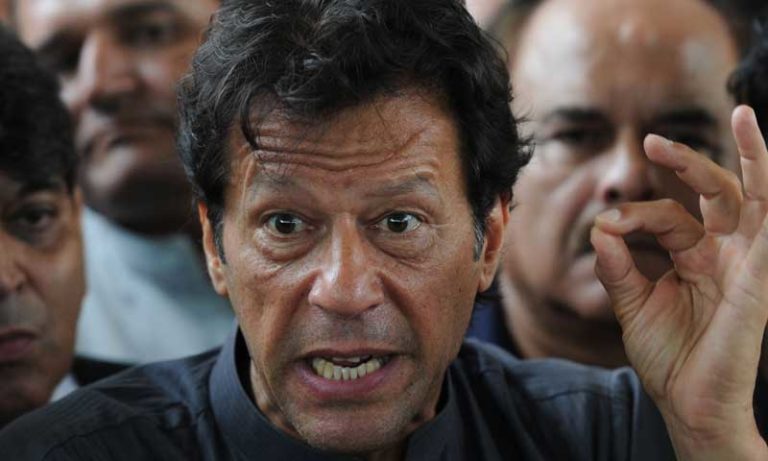
Pakistan is grossly under-reporting CoronaVirus cases

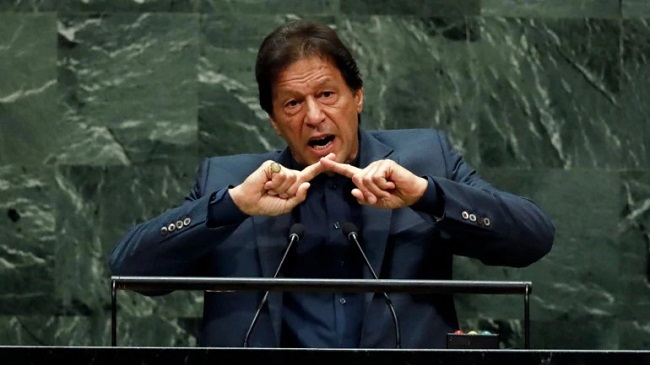
Imran Khan, the Prime Minister of Pakistan, seems to have taken over the task of spreading despicable anti-India propaganda that has, for decades earlier, been the responsibility of Pakistan Army’s  Inter Services Intelligence (ISI) and the Inter Service Public Relations (ISPR). He has uploaded a fake video on his Twitter handle accusing the Indian government of deliberately targeting Muslims of the country “as the world battles CoronaVirus.” The video is of a violent situation between government forces and some locals in Bangladesh a few years back. This obnoxious propaganda by the prime minister himself has elicited a prompt and very apt response for the Indian Ministry of External Affairs (MEA). “The bizarre comments the by Pakistani leadership are an attempt to shift focus from the abysmal handling of their internal affairs,” said Spokesperson of the Ministry External Affairs, India.

The situation of CoronaVirus combined with precarious economic conditions and political instability has put Pakistan into an existential crisis. Pakistan’s national figures of the CoronaVirus situation speak of a nationwide tally of 8,418 cases. Of these, 176 are reported dead and 1970 recovered. These numbers are grossly under-reported due to the iron grip that the Pakistan Army has on their media.

A better insight into the actual situation comes from an article by Tufail Ahmed, carried by the Pakistani newspaper, Express Tribune, on 17 April that was titled: “3,265 bodies brought to 30 graveyards of Karachi in 49 days, data reveals.”

As the source of the worrisome body count of 3,265 dead given in the headline of news story itself, the writer has quoted, “official statistics from the city’s top administrative body,” later identified as the Karachi Metropolitan Corporation’s (KMC) data. The 49-day time period is from February 20 and April 9 when the CoronaVirus situation had erupted in Pakistan. In the succeeding weeks, the numbers would have increased manifold. The author has gone further to give a cemetery wise data of the Central, West, East and Malir Districts of the city. Earlier, a number of media reports had mentioned a sudden spike in deaths in different hospitals in Karachi.

As expected, the Pakistani authorities have stayed tight lipped. There are no authenticated reports available that could link the cause of death to the CoronaVirus since no hospital has kept any record of tests conducted to ascertain cause of death. This situation is against all medical conventions. Even proper postmortems have not been conducted. Quite obviously, this is a blatant attempt by Pakistan to hide the actual figures related to deaths due to CoronaVirus which is very high in numbers.

More critical is the fact that the Pakistan Army, that was forced to come out and enforce the shut down has suffered widespread infection of the CoronaVirus. There are reports of many Army specific quarantine and isolation centers operating in places like Pakistan-Occupied Kashmir (POK), Gilgit-Baltistan and Balochistan far away from the media glare. The cases have been divided into three categories, positive cases, Category-A cases and Category-B cases. The overall numbers are running in thousands.

A very serious allegation on Pakistan’s role in the spread of the CoronaVirus in Islamic nations worldwide has been made by a reputed Pakistani journalist, Kunwar Khuldune Shahid, who is a correspondent with The Diplomat and other prestigious publications.

In his article titled, “How Pakistan became a Coronavirus super-spreader to the entire Muslim world” carried by the news website Haaretz, the introductory paragraphs states, “On Sunday, the Gaza Strip reported its first two cases of CoronaVirus. The two Palestinian men had recently returned from Pakistan. They were among the 250,000 people that gathered in Lahore two weeks ago, to participate in the Tableeghi Ijtema…an Islamic event organised by the local Tableeghi Jamaat.” In addition to Palestine, those from Kyrgyzstan who attended the meeting have also tested positive,

According to the author, by the end of February Pakistan had already reported its first Coronavirus cases. Yet, the Government dilly-dallied in cancellation of the event to be held from March 11 to March 15. On March 12, the organisers were asked to disband the congregation. By then, around 250,000 people from all Islamic countries had already assembled, apart from Pakistanis in large numbers. These participants of the event have become “carriers” of the CoronaVirus and are instrumental for a burgeoning catastrophe in the Islamic world.

The Jamaat cited “rainy weather” and not the CoronaVirus as the reason for the closure which compelled Khuldune Shahid to state in his article, “The Tableeghi Jamaat’s reluctance to cite an infectious virus as cause for the disbandment is rooted in its regressive ideology, whose exponents have ranged from militant jihadists to radical preachers….”

The government of Pakistan continues to be wary of the mullahs and is not taking firm steps to stop mosque congregations even though countries like Saudi Arabia, Iran, Turkey that hold many Muslim holy places have already gone into total shutdown of religious institutions. Imran is following this path because of his government’s weak response to the crisis, it has no money; the aid that is to come from outside will not be optimised since it does not have the requisite infrastructure in place to use it effectively. The government’s priority is to ensure the Islamic clerics that their money making shops will remain open. By doing so, it is looking for support from the clerics once the Corona balloon goes up. The deep state is attempting to put similar regressive thought in the minds of Indian Muslims. That is the intention behind the twitter post by the puppet Prime Minister Imran Khan. Instead of taking some affirmative action, the prime minister is looking out to stall negative media that, he feels, will damage irretrievably his already tottering political career. He is, therefore, turning media attention towards India.

While Prime Minister Imran Khan jumps from one mistake to another, demonstrating his total ineptness to deal with the situation, Pakistan remains headed towards a crisis of unimaginable proportions. For India, the situation in Pakistan should serve as a demonstration of what not to do under the prevailing circumstances. 

We are on the threshold of a new world order

A columnist of the New York Times made a cryptic but  meaningful comment on COVID-19. He wrote, “The coronavirus is more like an earthquake, with aftershocks that will permanently reshape the world.” In the context of current corona pandemic, pragmatism demands that we focus on what shape the world economy, political structures and social institutions will take even if we are able to control the scourge in next six months. We need to visualize the new shape which the human civilization is likely to take in the near future.

Globalization concept of contemporary times supplemented by mind-boggling phenomenon of information technology made us complacent about the dangerous trend of aspiring for eco-colonizing ambitions nursed by neo-colonizing actors. The case merited serious thinking of all of its dimensions. What needs to be emphasized more than anything else is the destination to which globalization has dragged our species. The dense connectivity facilitated the rapid spread of the deadly virus. The inference is that this dense connectivity reflected through panoramic human assemblages (which also means convergence of vested interests) has to get dissolved if the survival of the human race is the purpose. 

Medicos believe that numerous strains of COVID-19 encircle the world which diminishes the chances of finding an effective vaccine within the 12-18 months time schedule. At present, the system adopted is to lay emphasis on stay-home and quarantine techniques but in poor and densely populated countries vulnerability is greater. 

Prime Minister Modi’s broadcast to the nation clearly reflected the serious conflict with which he, and perhaps also some more world leaders are seized. Its the painful choice between reopening notional economies and exposing the populations to further infection and disaster. The decision of extending the lockdown till May 3, was preceded by an intensive interaction between the entire national leadership, economic and financial experts and inputs from recognized institutions and individuals all in the background of the predictions made by global experts that the aggregate death toll could cross from under 100,000 at present to nearly one million or more.

At present all countries are self-isolating, commonly called social distancing. However, given the phenomenon of interdependence, the thrust of globalization trend, there could be ring-fencing from the physical exchange with others. The question is whether social distancing becomes the new lasting civilizational characteristic?

This may lead some of us to think of U-turn of our existing civilization. Civilizations are not made or unmade overnight. One thing is clear, and that is the near-collapse situation of traditional institutions of economy, international relationship parameters, social behaviour and community bookmarks. The closing down of world economic hubs, ceasing of supply and marketing chains, locking down congregational destinations (note the closing down of twin holy shrines of the Mecca and Medina in Saudi Arabia) etc. all point to the imperative of emerging new world order. The current American debacle with surgical masks and ventilators is a case in point. Emerging markets and developing countries are critical both as suppliers and markets. Their demise weakens the world economy as a whole.

Symptoms of change in world order are already there. President Donald Trump has made no secret of his displeasure of the WHO accusing its chief of failure in cautioning the world of impending crisis. The US has ordered suspension of financial support to the WHO. In knowledgeable circles it is believed that the WHO chief has given unnecessary leverage to China. He is unsuccessfully trying to defend himself. President Trump had already withdrawn US from the membership of the UN Human Rights Council saying the organization is politicized. The covert reference was to the overarching influence of China in all organs of the UN.

In a very significant development of last week, Japan Prime Minister announced a financial package of US$990 billion by way of a support fund for the Japanese factories and industrial units established in China for withdrawing from China and re-establishing in any other five prospective countries of which India has also been mentioned. A dependable source has said that 200 Japanese and 100 American companies in China have already announced they are shifting to some other countries to continue their economic activity. Japan has also announced financial support to such units of any country if they would be willing to shut down their units in China and reopen anywhere else in the globe.

The indication is that China will gradually but obviously lose its global economic centrality and multi-polar eco-financial centrality. It is in the offing. The South-East Asian countries are poised for an economic boost once the virus’ intensity subsides.

China’s economic recession will directly impact some of her mega global projects and fundamentally her world policy of economic expansion. The first casualty could be the Belt and Road programme of which CPEC (China-Pakistan Economic Corridor) is a component. Secondly, China’s naval supremacy in the South Asian and China Sea region will receive a big setback. Henceforth, Chinese naval command of the Indian Ocean will increasingly feel to be anchored in hostile and not in a friendly and cooperative region.

More importantly, China’s domination of the UN is also likely to take a drubbing. The aims and objectives stipulated in the UN Charter, its structure and functionality can undergo a drastic change. In any case, the existing structure of regional and global strategies has to be pulled down.  Nationalism is likely to supersede all other identities and denominations. Two largest religions of the world are on the verge of submitting to the supremacy of reason as the guiding force not die-hard conviction.

This is a view of how things are likely to shape in the aftermath of the epoch changing pandemic facing humanity. In a narrower sense, the legendary Dajjal has appeared from the East in the shape of a tiny invisible butterfly. It reminds us how the great Mongol Empire was finally brought down by invisible plague in the 14th century. Those who will survive the Doomsday will be the harbingers of a new world, new civilization, new cosmology and a new divinity.

Pakistan in Coronavirus distress, yet unwilling to shed its evil Kashmir agenda

Pakistan is in a miserable condition due to the spread of Coronavirus. When the Corona threat was creeping in, Pakistan’s Prime Minister Imran Khan chose to stay in denial mode unwilling to impose lockdown on the plea that a poor country like Pakistan cannot survive without work. Ultimately the Pakistan Army took over and announced a lock down till April 15th, but by then the damage had been done. Today there are over 7,000 active cases across Pakistan with more than 135 deaths.

Active involvement by Pakistan Army has led to the Coronavirus creeping into its ranks. More and more soldiers are reporting sick. In order to hide the grim situation they are being quarantined, isolated and treated in Pakistan Occupied Kashmir (POK), Gilgit-Baltistan and Balochistan, much to the distress of local population that is now facing an existential threat.

The rank and file of Indian Army, on the other hand has been kept away from public duty and has remained safe from infection. It’s so because police and civil administration in India have been able to control the situation admirably and support from the Army has not been required.

Imran Khan seems to have finally understood the gravity of the situation and has appealed to the international community for financial help. “For developing countries, apart from containing the virus and dealing with the economic crisis, the biggest worry is people dying of hunger as a result of the lockdown,” he said.

Pakistan’s two largest creditors, the World Bank and the Asian Development Bank (ADB) have committed huge loans on humanitarian grounds and China too has provided massive medical aid. However, Pakistan’s chronic problem of not having in place basic infrastructural capacity to fully utilise such loan will cause severe problems. The prime minister has already warned that “hospitals may not be able to cope” with the increasing number of COVID-19 patients.

Prime Minister Imran Khan has announced another two-week extension in the lockdown taking it to April 30. However, several trade associations have announced that they will be reopening their shops, and markets. “The prolonged lockdown has not only badly hit our businesses but the country’s poor class. We are going to resume our businesses while observing safety procedures, ” said Ilyas Bilour, a former president of Pakistan Chamber of Commerce and Industries.

In India, Prime Minister Narendra Modi has exuded confidence with regards to the health condition in the country where the virus spread has been well managed. “India’s fight against the Coronavirus global pandemic is moving ahead with great strength and steadfastness. It is only because of your restraint, penance and sacrifice that India has so far been able to avert the harm caused by corona to a large extent….,” he said in his address to the Nation on 14 April, on completion of first 21 day period of lockdown. He attributed this success to the correct path chosen and the disciplined response from the people despite the considerable difficulties being faced.

After showering wholesome praise to all countrymen, PM Modi announced extension of the lockdown till May 3. Such a recourse had been recommended by state governments and other experts. However, he did leave open a window for reappraisal on April 20 and the possibility of conditional opening of some areas that are not in the “hot-spot” category.

Prime Minister Modi culminated his address with an assurance that the country is well equipped to face the challenge. “Friends, the country has ample reserves of medicines, food-ration and other essential goods; and supply chain constraints are continuously being removed. We are making rapid progress in ramping up health infrastructure as well. From having only one testing lab for Coronavirus in January, we now have more than 220 functional testing labs. Global experience shows that 1,500-1,600 beds are required for every 10,000 patients. In India, we have arranged more than 1 lakh beds today. Not only this, there are more than 600 hospitals which are dedicated for Covid-19 treatment. As we speak, these facilities are being increased even more rapidly,” he said. What is quite visible is that India is well placed in fighting the Corona threat and, more importantly, high in morale to face the challenge. PM Modi has exuded confidence that the country will not need to look over her shoulder for support.

However, the terrible social, economic and health conditions in Pakistan is quite amazingly not deterring the country from continuing with its evil policy of Proxy War in Kashmir. The beginning of April witnessed a massive infiltration bid in the Kupwara sector which was successfully thwarted by India by killing all five well trained Pakistani terrorists.

On April 10, Pakistan Army started massive cross border firing in the areas from South of Athmuqam to Upper Neelam Valley. The firing started with automatics and mortars, and was soon up-scaled to artillery guns engaging even the local populace. Indian retribution was fast and incisive, artillery guns from Indian side started delivering fire with great intensity and accuracy, causing great agony to Pakistani troops. Pakistani gun area were silenced and guns badly damaged. Next, identified terrorist launch pads were targeted and a building where about 20 terrorists were housed was demolished with casualties. A Pakistani ammunition dump was also hit.

Pakistan has yet not been chastised, in recent days cross border shelling by Pakistan has been reported in Keran Sector of Kupwara, Kashmir. In another firing incident, two Indian civilians have been reported injured  and some houses damaged in cross border shelling in Manjakote, district Rajouri. Indian troops, of course, retaliated with required intensity inflicting terrible punishment to Pakistani troops .

It seems that the Corona crisis is not going to be a deterrent for the Pakistani leadership so far as targeting India (Kashmir) is concerned. It will not hesitate to even employ Coronavirus affected soldiers and terrorists for this purpose. If somebody can help Pakistan at this sensitive stage it is India, under the circumstances such mindless belligerence is very unfortunate indeed.

Pakistani military operation continues unabated in Balochistan even during Corona pandemic

Pakistan’s military operation entered its 4th day across different areas of the Makran region of Balochistan. On the fourth day of this military operation several Baloch residents have disappeared that include women and children.

According to local sources, Pakistan’s military attacked in districts Kech, Awaran and Panjgur. During these attacks Pakistani forces raided and searched houses in various areas and arrested many people indiscriminately.

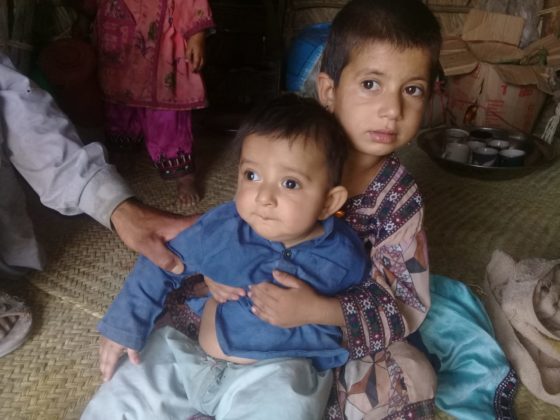
On Wednesday, during a raid on the house of Razai in Badrang, Kolwah area, Pakistani forces arrested all the members of a house including women and children. Those arrested include Razai, Pir Bakhsh, Bibi Maryam, Asad, Mahal, Gohar and nine the -month-old Mehlab. Whereas many others were arrested from Teetaj area and these abductees have been identified as Jaffer, Noorbakhsh, Muradjan, Abbas, Ashraf, Charshambe, and Pullain.

The abductees from Malar have been identified as Jan Mohammad Pindok including his two sons, Maqsood and Khudadad. The two other abductees from Malar are Mohammad Khan and Mia Sanjar. Baloch residents said that the Pakistani forces are operating extensively in the above mentioned areas, while check posts are being set up in different areas as well.

“Today the whole world is taking strong steps to protect the lives of its people and keep them safe but Pakistani state agencies have come down for military operations in Balochistan and for extra-judicial arrests even in these days of this deadly Coronavirus pandemic. This can have very serious consequences for the people of Balochistan,” said the Chairperson of BSO-Azad while condemning Pakistan’s military operations.

Mishandling of Armed Forces can weaken the Nation

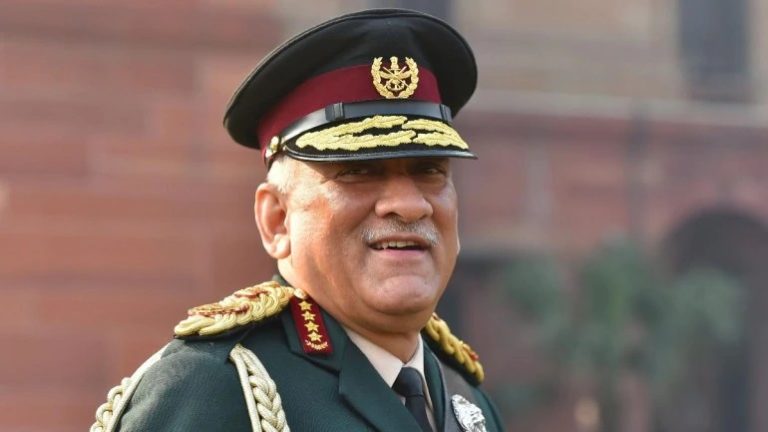
There was an instance recently where the Cabinet Secretary, of the government of India, had allegedly addressed the Chief of Defence Staff (CDS), General Bipin Rawat as “Shri”  and put down his designation as “Secretary” DMA,  in an official letter to the Department of Military Affairs (DMA), Ministry of Defence.

The first thought that comes to mind is that this letter that is doing the rounds is fake and has been mischievously circulated to create dissension and bad blood with respect to the vibrant new organisation– the Department of Military Affairs. How otherwise could an official letter of such import be leaked with such ease? However, even if this letter is fake then too it has the potential to inflict damage to the aura of our revered Armed Forces. Even a presumption that it could be genuine raises one’s concern manifold. An attempt is being made through this article to address this matter in a manner that would bring clarity with regard to the Government-Military interface and role of the CDS (Chief of Defence Staff).

“Shri” is a beautiful word that gives the highest respect to the person being addressed, it is used for all dignitaries including presidents and prime ministers. However, in the context of the Armed Forces there is no precedent or tradition of affixing any title of reverence and respect before the name of a soldier, they are addressed only by their rank.

It is so since Armed Forces personnel hold Commissioned Ranks, granted to them at the pleasure of the President of India in his capacity of being Head of the State and also as Supreme Commander of the forces. A similar precedent in followed in other democratic countries like Britain where the Queen, as Head of the State, grants the Commission. A title given by the Head of State, can be taken away only by the same office. The Armed Forces personnel, therefore, retain their rank for life and are authorised to affix it to their names even after retirement. Such is the case across the world, and one does not hear of the British, American or other military personnel being called Mr. or General Mr.

The personnel of Central Government services are not Commissioned, they are Government Servants. As such, their designation is written after their names and they do not carry it to their retirement.

To address an Armed Forces personnel, serving or retired without rank amounts to insulting the President of India in whose pleasure the person holds the rank. This being done in a government communication is a very serious matter indeed. The fact that, prima facie, the communication appears to be fake only adds to the criticality.

The “Letter” signed by Cabinet Secretary and addressed to Gen. Bipin Rawat, Chief of Defence Staff (CDS) India. Though this “letter” appears to be fake, yet it has the potential to inflict damage to the aura of our revered Armed Forces.

The designation of Secretary for the Chief of Defence Staff is also creating confusion with regards to the role and responsibility of the new appointment. Is he an Armed Forces personnel on the active list holding the rank of General or is he a civil servant on deputation to a department of the Government? Quite obviously he cannot be both since it would lead to contradictions as has emerged from the “letter” itself.

The “letter” in question is purportedly written by the Cabinet Secretary. In this letter, he has given an overall directive to ministries to remain ready to give a robust “Whole of Government” response to the CoronaVirus situation.

In this instance of a virus afflicting the nation and the whole world, the primary role of the Armed Forces would be to keep themselves isolated so as to stay fit to take on their primary responsibility of defence of the nation. The same has been clarified by the COAS (Chief of the Army Staff), General Manoj Mukund Naravane, in no uncertain terms. The office of the CDS cannot be leveraged to use the nation’s military resources as administrative assets.

More critical is the fact that by incorporating the highest office of the Armed Forces in a call for a “Whole of Government” approach, a message has been sent to the world through this “letter” that India is calling out the military to “assist” the Governments effort to meet the CoronaVirus situation.

Calling out the military in an emergency is seen as the last resort of a nation. It denotes a situation of emergency. In Pakistan, the Imran Khan government has failed and hence the Pakistan Army has taken charge. Such a recourse has grave strategic and security implications for Pakistan as it would have for any nation.

India is nowhere near any such situation where Army assistance would be required. The central and state governments, with their integral assets are very much in control of the situation. Across the nation, the Police is doing a wonderful job and even Paramilitary has not been called in. There does not seem to be even a remote possibility of a situation coming to pass where the Armed Forces would be required. Their singular responsibility in this situation is to ensure that troops stay fit and fine.

Certain Ministry of Defence assets like the DRDO, Ordnance Factories, some military hospitals etc. can assist in research and production fields or to boost the medical infrastructure. They are already doing so. These do not come under the Department of Military Affairs (DMA), but under the Defence Secretary. Undoubtedly, this “letter” if it was written at all, must have gone to the Defence Secretary. There was, as such, no need to separately address the DMA.

The contents of this “letter” (if written), would create a contradiction in what the government expects from a Secretary-led Department of Military Affairs (DMA) and what the nation expects from the Chief of Defence Staff.

The DMA should not be seen as one more department of the Ministry of Defence. If such becomes the case then Secretary, Department of Military Affairs would merely be fulfilling the vision of the prime minister of inducting highly-rated professionals in government departmental verticals on contract to offset the “Generalisation” that the Indian Administrative Service (IAS) cadre represents.

While “Secretary-DMA” would improve the staff level functioning of the Ministry of Defence, the requirement of a single point Advisor to the Defence Minister and through him the political leadership of the country would remain unfulfilled.

For too long now there has been confusion with regards to the interface between the Government Ministries and the Armed Forces. There are acrimonious protocol issues and turf battles that come up all the time. These could be genuine issues or created by inimical powers for vested interests towards weakening the national fabric. It is important to stay vigilant against any form of dissension.

Employment of the Armed Forces for any role in war or peace is a political decision conveyed to the force directly by the political leadership. The civilian structure has a staff duty to perform. It provides administrative inputs to political leadership to assist in the decision making process. The strategic and military input, which is of primary importance, is provided only by the Armed Forces themselves and this is the primary role of the Chief of Defence Staff.

Regardless of the government being a Democracy, Communist, Dictatorship, Monarchy or whatever, mishandling of the Armed Forces can lead to its weakening and that of the nation. The enemy remains forever active to create this confusion, build trust deficit and create dissension that weakens the national fabric. Within the sub-continent there are many examples to this effect. In recent history, the British took over the Indian sub-continent by using such psychological tools. Could the British have ever defeated the Khalsa Army in Punjab if it had remained politically cohesive?

Lingering sores can fast become cancerous. It is the responsibility of the political leadership to ensure that dissension does not creep in, and for this the leadership has to generate a positive political will and take on contentious issues in an honest and transparent manner to nip acrimony in the bud. Here’s hoping that the “letter controversy,” whether it is a fake or genuine, is dealt with the sensitivity and application that it deserves.

Some doubts remain over implementation of US-Taliban peace agreement: Rahimullah Yusufzai

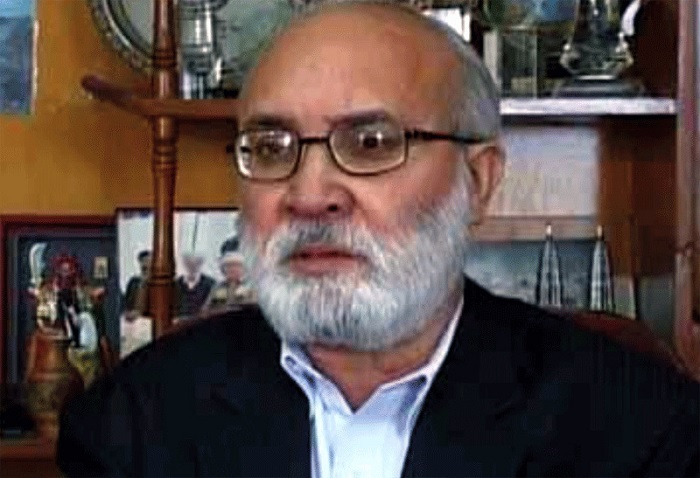
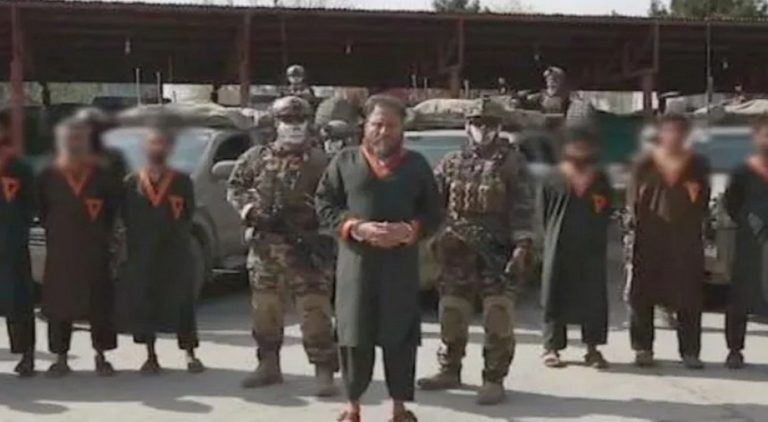
Even in these times when world is fighting against the Coronavirus pandemic, Afghanistan continues to be in news for different reasons. Soon after Islamic State Khorasan– IS(K) took responsibility for gruesome terrorist attack on the Kabul Gurdwara, the special forces of Afghanistan arrested Aslam Farooqi, the chief of IS(K). Thereafter, Pakistan promptly demanded the custody of Aslam Farooqi, which Afghanistan has now denied. News Intervention and Sangar Media House spoke to Rahimullah Yusufzai, Pakistan-based senior journalist and a security analyst. He has been a part of Track-II dialogues with Afghanistan and India. Rahimullah Yusufzai was also the first to interview Taliban’s founder Mullah Omar and has interviewed Osama bin Laden twice. He offered a fresh perspective into the recent developments in Afghanistan.

Vivek Sinha/Dosten Baloch: Afghanistan’s National Directorate of Security (NDS) has arrested Aslam Farooqi, who is the chief of Islamic State Khorasan (IS-K). Immediately after this arrest Pakistan sent a request to the Afghanistan government to hand over Aslam Farooqi. Why do you think Pakistan wants the custody of IS(K) chief Aslam Farooqi?

Rahimullah Yusufzai: This might not be the first time Pakistan is seeking custody of someone who has been captured in Afghanistan, because (even earlier) there were Pakistanis who had fled to Afghanistan. Same is the case with Aslam Farooqi who is also known as Abdullah Orakzai. Because Aslam Farooqi is a Pakistani citizen and he had been a part of the Tehreek-e-Taliban (Pakistan) in the Orakzai tribal district in Pakistan’s FATA (Federally Administered Tribal Areas) and he had been fighting the Pakistani state as well. And then Aslam Farooqi joined the Islamic State (Daesh) Khorasan and his group under his leadership claimed responsibility for a number of terrorist attacks in Pakistan. So Pakistan is seeking his custody because it says this man has committed crimes and terrorist attacks in Pakistan.

But let me also tell that there is no extradition treaty between Afghanistan and Pakistan and Afghanistan has declined to hand him over to Pakistan because Afghanistan says he has committed terrorist attacks in Afghanistan and he will be tried in Afghanistan. So I don’t think that Aslam Farooqi will be delivered to Pakistan. In the past also Afghanistan has never handed over any wanted Pakistani to the Pakistan government. Never in the past. While on the other hand, Pakistan has handed over a number of Afghans including the Afghan Taliban who were wanted by the Afghanistan government. And I don’t think that this issue will be resolved because the relations between the two governments (Pakistan and Afghanistan) are not friendly.

Vivek Sinha/Dosten Baloch: Will the arrest of IS(K) chief by Afghanistan and the Afghanistan government’s refusal to hand over Aslam Farooqi to Pakistan create further unrest in the region?

Rahimullah Yusufzai: I don’t think it will lead to any disturbance because this was already understood that Pakistan may demand his (Aslam Farooqi’s) custody and that Afghanistan will not agree. It has happened in the past as well, relations are not good (between Pakistan and Afghanistan) and it will not become friendly or more hostile because of this one incident. Even the Pakistan government was aware that Afghanistan government may not deliver Aslam Farooqi to Pakistan.

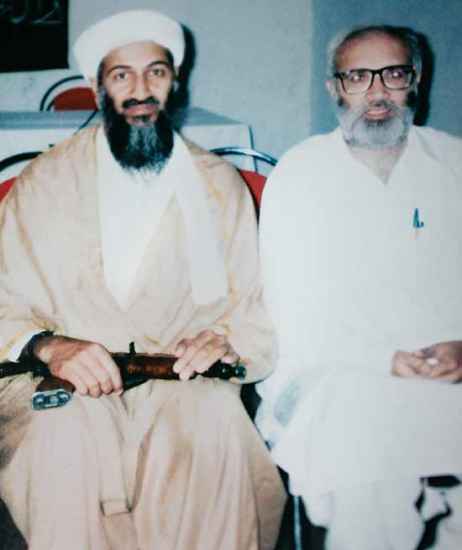
Rahimullah Yusufzai (right) with Osama bin Laden (left).

Vivek Sinha/ Dosten Baloch: The Taliban in Afghanistan have released 20 Afghan government prisoners and the Afghanistan government has in return released 300 Taliban prisoners. How will this prisoner exchange impact the domestic politics of Afghanistan?

Rahimullah Yusufzai: This is an issue concerning Afghanistan so whatever impact it may have, it will be on Afghanistan and not on Pakistan. As the Americans say, Pakistan’s role is that of a facilitator for peace talks…to facilitate to bring Taliban to the negotiations table with the Americans. And now the US has been asking Pakistan to ask Afghan Taliban to hold direct peace talks with the Afghanistan government.

Also, this release of prisoners is part of the Doha peace agreement signed by the US and Taliban on 29th February. The timeline that was announced in the peace agreement has not been actually met. There has been delays. There was supposed to be an exchange of 6,000 prisoners. 5,000 Taliban prisoners were to be released by the Afghan government and 1,000 Afghan government prisoners by the Taliban by March 10thas per the agreement, but this did not happen. And the next stage was intra-Afghan peace negotiations which was also supposed to start on March 10th after the exchange of prisoners, which has now been delayed.

I think these delays are causing concern and there are now some doubts about implementation of the peace agreement between the US and Taliban. Now that some prisoners have been released so at least there is a good start. It has created some hope. But we must remember that 6,000 prisoners have to be exchanged and Taliban have been saying that they will not join the intra-Afghan negotiations until their prisoners are released. I think that this will take some time and there will be further delays.

Another issue which is holding up intra-Afghan negotiations is the political dispute between President Ashraf Ghani and his rival Dr Abdullah Abdullah, because they were supposed to reconcile and try form a coalition government as they did earlier in 2014. They were also supposed to form a joint negotiating team to talk to Taliban which, I think, would be in the next stage. But there’s some hope that probably President Ashraf Ghani and Dr Abdullah are moving towards some kind of power sharing, because the Americans are also mediating among senior Afghan politicians. Hamid Karzai, Professor (Abdul Rab Rasool) Sayyaf, Younus Qanooni, Kareem Khalili are trying that there should be reconciliation so there is now expectations that finally this dispute will be resolved and maybe Dr Abdullah will get a share of power in a government led by President Ashraf Ghani.

Vivek Sinha/Dosten Baloch: What will be the larger impact of the ongoing Pashtun movement in Pakistan and in Afghanistan? Can this Pashtun movement and the PTM have any kind of impact on the peace talks in Afghanistan?

Rahimullah Yusufzai: This movement for the rights of Pashtun people in Pakistan called the Pashtun Tahafuz Movement (PTM) mostly has young people and also those who have suffered because of militancy and military operations. They (Pashtuns) have organised themselves and they are demanding their rights and they get some support in certain areas in the former FATA (Federally Administered Tribal Areas) and other tribal areas. PTM has got more support in North Waziristan and South Waziristan where PTM has also won elections and have two seats in the National Assembly. I think that PTM still does not have much support in other areas such as Khyber-Pakhtunkhwa, Karachi or Balochistan. They have pockets of support but not enough to win seats in Parliament. Also, PTM and its leader Manzoor Pashteen have clarified that they are working for the rights of Pashtun people in Pakistan and not of the Afghan Pashtuns. He has said that they are not working in Afghanistan and the Afghan Pashtuns have to struggle for their own rights, whatever they are.

So I think this movement is confined to Pakistan, though it has some support abroad among the Pashtun diaspora. It’s not going to have much impact on the Afghan peace talks because PTM is clearly supporting the Afghanistan government against Taliban and it is also very critical of the Pakistan Military. And the Pakistan Military will not give it a role in the peace processes in Pakistan or in Afghanistan. Yet, I believe that PTM’s campaign in Pakistan will continue. Some of their demands have been accepted but they still have many more demands because of the suffering of the people who have been displaced due to militancy and military operations. Because the people who are missing, killed, injured or arrested due to the land mines… and it has taken a toll on the lives of people in the former tribal areas and also due to unemployment. PTM will continue to have some support but I don’t think that it will replace other Pashtun political parties like the ANP (Awami National Party) that has more electoral support in Pakistan.

(News Intervention appreciates the efforts of Sangar Media House for facilitating this interview)

Dosten Baloch is Editor-in-Chief of Sangar Media House. Follow him on Twitter @DostenBaloch1
Sangar Media House: @DailySangar

No help for stranded Hong Kong Indians

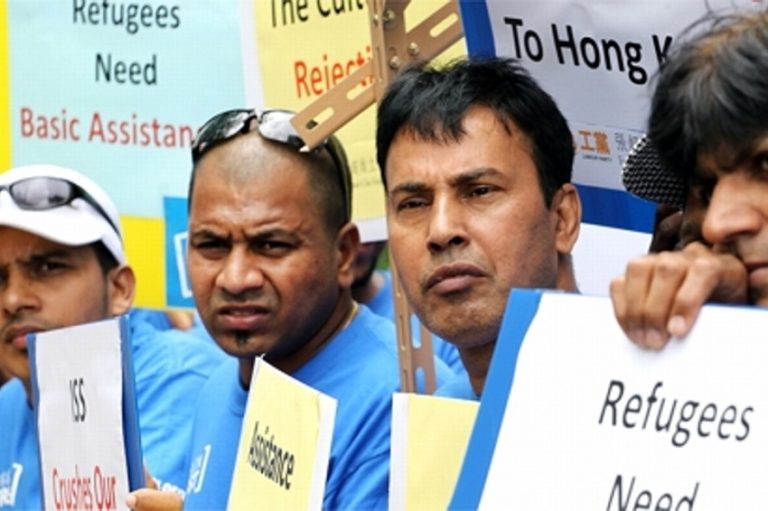
An estimated 1300 Hong Kong Indians are desperately seeking help from both India and Hong Kong for a passage back to the City of Victoria, the capital city of Hong Kong. The impasse has now turned into a diplomatic slugfest between the two nations.

Those stuck in India are known as Hong Kong Indians, they are Hong Kong Special Administrative Region of the People’s Republic of China (HKSAR) passport holders, and scattered across India.

In repeated interviews, they claimed they were unable to contact immigration officials in Hong Kong and worried about their status. Worse, the closure of Indian air space has added to their problems. They could leave India only if either Hong Kong or India organise charter flights. Or India decides to use some charter flights to send them home. 

But no one is responding.

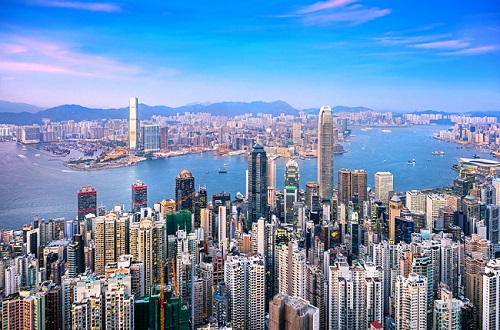
Hong Kong Skyline

Half of those stuck are truck drivers, food supply chain workers, and cargo delivery agents. There are a number of students stuck across India. Bulk of them are holed up in Punjab, rest in other Indian states like Maharashtra, Tamil Nadu, Karnataka and West Bengal.

“We are in a state of panic because nothing is working, nothing is happening. We are helpless, we need help badly. Hundreds have lost jobs, and there is no effort from the Hong Kong government to evacuate us, nor there is help from the Indian government to fly us out,” says Pune-based Kavita Khosa who is trying hard to compile a list of Hong Kong Indians stuck across over 30 Indian cities. “Like me, they all wish to go back to the safety of their home and families,” Khosa said in an interview.

She said she has personally written to the Consul General of India in Hong Kong and also the attached petition which has been sent out to the authorities in Hong Kong through a newly-organised task force. Kosha said she is under lockdown alone in an apartment in Pune while her family is back home in Hong Kong.

“We have around 3 WhatsApp groups of 250 people in each group, all worried and concerned for their safety and desire to get back home. Many have lost their jobs because they have not been able to return to work. Many are food delivery boys now left jobless with no money. Many separated from their babies and children in sealed areas with no WiFi or access to laptops to seek help,” said Khosa.

Khosa moved to Hong Kong from India more than three decades ago. She considers herself a Hong Konger. She said that she was left with only six eggs, a watermelon, some vegetables and a packet of rice. Worse, supplies were scarce at nearby grocery stores.

Khosa says she doesn’t know why the Hong Kong government is refusing to evacuate its own people. She says she often wonders if this is some kind of racial profiling because Indians in Hong Kong are considered ethnic minority. There are approximately 40,000 people of Indian origin in Hong Kong.

A senior official of the Ministry of External Affairs said the Indian government was looking into the demands of the stranded Hong Kong Indians. “But the problem is there is no single, comprehensive list of these Hong Kong Indians. They are scattered all over India. India has had no such evacuation request from Hong Kong.”

The official said tracking all Hong Kong Indians from all over India is a herculean task, now made difficult because of the Covid-19 scare.

The Hong Kong Indians stuck in India are flustered because the Hong Kong Government recently evacuated some 60 Chinese who were on holiday in Peru and 26 Chinese from Morocco. But till date, the Hong Kong government has not responded to repeated pleas from Hong Kong Indians stranded in India. “The apathy of the Hong Kong government and the Indian Consulate in the City of Victoria is appalling,” said Khosa.

The South China Morning Post, meanwhile, said the Indian Consulate in Hong Kong was poised to work with the city’s government to fly stranded residents out of India, even as the Hong Kong administration remained non-committal.

“Some foreign governments have requested the government of India for permission to arrange special flights to bring back their nationals,” consul Ajith John Joshua told the daily. 

“If the government of Hong Kong sends a similar proposal to the consul general of India in Hong Kong, we will process the proposal for obtaining necessary approvals from the government of India.”

The Hong Kong Security Bureau told the daily that the Immigration Department had provided “relevant information,” as well as “proper advice and practicable assistance” to those stranded in India.

An official of the Security Bureau told the newspaper that the Immigration Department had received 1,527 requests for help from Hong Kong residents stranded in 62 countries, with a “relatively large number” of them being stuck in Vietnam, Pakistan and the Philippines. It did not mention India.

“When necessary, the government of [Hong Kong] may render assistance in liaising with relevant airlines to reserve seats for the journey to return to Hong Kong, and where the circumstances so warrant, the government would assess the need to exceptionally charter a special flight for the return of stranded Hong Kong residents,” the official told the daily.

He added that factors to be considered included the ground situation in the countries, the availability of transport facilities, the number of Hong Kong residents involved and their locations, the feasibility for airlines to operate chartered flights in the countries, as well as the readiness and capacity of quarantine facilities in Hong Kong to receive the returning residents.

Mohan Chugani, a former president of the India Association in Hong Kong, said the government must come up with a plan to bring those stranded in India back home. 

Chugani told the South China Morning Post that stranded city residents in the mainland Chinese city of Wuhan were brought home on government-chartered flights much earlier because they were Chinese, accusing the government of “double standards” for dragging its feet over those in India.

Siachen Day: India’s domination of Saltoro Ridge is a strategic imperative

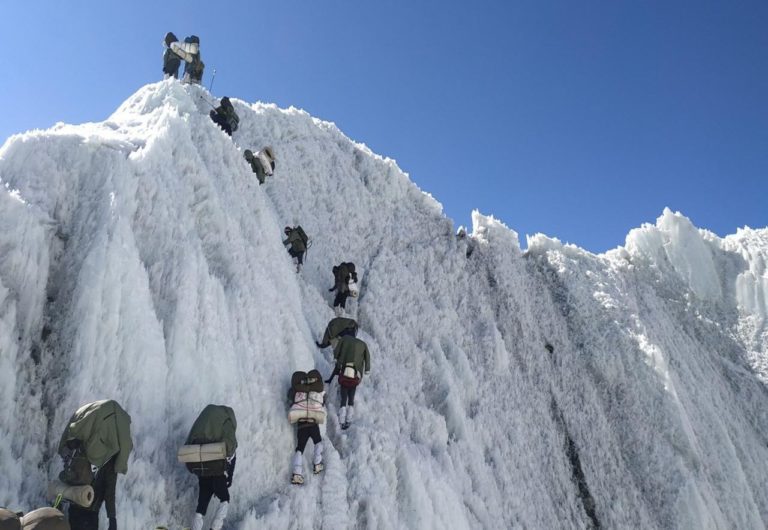
“I am proud of all Army personnel serving in Siachen who are leaving no stone unturned to defend our motherland. I am also proud of their parents who have sent their children to serve the nation by joining the Armed forces. I will personally send a thank you note to them,” said Defence Minister Rajnath Singh in June 2019 during his maiden visit Siachen, the highest militarised zone in the world. The Defence Minister echoed sentiments of the entire India that remains in awe of the gallant Siachen Warriors ever since the launch of Operation Meghdoot on April 13, 1984 when, in an unimaginable feat of grit and bravery, the Indian Army gained control over the dominating heights of the Saltoro Ridge, Sia La and Bilafond La, in a short period of time. Since then, Siachen has witnessed a saga of unparalleled valour in the face of a belligerent enemy, arduous terrain and challenging climatic conditions.

Three years later, Pakistan tried to gain a dominant position by forcibly occupying a height which it called the Quaid Post. The Quaid Post was regained by a five member team of 8 Jammu and Kashmir Light Infantry led by Naib Subedar Bana Singh. This almost superhuman effort, after the unit had suffered initial setbacks and even lost an officer, Second Lieutenant Rajiv Pande, is now a part of military folklore. The post was renamed as Bana Post.

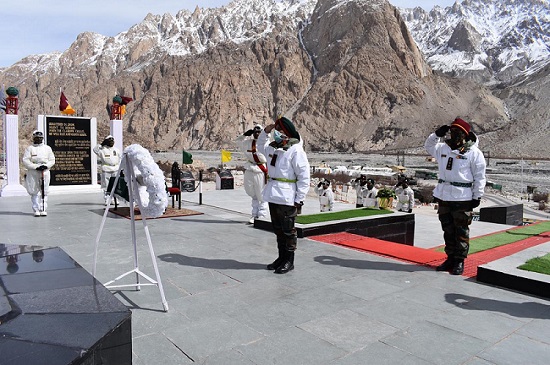
Indian Army’s Fire & Fury Corps celebrating the Siachen Day on April 13, 2020.

Siachen Day, celebrated on April 13, every year, honours all the brave Indian soldiers who have, over the years, successfully thwarted evil designs of the enemy in Siachen. It was marked this year with reverence and  remembrance of the gallant martyrs by a grateful nation, in a solemn and controlled manner. The Leh-based Fire & Fury Corps of the Indian Army in whose Area of Responsibility (AOR) the “highest battlefield in the world” is located held a somber Wreath Laying Ceremony.

Pakistan has been consistently pressurising India to demilitarise the Glacier since it is in a very weak position over there. Earlier in 2012, Pakistan had lost 130 men in a massive avalanche at Gayari, its post nearest to the Glacier. At that stage, instead of adopting a pragmatic approach, the then Pakistan Army Chief, General Kayani, reiterated the Pakistani position that it was India which started the dispute in 1984. Pakistan resorts to consistent lobbying to bring down international pressure in this regard on the Indian leadership.

Successive governments in India have not been averse to the idea of demilitarisation, On June 12, 2005 while on a visit to the Glacier, the then Indian Prime Minister Dr. Manmohan Singh had said, “Now the time has come that we make efforts that this battlefield is converted into a peace mountain.”

Indian Army soldiers guard the “Frozen Frontiers” at Siachen Glacier with grit and determination.

In order for this to happen, India has laid down a few pre-conditions. The most prominent among these is authentication on a map of the Actual Ground Position Line (AGPL) along which troops are presently deployed. Pakistan is insisting on a withdrawal to the positions held in 1984, which is clearly not acceptable to India. India is well aware that after having achieved its first step, Pakistan will declare the region as a disputed territory. After this, a Jihadi intrusion to fructify expansionist designs will then be resorted, regardless of the assurances given.

Control over the area would constitute a major strategic achievement for Pakistan as it would breathe down the Indian Army’s positions in Ladakh while denying India the capability to monitor the sensitive Pakistan-China axis. This matter has taken an even more critical turn for India now that Pakistan has been practically ceding to China the whole of Gilgit-Baltistan and especially the Shaksgam Valley. Due to this illegal deed, China is in a position to bridge the Aksai Chin-Gilgit-Baltistan gap and dominate the Karakoram Pass.

India cannot allow such a strategic misadventure to take place. Thus, holding of the Siachen Glacier is crucial for India. Prime Minister Narendra Modi celebrated the Diwali of 2014 with the soldiers at Siachen. He reiterated the commitment of his government to uphold the position that the Indian Army has maintained with so much sacrifice.

In October 2019, Defence Minister Rajnath Singh announced opening of the Glacier from Siachen base camp to Kumar Post for tourism purposes. Pakistan responded quickly by terming the region as a disputed territory. “India forcibly occupied Siachen Glacier and it is a disputed area. How can India open it for tourism?” said Pakistan Foreign Office Spokesperson Muhammad Faisal.

In November 2019, six people (four soldiers and two porters) lost their life in an avalanche, triggering the usual media hype for demilitarisation of the region.  It is admitted that India has many weather related casualties in Siachen. Better procedures and precautionary process, however, have reduced the casualties to a great extent. Now advanced technology is being used to make the life of soldiers posted over there a little easier. A massive plan to modernise all roads and construct new ones leading to the Siachen Glacier, has been launched in the Ladakh sector for faster movement of troops and equipment.

Adverse climatic conditions or any other form of hardship will not deter Pakistan from covetously eyeing Siachen. Now even China would be equally interested to dislodge the Indian deployment over there. Such inimical designs make it imperative for India to steadfastly man the heights notwithstanding the cost and the difficulty.

For India, expenditure and effort to regain the Saltoro Ridge, if demilitarised, would escalate as a geometric/logarithmic progression. In fact, cost escalation for India would begin the moment any unfortunate decision to demilitarise from Siachen is taken. This will happen in terms of building a new line of defence further down which will require more infrastructure and troops involving prohibitive expenditure. As and when the conflict escalates, the money saved will go down the gutter in nanoseconds. A much larger number of soldiers will be called upon to sacrifice their lives than the few who are becoming unfortunate victims of the weather at present. More dangerous is the fact that this may well trigger a scary sub-continental conflict. Hence, domination of Saltoro Ridge by India has been a strategic imperative since Operation Meghdoot.

IS(K) chief can reveal Pakistan’s dirty secrets. But…?

Afghanistan’s Vice President Amrullah Saleh is confident that captured Islamic State Khorasan (IS-K) chief Aslam Farooqi will prove to be “treasure of intelligence.” What Saleh says certainly carries a lot of weight, not because he’s the Vice President of Afghanistan, but since he has been the chief of Afghanistan’s premier intelligence Agency, National Directorate of Security (NDS) for more than six years (2004-2010) as well the country’s former Minister of Interior Affairs (2018 -2019).

Saleh is a no-nonsense man. According a report in The Guardian, he had enraged Pakistan’s former President Pervez Musharraf in 2007, by saying that he was confident that fugitive Al-Qaida founder Osama bin Laden was not holed up in Afghanistan but instead was hiding in Manshera, a stone’s throw from the city of Abbottabad. In an apparent fit of rage (or perhaps due to discomfiture on account of Saleh’s near-accurate information regarding the whereabouts of Osama bin Laden), a fuming Musharraf told Afghanistan President Hamid Karzai “Why have you have brought this Panjshiri guy to teach me intelligence?”

Saleh is also the one who during the Tehran Security Forum in 2018, had said, “The presence of ISIS (IS-K) in Afghanistan is not genuine. It is an intelligence game played by some of our neighbours.” But as he was the Interior Minister at that time, diplomatic conventions prevented him from specifying who exactly was the patron of IS-K. But now that the so called ‘amir’ of this terrorist group is in NDS custody, Saleh’s tweet highlighting that Farooqi is a “Pakistani national” who “will sing more to the dismay of his patrons in and out,” leaves nothing to imagination.

Furthermore, Islamabad’s frantic attempt to secure the custody of Farooqi betrays its uneasiness with him being in Afghan hands. Islamabad’s conundrum is understandable as Farooqi will most certainly “sing” and what he has to say will expose the Inter-Services Intelligence (ISI), which as we all know is Rawalpindi’s ‘dirty tricks’ department. But while there are great expectations that Aslam Farooqi’s revelations will completely expose the Pakistan Army’s nexus with terrorist groups, one needs to guard against over-optimism since there are bright chances that the ‘lyrics’ we end up hearing may not be as damning as Saleh hopes, and the reason for this is simple.

Islamabad, which has the most to lose from IS-K chief’s candid confessions, has an ace up its sleeve in the form of Pakistan-based Quetta Shura of the Taliban, which is the key player as far as US- Taliban peace accord is concerned. Islamabad has been successfully playing the Taliban card to have its way, ever since 2001, when Washington committed its troops in Afghanistan. Whereas Islamabad may have been talking a lot about its war on terror, but it never discontinued providing safe havens to the Taliban and other terrorist groups that it had created even though they are fighting against the US-led NATO forces in Afghanistan.

When even former the US Vice President Dick Cheney failed to convince Musharraf “to do more” against anti-US terrorist groups, President George Bush was left with no other option but to issue a secret executive order in July 2008 that allowed US forces in Afghanistan to conduct anti-terrorist operations inside Pakistan without informing or taking Islamabad’s permission. The fact that US Navy Seals supported by attack helicopters did raid a terrorist safe-haven in Pakistan’s tribal belt two months later proves that ultimately, even Bush had to reconcile to the idea that US forces would have to take-out the Taliban on its own since Islamabad will never ever abandon the Taliban and other terrorist groups that it considers to be its ‘strategic assets’!

Similarly, under Obama too, the Taliban enjoyed unfettered access to safe havens in Pakistan. In fact, in 2016, Sartaj Aziz who was then Pakistani Prime Minister Nawaz Sharif’s special adviser on foreign affairs admitted that “…we have some influence on them (Taliban) because their leadership is in Pakistan, and they get some medical facilities; their families are here,” and boasted, “…so we can use those levers to pressurise them to say ‘come to the table’.” What is ironical is that these statements confirming that Islamabad was sleeping with Taliban were made during a panel discussion at the Council on Foreign Relations held on American soil– and that too in its capital city, Washington! No wonder Obama didn’t inform Islamabad about the details of ‘Operation Geronimo’ to get Osama bin Laden, as the US had no faith in the Pakistan Army!

Some thought that things would finally change when President Donald Trump, ushered in new year 2018 by tweeting “The United States has foolishly given Pakistan more than $33 billion in aid over the last 15 years, and they have given us nothing but lies and deceit, thinking of our leaders as fools. They give safe haven to the terrorists we hunt in Afghanistan, with little help. No more!” But, instead of mending its ways, Islamabad, (under instructions of the army) decided to brazen it out and played its ‘ace’ by pressurising the Taliban to threaten the peace accord with Washington, and like always, it worked yet again!

Gen Qamar Javed Bajwa, (the de facto decision maker in Pakistan) knows that it’s election year in America and he’s fully aware of how badly Trump needs the US-Taliban accord in order to get his troops back home before the elections. So, it goes without saying that Islamabad will surely demand that Washington instructs Kabul to ensure that the IS-K chief’s revelations have the requisite degree of ambiguity so that it doesn’t inextricably nail Pakistan Army’s nexus with terrorist groups. Let’s not forget that if Pakistan can (in the words of Sartaj Aziz), “use those levers to pressurise them (Taliban) to say ‘come to the table’,” it can very well use the same “levers” to ensure that they ‘leave the table’!

For Trump to bully his way with Kabul is no big deal. Four decades of conflict has turned Afghanistan into a veritable wasteland and Trump knows that any government in Afghanistan cannot survive without substantial aid. So, in order to prevent Islamabad from playing its ‘Taliban card’ once again and wrecking the peace accord, Washington can easily hammer-out a ‘deal’ by promising aid to Kabul provided it in turn ensures that revelations of the captured IS-K chief gives Pakistan adequate scope to get off the hook as far as its shameless patronage of terrorist groups is concerned. This would be a ‘win-win’ situation for all, except those massacred by IS-K and their grieving families.

But then how does it matter for the US and Pakistan, and more importantly, who cares!