Home Blog Page 378

Ashok Khemka: The Man Who Kept His Travel Kit Ready

It was in September last year when Enforcement Directorate told the Delhi High Court that the “money trail (in a laundering case) is directly related to Robert Vadra. “There is a money trail directly related to Robert Vadra. Direct payments were made into Pilatus,” said ED counsel DP Singh before a single judge bench presided by Justice Chandra Shekhar. The court was hearing the petition filed by the agency seeking cancellation of bail granted to Vadra in the money laundering case related to the purchase of 75 Pilatus aircraft by the UPA government in 2009-10. The ED claimed to have tracked kickbacks of Rs 310 crore allegedly paid to Bhandari for swinging the Rs 2,900 crore deal. After the AgustaWestland VVIP chopper deal, this was the second big defence contract signed by the UPA government which is being probed by the ED and the CBI. Now, the ED action against Bhandari was politically significant because of his alleged proximity to Congress leader Priyanka Vadra’s spouse Robert Vadra.

So what did the ED claim? 

The ED said it found huge cash deposits in Vadra’s front entity in Dubai which were used to acquire properties in London, which linked Vadra to Bhandari. The email correspondence between Sanjay Bhandari, Summit Chadha (London-based relative of Bhandari), Manoj Arora and Vadra showed that he (Vadra) had a keen interest in this property and was interested in knowing all about the renovation work that was being carried out. The ED further informed the court about properties whose beneficial owner was Vadra, this included two houses in London worth 5 million pounds, 4 million pounds and six flats.

The Pilatus case showed the clout and power of Vadra. Everyone in Delhi and other Indian cities knew his prowess, and also the fact that he was fiercely guarded by the powers that be in the Indian Capital. He was like a champion without winning medals. It was only when the BJP-led NDA government returned to power in 2014, his special no-security-check status was withdrawn from the airports. More importantly, he was being treated like the rest, he was no VVIP.

But if you want more then you must rummage through the papers in the state departments of Haryana where the government has begun the process of cancelling the licence given to Vadra’s Sky Light Hospitality to develop land that was later transferred to realty major DLF for ₹58 crore. The Director of the state’s Town and Country Planning Department KM Pandurang is on the record saying the procedural formalities to cancel the licence have been completed keeping in with provisions of the Haryana Development and Regulation and Urban Areas Act, 1975.

Two incidents here highlight the immense power and clout Vadra had during the two terms of the UPA government. The trial is on for the Pilatus case, but the land issue in Haryana only happened because an honest IAS officer decided to stand up and take notice against what he felt was rampant corruption, aided by dubious politicians of the ruling dispensation in Haryana.

What is actually interesting is that the 1991 batch IAS officer Ashok Khemka had shot to limelight in 2012 when he cancelled the mutation of the land deal between Skylight Hospitality and DLF. In 2011, the then Haryana CM Bhupinder Singh Hooda said the licence for the land in Gurgaon’s Sector 83 which was sold to Skylight Hospitality and then transferred to DLF was “deemed to have lapsed”. The licence for the land parcel had not been renewed, Hooda had then said. For the records, the BJP had alleged there were irregularities in the land deal involving Vadra during the term of the Bhupinder Singh Hooda government in the state.

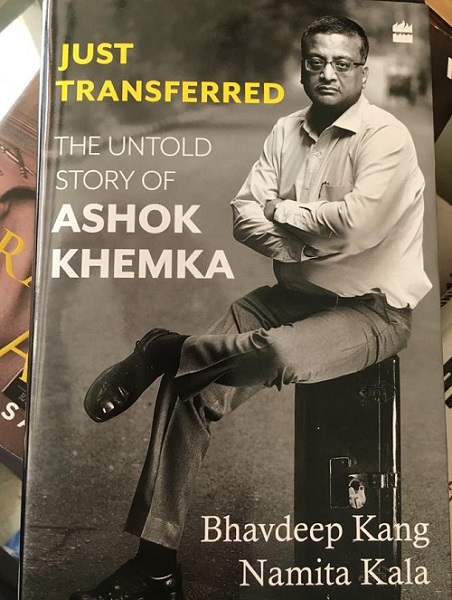
Bhavdeep Kang and Namita Kala’s brilliantly scripted book, Just Transferred: The Untold Story of Ashok Khemka (from Harper Collins) highlights the plight of this brilliant IAS officer who was routinely transferred because he took on the power, the power brokers and politicians. He never protested, no one bothered when he packed his bags and went for the next posting. Worse, messages reached his new office even before he could assume charge, the lobbyists informed the officers that a troublesome person is coming to take charge, he must be listened but ignored. But Khemka stood his ground, he was like the master of the earth, a root man who would not let anything spoil the land. But he was a lone ranger.

When ‘Vadragate’ broke, Khemka was DG, Land Records & Consolidation and Inspector General, Registration and fully aware that manipulation of revenue norms for the benefit of influential individuals was standard practice in Haryana. He had already inquired into and taken action in multiple instances of misappropriation of panchayat land. All hell broke loose, news reports suggested there was evidence of gross undervaluation of properties registered by Vadra’s companies. Khemka started probing his own officers. He asked revenue officials in Gurgaon, Faridabad, Mewat and Palwal to examine the allegations of undervaluation in Vadra’s deals and demanded the relevant land records. But there was a deathly silence.

The book says it all, especially how Khemka reiterated his request for the records. One of the officials got back to him a couple of days later, expressing strong reservations about complying with his request. The official and his colleagues were warned by powerful politicians that the matter should not be probed. Khemka was flummoxed but he brushed his fears aside and renewed his request for the records in question. On October 8, 2011, his staff prepared the paperwork for an inquiry into Vadra’s land purchases in Haryana. Khemka knew he was walking into a lion’s den and there could be some serious, inevitable consequences. He was summoned by the CM on October 11 and ridiculed like anything. He was called Khoparchand that translates into a buffoon. But within seconds, the CM retracted his word. He said, “I am just joking. It is Haryanvi slang.”

Like a James Hadley Chase novel, the authors weave the narrative in a gripping style. Khemka walked back home, realising he would soon be punished by the powerful politicians who would push him out with a routine transfer and loads of humiliation. He was ready. Inevitably, worse followed: He was to be shunted to an under-secretary level post in the Haryana Seeds Development Corporation (HSDC). With a seniority of twenty-two years, he was clearly qualified for a better post, befitting his rank. Khemka raised the red flag and registered his protest, but later that night, at 10 PM, the transfer order was delivered to his home. It was an error of judgement that was to cost Hooda dearly in the days to come, because Khemka’s stint in HSDC would lead to the unearthing of the Raxil scam which would result in a CBI investigation. But Khemka has to leave for a new posting, a new day.

Can you ever imagine the plight of an honest officer who has to face such humiliation for standing tall, standing correct? And what if he buckled and cleared the files. An investigation five or ten years later would push him to humiliation, even behind the bars. Remember the plight of those IAS officers who got caught for no fault of theirs in the infamous coal block allocation scam –the Coalgate? They are still struggling to keep their names clean.

Khemka knew, claim the authors, he had no one to back him. But he was supremely confident because he was honest, downright honest. Those who are honest have no one to fear, not even the Gods. Wrote the authors: “On the morning of 12th October, 2012, a Friday, Khemka followed protocol by calling up the incumbent MD of the HSDC, a promotee and twelve years his junior. He asked his successor when he should take charge. The gentleman was on tour in Rewari, and suggested that they swap jobs on Monday, after the weekend. Khemka informed the office of the chief secretary of the conversation. And off he went to his old office. The news dominating the day was a press conference by the former CM, Om Prakash Chautala, who alleged that Real Earth Estate Pvt. Ltd, a firm owned by Vadra, had bought 29 acres of land in Mewat at a price far below the collector rate. Chautala demanded a probe into Vadra’s dealings in Haryana and alleged undervaluation of registered sale deeds.

Then, he shot off a letter to the chief secretary protesting against his transfer.

At noon, one of his subordinates dropped in to see him. The man’s main agenda pertained to a departmental inquiry against him. He wanted Khemka to undertake it. ‘Sir’ told him that it was no longer possible because he had been transferred, but he promised to write an explanatory note for his successor. They chatted and that’s when Khemka learnt about the size of Robert Vadra’s deal with DLF in Shikohpur village. Vadra had sold his land to DLF on 18th September 2012. Judging from the size of the deal, said his subordinate, the land was worth “16 crore an acre”.

“No, no! I am telling the truth, sir,” the subordinate protested. He went on to suggest that if someone were to purchase two half-acre plots in Shikohpur village, where consolidation was underway, he could ensure the allotment of a 1-acre plot adjoining Vadra’s. Would ‘sir’ know of anyone who might be interested in such a deal? Khemka shook his head dismissively. But on his way out, the functionary decided to drop a copy of the Vadra-DLF sale deed in his superior’s car. When Khemka got home, his man Friday, as usual, piled all the files and sundry papers he had found in the car next to the bed. Right on top was the Vadra-DLF sale deed. The name ‘Skylight’ caught Khemka’s eye. He picked up the document and started reading. As Khemka read the sale deed, it became clear to him that Vadra had earned super profits through what appeared to be a chain of suspicious transactions. He then rang up an official in the Town & Country Planning department to verify the facts of the case. That gentleman confirmed that the information in the sale deed was correct.”

He was brief and to the point: Do not probe further or create a problem by sharing this information with others. It was clear to Khemka that the deal in question was not above board, because it involved sidestepping rules and a substantial loss to the Exchequer. On the other hand, as a loyal bureaucrat, he was expected to behave like Gandhi’s three monkeys and remain blind, deaf and mute.

But Khemka preferred not to lie like a prostrate, disemboweled Gulliver. He stepped up the heat, and walked that extra mile. Indian bureaucracy’s Forever-In-Transit man never gave up against the pressures, he just paid the price of being straight. The book shows how it is for the bureaucrat to remain firm on the decisions, and not play garden-garden as wonderfully depicted in Anurag Kashyap’s two part classic, The Gangs Of Wasseypur.

A brilliant read. 
YES Bank? Ah, now its the NO Bank!

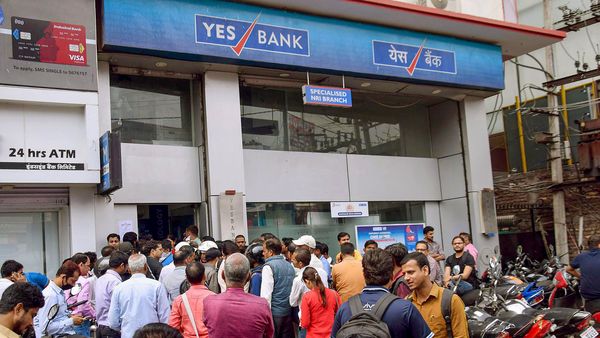
Yes Bank is a classic case of complete travesty of fate. Not just history but even fraud repeats itself. Compulsively.

Several years ago, when the flamboyant Rana Kapoor launched his overly ambitious enterprise in late 2003 and named it Yes Bank, the first powerful premonition that came to mind was that the self-serving business model of this family dominated bank, which was dressed to appear professionally run was destined to rise and fall rapidly. The flux of time has proved this apprehension unerringly right. Effective 5th March, 2020 this Bank has come under the supervision of the Reserve Bank of India (RBI).

Impressive but Flimsy Track Record

The deft camouflaging of fake large volume transactions, nepotism, favouring unworthy borrowers, repeated acts of money laundering, lending against norms prescribed by RBI, violating code of banking conduct – all for quid pro quo – are some of the highlights of the business style of the gutsy Rana Kapoor, ably assisted by a coterie of “trusted” bank officers, operating level staff, collusive auditors and regulatory inspectors – and not the least, the other Board Members and so-called Independent Directors —  without whose abetment, not a single such misdeed could have ever been perpetrated. All of these people are collectively guilty of connivance and contributory negligence.

In recent years, Yes Bank was on the path of aggressive growth, following wild and indiscriminate lending decisions by its Board. As on March 31, 2014, the bank’s loan book stood at ₹55,633 crore and deposits at ₹74,192 crore. The loan book grew to ₹2,24,505 crore at the end of the second quarter (September) of the current financial year, while deposits were at
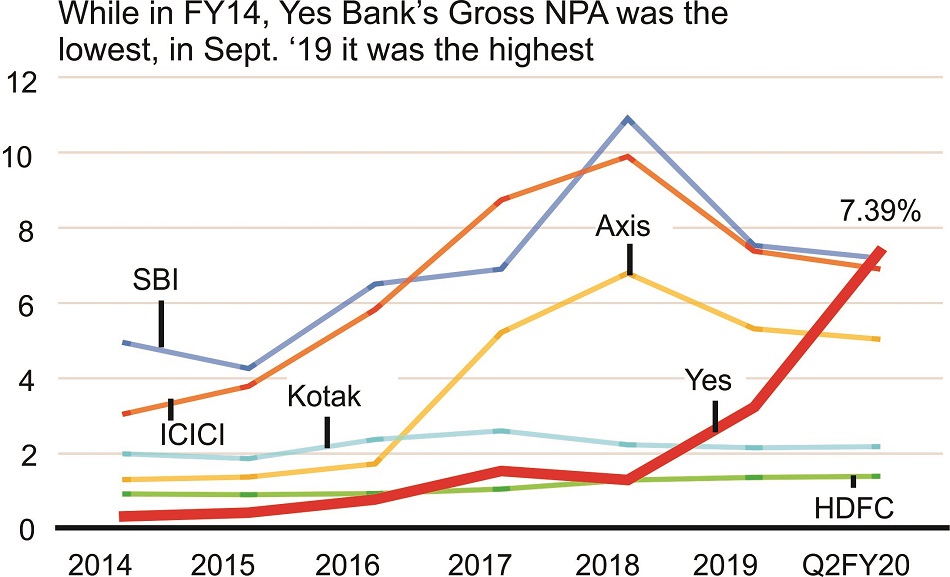
₹2,09,497 crore. So in the last five years, the loan book grew by over four times, but deposits failed to keep pace. Asset quality worsened during this period, with gross non-performing assets (NPAs) going up from 0.31% as on March 2014 to 7.39% . Basel-3 norms were unceremoniously thrown to the winds.

Confidence Drop

Amidst the loan mess, customers withdrew large amounts, resulting in the credit-deposit ratio of Yes Bank crossing 100% (the bank lent more than what it received) in financial year 2018-19. A credit-deposit ratio of 106% means the bank loaned ₹106 for every ₹100 it received.

Investors sensed trouble

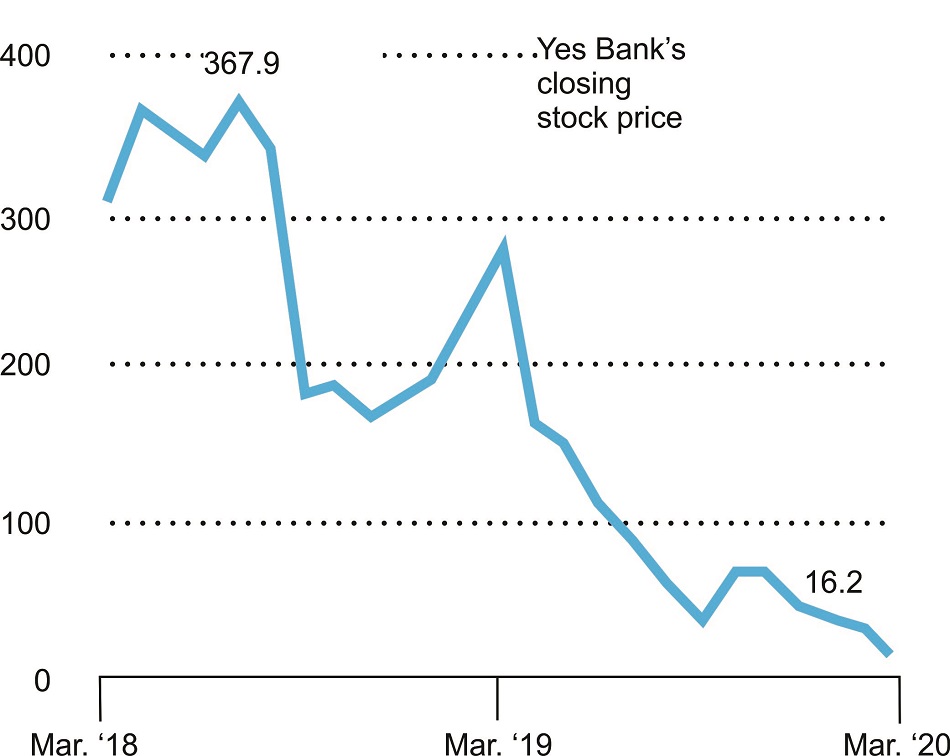
Though the bank’s troubles came as a shock to many, investors sensed it early. The bank’s stock price fell steadily in the past year.

Tumbling Stocks of Yes Bank

According to reliable reports received recently from investigating authorities, Yes Bank had provided loans aggregating to ₹3,750 crores to DHFL and ₹600 crore to RKW Developers, an entity controlled by DHFL. They defaulted on payment but got kickbacks of ₹600 crore in Doit Urban Ventures, an entity controlled by close members of Rana Kapoor’s family.

Real Issues to Address: Primordial Role of RBI

But that’s not the real issue being analysed. The most recent adversities faced by this Bank were waiting to happen. Unfortunately, the concerned authorities did nothing to prevent the catastrophe from happening despite visible forebodings.

The iconic Reserve Bank of India, established under the RBI Act of 1934 long before India gained Independence, is a magnificent Institution by any measure. Like all central banks, RBI is always expected to remain completely independent from the national government in power and function with unfettered power and total freedom to safeguard the country’s monetary system and promote the national economy.

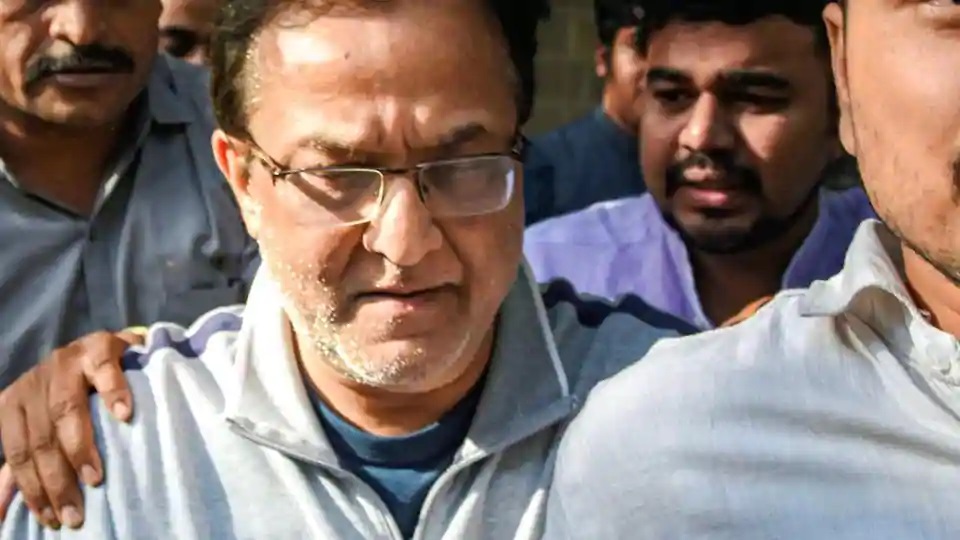
Yes Bank Promoter Rana Kapoor has now been arrested. Enforcement Directorate (ED) suspects that Rana Kapoor was involved in money laundering to the tune of 4,300 crore. (Photo: PTI)

Clearly, as events on record prove, RBI has failed to fulfil its cardinal role, thus adversely impacting its credibility and pre-eminent stature as India’s admired apex financial regulatory authority. Let us understand the three main reasons for this.

Firstly, it has often yielded to directives in the past from the national government — regardless of party in power — thus compromising its independent decision-making and operational authority. This forced a series of resignations of top RBI officials unprecedented in its long and illustrious history of over 85 years. They were all men of high professional calibre and personal integrity, who were unwilling to work against their conscience and unprepared to serve as ‘yes men’.

Secondly, RBI has failed to institute stringent control mechanisms to effectively prevent the occurrence (recurrence) of (a) serious bank frauds and (b) significant levels of non-performing assets (NPAs) in both the public as well as the private sector. It has neglected to introduce preventive measures and early warning systems capable of detecting and controlling these problems in their nascent stage, instead of allowing them to escalate to full-blown crises. The central bank’s intelligence system has proved to be woefully inadequate.

Thirdly – and the cause of the second deficiency — there has been a sharp decline in governance standards and oversight mechanisms covering commercial banks, which RBI is expected to follow consistently, covering all facets – not just policing — of this vital sector of the national economy.

Specific Forewarning Published October 2019

In a deeply researched article published as far back as 13th October 2019 in New Intervention, this Author provided a thorough analysis of the deeper causes which resulted in PMC Bank’s failure. In this article, the Author had prophesied as follows, under the sub-section titled: PMC is not the last Case:  “ ….it is evident that the rot is very deep in India’s Financial System.  Beyond doubt, the replication of several PMC-type frauds are already in the making, perhaps on a larger scale.” 

“Yes Bank is a classic example of misuse of bank resources, as their own records acknowledge.  Their shares have lost 96% of recent market value.”

It’s sad that the RBI did not take any action, until the bubble burst recently.

Clearly, it is only the RBI which should accept blame for this latest tragedy, because perpetrators of financial crime will continue their misdeeds unless prevented from doing so by means of stringent regulatory practices and in-built systemic safeguards.

A series of very deeply considered recommendations have already been put forth in my earlier article on PMC Bank. Each and every recommendation therein is relevant to and applies equally, perhaps more so to the Yes Bank.  Readers are invited to refer my earlier article by clicking in this link.https://newsintervention.com/pmc-bank-scam-is-indication-of-the-systemic-rot-in-indias-financial-sector/

Urgent Actions now Required by Government of India, Platitudes Apart

It is time the Government decides on interceding to prevent recurrence of such frauds in our economy which is already languishing for a variety of reasons.

Post PMC Bank’s fiasco, the RBI Governor said “our Banking System, including co-operatives, are safe, sound.” His unwarranted platitude now echoes with magnified hollowness and greater falsity. Do our trusting investors and harmed depositors deserve to lose their precious monetary resources arising from systematic fraud perpetrated by wily promoters of private banks? Can we subscribe to the tenet that profits are privatised while losses are nationalised?

Can Indian entrepreneurs not present a better picture of themselves to the world and shed this fraudulent stance? Can bank employees and auditors not stop colluding with unethical Promoters and Directors? Can our regulatory systems not become truly effective?

The entire gamut of remedial actions necessary to prevent such gross misdeeds involving thousands of crores of rupees of unsuspecting depositors has been clearly defined in my earlier article on the PMC Bank.  What may now be added is the strong recommendation that RBI must create a new, independent Intelligence Wing, with a specific mandate to discreetly gather inside information of key decisions and developments in all banks and financial institutions. Offices of this Intelligence Wing would be located in all State and Union Territory capitals.

The information so gathered should be aggregated and analysed to draw up distilled reports which are then provided to the herein recommended Intel Sub-Committee of the main Board of RBI on a monthly basis – as well as on need-based ad hoc basis — including its perception of emerging financial risks and pre-emptive actions recommended by it to the RBI. Serving and retired officers from India’s law enforcement agencies must be inducted to support the functioning of this RBI’s Intelligence Wing. Trusted employees must be chosen to serve as implants and informants in key offices of banks in all States and UTs. Their skills would lie in prompt early stage diagnosis of financial crime-in-progress and swift reporting misdeeds in their nascent stage to deter their damage. This activity calls for close and regular interaction with SEBI, stock markets, other banks and financial institutions, MCA, corporates etc to gather useful early-stage clues of possible irregularities in the offing.

It is also recommended that the Government of India take urgent steps to constitute a Joint Parliamentary Committee – assisted by an independent team of senior experts including former RBI and Finance Ministry operating chiefs — to review the governance standards and oversight practices covering commercial banks and financial institutions presently being followed by both RBI and the Ministry of Finance in their respective domains. This exercise must culminate in the time-bound formulation of new, thoroughly overhauled regulatory practices incorporating stringent measures to pre-empt fraud and raise deterrent procedures, aimed at safeguarding precious public monetary resources of our country.

In the following phase, RBI and Ministry of Finance must initiate coordinated actions based on these prescriptions, with a sense of deep commitment and urgency. It is further recommended that a randomly composed Special Audit Group — variable annually – closely oversees the very functioning of RBI’s Governance Systems and certify their soundness periodically.

End Note

The money spent on implementing and persevering these recommendations year after year would be but a fraction of the colossal losses being presently faced by the India’s banking sector.

Sending a few people to jail is not the answer because these people anyway knew this would be their ‘guest house’ during the coming days; and yet, they chose to willfully commit such acts of serious fraud. They will soon get accustomed to their new interim habitat, as courts will grant them bail in a few months, enabling them to return to their life of luxury. Their cases will then prolong for many years. Public memory being short-lived, the whole episode will soon be forgotten, much the same has happened in the cases of Global Trust Bank, Satyam, Nirav Modi, various Chit Fund scams, and other unpardonable ignominies across India, which have now faded or are in the process of receding into history.

The real solution lies in making the entire banking system fraud-proof on an enduring basis, using the valuable recommendations comprising preventive measures and comprehensive know how already offered by this Author. Readers are now free to draw judgement and respond on social media or file PILs in the interests of our economy and the people who contribute to its economic well-being. Without waiting for another tragedy to occur in our crises-hit banking sector which is already in shambles — tottering to rise equal to the task of being able to support the attainment of the much vaunted $5 trillion economy by 2025, which –  believe it or not – calls for a sustained GDP growth rate higher than 14% year on year– a complete myth in the absence of a flawless, robust and trustworthy banking system.

© CSS Rao 2020 All rights reserved.

Pak regime killing Baloch and Pashtuns: Afghan politician tells UNHRC

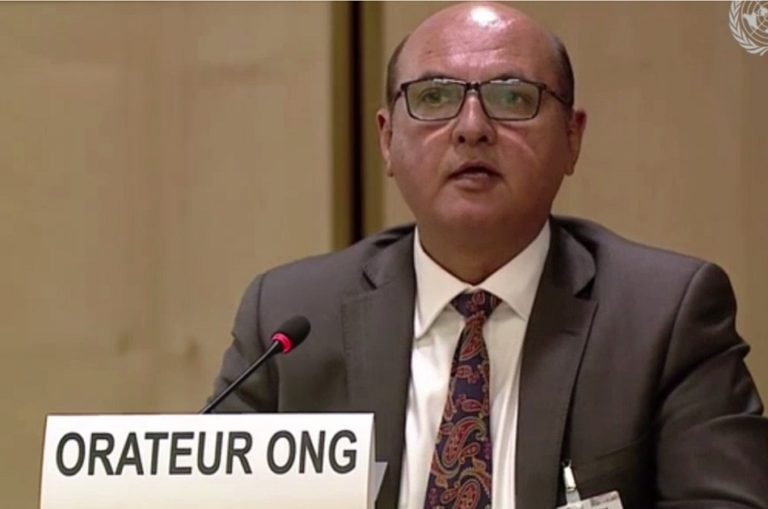
Dr Abdullah Haiwad, President Afghan Governors Assembly and former Governor of Afghanistan’s Ghor province has forcefully raised the issue of mass killings and gross human rights violations of Baloch and Pashtuns at the hands of Pakistani regime.

This is the first time that human rights violations in Balochistan have been raised by an Afghan politician at the UN’s international forum.

Speaking at the 43rd session of UN Human Rights Council (UNHRC) in Geneva, Dr Abdullah Haiwad vehemently urged the Human Rights Council to send their delegates to Balochistan to “see for themselves” and get a first-hand information about what is happening in Balochistan. He also raised the issue of how Pakistani regime is abducting and killing the Pashtuns who are a large majority in Pakistan and in Afghanistan.

“I did not come with a piece of paper today. I came with the plight of tens of millions of Pashtuns and Baloch living under the oppression in Pakistan. Since 1948, when Balochistan was occupied by Pakistan hundreds and thousands of Baloch have been abducted, mutilated and killed by the Pakistani government and their plight have never been addressed by the United Nations. Pashtuns are similarly under the oppression of the Pakistani government. Thousands and thousands of Pashtuns have been abducted and they have been killed, they have been discarded and nobody has listened to the plight of the Pashtuns,” said Dr Abdullah Haiwad during his address to the UN Human Rights Council (UNHRC) in Geneva.

He explained that in recent times the Pakistani regime has increased its spate of abductions and killings of Baloch and Pashtuns. “Recently there’s been a surge of attacks on Pashtuns and Baloch in Waziristan and other parts of Pashtunistan as well as in occupied Balochistan in Quetta and other parts of Balochistan. Unfortunately this voice has never been heard and this plight has never been raised. I urge the Human Rights Council who address this issue more seriously to send the delegates to Balochistan and Pashtunistan to see for themselves what the problem is and what is happening.” Dr Haiwad added.

Pashtunistan is the geographical region in Pakistan and Afghanistan inhabited by the Pashtuns. Balochistan was illegally and forcibly occupied by Pakistan in 1948, and continues to be under forceful Pakistani occupation till today. Pakistani regime’s infamous “kill and dump” policy where the Pakistani Army kills and dumps Baloch people was rarely discussed in international forums. Global champions of human rights also have never discussed about brutal human rights violations in Balochistan. Dr Abdullah Haiwad has taken a bold initiative to apprise the world about killings of Baloch and Pashtuns by Pakistani regime by urging the UN Human Rights Council to send delegates to these regions to get a first hand information about the ground realities.

COVID-19: GOI rescued 902 Indians and 48 foreign nationals in multiple evacuation operations

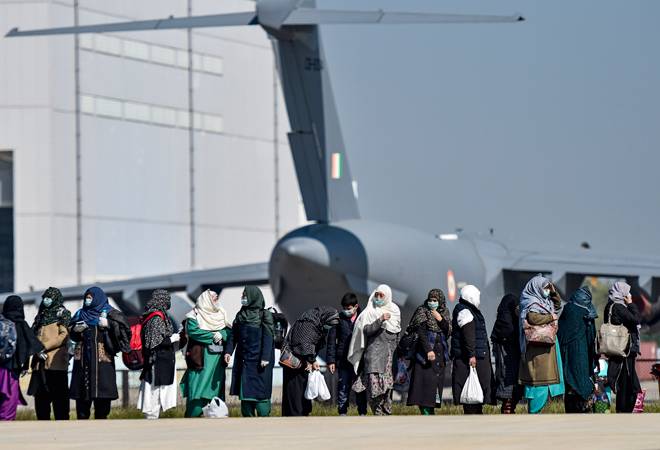
Government of India undertook evacuation operations from several countries in the wake of the COVID-19 outbreak. So far, Government of India has evacuated 950 passengers from COVID-19 affected countries. Out of these, 902 were Indian citizens and 48 belonging to different nationalities including Maldives, Myanmar, Bangladesh, China, US, Madagascar, Sri Lanka, Nepal, South Africa and Peru.

The Wuhan city in Hubei province of China had become the epicenter of the COVID-19 and there were hundreds of Indians stuck in the city. India engaged with China to safely evacuate its citizens and citizens of other friendly nations on a priority basis. Air India operated two special flights for the evacuation efforts which brought back 654 passengers that included 647 Indian citizens

The first batch consisting of 324 Indians were evacuated from Wuhan, China on 1st February. 104 of these were quarantined for monitoring at ITBP Chhawla camp and the rest 220 were housed in the army facility at Manesar. The second batch of 330 passengers (including 7 Maldivian citizens and two Indian Embassy officials who were on the ground to coordinate the evacuation efforts) arrived in India on 3rd February. 300 of these (including 7 Maldivians) were housed at ITBP Chhawla Camp and 30 were shifted to Manesar facility for monitoring. All of these evacuees were placed in the isolation facilities for14 days. They were tested twice and were found negative for COVID-19. They were discharged on 18th February, 2020.

On 26th February, Indian Air Force evacuated 112 passengers from Hubei province in China. Among these 76 were Indian citizens. The other nationals evacuated by Indian Air Force included citizens of Myanmar, Bangladesh, Maldives, China, USA, Madagascar and South Africa. The passengers reached India on 27th February and subsequently are housed at ITBP camp for a period of 14 days as per protocol. They have tested negative for COVID-19 in the first test. The IAF flight had also carried medical supplies which were given as good-will gesture to China.

Japan (Diamond Princess Cruise Ship): The Japanese Cruise Ship, Diamond Princess, carrying 3700 passengers faced a COVID-19 outbreak when 705 passengers were tested positive. Among the 705 affected passengers, 16 were Indian nationals. On 27th February, Air India flight carried an evacuation operation bringing back 124 passengers including 5 foreign nationals from Sri Lanka, Nepal, South Africa and Peru, from Port of Yokohama in Japan. 16 Indian nationals who were tested positive for COVID-19 are undergoing treatment. The evacuees are housed at army facility in Manesar. They have tested negative in the first test.

Monitoring and surveillance of Indian nationals in Iran: As it became clear that Iran was also facing a COVID-19 outbreak, Government of India started to undertake measures to ensure safety and security of its citizens in the country. Indian nationals in Iran include pilgrims, students and fishermen. On 7th March, 108 samples were received from Iran. These samples are being tested at the laboratory of AIIMS. Also, six scientists from the Indian Council of Medical Research (ICMR) have been stationed in Iran. Equipment and reagents have also been dispatched to enable them to setup a lab. India is expected to undertake operations to evacuate its citizens soon. First batch of 58 Indian pilgrims were brought back from Iran in IAF C-17 plane on March 10, 2020.

Localised urban sanitation solutions must to make Indian cities truly inclusive

With a lot of emphasis on developing ‘smart cities’; the current government has been providing a major push to urban growth in the country.  The National Smart Cities Mission, which is an urban renewal and retrofitting program by the Government of India, aims to develop 100 smart cities across the country making them citizen friendly and sustainable. But is it possible to make cities and urban settlements inclusive, safe, resilient and sustainable, without focussing on urban sanitation and people’s participation? The National Conference on “Future of Urban Sanitation in India”, organised recently in New Delhi, emphasised on localising Sustainable Development Goals (SDGs) and the need to accelerate behaviour change and citizen participation for inclusive and sustainable urban sanitation services.

As per the Census 2011, 31% of India’s total population is urban. 2613 towns in the country have reported 22.4% slum population out of 4041 statutory towns, 17% of total urban population lives in Informal settlements, 31% HHs in informal settlements lack access to toilets and defecate in open, 71% informal settlements lack access to underground sewerage system, 31% informal settlements lack draining system, and 27% of informal settlements have no arrangement for garbage disposal. For any sustainable growth of cities, participation of urban poor is, thus, extremely critical. The focus should be on localising Sustainable Development Goals (SDGs) in the context of the provision of urban services such as transportation, sanitation, sewerage, and waste management. It is extremely important to create commensurate spaces for acknowledging and encouraging people’s engagement with urban policy frameworks, and to invest in local development planning.

Dr. Rajesh Tandon, civil society leader and President, Participatory Research in Asia (PRIA), is of the view that, “Sanitation must be a priority, if economic growth matters. Investment in sanitation should also be seen as an economic priority as 8-10% of cities GDP is coming through economic contribution of informal settlements.” He believes that there is a need for catalysing and supporting local action, because investment in small and medium towns remained unutilized over the past 5 years, as the Urban Local Bodies (ULBs) did not have the capacity to utilize those funds, and invest in local planning.

Prof. Om Prakash Mathur, Senior Fellow, Institute of Social Sciences believes that localisation of SDGs is not restricted to just the Municipality. “There are public private enterprises, private sector, civil society organisation, etc which undertake activities at their own level. How exactly do we work to bring them all together? This is something that needs to be thought about,” he says.

Taking into account the lack of progress in urban sanitation and the concern of informal settlements Prof. Amitabh Kundu, Distinguished Fellow, Research and Information System for Developing Countries (RIS), says, “In India, only one-third of urban households are connected to a sewerage system, while others use pit latrines and septic tanks. The smartest solutions here are not necessarily going to be found in the frontiers of technology, and can also be found in the institutions of governance, community mobilization, and support systems. Global standards are not sufficient in the developing world, and need to include local knowledge and reporting.”. He further adds that upscaling of solutions is difficult, because it requires an in-depth knowledge of the local contexts, socio-economic condition of the prospective beneficiaries and flexibility in crafting solutions.”

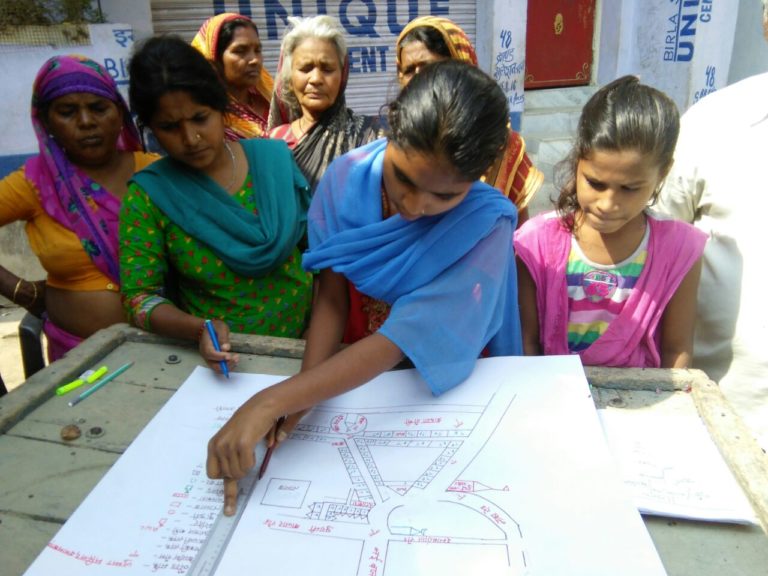
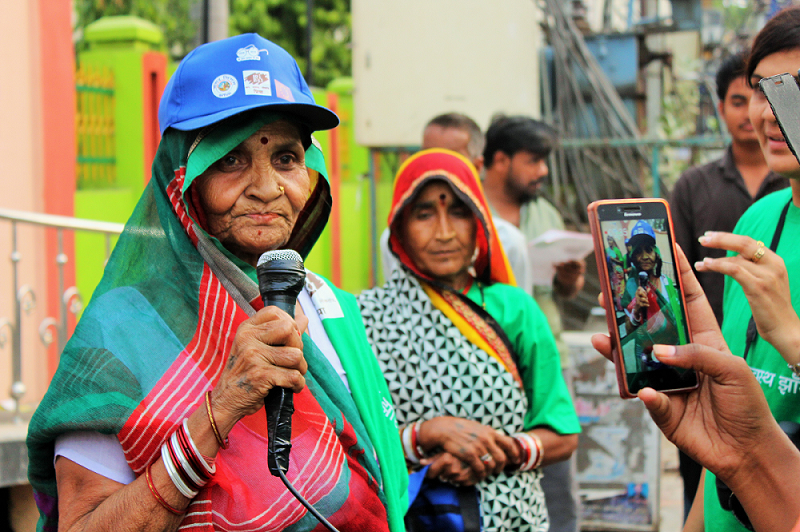
A notable project aimed towards making urban sanitation inclusive and sustainable in India, being implemented by Participatory Research in Asia (PRIA), is the “Engaged Citizens Responsive City (ECRC)” project in Ajmer (Rajasthan), Jhansi (Uttar Pradesh) and Muzaffarpur (Bihar). The project is being implemented with support from the European Union. Over the last four years, ECRC project has fostered numerous innovative practices to engage citizens with a particular focus on the urban poor in bottom-up participatory planning based on authentic data generated by the communities. Strengthening Civil Society of the Urban Poor to Participate in Planning and Monitoring of Sanitation Services in Indian Cities. The project focussed on 169 municipal wards, reached to 250 Informal Settlements directly (305 indirectly), touching 0.25 million urban poor in three cities. The ECRC initiative of PRIA and many other initiatives by civil society organisations, municipalities, state and national governments are valuable sources of knowledge about how to accelerate effective behaviour change and strengthen citizen participation.

There is a need to strengthen decentralized local decision-making capacity as well providing mechanisms in urban spaces for people’s comprehensive participation and engagement with political matters. Sustainability of the enhanced urban sanitation services will be contingent upon sustained citizen participation and behaviour changes along with enhanced capacities of Urban Local Bodies (ULBs) and the city-level institutional ecosystem. The adoption of Sustainable Development Goals (SDGs) and New Urban Agenda (NUA) usher a new opportunity for making cities sustainable, resilient, and inclusive through appropriate planning and governance. Nearly all the SDGs have targets that will depend on local government action, including SDG 11. Localisation is the process by which local authorities and local stakeholders will adapt and implement these targets within cities and human settlements. Experts feel that emerging lessons around inclusion and participation of all stake-holders for effective sanitation need to be shared so that new India can emerge in its many urban centres soon.

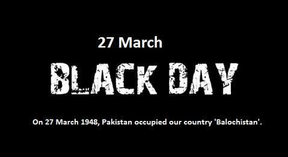
Baloch National Movement urges everyone to observe 27th March as Black Day

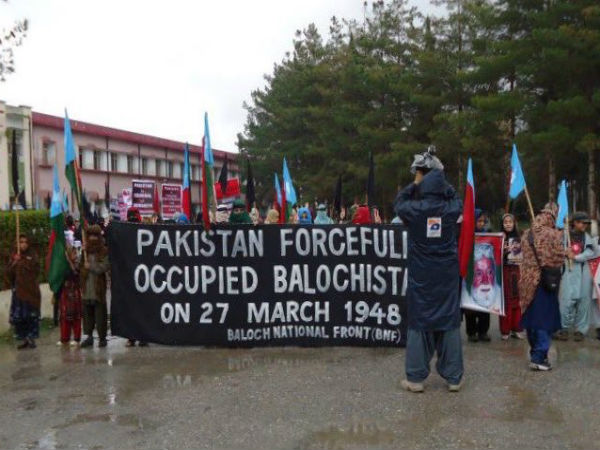
Baloch National Movement (BNM) has called upon to observe 27th March as a Black Day. The spokesperson of Baloch National Movement, in a statement, said, “Like in the past years, this year also we will observe 27th March as Black day. All zones of the Baloch National Movement will organize reference programs in Balochistan as well as at the international level in Germany, Netherlands, Australia, South Korea, England, and Canada. BNM’s different zones will demonstrate and protest.”

The BNM spokesman said that 27th March, 1948 will always remain etched in the Baloch history. On this day, Pakistan had occupied the newly formed state of Balochistan, which had its own history of thousand years, through brute military power and after that Pakistan turned the Baloch nation into its colony. From this day Baloch national identity, its culture, traditions and high moral values fell prey at the hands of a state that completely lacks history and culture. The sole purpose of the formation of a state like Pakistan was to safeguard the vested interests of the West.

The spokesman of Baloch National Movement (BNM) also said that from 27th March 1948 Pakistan has caused destructive impact on Baloch history, culture, and tradition. “On this day we lost our freedom and were forced to live a wretched life of slavery. The living and active nations never forget the days of national significance, rather observe it with the fullest intensity and draw policies according to the requirements and importance of such occasions. Therefore it is our national responsibility to educate our youth and the world about the historical significance of 27th March. On 27th March 1948, Pakistan occupied Balochistan and turned us into colonized people. Hence, the Baloch nation rejected the occupation of Balochistan and has been struggling against Pakistani occupation from the very first day. This national movement of the Baloch nation has gone through several ups and downs, and it is still going on with fullest vigor towards its cherished destination. The Baloch nation has offered infinite sacrifices in this journey; the series of sacrifices will continue until the final destination of national liberation.”

He added that Pakistan had been targeting political activists, social workers, students, professors, doctors, engineers, lawyers, literary persons and people from all fields of life in order to crush the national struggle and enslave Baloch nation for eternity. Thousands of Baloch have been martyred and thousands more had been enduring the atrocities and inhuman torture in the custody of the Pakistani Army.

“Today Baloch nation is facing an all out genocide which has continued in different ways from the first day of the occupation of Balochistan.”

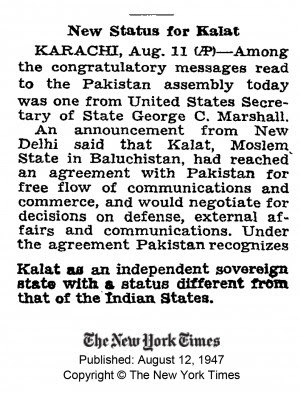
The BNM spokesman further explained: “The ruler of Balochistan Mir Ahmedyar Khan on 11th August 1947 announced the freedom of Balochistan from the British empire that was broadcast by All India Radio Delhi and on 12th August 1947, New York Times also published this news of the freedom of the State of Kalat (Balochistan). After the fourth day of the freedom of Balochistan, on 15th August 1947, Britain declared the independence of subcontinent while creating two different states India and Pakistan,”

“The ruler of Balochistan, Khan of Kalat revived the old traditional system of ruling through establishing a bicameral parliament, Dewan-e- Aam (House of Representatives) and Dewan-e-Khas (House of Lords) by following the cabinet system of Great Britain. Meanwhile, Mohammad Ali Jinnah having the backing of Britain started exerting pressure on the state of Kalat to join Pakistan. In this regard, the first parliamentarian session of the lower chamber of Balochistan was convened in Dadar in order to discuss the question of accession to Pakistan between 12th to 15th December 1947. Balochistan’s House of Representatives (Dewan-e-Aam) unanimously rejected the idea of accession to Pakistan. Similarly, Dewan-e-Khas (House of Lords) rejected the motion of joining Pakistan on 4th January 1948. The Parliament of Kalat in its second session on 27th February 1948 once again rejected the idea of joining Pakistan.”

He further added, “After this Pakistan sent its regular army into Balochistan and occupied Balochistan by brute military force on 27th March 1948. Baloch nation opted to resist this military aggression of Pakistan which has continued as one of the extremely successful resistance movements till today.”

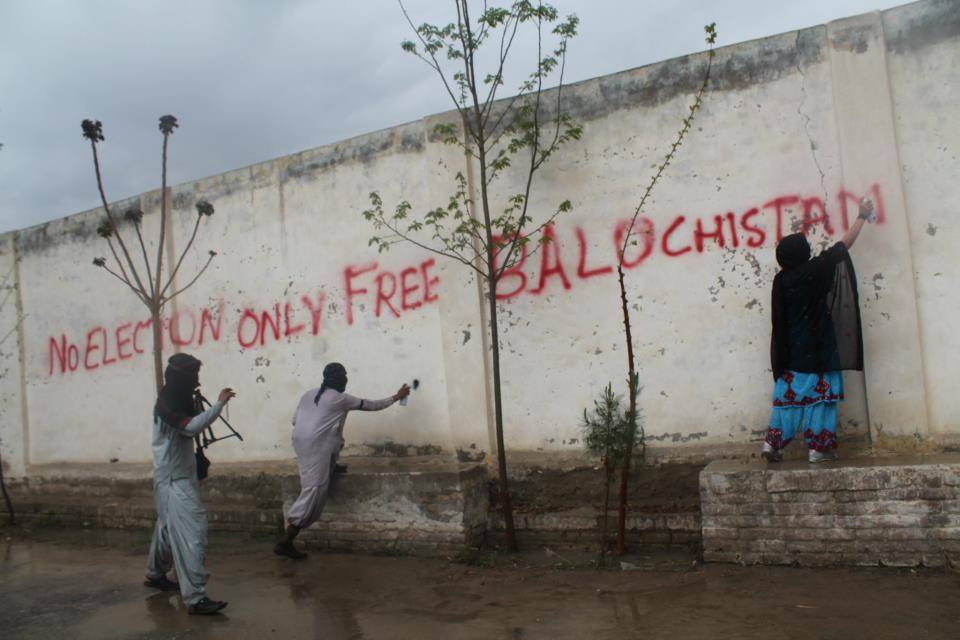
Free Balochistan: The Writing is on the Wall !

He said, the Baloch nation is known for its hospitality, bravery, resilience, secularism, religious tolerance and abiding by agreed accords. The Baloch nation has always resisted the foreign invaders and struggled against the expansionists. The historical event of resistance against Alexander, Iranian empires, Arabs, Mongols, and Central Asian invaders are a golden part of our history of resistance. This is the reason Balochistan has always been a hard nut for the foreign invaders to chew.

He explained further: “On 13th November 1839 under the leadership of Major Wilshire, the British Army attacked Kalat. But the ruler of Balochistan instead of surrendering to the British Army opted to resist the advancing army and preferred martyrdom. Even amidst the intrigues of British, Balochistan maintained its existence and sovereignty till 27th March 1948. But the British remain successful in dividing India into two parts. They needed a client state in this region to protect their interests in the future. They remained successful in galloping Muslim League and Mohammad Ali Jinnah as their pawns that successfully worked in their favour.”

History witnesses Pakistani occupation of Balochistan through the conspiracy of Britain. It is also the hard part of history that during the conference of 4th August between the ruler of Balochistan and Viceroy of India, the leaders of Muslim League, Mohammad Ali Jinnah and Liaquat Ali Khan were also present where the freedom of Balochistan (State of Kalat) and the return of British Balochistan were discussed. As well as the position of Balochistan was kept separated from the other states of India and Balochistan was declared a separate sovereign state.

The spokesperson of BNM said that Baloch nation observes 27th March as Black Day every year, because this day Pakistani Army stormed into Balochistan and forcefully occupied Balochistan on 27th March 1948 against the wishes of the people of Balochistan. “We have lost our national identity after becoming a colony of Pakistan. Not only we have been deprived of our motherland, but also soon after the occupation of Balochistan Pakistan Army set on atrocities and genocide of a Baloch nation.”

Previously Baloch nation has gone through four waves of national genocide, the fifth waves of Baloch national genocide has started with the beginning of the 21st century. In comparison, to the previous episodes, this phase of the Baloch national genocide is much more intense and extended. Thousands of Baloch are killed and thousands more lie in the custody of the Pakistani state and millions of people have been forced to migrate. But unlike past, this time the Baloch nation is more committed and determined in its struggle to attain national freedom. This is the obvious symbol of the love and sacrifice of the Baloch nation for the freedom of their motherland.

“Baloch National Movement (BNM) will run an online campaign on social media while using the hashtag of #27MarchBlackDay. It is an appeal to all social media users and human rights activists to take part in this online campaign,” the BNM spokesperson said.

Discrimination due to skin colour must stop. Now.

A month ago the Indian government introduced a bill seeking ban on promotion of fairness creams and other products. The punishment, in case of a violation, could be a jail term of five years and a fine of Rs 50 lakh. Yes, this is an extremely commendable move and this social issue should have been discussed at length—that unfortunately did not happen. For years, we have seen fairness creams being promoted brazenly on television channels, radio and the print media. And of course, Bollywood has played its part. Mega stars including Shahrukh Khan and Yami Gautam have shamelessly featured in advertisements showcasing fairness creams.

The ads had one message—life was in shambles due to the colour of the skin and the moment the skin tone changed and became lighter or fairer, things brightened up. How terrible and absurd can that be!

India, like the world over, has been obsessed with fair skin and this is not just a development of recent times, the trait can be traced back to the country’s ancient history. We have been taught how the Aryans were conscious of their skin colour and therefore considered themselves superior to the Dravidians who had darker skin complexion.

This trait, unfortunately has stubbornly remained etched in the country’s social order. It is no secret how matrimonial columns read in India. It was considered absolutely normal to “want” beautiful, slim and fair girls as brides. Again if the groom was well educated with a good job, it was almost as a matter of right that he and his family would seek a beautiful and fair girl.

During my growing up years, I have seen how the society celebrated girls and women with fair skin tone. I spent most of my growing up years in Kolkata, a city known for its culture and intellect. But unfortunately things were not very different even there. In the 1990s and 2000s, being fair skinned was an advantage and clearly mostly those who qualified being “fair” often displayed a sense of superiority.

Barring Kajol, we hadn’t seen a Bollywood star, especially around that time who looked “normal” – like a girl next door. They had to be fair and being fair meant being beautiful.

Several comedians on television programmes or movies have ridiculed people especially girls for being dark. And worse, this was never considered rude or offensive. Small wonder that Hindustan Unilever Limited’s signature brand Fair & Lovely has been one of the most demanded products for many years. Words like “kallu” (slang for Black) and descriptions such as “kali bhains” (Black Buffalo) among many others were just as normal as they could be.

What is even more baffling is the fact that Indians often complain of racial discrimination when they go outside the country. Yes, they may have been subject to discrimination due to their skin colour but is it okay to complain when we ourselves are utterly racial in our innate behaviour?

Even today, many wouldn’t admit or agree but the society does discriminate against people of other nationalities who are dark skinned. Often they have to face up to excessive aggression by many of us and that is shameful. Simply put, many Indians complaining of racial discrimination are racists themselves and have biases against those with dark skin colour.

Earlier this year Norway banned Fair & Lovely creams as they found toxic ingredients in it posing health hazards. While it does make many feel elated that the ads for these products have been banned but it would have been better if they had been taken off the shelves for social and ethical reasons.

The silver lining: Things are starting to change. We have seen several activists including Nandita Das coming forth. It is also heartening to see things gradually change in Bollywood, which is nothing less than religion in India. Remember in the Ranveer Singh-Alia Bhatt blockbuster Gully Boy, the message was clear—shun Fair & Lovely or any fairness products.

As we gear up to celebrate yet another Woman’s Day on March 8, let us ensure that no girl or woman is discriminated because of her colour. It is not only important to ban promotion of fairness creams but it is time we ban the usage of those products.

Despite current normalcy in Kashmir, the danger is far from over

This time of the year, in 2019, there were great tensions between India and Pakistan. The immoral terrorist attack on a CRPF convoy at Pulwama, Kashmir, on 14th February elicited a strong riposte from India. Indian Air Force carried out a very successful air strike on a terrorist camp at Balakot, deep inside the Pakistani territory on 26th February. More than 300 terrorists trained and ready for infiltration into India were killed in the strike.

The very next day, a weak aerial response from Pakistan was met with strong opposition from the Indian Air Force and the Pakistani jets were forced to withdraw. In the heat of the air battle a daring Indian pilot, Wing Commander Abhinandan, shot down a Pakistani F-16 aircraft. The aircraft of Wing Commander Abhinandan also got hit and he ejected successfully, but inside the Pakistani territory and was taken as a prisoner. After hair raising negotiations, where India maintained a strong and righteous stand, the pilot was returned back to India on 1st March, 2019.

The release was appreciated as a good gesture by Pakistan, but, it did not have any impact on the situation along the Line of Control (LOC) and the hinterland in Jammu and Kashmir. Ceasefire violations and terrorist initiated violence continued unabated.

Post the General Elections in India, BJP came back to power. One of the first actions that it took was to bring about the long awaited and much desired change of political status of Jammu and Kashmir. In an act hailed as both righteous and justified, the new government passed legislation to dilute the draconian Article 370 and Article 35A and also bifurcated the state into two manageable Union Territories.

Anti-India separatist forces led by Pakistan predicted massive riots and disruption of normal life in the wake of the new dispensation. Their predictions, however, proved terribly wrong with the people accepting wholeheartedly the new set up as one that would be of benefit to them.

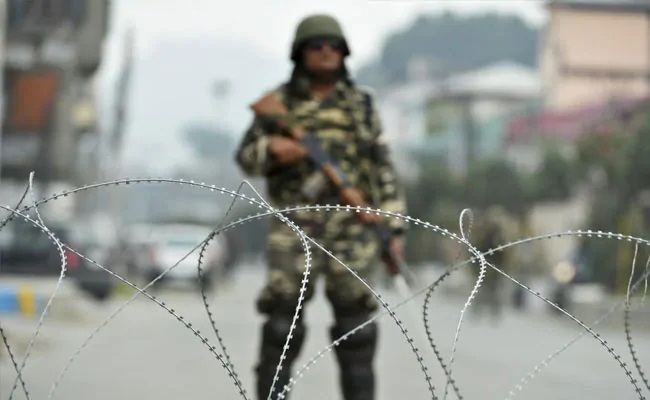
Considerable credit for this peaceful transition lies on the broad shoulders of the Indian Army. The force remained sensitive to the emerging challenges. Pakistani attempts to increase the threshold of violence both along the LOC and in the hinterland were thwarted effectively. The army worked in close coordination with other security forces and gave them the confidence to function in the very difficult conditions.

The end result was that the government was able to bring about the legislated change on schedule despite all threats of dire consequences. The two Union Territories under their respective Lieutenant Governors became effective on the night of October 31st, 2019 as planned.

Even as the political process continues smoothly, the Indian Army and other security forces have enough cause to remain ever vigilant against machinations of a very determined enemy – Pakistan. The year 2019 witnessed a record 1,586 incidents of ceasefire violations. This year has been no better with 646 ceasefire violations already recorded in the first two months up to 23rd February. The singular objective of ceasefire violations is to infiltrate terrorists into Kashmir since the existing strength is dwindling at an alarming pace, much to the discomfiture of the Pakistan Army and its ISI.

The period from declaration of the new status of Jammu and Kashmir on August 5th, last year to the present has witnessed 27 encounters of security forces with terrorists in Kashmir; a sizeable number considering the depleted condition of the terrorist cadre. The terrorists operating in Kashmir had been given a “fight to the finish” diktat by their masters sitting across the border. 

In the interim, there has been a change in command of the Indian Army with General MM Naravane taking over as Army Chief. As expected, he is giving full attention to the region. General Naravane has extended full support to the new political dispensation put in place in the region, and has made no bones about the proactive policy that the Indian Army would follow in eliminating the scourge of terrorism. “The scrapping of Article 370 — a historic step — has adversely affected the plans of the western neighbour and its proxies. It will help integrate Jammu and Kashmir with the mainstream,” he said, further adding that the armed forces would have “zero tolerance against terrorism.” “The army has many options to counter those who promote terrorism. We will not hesitate to use them…We will respond in equal measure,” he said in a strong message to terrorists.

“We have evolved a strategy of resolute punitive response against sponsored terrorism. If Pakistan does not stop state-sponsored terrorism, we reserve right to pre-emptively strike at sources of terror,” was the direct message that General Naravane gave to Pakistan.

Recently, Lt. General KJS Dhillon has completed an eventful and successful tenure as General Officer Commanding of the Chinar Corps of the Indian Army, whose operational area falls in the Kashmir Valley. The army has chosen as his replacement, Lt General BS Raju, who has great experience in the region having commanded a Brigade and a Rashtriya Rifles Force Headquarter there. On taking over command, Lt General Raju, spoke of the marginalisation of the separatist and militant movement. “I believe that those nurturing separatist feelings have been shown the door,” he said. He, however, also held forth a word of caution with respect to the security scenario by stating that there are indications that Pakistan may try to push terrorists into India. “We are prepared to give them a befitting reply and defeat their nefarious designs,” he added.

Many positive changes have taken place in the last one year and things are moving smoothly, but the danger is far from over. The new political dispensation is firmly embedded but Pakistan has no intention of shelving its malevolent designs for the region. The security forces, led by the Indian Army, need to remain ever vigilant and proactive so as to provide the platform of normality on which the political process can take roots.  

US-Taliban peace deal shows American desperation to quit Afghanistan

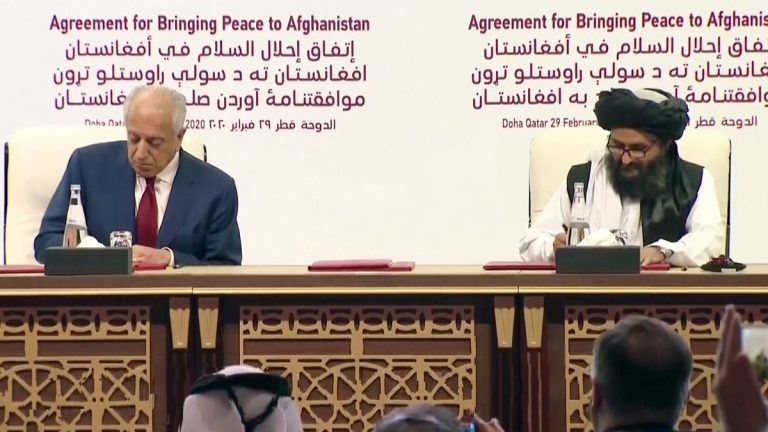
Every nation works in the best interests of its people and so there’s nothing wrong with Washington making an agreement with the Taliban to end the nearly two-decade old conflict in Afghanistan in order to get its soldiers back home. But who would have ever thought that a country that talks so big about its unconditional commitment to fight the scourge of terrorism worldwide, would abandon this stated principle so shamefully for exiting Afghanistan? Yet, what has happened is right there in front of us to see and current developments don’t inspire much confidence that this so-called ‘peace deal’ will work out as is evident from the renewed attacks by Taliban within just two days of the accord being signed.

But then, what’s happening is on the expected lines because in its tearing hurry to get out of Afghanistan, Washington has made two cardinal mistakes. The first one is that even though US President Donald Trump correctly identified Pakistan as being the patron of Taliban (remember his 2018 tweet “They (Pakistan Government and Army) give safe haven to the terrorists we hunt in Afghanistan?” and yet Washington’s efforts to discipline Islamabad weren’t either sustained or determined. Whereas the US did impose certain restrictions on financial aid to Islamabad for “not doing enough” in its war against terror, it seems that the US State Department was over awed by Pakistan Foreign Minister’s Khawaja Asif’s open threat that Washington couldn’t win its war on terrorism “by excluding or confronting Pakistan.”

Trump’s second blunder was making his sheer desperation to exit Afghanistan so evident that it emboldened the Pakistan Army not only to continue patronising Taliban but also discreetly pushing it to dictate ridiculous terms and preconditions. Taliban’s proclivity for violence is well known and its car bombing in Kabul that killed a US serviceman in September last year forcing Trump to call-off the peace deal that was in its final stages is ample proof of this. Yet, rather insisting upon that the Taliban should display its seriousness by ensuring a reasonable period of peace as a prelude to signing the accord for American troops withdrawal from Afghanistan, Washington surprisingly settled for merely a “reduction in violence” clause, and that too for just one week. But the most astonishing thing is that this weird one-week long “reduction in violence” condition wasn’t been set by Washington but thrust upon it by the Taliban.

This leaves one in no doubt as to who’s calling the shots during the US-Taliban negotiations and it’s because of this that the proposed peace deal appears to be a non-starter. Already, the Taliban has put an unreasonable precondition that 5,000 of its captured fighters should be freed before negotiations can proceed any further and Taliban spokesman Zabihullah Mujahid has already warned that, “If our 5,000 prisoners – 100 or 200 more or less does not matter – do not get released there will be no intra-Afghan talks.” It’s quite likely that in its desperation to exit Afghanistan, Washington may oblige to release these prisoners; but doing so will be a humungous blunder because once its captured fighters are released, the Taliban will have no reason to honour an agreement that questions its supremacy.

Even if the accord works out and gives an honourable closure to the US-led military operation in Afghanistan (officially christened “Operation Enduring Freedom”), the one thing certain is that peace will continue to elude Afghanistan! The Taliban doesn’t recognise the democratically elected Government of Afghanistan (and since Rawalpindi too isn’t quite happy with it), a bloody power struggle between Afghan forces and the Taliban after US troop withdrawal is inevitable. The Taliban has already made this clear by launching 43 attacks on Afghan security check-posts on Tuesday and though these attacks are obviously meant to pressurise the Ashraf Ghani government into releasing Taliban fighters from Kabul’s custody, it also serves as a message that the Taliban will use guns to resolve its differences with the Afghanistan government, which it refers to as “the Kabul puppet administration.”  

Whereas the US has retaliated to the Helmand attacks with an airstrike against the Taliban, but by taking pains to clarify that this was a “defensive” strike, the Americans have exhibited an apologetic stance. But what’s most disturbing is that instead of issuing a strong and unambiguous warning of appropriate retribution in case such attacks don’t cease, the US military spokesperson Col. Sonny Leggett came up with a politically sounding tweet saying, “We call on the Taliban to stop needless attacks and uphold their commitments.” Whereas the US military may not be wanting to jeopardise the ongoing talks by adopting a belligerent approach, but by saying things that convey an impression of being willing to accept any compromise for saving the accord will only embolden the Taliban to violate the reached agreement.

Lastly, by demanding that the Taliban should take necessary measures to “prevent any group or individual, including Al Qaeda, from using the soil of Afghanistan to threaten the security of the United States and its allies,” the Americans may give an impression of being very concerned about the wellbeing of their allies. But by conveniently missing out the seeking of a similar safeguard in terms of Taliban not threatening the security of the Afghan government, Washington is literally ushering in an all-out civil war that would obviously culminate in the Taliban’s return to power in Afghanistan and replay of the dark 1996-2001 period that saw unspeakable atrocities being committed on innocent men and women.

Postscript- It was America’s Faustian deal with Pakistan in the 1980s that not only saw the rise of Taliban but also created a fertile breeding ground for the spawning of religious fundamentalism and radical Islam. Four decades down the line, we are once again witnessing Washington making another Faustian compromise that will accord official recognition to the Taliban terrorist group. Strange as it may sound, but the reality is that while America wants the world to shun Tehran for allegedly patronising terrorist activities, but by turning a blind eye to Pakistan which (by Prime Minister Imran Khan’s own admission) has been providing sanctuary to many internationally proscribed terrorist groups, Washington has fared no better!

Karnataka government presents ‘Child Budget’

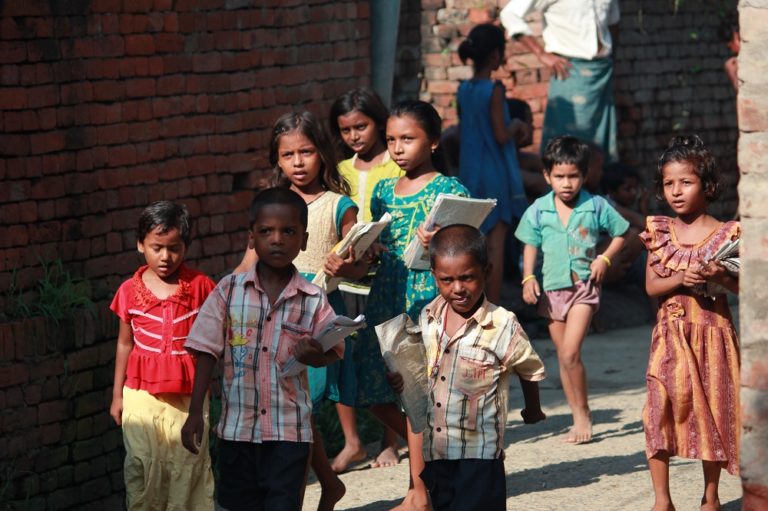
Bringing child-centric issues and relevant policies in focus, for the first time in India, Karnataka government presented a ‘Child Budget’ on Thursday. Chief Minister B.S. Yediyurappa said this budget, as a special feature, consolidates all the policies and programmes for the development of children aged below 18. It has 279 programmes with an allocation of ₹36,340 crore, which constitutes 15.28% of the total volume of the State Budget.

The Child Budget lists a range of issues — survival, protection, and development — from different departments. The maximum funds in this Budget are from the Department of Primary and Secondary Education and the Department of Women and Child Development. Experts feel that this kind of budgetary focus  will facilitate better programme monitoring and expenditure on child-centric issues.

The Chief Minister also announced modernising Mahila Supplementary Nutrition Production and Training Centres, aimed at better nutrition at anganwadi centres. “To enhance the production capacity by modernising these centres, it is proposed to provide interest-free loan from ₹15 lakh to ₹20 lakh under the Marginal Loan Scheme of the Karnataka State Women Development Corporation,” he said.

It was also announced that youngsters who are discharged from Bala Mandiras after 21 years will be given a financial assistance of ₹5,000 a month for a maximum of three years under the ‘Upakara’ scheme. Skill Development Training will also be provided to these young men and women.

The government will repair 842 anganwadis damaged in floods last year at a cost of Rs 138 crore.

Another interesting announcement that was made was about bag free classes. Two Saturdays a month, school students in Karnataka will attend classes free from a load of school bags. “By making two Saturdays a month as bag-free days, ‘Sambhrama Shanivara’ will be observed with the objective of creating a joyful learning experience by reducing the burden of textbooks,” stated the Karnataka CM. There will be an effort to create awareness, through a range of activities, on topics that are necessary for students to be ideal citizens.