Home Blog Page 422

Lucknow to host 11th DefExpo from 5th to 8th February 2020

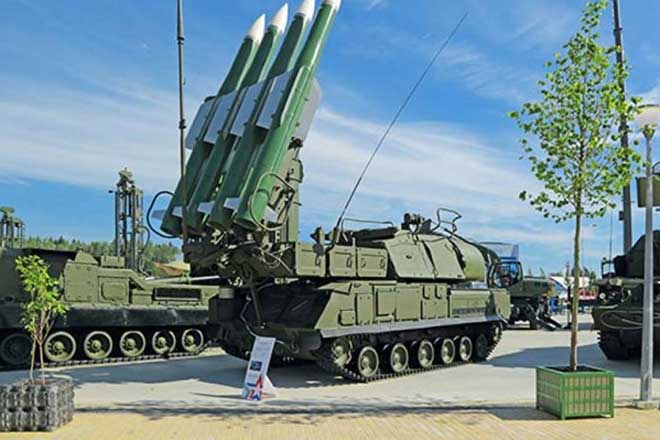
The 11th biennial edition of DefExpo India- 2020 is scheduled to be held for the first time in Uttar Pradesh capital Lucknow.  It offers an excellent opportunity for the Indian defence industry to showcase its capabilities and promote its export potential. Main theme of the DefExpo India- 2020 will be ‘India: The Emerging Defence Manufacturing Hub’ and focus will be on ‘Digital Transformation of Defence’.

The shows are conducted at an international level, which not only facilitates Business-to-Business (B2B) interaction with senior foreign delegations but also Government-to-Government (G2G) meetings and signing of Memorandums of Understanding (MoUs). The exhibition will also highlight emergence of UP as an attractive destination for investment in the defence sector and act as a platform for alliances and joint ventures in the defence industry.

The northern state has a strong defence industrial infrastructure. It has four units of Hindustan Aeronautics Ltd at Lucknow, Kanpur, Korwa and Naini (Prayagraj), nine ordnance factory units, including Kanpur, Korwa, Shahjahanpur, Firozabad and one unit of Bharat Electronics Limited at Ghaziabad. One of the two Defence Industrial Corridors (DICs) of India is also planned in Uttar Pradesh. The Corridor will encourage Defence Micro Small and Medium Enterprises (MSMEs), including our Indian defence industry and promote Defence Public Sector Undertakings (DPSUs). The other DIC is proposed in Tamil Nadu.

The DefExpo will provide an opportunity to the major foreign Original Equipment Manufacturers (OEMs) to collaborate with the Indian defence industry and help promote ‘Make in India’ initiative of Hon’ble Prime Minister Shri Narendra Modi. It will be a unique platform for Defence industry OEMs, exhibitors and private industry to display their latest innovations and capabilities.

Ministerial level delegations from the foreign countries and visitors from all over the country as well as abroad are expected to visit DefExpo and witness India’s emergence as a major manufacturing hub providing attractive opportunities for co-development and co-production of defence equipment and systems not only for our defence forces but also for export to the world.

Seema Kohli’s solo show in Belgium explores themes of femininity, beauty, and spirituality

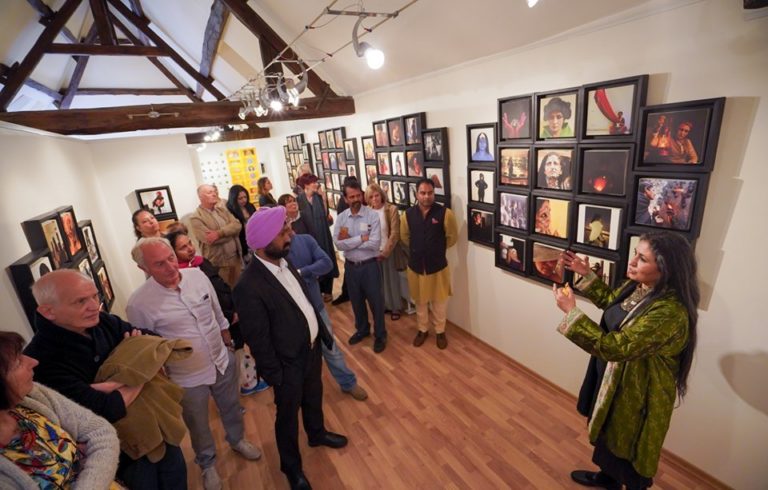
India’s celebrated artist Seema Kohli has recently taken her ‘Celestial Revelations’ to Belgium. The solo exhibition is currently on view at the Museum of Sacred Arts (MOSA), Durbuy. A multidisciplinary artist, Seema explores the myriad themes of femininity, beauty, and spirituality through her diverse set of works. The opening ceremony of the exhibition was marked by graceful performances of Harisaprasad Chaurasiya, flute maestro, and Gaura Nataraja, a brilliantly talented bharatnatyam dancer from Latvia.

 A celebration of female form and her energy, explored and captured in a contemplative mode, is well reflected in this vast and varied collection of about two hundred works of art in the exhibition. The show is curated by Sushma Bahl and founder of MOSA Martin Gurvich. The substantial solo show incorporates some new art in varied media created by her especially for MOSA. This includes Parvati within a composition of Ardhanarishwar as a manifestation of Shakti. Also ‘Saptmatrika’, ‘Astlakshmi’, ‘Navdurga’, ‘Dasmahavidya’, and ‘Chausath Yogini’, all of them revered women divinities, as part of the eclectic repertoire that celebrates female form and energy. “The body of works showcased at the museum encompasses my complete practice through various mediums and methods, ranging from sculpture in fibreglass & bronze, video, performance, paperworks, to, of course, paintings,” Kohli shared.

The focus for much of Seema Kohli’s artistic practice has been Hiranyagarbha  – the ancient notion of universe floating in waters amidst dark empty and non-existence realm, as the ‘golden womb’ – the all pervasive source of life. Inspired by philosophies and myths, the work retains its umbilical cord with divine dimensions as the central axis. The aesthetics of her art engage with beauty, vitality and sensuality within the concept of creation, decay and renewal in the cycle of life.  Another fascinating feature of her work is encompassing the sacred and the profane in a dynamic interactive mode, and not as opposing poles, as the creatives seek to search for the divine within. The remarkable exhibition embodies the ancient, mediaeval, modern, contemporary, urban and folk, as the different streams merge and cohabit in the soulful creations.

According to arts advisor and curator Sushma K. Bahl, “A fine blend of natural elements, anthromorphic forms and divine figures, often winged and flying, appear in Seema Kohli’s seminal artworks. There are mermaids and nymphs, women and men, gods and goddesses, birds and animals, trees and flowers, lotus and fish, the sun and the moon, mandala and other metaphors, along with meandering rivers and mighty mountains featured in the celestial revelations exposition. Various hybrid forms, part human part animal, encompassing the origin and proliferation of life add to the enticing appeal of the work.”  

“The multihued visuals incorporate swarming canvases, dense drawings, fine etchings, meticulously sculpted forms, enchanting installations, performative photographs and cinematic videos. The diligently drawn celestial embodiments, reveal and conceal as the creatives on display, in diverse mediums delve into the realm of Hiranyagarbha. Within the broad premise of Hiranyagarbha together with feminine energy, her visuals also explore themes of decay and transformation. In a dialogue of matter and memory, Kaal (time) and Maya (illusion), continuity and temporality, vulnerability and awareness, personal and public, the concept of Shakti, the divine feminine and cosmic energy, replays in diverse manifestations. A sense of harmony across faiths and coming together of yin and yang in tandem, evokes beauty and subliminally in her art,” she added. 

The range of materials and methods in Seema Kohli’s art-scape include prints, drawings on paper in pen and charcoal, paintings in watercolours and mixed media on canvas. Her sculptures and installations including cows and other forms, appear in bronze, fibre, steel and wood. She also works in photography, serigraphy and etchings besides live and performance videos. The exhibition will be on display at the Museum of Sacred Art (MOSA), Belgium till 15 December 2019.

Veteran Congress leader Sheila Dikshit passes away at 81

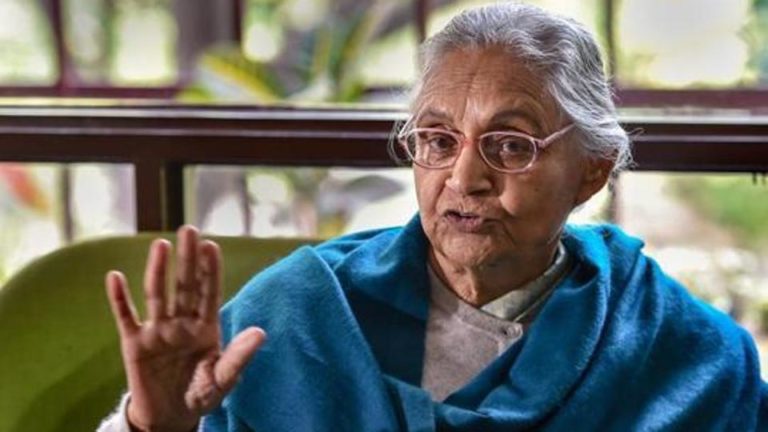
Popular Congress leader and former Delhi CM Sheila Dikshit passed away this afternoon. She was 81. Shiela Dikshit had been ill for a long time and was admitted at around 10.30 am today. She died at 3.30 pm at a city hospital.

Prime Minister Narendra Modi has expressed his condolences on the death of Shiela Dikshit. In a tweet he said he is deeply saddened by the news. “Deeply saddened by the demise of Sheila Dikshit Ji. Blessed with a warm and affable personality, she made a noteworthy contribution to Delhi’s development. Condolences to her family and supporters. Om Shanti,” PM Modi said in a tweet.

Dikshit was the senior-most Congress leader in its Delhi unit. She served as Delhi’s chief minister for 15 years from 1998 to 2013. Dikshit led Congress party to three consecutive electoral victories in Delhi. In the December 2013 elections to the Delhi Legislative Assembly, Dikshit was defeated in New Delhi constituency by Aam Aadmi Party leader Arvind Kejriwal, who replaced her as Delhi’s chief minister. Subsequently, she was sworn in as Governor of Kerala on 11 March 2014. However, she resigned on 25 August 2014. She had been declared as Chief Ministerial candidate for the Indian National Congress in the 2017 Uttar Pradesh Legislative Assembly election; however she later withdrew. She was appointed as president of Delhi Pradesh Congress Committee on January 10, 2019

Dikshit was also very close to UPA Chairperson Sonia Gandhi. In a tweet, the Congress said it regrets the death of Sheila Dikshit. The party said as chief minister, she transformed the face of Delhi in her 15-year tenure.”We regret to hear of the passing of Smt Sheila Dikshit. Lifelong congresswoman and as three time CM of Delhi she transformed the face of Delhi. Our condolences to her family and friends. Hope they find strength in this time of grief,” the Congress said.

UN Human Rights Commissioner has no knowledge about Kashmir

The fatuous approach of the United Nations towards understanding the dynamics of “Kashmir issue” came to the fore once more in the second report presented by the Office of the United Nations High Commissioner for Human Rights (OHCHR) on Human Rights situation in Kashmir and Pakistan-Occupied Kashmir (POK). The report covers the period from May 2018 to April 2019.

On 14 June 2018, OHCHR had released the first report on the human rights situation in what it termed as the Indian-Administered Kashmir and Pakistan-Administered Kashmir. That report spoke of allegations of serious human rights violations. A notable parameter was excessive use of force by Indian security forces that led to numerous civilian casualties, arbitrary detention etc. etc…

The OHCHR had the good grace to admit that, “…the quantity and quality of information available on Indian-Administered Kashmir contrasts significantly to Pakistan-Administered Kashmir. Despite significant challenges, NGOs, human rights defenders and journalists are able to operate in the Indian state of Jammu and Kashmir, generating documentation on the ongoing human rights violations there. Restrictions on the freedoms of expression, opinion, peaceful assembly and association in Azad Jammu and Kashmir and Gilgit-Baltistan have limited the ability of observers, including OHCHR, to assess the human rights situation there.” In this single paragraph the report has given two different names to the region which indicates a complete lack of functional clarity. Despite this indictment Pakistan had welcomed the report while India had dismissed it as biased and frivolous.

What came as a big surprise was that the OHCHR had based its conclusions on the inputs given by an organisation going by the name of Jammu and Kashmir Coalition of Civil Society (JKCCS) which, quite obviously, is aligned to Kashmir’s separatist movement being sponsored by Pakistan. It failed to leverage the complete freedom available in the state to collect some viable data and reach to empirical decisions.

It spoke of the use of pellet guns as an example of “excessive use of force” and failed to address the huge law and order problem that large, foreign motivated mobs create with the stone-pelting and the danger that is posed by them to the law enforcing apparatus of the state.

It spoke of the Armed Forces (Jammu and Kashmir) Special Powers Act 1990 (AFSPA) being a key obstacle to accountability since, “…In nearly three decades that the law has been in force in Jammu and Kashmir, there has not been a single prosecution of armed forces personnel granted by the central government.” This is a blatant lie. All cases pertaining to violation of law in Jammu and Kashmir have been investigated by the army. The Indian Army has, on several occasions, used the strict provisions of the Army Act to punish such soldiers who have committed criminal offenses. General Court Martial’s (GCM) have been convened and defaulters charge sheeted. The judicial procedure has been completed in a time period much less than what would be taken in a civil court. Justice has been fast and punishment exemplary.

The OHCHR has failed to understand that AFSPA does not give the soldier immunity from law, rather it merely places the soldier under a different set of laws that are equally stringent, if not more, than the Criminal Procedure Code. It is an enabling legislation that facilitates the soldier to function in an extraordinary situation without worrying about his own exploitation through legal means.

The OHCHR has further failed to understand that the Indian Army and other security forces operating in the state have an onerous responsibility to thwart all evil designs of the enemy and meet the aspirations of peace and tranquility that the common man harbours. While fighting foreign ingress in Jammu and Kashmir the soldier is only living up to his oath of securing the sovereignty and integrity of his nation and he can, by no means, be faulted for doing so.

The strong protest that India has lodged with UN Rights Office by asserting that the second report is a continuation of the earlier “false and motivated” narrative that ignores the core issue of cross-border terrorism emanating from Pakistan is the most befitting response to the meaningless discourse that the OHCHR seems to be pursuing of late.

One cannot help agree to a strong statement made by India’s Ministry of External Affairs Spokesperson Raveesh Kumar, “A situation created by years of cross-border terrorist attacks emanating from Pakistan has been ‘analysed’ without any reference to its causality. The update seems to be a contrived effort to create an artificial parity between the world’s largest and the most vibrant democracy and a country that openly practices state-sponsored terrorism.”

It must never be forgotten that the Indian Army while fighting against foreign sponsored insurgency and terrorism in Jammu and Kashmir has taken enormous risks of life and limb and has made tremendous sacrifices in order to protect the common man. The prime motivation for this has come from the love and respect that the common man of the region has bestowed on the soldier over all these years. The bond between the “Jawan and the Awaam” (soldier and the people) of Jammu and Kashmir has always remained strong and unique.

Till such time that Pakistan does not stop the export of terror from its soil the Indian Army has no option but to keep the pressure on and ensure that the threshold of violence is not allowed to escalate. Under these circumstances, there is little leverage to revoke AFSPA.

The OHCHR would be well advised to impose upon Pakistan to desist from its evil agenda of engineering cross border terrorism on to the territories of Kashmir and to give back to India the occupied territories of the state. Such an act would also assist Pakistan to shed the baggage of the partition and grow as a truly independent and honourable nation.

Dharmendra Pradhan urges use of steel pipes for water distribution

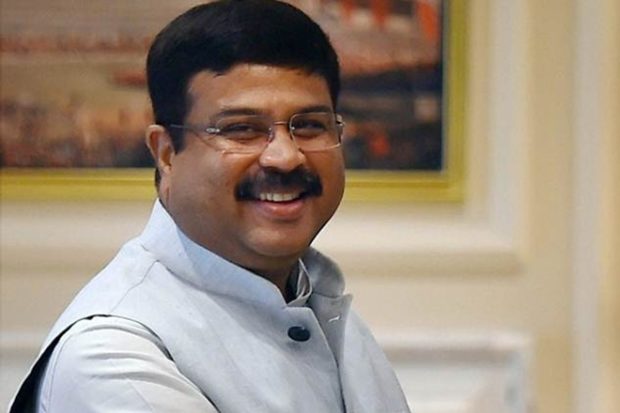
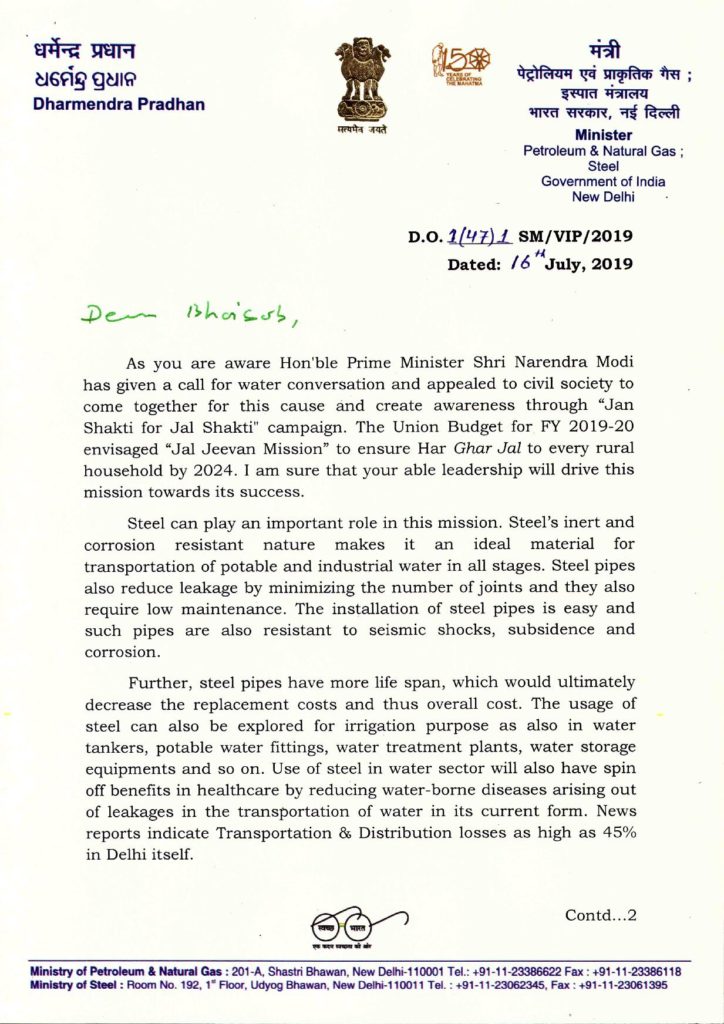
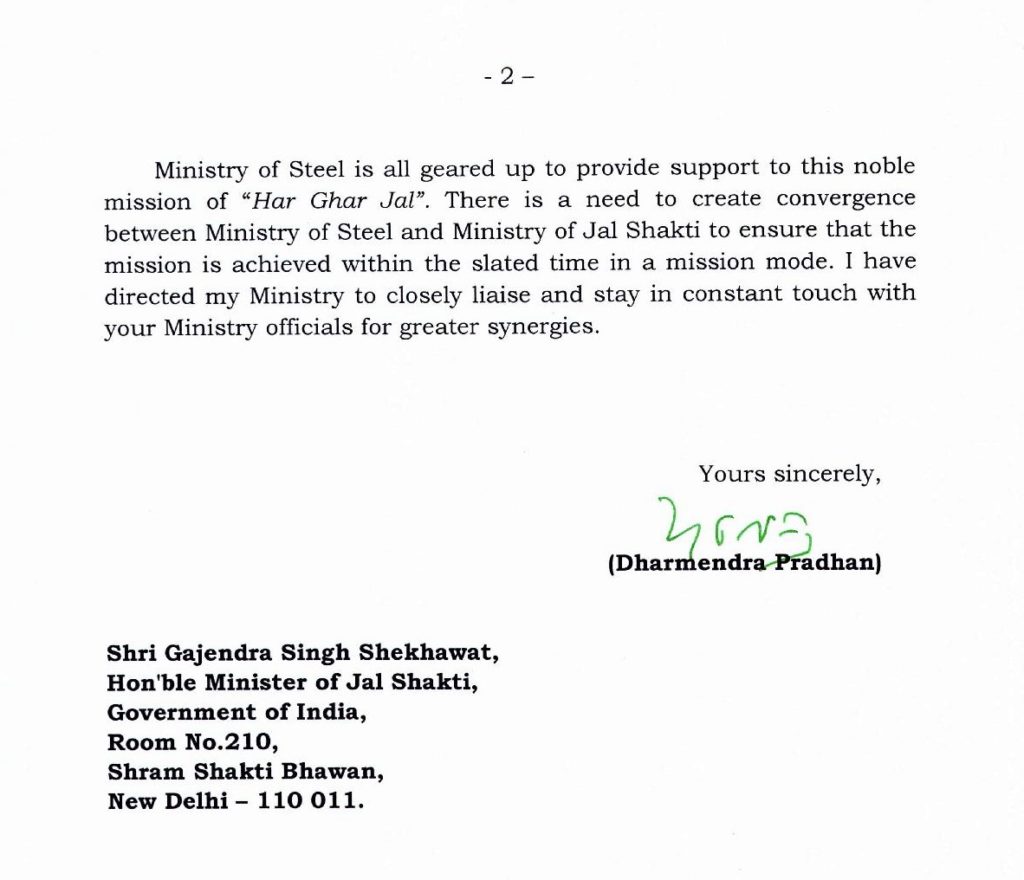
Dharmendra Pradhan, who holds the Ministries of Steel, Petroleum & Natural Gas has made a strong case for the use of steel pipes for water supply in the country. Pradhan in his letter to Gajendra Singh Shekhawat, Minister of Jal Shakti has pitched for a convergence between his steel ministry and the jal shakti ministry so that steel water pipes can be laid across India in order to ensure Har Ghar Jal (water connection to each home) by 2024.

“Steel can play an important role in this mission. Steel’s inert and corrosion resistant nature makes it an ideal material for transportation of potable and industrial water in all stages. Steel pipes also reduce leakage by minimizing the number of joints and they also require low maintenance,” Minister of Steel, Dharmendra Pradhan wrote in his letter to Jal Shakti Minister Gajendra Shekhawat.

Several industry estimates suggest that around 50% piped water is lost due to leakage in rickety iron pipes. Even in the country’s capital city Delhi, water lost in leakage during transmission is estimated at around 45%. All of this can stop if steel pipes are used instead of the iron pipes hitherto used for water distribution. Steel pipes also have a longer life span when compared with iron pipes thus reducing the replacement cost.

Minister of Steel Dharmendra Pradhan’s Letter to Jal Shakti Minister Gajendra Singh Shekhawat offering all cooperation to lay steel pipes for water distribution.

Minister of Steel Dharmendra Pradhan’s Letter to Jal Shakti Minister Gajendra Singh Shekhawat offering all cooperation to lay steel pipes for water distribution.

Outlining Prime Minister’s vision, Dharmendra Pradhan writes that Hon’ble Prime Minister Narendra Modi has given a call for water conservation and has appealed to civil society to come together for ‘Jan Shakti se Jal Shakti’ campaign.

Pradhan, further mentions that Ministry of Steel is all geared up to provide support to the noble mission of “Har Ghar Jal” (water to every home) and has called for convergence and synergy between the Ministry of Steel and Ministry of Jal Shakti to ensure this mission is achieved within the slated time.

Functional routes under UDAN rises to 186

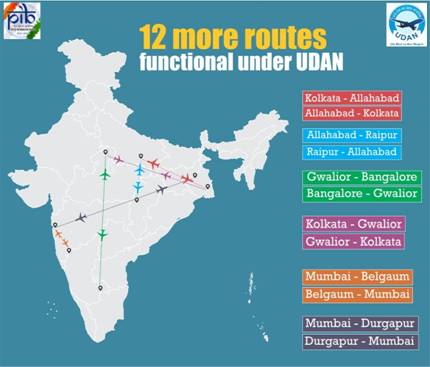
New 12 routes under the Regional Connectivity Scheme (or UdeDesh ka AamNaagrik /UDAN in Hindi) have recently become functional.  This takes the total operational routes under UDAN to 186 (including 8 Tourism RCS routes) of the total 706 sanctioned Routes. Also, Durgapur airport is the 40th airport to become functional under the scheme.

The 12 routes with daily flight operations that commenced are:

Kolkata(WB)- Allahabad(UP)

Allahabad(UP)- Kolkata(WB)         

Allahabad(UP)-Raipur(CG)

Raipur(CG)-Allahabad(UP)

Gwalior(MP)- Bangalore(KA)

Bangalore(KA)-Gwalior(MP)

Kolkata(WB) -Gwalior(MP)

Gwalior(MP)- Kolkata(WB)           

Mumbai (MH) – Belgaum(KA)

Belgaum(KA)-Mumbai (MH)

 Mumbai (MH)- Durgapur(WB)

 Durgapur(WB)-Mumbai (MH)

The Ministry of Civil Aviation (MoCA) had launched Regional Connectivity Scheme (RCS) – UdeDesh ka AamNagrik (UDAN) on Oct 21, 2016 to stimulate regional air connectivity and making air travel affordable to the masses.  Since then 3 Round of biddings have been completed. The first RCS-UDAN flight was launched by the Prime Minister on 27th April, 2017 at Shimla. 106 RCS Airports / Water aerodromes (76 Unserved, 20 Underserved & 10 Waterdromes) and 31 heliports have been identified for commencement of RCS flight connecting small cities in India.  706 RCS routes including 46 Tourism RCS routes have been awarded to 19 selected Airline operators under UDAN. RCS flights commenced from 40 RCS (23 Unserved & 17 Underserved) Airports and Durgapur is the latest airport on the map of  RCS UDAN .

Netflix to hit Amazon Prime and Hotstar with cheaper subscription plans in India

Online content consumption in India has seen massive growth with data plans becoming more affordable. Video streaming company Netflix has now decided to roll out a cheaper mobile-only plan in India as it looks to woo viewers amid growing competition from Amazon Prime Videos and other local players.

After several months of testing, the company has decided to roll out a lower-priced mobile-screen plan in India to complement existing plans, Netflix said in a statement. “We believe this plan, which will launch in Q3, will be an effective way to introduce a larger number of people in India to Netflix and to further expand our business in a market where Pay TV average revenue per user (ARPU) is low (below USD 5),” it added. Netflix had been testing a Rs 250 monthly subscription for mobile devices in India. Its current plans are available for Rs 500 onwards.

Netflix Chief Product Officer Greg Peters said the company sees an opportunity to broaden access to its service in India. Peters said the company is also working on partnerships in the Indian market. “We are also working on the partnerships we have in the market because we think there are specific opportunities to improve accessibility via those partnerships as well,” he said.

Netflix Chief Content Officer Ted Sarandos referred growth in India as a “marathon”. “We are in it for the long haul and we are seeing nice steady progress,” he said, adding that the company is also scaling up its library for the Indian market.

Netflix said its paid membership grew by 2.7 million in the second quarter, less than the 5.5 million in the year-ago period and its own forecast of 5 million for the June 2019 quarter. In the third quarter, Netflix said it expects to grow by 7 million paid memberships (0.8 million in the US and 6.2 million internationally) compared to an addition of 6.1 million subscribers in the year-ago period.

The company has over 148 million paid memberships in over 190 countries.

More than 1000 Indians languishing behind bars in Nepal; 3rd highest after Saudi and UAE

As many as 8,189 Indian prisoners, including undertrials, are lodged in various jails around the world, the External Affairs Ministry said on Thursday. While Saudi Arabia has the highest 1811 Indian prisoners, followed by the UAE with 1,392 and Nepal 1,160 jail inmates, Minister of State for External Affairs V Muraleedharan said in a written reply to a question in the Rajya Sabha. “As per the information available with the Ministry, the number of Indian prisoners in foreign jails as of May 31 is 8,189 which also includes undertrials,” he said.

“However, due to strong privacy laws prevailing in many countries, the local authorities do not share information on prisoners unless the person concerned consents to the disclosure of such information,” he said. Muraleedharan said even the countries which share data do not generally provide detailed information about the foreigners imprisoned.

The Union Minister said the government through its missions and posts abroad also takes up and pursues grant of amnesty and commutation of sentences of Indian prisoners in foreign countries.

“From 2016 till present, in the countries in the Gulf region a total of 3,087 Indian nationals have received amnesty or commutation of their sentences,” he said.

Pakistan is systematically destroying the fragile ecosystem of POK

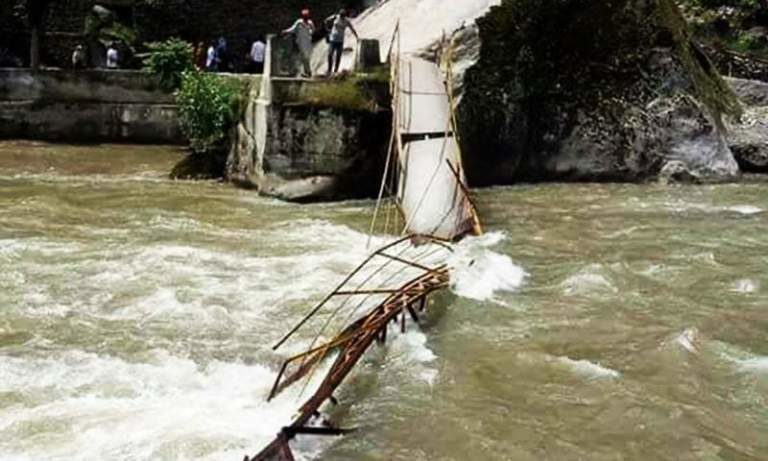
The beautiful Neelam Valley in Pakistan Occupied Kashmir (POK) stands devastated due to a cloudburst that led to flash floods. The calamity took place on 15th July and most badly hit was the Laswa area, where hundreds of houses and a few Mosques have been swept away. More than 23 people are reported to be killed while many are still missing. The death toll is expected to rise further.

The usual media blackout that is the norm for Pakistan under such circumstances is at play; not much information about the situation on ground is available. The preliminary report has been released by the State Disaster Management Authority. “The Laswa area of the valley was badly hit where many house were swept away. There were also reports of landslide in some areas. A total of 23 people have been killed,” said Syed Al-Rehman Qureshi, Director of Operations, State Disaster Management Authority. He added that several people, including women and children, are still missing.

The Pakistan Army, always in the forefront to take credit, has issued a press brief to say that 52 individuals have been evacuated to camps and safer places. A statement to this effect has been issued by the Pakistan Army’s media wing Inter-Services Public Relations (ISPR).

A week earlier on July 8th, floods hit several villages in Golen Gol area of Chitral district after the Jam Ashpar Glacier, a favourite destination of the tourists to Chitral, exploded overnight and burst its banks. The entire area got inundated, leaving the locals and tourists stranded. There was no electricity for several days and no roads to talk of. Among those stranded was Aleema Khan, the sister of Prime Minister Imran Khan along with many foreign tourists who had gone there to witness the famous Shandur Polo Festival.

While heavy, torrential rains is a normal phenomenon in these areas, inundation and flooding is something that is a recent phenomenon. According to experts the reason behind this is attempts by Pakistan to change the course of rivers emanating from the areas and construction of dams.

Junaid Qureshi, Director of the European Foundation for South Asian Studies (EFSAS), who operates a twitter handle @JQ_plaintalk tweeted, “Pakistan diverting the flow of the Neelam River into Punjab has today caused floods in the Neelam valley; 23 dead,150 houses and two Mosques destroyed. But why would we care for that part of Jammu and Kashmir? Our J&K “Azaadi” and so-called struggle is limited to Srinagar.”

The Neelam River is not the only example of dangerous exploitation of water resources of the region by the federal government of Pakistan. Stuck with a power situation that is getting worse by the day, Pakistan is determined to revive the mammoth Daimer-Bhasha Dam project. There is ample reason for this eagerness to get the project moving since the dam on the River Indus, to be situated near a place called “Bhasha” in Gilgit-Baltistan’s Diamer district, promises 4,500 MW of electricity and 8.5 million acres feet (MAF) of water that can be channelised for irrigation.

What is being sidelined is the fact that it will also displace 35,000 people and cause the inundation of scores of villages and lush farmlands. It will destroy a heritage that has existed for millenniums. The benefit of the project is likely to miss the locals (as is the norm in Pakistan), and accrue to the Punjab region.

The project has a long and chequered history. In January 2006, the Pakistan government announced its decision to construct 5 multi-purpose storage dams in the country over the next 10-12 years. According to the plan, Diamer-Bhasha Dam project was proposed in the first phase with an astounding price tag of over US $8.5 billion. The World Bank, however, linked construction of the Dam to a No Objection Certificate (NOC) from India since the area is under dispute between the two countries. Pakistan knew that no such certificate would be forthcoming. There was also the problem of public protest against the project. The project has remained in a limbo ever since.

As was expected China made an offer to construct the dam as it is constructing many others in Pakistan along with the China Pakistan Economic Corridor (CPEC). Surprisingly, Pakistan has rejected the offer in what is being seen as a strategy to showcase to the world that globally established rules are being followed for projects financed by China under CPEC. 

There are now reports emanating from Pakistan that construction of the dam could commence in mid-2019 with money collected through internal donations in a fund created by the chief justice and the prime minister jointly. It is quite surprising and unconvincing that the impoverished public of Pakistan would be in a capacity to donate or even willing to donate such a large amount for a project of this nature. There is a strong possibility that the money has been surreptiously provided by Pakistan’s friends such as China and Saudi Arabia.

Considering the many fault lines that plague Pakistan, it is astounding to see the country hurtling ahead to make one mistake after another. It is not being able to control its fragile internal security situation where fundamentalist war lords are calling the shots; it is unable to resurrect its gasping economy or convince the international community to provide it with a monetary lifeline. And yet, it is indulging in projects like changing the course of rivers and building costly dams which will have a severe environmental impact leading to man-made environmental disasters of the type that are already being witnessed.

Against this backdrop, India needs to generate extensive pressure to ensure that concerns that have been raised over the years are met in total by Pakistan. First is the disputed nature of the area, and second the more important is the plight of people who are essentially Indian nationals stuck in a debilitating condition of occupation. India has an abiding responsibility towards these people that goes beyond the territorial dispute.

20th Anniversary of Kargil War: Time to celebrate and introspect

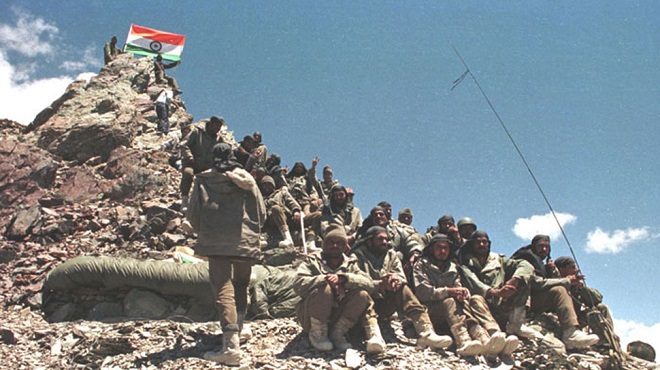
India is celebrating, in this month of July, 20th anniversary of the Kargil War, a military epic fought at heights over 16,000 feet and temperatures as low as minus 15 degree Celsius. The ignominious designs of a belligerent neighbour (Pakistan) to violate the territorial integrity of the nation were thwarted by a military action that has no parallel in the annals of military history.

The war was necessitated due to Pakistan’s ignoble attempt to occupy the Kargil heights in Indian territories with the objective of isolating Ladakh and occupying the Siachen Glacier and at the same time to open a route for ingress of terrorists into the Kashmir Valley. The plan was spearheaded by General Pervez Musharraf, the then Chief of Army Staff of Pakistan Army. It culminated on July 26th 1999, with Pakistan lamely announcing the withdrawal of its battered troops when there was very little left to withdraw.

The entire nation is poised to celebrate the historic occasion. The Indian Army has already set the ball rolling with a series of activities. In the battleground the army is recreating the historic events by undertaking a series of commemorative treks in honour of the martyrs. The treks are being conducted by the battalions that fought in the sectors. A trek to Tololing Top has been undertaken by 2 Rajputana Rifles. Similarly separate treks to Batra Top and Tiger Hill have also been undertaken by 13 Jammu and Kashmir Rifles (JAK RIF) and 18 Grenadiers.

The Chief of the Army Staff, General Bipin Rawat, has released a Kargil War Tribute Song titled, “Tujhe Bhulega Na Hindustan” that honours the martyrs and war veterans who fought the epic battles. The lovely and nostalgic song brings alive the sacrifices made by our young soldiers in service of their motherland. No Indian can merely listen to it without getting emotional and feeling immensely proud of the nation’s soldiers.

An Indian Army think tank, Centre for Land and Warfare Studies (CLAWS) has, on this occasion, published a book titled “Surprise, Strategy and ‘Vijay’: 20 Years of Kargil and Beyond.” A curtain raiser on the book by Nikita Kohli describes it as, “…An account of the war from various commanders, an in-depth analysis of the operations, the logistics, the movements, and of intelligence in the months of May, June and July 1999 and …predictive analytics provided by some of the most senior military officers of the country.” It will definitely be a good read.  

President Ram Nath Kovind is scheduled to lead the memorial service at the Dras War Memorial on July 26th and Prime Minister Narendra Modi will honour the heroes at the National War Memorial in New Delhi on the same day. The entire nation will join the leaders in remembrance of the great deeds of valour and pay homage to the heroes.

As the twentieth anniversary of the war approaches, it would be appropriate to revisit the treachery, duplicity and deceit that went into its planning and execution by Pakistan. Even as India was being feted with an olive branch by Pakistan, with the “Bus Diplomacy” of Prime Minister Atal Bihari Vajpayee being in full swing, the troops of Pakistan Army were already on their way to stealthily occupy Indian territories in Kargil.

The Pakistan Army, under the leadership of General Musharraf, factored in a normal winter, a weak and vacillating Indian reaction, a strong element of surprise, and most likely a strong international intervention for fear of a possible nuclear escalation. All tenuous probabilities not based on rational analysis. The then Prime Minister, Nawaz Sharif, has gone public to acknowledge complete lack of information about the operation; Benazir Bhutto openly condemned the same.

Having decided to launch the operation, the Pakistani leadership sent in troops of the Northern Light Infantry (NLI) for the same. The NLI comprises exclusively of troops from Pakistan Occupied Jammu and Kashmir. Being from a backward and underdeveloped area, their education levels are low. They are hardy, innocent and well disciplined troops who exude a great sense of loyalty. However, they are looked down upon by their Punjabi counterparts and are given a status of low grade soldiers. It is these troops that the Pakistani military hierarchy decided to sacrifice at the altar of its unsustainable ambition. They were, in other words, cannon fodder.

The response of the Indian Amy to Pakistani belligerence was politically righteous and militarily courageous beyond the call of duty. That the entire nation stood behind the soldiers is what made the victory even more enduring. The restraint and maturity shown by the country won for it international acclaim and moral ascendancy over Pakistan.

No sooner was the battle joined, the intruders realised the harsh reality of the treachery of their own leaders. The result for this hapless body of troops was an ignominious death under conditions of great deprivation and humiliation. 

While getting into a celebratory mood in view of the great victory it is also important to remember that the India Army was not adequately prepared for the enemy action. There was an intelligence failure and shortages to contend with which compelled the then Indian Army Chief, General VP Malik to ominously state, “We will fight with what we have.” Despite the handicaps, the Indian response was swift and more importantly, abounding in courage. The tactical advantage of the enemy sitting on high ground did not deter the resolve of the Indian soldiers to throw him out of Indian soil.

The government of the day within three days of the victory set up a committee, “To examine the sequence of events and make recommendations for the future.” The Kargil Review Committee (KRC) extensively reviewed thedevelopments and gave extensive recommendations on the measures to be undertaken to prevent such an occurrence in the future. Sadly, the recommendations of the committee have not been implemented even in parts, twenty years after the battle. Such procrastination in matters of defence and security do not augur well for the nation.

This is an apt occasion to rise above petty egos and blinkered viewpoints and look at the national cause in its entirety. While showering laurels to the Kargil martyrs and heroes, it is also important to ensure that the serving soldiers have what they want to guard the nation. The nation should take a vow to never let its soldiers remain wanting for anything whatsoever.