Veteran
choreographer Saroj Khan, who is not getting much work in the film industry,
recently met superstar Salman Khan, who promised to give her work in his future
projects. Actor Salman Khan and choreographer Saroj Khan, have worked together in
films like Biwi Ho Toh Aisi (1988) and Andaz Apna Apna (1994).
Saroj
Khan is known for her magical pairing with Madhuri Dixit in songs like Ek Do
Teen (Tezaab), Choli Ke Peechey (Khalnayak) and many others. Recently, Saroj
had reportedly said that the industry had stopped giving her work. When Salman
got to know of it, he asked her to meet him.
Speaking
about the meeting, Saroj said: “When we met, Salman asked me what I was doing
nowadays. So I told him honestly that I don’t have any work [film offers], and
that I am teaching Indian classical dance to young actresses. Upon hearing
that, he said, ‘Now, you will work with me’. I know he is a man of his word, so
he will keep his promise.”
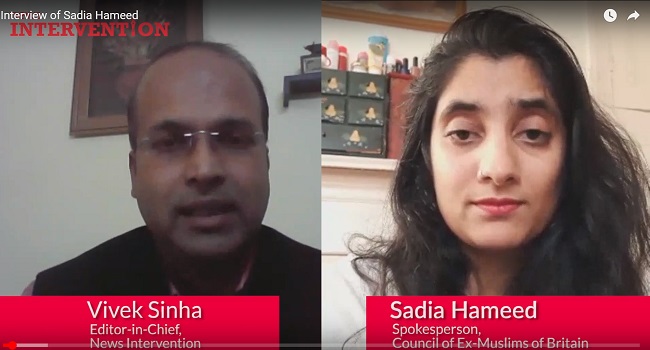
Twitter suspended the account of Sadia Hameed, Spokesperson of the Council of Ex-Muslims of Britain (CEMB) on frivolous grounds. In an interview with News Intervention, Sadia Hameed describes how Wahhabi influence is affecting the policies of social media giants.
Delhi
Horse Show is back and will continue till April 7. The show is being conducted
by the Army Polo & Riding Centre at the Army Equestrian Centre here. Over
500 competitors would display their skills in four different categories at the show.
Participating teams and contingents include those from the Army, paramilitary,
police forces, riding clubs, institutes, schools and colleges.
Over
400 horses are participating in the event which got underway on Friday.
Competitors are grouped in four categories senior, young rider, junior and
children. The events will be conducted in the early morning and late in the
evening under floodlights
The
Delhi Horse Show has been in existence since the early part of 20th century. It
was discontinued in 1979 as the grounds of the Red Fort were no longer
available and as a result the public interest waned. The show was revived in
1986 under the aegis of the President’s Estate Polo Club.
This
show will feature events ranging from the more serious Dressage and Show
Jumping events for India’s top riders to fun gymkhana events for children and
teenagers.
Josh Johnson is an Administrator of Atheism 411. Here we talk about his life and views.
Scott Douglas Jacobsen: Within personal and family history, was religion or atheism part of it?
Josh Johnson: A lot of my earlier memories take place on a theological seminary that my mother was attending, and then in and around churches and parsonages. While my mother’s brand of religion was always about as progressive as religion could get, she eventually left the church over their terrible treatment of the LGBTQ+ community – something that I’m still quite proud of.
I was lucky that my parents have always been about as progressive as their generation and upbringing allowed, as if that weren’t true, I’m sure I’d have turned into an entirely different person. Their liberal-slanting brand of worship was considered downright blasphemous by other members of my family, whose “Hellfire and Brimstone” style of theology was certainly trotted out for my benefit on more than one occasion.
Jacobsen: How have your views on religion and non-religion evolved over the years?
Johnson: It was part luck, and partially a genuine effort from my parents that allowed me to see such a wide spectrum of religious faiths as a child. I was a curious kid (on levels), and the more I compared and contrasted the beliefs, the more it became clear that even the seemingly similar denominations had deeply contrasting ideas on the same subjects. Multiple parties all speaking for what is supposedly the same all-powerful entity, each giving different sets of instructions… I don’t think the idea of being a believer ever really “took”.
I can remember trying to pray once as a kid, “testing God” if you will, and when the experience was as empty for me as it appeared for others, being pretty sure the whole thing was a ruse. I functionally gave up belief in any kind of god at about the point I gave up belief in Santa.
I was dragged to church for a few years more, until I started taking an active interest in getting a Sunday school teacher to quit in protest over my non-stop questions, at which point church became optional. I briefly opted to join the Unitarian Universalist church as a teenager, as an open atheist, in an effort to better socialize with folks my own age. While the “religion without a creed” was conceptually interesting, and I met a lot of good people, at the end of the day I still found it unfortunately rife with a more traditional style of church politicking.
Since then, my only interest in anything religious has been academic. It’s harder to talk people out of their baseless superstitions if you aren’t fairly well-versed in them.
Jacobsen: In an examination of the landscape for atheism, there has been a large increase in the numbers of nonbelievers in the advanced industrial economies. Why?
Johnson: For starters, have you ever tried to live your life according to the dictations of an ancient “holy” text? If we just look at the Bible, you’re given a poorly written and contradictory set of rules that discourages rational thought, and encourage every kind of bigotry you can think of.
No kind-hearted person can read any fair translation of the Bible from start to finish without finding it, as a complete work, to be a morally reprehensible tome. It’s pro-slavery, it’s proudly violent, and it calls on you to treat other human beings badly. While I’m far from the first to have noticed, the god of the Bible is a truly evil character that expects horrendous things of his followers.
In my observation, most “believers” don’t even believe most of the insane ramblings that their religions are based on. They just like belonging to a community, and in a great many cases their parents successfully implanted a fear of eternal torture in Hell, which keeps them from asking too many questions. If you think simply calling yourself a “Methodist” and paying lip-service to an invisible all-powerful man on holidays is all you need to protect yourself as you keep on living an otherwise “sin-filled” life, it’s easy enough to imagine how so many people can live “religious-lite” while running on auto-pilot.
Living in an age where practically everyone has some form of access to the internet, it’s become harder to call yourself religious and not feel embarrassed by large portions of what you’re meant to believe. To give a quick example, according to the Bible you’re not meant to go near a woman when she’s on her period. Simply touching a menstruating woman means you become unclean for a week, so says the source document for Christianity.
So why are there less and less religious people, in an increasingly digital age? Because the most ignorant person you know, knows that that’s an unacceptable stance. Sexism, racism, homophobia and more are required of a “good believer”, so says their texts. As self-education becomes as easy as picking up your phone, less and less people are willing to be associated with that kind of willful ignorance.
Jacobsen: However, alongside this increase in the atheist population within the nonbelievers, we have seen a collection of two reactions. Mostly male leaders, often white, in each case.
The one stream is more, stronger, and more literal forms of fundamentalist preaching, especially within North America and often tied to white ethnic nationalism.
Another stream is the attempts to reinterpret the purported holy texts by a collection of unqualified, hyperbolic, and humorless people to make the Bible – as it’s mostly Christian imagery – cool again, where this tends to have thinly veiled rightwing laissez-faire economics and social views built into them.
Do you notice these too? If so, why are these the streams of reactionary ‘movements’ in the religious and religious-curious camps?
Johnson: I have certainly noticed the unfortunate truth that many recognized “atheist leaders” (I don’t like the term, as atheists don’t have a central hierarchy or any kind of clergy analog, but I know what you mean) are white men, and I have certainly seen many white men – including atheists – push grossly unacceptable ideas into the public sphere as of late.
While the “alt-right” infestation currently plaguing the United States has certainly been felt in atheist communities, we (the collective crew at Atheism 411) count ourselves among their staunch opposition. I’ve seen some semi-famous atheist YouTubers and bloggers becoming unapologetically bad people. We’ve even had to throw out a contributor on at least two occasions in the last 6 years for seemingly out of no where throwing out some kind of bigotry – including bigotry against believers in religion themselves.
Before I go any further, I want to clarify my stance on religious people: I love them. Religious people are my family, my friends, my neighbors. Atheism 411 is a humanist group, and the reason I oppose religion is because it hurts people. Tangibly and regularly, religion harms innocent human beings all over the globe… and I oppose that. But humans are awesome, so we have a zero-tolerance policy (both in our public groups, and for our page contributors) for any kind of bigotry. You can disagree with someone without dehumanizing them, and anyone incapable of meeting that reasonable mandate is not welcome among us.
Which unfortunately brings us back to the question: Since atheists are human beings, and a human being can be any kind of person – including a bad one – we have dealt with our share of bigots. While I have seen racist, sexist, homophobic, transphobic atheists pop up in our online communities, the response of myself and my admin team is always to remove them from the community ASAP, and usually to address the issue publicly if it affected more people than can be spoken to individually.
This of course opens us up to cries of being a “progressive echo-chamber”… which, to be honest, doesn’t bother me as much as some think it should. Don’t get me wrong; we welcome every kind of atheist into our community, political beliefs aside, as long as they follow a simple set of rules. But those rules include respectfully talking out your differences, and NOT being an openly bigoted bully. Which means that people who believe other human beings are somehow worth less, or entitled to less of a fulfilling life than they are, simply aren’t allowed in the club.
Funny thing about a club for humanists… You have to care about humans, to join. Even the ones who don’t look, love, or even think the way you do. Seems fair enough, to me.
As for people trying to make the Bible “cool”… I’ve not seen any successful attempts, let’s say that.
Jacobsen: How did you become involved in Atheism 411?
Johnson: I’m a marketing consultant by trade, and what finally got me to sign-up for Facebook was a specific client insisting that I start writing their FB ads for them, too.
I was a hold-out on social media as I’ve been creating websites myself since the late 90s, and the appeal/reach of social networking on other people’s websites hadn’t yet bashed me over the head.
I’ve always been an opinionated lad, but around 6 years ago I decided I wanted to start writing on atheistic topics. I found a Facebook page called “Atheism for Beginners” – founded by Matthew Happle – that had a modest following of around 7,000 people, and applied for a spot making content with a rather narcissistic image of myself juggling knives (I do that), with text imposed over it decrying the terrible bigotry that religion has a unique hand in perpetuating around the world.
I got that spot, and over time the page changed. For one, the name got swapped out for “Atheism 411” – which means “Atheist Information”, for those of you who have never experienced U.S. phone codes – and it grew in size considerably (around 46,500, at time of writing).
For a lot of its growth-period, my essays and other original content made up a large percentage of what the page put out, so I eventually took on a partnership with Matthew and became co-owner of A411 and its related Facebook pages and groups.
While Mattie is still my partner and co-owner, I’ve largely taken over the day-to-day “business”, in so much as it exists. Or I should say, the technical responsibility for said; Truth be told, I’d be incapable of keeping it in any kind of order if it weren’t for the small team of admins that selflessly and awesomely dedicate a lot of their spare time to making sure our pages and communities are friendly and entertaining places to visit. They’re my brothers and sisters, I love them, and I can’t thank them enough.
Jacobsen: What is the mission and mandate of Atheism 411?
Johnson: We seek to peacefully talk people out of their dangerous superstitions.
We see copious evidence of religion uniquely influencing the world in a negative way. The holy texts for JUST the Abrahamic religions are still used all around the world to justify slavery, the oppression and subjugation and murders of women and members of the LQBTQ+ community…
True story; because of my position with Atheism 411, people send me videos sometimes of terrible acts perpetrated in the name of gods. This is how I saw my first literal “witch burning”.
Obviously there’s no such thing as magic, so they weren’t real “witches”… but I’ve had the sickening displeasure of watching in confusion a video where people beat frightened men and women unconscious with tree branches, then cover them in branches and light it ablaze.
I probably wouldn’t have chosen to view the video, had I known what it was when I clicked. What it featured wasn’t at all clear to me, even after it started.
It wasn’t until the images were effectively seared into my brain that I realized what it was I was even watching… the violent and terrifying deaths of innocent people, because “Thou shalt not suffer a witch to live.” (Exodus 22:18 KJV)
It is my mission to peacefully talk people out of the ignorant and baseless superstitions that lead to that kind of depravity. Because the people who did that weren’t “twisting the Bible”… they were reading it literally, and applying it to reality. And that’s the same book you’ll find on the back of pews in churches around the world.
To pretend religion hasn’t earned rebuke is intellectually dishonest, to say the very least. And we have always aimed to be one of many good sources you can come to for said rebuke.
Jacobsen: Also, what is its niche? Where can people find it?
Johnson: We aim to be a reasonable voice, even though we know what we’re saying is conceptually offensive to a lot of people. Open dialog is important, sometimes especially when it’s uncomfortable. Religion is definitely one of those times.
Angel Sumka is the President of Albert (Canada) Sex Positive Centre. Here we talk about men.
Scott Douglas Jacobsen: What should men know about a sex-positive lifestyle?
Angel Sumka: All people, regardless of gender, should know that sex-positive culture (which is not a lifestyle, although there are some lifestyles that are sex-positive in nature), is about valuing the diversity of human sexuality, and recognizing that consensual sexual activity is pleasurable and healthy. I think it is important to consider the benefits to our intimate relationships in learning to have this attitude, as when we are accepting and remove shame from our thinking about bodies and sexuality, we create a safe space for our partner to talk to us about their own thoughts and desires.
Jacobsen: How can men be better lovers?
Sumka: All people, regardless of gender, become better lovers when they communicate openly and honestly, and listen to the feedback they receive from their lover(s). There is no one true way, everybody is different, and the situation is different.
Jacobsen: For young men, or inexperienced men at any age, how can they start to have a more sex-positive perspective and skill set?
Sumka: For all inexperienced people (I am sure you are seeing the trend here), sex positivity starts with the self. Think about how you perceive gender and the ways in which that is helpful and not so helpful. Challenge your biases about sex and gender, think critically about what you think you know about sex and pleasure. The best way to improve your sexual skill set is to start by learning about your own body, and how to communicate your own needs, and inviting your lover(s) to do the same.
Jacobsen: What are the principles of safe sex? How often are these not practiced? What are some tips and tricks to make this easy to practice?
Sumka: The principle of safe(r) sex is that we each, as responsible individuals, can take measures to reduce the risk of harm or infection for ourselves and our partners. This starts with communication about our risk profile (do we use condoms? Do we get tested? Are we in a high-risk category, such as i.v. drug use?), includes being regularly tested, and using appropriate barriers. Often missed is that we have the responsibility to continue to be educated about sexual risks, such as learning about the risks associated with unprotected oral sex with various types of genitals.
Jacobsen: What are the main things with sex that men do not get, whether a homosexual or heterosexual?
Sumka: As you may have noticed, I work hard to not lump people together by gender. Society, however, does not get that consent is not optional. Anytime you go to touch another person, regardless of how casually, you should be first ensuring they are 100% ok with that touch. Same with sexual comments. Your sexuality does not negate your responsibility to be sure the person you touch wants that touch. Your gender does not excuse you from requiring consent. It always troubles me that so many of us resist the idea of enthusiastic consent. Why are we ok touching people that do not want our touch?
Jacobsen: What forces are generally sex-negative in society?Sumka: Humans, ones that feel shame about sex and continue to ensure that others feel the same way, are the ones that drive sex-negativity.
Dr. Alexander Douglas specialises in the history of philosophy and the philosophy of economics. He is a faculty member at the University of St. Andrews in the School of Philosophical, Anthropological and Film Studies. In this series, we discuss the philosophy of economics, its evolution, and how the discipline of economics should move forward in a world with increasing inequality so that it is more attuned to democracy. Previous sessions can be found here inpart 1, part 2, part 3, part 4, part 5, and part 6.
Scott Jacobsen: With psychology classified as a natural science by you, what are the most substantiated and broad-reaching strong conclusions of psychology relevant to economics?
Dr. Alexander Douglas: I’m no expert on this. Behavioural economics is the main area in which the findings of clinical psychology have been integrated. The major challenge attacks, as Robert Sugden puts it, the notion of ‘integrated’ preferences, according to which each agent is defined by a stable set of preferences that has to be tailored to fit her choice behaviour in all circumstances. So if I choose soup over salad today, and salad over soup tomorrow, then the assumption that I am rational compels us to redefine the objects in my preference-set. It would be irrational to prefer salad to soup and soup to salad tout court, but not, e.g., to prefer soup to salad when I’ve eaten 1000 soups in my life but salad to soup when I’ve eaten 1001 soups.
But is it rational for what I’ve eaten in the past to influence what I choose today? What about the lighting in the restaurant? What about what other people are eating? And then, of course, every soup is unique and every salad is unique: perhaps I prefer this soup to this salad, but not that soup to that salad. But then if the descriptions under which I choose become so specific, economic predictions become impossible: nothing about what I choose today will inform us about what I’ll choose tomorrow, since tomorrow everything will be slightly different.
Economists, it turns out, make a lot of implicit assumptions about what can and what can’t go rationally into what is called the ‘framing’ of a choice: past consumption is permitted to be relevant, but not seemingly extraneous factors like the day of the week on which a choice is made. But who is to say what it is rational to consider relevant to a choice? A lot of behavioural economics is about coming to terms with the importance of framing; people can be found, e.g., to choose to save 98 out of 100 lives but not to condemn two out of 100 people to death. Behavioural economics seeks to know how people typically frame their choices, and how the framing affects what they choose.
In a way, it tries to honour the ideal of ‘value-neutrality’ that underpins modern economics: it looks like a value-judgment to say that past consumption can rationally influence a choice but not the day of the week. Behavioural economists want to get by without even that value judgment. We shouldn’t say that people are irrational just because they take to be relevant what economic theorists take to be irrelevant.
Sugden believes, by the way, that even without identifying people’s preferences as such we can make some judgments about the sorts of economic institutions that they would rationally choose. I’m sceptical. He believes that people will rationally choose an economically liberal arrangement, in which free agents can engage in voluntary exchange in pursuit of a better allocation to themselves – and so they might, under that description. But how about under the sort of description Thomas Carlyle might give to such an arrangement: an unearthly ballet of higgling and haggling, conducted by little profit-and-loss philosophers; an array of pig-troughs where the pigs run across each other in unresting search of the tastiest slops, etc. etc.? Framing matters when agents ‘rationally’ choose institutions, just as much as when they ‘rationally’ choose goods. Public choice theory, I think, must also come to terms with the centrality of framing.
Jacobsen: How might, or are, these most substantiated and broad-reaching strong conclusions of psychology influence the philosophizing about economics?
Douglas: Once we bring framing into the question, I think the whole way of modeling human behaviour has to radically change. I don’t see how this can be avoided. A standard ‘utility function’ in economics will look something like this: U=f(x), where U is the overall utility or wellbeing of an agent and x is some vector of magnitudes, each representing the amount of a certain good consumed. To take framing into account, we’d need to replace x with a vector of descriptions of goods. These can’t be simple magnitudes, and so the whole project of a mathematisation of human behaviour is undermined. Could you not just expand the vector of magnitudes to have one argument for every good consumed under every possible description? You’d have one magnitude for coffee in the morning on my own, one for tea in the afternoon with a friend, one for tea in the afternoon with a work colleague, one for coffee in the evening with my beloved, etc. etc. The problem, of course, is that every good will fall under an infinite number of possible descriptions. And worse, there are descriptions of descriptions: choosing off a menu isn’t the same as choosing from a buffet, and so on.
Moreover, it is hard to see how we can get solid experimental evidence on how people frame choices. We might, using the above example, find that people will choose to accept the loss of two people but not to condemn two people to death. These framing effects matter a great deal, as our spin doctors know well. But how do we define the difference? That too is far from clear – our spin doctors know that too. I think that properly taking these subtleties into account would make economics into a qualitative, hermeneutic, ‘soft’ science – more akin to anthropology than physics.
Behavioural economists are attempting to walk the tightrope between hermeneutic anthropology and quantitative science, but I believe that the tightrope is of infinitesimal width, and sooner or later they’ll topple over onto one side.
Jacobsen: Do any of the aforementioned strong conclusions influence the treatment of time-inconsistency first considered by Spinoza and into the present with professional philosophers such as yourself?
Douglas: Spinoza has an idea of rationality that, I think, sits very badly with economics in general. For him it is irrational to discount the future at all. I might prefer one marshmallow today to two marshmallows tomorrow, but tomorrow I would, if I could, certainly not give up two marshmallows to have had one in the past. It is arbitrary to identify myself with myself at a particular moment in time. Thus he says that the rational person does not value a good differently depending on whether it is past, present, or future (Ethics 4p62).
When modern economists talk about time inconsistency, they mean something much weaker than this. They’re talking about a time-discounting function that is hyberbolic, or generally non-linear. Only a few concede that time-discounting, in general, is irrational; Joan Robinson calls it ‘an irrational or weak-minded failure to value the future consumption now at what its true worth … will turn out to be’ (The Accumulation of Capital, 394).
If agents didn’t engage in time-discounting, economic explanations of interest rate, profit, and so on wouldn’t work. Economists certainly don’t want to say that economic equilibrium depends on profound irrationality in the agents involved. In fact, I think you could argue that their equilibriums depend on forced labour or coercive extraction of some sort. If I take on a loan today, my future self will have to work to pay the interest. He gets no direct benefit from what happened in the past. Or, even if he does, he is unlikely to set the relative value of the past benefit as high as his past self did. But he simply wasn’t consulted in the decision. My past self can be paternalistic or exploitative towards my future selves, but, in any case, there is a dictatorship of the present. Economists treat as coercive a situation in which the preferences of a select group determine the outcomes for everyone. But that is exactly what happens when, in their models, agents at time zero determine what all their future selves will pay and receive, by negotiating with other agents present at time zero.
We could, of course, identify all the future selves of an agent with that agent at time zero, but then we would have an agent with deeply inconsistent preferences. Again: today I prefer to give up the promise of two marshmallows tomorrow for one today, but tomorrow I certainly wouldn’t give up two marshmallows in order to have had one in the past. So a single diachronic agent with a nonzero time-discounting rate would have preferences that are not just ‘inconsistent’ in some weak sense but plainly contradictory.
This isn’t only an academic exercise; it gets to the heart of why markets can’t plan – an issue rendered very palpable in our day by the climate crisis. James Galbraith points this out somewhere in The Predator State. You shouldn’t make the mistake of thinking that futures markets allow markets to plan: what they allow is for present agents to divide up the spoils of what they plunder from future generations by contractual obligations or irreversible natural processes. In this way, as in many others, Spinoza has never been more relevant.
Jacobsen: Thank you for the opportunity and your time, Alex.
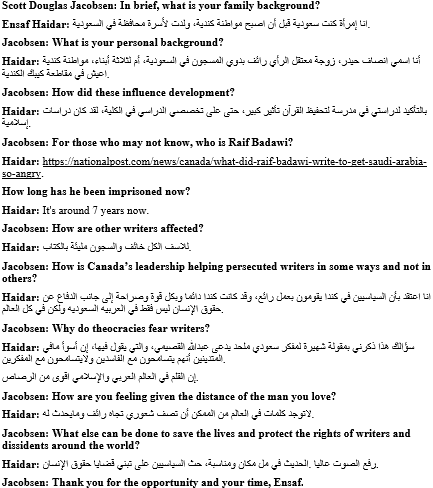
Scott Douglas Jacobsen: In brief, what is your family background?
Ensaf
Haidar: I was a Saudi
woman before I became a Canadian citizen. I was born to a conservative family
in Saudi Arabia.
Jacobsen:
What is your personal
background?
Haidar:
My name is Ensaf
Haidar, wife of prisoner of conscience Raif Badawi, imprisoned in Saudi Arabia,
mother of three children, and a Canadian citizen living in the Canadian
province of Quebec.
Jacobsen:
How did these influence your
development?
Haidar:
Certainly, memorization
of the Quran during my studies had a big impact. I even specialized in Islamic
Studies in college.
Jacobsen:
For those who may not
know, who is Raif Badawi?
Haidar:
Unfortunately, everyone
is afraid and the prisons are full of writers.
Jacobsen:
How is Canada’s
leadership helping persecuted writers in some ways and not in others?
Haidar:
I think that the
politicians in Canada are doing a wonderful job. Canada has always been strong
and open about defending human rights, not only in Saudi Arabia, but all over
the world.
Jacobsen: Why do theocracies fear writers?
Haidar: Your question reminded
me of a famous quote by an atheist Saudi writer named Abdullah al-Qasemi, who
said that the worst thing about the religious is that they tolerate the corrupt
and don’t tolerate the intellectuals.
The
pen is more powerful than bullets in the Arab and Islamic world.
Jacobsen:
How are you feeling
given the distance of the man you love?
Haidar:
There are no words in
the world that can possibly describe my feelings about Raif and what is
happening to him.
Jacobsen:
What else can be done
to save the lives and protect the rights of writers and dissidents around the
world?
Haidar:
Speak up loudly – have
the conversation everywhere, at every opportunity. Urge politicians to embrace
human rights issues.
Jacobsen: Thank you for the opportunity and your time, Ensaf.
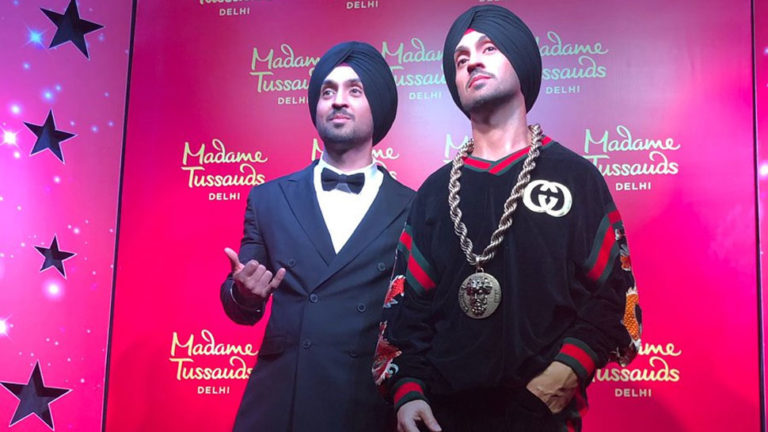
Actor and singer Diljit
Dosanjh on Thursday unveiled his wax figure at Madame Tussauds Museum in New
Delhi. The actor said it was a special moment for him as this is the first wax
statue of a personality sporting a turban, and it was a dream come true for
him.
“I never thought that I
would visit Madame Tussauds to unveil my own wax figure. Today, I got to know
how I actually look. A big thank you to the team of Madame Tussauds who have
worked so hard. It is a big moment for me and my fans that a man wearing a
turban and representing Sikh culture has a wax statue here for the first
time,” Diljit told reporters.
He recalled passing through
London’s Madame Tussauds and wondering what was inside the museum. “I saw
a long queue outside the museum and I asked my friend ‘What is inside?’. I come
from a village and I had never seen such things before. At that point of time,
I really wished to get inside the museum and today I am a part of the
family.”
The actor has joined the
likes of Asha Bhonsle, Virat Kohli, Anil Kapoor, David Beckham, Sachin
Tendulkar, Shreya Ghoshal, Sonu Nigam, Beyonce and Lady Gaga, among others to
have their figures at the museum.
As noted by linguist and prominent general atheist — in general terms with specifications based on what is exactly being denied — Noam Chomsky, the nature of the Young Earth Creationism and Evolution controversy simply remains within the sociopolitical realm, in which the controversy should, in fact, shift to that which has a large number of evidence: unlike Young Earth Creationism, which has none.
The shift of the conversation should be into Malignant Design, for which, by some metrics described by Chomsky, has much more evidence than some aspects of either theory, of which the former, Young Earth Creationism, has none and the latter, Evolution by Natural Selection, has plenty.
Malignant Design has more evidence in terms of the level of suffering in the world, whether by human machinations, e.g., conspiracy, war, bad medicine, apparently anti-vaccination now, and so on, or strictly non-conscious mechanical processes of the natural world, e.g., storms, tornadoes ripping through communities, pestilences, deadly diseases, infections, and so on.
Chomsky, in the Khaleej Times, stated, “Unlike Intelligent Design, for which the evidence is zero, malignant design has tons of empirical evidence, much more than Darwinian evolution, by some criteria: the world’s cruelty. Be that as it may, the background of the current evolution/intelligent design controversy is the widespread rejection of science, a phenomenon with deep roots in American history that has been cynically exploited for narrow political gain during the last quarter-century. Intelligent Design raises the question whether it is intelligent to disregard scientific evidence about matters of supreme importance to the nation and world — like global warming.”
The issue of the world’s suffering is tracing the motivations and consequences of the pain and misery seen throughout the world due to human actions and decision, policies, initiatives and programs, and failures to plan ahead and prepare for likely disasters, but also having appropriate scientific investigation and widespread-enough comprehension of the reasons for actions of the material world and then how certain disasters can impact human livelihood; each of these angles is important in order to, in a rational manner, deal with the problems confronting us. The reasons may be irrational, as in human motivations and fear, but the consequences and investigations of the irrationalities can be rational; with the natural world, it is simply not fooling ourselves and having specific tools in place, including the scientific method, to properly know the world to respond in a rational way to the likely consequences of natural phenomenon of the world impacting us.
Malignant design, if one is to notice the world’s suffering, akin to knowledge about mutual aid, is an important adjunct to knowledge of evolution, as a factor in evolution.
“Demonetisation” is shown within double inverted commas since the 8th November 2016 action / process followed is not Demonetisation as defined in true macro-economic parlance.
Also – and more importantly – because the RBI Act, 1934 itself does not contain this term “Demonetisation” anywhere.
Though the subject of “Demonetisation” was national news way back in November 2016, the matter has gained fresh importance since the startling revelations of the Minutes of the Meeting of RBI’s Central Board of Directors held on 8th November 2016, became public knowledge as recently as 8th March 2019 when RTI Activists did the nation a great favour by pursuing the official procurement of this vital document from RBI and publishing these Minutes for the benefit of our public. The valuable content of these Minutes provide specific details of the steps preceding the announcement of Demonetisation by the Prime Minister on 8th November 2016. It also helps gain insight into the propriety of actions taken by the Government and their compliance with the prescriptions contained in the RBI Act of 1934 and in the RBI Regulations, 1949 which are adjunct to the main Act.
As is well-known, the ultimate responsibility of managing the country’s monetary resources rests with the RBI, which is required to follow the Act and Regulations referred above. Also, the Government of India is expected to conduct itself in a manner which respects and complies with the RBI Act in all matters relating to our Country’s Monetary Policies and Practices.
We shall now dwell deep into each of the important issues concerning the actions of the Government of India in respect of “Demonetisation”. It is important for intelligent nationalists to review the actions of the Government in order to attain a proper understanding of the propriety of the Government’s actions and gauge their enduring impact and value on our economy and on the lives of our people.
Before proceeding, it is clarified that this analysis is not intended to criticise the Government or its actions. It is purely a macro-economic analysis of the actions of the Government viewed against the back drop of prescribed Legal and Administrative processes which ought to have been followed. If these aspects were not dealt with in accordance with the RBI Act, it is up to the thinking public to draw judgment on the entire exercise and voice their collective opinion resulting from a careful comprehension of the various points explained below in an unbiased and professional manner.
Several Key Documents are attached to this submission:
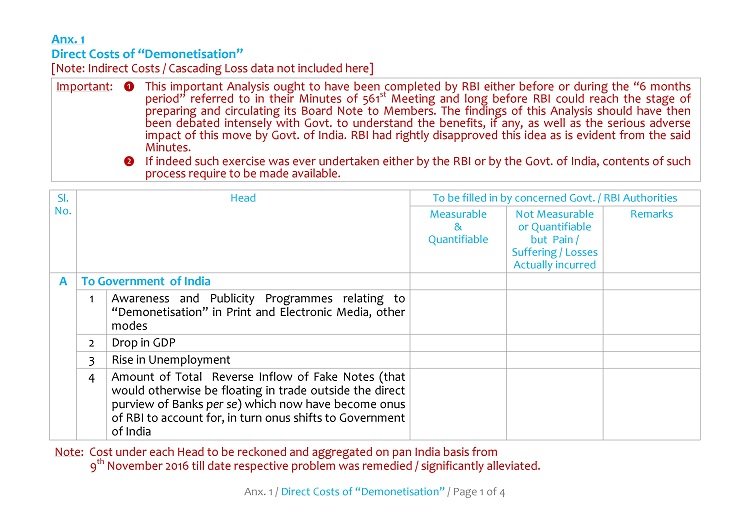
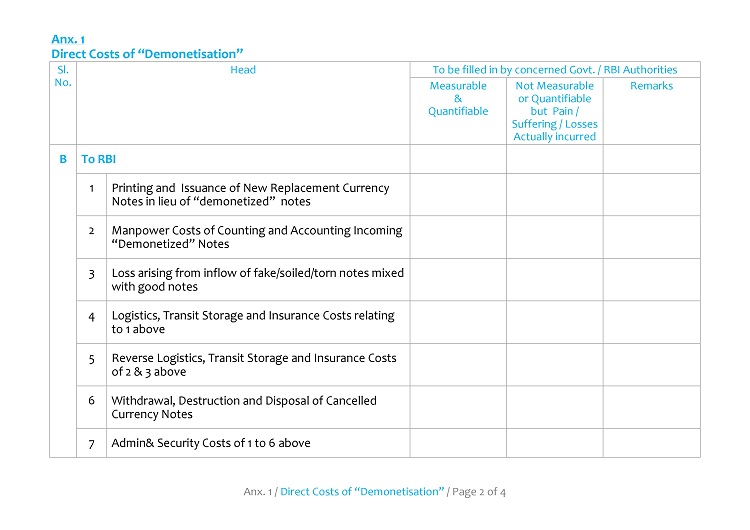
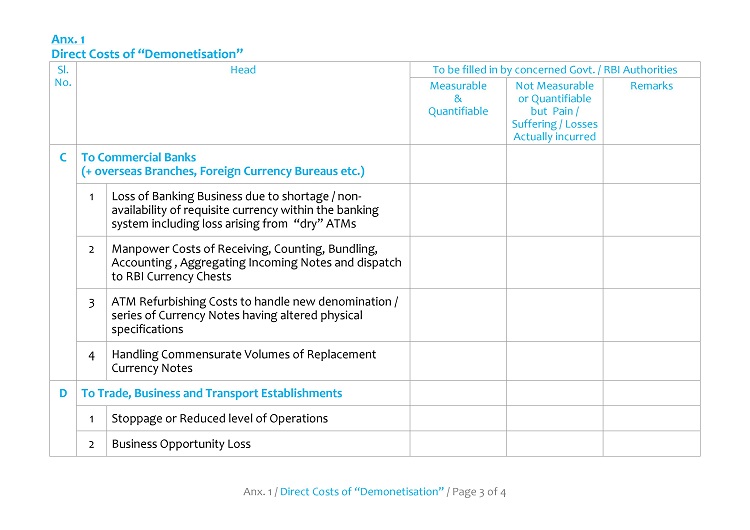
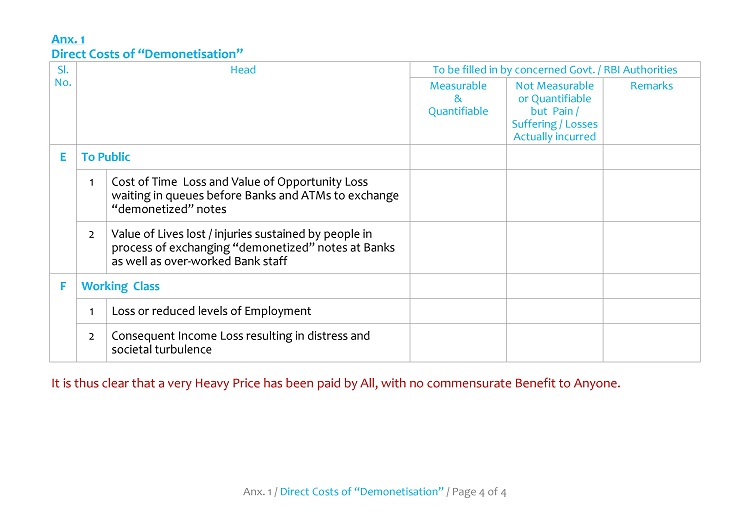
Annexure 1 is a Chart titled: “Direct Costs of Demonetisation”. Its data is to be filled in by the concerned Authorities to quantify, wherever possible, the extent of loss/physical damage caused by “Demonetisation”. Many of the events of loss/damage can be measured in monetary terms. We have catalogued the illustrative list of losses under various heads with the desire and expectation that concerned Authorities will do justice by providing the requisite data. However, many of these data can be expressed only in non-monetary terms. It is necessary to understand the aggregate damage caused to the country and its people by this action of the Government. Of course, readers are also free to contribute in this regard.
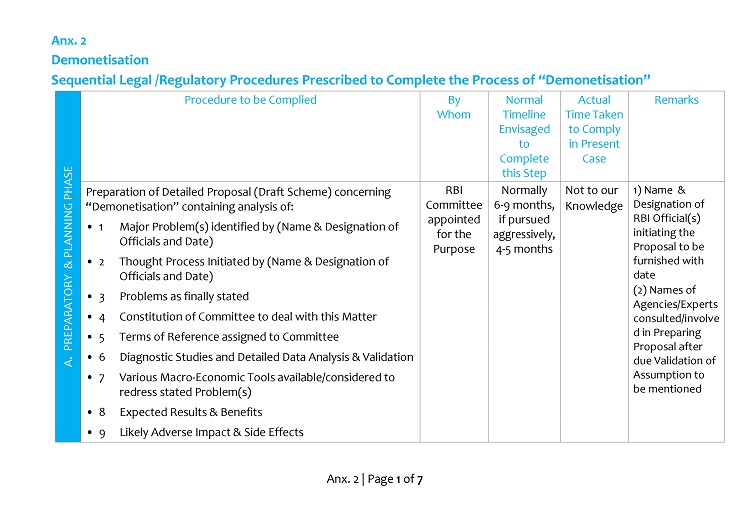
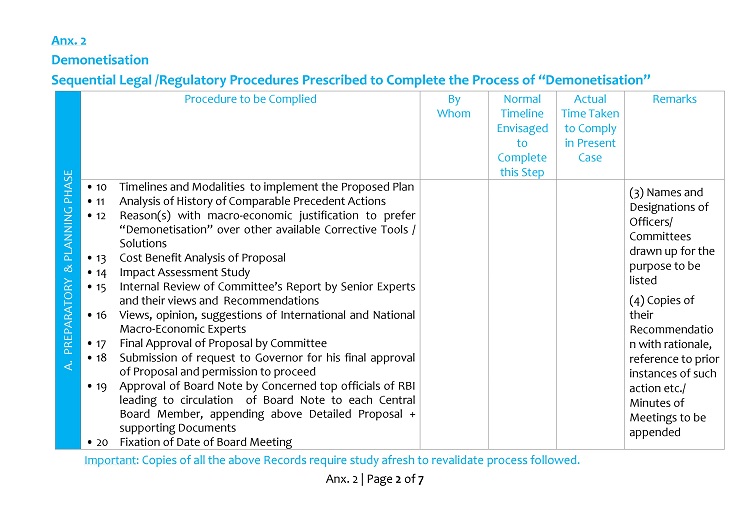
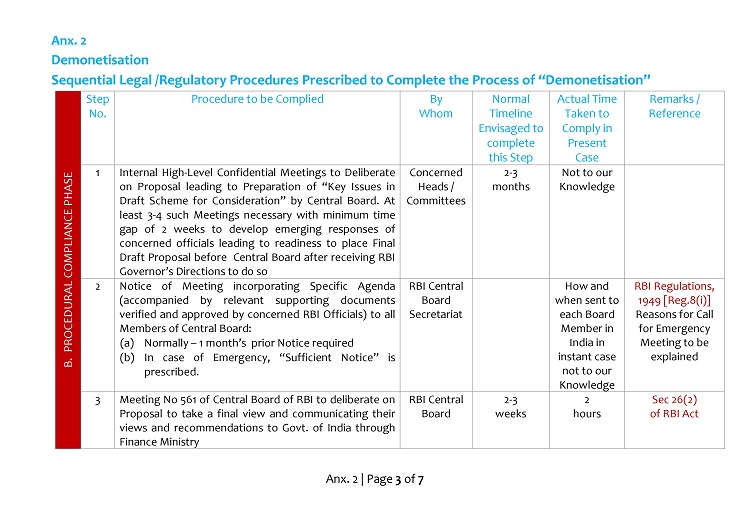
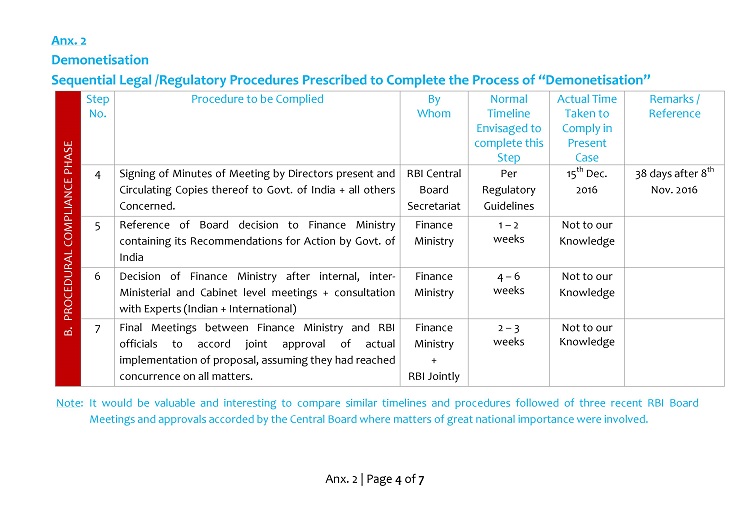
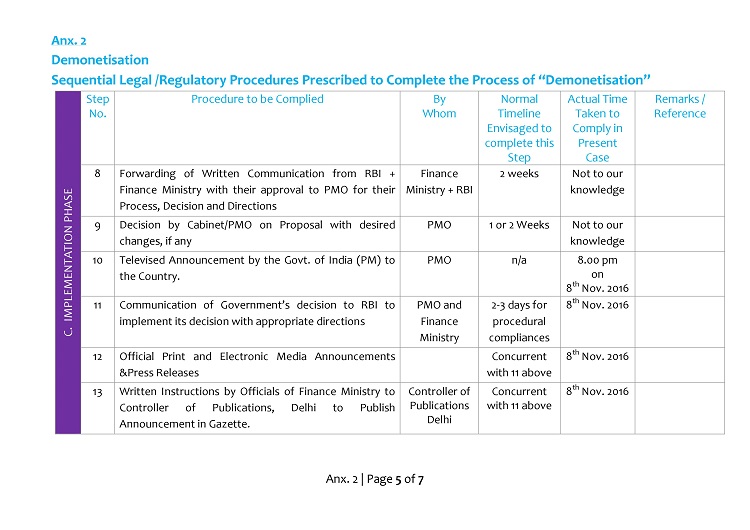
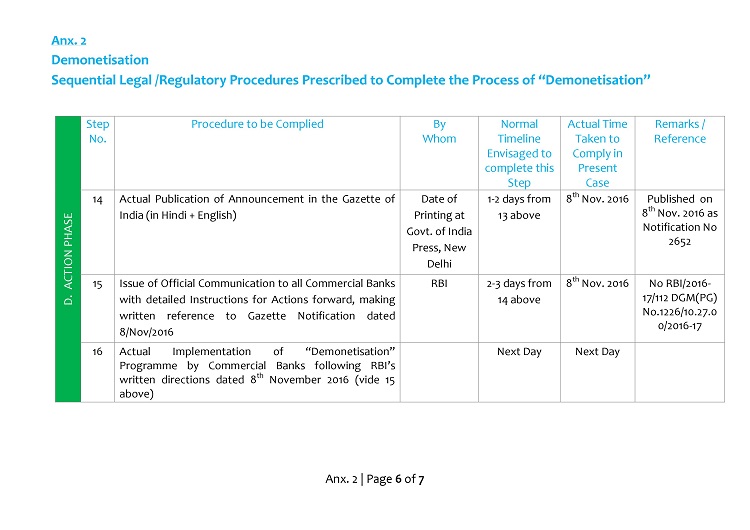
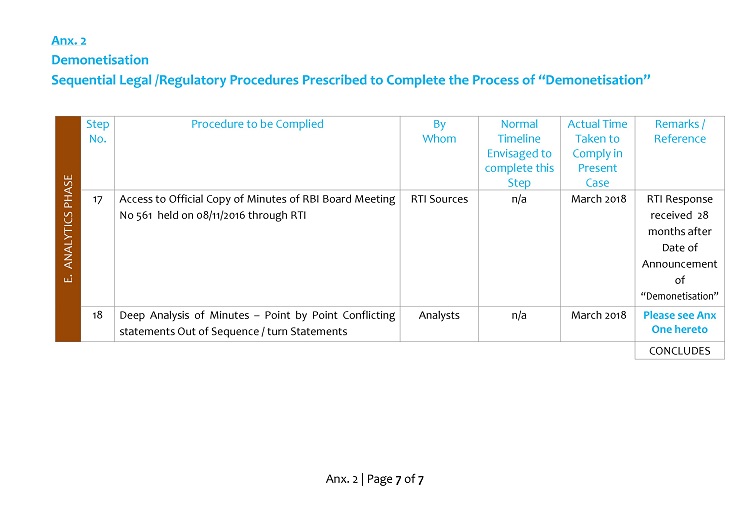
Annexure 2 is titled: “Sequential Legal Regulatory Procedures Prescribed to Complete the Process of “Demonetisation”. This contains a lucid description of various aspects of “Demonetisation” and is intended to help readers gain an in-depth knowledge of the specific legal provisions and administrative compliances which ought to have been followed both by the RBI as well as the Govt. of India during the four Main Phases of this initiative. If either of them had — fully or partially — neglected or failed to follow these legal prescriptions, in all fairness, they owe a satisfactory explanation to Parliament and to the people of India on every point which has been dealt with herein.
A purely professional assessment of the actions leading to the announcement of 8th November 2016 by the Prime Minister clearly indicates gross neglect and violation of relevant provisions of the RBI Act and related Regulations. This is an impartial assessment and is not intended to criticize or blame the actions of those concerned.
According to Section 26(2) of RBI Act, it is only based on the recommendations of the Central Board of RBI to the Central Government that “the latter may by Notification in the Gazette of India declare that with effect from the date(s) specified therein any series of bank notes of any denomination shall cease to be legal tender save at such office or agency of the Bank and to such extent as may be specified in the Notification”.
The term “office or agency” of the RBI is explained in Section 6 of the Act. However, the term “agency” of the Bank requires careful understanding as this is not specifically defined in the Act.
Regulation 8 of the RBI General Regulations 1949 specifies that one clear month’s notice shall be given of each meeting of the Central Board to every Director to his registered address. It further adds that if it should be found necessary to convene an emergency meeting, sufficient notice shall be given to every Director who is at the time in India to enable him to attend. “Sufficient” is a subjective term, hence lacks clarity of real-time necessity.
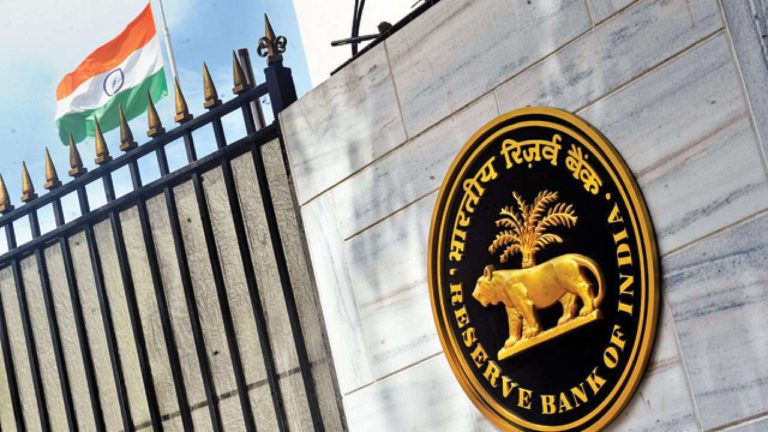
Old Rupee 500 and Rupee 1000 currency notes. These notes have ceased to be legal tender in India from the midnight of 08 November, 2016 after government’s “Demonetisation” announcement.
It is thus clear that the initiative to recommend cancelling the legal tender status to any currency notes must originate from the Reserve Bank of India which should prepare its Draft Report providing reasons and justification for such Proposal and highlighting the benefits that result from such actions. The Report should also clearly mention the expected adverse impact of such decision and possible damage to the economy and inconvenience to the public. The various sequential steps to follow are described in specific terms in Annexure 2.
Annexure 2 also gives an indication of the normal timeline to comply with each of the above steps. These datelines are juxtaposed with the actions, dates and timelines actually followed by the RBI/Govt. of India in the present case. It is for readers to draw Judgement on the practical attainability of the later dates which clearly indicate that both RBI and Govt. of India have bypassed vital procedures. It is reasonable to opine that these violations would not have been committed in the normal course either by the Central Board or by RBI.
The overwhelming point to be noted as it emerges from these records is that the entire act of “Demonetisation” is an idea of the Govt. of India which has been forced on the RBI and people of India without proper consideration of any of the aspects essential before embarking on a misadventure of such unprecedented magnitude.
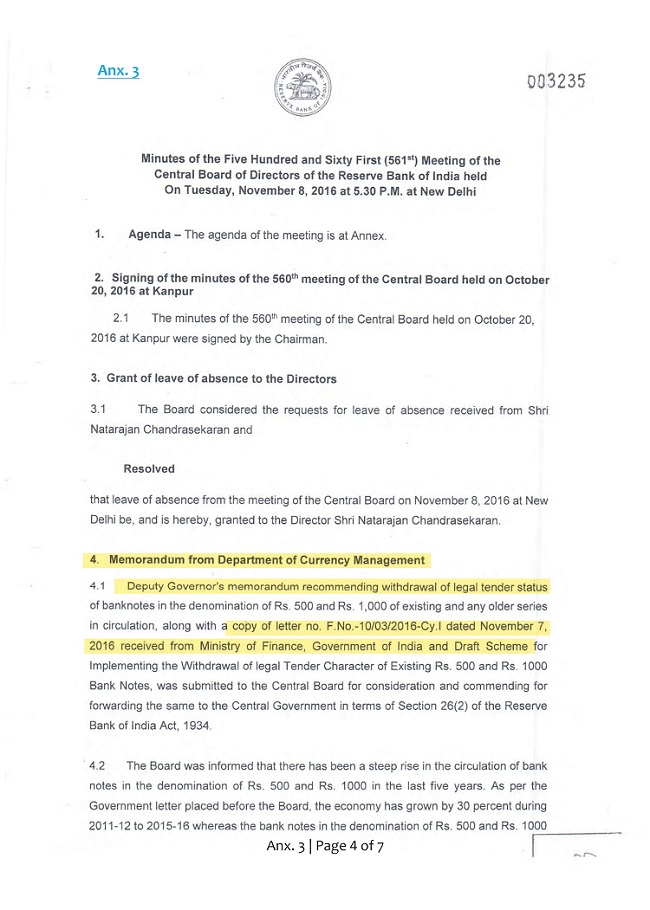
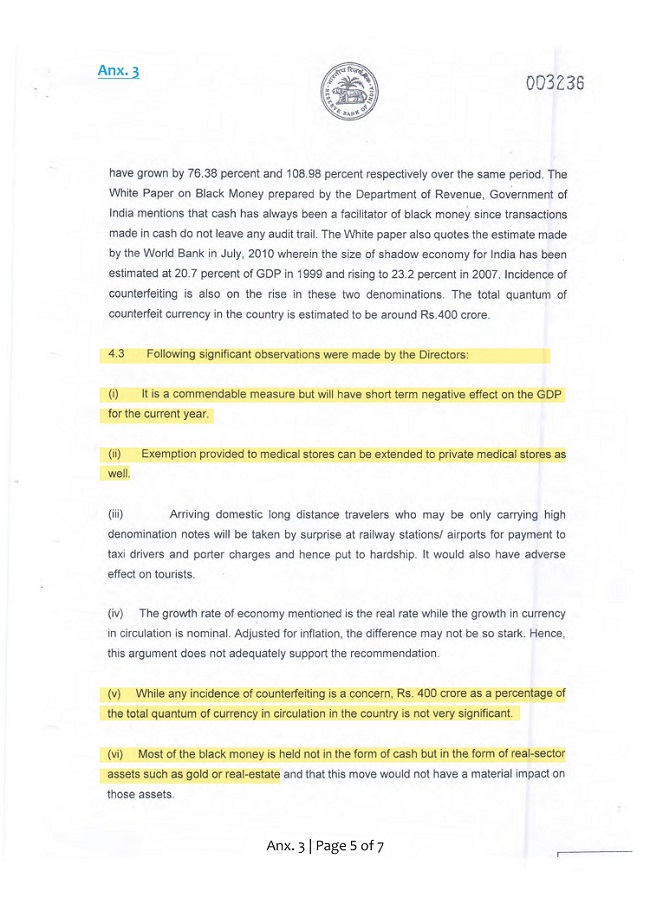
Annexure 3 is a true copy of the Minutes of the 561st Meeting of the RBI Central Board held at 5.30 pm on 8th November 2016 at New Delhi. Following points must be carefully noted:-
The meeting was held barely 2½ hours before the announcement by the Prime Minister on National Television at 8.00 pm, the same evening, declaring “Demonetisation”. It is evident that the Govt. of India compelled the RBI to hold this Meeting to fulfill the requirement of Section 26(2) of RBI Act and create the circumstance required in Section 26(2) that recommendation of “Demonetisation” should originate from RBI. It is impossible to comprehend how such a responsible institution as RBI was compelled to sacrifice its integrity and independence to blindly obey the directions of the Government. Indeed a travesty of regulatory process.
The Resolution passed at the 561st Meeting of the Central Board of RBI held on 8th November 2016 has been signed on 15th December 2016 by the then Governor of the RBI and the Chairman of the said Meeting, which reads thus, “Resolved that the proposal of the Deputy Governor recommending withdrawal of legal tender status of bank notes in the denomination of Rs. 500 and Rs. 1000 of existing and any older series in circulation is hereby considered and commended by the Central Board of Directors for forwarding the same to the Central Government.”
It is strange that the Governor of the RBI refers to the Proposal of the Deputy Governor commending this action as if it came to his knowledge for the first time on 8th November 2016, whereas he should have examined such a serious document far earlier than the said date. Section 26(2) of the RBI Act clearly states that “On recommendation of the Central Board —” it does not say on the recommendation of the Deputy Governor.
Further the Resolution is signed on 15th December 2016 which is 38 days after the Prime Minister’s announcement of “Demonetisation” on 8th November 2016. Truly speaking, this is procedurally incongruous and bad in law.
Under Para 4 of the Minutes of Meeting titled Memorandum from Department of Currency Management, at 4.1, it is recorded thus, “Deputy Governor’s Memorandum recommending withdrawal of legal tender status of banknotes in the denomination of Rs 500 and Rs. 1000 of existing and any older series in circulation, along with a copy of letter No. F.No. 10/3/2016-Cy.I dated November 7, 2016 received from Ministry of Finance, Government of India and Draft Scheme as above was submitted to the Central Board for consideration and commending for forwarding the same to the Central Government in terms of Section 26(2) of the RBI Act 1934.”
The public deserves to know why the Deputy Governor’s Memorandum was considered by the Central Board only few hours before the Prime Minister’s announcement and not weeks/months prior, which should have been the normal timeline. Also, a good explanation is required as to why the Finance Ministry’s letter dated 7th November 2016 was also pushed in to the Meeting of the Central Board on 8th November 2016, whereas this is a process which should have happened weeks / months prior as described in Annexure 2.
It is very important for the RBI Central Board Secretariat to candidly confirm and provide factual documents to substantiate the fact that in the Notice of Meeting to be held on 8th November 2016, the Agenda stated therein was supported by the various documents herein referred and duly attached for the prior knowledge and understanding of each Board Member, in preparation for the said Board Meeting. If these supporting documents are not now satisfactorily made available, there is definite reason to believe that the whole process which ought to have been followed was circumvented.
In para 4.3 of the Minutes of the Meeting, it is amusing to read at sub para (i) that “it is a commendable measure —”. These 5 words totally expose the reality of the subject viz., the whole Proposal of Demonetisation came from the Govt. of India and was not initiated by RBI as required by Section 26(2) of the RBI Act. Being an independent body, it was wholly unnecessary for RBI to praise the Govt. of India. But this proves that the process of Demonetisation originated with Govt. of India. Otherwise, if it indeed originated from the RBI itself as required by law, it would be ludicrous for the Central Board to refer to its own Proposal “as a commendable measure!” So, these 5 famous words have disclosed and affirmed the truth that the Demonetisation Proposal indeed originated from Govt of India.
At sub para (ii), the Minutes record that “Exemption provided to medical stores can be extended to private medical stores as well”. The public are entitled to know whether this exemption was contained in the Scheme prepared by the Currency Management Department or if not, who specified the grant of this relief.
At sub para (v) “the Central Board has clarified that the incidence of counterfeiting is merely Rs. 400 crores which is not very significant as a percentage of the total quantum of currency in circulation.
Therefore, the RBI Board has not construed the prevailing counterfeit currency notes as a reason to recommend “Demonetisation”.
At sub para (vi), the Minutes record that “ most of the black money is held not in the form of cash but in the form of real-sector assets such as gold and real estate and that this move (referring to “Demonetisation”) would not have a material impact on those assets”. Again, the RBI Board has clearly dissented and held that Demonetisation is unwarranted as a measure to counter black money.
However, I would like to respectfully point out that this too is a seriously flawed and myopic view inasmuch as secondary market transactions in both real estate and bullion / jewellery constantly involve the liberal use of cash while changing ownership — a process for which currency is the most fundamental pre-requisite – for both buyers and sellers. This is an undeniable ground reality pan India.
Para 4.4 states that “the Board was assured that the matter has been under discussion between the Central Government and RBI over the last six months during which most of these issues have been considered.” This requires careful understanding.
No discussion between Govt. of India and RBI especially on such a crucial matter could have ever taken place without prior knowledge, consent and approval of the Governor / Central Board, it is therefore a laughing matter that at this 561st meeting, the Board was “assured” as above. Assured by whom? requires to be clarified.
“Most of these issues have been considered”. If indeed these have been considered the views of the RBI Board mentioned in the preceding sub paras (v) & (vi) would have been sorted out at such meetings and would not find space in the present Minutes. Very difficult to understand why Para 4.4 states that “the Board has to be assured that the matter has been under discussion”. The public deserves to have complete set of copies of Minutes of all such Meetings reported to have been held, in order to understand the reality of the entire proceedings, if indeed they were held.
At Para 4.5, it is amusing to know that “the Board was assured that the Government will take mitigating measures to contain the use of cash.” One fails to understand why and how the Board of RBI required such assurances from the Government, at this Board Meeting.
Para 4.6, “The Board considered the Memorandum and after detailed deliberations —” the Board ought to have considered this Memorandum served weeks in advance, and not a few hours before announcement of “Demonetisation”.
Officially, the Resolution signed on 15th December 2016 by the Chairman of the Meeting namely the Governor of Reserve Bank Mr. Urjit Patel states that “— is hereby considered and commended by the Central Board of Directors for forwarding the same to the Central Government.” Considering Paras 18 & 19 above, which clearly reflect RBI’s disapproval of the “Demonetisation” process, how then could be that Board record its Resolution as described above in this Paragraph no. 23? In other words, how could the Board commend an action which it has itself recorded to be incorrect and unnecessary? Frankly, they are contradicting themselves by passing such a faulty Resolution.
Clearly, a great deal of further process remained at the hands of the Central Government after receiving the Minutes duly approved by the Central Board on 8th November 2016 — and signed and officially released on 15th December 2016 — before it could embark on announcing Demonetisation. Unfortunately, the entire timeline of just a few hours could never have been sufficient to make such carefully considered decisions and implement such major actions, as witnessed.
The Minutes have been signed on 15th December 2016. Legally the Government could not have taken on record this Minutes — much less acted upon them — prior to receiving and studying the same. In sharp contrast, we all know how the events unfolded rapidly on 8th November 2016.
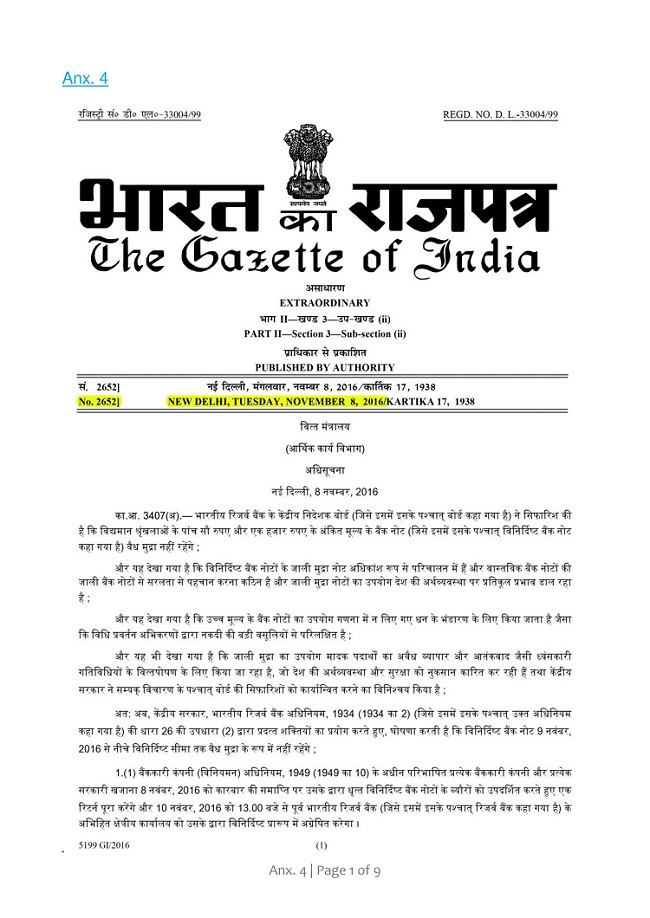
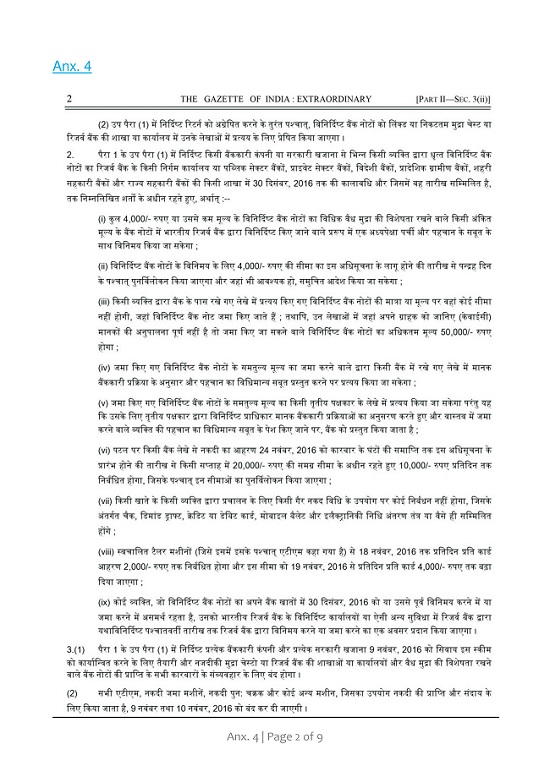
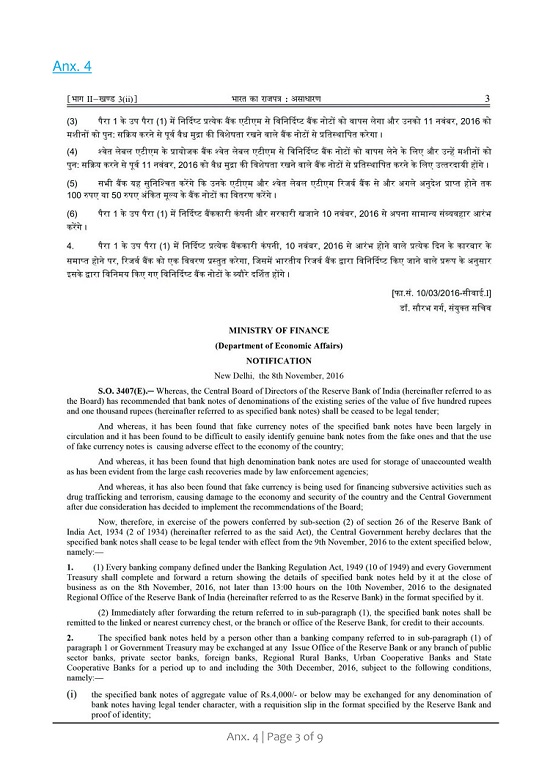
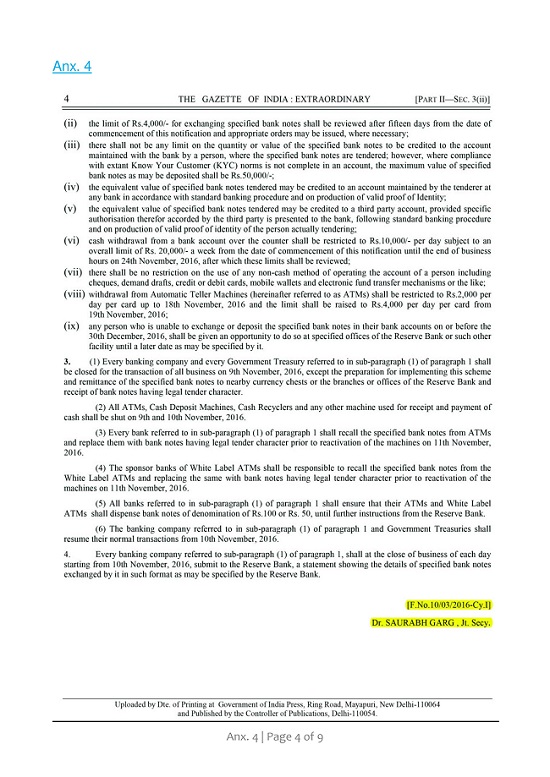
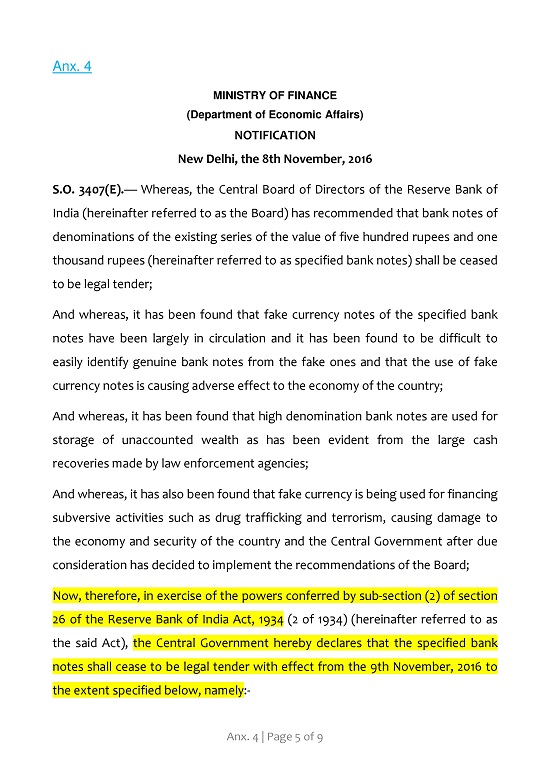
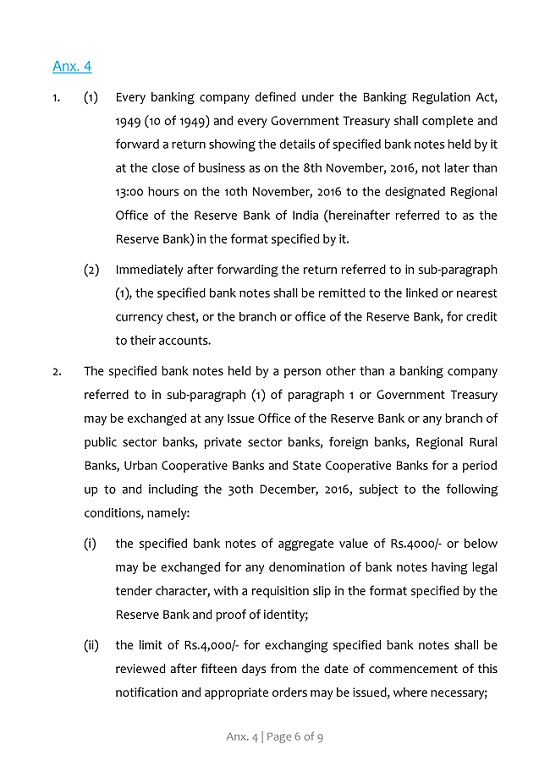
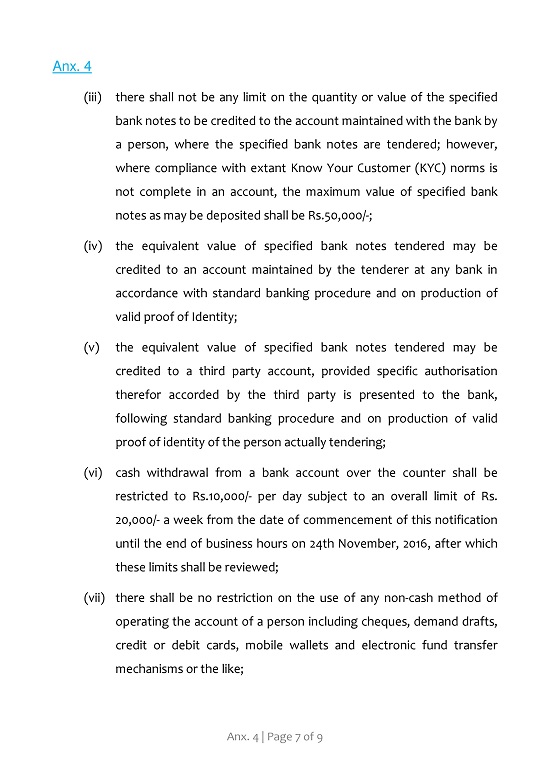
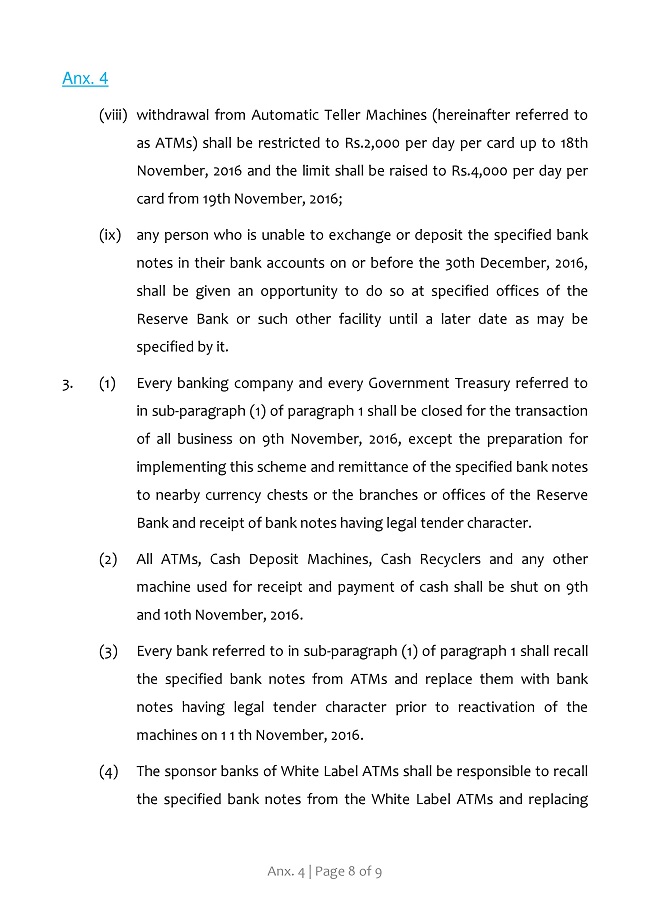
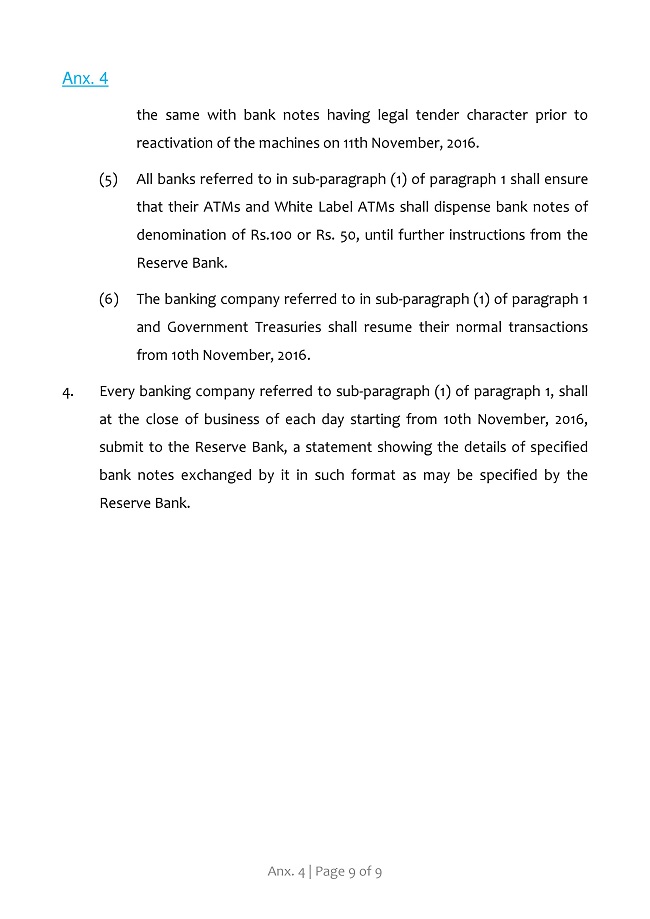
At Annexure 4, the Gazette of India N0. 2652 containing publication of Notification No. S.O. 3407(E) regarding Demonetisation is also dated 8th November 2016. If the PM’s Announcement was made at 8.00 pm, it is difficult to believe that the content of the Gazette Notification was sent by the Finance Ministry to the Controller of Publications who in turn sent written instructions to the Directorate of Printing at the Govt. of India Press for inclusion in the Gazette published and released on the same date. These reflect the super human speed of action which is not supported by real life experience.
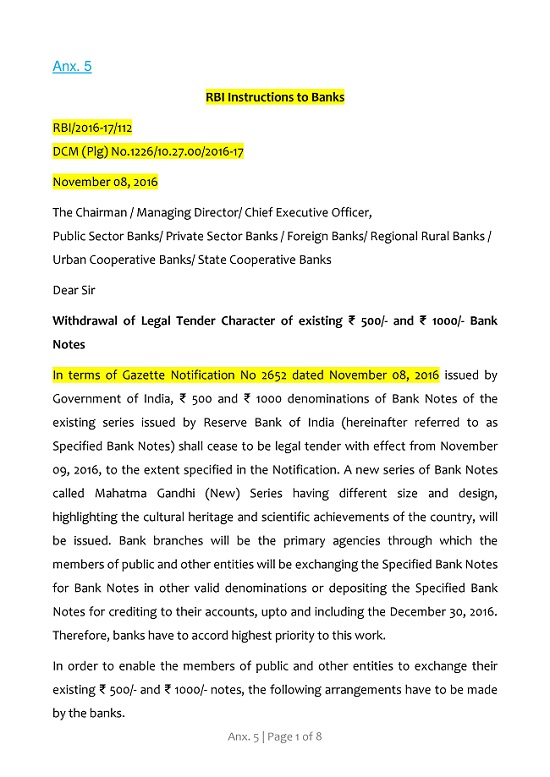
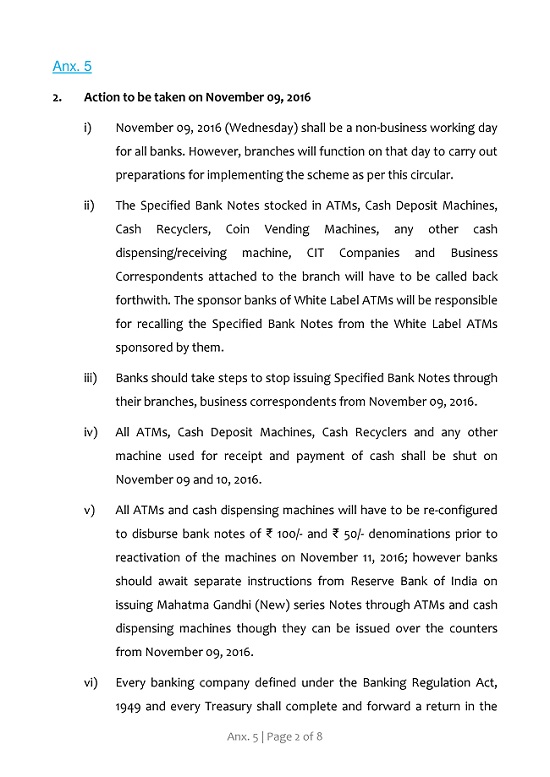
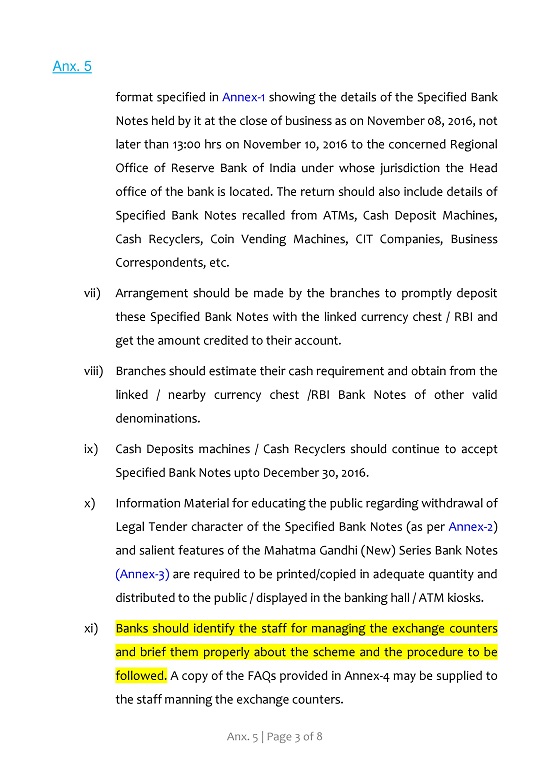
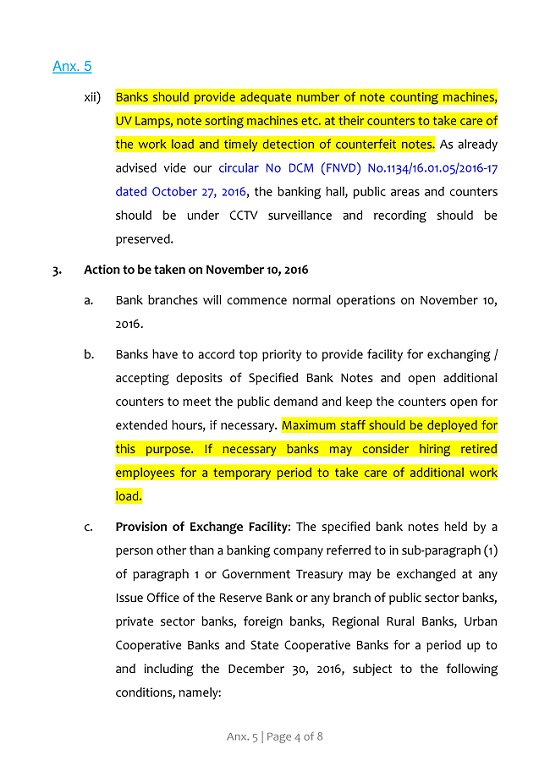
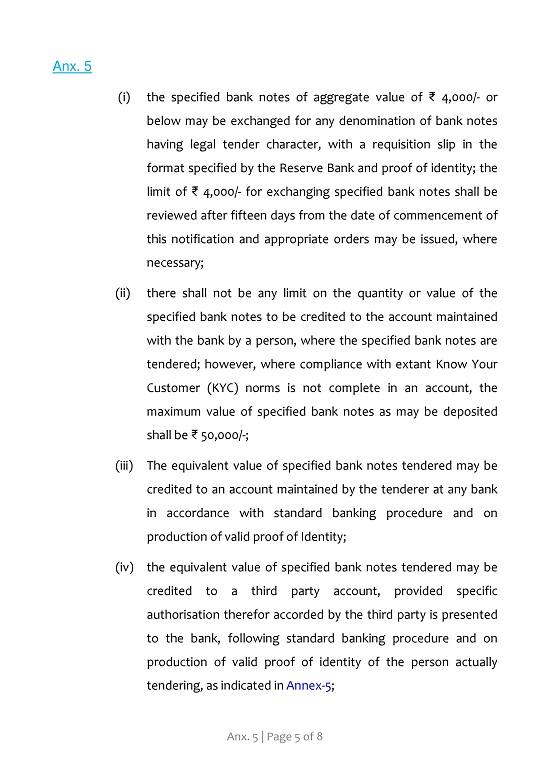
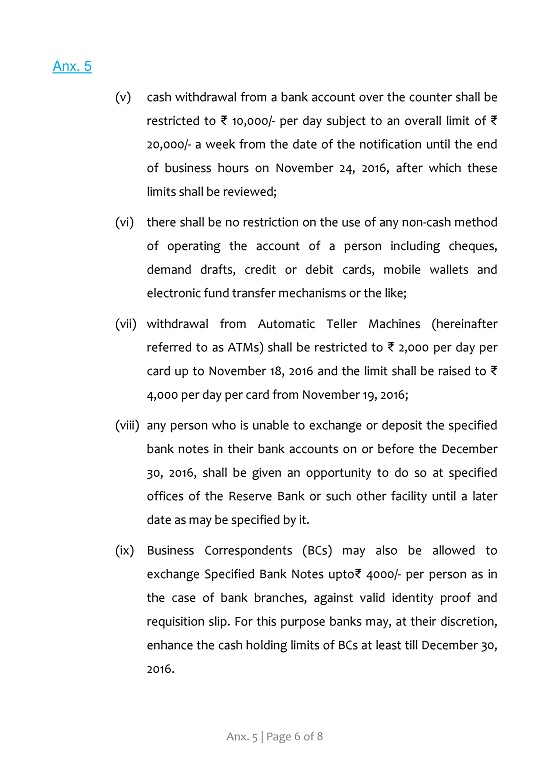
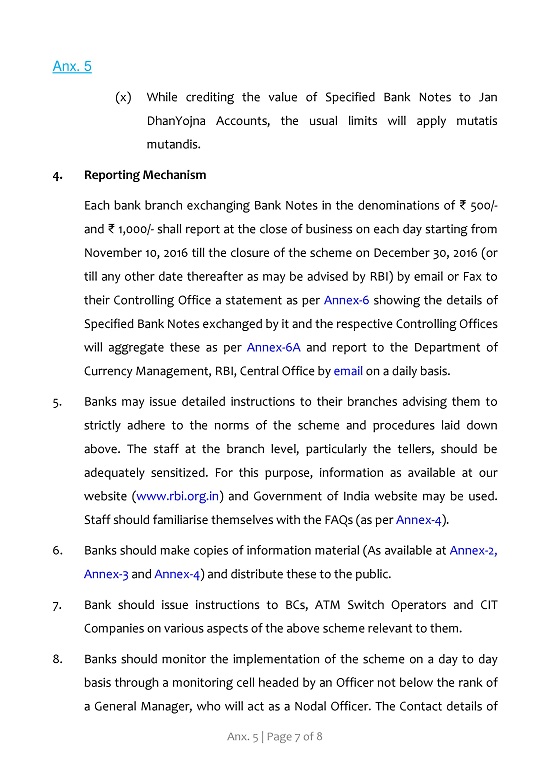
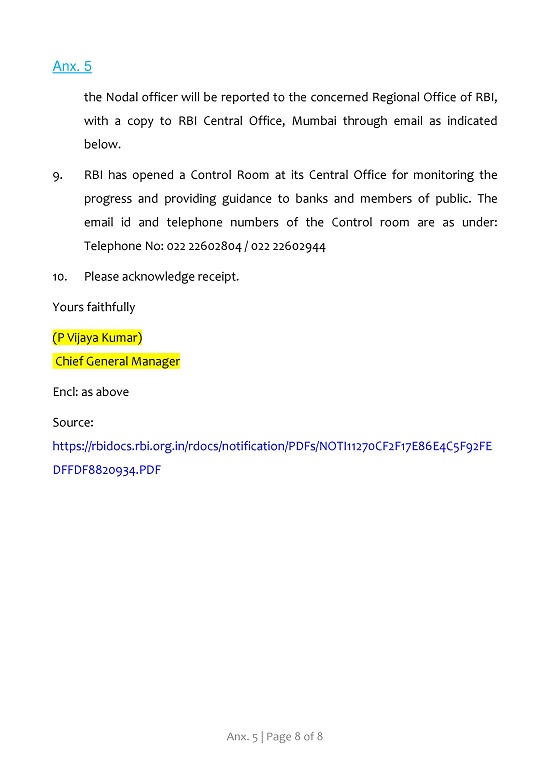
From Annexure 5, we observe that on the very same date of 8th November 2016, the RBI under the hand of its Chief General Manager has issued “Instructions” to the Heads of all Banks. In this Circular, reference is made to the Gazette Notification No. 2652 of 8th November 2016. This naturally implies that the Circular – with all the details seen therein — was prepared after the Gazette Notification was published which would have been physically seen only on 9th November 2016. Whereas, the RBI’s Circular has been issued almost simultaneously lending credence to the belief that this was prepared in advance and kept ready for issue, long before the Gazette Notification was actually published. The contents of Point No. 2: Action to be Taken on 9th December 2016, in particular instructions at Sub Para (xi) & (xii) as well at Para 3(b) clearly confirm that this Circular was prepared long before the Gazette Notification and kept ready for circulation.
The Minutes of the Meeting of RBI Central Board became available very recently hence the renewed interest on this subject. If RBI had not recommended “Demonetisation” for reasons stated in their documents, how could Government of India forced its ideas on RBI and directed it to abide by its decision to go ahead with “Demonetisation”? It is thus clear that the Government forced its will on RBI and compelled it to concur.
The primordial role of our Finance Ministry in this whole exercise is never explained anywhere though this is the apex operational Ministry for such matters.
The Minutes speak of the Memorandum on this subject being prepared by the Deputy Governor of RBI, but surprisingly his name is not mentioned in anywhere. He had to be authorized in writing in advance to do so either by the RBI Governor or by the RBI Central Board. We desire to know who mandated him to take up this serious exercise and who are the members of the Committee constituted to prepare the Memorandum along with the said Deputy Governor. The Deputy Governor could not have prepared it in isolation considering the weight of the subject and the volume of work involved.
If all proceedings had been followed for over 6 months as stated in the Minutes, then where was the need to call for an emergency meeting on 7th November 2016 instead of following the usual option of a regularly convened meeting, giving one month’s notice to all Directors ?
If indeed, the idea of the Government was to curb the use of black money, why were the erstwhile Rs. 1000 currency notes replaced by the even higher denominated Rs. 2000 currency notes, which facilitate and encourage dealing with cash and thereby support the perpetration of black money transactions? Since the storage space and logistics involved were both reduced by 50%, surely, the Reserve Bank could not have recommended the introduction of Rs. 2000 currency notes and that too, as a replacement for Rs. 1000 currency notes. Undeniably, there are highly knowledgeable and experienced officials in RBI, who would never have put forth such recommendations, and risk jeopardising their enviable reputation.
As far as Rs. 500 notes are concerned a new series has replaced the old series, therefore there is no impact one way or the other on the volume of cash in circulation and its use for unaccounted operations.
As far as counterfeiting is concerned, reports during 2017-18 by Law Enforcement Agencies in India clearly debunk the proposition of the Govt. of India that Demonetisation would deter / eliminate counterfeiting.
As far as use of currency of unaccounted transactions is concerned, the total incidence of black money operations has substantially increased since 2017 assisted by the welcome presence of the higher denomination of Rs. 2000 currency notes. Therefore “Demonetisation” has not in any way helped abate either the circulation of black money or corruption.
Specific Questions which Deserve Factual Response from RBI and Govt. of India
(I) Why did it take 28 months for RBI to provide copy of Minutes of their Central Board’s Meeting No. 561 dated 8th November 2016, to RTI Activists ?
(II) Did RBI have more to conceal than reveal regarding procedural lapses with regard to “Demonetisation”?
(III) Is RBI guilty of participative / contributory wrong doing by not recording its disapproval of Government of India’s directions concerning “Demonetisation” as they were violative of provisions of the RBI Act?
(IV) RBI’s passive stance on this crucial subject as seen from text of the Resolution passed at this Meeting but signed by the Governor as late as 15th December 2016 contains veiled admission of serious procedural lapses on their part as well as on the part of Government of India to a greater extent.
(V) Being an apex, independent body renowned for its integrity and organisational strength, it was well within the powers of the RBI Board to desist from violating the RBI Act and relevant Regulations thereunder, and instead, submit written disapproval of the Government’s proposed actions which was compulsively forced on it by Govt. of India.
(VI) RBI appears guilty of violating its own Act. What are the legal provisions for such violation?
(VII) If as stated in the Minutes, 6 months interaction between RBI and Finance Ministry/Govt. of India had indeed taken place, where was the need to state and record this in the present Minutes of Meeting No. 561?
The proceedings of all such Meetings held during these 6 months ought to be made available to lend credence to this claim.
Otherwise one would be compelled to conclude that this paragraph in the Minutes was also included at the behest of the Government, to give semblance of procedural compliance by both Govt. of India and RBI to “prepare and plan” for such a major action.
(VIII) How many days prior notice were given to the Members of RBI’s Central Board to prepare to attend the most crucial 8th November Meeting? Was the Board Note accompanied by all the supporting documents necessary to understand and prepare for the Meeting ?
(IX) Two more key documents need to be disclosed by RBI/Government:
(a) Memorandum from RBI, Department of Currency Management referred to at Para 4 of the Minutes of its 561st Meeting.
(b) The letter from Finance Ministry to RBI dated 7th November 2016 referred to therein.
(X) In its Annual Report for 2017-18, RBI has reported on 30 Aug, 2018, thus; “As much as 99.3% of the junked Rs. 500 and Rs. 1000 notes have returned to the banking system. Of the Rs. 15.41 lakh crore worth Rs. 500 and Rs. 1000 notes in circulation on November 8, 2016, when the note ban was announced, notes worth Rs. 15.31 lakh crore have been returned. This meant just Rs. 10,720 crore of the junked currency did not return to the banking system.”
This once again confirms
that the view of the Board recorded at Para 4.3 (vi) that “this move would not
have a material impact on those assets” stands reconfirmed by this statement in
its own Report.
We use cookies on our website to give you the most relevant experience by remembering your preferences and repeat visits. By clicking “Accept All”, you consent to the use of ALL the cookies. However, you may visit "Cookie Settings" to provide a controlled consent.
This website uses cookies to improve your experience while you navigate through the website. Out of these, the cookies that are categorized as necessary are stored on your browser as they are essential for the working of basic functionalities of the website. We also use third-party cookies that help us analyze and understand how you use this website. These cookies will be stored in your browser only with your consent. You also have the option to opt-out of these cookies. But opting out of some of these cookies may affect your browsing experience.
Functional cookies help to perform certain functionalities like sharing the content of the website on social media platforms, collect feedbacks, and other third-party features.
Performance cookies are used to understand and analyze the key performance indexes of the website which helps in delivering a better user experience for the visitors.
Analytical cookies are used to understand how visitors interact with the website. These cookies help provide information on metrics the number of visitors, bounce rate, traffic source, etc.
Advertisement cookies are used to provide visitors with relevant ads and marketing campaigns. These cookies track visitors across websites and collect information to provide customized ads.
Necessary cookies are absolutely essential for the website to function properly. These cookies ensure basic functionalities and security features of the website, anonymously.
Cookie
Duration
Description
cookielawinfo-checkbox-analytics
11 months
This cookie is set by GDPR Cookie Consent plugin. The cookie is used to store the user consent for the cookies in the category "Analytics".
cookielawinfo-checkbox-functional
11 months
The cookie is set by GDPR cookie consent to record the user consent for the cookies in the category "Functional".
cookielawinfo-checkbox-necessary
11 months
This cookie is set by GDPR Cookie Consent plugin. The cookies is used to store the user consent for the cookies in the category "Necessary".
cookielawinfo-checkbox-others
11 months
This cookie is set by GDPR Cookie Consent plugin. The cookie is used to store the user consent for the cookies in the category "Other.
cookielawinfo-checkbox-performance
11 months
This cookie is set by GDPR Cookie Consent plugin. The cookie is used to store the user consent for the cookies in the category "Performance".
viewed_cookie_policy
11 months
The cookie is set by the GDPR Cookie Consent plugin and is used to store whether or not user has consented to the use of cookies. It does not store any personal data.