Home Blog Page 97

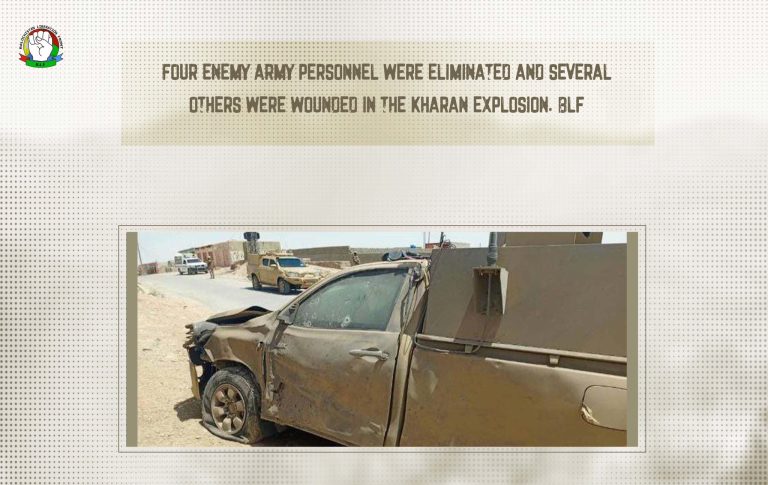
BLF attacks Pak Army convoy, kills four Pak soldiers in Kharan POB

The Balochistan Liberation Front (BLF), a prominent Baloch freedom fighter group, has claimed responsibility for a deadly attack on a Pak military convoy in the Kharan district of Pak-occupied-Balochistan province.

In a statement issued to the media, Major Gwahram Baloch, the spokesman for the BLF, said their freedom fighters targeted a vehicle in a convoy of the occupying Pak Army on the Gwash Road in Kharan city on May 31 around 1:30 pm. The vehicle was hit by a remote-controlled bomb blast, resulting in its complete destruction.

This blast killed four personnel on board, and several others were injured. Asserting their responsibility, the BLF spokesman warned that the freedom fighters’ attacks on the occupying forces would continue until the “complete liberation of the land”.

Balochistan, Pakistan’s largest but least populated province, has grappled with a long-running freedom struggle. Various Baloch freedom fighter groups, including the BLF, have waged an armed struggle against the Army, for subjugation of the Baloch people and exploitation of the resource-rich region’s natural resources.

Pak security forces arrest students peacefully protesting against land grab in POGB

Tensions escalated in the Pakistan-occupied Gilgit-Baltistan region on Friday when security forces arrested several students for participating in a peaceful demonstration against the land grab in the name of promoting “green tourism.”

The arrests took place after students from Karakoram International University in Skardu held a symbolic protest walk in the city’s park on May 26. Among the arrested were Comrade Babar, Owais Ahmed and others. They voiced vehement opposition to the Pakistan Army’s attempts to seize control of forests, rest houses and other lands across Pak-occupied-Gilgit-Baltistan under the guise of environmental initiatives.

The students accused Pakistan military of trying to deprive locals of their land resources and make them landless and voiceless minorities in their own territory for corporate gains. The demonstration came after the POGB authorities recently leased out 20 guest houses and 16 forest nurseries to a private company favored by the Army.

Pak police randomly arrests PTM Coordinator Fateh Mohammad at midnight

In the early hours of the morning, at around 1 a.m.,Pak police conducted a raid on the home of Fateh Mohammad Kakar, the PTM coordinator in Killa Saifullah. Kakar was arrested during this raid, an action that has been widely condemned as unjust and unconstitutional.

This incident is part of a broader pattern of oppression against the Pashtun community. Just days earlier, on May 4, the family of Wali Salam, a Pashtun man from North Waziristan, received his lifeless body. Salam had been forcibly disappeared three years ago and reportedly endured severe torture at the hands of the Pakistan Army. He ultimately succumbed to his injuries in an internment center.

Salam’s tragic death is not an isolated case. Numerous Pashtuns have reportedly faced similar fates, suffering abduction, torture, and other human rights abuses.

The Army is not only harboring terrorists in the region but also engaging in the abduction, torture, and rape of innocent Pashtuns. These actions are aimed at maintaining control over the region, perpetuating the deprivation of the Pashtun people, and exploiting their resources for monetary gain.

Balochistan Awami Party President’s convoy comes under attack in occupied Balochistan

Balochistan Awami Party (BAP) President Nawabzada Khalid Hussain Magsi’s convoy came under attack in Pakistan-occupied- Balochistan on Thursday, though he remained unharmed in the incident.

Reportedly, unidentified gunmen opened fire on the vehicle of Magsi, while he was traveling on the Notal Central Highway near Nasirabad town. Magsi was en route from the provincial capital Quetta to his hometown of Jhal Magsi when the attack occurred.

According to the Deputy Commissioner (DC) of Sibi, the dacoits from the riverine areas opened fire while trying to flee from the Levies personnel chasing them. As is often seen, the Army tries its best to fabricate stories to hide the truth about its struggles in the region.

Pakistan-occupied- Balochistan has experienced a long-running unrest because of the oppressive Army regime and therefore the demand for independence from Pakistan is very important as the cases and crisis of enforced disappearances, indiscriminate killings, kill and dump policy, raids, harassment & discrimination and lack of provincial autonomy has become a daily norm.

In these circumstances, pro-Army figures who are not only the puppets of the Pak ‘establishment’ but are also against Baloch community. Therefore, such attacks are not out of the ordinary. However, so far, no group has claimed responsibility for the attack on Magsi.

Muslim family beats and chains Christian sanitation worker for hours in Lahore

In another disturbing case of violence against Pakistan’s marginalized Christian minority, a sanitation worker was brutally assaulted and left chained in the street for hours by a Muslim family angered over delayed garbage collection.

Yasir Masih, 35, was found severely beaten and shackled to a chair in the blistering heat in Lahore’s Gujjarpura neighborhood on Tuesday. His body was covered in bruises after being attacked with iron rods and repeatedly punched and kicked, according to his father-in-law Hussain Masih. 

The vicious assault occurred after Masih, a Christian employed by the city’s sanitation department, did not immediately clean the doorstep of Muhammad Khadim Hussain’s home as demanded. Masih explained he would complete the request after finishing his official street cleaning duties.

However, when Masih later arrived at Hussain’s residence, he was lured to the roof where Hussain, his son, and three others were waiting. They proceeded to violently beat him before shackling him to a chair out on the street.

“I found my son-in-law chained on a chair, his body was full of bruises”, recalled Hussain Masih.

Though still restrained, the bloodied victim managed to drag himself into the street where passersby eventually noticed and alerted his family, who had grown concerned over his absence from work that morning.  

Christians in Pakistan are often referred to as Chuhra (low caste), a pejorative term used for sanitation workers. They continue to suffer the same discrimination and are pushed to jobs seen as degrading. In Pakistan, road sweepers are mostly Christians and are referred to by other abusive slurs.

Recently, a Christian man was nearly lynched, looted and his shoe factory was set ablaze because he was accused of blasphemy. These deplorable incidents are just the latest example of the deeply-rooted discrimination, violence, and lack of basic rights faced by Pakistan’s Christian minority community. Such abuses, often borne from perceived insults to the Muslim majority, occur with little accountability.

Grenade attack on Pakistan’s Levies Force headquarters in POB

One person was injured on Wednesday when unknown armed men launched a grenade attack on the headquarters of the Levies paramilitary force in Mastung district of Pakistan-occupied Balochistan.

Reportedly, unidentified armed men lobbed a powerful hand grenade at the Levies headquarters in Road Tehsil area of Mastung before fleeing the scene. The grenade detonated with an intense blast, leaving at least one person wounded.

No group immediately claimed responsibility for the brazen attack. However, Pakistan-occupied-Balochistan has experienced simmering resentment against the Pak Army due to human rights abuses and atrocities committed against the ethnic Baloch community on a regular basis.

The Levies force is a key law enforcement body assisting Pakistan’s regular police and military in killing and harassing the Baloch in the name of maintaining security. The Pak Army has time and again damaged Pak-occupied-Balochistan either directly or with proxies. 

Trump becomes first ex US president to be convicted of crime

In an unprecedented ruling, former U.S. President Donald Trump was convicted on all charges on Thursday in a hush money case, becoming the first ex-president in the nation’s history to be found guilty of a crime. The conviction comes just months before Trump aims to regain the White House in the 2024 election.

A New York jury found the 77-year-old Republican guilty on all 34 counts of falsifying business records to conceal a $130,000 payment to porn star Stormy Daniels, made shortly before the 2016 presidential election to buy her silence about an alleged sexual encounter with Trump.

While Trump could face up to four years in prison on each count, legal experts say he is more likely to receive probation as a first-time offender when sentenced on July 11 – just days before the Republican convention where he is expected to be nominated as the party’s presidential candidate.

Trump, who was released without bail, maintains his innocence and denounced the trial as “rigged” and a “disgrace.” However, the conviction marks him as a felon – a historic first for a former U.S. president.

The nine-week trial featured testimony from Daniels, whose real name is Stephanie Clifford, who provided graphic details about her alleged 2006 sexual encounter with the married Trump. Prosecutors argued the hush money payment, funneled through Trump’s former lawyer Michael Cohen, was part of an illegal plot to cover up information that could have derailed Trump’s 2016 White House bid.

Despite the conviction, Trump is not barred from running for president again, even if he receives a jail sentence. His campaign issued a defiant fundraising appeal after the verdict, calling Trump “a political prisoner”.

The hush money case is just one of several legal battles Trump faces, including charges of trying to overturn his 2020 election loss and mishandling classified documents after leaving office.

China-Pakistan Economic Corridor: Who really benefits?

Beijing and Islamabad recently celebrated the tenth anniversary of the ambitious USD 62 billion China-Pakistan Economic Corridor [CPEC] and complimented each other for the spectacular progress this project has made. While this project has promoted infrastructural development in the power generation and surface communication sectors, it most certainly hasn’t measured up to Beijing’s oft-repeated claim of being a ‘game changer’ for Pakistan.

Au contraire, CPEC has been viscously plagued by time overruns resulting in burgeoning budgetary escalations. To add to these woes, inexplicable opaqueness in the terms and conditions of contracts as well as interest rates on loans extended to Islamabad by Beijing makes an accurate cost-benefit analysis of this project extremely difficult.  Nevertheless, information available in the public domain does suggest that things may not be as hunky-dory as being portrayed by both Beijing and Islamabad.

On paper, CPEC is a brilliantly conceived initiative incorporating “early harvest” projects for speedy provision of basic facilities to the people of Pakistan and simultaneously generating income for the government into three phases [short, medium and long-term]. While the short-term phase [2015-2022] focussed on infrastructure, energy and port development projects, creation of 33 special economic zones [SEZs] were planned to be executed in the medium phase. The third phase is yet to commence formally.

While several independent power projects [IPPs] being operated by Chinese companies have come up in the first phase, electricity is still not available to many living in remote areas due to inadequate power distribution infrastructure. To make matters worse, instead of generating revenue for the government, CPEC’s power generation project has created a ‘circular debt’ in Pakistan due to unpaid government subsidies and this leads to debt accumulation in power distribution companies.

Quoting data released by Pakistan’s Power Division of the Ministry of Energy, Dawn, has disclosed the total circular debt of Pakistan [as on March 2024] was a whopping Rs 3,000 billion. There have been several allegations of over invoicing by IPPs resulting in exorbitant per unit cost of electricity as well as huge transmission losses. Furthermore, thermal power plants created as part of CEPC utilise imported coal and the regular requirement of foreign exchange to procure the same further depletes Pakistan’s already woefully scarce foreign exchange reserves.

Port Qasim Electric Power Company Ltd, an ‘early harvest’ IPP owned by China’s Sinohydro Resources and Qatar’s Al Mirqab Capital Ltd which runs a 1,320 megawatts power plant using imported coal. The fact that in May last year, this IPP served a payment default notice of USD 263.5 million on Pakistan’s Central Power Purchasing Agency, illustrates how CPEC is slowly turning out to be a liability of sorts. It also indicates that the patience of Pakistan’s ‘Iron brother’ is fast running out and this isn’t the first such incident.

In September 2021, while presiding over Pakistan’s Senate Standing Committee on Planning and Development, its chairman Saleem Mandviwalla disclosed that the “Chinese ambassador has complained to me that you have destroyed CPEC and no work was done in the past three years.” [Emphasis added]. Beijing has also publicly expressed its annoyance on several occasions as regards the Pakistan Army’s dismal failure to prevent attacks by Baloch freedom fighters on its nationals working on CPEC projects.

Another issue riling Pakistanis is that the promise of employment opportunities on a large scale has turned out to be a damp squib. While some data has been furnished by Beijing and Islamabad, but in absence of any independent verification, the same can’t be relied upon as there’s a wide disparity in the official data. While Chinese official state media estimates that about 1,55,000 Pakistanis are working on various CPEC projects, Pakistan’s erstwhile minister for planning, development and reforms Ahsan Iqbal estimated that CPEC has created more than 2,30,000 jobs!

Excessive restrictions on movement and frequent military operations in Balochistan, purportedly for ensuring security of CPEC projects and Chinese workers, result in indiscriminate arrest of innocents and enforced disappearances on mere suspicion cause untold miseries to locals. In addition, with Chinese fishing mafia using sophisticated trawlers in the area, the traditional fishermen of Gwadar have been deprived of their traditional vocation, while security fencing in this area has literally made Gwadar ‘out of bounds’ to locals.

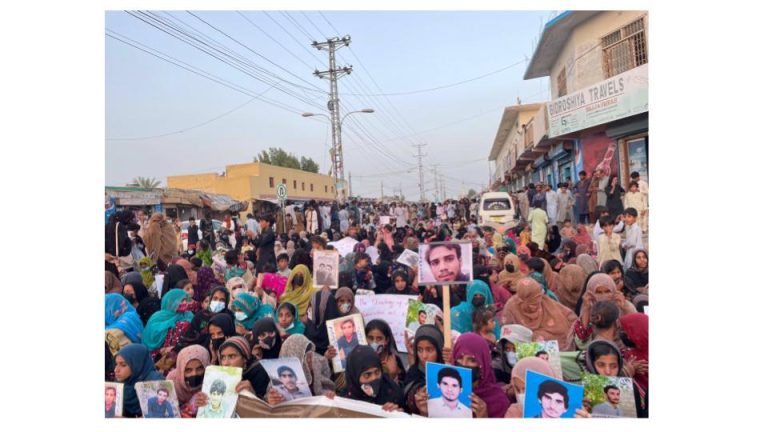
Institutional repression of Baloch people has not only led to an escalation in attacks on CPEC assets and Chinese workers but also inspired the immensely popular ‘Haq Do Tehreek Balochistan’ [give us our rights movement of Balochistan] non-political mass public campaign. The fact that Baloch women who traditionally avoided participation in public rallies and stayed indoors came out in great numbers to protest against the Pakistan Army’s highhandedness indicates the gravity of the prevailing situation. Speaking in the Senate, PML-N’s Senator Kulsoom Parveen lamented that “the people of Balochistan have not gained anything from the [CPEC] project” and aptly echoing their disillusionment by adding that “Maybe, the people of Balochistan will only be given jobs to fix punctured tires”!

While CPEC has undoubtedly brought about development, the costing of this mammoth project is one of the major factors responsible for pushing Pakistan into the inextricable morass of financial instability. So, the question arises is- whose interests does the CPEC primarily serve? A quick project intention internet search of CPEC offers two answers.

Popular Indian educational technology company BYJU’S opines that “The project intention of CPEC is to rapidly upgrade Pakistan’s important infrastructure and strengthen its economy by the construction of energy projects, special economic zones, ports, and transportation networks.” [Emphasis added]. However, even after more than a decade, neither has CPEC resulted in a rapid infrastructure upgrade, nor has it strengthened Pakistan’s economy.

On the other hand,  Wikipedia maintains that This sea-and-land-based corridor is aimed to secure and reduce the passage for China’s energy imports from the Middle East by avoiding the existing route from the Straits of Malacca between Malaysia and Indonesia which, in case of war could be blockaded, and thus hamper the Chinese energy-dependent economic avenues.” [Emphasis added]. Being a more practical assessment, this reasoning is certainly more convincing.

Accordingly, while it would be incorrect to consider CPEC a white elephant for Pakistan, it would also be equally naïve to believe that the driving force behind this extremely cost-intensive project is Beijing’s love for its ‘iron brother’ Pakistan. The harsh reality is that CPEC is primarily meant to serve Beijing’s commercial interests and any benefits from it that may come in Pakistan’s way are just incidental.

Because had CPEC indeed been truly Pakistan centric, then why [in the words of the Chinese ambassador], “no work [on CPEC] was done in the past three years” by Islamabad? And if this project was not primarily meant to serve Beijing’s interests, then why did the Chinese ambassador get so agitated and complain to the Chairman of Pakistan’s Senate Standing Committee on Planning and Development that “you have destroyed CPEC”?

Target killings in Khyber-Pakhtunkhwa: TTP shoots dead tribal man

In a tragic incident, a local elder tribal, Malik Salahuddin, was shot dead allegedly by TTP in Gomal Bazar, Tank district of Khyber- Pakhtunkhwa. The attack occurred when a group of five individuals entered a shop and opened fire on Salahuddin, killing him on the spot. The assailants fled the scene immediately after committing the crime.

Police have launched an investigation into the killing. However, this incident is part of a worrying trend, as target killings in Khyber Pakhtunkhwa have risen significantly in recent weeks. Despite the spike in cases, the so-called security forces have failed to apprehend the accused or curb such instances effectively.

Meanwhile, a pro-TTP channel has claimed that TTP killed Salahuddin as he was helping Pak Army in its operation.

Post acknowledged TTP role in Salahuddin’s assassination (Photo: X)

However, the local community has voiced strong accusations against the security forces, claiming that they have put the region in this vulnerable and devastating position. The condition of civilians in the region has worsened as TTP and Pak Army, both are involved in killing them.

Pashtuns argue that most part of the region are heavy militarised and checkposts are installed at close distances still the target killings are on the rise. Apparently, their concern is genuine as Pak Army barely takes fructifying steps against the terrorists but keeps a close eye on civilians in the region. Recently, Pashtun right organisation Pashtun Tahafuz Movement (PTM) held a protest in Dhaka city against the rise in target killings and the incident of six coal trucks being set on fire.

PTM argues that such acts are happening under the watch of Pak Army and its generals. They harbour terror, fear in the region and the cost is paid by the Pashtun population.

Pakistani court acquits Imran Khan of two more cases linked to May 9 riots

In a legal reprieve for the jailed former prime minister, a Pakistani court on Thursday acquitted Imran Khan in two more cases related to last year’s violent protests by his supporters following his arrest.

The District and Sessions Court in Islamabad cleared Khan of the charges filed at Shehzad Town police station, citing “insufficient evidence” presented by the prosecution against the Pakistan Tehreek-e-Insaf (PTI) party chief.

“Because of insufficient evidence presented by the prosecution, the PTI founder has been acquitted”, the court order by Judicial Magistrate Umar Shabbir stated.

Khan, 71, has already secured acquittals in two other cases connected to May 9 vandalism earlier this month from a separate magistrate’s court.

The back-to-back legal victories have provided some relief to the embattled former premier, who remains incarcerated at the high-security Adiala Jail in Rawalpindi over allegations stemming from the nationwide protests last year.

On May 9, 2023, Khan’s arrest on graft charges sparked widespread arson and attacks on military installations across Pakistan by enraged PTI workers. This collective outburst was very uncharacteristic in Pakistan’s history.

The rampage saw mobs storming the Lahore Corps Commander’s residence, known as the Jinnah House, as well as the Mianwali airbase, ISI building in Faisalabad, and even an audacious assault on the Army headquarters in Rawalpindi.

While the acquittals have buoyed Khan’s supporters, he still faces a multitude of other cases related to the May 9 violence, including charges of inciting attacks on state symbols and military assets.