Home Blog Page 98

BLF attacks Pak Army camp, inflicts heavy casualties

In a major offensive against the occupying Pak forces, the Balochistan Liberation Front (BLF) carried out a fierce assault on a central army camp in the Nondara area of Jhao, Awaran district, on the evening of May 26th. The attack resulted in significant human and material losses for the military, according to a statement issued by Major Gwahram Baloch, the spokesperson for the BLF.

The BLF’s Qurban Unit fighters surrounded the Army camp from all sides at around 6 pm on Friday and launched a massive assault using heavy weapons. The attacking team also included skilled BLF sniper shooters. “In this intense attack, more than a dozen army personnel were killed, and many others were injured,” Major Gwahram Baloch said.

The spokesperson revealed that the assault led to the destruction of five Army outposts and all bunkers within the central camp. The fighters even managed to reach near the camp and lobbed hand grenades inside, inflicting further casualties and damage on the Army personnel. “Many soldiers fled from their pickets and the central camp out of fear during the attack, which continued for over four hours,” he added.

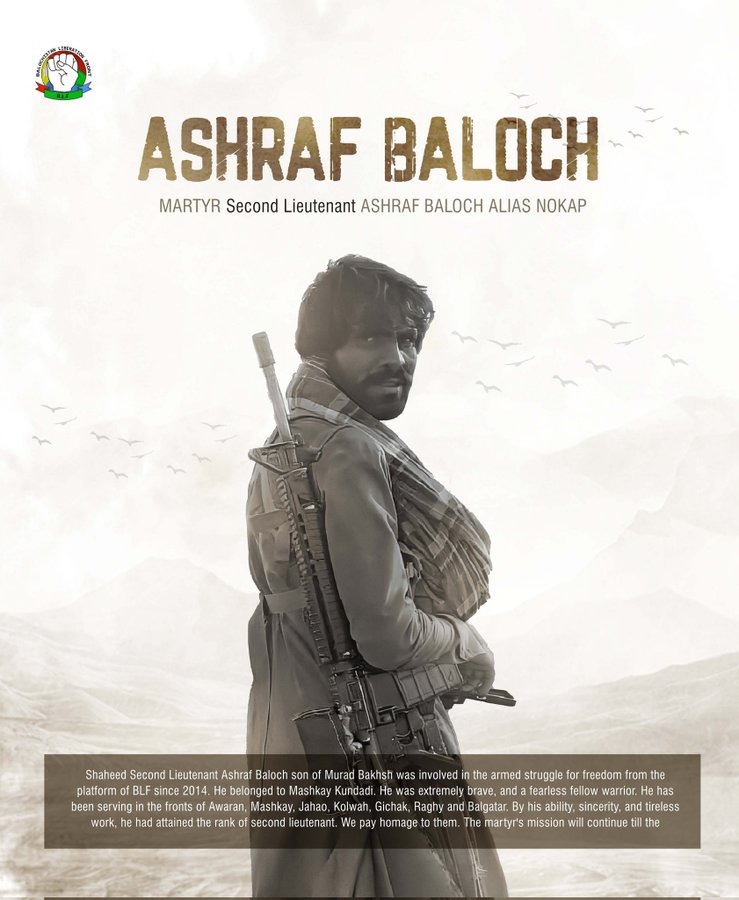
Tragically, the BLF also suffered a loss, as Second Lieutenant Ashraf, also known as Rehan Nokap, son of Murad Bakhsh from Mshkey village in Kandi area, was martyred during the retaliatory shelling. Paying tribute to the fallen fighter, Major Gwahram Baloch described Shaheed Ashraf as “an extremely hardworking and brave fighter who was dedicated to the freedom struggle.”

The next day, on May 27th, the defeated occupying Army retaliated against the civilian population, as per their usual tactics, by blocking roads and harassing people in several areas.

In contrast to the BLF’s open acknowledgment of the attack and its consequences, the Pak Army’s media wing, ISPR, has attempted to downplay or conceal the human and material losses suffered by its forces. “The enemy fears demoralization of its hired forces, so ISPR is trying to hide the losses even in this attack,” the BLF spokesperson stated.

Major Gwahram Baloch reiterated the BLF’s responsibility for the intense attack and vowed that such operations would continue with greater intensity until the complete liberation of Balochistan is achieved.

The assault on the Nondara army camp is a significant escalation in the long-running conflict between the Baloch liberation forces and the brutal occupying Pak Army, which has occupied the resource-rich region for decades, abuses and suppresses of the Baloch population through henious tactics such as enforced disappearances, extrajudicial killing, raids.

Islamabad: Will the judiciary prevail over the Pak Army?

In Pakistan, being critical of the country’s omnipotent Army is indeed a very dangerous thing as it can invite serious repercussions ranging from being mercilessly belaboured to being abducted and in some cases even losing one’s life. Rawalpindi’s acute intolerance to criticism, even when it’s constructive in nature, is no secret and the military is particularly offended when someone exposes its cavalier ways and abuse of power without any accountability. So, incidents of people who have dared to antagonise those in khakis being roughed up or abducted by unknown persons aren’t uncommon.

However, despite being well-aware about the law and having a fair idea of who the assailants are, seldom do the victims who dared to criticise the Pakistan Army disclose the identity of their attackers/ kidnappers and very rarely file police complaints. And leave alone preventing such incidents the police are not even able to  apprehend those brazenly carrying out these illegal acts, even when they take place in the heart of major cities and that too in broad daylight.

Islamabad claims to be having an exceptionally efficient intelligence  and investigative setup with exceptional professional skills. After every major terrorist attack, these agencies come up with a blow by blow account of how these were planned behind closed doors in its neighbouring countries, by not only Indian spy agency Research and Analysis Wing [RAW] but also the Tehreek-e-Taliban Pakistan [TTP] terrorist group.

Yet, Pakistan’s premier intelligence and investigating agencies inexplicably make no headway when it comes to tracking down those who brutalise or abduct critics of the Pakistan Army. This is even in cases wherein courageous victims give enough indications that clearly reveals who had whisked them away, and when irrefutable evidence in terms of video recordings of the incident exists. A few incidents that prove this observation:

·        On September 4, 2010, journalist Umar Cheema who had written several articles that were critical of the Pakistan Army in The News was abducted in Islamabad. Taken to an undisclosed location in the outskirts, he was physically abused and warned not to write articles that were critical of the government. After being released, Cheema reported this incident and even went on record to say that “I have suspicions, and every journalist has suspicions, that all fingers point to the ISI.” [Emphasis added]. With  Dawn in its editorial of September 7, 2010, maintaining that “This paper’s stand is clear: the government and its intelligence agencies will be considered guilty until they can prove their innocence,” [Emphasis added], there’s no room for any doubts as to who was behind this abduction. Regrettably, despite the journalist’s revelation as well as the then Pakistani Prime Minister Syed Yusuf Raza Gilani’s personal assurance to him that this incident would be thoroughly investigated, it remains unsolved till date.

·        On June 5, 2018, Gul Bhukari who is critical of the Pakistan Army was abducted when the car in which she was travelling was intercepted by “unknown persons.” As this incident took place on Sherpao Bridge inside Lahore Cantonment, which is a virtual fortress with strictly controlled access and exit points. This incident raises two questions-one, how could the abductors enter the well secured Lahore Cantonment in the first place, and two, how could they manage to get past the security check-post and escape with a kidnapped lady journalist in tow? Though Bhukari was subsequently released by her abductors, this case still remains unsolved.

·        On July 21, 2020, senior Pakistani journalist and YouTuber Matiullah Jan was abducted in broad daylight from a women’s college in Islamabad just after he had dropped his wife. The college CCTV showed around a dozen men, some dressed in uniforms worn by Pakistan’s Anti-Terrorist Squad [ATS] blocking Jan’s car and ordering him to come out. When he resists, they manhandle him and after forcing him into another vehicle drive away. Despite the fact that at least five of his abductors weren’t wearing masks the police have failed to identify the assailants.  Even the National Database & Registration Authority [NADRA] expressed inability to identify the abductors whose faces are clearly visible, giving the feeble excuse that the images weren’t clear enough. The Pakistan Army and police outrightly denied any involvement and this makes things even scarier. Needless to say that the very thought of three vehicles filled with men disguised as ATS commandos moving around unchecked in the national capital and abducting a journalist in broad daylight is indeed very disquieting. In fact, Islamabad High Court Chief Justice Athar Minallah’s pointed query that “What impression will the public get that people are roaming around freely in police uniforms,” endorses this matter-of-fact apprehension. Furthermore, Jan’s unconditional release just 12 hours later doesn’t make sense-unless its aim was to “scare others” as mentioned by the IHC chief Justice.

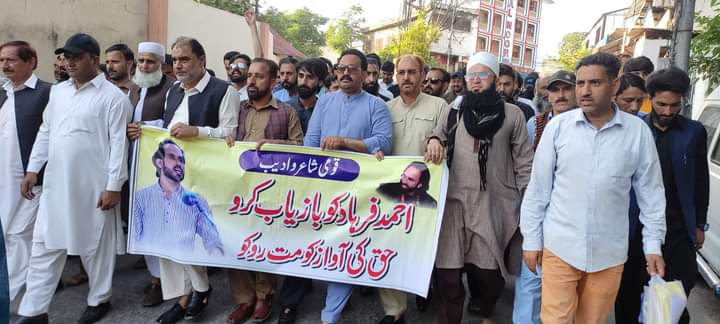
Despite so many incidents of those critical of the Pakistan Army being abducted, investigating agencies have failed to identify a single culprit and this in itself gives a clear indication as to who are the perpetrators. This issue has come up before the Islamabad High Court [IHC] in the ongoing case of Kashmiri poet Ahmed Farhad Shah who was abducted soon after he criticised the Pakistan Army’s harsh dealing in the recent Pakistan occupied Jammu and Kashmir [PoJK] unrest on social media.

IHC senior puisne judge Justice Mohsin Akhtar Kayani hearing this case outrightly rejected ISI’s claim that it had no information regarding the abduction of Farhad and made it clear that the claim made by Pakistan Army’s spy agency was “not believable”. He has accordingly summoned the sector commanders of both ISI and Military Intelligence [MI] alongwith others and directed that “Now, the ISI sector commander’s statement will be recorded in the missing person’s case,” adding that “A police officer will record his statement and write it.” 

The puisne judge also highlighted the fact that “In general, IB [Intelligence Bureau], MI and ISI are accused of missing persons and enforced disappearances, which has affected their reputation and governance and created a negative perception of these institutions in the eyes of the public,” and asked “What steps has the state taken so far to eliminate institutional antagonism and the negative public perception of key state institutions and their reputation?” As expected, the Attorney General had no answer!

Most importantly, Justice Kayani has decreed that “Whichever case on missing persons is fixed before this court, its hearing will be live-streamed.” This will draw public attention to the widespread malaise of abductions and enforced disappearances orchestrated by the Pakistan Army, and thus act as a deterrent. However, despite being censured on this issue several times, Rawalpindi has shown scant regards for the judiciary.

The reason for such shocking indifference can be best described in the words of senior IHC judge Justice Shaukat Aziz Siddiqui who in 2018 admitted that  “Today the judiciary and media have come in the control of ‘Bandookwala’ [literal translation ‘gunmen’; here a reference to the army],” and that the  “Judiciary is not independent.” He went on to elaborate by revealing how “In different cases, the ISI forms benches of its choice to get desired results”, adding that the Army’s spy agency blatantly indulges in “manipulating judicial proceedings as its officials manage to constitute benches at its will and mark cases to selected judges.” 

Justice Kayani has asked ISI- “Are you going to run the country or follow the law?” While this blunt poser exposes ISI’s complete lack of accountability, but what needs to be seen is how Rawalpindi reacts. Will Pakistan Army meekly accept this frontal assault on its extra-constitutional powers and supremacy over other state organs, or as is its wont, will decide to brazen it out. While logic suggests that it would be puerile for Rawalpindi to take-on the judiciary, but then, Pakistan Army’s dogged determination to defend its turf at all costs should not be underestimated!   

Armed men attack Pak Army posts and camps in Kech, Awaran

In a major offensive against the Pak Army occupation, armed men carried out two daring assaults on occupying forces in Kech and Awaran districts of Pak-occupied-Balochistan.

The first strike targeted a Pak military post in the Archinaan area of Zamran, Kech district. They effectively engaged the Army forces deployed at the post, inflicting substantial casualties upon them through precise and unrelenting fire.

Just hours later, a larger contingent of armed men launched an even more audacious operation in Awaran’s Nodra area. Surrounding a major Pak military camp from all sides, the men launched an intense multi-pronged assault. Intense exchange of gunfire and loud explosions rang across the area for an extended period as the men rained fire on the besieged military installation.

https://twitter.com/bahot_baluch/status/1795142523259650468

The fierce attack forced the Pak occupying forces trapped inside the camp to remain confined for several hours, pinned down by the armed fighters’. Reportedly, the Army suffered many casualties and losses during the daring raid.

However, the puppet authorities have not yet commented on the losses caused by the attacks. It is interesting to note that, neither the Pak Army nor its terrorist death squads have mustered the courage to officially admit the losses their forces endured during the defiant operation by the armed fighters.

No freedom fighter group has claimed responsibility for the deadly attacks as yet. However, Baloch independent groups waging an armed struggle for independence from Pakistan are known to be actively operating in the region.

Pak-occupied Balochistan has long suffered under the forceful control of Pakistan, dating back to 1948. In its efforts to maintain control over Pak-occupied Balochistan, the Pak Army has resorted to various oppressive tactics.

Enforced disappearances, kill & dump policy by Pak Army continues in occupied-Balochistan

In the latest act of violence, Yar Muhammad, son of Jalal, has been killed by the brutal Army force’s barbarians. The oppressive Pak Army continues its reign of terror and atrocities against innocent Baloch people.

Yar Muhammad was abducted and forcibly disappeared by the Pak forces just two days ago during a night raid in Dera Murad Jamali. His mutilated body bearing marks of severe torture was found dumped in the Chhattar area. The cowards tried to hide their crimes by disappearing him first, but ultimately could not escape from delivering his lifeless body as proof of their heinous acts.

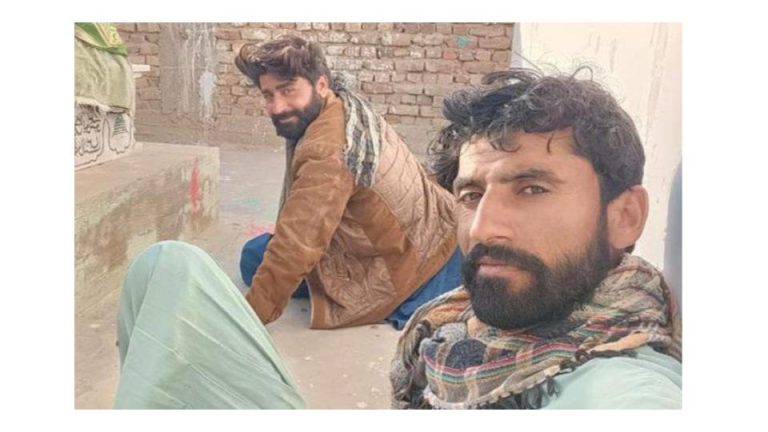
Another Baloch brother Akhtar, son of Khair Muhammad, who was also abducted along with Yar Muhammad, remains forcibly disappeared by these monsters.

The atrocities did not end there. In another deplorable incident, Rafiq Baloch and Faisal Baloch, were kidnapped by the forces from their own home in Turbat Koh Murad late last night. Faisal is employed with the ATF, while Rafiq is a laborer. The Army resorted to their typical brute tactics – violating the sanctity of the home, beating up the innocent civilians, and snatching away their mobile phones during the illegal raid and abduction.

Family of victims of enforced disappearance Faisal Suwali and Rafiq Suwali staged a protest in Turbat in a sit-in outside the Kech Deputy Commissioner’s office, demanding the brothers’ immediate release after they were forcibly disappeared by Pak Army from their home Ziarat Absar.

The Pak forces through such cowardly tactics of enforced disappearances, kill-and-dumps, and other brutalities are trying to suppress the Baloch community and their voice since it has occupied the region in 1948.

Kashmiris hold ‘Martyrs Public Rights March’ demanding justice in POJK

On May 27, the entire Pakistan-Occupied Jammu and Kashmir (POJK) observed a complete shutdown and took out a procession titled ‘Martyrs Public Rights March’ in Muzaffarabad. Thousands of people participated in the march, demanding justice for the protesters who were brutally killed by the Pakistan Army during the incidents from May 10-12.

The protesters highlighted the deaths of three Kashmiri youths, namely Waqar, Chaudhary Zaheer, and Saqib Fayaz, who lost their lives to bullets fired by Pakistani Frontier Corps (FC) forces during the protests. The marchers called for accountability from the authorities responsible for the violence against peaceful demonstrators and demanded the release of incarcerated activists.

In addition to seeking justice for the slain protesters, the marchers also demanded the release of poet and journalist Ahmad Farhad, who was abducted after his coverage of the rights movement during the May 10-12 protests. Farhad’s abduction has raised concerns about the suppression of free speech and the targeting of individuals who report on human rights issues in the region.The shutdown and the march were significant demonstrations of solidarity among the people of POJK, showing their resolve to stand against oppression and demand justice for the victims of state violence. The peaceful yet powerful demonstration sent a strong message to the authorities, urging them to address the grievances of the people and ensure accountability for the actions of security forces.

Skardu POGB boils against Pak Army’s land grab tactics

On May 26, a symbolic protest walk was held in City Park Skardu against the occupation of forests and rest houses. The protesters voiced strong opposition to the Pakistan Army’s attempts to seize the land of Pakistan-Occupied Gilgit-Baltistan (POGB) under the guise of green tourism.

They accused the military of exploiting POGB’s resources for its own gain, enforced through the threat of arms.

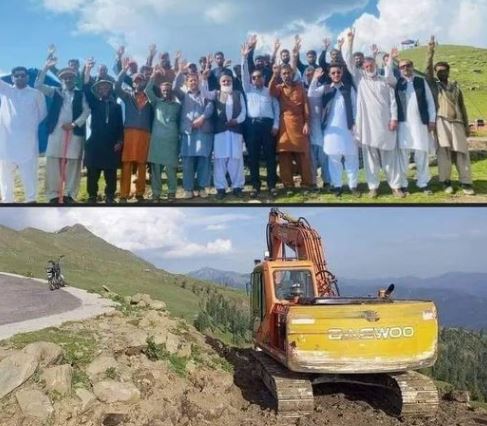
Separately, Najaf Ali, Chairman of the Awami Action Committee Baltistan, led a protest in Skardu City Park against the occupation by a non-local company. He also instructed the construction staff to cease their activities in the park.

Meanwhile on May 27, an important meeting was convened at Jamia Masjid Gamba Skardu, called by the Deputy Imam of Friday Prayers. The meeting was attended by members of the Awami Action Committee and local leaders. During the gathering, there was a consensus to launch a door-to-door public awareness campaign. The participants agreed to initiate a movement soon to resist the military’s efforts to seize the region’s resources.

The protestors emphasized that the resources of Gilgit-Baltistan, from the riverbanks to the mountain peaks, rightfully belong to the local people and that any occupation by external forces is unacceptable.

It is worth mentioning that POGB started to boil after the occupying government put 20 guest houses and 16 forest Nurseries land to a non-native private company, allegedly a favourite of Pak Army. The sole purpose of such lease is the land grab to make the native population landless and minority in their own land, thereby making them voiceless.

Gwadar grapples with surge in enforced disappearances by Pak Army

The coastal town of Gwadar has become the latest epicenter of the intensifying crisis of enforced disappearances plaguing the oppressed Baloch people under the brutal occupation of Pak security forces.

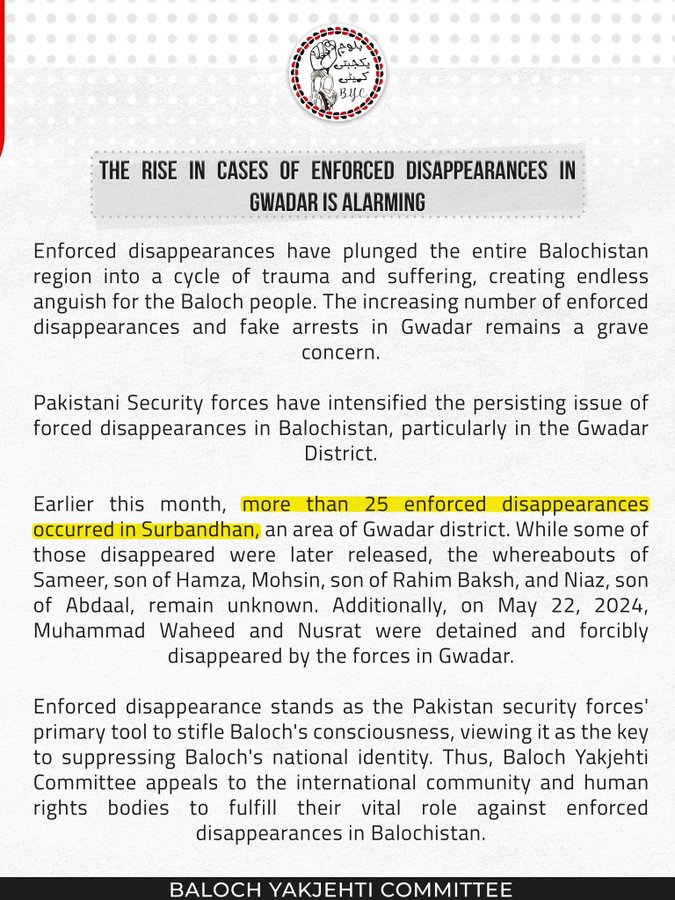
Reportedly, more than 25 Baloch civilians, including students and political activists, were abducted by Pak military and intelligence personnel in raids across the Surbandhan area of Gwadar district earlier this month.

While some of the disappeared individuals were later released, the whereabouts of Sameer, son of Hamza, Mohsin, son of Rahim Baksh, and Niaz, son of Abdaal, remain unknown. Given the nature and history of the Army the victim’s families fear of torture, extrajudicial killings or indefinite secret detentions.

“The Pak forces barged into our homes like thugs in the middle of the night and dragged away our sons”, recalled an elderly resident of Surbandhan, further adding, “We have no idea if they are even alive”.

The wave of abductions in Gwadar follows the enforced disappearance of Muhammad Waheed and Nusrat on May 22 by Pakistani personnel, in another chilling addition to the thousands of such illegal abductions across Pak-occupied-Balochistan.

For the beleaguered Baloch community, enforced disappearances have become a brutal tool of repression and collective punishment by the Army to crush their struggle for self-determination and human rights.

Enforced disappearances have plunged the entire region into unending trauma and suffering and it is meant to erase the national identity by spreading fear.

Despite repeated appeals and protests, the Pak military has shown no signs of relenting in its scorched-earth campaign against the Baloch population, which has faced decades of marginalization, resource plundering, and violent suppression of dissent.

Baloch activists have urged the international community and global human rights bodies to take decisive action against the grave human rights violations being perpetrated by Pak forces under the guise of counter-insurgency operations.

Mashkel protesters’ Long March against Pak Army’s oppression in PoB

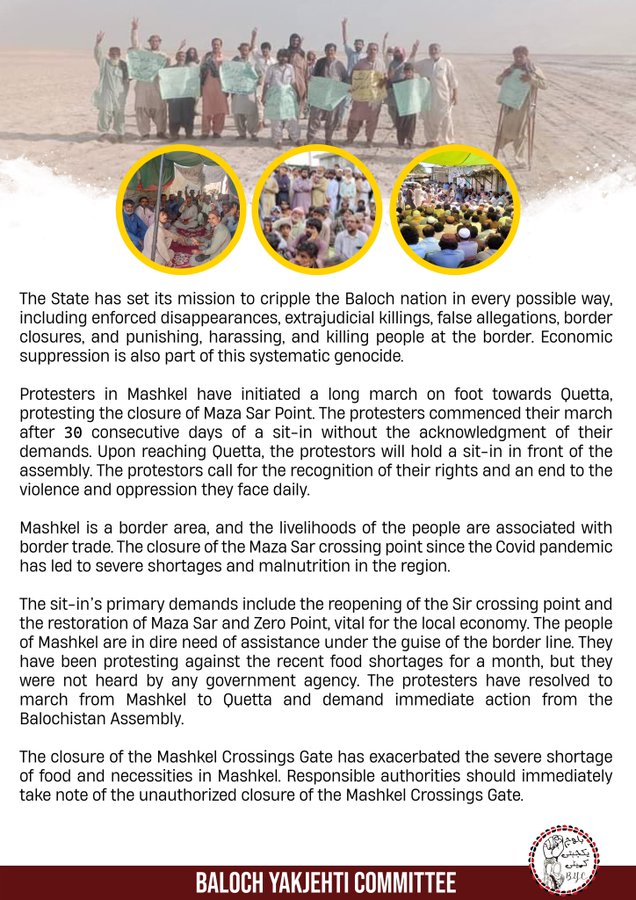
Hundreds of protesters from the town of Mashkel have embarked on a grueling long march towards the provincial capital Quetta, against the Pak Army’s systemic economic strangulation and oppression of the Baloch people.

The Mashkel protesters, comprising men, women and children began their march on foot after a 30-day sit-in protest in their town failed to draw any response from authorities regarding the crippling closure of the vital Maza Sar border crossing point with Afghanistan.

Upon reaching Quetta after the nearly 200 k.m. trek, the marchers have vowed to stage an indefinite sit-in outside the Pak-occupied-Balochistan Provincial Assembly, demanding immediate action to ease the humanitarian crisis unfolding in the border town.

The Army has unleashed systemic genocide on Baloch people through enforced disappearances, extrajudicial killings, false imprisonments and economic suffocation. Mashkel’s very survival is at stake due to the border closure.

The remote town of Mashkel lies in a region straddling the Afghanistan-Pakistan border, with its economic lifeline dependent on cross-border trade and movement. However, the closure of the Maza Sar crossing point since the COVID-19 pandemic has paralyzed this vital trade artery, leading to acute shortages of food, medicines and other essentials.

Children are going hungry, our sick cannot access medical care due to this illegal border blockade by Pak Army. They have been rendered prisoners on their own land.

The marchers have demanded the immediate reopening of not just the Maza Sar crossing, but also other key border points like Sir and Zero Point, stating that their very livelihoods have been destroyed by Islamabad’s collective punishment policies against occupied-Balochistan.

The powerful visuals of the Mashkel Caravan, comprising people of all ages braving the scorching desert terrain, have sparked an outpouring of support and solidarity protests.

However, Pak authorities have responded with a brutal crackdown, imposing internet shutdowns, mass arrests of activists and enforced disappearances to quell the dissenting voices.

The Army wants to economically bleed the Baloch land, starve the population into submission for daring to demand the basic rights over their own resources and lands. But this march is a resounding rejection of that oppression.

Pashtuns commemorate and honour the martyrs of Kala Qamar massacre

Pashtuns across Pakistan, along with other human rights activists, commemorated the victims of the Kala Qamar massacre and paid tribute to them on Sunday (May 26).

In North Waziristan, the Pashtun Tahafuz Movement (PTM) held a public meeting to honor the martyrs. The organization’s leader, Manzoor Pashteen, was present during the meeting.

The massacre took place on May 26, 2019, when the Pakistan Army opened fire on peaceful PTM protesters at the Khar Qamar check post in North Waziristan. The brutal act resulted in the deaths of 15 individuals and left 45 others injured.

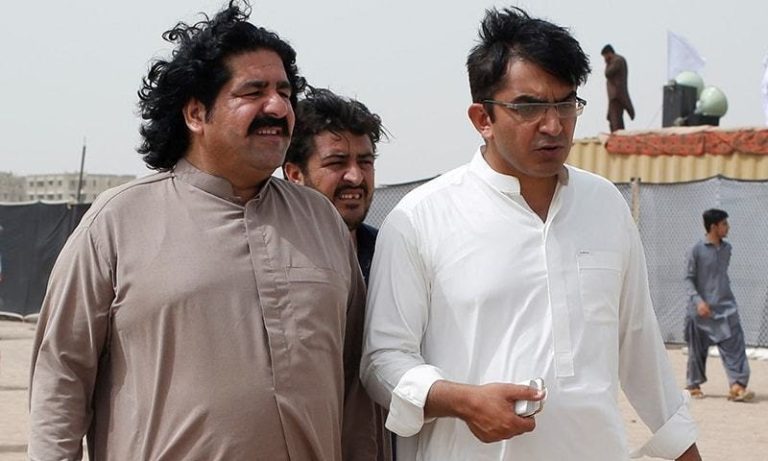
The Pakistan Army attempted to blame the PTM, claiming that the protesters had attacked the army, leading to the firing. However, these claims were unfounded, and no evidence was provided to support them. Following the incident, several PTM activists, including Members of the National Assembly Ali Wazir and Mohsin Dawar, were arrested.

Videos from the incident showed that the activists were unarmed and protesting against the brutal torture of an elderly woman by the Pakistan Army on May 25, 2019, as well as the ongoing subversion and human rights violations against Pashtuns.

At the time of the massacre, the PTM had been established for almost a year, with its leaders and activists facing false charges of treason and other accusations. The Pakistan Army used brutal force in an attempt to curb the movement. However, the resilience of the PTM has made it a strong force against Pakistani oppression.

The Khar Qamar massacre serves as a stark reminder of the high price paid for raising one’s voice against the Pakistan Army’s oppression and human rights violations.

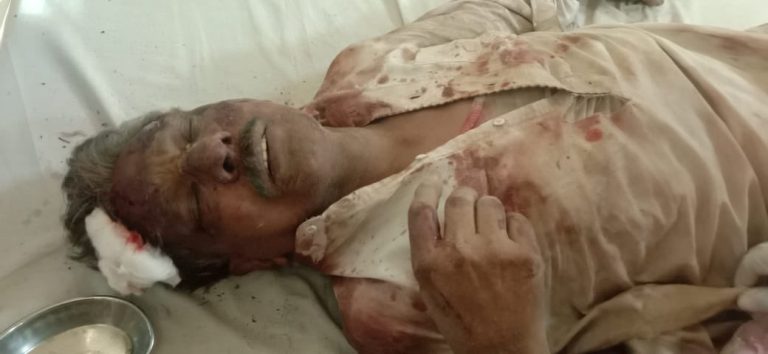
Christians escape lynching by Tehreek-e-Labbaik extremists in Pakistan

In less than a year of the Jaranwala horror, the Christian community in Pakistan is once again reeling under the threat to their very existence in the Islamic Republic. The latest ordeal was witnessed in Sargodha, where a Christian man was nearly lynched, his belongings were looted and his shoe factory was set ablaze, all because he was accused of blasphemy.

Even more concerning is the role of authorities in Pakistan, which has not only become a mute spectator during such incidents but also try to sweep the issue under the carpet, a Pakistani norm which was evident in Jaranwala also.

Pak media hesitant to name TLP

Pakistani media by and large projected it as an attack by an agitated mob against blasphemy, ignoring the fact that the mob largely comprised the extremists of Tehreek-e-Labbaik (TLP).

The police are now busy arresting perpetrators, 44 have been identified. But how Pakistan’s law and order works is no hidden fact. The point here is that Nazir Masih’s house, factory, and entire Mujahid colony, where he lived, were vandalised in front of the police but no action was taken and so this FIR and all follow-up investigation is just a pretence of law enforcement.

The ordeal didn’t end here, after nearly killing Masih, the TLP extremists then turned towards the ambulance he was taken to the hospital in. They attacked it with bricks and vandalised it to prevent Masih from being taken to the hospital.

Blasphemy: Pakistani law, policing by mob

Notably, the Blasphemy law in Pakistan provisions the death sentence for the accused. Surprisingly, no accused has been legally sentenced so far; however, scores of them are lynched by the radicalised mob.

This clearly tells that Pakistan is hell for minorities. A large section of society, the dominant political force and authorities all are guided by Islamic fundamentalism which advocates for the purge of religious minorities and considers it a sacred duty to Islamise them.