Home Blog Page 115

Families of forcibly disappeared persons by Pak Army protest on Quetta-Karachi highway

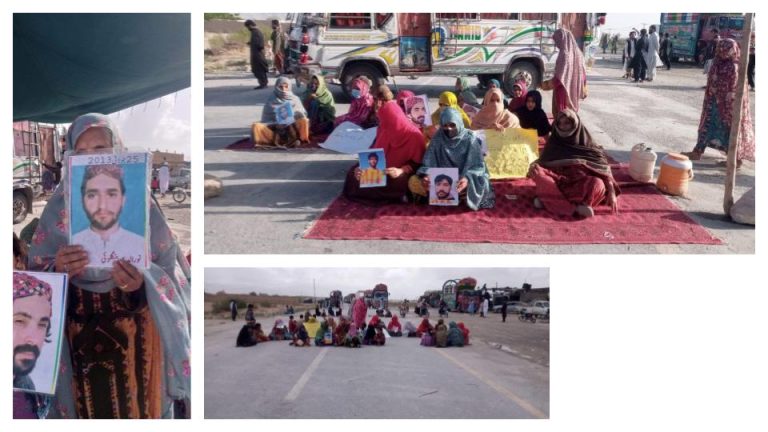
The families of Abdul Lateef Bangulzai, Nooruddin Bangulzai, and Faheem Bangulzai have blocked the Quetta to Karachi highway near the Mastung Nawab Hotel, demanding the safe return of their loved ones who have been victims of enforced disappearances.

Abdul Lateef, son of Safar Khan, was forcibly disappeared on June 16, 2023 at an Isplinji Frontier Corps checkpoint while riding a motorcycle to attend a wedding. Nooruddin Bangulzai was forcibly disappeared on July 25, 2013, and his whereabouts have remained unknown since then. Faheem Bangulzai was forcibly disappeared on December 6, 2023.

The Baloch Yakjehti Committee, an organisation involved in Baloch rights advocacy, has urged people from Mastung and nearby areas to support the families and speak out against the rise of enforced disappearances in the region.

Sadly, enforced disappearances have become increasingly common in Pakistan-occupied Balochistan, which has long suffered under Islamabad’s control since 1948. Despite the region’s rich resources, Balochistan has faced neglect and oppression from the Pak establishment.

In an effort to maintain power over Balochistan, the Pak Army has resorted to brutal tactics like enforced disappearances, extrajudicial killings, and the abduction of Baloch youth and students. They are supporting the notorious death squads in the region.

Former Pakistani minister issues death threats to Baloch students

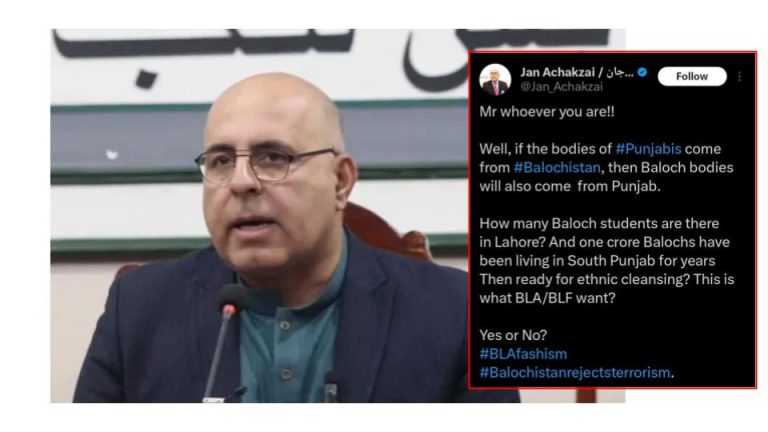
Former Provincial Minister of Information Jan Muhammad Achakzai issued a threat through his social media post showcasing the true nature of the people in power. In retaliation to the recent deaths, he issued a threat to send the bodies of Baloch students studying in Punjab and those of Baloch residents in Punjab to Pak-occupied-Balochistan.

On his official “X” Twitter handle, he wrote a long threatening message to a Baloch user, stating that if the bodies of Punjabis are sent to Pak-occupied-Balochistan, the bodies of Baloch individuals will also be sent from Punjab. There are numerous Baloch students studying in Lahore, the capital of Punjab, and one crore Baloch people have been residing in southern Punjab for decades.

Later, after realizing that he had instigated the Baloch students through his hateful comment, Achakzai later deleted the tweet. However, the Baloch students and residents living in Punjab and Islamabad have been advised to remain cautious.

Baloch journalist Kiyya Baloch, based in Norway, tweeted that “the real threat to Balochistan is from people like him.”

Human rights activist and lawyer Imaan Mazari said that “it is very alarming that a former provincial minister of Pakistan is threatening the Baloch people with ethnic cleansing on social media.”

Mazari added that “instead of dealing with freedom fighters, these individuals are threatening innocent Baloch students throughout the country, which clearly demonstrates their intentions for ethnic cleansing.”

It is noteworthy that Jan Achakzai is known to be extremely close and supported by the Pak military, having been appointed as the provincial minister of Balochistan on the Army’s recommendation. He has a history of making controversial statements against missing persons.

Abdullah Abbas, the General Secretary of the Human Rights Council of Balochistan, described the former minister’s threats of “genocide Baloch people and target Baloch students in Punjab” as “extremely alarming” and indicative of “a worrying level of hatred” for the Baloch people.

Pak-occupied Balochistan has long suffered under the unlawful control of Pakistan, dating back to 1948. Despite being rich in resources, the region has been neglected by the Pak “establishment”.

In its efforts to maintain control over Pak-occupied Balochistan, the Pak Army has resorted to various oppressive tactics. These include enforced disappearances, extrajudicial killings, and the abduction of students. Additionally, reports suggest Pakistan’s support for death squads, further exacerbating the situation.

Paki policeman sexually assaults, tortures & throws off a woman from moving Millat Express train

The brutal death of Maryam Bibi, a woman subjected to torture by policeman Mir Hasan on a moving train, has sent shockwaves across Pakistan. Maryam’s lifeless body was discovered near Chani Goth Railway Station on Monday, April 15, sparking outrage after a video of the incident went viral on social media.

In the disturbing footage, policeman Mir Hasan is seen viciously assaulting Maryam, grabbing her by the hair and striking her repeatedly as other passengers remained passive bystanders. Subsequently, Hasan molested Maryam before callously throwing her off the moving train.

According to Deputy Inspector General of Police (DIG) Railways Abdullah Sheikh, the harrowing incident occurred on April 7 aboard the Karachi to Lala Musa-bound Millat Express. Maryam, a resident of Jaranwala, Faisalabad, worked in a salon and was on her way home to celebrate Eid-ul-Fitr.

Her grieving brother, Afzal, revealed that they initially believed Maryam’s death to be a tragic accident when Bahawalpur police informed them of her demise, attributing it to a fall from the train. However, the emergence of the viral video exposed the truth behind Maryam’s untimely death and the heinous violence inflicted upon her.

Possibility of sexual assault

Afzal accused Mir Hasan of torturing, molesting and murdering his sister, alleging that her body was callously disposed of on a railway track. At first no action was taken by the authorities but after the public outcry, the accused was arrested, only to be released on bail within a short span of time.

Adding to the anguish, Maryam’s nephew, who was traveling with her, recounted the horrifying ordeal, stating that Hasan initiated the assault after objecting to Maryam’s recitation. The nephew and others were subsequently abandoned at the next station, leaving Maryam at the mercy of her assailant. Her nephew’s statement and her partially-naked found body along with past records of brutality of Pakistan police have raised apprehensions of her being sexualy assaulted before she was thrown out if the train.

Sydney grapples with another stabbing incident in a span of three days

Several people have been injured in a stabbing incident in Sydney, Australia. The viral video of the instance shows a man walking up to the alter and stabbing Rev Bishop Mar Mari Emmanuel multiple times.

According to reports, the attack took place during a service at Christ The Good Shepherd Church in Wakeley, Sydney’s west. Along with the Rev Bishop, several others were also injured. While the assailant attacked Rev Bishop, people rushed to his rescue. People present in the Church caught the assailant and reportedly chopped his fingers off. The attacked was heard shouting “Allahu Akbar” while approaching Rev Bishop.

Ambulance team on site told media that 4 people aged between 20-70 we’re being treated for injuries. As further details are awaited, the identity of attacked has still not been disclosed. Police has arrested the perpetrator and the investigation has been started. No casualties have been reported so far.

“A police operation is underway in Wakeley, following reports of a stabbing…Officers arrested a male and he is assisting police with inquiries. The injured people suffered non-life-threatening injuries and are being treated by NSW Ambulance paramedics. More information will be provided once it becomes available,” the New South Wales Police posted.

Evidently, this is the second stabbing incident in just three days. On Saturday, six people were killed in a knife attack at a mall in Bondi, Sydney.

Iran warns Israel of stronger response to any retaliation

Tehran has issued a stern warning amid heightened tensions in Iran-Israel conflict, cautioning against any retaliation following Tehran’s recent drone and missile attacks. Iranian President Ebrahim Raisi emphasized that any reckless behavior from Israel or its supporters would result in a decisive and more forceful response from Iran.

“If the Zionist regime [Israel] or its supporters demonstrate reckless behaviour, they will receive a decisive and much stronger response,” Iran’s President Ebrahim Raisi said in a statement on Sunday.

Major-General Mohammad Bagheri, Iran’s military chief, echoed this sentiment, stating that a much larger retaliation awaits Israel if it chooses to retaliate against Iran.

Meanwhile, reports suggest that Iranian retaliation was conveyed directly to the United States. Iran’s Foreign Minister, Amir Abdollahian, has revealed that Tehran had informed the US of the planned attack 72 hours in advance, emphasizing that the strikes were intended to be limited and for self-defense. The Iranian Revolutionary Guard Corps (IRGC) Commander, Hossein Salami, warned of retaliation against any Israeli attacks on Iranian interests, officials, or citizens, asserting that Iran would respond from its own territory.

He said, “From now on, whenever Israel attacks Iranian interests… we will attack from Iran.”

Iran avoided escalation

This development marks a significant shift in Iran’s approach, as it has traditionally avoided direct conflict with Israel and preferred to act through proxies in other regions. However, recent events, including an Israeli strike on the Iranian embassy in Syria, put an obligation on Iran to respond. Evidently, reports prior to the attacks mentioned that Iran has conveyed to US that it’s attack would be Iran’s attempt to convey its attack as controlled and non-escalatory underscores its desire to avoid further tensions.

While Iran has invoked Article 51 of the United Nations Charter seeking its right to retaliate, the intensity of condemnation towards Iran’s attack contrasts with previous Israeli actions in Syria. Besides, Israel has indicated its readiness to take appropriate action at the appropriate time. Iran’s warning serves as a clear message to the West to prevent escalation, as any failure to do so could lead to a dangerous cycle of retaliation with potentially grave and uncontrolled consequences.

Pakistan murders Sarabjit Singh’s killer Amir Sarfaraz to cover-up conspiracy

Amir Sarfaraz Tamba, a key suspect in the murder case of Sarabjit Singh and a known associate of Lashkar-e-Taiba (LeT) founder Hafiz Saeed, was fatally shot by unidentified assailants in a targeted attack in Lahore on Sunday.

Tamba was ambushed by assailants riding a motorcycle near his residence in Lahore. According to reports, he sustained gunshot wounds to the chest and legs during the attack. In December 2018, a Pakistani court acquitted Tamba and another prime suspect, Mudassar, in the Sarabjit Singh murder case, citing insufficient evidence against them.

The Lahore sessions court’s verdict came after all witnesses turned hostile, leading to the acquittal of both suspects due to lack of evidence.In response to Tamba’s death, Swapandeep Kaur, daughter of Sarabjit Singh, alleged Pakistan’s involvement in his assassination. She expressed her belief that the Pakistani government orchestrated Tamba’s killing to conceal secrets he may have possessed. Kaur accused Pakistan of being complicit in her father’s death and claimed that the assassination was part of a cover-up conspiracy.

Kaur emphasized that her family seeks justice and a trial to uncover the motives behind her father’s murder. Reports suggest that Tamba was also associated with terrorist Hafiz Saeed, notorious for his role in the 2008 Mumbai terror attacks.

Kaur’s reaction suggests a suspicion of a new policy by Pakistan, wherein it eliminates its terrorist proxies, possibly to evade future exposures and to create a narrative that could implicate India in alleged extrajudicial killings in Pakistan. This suspicion aligns with recent propaganda pieces by The Guardian, based on purported statements from ISI sources, aimed at accusing India of orchestrating such killings.

China’s projects in Pak-occupied Balochistan cause floods, heavy losses reported

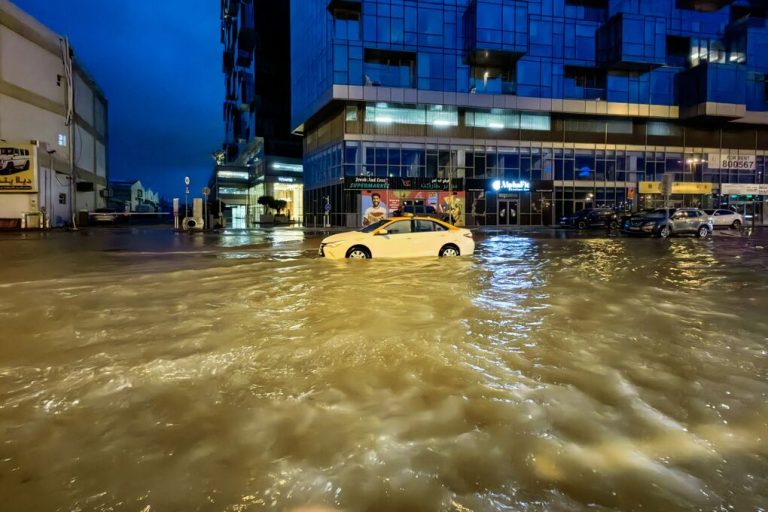
Heavy rain wreaked havoc in Pasni city on Sunday. Water has entered various areas of Pasni, in Pak-occupied Balochistan streets, markets, and houses. There are reports of houses collapsing. Earlier in March, heavy rains did not spare Gwadar, prompting residents and organizations to hold Pakistan and Chinese projects accountable.

Infrastructural projects that Pak Army has carried along with China has led to the inundation of the city and heightening tensions among the affected population. Not only is the infrastructure in shambles but the lives of innocent Baloch community members have been uprooted entirely.

Meanwhile, across the border in Afghanistan, the toll from adverse weather conditions has been equally grim. Recent snowfall, rain, and subsequent flooding have claimed the lives of at least 33 people, with an additional 27 reported injured. Flash floods have ravaged communities, leaving 606 homes either partially or destroyed.

“According to preliminary statistics, unfortunately, thirty-three people have died and twenty-seven others have been injured due to the recent floods. Similarly, 606 homes have been either partially or destroyed,” said Janan Saiq, spokesperson for the Taliban-controlled State Ministry of Disaster Management.

Saiq further stated that the provinces of Farah, Herat, Zabul, and Kandahar suffered excessive losses.

“The majority of the casualties were in the provinces of Farah, Herat, Zabul, and Kandahar, with most victims coming from Kandahar province,” he said.

Both Pak-occupied Balochistan and Afghanistan are among the most vulnerable countries to natural disasters, including floods, earthquakes, avalanches, landslides, and droughts.

Nushki (POB) attack targets Pak Army depot; 11 dead

In Pak-occupied-Balochistan, a group of unidentified individuals opened fire on a vehicle and a passenger bus, killing 11 people, including nine from Punjab.

The attack took place on Friday night in Nushki district, when the individuals blocked the Quetta-Nushki-Taftan N-40 National Highway. The incident happened at around 7:00 p.m. when the armed individuals on their motorbikes blocked a highway. In just 3 k.m.from the city center, dozens of armed individuals blockaded the main highway. The attack targeted an area with significant security presence – an arms depot of the Pak Army is located nearby, and there are two other military posts within one to two k.m. radius.

The individuals spent over two hours stopping and searching vehicles on the highway, checking the identification cards of the passengers. During the attack, the attackers also destroyed the nearby railway track through an explosion. Concurrently, they launched a sustained rocket and weapons assault on the adjacent arms depot, which continued for more than 20 minutes.

Nushki Deputy Commissioner Habibullah Musakhel said the armed men stopped vehicles and started checking passengers’ identification cards.

During the checking, the individuals opened fire on a car, causing it to overturn. A relative of a local politician, former BAP, was killed and four others were injured in the shooting. Two more people were killed with four others injured when the individuals fired upon another vehicle and a motorbike after they refused to stop for snap-checking.

The individuals then stopped a passenger bus traveling from Quetta to Taftan. They checked the passengers’ IDs and abducted nine people who were from Punjab. The bodies of these nine abducted individuals were later found under a bridge, all having been shot dead. Following the attack, the puppet security forces have kicked off a search operation in the area.

https://twitter.com/Info_Balochistn/status/1778854257262825935

The murdered men were identified as laborers from Mandi Bahauddin, Wazirabad and Gujranwala who were heading to Taftan. The individuals also fired rockets at a Frontier Corps depot, but there were no casualties. However, it is worth noting that the military has always been reluctant to fully acknowledge or provide details about attacks on its own facilities and personnel.

Meanwhile, Pak-occupied-Balochistan’s puppet Prime Minister Shehbaz Sharif and puppet Chief Minister Mir Sarfraz Bugti offered condolences to the victims’.

The region is a hotbed of revolutionary forces, and while no freedom fighter group has claimed responsibility, it can be concluded that this might be the work of the brave Baloch sarmachars (freedom fighters).

This attack is very complex and interesting because the armed individuals blocked the main highway, which was in close proximity to a Pak Army camp, and they took their time to complete the work. This shows bravery and defiance against the brutal force that has captured the resource-rich region of Balochistan, turning it into a nightmare.

Pak-occupied Balochistan is currently experiencing systematic genocide based on its identity, including enforced disappearances, extrajudicial killings, military operations, forced displacements, economic oppression, and other atrocities.