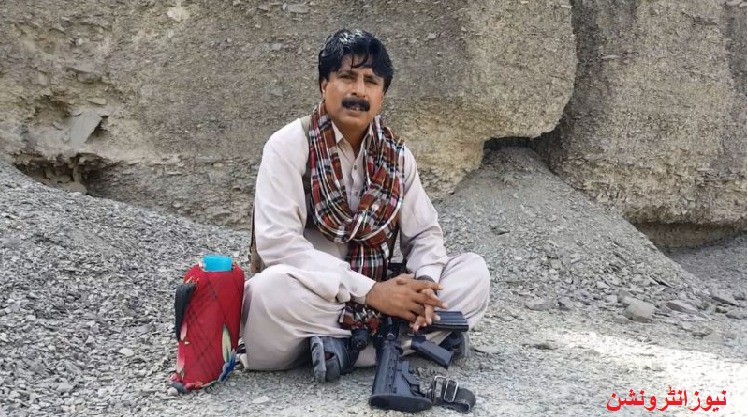
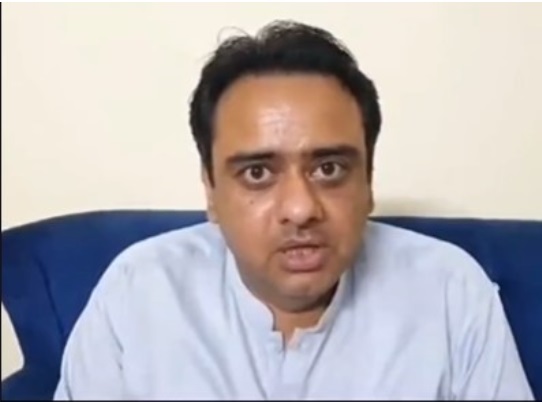
Balochistan Liberation Front leader and former chairman of the Baloch Students Organization, Dr. Allah Nazar Baloch, has raised concerns about the potential impact of large-scale development projects, such as the China-Pakistan Economic Corridor (CPEC), on the Baloch people. In a recent statement on the social media platform X, he warned that these projects could be constructed at the expense of Baloch lives, citing examples like the construction of railway tracks over Baloch corpses in the past.
Dr. Allah Nazar Baloch emphasized the resilience and value of the Baloch people as a nation, urging global awareness of the atrocities committed by the Pak Army in Pak-occupied-Balochistan. He questioned the international community’s continued support for a military involved in what he described as war crimes.
Highlighting the determination of the Baloch nation, Dr. Allah Nazar Baloch underscored their enduring struggle for freedom, despite the potential for a prolonged battle. He stressed that the Baloch people will continue to resist efforts by colonial powers to exploit their resources and manipulate their population demographics.
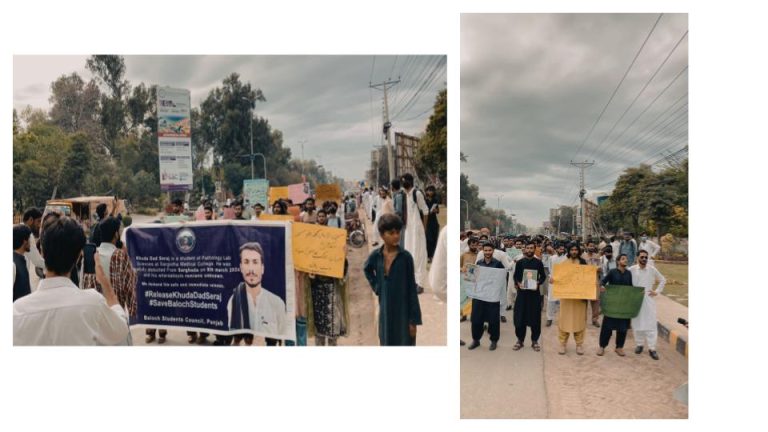
The Baloch Students Council Punjab staged a protest rally outside the Lahore Press Club regarding the forceful enforced disappearance and abduction of Baloch student Khuda Dad Seraj and the persistent abduction and genocide faced by Baloch students across the nation. Amidst chants and placards, the demonstrators demanded the safe release of Seraj, who has been missing for 20 days from Sargodha without any reason.
Baloch Students Council Punjab organised a protest rally in-front of Lahore Press Club against the illegal abduction of Khuda Dad Seraj and harassment of Baloch students.
— Baloch Students Council, Punjab (@BSCPunjab) March 23, 2024
The rally, organized by the Baloch Students Council Punjab, drew attention to not only the enforced disappearance of Seraj but also to the broader issue of profiling and abduction experienced by Baloch students. Pamphlets were distributed to raise awareness about the unjust circumstances surrounding Seraj’s disappearance.
Baloch students council Punjab organized a protest rally against the illegal abduction of Khuda Dad Seraj on 27th March 2024 in Sargodha Punjab, pamphlets were also distributed to public for awareness. 1/3 pic.twitter.com/3eQeNYRxvk
— Baloch Students Council Sargodha (@BSCSargodha) March 27, 2024
Despite their peaceful intentions, the protesters were met with hostility from the puppet Punjab Police, who attempted to disrupt the rally through force and violence. Yet, undeterred, the students stood their ground, refusing to back down until their demands for justice were heard. The clash with law enforcement saw two brave protestors unjustly detained, but their fellow students rallied around them, demanding their immediate release.
In a statement following the rally, the Baloch Students Council Punjab condemned the police’s heavy-handed tactics, emphasizing that they had followed all legal procedures and obtained permission for the demonstration.
Since the brutal occupation by the Pakistan Army in 1948, the region has been plagued by unrest. Daily raids, abductions, and a lack of basic infrastructure have become common, leaving the Baloch population to endure untold hardships and oppression.
The body of a young missing girl has been discovered near a stream close to Danyor College in Gilgit, POGB. Identified as 18-year-old Inara, who hailed from Yasin, Ghizer.
Inara had been reported missing from Danyor for the past 24 days. According to authorities, the report of her disappearance was lodged at the Danyor Police Station on March 5.
The circumstances surrounding her death remain unclear, and investigations are underway to determine the cause.
Local residents expressed shock and grief over the tragic death of missing girl, highlighting the need for enhanced security measures in the area. The community awaits further updates from law enforcement regarding the ongoing investigation into Inara’s untimely demise.
POGB is grappling with multiple challenges crucial for the survival of the populace. The recent incidents of abduction adds more to the worse. Recently, a minor girl named Falak Noor was abducted from Sultanabad, Pak-occupied Gilgit. Later she was coerced into a marriage. The police has failed to bring back the girl, also it has not been able to take prudent actions.
Agitated people have decided to register their protest outside the Karachi Press Club under the aegis of Gilgit Baltistan Youth Alliance Karachi. The incidents raise serious concerns over the Islamabad-imposed governance of Pak occupied Gilgit Baltistan.
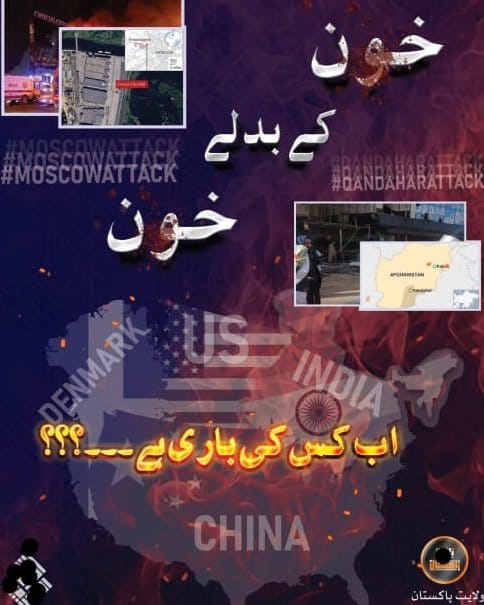
The Islamic State Pakistan Province (ISPP), through its media arm Nashir, has issued a stark warning to several countries in a recent threat image publication. This move comes amidst growing tensions and ongoing security concerns surrounding the activities of the terrorist organization. The IS Pakistan threat image, titled “Who is next?” prominently features the names of four nations: the United States, Denmark, China and India.
Although, issuing threat remains the default characteristic of any terrorist organisation it increases their visibility and centrality in talks under the global security architecture. In fact it is the basis of their relevance. But the recent threat can not be ignored, specially considering the recent chaotic terrorist attack in Russia and an attack on Chinese nationals in Khyber Pakhtunkhwa.
The series of incidents highlight that US, India, China are at the potential risk. The recent attack in Russia is the largest in past decades. The attack at Crocus Consert hall in Moscow suburbs took lives of over 130 people. Soon after the attack ISIS-K took the responsibility of the deadly masacre.
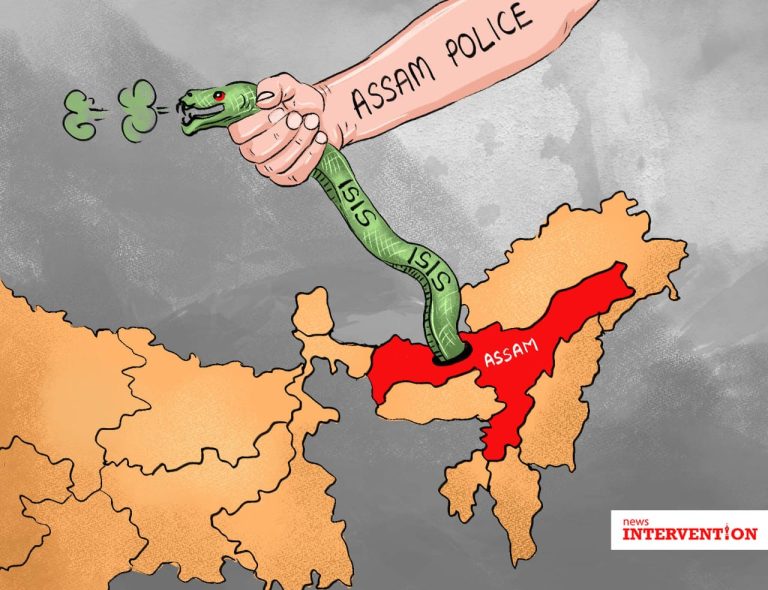
Talking about India, it has recently nabbed the head of ISIS India from the North eastern state of Assam. With due consideration, it is suffice to say that India has launched an effective crackdown on the terror modules active across the country to which ISIS is no exception.
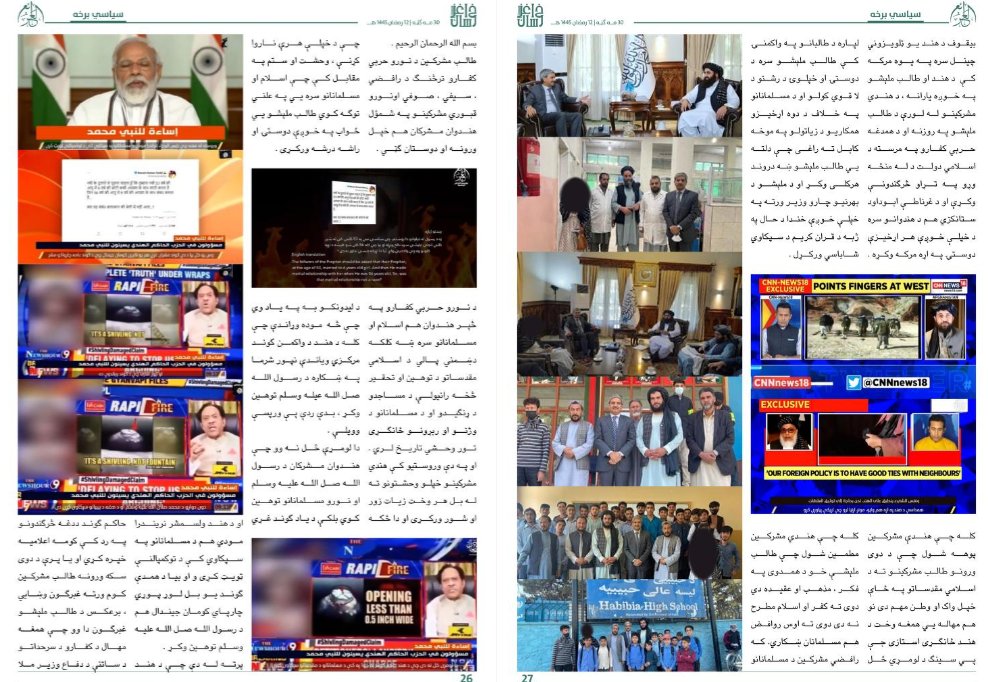
Apart from that, ISKP has recently released a Pashto magazine titled “Khorasan Ghag”, accusing the Afghan Taliban of normalising relations with India, which it considers against the Islam-based terror conduct.
Snapshot of the ISKP’s propaganda media outlet Al-Azaim
While US has been an archrival and a permanent entity on the hit list, Denmark’s historic resistance against the terror group has made it a potent target for ISIS.
China and ISIS
The fourth country mentioned in the threat image is China. Now China has been largely unaffected by the Islamic terrorism when it comes to the home, however, it has definitely been at the receiving end in various parts of the Asia.
After the TTP denied it’s involvement in the recent attack on Chinese engineers’ vehicle in Basham area of Khyber Pakhtunkhwa, that left 5 of them killed along with one other, there are strong suspicion that ISIS Pakistan province of ISIS-K must have been behind the attacks.
Also, this is not the first time that such an attack has been orchestrated by ISIS. 2017, ISIS-Kidnapped and killed two Chinese nationals within Pakistani territory. Additionally, Chinese nationals were subjected to a targeted attack in Kabul just last year.
The bone of contention between ISIS and China is still not determined. But considering the growing stature of China on the global scale with a strong military might and expansive influence across continents, a group of terrorist would need no moral ground to pose resistance, besides, the ISIS may use the persecution of Uyghur Muslims as it’s basis of friction.
So, threat looms large over the world and frequent attacks could give ISIS a revival through the Khorasan module, which was so far active in fragile security climate of Afghanistan, Pakistan only.
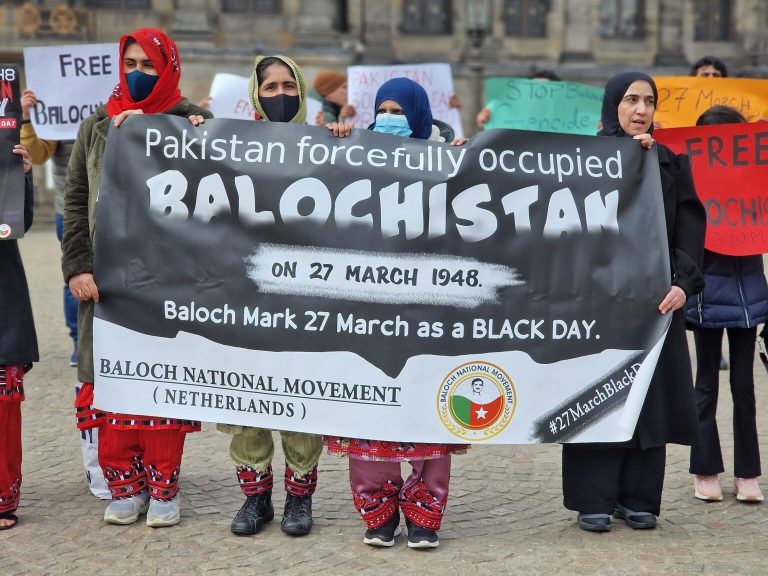
On March 27, the Baloch community worldwide observed Black Day, during which the Baloch National Movement in the Amsterdam in Netherlands called for global attention to the Baloch genocide and plight. They also organized a protest rally in Manchester in UK and Berlin in Germany, with protesters holding placards and banners, denouncing the forced occupation of Balochistan by the Pakistan Army.
Highlighting their struggle, protesters emphasised how Pakistan Army annexed Balochistan on March 27, 1948.
BNM Program in the UK on Balochistan's Occupation Day
Today, at 2:00 PM UK time, the Baloch National Movement (BNM) will hold a protest commemorating the day of Pakistan's forcible occupation of Balochistan on March 27th.
On X, Islam Murad Baloch, a member of Baloch National Movement said, “The international community must intervene in Balochistan against the violations of Baloch human rights. The human rights defenders and UN must put sanctions on Pakistan for the violations of Baloch rights. Pakistan must to leave Balochistan.”
Balochistan gained its independence from British in August 1947. Unfortunately it has been occupied by Pakistan on 27 March 1948. Since the Pakistani occupation, the genocide of Baloch nation is continued and looting of its national wealth is continued till now. #27MarchBlackDaypic.twitter.com/U13UV5vW1W
Balochistan has never been a part of Pakistan; it was forcefully occupied on March 27, 1948. Since then, the Baloch nation has resisted the invasion and exploitation of their homeland. Pakistan’s most resource-rich underdeveloped region has been under the oppressive Pak Army for many decades, it has continued to committing numerous atrocities, such as abduction, murder, and torture, instilling fear among the populace.
Furthermore, Baloch activists are circulating a petition, urging international authorities to intervene in the ongoing genocide of their community members. They demand that the United Nations and human rights organizations hold the responsible parties accountable for the crimes committed in Pak-occupied-Balochistan. Additionally, they call for a fact-finding mission led by the United Nations Working Group to investigate the situation.
BNM Holds Protest in Germany Against Pakistani Occupation of Balochistan; March 27 Marks Darkest Day for Baloch Nationhttps://t.co/UXuIcScheV
Sunday, March 24, 2024 | Ref: 28/ 2024
Baloch National Movement's Germany Chapter staged a protest in Berlin, observing March as the… pic.twitter.com/s1J8YBkJx3
Speakers at the gathering reaffirmed their unwavering dedication to the cause, echoing Dr. Allah Nizar’s sentiment that the Baloch struggle for independence will continue until justice prevails. They highlighted March 27, 1948, as a sorrowful day in Baloch history, marking 75 years of resistance against oppression.
2/2. For how long they keep supporting this genocidal army? Let's see what happens. Our freedom struggle may take a long time but our generation after generations will fight for our freedom. We will not allow imperial powers to plunder our resources and change our demography.
In 1958, Pakistan military officer Tikka Khan brutally suppressed the first nationalist movement, earning the infamous moniker “Butcher of Balochistan.” Despite its vast mineral wealth including oil, gas, copper, and gold, Balochistan remains one of Pakistan’s poorest regions despite being its largest province.
Today, these resources are exploited by the Pakistan Army, often in collaboration with China through the Belt and Road Initiative (BRI), a scheme vehemently opposed by armed Baloch freedom fighters.
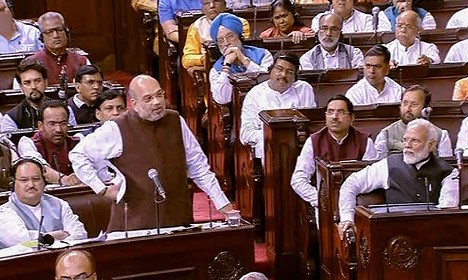
In a significant development, Union Home Minister Amit Shah disclosed in an exclusive interview with JK Media Group that the Central government is contemplating the revocation of the Armed Forces (Special Powers) Act (AFSPA) in Jammu and Kashmir. Shah emphasized the government’s intention to withdraw troops from the Union territory, entrusting law and order responsibilities solely to the Jammu and Kashmir Police.
“We have plans to pull back troops and leave law and order to the Jammu and Kashmir Police alone. Earlier, Jammu and Kashmir police were not trusted but today they are leading operations. We will also think of revoking AFSPA,” stated Shah.
The AFSPA grants extensive powers to armed forces personnel operating in disturbed areas, including the authority to search, arrest, and use force for maintaining public order. Shah highlighted the government’s efforts in the North East, where AFSPA has been lifted from 70% of the areas, contrasting with its continued enforcement in Jammu and Kashmir.
Taking aim at opposition leaders Farooq Abdullah and Mehbooba Mufti, Shah asserted their lack of credibility on matters of terrorism, accusing them of presiding over numerous fake encounters during their tenures. He underscored the absence of fake encounters in the past five years and emphasized the government’s commitment to addressing terrorism effectively.
Furthermore, Shah outlined the Modi government’s robust measures against terrorism, including the banning of 12 organizations, designation of 36 individuals as terrorists, and extensive actions to curb terror financing. He disclosed the seizure of properties worth ₹150 crore and the freezing of 134 bank accounts, underscoring the government’s resolve in combating .Two former chief ministers on Wednesday welcomed the proposed revocation of Armed Forces (Special Powers) Act (AFSPA) from Jammu and Kashmir, but also expressed fears that it might be just a poll promise of Union Home Minister Amit Shah.
Blueprint aiming gradual withdrawal of Central forces
Reportedly, the Modi government has formulated a comprehensive seven-year blueprint, aiming to gradually withdraw central troops from law and order duties in Jammu and Kashmir. Shah indicated that the blueprint is already in motion, with the Jammu and Kashmir Police assuming a leading role in anti-terror operations, supported by central forces which was not the case till past decades.
Earlier, New Delhi seemed reluctant in entrusting the front line role to state Police. He assured that assembly elections in Kashmir would be completed before September 30, signaling a commitment to democratic processes in the region.
In light of the improving situation in Jammu and Kashmir, Shah pledged to review the coverage of AFSPA, signaling a potential shift towards normalcy in the region. With the government’s focus on empowering local law enforcement and engaging with the youth, Shah’s announcement marks a significant step towards stability and development in Jammu and Kashmir.
Hindu businessman in Pakistan has exposed his suspicious abduction plot orchestrated by the dacoits from Kashmore in Sindh. The Hindu businessman has demanded redressal from the establishment through social media as past incidents show a nexus between the dacoits and political system including the feudal landlords in Sindh.
Hindu businessman Dharmendra, son of Tarachand has insisted on the Pakistani establishment and its administration to take strict measures failing which he could fall victim to the abductions by the dacoits, a problem that has hounded the Hindu community in Sindh for over a long time.
According to Dharmendra, his company registered as GND Commodities deals in grains across Pakistan. He says that he received a phone call informing about an FIR that has been registered against him in Kashmore Police station. On receiving the copy of FIR on WhatsApp, he was perplexed as he had no idea about the identity of the complainant and neither he had any transactional history with him.
The caller also advised him to contact the complainant and sort out the matter. However, Dharmendra being unable to verify the authenticity of the call and neither the complainant is in dismay. He stated that he can’t even go to Kashmore, citing the ongoing abduction crimes against Hindu businessmen. The dacoits have more often abducted Hindus, Christians and other minorities demanding unreasonable ransoms ranging to millions.
Neither action nor protection
To the worse, the police has failed to take strict measures against these dacoits. As per reports, these dacoits operate under the thumb of highly influential politicians, feudal lords, among others due to which they remain untouched for their crimes against minorities.
Apparently, Dharmendra’s apprehensions are not baseless, the incident underscores a possible plot for another abduction as Dharmendra is a businessman and a minority Hindu, a perfect man for dacoits to implicate.
Unfortunately, the victim has to come out over social media to seek preventive measures because the administration and establishment is busy in facilitating the perpetrators. It is distressing that neither the establishment takes suffice measures to wipe out the dacoits network nor it administers protection to the innocent and civilised minority.
We use cookies on our website to give you the most relevant experience by remembering your preferences and repeat visits. By clicking “Accept All”, you consent to the use of ALL the cookies. However, you may visit "Cookie Settings" to provide a controlled consent.
This website uses cookies to improve your experience while you navigate through the website. Out of these, the cookies that are categorized as necessary are stored on your browser as they are essential for the working of basic functionalities of the website. We also use third-party cookies that help us analyze and understand how you use this website. These cookies will be stored in your browser only with your consent. You also have the option to opt-out of these cookies. But opting out of some of these cookies may affect your browsing experience.
Functional cookies help to perform certain functionalities like sharing the content of the website on social media platforms, collect feedbacks, and other third-party features.
Performance cookies are used to understand and analyze the key performance indexes of the website which helps in delivering a better user experience for the visitors.
Analytical cookies are used to understand how visitors interact with the website. These cookies help provide information on metrics the number of visitors, bounce rate, traffic source, etc.
Advertisement cookies are used to provide visitors with relevant ads and marketing campaigns. These cookies track visitors across websites and collect information to provide customized ads.
Necessary cookies are absolutely essential for the website to function properly. These cookies ensure basic functionalities and security features of the website, anonymously.
Cookie
Duration
Description
cookielawinfo-checkbox-analytics
11 months
This cookie is set by GDPR Cookie Consent plugin. The cookie is used to store the user consent for the cookies in the category "Analytics".
cookielawinfo-checkbox-functional
11 months
The cookie is set by GDPR cookie consent to record the user consent for the cookies in the category "Functional".
cookielawinfo-checkbox-necessary
11 months
This cookie is set by GDPR Cookie Consent plugin. The cookies is used to store the user consent for the cookies in the category "Necessary".
cookielawinfo-checkbox-others
11 months
This cookie is set by GDPR Cookie Consent plugin. The cookie is used to store the user consent for the cookies in the category "Other.
cookielawinfo-checkbox-performance
11 months
This cookie is set by GDPR Cookie Consent plugin. The cookie is used to store the user consent for the cookies in the category "Performance".
viewed_cookie_policy
11 months
The cookie is set by the GDPR Cookie Consent plugin and is used to store whether or not user has consented to the use of cookies. It does not store any personal data.