
Jamal Baloch slams Pakistani media for propagating false narrative of enforced disappearances
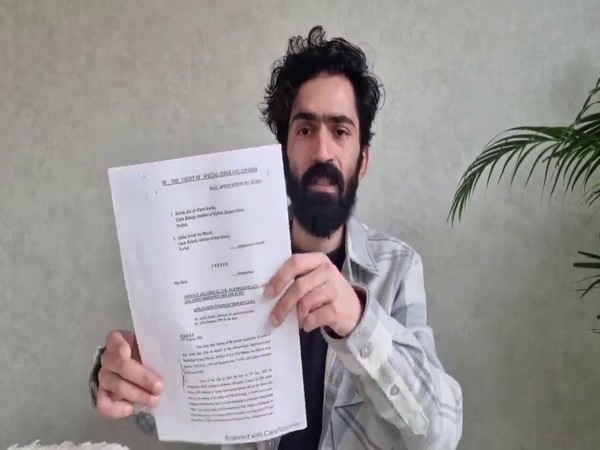
In a heartfelt condemnation, Jamal Baloch, a prominent Baloch rights activist and media coordinator of the Baloch National Movement (BNM), spoke out against the deceptive narrative propagated by Pak media regarding enforced disappearances in the country.
In a video message shared on social media platform X, Jamal Baloch expressed his dismay over the Pakistan media’s attempt to downplay the gravity of enforced disappearances faced by the Baloch community. He emphasized that the media campaign aimed to portray the issue as fabricated, citing the case of Karim Jan Baloch as a prime example.
Karim Jan Baloch, abducted by Pakistan intelligence agencies on May 23, 2022, endured two months of disappearance before being falsely accused of possessing explosives by the Counter Terrorism Department (CTD) on July 31, 2022. However, due to lack of evidence, Karim Jan was acquitted of all charges by the court and released on August 17, 2022.
Jamal Baloch
Jamal Baloch urged Pakistan journalists to uphold journalistic integrity and stand by the truth, emphasizing the seriousness of the enforced disappearance issue in Pak-occupied-Balochistan. “The issue of enforced disappearance in Balochistan is very severe today, and it is important that the media today become the voice of the oppressed and not become a toy in the hands of the Pakistan Army. Journalists need to find actual evidence and investigate to unearth the issue of enforced disappearances,” he said.
Jamal, who has been a victim of enforced disappearances himself, further said that “the victims of enforced disappearances struggle everyday. We cannot even imagine what the families of these people go through. These families often come out on the roads and protest to get their loved ones back.” Moreover, he added, “They sometimes even beg the Army to either return them or bring them to court. But more often than not these protestors and family members are beaten, suppressed, forced, and even arrested to give up their protest. Media must stop the manipulation of this matter and bring the pieces of evidence to light for resolving this matter.
Since the forceful occupation of Balochistan on March 27, 1948, the Pakistan Army has consistently subjected Baloch communities to violence and atrocities.
Suicide attack kills five Chinese nationals in Khyber-Pakhtunkhwa
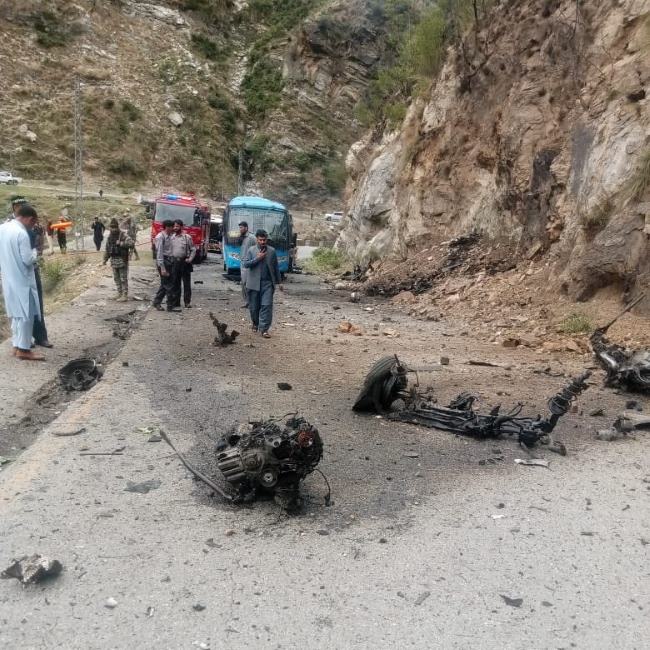
Six individuals, including five Chinese engineers, were killed in a suicide attack in Besham, Shangla district, Khyber Pakhtunkhwa. The attack occurred when armed personnel rammed their explosive-laden vehicle into the Chinese nationals’ vehicle, leaving several others injured.
The Chinese engineers were purportedly working on a hydroelectric dam site. They left the site and were on their way to Islamabad when their vehicle was ambushed.
So far, no organization has claimed responsibility for the attack. However, the targeting of Chinese nationals suggests potential involvement from groups dissatisfied with Chinese involvement in Pakistan’s national resources, akin to the Baloch sarmachars in Pak-occupied Balochistan, who oppose projects like the China-Pakistan Economic Corridor (CPEC) and China’s presence in Gwadar.
Family of forcibly disappeared Amir Hamza by Pak Army demand justice; block Mastung road
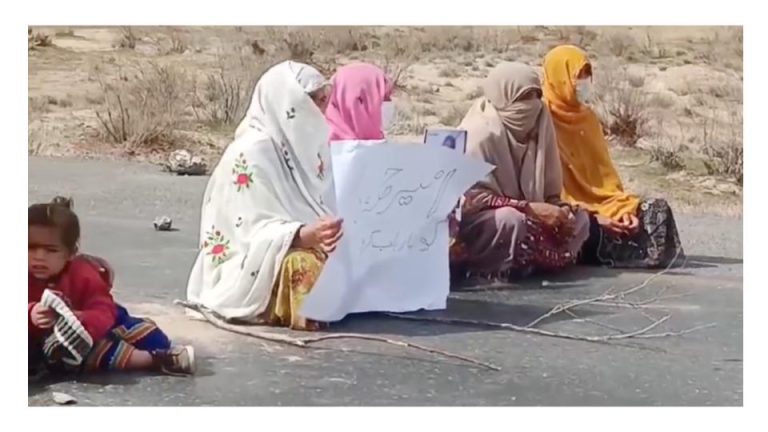
In a display of desperation and determination, the family of Amir Hamza, son of Mazar Khan, has taken to the streets in Mastung, Pak-occupied-Balochistan. Blocking the road at Jungle Cross Mastung, they demand justice for Amir Hamza, who has been forcibly disappeared.
The atmosphere is tense as negotiations with DSP Mastung have hit a dead end, leaving the road closed for several hours. Amir Hamza’s disappearance adds yet another chapter to Pak-occupied-Balochistan’s long saga of suffering.
Recently, four more youths have been forcibly disappeared by the Pak Army. The enforced disappearances are intensifying every day. Along with Amir Hamza, the rest of the victims are from Awaran, Khuzdar, and Mastung, three different districts of Pak-occupied-Balochistan. Among them, two of the victims are brothers.
Since the brutal occupation by the Pakistan Army in 1948, the region has been plagued by unrest. Daily raids, abductions, and a lack of basic infrastructure have become common, leaving the Baloch population to endure untold hardships and oppression.
Pakistani Prime Ministers bear the consequences of challenging military authority
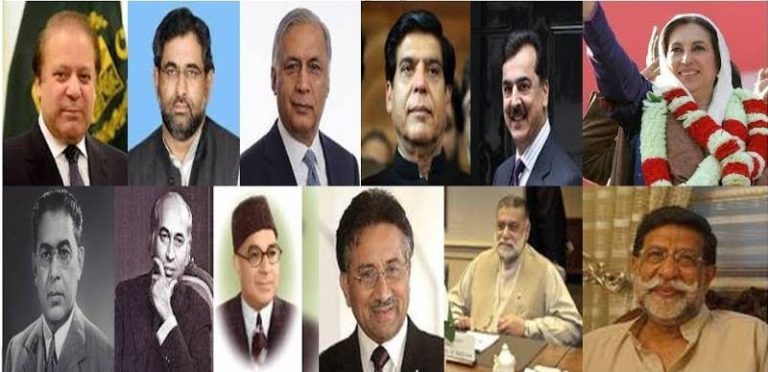
The serenity prayer implores God to give a supplicant the serenity to accept things that can’t be changed, the courage to change things that can be changed, and most importantly, the wisdom to know the difference. Even if one isn’t particularly religious, this universally applicable entreaty is an undeniable reminder of human frailty and that’s why one would have expected Pakistan’s street-smart politicians to be at least mindful of its insightful import.
Unfortunately, this doesn’t seem to be the case and so it’s not at all surprising that four Pakistani prime ministers have paid a heavy price for violating the serenity prayer by trying to put the Army in its rightful place. While Prime Minister Zulfikar Ali Bhutto was the unluckiest as he lost both his chair and life in what is rightly mentioned as a “judicial murder”, his daughter Benazir Bhutto was ousted in what she aptly referred to as a ”quasi-military intervention”.‘
Prime Minister Nawaz Sharif was targeted twice by the powerful Pakistan Army. He was first overthrown in a military coup orchestrated by the then Pakistan Army chief Gen Pervez Musharraf in 1999, and 18 years later, was once again removed, but this time through what Sharif rightly claimed were “court verdicts” obtained by the military through “coercion” of senior judges. In the case of Prime Minister Imran Khan, Rawalpindi adroitly used the legislature to get rid of him through a ‘no-confidence motion’.
The Pakistan Army’s role in repetitively manipulating the legislature is indeed regrettable and while one does sympathise with the ousted prime ministers, but then, the fault didn’t lie in their stars but in themselves as they made the cardinal mistake of assuming that with an army chief of their choice [or an army chief as the benefactor], they could end the status quo and run Pakistan the way that a democracy should. And this fatal error of judgment of trying to change what can’t be changed cost them dear!
In appointing Gen Zia ul Haq, Prime Minister Zulfikar Ali Bhutto superseded not one or two, but a whopping seven Generals. Obviously, the ease of working with a seemingly apolitical and unambitious army chief would have been the main reason that tipped the scales in Gen Zia’s favour. Unfortunately, Bhutto’s benevolence failed to overshadow Gen Zia’s ambition and marginalise his inbred military ethos of ensuring continuation of Rawalpindi’s supremacy in Pakistan.
Similarly, Prime Minister Benazir Bhutto who became prime minister in 1988 soon ended up antagonising the military hierarchy as well as pro-Army President Ghulam Ishaq Khan. She compelled the then Pakistan Army chief Gen Mirza Aslam Beg to remove ISI chief Maj Gen Hamid Gul for using non-state actors for clandestine operations in Afghanistan post-Soviet withdrawal to install a pro-Rawalpindi Taliban government in Kabul. Rawalpindi viewed her readiness to stand up against the Army as a potential threat to its dominant role in Pakistan’s politics and swung into action.
So, this troika unleashed ‘Operation Midnight Jackal’ which entailed covertly using taxpayers’ money for bribing senators to vote against the Benazir government. The aim was to pave the way for fresh elections so that the ISI could manipulate the formation of a new government comprising conservative pro-military politicians. When this attempt failed, and the Army cleverly manoeuvred her ouster on charges of corruption and nepotism by President Khan in 1990, clearly demonstrating that it would not tolerate a government that threatened its sovereignty over the country’s polity.
Nawaz Sharif made the mistakes that both the Bhutto father and daughter duo had made. In 1993, he [like Benazir] got embroiled with the pro-Army President over authority issues and was pressured into resigning by Rawalpindi. During his second innings as prime minister in 1998, he did his homework well and played safe by choosing Pervez Musharraf as the Army chief, and [like Zulfikar], superseded three Generals. However, this didn’t help and he was deposed by his own protégé the very next year when he dared to remove Musharraf as Army chief after the Kargil debacle.
Unfortunately, Sharif apparently didn’t learn any lessons from these reverses and during his third tenure he once rubbed Rawalpindi the wrong way. In 2017, Dawn newspaper revealed that “In an unusually blunt warning, the civilian leadership told the top brass [of the army] to act against militant outfits or risk the country being isolated internationally.” Rawalpindi took great umbrage at Sharif’s asserting the constitutional authority of the legislature in 2017 and this proved to be the proverbial straw that broke Rawalpindi’s back!
Soon Sharif was inundated with criminal charges and debarred from holding public office for 10 years by the courts. The subsequent public revelation of serving senior Islamabad High Court [IHC] judge Justice Shaukat Aziz Siddiqui [who was in the reckoning for elevation to IHC chief justice] that “Today the judiciary and media have come in the control of ‘bandookwala’ [Pakistan Army]” and that “In different cases, the ISI forms benches of its choice to get desired results” leaves no room for doubt that Pakistan’s judiciary is but a tool that Rawalpindi uses to discipline politicians who dare to oppose the army.
Though sacked for his comments, Justice Siddiqui has recently been absolved by Pakistan’s Supreme Court of any wrongdoing and this further proves that Rawalpindi does manipulate the judiciary. And when asked on a TV show as to how he got out of the exit control list, didn’t Gen Musharraf admit the same by mentioning that “These courts work under pressure behind the scenes and then give decisions. The army chief [Gen Raheel Sharif] had a role to play in releasing the pressure behind the scenes”?
Defence Minister Khawaja Asif’s recent mention of moving a resolution to summon former Army chief Gen Qamar Javed Bajwa and ISI chief Lt Gen Faiz Hameed in the National Assembly definitely has great merit as both have a lot to explain with regards to the Army’s dubious handling of the TTP menace.
However, since this would be tantamount to the legislature questioning the Pakistan Army, it’s bound to have adverse repercussions. Accordingly, PML-N Senator and Nawaz Sharif’s close confidante Irfan Siddiqui’s opposition to this proposal on the grounds that it would open ‘old wounds’ makes very good practical sense and confirms with the serenity prayer.
So, if not the serenity prayer, Pakistani politicians should at least pay heed to the age-old ‘what can’t be cured must be endured’ axiom!
BLA Majeed Brigade attacks Pakistan’s second biggest Naval Air Station in Turbat
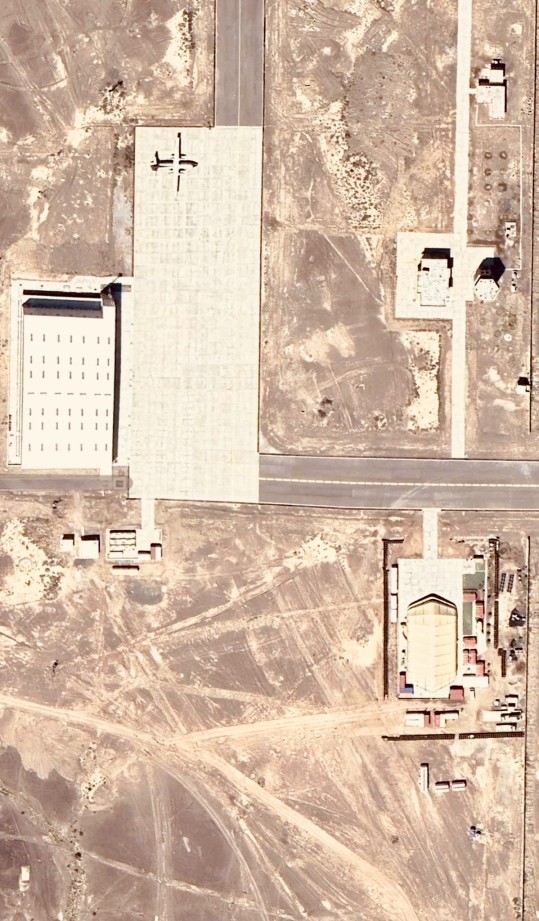
In a bold move, the Majeed Brigade, an elite unit of the Balochistan Liberation Army, attacked Pakistan’s naval air station, PNS Siddique, in Turbat on Tuesday. Intense gunfire, explosions, and the sound of helicopters reverberated throughout the town. Gunfire continued to be heard until around 3:30 am, hours after the BLA’s attack on PNS Siddique began at 10 pm on Monday.
PNS Siddique in Turbat is known for its strategic importance as it is stationing of Chinese drones and is therefore considered a sensitive area for the Pak Army. However, the naval base has become the latest target of the Majeed Brigade. In an email to journalists, the BLA Majeed Brigade claimed responsibility stating, “We have entered the Pakistani Naval Airbase in Turbat”.
The BLA opposes the Pak Army’s oppression and allowance of China’s overpowering presence and exploitation of the rich resources of Pak-occupied-Balochistan, all in the name of investments.
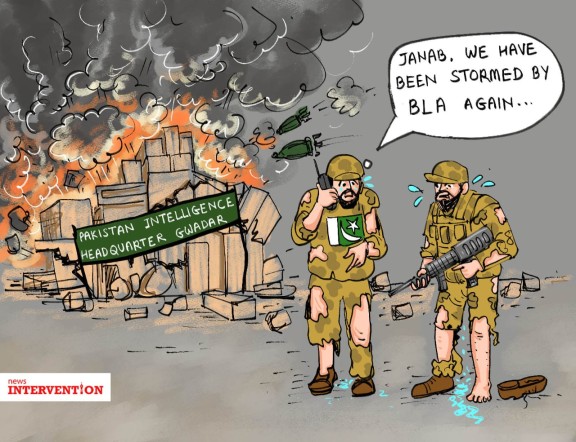
This incident marks the group’s second operation within a week and its third major attack this year. Earlier attacks included an operation in Mach city on January 29 and an attack on the ISI and MI headquarters in Gwadar on March 20 which resulted in killing of 25 Army personnel.
Following the attack, District Health Officer Kech has imposed an emergency at Teaching Hospital Turbat and all medical staff have been ordered to report to duty immediately to manage the casualties.
Turbat is currently witnessing a surge in military action, marked by helicopters flying overhead and constant gunfire and explosions on the ground. The Frontier Corps has blocked off several major roads in Turbat, while a a large contingent of FC personnel is heading towards the naval airbase.
Recently, BLA says it has killed “over a dozen” personnel in its ongoing attack in Turbat, which has been ongoing for the last three hours. Additionally, they’ve shared an audio clip from one of their fighters involved in the attack. In the recording, the fighter mentions targeting multiple Army vehicles, signaling an intensification of the attack.
The significance of Gwadar port cannot be overstated; it stands as a cornerstone of the China-Pakistan Economic Corridor (CPEC), a symbol of bilateral cooperation under the Belt and Road Initiative (BRI). Independent groups like the BLA are striving for Balochistan’s autonomy. Balochistan has faced marginalization, violence, and genocide at the hands of the Pakistan Army since its illegal occupation in 1948. Alongside China, the Pak Army has continuously exploited the resource-rich province, making it not only one of the poorest regions of the country but also marked by violence, bloodshed, and tears.
Putin accuses radical Islamists for Crocus Concert attack, hints Ukrainian involvement
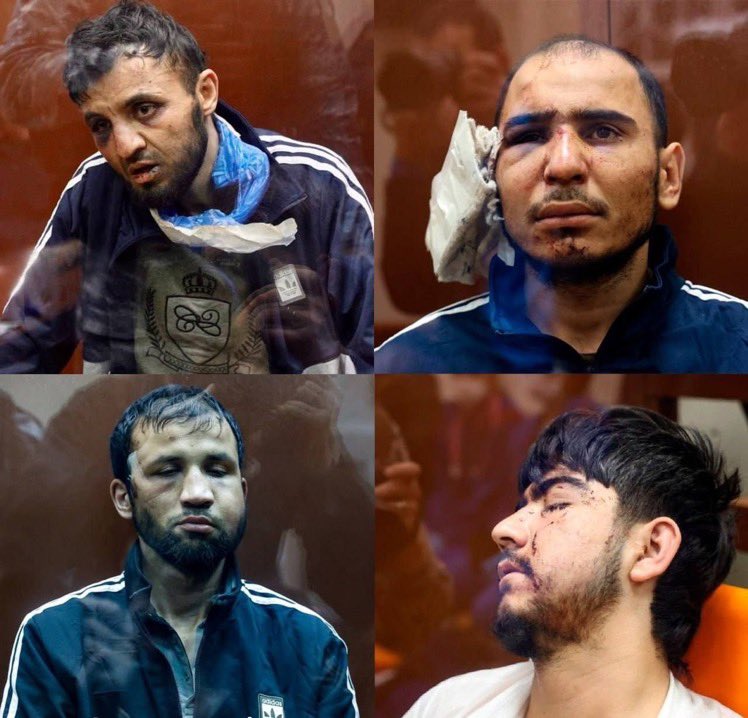
In a somber aftermath following the tragic Crocus concert attack in a Moscow suburb, Russian President Vladimir Putin has labelled the perpetrators as “radical Islamists”. The assault, which resulted in the loss of over 130 lives and left more than 180 wounded, has sent shockwaves across the nation, prompting urgent calls for justice and heightened security measures.
President Putin, addressing the nation on Monday, revealed that the assailants, four in number, were intercepted while attempting to flee to Ukraine. However, he refrained from explicitly mentioning the Islamic State (IS) group, despite an affiliate claiming responsibility for the heinous act. Instead, Putin emphasized the need to delve into the motives behind the attackers’ escape route, hinting at possible Ukrainian links.
The absence of a direct acknowledgment of IS involvement by Putin contrasts sharply with assertions made by U.S. intelligence and French President Emmanuel Macron, both suggesting IS culpability. Nonetheless, Kremlin spokesman Dmitry Peskov remained cautious, urging patience for the ongoing investigation’s outcomes while refusing to confirm reports of prior intelligence warnings from the U.S.
Meanwhile, as the legal proceedings unfold, four suspects, identified as Tajik nationals, have been charged with terrorism-related offenses. Their court appearance revealed that terrorists were firmly interrogated. Prime Minister Mikhail Mishustin assured the public of swift justice for the perpetrators, stressing that they “do not deserve mercy”.
The deadliest attack in recent memory
The attack, which targeted Crocus City Hall on Moscow’s western outskirts, stands as the deadliest in Russia in recent memory. Eyewitnesses described scenes of chaos and terror as gunfire rang out amidst the blaze that consumed the concert hall, ultimately leading to its collapse. As investigations continue, questions linger regarding the extent of IS involvement and the possibility of external support, including from Ukraine.
Amidst the uncertainty, videos released by Russian media have shed light on the recruitment process of one of the attackers, suggesting a connection to radical ideologies propagated through messaging apps. With seven additional suspects in custody, the search for answers intensifies, fuelling speculation about the true orchestrators behind this brutal act of terror.
Bhojshala Complex: Another Hindu sacred site under reclamation
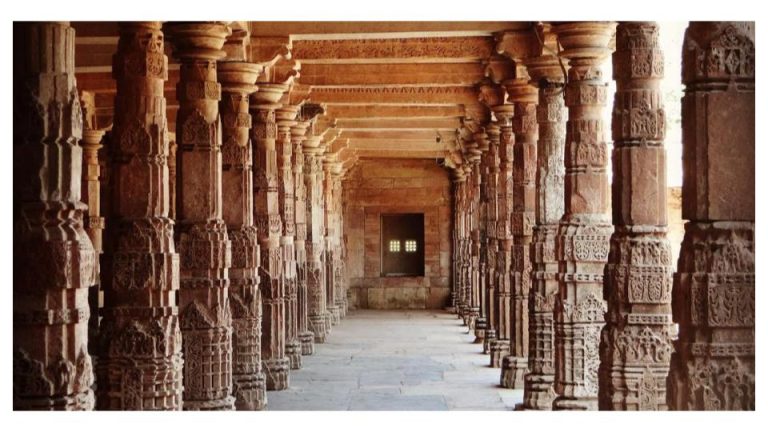
The Archaeological Survey of India (ASI) team is conducting a survey of the Bhojshala located in Dhar, Madhya Pradesh, as per the orders of the Madhya Pradesh High Court. The ASI team will determine whether the Bhojshala houses the Saraswati Temple or the Kamal Maulana Mosque based on archaeological and scientific surveys. Stringent security arrangements have been made around the premises of the Bhojshala. The court had directed the ASI on March 11 to conduct a scientific survey of the controversial Bhojshala within six weeks. Let’s find out the history of the Bhojshala in Dhar and why the fresh controversy has arisen. And to comply with that the ASI started the survey on March 22.
Backdrop of the case
Bhojshala is a protected monument from the 11th century, considered by Hindus as the temple of Vagdevi (Goddess Saraswati) and by Muslims as Kamal Maulana Mosque. While the controversy surrounding the Bhojshala is decades old, it took a new turn in 2022 when a petition was filed in the Indore High Court. The petition demanded the installation of the idol of Goddess Saraswati and the documentation of the entire premises through photography and videography. The petition also sought to halt prayers at the site.
On March 11, the court ordered the ASI to conduct a scientific survey of the premises. The Muslim side had knocked on the Supreme Court’s door to intervene in the matter. However, the Supreme Court refused to interfere with the High Court’s order on the Muslim side’s petition. The Supreme Court stated that it would not issue any orders in this matter at the moment. The Muslim side was demanding an immediate halt to the survey.
History of Bhojshala complex
Thousands of years ago, this place was ruled by the Paramara dynasty. From 1000 to 1055 CE, King Bhoj ruled here. He was a devoted follower of Goddess Saraswati. In 1034 CE, he established a university which later came to be known as ‘Bhojshala’ named after him. It is said that Alauddin Khilji destroyed the Bhojshala in 1305 CE. Then, in 1401 CE, Dilawar Khan Gauri built a mosque in one part of it. Mahmud Shah Khilji built another mosque in the other part in 1514 CE.
Almost 350 years later, the excavation was carried out here in 1875 and the statue of Goddess Saraswati was unearthed, which was taken by Major Kincaid to London. Currently, the statue is in a museum in London.
Currently, Hindu organizations consider it to be the temple of Raja Bhoj’s era. Their argument is that during the reign of the dynasty, Muslims were allowed to offer prayers for some time. On the other hand, the Muslim side claims that they have been offering prayers here for many years. They refer to this place as Bhojshala-Kamal Maulana Mosque.
Current controversy around Bhojshala
The controversy surrounding the Bhojshala is many years old, which has caused tension between Hindu and Muslim factions multiple times. With the advent of Basant Panchami the conflict escalates between Hindus and Muslims. Considerably, Basant Panchami is the only annual festival for worshiping Ma Sarswati. Hindus are allowed entry into the Bhojshala from sunrise to sunset for worship on Tuesdays. Additionally, on Fridays, from 1 p.m. to 3 p.m., only those offering Namaz are permitted to enter. The rest of the week, the Bhojshala remains open for all visitors from sunrise to sunset, with an entry fee of one rupee.
It is important to understand when pooja and namaz were permitted here simultaneously. In 1909, the princely state of Dhar declared the Bhojshala a protected monument. Later, it was handed over to the Archaeological Department. In 1935, the princely state of Dhar allowed prayers here on Fridays. Earlier, the premises used to be open only on Fridays. In 1995, a dispute arose here, after which worship on Tuesdays and prayers on Fridays were allowed.
Two years later, on May 12, 1997, the Collector banned the entry of the general public into the Bhojshala and also halted pooja on Tuesdays. Only namaz on Fridays and worship on Basant Panchami were allowed. However, the ban was lifted just two months later. But, on February 6, 1998, the Archaeological Department again imposed a ban on entry here and halted pooja on Tuesdays. In 2003, all restrictions were finally lifted, and entry for tourists along with worship was allowed.
Everything was going smoothly until 2013 when Basant Panchami was celebrated on Friday, which caused a disruption in the area. Police had to resort to lathi-charge to control the situation. Again in 2016, a similar situation arose when Basant Panchami was celebrated on Friday, leading to unrest.
Reclamation for getting free from colonial captivity
This must be noted that numerous Hindu temples and holy sites have been desecrated and vandalised by barbaric Islamic invaders in history. While the ancient Indian society showed utmost tolerance and assimilation character, they suffered as the cost of it. As a result the reclamation of the holy site is imperative to their awakening of cultural and religious conscience. The consecration of Ram Mandir in Ayodhya marks a milestone in that direction. In a way, the reclamation of site as the only viable option to get their religious rights and get their temples free from colonial captivity.
Pakistan to start fresh deportation of Afghan refugees
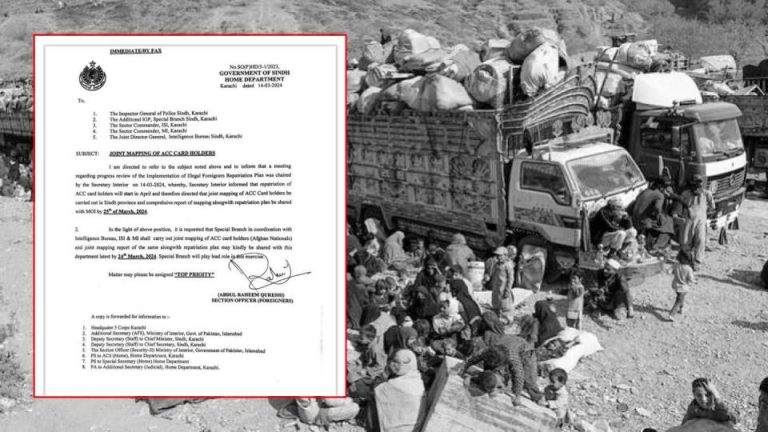
In a move to reignite tensions between Pakistan and Afghanistan, Pak “establishment” has announced plans to recommence the deportation of Afghan migrants from their territory starting next month. The decision comes after increase in tensions at the border and the exodus of over half a million Afghans from Pakistan after Islamabad set a deadline last November for undocumented migrants to leave or face arrest.
While Pakistan has cited security concerns and economic pressures as motivations for the crackdown, but the main underlying reason is to exert pressure on the Taliban-led government in Kabul over issues related to clashes at border.
A senior official from Khyber Pakhtunkhwa province, which shares a border with Afghanistan, revealed that the Army establishment had informed them about the commencement of the second phase of deportations following the Eid holiday in April. Similarly, another senior police personnel based in Peshawar disclosed plans for a renewed operation targeting “illegal Afghans” post-Eid, with directives issued to identify their locations.
Afghan refugees
Despite the lack of specific directives, the puppet authorities have already begun compiling data on Afghan refugees residing in the region. The influx of Afghans into Pakistan has been ongoing for decades, with millions seeking refuge, particularly following the Taliban’s rise to power in 2021, which saw a surge in arrivals due to the imposition of strict Sharia laws.
Furthermore, tensions between Pakistan and Afghanistan have further escalated, with Islamabad accusing Kabul of harboring groups and organisations responsible for cross-border attacks, a claim consistently denied by the Taliban. The recent escalation follows BLA Majeed Brigade attack inside Pak-occupied-Balochistan’s Gwadar that claimed the lives of over 25 personnel. Pakistan Army is now doing what it does best, in an attempt to cover up their failing structure, the Pak establishment is now issuing a yet another brutal crackdown on the innocent Afghan refugees.