Home Blog Page 258

Prof. Vaknin on Gut Feelings and Intuition

 Prof. Shmuel “Sam” Vaknin (YouTubeTwitterInstagramFacebookAmazonLinkedInGoogle Scholar) is the author of Malignant Self-love: Narcissism Revisited (Amazon) and After the Rain: How the West Lost the East (Amazon) as well as many other books and ebooks about topics in psychology, relationships, philosophy, economics, international affairs, and award-winning short fiction. He was Senior Business Correspondent for United Press International (February, 2001 – April, 2003), CEO of Narcissus Publications (April, 1997 – April 2013), Editor-in-Chief of Global Politician (January, 2011 -), a columnist for PopMatters, eBookWeb, Bellaonline, and Central Europe Review, an editor for The Open Directory and Suite101 (Categories: Mental Health and Central East Europe), and a contributor to Middle East Times, a contributing writer to The American Chronicle Media Group, Columnist and Analyst for Nova MakedonijaFokus, and Kapital, Founding Analyst of The Analyst Network, former president of the Israeli chapter of the Unification Church‘s Professors for World Peace Academy, and served in the Israeli Defense Forces (1979-1982). He has been awarded Israel’s Council of Culture and Art Prize for Maiden Prose (1997), The Rotary Club Award for Social Studies (1976), and the Bilateral Relations Studies Award of the American Embassy in Israel (1978), among other awards. He is Visiting Professor of Psychology, Southern Federal University, Rostov-on-Don, Russia (September, 2017 to present), Professor of Finance and Psychology in SIAS-CIAPS (Centre for International Advanced and Professional Studies) (April, 2012 to present), a Senior Correspondent for New York Daily Sun (January, 2015 – Present), and Columnist for Allied Newspapers Group (January, 2015 – Present). He lives in Skopje, North Macedonia with his wife, Lidija Rangelovska. Here we talk about gut feelings and intuition.

*Previous interviews listed chronologically after interview.*

Scott Douglas Jacobsen: What differentiates intuitions from gut feelings if at all?

Prof. Shmuel “Sam” Vaknin: Gut feeling is immediate and nebulous. Intuition takes longer to form and feels more precise, incisive, and certain.

Jacobsen: How much of knowledge is filtered, processed, and prefabricated non-consciously and then presented to a conscious arena/awareness for decision-making?

Vaknin: There are three types of intuition.

Eidetic Intuitions

Intuition is supposed to be a form of direct access. Yet, direct access to what? Does it access directly “intuitions” (abstract objects, akin to numbers or properties – see “Bestowed Existence”)? Are intuitions the objects of the mental act of Intuition? Perhaps intuition is the mind’s way of interacting directly with Platonic ideals or Phenomenological “essences”? By “directly” I mean without the intellectual mediation of a manipulated symbol system, and without the benefits of inference, observation, experience, or reason.

Kant thought that both (Euclidean) space and time are intuited. In other words, he thought that the senses interact with our (transcendental) intuitions to produce synthetic a-priori knowledge. The raw data obtained by our senses -our sensa or sensory experience – presuppose intuition. One could argue that intuition is independent of our senses. Thus, these intuitions (call them “eidetic intuitions”) would not be the result of sensory data, or of calculation, or of the processing and manipulation of same. Kant’s “Erscheiung” (Sic!) – the “phenomenon”, or “appearance” of an object to the senses – is actually a kind of sense-intuition later processed by the categories of substance and cause. As opposed to the phenomenon, the “nuomenon” (thing in itself) is not subject to these categories.

Descartes’ “I (think therefore I) am” is an immediate and indubitable innate intuition from which his metaphysical system is derived. Descartes’ work in this respect is reminiscent of Gnosticism in which the intuition of the mystery of the self leads to revelation.

Bergson described a kind of instinctual empathic intuition which penetrates objects and persons, identifies with them and, in this way, derives knowledge about the absolutes – “duration” (the essence of all living things) and “élan vital” (the creative life force). He wrote: “(Intuition is an) instinct that has become disinterested, self-conscious, capable of reflecting upon its object and of enlarging it indefinitely.” Thus, to him, science (the use of symbols by our intelligence to describe reality) is the falsification of reality. Only art, based on intuition, unhindered by mediating thought, not warped by symbols – provides one with access to reality.

Spinoza’s and Bergson’s intuited knowledge of the world as an interconnected whole is also an “eidetic intuition”.

Spinoza thought that intuitive knowledge is superior to both empirical (sense) knowledge and scientific (reasoning) knowledge. It unites the mind with the Infinite Being and reveals to it an orderly, holistic, Universe.

Friedrich Schleiermacher and Rudolf Otto discussed the religious experience of the “numinous” (God, or the spiritual power) as a kind of intuitive, pre-lingual, and immediate feeling.

Croce distinguished “concept” (representation or classification) from “intuition” (expression of the individuality of an objet d’art). Aesthetic interest is intuitive. Art, according to Croce and Collingwood, should be mainly concerned with expression (i.e., with intuition) as an end unto itself, unconcerned with other ends (e.g., expressing certain states of mind).

Eidetic intuitions are also similar to “paramartha satya” (the “ultimate truth”) in the Madhyamika school of Buddhist thought. The ultimate truth cannot be expressed verbally and is beyond empirical (and illusory) phenomena. Eastern thought (e.g. Zen Buddhism) uses intuition (or experience) to study reality in a non-dualistic manner.

IB. Emergent Intuitions

A second type of intuition is the “emergent intuition”. Subjectively, the intuiting person has the impression of a “shortcut” or even a “short circuiting” of his usually linear thought processes often based on trial and error. This type of intuition feels “magical”, a quantum leap from premise to conclusion, the parsimonious selection of the useful and the workable from a myriad possibilities. Intuition, in other words, is rather like a dreamlike truncated thought process, the subjective equivalent of a wormhole in Cosmology. It is often preceded by periods of frustration, dead ends, failures, and blind alleys in one’s work.

Artists – especially performing artists (like musicians) – often describe their interpretation of an artwork (e.g., a musical piece) in terms of this type of intuition. Many mathematicians and physicists (following a kind of Pythagorean tradition) use emergent intuitions in solving general nonlinear equations (by guessing the approximants) or partial differential equations.

Henri Poincaret insisted (in a presentation to the Psychological Society of Paris, 1901) that even simple mathematical operations require an “intuition of mathematical order” without which no creativity in mathematics is possible. He described how some of his creative work occurred to him out of the blue and without any preparation, the result of emergent intuitions.

These intuitions had “the characteristics of brevity, suddenness and immediate certainty… Most striking at first is this appearance of sudden illumination, a manifest sign of long, unconscious prior work. The role of this unconscious work in mathematical invention appears to me incontestable, and traces of it would be found in other cases where it is less evident.”

Subjectively, emergent intuitions are indistinguishable from insights. Yet insight is more “cognitive” and structured and concerned with objective learning and knowledge. It is a novel reaction or solution, based on already acquired responses and skills, to new stimuli and challenges. Still, a strong emotional (e.g., aesthetic) correlate usually exists in both insight and emergent intuition.

Intuition and insight are strong elements in creativity, the human response to an ever changing environment. They are shock inducers and destabilizers. Their aim is to move the organism from one established equilibrium to the next and thus better prepare it to cope with new possibilities, challenges, and experiences. Both insight and intuition are in the realm of the unconscious, the simple, and the mentally disordered. Hence the great importance of obtaining insights and integrating them in psychoanalysis – an equilibrium altering therapy.

Kazimierz Dąbrowski’s theory of positive disintegration (TPD) posits that angst (existentialist tension and anxiety) not only induces growth, but is a necessary condition for it. Disintegrative processes are desirable. The absence of positive disintegration results in a fixated state of “primary (not secondary) integration”, without true individuality. One’s developmental potential, especially one’s overexcitabilities (abnormally strong reactions to stimuli) determine the potential for positive disintegration. Overexcitability (OE) is a heightened physiological experience of stimuli resulting from increased neuronal sensitivities.

Like Jordan Peterson, Dabrowski regards suffering – including the self-inflicted kind – as a key to both progress and healing. Personality shaping depends on socialization and on peer pressure (second factor). Strict unthinking and unwavering adherence creates robopaths (von Bertalanffy). Disintegartion requires countering social signalling and pressures which, I suggest, are mostly detected intuitively. Intuition, therefore, plays a key part in the regulation of these processes.

IC. Ideal Intuitions

The third type of intuition is the “ideal intuition”. These are thoughts and feelings that precede any intellectual analysis and underlie it. Empathy may be such an intuitive mode applied to the minds of other people, yielding an intersubjective agreement. Moral ideals and rules may be such intuitions (see “Morality – a State of Mind?”).

Mathematical and logical axioms and basic rules of inference (“necessary truths”) may also turn out to be intuitions. These moral, mathematical, and logical self-evident conventions do not relate to the world. They are elements of the languages we use to describe the world (or of the codes that regulate our conduct in it). It follows that these a-priori languages and codes are nothing but the set of our embedded ideal intuitions. This is why we can be pretty certain that the language of mathematics is inadequate and insufficient to capture reality or even the laws of nature.

As the Rationalists realized, ideal intuitions (a class of undeniable, self-evident truths and principles) can be accessed by our intellect. Rationalism is concerned with intuitions – though only with those intuitions available to reason and intellect. Sometimes, the boundary between intuition and deductive reasoning is blurred as they both yield the same results. Moreover, intuitions can be combined to yield metaphysical or philosophical systems. Descartes applied ideal intuitions (e.g., reason) to his eidetic intuitions to yield his metaphysics. Husserl, Twardowski, even Bolzano did the same in developing the philosophical school of Phenomenology.

The a-priori nature of intuitions of the first and the third kind led thinkers, such as Adolf Lasson, to associate it with Mysticism. He called it an “intellectual vision” which leads to the “essence of things”. Earlier philosophers and theologians labeled the methodical application of intuitions – the “science of the ultimates”. Of course, this misses the strong emotional content of mystical experiences.

Confucius talked about fulfilling and seeking one’s “human nature” (or “ren”) as “the Way”. This nature is not the result of learning or deliberation. It is innate. It is intuitive and, in turn, produces additional, clear intuitions (“yong”) as to right and wrong, productive and destructive, good and evil. The “operation of the natural law” requires that there be no rigid codex, but only constant change guided by the central and harmonious intuition of life.

Intuition is a topic that concerned many philosophers throughout the ages.

IIA. Locke

But are intuitions really a-priori – or do they develop in response to a relatively stable reality and in interaction with it? Would we have had intuitions in a chaotic, capricious, and utterly unpredictable and disordered universe? Do intuitions emerge to counter-balance surprises?

Locke thought that intuition is a learned and cumulative response to sensation. The assumption of innate ideas is unnecessary. The mind is like a blank sheet of paper, filled gradually by experience – by the sum total of observations of external objects and of internal “reflections” (i.e., operations of the mind). Ideas (i.e., what the mind perceives in itself or in immediate objects) are triggered by the qualities of objects.

But, despite himself, Locke was also reduced to ideal (innate) intuitions. According to Locke, a colour, for instance, can be either an idea in the mind (i.e., ideal intuition) – or the quality of an object that causes this idea in the mind (i.e., that evokes the ideal intuition). Moreover, his “primary qualities” (qualities shared by all objects) come close to being eidetic intuitions.

Locke himself admits that there is no resemblance or correlation between the idea in the mind and the (secondary) qualities that provoked it. Berkeley demolished Locke’s preposterous claim that there is such resemblance (or mapping) between PRIMARY qualities and the ideas that they provoke in the mind. It would seem therefore that Locke’s “ideas in the mind” are in the mind irrespective and independent of the qualities that produce them. In other words, they are a-priori. Locke resorts to abstraction in order to repudiate it.

Locke himself talks about “intuitive knowledge”. It is when the mind “perceives the agreement or disagreement of two ideas immediately by themselves, without the intervention of any other… the knowledge of our own being we have by intuition… the mind is presently filled with the clear light of it. It is on this intuition that depends all the certainty and evidence of all our knowledge… (Knowledge is the) perception of the connection of and agreement, or disagreement and repugnancy, of any of our ideas.”

Knowledge is intuitive intellectual perception. Even when demonstrated (and few things, mainly ideas, can be intuited and demonstrated – relations within the physical realm cannot be grasped intuitively), each step in the demonstration is observed intuitionally. Locke’s “sensitive knowledge” is also a form of intuition (known as “intuitive cognition” in the Middle Ages). It is the perceived certainty that there exist finite objects outside us. The knowledge of one’s existence is an intuition as well. But both these intuitions are judgmental and rely on probabilities.

IIB. Hume

Hume denied the existence of innate ideas. According to him, all ideas are based either on sense impressions or on simpler ideas. But even Hume accepted that there are propositions known by the pure intellect (as opposed to propositions dependent on sensory input). These deal with the relations between ideas and they are (logically) necessarily true. Even though reason is used in order to prove them – they are independently true all the same because they merely reveal the meaning or information implicit in the definitions of their own terms. These propositions teach us nothing about the nature of things because they are, at bottom, self referential (equivalent to Kant’s “analytic propositions”).

IIC. Kant

According to Kant, our senses acquaint us with the particulars of things and thus provide us with intuitions. The faculty of understanding provided us with useful taxonomies of particulars (“concepts”). Yet, concepts without intuitions were as empty and futile as intuitions without concepts. Perceptions (“phenomena”) are the composite of the sensations caused by the perceived objects and the mind’s reactions to such sensations (“form”). These reactions are the product of intuition.

IID. The Absolute Idealists

Schelling suggested a featureless, undifferentiated, union of opposites as the Absolute Ideal. Intellectual intuition entails such a union of opposites (subject and object) and, thus, is immersed and assimilated by the Absolute and becomes as featureless and undifferentiated as the Absolute is.

Objective Idealists claimed that we can know ultimate (spiritual) reality by intuition (or thought) independent of the senses (the mystical argument). The mediation of words and symbol systems only distorts the “signal” and inhibits the effective application of one’s intuition to the attainment of real, immutable, knowledge.

IIE. The Phenomenologists

The Phenomenological point of view is that every thing has an invariable and irreducible “essence” (“Eidos”, as distinguished from contingent information about the thing). We can grasp this essence only intuitively (“Eidetic Reduction”). This process – of transcending the concrete and reaching for the essential – is independent of facts, concrete objects, or mental constructs. But it is not free from methodology (“free variation”), from factual knowledge, or from ideal intuitions. The Phenomenologist is forced to make the knowledge of facts his point of departure. He then applies a certain methodology (he varies the nature and specifications of the studied object to reveal its essence) which relies entirely on ideal intuitions (such as the rules of logic).

Phenomenology, in other words, is an Idealistic form of Rationalism. It applies reason to discover Platonic (Idealism) essences. Like Rationalism, it is not empirical (it is not based on sense data). Actually, it is anti-empirical – it “brackets” the concrete and the factual in its attempt to delve beyond appearances and into essences. It calls for the application of intuition (Anschauung) to discover essential insights (Wesenseinsichten).

“Phenomenon” in Phenomenology is that which is known by consciousness and in it. Phenomenologists regarded intuition as a “pure”, direct, and primitive way of reducing clutter in reality. It is immediate and the basis of a higher level perception. A philosophical system built on intuition would, perforce, be non speculative. Hence, Phenomenology’s emphasis on the study of consciousness (and intuition) rather than on the study of (deceiving) reality. It is through “Wesensschau” (the intuition of essences) that one reaches the invariant nature of things (by applying free variation techniques).

Jacobsen: Is this a large part of intuition and/or gut feelings if inclusive of the filtration, processing, and prefabrication, of information from physiology – the body – too? I do not necessarily mean extensive amounts of time – could be fractions of a second – from input to presentation to consciousness (conscious awareness).

Vaknin: There is no question that input from the body is crucial to the formation of intuitions. The sensa (sensory inputs) are only one part of it. Autonomous reactions – such as heartbeat or perspiration – also figure into the equation. As we try to make sense of these corporeal data, we often come up with a heuristic or a narrative and most of the time we perceive the outcomes of these attempts as gut feelings or intuitions.

Jacobsen: When something feels wrong to an individual, how is this justifiable in considering the “something” as wrong in and of itself, or wrong in interpretation of an individual (more likely than not a fallible individual)? Are there moments when these feelings of wrongness about something are themselves inaccurate – following more generally from part of the last question?

Vaknin: Intuition is wrong as often as right. It is a shaky foundation for decision making. But it is a reliable signal that further research and investigation are called for.

Intuition should not be confused with either emotions or cognitions. They are an amalgam of both but they are a form of anxiety reaction, a variant of hypervigilance.

Jacobsen: When someone is trying to force-fit a relationship, a friendship, a marital situation, a professional arrangement, why is this a sign of inauthenticity, a fake?

Vaknin: Authenticity consists of being yourself even when you adhere to social strictures, norms, and mores or when you are trying to meet expectations and obligations. Feeling good about your choice to conform and act responsibly, reliably, and predictably (ego syntony).

If the sum total of an engagement with others causes you acute discomfort (ego dystony or dissonance) – this is a sign that you are betraying yourself somehow and, therefore, being inauthentic.

Watch “Being is Slavery, Nothingness is Freedom (Sartre’s “Being and Nothingness”, FIRST LECTURE)”

Watch “Relationships Always Fail, Inauthentic (Sartre’s “Being and Nothingness”, SECOND LECTURE)”  https://www.youtube.com/watch?v=xFvRcB1MOWM

Jacobsen: Grandiose claims are made all the time. Those claims too good to be true. Why are the “too good to be true” more likely to be false than true?

Vaknin: Splitting is an infantile psychological defense mechanism: the baby divides the world into all good and all bad. Of course, this is counterfactual: there is good and bad, right and wrong, helpful and obstructive in everything and in everyone.

So, “too good to be true” is an outcome of splitting coupled with magical thinking (the delusion that your willpower or thoughts affect reality even without any commensurate action). It is the offspring of a pathology of impaired reality testing.

Jacobsen: Why are we prone to believing things people say far more often than not, when people lie all the time in little and big ways?

Vaknin: This is known as the base rate fallacy. This cognitive distortion aims to resolve a cognitive dissonance: I know that people lie but I want to trust them all the time in order to feel safe.

It stems from the same pathological roots which involve grandiosity magical thinking: other people are all good and can be always trusted because I am all-powerful and immune to harm as well as all-knowing and so, I cannot be conned.

Trusting other people is the optimal strategy when you are the omniscient and omnipotent master of the Universe: investing in research and investigation would be wasteful.

Jacobsen: Should we make decisions immediately based on gut feelings and intuitions or over a reasonable amount of time making incremental, moderate changes/decisions based on increasing feedback from the processes colloquially called “gut feelings” and “intuitions”?

Vaknin: We should definitely listen to gut feelings and intuitions. They are telling us that something has gone awry with the way we perceive reality. This alert bears careful investigation and research.

But I would not act on my intuition or gut feeling unless and until I have delved deeper into what it is that is nagging at me.

Jacobsen: How can intuitions and gut feelings, ultimately, save us from our conscious delusions?

Vaknin: Intuitions and gut feelings are a poor guide in this sense because, as I said, as often as not, they turn out to have been wrong. Some intuitions are delusional!

Shoshanim: Thanks so much for the time and opportunity, Prof. Sam (Wise Gamgee).

Shoshanim’s Shoshanim: I have an intuition that you actually mean it this time!

Previous Electronic ‘Print’ Interviews (Hyperlinks Active for Titles)

Prof. Sam Vaknin on Narcissism in General

(News Intervention: January 28, 2022)

Prof. Sam Vaknin on Cold Therapy (New Treatment Modality)

(News Intervention: January 30, 2022)

Prof. Sam Vaknin on Giftedness and IQ

(News Intervention: February 2, 2022)

Prof. Sam Vaknin on Religion

(News Intervention: February 11, 2022)

Prof. Sam Vaknin on Science and Reality

(News Intervention: April 30, 2022)

Prof. Sam Vaknin on the Gender Wars

(News Intervention: May 21, 2022)

Prof. Sam Vaknin on Psychological Growth

(News Intervention: May 24, 2022)

Prof. Sam Vaknin on Structure, Function, Society, and Survival

(News Intervention: May 26, 2022)

Prof. Vaknin on Chronon Field Theory and Time Asymmetry

(News Intervention: May 28, 2022)

Prof. Vaknin on Genius and Insanity

(News Intervention: June 1, 2022)

Prof. Vaknin on Freedom of Expression

(News Intervention: June 10, 2022)

Prof. Vaknin on Misogyny and Misandry

(News Intervention: June 20, 2022)

Prof. Vaknin on Victimization and Victim Identity Movements

(News Intervention: July 27, 2022)

Previous Interviews Read by Prof. Vaknin (Hyperlinks Active for Titles)

How to Become the REAL YOU (Interview, News Intervention)

(Prof. Sam Vaknin: January 26, 2022)

Insider View on Narcissism: What Makes Narcissist Tick (News Intervention)

(Prof. Sam Vaknin: January 29, 2022)

Curing Your Narcissist (News Intervention Interview)

(Prof. Sam Vaknin: January 31, 2022)

Genius or Gifted? IQ and Beyond (News Intervention Interview)

(Prof. Sam Vaknin: February 3, 2022)

Thrive: Your Future Path to Growth and Change (News Intervention Interview)

(Prof. Sam Vaknin: May 25, 2022)

Previous Interviews Interpreted by Prof. Vaknin (Hyperlinks Active for Titles)

Your Narcissist: Madman or Genius? (Based on News Intervention Interview)

(Prof. Sam Vaknin: June 3, 2022)

Image Credit: Sam Vaknin. 

BNM lambasts Pak Army for killing Haji Sanaullah’s sons & murderous attack on Raza Jahangir’s widow

The spokesperson of Baloch National Movement said in his statement that the direct subordinate organizations of the Pakistani Army FC, Counter-Terrorism Department (CTD) of Police, Regular Police, Balochistan Levies and Death Squads are above the laws in Balochistan and cooperate with Pakistan Army in their  actions like Baloch genocide, collective punishment, enforced disappearance and custodial killings. 

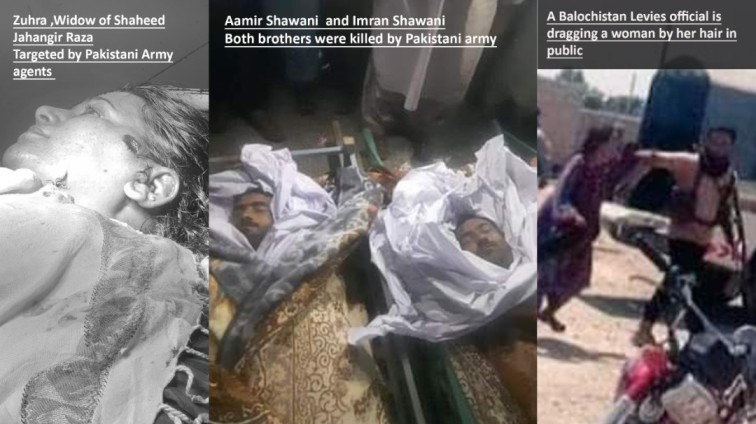
He said the attack of FC on the house of Haji Sanaullah Shahwani in Kharan, the killing of his two sons and forced disappearance of one, murderous attack on the widow of the martyred leader of BSO-Azad Raza Jahangir in Shaal and the dragging of a woman by the hair in public by a Levies official in Suni Khuzdar were prominent examples of human rights abuses by state institutions. In order to prolong its occupation of Balochistan, the Pakistani army has been systematically using all institutions, including the police, to carry out its anti-Baloch plan.

Deceased sons of Sanaullah Shahwani in Kharan (Photo: News Intervention)

On the morning of 14 August 2013, the Pakistani army stormed the house of BNM Kech leader Shaheed Imdad Boujeer and martyred him and his guest BSO-Azad Secretary General Raza Jahangir. One year after the martyrdom of Raza Jahangir, on 28 August 2014, Pakistani army attacked a place of worship in Aawaran and killed his father, Bakhtiar Baloch including 6 other worshipers. Now, by choosing the month of August again, the agents of the Pakistani army have carried out a murderous attack on Shaheed Raza Jahangir’s widow ‘Zohra Baloch’ in front of the University of Balochistan in Shaal. The Pakistani army had continuously targeted this family and had forced them to migrate from their native area. The men of the family have been  killed by the Pakistani army today the widow of Shaheed Reza Jahangir had also been attacked.

Zorah Baloch widow of BSO-Azad Secretary General Raza Jahangir who attacked ( Photo: News Intervention)

The spokesperson further added that the family of Haji Sanaullah Shahwani in Kharaan was also a victim of the brutality of the state of Pakistan. His house was attacked by FC and Pakistan Army on the night of 2 August 2022. According to Haji Sanaullah, FC and Pakistani army personnel tortured all the people in the house including women and children. Amir and Imran Shahwani, sons of Haji Sanaullah, were shot during the torture and his third son Irfan Shahwani was tortured with kicks and gun butts. After the torture of the three sons, two of whom were seriously injured, were forcibly disappeared. Both brothers Aamir and Imran were martyred in the custody of secret agencies whose dead bodies were thrown in the Civil Hospital of Quetta while Haji Sanaullah’s third son Irfan Shahwani is still missing.

The spokesperson of BNM further said that the family of Haji Sanaullah had been completely destroyed by the Pakistani army as a target of revenge.A month ago, one of his sons, Ashfaaq Shahwani, was also killed by state backed proxy and now three of his sons have been targeted, two of whom have been extrajudicially killed while one has been forcibly disappeared after arrest. These crimes against humanity committed by the state of Pakistan in Balochistan cannot be forgiven under any circumstances.

He stressed, “The Baloch people must unite and give strength to the national movement of Baloch to protect their society and national survival. Without the independence of Balochistan, we cannot get rid of these atrocities”.

Levies official Asadullah in the Suni area of Khuzdar dragging a woman by her hair (Photo: News Intervention)

In the end, the spokesperson regarding the social media viral picture of a Levies official named ‘Asadullah’ in the Suni area of Khuzdar dragging a woman by her hair said  “we expect better behavior from the Baloch police, especially the Levies officials” as  Baloch majority institutions are expected to “fulfil their responsibilities for the elimination of social crimes” and the Baloch would refrain from getting involved in anti-Baloch activities. The majority of these institutions have become puppets of the Pakistani army. “The said action of the official named Asadullah is against human dignity which the Baloch nation will never allow”. “We ask to the Baloch officers of the police and levies to refrain from such act. Otherwise, the Baloch nation considers them as enemies and holds them accountable. They have to correct their behaviors. The enemy wants to pit the Baloch against the Baloch, but we have to understand that this is against our national interest and the Baloch nation cannot afford it” he said .               

Changing tactics of Islamist theofascists

First, the selective killings of the Hindus and Sikhs in Kashmir, and now the “sar tan se  juda”  monstrosity of  theo-fascists at some places in India, all point to the new tactics of  Ghazvatu’l Hind mission as stipulated in some books of Islamic Tradition (hadith).

The operatives of Ghazavatu’l Hind (the Indian campaign) had temporarily slowed it down for two years for two reasons.  One was to let the Taliban authority get stabilized in Kabul and the second the fast economic crisis overtaking Pakistan — a situation which the disruptive forces cherished. Now, the masterminds of the Ghazavatu’l Hind plan accelerated the operation of their assignment.

The murder of identified Hindus in Udaipur, Amravati, Ara and other places is not an isolated incident although the criminals would wish the Indian security authorities and policy planners remain wrapped up in that delusion. Investigating agencies are gradually removing the layer after layer of a conspiracy that shrouds these murders. For example, one of the strategies adopted by the Ghazava Ansars could be that of establishing a countrywide network of Dawat-e-Islami, the new Pakistan-based Islamic organization, with a specific agenda of unleashing terror in entire India through the indoctrinated Indian Muslim youth. It may be reminded that sometimes back, there was much talk about Ghazavatu’l Hind in Islamic circles and this writer had scripted a column on the subject.

Islamists fervently pursuing the resurgence of radicalized Islam (which they label as puritanical Islam) strongly argue that their scriptures categorically enjoins upon the puritan to efface from the surface of the earth the last vestiges of kufr, meaning apostasy/ idolatry, especially in India. They are asked to believe that the orthodox Islamic faith, culture and sharia must prevail as stated in the teachings of the scriptures.

 However, some Muslim scholars are of the view that violence against other faiths like Hinduism or Judaism, is not recommended anywhere in the Islamic scriptures. They bring the onus of the aberrations like these to the doorsteps of the half-literate mullahs and the Islamic clergy guided by self-aggrandizement. The clash between the orthodoxy and liberalism in Islam has been as old as Islam itself. But because the orthodoxy made use of brute force and politicized Islam to stifle the voice of liberalism, the latter always remained subdued and passive. A major portion of Islamic history is the unending struggle between the two ideologies.

Under this classification, those who do not indulge in violence always say that all Muslims cannot be branded as violent, terrorists and criminals. But to their dismay, this argument cannot have many takers. The fact is that if the majority of the Muslims are rationalists and only a handful of their community are misguided hypocrites, then they should have mustered the courage to weed out the pretentious elements from society. We have never heard crowds of righteous Muslims coming out on the streets and announcing resistance to the fascist elements in society. But there is no example of mass protest by the rationalist and humanist Muslims in any part of the world though some outstanding personalities like Kamal Ataturk of Turkey and Reza Shah Pahlavi of Iran had tried to set an example of resilience when in power. Once they were out, orthodoxy returned with a bang.  It means that by their inaction the so-called rationalists among the Muslims advertently or inadvertently lend support to the upholders of Theo-fascism.

 The extremists and radicals among the Muslims consider it their religious duty to join the jihad against the idol-worshippers in India because they feel Islam is under threat as long as idolatry exists no matter howsoever docile, passive and non-violent these idolaters are.  Don’t forget that a champion of theirs had the temerity to say publicly that “the Hindu terrorism is the most dangerous of all terrors.”  They consider the time suited for undertaking the mission of Ghazavatu’l Hind; they have already started it. This is what the madrasahs teach the young kids who ultimately grow with a particular mindset in which the elements of hatred and violence enjoy primacy.

Indian policy planners are under a misconception that the pro-ghazava forces may plan an onslaught on the Hindus of India resembling the one they unleashed in Kashmir in 1990. In such a situation, they think that the state security and defence apparatus will come into action. This is wrong thinking. The Islamists have very carefully calculated what strategy has to be employed when and where. For example, General Zia’s theory was to bleed India by a thousand cuts. Although he was a General trained in a modern military academy, he eschewed direct attack on India and devised a strategy that worked fairly well.

A proxy war is one of the viable strategies which the State of Pakistan has adopted for use against India. Once, General Musharraf said that the Indian Muslims are our crucial asset for the implementation of a proxy war against India. This was a grandiose strategy and Pakistan’s intelligence agency worked on it in good time. The Ghazavatu’l Hind and its latest version called Dawat-e-Islami are the variants of the changed strategy.  Taqiya or camouflaging is another essential component of the new strategy and Theo-fascists use it successfully. In the same strain “denial” is another strong instrument very much in use to promulgate the Ghaazva mission. So pervasive is the denial theory that President Trump in a tweet in 2018 wrote, “The United States has foolishly given Pakistan more than 33 billion dollars in aid over the last 15 years, and they have given us nothing but lies and deceit, thinking of our leaders as fools. They give a haven to the terrorists we hunt in Afghanistan”.

Pakistan will never fight India face to face. It will resort to subversion at various levels and in various forms. Penetrating various institutions of the State including the critical ones like the Atomic Energy base, Space Centres, departments of some selected ministries, judiciary, police, intelligence, cyber technologies, foreign missions etc. The mosques, their Imams, Muslim religious or political leadership and numerous so-called Islamic welfare institutions and NGOs, all are under their radar. Spreading terror to cow down state functionaries from discharging their duty without fear and favour is reflected in the threat letters that have begun to be sent to a large number of people. Imagine the impact of terror that even the judges of the Supreme Court and lower courts feel pressurized to give verdicts against their conscience. This is the vast game of subversion and it succeeds because it is not challenged; because the Indian State is lost in the pretentious slogans of non-violence and peaceful coexistence.  Imagine when two judges of the Indian Supreme Court issued a verdict that the beheading of Kanhaiya in Udaipur was the result of Nupur Sharma’s derogatory statement, the Taliban in Kabul issued a statement appreciating the Indian Supreme court’s verdict and comments. Imagine how the Supreme Court of the world’s largest democracy allowed itself to be derided. 

The most dangerous and unfortunate part of this anti-India Herculean mission is that a section of Indian citizenry, (apart from the Muslim community), is treacherously supporting the Theo-fascists for their wicked designs against the Indian State not out of any conviction but to see that the Modi government is toppled and then the chaos follows. Their machinations are in no way inferior or less effective than those of the prime actors of the Ghazava. Some sections of media including television channels vie with one another in denigrating the Indian State and the Indian nation. It should not be forgotten that most of these rabidly anti-national elements serve the purpose of the deep state and all-powerful international agencies who, through money and muscle power, want to control the globe and give direction to the events according to their choice. The rise of India as a military and economic power through strong policies like “atmanirbhar” is a red rag to the bull. The Shaheen Bagh event, Delhi riots, Kisan agitation, Agniveer agitation, hijab agitation and now “sar tan se juda” monstrosity, all drew inspiration from the global anti-India network. The scuttling of FTA between India and the UK, the defeat of Donald Trump in the previous election, the resignation of the British PM Boris Johnson and the assassination of Shinzo Abe (the brain behind Quad-4), all these events carry a common thread. In this vast ocean of perfidies and conspiracies, PM Modi stands like an immovable rock drawing strength from the support and love of his people who form one-fifth of the world’s population.

The Dawat-i-Islami, in combination with other lashkars raised on the soil of Pakistan, has been busy spreading their network in many parts of India from east to west and north to south. Thanks to India’s developed digital connectivity, these modules are connected not only to their mentors in Pakistan but also to others in different parts of the world especially those in the category of fundraisers and military strategists. The term Ghazavatu’l Hind has become a household word for almost all Muslims wherever they are.

The investigating agencies are just concluding that the Islamists are adopting uniform patterns, other than man-to-man confrontation, to advance the Islamic agenda in India.  The undercurrent of Ghazvatu’l Hind/Dawat-e-Islami runs in all Islamic communities irrespective of the fact whether they feign friendship with India or not.  This has been amply proved in the Napur Sharma case.

How is the Indian State responding to this situation? This is the crucial question. Indian authorities do not understand the tsunami of Theo-fascism preparing to overrun India. Right from the times of the Shaheen Bagh episode to the beheading of Kanhaiyalal in Udaipur, there have been recurring Islamic uprisings in this country. The idiom of the activists of these upsurges is not indigenous but imported one. Reports of inquiry committees invariably identify the miscreants but the authorities seldom divulge what punishment has been given or not given to the culprits. It is kept a secret out of the fear of displeasing the vole bank segment. Be sure the Theo-fascist tsunami will overrun India if Indian policy planners do not dump the vote bank theory in the dustbin. The Indian government feels that its penal code and other laws are sufficient to deal with this threatening scenario. It has to change its mindset. It has to learn that an extraordinary political and social challenge, needs extraordinary measures and laws. It has to learn the language that Theo-fascists understand. France presents an example. She has closed the Islamic seminaries; she has imposed restrictions on sermons delivered in the mosques; she has set the heaviest fines and imprisonment on those intending to spread religious violence. India needs to hold OIC responsible for stimulating the anti-State attitude of Indian Muslims by issuing irresponsible statements after its meetings, and on the insistence of Pakistan. Conversely, OIC must decide India’s inclusion in the organization being home to the second largest Muslim population in the world.

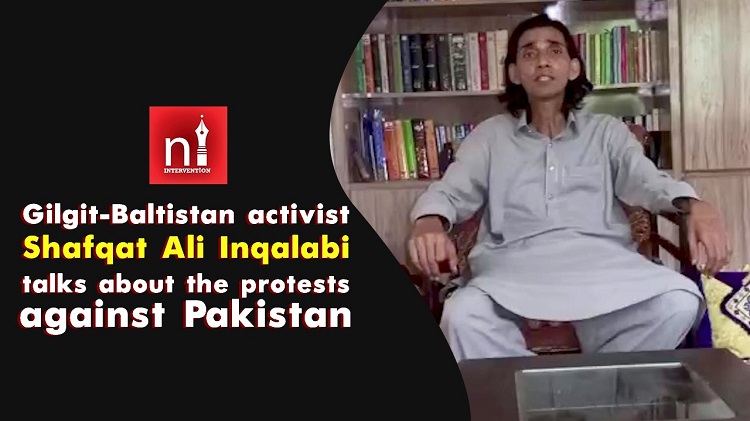
Video: Gilgit-Baltistan’s political activist Shafqat Ali Inqalabi talks about ongoing protests

There have been demonstrations and protests across Pakistan-occupied Jammu Kashmir (POJK) and Gilgit-Baltistan over the last several days. Shafqat Ali Inqalabi, Political Activist from Gilgit-Baltistan explains the underlying causes for these demonstrations in this interview with Vivek Sinha, Editor-in-Chief News Intervention.

Way ahead after Art 370 & Art 35A abrogation

August 5 marks the third anniversary of the center’s decision to abrogate Articles 370 and 35[A] of the Indian constitution, and though it’s still too early to comprehensively comment on the pros and cons of this move, however, after evaluating the post Article 370 abrogation developments in the union territories of J&K and Ladakh, certain inferences can nevertheless be drawn from the same.

The Positives

In democracies, all citizens enjoy equal rights and privileges and as such, Article 370 which accorded a ‘special status’ to J&K and its people, was perse discriminatory in nature. This dichotomy in the Indian constitution was being exploited by vested interests to prop-up their infirm narrative of J&K being “disputed territory”.  However, by abrogating Article 370, New Delhi has unambiguously reiterated its legally sound and internationally acknowledged stand that J&K always was, is, and will forever remain an integral part of India

That abrogation of Article 370 was a diplomatic masterstroke which completely demolished Pakistan’s Kashmir narrative is evident from the unprecedented pandemonium this decision caused across the Radcliffe Line. Islamabad’s knee jerk reactions and desperate attempts to salvage its ‘beating stick’ by taking up this issue with UNSC, as well as the threat to move International Court of Justice [ICJ] seeking revocation of Article 370, is a clear indication of the disconcert that this move created in Pakistan.

However, while Islamabad would have never expected this to happen, it would be completely wrong to assume that it was unaware that it’s objections to abrogation of Article 370 were both legally and diplomatically untenable. Why else would have the then Pakistani Foreign Minister Shah Mehmood Qureshi caution his countrymen not to “live in fool’s paradise” since “They [UNSC members] are not waiting for you with garlands in their hands” even before this issue was taken up at UNSC?

Furthermore, by pompously announcing that “An in-principle decision has been taken to take the issue of Kashmir to the International Court of Justice”, as well as adding that “The decision was taken after considering all legal aspects,” and thereafter suddenly developing cold feet, Qureshi unwittingly admitted that there was no substance in Islamabad’s puerile stand on abrogation of Article 370! With UNSC agreeing to China’s request hold just an ‘informal’ and generic meet on Kashmir without discussing Article 370 or issuing any resolution, it was abundantly clear that it was merely a perfunctory face-saving exercise to extricate Islamabad from an embarrassing situation!

The turmoil Article 370 abrogation caused was not limited to Pakistan’s Foreign Office only. It also seems to have rattled Rawalpindi, forcing Pakistan army chief Gen Qamar Javed Bajwa to declare that “Pakistan Army firmly stands by the Kashmiris in their just struggle to the very end. We are prepared and shall go to any extent to fulfil our obligations…,” which is a clear confession regarding the devious role being played by Pakistan army and its notorious spy agency Inter-Services Intelligence [ISI] by fomenting terrorism in J&K. What else can one infer when an army chief of a country expresses his army’s solidarity with secessionist activities and terrorism in a foreign country?

With the abrogation of Article 370 and 35[A], while central welfare schemes have been extended to J&K, many discriminatory laws like denial of residency and inheritance rights to women who choose to marry men from outside the state stand null and void. This move has also made J&K more accessible to business and the fact that, Dubai based Lulu Group, which is Middle East’s largest hypermarket and retail group has signed a memorandum of understanding (MoU) to set up a food processing and logistics hub in Srinagar is a case in point.

Besides generating substantial employment, this MoU also comes as a windfall for J&K’s farmers and horticulturists. Lulu Hypermarket has already launched the world-famous GI tagged saffron of Kashmir and is importing fruits and spices for sale in the Middle East. Similarly, the J&K govt has also signed a MoU with the Dubai government for development of real estate and industrial parks, and this will create a host of job opportunities as well as attract businesses.

The Challenges

The main impediment threatening optimum exploitation of the multi-faceted benefits accruing from Article 370 abrogation expectedly comes from Pakistan and its proxies as well as those who have lost their political and financial fiefdoms or relevance. While these entities spread negativity, politicians supporting pro-Article 370 abrogation who go overboard by making incredulous claims such as this decision will overnight end terrorism or unemployment too generate cynicism amongst the people.

Islamabad’s attempts to sabotage the benefits of Article 370 abrogation is evident from its attempts to create a state of anarchy in J&K by using terrorists to escalate violence levels. With targeted killing of minority community members and migrant workers, ISI has now enlarged the scope of its sponsored terrorist activities in Kashmir Valley in a bid to dissuade business houses from setting up shop here. This is a serious challenge since there’s no reason to believe that Pakistan will mend its way and cease its disruptive activities in Kashmir Valley.

While Pakistan may wax eloquent on its concerns regarding the wellbeing of Kashmiris, its actions smack of utter duplicity. For example, it was expected that Islamabad would welcome direct flights between J&K and the Middle East, and allow overflight facilities to make it cheaper for Kashmiri passengers as well as to earn revenue. However, by unilaterally reneging on its agreement allowing a private Indian airline overflight facility from Srinagar to UAE, hasn’t Islamabad exposed its brazen attempt to sabotage J&K centric commercial and travel activities?

The Way Ahead

When viewed holistically, it’s apparent that while Pakistan has most certainly lost its diplomatic battle on Kashmir, it’s still not willing to give up, and just like a psychotic spurned lover has adopted the destructive ‘If I can’t have you, then no one else can’ approach! This is what has to be explained in great detail to the people of J&K alongwith examples that prove the same so that Pakistan’s Kashmir façade can be exposed. Simultaneously, use of all mediums of communication [especially social media] to counter the propaganda being disseminated by the pro-Pakistan camp in J&K also needs to be undertaken on a war footing.

Lastly, there’s a need for a comprehensive public awareness campaign to educate people so that they can for themselves realise that criticism of Articles 370 and 35[A] abrogation is motivated and designed to suit vested interests. While factual information/data relating to the various post-Article 370 abrogation initiatives is regularly being disseminated through government agencies, the same doesn’t have the required impact at grass root levels. Therefore, it’s necessary to engage the public in frank discussions and debates.

Pakistan continues to kill Baloch in fake encounters

When armed gunmen of Baloch Liberation Army [BLA] abducted Lt Col Laiq Baig Mirza of Pakistan army and his cousin Umer Javed on the night of July 12/13, Pakistan army launched a swift rescue operation using its elite Special Services Group [SSG] commandos and helicopters.

In its statement issued on 14 July, Pakistan army’s media wing Inter Services Public Relations [ISPR] claimed that after receiving information of the abduction, Army Quick Reaction Forces were immediately despatched to chase fleeing terrorists who traced them moving to their hideouts in general area Mangi Dam.”

To successfully track down a small armed group of just six to eight fighters in complete darkness and in extremely difficult terrain so quickly, is indeed a stellar achievement, which borders on the impossible. Though the abducted officer couldn’t be saved and nor could his cousin be rescued, ISPR’s assertion that Pakistan army had gunned down two BLA fighters who were directly involved in his kidnapping, would certainly help in calming public anger on the army’s inability to ensure security in Balochistan.

In a subsequent statement, ISPR claimed that “On the night of July 14/15, a terrorist hideout was identified and cleared by security forces near Khost in the Khalifat Mountains”. The statement mentioned that five BLA fighters had been killed in the Khost operation. This again was yet another major success for the Pakistan army and ISPR confidently stated that “The sanitisation operation, however, will continue in the area to apprehend the remaining perpetrators and recover Omer Javed”.

However, no sooner had ISPR issued its statement claiming that two BLA fighters had been killed by Pakistan army the night after Lt Col Mirza was abducted, BLA issued a strong rebuttal. Terming ISPR’s claims as “merely propaganda tactics to hide its catastrophic failures in Balochistan,” BLA spokesperson Jayaand Baloch maintained that “After executing the special operation in Ziarat, freedom fighters of BLA’s Special Tactical Operations Squad successfully reached their desired destinations,” adding, “In the whole operation not even a single fighter of BLA was injured or killed”.

Even before Lt Col Mirza was finally laid to rest, rumours were already doing the rounds that those killed by Pakistan army in the so called “rescue operations” weren’t BLA fighters, and there was more than one reason that lent credence to this assertion. First and foremost, BLA fighters are no novices and as such would have taken extraordinary precautions to conceal their location. So, the very speed and precision with which the Pakistani army was able to locate the abductors of Lt Col Mirza in such difficult terrain that provides excellent cover and concealment, in itself raises serious doubts regarding this claim.

Lt Col Laiq Baig Mirza of Pakistan army (Photo: News Intervention)

Nevertheless, let’s still give the rescue teams the benefit of doubt and assume that they did track down the kidnappers who were moving with their quarry. This brings us to the second question- how could this highly proficient rescue team that had accurately identified the kidnappers in the dead of the night and even managed to kill two of the abductors, suddenly lose track of them as dawn broke? What were the helicopters being used by the army doing? Something is clearly amiss!

Thirdly, ISPR claim that “On sensing their possible encirclement, Terrorists shot Lt Col Laiq Baig Mirza Shaheed and attempted to flee,” is plausible as on being cornered, kidnappers often kill their victims. Hence, BLA may have killed Lt Col Mirza “on sensing their possible encirclement” [as ISPR claims]. However, if the fear of encirclement compelled BLA to kill Lt Col Mirza, why didn’t they kill his cousin as well?

Trying to elude a security dragnet with a hostage in tow is asking for trouble and that’s why ISPR’s claim that the BLA fighters were successful in breaking contact with SSG commandos and getting away along with the kidnapped civilian somehow doesn’t gel. Lastly, the claim that five BLA fighters were killed in the Khost area the next night too needs to be taken with a pinch of salt because BLA has outrightly rejected this claim.

One may ask as to why more credence is being given to the BLA statement rather than ISPR. The answer is simple. In its statement, BLA has announced that “Baloch Liberation Army takes utmost pride in its struggle and the martyrdom of our comrades during this struggle. BLA announces all martyrdoms of its members with great glory and honour. If any of our freedom fighters had lost their lives in this successful operation, we would have taken pride in making it public and paying rich tributes to them.” All said and done, BLA has lived up tothis claim.

So, while past experience validates BLA’s contention as far as accepting casualties is concerned, unfortunately the same can’t be said about ISPR. Didn’t the Pakistan army deny that its soldiers were involved in the 1999 Kargil intrusions, and even disowned its own dead by claiming that these were corpses of ‘mujahideens’ and not its soldiers? When an army can go to the extent of trying to cover its lies by abandoning its soldiers killed in action during the Kargil War, then how can one accept what ISPR says without double-checking?

To cut a long story short, the truth is out. Human Rights Council of Balochistan has tweeted that “5 bodies out of 9 have been identified & all 5 persons are registered enforced disappeared persons who had remained in the custody of forces for months & years.” [Sic]. By providing specific details of their enforced disappearances, unlike ISPR, it has left nothing to speeculation as is evident from the information shared below:

·        Victim 1- Shams Satakzai, who was forcibly disappeared by [Pakistani] forces five years ago and has remained in custody.

·        Victim 2- Salim Karim, a student and resident of Panjgur who was whisked away [by the Pakistani military] in April 2022 when he was on his way to Quetta.

·        Victim 3- Dr Mukhtar, a physiotherapist by profession who was forcibly disappeared on 11 June, 2022 from Quetta.

·        Victim 4- Engineer Zaheer Bangulzai who was forcibly disappeared [ by security forces/ intelligence agencies] from his office at Airport Road Quetta on 7 October 2021.

·        Victim 5-Shehzad Khuda Bakhsh, who was abducted by security forces on 4 June  2022 and had remained ‘disappeared’ since then.

While this revelation about these staged killings may shock others, it’s nothing new for the hapless people of Balochistan. In fact, the HR Council of Balochistan has aptly summed it up by saying, “Extrajudicial execution of Eds persons [victims of Enforced Disappearances] in staged encounters is not a new phenomenon. State has been practicing it since the adoption of EDs, kill and dump policy”!

So, while the Pakistan army may feel that it can keep up its pretence of being successful in keeping Balochistan under its control through staged killings, the fact is that through its ‘abduct, kill and dump’ policy, Rawalpindi is only pushing the persecuted Balochis into picking up the gun and while the world watches on impassively, people in Balochistan live under the omnipresent fear of being forcibly disappeared some day and after being killed in a ‘routine’ encounter conveniently be identified as terrorists!

Why is Sindh saying Go Afghani Go?

Why are the Sindhis protesting against illegal Afghanis in Sindh?

Watch our special news report to know the full story

Click on the YouTube link to watch our news report

Prof. Vaknin on Victimization and Victim Identity Movements

Prof. Shmuel “Sam” Vaknin (YouTubeTwitterInstagramFacebookAmazonLinkedInGoogle Scholar) is the author of Malignant Self-love: Narcissism Revisited (Amazon) and After the Rain: How the West Lost the East (Amazon) as well as many other books and ebooks about topics in psychology, relationships, philosophy, economics, international affairs, and award-winning short fiction. He was Senior Business Correspondent for United Press International (February, 2001 – April, 2003), CEO of Narcissus Publications (April, 1997 – April 2013), Editor-in-Chief of Global Politician (January, 2011 -), a columnist for PopMatters, eBookWeb, Bellaonline, and Central Europe Review, an editor for The Open Directory and Suite101 (Categories: Mental Health and Central East Europe), and a contributor to Middle East Times, a contributing writer to The American Chronicle Media Group, Columnist and Analyst for Nova MakedonijaFokus, and Kapital, Founding Analyst of The Analyst Network, former president of the Israeli chapter of the Unification Church‘s Professors for World Peace Academy, and served in the Israeli Defense Forces (1979-1982). He has been awarded Israel’s Council of Culture and Art Prize for Maiden Prose (1997), The Rotary Club Award for Social Studies (1976), and the Bilateral Relations Studies Award of the American Embassy in Israel (1978), among other awards. He is Visiting Professor of Psychology, Southern Federal University, Rostov-on-Don, Russia (September, 2017 to present), Professor of Finance and Psychology in SIAS-CIAPS (Centre for International Advanced and Professional Studies) (April, 2012 to present), a Senior Correspondent for New York Daily Sun (January, 2015 – Present), and Columnist for Allied Newspapers Group (January, 2015 – Present). He lives in Skopje, North Macedonia with his wife, Lidija Rangelovska. Here we talk about victimization, victims, and victim identity movements.

*Previous interviews listed chronologically after interview.*

Scott Douglas Jacobsen: What defines victimization? What defines a real victim in contrast to a fake victim?

Prof. Shmuel “Sam” Vaknin: Victimization involves the denial of the self-determination, identity, self-actualization, rights, and boundaries of a person without their express consent and collaboration.

Jacobsen: What makes victim identity movements, in fact, movements?

Vaknin: When victimhood becomes an organizing and explanatory (hermeneutic) principle, a determinant of the victim’s identity, and a socially binding force centred around grievances; prosocial or communal grandiosity; entitlement; conspiracism (paranoid or persecutory delusions); aggressive engagement or, on the other end of the spectrum, schizoid withdrawal; dysempathy; defiance (reactance); and contumaciousness (rejection of expertise and authority) – we have on our hands a victim identity movement.

No one is a victim. We may end up being victimized – but it doesn’t render us victims for life, it doesn’t brand us.

Jacobsen: Some studies in British Columbia, as you have noted, found some victimhood movements have been hijacked by narcissists and psychopaths. How does this muddy the waters of the real justice movements and make them ineffectual?

VakninThis was not the only study to have unearthed this very disconcerting undertow. We are beginning to wake up to the reality of what Gabay et al. call (2020) Tendency for Interpersonal Victimhood, TIV). “professional” or “career” victims with emphasized narcissistic and psychopathic tendencies find new homes (“pathological narcissistic spaces”) in these social justice upswells.

It makes it difficult to tell apart legitimate evidence-based grievances from entitlement-fueled manipulative and counterfactual claims.

One helpful way to distinguish the two is by noting that narcissists and psychopaths are destructive, not solutions-oriented. They thrive on negative affects such as anger and envy and are loth to invest in the routine and tedious chores attendant upon rectifying wrongs and building a better world.

More here: Victimhood Movements Hijacked by Narcissists and Psychopaths https://www.youtube.com/watch?v=lBpxFxMAztA

Jacobsen: What have been extreme historical cases of this going awry, as this phenomenon has been historically cyclical, including one close to ‘home’ in 2004?

VakninNazism is a victimhood movement gone awful. And, to a lesser degree the white man’s grievance movement implausibly headed by Trump is a more recent example of such subversive dynamics.

Jacobsen: What is the typical arc of development of victim movements?

Vaknin: The sociologist Bradley Campbell suggested that we have transitioned from a culture centred around dignity to one based on victimhood.

Learn more by reading Habermas, Fukuyama, and Foucault. All justice-seeking movements start with grievances (injustices). They decry and seek to remedy and reverse individual transgressions (eg, the narcissistic abuse online movement) or societal and cultural biases (implicit and explicit), discrimination, and suppression.

The victims organize themselves around exclusionary identity politics and intersectionality and this orientation results in grandiosity and entitlement, in other words: in growing narcissism. Increasingly more aggressive, these movements often become psychopathic (defiant and contumacious) and demonize the Other.

Left-leaning victimhood movements centre around entitlement and reparations claims on the majority, on social institutions, and on history. Right-wing movements are conspiracy-minded and avoidant, but also more violent.

Narcissists and psychopaths gravitate to such movements in order to obtain narcissistic supply, money, power, and sex. They become the public faces and the media darlings on these hapless victims, having hijacked their legitimate complaints and demands.

Jacobsen: How much of the online content on narcissism and psychopathy is garbage (worthless or worse) now?

VakninAbout 90%. It is not only worthless (wrong), it is dangerously misleading and entrenches a lifelong self-defeating and self-aggrandizing victimhood stance even as it demonizes and mythologizes abusers.

Jacobsen: What is the Tendency for Interpersonal Victimhood (TIV)?

Vaknin: A series of two studies by Israeli scholar Gabay and others, published in 2020. The authors provided this abstract:

“In the present research, we introduce a conceptualization of the Tendency for Interpersonal Victimhood (TIV), which we define as an enduring feeling that the self is a victim across different kinds of interpersonal relationships. Then, in a comprehensive set of eight studies, we develop a measure for this novel personality trait, TIV, and examine its correlates, as well as its affective, cognitive, and behavioral consequences. In Part 1 (Studies 1A-1C) we establish the construct of TIV, with its four dimensions; i.e., need for recognition, moral elitism, lack of empathy, and rumination, and then assess TIV’s internal consistency, stability over time, and its effect on the interpretation of ambiguous situations. In Part 2 (Studies 2A-2C) we examine TIV’s convergent and discriminant validities, using several personality dimensions, and the role of attachment styles as conceptual antecedents. In Part 3 (Studies 3–4) we explore the cognitive and behavioral consequences of TIV. Specifically, we examine the relationships between TIV, negative attribution and recall biases, and the desire for revenge (Study 3), and the effects of TIV on behavioral revenge (Study 4). The findings highlight the importance of understanding, conceptualizing, and empirically testing TIV, and suggest that victimhood is a stable and meaningful personality tendency.”

Read an analysis of these studies here: “The Tendency for Interpersonal Victimhood: The Personality Construct and its Consequences” (https://www.sciencedirect.com/science/article/abs/pii/S0191886920303238):

Another interesting study:

“New research provides evidence that narcissism, psychopathy, and Machiavellianism — maladaptive personality traits known as the “Dark Triad” — are associated with overt displays of virtue and victimhood. The study suggests that people with dark personalities use these signals of “virtuous victimhood” to deceptively extract resources from others.”

(“Signaling Virtuous Victimhood as Indicators of Dark Triad Personalities“, was authored by Ekin Ok, Yi Qian, Brendan Strejcek, and Karl Aquino, Journal of Personality and Social Psychology, American Psychological Association, May 2020).

Jacobsen: What are the primary signifiers of narcissists and psychopaths who have or might hijack legitimate victimhood or justice movements looking for money, power, and sex?

Vaknin: Ironically, these usually are prosocial or communal narcissists. They often “control from the bottom” (emotionally blackmail by being self-sacrificial). So, the infestation of victimhood activism by narcissists and psychopaths is the tip of a submerged iceberg of ersatz altruism.

Some narcissists are ostentatiously generous: they dedicate time and other resources to social justice movements and to activism, they donate to charity, lavish gifts on their closest, abundantly provide for their nearest and dearest, and, in general, are open-handed and unstintingly benevolent. It is a form of virtue signalling. How can this be reconciled with the pronounced lack of empathy and with the pernicious self-preoccupation that is so typical of narcissists?

The act of giving enhances the narcissist’s sense of omnipotence, his fantastic grandiosity, and the contempt he holds for others. It is easy to feel superior to the supplicating recipients of one’s largesse. Narcissistic altruism is about exerting control and maintaining it by fostering dependence in the beneficiaries.

But narcissists give for other reasons as well.

The narcissist flaunts his charitable nature as a bait. He impresses others with his selflessness and kindness and thus lures them into his lair, entraps them, and manipulates and brainwashes them into subservient compliance and obsequious collaboration. People are attracted to the narcissist’s larger than life posture – only to discover his true personality traits when it is far too late. “Give a little to take a lot” – is the narcissist’s creed.

This does not prevent the narcissist from assuming the role of the exploited victim. Narcissists always complain that life and people are unfair to them and that they invest far more than their “share of the profit”. The narcissist feels that he is the sacrificial lamb, the scapegoat, and that his relationships are asymmetric and imbalanced. “She gets out of our marriage far more than I do” – is a common refrain. Or: “I do all the work around here – and they get all the perks and benefits!”

Some narcissists are compulsive givers.

To all appearances, the compulsive giver is an altruistic, empathic, and caring person. Actually, he or she is a people-pleaser and a codependent. The compulsive giver is trapped in a narrative of his own confabulation: how his nearest and dearest need him because they are poor, young, inexperienced, lacking in intelligence or good looks, and are otherwise inferior to him. Compulsive giving, therefore, involves pathological narcissism. In reality, it is the compulsive giver who coerces, cajoles, and tempts people around him to avail themselves of his services or money. He forces himself on the recipients of his ostentatious largesse and the beneficiaries of his generosity or magnanimity. He is unable to deny anyone their wishes or a requests, even when these are not explicit or expressed and are mere figments of his own neediness and grandiose imagination.

Some narcissists are ostentatiously generous — they donate to charity, lavish gifts on their closest, abundantly provide for their nearest and dearest, and, in general, are open-handed and unstintingly benevolent. How can this be reconciled with the pronounced lack of empathy and with the pernicious self-preoccupation that is so typical of narcissists? The act of giving enhances the narcissist’s sense of omnipotence, his fantastic grandiosity, and the contempt he holds for others. It is easy to feel superior to the supplicating recipients of one’s largesse. Narcissistic altruism is about exerting control and maintaining it by fostering dependence in the beneficiaries.

The People-pleasers

People-pleasers dread conflicts and wish to avoid them (they are conflict-averse) – hence their need to believe that they are universally liked. Always pleasant, well-mannered, and civil, the conflict-averse people-pleaser is also evasive and vague, hard to pin down, sometimes obsequious and, generally, a spineless “non-entity”. These qualities are self-defeating as they tend to antagonize people rather than please them.

But conflict-aversion is only one of several psychodynamic backgrounds for the behavior known as “people-pleasing”:

1.     Some people-pleasers cater to the needs and demands of others as a form of penance, or self-sacrifice;

2.     Many people-pleasers are codependents and strive to gratify their nearest and dearest in order to allay their own abandonment anxiety and the ensuing intense – and, at times, life-threatening – dysphoria (“if I am nice to him, he won’t break up with me”, “if I cater to her needs, she won’t leave me”);

3.     A few people-pleasers are narcissistic: pleasing people enhances their sense of omnipotence (grandiosity). They seek to control and disempower their “charges” (“she so depends on and looks up to me”). Even their pity is a form of self-aggrandizement (“only I can make her life so much better, she needs me, without me her life would be hell.”). They are misanthropic altruists and compulsive givers.

All people-pleasers use these common coping strategies:

1.     Dishonesty (to avoid conflicts and unpleasant situations);

2.     Manipulation (to ensure desired outcomes, such as an intimate partner’s continued presence);

3.     Fostering dependence: codependent people-pleasers leverage their ostentatious helplessness and manifest weaknesses to elicit the kind of behaviours and solicit the benefits that they angle for, while narcissistic people-pleasers aim to habituate their targets by bribing them with gifts, monopolizing their time, and isolating them socially;

4.     Infantilization: displaying childish behaviours to gratify the emotional needs of over-protective, possessive, paranoid, narcissistic, and codependent individuals in the people-pleaser’s milieu;

5.     Self-punishment, self-defeat, and self-sacrifice to signal self-annulment in the pursuit of people-pleasing.

Jacobsen: What, historically speaking, can be done to combat these Cluster B bad behaviours connected to some social movements?

Vaknin: As the grievances of these movements are addressed, they become a part of the establishment. This is when the hard work begins: the labors of writing laws, regulatory oversight, politics, negotiations and compromise, and the tedium of perseverance and routine.

These newfangled demands on the psychological and logistical resources of the movement and its adherents drive narcissists and psychopaths away: they are unaccustomed to and reject the hard slog and the often Sisyphean undertakings of public policy.

Shoshanim: Thanks so much for the time and opportunity, Prof. V.

Shoshanim’s Shoshanim: V for Victim or V for Vaknin? Just kidding. Thank you for suffering me yet again!

Previous Electronic ‘Print’ Interviews (Hyperlinks Active for Titles)

Prof. Sam Vaknin on Narcissism in General

(News Intervention: January 28, 2022)

Prof. Sam Vaknin on Cold Therapy (New Treatment Modality)

(News Intervention: January 30, 2022)

Prof. Sam Vaknin on Giftedness and IQ

(News Intervention: February 2, 2022)

Prof. Sam Vaknin on Religion

(News Intervention: February 11, 2022)

Prof. Sam Vaknin on Science and Reality

(News Intervention: April 30, 2022)

Prof. Sam Vaknin on the Gender Wars

(News Intervention: May 21, 2022)

Prof. Sam Vaknin on Psychological Growth

(News Intervention: May 24, 2022)

Prof. Sam Vaknin on Structure, Function, Society, and Survival

(News Intervention: May 26, 2022)

Prof. Vaknin on Chronon Field Theory and Time Asymmetry

(News Intervention: May 28, 2022)

Prof. Vaknin on Genius and Insanity

(News Intervention: June 1, 2022)

Prof. Vaknin on Freedom of Expression

(News Intervention: June 10, 2022)

Prof. Vaknin on Misogyny and Misandry

(News Intervention: June 20, 2022)

Previous Interviews Read by Prof. Vaknin (Hyperlinks Active for Titles)

How to Become the REAL YOU (Interview, News Intervention)

(Prof. Sam Vaknin: January 26, 2022)

Insider View on Narcissism: What Makes Narcissist Tick (News Intervention)

(Prof. Sam Vaknin: January 29, 2022)

Curing Your Narcissist (News Intervention Interview)

(Prof. Sam Vaknin: January 31, 2022)

Genius or Gifted? IQ and Beyond (News Intervention Interview)

(Prof. Sam Vaknin: February 3, 2022)

Thrive: Your Future Path to Growth and Change (News Intervention Interview)

(Prof. Sam Vaknin: May 25, 2022)

Previous Interviews Interpreted by Prof. Vaknin (Hyperlinks Active for Titles)

Your Narcissist: Madman or Genius? (Based on News Intervention Interview)

(Prof. Sam Vaknin: June 3, 2022)

Image Credit: Sam Vaknin. 

Kashmir seethes with anger over Pakistan’s crooked gambit

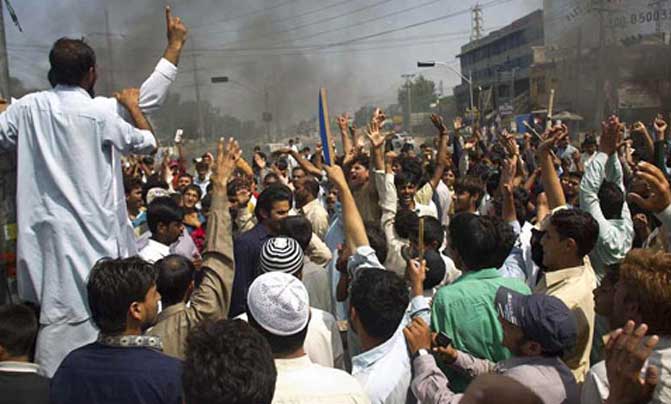
Pakistan-occupied Kashmir (POK) has been grappling with a flurry of protests over the last several days disrupting day-to-day life and bringing the administration to a standstill. The local Kashmiris are furious over rising price of food, fuel and unemployment. The absence of rule of law coupled with high-handed behaviour of Pakistan Army and blatant corruption within the puppet Muzaffarabad government has added fuel to fire. This has resulted in massive uprising in all the ten districts of POK.

“Demonstrations of some sort are taking place in all 10 districts of AJK (POK) and roads leading to Pakistan are also being blocked almost on a daily basis. The people’s frustration is amplified by the absence of executive power among local politicians and a lame administration/judiciary. They have finally understood that Pakistan is a sinking ship and they don’t want to be on board,” observed Tanveer Ahmed, researcher and senior journalist based in the region. Tanveer Ahmed was arrested by the Pakistani establishment in August 2020 when he pulled down Pakistani flag at the Maqbool Bhat Square at Dadyal.

That the Muzaffarabad government has always taken diktats from Rawalpindi is an open secret. So when the Tanveer Ilyas-led Muzaffarabad administration imposed higher taxes on electricity ‘supplied’ in the region it infuriated local Kashmiris and they could figure out that it was Islamabad-Rawalpindi nexus that is behind the higher taxes. Local Kashmiris understand that the hydroelectricity is generated in POK and then transmitted to Pakistan from where this electricity is re-transmitted to the ten districts after levying heavy taxes and surcharge. Islamabad’s economic chaos has had an effect on Kashmiris as well. Price of food grain and fuel has been rising steadily, eating up the monthly expense of a household and adding up to collective anger.

Further, tourism is the major source of bread and butter for Kashmiris. However, the Pakistani military’s taking over of tourist hotspots and making a tourism development authority has incensed the local Kashmiris. These local Kashmiris are also jittery about Pakistan’s efforts to gobble POK into its federation. Pakistan PM Shehbaz Sharif has formed a high-level committee to prepare a draft for 15th amendment to the AJ&K Interim Constitution Act 1974 by July 31. “Pakistan is making serious attempts to integrate AJK (POK) into its federation,” explained Tanveer Ahmed.

The result has been massive widespread protests and demonstrations at Rawalakot, Bagh, Poonch, Muzaffarabad and Neelam Valley among other districts in Pakistan-occupied Kashmir.