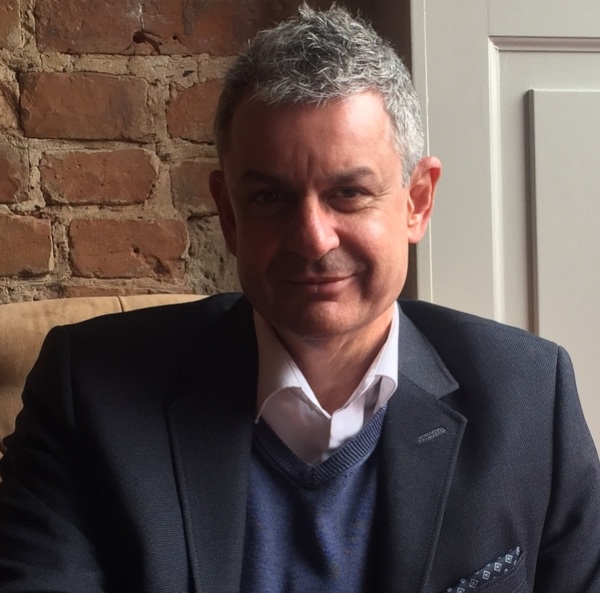
Prof. Shmuel “Sam” Vaknin (YouTube, Twitter, Instagram, Facebook, Amazon, LinkedIn, Google Scholar) is the
author of Malignant Self-love: Narcissism
Revisited (Amazon) and After the Rain: How the West Lost the East (Amazon) as well as many
other books and ebooks about topics in psychology, relationships, philosophy,
economics, international affairs, and award-winning short fiction. He was
Senior Business Correspondent for United Press International (February,
2001 – April, 2003), CEO of Narcissus Publications (April, 1997 –
April 2013), Editor-in-Chief of Global Politician (January, 2011 -), a
columnist for PopMatters, eBookWeb, Bellaonline,
and Central Europe Review,
an editor for The Open Directory and Suite101 (Categories: Mental Health and
Central East Europe), and a contributor to Middle
East Times, a contributing writer to The American Chronicle Media
Group, Columnist and Analyst for Nova Makedonija, Fokus,
and Kapital,
Founding Analyst of The Analyst Network, former president of the Israeli
chapter of the Unification Church‘s Professors
for World Peace Academy, and served in the Israeli
Defense Forces (1979-1982). He has been awarded Israel’s
Council of Culture and Art Prize for Maiden Prose (1997), The Rotary Club Award
for Social Studies (1976), and the Bilateral Relations Studies Award of the
American Embassy in Israel (1978), among other awards. He is Visiting
Professor of Psychology, Southern Federal University,
Rostov-on-Don, Russia (September, 2017 to
present), Professor of Finance and
Psychology in SIAS-CIAPS (Centre for International Advanced and
Professional Studies) (April, 2012 to present), a Senior
Correspondent for New York Daily Sun (January, 2015 – Present), and Columnist
for Allied Newspapers Group (January, 2015 – Present). He lives in Skopje,
North Macedonia with his wife, Lidija Rangelovska. Here we talk about
religion.
*Previous interviews listed chronologically after
interview.*
Scott
Douglas Jacobsen: Sorry for the delay, folks, and Prof. Vaknin, I had some
equine (horsey) matters. For those who would like to see previous sessions with
Prof. Vaknin, please see the links at the bottom of this session – 5th of
10 so far, the tedious sessions come in print with footnotes and references, so
academic accoutrement; the more flowing, natural sessions come from
readings by Prof. Vaknin on YouTube. He reads both interviewer and interviewee
text, then interprets and interpolates for education and entertainment. Let’s
start on a general question, what defines faith and religion? Lots of extant
definitions.[1]
Prof.
Shmuel “Sam” Vaknin:Religion is a sublimated (socially acceptable) form
of delusional disorder whose contents include a supreme being or power which
dictates a code of conduct and sanctions transgressors. Religion is the
institutional manifestation of this mental illness, hijacked by psychopaths and
narcissists for purposes of attaining power and riches.
Jacobsen:
Why is the vast majority of the world beholden to religion or faith, attempts
to connect with the so-called transcendent and metaphysical, trying to make
their lives isomorphic with their ‘holy’ figures, and so on?
Vaknin:The vast
majority of people are in a constant state of anxiety. Religion, mysticism, the
occult and affiliated derangements are anxiolytic (mitigate anxiety). They are
also forms of escapism from unbearable reality via self-imposed psychotic
delusions.
On a
deeper level, people use religion and its institutions to constrain evil,
antisocial behaviors, and negative affectivity (such as anger and envy).
Religion is a pillar of communality and the status quo. Historically, when it
had failed in this mission, religion had witnessed the rise of belligerent
reformers such as Jesus and Martin Luther.
Jacobsen:
Similar to the previous question, though on a different track of thought, what
is, and is not, practically useful in religious scriptures, the purported biographies
of the lives of religious leaders, and traditional rituals in faiths?
Vaknin: Religion
is a mental illness, both individual and collective. The content of its
delusions had always been tailored by the elites to rein in the masses.
From the
elites’s point of view, religion is, therefore, a useful tool of social
control.
From the
viewpoint of the masses, it guarantees protections against social unrest,
malevolent misconduct, arbitrary subjugation, and injustice. It ameliorates the
anxiety and fear that these pernicious social phenomena evoke in individuals
and in their collectives.
Religion
is indeed “opium for the masses”, but it has its utility in guaranteeing a
structured order for all, founded on predictable and reliable ethics and codes
of conduct.
Jacobsen:
When metaphysicians, religious philosophers, and theologians opine about the
existence and attributes of gods, what do these opinions, typically, state
about their cognition and reality-testing abilities?
Vaknin: Even
renowned scientists, thinkers, and intellectuals can be or become delusional.
But it is not as simple as that.
To start
with, “religion” is an all-inclusive umbrella term, a big tent. Even among the
Abrahamic monotheistic religion, there are vast hermeneutic differences.
The
three major monotheistic religions of the world – Judaism, Christianity, and
Islam – can be placed on the two arms of a cross. Judaism would constitute the
horizontal arm: eye to eye with God. The Jew believes that God is an
interlocutor with whom one can reason and plead, argue and disagree. Mankind is
complementary to the Divinity and fulfills important functions. God is
incomplete without human activities such as prayer and obeying the
Commandments. Thus, God and Man are on the same plane, collaborators in maintaining
the Universe.
The
vertical arm of the cross would be limned by the upward-oriented
Christianity and the downward-looking Muslim. Jewish synagogues are horizontal
affairs with divine artifacts and believers occupying more or less the
same surface. Not so Christian churches in which God (or his image) are placed
high above the congregation, skyward, striving towards heaven or descending
from it. Indeed, Judaism lacks the very concept of “heaven”, or
“paradise”, or, for that matter, “hell”. As opposed to both
Islam and Christianity, Judaism is an earthly faith.
Islam
posits a clear dichotomy between God and Man. The believer should minimize his
physical presence by crumbling, forehead touching the ground, in a genuflection
of subservience and acceptance (“islam”) of God’s greatness,
omnipotence, omniscience, and just conduct. Thus, the Muslim, in his daily
dealings with the divine, does not dare look up. The faithful’s role is merely
to interpret God’s will (as communicated via Muhammad).
But the very
concept of “god” – which is a narrative, an organizing principle, and an
interpretative-explanatory tenet – is not necessarily incompatible with other
dominant constructs, such as science. All human systems of thought rely on
beliefs, implicit or explicit.
If neurons were capable of
introspection and world-representation, would they have developed an idea of
“Brain” (i.e., of God)? Would they have become aware that they are
mere intertwined components of a larger whole? Would they have considered themselves
agents of the Brain – or its masters? When a neuron fires, is it instructed to
do so by the Brain or is the Brain an emergent phenomenon, the combined and
rather accidental outcome of millions of individual neural actions and
pathways?
There
are many kinds of narratives and organizing principles. Science is driven by
evidence gathered in experiments, and by the falsification of extant theories
and their replacement with newer, asymptotically truer, ones. Other systems –
religion, nationalism, paranoid ideation, or art – are based on personal experiences
(faith, inspiration, paranoia, etc.).
Experiential
narratives can and do interact with evidential narratives and vice versa.
For
instance: belief in God inspires some scientists who regard science as a method
to “sneak a peek at God’s cards” and to get closer to Him. Another
example: the pursuit of scientific endeavors enhances one’s national pride and
is motivated by it. Science is often corrupted in order to support
nationalistic and racist claims.
The
basic units of all narratives are known by their effects on the environment.
God, in this sense, is no different from electrons, quarks, and black holes.
All four constructs cannot be directly observed, but the fact of their
existence is derived from their effects.
Granted,
God’s effects are discernible only in the social and psychological (or
psychopathological) realms. But this observed constraint doesn’t render Him
less “real”. The hypothesized existence of God parsimoniously explains a myriad
ostensibly unrelated phenomena and, therefore, conforms to the rules governing
the formulation of scientific theories.
The
locus of God’s hypothesized existence is, clearly and exclusively, in the minds
of believers. But this again does not make Him less real. The contents of our
minds are as real as anything “out there”. Actually, the very
distinction between epistemology and ontology is blurred.
But is
God’s existence “true” – or is He just a figment of our neediness and
imagination?
Truth is
the measure of the ability of our models to describe phenomena and predict
them. God’s existence (in people’s minds) succeeds to do both. For instance,
assuming that God exists allows us to predict many of the behaviors of people
who profess to believe in Him. The existence of God is, therefore, undoubtedly
true (in this formal and strict sense).
But does
God exist outside people’s minds? Is He an objective entity, independent of
what people may or may not think about Him? After all, if all sentient beings
were to perish in a horrible calamity, the Sun would still be there, revolving
as it has done from time immemorial.
If all
sentient beings were to perish in a horrible calamity, would God still exist?
If all sentient beings, including all humans, stop believing that there is God
– would He survive this renunciation? Does God “out there” inspire
the belief in God in religious folks’ minds?
Known
things are independent of the existence of observers (although the Copenhagen
interpretation of Quantum Mechanics disputes this). Believed things are
dependent on the existence of believers.
We know
that the Sun exists. We don’t know that God exists. We believe that God exists
– but we don’t and cannot know it, in the scientific sense of the word.
We can
design experiments to falsify (prove wrong) the existence of electrons, quarks,
and black holes (and, thus, if all these experiments fail, prove that
electrons, quarks, and black holes exist). We can also design experiments to
prove that electrons, quarks, and black holes exist.
But we
cannot design even one experiment to falsify the existence of a God who is
outside the minds of believers (and, thus, if the experiment fails, prove that
God exists “out there”). Additionally, we cannot design even one
experiment to prove that God exists outside the minds of believers.
What
about the “argument from design”? The universe is so complex and
diverse that surely it entails the existence of a supreme intelligence, the
world’s designer and creator, known by some as “God”. On the other
hand, the world’s richness and variety can be fully accounted for using modern
scientific theories such as evolution and the big bang. There is no need to
introduce God into the equations.
Still,
it is possible that God is responsible for it all. The problem is that we
cannot design even one experiment to falsify this theory, that God created the
Universe (and, thus, if the experiment fails, prove that God is, indeed, the
world’s originator). Additionally, we cannot design even one experiment to
prove that God created the world.
We can,
however, design numerous experiments to falsify the scientific theories that
explain the creation of the Universe (and, thus, if these experiments fail,
lend these theories substantial support). We can also design experiments to
prove the scientific theories that explain the creation of the Universe.
It does
not mean that these theories are absolutely true and immutable. They are not.
Our current scientific theories are partly true and are bound to change with
new knowledge gained by experimentation. Our current scientific theories will
be replaced by newer, truer theories. But any and all future scientific
theories will be falsifiable and testable.
Knowledge
and belief are like oil and water. They don’t mix. Knowledge doesn’t lead to
belief and belief does not yield knowledge. Belief can yield conviction or
strongly-felt opinions. But belief cannot result in knowledge.
Still,
both known things and believed things exist. The former exist “out
there” and the latter “in our minds” and only there. But they
are no less real for that.
Jacobsen:
Of the arguments for the existence of any god, what ones, in a principle of
charity, seem the most reasonable? Of the arguments for the existence of any
god, what ones, in ignoring the principle of charity, seem the most
unreasonable?
Vaknin:Could God have failed
to exist (especially considering His omnipotence)? Could He have been a contingent
being rather than a necessary one? Would the World have existed without Him
and, more importantly, would it have existed in the same way? For instance:
would it have allowed for the existence of human beings?
To say
that God is a necessary being means to accept that He exists (with His
attributes intact) in every possible world. It is not enough to say that He
exists only in our world: this kind of claim will render Him contingent
(present in some worlds – possibly in none! – and absent in others).
We
cannot conceive of the World without numbers, relations, and properties, for
instance. These are necessary entities because without them the World as we
known and perceive it would not exist. Is this equally true when we contemplate
God? Can we conceive of a God-less World?
Moreover:
numbers, relations, and properties are abstracts. Yet, God is often thought of
as a concrete being. Can a concrete being, regardless of the properties imputed
to it, ever be necessary? Is there a single concrete being – God – without
which the Universe would have perished, or not existed in the first place? If
so, what makes God a privileged concrete entity?
Additionally,
numbers, relations, and properties depend for their existence (and utility) on
other beings, entities, and quantities. Relations subsist between objects;
properties are attributes of things; numbers are invariably either preceded by
other numbers or followed by them.
Does God
depend for His existence on other beings, entities, quantities, properties, or
on the World as a whole? If He is a dependent entity, is He also a derivative
one? If He is dependent and derivative, in which sense is He necessary?
Many
philosophers confuse the issue of existence with that of necessity. Kant and,
to some extent, Frege, argued that existence is not even a logical predicate
(or at least not a first-order logical predicate). But, far more crucially,
that something exists does not make it a necessary being. Thus, contingent
beings exist, but they are not necessary (hence their “contingency”).
At best,
ontological arguments deal with the question: does God necessarily exist? They
fail to negotiate the more tricky: can God exist only as
a Necessary Being (in all possible worlds)?
Modal
ontological arguments even postulate as a premise that God is a necessary being
and use that very assumption as a building block in proving that He exists!
Even a rigorous logician like Gödel fell in this trap when he attempted to
prove God’s necessity. In his posthumous ontological argument, he adopted
several dubious definitions and axioms:
(1)
God’s essential properties are all positive (Definition 1); (2) God necessarily
exists if and only if every essence of His is necessarily exemplified
(Definition 3); (3) The property of being God is positive (Axiom 3); (4)
Necessary existence is positive (Axiom 5).
These
led to highly-debatable outcomes:
(1) For
God, the property of being God is essential (Theorem 2); (2) The property of
being God is necessarily exemplified.
Gödel
assumed that there is one universal closed set of essential positive properties,
of which necessary existence is a member. He was wrong, of course. There may be
many such sets (or none whatsoever) and necessary existence may not be a
(positive) property (or a member of some of the sets) after all.
Worst of
all, Gödel’s “proof” falls apart if God does not exist (Axiom 3’s
veracity depends on the existence of a God-like creature). Plantinga has
committed the very same error a decade earlier (1974). His ontological argument
incredibly relies on the premise: “There is a possible world in which
there is God!”
Veering
away from these tautological forays, we can attempt to capture God’s alleged
necessity by formulating this Axiom Number 1:
“God
is necessary (i.e. necessarily exists in every possible world) if there are
objects or entities that would not have existed in any possible world in His
absence.”
We
should complement Axiom 1 with Axiom Number 2:
“God
is necessary (i.e. necessarily exists in every possible world) even if there
are objects or entities that do not exist in any possible world (despite His
existence).”
The
reverse sentences would be:
Axiom
Number 3: “God is not necessary
(i.e. does not necessarily exist in every possible world) if there are objects
or entities that exist in any possible world in His absence.”
Axiom
Number 4: “God is not necessary
(i.e. does not necessarily exist in every possible world) if there are no
objects or entities that exist in any possible world (despite His
existence).”
Now
consider this sentence:
Axiom
Number 5: “Objects and entities are necessary (i.e.
necessarily exist in every possible world) if they exist in every possible
world even in God’s absence.”
Consider abstracta, such as numbers. Does their
existence depend on God’s? Not if we insist on the language above. Clearly,
numbers are not dependent on the existence of God, let alone on His necessity.
Yet,
because God is all-encompassing, surely it must incorporate all possible worlds
as well as all impossible ones! What if we were to
modify the language and recast the axioms thus:
Axiom
Number 1:
“God
is necessary (i.e. necessarily exists in every possible and
impossible world) if there are objects or entities that would not
have existed in any possible world in His absence.”
We
should complement Axiom 1 with Axiom Number 2:
“God
is necessary (i.e. necessarily exists in every possible and
impossible world) even if there are objects or entities that do
not exist in any possible world (despite His existence).”
The
reverse sentences would be:
Axiom
Number 3: “God is not necessary
(i.e. does not necessarily exist in every possible and
impossible world) if there are objects or entities that exist in
any possible world in His absence.”
Axiom
Number 4: “God is not necessary
(i.e. does not necessarily exist in every possible and
impossible world) if there are no objects or entities that exist
in any possible world (despite His existence).”
Now
consider this sentence:
Axiom
Number 5: “Objects and entities are necessary (i.e.
necessarily exist in every possible and impossible world)
if they exist in every possible world even in God’s absence.”
According
to the Vander Laan modification (2004) of the Lewis counterfactuals semantics,
impossible worlds are worlds in which the number of propositions is maximal.
Inevitably, in such worlds, propositions contradict each other (are
inconsistent with each other). In impossible worlds, some counterpossibles
(counterfactuals with a necessarily false antecedent) are true or non-trivially
true. Put simply: with certain counterpossibles, even when the premise (the
antecedent) is patently false, one can agree that the conditional is true
because of the (true, formally correct) relationship between the antecedent and
the consequent.
Thus, if
we adopt an expansive view of God – one that covers all possibilities and
impossibilities – we can argue that God’s existence is necessary.
What
about ontological arguments regarding God’s existence?
As Lewis
(In his book “Anselm and Actuality”, 1970) and Sobel (“Logic and
Theism”, 2004) noted, philosophers and theologians who argued in favor of
God’s existence have traditionally proffered tautological (question-begging)
arguments to support their contentious contention (or are formally invalid).
Thus, St. Anselm proposed (in his much-celebrated “Proslogion”, 1078)
that since God is the Ultimate Being, it essentially and necessarily comprises
all modes of perfection, including necessary existence (a form of perfection).
Anselm’s
was a prototypical ontological argument: God must exist because we can conceive
of a being than which no greater can be conceived. It is an
“end-of-the-line” God. Descartes concurred: it is contradictory to
conceive of a Supreme Being and then to question its very existence.
That we
do not have to conceive of such a being is irrelevant.
First: clearly, we have conceived of Him repeatedly and second, our ability to
conceive is sufficient. That we fail to realize a potential act does not
vitiate its existence.
But, how
do we know that the God we conceive of is even possible? Can we conceive of
impossible entities? For instance, can we conceive of a two-dimensional
triangle whose interior angles amount to less than 180 degrees? Is the concept
of a God that comprises all compossible perfections at all possible? Leibnitz
said that we cannot prove that such a God is impossible because perfections are
not amenable to analysis. But that hardly amounts to any kind of proof!
Is God an external object – or an internal
one? Is He a mere voice in our heads – or is He out there? Psychosis occurs
when we confuse and conflate our inner world with outer reality. In this sense,
all religious prophecy is psychotic and all religious faiths are manifestations
of psychosis.
Julian Jaynes (“The Origins of Consciousness in the Breakdown of the Bicameral
Mind”, 1976) was the most forceful advocate of the idea of bicameralism and the
bicameral mind: that supernatural revelation was merely how some people
experienced a channel of communication between their cerebral hemispheres.
Modern day ambient noise, information pollution, stress, and abnormal living
conditions in cities served to suppress and extinguish this intracranial
exchange, except in cases of schizophrenia. Instead, we developed compensatory
introspection, self-awareness, and consciousness
There is, of course, the added problem of false prophecy: how to tell the
ersatz from the echt. Most false prophets are not crooks: they sincerely
believe in the authenticity of the provenance of their message and mission.
But does all this really matter? Whether these voices are mere hallucinatory
neurological artifacts or the true Word of a god is immaterial as long as they
affect the lives of millions, as they all too often do.
Jewish
mysticism believes that humans have a major role: fixing the results of a
cosmic catastrophe, the shattering of the divine vessels through which the
infinite divine light poured forth to create our finite world. If Nature is
determined to a predominant extent by its contained intelligences, then it may
well be teleological.
Indeed, goal-orientated behaviour (or behavior
that could be explained as goal-orientated) is Nature’s hallmark. The question
whether automatic or intelligent mechanisms are at work, really deals with an
underlying issue, that of consciousness. Are these mechanisms self-aware,
introspective? Is intelligence possible without such self-awareness, without
the internalized understanding of what it is doing?
Kant’s third and the fourth dynamic antinomies deal with this apparent duality:
automatism versus intelligent acts.
The
third thesis relates to causation which is the result of free will as opposed
to causation which is the result of the laws of nature (nomic causation)
The antithesis is that freedom is an illusion and everything is pre-determined.
So, the third antinomy is really about intelligence that is intrinsic to Nature
(deterministic) versus intelligence that is extrinsic to it (free will)
The fourth thesis deals with a related subject: God, the ultimate intelligent
creator. It states that there must exist, either as part of the world or as its
cause a Necessary Being. There are compelling arguments to support both the
theses and the antitheses of the antinomies.
Jacobsen:
You have written on, or have been interviewed about, religion with references
to atheism, anti-theism, and agnosticism.[2] In
one interview[3], you
identify as an agnostic. In an article, you identify as an anti-theist.[4] You
defined atheism as a religion or another faith, too.[5] With
agnosticism and anti-theism as self-identifications while atheism seen as
another religion/faith, what is the current reasoning for agnosticism and
anti-theism with more time passing from the words in the publications, if any?
Vaknin: “If
a man would follow, today, the teachings of the Old Testament, he would be a
criminal. If he would strictly follow the teachings of the New, he would be
insane”
(Robert
Ingersoll)
In
answer to your question, I would like to incorporate the full text of reference
4 in your question, amended to reflect my current views.
Is ours
a post-religious world? Ask any born again Christian fundamentalist, militant
Muslim, orthodox Jew, and nationalistic Hindu. Religion is on the rise, not on
the wane. Eighteenth century enlightenment is besieged. Atheism, as a creed, is
on the defensive.
First,
we should get our terminology clear. Atheism is not the same as agnosticism
which is not the same as anti-theism.
Atheism
is a religion, yet another faith. It is founded on the improvable and
unfalsifiable belief (universal negative) that there is
no God. Agnosticism is about keeping an open mind: God may or may not exist.
There is no convincing case either way.
Anti-theism
is militant anti-clericalism. Anti-theists (such as myself) regard religion as
an unmitigated evil that must be eradicated to make for a better world.
I am
a militant agnostic when it comes to the question: “Does God
exist?”. I have reached the conclusion that there is no way anyone could ever
answer this question. The query, as posed, is unresolvable in principle. There
is no procedure or theorem that could ever lead to its resolution one way or
another.
But God
is NOT the same thing as religion. Religion consists of an ensemble of rituals
and institutions with a social agenda. I am dead set against it. I am a fundamentalist
anti-theist, therefore, not only a militant agnostic.
Authors like
Tremblay and even Dawkins label religion a swindle and mental terrorism –
befitting epithets, fully validated by its gory history. There seems to be an
inextricable link between the belief in the afterlife and immorality, rather
than morality.
Many authors
castigate religion’s intolerance coupled with its ever-shifting philosophical
goalposts. Its dogmatism leads to a loss of experiential richness and to
negative cognitive consequences to both the believer and his milieu.
Religion
scams people with false promises of the hereafter, its texts are objectionable,
it is unnatural, and it promotes falsities. In other words, it is a criminal
enterprise.
Bogus
arguments from design had been dealt with in the works of George Smith, Michael
Martin, and Corey Washington: complexity and order do not a design make.
Still,
we need to distinguish between established religions and cults or sects.
Moreover, theocracy is not merely the rule of religion (lexically correct): in
the real world, it is the misuse and abuse of religion by rulers and elites.
The
purported existence of God has been scrutinized in a plethora of discoveries,
theorems, hypotheses, and theories in the exact sciences and in formal logic.
Consider
this example: it can be proven that God cannot and does not exist (“strong
atheism”) because having a God leads to either meaninglessness or to
contradictions or to both. But this is precisely the Gödel theorem: formal
logical systems can be either complete or consistent, but never both.
As Freud
correctly noted a century ago, religion is a mental pathology. You cannot
rationally argue with people whose judgment and reason are suspended.
Distinctions between personal and objective beliefs are lost on delusional
fanatics.
Religious
people have faith in a god because it fulfills basic and entrenched (and
unhealthy) emotional needs – not because its existence can or has been proven.
We all – even atheists – hold irrational beliefs to some extent. Religion just
happens to be a particularly virulent and insidious strain of irrationality.
Jacobsen:
If you survey the landscape, not of the traditionally defined as religious but,
of the anti-theists, atheists, agnostics, freethinkers, humanists, and the
like, what seems like the status of them, e.g., growing and healthy, unhealthy
and declining, on the assertive, on the defensive, etc.?
Vaknin:There
are emerging battle lines between the regrouping forces of reason and the
resurging Dark Ages. This is the real Armageddon that is upon us.
But
religion is only one penumbral force which combats rationality and the
scientific method. Conspiracy theories; the occult; philosophical schools like
deconstruction; political correctness and woke movements; truthism (fake news
and misinformation online); the virulent rejection of authority, intellect, and
expertise (malignant egalitarianism) – I regard all these as far bigger
threats.
Jacobsen: Christianity,
Islam, and Hinduism, comprise the most significant religious populations in the
world, in absolute numbers. Yet, social ideologies and political philosophies
seem to metastasize into dogmas, as well. What social ideologies and political
philosophies seem as if dogmas akin to religions/faiths, and why? These could
include political leaders as religious leaders as part of the examples. You
have written on Islam and Liberalism, as two examples in comparisonand
contrast.[6]
Vaknin: All
ideologies mutate into secular religions with their own churches, hagiography,
and rituals. Religions are forms of victimhood movements (martyrology) and all
social activism and woke movements tend to become dogmatic and exclusionary,
with a claim on possessing a monopoly on the truth.
But
there is an especially worrisome contemporary development: the confluence of
narcissism, oligarchy, and religion.
I coined
the neologism “theochlocracy” to describe the noxious mixture of theocracy and
ochlocracy (mob-rule). Yet, as distinct from the former, in a theochlocracy,
church and state are constitutionally separated. The power is not in the hands
of the clergy, but, putatively, in the hands of the people and its
representatives. Theochlocracies are often also democracies. Religion – in all its
faux-manifestations – is imposed on non-believers and nonconformists by mobs
and by populist collectives or organizations who claim to represent “public
opinion”.
These
self-appointed tribunals seek to enforce mores and values they deem to be
“universal” and indisputable (usually by virtue of their divine and epiphanic
origins.) Such is the threat implicit in these proceedings that they often
result in self-censorship and self-denial on the part of their targets and
victims. Bible – or Qur’an – thumping give rise to terror and to the
suppression of free speech and unmitigated self-expression. The penalties for
transgressors range from ostracism to physical harm.
On the
level of individuals, theochlocracy is a form of malignant narcissism.
The
narcissist is prone to magical thinking. He regards himself in terms of
“being chosen” or of “being destined for greatness”. He
believes that he has a “direct line” to God, even, perversely, that
God “serves” him in certain junctions and conjunctures of his life,
through divine intervention. He believes that his life is of such momentous
importance, that it is micro-managed by God. The narcissist likes to play God
to his human environment. In short, narcissism and religion go well together,
because religion allows the narcissist to feel unique.
This is
a private case of a more general phenomenon. The narcissist likes to belong to
groups or to frameworks of allegiance. He derives easy and constantly
available Narcissistic Supply from them. Within
them and from their members he is certain to garner attention, to gain
adulation, to be castigated or praised. His False Self is bound to be reflected
by his colleagues, co-members, or fellows.
This is
no mean feat and it cannot be guaranteed in other circumstances. Hence the
narcissist’s fanatic and proud emphasis of his membership. If a military man,
he shows off his impressive array of medals, his impeccably pressed uniform,
the status symbols of his rank. If a clergyman, he is overly devout and
orthodox and places great emphasis on the proper conduct of rites, rituals and
ceremonies.
The
narcissist develops a reverse (benign) form of paranoia: he feels constantly
watched over by senior members of his group or frame of reference, the subject
of permanent (avuncular) criticism, the centre of attention. If a religious
man, he calls it divine providence. This self-centred perception also caters to
the narcissist’s streak of grandiosity, proving that he is, indeed, worthy of
such incessant and detailed attention, supervision and intervention.
From
this mental junction, the way is short to entertaining the delusion that God
(or the equivalent institutional authority) is an active participant in the
narcissist’s life in which constant intervention by Him is a key feature. God
is subsumed in a larger picture, that of the narcissist’s destiny and mission.
God serves this cosmic plan by making it possible.
Indirectly,
therefore, God is perceived by the narcissist to be at his service. Moreover,
in a process of holographic appropriation, the narcissist views himself as a
microcosm of his affiliation, of his group, or his frame of reference. The
narcissist is likely to say that he IS the army, the
nation, the people, the struggle, history, or (a part of) God.
As
opposed to healthier people, the narcissist believes that he both represents
and embodies his class, his people, his race, history, his God, his art – or
anything else he feels a part of. This is why individual narcissists feel
completely comfortable to assume roles usually reserved to groups of people or
to some transcendental, divine (or other), authority.
This
kind of “enlargement” or “inflation” also sits well with
the narcissist’s all-pervasive feelings of omnipotence, omnipresence, and
omniscience. In playing God, for instance, the narcissist is completely
convinced that he is merely being himself. The narcissist does not hesitate to
put people’s lives or fortunes at risk. He preserves his sense of infallibility
in the face of mistakes and misjudgements by distorting the facts, by evoking
mitigating or attenuating circumstances, by repressing memories, or by simply
lying.
In the
overall design of things, small setbacks and defeats matter little, says the
narcissist. The narcissist is haunted by the feeling that he is possessed of a
mission, of a destiny, that he is part of fate, of history. He is convinced
that his uniqueness is purposeful, that he is meant to lead, to chart new ways,
to innovate, to modernise, to reform, to set precedents, or to create from
scratch.
Every
act of the narcissist is perceived by him to be significant, every utterance of
momentous consequence, every thought of revolutionary calibre. He feels part of
a grand design, a world plan and the frame of affiliation, the group, of which
he is a member, must be commensurately grand. Its proportions and properties
must resonate with his. Its characteristics must justify his and its ideology
must conform to his pre-conceived opinions and prejudices.
In
short: the group must magnify the narcissist, echo and amplify his life, his
views, his knowledge, and his personal history. This intertwining, this
enmeshing of individual and collective, is what makes the narcissist the most
devout and loyal of all its members.
The
narcissist is always the most fanatical, the most extreme, the most dangerous
adherent. At stake is never merely the preservation of his group – but his very
own survival. As with other Narcissistic Supply Sources, once the group is no
longer instrumental – the narcissist loses all interest in it, devalues it and
ignores it.
In
extreme cases, he might even wish to destroy it (as a punishment or revenge for
its incompetence in securing his emotional needs). Narcissists switch groups
and ideologies with ease (as they do partners, spouses and value systems). In
this respect, narcissists are narcissists first and members of their groups
only in the second place.
In
short:
God is
everything the narcissist ever wants to be: omnipotent, omniscient,
omnipresent, admired, much discussed, and awe inspiring. God is the
narcissist’s wet dream, his ultimate grandiose fantasy. But God comes handy in
other ways as well.
The
narcissist alternately idealizes and devalues figures of authority.
In the
idealization phase, he strives to emulate them, he admires them, imitate them
(often ludicrously), and defends them. They cannot go wrong, or be wrong. The
narcissist regards them as bigger than life, infallible, perfect, whole, and
brilliant. But as the narcissist’s unrealistic and inflated expectations are
inevitably frustrated, he begins to devalue his former idols.
Now they
are “human” (to the narcissist, a derogatory term). They are small,
fragile, error-prone, pusillanimous, mean, dumb, and mediocre. The narcissist
goes through the same cycle in his relationship with God, the quintessential
authority figure.
But
often, even when disillusionment and iconoclastic despair have set in – the
narcissist continues to pretend to love God and follow Him. The narcissist
maintains this deception because his continued proximity to God confers on him
authority. Priests, leaders of the congregation, preachers, evangelists, cultists,
politicians, intellectuals – all derive authority from their allegedly
privileged relationship with God.
Religious
authority allows the narcissist to indulge his sadistic urges and to exercise
his misogynism freely and openly. Such a narcissist is likely to taunt and
torment his followers, hector and chastise them, humiliate and berate them,
abuse them spiritually, or even sexually. The narcissist whose source of
authority is religious is looking for obedient and unquestioning slaves upon
whom to exercise his capricious and wicked mastery. The narcissist transforms
even the most innocuous and pure religious sentiments into a cultish ritual and
a virulent hierarchy. He preys on the gullible. His flock become his
hostages.
Religious
authority also secures the narcissist’s Narcissistic Supply. His
coreligionists, members of his congregation, his parish, his constituency, his
audience – are transformed into loyal and stable Sources of Narcissistic
Supply. They obey his commands, heed his admonitions, follow his creed, admire
his personality, applaud his personal traits, satisfy his needs (sometimes even
his carnal desires), revere and idolize him.
Moreover,
being a part of a “bigger thing” is very gratifying narcissistically.
Being a particle of God, being immersed in His grandeur, experiencing His power
and blessings first hand, communing with him – are all Sources of unending
Narcissistic Supply. The narcissist becomes God by observing His commandments,
following His instructions, loving Him, obeying Him, succumbing to Him, merging
with Him, communicating with Him – or even by defying him (the bigger the
narcissist’s enemy – the more grandiosely important the narcissist
feels).
Like
everything else in the narcissist’s life, he mutates God into a kind of
inverted narcissist. God becomes his dominant Source of Supply. He forms a
personal relationship with this overwhelming and overpowering entity – in order
to overwhelm and overpower others. He becomes God vicariously, by the proxy of
his relationship with Him. He idealizes God, then devalues Him, then abuses
Him. This is the classic narcissistic pattern and even God himself cannot
escape it.
In a
narcissistic culture or civilization, these warped relationships – between
individuals, their God, and their institutional affiliation – are magnified.
Nowhere is this more true – and is theochlocracy more evident – than in the
United States of America (USA).
Jacobsen: As
you have written on religion a lot, what needs to happen to religion/faith in a
self-centered era for survival of the species?
Vaknin: Narcissism
is the new religion. In an age of godlike technological self-sufficiency,
everyone is rendered both a deity and a worshipper of themselves. This new
religion is distributed: billions of equipotent divine nodes, one man or one
woman cults and loci of worship.
Jacobsen:
Thank you for the opportunity and your time, Professor Vaknin.
Vaknin: A
pleasure as always.
References
Bishop,
J. (2016, December 21). Faith. Stanford Encyclopedia of
Philosophy. https://plato.stanford.edu/cgi-bin/encyclopedia/archinfo.cgi?entry=faith.
Psychology
Today Staff. (2022). Religion. Psychology Today. https://www.psychologytoday.com/us/basics/religion
Smashwords.
(2014, October 19). Interview with Sam Vaknin. https://www.smashwords.com/interview/samvaknin.
Taliaferro,
C. (2021, December 21). Philosophy of Religion. Stanford
Encyclopedia of Philosophy. https://plato.stanford.edu/cgi-bin/encyclopedia/archinfo.cgi?entry=philosophy-religion
The
Editors of Encyclopaedia Britannica. (2017, June 16). faith. Encyclopedia
Britannica. https://www.britannica.com/topic/faith
The
Editors of Encyclopaedia Britannica (2021, February 2). religion. Encyclopedia
Britannica. https://www.britannica.com/topic/religion
Vaknin,
S. (n.d.a). Atheism in a Post-Religious World: Book Review. samvak.tripod. https://samvak.tripod.com/atheism.html.
Vaknin,
S. (2016, January 14). Islam and Liberalism: Total Ideologies.
Medium. https://samvaknin.medium.com/islam-and-liberalism-total-ideologies-2eae7eaeb312
Vaknin,
S. (n.d.b). Sam Vaknin’s Instagram Epigrams – Page 4.
samvak.tripod. https://samvak.tripod.com/instagramvaknin4.html
Footnotes
[1] “religion”
states:
religion, human beings’
relation to that which they regard as holy, sacred, absolute, spiritual,
divine, or worthy of especial reverence. It is also commonly regarded as
consisting of the way people deal with ultimate concerns about their lives and
their fate after death. In
many traditions, this relation and these concerns are expressed in terms of
one’s relationship with or attitude toward gods or spirits; in more humanistic or naturalistic forms
of religion, they are expressed in terms of one’s relationship with or
attitudes toward the broader human community or
the natural world. In many religions, texts are deemed to have scriptural
status, and people are esteemed to be invested with spiritual or moral authority.
Believers and worshippers participate in and are often enjoined to perform
devotional or contemplative practices such as prayer, meditation, or
particular rituals. Worship,
moral conduct, right belief, and
participation in religious institutions are among the constituent elements
of the religious life.
See
Britannica, T. Editors of Encyclopaedia (2021).
“Religion”
states:
Since the earliest humans walked the
earth, individuals have wondered where they came from, why they’re here, and
what it all means. Religion, by and large, represents society’s attempts to
answer those questions. While it isn’t always able to achieve that goal, it
often succeeds at providing followers with structure, a code of ethics, and
a sense of purpose. The promise of an afterlife, a core tenet of most organized
religions, is another key motivator for followers, as this belief serves an
important psychological function.
See
Psychology Today Staff (2022).
“Philosophy
of Religion” states:
Ideally, a guide to the nature and
history of philosophy of religion would begin with an analysis or definition of
religion. Unfortunately, there is no current consensus on a precise
identification of the necessary and sufficient conditions of what counts as a
religion. We therefore currently lack a decisive criterion that would enable
clear rulings whether some movements should count as religions (e.g.,
Scientology or Cargo cults of the Pacific islands). But while consensus in
precise details is elusive, the following general depiction of what counts as a
religion may be helpful:
A religion involves a communal,
transmittable body of teachings and prescribed practices about an ultimate,
sacred reality or state of being that calls for reverence or awe, a body which
guides its practitioners into what it describes as a saving, illuminating or
emancipatory relationship to this reality through a personally transformative
life of prayer, ritualized meditation, and/or moral practices like repentance
and personal regeneration. [This is a slightly modified definition of the one
for “Religion” in the Dictionary of Philosophy of Religion,
Taliaferro & Marty 2010: 196–197; 2018, 240.]
See
Taliaferro (2021).
“Faith”
states:
‘Faith’ is a broad term, appearing in
locutions that express a range of different concepts. At its most general
‘faith’ means much the same as ‘trust’. This entry is specifically concerned,
however, with the notion of religious faith—or, rather
(and this qualification is important), the kind of faith exemplified
in religious faith. Philosophical accounts are almost exclusively
about theistic religious faith—faith in God—and they
generally, though not exclusively, deal with faith as understood within the Christian
branch of the Abrahamic traditions. But, although the theistic religious
context settles what kind of faith is of interest, the question arises whether
faith of that same general kind also belongs to other,
non-theistic, religious contexts, or to contexts not usually thought of as
religious at all. Arguably, it may be apt to speak of the faith of a humanist,
or even an atheist, using the same general sense of ‘faith’ as applies to the
theist case.
Bishop
(2016).
“faith”
states:
faith,
inner attitude, conviction, or trust relating human beings to
a supreme God or ultimate salvation. In religious traditions stressing
divine grace, it is the inner
certainty or attitude of love granted by God himself. In Christian theology, faith is the divinely inspired human
response to God’s historical revelation through Jesus Christ and, consequently, is of
crucial significance.
No definition allows for identification
of “faith” with “religion.” Some inner attitude has its part in all religious
traditions, but it is not always of central significance. For example, words
in ancient Egypt or Vedic India that can be
roughly rendered by the general term “religion” do not allow for “faith” as a
translation but rather connote cultic duties and acts. In Hindu and Buddhist Yoga traditions, inner attitudes
recommended are primarily attitudes of trust in the guru, or spiritual
preceptor, and not, or not primarily, in God. Hindu and Buddhist concepts of
devotion (Sanskrit bhakti) and love or compassion
(Sanskrit karuna) are
more comparable to the Christian notions of love (Greek agapē, Latin caritas) than to faith.
Devotional forms of Mahayana Buddhism and Vaishnavism show religious expressions
not wholly dissimilar to faith in Christian and Jewish traditions.
The
Editors of Encyclopaedia Britannica (2017).
[2] See
Vaknin (n.d.a) about differentiation between the terms and personal
anti-theism, Smashwords (2014) about family and himself, and Vaknin (n.d.b)
about Ghandi’s earlier life.
[3] “Interview
with Sam Vaknin” (2014) states:
Q: What was your family’s attitude
toward religion?
A: My parents vacillated between ridicule and disdain and bouts of devoutness.
On the average, we were a mildly traditionalist family: selectively observed a
few religious commandments and rites. Two of my brothers flirt with
fundamentalist Judaism (more charitably known as Orthodoxy). I am agnostic. I
do not waste my time on questions the answers to which are, in principle,
unknowable.
See
Smashwords (2014).
[4] “Atheism
in a Post-Religious World: Book Review” (n.d.) states:
Is ours a post-religious world? Ask any
born again Christian fundamentalist, militant Muslim, orthodox Jew, and
nationalistic Hindu. Religion is on the rise, not on the wane. Eighteenth
century enlightenment is besieged. As the author himself often admits, atheism,
as a creed, is on the defensive.
First, we should get our terminology
clear. Atheism is not the same as agnosticism which is not the same as
anti-theism.
Atheism is a religion, yet another
faith. It is founded on the improvable and unfalsifiable belief (universal
negative) that there is no God. Agnosticism is about keeping an open mind: God
may or may not exist. There is no convincing case either way.
Anti-theism is militant anti-clericalism.
Anti-theists (such as Tremblay and myself) regard religion as an unmitigated
evil that must be eradicated to make for a better world. This treasure of a
book – it is incredible how much the author squeezed into 50 pages! – is about
anti-theism.
See
Vaknin (n.d.a).
[5] See
Ibid.
[6] “Islam
and Liberalism: Total Ideologies” states:
Islam is not
merely a religion. It is also — and perhaps, foremost — a state ideology. It is
all-pervasive and missionary. It permeates every aspect of social cooperation and
culture. It is an organizing principle, a narrative, a philosophy, a value
system, and a vade mecum. In this it resembles Confucianism and, to some
extent, Hinduism. Total ideologies are both prescriptive and proscriptive: by
prohibiting certain kinds of activities and types of conduct, they cohere the
pent-up energies (“libido”) and narcissistic needs of their adherents and
channel these forces towards predetermined goals, both constructive and
disruptive (or destructive).
Judaism and its
offspring, Christianity — though heavily involved in political affairs
throughout the ages — have kept their dignified distance from such carnal
matters. These are religions of “heaven” as opposed to Islam, a practical,
pragmatic, hands-on, ubiquitous, “earthly” creed.
Secular
religions — Democratic Liberalism, Communism, Fascism, Nazism, Socialism and
other isms — are more akin to Islam than to, let’s say, Buddhism. They are
universal, prescriptive, and total. They provide recipes, rules, and norms
regarding every aspect of existence — individual, social, cultural, moral,
economic, political, military, and philosophical.
See Vaknin (2016).
Previous Electronic ‘Print’ Interviews (Hyperlinks
Active for Titles)
“An Interview with Professor Sam Vaknin on Narcissistic
Personality Disorder”
(In-Sight:
Independent Interview-Based Journal: June 22, 2020)
“Interview with Sam Vaknin and
Christian Sorensen on Narcissism”
(News
Intervention: June 23, 2020)
“Prof. Sam Vaknin on the Philosophy
of Nothingness”
(News
Intervention: January 26, 2022)
“Prof. Sam Vaknin on Narcissism in
General”
(News
Intervention: January 28, 2022)
“Prof. Sam Vaknin on Cold Therapy
(New Treatment Modality)”
(News
Intervention: January 30, 2022)
“Prof. Sam Vaknin on Giftedness and
IQ”
(News
Intervention: February 2, 2022)
Previous Interviews Read by Prof.
Vaknin (Hyperlinks Active for Titles)
“How
to Become the REAL YOU (Interview, News Intervention)”
(Prof.
Sam Vaknin: January 26, 2022)
“Insider
View on Narcissism: What Makes Narcissist Tick (News Intervention)”
(Prof.
Sam Vaknin: January 29, 2022)
“Curing
Your Narcissist (News Intervention Interview)”
(Prof.
Sam Vaknin: January 31, 2022)
“Genius
or Gifted? IQ and Beyond (News Intervention Interview)”
(Prof.
Sam Vaknin: February 3, 2022)
Image
Credit: Sam Vaknin.