Home Blog Page 275

BRAS attacks Pak military in Gwadar, 3 Pak soldiers killed

Baloch Raaji Aajoi Singar (BRAS) said that Baloch freedom fighters targeted a convoy of Pak military in Badok, Gwadar on Sunday. In the attack on Makuran Coastal Highway the Pakistan military suffered heavy losses. Three Pak personnel were killed in this attack, whereas five more were severely injured, said BRAS spokesperson in his media statement. BRAS is the joint front of occupied Balochistan’s armed freedom fighters.

Soon after the attack, Pakistani gunship helicopters reached the area, however, Baloch freedom fighters successfully managed to leave the site of the attack.

Due to successful and continuous attacks by Baloch freedom fighters, the Pak forces are targeting innocents and taking away Baloch youth. However, Baloch freedom fighters  continue to intensify attacks against the Pak forces and all brutalities inflicted upon the Balochis. In the meantime, Pak military has reportedly launched a ground and aerial operation in Bambor area between Kohlu and Dera Bugti districts of Balochistan.

According to local reports, the military operation is being carried out in the vicinity of Bambur and in the mountainous areas while there are also reports of shelling by gunship helicopters at various places.

However, during the operation, no casualties or arrests have been reported yet. Meanwhile, military convoys and helicopters were seen advancing from Dhadar area of Balochistan.

UK court acquits Altaf Hussain, drops terrorism charges

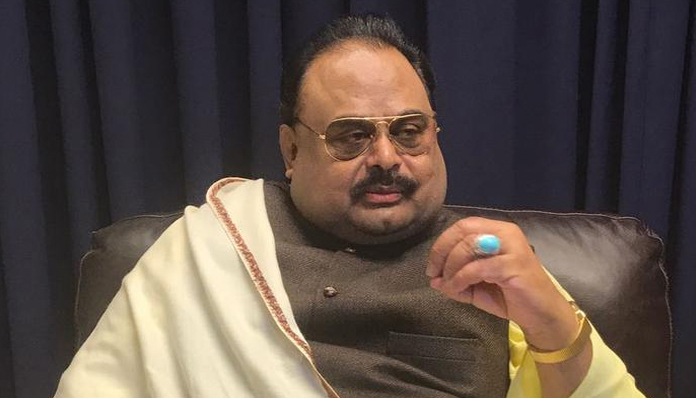
A 12-member jury in London’s Kingston Crown Court has acquitted UK- based MQM leader Altaf Hussain of charges of inciting his workers to engage in terrorism in Karachi. The Crown Prosecution had registered a case against Altaf Hussain under Section 1 (2) of the Terrorism Act 2006. Altaf Hussain was accused of inciting his party workers to violence in two separate speeches telephonically from London on 22 August 2016. Altaf Hussain was accused of allegedly raising anti-Pakistan slogans in his speech and inciting his supporters to attack the ARY, Geo and Sama offices in addition to the Karachi Rangers headquarters. Altaf Hussain pleaded not guilty and was present in court at the trial. Altaf Hussain’s lawyer told the court at the start of the trial that his client would testify in court but later changed his mind.

The prosecution had told the jury that on the eve of 22 August, 2016 Altaf Hussain in a speech lasting one hour and forty minutes, raised the slogan “Pakistan Murda Baad” and his supporters followed. Altaf Hussain had repeated the same words. The prosecution had told the jury that the accused was sitting in a safe environment in the UK and was instructing his workers in Pakistan to take steps that would incite terrorism under British law.

Altaf Hussain’s lawyer had told the jury that “my client is not a terrorist’.

Defense counsel said that Altaf Hussain was under stress due to the Lahore High Court’s ban on broadcasting his speeches. Altaf Hussain’s lawyer had argued before the jury that the jury should take into account the situation in Pakistan. He said the allegations against his client should not be judged on British standards as the situation in Pakistan and Britain, culture, politics and attitudes of elements of the state are different. Defense attorneys said state elements in Pakistan have been accused of torturing, abducting and extra judicially killing civilians.

Defense attorneys said state elements in Pakistan have been accused of torturing, abducting and extra judicially killing civilians. The defense lawyer said that Altaf Hussain’s talk of raiding the Rangers headquarters with 500,000 people and parading the Rangers chief on a donkey in the city was nothing more than a form of “passionate rhetoric”.

The defense lawyer further said that when Altaf Hussain addressed his supporters in Karachi on 22 August, 2016 he was the head of MQM, Pakistan’s third largest political party. Defense counsel said that his clients were only raising their voice against the barbarism of state institutions in Karachi.

The Beijing Winter Olympics and Indian Complacency

I have been a defender of India for three decades. In thousands of articles, numerous books and videos, telling my country of origin France, and the West in general, that India—not China—is the country of the future, and that the French should invest there, not only economically, but also in a geopolitical manner (for instance by recognising India’s legitimate right over Kashmir, like France recognised China’s right over Hong Kong, and eventually Taiwan). For India, a vibrant pro-Western democracy, is at the crossroad of many extremisms: From Islamic fundamentalism, born in Afghanistan, Pakistan, or even Indonesia, to Muslim hegemonism which wants to dominate the world.

In the same way, I have been for three decades an enemy of China, a communist dictatorship, which killed nearly one million Tibetans, and millions of its own Chinese, through Mao Zedong’s violent, bloody, and megalomaniac Cultural Revolution. I have also repeatedly said that India has a good karma because it never invaded other countries, except peacefully, as Angkor Vat is a testimony of, and never sought to impose Hinduism by the force of its armies like Christianity and Islam did and that China’s bad karma would soon catch up with them.

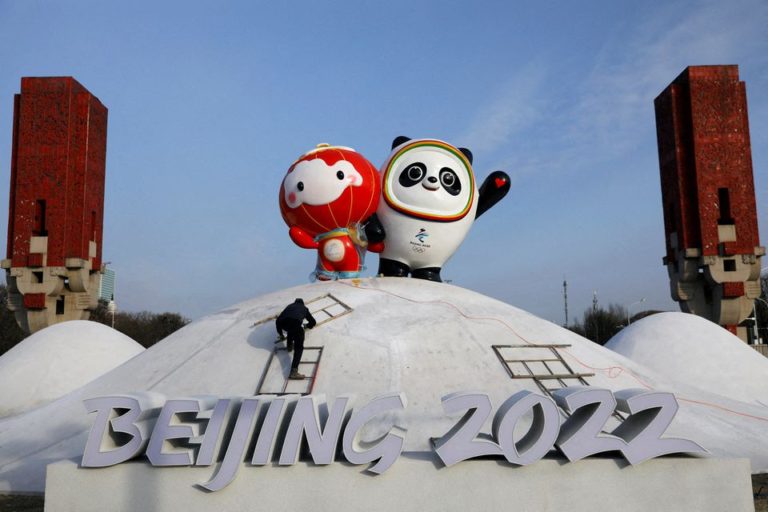
I have been an avid skier, and I’m watching on television the Beijing Winter Olympic Games which are going on right now. I marvel at the flawless, impeccable, and dazzling way they are conducted, by a nation that knew nothing about winter sports 20 years ago. Even if there must have been a lot of Western support and know-how, brought in, it requires immense technological, electronic software, and practical skills to conduct them in this way.

As I am in the process of writing this article, I am coming out of the Delhi’s Indira Gandhi International Airport, and the electronic toll just outside does not function, which means that the electronic chip that we have in our car, which should automatically open the gate, does not connect. I see that the one on the right, and the other one on the left are also not functioning, and that four or five employees have to come and manually open the gates. Now, this is one of the most basic electronic chips that is used in millions of places around the world, and in China, of course. And this sets my mind working: India has a background in skiing, whether in Gulmarg in Kashmir or Auli in Uttarakhand, and why is it that there is no promotion of that sport in India, whereas the Chinese President wants 300 million of his children to ski by 2025, and has invested billions of dollars in skiing facilities and even artificial skiing resorts?

Then, coming home, I see Indian political leaders on television: they look so happy with themselves, so complacent and self-satisfied … But where is the drive, where is the ambition, where is the hard, unwavering will to project India in the 21st century as a superpower, economically, politically, militarily, and even sports-wise. We see that China, even with COVID, has started producing full stream, and is flooding the world with goods of quality. But does India produce any laptop, any mobile, any hardware electronic, like computer chips, air conditioner, fridge, or airplane (like Brazil) of international quality ? Sadly, no.

And yet, Indian politicians still look very happy with themselves. The Indian 2022 budget has been feted everywhere—I am not an economist, but it seems to me that there are many grey areas. Where is all the money going to come from for all the subsidies which are doled out to nearly everyone. From borrowing? From more borrowing?

The Media is not asking the right questions: Why do middle-class and upper-class Indians still send their children to American, English, or Canadian universities after 75 years of independence? Why do these young eventually settle in the US or elsewhere and never come back, the greatest brain drain in the world? Why do the very few NRIs who want to come back and invest in India return to the USA, because they find it so difficult to do business in their own country? The Chinese President laid a golden carpet for the Chinese Americans, even if they were Christians, to bring back their skills into mainland China and invest there. But we see here in India that so many restrictions have been put on the OCIs, and that the Indian government has even stopped issuing five-year visas, and is applying a Nehruvian suspicion-first policy towards Westerners wanting to work in India.

Coming back to sports, cricket here, the golden goose, has stifled all other sports, and eleven spoiled brats hog the limelight, the media attention, the corporate sponsorship, travel first class, stay in five-stars, earn crores of rupees, while track and field athletes, hockey players or footballers have to rough it out. Why is India so obsessed with cricket, a colonial sport, whatever its values, and neglect other sports like skiing?

People will say that I’m negative, but I’m a lover of India. I want India to succeed, I want India to overtake China, because Indians are better people, more tolerant, more open, more spiritualised. But looking at the Beijing Winter Olympics, I have my doubts.

Sri Aurobindo says in the Hour of God that when the breath of the Divine is upon a country, progress can be made in a few years that usually would take centuries. It is my belief, that the coming to power of the BJP and Narendra Modi could represent that golden moment for India. It indeed started with a bang, and we saw that the Prime Minister had this far-reaching vision, this dynamism, and this will to make transformations that bode well for the future. But Delhi is a golden jail that was made by the British for their own glory, so far away from the rest of India, so imbued with its own taste of power—and the BJP seems have settled in these VVIP shackles, like the Congress did before.

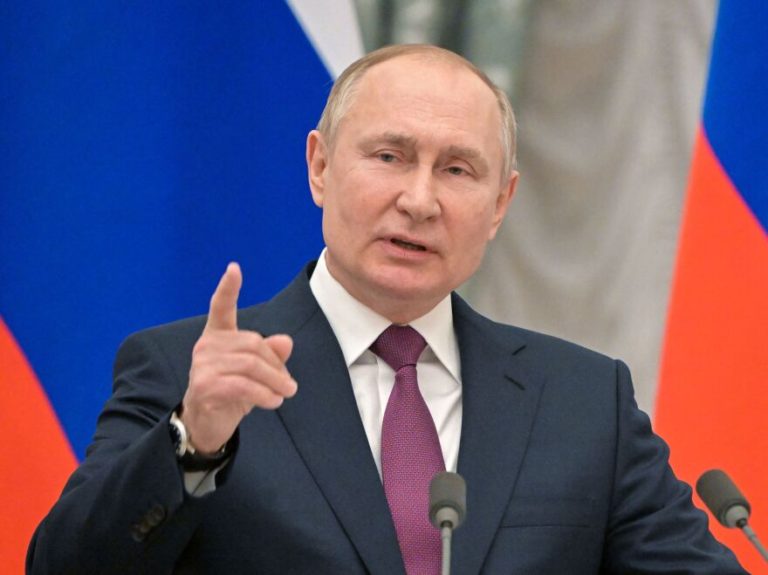
We need to get rid of this complacency, and, like the Chinese, but with an added inner quest and loftiness that was set by the rishis and so many contemporary saints like Sri Ramakrishna, Swami Vivekananda and Sri Aurobindo and embark upon an ambitious, but also ruthless, non-Gandhian drive to project India as a superpower. We may look not only towards President Xi, who has fashioned China into a superpower in sports and otherwise, but also towards President Putin, who is hated by the West, but loved and respected by Russians themselves, because he thinks about Russia first—and not by what the media will say about him.

Sindh’s Namrita Chandani & Nousheen Kazmi were raped & murdered by same person, proves DNA report

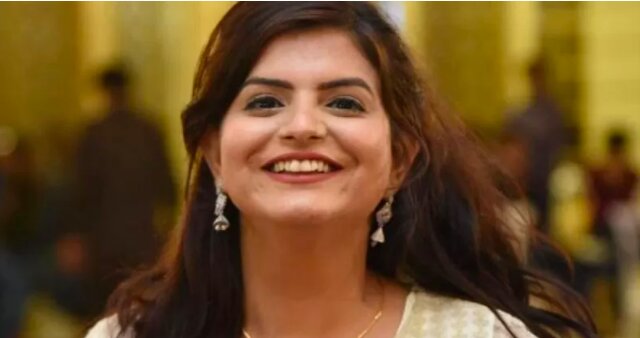
DNA analysis of two female students who were found dead in the hostel of Chandka Medical University in Larkana, Sindh, Pakistan, reveal that it is of the one and the same person who committed the homicide.

Dr Namrita Chandani a BDS student of Chandka College died in 2019 and Nousheen Kazmi in 2021. The bodies of the two students were found hanging from a rope in the rooms of the university hostel. The body of Dr Namrita, was found in a hostel on 16 September 2019 while the room was locked from inside. On 24 November, 2021 the body of Nousheen was found hanging from a fan in one of the rooms of the Girls Hostel No. 2 of Chandka Medical University in Larkana.

Assistant Commissioner of Larkana, Ahmed Ali Soomro said that Nousheen Kazmi’s roommate had gone out while she was alone in the room. When the roommate returned after two or three hours, the door of the room was locked from inside.

Above the writing table in the corner of this room were Nousheen’s feet, not in the air, but on the surface of the table, while the rope above was tied to the ceiling fan, which was slightly bent, and the end of the rope was snared into Nousheen’s throat.

Police also found two written notes in the room. According to a police spokesman, one was found near a notepad and the other in a closet while both had almost the same message. The note was written in Roman script, “I’m going to hang on my own (sic), not under pressure”.

DNA report of the semen found on vaginal swab of Nousheen Kazmi proves that it matches with the semen found in Dr Namrita Chandani. (Photo: News Intervention)

An initial post-mortem report ruled that the cause of death was asphyxiation by hanging from a rope. However, the student’s father, Hidayatullah Kazmi, said his daughter could not commit suicide.

Although, there is a two year gap between the deaths of the two students, but according to the police, similarities have been found between these two cases now. The similarities between the two deaths came to light when on 28 January 2022, the forensic laboratory of Liaquat Medical University released a report. The forensic laboratory was provided with two vaginal swabs of the students, the clothes they were wearing, the clothes found in the hostel rooms and the rope used for hanging as samples by the police.

According to the report, reproductive material or semen was found in the vaginal swabs and clothes and blood stains were found on the grey salwar, black shirt found in the room. The report further states that the similarity in the DNA found in the bodies of Nousheen and Namrita was 50%.

According to the two-page report, ropes and worn clothes were delivered to the laboratory by police on 28 November 2021, four days after the incident, while clothes found at the scene were delivered on 6 December 2021. The report stated that the DNA of the semen has been preserved. The report also suggested that the blood samples of those entering or leaving the girls’ college need to be furnished for DNA testing and comparison. However, the report was alleged by many as an attempt to influence judicial investigation. When SSP Larkana Sarfraz Sheikh was informed about the progress of the investigation as per the report, he said that a judicial inquiry “has been ordered and therefore all the evidence has been preserved”. However, a statement issued by Chandka University termed the report as an attempt to influence the judicial inquiry.

At a high-level meeting of the university, the legal expert told the participants that no laboratory can compare the sample obtained for a single case with any other case without a court order, nor can any laboratory make a recommendation. According to a statement issued by the Home Department, the Sindh High Court has directed the Additional Sessions Judge to conduct an inquiry at the request of the Sindh government. The SSP and DC have been directed to cooperate in the investigation.

According to the initial post-mortem report, Namrita Chandani had scars on her neck and died of asphyxiation. Namrita’s brother Dr. Vishal Chandani had rejected the post-mortem report. He asserted that his confession had been obtained through torture.

Heckled in India, but Lynched in Pakistan

Mob frenzy is bereft of rationality, prudence and discretion. Once rabble-rousers take charge the sane voice is buried under the cacophony of mass fury. In civilized nations such instant justice served by the crowds is frowned upon and the perpetrators are meted out punishment within the legal ambit. Not so in the Islamic Republic of Pakistan.

Islamic extremism has always been the cushion for Pakistani regime such that pandering to the extremists, nay glorifying the radical Islamists, has always been Islamabad’s state policy. Direct result is that mob lynching of the blasphemy ‘accused’ has been growing steadily across Pakistan.

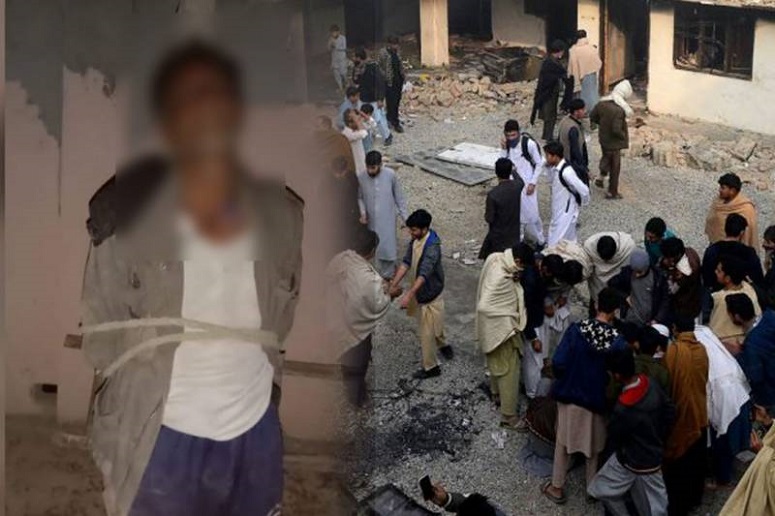
A few days ago Mushtaq Ahmed, a mentally unstable man, who was ‘alleged/accused’ of disrespecting the Holy Quran was brutally murdered by an angry mob at Mian Channu tehsil in the Khanewal district of Punjab province in Pakistan. The key word here is ‘alleged/accused’, which effectively means someone might have just alleged that Mushtaq Ahmed had dishonoured the Holy Quran. It may or may not be true. Mushtaq’s blasphemy was never proven in the courts.

Mushtaq Ahmed, a mentally unstable man was lynched on mere allegations of blasphemy at Mian Channu in Pakistan.

Pakistani journalist Fakhar Yousafzai while describing the lynching of Mushtaq Ahmed said that Pakistanis feel it’s their basic responsibility to kill someone brutally. “(It’s)…because we are fanatics and love extremism,” Yousafzai explained in his vlog (video blog).

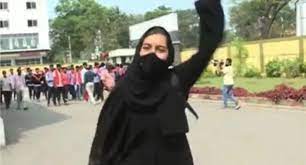
Let me give an example of another mob frenzy from India, which is much talked about and placed as an example of rising intolerance against Muslims. On February 9, a young college student Muskan Khan drove her bike inside the college campus at Mandya, Karnataka. A hijab wearing Muskan was heckled by a group of saffron clad college students who were chanting Jai Shri Ram.

In the viral video it can be clearly seen that Muskan Khan came in with her hijab/niqab when her college had strictly prohibited wearing face covering hijab/ niqab/burqa. Yet Muskan Khan chose to provoke the college administration by putting on the hijab. As Muskan Khan parks her bike she is confronted and heckled by a large mob of Hindu men.

Now here’s lies the real story.

All saffron clad Hindu men who were heckling Muskan Khan with loud chants of Jai Shri Ram remained at safe distance of at least twenty-thirty feet and at no time did this saffron clad crowd try to come in physical proximity of Muskan in order to harm or attack her.

Even Muskan Khan was confident that not a single person in this saffron clad crowd would come near or harm her in any way, so much so that she could retort with Allah hu Akbar jibe.

Another dissimilarity is over the nature of provocation. Muskan Khan and her ilk are the provocateurs in India’s hijab controversy. Schools, colleges and educational institutions have always framed their own set of rules, which includes their dress code. Minority run schools can have their own dress code for students and this model has been running successfully over the last seven decades. The controversy over hijab was manufactured in order to create bad optics for India.

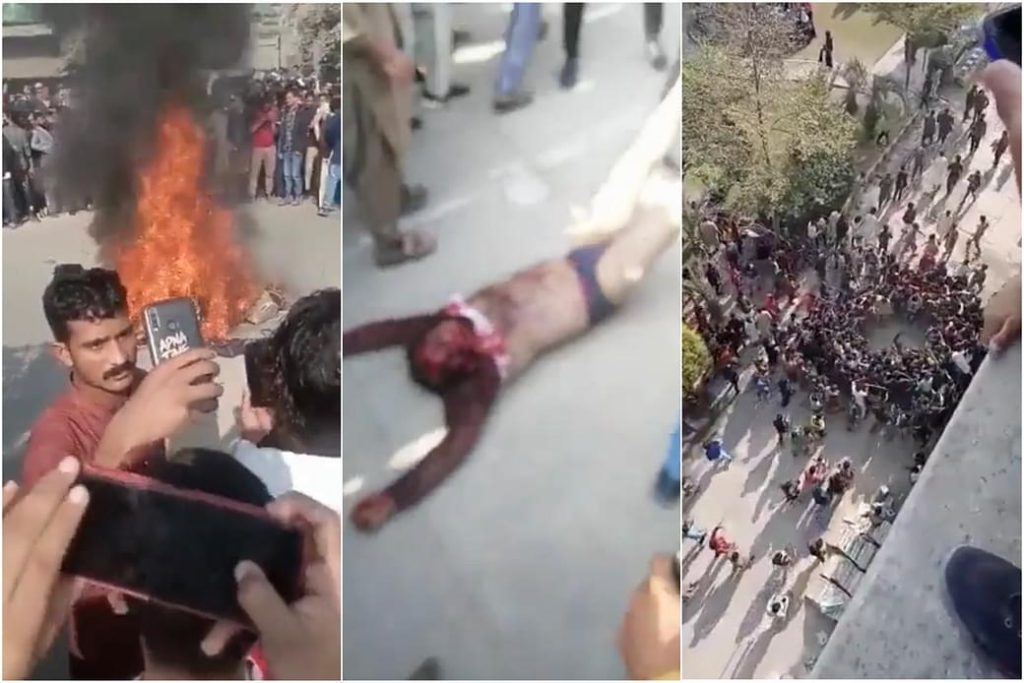
Compare Muskan Khan’s heckling with Pakistani TicToker Ayesha Akram who was molested in broad day light at Lahore on August 14, 2021. Ayesha Akram was making videos at Greater Iqbal Park in Lahore on that fateful day when hundreds of men molested her in broad day light. The hapless woman’s clothes were torn and she was tossed around like a trophy. It’s indeed a miracle that Ayesha Akram could survive that mass-molestation. And the reason for this mass-molestation was yet again some unfounded ‘allegations’.

Pakistani TicToker Ayesha Akram being mass-molested by a frenzied crowd at Lahore on August 14, 2021.

In a yet another incident on December 4, 2021 a Sri Lankan national Priyantha Kumara was brutally beaten to death, his body doused with petrol and set on fire. Once again the mob frenzy acted on certain ‘accusations’ of blasphemy.

Sri Lankan business executive Priyantha Kumara was lynched on mere suspicion of blasphemy at Sialkot in Pakistan. His body was dragged and then burnt by the frenzied mob.

Centre for Research and Security Studies (CRSS), a Pakistani think tank, in its latest report said that from 1947 till 2021 a total of 1415 blasphemy charges were labelled, of which 89 were killed. “Even after acquittal from blasphemy cases, the accused remain vulnerable to extrajudicial killing. On 4 July 2021, a policeman killed a man with a cleaver over blasphemy allegations years after the victim was acquitted of the charge by a court,” reveals the CRSS report.

The point being that mere accusation or a random allegation can trigger mob frenzy in Pakistan that leads to brutal lynching of the accused. In almost all cases of mob violence in Pakistan the victim was ‘accused’ and mob was the perpetrator of violence. In India, on the contrary, it was Muskan Khan and others of her ilk who had provoked an otherwise quaint college by disobeying college rules and creating the needless hijab controversy.

This is radical Islamists well planned stratagem of tweaking their gambit to play aggressor and victimhood as per the prevailing scenario. In India, Muslims are in a minority so their tactic is to first provoke the Hindu majority. Any step thereafter is branded as atrocities on Indian Muslims. In the Islamic Republic of Pakistan where Muslims are in a majority all dissent and rational thought is killed in the name of nebulous blasphemy laws. Mere ‘allegation’ of blasphemy and mob gets a licence to slaughter the accused in Pakistan, here radical Islamists play as the aggressors.

Unfortunately a large section of mainstream (read lame-stream) media is still busy churning out stories about rising intolerance against Muslims in India. Brutalities, lynching and crowd violence during these mob frenzy is never talked about in op-ed columns nor are editorials written about rising intolerance across Pakistan under patronage of Pakistani regime. What a pity!

Even as the Muskan Khans will continue to misuse the freedom offered in India and play the Muslim victimhood card to make some quick buck, the Mushtaq Ahmeds in Pakistan will continue to be lynched in neighbouring Pakistan.

Fakhar Yousafzai rightly says: “Nobody is conspiring against Muslims. We are doing it ourselves.”

How Russia views the ‘Ukraine Crisis’

Genesis of the Crisis: When it all began in 2013-14
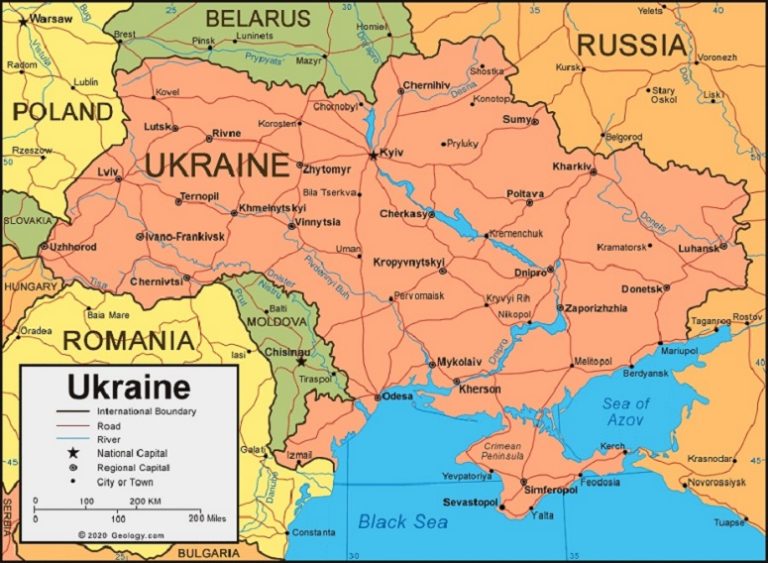
The Ukrainian crisis is the collective name for the 2013–14 Ukrainian mass protests associated with emergent social movement of integration of Ukraine into the European Union, the February 2014 Maidan revolution and the ensuing pro-Russian unrest. The crisis began on November 21, 2013 when the then president Viktor Yanukovyhch suspended preparations for the implementation of an association agreement with the European Union. This decision sparked mass protests from proponents of the agreement, which resulted in precipitating a revolution in February 2014 between votaries for and against the merger. It sparked unrest in largely Russophone Eastern and Southern regions of Ukraine, from where Yanukovych had drawn most of his support.

Subsequently, the Russo-Ukranian war began. Apart from the unrest, Russian troops without insignias took control of strategic positions and infrastructure within the Ukrainian territory of Crimea. On March 1, 2014 the Federation Council of the Russian Federation unanimously adopted a resolution on petition of President Putin to use military force on territory of Ukraine. Russia annexed Crimea by mainly capturing the Crimean Parliament by ‘little green men’, while concurrently in a referendum (widely criticised in the West) involving the population of Crimea, voted to join the Russian Federation. In April, demonstrations by pro-Russian groups in the Donbas area of Ukraine escalated a local conflict between the Ukrainian government and the Russian-backed separatist forces of the self-declared Donetsk and Luhansk People’s Republics. In August, Russian military intervened in Donetsk and are considered responsible for the defeat of Ukrainian forces in early September 2014.

The Gathering Storm (Rapidly evolving as I write)
In March and April 2021, Russia started to amass thousands of military personnel and equipment near its border with Ukraine, representing the highest force mobilization since the annexation of Crimea. This precipitated an international crisis and generated concerns over a potential invasion. Satellite imagery and widespread Western media coverage reported movements of armour, missiles, and heavy weaponry. While reports of partial withdrawal of troops in June 21 are available, the crisis deepened in Oct/Nov 21 with more troops being inducted including into Belarus in areas bordering Ukraine ostensibly for a large-scale military exercise. Reports vary between 100,000 to 130,000 troops along the border. As on date, Western media and Russian media have talked off some troops having been withdrawn after the termination of the exercise, however, President Biden and Western interpretation again downplays the withdrawal saying that it does not reduce the possibility of invasion or eases the tensions in anyway till reports are fully verified.

Russia wants its legitimate Security Sensitivities to be ‘Guaranteed’
In December 2021, Russia advanced two draft treaties that contained requests of what it referred to as “security guarantees”, including a legally binding promise that Ukraine would not join the NATO as well as a reduction in NATO troops and military hardware stationed in Eastern Europe, and threatened unspecified military response if those demands were not met in full. NATO rejected these requests, and the United States warned Russia of “swift and severe” economic sanctions should it invade Ukraine. The West appears divided over the issue because of geo-political considerations mainly economic, and its overwhelming dependence on Russian oil and gas. France and Germany have been particularly cautious with their statements and visible military support on ground to assist NATO.

Reports having Western interpretation and Domination
Realistically what all of us are hearing and reading about the Russia-Ukraine crisis is from the Western media. Ironically, even what the Russians think is based on what the Western media, think tanks and leaders perceive. During the joint press conference on February 15, 2022 after meeting the German Chancellor Olaf Scholz, Putin stated “We are ready to work further together. We are ready to go down the negotiations track.” However, Putin maintained that Russia’s demands had not had constructive response. He also described situation in East Ukraine’s breakaway regions as ‘genocide’. He called for the conflict there to be resolved through the Minsk peace progress. Putin emphasised that NATO promised Russia it would not expand after the Cold War, and will interpret Article 10 of NATO’s founding treaty, which says “any other European State in a position to further the principles of this Treaty and to contribute to the security of the North Atlantic” can apply for membership” accordingly. NATO denies making any such commitment. To a pointed question from one of the reporters on prospects of war, he immediately responded that entire Europe will be drawn into a conflict in the ‘blink of an eye’ including possibility of a nuclear confrontation which none may want, if NATO precipitates matters.

French President Emmanuel Macron has been frantically carrying out diplomatic manoeuvres to de-escalate the crisis by talking over phone to President Putin and Ukrainian President Volodymyr Zelensky and meeting them personally on 9/10 Feb 22. He told reporters that Putin assured him that Russian forces would not ramp up the crisis near Ukraine’s borders. “I secured an assurance there would be no deterioration or escalation,” he said before meeting Ukraine’s leader. Russian media, however, has reported that any suggestion of a guarantee was “not right”. The Russian diplomats, foreign ministry spokesperson and media have repeatedly denied any plans to invade Ukraine.

Some Excerpts and Interpretations from Russian Media
Obviously, this is not original but basically inputs after scouring the internet for Russian media inputs (TASS, Pravda, Moscow Times, The Bell, The Kommersant, and TV channels Rossia-1 and Channel One), including from the Russian government spokespersons only of one day, 16 Feb 2022.

  • Russian diplomat slams US statements on Russia’s invasion of Ukraine as disgraceful
  • Russia doesn’t take statements by NATO chief seriously any longer — MFA.Russian Foreign Ministry Spokeswoman Maria Zakharova said at a news conference that Moscow will no longer take seriously any statements by NATO Secretary General Jens Stoltenberg who has been named to head Norway’s central bank.
  • Russia urges the West to end hysteria around Ukraine — Foreign Ministry spokeswoman.
  • Pumping Kiev with weapons negatively affects both the settlement of the conflict in Donbass and the general situation on the track of security and stability in Europe, Maria Zakharova pointed out.
  • ‘Illogical and Unfair’: Russian Firms Hunker Down Under Sanctions Threat – Despite signs of de-escalation, the war scare has spooked Russia’s government and firms into action over their vulnerabilities to Western sanctions. The Kremlin has staged a series of stress tests to gauge how the country’s key industries would fare should the US impose some of its most potent economic weapons, such as cutting Russian banks out of the international financial system, or banning the sale of US-made technology to Russian companies. The stress tests focused on the country’s finance sector and electronics industry, as well as key state-owned enterprises such as the postal service, railway network, energy grid and flagship-carrier Aeroflot, according to reports by Russian business outlets. None of the companies involved have publicly commented on the results of the exercises. The latest showdown with the West has only sharpened the Kremlin’s appetite for import substitution amid such mixed results over the last six years of the campaign.
  • ‘Western media tried hard to trigger war in Ukraine’ – Russian Foreign Ministry – “For the first time ever in the history of humanity not only a suspect aggressor country, but also a potential victim country in the American media show both denied all plans, stubbornly dictated by the Anglo-Saxon mass media,”
  • US Troop Reinforcements Arrive Near Poland-Ukraine Border – further aggravating and precipitating the crisis situation
  • Russia is ready for security talks with West if they don’t scuttle Russia’s demands – Russian Foreign Minister Sergey Lavrov told reporters on Wednesday (16 Feb 22).
  • Kyiv/Ukraine ready to unleash military attack on Donbass – Kremlin points to high probability of Kiev unleashing military attack on Donbass. It is highly probable that Kiev will embark on a combat operation in Donbass, Kremlin Spokesman Dmitry Peskov said on Wednesday.
  • Putin in his controversial essay titled “On the Historical Unity between the Russian and the Ukrainians” published on 12 July 2021, has highlighted the bonding between Russia and Ukraine. President Vladimir Putin after talks with visiting German Chancellor Olaf Scholz on 9 Feb 2022, stated to the international media that “Russia cannot turn a blind eye on how the United States and the North Atlantic Alliance are interpreting, quite freely and for their own benefit, the key principles of equal and indivisible security, which are committed to paper in many European documents”. He recalled that this principle includes not only the right to choose ways of ensuring own security and join any military unions or alliances, but also the liability not to strengthen one’s security at the expense of the security of other countries. He noted that although under Article 10 of the 1949 North Atlantic Treaty the alliance is free to invite other countries, it is not obliged to do it.

Connected News

  • China blasts inflated war hype by US, notes harm to Ukraine’s socio-economic stability – Chinese Foreign Ministry Spokesman expressed hope that the West “will cease to spread such false information, will do more to facilitate peace, mutual trust, and cooperation”. Washington’s exaggerated ‘war-is-imminent’ hype has dealt a blow to Ukraine’s economy and social stability, Chinese Foreign Ministry Spokesman Wang Wenbin said at a briefing on Wednesday.
  • Bolsonaro’s Moscow Visit Win-Win Opportunity – Bolsonaro is visiting Russia despite Washington’s protests. Both Russia and Brazil believe they can capitalize on his visit. Brazil and Russia’s mutual interests are not based on a shared deep anti-American sentiment. In the case of Brazil, Bolonaro would be able to advance his foreign policy agenda, only with Russia’s support. I feel that for Putin it is an excellent chance to offer evidence to the Russian public that Moscow cannot be isolated from the rest of the world, despite American attempts; and also enables Putin to enforce Moscow’s key Latin American narrative further; maintain strong links to countries in the US’ backyard.
  • On Russia 1’s popular show “Evening with Vladimir Solovyov,” host Solovyov said that the US warnings over an impending Russian invasion are linked to Biden’s effort to be re-elected. The participants commented that Biden is provoking Russia and tied it to the US midterm elections.

News from Ukraine Media
On 15 Feb, Ukraine reported that websites of the country’s defense ministry and armed forces as well as two banks had been hit by cyberattacks from Russian side. Ukraine’s leader vowed on 16 Feb that his country would stand tall against any invasion, as NATO warned it could see no sign that Russia is withdrawing its forces. President Volodymyr Zelensky watched troops training with some of their new Western-supplied anti-tank weapons on a range near Rivne, west of the capital. The demonstration of Ukrainian firepower and rhetoric contrasted with images on Russian state media that were said to show Moscow’s forces bringing an end to a major exercise in occupied Crimea. In Rivne, missiles pounded targets and armored vehicles maneuvered and fired on the yellowing moorland, while in Kyiv hundreds of civilians marched in a stadium with an enormous national banner. The “Day of Unity” displays came as the Kremlin called for “serious negotiations” with Washington, and European leaders pushed hard for a diplomatic resolution to the crisis.

Conclusion
There are not just two sides, but multi-lateral sides to a geo-political situation or crisis in today’s interconnected, multi-polar, multi-dimensional world. Verticals as wide ranging as historical enmity, boundary issues, different ideologies to economy, politics, trade, history, information and perception management, transfer of niche and disruptive technology, scarcity of resources, asymmetry of resources within and outside nations and people, impact the delicate global security balance. All nations are forced to continuously carry out strategic balancing and indulge in 24×7 activity of cooperation, competition, confrontation and even conflict if their national integrity is threatened, to maintain and enlarge their status in the comity of nations. The Ukraine crisis is one such element of global geo-politics playing out. As I conclude, the situation appears to be stabilising. However, this will not be the end of this or other geo-political stories, in a rapidly evolving, dynamic global order.

Beware women! The Camera is watching YOU

0

Actress Anushka Sharma and her Indian cricketer husband Virat Kohli slammed the media for posting their daughter’s picture on social media and issued a statement after pictures of their one-year-old Vamika started doing the rounds. Sharma and Kohli took to their official Instagram handles to urge people to not spread it, and said that they were caught off guard and didn’t realize that a camera was watching them.

“Hi guys! We realize that our daughter’s images were captured at the stadium and widely shared thereafter. We want to inform everyone that we were caught off guard and didn’t know that the camera was on us,” Sharma and Kohli said. The actress clarified that their no-coverage stand regarding Vamika stays. “Our stance and request on the matter stays the same. We would really appreciate (it) if Vamika’s images are not clicked/published for reasons we have explained earlier. Thank you,” her statement added.

Several accounts on Instagram and Twitter circulated pictures of Sharma holding her daughter Vamika, as they stood inside a private stand cheering for Kohli during one of the ODI cricket matches in South Africa. The picture showed Vamika’s face, which, so far, was not revealed to paparazzi by her protective parents.

Since the birth of their baby, the couple has been very protective of their daughter in the media and has, in the past, requested everyone to not post pictures of the toddler, who was born on January 11, 2021.

As usual, netizens were divided over the issue. While angry fans supported the couple and slammed social media for not respecting the privacy of the family, there were many others, who thought it’s unfair to criticize social media in this digital era where nothing is private and that Sharma should have been more careful.

As a celebrity, Anushka should have known that she would be under media glare, felt many. Their argument was, if she was so protective about her child’s privacy, she should have not come to the stadium to watch the match, knowing fully well that cameras would focus on cricketer’s wives/ family/ GF, from time to time, especially when their man is on the crease. Some in fact called it a PR stunt to turn heads.

Anushka is not the first celeb to have raised her concerns on the protection of her family’s privacy. In the past many celebs, including veteran actress Jaya Bachchan and Asha Parekh, have raised their displeasure on being clicked without their prior permission.

In 2016, Jaya, present at a college discussion in Mumbai, was irked by the behaviour of certain college students as they were clicking pictures of her. “Please stop taking pictures. I hate it because it’s right into my eyes. These are basic manners which we Indians have to learn. Just because you have a camera and a mobile, you have the freedom to take anyone’s picture anytime, without asking that person!” Jaya said angrily.

Similarly, in 2021 when veteran actresses Asha Parekh, Waheeda Rehman and Helen’s vacation pictures went viral online, the actresses were not very happy with the pictures getting leaked and going viral. “These pictures are from a holiday we took in the end of March in the Andamans just before the lockdown. We thought it was a very private vacation. We just wanted to get out and relax. We’ve no idea who took the pictures. It was probably some tourists. The place was swarming with vacationers. Aaj kal koi bhi photos le sakta hai bina ijaazat ke,” Parekh said.

Privacy is the state of being free from public attention. It enables us to create barriers and manage boundaries to protect ourselves from unwarranted interference in our lives. It helps us establish boundaries to limit who has access to our bodies, places and things, as well as our communication and our information.

The Oxford dictionary defines privacy as “a state in which one is not observed or disturbed by other people” or “the state of being free from public attention”. So, privacy can also be defined as the ability of an individual to be left alone and express them selectively.

Over the years, the meaning and act of privacy has undergone sea change. The digital onslaught has intruded our lives leaving no scope to guard our private lives. No wonder, the Right to Privacy has been recognised as a right globally. In fact, Article 12 of the Universal Declaration of Human Rights, 1948, and Article 17 of the International Covenant on Civil and Political Rights (ICCPR), 1966, legally protects persons against “arbitrary interference” with their privacy, family, home, correspondence, honour and reputation.

Though India became a signatory to this right on April 10, 1979 it was in 2017 that Right to Privacy was accorded a Fundamental Right by the Supreme Court. In a landmark judgment, the apex court said that the Right to Privacy does not need to be separately articulated but can be derived from Articles 14, 19 and 21 of the Constitution of India. It is a natural right that subsists as an integral part to the right to life and liberty. It is a fundamental and inalienable right and attaches to the person covering all information about that person and the choices that he/ she makes. It protects an individual from the scrutiny of the state in their home, of their movements and over their reproductive choices, choice of partners, food habits, etc. Therefore, any action by the state that results in an infringement of the right to privacy is subject to judicial review.

The European Union also recognises the respect for private and family life, home and communications. In Europe, this is covered by the Data Protection Directive, which defines how information can be processed and used.

However, despite all these rights in place, individuals’ Right to Privacy has been compromised and breached. To be fair, in this digital driven society, while not every intrusion is a violation of privacy, the line is difficult to determine at any given moment because of shifting social expectations and the increasing interaction between people of different cultures.

Therefore, celebrities, especially women, have been at the receiving end from time to time.

In fact, in a ghastly breach of privacy, in 1997, Princess Diana lost her life in a fatal car accident, while she was trying to escape the hounding paparazzi, after spending an evening with her boyfriend Dodi Fayed in Paris.

The Princess’ death had raised serious questions on the Right to Privacy. But over the years, thanks to modern technology, it has been a challenge for everyone, especially women, to guard their privacy. The rise in cybercrimes related to breach of women’s privacy- harassment, dupe, etc-  is a clear indication that despite having a dedicated cyber cell, and proper law in place, things are in a bad shape.

Does that mean we have to live in a world ‘private-less’ world where we can be caught off-guard anywhere, anytime? Unfortunately YES. Therefore, the onus is on US, especially women, to at least guard their privacy as much as they can. Girls should be very careful what they post on the social media. Moreover, it’s good idea to lock your profile and accept friend requests only if you know that person ‘personally’. Spreading your friend circle is a great idea but remember it’s a virtual world out there. Stay cautious. Most important, don’t shy away from approaching the police and naming and shaming the predator, when your privacy is compromised. It will act as an inspiration for others to come out in open and talk about it.

But then, it’s also the responsibility of the authorities to come up with stringent laws to stop this menace. There should be proper guidelines on clicking, publishing pictures in social media and they must be monitored strictly. Actions should be taken against shutter bugs who click pictures without the permission of people, for at the end of the day it’s OUR LIFE AND WE HAVE THE RIGHT TO CHOOSE WHAT WE WANT!

Canadian Secular Alliance on the Coalition for a Single Public School System

0

Greg Oliver is the President of the Canadian Secular Alliance. Here we talk about One Public Education Now or OPEN, and the challenge to Catholic schooling privileges.

Scott Douglas Jacobsen: One Public Education Now, or OPEN, is a coalition of organizations and individuals working for a single public school system. Following from this, there is an interesting, even exciting, development. A Charter application challenge was filed by two members of OPEN, a teacher and a parent, to the public funding of Catholic schools of Ontario. What aspects of publicly funded Catholic education in Ontario are illegitimate (without merit in the law)?

Greg Oliver: The challenge brings forth a variety of legal arguments that we think are valid. Catholic schools have some immunity from the Charter because of Section 93(1) of the Constitution Act, 1867. This sub-section effectively grandfathers in whatever rights and privileges that denominational schools had in Quebec and Ontario when they entered confederation. Without immunity, these schools are an obvious equality rights violation under the Charter.

Now as much as we detest the idea of Charter immunity – which is essentially the right to discriminate based on religion – unless Ontario politicians take action to opt out as Quebec did a quarter century ago it’s a legal obstacle to change. So this begs the question. What was actually grandfathered in at confederation? Any privilege involving “denominational aspects” that was not granted at the time should not be permitted today.

One excellent example of this is non-Catholic enrollment – which in some school boards can be as high as half of all students. They are explicitly forbidden to attend by the grandfathered Scott Act (1863) but explicitly permitted by the modern-era Education Act (1990). This has never been considered by the courts in Ontario before.

Another example is funding for Grade 11 and 12. Catholic schools did not teach beyond, at maximum, the grade 9 or 10 level at Confederation. This was considered by the Supreme Court of Canada in the 1987 Reference re Bill 30 case. At the time, the SCC ruled extending funding to high school was constitutional but it was missing the majority of scholarly research that has been conducted on 19th century education in Ontario since then. They also put heavy emphasis on the importance of denominational schools to the “Confederation compromise”, which is an argument that has lost all weight after Quebec abandoned their denominational schools ten years later.
The challenge also raises arguments related to the substantial employment discrimination against non-Catholics that would never be tolerated in any other area of public employment.

Jacobsen: How are these reflected in Alberta and Saskatchewan as well?

Oliver: The enrollment of non-Catholics has been specifically relevant to Saskatchewan in recent years. In 2005, the Good Spirit School Division took the issue to court after a Catholic school opened up in Theodore, Saskatchewan and was populated with a majority of non-Catholic local students. In 2017, a landmark decision by Justice Donald Layh ruled that it was unconstitutional for non-Catholics to attend Catholic schools. We were very excited about this decision but sadly it was overturned by Saskatchewan’s top court in 2020 and the SCC declined to hear the case the next year (it’s worth noting that Ontario’s relevant legislation governing non-Catholic enrollment is much different than Saskatchewan’s).

So this challenge definitely could set precedents that would affect the legal frameworks of those provinces as well. Both Saskatchewan and Alberta had slightly different legislation when they entered confederation in 1905, but the similarities outweigh the differences. It could also potentially reignite the political debate surrounding the continued existence of these schools. As far as we are concerned, anything that could be done to diminish the scope of denominational schools in Alberta and Saskatchewan would be a positive development. Publicly funded religious schools should not exist anywhere in Canada in this day and age.

Jacobsen: Both religiously affiliated and religiously unaffiliated people work for and through OPEN. So, religion, in the sense of adherents challenging the legal merit, is irrelevant in one sense, while religion is relevant in the legal and equality sense. In “Charter challenge to Ontario Catholic schools,” GlobeNewswire states:

A parent and a teacher, both members of OPEN, are the plaintiffs in an application served on the Ontario Government by the lawyers Adair Goldberg Bieber stating that the current public funding of Ontario Catholic schools violates s.15(1) of the Charter of Rights…

… The Application states there have been sufficient changes since 1987 to justify the Supreme Court of Canada re-examining the Reference re Bill 30 ruling that granted Charter immunity to the funding of Ontario’s separate Catholic schools.

If the challenge wins, in the sense of a complete victory, what would be the long-term impacts on the separate school system and its funding?

Oliver: A victory would end the public funding of non-Catholic enrollment and Grade 11 and 12 in Ontario Catholic schools. This would present a major disruption to current operations. We cannot know for certain what the government response would be.

Polling is typically around 70% support for a single school system for each official language. But politicians of all persuasions have tried their best to avoid this issue out of fear of a backlash from a noisy minority of supporters. The Catholic school lobby has been extremely effective at protecting their lucrative entrenched interest from mainstream political discourse. A crisis of this magnitude would foist the issue into the public eye and force the government to make tough decisions. This could mean a significantly reduced version of existing Catholic schools or it could prove the fatal blow to the system itself given the hassles of adjusting to a new legal framework and existing political support for amalgamation amongst the general public.

Jacobsen: Also, most people don’t want separate schools, i.e., most want equality for all. What equal rights and financial arguments can be made in favour of the abolition of the separate school system?

Oliver: We live in a pluralistic liberal democracy. Everyone should be entitled to equal treatment under the law, regardless of their religious worldview. Government neutrality in matters of religion is a prerequisite to attaining this ideal. This means not favoring one religion over another or favoring religion over no religion (or vice versa). When the government funds schools that advance religion, they are substantively advantaging the religious over the non-religious. Granting public funding only for Catholic schools advantages Catholics over non-Catholics. It’s also a lousy idea to separate children based on the religious views of their parents.
Running two school systems for each official language is much more costly than running one. Knowing the precise savings that would be realized is extremely difficult because it depends on what replaces the status quo. But the duplication costs are very high under any reasonable set of assumptions. The majority of these duplication costs come out of overlapping school boards, operating schools well below enrolment capacity and otherwise unnecessary student transportation distances.

Jacobsen: Where can people help with money, time, or volunteering time/skills/connections?

Oliver: We have raised over $100,000 so far to pay for lawyer’s fees, FOI requests and research (including contracting a legal expert on 19th century education in Ontario to write an original report on the history of Catholic schools in the years leading up to confederation). But challenges of this nature take a lot of time and can be quite costly so we will need more funding and are currently fundraising. Donations to contribute to the challenge can be made via PayPal at https://open.cripeweb.org/aboutOpen.html or by Interac e-transfer to open@cripeweb.org. Every $20 helps continue the legal challenge, though larger contributions are also appreciated.

Aside from that, anything that can be done to raise awareness is very helpful. Posting on websites, using social media such as Facebook or Twitter or writing opinion pieces for local media. The more people know about this the easier it will be to overcome our financial hurdles so we can finally see these issues fully considered in the courts.

Jacobsen: Thank you for the opportunity and your time, Greg.

Photo by Element5 Digital on Unsplash

Pak forces arrest and detain four Baloch in POB

Pakistani forces have detained four people and shifted them to a concealed location in Pakistan-occupied Balochistan (POB). According to details, Pakistani forces cordoned off the house of a man named Mohammad Hashim in Sui on the night of 6t February. They searched the house and took him into custody with them.

Hashim’s family has confirmed the incident of his enforced disappearance and said that Pakistani personnel came in six vehicles and took him away. According to his family, Hashim was a former Pakistan Army officer.

On the other hand, Pakistani forces arrested a man named Naeem from Gokdan of Ketch district and shifted him to an unknown location. He has been missing since then. Noshki and Panjgur are the two most affected areas of the recent enforced disappearances. Mustafa Sarpara’s brother Sadiq, is the son of Aziz Sarpara, who had already gone missing from Noshki few days ago after being taken into custody.

Further, a student named Hafeez Bajoi from Khuzdar was also reported as ‘disappeared’ by the forces while on the same day seven more persons were detained by the Pakistani forces from different areas and shifted to an unknown location. A youth from Kohlu area of Balochistan has gone missing after being detained by the Pakistani forces from Karachi. The missing youth has been identified as Chargal, son of Nihal Shahija Muree.

According to sources, a youth was arrested by the forces on 9 February around 9 AM (local time) from Gulshan-e-Memar area of Karachi. This is the second incident in this week. Earlier, Meraj a resident of Panjgur district of Balochistan, was also taken into custody by the forces from Raees Goth area of Karachi and had gone missing.

During recent days, more than thirty people have gone missing from different parts of Balochistan and four have been killed so far.

Pak forces detain eight Baloch from occupied Balochistan, they’re now ‘Missing’

Pakistani forces detained eight persons from Noshki, Panjgur, Khuzdar and Turbat districts of Pak occupied Balochistan and have disappeared them.

According to sources, Pakistani forces have arrested a student leader and brother of BSO Central Secretary General from Turbat, the nodal city of Ketch district of Balochistan. Two other persons from Panjgur and four persons from Noshki were detained. They are  identified as Nazir Rehmat alias Aziz Baloch, a Baloch artist and elder brother of BSO Secretary General Mama Azeem Baloch, Rajab son of Haji Dilmurad, Basit son of Hassan, Waheed, Asim, Farid son of Muhammad Aslam and Sami son of Abdul Ghaffar.

Nazir Rehmat was arrested by the forces from Turbat while Rajab and Basit from Panjgur, Waheed, Sami, Farid and Asim were arrested from Noshki.

Sources revealed that the forces in Noshki have detained innumerable people in the last few days while the area is facing difficulties in identification due to heavy military operation and communication system. Hafeez Baloch, a student of M.Phil (final year), has been detained by the forces in Khuzdar and has reportedly gone missing since then.