Wellness guru says time to handle mind and body, they form a two-way street.
Sri Sri Ravi Shankar has alerted millions of his followers not to neglect mental illness, explaining why mind and body form a two-way street. To his near 400 million followers across the world, India’s wellness and spiritual guru said depression and anxiety is impacting the body faster than before. And it could be worse than some of the most dreaded diseases.
“Having a broad perspective on life gives you the strength to move forward through painful times. And you, as a person, must focus on one most important thing in your life: Mental Health,” Sri Sri told his followers at his expansive commune on the outskirts of Bengaluru.
Sri Sri Ravi Shankar said Today, mental health is a global concern. In the UK they have initiated a Loneliness Ministry. Among young people, the idea that Instagram can hurt someone’s self-image is widely discussed. Many are seeking pacemakers for the brain.
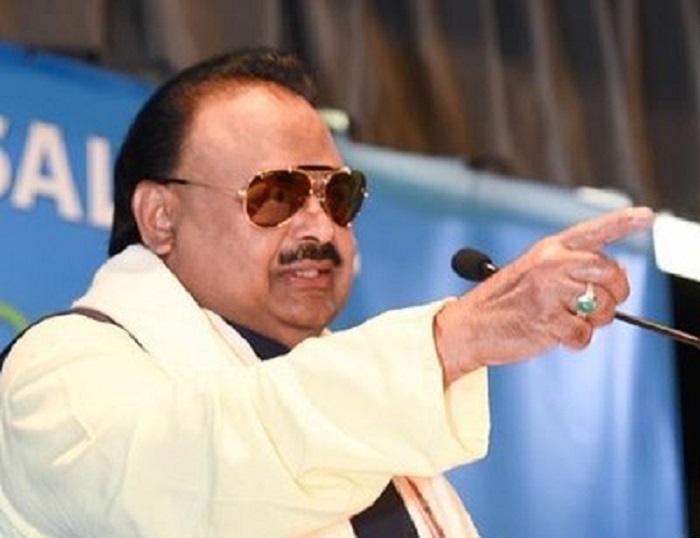
Sri Sri Ravishankar addressing his followers at his ashram in Bangalore
“Remember 40 percent of the planet is afflicted with some form of mental illness. The World Economic Forum (WEF) has also acknowledged depression is a big worry. This is a concern I have tried to draw attention to for the last 20 years at various forums. We have to take care of the mental health of the planet.”
The wellness guru said he was worried that many found their lives have no meaning. “When you find life is meaningless, a sense of emptiness comes within you and then you get depressed. But this same state of mind, with some wisdom can take you to a higher state of consciousness, to self knowledge. And this is what one must look forward to, one must aspire for in life.”
Sri Sri Ravi Shankar said Prana or Chi, the subtle life force energy, is directly related with the state of mind. “When the prana (your energy level) is high, you will notice there is a feeling of expansion and well-being. When the prana level becomes low, for example, when someone has insulted you or you are depressed, there is a feeling of contraction or shrinkage.
Sri Sri Ravishankar addressing his followers at the Bangalore ashram
“Prana can be increased through meditation. Exercise also increases the prana and brings about a sense of well-being, but it also tires the body. Music, dancing and spending time with a happy group of people also increase Prana. Meditation and Yoga are the easiest ways to increase and sustain the level of Parna.”
The wellness guru also said it was important to develop an attitude of service that keeps the mind happy. He further said getting involved in a bigger cause shifts the whole focus of life and can take one out of the rut of ‘what about me’. “Societies where values of service, sacrifice and community participation are ingrained have fewer instances of depression and suicides. The Sikh community is a great example of this. You have to know that you are very much needed in this world,” said Sri Sri Ravi Shankar.
He said it was important for the world to practice what is now becoming popular as mental hygiene. “Just like we brush our teeth twice daily, mental hygiene should also be practiced daily. Love gets kindled in you when you meditate. You just need a little commitment. That is where most people falter. This is just like the gardener who gets fruit from a tree, but as he is enjoying the fruit, he forgets to water the roots. Soon, the fruits will dwindle.”
Global institutions like Harvard and Yale have carried out important research on the mental health benefits of practices like Sudarshan Kriya. Research has shown that a whopping 87 percent of students had a sense of well being and happiness after doing these practices.
“The governments around the world also have a role in promoting meditation among the masses to make it more mainstream and reducing the spate of mental health- related suicides,” said Sri Sri Ravi Shankar, fondly called Gurudev by his followers in India and across the world.
“Sometimes we get depressed from hanging onto the past or are over-ambitious and anxious about the future. Life, however, is a continuous process of learning how to let go. We must see our life from a bigger perspective, and not get stuck in events, objects or situations of the past, said Sri Sri Ravi Shankar.
“Just look at your own life, suppose you live on this planet for 80 years, 40 years you spend sleeping; 10 years is spent in the washroom; 10 years in eating and snacking; and some years stuck in traffic jams maybe. Life is passing us by very quickly. You wake up and see, it’s all like a dream. Don’t think, another 20-30 years is very far away. They will pass too, in a snap, like the previous 30-40 years have. We are not even conscious of it. But when we wake up and see the whole life appears like a dream! You are lucky if you even have a glimpse of this realization. Then, you can see life from a broader perspective.”
“That gives rise to vivek, wisdom or discrimination from inside of you. Then you know what is important, and what is not important. Unimportant things will not bother you then. Perty worries and concerns simply fall off. This, actually, changes your life.”
It is time to live and think for others and it is time to check undue depression which can foster the development of a serious physical disease due to the ongoing stress and disruptions of the pandemic that continue to take a severe toll on mental health.
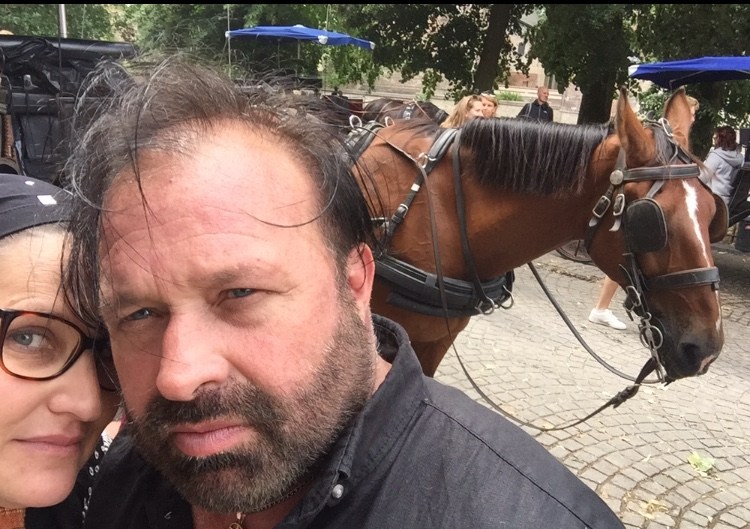
Christian is a Philosopher that comes from Belgium. What identifies him the most and above all is simplicity, for everything is better with “vanilla ice cream.” Perhaps, for this reason, his intellectual passion is criticism and irony, in the sense of trying to reveal what “hides behind the mask,” and give birth to the true. For him, ignorance and knowledge never “cross paths.” What he likes the most in his leisure time, is to go for a walk with his wife.
Scott Douglas
Jacobsen: Let’s take a step back before the conversation to set a tone, as far
as I know, on one of the more established high-IQ rankings, for those who care
for such things deeply or have a passing interest, if you parse them, you have
the highest mainstream intelligence test extrapolated score at 185+ (S.D. 15)
on the WAIS or an IQ test considered, by many, the gold standard at the moment
with an accepted verification on a high-IQ ranking. On the alternative tests,
Rick Rosner appears to have the most consistent highest rankings on the
alternative tests with a large number of scores in the 180s and 190s. The main
ranking taken into account: The World Genius Directory. At one slice of time a
while ago, all known were examined and presented in some publicly searchable
articles. Now, Ashkenazi Jewish heritage individuals, genetically, based on
research, seem to have the highest ethnic grouping score. You’re both Jewish.
Jewish intellectual achievement seems markedly above the norm of most cultural
groups. Intellectual output of note appears much higher on a per capita basis
for Jewish heritage peoples with an emphasis on the Ashkenazim out of the
Ashkenazim, Ethiopian, Mizrahim, Sephardim, and
other Jewish peoples. There’s more to the reasoning. However, this seems
like a sliver of the shorthand, to me, especially if you look at the highest
scores on alternative tests more closely. This doesn’t negate the
impressiveness of all high-scorers’ scores to members of the high-IQcommunities
who partake of these niche activities and the respect for all individuals by
most others within the communities of the high-IQ. Most of the communities may
disagree, but respect and provide dignity to one another, while despairing
about the state of the high-IQ. Although, whether mainstream tests or
alternative tests, there will be some overlapping and other non-overlapping
caveats to claims of the highest this-or-that or scores claimed. What does a
distinct score on a gold standard test mean to you?
Dr. Christian
Sorensen: On
the one hand, it means that said score is a fact that certainly represents a
higher value than indicated, although it lacks the quantifiable certainty of
its limit, and on the other hand, it is a representative-representative, that from
the point of view of what a noetic consensus means, constitutes an objective
reality.
Jacobsen: How
does this impact relations with others in the high-IQ communities?
Sorensen: I think it has
a cacophonic effect on their brains, in the sense that it sounds profane to
them, and therefore disrespectful and
shocking.
Jacobsen: What
is the essence of Jewish intellectual life?
Sorensen: The critical
spirit that suppresses the spirit of truth, and in consequence, that eclipses
the faith in the name of light.
Jacobsen: Why
is Jewish intellectual achievement such a per capita outlier?
Sorensen: Because they’re
based on a divergent style of thinking, that is essentially unpredictable, and for
this reason, escapes the norm.
Jacobsen: How
do different Jewish peoples view one another – listed above, e.g., Ashkenazim, Ethiopian, Mizrahim, Sephardim,
and other Jewish peoples?
Sorensen: I would say that more than how the different Jewish peoples see each other, it’s the manner in which the Ashkenazis perceive the rest, although at the same time the last prefer not to see the first ones even in paint, who evidently interpret them in a derogatory sense, and from this perspective, as intellectually inferior; matter over which their explanations attribute the cause to ethnic mixtures regarding peoples of Arab and African origin, which subsequently, are going to correlate with lower degrees of cortical thickness evolution at the level of cerebral functioning.
Jacobsen: What
controversies have followed the high intelligence score for you?
Sorensen: It has led me
to be the creator of the reverse attraction
law, which pragmatically speaking,
implies being a stone guest wherever I am.
Jacobsen: How
have you been followed, studied, and treated as if a laboratory animal growing
up and into the present if at all?
Sorensen: With social
distancing, due to the risk for the observer of being a victim of cross
contamination, caused by the effects
of subliminal cognitive manipulation, that could induce on him a loss of behavioral
control, and consequently, lead to an
idiopathic existential crisis.
Jacobsen: How
does higher intelligence help and hinder intimate relationships?
Sorensen: I would rather
say that higher intelligence prevents intimate relationships, because it’s a
kind of not exhilarating trait (although my wife thinks otherwise), and hinders or obstructs these, by the oversaturation of dissimilar emotional
mechanisms.
Jacobsen: What
peculiarities of thought come forward earlier in life for you?
Sorensen: The fixed idea
around the why of why, accompanied by a feeling of loneliness.
Jacobsen: What
patterns of childlike curiosity have continued into the present?
Sorensen: The feeling of
being motivated more by unanswerable questions, than by unquestionable answers.
Jacobsen: One
bonus question, how many languages do you know and to what proficiency in each?
Sorensen: Twelve
languages, with advance level of proficiency in each of them, although I have
a preference in favor of some of these, especially in regards to their logical structuring over the ones that are
essentially analog. The average time it takes me to learn a spoken and written
language, without classes, since I have never taken them because they bore me, and
without dedicating myself exclusively to that, is two to three weeks.
Jacobsen: Thank
you for the opportunity and your time, Dr. Sorensen.
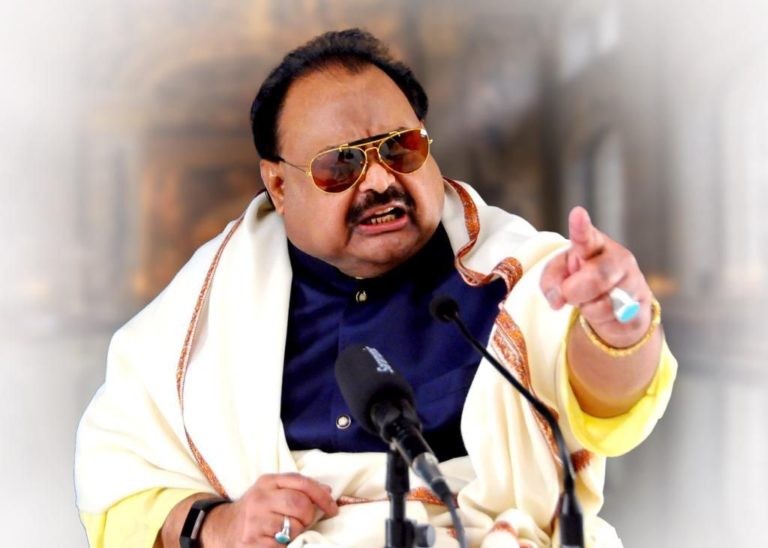
Sindh’s mass leader Altaf Hussain endured all kinds of atrocities at the hands of Pakistan Army and ISI, yet he continues to fight for the rights of Mohajirs (migrants) and Sindhis. In this interview with Vivek Sinha, Editor-in-Chief News Intervention the founder of Muttahida Qaumi Movement (MQM), Altaf Hussain, says Sindh doesn’t want to stay with Panjabi Pakistan anymore. Altaf Hussain wants a separate Sindhudesh.
Vivek Sinha: Taliban has captured Afghanistan with active help from Pakistan Army and ISI. How do you see Taliban’s takeover of Afghanistan and how will it affect the MQM’s movement in Sindh?
Altaf Hussain: There is no doubt that without logistic, financial, military and intelligence sharing, Taliban could never ever have captured Kabul and other parts of Afghanistan. Certainly, with regard to taking over Afghanistan, Taliban have strong connections with Pakistan Army and ISI and they would capture financial hub of Pakistan i.e. Karachi too, where original MQM founded by me has more than 95% of the people not only in Karachi but also in other urban areas of Sindh. We are also getting support from indigenous population that means people from the rural Sindh.
MQM is struggling harder to liberate Sindh from the occupation of Punjabi Army, their henchmen and their proxies. MQM wants to make Sindh an independent and sovereign Sindhudesh. We don’t want to stay with present Pakistan anymore. Even earlier, we fought with Taliban for several years and stopped Taliban from taking over Karachi. That was MQM. Nonetheless, we urgently need the support of all democratic nations of the world and international community, particularly from neighbouring India. We are fully prepared and we will face them (Pakistanis) with full force to liberate Sindh and keep Karachi protected. We will save Karachi and would never become part of Punjab or Pakistan or their federal territory.
Vivek Sinha: Will there be a rise in Islamic extremism across Sindh and other occupied territories of Pakistan in the near future?
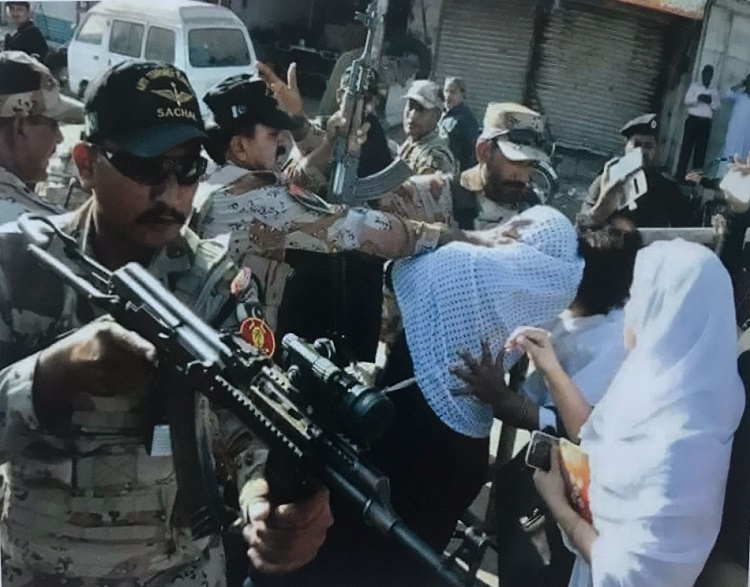
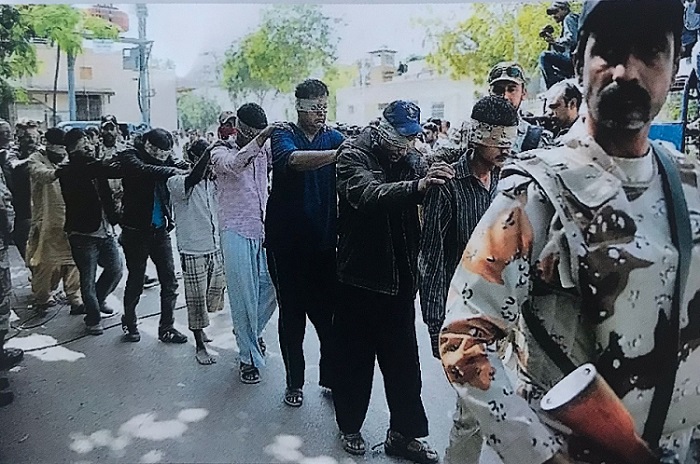
Mohajir women being arrested by Pakistani Rangers in Sindh. (Photo: News Intervention)
Vivek Sinha:Almost every month there are instances of Hindu and Christian girls being abducted and raped by radical Islamists in the Sindh province. Why do think the world remains silent on these Pak Army-sponsored atrocities in Sindh?
Altaf Hussain: As far as the abduction of Hindu girls and women is concerned, MQM has always been very vocal, and is the only party that has always condemned these furious anti-human acts and deeds by religious fanatics. It is our commitment to the international community that after getting independence, Sindhudesh would be a secular country. There would be complete religious freedom and the non-Muslim communities would enjoy full freedom to celebrate and observe their rituals and festivals. MQM would guarantee it at all cost. Unfortunately, it is very sad on the part of the international community to remain silent over this tyranny.
Vivek Sinha: MQM has had a long journey and the movement is built upon sacrifices of countless Mohajirs. Despite this glorious past, MQM is still a struggling movement till today. What do you think is the reason?
Altaf Hussain: Because the military establishment of Pakistan persistently intervened in political system and affairs of political parties through blackmailing tactics and by offering lucrative positions and power sharing… so they also made efforts to make me tilt on their side, but to no avail. (Pakistan’s) military establishment tried several times to take me on their side, but I have a different DNA which is not saleable. That’s why, in sheer frustration, they unleashed their wrath and played havoc on MQM through frequent deadliest military crackdowns. They failed to buy me and then they switched to their Plan B and created factions within MQM.
Pakistan Army and ISI had created terrorists’ gangs and named them as MQM HAQIQI, MQM-P and PSP, whereas the original MQM led by me has been banned and its offices bulldozed. Even my house has been sealed. Thousands of MQM office bearers and activists were murdered in captivity and in fake encounters and as many have been thrown in the river (waters) without any lawful charge. They tried everything, every trick in their book but they can’t force the Mohajirs to move away from me. We have lost 25,000 Mohajir youth and MQM workers at the hands of demonic Pak Army.
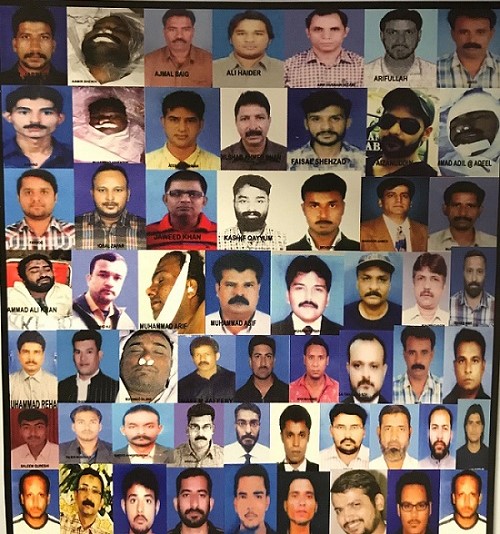
MQM members killed or disappeared by the Pakistani regime during the last few years. Thousands of MQM members and leaders have been abducted and killed in cold blood by the Pakistan Army and ISI since 2013. (Photo: News Intervention)
Vivek Sinha:During the glorious days of MQM there were people who could lay down (or take) lives for Altaf Hussain. Yet today’s scenario is slightly different. What is the reason for this political downfall?
Altaf Hussain: I don’t agree that MQM has fallen down politically, but the actual scenario is totally different because every street, town and district is held hostage under guns of Pakistan Army and their law enforcement agencies (LEAs) like the Paramilitary Rangers and others. After persistent assassinations, abductions and enforced disappearances of MQM office-bearers and workers, I asked my followers to observe unity under silence till our next strategic move. Military has unlimited variety of weaponry and we are totally unarmed. You may guess as to how the unarmed may engage in fight with the heavily armed.
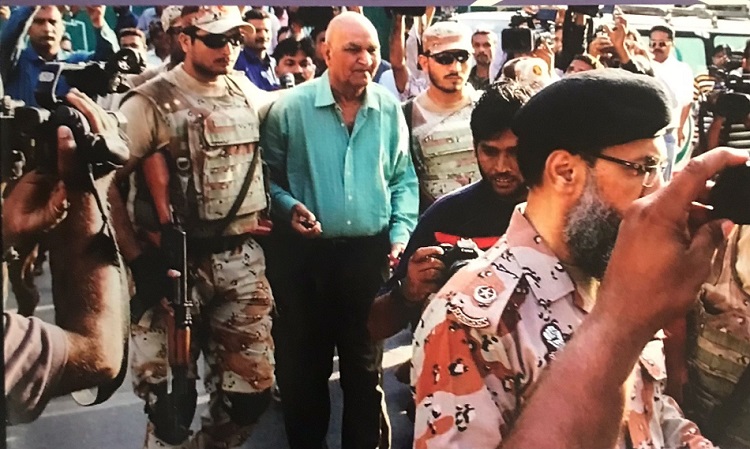
Prof. Zafar Hasan Arif, Deputy Convenor MQM being arrested by the Pakistani security forces. He embraced martyrdom when Pakistani regime killed him in cold blood. (Photo: News Intervention)
Vivek Sinha: There have been reports that your party/movement is in talks with the Pakistani regime through backchannels. Is there any truth in these reports? Are you in touch with the Pakistani regime for the rights of Urdu speaking people in Sindh?
Altaf Hussain: I have already given the answer that covers all aspects of your question, the excesses and the genocide of Mohajirs by Pak Army. We knocked at all the forums in the past and we are still approaching the international community for help. No way, we are not engaged in any sort of backdoor negotiations with the military establishment and reports in that context are sheer rumours.
Vivek Sinha: Do you think that Mohajirs should also pick up guns and fight for their independence, like the Baloch brethren in Balochistan? Is there any organisational strategy towards this goal?
Vivek Sinha:What is your political resistance strategy to counter the international terrorist state Pakistan?
Altaf Hussain: We are doing what we can. We are sending human intelligence based true and factual reports to all the corners of the world. We play a big part in war against terror. We are shoulder to shoulder with international democratic world.
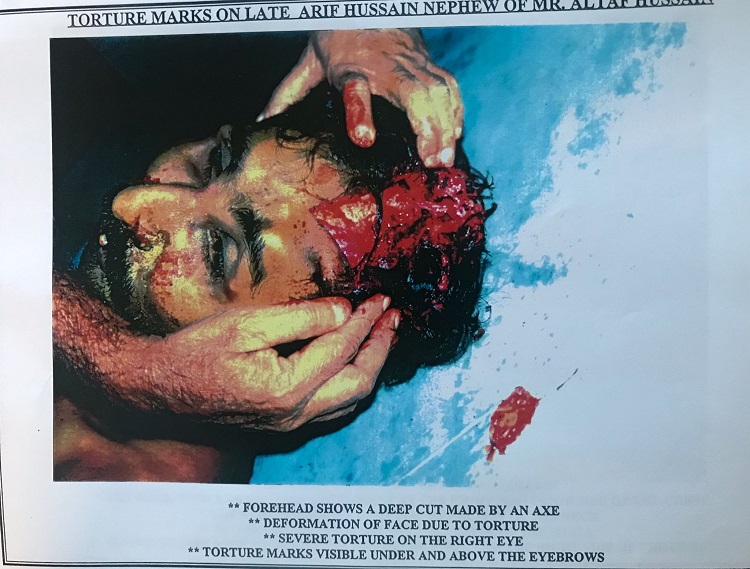
Arif Hussain, nephew of Altaf Hussain was abducted and killed by the Pakistani forces. (Photo: News Intervention)
Vivek Sinha:How would you motivate the oppressed Urdu speaking population against atrocities of Pakistan Army and the ISI?
Altaf Hussain: Each and every Mohajir is aware of the atrocities and barbarism of Pak army. They suffered from irreparable loss in the form of murder of either one, two or three members of their family. Even from my own family my elder brother Nasir Hussain and nephew Arif Hussain were arrested, tortured for three days and later on they were taken to one of the suburban areas of Karachi and were shot dead in cold blood. And after murdering them, my nephew’s head was axed into two pieces. Almost all Mohajirs are already motivated because of such brutal killings and waiting for the support of international, democratic world.
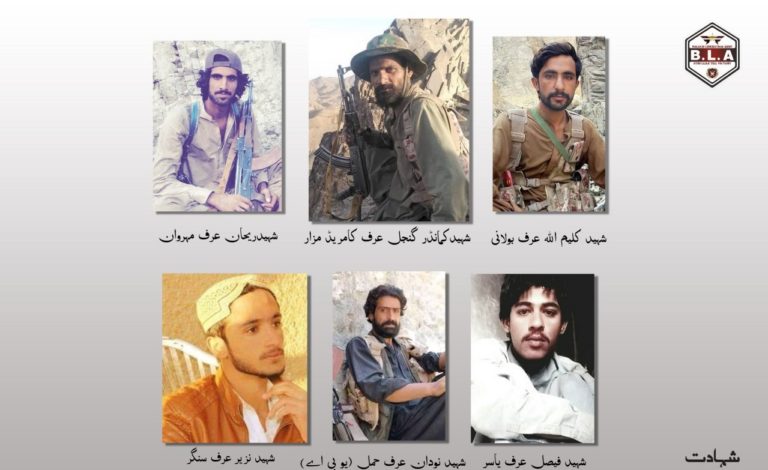
Baloch sarmachaars (freedom fighters) killed more than a dozen Pakistani soldiers and their proxies in a fierce battle at the mountainous region of Noshki and Kharan on September 24. Six Baloch sarmachaars embraced martyrdom in this battle.
“The battle commenced early in the morning on Friday (September 24) at Siyah Lop, near Baddo Dor when the enemy forces tried to encircle a patrolling party of Baloch freedom fighters. In the face to face battle that lasted for more than four hours, scores of enemy personnel were killed and injured. Five freedom fighters of BLA (Baloch Liberation Army) and one freedom fighter of the United Baloch Army (UBA) embraced martyrdom,” said Jeeyand Baloch, spokesperson of the BLA in a media statement.
Balochistan is an independent country that was under British colonial rule alongwith India. Balochistan attained its independence from British rule on 11 August 1947, which was four days before Indian independence on August 15, 1947. However, Balochistan’s independence was short lived and the newly created Pakistan captured Balochistan on March 27, 1948. The Baloch has been fighting for their independence ever since then.
Over the years Pakistan has used all kinds of sophisticated weapons to intimidate Balochistan into subjugation but has failed miserably. Baloch are valiant fighters and the September 24 battle on the mountains of Noshki and Kharan is part of Balochistan’s freedom movement in which over a dozen Pakistani soldiers were killed while six sarmachaars embraced martyrdom.
The Baloch martyrs from the Baloch Liberation Army (BLA) include Commander Ganjal alias Comrade Mazar, Nazeer alias Sangat, Faisal alias Yasir, Kaleem alias Bolani and Rehan alias Mehrwaan. Nodaan alias Hammal was from the United Baloch Army to embrace martyrdom.
“Sangat Ganjal and his comrades Sangat Kaleem, Sangat Faisal, Sangat Nodan, Sangat Rehan and Sangat Nazeer fought bravely against the enemy and sacrificed their lives for the better future of Baloch people. The Baloch independence movement cannot be stopped or weakened by any power, this struggle will continue until the flag of an independent #Balochistan is hoisted. Until then a vigorous and intense war against the occupying Pakistani state shall continue,” said Bashir Zeb Baluch, chief commander of the Baloch Liberation Army (BLA) in his tweet.
Bashir Zeb’s tweet extolling the fighting spirit of Baloch revolutionaries against the occupying Pakistani regime
“In the battle, that lasted for several hours, Kaleem and Nodaan, after inflicting heavy casualties on the enemy, ended their own lives using their very last bullets to secure organisational secrets. BLA pays tribute to the fallen comrades and salutes their ultimate sacrifice for motherland. The organisation vows that the sacrifices of the comrades will never be forgotten and their mission will continue until independence of Balochistan,” said BLA spokesperson Jeeyand Baloch in his statement.
Altaf Hussain, founder and leader of the Muttahida Quami Movement (MQM) said in clear terms that Pakistan is the “epicentre of all kinds of terrorism” and the Pakistan Army and “its notorious intelligence agency ISI” have created terrorist proxies across the world that includes the Al-Qaeda, Jaish-e-Mohammad and Lashkar-e-Taiba, among several others.
“I have been pointing out to the democratic world including the United Nations for many years but unfortunately, all in vain,” said Altaf Hussain in his tweet. Hussain further explained how the Pakistan Army and ISI have created terrorist proxies and listed the terrorist organisations created by Rawalpindi.
Pakistan is the epicentre of all kinds of terrorism. I have been pointing out to the Democratic world including United Nations for many years but unfortunately, all in vain.#PakProxyTalibanpic.twitter.com/PtfuwmlMBv
Altaf Hussain’s tweet where he explains how Pakistan Army and ISI are supporting and creating terrorist organisations across the world
“It’s the Pakistan Army and its notorious intelligence agency, ISI that have created and are still busy in creating their terrorist proxies and exporting terrorists throughout the world e.g. Taliban, Al-Qaeda and ISIS,” said Altaf Hussain in his statement.
“Pakistan Army and ISI are involved in creating, funding and patronising terrorist factions in the political parties including my party, Muttahida Quami Movement (MQM) founded by me,” said Altaf Hussain without mincing his words.
Hussain explained that in order to weaken the original MQM the Pakistan Army and ISI had created MQM Haqiqi, Pak Sar Zameen Party (PSP) and MQMP. “The original MQM led by me has been banned illegally, all of its offices including my house has been sealed, thousands of MQM office-bearers and members have been killed extrajudicially. Hundreds are incarcerated in jails and hundreds have been enforcedly disappeared.”
Explaining about the current situation in Afghanistan, Altaf Hussain said that Taliban could easily take over Afghanistan only due to active help and logistical support from the Pakistan Army and ISI. Rawalpindi’s support to the Taliban included financial, medical, military and intelligence sharing.
Altaf Hussain released a list of terrorist proxies (organisations) created by the Pakistan Army and ISI. * Al-Qaeda * Sipah-e-Mohammad * Tehreek-e-Nifaz-e-fiqha-e-Jafaria * Sipah-e-Sahaba * Jamaat-ud-Dawa * Al Rasheed Trust * Jaish-e-Mohammad * Lashkar-e-Jhangvi * Tehreek -e-Taliban * Lashkar-e-Taiba * Lashkar-e-Islam * Jamaat-ul-Ansar * Khuddam-e-Islam * Harkat-ul-Ansar * Tehreek-e-Labbaik Pakistan
Hypersonic Weapons Capable of traveling at more than 10-15 times the speed of sound, hypersonic missiles arrive at their targets in a blinding, destructive flash, before any sonic booms or other meaningful warning. So far, there are no guaranteed defences against them. Fast, effective, precise and unstoppable: these are rare but highly desired characteristics on the modern battlefield. And the missiles are being developed not only by the United States but also by China, Russia, France, Japan, EU, India and other countries. Hypersonic weapon systems can be armed with both nuclear and conventional warheads, and can hit critical/sensitive/ strategic targets with impunity like nuclear stockpiling and delivery sites, ships and strategic objectives in all dimensions of ground, air, sea and under-sea. They will be as big a game changer in strategic, security and armament environment in as much as nuclear weapons; and India with its aspirations as a regional player and a global balancing power, needs to stay in the loop of this most potent, versatile, hi-tech, disruptive technology[i].
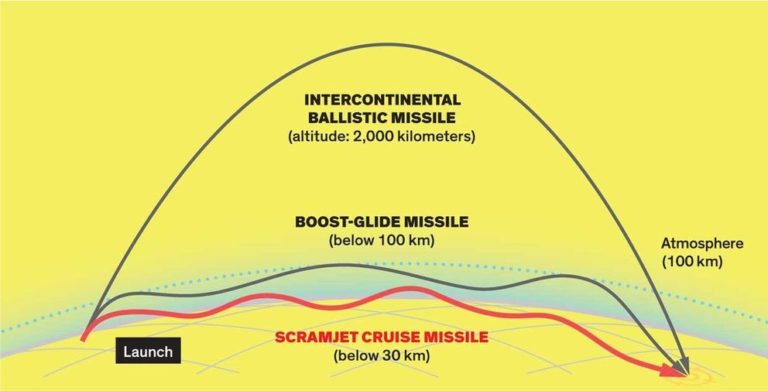
Type of Hypersonic Weapons/Missiles/Glide Vehicles (HW/HM/HGV) There are two primary categories: HGVs are launched from a rocket before gliding to a target. Hypersonic cruise missiles are powered by high-speed, air-breathing engines, or “scramjets,” after acquiring their target.
Characteristics Unlike ballistic missiles, Hypersonic Weapons do not follow a ballistic trajectory, are highly manoeuvrable, have the ability to fly at lower altitude, making their flight path unpredictable and difficult to track, thereby reducing the effectiveness of ballistic missile defence (BMD) systems. They can approach their targets at roughly 12 to 50 miles above the earth’s surface which is below the altitude at which ballistic missile interceptors such as the US Aegis ship-based system and the Thaad ground-based system are designed to operate, yet above the altitude that simpler air defence missiles, like the Patriot system, can reach.
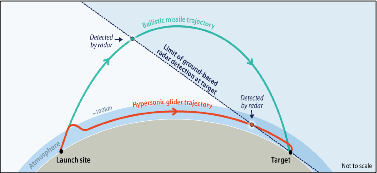
Officials will have trouble even knowing where a strike would land. Although the missiles’ launch would probably be picked up by infrared-sensing satellites in its first few moments of flight, they would be roughly 10 to 20 times harder to detect than incoming ballistic missiles as they near their targets. They would zoom along in the defensive void, manoeuvring unpredictably, and then, in just a few final seconds of blindingly fast, mile-per-second flight, dive and strike a target such as an aircraft carrier from an altitude of 100,000 feet. During their flight, the perimeter of their potential landing zone could be about as big as 3000 sq km. Early warning systems might sound a general alarm, but they’d be clueless about exactly where the missiles were headed. No nation currently has any defence against such systems. This delayed detection, compresses the timeline for decision makers assessing their response options, and for a defensive system to intercept the attacking weapon; potentially permitting no response/only a single intercept attempt.
Terrestrial-based detection of Ballistic Missiles vs. Hypersonic Glide Vehicles
Overview of Hypersonic Weapons in different countries
USA — The US has pursued development of Hypersonic Weapons as a part of its Conventional Prompt Global Strike (CPGS) program since the early 2000s. Endorsing Trump’s budget of $3.2 billion for 2021, the Biden administration has bid $3.8 billion for hypersonic-related research funding in fiscal year 2022. Additionally, MDA (Missile Defense Agency) has requested $8.9 billion with the goal of developing capabilities such as “a next-generation interceptor for homeland missile defence, hypersonic defensive capability, and a hypersonic and ballistic tracking space sensor (HBTSS)”[i]. The US has 70 ongoing projects that are estimated to cost over $15 billion through 2024. Most US Hypersonic Weapons, in contrast to those in Russia and China, are not being designed for use with a nuclear warhead. This implies necessity of technically challenging, more accurate Hypersonic Weapons.
Russia and China — Russia and China provide similar rationale for developing hypersonic systems: “A concern that US Hypersonic Weapons could conduct a pre-emptive, decapitating strike on their nuclear arsenal and supporting infrastructure, thus impacting their ‘second strike capabilities”. China has made systematic progress in its pursuit of hypersonics. Scientific and strategic community globally specially in the USA, feel that China is ahead of its peers in this niche-technology. At the October 2019 military parade in Beijing, marking the 70th anniversary of its founding, China paraded for the first time the DF-17 missile, that has a range of 1,800-2,500 kilometres, equipped with a hypersonic glide vehicle (HGV). Alexander Fedorov, a professor at Moscow Institute of Physics and Technology accepts that an arms race is already on in this area but adds that Russia “has experience without much money, China has money without much experience, and the United States has both, although it revived its efforts later than did Russia or China and is now playing catch-up.[ii]”
Russia is not far behind, and has made it its priority for R&D and deployment. Russian research on hypersonic technology dates back to the 1980s, the program began to pick up momentum after the US withdrew from the Anti-Ballistic Missile (ABM) Treaty in 2001. The Russian military currently has two Hypersonic Missiles: The Avangard and the Kinzhal[iii]. Both are nuclear capable, reportedly can fly at 20 times the speed of sound; and according to reports, is being prepared for deployment with the Northern fleet.
India and Hypersonic Weapons India is developing a Hypersonic Cruise Missile Brahmos-II in cooperation with Russia and launched the first test flight in June 2019, which failed. India, however, tested an indigenously designed and built Hypersonic Glide Vehicle (HGV) on 7 September 20 21[iv]. It is powered by a supersonic combustion ram jet/scramjet engine which activates after being launched by a solid-fuel ballistic missile rocket motor. The test vehicle flew at an altitude of 30 kilometres at six times the speed of sound for about 20 seconds after separating from the launcher, according to reports from the Defense Research and Development Organization (DRDO), which developed the system. The DRDO confirmed that the test launch “proved several critical technologies including aerodynamic configuration for hypersonic manoeuvres.” Another three tests in the next five years “to make the platform into a full-fledged hypersonic weapon that is capable of carrying both conventional and nuclear warheads” is scheduled.
International Security and Safety Protocols There are currently no international agreements on how or when Hypersonic Weapons (HWs) can be used, nor are there any plans to start those discussions. Instead, the rush to possess HWs has started a new dangerous arms race; one that could, some experts worry, upend existing norms of deterrence and renew Cold War-era tensions. The HGVS dangerously compress the time during which military officials and their political leaders in any country can figure out the nature of an attack and make reasoned decisions about the wisdom and scope of defensive steps or retaliation. And the threat that hypersonics pose to retaliatory weapons creates what scholars call “use it or lose it” pressures on countries to strike first during a crisis. Experts say that the missiles could upend the concept of Mutual Assured Destruction, the bedrock military doctrine of the nuclear age that argued globe-altering wars would be deterred if the potential combatants always felt certain of their opponents’ devastating response.
Unlike the previous leaps in military technology, like chemical and biological weapons and ballistic missiles with multiple nuclear warheads, which were controlled through superpower treaty negotiations: The ‘big three’ haven’t seriously considered any sort of accord limiting the development or deployment of Hypersonic Weapons. The UN Office of Disarmament Affairs has officially implored nations to sit down to negotiate a protocol. For years the big powers have cared mostly about numerical measures of power: Who has more warheads, bombers and missiles, and negotiations have focused heavily on those metrics. Only occasionally has their conversation widened to include the issue of strategic stability, a topic that encompasses whether specific weaponry poses risks of inadvertent war.
Conclusion Hypersonic Weapons are strategic and geo-political game changers, and are here to stay. A new arms race involving hypersonics is clearly already underway. No one is interested in hypersonic weapons limitation talks. In any case due to present regime of distrust, every nation which has potential, would like to own HW/HGVs. The portents are even more lethal and deadly than what transpired with nuclear weapons. As a regional power, India needs to be part of this geo-politically and militarily essential club, as also use its soft power to cajole the international community specially the ‘big three’, to initiate protocols for its development, deployment and use.
————
[i] There is a lot
of material available on hypersonic weapons, its technical characteristics,
strategic, security and international ramifications and nations pursuing this
technology. Some of the important references consulted are given below.
Encyclopedia Britannica and Wikipedia.
National and International Digital Newspapers like The Hindustan Times, New York Times, The Economic Times.
Kelley M. Sayler, ‘Hypersonic Weapons: Background and Issues for Congress’, Updated August 25, 2021, Congressional Research Service, available at https://sgp.fas.org/crs/weapons/R45811.pdf.
Pakistan-occupied “Azad” Jammu Kashmir (POJK) is at the mercy of Pakistan Army and its puppet regime in Islamabad, who treat POJK as their private property thereby depriving the region of all power and resources. The local Kashmiris across POJK live a life of oppression, humiliation and poverty. And it doesn’t stop here. Not content with loot of POJK resources, the Pakistani regime has forged the system in a way that hurts the self-esteem of local Kashmiris at every step of their lives.
It all starts with the installation of a parasitic
government according to a ridiculous interim constitution of the
Pakistan-occupied “Azad” Kashmir. As per this interim constitution a five
member assembly is formed which “selects” a prime minister and a president as
per the diktats of Rawalpindi.
The interim constitution of Pakistan-occupied “Azad” Jammu
Kashmir ‘allows’ the “Azad” Jammu Kashmir government to take small decisions
under only two articles. The remaining fifty six articles are in the hands of
Pakistan. As per this constitution, any political party, individual or group in
“Azad” Kashmir can neither participate in elections nor can the political party
be registered with the Election Commission of Pakistan if it does not believe in
Jammu Kashmir’s accession to Pakistan. This is a mandatory condition for it ensures
Rawalpindi that only those people remain in the political landscape of Kashmir
who overtly support their affiliation with Pakistan. Further, no politician,
social worker or a common Kashmiri can ever dare to speak against Pakistan Army,
even mild criticism falls under the category of treason.
However, on paper Pakistan creates this sham of installing a
President, Prime Minister, Cabinet Ministers, Supreme Court, High Court, and an
Assembly for “Azad” Jammu Kashmir (POJK). In reality, however, all these
institutions and their heads have no autonomy and rely on GHQ Rawalpindi and
Islamabad for every decision.
The process starts by selecting six members from Pakistan
under the chairmanship of Prime Minister Pakistan to keep control over POJK.
Chief Secretary, Health Secretary, Auditor General and Inspector General of
Police in POJK are all appointed on the instructions from Pakistan and they work
on direct orders from Islamabad and Rawalpindi. The Minister of Kashmir Affairs
of Pakistan exercises control over everything that’s happening in POJK. And to
make further worse for the Kashmiris the Prime Minister of Pakistan works
directly under the Chief Secretary of POJK who in turn reports to the Prime
Minister Pakistan.
Pakistan Army’s network of check posts in Pakistan-occupied
“Azad” Kashmir
Pakistan Army has created a network of army cantonments across “Azad” Kashmir (POJK) such that military camps exist at the entrance and exit of every major city. The purpose of this huge network of military cantonments is to monitor each and every movement of the local Kashmiris. For instance, heavily armed Pakistan military guards are present round the clock at the entrance outpost at Amboor in Muzaffarabad, the capital city of POJK. Similar military camps have been set up at several places in Poonch district. Before any Kashmir can enter Bagh they need to pass through the check posts at Chahala, Mang Bajri, Ardee Gahal. Military cantonments also exist amidst heavily populated areas at Qadirabad and Chattar no. 2 (Barhamna) with a brigade headquarter of the Pakistan Army. In this way the entire Poonch and Rawalakot districts are encircled by cantonments, check posts and offices of Pakistan military and the ISI.
News Intervention Special Report on Pakistan-occupied “Azad” Kashmir
At Poonch, Chahala, Mang Bajri and Adee Gahal, the cantonments
of Pakistan Army is within the populated area. Military hospital MDS is located
in the heart of Bagh city and in its close vicinity lies the regional office of
Pakistan’s intelligence agency ISI. Despite military hospital in the heart of
city it remains out of bounds for POJK Kashmiris.
Kashmiris have to cross a similar Pakistan military camp
before entering district Mirpur, and then there’s a check post at Mangla, the
city with its famous Mangla Dam that supplies hydroelectricity to a large part
of Pakistan while POJK remains in the dark. Likewise, Bhimber district is under
strict control of the Pakistan Army due to its proximity to Jammu, with several
military camps before and after in Kotli district where the terrorist
organisation JKLF continues to run training camps.
Harassment of Kashmiris in Pakistan-occupied “Azad”
Kashmir
Every Kashmiri is considered suspicious by GHQ Rawalpindi
such that each and every POJK Kashmiri needs to register name, address and
purpose of visit before they can enter any of the other districts in “Azad”
Kashmir (POJK).
The training camps for several other Islamist jihadi groups are
also run under the direct supervision of Pakistan Army. And though there are
several restrictions on the local Kashmiris to move around in POJK the jihadi
terrorists roam around freely, brandishing sophisticated guns.
Leepa and Neelam Valley may geographically be a part of
Pakistan-occupied “Azad” Kashmir and yet local Kashmiris have to undergo
rigorous questioning, which includes humiliating whole body frisking by the
Pakistani soldiers searching of clothes and by the Pakistan Army before they can
enter these areas.
In Hajira, Dwarandi, Abbaspour and in forward Kahuta areas
of Poonch the common Kashmiris face humiliation on a daily basis. The dignity
and lives of women are always in danger. Instances of molestation, sexual
assault and rapes by Pakistani soldiers on duty at these check posts and
military cantonments take place at a regular frequency and yet nobody is ever
convicted. Almost every day there are instances when Pakistani soldiers try to molest
Kashmiri women at check posts in the garb of physical frisking, and yet all
voices of dissent are suppressed.
Pakistan Army rules “Azad” Kashmir with an iron hand and all
protests by the Kashmiris is promptly suppressed.
Pakistan Army commanders treat “Azad” Kashmir as their
personal fiefdom and dole out business contracts to their people and mint money
at the expense of local Kashmiris. Such is their stranglehold over POJK that no
work can be done without approval from GHQ Rawalpindi. The generals and their
junior officers capture public property in the name of defence establishments
and then use them for personal gains. For instance, Tuli Pir, a tourist
destination in Bagh was captured by the Pakistan Army. Similarly, the land of health
department in the middle of Bagh city was occupied by Pakistan military in broad
daylight, a market built over it and has been rented out on a commercial basis.
This is how Pakistani regime commits day light robbery of public land in “Azad”
Kashmir.
On the other hand, Kashmiris in POJK need to sign an oath of
allegiance to Pakistan before they can get admission in educational
institutions or bag some menial government job. Any local Kashmiri who refuses
to sign oath of allegiance to Pakistan is denied admission to educational
institutions and cannot get into government jobs.
Even after facing such humiliation the Kashmiris of
Pakistan-occupied “Azad” Kashmir is expected to never question Rawalpindi or
Islamabad. Criticism of Pakistan Army and Pakistani regime in any form is a
crime. Every day, treason cases are filed against people, especially
progressives, secularists, liberals and nationalists, due to which there is
fear all around, and Kashmiris are afraid to talk freely.
Islamist-Jihadi network across Pakistan-occupied “Azad”
Kashmir
Numerous jihadi groups operate under the supervision of Pakistani
military, including Hizbul-Mujahideen, Lashkar-e-Taiba, Jamaat-ud-Dawa,
Jaish-e-Muhammad and several others.
Their job is to preach jihad, distribute Islamist literature,
propagandize, as well as attract young people to jihad and sends them to training
camps, where the Pakistan Army trains them and sends them to commit terrorist
acts. One of the jobs of these jihadis is to intimidate local Kashmiris
and take control of their resources.
The civil administration of “Azad” Jammu and Kashmir
government cannot talk to these jihadi groups, but a large number of government
employees and officials also give them monthly donations, some out of fear and
some out of ideological affiliation.
These jihadi camps operate under the direct supervision of Pakistan
Army who have offices in Muzaffarabad, while training camps are set up in
forests and remote areas throughout “Azad” Kashmir where the common Kashmiri is
not allowed to enter. All these jihadi training camps are in Neelam Valley,
Lepa Nikail, Hajira apart from Kahuta Kotli and Khoi Ratta. At forward
positions of the military bases in Mansera area it is the Pakistan Army that trains
these jihadis.
Each of these jihadi group is assigned an area Kashmir.
Apart from occupied “Azad” Jammu and Kashmir, the trainees come in from
different parts of Pakistan, especially Punjab and Khyber-Pakhtunkhwa and
Afghanistan.
One of the biggest jihadi network is of Jamaat-e-Islami that
operates on a large scale under the auspices of Pakistan Army. Hundreds of
educational institutions are run by Jamaat groups under its NGO Red Foundation which
serves as feeder institute for the main jihadi training camps. Thousands of
students are brainwashed into Islamist jihadi narrative. Jamaat-e-Islami’s
subsidiary Khidmat-e-Islami runs a number of orphanages and other charities,
which are not only funded by the government but also sponsored by the local
administration and the Pak Army. Through these institutions, jihadi narratives
are systematically disseminated. Magazines and books published under their
auspices are widely disseminated to all educational institutions, government
agencies to tap the young impressionable minds into jihadi narrative.
Local commanders of the Pakistan Army are invited as special
guests on the occasion of annual examination results at schools and sometimes
military weapons are displayed in the schools and children are made to salute military
commanders.
Jihadi rhetoric and Islamist radical ideology is propagated
across Pakistan-occupied “Azad” Kashmir in an institutionalised planned manner
that affects every Kashmiri in one way or another. On the other hand liberal
secular-minded individuals and organizations are banned. Dozens of books and
magazines that talk about Kashmir and Kashmiriyat are banned and publishers face
fraud cases.
Pakistan’s intelligence agencies play a key role in inciting
violence and fabricating cases against rational Kashmiris. They are called ‘agents’,
‘traitors’, ‘enemies of Pakistan’ or ‘enemy of Islam’ and killed with impunity
as killers know they have state protection. Kashmir’s nationalist leader Arif
Shahid and Dr Ghulam Abbas were eliminated by ISI and so the killers remain
free. And there are several other cold blooded murders where they go unnoticed
and remain reported.
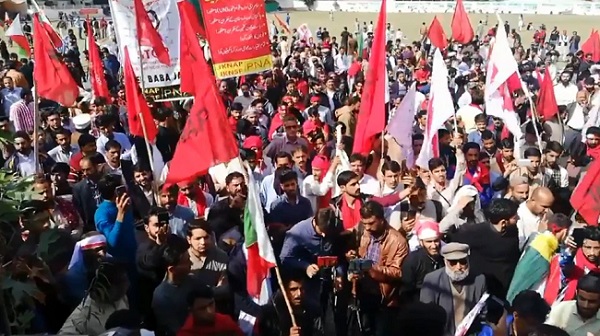
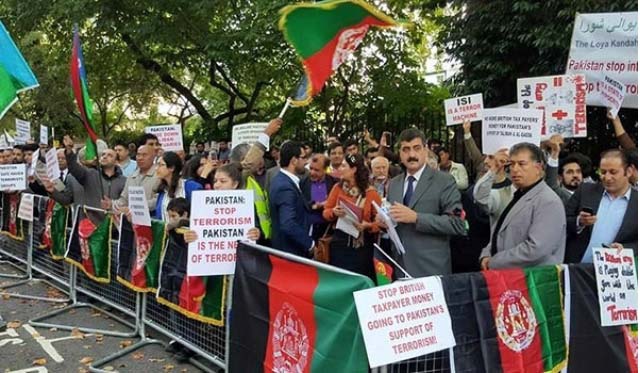
A joint protest rally was organized by the Jeay Sindh Freedom Movement, PTM-USA, South Asia Liberty, Afghan and Baloch activists in front of the UN headquarters in New York against Pakistan’s atrocities and oppression on people across Sindh, Balochistan, Pashtunistan and Afghanistan. This year Pakistani Prime Minister Imran Khan addressed UNGA (United Nations General Assembly) virtually on Friday 24 September 2021.
The diaspora of historical nations such as Sindh, Balochistan, Pashtunistan and Afghanistan assembled at the UN headquarters to demand for their nation’s right to self determination that has been enchained in slavery by fundamentalist elements of Pakistan. They also demanded an end to enforced disappearances, safe release of wrongly arrested nationalist political leaders and justice for minorities.
A car rally was carried out with trucks having flash signs, photos and videos that showed the atrocities of Pakistan.
“United Nations, US and other civilized nations must take notice about Pakistan. Pakistan must be sanctioned and balkanized because of its crimes against historical nations and for promoting Islamist terrorism in neighboring countries and across the world. Today Afghanistan is an example in front of us tomorrow the whole world is going to suffer due to Pakistan-backed Taliban,” said Zafar Sahito founder and central chief organizer of Jeay Sindh Freedom Movement.
Activists from Sindh, Pashtunistan and Afghanistan protesting against Pakistan’s atrocities at UN headquarters, New York. (Photo: News Intervention)
PTM-USA representative Pir Zubair Shah said that Pashtun nation has suffered a lot during the last several decades due to ISI’s double game with world. “But we Pashtuns know very well who is our real enemy. I demand the immediate release of all Pashtun political prisoners,” said Pir Zubair Shah.
“Pakistan is trying its best to show that Baloch is a slave who would pay with bullets in chest, corpses and prison sentences. Balochistan is a laboratory where everything from atomic bombs to targeted killings, kill and dump, including mass graves, is being witnessed. It is up to the Baloch nation whether they are content with the dirty values set by Pakistan or will they rise and strengthen the national resistance for freedom,” said BNM spokesperson in his statement to media.
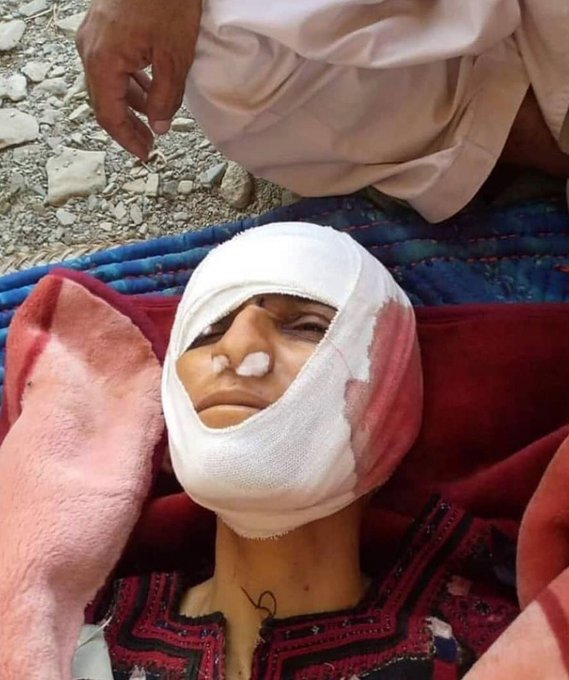
He explained that the killing of people engaged in daily life was not an unintentional mistake rather it’s a part of planned genocide by the Pakistani regime and the army. The killing of Taj Bibi is neither the first nor the last incident. This will continue until the Baloch gets rid of Pakistan.
BNM’s central spokesperson added that Taj Bibi, wife of Musa, had to face the horrors of Pakistan Army even before her cold blooded murder. The barbarism of Pakistan Army had forced her family to migrate from their hometown at Keelkaor. “Here in Kech, the entire population of Askani or a large majority of them are refugees who have been forcefully evicted by the Pakistan Army from their respective areas. But even in Kech Pakistan continues with its barbaric activties on them.”
BNM said that the only way to stop Baloch genocide is to organize national resistance. “Otherwise our mothers, sisters, brothers and elders will continue to be killed. All zones are directed to hold global demonstrations and awareness campaigns against Pakistani atrocities.”
The 9/11 anniversary
this year has brought in its wake old memories and new horrors. After two
decades and trillions of dollars down the drain the world is back to square
one, the difference being that, yet again, a super power stands humiliated
while the extremists and terrorists are having the last laugh.
Strategic
analysts across the world are voicing one opinion after another, think tanks are
churning out reams of reports and analysis. Social media has popped up a huge
array of self appointed “experts and opinion makers.”
In this melee one very basic aspect that continues to remain in the shadows is — who exactly is responsible for this mess. While the finger universally points toward Pakistan there are not many who are ready to speak out bluntly, not even the US that has lost its all due to the treachery and doublespeak of Pakistan. The US, strangely, continues to harbour a notion that Pakistan can be of some use in the future, which makes it diplomatically difficult to openly denounce the country. That Pakistan is a haven for proliferation of terrorism, religious extremism and hybrid conflict not only in the South Asian region but the world over is a fact that the US prefers to gloss over.
A courageous and
honest voice from the US highlighting the actual reality of Pakistan is that of
Christine Fair, an American political scientist who is primarily focussed on counter-terrorism
and South Asia. In her recent article titled, “Pakistan Is an arsonist that
wants you to think It’s a fire fighter”, she has stated lucidly and with utmost
honesty, “It’s astonishing that U.S. officials continue to peddle
Pakistan’s own fictions—alongside such media outlets as the BBC.”
Even today the world stands a mute witness to the gross interference by Pakistan in the internal affairs of Afghanistan by assisting one group in eliminating the other through military means. Everybody knows that the Taliban was not capable of taking on the Northern Alliance in Panjshir; it emerged victorious only with the huge military assistance provided by Pakistan which included trained commandos, tanks, artillery, attack helicopters engineer supports, drones, etc.
It is astonishing that the world has chosen to stay quiet about this blatant aggression that has led to the brutal killing of thousands of innocent civilians, including members of the legitimate government of Afghanistan. Somehow the world has failed to register the fact that the holed up Afghan leader, Amarulla Saleh, is still the head of the government of Afghanistan, since the Taliban has not been recognised by any government as yet.
It is common knowledge that all through its so-called assistance to the US in the Global War on Terrorism (GWOT) Pakistan never gave up on its Islamic fundamentalist assets created from the times when the Taliban was in control there. In some cases the Pakistan Army maintained direct communication through the ISI and in others through the many fundamentalist terrorist organisations operating from Pakistan like the Lashker-e-Toiba (LeT) and Jaish-e-Mohammad (JeM). Notably, the Pakistan based terror organisations also operate under the overall control of the ISI even as they do have some autonomy at the tactical level. The Haqqani network that has a big role to play in the new Taliban set up in Afghanistan is the most prominent and enduring ally of Pakistan. Also notable is the sworn commitment of the Haqqani network to actively participate in all actions taken against India, particularly in Kashmir.
Pakistan seems to be quite unconcerned about the chaos that it has created in Afghanistan and continues to parrot its time tested diatribe of being a country that has contested the cult of terrorism with its sweat and blood. Its propaganda machinery is rapidly parroting out figures of the al Qaeda terrorists that its forces have eliminated in the past decades and the success gained in controlling domestic as well and global terrorism. The country, of course, never tires of reminding the world that it is, by itself, the biggest victim of terrorism. This is propaganda based on misinformation and disinformation at its best.
The manner in
which the West and especially the US turns a blind eye to the monstrous
machinations of Pakistan defies logic. One wonders as to why there is no
realisation about the threat that the country poses to world peace and
security. How can Pakistan keep breeding and training these serpents while
playing the victim card?
A lot has to do with the US fixation about Pakistan being indispensable because of its geographic location in South Asia. What the mandarins of the country are not realising is that this narrative has been created by Pakistan itself through some very intelligent and aggressive lobbying in the corridors of power in both Europe and the West. It is a deep rooted structure created by throwing in astronomical amounts of money in shady deeds. Christine Fair, in her article quoted above, has very lucidly put across this point. “Pakistan and the United States will likely establish yet another pay-to-play scheme. Pakistan will continue to provide the minimal results to justify the expenditures to the US,” she says.
For India the aforementioned creates a Catch-22 situation; it would not be possible for the country to stay tuned to the US policy on Afghanistan and Pakistan beyond a point since the two countries pose a huge security threat to her. Taliban is vowed to support Ghazwa-e-Hind ideology which support to the Pakistani efforts to grab Kashmir incumbent.
The best option for India would be to strongly explain to the US and the West that they need to get over their fixation with Pakistan. It is nothing more than a bankrupt country on the verge of disintegration; it lacks national character and is often described as a rogue state.
It is also
necessary for the world to know that any misadventure by Pakistan and its
cronies along the Line of Control (LOC) will invite massive retaliation from
India to the extent of deep strikes into Pakistan Occupied Jammu and Kashmir
(POJK)
We use cookies on our website to give you the most relevant experience by remembering your preferences and repeat visits. By clicking “Accept All”, you consent to the use of ALL the cookies. However, you may visit "Cookie Settings" to provide a controlled consent.
This website uses cookies to improve your experience while you navigate through the website. Out of these, the cookies that are categorized as necessary are stored on your browser as they are essential for the working of basic functionalities of the website. We also use third-party cookies that help us analyze and understand how you use this website. These cookies will be stored in your browser only with your consent. You also have the option to opt-out of these cookies. But opting out of some of these cookies may affect your browsing experience.
Functional cookies help to perform certain functionalities like sharing the content of the website on social media platforms, collect feedbacks, and other third-party features.
Performance cookies are used to understand and analyze the key performance indexes of the website which helps in delivering a better user experience for the visitors.
Analytical cookies are used to understand how visitors interact with the website. These cookies help provide information on metrics the number of visitors, bounce rate, traffic source, etc.
Advertisement cookies are used to provide visitors with relevant ads and marketing campaigns. These cookies track visitors across websites and collect information to provide customized ads.
Necessary cookies are absolutely essential for the website to function properly. These cookies ensure basic functionalities and security features of the website, anonymously.
Cookie
Duration
Description
cookielawinfo-checkbox-analytics
11 months
This cookie is set by GDPR Cookie Consent plugin. The cookie is used to store the user consent for the cookies in the category "Analytics".
cookielawinfo-checkbox-functional
11 months
The cookie is set by GDPR cookie consent to record the user consent for the cookies in the category "Functional".
cookielawinfo-checkbox-necessary
11 months
This cookie is set by GDPR Cookie Consent plugin. The cookies is used to store the user consent for the cookies in the category "Necessary".
cookielawinfo-checkbox-others
11 months
This cookie is set by GDPR Cookie Consent plugin. The cookie is used to store the user consent for the cookies in the category "Other.
cookielawinfo-checkbox-performance
11 months
This cookie is set by GDPR Cookie Consent plugin. The cookie is used to store the user consent for the cookies in the category "Performance".
viewed_cookie_policy
11 months
The cookie is set by the GDPR Cookie Consent plugin and is used to store whether or not user has consented to the use of cookies. It does not store any personal data.