Home Blog Page 303

Occupied Balochistan: Protest for justice for a child victim of sexual abuse by the Pakistani army

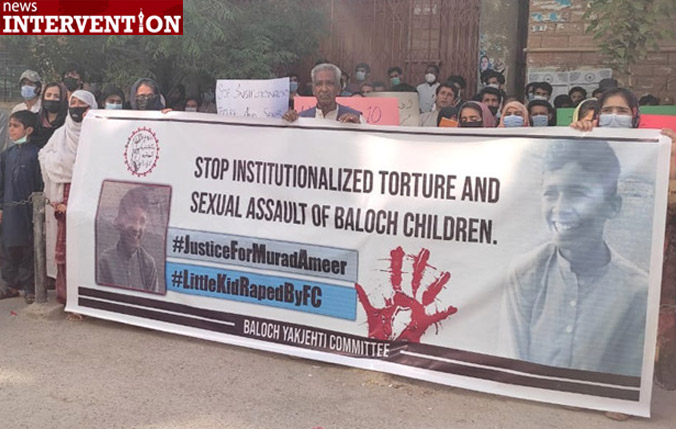
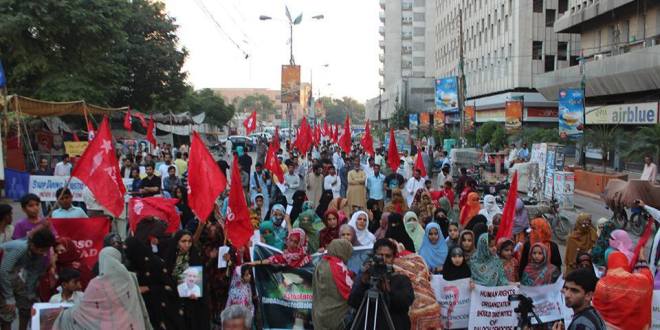
The Baloch Student Organization (BSO) held a protest rally in Quetta on Friday, calling for justice for the ten-year-old victim of the Hoshap incident who had been molested by FC soldiers. Scores of participants took to the streets, carrying placards and demanding that the culprit be brought to justice. A demonstration was also held in Turbat, Kech, where the victim’s mother participated and addressed the gathering.

Scores of participants, led by the Baloch Student Organization, held a demonstration in front of the Quetta Press Club on Saturday where the participants repudiated the medical report of the Hoshap incident and demanded that the authorities arrest and bring the culprit to justice. Several members of the Balochistan National Party, social and political workers, students and the civil society participated in the gathering in large numbers.

Addressing the gathering, the speakers said that Pakistan has a long history of inflicting tyranny on the Baloch nation. The Baloch Student Organization always stood in way of this repression and will continue to do so in future. They said that our history is the testimony of our peaceful struggle against oppression – we must not be forced to pick up arms.

Another speaker from the Balochistan National Party said that such incidents reflect the sinister face of the Pakistani state. Dr Shazi Khalid also suffered molestation, and now Murad Baloch had to go through the same ordeal. This kind of repression in Balochistan means one thing – the state cares only for the resourceful land of Balochistan, not for its population, he said. He said that despite the cruelties, his party – BNP – will stay beside the Baloch students in their struggle.

A demonstration was also held in Turbat, Kech, on Saturday where hundreds of individuals marched on the roads in pursuit of justice. The participants, chanting slogans and carrying placards, said that Pakistan is repeating in Balochistan what it did to Bangladesh in 1971. Addressing the gathering, the victim’s mother said that the Pakistani forces must shoot us down, or blow us up in via bombs, but not strip us of our honor. She said that this ill has not befallen her family alone, but the entire Baloch nation.

BSO-Azad, the “pro-independence” offshoot of the Baloch Student Organization, also condemned the incident in a recent media statement, saying that the Pakistani forces are involved in all sorts of human rights violations in Balochistan. The statement said that the “colonial oppression” has reached such a critical level in Balochistan that innocent minors are targeted in broad daylight.

The statement said that such incidents frequently occur at the hands of the Pakistani security forces throughout Balochistan, but media houses and world organizations are exhibiting a deafening silence. We request the United Nations and other global organizations to see through the lies of the Pakistani state and take notice of the rampant human rights violations occurring in Balochistan, the statement concluded.

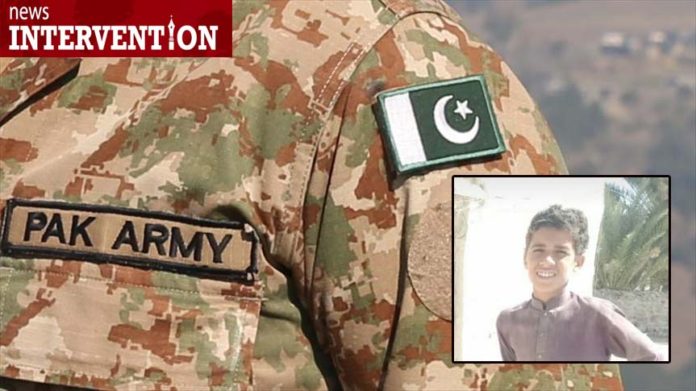
The Hoshap incident has agitated and galvanized a large portion of the Baloch society where thousands are running campaigns on roads and social media, demanding justice for Murad Baloch. Murad, a ten-year-old boy, was sexually assaulted by FC soldiers a few days ago in Hoshap. His family members have said that the incident occurred when Murad and his brother were on their way to a garden near the FC check post. The FC soldiers saw them; they beat up his brother and forced him to flee. They cornered Murad, tortured and molested him and left him unconscious in the wilderness. He regained his consciousness and came back home weeping.

The whole nation is tormented by the sexual violence against the young Murad Ameer. BNM

The incident with the young Murad Amir is a blow to our collective spirit and honor.

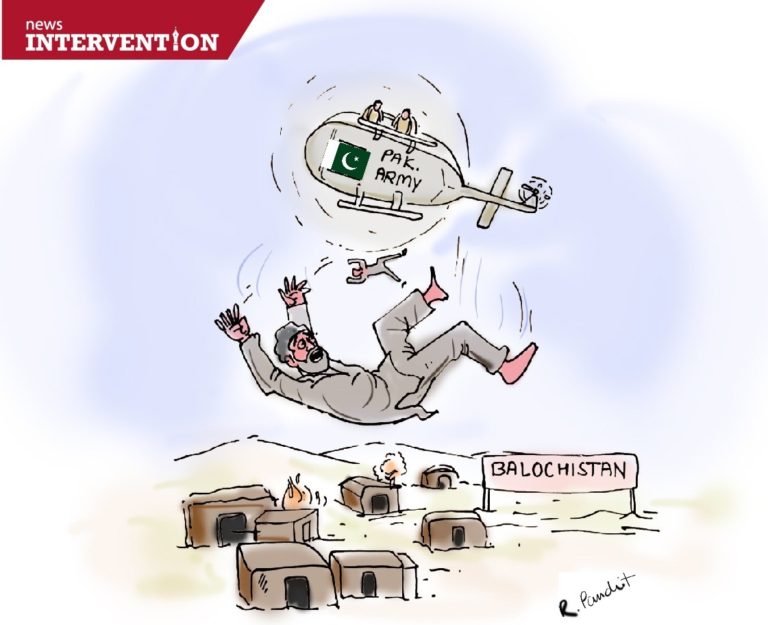
The central spokesman of the Baloch National Movement strongly condemned the rape of a minor, Murad Ameer, by the Pakistani army in Hoshap, district Kech, saying that the Pakistani army was not a human being but a mob of beasts. The army has been committing crimes against humanity and war crimes in Balochistan for the past two decades, including the Baloch genocide. We have been providing information to the world for many years that Pakistan should be held accountable for war crimes in Balochistan so that it does not repeat the bloody and inhumane history of Bangladesh. The silence of international organizations, media blackout and the attitude of journalists and human rights organizations towards Balochistan have exacerbated this horrific situation.

He said it was not the first of its kind and would not be the last. In Balochistan, many women and children have fallen victim to such atrocities at the hands of the Pakistani army, but only a few of them have come to light. Traditionally in Baloch society, due to the sensitivity of the issue like rape, the family members of the victims themselves refrain from talking about it, but nowadays the main and basic reason is the immense pressure from the Pakistani army. In this case also, an attempt is being made to silence the victim’s family through money and threats. Murad Ameer’s elder brother has been taken into custody by the Pakistan Army and threatened to withdraw the FIR. But as long as we remain silent, this savage army will continue to increase its atrocities. The Baloch as a nation must speak out on this issue and expose the ugly face of Pakistan.

The spokesman said that there was no room for such incidents in Baloch society. Even the worst of characters are reluctant to do such a thing. The whole nation is tormented by the sexual violence against the young Ameer Murad at the hands of the Pakistani army. If our response is weakened, Pakistan will not leave any stone unturned in humiliating us and will continue to undermine our national dignity and our traditions.

He said that whether it was the incident of Hayat Baloch or today the rape of Murad Ameer, Pakistan could fall to any extent to humiliate us, kill us and subdue us psychologically. This state cannot be expected to be a good, humane and produd enemy. Living in Pakistan and living a life of Baloch national identity and dignity is nothing but aspiration.

The spokesperson said that the incident with the minor Murad Ameer was a blow to our collective spirit and honor. We will not forget such atrocities for centuries. The enemy must remember that if the alive nations could be subjugated by such heinous acts, Bangladesh would still be a slave to Pakistan.

Pakistani occupied Kashmir sexually explicit with innocent kid – Writer: Junaid Kamal

This is neither the first nor the last time a Pakistani soldier has sexually abused an innocent child in the Dhirkot region of Pakistan-occupied Kashmir Bagh. The evil army’s trousers were taken off in Bangladesh when the Bangladeshis were united and organized, and the country is now a free country.


The Pakistani occupying army has played this role in Balochistan, and Ameer Murad from Hoshab, Balochistan, was recently raped by Pakistani FC personnel in Hoshab. The Baloch nation began an organized war against them as a result of their position in Balochistan, and the Baloch nation is now on the verge of independence. The fight of wills has been lost.


Rape of children and women is a daily occurrence in Pakistani Occupied Kashmir, especially in the border areas at the same time, the army manages to cover up such incidents. Dhirkot a soldier was raping a child at a time when a law is being made about the Pakistani army that anyone who speaks against the army will be punished. Is being given a legal right.


Rather than handing over the soldier who raped the innocent child to the authorities, the soldiers were saved by the locals and later sent across the coal. He is accused of torturing a soldier for raping a girl, according to a police report. In other words, the occupying forces should rape our children and the case should be made against our people. Where is the justice? What can be done against the occupying forces in the enslaved areas? The mockery movement against the army which is rooted in such incidents. As a slave nation we must analyze the role of the occupying army from Bangladesh to Balochistan and movement against this unbridled fascist evil army.

Balochistan: 200 Baloch killed, 705 missing in 682 Pak military operations in 2020

The year 2020 passed as another difficult year in Baloch national history, where Pakistani military operations and bloodshed continued through ground attacks and air operations till the last sunset of 2020. Serious human rights violations across occupied Balochistan and the Pakistan Army’s war crimes operations’ data have been compiled by Sangar group that in turn have been obtained from Balochistan’s official print media, online and social media and locals in the concerned areas.

The Pakistani military conducted 682 operations across occupied Balochistan during the year, and 705 Baloch went missing at the hands of Paki security forces. In the year 2020, at least 200 Baloch bodies were recovered and 122 Baloch were martyred by military, intelligence agencies and state-backed death squads. Of these the motive of killing of 60 Baloch people could not be ascertained and 18 Baloch bodies could not be identified.

During operations, the Pakistan Army looted more than 2,200 homes, plundered everything and set more than 1,100 homes on fire.

Baloch women march to protest against unlawful abductions by Pakistani regime.

According to the available data, Pakistani forces also set up 60 new outposts across occupied Balochistan. Also, during the operations, more than 4,000 cattle were killed and more than 2,000 were taken away by the forces as booty.

In the same year, the Pakistan Army launched a new series of war crime by burning off natural forests throughout Balochistan, including Dasht, Buleda, Parom, Zamuran, Mand, Jhaoo, Gichk, Mashkai, and Bolan.
Pakistani forces also set fire to three schools in Buleda Tehsil of Kech district.

Click on the YouTube link to watch our news video report

Further, in the year 2020, 106 missing persons were recovered from the forces’ dungeons; most of which had gone missing in different months of the same year. Interestingly, no human rights organization in the world has ever tried to find out where these Baloch missing people were. No one bothered to question Pakistani forces in this regard. This is a shame for human rights organizations and the mainstream media.

Year 2020 was devastating for the Baloch nation, where state bombings and operations began earlier in the year. The assassination of Sajid Baloch in Sweden and the martyrdom of Karima Baloch added another bloody chapter to Baloch national history. After the sudden disappearance and assassination of Sajid Baloch in Sweden, the assassination of Baloch leader Banuk Karima Baloch in Canada shook the Baloch nation.

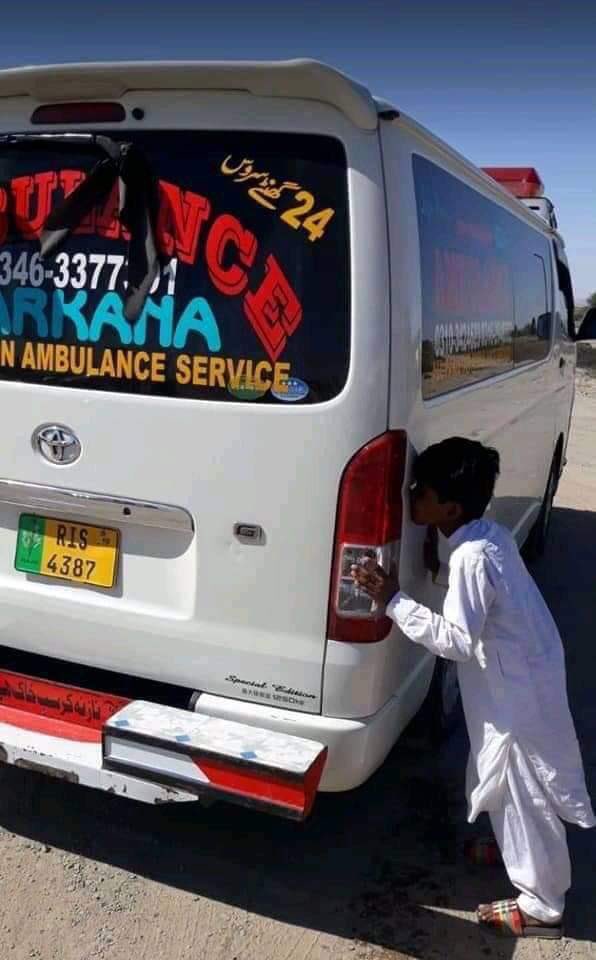
A Baloch boy kisses the ambulance carrying Karima Baloch's dead body. (Photo: News Intervention)
A Baloch boy kisses the ambulance carrying Karima Baloch’s dead body. (Photo: News Intervention)

Karima Baloch was an effective voice. She was martyred under a special and organized strategy. There was hardly a street, village or city in occupied Balochistan where there was no protest against the murder of Karima Baloch. Karima Baloch was a revolutionary and the reaction to her martyrdom made it clear to the world and the murderous state of Pakistan that Karima is the name of a thought, rather an individual.

The ongoing atrocities in Balochistan over the past two decades have been increasing with each passing month and year. Seeing this, one can better imagine Pakistan’s intentions for the Baloch national genocide. There is no area left that has not been set on fire, people have not been evacuated, and houses have not been set on fire. In fact, no area in Balochistan is safe.

Daily, the Pakistani military and intelligence agencies are picking up people and disappearing them. Homes and cattle are being looted. They have even created an outsourced model to create terror in the form of death squads that together with the state forces, intelligence agencies, and the Pakistan Army has made life hell for the Baloch people on their own soil.

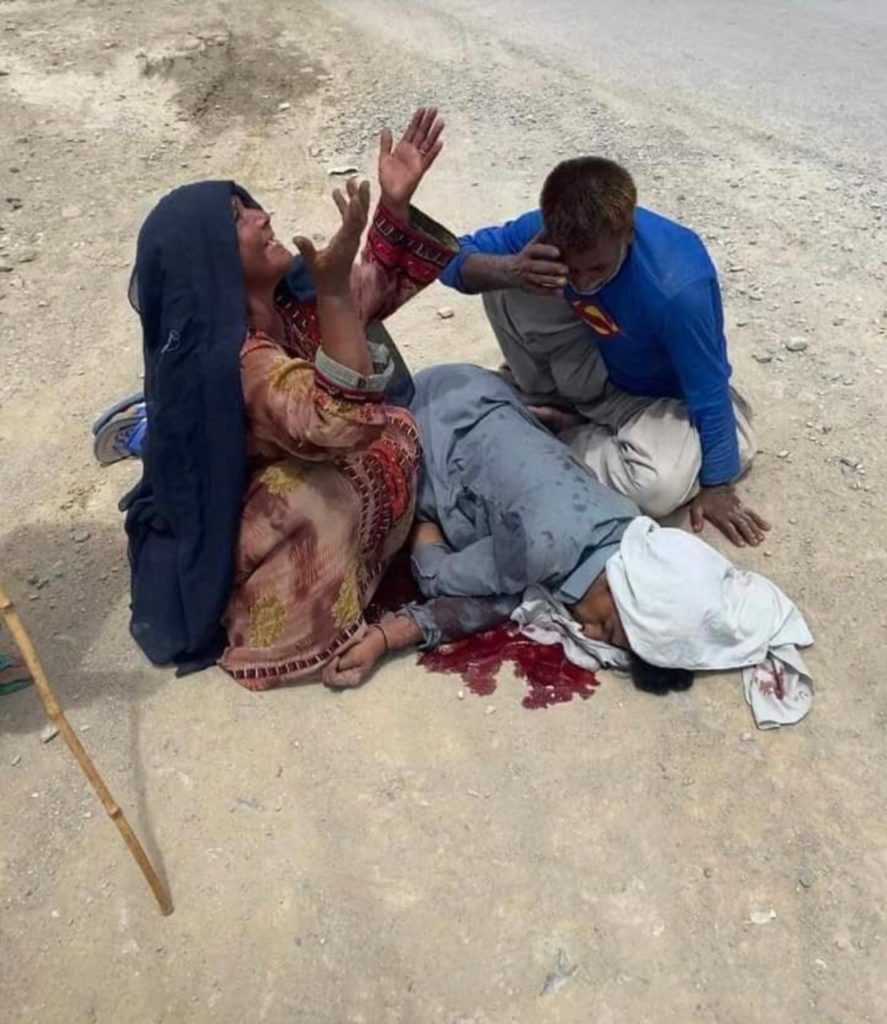
Mother and Father of Hayat Baloch crying over the body of their son. Hayat Baloch was a student and was murdered in cold blood by the Pakistani security forces in occupied Balochistan. (Photo: News Intervention)

The young Baloch children are picked up in front of the eyes of the people. The people have become a practical example of helplessness who have been protesting for years in protest rallies and hunger strike camps in the hope of return of their loved ones.

It is clear that Pakistani barbarism has given birth to a human tragedy in Balochistan. The affected families are in an indescribable situation. This situation is getting worse day by day.

Disappearing people is a serious crime. No law in the world allows a person to go missing, but this inhumane act is on the rise in Balochistan. This is a clear war crime. Pakistan should have been brought to book for this crime but at the cost of people’s emotions, compulsions, and human tragedy, Pakistan is being acquitted of this crime.

The year 2020 also witnessed dozens of Baloch people including Malik Naz being martyred. Malik Naz’s little child Bramsh was wounded in Dannuk, Turbat. This, once again made Balochistan the center of global attention. Similarly, Hayat Baloch was dragged in front of his parents by the occupying Pakistan Army and shot eight times in a row. The photo of his parents with the body of martyr Hayat Baloch on social media shook humanity and yet the the oppressors and human rights organizations did not notice it.

Click on the YouTube link to watch full video

The picture of Hayat Baloch’s parents sitting with their son’s dead body and their cries may have reached the skies, but we didn’t hear anything from international mainstream media and global champions of human rights. Hayat, with his blood, sent a message to the nation that you are slaves! Just a slave!

It should be noted that due to the control of Pakistani establishment over media in Balochistan, the Pakistan Army has become completely unrestrained and it has committed war crimes without heeding any international humanitarian and war laws.

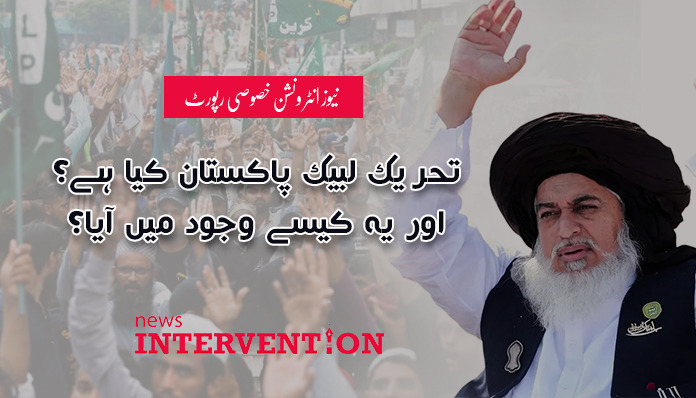
Whose baby is Tehreek-e-Labbaik Pakistan?

The anarchy and bedlam let loose by the extremist right-wing party Tehreek-e-Labbaik Pakistan (TLP) in Lahore and other major cities of Pakistan is the reward deservingly offered to the politicians of Pakistan. It is a stunning example of Frankenstein monster.

The TLP came into existence in 2015. Its main agenda is to run down all religious denominations in Pakistan except the Sunni Wahhabi faction, which it considers the only truly Islamic. In particular, Ahmadiayas and Christians are their main targets, though other religious minorities do not fall outside the ambit of their long-range agenda.

What triggered the formation of TLP was the verdict of the Pakistan Supreme Court staying the hanging order of Asia Bibi, a Christian woman charged under the blasphemy law. Khadim Hussain, the founder of TLP vowed that he would see to it that the blasphemy law was implemented in letter and spirit in Pakistan and that it was his moral and religious duty to decimate all those who attempt to show disrespect to the Prophet of Islam.

Some hardliners of the TLP demanded that all the three judges of the Supreme Court who had ordered the stay of execution order should be killed. Someone from their guards, attendants or cooks should put an end to their lives was the public cry. Governor Taseer of Punjab was shot dead by his guard just because he had visited Asia Bibi in the jail and sympathized with her. His murderer Qadri was hailed a hero by the goons of the TLP and a basketful of flowers was showered on him for performing an act in service of Islam.

In 2017 Pakistan government changed some wording of the blasphemy law which the Tehreek-e-Labbaik fiercely resented. And now, during the last fortnight, the furious demonstrations going on in Pakistan by the Tehreek-e-Labbaik have almost paralyzed the administration. They demand that the French Ambassador in Pakistan is deported and a boycott of French goods announced. How does France come in, is the question?

Why is Tehreek-e-Labbaik against France?

In 2020, Samuel Paty, a French school teacher was decapitated by his 18-year old student of Chechen origin in a French school because Paty had shown a caricatured picture that offended the murderer’s sentiments. The French police, in trying to nab the murderer, met with resistance as a result of which the police shot him dead. This event caused a commotion in the circles of radical Islamists not only in France but in other Muslim countries in the West Asian region also.

However, Emmanuel Macron, the French President said in a statement that France gives priority to freedom of expression and that France would not curb that freedom in any way. He said that Islamists want to replace the legal system with sharia and France would never allow that to happen. Apart from announcing France’s policy of zero patience on radical violence, France had taken certain decisions to curb the nefarious and exclusivist tendencies among a section of the French Muslim population that comprises about 30 per cent of the total population of France.

France announced control on the funding of mosques; it forbade political propaganda carried out by the clergy in mosques; it disallowed the veil for the Muslim women. President Macron said that France respects all religions but she is not going to succumb to the intimidation of fanatical Islamists who want a different system for themselves.

The pan-Islamists took big offence to the frank and fearless statement of the French President. Though succinct, it conveyed to overbearing Islamists in France and elsewhere in the European states a message that they shall have to live within the limits and abide by the constitutions of the respective states and that freedom was not something absolute. The pan-Islamist leadership considered it a challenge and they reacted furiously to bring about the charge against President Macron that he is anti-Islam. Top leaders of two Islamic countries, namely Erdogan of Turkey and Imran Khan of Pakistan came out openly against President Macron and began issuing indirect threats and used insulting language. Erdogan said Macron’s mental state was doubtful. He said that since Macron was against Islam, therefore, he was against Turkey also. It meant that Turkey was considering France an enemy. Erdogan exhorted the Muslims all over the world to boycott French goods.

It has to be recalled that Turkey, Pakistan and Malaysia want to create a pan-Islamic block with an aim to wrest the leadership of the Muslim world from the hands of Saudi monarch. It has caused a rupture in Muslim society between the Semitic and non-Semitic Muslims

Imran Khan went a step further. He said that President Macron was trying to divide the Muslims as colonizers used to do. He said that it was an attempt to spread Islamophobia and he wrote a letter to the CEO of Facebook asking him to ensure that it did not allow Islamophobia to be traded on mobiles. He strongly urged the Islamic countries to boycott French goods and this was in line with what Erdogan was preaching. Neither Turkey nor Pakistan said a word against Islamic Theo-fascists who were spreading hatred on a religious basis. The truth is that both of them were giving vent to their pent up emotions against France for imposing restrictions on Islamic extremism in that country.

France has nearly 30 per cent Muslim population mostly emigrants from North African countries and West Asia. These emigrants and asylum seekers are provided with all rights and privileges available to them under the UN Charter and perhaps much more than that. The French government never discriminates against them and gives them an equal opportunity for growth and development. It is an irony that these radicals should rise against the world’s most liberal and freedom-loving country.

Making the statement of French President the cause for agitation, TLP (Tehreek-e-Labbaik Pakistan) took to streets and mass agitation and demanded deportation of the French Ambassador. Imran Khan government engaged the Labbaik leadership in dialogue and an agreement was arrived at giving the government 20 April as the deadline for the expulsion of the French Ambassador. And when that did not mature and the government said it wanted an extended date, the TLP gave a call for mass movement and the entire country saw millions of demonstrators defying law and order and even taking several policemen as hostages. Lahore became a battlefield between the security forces and protesting crowds. The government was unnerved. It took the leader Saad Rizvi into custody and said a ban would be imposed on Tehreek-e-Labbaik.

The question is who should be held responsible for the chaotic situation that Pakistan is in. All radical and extremist groups in Pakistan are the creation of Pakistan Army and ISI primarily to create the first line of offence (by proxy) and second line of defence against India. These legions had to be indoctrinated with hate India ideology and also with adherence to suicide (shahadat) ideology as specific to Islamic history. Over so many decades, the indoctrination in madrasas went on till the huge mujahedeen force was ready to execute the instructions of their mentors.

Tehreek-e-Labbaik Pakistan (TLP) is also a part of this series and it has been given the mandate of liquidating the Christians under the blasphemy law and also the Ahmadiyas. They targeted the Christians. But when some saner elements in Pakistan began questioning the rationale behind the blasphemy law the rulers found themselves in an embarrassing situation. The critics became new victims. French President’s statement became a pretext for them to pillory the government and show that they could flex the muscle. The statements given by leaders like Erdogan and Imran Khan in the context of the Samuel Paty murder case greatly fuelled the flames of communal hatred. They are the real culprits for inciting the public and the Tehreek-e-Labbaik lost no time in leading the unprecedented protests. Pakistani leaders and army echelons have to understand that their anti-India tirades have begun to boomerang on them. This is only the tip of the iceberg. The future is much more to unfold for a nation torn between the two diktats — that of the Pakistan Army and the clergy.
Mirza Ghalib has put it nicely:
Jata hun thori dur har ik rahrav ke sath
Pahchanta nahin hun abhi rahbar ko main

Tehreek-e-Labbaik is a pawn in the hands of Pakistan Army

Pakistan’s religious organization Tehreek-e-Labbaik Pakistan (TLP), which is fully backed by the Pakistan Army and has wide political support has now been banned by the Pakistani regime. Violence and protests have been going on across Pakistan for the past few days by the Tehreek-e-Labbaik Pakistan (TLP) all over the country.

The spate of recent protests by Tehreek-e-Labbaik began on April 12 after the arrest of party chief Saad Rizvi from Lahore. Earlier, the Tehreek-e-Labbaik Pakistan (TLP) had warned the Pakistan government that if the French ambassador is not deported from Pakistan by April 20 and diplomatic relations with France are not terminated, the TLP would sit on a protest at Faiz Abad Square in Islamabad from April 20. Thereafter Imran Khan-led Pakistan’s civil regime panicked and Saad Rizvi was arrested to prevent a sit-in on April 20. But soon after Saad Rizvi’s arrest TLP instigated violent protests across Pakistan.

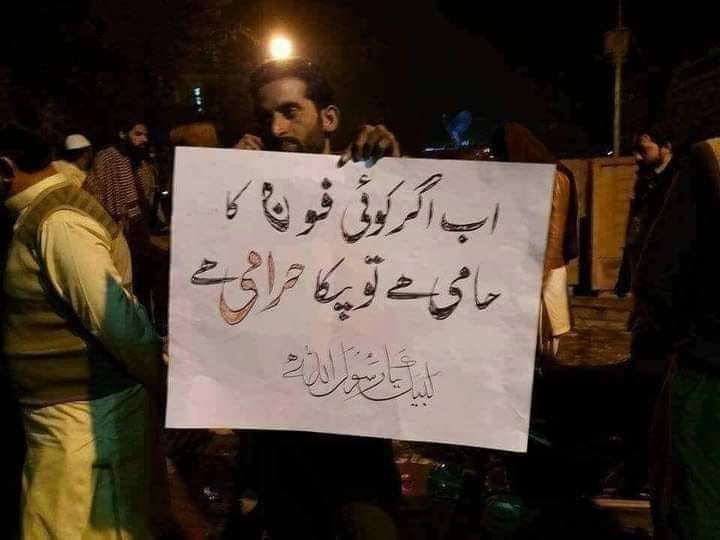
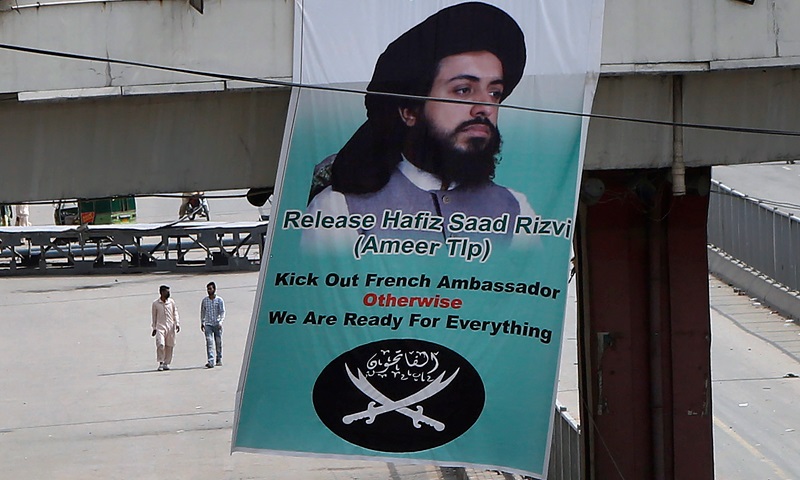
TLP has put up posters (as above) demanding the release of Saad Rizvi, current chief of Tehreek-e-Labbaik Pakistan (TLP). The Labbaik cadre has also issued an ultimatum to Imran Khan-led Pakistan government to deport the French Ambassador from Islamabad.

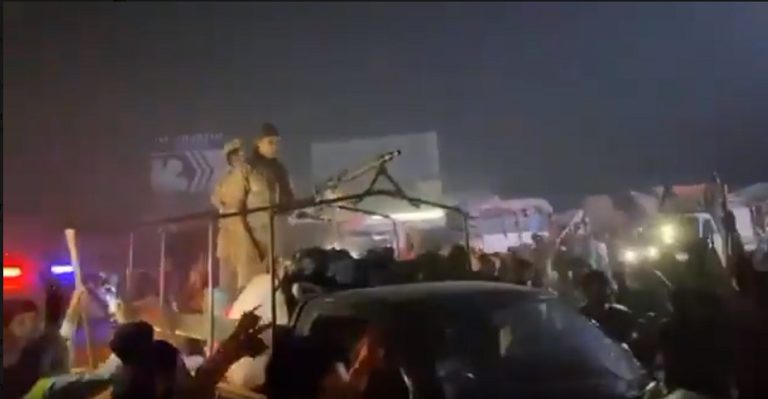
Activists of this religious tanzeem (organization) have blocked roads in several cities that include Lahore, Islamabad, Karachi and Quetta and have allowed sit-ins. More than 300 people have been injured in the clashes and five others, including the two policemen who were injured in an attempt to disperse the protesters, died in this clash.

Following violent protests by the Labbaik movement, Pakistan’s Interior Ministry banned the organization under 1997 Anti-Terrorism Act. Announcing the ban, Pakistan’s Interior Minister Sheikh Rashid said that the decision was taken on the recommendations of Punjab government. Sheikh Rashid explained that the ban on Tehreek-e-Labbaik (TLP) would destroy TLP’s political activities and freeze their financial assets. This ban was imposed under Rules 11B of the Anti-Terrorism Act 1997 for which only the cabinet requires approval.

It may be recalled that in 2017 when Nawaz Sharif was in power and the Tehreek-e-Labbaik Pakistan (TLP) movement was coming to Islamabad to hold a sit-in, then the interior minister Sheikh Rashid, who was in opposition at the time had warned the government and came out in support of TLP. Rashid had said that from now there would be a movement of the Prophet (peace be upon him) that even your looted wealth will not work and it will also bring down the outdated system. However, now that the TLP’s sit-in was announced against government of Imran Khan the tanzeem has been banned and is being called as a terrorist organization. The violent protests of TLP which was appreciated by Sheikh Rashid during his opposition days has now been declared wrong when his party is in power at Islamabad.

According to another report released by the Interior Ministry, people from across Pakistan were arrested during violent protests by the Tehreek-e-Labbaik Pakistan over the past three days of which 1,669 were arrested in Punjab and 228 in the Sindh province. The report said that 193 people were arrested from Khyber-Pakhtunkhwa and 45 from Islamabad while anti-terrorism cases have been set up against the detainees.

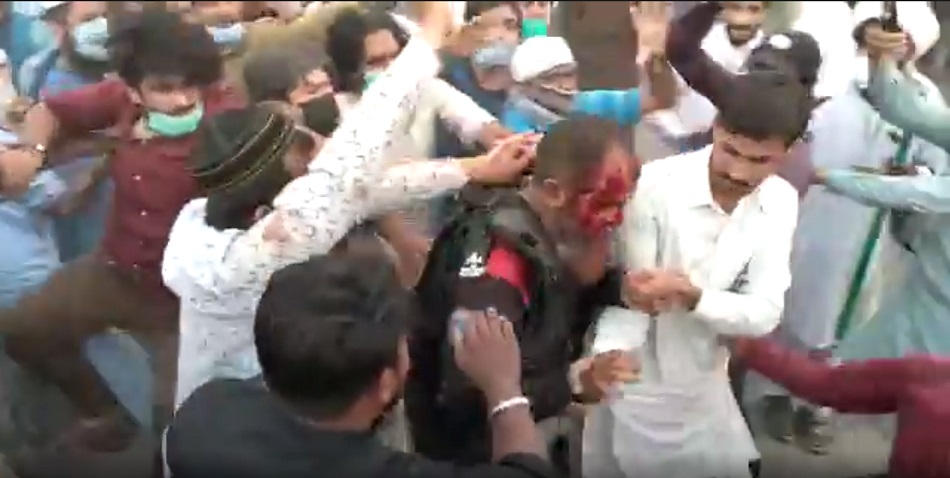
Tehreek-e-Labbaik cadre beating up a Pakistani policeman. Tehreek-e-Labbaik has support of the Gen. Bajwa group in the Pakistan Army.

Tehreek-e-Labbaik Pakistan — Background

Tehreek-e-Labbaik Pakistan (TLP) was founded by Khadim Hussain Rizvi in 2017. Khadim Hussain Rizvi, a Barelvi-minded cleric worked in the department of endowments and was a preacher in a mosque at Lahore, Pakistan.

In 2011, when a Punjab Police Guard Mumtaz Qadri assassinated Punjab Governor Salman Taseer, Khadim Hussain Rizvi had openly supported Mumtaz Qadri. Due to which Rizvi was fired him from the Punjab’s department of endowments.

After this not only did Khadim Hussain Rizvi moved for the protection of Prophethood Law and Article 295C of the Constitution, but also remained active for the release of Mumtaz Qadri. Khadim Rizvi held a rally in January 2016 in favor of Mumtaz Qadri without the government’s permission. Later, when Mumtaz Qadri was hanged Khadim Rizvi turned to Islamabad’s D-Chowk to protest against his hanging. However, after negotiations with the government, the protest ended within four days.

At the end of this sit-in, Khadim Rizvi announced that he would form a regular religious party in the name of ‘Muqtah Labbaik Pakistan al Rasoolullah’. At this time the movement was not registered by the Election Commission as a political party, but Sheikh Azhar Hussain Rizvi, the party-backed independent candidate ran for office in September 2017 and won 7,130 votes in the National Assembly of Pakistan, which was vacated after the disqualification of former Prime Minister Nawaz Sharif. 

Khadim Rizvi, was a radical Barelvi cleric who laid the foundation of Tehreek-e-Labbaik with active help from Pakistan Army.

Under the leadership of Khadim Rizvi this movement once again turned towards Islamabad against the proposed amendments in the Election Act 2017 by the then Minister of Law Zaid Hamid in November 2017 at Faizabad, the confluence of Rawalpindi and Islamabad. A long but seemingly successful sit-in against the amendment to the law greatly increased the reputation of not only Khadim Rizvi but also the movement of Labbaik in Pakistan. It’s quite clear that behind this sit-in of the Labbaik movement was Pakistan Army and the ISI. The Labbaik movement helped replace removal of the then Prime Minister Nawaz Sharif and the abolition of Muslim League’s vote bank in Punjab. However, it also became clear that the Pakistan Army distributed money to all those who took part in this Labbaik sit-in. As a result of the sit-in at Islamabad the law minister had to resign and for the first time, the government signed an agreement with the Tehreek-e-Labbaik Pakistan (TLP) acknowledging their demands at the sit-in.

When a video of money being distributed by a Pakistani military officer went viral, Justice Qazi Faiz Isa, a senior judge of the Pakistan Supreme Court who is from Balochistan, took note and exposed the hands involved behind the sit-in. Justice Qazi Faiz Isa also revealed the names of other people who were involved.

The military establishment and Imran Khan’s government filed a case in the Supreme Court against Justice Qazi Faiz Issa of the Pakistan Supreme Court for taking action against Pakistan Army, which is still pending today. Today Pakistan’s mainstream media is openly casting aspersions on Justice Qazi Faiz Isa’s character and his family is also being defamed. As a result Pakistan’s judiciary has also become a supporter of the Labbaik movement or the Islamist extremist ideology.

Taking advantage of the success of 2017 Islamabad sit-in, TLP soon announced its candidacy across four provinces in the 2018 general elections and fielded a total of 559 candidates in the National and Provincial Assembly, two of whom were candidates from the Sindh Assembly. Tehreek-e-Labbaik Pakistan (TLP) soon emerged as the fifth largest party in the country in terms of votes in the National Assembly elections that received more than 2.2 million votes. TLP boasts of three members in the provincial assembly at present. In addition, Khadim Rizvi also had a madrassa in Lahore named Abu Ghaffari. TLP has been made a major force by providing full political and logistical support to the Pakistani military and its support organizations, PTI (Pakistan Tehreek-e-Insaf) and the Q-League, among others.

Build up of the current scenario

In November last year Khadim Rizvi led a movement against France’s Charlie Hebdo magazine for publishing sketches on Prophet Mohammed. Tehreek-e-Labbaik Pakistan (TLP) under Khadim Rizvi demanded that French ambassador be deported from Pakistan. TLP also demanded a total boycott of French products in Pakistan and severance of all diplomatic relations with France. However, Khadim Rizvi died in November 2020 and his son Saad Rizvi was appointed as the new chief of Tehreek-e-Labbaik Pakistan.

After Khadim Hussain Rizvi’s death and Saad Rizvi’s appointment as the chief of Tehreek-e-Labbaik the Pakistani regime entered into a second agreement with TLP regarding the deportation of French ambassador from Pakistan and TLP’s demands for an end to diplomatic relations with France. Under this agreement, the Pakistani regime agreed to not only take steps to deport the French ambassador from Pakistan by April 20, 2021 but to also remove names of all members of the Tehreek-e-Labbaik from the list of Fourth Schedule, which effectively means striking off the names of TLP cadre from the list of terrorists.

Imran Khan’s government signing an agreement with the Tehreek-e-Labbaik for deportation of the French ambassador and severance of diplomatic relations with France was practically impossible. Imran Khan took this agreement quite lightly and thought that the Tehreek-e-Labbaik will forget the agreement and that the sit-in being called off the entire movement would fizzle out.

But when Tehreek-e-Labbaik announced another sit-in at Islamabad on April 20 the government panicked and arrested TLP chief Saad Rizvi. Now the Pakistani regime has reached a dead end because Imran Khan’s government is not in a position to accept TLP’s demands for deportation of the French ambassador and termination of diplomatic relations with France, nor is it possible. On top of this there is this pressure of being black-listed by the Financial Action Task Force (FATF). Pakistan is already on the FATF grey list.

France is among the FATF members that has taken steps against money laundering. If Pakistan takes any action against France under pressure from radical Islamists of Tehreek-e-Labbaik, in all likelihood Pakistan will then be blacklisted by the FATF. To complicate matters further, the French government has already issued instructions to its citizens, including their traveling staff in Pakistan, to leave Pakistan immediately.

Prominent Pakistani journalists and political analysts are calling Imran Khan’s ban on Tehreek-e-Labbaik a mere pretense as they believe that the government simply cannot implement it.

Ban on social media in Pakistan

Tehreek-e-Labbaik is quite active on social media like other political parties in Pakistan. The Twitter account of the former head of the organization Khadim Rizvi, which had millions of followers, was closed on a complaint by the government of Pakistan, but there still are numerous accounts and pages on the organization’s Facebook and Twitter, while there are two official channels on YouTube.

Tehreek-e-Labbaik has several thousand followers through these social media accounts which the organization uses to mobilize the public to come for protests and sit-ins. Social media is also an important means of popularizing the TLP’s ideology and drumming up support for it.

The Labbaik movement is, in fact, a product of Pakistan Army’s Islamist religious ideological production, under which it sells Islamist and religious extremist ideologies to Muslims and arouses religious sentiments of Pakistani Muslims.

According to political analysts, although Pakistan Army was instrumental in installing Imran Khan as Pakistan’s Prime Minister, yet during the last two and a half years, Imran Khan’s government has not delivered anything noteworthy. On top of this the opposition’s coalition PDM has called Pakistan Army bad for the country’s economy which is responsible for worsening situation in Pakistan. Country’s corruption, restriction on freedom of expression, increase in enforced disappearances, control of mainstream media and social media and the worsening of economy has led people from all walks of life to blame Pakistan Army for all their ills. This has led to a low morale in the ranks of Pakistan Army.

Yet the failure of current civil government of Pakistan in the form of Imran Khan is entirely the work of Pakistan Army because the civil government of Imran Khan is just a façade that has no authority in its hands. Pakistan’s state and routine administrative affairs are also being run entirely by the military, which, due to lack of experience, is leading Pakistan to anarchy because the military does not have a political vision and no country can be coached at gunpoint.

The buzz in Islamabad is that the Pakistan Army is not happy with Imran Khan’s government, so the movement of Tehreek-e-Labbaik has been used to prepare ground for removal of Imran Khan’s government. This is a tested method of Pakistan Army that had earlier used Tehreek-e-Labbaik to topple Nawaz Sharif’s government. Now another drama is being propagated to gain credence for the removal of Imran Khan’s government.

Also if one closely analyzes the backend support for radical Islamist and religious extremist organizations such as Taliban, ISIS, Al-Qaeda or the Tehreek-e-Labbaik the involvement of uniformed men of the Pakistan Army can be clearly seen. These Islamist terrorist organizations are all assets created by the Pakistan Army who are used as pawns to further the interests of uniformed officers and to create mayhem across the world in the garb of Islamic religious activities.

World has declared ISIS and the Al-Qaeda as largest and most powerful terrorist organizations but in reality it’s the Pakistan Army that calls the shots and has direct influence over their actions. It’s time the world accepts this reality.

Is the Pakistan-occupied “Azad Kashmir” really free?

How Free is Azad Kashmir? Do Kashmiris enjoy any kind of freedom in this part of Kashmir which has been under Pakistan’s illegal occupation since 1947? Watch this video report to know about the condition of Kashmiris in Pakistan-occupied Kashmir.
Click on the YouTube link below to watch our video report.

Click on the YouTube link to watch out news video report

Pak Army officer rapes a Kashmiri boy in POK

Pakistan Army officer Zawar Hussain rapes a Kashmiri boy in POK (Pakistan-occupied Kashmir). This incident happened at DhirKot in so-called “Azad Kashmir” where a 11 year old Kashmiri boy was raped by Zawar Hussain, an officer of the Pakistan Army. Zawar Hussain is originally from Chakwal, Pakistan’s Punjab province and was stationed at Charala village in Dhirkot where he committed this crime.
Click on the YouTube link below to watch our news video report.

Click on the YouTube link to watch our news video report

Afghanistan: What does the future portend?

Oblivious Precepts
Before we analyse the future portends for Afghanistan, let me spell out some oblivious precepts, which have a bearing on the likely prognosis.
* War/confrontation is seen as an exception, an extreme and an aberration in international affairs; the paradox is that it is the invention of peace which is the artificial edifice.
* Scenario building/forecasting difficult in geo-politics. The most vibrant characteristic of geo-politics is ‘uncertainty’.
* Why does the World ‘NOT’ leave Afghanistan alone, to decide their own future?
* India is gaining significant influence in Afghan peace process, but does not carry definitive political heft and capabilities to be a decisive/pivotal constituent in the peace process.

Background to Current Imbroglio
Four US Presidents have overseen the longest war being fought by USA starting 9/11/2001 which will soon enter its third decade. All without exception wanted a ‘quick in and out’ after achieving geo-political and strategic victory, but had no choice but to stay, with actual troop involvement forming a sinusoidal curve. Let us not forget that their initial aim was to eliminate Al-Qaida from Afghanistan, which they largely accomplished in a very short period. The war has already cost more than $1 trillion directly[i], and its broader costs are at least double that figure. Ironically, in case of Afghanistan, history seems to be repeating itself.

President Trump’s Legacy
Following up on one of the main planks of his election policy of ‘America First’ and ‘not fighting others wars’, Trump favoured fixing ‘time lines’ for withdrawal and quickly announced the same. He subsequently backtracked on the above policy under domestic political compulsions and stoutly asserted that US Forces’ withdrawal from Afghanistan would be solely dependent on the security and stability situation prevailing in Afghanistan. As is his wont, he upended everything and everybody including his closest aides by reaching a “US-Taliban Deal (Doha Accord)” with the Afghan Taliban in February 2020, to withdraw all US and NATO troops by 1 May 2021[ii]. In exchange, the United States received security assurances and a commitment from the Taliban to begin peace talks with the Afghan government.

Real Politik has no Morals
Perhaps nothing reflects the challenges facing the Afghan negotiations more starkly than the title “Agreement for Bringing Peace to Afghanistan Between the Islamic Emirate of Afghanistan and the USA which Is Not Recognized by the US as a State, and which is known as the Taliban” [iii] ! The leader of the Haqqani Network, Sirajuddin Haqqani, the second-in-command of the Taliban is on the US wanted list with a reward of $10 million for information leading to his capture or death. To top it all, the US considers the Taliban a partner in counter-terrorism (CT) operations against Al-Qaeda and IS and other terrorist groups.

Geo-Political and Strategic Rationale leading to Joe Biden’s Afghanistan Peace Plan
President Biden was left holding the hot potato. He had three stark choices; follow the timelines agreed by Trump (1 May); stay the Afghan course; or “accelerate the peace process” and carry out a ‘responsible withdrawal’, leaving behind a small counter terrorism (CT) force. Biden and Blinken (US Secretary of State) felt the last option is the best way to advance the shared interests of the US, her allies, and the people of Afghanistan (US-Taliban deal remains the pivot of the plan). The US assessment shared by most experts is that if American troops are pulled out of Afghanistan, the Taliban would make quick gains, clashes between Taliban and ANA (Afghan National Army) would escalate which would draw in US and allied troops, violence will spiral, talks between Taliban and Afghan National Government (ANG) will fail, leading to a very high probability of a civil war.

Biden’s Peace Plan
On 14 April 2021, US President Joe Biden, announced the withdrawal of all US troops including the civil contractors servicing them in a phased manner by 11 September 2021. Interestingly, US completes two decades of intervention on that date since 9/11 (9 September 2001). It is a unilateral announcement and the Taliban is yet to respond. The Biden administration has proposed a modified peace plan to the Afghan government and the Taliban, seeking to bring violence to a halt and form an interim government. The proposal included many elements; first, a UN-led conference of representatives of Russia, China, Pakistan, Iran, India and the US “to discuss a unified approach to support peace in Afghanistan”; share written proposals with the Afghan leadership and the Taliban to accelerate talks. It urges both sides to reach a consensus on Afghanistan’s future constitutional and governing arrangements (the Taliban and the Afghan government still disagree on fundamental issues, including whether the country should remain a republic or even retain any features of electoral democracy); third, find a road map to a new “inclusive interim government”[iv]; and lastly, agree on the terms of a “permanent and comprehensive ceasefire”. The proposal recommends a senior level meeting of the Afghan government and the Taliban in Turkey to discuss power sharing, reduction of violence and other specific goals. Essentially, the Biden administration is attempting to embed the peace process in a wider regional framework. The Biden administration has chosen a more decisive course in Afghanistan and has to make substantial movement on above aspects before final withdrawal.

Apathy of US Public assists Biden
Interestingly and surprisingly the Afghan issue is not in the US public eye, due to public apathy unlike other US military involvements, with majority of Americans thinking that the issue has been resolved, as also thanks to COVID, low casualties, volunteer army and hi-tech warfare being conducted (drones and missile warfare, aerial support both for logistics and warfighting). This will ease the domestic compulsions for Biden giving him time to activate the plan.

Afghan Govt stance: Geo-Strategic-Political Implications
The Ghani administration has consistently been critical of the US direct outreach to the Taliban. On the proposed plan, Ghani recently commented “My power rests on my legitimacy,” and “the moment that legitimacy is gone, the whole thing implodes. [v]” Vice President Saleh emphasised that the US “can decide on their troops, not on the people of Afghanistan”. Mr Ghani will find it very difficult to resist the pressure by the US, EU and the five nations requested to negotiate a way forward. Interestingly stake holders except possibly for India want US troops out. If Pakistan foresees continuation of US troops it will increase its support to Taliban with the backing of China. One thing is very clear, if Ghani rejects the plan and refuses to talk to the Taliban, we are looking at a very bleak future where great power and regional games will continue forever, and in all probability so will the fighting. Ghani’s failure to take the initiative has created a void that other actors are filling with proposals for peace, that address only their own concerns and do not grapple with the fundamental issues that hobble Afghanistan. The Afghanistan government’s inertia in this area has made it a mere spectator, while other stakeholders are getting poised to decide the fate of the country.

Some fundamental Non-Negotiables for Success of Peace Plan.

  • 90 days immediate ceasefire between Taliban and ANA (Afghan National Army), followed by comprehensive ceasefire. No targeting of US and Allied troops.
  • Non-interference by regional players in internal situation.
  • Interim reconciliation government to be formed.
  • Future of Taliban soldiers; absorption into ANA (Afghan National Army)? Disarmament and demobilization methodologies and packages to be worked out.
  • National bipartisan body to discuss constitution and type of political structure to govern Afghanistan.
  • Conduct of elections within a time bound period.

Stakeholder’s Stakes
Cutting all rhetoric to the bone, ALL Nations want mainly two things, which need not necessarily be aligned to Afghan interests specially its people.
* An Afghanistan aligned to their interests.
* Their strategic space, influence and economic payoffs are bettered, whatever the political dispensation, while ensuring ‘no spread of jihadi culture leading to terrorism[vi]’.

Taliban
The new agreement and the looming US exit places the Taliban in the strongest position they have ever been. The Taliban have demonstrated to the Afghan people, the world, and especially militant groups around the world, that they possess the (military) capability to resist a US invasion and outlast a superpower. They have made themselves an intrinsic part of any attempt to find a long-term solution for peace. As of March 2021, Taliban controls substantial real estate[vii] which gives them significant leverage in negotiating with the government: they are aware that Kabul will be forced to concede to most demands, if only to avoid the group from taking over more areas especially urban. Adding to the Taliban’s leverage is the political legitimacy it has managed to gain as an international actor; one that the US has negotiated with, and now asking them to be part of an interim Afghan government [viii] (and coercing Ghani!). The Taliban over the years has evolved its relationships with all regional stakeholders barring India. Here too Taliban has shown diplomatic finesse stating that it will not act nor allow any party to act against another country, specifically naming India[ix]. The Taliban has also been an active participant in the talks hosted by Moscow in November 2018 and March 2021, as also increasingly with Iran.

A word of caution: Taliban has always rejected the democratic ideals of universal suffrage, free and fair elections, and respect for minorities, all of which are prerequisites, as outlined in the draft agreement. It has also always considered the Afghan National Govt. (ANG) an ‘American puppet’. The Taliban are not pressed for time and can wait until they get what they want: A complete US withdrawal, a slow surrender of democracy, and a return to the Islamic Emirate of Afghanistan that the group installed and commandeered in Afghanistan from 1996 until losing it to the US invasion in 2001. 

China and Pakistan Commons
China and Pakistan want to keep India confined internally and externally, and constrict its strategic space. Once Taliban comes to power, the China-Pak duo would use jihad and terrorism to create trouble, and exploit the facade of ambiguity. The longer the conflict more clout China and Pakistan will have with Taliban and thus in Afghanistan. They will enhance their geo-strategic and political clout in the region and leverage it with Iran, CAR (Central Asian Republics) and Russia.

China
In addition, integrate CPEC with Afghanistan (Pakistan may not be too pleased), enhance land route of BRI (Belt Road Initiative) towards CAR (Central Asian Republics), Russia and Europe. Already an ambitious five nations railway connecting China and Iran via Kyrgyzstan, Tajikistan and Afghanistan is in the offing.

Pakistan
In addition, cement its notion of strategic depth against India, keep Durand Line issue quiet and formalise it, opportunities for trade, entry into CAR (Central Asian Republics), access to Middle East, influence Iran and play power broker in Middle East specially KSA and Turkey.

Russia
Russia’s own security and geopolitical interests make it an interested party in a stable Afghanistan and in putting an end to armed conflict in the region. Its concern is that in the event of heightening instability, violence could spill over into Central Asia and cause destabilisation close to Russia’s borders. The threat of extremist and radical ideology spreading to Central Asia and onwards to South Caucasus and broader Russia is another worry, especially when it comes to the Islamic State (ISIS). The continued flow of illegally trafficked drugs into Russia is a major concern.

Iran
Seat of Shia Islam, Iran has historically been at ideological odds with a powerful Sunni Taliban. From almost going to war with the Taliban in 1998, to supporting the US invasion in 2001, today Tehran nurtures high-level contacts with the Taliban aimed at stopping the growth of the Islamic State-Khorasan in the region and get US out of its underbelly. Currently adopted two-pronged approach; one regional in nature, and second in the context of Iran’s fractured relations with the US.

Flipside
There is also a flipside to Taliban usurping power or having a major say in geo-politics in Afghanistan. It can bite back like the proverbial snake.

  • Spread of jihadi culture.
  • Taliban like others has never accepted the Durand Line (renewed demand for Pashtunistan). It can cause instability as also interfere in China’s handling of Uighurs in Xinjiang, by supporting them (a threat which China takes very seriously).
  • Talibanisation of Pakistan

Indian Interests, Stakes and Capabilities: Limited Choices
Indian stakes in Afghanistan are not existential. A lot has been spoken and written, and India too desires Afghanistan aligned to its national interests. The necessity is more due to geography as also the China-Pakistan adversarial collusivity, with scope to exploit the violent jihadist elements in Afghanistan using ambiguity as a cover, causing both external and internal instability in India. On a positive note, India can also use its strategic partnership (India-Afghanistan Strategic Partnership Agreement in October 201) with a stable aligned Afghanistan to leverage geo-political and economic gains and entry into CAR (Central Asian Republics), Iran and onto Middle East and Europe.

Coupled with an active ‘Look East’ policy the ‘Look West’ will gain realistic traction. India has not yet opened official talks with the Taliban. However, India ‘cannot let sleeping dogs lie’ but be bold and less dogmatic, and navigate unchartered territory to exploit the geo-political situation emerging, as the consequences are strategic. Within this complex loop, India’s USP, is that it is the only country that can engage with the US, Europe (EU) on the one hand, and China (commons: Islamic fundamentalism in Xinjiang and Kashmir), Russia and Iran on the other, and shares a relationship of trust with Afghanistan, which MUST be played to safeguard our strategic interests. We are well placed to play a pivotal role (despite being a low-key player so far) to form a consensus on how to shape the future of Afghanistan, which naturally depends on how we handle Taliban. Iran is wary of elements who are anti-Shia which suits India, as it places Pakistan in the opposite camp. India views Russia as a balancer in the regional security matrix, despite its proximity with China, due to its interests in CAR (Central Asian Republics) and Europe. India, Iran and Russia besides convergence on regional security, can develop cooperative mechanisms for commercial and economic ties with Afghanistan.

Recommendations or India

  • Broaden Diplomatic Engagement/Appoint Special Envoy. Appoint a special envoy dedicated to Afghan reconciliation. The envoy to safeguard Indian interests at every international, regional and internal forum, and reaches out to Taliban representatives. While this will come at the risk of annoying the current Afghan dispensation, they are pragmatic enough to realise how the international and internal winds are blowing.
  • Further Enhance Multi-Dimensional Assistance. Capacity and capability enhancement in defence, intelligence sharing specially of anti-India terrorist groups must be a priority. Given the unstable situation and impact of COVID on the economy, India must spearhead developmental assistance.
  • Regional Cooperation. Exploit own soft and hard power capabilities and become a lead player in coordinating and consolidating Biden’s Peace Plan.

Multi-Dimensional Assistance to Afghanistan
The people of Afghanistan and government deeply appreciate India’s assistance without baggage. India has made substantial contributions in terms of infrastructure development, financial support ($2.2 billion), human capital (over 15,000 students in Indian Universities), security architecture (defence systems like 4 MI-26 helicopter, 285 vehicles, hospitals; basic and advanced military training) and numerous other fields towards nation building and prosperity of Afghanistan. To name a few major projects; constructed Parliament building in Kabul; restoration of the Stor palace; reconstruction of Salma dam now known as the Afghan-India Friendship Dam; building strategically important Zaranj-Delaram road which connects the border town of Zaranj (leading to Iranian port of Chabahar) with the city of Delaram, thereby establishing better communication.

In Geneva (November 2020) India’s Foreign Minister Dr S Jaishankar announced that India had concluded with Afghanistan, an agreement for the construction of the Shatoot dam, which would provide safe drinking water to 2 million residents of Kabul city. He also announced the launch of Phase-IV of the High Impact Community Development Projects in Afghanistan, which envisages more than 100 projects worth $80 million that India would undertake in Afghanistan. India’s development portfolio in Afghanistan has till date amounted to US $3 billion. Developmental assistance are centered around five pillars: large infrastructure projects; human resource development and capacity building; humanitarian assistance; high impact community development projects; and enhancing trade and investment through air and land connectivity.

Points to Ponder

  • Impossible to separate counter-terrorism from counter-insurgency. US will not be able to hold bases in Afghanistan purely for counter-terrorism, while withholding operational support from its host and counter-terrorism partner, Afghan National Army. The US would need to continue providing the Afghan military some essential backup in its existential fight with the Taliban. Absent that support, the war would intensify and Kabul would lose ground. In other words, it is impossible to disentangle CT (counter-terrorism) from CI (counter-insurgency) in Afghanistan[x]. In time, it will become akin to ‘staying the course’.
  • Is USA making a historic strategic mistake by withdrawing troops from Afghanistan? Undoubtedly withdrawal would imply letting go of its strategic advantage and leaving a strategic void in an extremely sensitive, volatile but important region, to be exploited by all the stakeholders. Pakistan, China, Russia and Iran would move in, and are geo-political and ideological rivals, possibly leading to their power consolidation and also more instability. Re-intervention could cost USA dearly and even jeopardise its position as the prime global power. Along with a peaceful deployment in Japan and South Korea, a kinetic deployment in Afghanistan of say 2500 to 5000 troops (low stakes and low key) may well be worth the strategic upper hand.

India is in a good place and can now influence Afghanistan’s future more than ever before. The other stake holders have more to lose. The world waits and watches with bated breath.


[i] Neta C. Crawford, Costs of War, United States Budgetary Costs of the Post-9/11 Wars Through FY2019: $5.9 Trillion Spent and Obligated, November 14, 2018, accessed on 10 Apr 21

[ii] Sarah Kreps and Douglas Kriner, ‘In or Out of Afghanistan Is Not a Political Choice: Americans Won’t Pull the Trigger on the Country’s Longest War’, 22 Mar 21

[iii] https://www.state.gov/wp-content/uploads/2020/02/Agreement-For-Bringing-Peace-to-Afghanistan-02.29.20.pdf

[iv] Colm Quinn, “Blinken Threatens May 1 Afghan Troop Withdrawal”, Foreign Policy, March 8, 2021, accessed 08 Apr 21.

[v] Stanley Johny, ‘Explained | Joe Biden’s Afghanistan peace plan’, 10 Mar 21, The Hindu

[vi] Philip Holtmann, ‘Terrorism and Jihad: Differences and Similarities’, Perspectives on Terrorism

[vii] Difficult to assess, varying reports; 54% as per Wikipedia; 52 % in other sources; As per Pajhwok Afghan News, the country’s largest independent news agency which carried out survey and report dated 13 Feb 21 the Taliban controls 337,000 square.km of Afghan land and about 297,000 square.km is under government control, while 18,000 square metre is reported to have no influence over by any of the parties. The findings revealed that 27 districts are under Taliban control while 64 other districts are fully controlled by the government and the rest 297 districts are controlled by both of the parties.

[viii] Kriti M Shah, ‘The Taliban Play the Waiting Game’, a chapter in essay titled ‘From War to Peace: The Reginal Stakes in Afghanistan’s Future’ compiled by Kabir Taneja, ORF – Issue Briefs and Special Reports, 26 Mar 21

[ix] Shishir Gupta, ‘Kashmir is India’s internal matter, says Taliban; denies plan to target Delhi’, The Hindustan Times, 19 May 20

[x] Laurel Miller, ‘The Myth of a Responsible Withdrawal From Afghanistan: Counterterrorism Without Counterinsurgency Is Impossible’, 22 Jan 21

‘Entitlement Culture’ amongst Pakistan Army officers

If an outsider were to say that there’s rampant corruption in Pakistan Army, especially within the top echelons, Pakistan Army’s media wing Inter Services Public Relations (ISPR) would label that person a “RAW agent” trying to malign the military and terming such assertions as “motivated” thereby outrightly dismissing the same. However, what explanation can ISPR offer when patriotic and well-meaning people in Pakistan level similar charges against Rawalpindi?

In her extensively researched book “Military Inc: Inside Pakistan’s Military Economy” published in 2007, noted Pakistani activist Ayesha Siddiqa reveals the highly opaque manner in which Pakistan Army conducts its commercial activities. In fact, after realising that it’s “a completely independent genre of capital,” she felt it necessary to coin an appropriate term– “Milbus” (military business), and defines it as “military capital that is used for the personal benefit of the military fraternity, especially the officer cadre, but is neither recorded nor part of the defense budget.”

Elaborating further on “Milbus,” Ms. Siddiqa notes that its “most significant component is entrepreneurial activities that do not fall under the scope of the normal accountability procedures of the state, and are mainly for the gratification of military personnel and their cronies… in most cases the rewards are limited to the officer cadre… The top echelon of the armed forces who are the main beneficiaries of Milbus justify the economic dividends as welfare provided to the military for their services rendered to the state.” The scale and extent of Pakistan armed forces’ involvement in commercial activities is indeed mind boggling as they seem to have interests in almost every business under the sun!

During July 2016, in his written reply to a question asked by a Senator, Defence Minister Khwaja Asif informed Parliament that the armed forces of Pakistan were running nearly 50 commercial entities. These included banks, bakeries, petrol pumps, schools and universities, shoe, woollen, apparel, food processing production units, milk dairies, stud farms, cement plants, an insurance company and even restaurants and wedding halls! They also have an exposure in insurance, agriculture, fertilizer and aviation sectors. So much so that in 2008, Pakistan Army’s Fauji Foundation even floated a company called ‘Pakistan Maroc Phosphore SA’ in faraway Morocco.

Three years later, Pakistan’s Supreme Court Judge Justice Gulzar Ahmed passed strictures on the army to cease commercial activities on military-owned land. In a scathing attack, he observed that “Defence Housing Authority (DHA) of Karachi have encroached so far into the sea. If they had their way, they would build a city on the sea. The owners of DHA would encroach on the entire sea all the way to America and then plant their flags there. The owners of DHA are wondering how they can make inroads into India!” In fact, Pakistan Army’s phenomenal lust for land, (at both individual and organisational levels) is understandable as it gives maximum returns. Ms. Siddiqa reveals that Pakistan Army owns 12% of the country’s land, and of this, two-thirds are being owned by senior ranking military officials.

In an investigative piece (‘Bajwa family business empire grew in four countries in sync with Asim Bajwa’s rise in military’Fact Focus, August 27, 2020), noted Pakistani investigative journalist Ahmad Noorani published very specific and verifiable details that retired Lt Gen Asim Bajwa and his family members “own a business empire which set up 99 companies in four countries, including a pizza franchise with 133 restaurants worth an estimated $39.9 million.” Whereas, there’s nothing wrong in a former General creating wealth, but two things make this case suspicious: One, he didn’t declare his offshore wealth or assets, and two, though he termed these assertions a “malicious propaganda story,” Lt Gen Bajwa surprisingly didn’t consider it necessary to approach the courts to redeem his honour by slapping a defamation suit against Noorani.

No prizes for guessing why!

In his 2008 book ‘Crossed Swords: Pakistan, Its Army, and the Wars Within,’ Shuja Nawaz mentions about how a self-created “culture of entitlement” is rampant in the military, especially amongst its top brass. Last year, while ruling on a case regarding the Federal Government’s housing project, Justice Qazi Faez Isa of Pakistan’s Supreme Court invoked this book saying that even though gifting land didn’t have constitutional or legal sanction, “nevertheless, senior members of the armed forces get plots and agricultural lands and continue to be given additional plots and agricultural lands as they rise up the ranks.” 

There was a time when Pakistan Army’s first chief Gen Douglas David Gracey turned down Gen Ayub Khan’s request for a plot of land. However, this happened long-long ago and if Gen Ayub was alive today, he would have had just no problems as his successors have successfully ‘institutionalised’ land allotment to themselves. Justice Isa rightly opined that “If lands are given to only one category like the members of the armed forces and the civilians in the service of Pakistan are disregarded, it constitutes discrimination and offends the fundamental right of equality.”

However, when there are some rumblings against allotment of 90 acres of land to former army chief Gen Raheel Sharif, Dawn newspaper quoted a security establishment official as saying that there was “nothing unusual” as it was “in accordance with the existing rules and purely on merit.” The “existing rules” on grant of land to Pakistan Army chiefs are indeed very interesting for two reasons. One, they lack any approval from government of Pakistan, and two, the entire process right from putting forth the proposal to identifying land to be gifted and its final approval rests with General Headquarters [GHQ].

Records of all land along the borders is maintained by Border Area Committee [BAC]. Its chairman is an army officer of Brigadier or Colonel rank with an assistant commissioner as the civil member assisted by a revenue officer (tehsildar) and his staff. The BAC projects the requirement of land to the concerned Provincial Board of Revenue (PBR), which in turn passes on the details to the district collector (DC) and the DC passes on the same to establishment officer who issues the land allotment order.

So, while it’s surprising that all this is done without any written rules on the subject, what’s even more perplexing is that civil officials still consider that an establishment officer is ‘legally bound’ to implement the orders of the BAC chairman! So, by involving the civil administration but making sure that it has no other option but to honour the GHQ’s ‘request’, Rawalpindi has cunningly given this patently illegal practice a veneer of legitimacy.

More than three decades ago, the then Jamaat Islami Amir Qazi Husain Ahmed had quipped that corps commanders of Pakistan Army were actually “crore” (millionaire) commanders, a rather embarrassing sobriquet that Rawalpindi has been unable to playdown. How badly has Pakistan Army’s land grab riled the public became evident during the 2007 protests that broke out when Gen Musharraf removed Chief Justice of Pakistan, when lawyers carried banners proclaiming “Ae watan ke sajeele Genrailon; saaray ruqbey tumhare liye hain [O’ handsome Generals of the country, all the plots are there just for you],” even though this issue wasn’t in anyway connected to the protests!

In fact, with National Assembly’s Standing Committee on Interior approving the bill for amending Pakistan Penal Code and Code of Criminal Procedure 1898 to criminalise any attempt to ridicule Pakistan’s armed forces, it’s clear that public resentment against Pakistan Army’s “culture of entitlement” has reached tipping point! But whether the “crore” commanders of Pakistan Army will reform themselves or throw the book at those who object to their financial impropriety remains a million dollar question!