Home Blog Page 325

Rise in journalist deaths due to Coronavirus pandemic

Geneva/Guwahati:  Yet another journalist died in this ongoing Covid-19 pandemic as cases in the National Capital saw an upward surge in recent weeks. Noida-based journalist Pankaj Shukla, 50, died of Covid-19 complications on November 20.

Shukla, who hailed from Bareilly, Uttar Pradesh, was admitted at JP Hospital, Noida, following complications, where he succumbed to the aggravations caused due to Covid-19 infection.

An enterprising journalist, Shukla studied at Allahabad University and started his journalism career with popular Hindi newspapers like ‘Amar Ujala and Dainik Jagaran. Later, he shifted to electronic platforms like Janmat TV, KhabarBharti, News 30, NewsExpress, etc. Recently, he launched his own YouTube channel ‘Rajsatta Express’ and worked as its editor-in-chief.

On November 16, Haryana- based journalist Rakesh Taneja (51), who worked for Zee News, Amar Ujala, Dainik Bhaskar etc also died due to Coronavirus.

In recent months, several journalists have died of Covid complications.

Prabir Kumar Pradhan, 35, an Odisha TV scribe succumbed to the virus infection on November 5. Tripura-based journalist Jitendra Debbarma, 46 lost his battle against the corona infection on October 20. Debbarma worked for a Kakborok language cable channel named Chini Khorang and succumbed to Covid-19 complications at Khumulwng hospital.

Patna- based photojournalist Krishna Mohan Sharma (63), who worked for
The Times of India, died of corona complications on October 15, while undergoing treatment at the AIIMS, New Delhi. Same day, veteran cricket journalist and commentator Kishore Bhimani (81), died after contracting the Coronavirus at a hospital in Kolkata.

In September, at least 12 journalists died of the pandemic. The pandemic has affected thousands of journalists and media employees in India, as they are playing the role of corona-warriors along with the doctors, nurses, sanitation workers, police personnel.

The insensitive attitude of the editors and management towards their employees, while engaging them and subsequent lack of adequate precautions is one of the causes of the rise in casualties among the media persons due to Covid.

“India has lost 50 working journalists to Covid-19 complications, with the number of casualties rising to 469 in 56 countries,” said Blaise Lempen, general-secretary of Press Emblem Campaign (www.pressemblem.ch), an international media rights body based in Switzerland. In fact, India has emerged as the second most affected country among media persons after Peru, followed by Brazil, Bangladesh, Mexico, USA, Pakistan, UK, Afghanistan, Russia, France, Spain, Italy, Egypt, Nepal etc,” he added.

The Covid- induced pandemic has taken a toll on the media industry globally. Several print media have closed their print editions and shifted to the digital version. Some print management have even closed down their editions in different places, reduced pages, cut salaries and have laid off their staff, including senior journalists, citing shrinking advertisement revenues.

Why is Monsieur Macron facing music from Islamic Radicals?

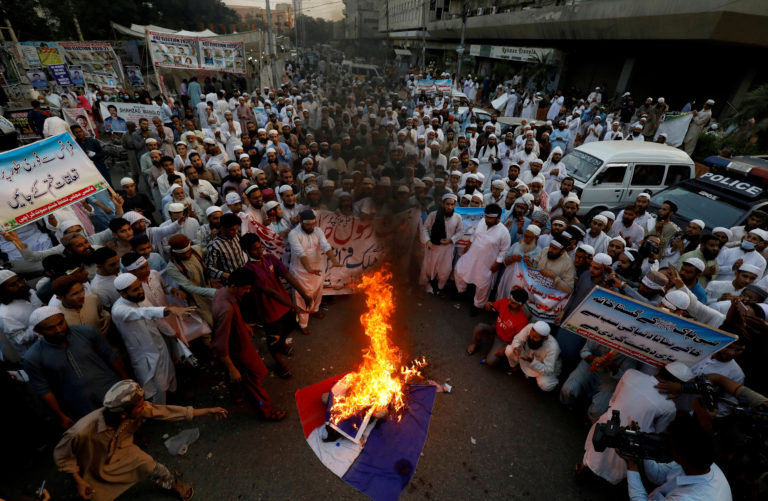
French President Emmanuel Macron drew the ire of many Muslim countries recently, following his statement on Islamic terrorism. In countries like Pakistan, the mobs after Friday prayers became uncontrollable and turned violent so much so that the authorities had to deploy riot force to control the unruly mobs.

The leaders of the protesting nations lost no time in denouncing President Macron for what they call “disrespecting the Prophet and humiliating Islamic religion”. When Pakistani Prime Minister, the Turkish President, Malaysia’s ex-Prime Minister and other senior leaders orchestrated this allegation, their masses took the cue and staged huge demonstrations, pledging to protect their faith at the cost of their lives.

Turkish President Recep Tayyip Erdogan, who had earlier snubbed the French President over the Charlie Hebdo and its caricatures, went a step ahead by saying that President Macron should undergo a mental health checkup, after he announced a plan to reform Islam to make it compatible with French values.

In Islamabad, the National Assembly passed a resolution demanding the suspension of relations with France, boycott of French goods and withdrawal of Pakistani Ambassador from Paris (interestingly, no Pakistani Ambassador has been appointed to France).

In Afghanistan, the Taliban leadership issued a warning to take action, if France did not apologize. At many places, the effigies of the French President were burnt and photographs trampled under feet by rowdy crowds to express deep hatred against the French President.

In India, Muslim majority areas witnessed protests and demonstrations as well. Munawwar Rana, a poet in Lucknow and Farhan Zubair, President, Aligarh Students Union, in Aligarh, have been arrested by the police and FIRs have been lodged against them for spreading hatred. Farhan had said that anybody disrespecting the Prophet will be beheaded.

Surprisingly, no leader except the Saudi monarch drew the attention towards the actual words uttered by the French President and also the context in which he said it.

“France was faced with the threat from Islamist terrorists… we respect all the religion”, the French President, said, reiterating that his country upholds the freedom of speech and expression.

A look at Macron’s speech suggests that there was no derogatory remark either against Islamic faith or the Prophet of Islam as has been alleged by the protesting masses with surcharged emotions and their leaders. Macron never said France faces a threat from Islam, but from Islamic terrorists, which is a reality. It has now become proverbial with the political commentators to say that every Muslim is not a terrorist but every terrorist is a Muslim. That is precisely what Macron meant. He disparaged neither the Islamic religion nor was disrespectful of the Prophet.

It may be recalled that even Pakistan has, at various world forums, including at the United Nations, raised its concerns on Islamist terrorists and threats posed by religious extremists. Moreover, the Zarb-e-azab campaign against Islamic extremists in North Waziristan, resulting in the killing of more than 70,000 people, is also a case in point. In fact, at the Financial Action Task Force (FATF), Islamabad had announced that it has put curbs on the radicals on its soil and even banned their organizations. So, how was Macron wrong?

Talking of Charlie Hebdo and the caricatures, let us not forget that France is a democratic country, where freedom of expression is given utmost respect. Now, if the magazine Charlie Hebdo, drew a caricature that hurt the feelings of a section of people, the proper way to seek justice is to lodge a complaint with the police and take the case to the French judiciary. Nobody has a right to take the law into his hands. Unfortunately, the law was taken into hand by those who want to be known as Islamic radicals.

The large scale propaganda and tirade against President Macron and France appears to be part of a larger conspiracy of the terrorist elements among the French population. As far as protests in Islamic countries are concerned, each has its own motive. Turkey is nursing rivalry against France in the backdrop of trade and commerce in African countries, where France has a strong clout. Pakistan is upset with France over its friendly relationship with New Delhi, especially over the Rafale deal, which has boosted India’s air capability. Besides, the fact that France had supported New Delhi during the Sino-India standoff in Ladakh hasn’t gone well in the power corridors of Islamabad. The Charlie Hebdo episode provided Islamabad the opportunity to square off with Paris, who in turn indirectly instigated mob outburst against the French President.

Let us now take a look at the context of the protests. Islamic terrorists have been active in France. On January 7 2015, two Islamist gunmen forced their way into the Paris headquarters of Charlie Hebdo and opened fire, killing 12 staff cartoonists. The gruesome attack surged the demand for the next issue of the news magazine, and no fewer than five million copies of Charlie Hebdo were published. The money collected from the issue was given to the victims. The French government also offered a sum of one million Euros help to the magazine. On September 25, 2020, weeks after the caricature republications, two people were critically injured by an assailant during a stabbing attack outside the magazine’s former headquarters. A day later, the perpetrator was identified as Zaheer Hassan Mehmood, a 25-year-old allegedly from Pakistan, who claimed to have arrived as an unaccompanied minor refugee in France in 2018. He confessed of his actions and said that he had acted in vengeance for the caricature republications. Recently, a French teacher showing the Hebdo caricature to students was beheaded by an 18-year old Chechen refugee Muslim carrying a knife.

These incidents pose a bigger debate on the right to freedom of expression and religious sensitivity. Remember, democracy is no democracy if it cannot ensure the right to freedom of expression. Millions of Muslims escaped their original countries and sought asylum in France just because they did not find the right of expression in their countries of origin. Today, France is suffering for its sin of generosity and humane treatment to the asylum seekers. Among all the countries in Europe, France has offered maximal largesse to the Muslim refugees, asylum seekers, immigrants and illegal intruders from the Middle East and North African countries not imposing any restriction on them in regard to education and pursuit of an economic prospectus. French judiciary is known for its just and humane treatment and nobody is denied justice if he or she approaches the court of law instead of taking the law into their hands. France will protect and uphold its democratic traditions in any case and no power can derail the country from what it stands for. This great country has been the model of freedom and liberty for entire Europe and the world.

Gupkar Gang’s U-turn on DDC elections

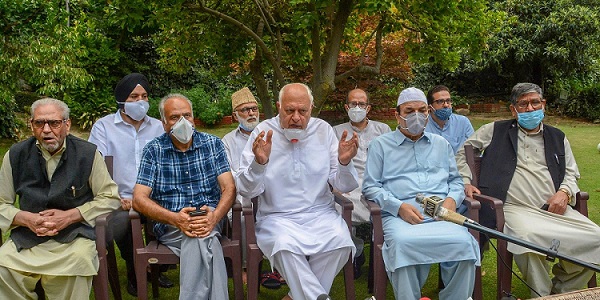
The angst expressed by the originators of Gupkar Declaration I and II need to thin out and become perceptional. Leaders long in seats of power tend to become an institution by default for good or mundane reasons. The Gupkar Gang, as their detractors would like to call them, belong to that specie of humanity.

Reconsidering the blunder of boycotting panchayat elections previously, the opposition parties have changed the course of their approach to the ongoing political scenario in Kashmir. This we presume is a healthy sign because what can be achieved through the normal democratic process cannot be achieved through unleashing of violence.

We consider it a good move by the Gupkar Alliance to jump into the mainstream and strengthen the democratic process. This also means that the militants will be forced to re-assess their line of action and come to the table for talks.

We consider it a healthy sign for the Indian democracy and especially for Kashmir where democracy and secularism have received a strong setback owing to militancy. Participation in the DDC elections would pave the way for further political interaction in the Union Territory and possibly the chances may open up for the restoration of the historical State of Jammu and Kashmir. Though one cannot predict whether the special status will be restored, nevertheless, the state will certainly work in a much improved political environment. It is likely to reduce corruption that has so venomously crept into the vitals of society.

When will the State be restored its previous status is not easy to predict but one thing is clear that the administration, development, law and order situation and security dimensions will get a new facelift. In particular, tourism will attain new dimensions if we consider the plans and programmes of the government.

However, the incumbent civilian government in the restored State will have to cut its cloth according to its size. Delivery will be the key and final proof of its performance. The days of dynastic and arbitrary rule are gone forever and can never return. Those used to the general look of the State Exchequer will find their perfidy coming to nought.

If these ideals are what the Gupkar Alliance intends to pursue, its policy will certainly receive accolades. But the question is will the elected civilian government have the courage to take on the militants and their threats and intimidation? Though of course, the security forces will cow them down everywhere and every time. The local leadership has a great responsibility of steering the ship of the state through disturbed waters. Fortunately for them, the central government is forthcoming with funds and plans that bring about a revolution in the economic life of the state.

The element of self-abnegation, expected of politicos seldom gets back benched. Ultimately, the connection between them and the demos they represent shrinks to a small coterie whose members tend to turn aggressive, worshippers of personality cult and finally goons and cronies with invidious influence the power structure.

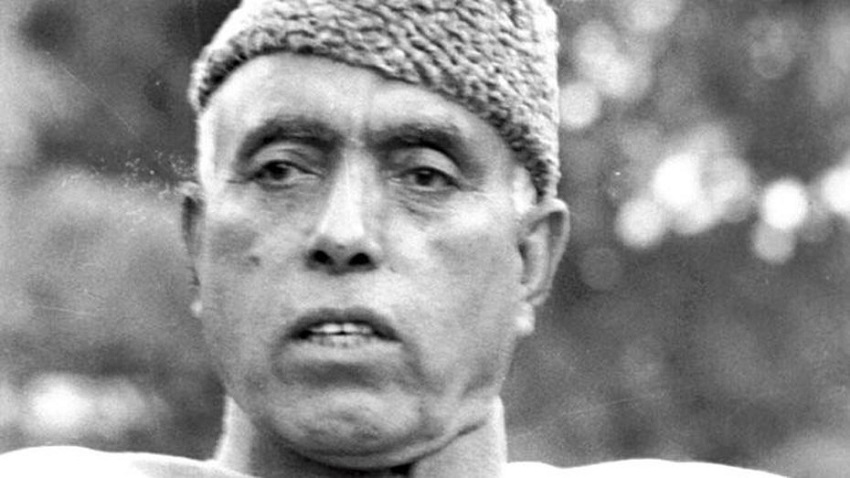
Kashmir Valley leaders are usually obsessed with local partisan politics and a narrow prism to look at the far-reaching consequences of being an entity of the world’s largest secular democracy. How amusing that Kashmir’s most popular leader Sheikh Muhammad Abdullah understood the benefits of a secular democracy for a region in which the Muslims formed as big a minority as to pass for almost an overwhelming group in the sense of adult franchise arrangement. But on the other hand, he erroneously concluded that his popularity, power knob and ego would remain secured and intact only if he pandered guardedly to premier community support in narrow parameters. It meant that he was trying to have the best of both the worlds without making conspicuous sacrifices for the advantages he was seeking. The undisclosed agenda of 1952 Nehru-Sheikh Accord became the catalyst to the sordid narrative of August 1953.

Sheikh Abdullah, founder of the political outfit National Conference that has a presence in certain pockets of the Kashmir Valley. (File Photo)

Thereafter, the gradual downslide of state-centre relations emerged as a new gamut on J&K political platform. In the beginning, Kashmir Valley masses did not make out the real cause of the Sheikh’s simmering estrangement with New Delhi in the early 1950s although sporadic incidents of limited civilian dissatisfaction could be felt. Bakhshi Ghulam Muhammad, who succeeded the Sheikh in 1953 AD, entreated himself to the masses of people in the valley and could also handle New Delhi with requisite dexterity. He proved himself to be the man of the masses and his unforgettable contribution towards the development of J&K, subscribing to nationalist politics and abiding secularist ideology.

But alas! The Kamaraj-ing of Bakhshi proved such a Himalayan blunder as makes Kashmir bleed ever since. The truth is that India lost Kashmir the day when the Bakhshi was removed more by caprice than by essential political pragmatism and statesmanship.

A big fissure developed in the state-centre relationship. No chief minister, thereafter, nor even Ghulam Muhammad Sadiq, could restore the crucial and expanded link because he posed as an icon of the Leftists bereft of the quality of mass leadership which was the domain of his predecessor. With Leftists playing the very unimpressive class and sectarian role in the country, they influenced Nehru who ousted some more popular contemporary regional leaders in whom he saw the potential of upstaging their popularity. Bakhshi was trapped.

Second stint of the Sheikh (1975-82), contrived through gross manipulation of democratic procedure was a different story. His fake secularism had vanished altogether; he got bogged with international Islamic politics; he established liaison with the Saudis through Pakistani conduits and brushed aside local issues essentially of development, of streamlining relations with New Delhi and of reforming the ideological assault led by Jamaat-e-Islami of Kashmir. He could not control the aggressive rather militant cadres of Plebiscite Front from indulging in hooliganism and public disorder just because in his physical absence from the scene owing to incarceration, his bigoted lieutenant Mirza Afzal Baig left no stone unturned to cement the link between Jamaat-e-Islami and the Plebiscite Front essentially based in Pulwama district of South Kashmir and Sopor town in North Kashmir at whose hinterland borders touched PoK via Kupwara.

After the Sheikh’s demise in 1982, the National Conference remained the premier mainstream political party in Kashmir with Farooq Abdullah, the second son of Sheikh at the driver’s seat. I will not go into the details of the sordid role of Farooq and his party in deliberately overlooking or underestimating the dangers of parochial politics in a sensitive border state torn by internal conflicts or political myopia and looming external threats. Although Farooq did not overtly socialize with the Jamaat-e-Islami of Kashmir, yet he knew them and declined to cut them to their size.  To alley their misconception about him, he regularized thousands of darsgahs meaning exclusive Jamaat seminaries and absorbed thousands of their teachers into government school education department without realizing how effective they would be in polarizing Kashmiri society vertically and subverting the social fabric and administrative functionality. Most of the bureaucrats who rose to senior administrative positions were in one way or the other the products of these seminaries that had done successful brainwashing experiments on them.

The situation became alarming for Farooq and his party when the political wing of the Jamaat-e-Islami known as Muslim United Front (MUF) actively participated in the assembly elections in 1986 and stunned the National Conference by leading in some constituencies in Srinagar especially the Magarmal Bagh. How National Conference goons under instructions from party echelons misbehaved and manhandled the winning MUF candidates and intimidated the returning officers as well, was attributed by the politically conscious Kashmiri Muslim voters as the underhand game of New Delhi in which it showed reluctance to popularize Kashmir’s political play game. This was the alienation point for them which did not look back any more. Therefore, after the MUF episode, Kashmir politics went through a sea change. ISI of Pakistan had won the first round. Farooq became fully conscious that his political survival had to be more reliant on support from the local influential Jammat rather than New Delhi.  

It was sheer political shortsightedness of New Delhi (Congress) to have allowed the critical situation in Kashmir drift to a dangerous course. But Congress had from very early days of Kashmir’s accession to India begun to feel that its interests were safe in the Kashmir proxy (the Sheikh dynasty). That ultimately proved the fundamental cause of exasperation for the valley-based populace and continues till date.

The dynastic rule in Kashmir focused on its primary objective of retaining power and self-aggrandizement and the camp followers leaving no stone unturned to promote its narrow-minded objective by means fair or foul. The bureaucracy understood how much Kashmir politics got personalized, spread out their fangs and hence the general loot in which the politicians, ministers and other beneficiaries flourished day and night. Their arrogance rose to the level that they refused submitting utilization certificates for the huge funds sanctioned by the centre under various central schemes and there was no action for dereliction of duty. Highly controversial laws that sullied rights and interests of the general public were enacted like the ‘Roshni Act’ which benefitted a small group of feudal lords but ignored the rights of the common man. Corruption became much more rampant during the tenure of Farooq’s son. That is what usually happens under the dynastic rule!

Gupkar Alliance is the new age separatists’ gambit for DDC elections in J&K

1

Elections in Jammu and Kashmir, regardless of the level at which they are being held, have a tendency of heating up the political environment. All parties bare their claws and go to each other throats with the worst form of name calling and trading of barbs/insults. In the melee, important issues are skirted as attention remains focused on mundane matters that are high on emotion.

The aforementioned scenario is being witnessed in full measure as the elections for the District Development Council (DDC) approach. The DDC is a new unit of governance introduced on 17 October 2020  by the Government of India by amending the J&K Panchayati Raj Act, 1989 and J&K Panchayati Raj Rules, 1996. It aims to strengthen grassroot democracy and the Panchayati Raj system by replacing the bureaucratic District Planning and Development Boards (DDBs) with the DDCs. In the new dispensation the planning process will be handled directly by the elected representatives of the people. While the DDBs functioned under a cabinet minister, the DDC will be headed by the local Member of Parliament as chairman and other locally elected representatives as members. The Councils will oversee the functions of the Panchayats and of the Block Development Councils as well.

As expected, the Peoples Democratic Party (PDP) was vociferous in its criticism of the progressive amendment and termed it as a mere tokenism. ‘The aim is to sub-divide, overlap, create layer after layer, so that nobody would know who is in charge. In such a scenario, the ultimate arbiter would be the bureaucrats and the security set-up’, said a spokesperson of the PDP. The other political parties of Kashmir also did not shy away from criticising the move of the government.

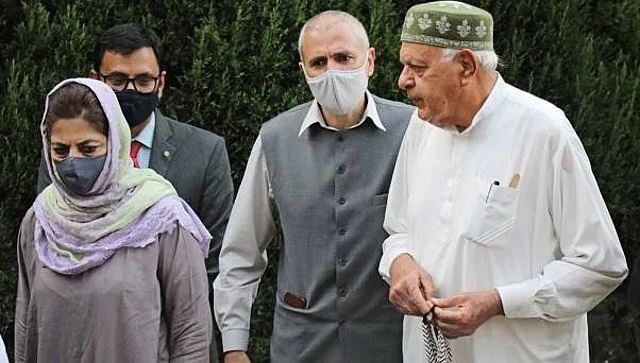
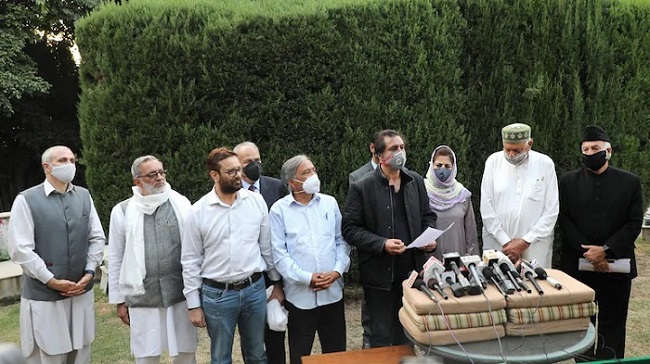
These parties, now in alliance as the People’s Alliance for Gupkar Declaration (PAGD) and comprising of the National Conference (NC), PDP, People’s Conference (PC), Communist Party (CPI-M), Awami National Conference (ANC) have taken on the separatist mantle with consistent calls for disruption and divisiveness by demanding restoration of Article 370. They have not taken long to comprehend the political isolation that they would face by not participating in the DDC polls. Hence, they have decided to fight the election together.

The adage, “politics makes strange bedfellows” most aptly denotes the PAGD. It’s constituents are bitter political enemies who have been at each other’s throats for decades; now they are coming together for a small grassroot election. Furthermore, most constituents had sworn publically that they would not fight any election till Article 370 is not restored and have now retracted. This is a reprehensible show of political opportunism. One has to agree with the definition of ‘Unholy Gathbandan (Alliance)’ given to this set up by Home Minister Amit Shah.

The Congress party, unsure of favourable result in the DDC elections has joined the PAGD bandwagon deftly sidelining the fact that it also rooted for the abrogation of Article 370 but could not garner the will to revoke it. Now it is associating with elements that seek restoration of the Article! India and the whole world are watching this double-faced opportunism of the Congress which is bound to negatively impact the party’s already diminishing reputation. However, the Congress seems to have realised the blunder and is attempting to make amends. The state level leadership gave a clarification that it “may pursue a state level electoral alliance” but would not be signatories of the proclamations. The central Congress leadership claimed that there was no alliance at all. It is very unfortunate to see a national party of the stature of the Congress stooping to such low levels.

PAGD is set to fight the DDC election on the platform of “restoration of Article 370.” How will it fulfil this dream through victory in a grassroot poll? Quite obviously, they are contesting on a flawed agenda. In any case, the fissures in the ‘unholy Gathbandan’ are already visible with most constituents expressing dissatisfaction over the seat sharing formula made by the National Conference. How can these people be relied upon to work for the welfare of the people?

There are some who wish to create an impression that the Bharatiya Janata Party (BJP) will come under pressure and stress by this ‘Gathbandan’ coming into play. This, experts feel, is a faulty argument. The BJP will definitely fight the election but its main interest is to ensure free and fair polls and smooth political movement to pave the way for state level elections. The PAGD has, in fact, played into the hands of the BJP by agreeing to fight the election and giving an indication that its anti-polls rhetoric was a fallacy. The NDA Government has, thus, moved a step nearer to its assurance to the people that assembly polls in the Union Territory will be held soon.

A point for concern is the manner in which the PAGD constituents are looking for support from across the border for their political survival. The PAGD chairman, Farooq Abdullah has led the alliance in seeking support from both China and Pakistan. This policy has grave security consequences. Pakistan has already taken cognizance of the statements and drastically increased its nefarious activity along the Line of Control (LOC). The recent exchange of fire all along the LOC and the killing of terrorists being transported from Jammu to Kashmir are indicators of the enhanced activity by Pakistan. The response by the Indian Army and other security forces has been strong and decisive, but that does not condone the anti-national bias of the PAGD constituents.

The new age separatists want the DDC election to become their political playground for their battle on the issue of Article 370. The stark reality is that abrogation of Article 370 is complete and irrevocable. India and the entire world have accepted it. Politics in the Union Territory have to be conducted within the ambit of this reality. Also, the existing set of politicians and their agendas are outdated and as such a new leadership needs to be given a chance by the people. (

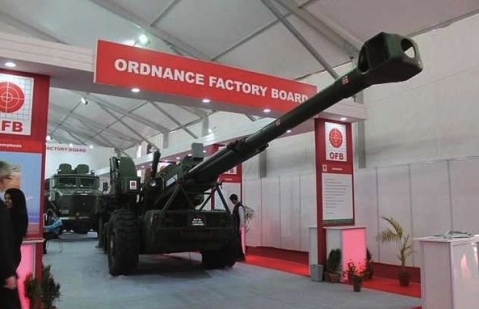
Defence Sector Reforms & Corporatisation of Ordnance Factory Board

Prelude          
In Part I, we looked at the historical background and colonial legacy of Ordnance Factory Board and the many challenges it faces leading to sub-optimal functioning of an institution which should have been a prime component of our ‘Atmanirbharata’, and vital for our strategic autonomy and comprehensive national power (CNP). Accordingly, one major component of the special economic package of Rs. 20 lakh crores announced by PM Modi on 14 May 2020 to revive the Indian Economy from the fallout of COVID, are key structural reforms in the defence sector.

Soon after a day, on 16 May the Finance Minister revealed the ingredients of the reforms, one being the ‘Corporatisation of the OFB’. Defence Minister Rajnath Singh followed up and announced on August 9, 2020 a list of 101 types of military equipment, weapons and ammunition which will be progressively barred from being imported starting December 2020. The ‘Negative Import List’ of 101 embargoed items comprises not just simple parts, but also some high technology weapon systems like artillery guns, assault rifles, warships, sonar systems, submarines, light transport aircraft, light combat helicopters (LCHs), radars and light combat aircraft. Any item on the ‘negative list’ can now only be sourced from the domestic industry. MoD will place orders worth Rs. 4 lakh crore with the domestic industry over the next 5-7 years by cutting down on these imports. For now, India remains a top importer of weapons and equipment.

Reforms Announced in Defence Sector
The key highlights of the announcements for the defence sector as given out in the press release issued by the Government of India are enumerated[i] as follows:

Policy Reforms in Defence Production

  • FDI limit in the defence manufacturing under automatic route[ii] will be raised from 49 to 74 per cent. This could well be a game changer as tweeted by the FM.
  • There will be time-bound defence procurement process and faster decision making will be ushered in by setting up of a Project Management Unit (PMU) to support contract management; Realistic setting of General Staff Qualitative Requirements (GSQRs) of weapons/platforms and overhauling Trial and Testing procedures.
  • Enhancing Self Reliance in Defence Production
  • ‘Make in India’ for self-reliance in Defence Production will be promoted by notifying a list of weapons/platforms for ban on import with year wise timelines, and indigenisation of imported spares, and separate budget provisioning for domestic capital procurement as brought earlier; resulting in reduction of huge defence import bill.
  • Improve autonomy, accountability and efficiency in Ordnance Supplies by Corporatisation of Ordnance Factory Board.

Industry Reactions:  The reforms announced by the government to boost indigenous defence production have been welcomed by the Confederation of Indian Industries (CII) and various private defence companies operating in the country[iii], as they are of the opinion that these reforms will provide a boost to domestic manufacturing in the defence sector.

Increase in FDI from 49 to 74 Percent: Will it be a Game Changer?

Private sector was permitted to enter the defence industry from May 2001 up to 26 per cent[iv] and raised to 49 per cent later in 2015.[v] Many studies including the ones conducted by the government showed dthat any FDI below 51 per cent ( FDI up to 100 per cent was also offered in case of state of the art technologies, after government approval[vi]) will not attract investment in India, mainly due to inability to participate in decision making. A few JVs were set up, but indigenisation efforts did not take off.

National Payoffs by Increasing FDIs:Few obvious advantages which accrue by increasing FDI to 74 per cent are broad basing of defence industrial base; induction of niche technologies; will encourage foreign defence conglomerates to set up subsidiaries specially under the ‘Buy Global-Manufacture in India’; create an eco-system to procure spares and parts from the local manufacturers to cut down on the cost of the equipment further cementing ‘Make in India’ during crisis situations; catalyst for making India as an ‘Export Hub’ for defence equipments, especially when nations are looking for alternative destinations to China; boost to our economy in terms of foreign exchange, create sensitive infrastructure and provide employment. Some of the challenges and concerns in raising the FDI limit are; valid concerns on threat to national security if foreign nations/company intervenes/interferes in the functioning; challenge to our indigenous industry to grow (rules allow JV in niche technology/when we don’t have the tech); however, the overall benefits override any negatives.

Corporatisation of OFB

A Move Long Time Coming: The corporatisation of OFB announced by the Government was incorporated in Modi 2.0 manifesto as part of their ‘167 transformation ideas’ but has been debated since a long time. The corporatisation was first suggested by the Nair Committee in 2000 and thereafter by Kelkar Committee in 2005 and Raman Puri Committee in 2015.[vii] Despite stiff opposition from the trade unions who are calling it ‘arbitrary illegal and unjustified’, the government appears determined to implement it. The rationale for doing so has been covered in Part I.  

Overview of Corporisation

The Corporatisation of OFB will put it at par with other DPSUs managed by its own board of directors with broad guidelines from the government.[viii] The growth envisaged is a turnover of Rs. 30,000 crore by 2024-25 annually against exiting Rs. 12,000 crore. A high level committee under Vice Admiral Raman Puri Committee recommended grouping existing ordnance factories under three or four verticals with core competencies. A likely structure categorising factories into four verticals of Ammunition, Weapons, Explosives and Combat Vehicles is shown in Fig. 1 below:

Corporate OFB will be allowed to forge partnerships with the private sector as per the MoD’s approved policy and will continue to receive orders from the country’s security forces. It will also be granted a special preference of 15 per cent  above L1 price for “Make” and “Buy and Make” category products. The Centre will support OFB in case of losses, by way of loan for 30 per cent  of the total shortfall and by way of equity investment for balance 70 per cent  of the amount. The working capital for the next five years will be provided by the Department of Defence Production (DDP) as a one-time corpus fund. Capital investment for ongoing and sanctioned projects will also be provided.[ix]

Benefits of Corporatisation: Some important benefits which will accrue post corporatisation are; improved efficiency leading to increased production capacity, greater autonomy and faster decision making; competitive pricing as competing with the private industry; induction of niche technology from the best sources/nations; increasing flexibility and financial independence; earnings through exports; and most importantly benefits to Armed Forces who will get more ‘bang for the buck’ for modernisation and procurement of latest systems improving capability and capacity. Some of the concerns of the employees and critics have been highlighted in Part I.

Separate Budget Provisioning for Domestic Capital Procurement:To boost indigenization and private defence sector, the government has promised to set up a separate budget for internal capital procurement. This ideally should be over and above the Defence Budget, with provision for R&D which is the hallmark of all growing powers. One thought which needs further study and analysis is to place Department of Defence Production (DDP) under the Department of Military Affairs (DMA), and Corporate OFB under the Ministry of Industry for optimal functioning.

Conclusion

We live in a multi-polar, multi-domain world which is currently going through a turbulent, violent phase forcing nations to carry out strategic balancing to retain/enlarge exploit strategic space. Nations are concurrently carrying our cooperation, competition, confrontation and engaging even in conflict if national sovereignty dictates so. India believes in ‘strategic autonomy’ and one of the vital ingredients to attain it is by becoming self-reliant in defence, in terms of forces, munitions and equipment, including niche technology. Corporatisation of OFB is likely to be a decisive step and a game changer towards self-reliance in defence production. Hopefully, it will transform ordnance factories into a modern, state of the art facility with flexible and better decision making in its functioning. It will make them more competitive and hopefully convert it to a profit earning organisation within next few years. However, the more important part will be the execution of these reforms on ground. The exact contours and timelines for implementation is still to be released by the government and is eagerly awaited by the Indian and foreign defence companies. Corporation of OFB is a defining step towards a ‘Aatmanirbhar Bharat’.

———————————————

[i]‘Finance Minister announces new horizons of growth; structural reforms across Eight Sectors paving way for ‘Aatmanirbhar Bharat’, Ministry of Finance, 16 May 20

[ii] The entry of Foreign Direct Investment by non residents into India is regulated through two routes –automatic route and approval route. Under the Automatic Route, the foreign investor or the Indian company does not require any approval from the Reserve Bank or Government of India for the investment.But, in the case of approval route, government agencies regulate and scrutinises foreign investment while approving it.

[iii] Piyush Pandey, ‘Confederation of Indian Industries lauds defence initiatives’, The Hindu, 16 May 2020

[iv] Revision of existing sectoral guidelines and equity cap on Foreign Direct Investment (FDI)’, Department of Industrial Policy and Promotion (DIPP) Press Note No 4, 21 May 2001,  available at https://dipp.gov.in/sites/default/files/press4_01.pdf

[v] ‘Review of FDI policy on various sectors’,  Department of Industrial Policy and Promotion (DIPP) Press Note No 12, 24 Nov 2015,  available at https://dipp.gov.in/sites/default/files/pn12_2015%20%281%29.pdf

[vi] ‘Review of FDI policy on various sectors’,  Department of Industrial Policy and Promotion (DIPP) Press Note No 5, 24 Jun 2016,  available at https://dipp.gov.in/sites/default/files/pn5_2016.pdf

[vii] ‘Committee for Corporatisation of Ordnance Factory Board’, Press Information Bureau of India, 02 Dec 2019, available at https://pib.gov.in/Pressreleaseshare.aspx?PRID=1594520

[viii] Laxman Kumar Behera, ‘In Favour of Corporatisation of Ordnance Factory Board’, IDSA, 21 Aug 2019, available at https://idsa.in/idsacomments/in-favour-corporatisation-ordnance-factory-lkbehera-210819

[ix] ‘Corporatization of Ordnance Factory Board (OFB)’, Defence ProAc, available at https://defproac.com/?p=9550

Corporatisation is a strategic necessity for Ordnance Factory Board

‘Atmanirbharata’ in the defence sector is nationally imperative for strategic autonomy. Putting to rest speculation of all cynics/sceptics, India is currently facing a real two-front war scenario in multiple domains of PDIME (political, diplomatic, informational, military and economic domains), with focus on the continental domain where our IAF and Indian Navy will play equally decisive roles. Public and social media is awash with speculation of what all, how much, and at what cost is India importing defence related munitions, equipment and spares to meet all emergent contingencies. This further highlights the strategic necessity of India to be independent in critical defence related products.

Pivoted around the sub-optimal Ordnance Factory Board (OFB) factories, our defence industrial base is woefully inadequate to ensure ‘Atmanirbharata’, which is imperative for the sovereignty and integrity of India. We enjoy the dubious distinction of being the largest arms importers accounting for 13% of global sales according to SIPRI data. India increased its arms imports by 43% between 2007–-11 and 2012–16. About 60–65% of military hardware is of Russian/Soviet origin. If the import figures since 1950 to 2017 are analysed, India has imported $119.89 billion worth of arms; by far the largest globally and double than that of Saudi Arabia.

Crisis Management

On 12 May 2020, PM Modi announced a special economic and comprehensive package of Rs 20 lakh crore to revive the Indian Economy from the fallout of the COVID-19 pandemic. He also called for an ‘Atmanirbhar Bharat Abhiyan’ to become self-reliant in future and outlined five pillars of ‘Atmanirbhar Bharat’ – Economy, Infrastructure, System, Vibrant Demography and Demand. As a part of the package, the Finance Minister announced certain key structural reforms in the Defence Sector on 16 May, in which ‘Corporatisation of OFB’ was a primary ingredient. In pursuance of the initiative, the MoD finalised KPMG Advisory Services-led consortium for providing strategic and implementation management consulting services to assist the MoD in the process of corporatization. Not surprisingly, the three federations of defence manufacturing sector workers of OFB, have issued the notice of a nationwide indefinite strike from 12 October against the proposed corporatization.

Historical Background

India inherited all 18 Ordnance Factories established by the British. These have since grown to 41 Ordnance Factories, 13 Development Centres and 9 Institutes of Learning divided into five operating divisions based on category of products–

·     Ammunition and Explosives        – 11 factories

·      Vehicles and Weapons                  – 11 factories

·      Material and Components            – 8 factories

·      Armoured Vehicles                       – 6 factories

·      Equipment Factories                     – 5 factories

Conceptually, they were expected to be national strategic assets with the potential of not only meeting national military hardware requirement, but also contribute to overall Comprehensive National Power (CNP), and earn valuable foreign exchange by exporting. The major buyers are the Armed Forces (Army being the top buyer), along with some supplies to CAPF and exports/civil trade.

The sub-optimal efficiency of this potential strategic asset is one of the major contributing factor that threatens the ammunition and armament holdings of the Indian Army. It is also a matter of concern that certain countries have refused to accept ordnance factory manufactured ammunition and equipment offered against Defence Lines of Credit due to concerns regarding quality of products, procedures in the factories and the inefficient post sales service support. Similar issues plague some of our DPSUs too which are involved in manufacture of military hardware.

Management and Organisation Structure

Ordnance Factory Board (OFB) Headquarters: Its location at Kolkata is a colonial legacy. The Chairman and his staff seek decisions from Ministry of Defence in New Delhi. Resultant costs and waste of time and public money are exorbitant, along with the need of running a parallel infrastructure at Delhi. It is pertinent to mention that the last seven DGs have had a tenure varying from four months to less than one year, providing no continuity, impacting higher leadership and obfuscating strategic direction to be pursued

OFB Organisation: The establishment functions as a three-tiered system with the Department of Defence Production (DDP-MoD) at the Apex. The OFB performs the executive functions and management of production units. The Ordnance Factory Board is managed by IOFS officers. The board is headed by a Director General and eight members. Five members of the board are responsible for functioning of each of the five manufacturing groups and three members are responsible for staff functions of personnel, finance and marketing. The OFB has around 81,000 personnel with about 1,400 officers.

Financial Structure: Fully owned by the government, budgetary allocations to the OFB under capital and revenue heads amounted to approximately 1% of the total defence budget for 2017–18 (BE). OFB is unable to run the factories with its own profits. Armed Forces, especially the Army, are captive customers irrespective of shortfalls in quality, delayed supplies, costly products and indifference to complaints.

OFB Performance Far Short of Expectations: Major Grey Areas

Cost of Production: Ordnance factories operate on ‘No Profit No Loss’ basis. The products are supplied at a price that includes ‘actual cost of production’. Actual cost of production is very high because all non-production expenditure is added to the pricing making the products extremely expensive. Captive consumers have no choice due to government policies. The cost of production includes — cost of material, cost of direct labour and overhead costs. The high pricing of OFB items is mainly attributed to the high percentage of overhead costs. Overhead costs can be further divided into fixed overheads such as indirect labour, supervisory charges and variable overheads such as indirect stores (stores other than raw material and components), transportation, electricity, depreciation and writing off products which are rejected by DGQA and others.

Just to elucidate, a combat dress which costs Rs. 1,800/- ex trade is priced at Rs. 3,300/-, jersey (Rs. 750/-//1,950/-), Ashok Leyland Stallion vehicle (Rs. 17/28 lakhs). It’s the Armed Forces that are being penalised; they pay the excessive costs out of the already stringent defence budget.

Production Shortfalls, Lack of Quality Control and Timeline Delays: As per 2019 CAG Report, from 2013 to now, the production shortfalls every year has been more than 50%. Importantly, the shortfall in supply of critical ammunition is a major concern. Between April 2014 and April 2019, Rs. 658.58 crore worth of products were declared unserviceable before their shelf life was over. Consequently, the government has opened up the defence sector to the private industry, allowing the armed forces to procure a few comparatively better products at competitive rates. Accordingly, 275 items manufactured by Ordnance Factories were declared as ‘non-core items’ in April 2017 by the government, another 93 in November 2017 and 39 in January 2018.

Lack of Accountability and Quality: Between 2014 and 2019, there have been 403 major accidents (majority of them being products for the Infantry and Artillery) related to armaments and ammunition, most of them leading to fatal/non-fatal casualties.

Factory Staffing Norms (Not as per Industry Norms): The OFB has a staffing structure modelled upon supervisory government departments rather than an industry. This has resulted in a supervisor to industrial employee ratio of 1:1.41 as against manufacturing industry standard of 1:5.

Supervisory costs on an average account for 65% as against an industry standard of 30% of the total labour cost of the OFB and account for 42% of its overhead costs.

Monopoly in Products a Disincentive for Innovation: Ordnance Factory Board enjoys monopoly on several products required by the armed forces. Lack of accountability leads to minimal innovation and technology development and hardly any incentive to improve quality and cost efficiency.

Major Concerns Projected for Corporatisation

Concern of Employees: The biggest concern of the OFB employees is that ‘corporatisation’ is the first step towards ‘privatisation’, and is likely to result in layoffs and job cuts. However, as of now the government has made it clear that it is not thinking of ‘privatisation’ in the near future and OFB will function akin to the various PSUs, post corporatisation.

Commercial Viability: The argument is that corporatisation of OFB will not be commercially viable since there are no fixed scales and periodicity of demands by the armed forces, irregular timelines for placing orders, uneconomical order quantity and life cycle support required for 30-40 years after the introduction of an equipment. It’s worth mentioning that DPSUs are also managing these issues.

Surge in Demand during War: OFB’s supposedly have some idle capacity as a war reserve, to cater for surge in demand during war, as was demonstrated during the Kargil conflict. This aspect needs to be analysed further. A vibrant private defence sector is one answer.

Corporatisation of OFB is likely to transform ordnance factories into a modernised, state of the art facility with flexible and better decision making in its functioning. This move is likely to make them more competitive and self-reliant in production of arms and ammunition and convert it to a profit earning organisation in the next few years. Coupled with a vibrant private defence sector it is the panacea/answer for India’s ‘Atmanirbharata’ and a decisive step towards becoming a major power amongst the comity of nations.

(Part II of the article will focus on defence reforms (measures) announced by the Finance Minister and advantages of ‘Corporatisation of OFB’)

Why didn’t big media report about the historic Miran Shah Rally of Pashtuns

A Massive Rally was organised by PTM (Pashtun Tahafuz Movement) at Miran Shah, the nodal centre of Waziristan on November 15. Lakhs of Pashtuns participated in the PTM’s Miran Shah Rally on Nov 15 despite severe restrictions imposed by Pakistan Army. Pashtuns braved severe cold and rains for the Miran Shah Rally in order to prove that they are not Pakistanis, rather their identity is of a “Pashtun”. Political analysts say that this is the largest Pashtun rally since the independence of Indian subcontinent in 1947.

Pashtun leaders Manzoor Pashteen, Mohsin Dawar, Ali Wazir and several others addressed this massive Pashtun rally at Miran Shah. Pashtuns show of strength at Miran Shah was to demand an independent nation for Pashtuns so that they escape the brutalities of Pakistan Army.

Click on the YouTube link to watch video report

Pashtuns have always been used by the Punjabi province of Pakistan, Pakistan Army and ISI in the name of Islam. Pashtuns were turned into suicide bombers. Chaos and mayhem created across Afghanistan and attacks on Kashmir were part of this strategy.

Miran Shah Rally sent a clear message that Pashtuns on both sides of the Durand Line are united and that they would not tolerate barbaric atrocities of Pakistan Army and the ISI. Thousands of children and elderly women also came with photographs of their “Missing” family members at the Miran Shan Rally.

The flame of nationalism has been lit across Pashtunistan and the Pashtuns have now understood the gambit of Punjabi Pakistan Army and the ISI.

Geopolitical analysts say that the Pashtun uprising is a harbinger of major global changes. PTM’s Miran Shah Rally is a game changer for geo-politics across South Asia.

Interestingly, this massive Miran Shah Rally got Zero Coverage in the Pakistani media, which only proves how Pakistani media carries out diktats doled out by the ISI and Pakistan Army.

Even the international media did not cover the Miran Shah Rally that shows the misplaced priorities of big media organisations. There is a massive surge of nationalism amongst Pashtuns, which could also change the boundaries in South Asia.

Pak’s decision to change Gilgit-Baltistan’s status is backdoor deceit

0

Pakistan Prime Minister Imran Khan on November 1 announced that his government would give “provisional provincial status” to its occupied territory Gilgit-Baltistan. Gilgit-Baltistan was a part of the pre-Independence princely state of Jammu and Kashmir. It became a part of India on the basis of legal accession of the state to the country in October 1947, and is internationally accepted to be under forcible occupation of Pakistan. Hence, the action proposed by Imran Khan is illegal under the international law and India has aptly protested on the same. The Ministry of External Affairs (MEA) has stated that India “firmly rejects” the attempt by Pakistan to bring “material changes” to a “part of Indian territory under its illegal and forcible occupation.” “Any action by Pakistan to alter the status of the militarily-occupied so-called ‘Gilgit-Baltistan’ has no legal basis whatsoever and is totally void ab-initio,” said Anurag Srivastava, spokesperson of MEA.

The attitude of Pakistani federal government, regardless of the party in power, has always been perfidious and double dealing, so far as Gilgit-Baltistan is concerned. This deceit and treachery go back to the times when the region was called Northern Areas and was plundered by the federal government with impunity due to its ambiguous political status. In continuation of the exploitative practices, the region was in 2009, renamed Gilgit-Baltistan through the Gilgit-Baltistan (Empowerment and Self Governance) Order, 2009, which replaced the Northern Areas Legislative Council (NALC) with a Legislative Assembly. The NALC was an elected body, but had a mere advisory role in the Ministry for Kashmir Affairs and Northern Areas, which ruled Gilgit-Baltistan from Islamabad. The 2009 order had no legal sanctity, since it did not emanate from the federal National Assembly and the Senate. It was merely an executive directive signed by the oppressive Ministry of Kashmir Affairs & Northern Areas. On ground, no worthwhile power has been vested upon the assembly constituents.

It is notable that in the run up to the sham Gilgit-Baltistan Assembly election of 2015, the then Prime Minister Nawaz Sharif had also prevailed over the Gilgit-Baltistan Supreme Appellate Court Bar Association to issue a demand for grant of a “Provisional Province of Pakistan” status, which was strongly opposed by the people. Imran Khan is following the same principle.

This matter has been on the discussion table for quite some time in Pakistan. Pakistan’s newspaper ‘Dawn’ reported in September that the government and the opposition had “almost reached a consensus” on granting ‘provisional provincial status’ to the region. Imran Khan could not have called for such a consensus without the explicit approval of his boss, General Qamar Bajwa, who is the chief of Pakistan Army for a second term. It is also reported that Gen Bajwa met all the key opposition parties in September to explain what was coming.

The fact that such an order has emanated from Gen Bajwa at a time when the army has taken over the China Pakistan Economic Corridor (CPEC) is an indication of the Chinese influence in the political drama that is being played out. It is no secret that China has been demanding a provincial status for Gilgit-Baltistan for long in order to safeguard its assets being created for the CPEC. It, therefore, has become imperative for Bajwa to assuage Chinese concerns about the safety of the massive $60 billion investment.

Pakistani propaganda machinery has been attempting to equate the proposed move with the change in the status of Jammu and Kashmir brought about by the Indian Government in August 2019. This is a false propaganda as the Government of India amended the Indian Constitution, while Article 257 of the Pakistan’s Constitution states that the country cannot change the status of the region without the wishes of the people.

By proposing to make GIlgit-Baltistan a province, Pakistan is acknowledging that the August 5 change of status of Jammu and Kashmir carried out by India will no longer be contested by the country. In other words, Pakistan is all set to abandon the so-called “cause of Kashmir” that it has been fraudulently espousing for so many decades. Its double dealing is becoming quite apparent. It is not without reason that Hurriyat Conference leaders are speaking openly against the proposal. Sayyid Abdullah Gillani, the Pakistan Occupied Kashmir (POK) based so-called special representative of Syed Ali Shah Geelani has reportedly termed the step as one that is “laden with disastrous consequences.” POK President Sardar Masood Khan has also opposed the move.

Pakistan is trying to justify the move by projecting it through the media as a policy shift that could secure vital geostrategic, economic, and energy interests while strengthening Pakistan’s Kashmir stance at the United Nations. Even a cursory look at the economic condition of all provinces in Pakistan other than Punjab shows the inherent contradictions in the “economic development” argument. So far as the United Nations is concerned, there is no talk on the issue. Hence, the arguments being given by Pakistan in support of the move fall flat. 

India is determined to get back the occupied territories of Jammu and Kashmir from Pakistan and fulfill the unfinished agenda of the Partition. Indian Government and Indian Army have strongly reiterated that the nation is prepared for a two front war, if it is imposed by the devious enemies. Attempting to make Gilgit-Baltistan the 5th Province of Pakistan will be yet another blunder committed by Imran Khan as the prime minister of his country. Whatever perfidy Imran Khan and his ilk may attempt, they cannot keep the people of Gilgit-Baltistan oppressed for long. The people will soon enjoy the fruits of freedom and democracy as a part of their own country – India.  

China’s expansionism policy backfires in Eastern Ladakh

China made a grave miscalculation in opening front against India in the Eastern Ladakh. It shows that the People’s Liberation Army (PLA) has turned into a typecast unable to keep pace with the dynamics of the changing world order. Its intrusive economic ventures globally have induced many developed countries in the West to look for protection and perpetuation of their commercial well-being.

Beijing’s miscalculations are twofold: It towed with its outmoded and unrealistic calculation of India’s ability to defend its borders competently, and secondly, it wrongly overestimated the effectiveness of Indian opposition. Both these miscalculations stem from the lack of democratic experience.

The Eastern Ladakh Sino-Indian standoff has not only unfolded PM Modi’s laudable strategic grasp of the ground situation but has also shown his resoluteness in dealing with threats and intimidations. Western leaders have acknowledged India’s ability and farsightedness to row through the rough waters.

The significant take from China’s misadventure is that India has blunted China’s old habit of expansionism along its long Himalayan border by intimidating smaller states and regions lying in the outskirts.  India is reaping the consequence of allowing Beijing to occupy the vast Tibetan plateau without demur.

The standoff in Eastern Ladakh demeaned China for its lust for territorial expansion-making it look like a minion and not a world power.  The world witnessed how China’s status was receding in the face of India’s will to meet the challenge. In fact, for the first time in history, India has successfully stonewalled the inflow of a northern predator.

 The significant take from the Himalayan heights’ standoff for China is that in dealing with India, Beijing must forget the narrative of its 1962 intrusion into the Indian Territory in Arunachal Pradesh. If pragmatism rules China’s Himalayan strategy, it must change the goalpost and lookout for a new phase of parity in the Sino-Indian relationship. China needs to understand that its strength lies not in behaving like a blood-sucking leech but a large-hearted benevolent state showing due respect to the borders with its neighbours. 

Pragmatism in the strategy means bringing into focus the ramifications of the Himalayan high altitude conflict, which China believes would be a booster to Pakistan’s belligerence along the Indo-Pak LoC in J&K.  However, China needs to understand that the Sino-Indian battle over the frozen Himalayas will be practically and ultimately fought in warm waters of the Indo-Pacific maritime channels with lasting consequences. Such is the dynamics of the ever-changing strategies in the region.

Although the pace of mega projects like the China- Pakistan Economic Corridor (CPEC) and Belt and Road (B&R) has slowed down, owing to Covid-19 and other undisclosed reasons, yet these remain the flagship projects with China and there seems no volte-face now. However, for quite some time, China has been voicing its unease on the actual status of Gilgit and Baltistan, a region which India claims as its rightful territory, and holds China as an illegal occupant.

For quite some time, Beijing has been insisting on Islamabad to bring about a meaningful change in the legal, constitutional and administrative status of Gilgit Baltistan that would indirectly reinforce China’s position as the pioneering investor in the economic and logistic development of the region. Some constitutional reforms that were introduced in Gilgit Baltistan in the recent past were no more than eyewash. These reforms generated more antagonism than reconciliation within the region.

Secondly, China is conscious of the fact that the presence of PLA and Chinese workers in Gilgit-Baltistan is vehemently resented by the local population as in Baluchistan. In either case, the real irritant is neither China nor the PLA, but Pakistan, which has not given the people of these regions their legitimate civil and political rights and powers. The demographic change brought about in the region by Lt. Gen Parvez Musharraf, the then Corpse Commander of 11th Corps of Pak army and stationed in Northern Areas is eating into the vitals of Pakistan politics.

China is convinced that Pakistan will never be able to take an inch of the territory of Kashmir that is under the control of India. It also understands that intensified border clashes and repeated attempts of infiltration into Indian part by the terrorist legions based in Pakistan and PoK may prompt India for a wider, deeper and more effective Balakot-like surgical strike or something bigger on terror-infested locales in Pakistan mainland supplemented by a plan that India had conceived following the shooting down of Wing Commander Abhinava’s jet aircraft somewhere over the PoK. In a prospect of India-Pakistan armed clash, China will be the loser because it can neither come to the rescue of Pakistan nor can it safeguard its onshore interests in the India-Pacific region, if it turns into a war zone.

Considering all these assumptions, astute statesmanship would prompt China to come out of its stereotype phantasm and meet the challenge in a way that security of the region and peace and tranquillity are ensured.  It has to play a role of friendly adviser to Pakistan –– a country it has been grooming for decades — and a well-meaning country with strong credentials of an astute player on the international chessboard.

China should also realize that since the restoration of normalcy and peaceful coexistence among the nations in South Asian region is the pre-requisite of just and equitable trade and commerce, the fundamental principle, which will help bring about such a conducive atmosphere is that the stakeholders should be prompted to say goodbye to hard-line politics and demonstrate the more resilient approach to the seven-plus decades-old Kashmir issue.

Pakistan has finally responded to China’s exhortation of integrating Gilgit Baltistan into Pakistan as its fifth province. As expected, India has lodged a strong protest against any step of that sort, arguing that it will be contrary to the Security Council Resolutions on Jammu and Kashmir.  Even if Pakistan integrates Gilgit Baltistan as its fifth province it will not give any real relief to China.  India has a strong case not only in Gilgit Baltistan but also in Shaksgam Valley as well, which Pakistan has ceded to China.

Assuming that China with the potential of making use of high-level statesmanship can bring about an understanding between India and Pakistan about conversion of existing LoC into IB, the question arises what will it do with Shaksgam and Aksaichin areas that originally belong to India? India will not accept any deal between New Delhi and Islamabad brought by China, who runs away with the chunk of land that it has grabbed illegally, to be retained till the Kashmir issue is decided between the two warring nations. If a deal does happen between India and Pakistan, the question that pops up is what is to be done with the Shaksgam Valley, when Pakistan and China have agreed to review it in the light of the resolution of Kashmir conflict between India and China.

For injecting blood into the veins of this hypothetical solution of Kashmir and other issues, initiation of primary spadework on the subject and proceed cautiously should be the approach. It would not be out of place to suggest that the UN should constitute a working group of legal advisers to help the stakeholders to discuss the issue after receiving the broad outline of a compromise formula from the actual stakeholders.

It needs to be remembered that Kashmir is a very complicated issue and there should be no hasty or emotional solution to it. Any viable deal on which attention is focused has to be internationalized. Aspirations of the people cannot be conceded in a vacuum but have to be taken into account along with geostrategic compulsions and oddities. Without the participation of the accredited world body like the UN, no real disengagement of the logjam is possible.

Similarly, the issue of displacement of population, their resettlement and security, the future of relationship among the countries in the region, trade, commerce and overland road and air connectivity, etc., needs to be sorted one by one.

We need to remember that a just and reasonable formula to be cobbled after a free and full exchange of views would also mean to give and take. Beijing knows the vision and capacity of Narendra Modi, the Prime Minister of India.

Soldier’s will to fight: Implications for Indian Armed Forces

“Man behind the Machine matters Most, Always and Every time”

Humans: The Final Arbiter in Battle        
Assessing morale and will to fight (adversary and own) is crucial to the science and art of war (Warcraft). Bruce Bueno de Mesquita, a political scientist at New York University, reckons human will matters enough for many wars to be won by what starts off, in strict military terms, as the weaker side [i].  With very few exceptions, all wars and almost all battles are decided by matters of human will: breaking the enemy’s will to fight while sustaining one’s own will to fight is the key to success in battle. Will to fight is the disposition and decision to fight, to keep fighting and to win.

Technology, Transparency and Modern Weapon Systems: Dilution of Human Impact
With continuous and increasing emergence of modern, potent, accurate, and long-range weapon systems, technology including autonomous systems, and ISR (intelligence, surveillance and reconnaissance), the essentially human nature of war is getting ignored. Many in the past have felt the same. Military history is, as a consequence, littered with disastrously wrong assumptions about belligerents’ will to fight. France (1950s), America and China (1960-70s), three UNSC members and major powers, for instance, famously underestimated the determination of Vietnam’s National Liberation Front when they intervened in Vietnam for their own strategic reasons and got a bloody nose instead. During the battle of DOGRAI on the Indo Pak border in the 1965 war, 3 JAT (Indian infantry battalion), known for their sustained dogged courage in battle, led by Lt Col Hayde, MVC achieved a superb victory against overwhelming odds. Lack of focus on the will to fight could create a vulnerable situation to many armed forces and nations forcing a critical situation. The best technology in the world is useless without the force of the will to use it and to keep using it even as casualties mount and unexpected calamities arise.

Use of Modern Computing to Quantify Morale and Will
Behavioral scientists are now, bringing the power of modern computing to bear on the question. Defence planners have long used computers to forecast the results of conflicts by crunching data on things like troop numbers, weapons capabilities, ammunition supplies and mechanized forces, air and naval forces quantification. The next step, which will be hugely facilitated with the emergence of artificial intelligence (AI) and scientific models, is to extend the idea into the area of morale, by quantifying the psychological variables that determine whether troops will flee, or stand and fight. 

Important Definitions/Aspects pertaining to Will to Fight             Predicting human behavior is not an exact science, however, we can significantly improve our understanding of an individual or a units’ will to fight by assessing and analyzing disposition[ii], which allows for an estimation of overall military effectiveness and forecasting of behavior. Wars rarely end simply because one military destroys another. Government and leaders determine how and when wars end, and they may have to decide many times during a conflict whether their country should continue enduring risk and sacrifice or whether it is time to stop fighting. Tangible factors, such as remaining force levels, logistical resilience, weapon systems, are obviously part of the decision calculus, but it is often less-tangible political and economic variables that ultimately determine what might be called a national will to fight. It is the determination of a national government to conduct sustained military and other operations to achieve their objective, even when the expectation of success decreases or the need for significant political, economic, and military sacrifices increases.

Pivotal Role of Influence Information and Psychological Operations (IIO and PSYOPS) affecting Morale and Will to Fight   Confrontation/conflicts have moved from attrition to manoeuvre, and now to a combination of the above along with the cognitive domains of Information (Influence) Operations (IIO/IO) and Psychological Operations (PSYOPS). Nations would always prefer achieving their strategic aims without warfighting in the traditional sense, and impose their will using cognitive/non-kinetic domains. There are innumerable examples in military history where larger/stronger forces have lost purely because they lost morale and the will to fight. One very recent and extremely vivid and game changing event in history where IO and PSYOPS destroyed an Army’s will to fight, is the Capture of Northern Iraq by ISIS. In the summer of 2014 the IS (ISIL/ISIS or Daesh in Arabic) roared into Northern Iraq in pick-ups and fully armed (even swords), and blew away four fully trained and equipped Iraqi divisions which vanished overnight into thin air.[iii] But, contrary to tradition, they did not keep their operations a secret but wanted the world to know everything about it. The IS succeeded in subverting the minds and weakening/destroying the will to fight of all commanders, troops and the local population psychologically. Closer home, despite an asymmetric superiority in comprehensive national power (CNP), military and multi-domain fighting capabilities of the Chinese PLA along the LAC in East Ladakh, the Indian Armed Forces operational and tactical superiority, combat experience, high altitude expertise, years of managing the LC/LAC, and the Indian jawans fortitude, raw courage and morale puts India Army on an equal (if not better) footing to negotiate.

Indian Army: Lack of Scientific Models to Evaluate Morale and Will to Fight
In our Armed Forces, lot of emphasis is paid to attributes of a leader and the role of morale as important battle winning factors. Theoretical and practical aspects are covered for officers and troops at the initial training, courses and on the job. However, we have not really added its contribution (being intangible) when evaluating/or when carrying out a net-assessment (see definition in Notes[iv] of an adversary’s military strength and potential. In our Armed Forces we do a mix of scientific model(s), and affix values to tangibles based on historical precedence/subject experts/ground experience/collective wisdom of group (Delphi system of management[v]). Indian armed forces needs to create models (specific to different situation/terrain/enemy) to assess value of own/adversary’s intangibles like morale and will to fight, which has become vital in today’s warfare.

Rand Corporation Report 2108[vi] on Will to Fight: An Overview  
In 2019, RAND published two reports for the US Army describing the will to fight[vii]. They found that there is no generally accepted definition, explanation, or model of will to fight. This means that armed forces and subsidiary forces have no central point of reference for understanding what is, according to joint doctrine, the most important factor in warfare. They created a three-step model to which they finally integrated will to fight in simulation, and needs to be incorporated in planning for actual combat situations.

  • Step 1. Adopt Universal Definitions which are useful and necessary starting point for mutual understanding.
  • Step2. Creating a working model- A nine-step explanatory–exploratory–portable Model has been created.
  • Step 3. Integrating Will to Fight in Simulation and Net Assessment of Forces- Computer simulation, tabletop exercises, and wargames can help bring clarity to complex issues and concepts, such as will to fight. If will to fight is one of the most important factors in war, and if it is absent or poorly represented in military gaming and simulation, and during net assessments, then it is a dangerous gap.

Findings on Morale and Fighting Spirit[viii]. Training, espirit-de-corps, morale, motivation, capabilities and culture are important facets contributing to the will to fight. After diligent research some interesting observations/conclusions are bulleted as follows:

  • Those who declared themselves willing to sacrifice the most were the ones who also seemed least interested in material comfort and economic prospects. This was confirmed by actual embedding with troops and post-mapping for reality check.
  • A typical fighting force, it is generally thought, will collapse sometime before a third of it has been destroyed. However, exceptions are there, for example some Kurdish and IS units in Iraq, fought on in a coordinated fashion after sustaining far more grievous losses. (Battles on famous last stands available online are strongly recommended for reading. Names of famous Indian armed forces battles post-independence are given in the end notes[ix]).
  • Soldiers’ identity must get fully “fused” with those of his brothers in arms. Their top priority has shifted from family to another cause, a transcendental ideal that has become so “sacralised” that it would not be traded away for anything (seen in fundamentalist groups). It is a truism of the Indian infantry soldier that he dies/ready to die for his ‘paltan/units izzat/respect’, more than for the motherland.
  • Fanaticism has long been recognized as a plus in a soldier, be it the Zealots of ancient Israel, the Roman Catholic conquistadors of the Americas, or the Nazis’ 12th SS “Hitler Youth” Panzer Division.
  • War is a human endeavor, and we must treat it as such.

Famous/Historic Battles showcasing will to fight upsetting military superiority

  • Failed assessment of the Arab will to fight leading up to the 1973 Yom Kippur War resulted in strategic surprise, nearly leading to the defeat of Israel.
  • The CIA’s analysis of the Vietnamese will to fight.
  • The Afghan Mujahideen of yesteryears and Afghan Taliban of today have displayed such staying power, making up for their lesser capabilities with motivation, improvisation and living conflict as a way of life. Likewise, casualties tend to “weaken or strengthen an adversary’s national will to fight”. In the case of the Al-Qaeda/Taliban, casualties tend to incite their revenge instincts, enhancing their will to fight.
  • In the 1965 Indo-Pakistan War of 1965, Pakistan had expected a quick retreat of the Indian Army from J&K leading to the re-opening of negotiations, when it launched its pre-emptive “Operation Grand Slam” in Kashmir. India expanded the war by attacking across the international border in Punjab.
  • Occupation of Kailash Range heights on the LAC in East Ladakh by highly motivated Indian special forces under adverse conditions totally surprised the PLA and changed the operational paradigm in India’s favour.

Battle of Imphal-Kohima
Very interestingly and proudly for the Indian Armed Forces and its troops, the battle of Imphal-Kohima during the Second World War (WWII) was voted in Britain as Britain’s most hard fought and significant battle in its entire history.[x] The Indian troops fought in horrendous jungle conditions of Nagaland, marked by vicious hand to hand fighting, when Japanese troops in large numbers crossed Burmese border. The Indian soldiers turned the tide against the Japanese army resulting eventually in their capitulation. “The victory was of a profound significance because it demonstrated categorically to the Japanese that they were not invincible. This was to be very important in preparing the entire Japanese nation to accept defeat,” Lyman said. “This was the last real battle of British Empire and the first battle of the new India.” The Indian troops “weren’t fighting for the British or the Raj but for a newly emerging and independent India and against the totalitarianism of Japan.”

Inspiring Quotes from Junior Indian Military Leaders. A few quotes of our junior leaders during battle, showcasing the Indian Armed Forces indomitable will to fight, and which will inspire generations to come.

  • . . . The eyes of the world are on us. The hopes and aspirations of our countrymen are based upon our efforts. We must not falter, we must not fail them . . .

To every man upon this earth Death Cometh soon or late
And how can man die better
Than facing fearful odds
For the ashes of his fathers
And the temples of his gods
                                                                                    Brig Mohd Usman (P) MVC; Battle Order for Recapture of Jhangar

  • If death strikes before I prove my blood, I swear I’ll kill Death.Capt Manoj Pandey (P) PVC
  • No Sir, I will not abandon my tank. My gun is still working and I will get these bastards.                                                                                    2nd Lt. Arun Khetrapal (P) PVC
  • Either I will come back after hoisting the tricolor, or I will come back wrapped in it, but I will be back for sure – “YEH DIL MAANGE MORE”
  • Capt Vikram Batra (P) PVC

Recommendations
Indian Armed Forces should —

  • Develop and adopt a universal will-to-fight definition and model.
  • Modify and use the model for net-assessment of own and allied military forces and adversarial (China and Pakistan) forces. Obviously extended to specific missions/theatre of operations.
  • Integrate will to fight into doctrine and application manuals; holistic estimates of combat effectiveness in wargames and simulations of combat; and incorporate during net-assessments of adversaries and profiling of their leaders (specially China and Pakistan).

Conclusion
Improving understanding of ‘morale and will to fight’ might not be a panacea, after all war is not won by silver bullets, but it is a vital factor that is routinely overlooked or misunderstood. Nations and militaries across the world are paying increasing attention to behavioral science to know an adversarial nation’s and military’s will to fight and their leader’s mind. India and its professional armed forces must institutionalize/incorporate this pivotal aspect in their strategic and operational planning expeditiously.


[i] ‘What motivates the dogs of war?’, The Economist; Science and Technology, 05 Sep 2020 edition

[ii] ‘Disposition’- Soldiers and the units they form develop the disposition to fight or not fight, and to act or not to act, when fearing death. Disposition is essentially likelihood.

[iii] The event is widely covered and also paraphrased from ‘Like War: The weaponization of Social Media’ by PW Singer and Emerson T.Brooking, An Eamon Dolan Book, Houghton Mifflin Harcout, 2018.

[iv]Net assessment’ is a complex and unconventional framework for the strategic analysis of military balances. It measures the hard power of nations in relation to each other, rather than each on its own terms. This kind of analysis, projected over the long-term, helps support more effective defence policies in conditions of military-strategic competition. Such a capability is urgently required today in view of the highly competitive nature of global geopolitics.

[v] ‘Delphi system of Management’ available widely online; one link – https://www.rand.org/topics/delphi-method.html

[vi] As a first step to understand will to fight, the RAND team undertook a literature review of more than 200 published works, reviewed U.S. and allied military doctrine, conducted 68 subject-matter expert (SME) interviews, and analyzed historical battles/campaigns/case-studies, war- gaming, and simulation.

[vii] Will to Fight: Returning to the Human Fundamentals of War, Rand Corporation, 2019; Link- https://www.rand.org/pubs/research_briefs/RB10040.html

[viii] Paraphrased and adapted from numerous Think Tanks and online articles/papers, including ‘ARTIS International’ which is a global scientific research organization which focuses on behavioral dynamics affecting conflict. Its work is field orientated, and the fellows come from a wide variety of disciplines; also USAF Academy’s Warfighter Effectiveness Research Centre (werc), in Colorado

[ix] Famous Indian battles post-independence showcasing leadership and the troops indomitable courage, morale and ‘will to fight’ are listed: Battles of Rezang La, 18 November 1962; Assal Uttar, 8-10 September 1965; Tololing, 20 May – 13 June 1999; Nathu La and Cho La, 1967; Laugewala; Meghna Heli Bridge; Chawinda; Dograi (all four 1971); Special mention to Battle of Saragarhi, 12 September 1897.

[x] ‘Victory over Japanese at Kohima named Britain’s greatest battle’, in Reuters