Home Blog Page 324

The Omni-Infinite – or, Finite Inversion-Externalization

0

One of the least endearing characteristics of the gods comes in the form of the psycho-anthropology of the gods. Those beings in whom individuals reflect and whom the divine reflect the mortal; it’s a duality of mirrors beginning in the human psyche.

That which is the psychological in humanity becomes the anthropology of the divine. A sense of the personal in the non-personal, even, where the divine meets the mundane. Some of the most important individuals in this respect have been the thinkers who devote themselves to the study of human psychology.

While, others have been those who study the workings of the divine. Even others, they have given their lives to the ways of the history of the gods. Even others, they commit themselves to a diligent study of those without sense.

I recall a story of a man from India who was a polytheist and who considered Donald Trump worthy of worship to some degree. In this sense, we can sense the sense of nonsense. Its appeal to the merely flesh and meat.

The gods are not only something of falsity or untruth. Once one moves past those notions of the divine, to reduce them down to size to the mundane, we can look at the ideas of the gods as human productions, as they are; whether actualized prior to human imagination, all gods must be constructed by human ingenuity, regardless.

In that, to conceive of something from the Infinite Nothing or the Imaginarium upon which all creativity or system depends, one requires a mind to structure it into a coherence, all of a piece, in other words.

Once this all of a piece-ness is presented, then the gods are made whole for human comprehension, even the ideas of the incomprehensibility of the ways of many or some of the gods, these, too, attribute a human limitation as a valuation of the possibilities of the gods.

In a more direct way, as with the mounts of the deceased burping forth from the Imaginarium, the gods can be viewed without the fear. They do not require a sense of love projected outwards from them either.

Neither fear nor love come from the dead, far as I know; these senses of the divine as the imaginary helps clarification so much, as if a principle of simplicity to parse the known and the unknown in regards to the gods.

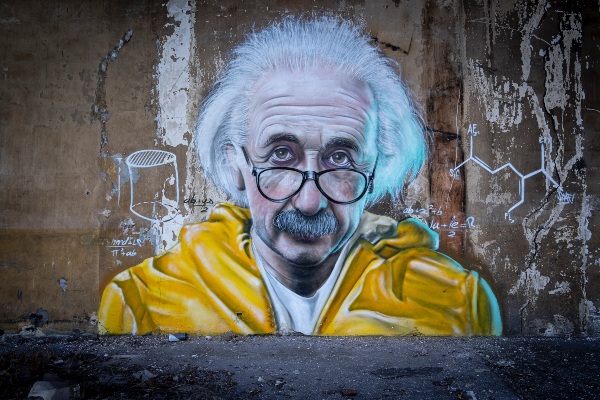
As Einstein remarked, “The word God is for me nothing more than the expression and product of human weaknesses, the Bible a collection of honourable, but still primitive, legends which are nevertheless pretty childish.”

He rejected not only the childishness of the Bible or the word God; its primitivity and established reflection of human weaknesses. He rejected even temporally derived notions of a final purposes to humanity, as in a rejection of the idea of teleology, stating, “I feel also not able to imagine some will or goal outside the human sphere,” while rejecting naïve realism too.

While a world out there must be taken in a serious manner, as the great theoretician rejected Kant’s idea of a rejection of objectivity of space as something ‘hardly to be taken seriously,’ a supporter of the Ethical Culture movement and a secular humanist.

Someone who said, “A Man’s ethical behaviour should be based effectually on Sympathy, Education and Social Ties; No religious basis is necessary. Man should indeed be in a poor way if he had to be restrained by fear and punishment and hope of reward after death.”

Someone who may remark as Noam Chomsky who stated on the question of God: As with Thomas Paine, if there is a God, then He is a Devil. Strong notion from powerful intellects, individuals of great influence in the history of intellectual thought.

The ideas of the gods as reflections of human beings are not new, nor can they be new, as these reflect more of the common ideas of the gods from generation to generation, as a mirror to the prejudices and self-perception of the people of a society. A society collapsed for a variety of reasons, as most have ended.

Always heed the words of Aurelius, ‘soon you will have forgotten all things, and all things will forgotten you,’ everything is temporary in this view, as with the societies and their gods. The gods as a formulation not as the weaknesses of society, but, rather, as the strengths of humanity externalized.

That which we wish was more. To posit a weakness of humanity in this view, it is as if to buy the Imaginarium as the reality. ‘Tis not fair wanderer, it is more human attributes considered strength – intelligence, powers over nature, beauty, leadership, presence and influence – taken to the Nth degree. So it is with all gods; this can be seen with the large finites of those traits or those Nths of traits made infinite, as in the Abrahamic God.

What this more realistically reflects is a sense of a psychological lack to some degree while deemed a properly strong one individually, something admirable, it is depersonalized apart from the individual personality.

While taken out of this context of the individual personality, it becomes part of the properties ‘out there’ in some abstraction because of its depersonalization from the individual. Following this depersonalization of the individual qualities, they become properties. These are taken once more as out in the world rather than simply in the mind.

This in-mindedness of them makes them a sort of psychological quality made objective property in the world. This property, in the most limited forms, becomes an anthropomorphic formulation of the god concept in which the gods reflects more of the individual form and capacities of the human being, which is where the traditional idea of the anthropomorphism of the gods inserts itself into human history after the gods have been inserted into human history by humans themselves.

Ones with infinite or omni-infinite capacities are claimed as fundamentally non-anthropomorphic. However, they are the anthropomorphic in the most important sense. It is an anthropomorphism in which this process of self-objectification through the making of a psychological quality as an objective property becomes something taken to the Nth degree.

Where, for example, the idea of the good nature of a human being, the benevolence of a human person, becomes divinized in the omni-benevolence of God. We can see this play out in the spatiality of human beings with the omnipotence of God.

With the ability to know things, as a virtue, this becomes omniscience. One time after another, these finite strengths of the human species become projected and made infinite, where there can be incalculable multiples of these infinities in which the ultimate is the omni-infinite, that which identifies with, inheres in, and constructs reality at the most fundamental levels and projects itself through all that exists and can exist as potential.

This externalization of the property becomes something once more reversed in which the finite becomes infinite, as the finite properties, formerly qualities, become infinite properties of God Himself. Once more, this becomes psychology, though, as God is made into a personal god with a personal identity.

A divine person, so a transcendent psychology, you see the process. It is a manner of inversion-externalization, where the finite and singular comprised of divisible, though unified, qualities, becomes properties, as these enter the objective world, formulate a divine character, made infinite, and then personal.

As follows: Name a psychological lack, objectify it as a property, externalize it as “out there” in the universe, then make it infinite and personalize it once more, so as to make an omni-infinite personality based on human lack. It’s a process of inversion-externalization.

Because the internal is made external, finite made infinite, and personal psychology made ‘divine’ psychology. All the pantheons of limited gods would be a self-limiting formulation going through the same process.

The gods are of use as much as we are them, whether Indian Hinduism or Pakistani Islam, not at all. Each of them come as one and the same operation while with individual, cultural, and people group manifestations, claimed as the objective truth for ever and always.

It’s not that we are the gods now; it’s that the gods were never here, but the gods have been a useful fiction. The question remaining: How much more useful is the fantasy?

Photo by Marc-Olivier Jodoin on Unsplash

Pakistan frees Gilgit-Baltistan leader Baba Jan, but keeps a watchful eye

Friday, the 27th day of November, was quite special for Gilgit-Baltistan so much so that cheerful sloganeering and celebrations went on till early next morning. Almost after a decade, their beloved leader Baba Jan was set free from captivity by the Pakistan Army.

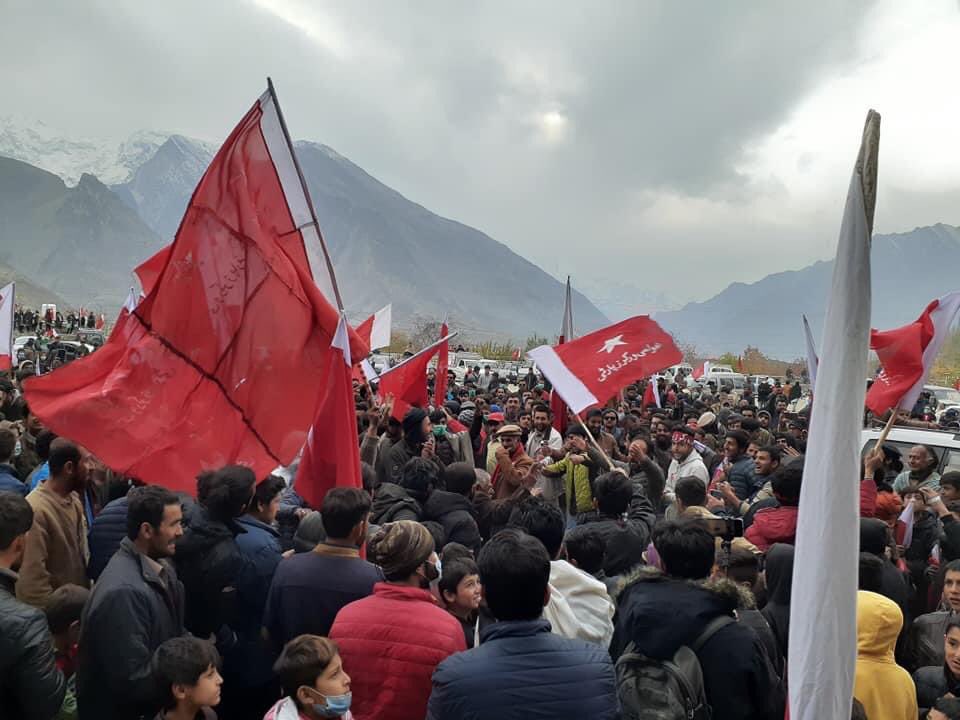
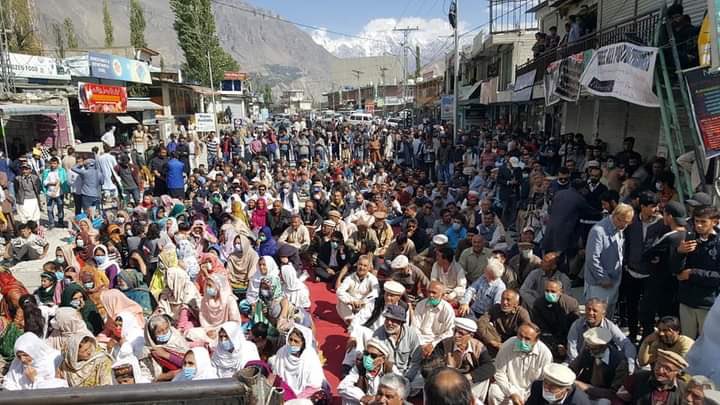
The release of Baba Jan and other political prisoners Iftikhar Karbalai, Aleem Khan and Shakoorullah Baig had come after arduous protests. Over the last few months, entire Gilgit-Baltistan especially the people in Hunza/Gojal Valley had been on streets demanding the release of Baba Jan. The sea of protesters included men, women, children and the elderly. People’s anger against authorities in the picturesque valley had reached a tipping point that had Pakistanis and the Chinese worried. Gilgit-Baltistan is the starting point of $64 billion CPEC (China-Pakistan Economic Corridor) and a widespread revolt in the region would mean CPEC had come to a cropper. And so the Chinese Communist Party (CCP) instructed Pakistan Army to release Baba Jan from prison.

The decision to release Baba Jan was taken sometime in October this year but it had to be delayed by another month and a half as Rawalpindi did not want Baba Jan to have any participation in Gilgit-Baltistan’s provincial elections. Rawalpindi’s fears were not unfounded. In 2015 Baba Jan had run for the Gilgit-Baltistan elections from inside the jail and despite massive rigging he had defeated the candidates propped up by Rawalpindi. Pakistan Prime Minister Imran Khan and Gen Qamar Javed Bajwa must have weighed in the effects of Baba Jan’s massive popularity, waited for the Gilgit-Baltistan elections to get over on November 15 and then released Baba Jan along with his comrades on the night of November 27.

Demonstration in Hunza Valley for the release of Baba Jan. (Photo: News Intervention)

Yet, this was nothing short of a miracle for the denizens of Hunza Valley. Baba Jan and his comrades were serving life sentence on charges of terrorism and there was little hope they would walk free. Yet bowing to massive demonstrations and protests the Pakistanis were forced to relent. This is the victory of people’s power. At least on the surface this seems so.

Rawalpindi’s calculation is that the elections in Gilgit-Baltistan are now over and Imran Khan’s political outfit has already won enough seats to form the provincial puppet government in the 23-seat Gilgit-Baltistan Assembly.

A closer look at the underlying facts reveal a clearer picture. Pakistanis have not acquitted Baba Jan of the terrorism charges, rather his charges have been suspended and he has simply been asked to walk out of jail to quell people’s anger. Police sources in Islamabad say that the released political prisoners can yet again be arrested at the whim of ISI or Pakistan Army.

Background of Baba Jan’s arrest

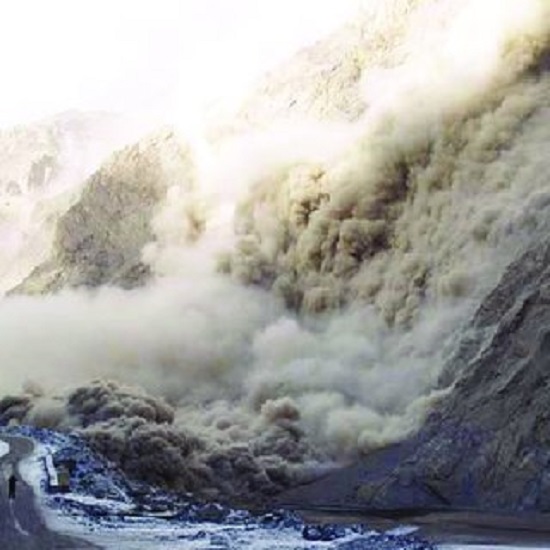
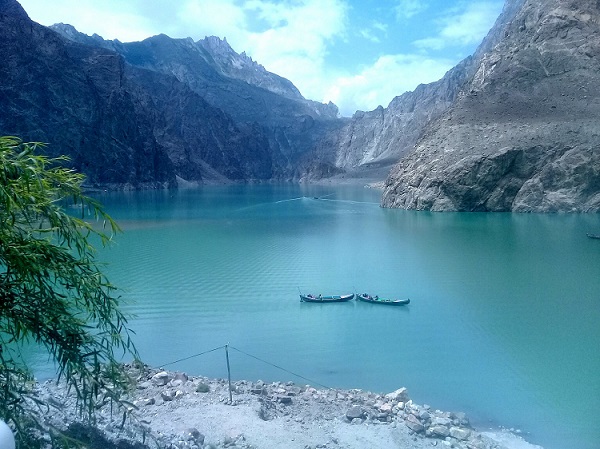
This matter dates back to January 2010, when a massive landslide hit the Hunza Valley in Gilgit-Baltistan that killed around twenty people and blocked a portion of the River Hunza. Due to this landslide a huge artificial lake was created that submerged several villages in Attabad. This landslide was the result of massive on-going construction activities under CPEC (China-Pakistan Economic Corridor) at the Karakoram Highway whereby explosions were carried out in the seismically sensitive mountains around Hunza/Gojal Valley that subsequently triggered the landslide.

As the explosions cracked up mountains and landslide debris gushed into Hunza Valley the water flow of River Hunza got blocked and inundated dozens of villages at Attabad, Ayeenabad and Sarat. The rapidly rising water submerged around 20 kilometre area and over hundred thousand villagers across the Hunza/Gojal Valley were suddenly left homeless and fending for themselves.

Landslide that created the artificial Attabad Lake which eventually submerged dozens of villages in the Hunza/Gojal Valley. (Photo: News Intervention)

Islamabad under direct instructions from Chinese masters in Beijing accorded top priority to restoring the road connectivity at the Karakoram Highway and turned a blind eye to the plea of villagers to be compensated for their homes and loss of livelihood. The water in artificially formed Attabad Lake kept rising steadily and several adjoining villages faced the threat of permanent submersion.

It was at this time when Baba Jan along with his comrades stepped in. Baba Jan became the voice of villagers across Hunza/Gojal Valley and launched massive demonstrations demanding compensation for the submerged villages and for those whose family members had died in the sudden landslide. Local administrators of Gilgit-Baltistan never bothered to offer any compensation to the thousands of villagers.

On August 11, 2011 the then chief minister of Gigit-Baltistan Syed Mehdi Shah was travelling through the reopened Karakoram Highway when the Attabad villagers under the leadership of Baba Jan blocked their cavalcade. Instead of listening to their plea the police opened fire at peaceful demonstrators and killed two people.

This news about police firing and subsequent deaths spread across Gilgit-Baltistan and protests started all across the region. People felt they were being unnecessarily targeted and their rightful compensation. CPEC was looked upon as the harbinger of death and Pakistani regime as the enabler for this spiteful project. The extent and expanse of riots across Gilgit-Baltistan had Beijing worried. These were starting years of CPEC and it was being marketed as game changer across the globe. Beijing wanted to iron out all protests in Gilgit-Baltistan.

Locals on a sit-in demonstration at Gilgit-Baltistan in August 2020. (Photo: News Intervention)

Pakistan also had to show to Chinese masters that it rules Gilgit-Baltistan with an iron hand. Baba Jan and his comrade Iftikhar Karbalai were promptly arrested and charges slapped under the Anti-Terrorism Act. Their bail pleas were rejected and Baba Jan along with his comrades were sentenced to seventy years in prison. Baba Jan was 35 in 2011, and a seventy year jail term meant he would not walk out of jails in his lifetime.

Unrest in Gilgit-Baltistan

Islamabad did incarcerate Baba Jan and his political associates but could not erase away his popularity from the collective psyche of people across Gilgit-Baltistan, especially in the Hunza/Gojal Valley. It was Baba Jan who had first demanded rightful compensation to the people of Gilgit-Baltistan in lieu of the “development activities” carried out under CPEC. Baba Jan’s popularity continued to soar.

It’s precisely due to this reason that when Pakistan declared Gilgit-Baltistan as its fifth province earlier this year in order to hasten the loot of natural resources under CPEC, there were massive protests in Hunza Valley for the release of Baba Jan, who had become the rallying point. Pakistanis knew their time was running out and keeping Baba Jan behind the bars would mean an open revolt in Gilgit-Baltistan that could even spill off to Muzaffarabad and other cities of POK (Pakistan-occupied Kashmir).

Baba Jan’s release was only a matter of time. Now Islamabad and Rawalpindi needed to time the release such that Baba Jan or his political associate Iftikhar Karbalai could not in any way affect the “elections” of Gilgit-Baltistan assembly. With due help from Pakistan Army, Imran Khan’s PTI (Pakistan Tehreek-e-Insaf) managed to ‘fix’ the November 15 elections in their favour. And after electoral processes were completed Baba Jan was released from jail on November 27.

However, mere suspension and not acquittal from the terrorism charges means Rawalpindi wants to keep a close eye on Baba Jan’s activities and could possibly detain him yet again.

The next few months will be crucial for Baba Jan and Iftikhar Karbalai as they walk the fine line of leading the people of Gilgit-Baltistan under the shadows of Rawalpindi. Probably, Attabad Lake could offer a start point. Pakistanis advertising Attabad Lake as a tourist spot is rubbing salt to the wounds of Hunza/Gojal Valley denizens who still see their villages and hamlets buried under the lake’s belly.

Dozens of Hunza Valley villages lie submerged in this picturesque Attabad Lake. (Photo: News Intervention)

Kashmir: What is the Gupkar lobby fighting for?

Gupkar lobby’s utterance is in effect the dirge for the demise of dynastic rule and power. The dynamics of history is that old order changes yielding place to new. This is as true about the Sheikh House as that of Maharaja Hari Singh. The history repeated itself after seventy-three years. Nations enjoy permanence but not the monarchs or their glamour.

Farooq Abdullah presumes he can undo this universal truth by a show of mobocracy to which the Kashmiris have a historical penchant. Who does not know that his popularity is an enigma?  It has come to him essentially from being the son of late Sheikh Muhammad Abdullah though most Kashmiris are strongly apathetic to a dynastic rule. Dispassionately speaking, his contribution to Kashmir history is only in one prominent field and that is a plethora of colourful whims and eccentricities, all bandaged in self-aggrandizement. Yet he rejoices when told he has a method in madness.

His ideology of no accession to Pakistan, bequeathed to him by his illustrious father is neither a whim nor an eccentricity. It does not mean either hate for Pakistan or love for India, none of these. He does not support the option of Kashmir for Pakistan because he knows very well how Pakistan would treat Kashmiris nothing more than hewers of wood and drawers of water. He has spent days in the UK living and interacting with Pakistanis and PoK Diaspora there. There are no takers of his bluff in Pakistan but in India, there is no dearth of them, and the Sheikh dynasty survived because its bluff worked with the Indians.

After grabbing power — offered on a platter in October 1947— the “doublespeak” became an obvious political culture and tactical idiom of National Conference leadership particularly Sheikh Abdullah and his lineal successors. Since in its early days, NC had gathered political momentum through mosques — now a copyright tradition of Kashmir politicos — and the Sheikh had assiduously fathomed the naivety of Congress leadership, the “doublespeak” became almost a political lethal weapon very deftly handled by the valley leadership for seven long decades. Valley political heavyweights, one and all, ensured that the bluff percolated down to the Kashmir feudalists, elites and the local bureaucratic segments, and finally to the unsuspecting plebeians. Interestingly, even other political groups pronouncedly differing with the NC in their ideological viewpoint also found this Goebelsian propaganda convenient and serviceable option to further their game plan.

The Congress in power at the Centre was complacent with the doublespeak of the valley leadership considering it a short cut to good riddance but oblivious of the fact that it was inadvertently allowing the strong nationalist predisposition in Jammu region become its casualty. Jammu is not still coming out of that trauma. The worst is that the BJP High Command is incapable of understanding the genesis of the political trauma of Jammuites.

As Kashmir polity was rife with the doublespeak, it revealed the duplicity of intentions and willful abandonment of conviction on the part of local leadership. The first and most disastrous outcome of this phenomenon was the widespread corruption in almost all facets of the polity. Slowly and steadily it began eating into its vitals. The civil society in general and the administrative superstructure, in particular, began believing that perpetuating a general loot of public exchequer and assets was its birthright because Kashmir “an Islamic territory was occupied by a non-Islamic power”. The loot of the state property raised by a non-Islamic ruling structure was permitted by faith as “mal-i-ghaneem” meaning enemy property lawful for general loot. Therefore whenever the ulema preached honesty they added the sentence that the property of the non-Islamic entity was lawful to be looted. What the Indian Enforcement Department today calls scams, embezzlement, misappropriation, money laundering, hawala, illegal transactions, narcotic trade etc. sounds strange and alien to the ears of Kashmir Valley leadership and the brainwashed public both. When the religion legitimizes it in the name of mal-i-ghaneem, what right has the ED to proceed in the matter?

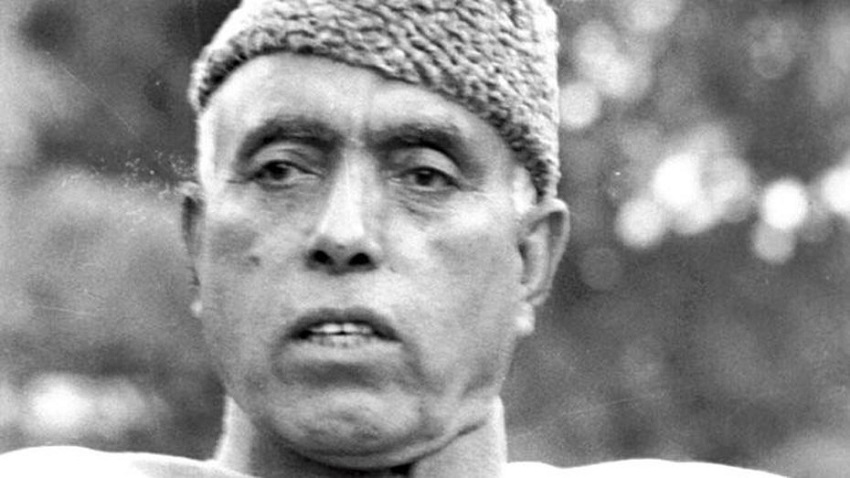
Sheikh Abdullah, founder of the political outfit National Conference that has a presence in certain pockets of the Kashmir Valley. (File Photo)

Has the Gupkar Alliance the welfare and development of Kashmir its primary objective? The development of Jammu and Kashmir, a heterogeneous conglomerate of humanity, along democratic, secular and egalitarian lines has been neither understood nor practiced by the valley majority based statecraft. How could they understand it when the J&K Constitution never accepted any group as a minority? It never considered minority as the wielding device and cementing force of a balanced social order and unifying ingredient. The alliance, as stated, is a loud lament for the loss of power and hegemony of a couple of ruling houses or local satraps and their ignominious auxiliaries, one and all pursuing the solitary agenda of self-aggrandizement and nepotism.

When late Mufti Saeed formed the Peoples Democratic Party (PDP), he publicly announced that one of the important programmes of the new party was to help Kashmir get rid of the dynastic rule because it was the negation of democracy. On this count, Mahbooba conducted her Jamaat-i-Islami proxied election campaign and won. But today she stands shoulder to shoulder with the leader who has roped in six or seven smaller groups to lend their support to him as the scion of the Sheikh ruling dynasty. Farooq’s one-time Finance Minister’s son has a case of ₹170 crore bank loan for setting up industries. Instead, he has purchased properties in the European and Gulf countries all at the expense of Kashmiri taxpayer.  Notwithstanding his history, this former Finance Minister is a close associate of Farooq in the Gupkar Alliance.

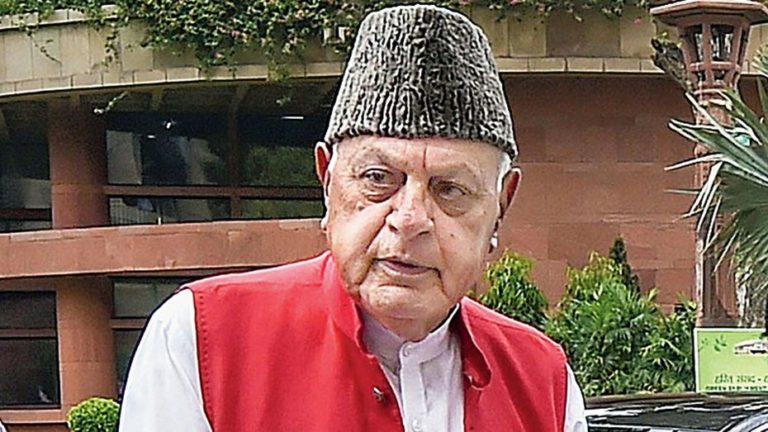
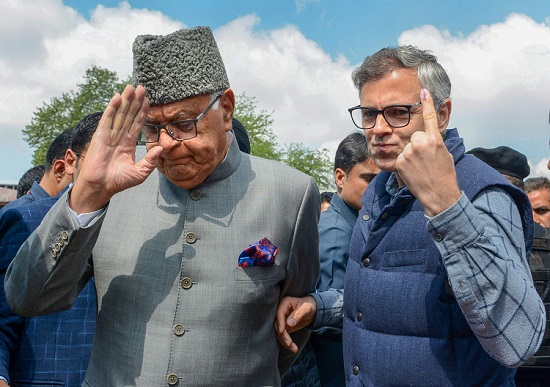
National Conference President Farooq Abdullah with his son and former Chief Minister of Jammu & Kashmir, Omar Abdullah. (Photo: PTI)

How far are the valley leaders concerned with the welfare of Kashmir is evidenced by the Roshni Act scandal through which more than two lakh kanals of state forest land has been granted to the politicians, bureaucrats, corporate houses, capitalists, and influential persons of one particular community at throw away price causing a loss of billions of rupees to the state exchequer? The Roshni Act has been declared null and void by the High Court. This scandal took place when Ghulam Nabi Azad of Congress was the chief minister in a coalition government with PDP and the conspiracy was allegedly hatched in collaboration with Farooq. Is the Roshni Act a developmental project for the millions of Kashmiri people or for the thick creamy layer of its society?

During its long stints in power, the NC has nothing to show by way of concrete development of Kashmir. They always stonewalled outside investment on the pretext of leaving space open for local entrepreneurs. What is the result? Look how these local entrepreneurs and their enterprises have been contributing to the alienation of the people and financially strengthening the creamy class of Kashmirian society. Why have not the administrative organs of the state been able to submit utilization certificates for enormous funds they received under various schemes over time? Where has that money gone? Why have most of the Centers’ development schemes been abandoned soon after these were inaugurated? What has happened to various central schemes generally called PM’s schemes for this and that?

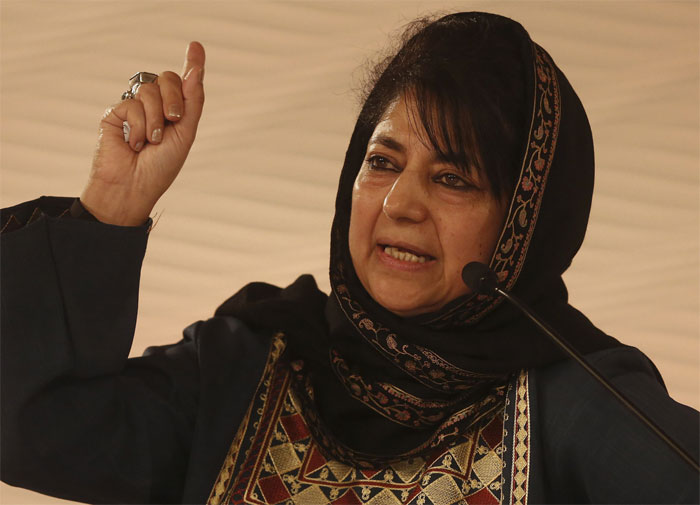
Mehbooba Mufti, PDP leader and former Chief Minister of Jammu and Kashmir. (Photo: PTI)

Kashmir Valley political parties have throughout pursued only a one-track policy of blackmailing the Centre with falsehoods, canards and fabricated stories. The simple formula which the Kashmir Valley leadership adopted in the course of insurgency beginning 1989-90 is “Hindostan sandooq band karega to Pakistan se bandooq lenge, meaning if India closes coffers on us we will grab guns from Pakistan.

Prime Minister Modi has understood the bottom of Kashmir doublespeak. He has taken strong measures to contain blackmailing of Central government and agencies. The easy flow of billions of rupees has stopped and the pockets of doublespeak robbers are going dry. Accountability has been initiated and the skeletons are crumbling out of the cupboards of broad-day burglar one by one. Their deep involvement in monetary scams, in overt empathy for militancy, in providing backdoor entries to government jobs to kith and kin, in looting the state exchequer, in corrupting society and services and in spreading falsehood and canards against India, are among their contribution to the development of Kashmir.

Now they want Kashmir to return to the same old order so that their path to perfidy and scandals is thrown open. That, in short, is what the Gupkar Alliance is fighting for. They want people of the valley to remain confined to straight-jacketed orthodoxy allowing no liberal ideas to grow and flow within the society. Progress and development of Kashmir is a distant cry and what sustains the unholy alliance is anti-India proclivities at a time when even in Pakistan saner voices are asking Pakistani government to understand and appreciate the nation-building ideology pursued by Prime Minister Modi.

In the final analysis, what is the Gupkar lobby fighting against? Yes, it has a comprehensive agenda for their fight. Let us itemize it. They are fighting the Home Ministry AGAINST (a) giving statehood to five lakh Hindu and Sikh refugees of 1947 carnage in Muzaffarabad, Mirpur and Rajouri living a stateless life for last seven decades (b) Against giving PRC (Permanent Resident Certificate) to nearly 2 lakh Valmikis whose services were formally requisitioned by the State government from Punjab as safai karamcharis more than half a century ago. Against (c) authorities taking action for clandestine resettlement of nearly 90 thousand Rohingya Muslims in Samba and Jammu district along the sensitive International Border and LoC thereby shredding Article 370 and Special Status proviso to pieces. (It will be noted that these people were given ration cards, Aadhaar cards, bank passbooks, water and electricity connections and other facilities within weeks of their arrival thus giving a clear proof that the valley-dominated regimes wanted to bring about demographic change in Jammu); against (d) Loot of nearly 2 lakh kanals of government land through illegal Roshni Act gifted away to ex-ministers, legislators, political VIPs, top bureaucrats, top businessmen and other favourites at a throwaway price. Not a single kanal has gone to a poor homeless Kashmiri urban or rural citizen; against (e) Kashmiri girls to whom the statehood status is desired to be restored even if they marry a spouse outside Kashmir, not only they but their progeny as well; against (f) Return and rehabilitation of ethnically cleansed seven lakh Kashmiri Pandits back in their homeland after grabbing or vandalizing their immoveable and moveable properties; against (g ) Investments in industrial enterprises with the potential of generating large scale employment for the unemployed locals; against (h) breaking monopolies by valley-based corporate houses that abet and disseminate anti-national and communal propaganda; against (i) universalization, liberalization and emancipation of Islamic society and harnessing it to the age of scientific and reason; against (j) the historic effort of the secular-democratic India to empower its minorities (especially the Muslims) and EWS with their constitutional and other rights, and against (k) holding entire Muslim community of the valley a hostage to conservative and orthodox Islam of Turko-Pak-Indonesian triumvirate where all beliefs converge on radicalization and weaponization.

The NC leadership is now preparing to invite China to help them get rid of Indian secular democracy and return to 14 centuries-old tribal social order to tell the world they are pure Muslims. If China can help Farooq Abdullah restore him the Kashmir Sultanate based on his religious philosophy, we would politely suggest Farooq go to Yarkand, Kashghar, Khotan, and Urumchi etc. in his first leg in Xinjiang and visit the hundreds of concentration camps for the Uighur Sunni Muslims to know what type of religious freedom they are enjoying. Kashmiris have a long history of inviting foreigners to come and rule over them. Farooq is meticulously preserving the tradition laid down by Maulana Sarfi and his delegation way back in the closing days of the 16th century to the court of Akbar. Hopefully, after his Chinese camaraderie, he will impress upon Kashmiris of the valley to enjoy the love of Chinese rule.

If the Gupkarists had any love for Kashmir they would have strongly condemned the attack planned by Jaish-e Muhammad terrorist organization of Pakistan that was foiled by brave Indian soldiers in Nagrota only recently. Anybody lamenting for Kashmir would not remain silent on such perfidy by Pakistan. This exposes the subconscious mind meaning the doublespeak of the Gupkarists nursing nothing but ill intentions against the Indian State and the nation.

The decision of the Gupkar lobby of participating in the DDC (District Development Council), Urban Local Bodies and Panchayat elections is a healthy decision. After realizing the blunder of boycotting previous Panchayat and other elections and leaving the space free for BJP to walk over, the Gupkar conglomerate has corrected itself albeit after a grave tactical miscalculation of which BJP took the fullest benefit. Their decision to participate in DDC and other elections this time is indicative of the fragility of their stand against democratic institutions of the county and their decision of fighting the elections jointly on the basis of fair distribution of seats is a big indication of their serious apprehensions about their ability to make a dent in the BJP constituency in the valley. It is so because they know the old game of rigging elections will no more work under present dispensation and the voters will no more be intimidated. No fewer than 18 BJP activists in the valley, or the Panchs and Sarpanchs have been gunned down so far by the militants reported to be enjoying overt or covert patronage of the politicians. The lobbyist did not have the humanism of even expressing condolence on the killing of these victims. The consequences of wanton destruction of innocent lives will have its far-reaching impact on the forthcoming elections. Interestingly, the constituent groups are askance at the usual hegemony of NC demanding lion’s share rightly or wrongly. The fissures in the phony unity of the cavaliers are not far to seek.

However, notwithstanding their antecedents, the lobbyists have taken a right step now, which is in the interests for genuine democratic dispensation in the Union Territory and its masses. Nobody anywhere in the world takes notice of their tantrum of restitution of abrogated articles or restoration of special status. The two power thirsty dynastic standard-bearers are standing on seashore and watching with utmost despondence their ship lowering down in the deep vacuum of history. One thing they fully and unanimously understand is that both of their reclining cushions viz. Pakistan and Congress, are either in the process of collapsing or have virtually collapsed. The takers and givers of doublespeak are conspicuous by their foolhardiness. There is still a chance of rectifying their waywardness and taking the masses of people of Jammu and Kashmir out of the morass into which they have been led. It is for the masses of the people to choose the right path as they are standing on the crossroad of history.

POK resident Naveed Majeed was brutally murdered, he didn’t commit suicide

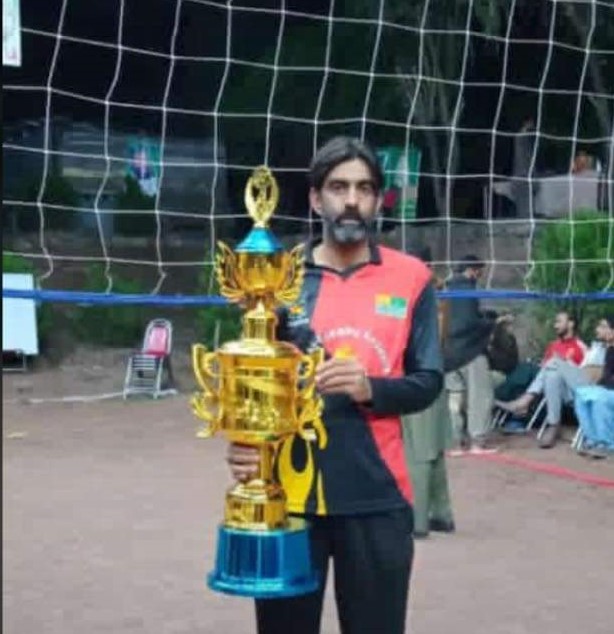
Naveed Majeed was a young man from Bagh district, an employee of the WAPDA (Pakistan Water & Power Development Authority) and was on duty at the Bagh Grade Station. Naveed had a good family life, participated in social activities and sports. On November 20, Naveed Majeed arrived on duty at the WAPDA office and within a few hours he was killed inside his office. After this heinous murder, Naveed’s body was taken to the hospital and postmortem was done. However, as soon as Naveed Majeed’s body reached hospital, his murder was described as suicide and people started talking about Naveed’s death as a suicide.

The dominance of a select few in our society is such that even hundred percent murder cases are conveniently turned into suicide. We call Naveed’s death as 100% murder because Naveed had a very happy family life who happily participated in social activities, he was a sports lover, he had no economic, social or family issues due to which he would have commit suicide.

Even earlier we had seen that Punjabis at WAPDA (Pakistan Water & Power Development Authority) had slaughtered a local employee from Nendrai Bagh a few years back. That murder was also dismissed with a report that the victim was mentally unbalanced and had committed suicide.

Everyone knows that the real reason for these murders is that the Punjabis do not tolerate a local citizen in WAPDA (Pakistan Water & Power Development Authority). These Punjabis come to our city, kill our citizen and then get a Punjabi to replace him. Naveed has also been killed on this same premise.

During the whole volleyball season since March, and in the Bes Bagla tournament a couple of days earlier, we were together. I knew Naveed from very close quarters. From economic affairs to the family affairs we shared everything with each other, we were unbridled companions in times of sorrow and joy.

On his way to the WAPDA office Naveed used to have his daily breakfast from a nearby shop. On the day of his murder also, he took the breakfast at this same place and later on bought a volleyball from a sports shop in Bagh. Naveed said that if there was a lockdown due to the Coronavirus pandemic he would pass his time by playing volleyball as he would have nothing else to do. An hour later he was murdered.

Naveed’s body remained in the hospital for about six hours after the murder. Autopsy was done on his dead body, but during this time neither the hospital’s MS (Medical Superintendent) came to the hospital nor the DC (District Commissioner) or the SP (Superintendent of Police) reached the hospital.

It’s surprising that a young citizen of Bagh who was also an employee of WAPDA (Pakistan Water & Power Development Authority) was murdered and yet the Bagh administration along with the hospital’s administration remained completely negligent as if a sheep or goat had died, rather than a human being. Since beginning the police started talking that this was a suicide, an attitude of removing the burden from their head.

We could get Naveed’s body after protests by his family, but we were dismayed by the attitude of the administration regarding Naveed’s murder. We will protest at every possible place if the administration will try to prove that Naveed Majeed committed suicide or if the investigation is not done properly.

Naveed is dead and our collective attitude towards Naveed’s murder has become such that we will bury Naveed, saying that this was Allah’s will and may Allah grant him a high position in heaven. If we do not pressurize the police to investigate the real reasons in Naveed’s death then one day the police will report that this was a suicide.

Earlier also an employee of Nindrai was killed, then last year Hamza Imtiaz and today Naveed has been murdered. If our collective attitude remains the same then we must remember that none of our youth will be safe. Our young people will continue to become victims of the mercenaries and we will continue to bury them and pray.

We urge the administration, DC, SP and the SHO Bagh to put in public domain the FIR and preliminary medical report of Naveed murder case. All the WAPDA employees on duty with Naveed, including the in-charge, should be arrested immediately and brought under investigation, otherwise the youth will protest.

Violent attack on Kashmiri protesters at Rawalakot, POK

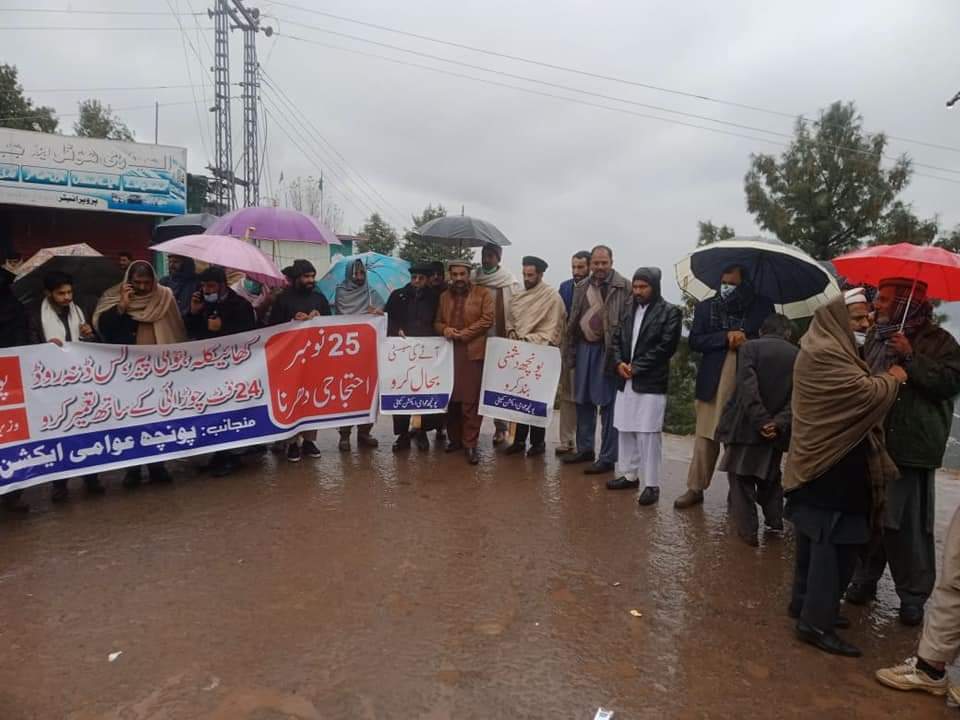
Rawalakot/POK: Acting on instructions issued by Islamabad the local administration baton-charged and used tear gas shells on Kashmiri protesters at Rawalakot in Pakistan-occupied Kashmir (POK) on Wednesday. The protesters were demanding that the administration complete Tuli Pir Road in POK.

“Police used tear gas and lathi charged all the participants of the Public Action Committee at Chandni Chowk in Rawalakot, POK. Several people were injured in this mindless attack on peaceful protesters,” a local eyewitness from Rawalakot told News Intervention.

However, despite using tear gas shells and lathi charging the Rawalakot police have failed to disperse the protesters who have now reached in front of the commissioner’s office for a sit-in. Local sources said that the protesters are now sitting in front of the commissioner’s office.

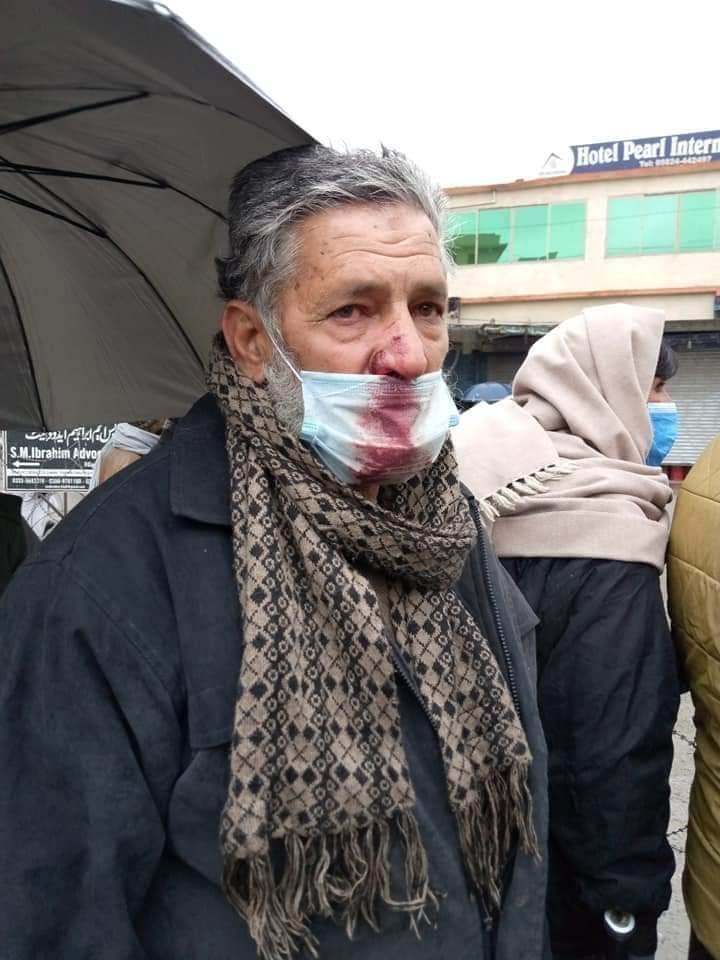
A Kashmiri protester injured in police violence at Rawalakot, POK. (Photo: News Intervention)

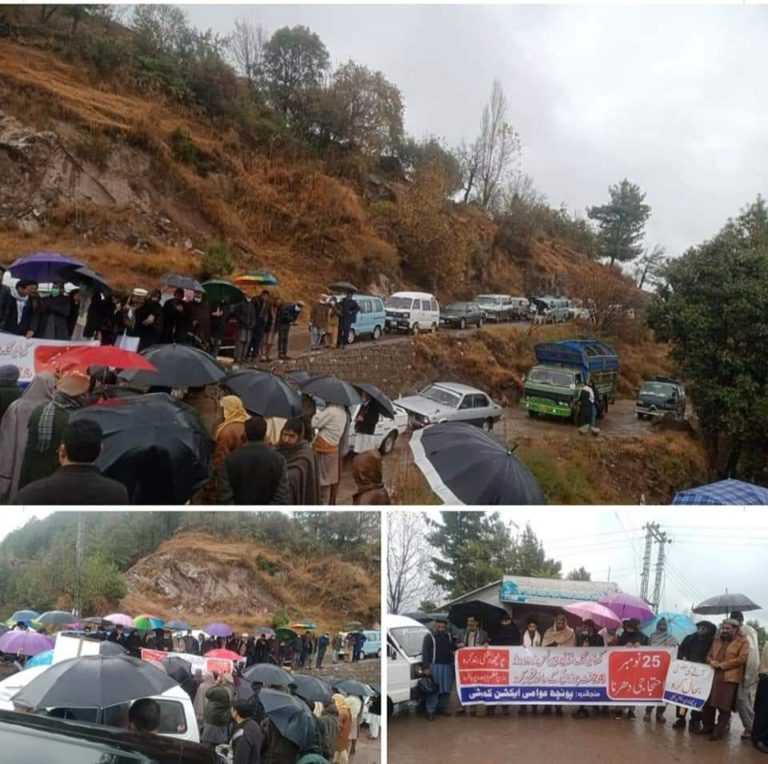
Earlier, a large number of protesters had gathered in caravans at the Jabota Cross in heavy rain and cold, from where they marched towards Rawalakot in the form of a rally. It was then that Islamabad issued directions to its puppet administration in Rawalakot to use brute force and stop this protest march. The Chandni Chowk Police then baton-charged the protesting crowd and used tear gas shells. However, despite the police brutality, the protesters managed to reach the commissioner’s office and the protests were still on till the time of writing this news report.

Local Kashmiris continue with their protests in Rawalakot, POK. (Photo: News Intervention)

Rawalakot is a POK-based town, which Pakistan calls as Azad Kashmir (free Kashmir) but then local Kashmiris have absolutely zero rights. The local administration in Muzaffarabad takes diktats from Islamabad and Rawalpindi and the local Kashmiris cannot even demand basic facilities for themselves. Even on Wednesday the protesters had gathered to demand the completion of Tuli Pir Road but the Pakistan Army and ISI do not allow even these protests.

26/11: Hafiz Saeed is guest of honour at Pakistan jail

Bleed India with a thousand cuts is a military doctrine followed by the Pakistani intelligence agency ISI. The 2008 Mumbai attacks were a series of terrorist attacks that took place on November 26, 2008, when 10 members of the LeT (Lashkar-e-Taiba), an extremist Islamist organisation based in Pakistan, carried out 12 coordinated shooting and bombing attacks that lasted for four days across Mumbai. This attack was just one cut, out of the thousands of cuts inflicted by Pakistan on India over the last 70 years.

Why only 70 years? Let’s also take into account the attacks carried out by Ghaznavi, Ghauri, Babur, Aurangzeb and all those Islamist invaders along with their “peaceful” followers? The 26/11 Mumbai terrorist attacks carried out by Pakistan against India was a continuation of the invasion by these extremist Islamist butchers. Pakistanis proudly propagate this as the “thousand years war”. So from the days of initial coup in Pakistan for military to rule over this unnatural country called Pakistan, an enemy was required and eventually Indian became that enemy.

I remember those sorrowful days after the tragic 26/11 attacks in 2008 when my neighbor from Mumbai at Sharjah in United Arab Emirates (UAE) was scared and worried. “Zafar Bhai why is Pakistan is doing this with us? You are also from Pakistan can you explain to me what are the reasons behind these attacks?” he asked me. I told him that I am not from Pakistan I am from occupied Sindh. “We are also under suppression of Pakistan and its state sponsored terrorism. I condemn these brutal attacks and killing of innocent people in India,” I explained to my Indian friend.

The Taj Mahal Hotel in Mumbai after the terrorist attack on 26/11/2008.

Unfortunately India has always been attacked or invaded through the Sindh. Persians, Arabs and Greeks entered Hindustan from Sindh because Sindh is the gateway to India. Even this time for the 26/11 Mumbai terrorist attacks in 2008, Karachi in Sindh was used.

India always had soft policies towards Pakistan, but Pakistan’s existence is on enmity with India. India must take strong decisions and must liberate Sindh, Balochistan and Khyber Pakhtunkhwa. Until and unless Pakistan is disintegrated and weakened, India will not be safe. Strong Sindh and Balochistan will play a key role for a strong India.

History repeats itself from time to time. I remember Timur from Central Asia invaded Delhi in 1398. Timur himself recorded the invasions in his memoirs, collectively known as Tuzk-i-Timuri. In this, he vividly described the massacre at Delhi: “In a short space of time all the people in the Delhi Fort were put to the sword, and in the course of one hour the heads of 10,000 infidels were cut off. The sword of Islam was washed in the blood of the infidels, and all the goods and effects, the treasure and the grain which for many a long year had been stored in the fort became the spoil of my soldiers. They set fire to the houses and reduced them to ashes, and they razed the buildings and the fort to the ground. All these infidel Hindus were slain, their women and children, and their property and goods became the spoil of the victors. I proclaimed throughout the camp that every man who had infidel prisoners should put them to death, and whoever neglected to do so should himself be executed and his property given to the informer. When this order became known to the Ghazis of Islam, they drew their swords and put their prisoners to death. One hundred thousand infidels, impious idolaters, were on that day slain. Maulana Nasiruddin Umar, a counselor and man of learning, who, in all his life, had never killed a sparrow, now, in execution of my order, slew with his sword fifteen idolatrous Hindus, who were his captives, on the great day of battle these 100,000 prisoners could not be left with the baggage, and that it would be entirely opposed to the rules of war to set these idolaters and enemies of Islam at liberty no other course remained but that of making them all food for the sword.”

The 26/11 Mumbai attack was carried out by Pakistan-sponsored Jihadis with this same mentality. These Islamist groups can’t rest until a single “infidel” is alive on earth. It’s in their nature to attack and even the ideology supports them for these cruel acts. However, at the same time ignorance and poverty also plays its role for such brutal actions. It is a fact that militant factions recruit and brainwash impressionable minds and then use them as pawns to kill innocent people. Most people are shown golden dreams of being granted a palatial mansion in the heavens for persecuting Indians, Jews, Christians, Muslim minorities and other non-Muslims. What remains unfathomable is how can the slaughter of innocent men, women and children help anyone to achieve heights of piety? God created life to be appreciated. Most of us know that such fundamentalist groups only serve one God and that’s “money and power” for themselves. Pakistani generals and their cultivated maniac mobs of Jihadis are destroying peace and humanity in the world.

Till today Pakistan is denying its involvement in the 26/11 attacks even after being provided with a large quantum of evidence and statements. Pakistani establishment and its state-controlled media is playing the dubious role to convince people of Pakistan that these Mumbai attacks were fake and are a ploy to defame Pakistan. It’s for this reason that 75% Pakistanis still believe that 9/11 or 26/11 was an inside job done by US/Israeli and Indian governments to give a bad name to peaceful Islam and to the Muslims. Even the Pakistani intellectuals (so called) say the same.

An emboldened Pakistan has now resorted to playing the same old tricks. A few days before Pakistan “sentenced” Hafiz Mohammad Saeed, the mastermind of 26/11 Mumbai serial attacks and chief of Lashkar-e-Taiba (LeT) & Jamaat- ud-Dawa (Jud). Hafiz Saeed has been “sentenced” for ten years by Pakistan not on charges of Mumbai terror attacks but for terrorist financing. This is merely eyewash meant only to save Hafiz Saeed the ‘asset’ of Pakistan. Pakistan is concerned for Hafiz Saeed’s safety and wouldn’t let any thing happen to him, and so he is currently enjoying at his second home (Haweli) in Kot Lakhpat Jail, Lahore. For the world Pakistan is seen as taking measures against terrorist Haifz Saeed, but what about Dawood Ibrahim and Masood Azhar and the hundreds of thousands Taliban roaming freely in Pakistan.

The fact of the matter is that Pakistan has become a hub of global terrorism and such extremist organizations could not have survived in Pakistan without the tacit support of government and some sections of the society. Pakistanis have to live with the fact that the entire world is pointing fingers at them. My sympathies are always with the relatives and families of all the Indians, Americans, Canadians, Europeans, Israelis and other victims who lost their lives in this tragic act of terrorism. We Sindhis are also victims of Pakistan-sponsored terrorism. We stand with India.

Minimalist Evidence Philosophy – Or, Striving Against And Worshiping The Maximal

0

To me it seems that those sciences are vain and full of error which are not born of experience, mother of all certainty, first-hand experience which in its origins, or means, or end has passed through one of the five senses. And if we doubt the certainty of everything which passes through the senses, how much more ought we to doubt things contrary to these senses — ribelli ad essi sensi — such as the existence of God or of the soul or similar things over which there is always dispute and contention. And in fact it happens that whenever reason is wanting men to cry out against one another, which does not happen with certainties. For this reason we shall say that where the cry of controversy is heard, there is no true science, because the truth has one single end and when this is published, argument is destroyed for ever. — Leonardo Da Vinci

I have found no confession of faith to which I could ally myself without reservation. — Johann Wolfgang von Goethe (Near the end of life)

Faith: not wanting to know what the truth is. — Friedrich Nietzsche

I had no need of that hypothesis. — Pierre-Simon Laplace

“Do you believe in a god?” “No.” Atty. Connolly then asked the court what God he meant, whereupon Judge Hayden replied, God Almighty. Here Sidis said that the kind of a God that he did not believe in was the “big boss of the Christians,” adding that he believed in something that is in a way apart from a human being. — About William James Sidis with the negation, the “No,” coming from Sidis

Theology is the study of God, in particular, or of the divine, in general. The most prominent discipline fractionation of theology is Christian theology. A common notion within the Christian faith throughout its sects comes in the assertion of the Virgin Birth of Christ. In fact, this gets taken as a proof of the divinity of Christ, of Yeshua, as the Son of God or God made flesh.

The idea comes from Christian theology with the Son of Man, Son of God, emergent as a source of both divinity and full humanity. As in Christian Humanism, Christ is the only fully human human being.

By mainstream Christian standards, Christian Humanism, certainly, comes as a surprise to many secular people, and many religious people, if they know about it. Most will not know about it. In fact, if people know about anything, they know about Christianity first, Humanism second, and Christian Humanism third.

A Christianity of “civilization,” of “human nature,” of “kindness,” of humanitas; in this sense, a self-understanding of oneself and others would be a source of paideia or (deep) education. A self-understanding of oneself and others through the personhood, the identity, of Christ, the anointed one, or through the flesh-made God identity of existence itself, or Jesus Christ as identified with the ground of being itself.

Any formulation of a Christian Humanism would bias an understanding of Humanism or bind it within the confines of Christian narrative, or metanarrative rather, where this would restrict conceptualizations by a limit of possible options and constraining that which could be considered virtuous to the tales of one era, one person, one tribe.

We are becoming human, while Christ was fully human. In this manner, we come to existence as Christ-like, in degrees, with the aim of a Christian life to become like Christ or as Christ without ever reaching the apex of humanity, Christ as the Son of God.

God creates human beings in this Christian Humanism incompletely human, commands them to be fully human, while inherently, by the laws of existence or God’s Law, coming to life with the inability to become fully human. A form of inveterate, in perpetuity, cruelty.

These theological issues or concerns grounded in theology stand tall, firm, fixed, and proud in the mantle of the study of God with the premise as the assumption of a god and then working from second principles to define such an entity. A being as a person, as eternal, omnipresent, a creator, as omnipotent, omniscient, self-existent (aseitous), and a sustainer with simple assertions of this as the fact of the matter, so working from second ‘principles,’ not first.

Theological concerns while not modern issues, though contemporary through inertia of historical processes of intellectual stagnation motioning towards the present due to the repetition of one male parrot to another male parrot, sluggishly burdening advancements around them, as if the divine enforcers of the Archangel of Boredom.

Theology, as the study of God, the Logos itself, or the divine Cogito, appears in so many formulations as to boggle the mind. Similarly, one finds this in the principled and detached-reality thought surrounding the Resurrection of Christ.

A God-man who died on a cross, or the Cross, for the Sins of Mankind who brought forth the Kingdom of God to the earthly dimensions of Man for a forgiveness of Sins forever and always for whoever shall submit themselves to the sacrificial witness of God Himself.

Flesh cages, prisons, of meat, bone, blood, brain, and skin, confining the reality of God written on the hearts of men and experienced in the soul of every human being. These forms of language tap into the orientation of the minds beholden to ancient mythology.

Capitalizations for effect. Signifiers repeated for impact. Strings of ungrounded concepts for both further effect and impact, or for pseudo-profundity. All this within the remit of significant portions of the global population, including the wealthy and powerful leaders around the world over many eras. One can recall the Divine Right of Kings so as to further entrench this political tool.

Every turn of phrase and punch of word triggering deeply unconscious, powerful and sincere emotions, sensitivities, within god-based sensibilities. That which is hoped for and remains unseen. The virgin birth of Jesus and the resurrection of Christ are significant theological issues in Christianity.

As with Nietzsche, and more powerfully, they have been written and read in blood. Not only this, and beyond the good and evil of Nietzsche’s “good” and “evil,” as in a trans-transvaluation of values, simply as a factual matter in other words, they have lead to blood, in the tonnage. Even there, it may be an inadequate descriptor, as such.

It’s a blood faith, a bloody religion, build on the sacrifice of a human being akin to animal sacrifices of old, while, within the framework of the theology, considered both a sacrifice of half of a god and half of a man in one being, while, at the same time, the sacrifice of God as a whole as a particular rather than a general point of existence with a specific worldline, such is the arithmetic of godhood.

Although, Nietzsche, had some piercing and negative commentary, succinct, on the looking at reproduction as sinful, as an act, at life as a works-project for an afterlife, and the valuation of death over life, or a death-oriented religion, as Cornel West notes, “Learning how to die,” a devout Christian himself in the prophetic and anti-Constantinian strain.

Most biblical historians, secular and religious, appear to take in the idea of Christ, Ben Yosef, as a real figure, charismatic, intelligent, and revolutionary, while disagreeing on supernatural powers, healing abilities, ability to prophesy, and divinity as in an incarnate form or flesh-form of the God of the Bible or the God of Abraham (and Isaac).

In the more modern comprehension of the world, the supernatural properties, the magic tricks with import and impact on individual health. Science or modern empiricism comes to the tentative conclusion of a natural world of objects and subjects, not a supernatural world of object and subjects, and then supernaturalistic, transcendental subjects acting in a supernormal manner on the natural subjects and objects.

Leaving the claims of magic to the side, in the dust, on the side of the highway, even in the ICU on life support, awaiting the grim reaper to come and take them kindly as the gate continues to close asymptotically, the world of nature is the world of the natural, while the world of the natural appears the world of the possible and impossible as the probabilistic and improbabilistic.

Laws of the universe set boundaries on the world, as such, as in the sphere of that which exists. The claim of the supernatural in regards to the workings of the world remain possible while forever unverified and, therefore, not infinitely but gargantuan-sized finite levels of the improbable if not the outright meaningless. Echoes of “colorless green ideas” in this hall of ancients.

By this natural deduction, we come to the idea of the claims of faith as not truly faith-based claims, where the discourse foundational to and on the nature of faith itself becomes a hall of mirrors reflecting a single aperture of the False. A mirage-like effect covering that which exists right outside if one would brave the cold.

Verity! Too bright for too many centuries, one might assume. Faith requires no evidence, while claims exist about reality and, therefore, pertain to that which exists, and so become something of the evident or about the empirical.

Because the ideas about the real contain implicit information or structural knowledge about the rules and contents of the real, so as to constrain the claims. It’s not that faith exists, but that faith exists only to the Empty Set Mind, of which no minds exist and no mind coincides (or all minds are co-extensive in a meaningless sense, or both).

Faith-based, or religious communities, amount more to minimalist evidence communities, properly defined and understood, instead of the long-term and common — several generations and eras — wrong definition of that belief held without evidence.

Religious beliefs, including the Christian and the Christian humanist, worldviews belong to a properly denominated category of minimalist belief structures in terms of informational content. Hence, they amount to low-information, or low-evidence, low-fidelity viewpoints, which becomes a common qualifying metric of the ignorant, not idiotic as many of the brightest lights belonged to the earthly armies of God Almighty while failing mightily, and sets the stage for the insane or the nonsensical, as in no sense or minimal sensory information taken into account.

In turn, this better explains the Christian psychology, as based on a logic of irrationality. One devised and designed within the framework of minimal information connected to the properly defined real, as opposed to the unreal, given by the scientific method.

Its antithesis in the unreal does not become maximal information, as information implies that which pertains to content, of which the unreal does not have, and of which the Christian worldview deals by the barrels and the Christian humanist perspective dishes out merely by buckets.

Theology, as well, its bases in the unreal, as in that which defines the real by the properly deemed unreal, statistically so, equates to a grounding in the idea of the opposition to reality, or unreality equates to reality in theological terms because of the claimed super-natural, truly the extranatural, as in not necessary, as equitable with the natural. However, it’s “extra-.” It is not needed; it adds nothing (or little).

Theology as an inversion of the way to know the world, as the study of God; the discipline of theology, as the study of the unreal claimed as the real, becomes a field of minimalist evidence belief structures or the metaphysics of (mostly) nothing claimed as everything, Q.E.D. In turn, theology fails; or, theology adds nothing, while claims to deliver everything and, in some cases, to deliver us, in turn.

It’s not that no god existed in the corners to be discovered in reality or a god existed and retreated, or was here once and then disappeared; it’s that the gods, as such, aren’t here, as they never left, because they were never here.

Magical thinking has been one term set to encapsulate the idea of religious ideologies and beliefs as the fundamental basis of human irrationality exhibited in religious ideologies, or dogmatic ones perceived in the state-based worships based on low-information or minimalist evidence belief structures.

Minimalist evidence communities asserting minimalist evidence worldviews as the highest valued, most virtuous, views with the maximal evidence perspective only inhered in the very presence of God Himself, as the entity of omniscience or perfect knowledge (and potentially foreknowledge) in which that which exists, the self-evident and the evident, is contained perfectly and only in the mind of God.

The mind of God as that which one will want to worship, or the worship of the maximal, through the minimalist evidence philosophy. That which one strives against, individually, evidence, for a minimal evidence worldview, is the opposite of that which one wants to worship, that which inheres with property omniscience or the maximal mind in terms of the evident and the self-evident, or God Himself, a strange counter-union. Perhaps, opposites attract; lovers by repulsion.

Individuals worship God on the basis of “faith,” as defined by an absence of evidence, more accurately means minimalist evidence propositions or premises, as in looking to the reduction of constraints of evidence to the lowest reasonable levels in which the gap may be perceived for the, rather massive, “leap of faith.”

Even “reasonable faith,” it means a mostly minimalist evidence worldview, while utterly within some of the arguments, in which arguments constrained little by the evidence become proposed, even the most popular arguments hinging on contingency with the idea of the unmoved mover, first principle, prime mover, final form or first form, the non-contingent, or the aseitous or the being with property aseity.

If contingent things exist, then a non-contingent thing exists; contingent things exist; therefore, a non-contingent thing exists, as every contingent thing depends on other contingent things until one comes to the non-contingent. To some, the greatest discovery ever or the most important argument in a theological arsenal in defense of the divine.

This poverty of intellect and wealth in effort for generation after generation; this empty flappers ball comprised of interlocutors looking at a nicely dressed suit on display and talking to it as if there’s a man present, when, in fact, there’s no there there, i.e., simply the nice exterior suit on display with nary the man in it to be seen.

It’s not using supernaturalism, except at the endpoint by definition and not by fact, but, rather, logic deduced from minimalist evidence because the world appears constructed in such a manner as to contain a series of contingent spatiotemporal events with some called objects and others deemed subjects. Each and every one with particular worldlines through reality.

Each running back to some eventuation of the start of everything, where the “start of everything” is God or “the unmoved mover, first principle, prime mover, final form or first form, the non-contingent, or the aseitous or the being with property aseity.” Not a helpful argument, however, it takes the facts of reality first, as a tip of the proverbial hat, without helping explain them that much.

One can run the course with these in terms of the “faith” arguments, the “reasonable faith” arguments, and the like; the presentation seems evidently clear as not “faith” formulations of arguments, but, instead, the arguments by minimalist evidence, i.e., theology. What are the smallest possible pieces of evidence presentable for the arguments towards or for, while not in closure of explanation of, the theity?

By minimalist evidence philosophy, this means the constructs informing mind, including words for no things, or imagery expanded to come to define a nothing, require some minimal evidence or sensory-based impressions for the thought, where thought is motion without motion and comes equipped with some informational content to come to claims even faith-premised ones in which faith, by this derivation, become minimalist evidence arguments and not no evidence arguments.

The Theity of Abraham and Isaac, of Noah and Methuselah, of Mary and Joseph, of the New Testament and the Old Testament, or the God of maximal comprehension of the evidence of existence. It’s one of the strange connections of the believers, the leaders, and the hypothesis of the divine.

Both former basing their worldviews on the arguments from minimalist evidence or low-information perspectives for worship of the maximally knowledgeable, the omniscient, or that with maximally evidenced comprehension.

A divergent self-negation in the form of bringing information for oneself to the lowest while worship of a hypothetical being claimed as having information to the highest. Something that one worships collectively and individually, while striving against an evidential framework individually to the utmost.

Perhaps, this could be seen as one of the sin-states as striving to be like God is sinful, so working to having the Empty Set Mind as one’s own vacuous mind becomes the highest ideal in the worship of the Totality of Knowledge and Foreknowledge called “God.”

The unreal, the low information views, faith arguments, the reasonable faith arguments, the minimalist evidenced worldviews, these remain all of a piece. All of a tapestry teleo-tropically— with teleo-tropism — oriented towards the fixedness of the god(s) concept, or, more properly, oriented towards the cultural, era, and people group, orbits and rotations of the god(s) concept.

The god(s) idea is differentiated in such a large finite as if to seem infinite because the god(s) idea is a poorly defined idea. Some concept more or less defining human lack in particular capacities made infinite, claimed as fundamental rather than derivative in some transcendental being, and divinizing human needs in this psychologically anthropomorphic entity (or entities), a thirst never quenched, except in the objectification of the self through an inversion of human limitations converted into the external where the lacks and needs are objectified, personified as external, and made omni-infinite (“eternal, omnipresent, a creator, as omnipotent, omniscient, self-existent (aseitous), and a sustainer”).

It is human psychology inverted and then externalized, and then claimed as the base of existence. An apparent objective argument for divine attributes as some abstract God is an anthropomorphic entity, too, in the aforementioned manner of inversion-externalization made the ‘ground of being’ or some such item. Similarly, claims of a virgin birth reflect the minimal evidence worldviews mentioned above. The Resurrection of Christ within the same mode of thinking.

In that, both stand as the highest claimed evidence for the divinity of Christ, as foundational to the Christian worldview, in fact ethic, while violating known processes in biology with reproduction, in physics with thermodynamics, in biology with cessation of physiological processes leading inextricably to the physical, as the boundary between life and non-life or the physiological and the physical is only them, i.e., the physiological lead to the physical or set the boundary between the living and the dead, the biological and the material.

The lowest forms of reasoning raised as the highest, and given the aura of the holy or the divine to reduce proper scrutiny and clarity on the empty claims asserted as the basis for entire philosophical systems to make for those who strive against evidence in matters deemed of first-rate importance as bases for the existence of the omniscient, i.e., theology as a means by which the sentient strive, diligently so, for the a-scient while worshipping the omni-scient. The lowest deemed the highest, the real seen as the unreal, unreality claim as reality, this is the legacy and telos of theology.

Its final destination of the abode of Thanatos, of itself; the teleology of theology is death, always has been: Theology is a form of self-thanatology played to the tune of history, as the words of the Word are claimed as the “Spirit who gives life” and, in fact, once more invert the real as truly the unreal, because the ‘Spirit,’ as Jesus, as YHWH, as the Word, brings death unto itself, eventually.

Photo by Davide Cantelli on Unsplash

ISPR: The Self-Appointed ‘Guardians’ of Pakistan History

In a democracy, whenever the military jumps into a political squabble, it becomes ‘breaking news’; and the moment an army General suddenly appears on TV, diplomatic hotlines between foreign embassies and their respective countries start buzzing frantically. But it is not so when these things happen in Pakistan, because such occurrences are quite normal here. In fact, Pakistan is one country where the army isn’t at all apologetic about either the extra-constitutional powers that it has unashamedly usurped, or the extensive control that it exercises over various state institutions.

So, when Director General Inter Services Public Relations [DGISPR] Major General Babar Iftikhar suddenly appeared on TV and commented on the statement made by a senior leader of the opposition in National Assembly [NA] it rattled no one. Whereas he didn’t take any names, but by saying ‘A statement was given yesterday which tried to distort the history of issues associated with national security’, he didn’t have to- because it was obvious that the subject of his ire was what senior PML[N] legislature Sardar Ayaz Sadiq had spoken in NA the previous day.

What the DGISPR opined to be an attempt to ‘distort history’, was actually nothing more than a bid by a political party in the opposition to put the government down by accusing it of indecisiveness. This is something that happens very frequently in democracies all over the world and is inconsequential. However, the PML[N] leader crossed the redline when he mentioned that the army chief had displayed signs of nervousness and panic and probably that’s why Gen Bajwa considered the army’s immediate intervention necessary and deputed his media chief Maj Gen Iftikhar to hold an unscheduled televised press conference post haste.

In this presser, DGISPR said that the statement in question was both ’disappointing’ as well as ‘misleading’ and his one-point agenda was to ‘correct the record’ as Sadiq had attempted to ‘distort history’. However, a fundamental question arises in a democracy. Since when has it become the army’s job to set the country’s historical records straight? With the DGISPR going all-out to justify the army’s intervention on a politician’s statement by citing a plethora of reasons clearly it is apparent that Rawalpindi was well aware that by intervening on this issue it was overreaching its mandate!

So, the DGISPR virtually used every trick in the book to make this interference appear to be an inescapable requirement of critical importance and in national interests, which made it incumbent on Rawalpindi to take things into its own hands. The first thing he did was term what the PML[N] leader said to be a brazen attempt to ‘distort the history of issues associated with national security’. On the face of it, this contention may sound worthy of the army’s intervention, but a dispassionate analysis raises a very basic question- can national security really be endangered by ‘distortion’ of just one single event and that too by a relatively insignificant person who hasn’t supported his assertions with any proof?

All that Sajid said in NA was that in the aftermath of IAF pilot Wing Commander Abhinandan Varthaman’s arrest, a meeting had been called, but while the Prime Minister chose not to attend it, the Foreign Minister was in a state of panic and the army chief’s legs were shaking and he was perspiring’. So, what actually emerges is that the PML[N] leader had only expressed his own impressions regarding the physical and mental condition of those present at the meeting. So, being only personal perceptions that didn’t involve leakage of any state secrets or divulging any sensitive information, how does this become an issue ‘associated with national security’ defies logic!

However, just like his predecessors, Maj Gen Iftikhar too has relied heavily on arousing public emotions by saying, ‘This [Sadiq’s statement] is in fact equivalent to making controversial the Pakistani nation’s clear supremacy and victory over India, and I think this is not acceptable to any Pakistani’. DGISPR seems to have overlooked the fact that having had lived through far more embarrassing incidents precipitated by the army, the common Pakistani has become not only far more resilient but also even more discerning today and gone are the days when the army could get away with anything by playing the nationalism or patriotism card!

The common Pakistani who grew up hearing of how Inter Services Intelligence [ISI] of Pakistan Army is the foremost intelligence agency in the world, was greatly embarrassed when it emerged that Al-Qaida founder and 9/11 mastermind Osama Bin Laden was living in Abbottabad along with his family, while ISI was allegedly clueless that the world’s ‘most wanted’ was residing just a stone’s throw away from Pakistan Military Academy. The common Pakistani also suffered unspeakable humiliation when despite Pakistan being Washington’s closest ally in the global war on terror, the US still didn’t share this information with Islamabad and instead, nonchalantly went ahead to hunt him down by violating Pakistan’s airspace!

The common Pakistanis who always believed that Pakistan army officers are the epitomes of patriotism and integrity had to hang their heads in shame when very senior army officers [Lt Gen (retd) Javed Iqbal and Brig (retd) Raja Rizwan] were found guilty of being involved in espionage activities and passing sensitive information to foreign intelligence agencies. The common Pakistani was appalled when despite being exposed for having amassed wealth far beyond his known means of income and declared the same, Lt Gen [retd] Asim Bajwa has still been retained as head of the $62 Billion CPEC [China Pakistan Economic Corridor] Authority.

The common Pakistani who looked upon the army as the foremost unifying force in the country being devoid of any radical or fundamentalistic influences, is indignant when Brig Ali Khan and four Majors are found guilty of having links with Hizbut Tahrir, a fundamentalist terrorist organisation. The common Pakistani is also extremely furious when it emerged that the PNS Mehran terrorist attack that left 18 military personnel dead and 16 injured was the result of failed negotiations secretly held between Naval authorities and Al Qaida representatives over release of arrested Al Qaida sympathisers serving in Pakistan Navy, and that this attack was facilitated by serving Naval ratings with Al Qaida affiliations!

But what defies explanation is Pakistan Army’s renewed push to playdown the effectiveness of the IAF Balakot airstrikes and this definitely betrays a deep sense of uneasiness. What else explains the requirement of DGISPR to waste ‘air time’ by talking about the Balakot airstrikes by IAF when the PML[N] leader’s statement in NA that prompted his unscheduled presser had no mention about or reference to this incident at all? Yet Maj Gen Iftikhar spoke about how ‘The enemy [IAF] planes that had come to drop the explosives on the Pakistani people escaped while dropping their payload on empty mountains in panic after seeing our Shaheens [hawks, here a reference to PAF]’.

Readers would recall that immediately after the Balakot airstrike that took place on 26 February 2019, Maj Gen Asif Ghafoor who was the then DGISPR had made a similar claim and even offered to take the media to this site as soon as weather conditions improved. However, even though the weather cleared in a couple of days, the media was finally taken to the target location only on 29 March which rightly fuelled speculations that this visit had been delayed by more than one month because there was something that Pakistan Army wanted to hide!

It’s a documented fact that a Reuters team which attempted to visit this site for independently ascertaining the veracity of contradictory claims being made by India and Pakistan wasn’t allowed to do so, and instead was turned back not once or twice, but three times by Pakistan Army officials citing ‘security concerns’. Since the otherwise hyper-vocal DGISPR gave no further reasons or explanations as to why this area was placed ‘out of bounds’ for media persons immediately after the IAF strike, or what compelled Pakistan Army to delay taking the media to this site for 43 days, the ISPR has itself let the cat out of the bag!

But the most irrefutable evidence to prove that DGISPR was being economical with the truth regarding the Balakot airstrikes are the three craters which the media was told had been created by the armament fired by IAF. Since media persons who visited the attack site wouldn’t have been aware that each type of armament and explosive has a ‘signature’ crater profile, the journos readily believed whatever was told to them. However, anyone with even ‘YouTube acquired’ knowledge will tell you that craters created by an air delivered ‘bunker burster’ munitions [like the 1000 k.g. Spice bombs used by IAF] characteristically have a very small surface spread but are at least 2-3 m. deep as they are specifically designed to penetrate concrete roofs and thereafter detonate, killing the occupants therein.

However, photographs of the craters [which DGISPR claimed had been created by IAF missiles] that were taken by the visiting media persons have just no similarity whatsoever with what an air delivered bunker penetrating missile would have made. The craters shown to media were quite wide and comparatively very shallow- a clear indication that these were intentionally created by controlled conventional high explosive explosions. Furthermore, that the Pakistan Army couldn’t even produce a single bomb fragment recovered from these three craters to support their claim, reads more like pulp fiction!

Similarly, when Maj Gen Iftikhar spoke about how the PAF ‘shot down their [IAF’s] two jets [and] Wing Commander Abhinandan was captured’, he raked up yet another issue that once again bared ISPR’s proclivity for falsehood. On 27 February  2019, Pakistan Army’s former DGISPR tweeted that two Indian aircrafts had been shot down inside Pakistani airspace and while one pilot [Wing Commander Abhinandan] had been arrested, two others were in the area. An hour later, while addressing a press conference, he spoke about a second IAF pilot being in Pakistan army’s custody adding that he was ‘injured and has been taken to Combined Military Hospital and will be given proper care’.

But by evening, the second IAF pilot who DGISPR had himself confirmed as being in Pakistan Army ‘custody’ and was undergoing treatment in a military hospital, suddenly vanished from the face of earth without any trace. It was only then that it became apparent that this injured pilot actually belonged to PAF and was flying the F16 which was brought down by Wing Commander Abhinandan. Though he bailed out safely, this unfortunate pilot was roughed up so mercilessly by locals [who mistook him to be an IAF pilot] that he lost consciousness by the time he was rescued by Pak security personnel. Stripped off his flying overalls by the mob, he was erroneously presumed to be an IAF pilot and this explains DGISPR’s claim of a second IAF pilot being in Pakistan Army’s custody!

So, rather than setting the record straight, by mentioning Balakot air strike and the air combat incident of 27 February, DGISPR Maj Gen Iftikhar has opened a can of worms and ended up exposing how Pakistan Army has itself been twisting facts all along to conceal it’s failing, whether it was the failure of Operation Gulmarg [attempt to annex J&K in the garb of a tribal invasion in 1947], Operation Gibraltar [annex J&K by inciting a local insurrection in 1965], Operation Koh Paima [Kargil intrusions of 1999, in an attempt to change the alignment of Line of Control], not to mention the Hamoodur Rahman Commission Report [on loss of East Pakistan in 1971], which hasn’t officially  yet seen the light of day.

With PML [N] leader Sardar Ayaz Sadiq standing by what he had said and refusing to apologise, things have become much murkier and that’s why DGISPR’s unsolicited intervention to ‘correct the record’ is simply just an attempt to debunk the PML[N] leader’s mortifying revelations about the army chief so that the ‘tough’ public image of the military isn’t compromised!

Gupkar Alliance is an unholy union to revive dynasty rule in J&K

The People’s Alliance for Gupkar Declaration (PAGD), an alliance of seven parties in Jammu and Kashmir that is seeking the restoration of the erstwhile state’s special status, revoked by the Centre in 2019, is in effect an elegy for the demise of dynastic rule and power. The dynamics of history reflects the transition of an old order paving way for a new system – this holds true for both Abdullahs and Singhs (read Sheikh Abdullah and Maharaja Hari Singh). Monarchy and dynastic rule can’t be a permanent feature of a nation.

However, by coming up with this Gupkar alliance, former J&K chief minister and National Conference chief Farooq Abdullah presumes that he can undo the universal truth by a show of mob movement. But his popularity is an enigma.  It has come to him essentially from being the son of late Sheikh Muhammad Abdullah, though many Kashmiris are strongly apathetic to dynastic rule.  Dispassionately speaking, his contribution to Kashmir history is only a plethora of whims and eccentricities, all bandied in self-aggrandizement.  Yet, he delights when told that he has a method in the madness.

His ideology of no accession to Pakistan, bequeathed to him by his illustrious father, is neither a whim nor an eccentricity.  It does not mean either hate for Pakistan or love for India. He never supported the option of Kashmir for Pakistan because he knows very well how Pakistan would treat them- nothing more than hewers of wood and drawers of water. He has spent days in the UK living and interacting with Pakistanis and PoK diaspora.  There are no takers of his bluff in Pakistan, but unfortunately in India, there is no dearth of them, and the Sheikh dynasty survived because its bluff worked with the Indians.

After grabbing power — offered on a platter in October 1947— “doublespeak” became an obvious political culture and tactical idiom of National Conference (NC) leadership, particularly Sheikh Abdullah and his lineal successors. Since in its early days, the NC had gathered momentum through mosque politics — now an encrypted tradition of Kashmir politicos — and the Sheikh had assiduously fathomed the naivety of Congress leadership- the “doublespeak” became almost a lethal instrument very deftly handled by the Valley leadership for seven long decades.  Valley political heavyweights ensured that the bluff percolated down to the Kashmir feudalists, elites and the local bureaucratic segments, and finally to the unsuspecting plebeians.  Interestingly, even other political groups pronouncedly differing with the NC in their political or ideological viewpoint, also found this Goebelian propaganda convenient and serviceable option to further their game plan. The Congress in power at the Centre was complacent with the doublespeak of the Valley leadership, as it considered it as short cut to good riddance. However, it was oblivious of the fact that it was inadvertently allowing the strong nationalist predisposition in Jammu region.

As Kashmir polity was rife with doublespeak, it revealed the duplicity of intentions and willful abandonment of conviction on the part of local leadership. The most disastrous outcome of this phenomenon was the widespread corruption in almost all facets of society that ingrained into the system. The civil society in general and the administrative structure in particular, began to believe that perpetuating a general loot of public assets was its birthright because Kashmir “an Islamic territory was occupied by a non-Islamic power”. The loot of the property raised by a non-Islamic ruling structure was permitted by faith as “mal-i- ghaneem” meaning enemy property meant for general loot. Therefore, whenever the ulema preached honesty, they added, the property of the non-Islamic entity was permitted to be looted. What the Indian Enforcement Department today calls scams, embezzlement, misappropriation, money laundering, hawala, illegal transactions; narcotic trade etc. was alien to the ears of Kashmiri leadership and the public, for their religion allowed it in the name of mal-i-ghaneem.

The Gupkar Alliance is not an alliance that has the welfare and development of Kashmir as its primary objective. Development of Kashmir along democratic, secular and egalitarian lines has neither been the objective of any political party nor the cementing force for unity among them. Even today, the alliance is the result of the lament for the loss of power and hegemony of one or two ruling houses and their ignominious auxiliaries, all pursuing the lone agenda of self-aggrandizement.  

A look at the major partners of this alliance will substantiate this theory.

A case in point is the People’s Democratic Party (PDP). When late Mufti Mohammed Saeed formed the PDP, he publicly announced of getting rid of dynastic rule from J&K’s political landscape as one of the important agendas of his party. In fact, his daughter Mehbooba made it a major election plank, campaigned on its basis and won the election riding on it. Ironically, today she is one of the major partners of this alliance.

Similarly, Farooq’s one-time finance minister,  a close associate in the Gupkar alliance, has a dubious record, albeit in his son’s name, who is alleged to have manhandled 170 crore rupees bank loan by purchasing properties in western countries and the Gulf in the name of setting up industries in J&K.

More importantly, the Roshni scandal through which more than two lakh kanals of forest lands were allegedly granted to the political leaders, bureaucrats, corporate houses, etc, at throw away price, causing a loss of billions to the state exchequer is a case in point. The scandal under the Roshni Act, which has been declared null and void by the high court, happened during the reign of Ghulam Nabi Azad, when he was the CM of J&K. It is alleged that the conspiracy was hatched in collaboration with Abdullah.

All these cases are an indication that the only aim of the Gupkar camaraderie is to reinstate dynastic rule in Jammu and Kashmir.

It may be noted that during its long stints in power, the NC did more harm to Kashmiriyaat than good. The citizens got alienated, thanks to the corrupt system that strengthened the hands of the creamy class of Kashmir at the cost of local entrepreneurs. The development schemes financed by the Centre were either siphoned off or abandoned, while the corrupt thrived.

Unfortunately, over the last few decades, major political parties in J&K pursued only a single track policy of blackmailing the Centre with falsehoods, canards and fabricated stories. The simple formula, which the Kashmir Valley leadership adopted in the course of insurgency beginning in 1989-90, was “Pakistan se bandook Hindustan se sandooq” (get arms from Pakistan to get funds from India).

Prime Minister Modi has understood the implications of Kashmir doublespeak. He has taken strong measures to contain blackmailing the central government and agencies. The easy flow of billions of rupees has stopped and the pockets of Valley leadership are going dry. Accountability has been initiated and the skeletons are crumbling one by one out of the cupboards of the leaders. Their involvement in monetary scams, in militancy empathy, in providing backdoor entries to government jobs to kith and kin, in looting the state exchequer, in corrupting society and services and in spreading falsehood and canards against India, are among their contribution to the development of Kashmir.

These stern measures by the Centre has hassled the Abdullahs and the Sayeeds. Now, they want Kashmir to return to the same old order so that their path to perfidy and scandal is thrown open. That, in short, is what the Gupkar Alliance is fighting for. They want people of the Valley to remain confined to straight-jacketed orthodoxy, allowing no liberal ideas to grow and flow within the society. Progress and development of Kashmir is a distant cry and what sustains the unholy alliance is anti-India proclivities at a time when even in Pakistan saner voices are asking Pakistani government to understand and appreciate the nation-building ideology pursued by Prime Minister Modi.

The NC leadership is now preparing to invite China to help them get rid of democracy and return to 14 centuries- old tribal social order to tell the world they are pure Muslims.  If China can help Farooq recover the Kashmir Sultanate based on his religion, then Farooq should pay a visit to Yarkand, Kashghar, Khotan, Urumchi etc. and visit hundreds of concentration camps for the Uighur Muslims of Xinjiang to know what type of life they are living. Kashmiris have a long history of inviting foreigners to come and rule over them. Farooq is meticulously preserving the tradition laid down by Sarfi and his team way back in the closing days of the 16th century.

Implications of rising Xenophobia and Islamophobia in Europe

The multi-polar world today is increasingly characterized by authoritarian states/rulers/dictators, rising nationalism and religious fundamentalism, growing economic asymmetry, a thousand mutinies mainly regional, chronic instability like in the Middle East, Afghanistan, and an increasing confrontationist clash between the democratic liberal world order and illiberal, non-conformist nations/regimes who want to follow their own pathways. Nations are compelled to constantly engage in 24X7 internal and external strategic balancing in a continuous phase of cooperation, competition, confrontation or even conflict if national aspirations are threatened. This transformation is fed by internal and external societal/cultural/historical/religious strife. Europe which was historically built on a shared belief in democracy, individual freedom, commitment to human rights, gender equality, freedom of speech and importantly religion, and right to migration/asylum has also been affected by the changing world.

There was a time when Muslim scientists, astronomers, surgeons and mathematicians were at the cutting edge of their disciplines. Muslims were then seen as representing a powerful, sophisticated and rich world civilization. Islamic mathematicians such as Al-Khwarizmi, Avicenna and Jamshīd al-Kāshī made advances in algebra, trigonometry, geometry and Arabic numerals. Islamic doctors described diseases like smallpox and measles and challenged classical Greek medical theory. Today, ironically, Muslims are seen as destitute refugees escaping mad and autocratic Muslim rulers.[i] In this guise it is understandable that Europeans will not see Islam as a part of European civilization. Therefore, it is necessary that they peep into their own history, when Muslims were very much part of the European culture/history and impacted the Renaissance, Scientific Revolution and Enlightenment. While many people talk of a ‘Judeo-Christian’ Europe, the fact is that it is the Judeo, Christian and Islamic religions, i.e. the Abrahamic faiths that came together, while engaging with Greek philosophy, to create and nourish what we now know as the European civilization. Chancellor Merkel’s welcoming of some million migrants was an act of compassion for which the world, have applauded her. The friction between a Europe that wishes to preserve its historic identity, and newcomers who wish to escape their own countries and move to Europe is real, not a delusion. There is unfortunately an alarming rise in xenophobia in which islamophobia is the pivotal constituent in Europe. At the outset, comprehensive statistical inputs indicate that contrary to presumptions and assumptions which a nationalist/original citizen feels/perceives the immigrants (from past and present wave of migrations in last 5/6 years) have indeed integrated with European nations well.

Xenophobia connotes ‘dislike of or prejudice against people from other countries’ and Islamophobia refers to ‘unreasonable dislike/hatred or fear of, and prejudice against, Muslim or Islam’. Many experts feel that the real danger to European unity and future, is neither economy, history, nationalism, or extreme political affiliations but rising xenophobia in which Islamophobia is the overriding factor. We have become accustomed to the word Islamophobia, but the ‘phobia’ part softens the meaning as if it was a medical condition deserving of tolerance. EU legislation classifies anti-Muslim as racism, which throws up its ominous characteristic starkly. Racism is not a temporary or transitional phenomenon; it is a social pandemic that burrows into the structures of society, infiltrating and disintegrating all areas of life. Another popular term commonly used today is ‘Political Islam’. Political Islam is any interpretation of Islam as a source of political identity and action. It can refer to a wide range of individuals and/or groups who advocate the formation of state and society according to their understanding of Islamic principles. This is not strictly applicable in Europe, at least for the present.

Common factors that trigger xenophobia in general are differences in cultural and social perception and the rejection of any alterations within the social environment and a lack of education. This has got cemented by highly publicized Islamic fundamentalism and dramatic visuals of terrorism globally, which unfortunately has cost many lives. Without pulling punches, another main cause is the Politicians’ effect.[ii]Experts of behavioral sciences and international relations accept that politicians have a clear effect on the people, urging them to participate in xenophobic movements while fueling their ideologies with hateful rhetoric. ‘Politicians affect society. The stronger their words, the more effect they have, as they polarize people’, said Özdemir (Mahinur Özdemir, former member of the Belgian Parliament). Soytekin (Serkan Soytekin, the press secretary of the DENK Party, first political party in the Netherlands established by migrants) endorses it and says, ‘For instance, in Holland I suffer the same problems as my neighbor, but they create an artificial difference between us based on race and religion,”. He adds “Our first aim is to make people recognize the fact that there is xenophobia; then, to find the main causes of this issue and see if there are enough measures against it’.

European History of Migrants Assimilation             

Europe has historically been able to cope well with large influxes of refugees. Throughout the Cold War, for example, millions of people moved from Eastern to Western Europe, fleeing communism. Europe then resettled hundreds of thousands of Vietnamese refugees in the 1980s and 90s. It even took large numbers of migrants from Bosnia and Kosovo in the 1990s, including many Muslims, but this was before Islam became politically toxic. There has been far greater political skepticism towards those fleeing conflicts in Afghanistan, Iraq, and now Syria. Concurrently, much of the Muslim world seems to be turning away from the liberal values that have defined Europe since 1945. A visible change can be seen in Turkey, which once was a candidate that wanted to enter the European Union, now an increasingly authoritarian and religiously chauvinist state. Interestingly, Europe of 44/51 (7 transcontinental nations) nations shares responsibility for a smaller number of refugees than is currently in Lebanon alone. Ironically, all European countries without exception desperately need immigrant labour. The elephant in the room[iii] is an underlying Islamophobia. The simple fact is that European member states don’t really want Muslim immigrants. The liberal political elites of western Europe have steered clear of admitting that the biggest single barrier to coherent asylum and immigration policies is public anxiety about Islam. The anti-Muslim bias is omnipresent not only geographically but also across the political spectrum.

Stereotyping Islam/Muslims

Broad and overlapping categories within Islam/ Muslims are available:

  • One source classifies them under three categories. Literalist Islam; those Muslims who believe that to be a good Muslim should mean to adhere to the letter and spirit of Islamic law; the mystics, those who believe in a warm, inclusive embrace of humanity which reflects the love of the divine for all creation; and finally, the modernists, those who believe in balancing faith with modernity. Those in this final category believed that modernity, with its characteristics of democracy and accountability and Islam were compatible. It is this category that is under threat directly from the literalists. It is the failure of the modernist category that creates a backlash and gives space for the emergence of the Taliban, ISIS and so on.
  • Another method is to view them as ‘contextualists’[iv], who believe that the policies and practices of Islamist movements are driven less by ideology than by events, and are reactive and adaptive. The groups’ main goal is to survive as coherent organizations and political actors. Their use of religious rhetoric is often little more than ‘Muslim-speak’. Whereas the ‘the essentialist’ view holds that Islamists are fundamentally ideological and that any concessions they make to secularist principles or institutions are purely tactical: their participation in electoral politics hardly precludes them from calling for violent jihad, as well. In other words, Islamists see the ballot box as little more than a path to power; once there, they would replace democracy with theocracy.
  • The mistake could be in stereotyping/characterizing people who come from across the Middle East, North Africa, South Asia, and Southeast Asia as ‘Muslims’ rather than as immigrants from different ethnicities or nationalities. Many Muslims actually wish to escape from being categorized as fundamentalist/ too religious. In each European country the relationship of the Muslim minority to the host country is different and depends on the historical relationship with their country of origin and the circumstances of their arrival. After 9/11, especially in the US and Europe they were seen simply as Muslims. While earlier in Europe they were known as Turks, Kurds, Pakistanis and also by their ethnicity and profession, now they are clubbed in people’s perception. The young generation of Muslim immigrants born as citizens in the US or Europe feel the full backlash of the prejudice against Muslims, and it is from here that some young men and women are susceptible to the preaching and get allured to the more extreme literalists who argue that there can be no coexistence between Islam and the West.
  • Policies have emerged across Europe that fundamentally contradict liberal values. A familiar pattern seen is; a negative incident occurs that implicates refugees (Muslim), the media pounces, the far right mobilizes, and the center-right shifts inches closer toward tightening borders. Prejudices difficult to break is that centrist politics has declined in Europe. Centrist politicians have seen their vote share collapse.

Security Sit: The security threats that Europe faces are real. The self-proclaimed Islamic State (also known as ISIS) and other terrorist groups threaten lives and values. Many of the refugees coming to Europe are themselves fleeing ISIS-related violence. The way to address security challenges is through better intelligence and criminal justice, not through restrictions on the right to asylum. The US and UK have avoided a mainland terrorist attack over the past decade because of its superior intelligence services and not because of its immigration policies. Bolstering those services, rather than undermining liberal values, is the response to terror.

Statistical Inputs: Statistically, there is no greater likelihood that refugees will be involved in terrorism or crime than the general populations. Have their numbers created as much havoc as many politicians claim? In fact, although their integration has been incremental and costly, the refugees have not, as right-wingers and others have charged, swamped the welfare system, overwhelmed the schools and public budgets, or deprived native citizens of employment. The refugees’ cultures and religions (mostly Islam) have not impeded integration or undermined social cohesion (degree varies from nation to nation with Germany being best at integration despite accepting maximum immigrants). The 2018, Islamophobia report of the SETA Foundation shows that there have been hundreds of thousands of Islamophobia attacks recorded in Europe in that year alone. The greatest number of incidents occurred in Germany, with 678 attacks on German Muslims, followed by France and Austria, with 676 and 540, respectively. When attacks on mosques and various discrimination cases are included, the numbers escalate even more. The report also shows that compared to the previous year, there has been a remarkable rise in the number of attacks. In 2019, research conducted for the Bertelsmann Stiftung’s Religion Monitor confirmed widespread mistrust towards Muslims across Europe. In Germany and Switzerland, every second respondent said they perceived Islam as a threat. In the UK, two in five share this perception. In Spain and France, about 60 per cent are of the opinion that Islam is incompatible with the ‘West’. In Austria, one in three doesn’t want to have Muslim neighbours.

Muslims in India, Europe can Learn: In India, after the 1857 uprisings that almost toppled British rule in the subcontinent, the British consciously left religion alone. This allowed Hindus, Muslims, and Sikhs to maintain their religious identity and even nourish it. However, the British did use religion to sow the seeds of partition for their geo-strategic interests. In  India the Indian Muslim community is well integrated into the Indian society.  The 195 million Muslim population of India make up 15 per cent  of the Indian population, 10.3 per cent of the world, three times the population of France today, yet, only 18 Indian Muslims were found joining ISIS. Compare this with France, which has only 10 million Muslims but has more than 2000 ISIS fighters who are of French nationality. Muslims excel in every field of human activity. The big moment of Indian Muslims came, when, in the wake of the deadliest and most famous Mumbai terror attack in 2008, the Muslim Council decided not to allow the burial of the bodies of the 9 Jihadists killed during the Taj siege. Islam, to Muslims in India, is not at all about killing innocent civilian people. This act drew international headlines.

Way Forward           

The starting point must be a clearheaded articulation and reassertion of liberal values. Özdemir (Mahinur Özdemir, former member of the Belgian parliament) said that as long as rising Islamophobia is not accepted by European countries, but clubbed loosely with xenophobia, a solution was not likely to occur. Despite the overwhelming increase in Islamophobic attacks, most European countries refuse to include Islamophobia as a separate category of hate crimes, an essential first step to uncovering the real scale of this problem, as is the case regarding anti-Semitism. The good news is that, thanks to the Black Lives Matter protests, the ground is now fertile in Europe for anti-xenophobic activism and policies. Soon after the killing of George Floyd in police custody and the Black Lives Matter campaign that spilled into Europe, it galvanised continent-wide protests, forcing EU in appointing its first ever anti-racism coordinator.[v] Concurrently, people who migrate to Europe must adhere to its laws and social norms. But people should be judged and punished as individuals. Second, Europe should not waver in its commitment to freedom of religion. In a liberal community, people must be allowed to believe what they choose. Third, Europe would have to do a better job upholding freedom of speech. Finally, Europe must protect the right to asylum.

Challenges and Recommendations

The physical, emotional and psychological impact and effects on anti-Muslim discrimination include[vi]:

  • Fear of attending worship services, entering mosques or wearing distinguishing religious or traditional attire or symbols that negatively affects the rights of individuals and communities to manifest their religion or beliefs.
  • A sense of requirement to abstain from identifying publicly as Muslim, expressing their cultural and religious identity or attending religious, cultural or other events, which can exclude them from public life.
  • A feeling or necessity to self-censor, which could cause Muslims to be reticent to express empathy or support for countries that have a Muslim majority in order to avoid being stigmatized.

What can European (or any) governments do? They can take a range of measures to address the problem of intolerance against Muslims. A secular, multi-dimensional democratic country like India must also pay heed. Governments can:

  • Acknowledge the presence of intolerance and prejudice against Muslims which poses a threat to social cohesion, security and stability and the need for this to be addressed institutionally and systemically.
  • Raise awareness of the phenomenon of anti-Muslim hatred, and reinforce values based on the protection of human rights for all.
  • Assess risk and prevent attacks by enhancing co-operation between police and intelligence agencies and Muslim communities through formal communication, transparency, joint planning and action, including regular meetings with mosques and Islamic institutions.
  • Build trust by developing and institutionalizing working partnerships with Muslim communities, civil society organizations and individuals.
  • Improve protection for Muslim communities, institutions and sites, with focus on special/religious holidays, as also days when anti-Muslim protests are on.
  • Consider and incorporate expertise within Muslim communities (diverse including women) when conducting threat assessment, security planning and/or development of crisis management systems.
  • Recognize and record any anti-Muslim bias motivation when investigating and prosecuting criminal acts or sensitizing police agencies to the specific features of hate crimes against Muslims.  
  • Reassure Muslim communities of the state’s commitment to protect.
  • Provide support to victims and assist communities.
  • Support research by academics and civil society groups on the narratives and ideology of hate groups and individuals promoting intolerant rhetoric.
  • Ensure that public messaging recognizes hate crime as not only a threat to the dignity and integrity of an individual, but also to entire communities.

Rising Xenophobia of which Islamophobia is the main ingredient is a ground reality in Europe. If unchecked it can pose a grave danger to the unity and stability of Europe and EU. India, a diverse multi-religion/ ethnic/ cultural/ nation is proud of its secular fabric and way of life, and enjoys genuine awe, respect and reputation globally. However, these are challenging times with rising majoritarianism and nationalism and with almost 200 million Muslims (15 per cent of the population), we must watch events in Europe closely, and ensure that our secular fabric remains intact. The implications directly impact the integrity of the nation. For Europe and India there is much to learn from each other.


[i] ‘Competing Visions of Islam Will Shape Europe in the 21st Century’; The Atlantic; https://www.theatlantic.com/international/archive/2018/05/akbar-ahmed-islam-europe/559391/

[ii] Xenophobia: Biggest threat to Europe’s future by  ŞEYMA NAZLI GÜRBÜZ, DEC 06, 2019, Daily Sabah, Link – https://www.dailysabah.com/politics/2019/12/06/xenophobia-poses-greatest-threat-to-europes-future

[iii] The Elephant in the Room: Islam and the Crisis of Liberal Values in Europe, by Alexander Betts,Foreign Affairs, 02 Feb 2016

[iv] Political Islam After the Arab Spring: Between Jihad and Democracy, BY Oliver Roy, Nov/Dec 2017; Link- https://www.foreignaffairs.com/reviews/review-essay/2017-10-16/political-islam-after-arab-spring

[v] ‘There’s a social pandemic poisoning Europe: hatred of Muslims’ by Patricja Sasnal and Yasemin El Menouar, 28 Sep 20, The Guardian, Link- https://www.theguardian.com/commentisfree/2020/sep/28/europe-social-pandemic-hatred-muslims-blm

[vi] ‘Understanding Anti-Muslim Hate Crimes: A Practical Guide’, OSCE Office of Democratic Institutions and Human Rights (ODHIR), 2020, Link- https://www.osce.org/files/f/documents/9/0/448696.pdf