Home Blog Page 222

Protest in Sindh against the rape of a Hindu girl

In their pursuit of justice, the Hindu community in Ghulam Nabi Shah, Sindh, has organized a protest against the Khipro Police. A few days ago, reports emerged of the rape of a poor farmer named Hemi Kolhi by Mashoq Mallah, a local thug. Displaying tremendous bravery, the girl resolved to fight her battle through the legal system, but unfortunately, the police force has proven to be utterly hopeless, failing to apprehend the perpetrator.

Now, alongside Hemi’s family, other members of the minority Hindu community have taken their grievances to the streets. The protesters have fervently appealed to Shazia Marri, a Member of the National Assembly, to ensure the arrest of the rapist. The fact that the accused continues to roam freely, even after being named in the complaint itself, speaks volumes about the state of law enforcement in Pakistan. It serves as a disheartening illustration of how a local criminal and rapist receive greater protection than the very victim from the minority Hindu community.

Deputy Commissioner’s vehicle targeted in Balochistan

In the Harnai district of Balochistan, the vehicle of the Deputy Commissioner was deliberately attacked by armed individuals. However, further information regarding the incident is still awaited.

Additionally, it is worth mentioning that unidentified armed individuals have taken control of the Harnai Mangi road. They have caused damage to coal-carrying vehicles near the base through acts of burning and firing.

Furthermore, armed men have detained a resident from the Rahim Yar Khan area of Punjab.

According to the latest updates, the highway remains closed, and the armed assailants targeted not only the vehicles of the deputy commissioner but also the security forces that arrived at the scene subsequent to the attack.

BLA fidayeen Sumaiya Qalandrani attacks ISI Convoy in Turbat

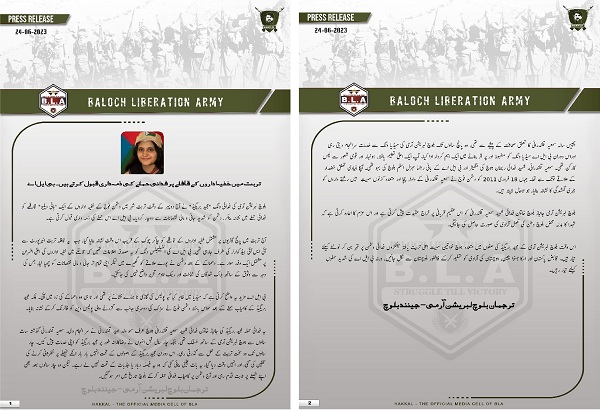
Majeed Brigade, the fidayeen wing of the Balochistan Liberation Army (BLA), has attacked a high-profile convoy of the ISI. The attack was carried out at Chakar Chowk in Turbat. On Saturday, a convoy of five vehicles was moving from Turbat Airport to the ISI headquarters. The BLA stated that its intelligence wing had received credible information indicating that the convoy included a delegation of senior officials from the secret agency. Soon after the attack, the Pakistan Army sealed the entire area, concealing information about casualties and losses.

Earlier, the Pakistan forces claimed that the attack targeted the police. However, the BLA clarified that it did not target police force vehicles. In fact, Pakistan forces targeted the police vehicles to cover up the attack on their own convoy.

In its statement, the BLA revealed that Sumaiya Qalandrani, a journalist by profession, executed the attack. Sumaiya has been associated with the BLA for seven years. She played a key role in the BLA’s media wing for over five years. For the past four years, she has undergone rigorous training under the Majeed Brigade.

Who is Sumaiya Qalandrani?

The attacks on Pakistan forces are a consequence of their oppressive policies and attitude towards the people of Balochistan. Cases of enforced disappearances are on the rise in the region, to which the BLA is countering through an armed struggle. In fact, Sumaiya Qalandrani herself was a victim of Pakistan-sponsored enforced disappearance. On 28th February 2011, Pakistan forces killed her uncle, Naeem Jan Qalandrani (17), and forcefully abducted her grandfather and several cousins from her hometown, Tootak in Khuzdar. She was the fiancée of Fidayee Rehan Baloch and the daughter-in-law of BLA’s founding leader, General Aslam Baloch.

It is worth noting that a female freedom fighter of the BLA has carried out this attack, marking it as the second fidayeen attack of its kind. Last year, Shari Baloch executed a self-sacrificing attack outside Karachi University, killing three Chinese officials.

The BLA has stated that hundreds of Baloch fidayeen, including women, are part of the Majeed Brigade and are ready to wreak havoc on the occupying forces of Pakistan and its ally China if they do not withdraw immediately.

80 per cent of Himalayan glaciers could melt by the end of the century

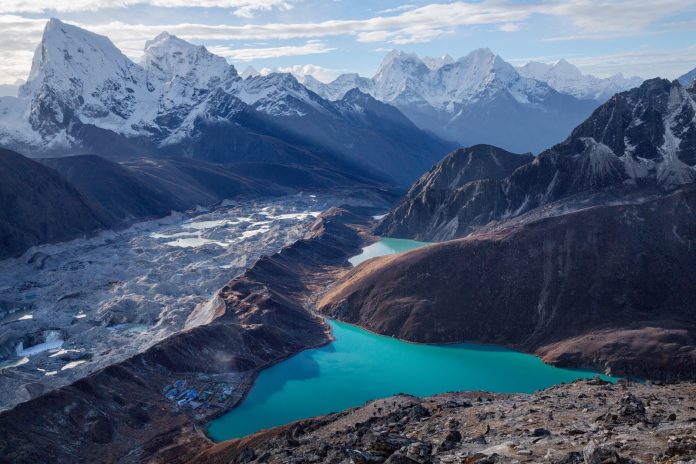
Scientists have warned that due to climate change, Himalayan glaciers are melting at an alarming rate, leading to accelerated melting beyond previous expectations. These glaciers provide water to nearly 2 billion people and are now posing unforeseen and perilous threats.

According to a report by the International Centre for Integrated Mountain Development (ICIMOD), the glaciers in the Himalayas have receded rapidly by 65% from 2011 to 2020.

Leading author Philipp Wester explained, “As it gets warmer, the snow will melt as anticipated, but the alarming aspect is the speed. It is melting at a much faster rate than we had anticipated.”

The report highlights that the glaciers in the Hindu Kush Himalayan region are a crucial source of water for approximately 240 million people residing in mountainous areas and an additional 1.65 billion people living in the valleys downstream.

ICIMOD, an intergovernmental organization based in Nepal, includes countries such as India, Pakistan, Myanmar, Afghanistan, Bangladesh, Bhutan, and China. The organization has cautioned that at the current pace, the glaciers could shrink by 80% of their current volume by the end of the century.

The Himalayan glaciers play a vital role in sustaining the world’s top 10 river systems, including the Ganges, Indus, Yellow River, Mekong, and Irrawaddy. Furthermore, they directly or indirectly contribute to the livelihoods of billions of people by providing food, energy, clean air, and income.

Even if the internationally agreed targets outlined in the Paris Agreement are met, aiming to limit global warming to 1.5 to 2 degrees celsius above pre-industrial levels, the volume of these glaciers could still decline by half to three-quarters by the end of the century.

Since the mid-1800s, the world has experienced an average temperature increase of approximately 1.2 degrees Celsius, resulting in severe impacts on weather patterns. Intense heatwaves, prolonged droughts, and devastating storms have further compounded the situation.

The countries most affected by these climate changes are often the most vulnerable and economically disadvantaged, despite contributing the least to global greenhouse gas emissions.

Radical Islamists attack Sikh minorities in Peshawar

In a horrifying act of violence, a Sikh shopkeeper named Manmohan Singh has been brutally killed in Peshawar. According to reports, two extremists on motorcycles targeted and fatally shot him at Rashidgarhi Bazaar in Khyber Pakhtunkhwa, Pakistan.

This tragic incident serves as a distressing reminder of the precarious situation faced by the Sikh minority residing in Khyber Pakhtunkhwa, as it marks the second attack on a Sikh individual in less than 24 hours. Prior to this shocking event, Tarlok Singh was also targeted by assailants affiliated with the ‘Islamic State of Khorasan Province’.

The terrorists unleashed a hail of gunfire, firing at least seven rounds at Tarlok Singh. Fortunately, he managed to evade the attack and survived. It is unfateful that attacks on religious minorities, including Hindus and Sikhs, have become distressingly repetitive in Pakistan. Unfortunately, rather than taking decisive action to prevent such incidents, Pakistan has consistently failed to address the issue, allowing the assailants and radical Islamists to operate with impunity.

Pakistan’s ongoing use of ‘Terrorist Proxies’ annoys Washington and New Delhi

Nothing could have been more embarrassing for Islamabad than Thursday’s joint Indo-US statement issued on the conclusion of Indian Prime Minister Narendra Modi’s US visit.  It mentioned, “They [US President and Indian Prime Minister] strongly condemned cross-border terrorism, the use of terrorist proxies and called on Pakistan to take immediate action to ensure that no territory under its control is used for launching terrorist attacks” [Emphasis added], and “They called for the perpetrators of the 26/11 Mumbai and Pathankot attacks to be brought to justice”.

That Washington’s expression of unconditional solidarity with New Delhi in calling out Islamabad’s duplicitous approach to terrorism would enrage Islamabad is but natural. However, if it felt that this indictment was incorrect or motivated, then one expected Islamabad to have rebutted the same by demanding proof to substantiate the damning charges made in the Indo-US joint statement. However, rather than doing so, Pakistani Defence Minister Khawaja Asif has conveniently tried to wriggle out of a tight corner by attempting to deflect the issue.

He has responded to the joint Indo-US statement attacking Pakistan for sponsoring cross border terrorism by accusing Indian Prime Minister Narendra Modi of leading a “campaign of state sponsored terrorism in Kashmir”. That an erudite politician like Asif could make such a ludicrous statement, and that too not even a month after New Delhi hosted the well-attended G20 Tourism Working Group meeting in Srinagar that gave foreign delegates an opportunity to visit Kashmir and get first-hand knowledge from ‘ground zero’, defies comprehension.

And here lies the irony. On June 23, the Pakistani defence minister in his tweet accused New Delhi of unleashing “state sponsored terrorism in Kashmir”, without providing any evidence. On the other hand, with Indian security forces gunning down four heavily armed Pakistan trained terrorists who were attempting to infiltrate into Kashmir across the Line of Control [LoC] on the night of June 22/23, New Delhi had physical proof of Pakistani sponsored terrorism in J&K which vindicated the joint Indo-US observation on use of “terrorist proxies” by Pakistan.

With this being the second such major infiltration attempt thwarted by the Indian army in as many weeks and the third one during this month alone, Islamabad can’t get off the hook by dismissing it as an aberration! But how could the Pakistani defence minister make the humongous blunder of levelling a counter-allegation that has already proved to be a dud just four years ago, is rather intriguing.

Isn’t Pakistan’s defence minister aware that after New Delhi abrogated Article 370 of the Indian constitution in 2019, Pakistan’s then Foreign Minister Shah Mehmood Qureshi had pompously announced that “We have decided to take Kashmir case to the International Court of Justice [IJC],” adding that “The decision was taken after considering all legal aspects”.

Could it be also be possible that Asif is unaware that Barrister Khawar Qureshi [Pakistan’s lawyer at ICJ] had himself admitted to the media that Pakistan has no credible evidence to support its claims of genocide in Kashmir, and “ in the absence of these pieces of evidence, it is extremely difficult for Pakistan to take this case to the ICJ”? . 

So, when Islamabad admittedly doesn’t have any worthwhile proof to substantiate the laughable allegation regarding a “campaign of state sponsored terrorism in Kashmir”, the Pakistani defence minister’s response is obviously worthless.

It would however be naïve to expect that Pakistan would stop sponsoring terrorism in J&K as a result of being jointly exposed by India and Washington. While its legislature may be amenable to mending fences with India as it would provide cash-strapped Pakistan a host of cost-effective commercial opportunities to check its financial downslide, Rawalpindi, for its own vested interests, is hell bent on sabotaging any initiative encouraging rapprochement between the two countries.

So, come what may, Pakistan Army will never abandon its terrorist proxies, and this isn’t mere speculation but a logical inference drawn from Rawalpindi’s enduring love for what it considers to be its ‘strategic assets’.

Readers may recall that in 2014, while heads of all SAARC nations invited for Modi’s oath taking ceremony confirmed their attendance, Islamabad’s response was inordinately delayed. It was also reported that Pakistan’s then Prime Minister Nawaz Sharif’s brother Shehbaz Sharif [who was then the chief Minister of Punjab] had met Army chief Gen Raheel Sharif and “informed” him about the Prime Minister’s decision to visit India for this purpose. However, this explanation isn’t very convincing for two reasons.

One, where was the need for Shehbaz to travel all the way to Lahore merely to ‘inform’ the Army chief about his brother’s decision to visit New Delhi, when the same could have been communicated through a phone call? Secondly, the media reported that the Shehbaz- Gen Sharif meeting went on for about half-an-hour, and so, it’s obvious that Shehbaz had dashed to Lahore to seek permission for his elder brother’s New Delhi trip, and not to merely apprise him of the prime minister’s decision.

Islamabad’s inexplicable delay in confirming that Sharif would be attending Modi’s oath taking ceremony, followed by Shehbaz’s half-an-hour long confab with the Army chief before Islamabad’s official confirmation of the Prime Minister Sharif’s New Delhi visit clearly suggests that Gen Sharif wasn’t quite happy with this visit, and this palpable apprehensive soon became evident.

Just three days before Modi’s oath taking ceremony, four heavily armed terrorists made an unsuccessful attempt to storm the Indian consulate in Herat, Afghanistan. Besides New Delhi and Kabul, even Washington [which carried out an independent inquiry] confirmed that the attackers belonged to Lashkar-e-Taiba [LeT], which is known to be Rawalpindi’s most trusted terrorist group.

The timing of this attack clearly indicates that its aim was to inflict heavy casualties on the security personnel and staffers of the Indian consulate. This in turn would arouse such strong anti-Pakistan feelings within India that Sharif would be dissuaded from visiting India, and that’s exactly what the Pakistan Army wanted. Some may question as to why would Rawalpindi not want Prime Minister Sharif to visit New Delhi? The answer is simple.

By wholeheartedly approving the path breaking Delhi-Lahore Bus service initiative in 1999, Sharif had demonstrated his determination to normalise Indo-Pak relations as it benefitted both nations. However, Rawalpindi’s agenda was different. Having skilfully created the illusion of an omnipresent threat from India, it has managed to grab extra constitutional powers, and so, peaceful relations with India would threaten Rawalpindi’s supremacy over other organs of the state, which the Generals can never accept.

Then there’s the famous 2016 exposé about a secret meeting of government officials and senior military officers carried by Dawn, which reveals how “In a blunt, orchestrated and unprecedented warning, the civilian government has informed the military leadership of a growing international isolation of Pakistan [due to Rawalpindi’s support to terrorist groups] and sought consensus on several key actions by the state.” [Emphasis added].

This blow-by-blow account of this incident [which earned the sobriquet of ‘Dawn Leaks’] and cost Nawaz Sharif the prime minister’s chair explicitly illustrates that Rawalpindi has no qualms in even comprising national interests just in order to protect its private army of terrorists! And so, if Pakistan is today being pilloried by the US and India for using ‘terrorist proxies’, it’s got no one else but Rawalpindi to blame!

Will Pakistan’s grandiose economic revival plan fare well?

Flashback

On 13 June 2019, the government of Pakistan issued a notification approving the creation of National Development Council [NDC] comprising 13 members under the then Prime Minister Imran Khan, which included the serving Army chief Gen Qamar Javed Bajwa. The ‘terms of reference’ assigned to this newly created body were, “set policies and strategies for development; formulated and tailor policies to achieve accelerated economic growth; approve long term planning for national, and regional connectivity and provide guidelines for regional cooperation.”

While inclusion of ministers and bureaucrats in NDC was understandable, given the purely economic nature of its mandate, incorporating the Army chief as a member didn’t quite fit into the scheme of things. Pakistan watchers will agree that nothing in this country is taken seriously unless and until the Army is incorporated in the said initiative. However, by contending that a country’s sovereignty and security was linked to its economic progress, Gen Bajwa indirectly justified his own inclusion in NDC.

Except for Gen Bajwa interacting with business honchos and talking about taking ‘tough decisions’ , what exactly did the NDC achieve is not known. With Khan as well as Gen Bajwa gone, and Prime Minister Shehbaz Sharif’s unveiling of an ambitious “Economic Revival Plan” [ERP] for turning Pakistan into a $ 1 trillion economy by 2035, it would be fair to assume that despite Gen Bajwa’s  intervention, Khan’s brainchild fell woefully short of the expectations and has been shelved.

The Present

As per The Express Tribune report onthe ERP, “the government has established a ‘Special Investment Facilitation Council (SIFC)’, which will serve as a streamlined interface for investors and remove all the bottlenecks in investments with the help of the army.” [Emphasis added]. While this initiative aimed at reviving Pakistan’s economic downturn is indeed welcome,  just like in the case of NDC, it’s unclear as to how exactly will the Army facilitate removal of “bottlenecks in investments.”?

Pakistan Army chief Gen Asim Munir [who was present during the ERP launch at the prime minister’s residence], has been quoted as having “assured [the] army’s all-out support to complement the government’s efforts for the revival plan considered to be fundamental to socio-economic prosperity of the Pakistanis and reclaiming Pakistan’s rightful stature in the comity of the nations.” Rather than clearing the air, this statement has only created more confusion.

Old Wine, New Bottle?

Though much hasn’t been revealed about the ERP, the newspaper has quoted “ government sources saying that since “security and economy were closely related to each other “that’s why the Pakistan Army will spend all its energy in the management, coordination and the success” of the project. With Gen Bajwa having articulated the same logic just four years ago, this viewpoint gives a strong feeling of déjà vu and raises apprehension regarding the success of this plan.

The newspaper also mentioned “a key cabinet minister” saying that the “army will play a key role  in the coordination of the projects,” and clarifying that “the army will provide only management and technical support in this initiative to successfully complete the project.” What special expertise or skills does the Pakistan Army have in providing requisite “management and technical support” to an economic programme that has no connection or link whatsoever to matters military escapes comprehension.

The ‘Game Changer’ Syndrome

It was on 5 July  2013 that Pakistan signed the China Pakistan Economic Corridor [CPEC] deal with China and this project was touted as a ‘game changer’ that would permanently rid Pakistan of its perpetual financial woes. However, this so-called ‘game changer’ has turned out to be a damp squib and 10 years down the line, Islamabad is facing an economic meltdown of gigantic proportions. With Islamabad unable to honour its own commitments, Beijing has rightly become wary of committing more funds into the CPEC project, shattering Pakistan’s ‘game changer’ dream.

With a whopping external debt standing at $125.7 billion in Mar 2023, it’s abundantly clear to everyone that only a miracle can save Pakistan. Express Tribune has quoted an unnamed minister saying that “The [ERP] project is a “game-changer” for the development of Pakistan”, and this declaration comes as no big surprise. With the CPEC dream turning into a nightmare, Islamabad has conveniently presented ERP as a repackaged ‘game changer’ fantasy to its people.

Army and Pakistan’s Economic Revival

Sharif has made his announcement regarding Pakistan Army’s incorporation in the ERP as an ingenious and path breaking step. However, Rawalpindi’s phenomenal influence over judiciary, legislature and executive remains Pakistan’s worst kept secret,  and just six months ago, former Army chief Gen Bajwa had himself admitted that “Pakistan Army has always remained a dominant player in national decision-making.”  So, it’s but natural that the decision to rope-in the Army to set Pakistan’s economy right hasn’t inspired public confidence.

Furthermore, despite its unquestionable authority over all other organs of the state, Rawalpindi remained a silent spectator even as the country headed towards an economic disaster. Gen Bajwa and Gen Munir have been publicly expressing serious concerns about Pakistan’s precarious financial condition, but the Pakistan Army has failed to come out with any recommendations or plans to arrest the country’s economic downslide. This is understandable as an Army can least be expected to offer solutions to rectify economic anomalies bedevilling a nation.

So, while rationalists are convinced that inclusion of the military in Pakistan’s Economic Revival Plan means little, cynics are having a field day making snide remarks on Rawalpindi. Some contend that with the Pakistani armed forces successfully running more than 50 commercial entities, which by conservative estimates are worth $ 20 billion, it can teach economists and industrialists a lesson or two in how to make money.

Detractors also argue that with Rawalpindi doubling up as the country’s judiciary, it could adjudicate on legal issues and take elusive economic offenders to task! Then there are others who feel that Rawalpindi could use the special skills of its spy agency Inter-Services Intelligence [ISI] in abducting and ‘disciplining’ those who can’t be brought to book. A few also feel that having failed to annex Kashmir, save East Pakistan and tackle home-grown terrorism, Rawalpindi needs a face saving device, and what could be better than becoming part of Pakistan’s economic revival programme by playing a cushy role without any accountability!

Indonesia shifts first-ever ASEAN military drill out of disputed waters

Indonesia has announced its decision to shift ASEAN’s first-ever joint military exercise from the South China Sea. It has shifted the drill in the vicinity of the Malacca Straits. Previously, as the chair of ASEAN this year, Indonesia had announced that the exercise would take place in Indonesia’s Exclusive Economic Zone (EEZ) in the South China Sea, specifically in the region known as North Natuna. North Natuna has been claimed by China through its nine-dash line.

Reports indicate that the primary reason for the location shift is Cambodia’s denial of any discussion on organizing the exercise. When Indonesia initially announced the exercise after a meeting of defense officials in Bali, Cambodia issued a statement denying any such discussion. Subsequently, during a planning conference attended by ASEAN countries, it was decided to relocate the exercise from the North Natuna Sea to the South Natuna area near Batam. However, Cambodia and Myanmar, both having close relations with China, did not participate in the planning conference.

Response to China’s growing assertiveness

This joint military exercise holds significant importance as ASEAN has never conducted such an exercise on its own. Furthermore, countries like Vietnam and the Philippines have firmly responded to Chinese intrusions into their territories lately. It is viewed as a response to China’s increasing assertiveness in the region.

While China claims the North Natuna region, Indonesia has consistently denied any dispute. It has maintained that the region is part of its sovereign territory. Additionally, the decision to shift the exercise’s location is stated to have no connection to maritime and territorial disputes. Rear Adm. Julius Widjojono, another Indonesian official, clarified that the selection of the new site near Batam island was based on its suitability for the planned drills. The priority has been given to the areas prone to natural disasters, as reported by RFA.

Although the new location may appear to be far from the contested waters, it can add an all new paradigm. As stated above, new location lies in the proximity to the Malacca Straits. It is a critical point for the Chinese trade. China heavily relies on this route for transporting raw materials, finished goods, and petroleum. The vulnerability of this route is often referred to as China’s “Malacca Dilemma.” The term was coined by former Chinese President Hu Jintao in 2003.

Therefore, while the shift may seem like a move to undisputed waters, it is actually a more concerning development for China compared to the previous location.

The desperate fight to save the Indochinese Leopard

The Indochinese leopard, an iconic species once found throughout Indo-China, is now perilously near to extinction in Cambodia, a dreadful warning to wildlife enthusiasts and environmentalists. A decade-long investigation by wild cat conservationists reveals a grim reality: only 35 adult Indochinese leopards were identified in two protected locations between 2009 and 2019, and additional inspections in 2021 provided no sightings at all. The implications of this analysis, which was produced in conjunction with Panthera and Oxford University’s WildCRU and published in Biological Conservation, highlight the critical need for rapid action to prevent this majestic creature from becoming extinct.

A Vanishing Presence

The Indochinese leopard, which formerly thrived in the lush landscapes of Cambodia, Laos, Myanmar, Thailand, Vietnam, and southwestern China, has suffered a rapid decline due to persistent human encroachment. Hunters, driven by an insatiable need for wild meat, represent a serious threat to these elusive felines. The research emphasises the attractiveness of their thick, spotted coats, which are much sought after by poachers, as well as the catastrophic reduction in prey populations caused by habitat degradation. Tragically, over the study period, human activity in Cambodia expanded twentyfold, and fatal traps increased an astounding thousandfold, catching not only leopards but also harming 700 animal species in the region, including the Asian elephant and Sumatran rhinoceros.

A Disturbing Trend

Cambodia’s struggle against corruption and deforestation adds to the dangers faced by Indochinese leopards. Cambodia, ranked 150 out of 180 in Transparency International’s annual Corruption Perceptions Index, confronts deep-seated corruption, impeding successful conservation efforts. According to the Global Forest Watch, the country has seen alarming rates of deforestation over the last two decades, losing about 557,000 hectares of tree cover in protected areas between 2001 and 2018.

As demonstrated by the violent arrest of five journalists in 2022 while covering a large-scale forestry operation in southern Cambodia, activists who bravely safeguard Cambodia’s forests face terrible dangers. Such occurrences underscore the importance of protecting both wildlife and individuals working to maintain the country’s natural heritage.

Adding the problem is the lack of a unified conservation programme dedicated to Indochinese leopards, owing to a lack of financing. Despite recent gains in combating poaching through enhanced local law enforcement, the research highlights the frightening extent of the illegal wildlife trade, needing a global collaborative response.

An Urgent Plea for Action

Panthera conservation expert and report lead author Susana Rostro-Garca emphasises the essential need for rapid intervention to prevent the Indochinese leopard from extinction. Without significant resources focused towards this rare subspecies’ last strongholds, extinction is a tragic certainty. Furthermore, Panthera’s leopard programme director, Gareth Mann, condemns the predicament of the Indochinese leopard, drawing parallels to the plight of the tiger in Cambodia, Laos, and Vietnam.

A Call for Change

Poaching efforts must go beyond punitive measures and involve broad attempts to limit game meat consumption proactively. The world community and conservationists must commit totally in rescuing the leopard along with the governments of Thailand, Malaysia, and Myanmar, making Indochina the focal point for preservation, just as it has become ground zero for poaching.

As the Indochinese leopard approaches extinction, immediate action is required to change this catastrophic trend. With the IUCN Red List of Threatened Species classifying it as “vulnerable” and the Indochinese leopard subspecies as “critically endangered,” the time to act is now. The globe must band together to tackle corruption, deforestation, and the illegal wildlife trade, while also aggressively reducing consumption of game meat. By doing so, we can protect Cambodia’s natural heritage and ensure that the enigmatic beauty of the Indochinese leopard roams the region’s forests, inspiring future generations.

BLA attacks Paki military and communication infrastructure across Balochistan

The Baloch Liberation Army (BLA)has carried out a series of coordinated attacks against the Pakistan Army, police, and communication infrastructure in different regions of Balochistan. In their press release, BLA spokesperson Jeeyand Baloch stated that these actions are part of their ongoing struggle for the liberation of Balochistan.

In Quetta, the BLA fighters targeted Pakistani police personnel on the airport road, resulting in the injury of a police officer identified as Hawaldar Abdul Razaq. The attack serves as a reminder of the group’s ability to strike in highly secured areas.

In Panjgur, the BLA launched a heavy weapon assault on a Pakistani military outpost located in Asank, Suhaki. The attack inflicted substantial losses upon the enemy forces, demonstrating the BLA’s determination and military capabilities.

Additionally, on 21 June in Kaabo, Mastung, and recently in Heeronk, Kech, the BLA fighters destroyed communication towers belonging to a Pakistani corporation. This targeting of communication infrastructure aims to disrupt the authorities’ ability to control and monitor the region while sending a message about the group’s resolve.

The BLA’s press release emphasizes that these attacks represent their continued campaign against the Pakistani military and those who collaborate with them. They pledge to persist with their resistance until the ultimate liberation of their homeland, Balochistan.