Home Blog Page 320

Pakistan arrests Pashtun rights activist Ali Wazir from Peshawar

Ali Wazir, a lawmaker and prominent ethnic Pashtun rights activist was arrested on Wednesday on unspecified charges. A police official who took part in the December 16 arrest in the northwestern city of Peshawar told News Intervention that Wazir was “wanted” in the port city of Karachi, where the police had been registered a case against him. Wazir would be transferred to Karachi, according to the police official. He refused to provide further details about the charges.

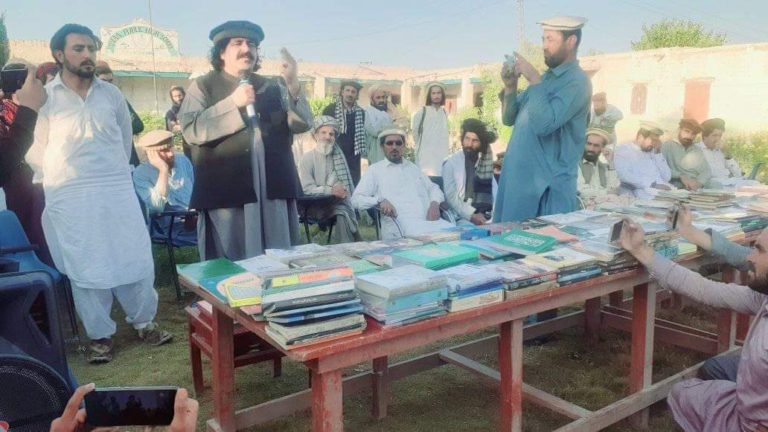
Ali Wazir, one of the leaders of the Pashtun Tahafuz Movement (PTM), was arrested while he was attending a public gathering marking the sixth anniversary of the massacre of more than 150 people at a Peshawar school in December 2014, according to Manzoor Pashteen, the civil rights group’s leader.

“The arrest of Ali Wazir in Peshawar is representative of the continuation of repression of state,” Manzoor Pashteen tweeted.

Manzoor Pashteen’s tweet about the arrest of Pashtun rights activist Ali Wazir

In a video uploaded on Twitter earlier in the day, Wazir had said police had barred him from entering Peshawar. His arrest comes days after the PTM staged a massive rally in Karachi on December 6.

International rights groups say Pakistani authorities have banned peaceful rallies organized by the PTM and some of its leading members have been arbitrarily detained and prevented from traveling within the country. Some members have also faced charges of sedition and cybercrimes.

Click on the YouTube link to watch our video report

The movement has campaigned since 2018 for the civil rights of Pakistan’s estimated 35 million ethnic Pashtuns, many of whom live near the border of Afghanistan where Pakistan Army had conducted numerous campaigns, which it claimed were to defeat the Pakistani Taliban.

But the PTM accuses Pakistan’s security services of cooperating with the “good Taliban” fighting in Afghanistan and allowing militants to return to the mountainous area.

The Pashtun Tahafuz Movement (PTM) has attracted tens of thousands of people to public rallies in recent years to denounce the powerful Pakistani Army’s heavy-handed tactics that have killed thousands of Pashtun civilians and forced millions more to abandon their homes since 2003.

PTM has been calling for the removal of military checkpoints in tribal areas and an end to “enforced disappearances,” in which suspects are detained by security forces without due process.

Pakistan’s government rejects allegations that its security forces cooperate with militants, pointing out that the military has lost thousands of soldiers fighting the Pakistani Taliban. It also denies intelligence agents are responsible for forced disappearances.

Disappearance of women and children by Pak Army is height of collective punishment: Dr. Murad Baloch

Dr. Murad Baloch, Secretary-General of Baloch National Movement, termed the abduction and forced disappearances of women and children from Gichk area of Panjgur as a continuation of collective punishment and said that such incidents had been happening frequently in Balochistan.

He added, “Pakistan is inflicting collective punishment on the Baloch nation through its horrific barbarism and genocide, so that the Baloch nation may give up its struggle for independence. But history has shown that nations cannot be suppressed by such crimes, instead, their faith is strengthened. They become aware of the fact that it is impossible to get rid of these atrocities without getting rid of this life of slavery.” Dr. Murad Baloch said that a young girl named Samani daughter of Shay Jan, Ajmal son of Shay Jan, Dur Mohammad son of Hassan and his wife Bibi Maryam, his youngest grandson Rashid son of Awaz, Muhammad Karim son of Yar Mohammad and his wife Shah Pari, Yarjan son of Dilmarad, Waheed son of Qadir Bakhsh, Saleem son of Muhammad, Nazir son of Umeed have been abducted by Pakistani Army from Gichk and transferred to secret cells.

Despite a lapse of several days, their whereabouts are still unknown. He said that with the onset of Musharraf’s imperialist plans to usurp Balochistan, began a renewed and never-ending cycle of Baloch genocide and war crimes. Initially, people were released half-dead after the worst punishment and inhumane torture. But over time, human rights violations in Balochistan took a terrible turn. During the PPP’s Zardari government, the “kill and dump” policy was an addition to it.

Nawaz Sharif continued these crimes and a process of burying people in mass graves started during his rule. His accompliance in these crimes was the then Chief Minister of Balochistan, Dr. Malik and Co. Today, he and his same National Party is trying to use the cases of Baloch enforced disappeared persons against Imran Khan’s government.

The BNM Secretary-General said that nothing has changed for the Baloch nation. The so-called Pakistani Prime Minister Imran Khan before becoming Prime Minister had said in his TV interviews about missing persons that if he were the Prime Minister, no one would be enforced disappeared in Balochistan. Of course, the Baloch nation was convinced at that time that these were all political slogans. Today, during the Imran Khan government, the policy of abduction took a new harsher shape, and women and children have become victims of enforced disappearances, a new addition to the previous policies.

This collective punishment is a brazen war crime. Dr. Murad Baloch concluded, “I appeal to local and international human rights organizations and activists to respond immediately as your silence encourages Pakistan to commit more heinous crimes. The biggest need of the hour is for all organizations and institutions to raise their voices to stop this unbridled and terrorist state from committing Baloch genocide.”

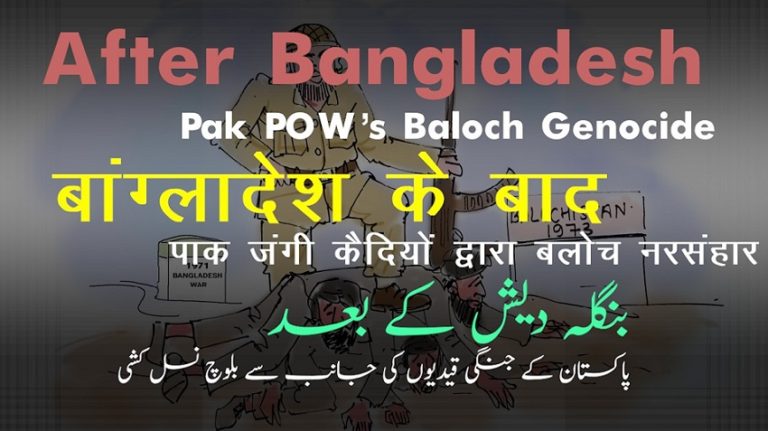
After Bangladesh: Pak POW’s Baloch genocide

What happened when 93,000 POWs (Prisoners of War) of the Pakistan Army were sent back to Pakistan after the Shimla Agreement? These vanquished Pakistan Army soldiers who had surrendered before the Indian Army during 1971 Bangladesh Liberation War, committed inhuman atrocities in Balochistan after their return to Pakistan. Sadly the world remains unaware of this dark truth. Watch our documentary After Bangladesh to this stark reality.

Click on the YouTube link to watch the documentary
“After Bangladesh: Pak POW’s Baloch Genocide”

Sindhudesh freedom struggle has uncanny similarities with Bangla repression

Sindhudesh freedom movement has several similarities with yesteryear’s freedom struggle for an independent Bangladesh. Some of these similarities are —

National language
Bangla language was ignored in the erstwhile East Pakistan (now Bangladesh). The people of East Pakistan (Bangladesh) had repeatedly demanded that Urdu language should not be imposed upon them. Similarly, today the demand of the people of Sindh regarding their language is being completely ignored by Pakistan.

Division of Civil and Military representatives in the Federal Government
There was no Federal Secretary or Pakistan Army General from Bengal. The same is the case today with Sindh.

Ratio of capital generation
75% percent of the Pakistan’s capital was generated from East Pakistan (Bangladesh), while they received only 25% money in return. Today, Sindh generates 65% of Pakistan’s total revenue while they receive only 15%.

Skewed Industrialization
Around 25 industrial facilities from Bangladesh were shifted to Punjab. Similar kind of shifting is also been taking place in Sindh.

Non-representation in Sports
Bangladeshi players were not given a chance in national sports team of Pakistan such as cricket, hockey etc. Similar discrimination is observed in Sindh as well.

Propaganda
There was a Pakistani propaganda against the Bengalis. It was claimed that Bengalis favor India, are not good Muslims and are supported by the RAW. Pakistanis also said that Bengalis’ business is in the hands of Hindus and they are share secret intelligence inputs with India. In the same way Pakistan has been propagating about Sindhis and are trying to establish a narrative that Sindhis are not good Muslims and are Jihadis.

Persecution of Hindus
In East Pakistan, Hindu Bengalis were persecuted and killed often because of the enmity of Pakistan with India by Jamaat Islamist groups who received full support from West Pakistan’s state machinery. Similarly, in Sindh the Pakistanis are carrying out genocide of Sindhi Hindus.

Funding of Madrasas
In Bangladesh a lot of government funds were spent on setting up madrassas, rather than spending on modern education in schools. Today, Pakistan is funding Islamist groups to open more madrassas in Sindh.

Ambassadors
There was no Bengali Ambassador from East Pakistan (now Bangladesh) who represented the country abroad. Sindh too has no such representation.

Rigged Elections
After the General Elections of 1970, Sheikh Mujeeb-ur-Rehman won with a clear majority, and yet he was not allowed to form the government. Later Pakistan created a new system of seats for the National Assembly that made it impossible for small provinces to be able to form a government even through a coalition as Punjab was allocated more number of seats.

Federal Land Occupation
The occupation of land in East Pakistan by the federal government was a common practice. Sindh is also suffering from this fate as Pakistan persistently occupies Sindh’s land, islands and is exploiting the natural resources of Sindh.

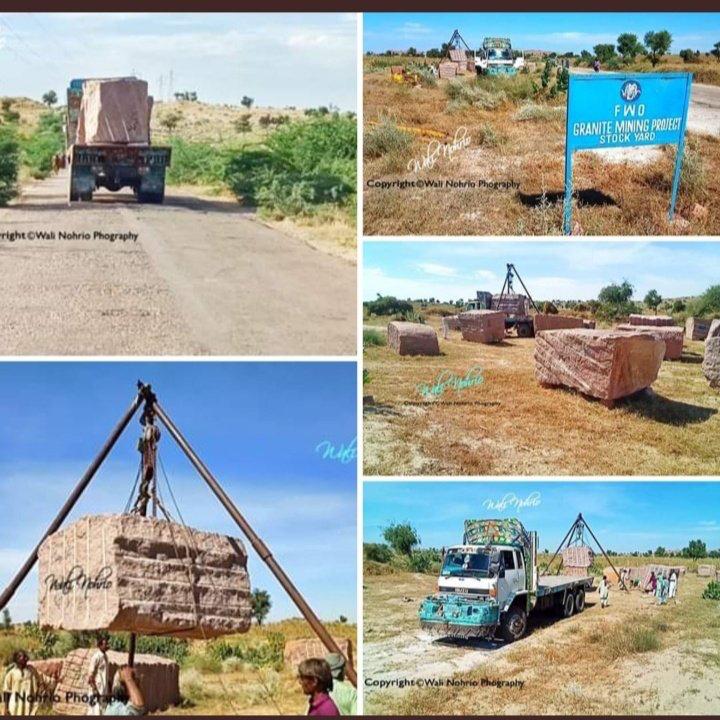
Plunder of Sindh's Karoonjhar mountains by Pakistan and China.
Plunder of Sindh’s Karoonjhar mountains by Pakistan and China.

Rampant Executions
Execution of Bengali nationalists, political leaders were rampant. Sindh, Balochistan and Khyber Pakhtunkhwa suffer this same fate.

Bangladesh exposed the emptiness of Two Nation Theory. Creation of Pakistan was a historical blunder, and so Pakistan must morally surrender now and give freedom to historical nations that have been enchained in slavery.

In 1842-43 when the East India Company invaded Sindh, Sindh was an independent country, but as British left the region, they created a monster Pakistan to serve their own interests based on a fake two nation theory.

The historical nations Sindhudesh, Balochistan and the Pashtuns have been forced to live under occupation of Panjabi Pakistan Army and Pakistan. In the name of federal government the Punjabis are exploiting and looting resources and wealth of other provinces.

Bangladesh paid price for their freedom, at least now they have their own identity. She is a great country on the path of development, prosperity and a much better economy. This compares to Pakistan’s poverty, corruption, dictatorship, extremism, human rights violations and genocide.

Pakistan commits genocide of historical nations, suppression of minorities, ethnic cleansing, nurseries of terrorist. It has a corrupt identity. Pakistan is a puppet of CCP and CPEC. Pakistan is a threat to world peace because of nuclear weapons in the hands of maniacs like Al-Qaeda and the ISIS that dream of an ottoman caliphate.

“Don’t play with fire, you cannot suppress and kill 70 million Bangla people, victory will be ours,” Sheikh Mujib-ur Rehman said in 1971. At that time it was Bangladesh now it will be Sindhudesh.

Pakistan’s humiliating surrender in 1971 & Balochistan’s current situation

Indian subcontinent was bifurcated and Pakistan created on the 15th August 1947. Two nations theory was used as an ideological tool for getting India divided into two states of Bharat and Pakistan. Such an ideology was fabricated and was far from reality. Factually Muslims of Indian subcontinent weren’t a nation, they were just part of a broader Muslim ummah comprising of believers from different people. This fact became obvious within three months after the creation of Pakistan.

In November 1947, a key resolution at a national education summit in Karachi proposed Urdu and English as the sole state languages despite the fact that either of the two proposed languages belonged to the people of any regions of Pakistan. So language resolution was strongly opposed by the Bengalis in East Bengal, the non-contiguous part of Pakistan who made up 44 million of newly created Pakistan’s 69 million population. Protests erupted across Bengal. Many Bengali students held a meeting in the Dhaka University campus on December 8, 1947 to formally demand that Bengali be made an official language. To promote their cause, students organized protests and rallies in Dhaka.

Despite strong opposition from Bengalis, the Bengali language was omitted as an official language which prompted organized protests and gradually changed into a broader movement which was answered with use of brutal force.

In the height of that unrest Mr. Jinnah, the founder and governor general of Pakistan arrived in Dhaka on 19 March 1948. On 21 March at a reception at Race Course Ground, Dhaka he blamed that language issue was designed by a “fifth column” to divide Pakistani Muslims. Jinnah, in his speeches of 24 and 28 March 1948, reasserted his “Urdu only” policy.

Language issue was the first crack in this so called “two nations” ideology. Despite fraudulent annexation in Pakistan of the British Balochistan’s Baloch and Pashtun regions in 1947, invasion on parts of Kashmir, forcible occupation of entire Balochistan in March 1948, introducing infamous parity or one unit system in 1955, still Bengalis formed the majority of Pakistan’s population but were treated as a lesser people.

News Intervention Documentary
“After Bangladesh: Pak Pow’s Baloch Genocide”

With passage of time Punjabi dominated West Pakistan’s continuous atrocities on Bengalis and oppressive policies united the Bengalis under the leadership of Sheikh Mujibur Rahman.

After more than a decade long martial law when general elections were held in Pakistan on December 7, 1970 the Awami League of Sheikh Mujibur Rahman won an absolute majority of seats in the National Assembly of Pakistan and all seats in East Pakistan. In the provincial elections, held ten days later, the Awami League again swept the all the seats save 2 in the East Pakistan’s provincial assembly.

After elections, initially the then President of Pakistan General Yahya Khan indicated to transfer the power to elected majority party. He met Z.A. Bhutto on 28 December 1970 and the following day a proclamation was issued that the first session of National Assembly would be held at Dhaka. Gen Yahya visited Dhaka on January 12, 1971 met Sheikh Mujibur Rahman and on his return to Karachi he said that Sheikh Mujibur Rahman would be the next Premier. But instead of summoning the national assembly, Gen Yahya Khan delayed the inaugurating of National Assembly on one or the other pretext which escalated unrest among the Bengali people.

The Awami League was being denied transfer of power in federal capital because Punjabi dominated Pakistan Army and bureaucracy didn’t want the majority party from East Pakistan to form government at the centre and lead the country.

Bengali resentment took the shape of widespread protests. West Pakistan’s Punjabi dominated army launched “Pperation Searchlight” against the people of East Pakistan on the night of 25 March 1971.

On 26 March 1971, responding to Operation Searchlight, Mukti Bahini declared war for the liberation of Bangladesh. Islamic extremists and Biharis in Pakistan sided with the Pakistan Army. Pakistan formed private militias namely Al-Shams, Al-Badr and Rizakars and armed them against Bengali freedom movement.

Pakistan Army and its proxy militias massacred Bengali nationalists, teachers, students, intelligentsia and general people at a large scale. After World War-II, Operation Searchlight was the widespread systematic genocidal war against common people.

In the short span of only nine months the savage Pakistan Army and its proxies martyred three million innocent Bengalis including women and children, raped thousands of women, displaced million people and forced them to take refuge in neighboring India. The provisional government of Bangladesh was formed on 17 April 1971 in Mujibnagar and was moved to Calcutta, India as the Government in Exile.

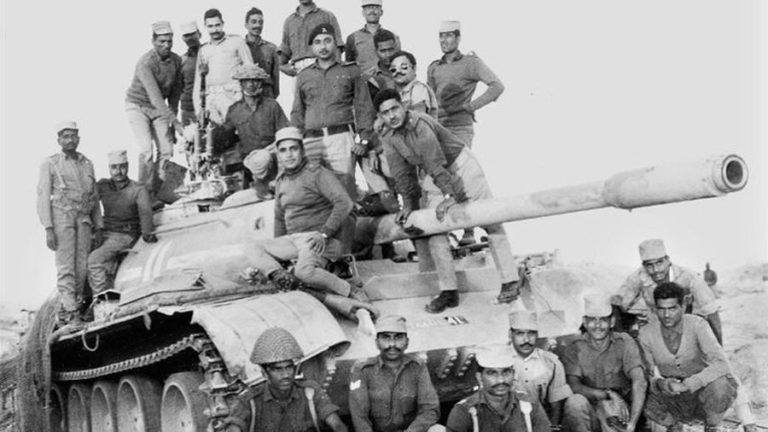
India joined the war on December 3, 1971 after Pakistan launched so called preemptive air strikes on north India. Allied forces of India and Bangladesh rapidly overran the war theatre. Within 13 days of India’s joining the war, Pakistan was brought to its knees. Pakistan Army surrendered on 16 December 1971, before joint forces of Indian Army and Mukti Bahini- National Liberation Army of Bangladesh.

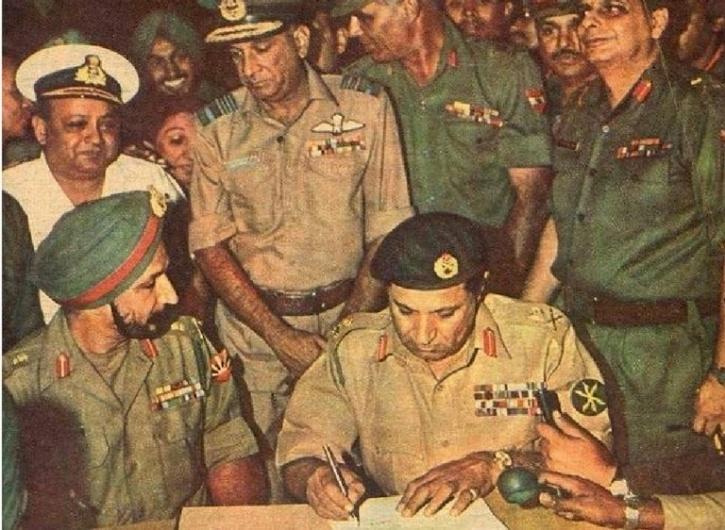
Pakistan's Lt. Gen. Amir Abdullah Khan Niazi (right) surrenders to India after losing the 1971 Indo-Pak War. Lt Gen. Jagjit Singh Aurora (left) received command of entire Pakistan's Armed Forces in Bangladesh.
Pakistan’s Lt. Gen. Amir Abdullah Khan Niazi (right) surrenders to India after losing the 1971 Indo-Pak War. Lt Gen. Jagjit Singh Aurora (left) received command of entire Pakistan’s Armed Forces in Bangladesh.

Lt. General Amir Abdullah Khan Niazi, Chief Martial Law Administrator of East Pakistan signed the Instrument of Surrender before Lt. General Jagjit Singh Aurora of the Indian Army. India captured more than 93,000 Pakistanis including more than 79,000 army personnel as war prisoners. It was the largest surrender of any army since the World War-II.

The humiliating defeat of Pakistan in Bangladesh provided a historic opportunity to both India and Baloch leadership to take advantage of the moment. It was the right time for India to get the Pakistan-occupied Kashmir (POK) reunited with Kashmir. Similarly it provided Baloch leadership with ever best opportunity to get rid of Pakistan’s forcible occupation and colonial rule. But both, Baloch and India failed to avail this opportunity.

India immediately offered a ceasefire which was accepted by Pakistan. India concluded Shimla Agreement with Pakistan, returned 13,000 km of land that Indian troops had seized in West Pakistan during the war, and released within 5 months all the PoWs (Prisoners of War) including those 195 soldiers who were sought for war crimes by Bangladesh.

As soon as Pakistan’s PoWs were released in 1972, Pakistan’s Punjabi dominated army and establishment pushed Z.A. Bhutto to respond to Baloch leadership’s silence during the 1971 war and their goodwill gesture in the process of enacting constitution for dismembered Pakistan with a fierce military operation in occupied Balochistan. Pakistan’s central government dissolved NAP’s elected Balochistan government in February 1973 within nine months of its formation in April 1972.

Baloch leaders along with NAP leaders were arrested, charged with high treason before an special tribunal known as Haiderabad Tribunal comprised of handpicked judges. Thousands of innocent Baloch including students, political activists, tribal were brutally were killed by Pakistan Army during the five year long armed conflict of 1973 to 1978. Thousands of Baloch families were forcibly displaced, their herds and valuables were plundered by the Pakistan Army. One reason, out of numerous others, behind that savage operations of Pakistan Army was to boost the morale of Pakistan’s defeated and humiliated army by unleashing them against innocent and militarily untrained Baloch people.

Since 2000 Pakistan has again launched a large scale military operation in occupied Balochistan. Thousands of Baloch families have been displaced and looted, hundreds of villages have been bombard and destroyed, thousands of Baloch students, political and human rights activists have been abduct by Pakistan Army, Frontier Corps (FC) and intelligence services. Thousands of Baloch, including famous Baloch leaders Sardar Akbar Khan Bugti, Mir Balach Marri and Ghulam Muhammad Baloch, students and members of Baloch intelligentsia have been killed in targeted and extrajudicial custodial killings and military operations.

In the ongoing military operations in occupied Balochistan the Pakistan Army is repeating savage atrocities that they had exercised during “Operation Searchlight” against the Bengalis in 1971. Like Al-Shams and Al-Badr, Pakistan Army and spy agencies have upto now formed dozens of private militias to fight against Baloch people and their freedom struggle.

In urban areas they are particularly targeting students, teachers, political and human rights activists, journalists and other segments of Baloch intelligentsia and the Hindu community of occupied Balochistan. In far flung mountainous regions and villages the Pakistan Army bombs and loots entire civilian population, forcibly displaces them, plunders their herds and valuables, targets women and children as a tool of collective punishment.

Naz Bibi, 6 year old child killed by Pakistani security forces at Harnai in occupied Balochistan. (Representative Photo: News Intervention)

Media is totally controlled, a slight sign of dissent is dealt with enforced disappearance, targeted killing and threats. Dozens of mass graves have been discovered in Tootak village, Parom, Panjgur, Dera Bugti and other regions of Balochistan. Media and the so called political parties have kept silent out of fear on the humanitarian issue of “Enforced Disappearances” in occupied Balochistan.

Despite Pakistan military’s ongoing genocidal operation, Baloch people have successfully kept their freedom movement going since 2000. It’s first longest resistance of Baloch people against Pakistan Army’s savagery and colonial rule with the clear cut demand for independence. We hope Baloch people will, like the Bengalis, succeed sooner or later to get rid of Pakistan’s colonial rule and forcible occupation.

1971 War: Remembering India’s victory over Pakistan

On the eve of 3 December, 1971, at about 5.40 P.M., fighter aircraft of the Pakistan Air force (PAF) carried out a coordinated, pre-emptive air strike on Indian Air Force bases in Amritsar, Pathankot, Srinagar, Avantipur, Utterlai, Jodhpur, Ambala and Agra. The air strikes were supported by heavy artillery shelling all along the border and a massive attack in the strategically important Chhamb sector of Jammu and Kashmir.

It became quite apparent that the Pakistani military leadership (General Yahya Khan and General Tikka Khan) and its vitriolic political leader, Zulfikar Ali Bhutto, had lost the battle of nerves and Pakistan had opted to initiate open hostilities. Quite obviously, the military objective was to garner a decisive tactical and strategic victory through the element of surprise.

Prime Minister Indira Gandhi, who was at that time in Calcutta, rushed back to Delhi and addressed the nation on radio, ‘I speak to you at a moment of grave peril to our country and our people. Some hours ago, soon after 5:30 P.M. on Dec. 3, Pakistan launched full‐scale war against us”, she said in her address. “I have no doubt that it is the united will of our people that this wanton and unprovoked aggression of Pakistan should be decisively and finally repelled. In this resolve, the Government is assured of the full and unflinching support of all political parties and every Indian citizen”, she added.

Thus started, formally, what is today known as the Indo-Pakistan War, 1971. It was to be, in the annals of military history of the sub-continent and the world, the shortest war to give such a  decisive victory, to the extent of carving out a new Nation – Bangladesh.

Pakistan's Lt. Gen. Amir Abdullah Khan Niazi  (right) surrenders to India after losing the 1971 Indo-Pak War. Lt Gen. Jagjit Singh Aurora (left) received command of entire Pakistan's Armed Forces in Bangladesh.
Pakistan’s Lt. Gen. Amir Abdullah Khan Niazi (right) surrenders to India after losing the 1971 Indo-Pak War. Lt Gen. Jagjit Singh Aurora (left) received command of entire Pakistan’s Armed Forces in Bangladesh.

The main reason behind the war was the horrifying persecution of the people of erstwhile East Pakistan (now Bangladesh) by the militarily more powerful West Pakistan. In the election held in Pakistan in 1970,  Sheikh Mujibur Rehman  led Awami League shocked Zulfikar Ali Bhutto and the military dictatorship of Pakistan by garnering 167 out of 169 seats in the East Pakistan Legislative Assembly and a near absolute majority in the 313 seat National Assembly. Mujibur Rehman had the mandate to govern the country, but this was not acceptable to the Punjabi centric military dictatorship and their stooge, Zulfikar Ali Bhutto.

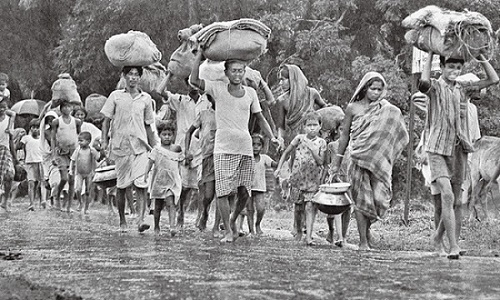
Mujibur Rehman was arrested in West Pakistan and martial law imposed in East Pakistan.  Then commenced genocide of the worst kind marked by brutal atrocities committed on civilians,  especially Bengali Hindus including wanton killing, rape and torture. These hapless people fled to India in large numbers to escape the carnage. India opened her borders to save the refugees whose number soon swelled to almost ten million.

India sought international assistance to meet the huge refugee challenge and also to pressurise Pakistan into stopping the atrocity, but it did not come by. The Government was keen to open hostilities with Pakistan in the monsoon months itself but the proposal was shot down by the then Chief of Army Staff, General SHFJ (Sam) Manekshaw. He said that the rainy season was not suitable for campaigning in East Pakistan and also that the army needed some time to prepare for war.

General (later Field Marshal) Sam Manekshaw, went on to become a folklore for his firm and brilliant planning and conduct of the war. His actions were in keeping with the highest traditions and strategic requirements and thus gave to India a resounding victory.

As soon as hostilities commenced Prime Minister Gandhi recognised East Pakistan as an independent nation called Bangladesh and India got into a war on two fronts, east and west, with the Navy and Air Force also incorporated. The Indian Navy was quick to implement a blockade which disallowed supplies from West Pakistan to East Pakistan and the Indian Air Force soon established complete air superiority  over the East Pakistan skies.

On the western front, the war witnessed many battles where the Indian soldiers exhibited courage and fortitude in the face of great odds and came out victorious, albeit after great sacrifice. Primary among the battles fought in this sector is the Battle of Chhamb, Battle of Laungewala, Battle of Shakargarh Bulge, Battle of Basantar, Battle of Fazilka among many others . The exploits of Major (later Brigadier) Kuldip Singh Chandpuri and his men of 23 Punjab in Laungewala have been depicted in an epic Indian movie “Border”.

The conduct of the war was a true example of the synergized efforts of the government and the Armed Forces with complete support of the people of the country. It was the support of the Nation that served as an elixir for the soldiers to attain success.

Bangladesh today is a proud, independent nation well on the path to development. Its rapidly improving economy and enduring democracy are its biggest assets. Its relationship with India is very good and improving rapidly. This freedom was won with great sacrifice. The role of the Indian army is providing to the people of Bangladesh the fruits of democracy and freedom is remarkable.

Due to the ignominious defeat suffered by Pakistan the evil policy to “bleeding India with a thousand cuts” was later formulated by the Pakistani Dictator, General Zia-ul-Haq, sometime in 1977. The basis of the policy lies in the conviction that Pakistan cannot beat India in a conventional war, so the best option is to resort to a Proxy War designed to weaken the fabric of Indian constitutional democracy from within.

 Jammu and Kashmir, particularly the Kashmir Valley, was chosen as the main battlefield for application of this policy. It has failed miserably. Foreign sponsored terrorism that formed the fulcrum of the policy has been decimated by the Indian Army. The political environment has been stabilised with revocation of Article 370 and re-designation of the state as a Union territory.

It is hoped that Pakistan and its stooges will read the writing on the wall and understand that it cannot break the fabric of India by any means, fair or foul. No kind of warfare, be it conventional, proxy, asymmetric, kinetic, hybrid or anything else can fructify the evil, fundamentalist ambitions of some self serving powers based in Pakistan.(

The High-IQ Rankings: or, the High-IQ Directories, Listings, Rankings

1

One of the great wildernesses of the international high-IQ communities, as delineated cells of IQ test-takers with scores on a variety of tests at a range of rarities with generalized and specialized communities, are the high-IQ directories, listings, and rankings.

With each, they tend to list from highest to lowest scores as reported on a variety of tests. In turn, this means the directories and the listings can be considered directories and listings, generically, and rankings, specifically.

Therefore, for most, the most precise terminology would be “rankings” rather than “directories” or “listings.” Although, all terms work in the patois of the high-IQ community if not considering differences in generic or specific implied meanings.

This article will explore some of them[1]. Those rankings include ESOTERIQ Society of Masaaki Yamauchi (incorporative of some of the Giga Society of Paul Cooijmans), GENIUS High IQ Network of Dr. Iakovos Koukas, GFIS IQ List/Dinghong Yao IQ Ranking List of Dinghong Yao, GIFTED High IQ Network of Dr. Iakovos Koukas, Hall of IQ Scores of Konstantinos Ntalachanis, Hall of Sophia of Guillermo Alejandro Escárcega Pliego, HRIQ Ranking List of Qiao Hansheng, Mahir Wu Ranking List of Mahir Wu, Real IQ Listing of Dr. Ivan Ivec, Svenska IQ-Listan of Hans Sjöberg and Alexi Edin, VeNuS Ranking List of Domagoj Kutle/Domagoj Domo Kutle, WIQF Listing[2] of Marco Ripà and Dr. Manahel Thabet, World Famous IQ Scores of Dr. Ivan Ivec, World Genius Directory of Jason Betts, and World Highest IQ Scores of Mislav Predavec.

For some further information with most actual or potential founding dates, and founders, and two highest score claimants at present, associated tests, scores, and standard deviations, please see further below:

ESOTERIQ Society of Masaaki Yamauchi founded in 2001 with the highest claimed scores at an IQ of 194.68 (S.D. 15) on the CIT5 by Dr. Heinrich Siemens and on RIDDLES by Yukun Wang. Its website stated:

The ESOTERIQ membership is separated into either the GIGA society members or non-the GIGA society members.  Any GIGA member is always automatically welcomed to the ESOTERIQ society.    

Non-GIGA members are required belonging to at least one of the following societies in advance and one test would be limited only per one candidate. Hence, the same tests are prohibited to be listed for the different individuals. 

A member or subscriber of the OLYMPIQ society (above IQ190.sd15 performance) 

A listed member of the World Genius Directory(above IQ190.sd15 performance) 

A non-belonging candidate of the above may also be considered on a case by case basis. 

WAIS-Ⅳ and Stanford-Binet-Ⅴ are invalid as the ESOTERIQ membership. 

The membership fee is free. 

Contact: info@esoter.iqsociety.org

These must be clerical errors, as the scores remain inclusive of IQs at 190 (S.D. 15) and, therefore, should state “at or above” rather than “above” alone.

GENIUS High IQ Network of Dr. Iakovos Koukas founded in 2014 with the highest claimed score at an IQ of 208 (S.D. 15) on MATRIQ by Iakovos Koukas (first attempt) and the second-highest score at an IQ of 194 (S.D. 15) on MATRIQ by Tor Arne Jørgensen (second attempt).

GFIS IQ List/Dinghong Yao IQ Ranking List of Dinghong Yao founded in 2017 (maybe) with the highest claimed score at an IQ of 192 (S.D. 15) on the Logicaus Strictimanus 24 (LS24) by Mislav Predavec and the second-highest claimed scores at an IQ of 190+ (S.D. 15) on the Numerus Classic by Wen-Chin Sui and Challenger by Junxie Huang.

GIFTED High IQ Network of Dr. Iakovos Koukas founded in 2014 with the highest claimed score at an IQ of 208 (S.D. 15) on MATRIQ by Iakovos Koukas (first attempt) and the second-highest score at an IQ of 194 (S.D. 15) on MATRIQ by Tor Arne Jørgensen (second attempt).

Hall of IQ Scores of Konstantinos Ntalachanis founded in 2016 with the highest score claimed at an IQ of 230 (S.D. 15) by Konstantinos Ntalachanis on the D.O.S. and a second-highest score claimed at an IQ of 216 (S.D. 15) by Ken Luo on RIDDLES.

Hall of Sophia of Guillermo Alejandro Escárcega Pliego founded in 2019 (maybe) with the highest claimed scores on a variety of tests differentiating historical and current figures, prominent and not.

HRIQ Ranking List of Qiao Hansheng with the highest claimed score at an IQ of 195+ (S.D. 15) on MATRIQ by Iakovos Koukas and the second-highest claimed score at an IQ of 191 (S.D. 15) on the Qoyman Multiple-Choice #3 by Dr. Evangelos Katsioulis.

Mahir Wu Ranking List of Mahir Wu founded in 2017 (maybe) with the highest claimed scores at an IQ of 190+ (S.D. 15) on Challenger by Junxie Huang and on Free Fall (Part II) by Jose Gonzalez Molinero.

Real IQ Listing of Dr. Ivan Ivec (also links to Jason Betts) founded in 2012 (maybe) with the highest claimed score at an IQ of 181.20 (S.D. 15) by Luca Fiorani and the second-highest claimed score at an IQ of 174.90 (S.D. 15) by Erik Hæreid.

Svenska IQ-Listan of Hans Sjöberg and Alexi Edin founded in 2016 (maybe) with the highest claimed score at an IQ of 180 (S.D. 15) on the Cogitatus Logicae by Stefan Langemalm and the second-highest claimed score at an IQ of 172 (S.D. 15) on GENE V3 by Tonny Sellen.

VeNuS Ranking List of Domagoj Kutle/Domagoj Domo Kutle founded in 2017 (maybe). It utilizes an idea of Jason Betts of TrueIQ with the Venus score as a composite of the highest scores.

Although, as noted by Darryl Miyaguchi, in previous writings, this has antecedents in title, as stated in “A Short (and Bloody) History of the High I.Q. Societies” (2000), “The method, called the Ferguson formula, after George A. Ferguson, a well-known psychometrician, involves estimating the ‘true’ I.Q. that would be required to achieve high scores on imperfectly-correlated tests, which is generally higher than the average of the scores on the tests used.”

The highest claimed Venus score is 558 of Konstantinos Ntalachanis and the second-highest claimed Venus score is 552 of Dr. Heinrich Siemens.

WIQF Listing of Marco Ripà and Dr. Manahel Thabet founded in April 2014 with the highest claimed score at an IQ of 229.44 (S.D. 24)/ 180.90 (S.D. 15) on 1 unnamed test by Varidh Katiyar and the second-highest claimed score at an IQ of 220.00 (S.D. 24)/175 (S.D. 15) on 1 unnamed test by YoungHoon Kim/YoungHoon Bryan Kim.

World Famous IQ Scores of Dr. Ivan Ivec founded in 2011 (maybe) with the highest claimed scores at an IQ of 190+ (S.D. 15) on Numerus by Dong Khac Cuong and Tianxi Yu, on Free Fall Part II by José González Molinero and Junxie Huang, and on Numerus Classic by Wen-Chin Sui.

World Genius Directory of Jason Betts founded in 2015 (maybe) with the highest claimed score at an IQ of 198 (S.D. 15) on the NVCP by Dr. Evangelos Katsioulis and the second-highest claimed score at an IQ of 195 (S.D. 15). on the CIT5 by Dr. Heinrich Siemens.

World Highest IQ Scores of Mislav Predavec[3] founded in 2007 with the highest claimed score at an IQ of 188 (S.D. 15) on the Ls 60 by Mislav Predavec and the second-highest claimed score at an IQ of 187.5 on the Logicaus strictimanus 24 by Mislav Predavec.

Based on these provisions, the founders of the rankings have a tendency to list themselves on the listings. In several, the founders rank themselves as the highest-scoring member of the ranking.

This happens with the GENIUS High IQ Network of Dr. Iakovos Koukas, GIFTED High IQ Network of Dr. Iakovos Koukas, Hall of IQ Scores of Konstantinos Ntalachanis, and World Highest IQ Scores of Mislav Predavec.

Now, a large number of rankings of the highest IQs, or the highest claimed IQs rather, exist online. Many at or above 6.00-sigma, in other words. When examining all of the above rankings, those individuals include the below names.

All, according to the rankings themselves, the scores at or above 6.00-sigma with individuals and tests if available, uncertain if all individuals themselves make these claims. Therefore, consider the below relative only to the individuated rankings in and of themselves, please:

ESOTERIQ Society of Masaaki Yamauchi

  • Dr. Heinrich Siemens (Germany) at 6.31-sigma on CIT-5 by Paul Cooijmans in 2020
  • Yukun Wang (China) at 6.31-sigma on RIDDLES by Konstantinos Ntalachanis in 2020
  • Mislav Predavec (Croatia) 6.13-sigma on LS24 by Robert Lato in 2010
  • Richard Rosner (U.S.A) 6.13-sigma on MATHEMA by Dr. Jason Betts in 2012
  • Dr. Evangelos Katsioulis (Greece) 6.06-sigma on QMC#3 by Paul Cooijmans in 2003
  • Christopher Harding (Australia) 6.06-sigma on SBIS-Oxford-Analysis-New-Zealand in 1976
  • Kenneth Ferrell (U.S.A) 6.00-sigma on HIEROGLYPHICA by Mislav Predavec in 2010
  • Dany Provost (Canada) 6.00-sigma on PIGS-1° by Paul Cooijmans in 2004
  • Junxie Huang (China) 6.00-sigma on CHALLENGER IQ TEST by Zoran Bijac in 2019
  • Jose Molinero (Spain) 6.00-sigma on FREE FALL PART-Ⅱ by Ivan Ivec in 2017
  • Wen Chin Sui (China) 6.00-sigma on NUMERUS CLASSIC by Ivan Ivec in 2017
  • Marios Prodromou (Cyprus) 6.00-sigma on MACH by Nickolas Soulios in 2018
  • Dong Khac Cuong (Vietnam) 6.00-sigma on NUMERUS by Ivan Ivec in 2019
  • Matthew Scillitani (U.S.A) 6.00-sigma on PM-QROSSWORDS by Paul Cooijmans in 2019
  • Thansie Yu (China) 6.00-sigma on N-WORLD by Mahir Wu in 2020
  • (YoungHoon Kim/YoungHoon Bryan Kim at 6.00-sigma or higher, potentially, formerly a member; no longer on the listing.)
  • (Cavan Cohoes at 6.00-sigma or higher, potentially, formerly a member; no longer on the listing.)
  • (Tanxi Yu at 6.00-sigma or higher, potentially, formerly a member; no longer on the listing.)
  • (Luca Fiorani at 6.00-sigma or higher, potentially, formerly a member; no longer on the listing.)
  • (Jose Molinero at 6.00-sigma or higher, potentially, formerly a member; no longer on the listing.)
  • (Junxie Huang at 6.00-sigma or higher, potentially, formerly a member; no longer on the listing.)
  • (Sanghyun Cho at 6.00-sigma or higher, potentially, formerly a member; no longer on the listing.)
  • (Dawid Skrzos at 6.00-sigma or higher, potentially, formerly a member; no longer on the listing.)

GENIUS High IQ Network of Dr. Iakovos Koukas

  • Iakovos Koukas at 6.93-sigma on MATRIQ
  • Tor Arne Jorgensen at 6.27-sigma on MATRIQ
  • Jose G. Molinero at 6.00-sigma on FREE Fall Part II
  • Marios Prodromou at 6.00-sigma on MACH

GFIS IQ List/Dinghong Yao IQ Ranking List of Dinghong Yao

  • Mislav Predavec at 6.13-sigma on Logicaus Strictimanus 24 (LS24)
  • Huang Junxie at 6.00+-sigma on Challenger
  • Wen-Chin Sui at 6.00-sigma on Numerus Classic

GIFTED High IQ Network of Dr. Iakovos Koukas

  • Iakovos Koukas at 6.93-sigma on MATRIQ
  • Tor Arne Jørgensen at 6.27-sigma on MATRIQ
  • Rick Rosner at 6.13-sigma on Mathema
  • Jose G. Molinero at 6.00-sigma on FREE Fall P.II
  • Marios Prodromou at 6.00-sigma on MACH
  • Wen-Chin Sui at 6.00-sigma on Numerus Classic

Hall of IQ Scores of Konstantinos Ntalachanis

  • Konstantinos Ntalachanis at 8.67-sigma on D.O.S.
  • Wen Luo at 7.73-sigma on RIDDLES
  • Yukun Wang at 6.31-sigma on RIDDLES
  • Marios Prodromou at 6.00-sigma on MACH
  • Jose Gonzalez Molinero at 6.00-sigma on FREE Fall Part II
  • Junxie Huang at 6.00-sigma on Challenger
  • Konstantinos Ntalachanis at 6.00-sigma on Monster IQ Test

Hall of Sophia of Guillermo Alejandro Escárcega Pliego[5]

  • William James Sidis at unmeasurable sigma (no test named)
  • Dr. Evangelos Katsioulis at 6.375-sigma (should be 6.53-sigma) (no test named, probably NVCP-R)
  • Thomas R. A. Wolf at or above 6.00-sigma (no test named)
  • Andreas Gunnarsson at or above 6.00-sigma (no test named)
  • Scott Ben Durgin at or above 6.00-sigma (no test named)
  • Dany Provost at or above 6.00-sigma (no test named)
  • Rolf Mifflin at or above 6.00-sigma (no test named)
  • Paul Johns at or above 6.00-sigma (no test named)
  • Dr. Evangelos G. Katsioulis at or above 6.00-sigma (no test named)
  • Rick Rosner at or above 6.00-sigma (no test named)
  • Christopher Harding at or above 6.00-sigma (no test named)
  • Kevin Langdon at or above 6.00-sigma (no test named)

HRIQ Ranking List of Qiao Hansheng

  • Iakovos Koukas at 6.93-sigma on MATRIQ
  • Dr. Evangelos Katsioulis at 6.06-sigma on Qoymans Multiple-Choice #3
  • José González Molinero at 6.00-sigma on FREE FALL (Part II)
  • Junxie Huang at 6.00-sigma on Challenger
  • Wen-Chin Sui at 6.00-sigma on Numerus Classic

Mahir Wu Ranking List of Mahir Wu

  • Junxie Huang at 6.00+-sigma on Challenger
  • José González Molinero at 6.00+-sigma on FREE FALL (Part II)
  • Mahir Wu at 6.00-sigma on Silent Numbers

Real IQ Listing of Dr. Ivan Ivec

  • None claimed at or above 6.00-sigma.

Svenska IQ-Listan of Hans Sjöberg and Alexi Edin

  • None claimed at or above 6.00-sigma.

VeNuS Ranking List of Domagoj Kutle/Domagoj Domo Kutle[6]

  • None utilize a single score for a particular sigma claim. However, before, or in others:
  • Konstantinos Ntalachanis at 8.67-sigma on D.O.S.
  • Dr. Heinrich Siemens at 6.31-sigma on CIT-5
  • Tor Arne Jørgensen at 6.27-sigma on MATRIQ
  • Konstantinos Ntalachanis at 6.00-sigma on Monster IQ Test
  • Marios Prodromou at 6.00-sigma on MACH

WIQF Listing Marco Ripà and Dr. Manahel Thabet

  • None claimed at or above 6.00-sigma.

World Famous IQ Scores of Dr. Ivan Ivec

  • Dong Khac Cuong at 6.00+-sigma on Numerus
  • José González Molinero at 6.00+-sigma on FREE FALL (Part II)
  • Junxie Huang at 6.00+-sigma on FREE FALL (Part II)
  • Tanxi Yu at 6.00+-sigma on Numerus
  • Wen-Chin Sui at 6.00-sigma on Numerus Classic

World Genius Directory of Jason Betts

  • Dr. Evangelos Katsioulis at 6.53-sigma on NVCP
  • Dr. Heinrich Siemens at 6.31-sigma on CIT-5
  • Rick Rosner at 6.13-sigma on Mathema
  • Mislav Predavec at 6.13-sigma on Logicaus Strictimanus 24 (LS24)
  • Kenneth Ferrell at 6.00-sigma on Hieroglyphica
  • Dany Provost at 6.00-sigma on PIGS1°
  • Wen-Chin Sui at 6.00-sigma on Numerus Classic
  • Marios Prodromou at 6.00-sigma on MACH
  • Cường Đồng at 6.00-sigma on Numerus

World Highest IQ Scores of Mislav Predavec

None claimed above 6.00-sigma. However, one claimed at 187.5 (S.D. 15) on the website, on the Ls 24 or the Logicaus strictimanus 24 would match the same test as the World Genius Directory with the claimed score of 192 (S.D. 15).

The same test and different scores with the World Genius Directory claimed at 6.12-sigma and the World Highest IQ Scores claimed at 5.83-sigma. Both claimed scores by Mislav Predavec; these may represent different attempts or clerical errors.

In this manner, we can produce a unified picture of the claims to scores at or above 6.00-sigma by living individuals. With the rankings, while elimination of redundancy or duplication of names with minor spelling or accent variations, we can produce a claimed score ranking.

A claimed score ranking of individuals at or above 6.00-sigma from the current crop of better-known living highest-IQ rankings (directories, listings, and rankings):

Compilation Ranking

  1. William James Sidis at unmeasurable sigma (no test named)
  2. Konstantinos Ntalachanis at 8.67-sigma on D.O.S. and at 6.00-sigma on Monster IQ Test
  3. Wen Luo at 7.73-sigma on RIDDLES
  4. Dr. Iakovos Koukas/Iakovos Koukas at 6.93-sigma on MATRIQ
  5. Dr. Evangelos Katsioulis/Evangelos Katsioulis at 6.53-sigma on NVCP-R and at 6.06-sigma on Qoymans Multiple-Choice #3
  6. Dr. Heinrich Siemens/Heinrich Siemens at 6.31-sigma on CIT-5
  7. Yukun Wang at 6.31-sigma on RIDDLES
  8. Tor Arne Jørgensen at 6.27-sigma on MATRIQ
  9. Rick Rosner at 6.13-sigma on Mathema
  10. Mislav Predavec at 6.13-sigma on Logicaus Strictimanus 24 (LS24)
  11. Dr. Christopher Harding/Dr. Christopher Philip Harding at 6.06-sigma on Stanford-Binet
  12. Junxie Huang at 6.00+-sigma on FREE FALL (Part II) and at 6.00+-sigma on Challenger
  13. Tanxi Yu at 6.00+-sigma on Numerus
  14. José González Molinero/Jose Gonzalez Molinero at 6.00+-sigma on FREE FALL (Part II)
  15. Matthew Scillitani at 6.00-sigma on Psychometric Qrosswords
  16. Mahir Wu at 6.00-sigma on Silent Numbers
  17. Kenneth Ferrell at 6.00-sigma on Hieroglyphica
  18. Dany Provost at 6.00-sigma on PIGS1°
  19. Wen-Chin Sui at 6.00-sigma on Numerus Classic
  20. Marios Prodromou at 6.00-sigma on MACH
  21. Thansie Yu at 6.00-sigma on N-World
  22. Dong Khac Cuong/Cường Đồng at 6.00-sigma on Numerus
  23. Thomas R. A. Wolf at or above 6.00-sigma (no test named)
  24. Andreas Gunnarsson at or above 6.00-sigma (no test named)
  25. Scott Ben Durgin at or above 6.00-sigma (no test named)
  26. Rolf Mifflin at or above 6.00-sigma (no test named)
  27. Paul Johns at or above 6.00-sigma (no test named)
  28. Christopher Harding at or above 6.00-sigma (no test named)
  29. Kevin Langdon at or above 6.00-sigma (no test named)

Former ESOTERIQ Members

  • (YoungHoon Kim/YoungHoon Bryan Kim at 6.00-sigma or higher, potentially, formerly a member; no longer on the listing.)
  • (Cavan Cohoes at 6.00-sigma or higher, potentially, formerly a member; no longer on the listing.)
  • (Tanxi Yu at 6.00-sigma or higher, potentially, formerly a member; no longer on the listing.)
  • (Luca Fiorani at 6.00-sigma or higher, potentially, formerly a member; no longer on the listing.)
  • (Jose Molinero at 6.00-sigma or higher, potentially, formerly a member; no longer on the listing.)
  • (Junxie Huang at 6.00-sigma or higher, potentially, formerly a member; no longer on the listing.)
  • (Sanghyun Cho at 6.00-sigma or higher, potentially, formerly a member; no longer on the listing.)
  • (Dawid Skrzos at 6.00-sigma or higher, potentially, formerly a member; no longer on the listing.)

With these 29 claimed by the rankings, while potentially only claimed by the Hall of Sophia for some, the range of sigmas would be 6.00-sigma to unmeasurable or, alternatively 6.00-sigma, to 8.67-sigma. All this on the premise of the accuracy of the testing and the claims of scores on tests connected to IQ scores.

The rarities out of the general population implied by the sigmas including and after 6.00 to, for example, 6.80-sigma would mean the following, as examples:

  • 6.00-sigma is 1 out of 1,009,976,678 people in the general population.
  • 6.07-sigma is 1 out of 1,525,765,721 people in the general population.
  • 6.13-sigma is 1 out of 2,314,980,850 people in the general population.
  • 6.20-sigma is 1 out of 3,527,693,270 people in the general population.
  • 6.27-sigma is 1 out of 5,399,067,340 people in the general population.
  • 6.33-sigma is 1 out of 8,299,126,114 people in the general population.
  • 6.40-sigma is 1 out of 12,812,462,045 people in the general population.
  • 6.47-sigma is 1 out of 19,866,426,228 people in the general population.
  • 6.53-sigma is 1 out of 30,938,221,975 people in the general population.
  • 6.60-sigma is 1 out of 48,390,420,202 people in the general population.
  • 6.67-sigma is 1 out of 76,017,176,740 people in the general population.
  • 6.73-sigma is 1 out of 119,937,672,336 people in the general population.
  • 6.80-sigma is 1 out of 190,057,377,928 people in the general population.

And so on, given the rarity past somewhere between 6.67-sigma to 6.73-sigma, and given the number of people who have lived on the planet in the history of the species, even in the present day, the scores on alternative tests compared to mainstream intelligence tests become inflated by the nature of the rarities claimed in addition to the number of individual test-takers claiming scores above or at 6-sigma.

Even with the elimination of scores claimed only on the rankings, or only the scores of individuals who themselves claim the scores on the alternative tests at or above 6-sigma, the continual issues of the rarities and the number of individuals glare forward.

In short, even if verified as accurate scores, as a premise of assuming trust in the scores claimed, the scores themselves, by individuals, can be claimed as inflated beyond the real metrics. Indeed, when on psychometric validity and reliability grounds, these remain alternative tests.

As such, these alternative tests lack the depth of reliability and validity found in the mainstream intelligence tests developed over decades and decades, even more than a century, so alternative tests compared to mainstream intelligence tests, including, as was noted to me, an alternative test (NVCP, NVCP-E, NVCP-R) made into a mainstream intelligence test.

Which is to say, as was described succinctly by one individual, the French branch of Harcourt Assessment acquired Pearson Education and made the NVCP-E, in particular, into the EPC, while the one highest-IQ claimant claims the score on the NVCP-R, not the NCVP-E. Both from Dr. Xavier Jouve; both test constructor and tested knew one another.

Indeed, Katsioulis took the NVCP-E twice and the NVCP-R twice for a first attempt and a second attempt on both tests as stated in “General information“:

IQ 205 , sd 16, NVCP-R [Rasch equated raw 49/54] • 2002
IQ 196 , sd 16, Qoymans Multiple Choice #3 [ceiling] • 2003
IQ 192 , sd 16, NVCP-E [Rasch equated raw 35/40] • 2002
IQ 186 , sd 16, NVCP-R [Fluid Intelligence Index Score] • 2002
IQ 183 , sd 16, NVCP-E [Fluid Intelligence Index Score] • 2002
IQ 183 , sd 16, Cattell Culture Fair III A+B [ceiling-1] • 2003
IQ 180+ sd 16, Bonnardel BLS4 – 2T [ceiling] • 2003
IQ 180+ sd 16, WAIS-R [extrapolated full scale] • 2002

Thusly, and if assuming a reasonable principle of first attempts resulting in lower scores, one comes to the first attempt on the NVCP-E at an IQ of 183 (S.D. 16) and on the NVCP-R at an IQ 186 (S.D. 16), and a second attempt on the NVCP-E at an IQ of 192 (S.D. 16) and on the NVCP-R at an IQ of 205 (S.D. 16).

In turn, as with the WAIS-R and the Bonnardel BLS4 – 2T scores listed above, and if assuming the seriousness in the effort of the experimental psychologist, Dr. Xavier Jouve, while ignoring relational conflict of interest between the two of them, we can come to the IQ scores from the mainstream intelligence tests at 175+ (S.D. 15), on the WAIS-R and the Bonnardel BLS4 – 2T, to 177.81 (S.D. 15) to 180.63 (S.D. 15), on the NVCP-E (first attempt) and NVCP-R (first attempt), respectively.

Since done by an experimental psychologist, this seems more serious than the MATRIQ and the score of Iakovos Koukas, though a first attempt on the MATRIQ.

One can see some of the highest claimants with WAIS, or a trusted mainstream intelligence test, score at 164 (S.D. 15), or 4.27-sigma, for Dr. Iakovos Koukas and 175 (S.D. 15), or 5.00-sigma, for Dr. Evangelos Katsioulis, while each, individually, claims a sigma of 6.93-sigma on MATRIQ and a 6.53-sigma on NVCP-R, respectively.

However, the WAIS-R scores for Katsioulis match the NVCP-E and NVCP-R first attempt scores far more than the MATRIQ first attempt and the WAIS score for Koukas.

Nonetheless, the N on all tests remains too low. Those with specific psychometric reliability and validity relate to the mainstream intelligence tests, as in aimed at measurement of the proposed scientific construct or psychological construct of general intelligence.

Thus, you see the massive differential between alternative tests and mainstream intelligence test scores for two of the highest-IQ in the world claimants.

This logic can be replicated across the spectrum for more scientific reliability and validity when making loose individual comparisons or larger contrasts, too, between alternative test scores (and scorers), seen mostly on these rankings, and mainstream intelligence tests, seen little on these rankings.

This leaves open the questions about individuals making claims about themselves or individuals assessed and claimed in history. Both more dubious, in different ways, than the rankings, though living rankings have import for individuals who wish for communal recognition of recognized test scores and claimed IQs.

Catherine Morris Cox made a ranking of 300. James Cattell made the Cattell 1,000. Jim Glenn made a list without specific IQs attached to the names. John Platt made a ranking with none at or above IQ 200, or without a specific IQ attached to the name.

Libb Thims made the ranking of 1,000 geniuses in history. The late Tony Buzan made a ranking. Same with the late Tony Buzan and Raymond Keene. Will Durant listed some without any at or above IQ 200.

Catherine Morris Cox ranked those above IQ 200 as Johann Wolfgang von Goethe (IQ 210), Gottfried Wilhelm (von) Leibniz (IQ 205), Hugo Grotius (IQ 200), and Thomas Wolsey (IQ 200).

Libb Thims made the ranking of those at or above IQ 200 with Johann Wolfgang von Goethe (IQ 225), Isaac Newton (IQ 220), Albert Einstein (IQ 215), James Clerk Maxwell (IQ 210), Willard Gibbs (IQ 210), Rudolf Clausius (IQ 205), Leonardo Da Vinci (IQ 200), and Thomas Young (IQ 200).

The late Tony Buzan included at or above IQ 200 as
Leonardo Da Vinci (IQ 220), Johann Wolfgang von Goethe (IQ 215), William Shakespeare (IQ 210), and Albert Einstein (IQ 205).

The late Tony Buzan and Raymond Keene ranked those above IQ 200 as Leonardo Da Vinci (IQ 220), Johann Wolfgang von Goethe (IQ 215), William Shakespeare (IQ 210), and Albert Einstein (IQ 205), too.

Even so, there exist self-claimed IQs or IQs claimed about some, as in media hype or inflated IQs.

In such a manner, there should be skepticism and more careful observation as to even the most minimal criteria of the type of test (alternative test versus mainstream intelligence test), the first attempt on the test or more than the first attempt on the test, and the real name or a fake name/pseudonym on the test, or, further, the financial conflicts of interest or other conflicts of interest inherent in the claimed scores or the rankings declared, as such.

Individuals have taken tests under false names, more than once, and on only alternative tests, for example. Outside of those considerations, these become increasing red flags, including if a difference between a mainstream intelligence test versus an alternative test, as can be noted by Libb Thims in a decent manner.

For example, outside of the genius listing, Libb Thims listed inflated IQs, where one needs to remain cautious: Adragon De Mello, Ainan Cawley, Michael Kearney, Maria Dos Marinos, Marnen Laibow-Koser, Evangelos Katsioulis, Avi Ben-Abraham, Rick Rosner, Marilyn Savant, Visalini Kumaraswamy, Marta Rodiguez, Gena Leung, Nathan Leopold, Christopher Langan/Christopher Michael Langan, Michael Grost, Sho Yano, Dylan Jones, Naida Camukova, Edith Stern, Christopher Harding, Daniel Simidchieva, Garry Kasparov, Philip Emeagwali, Bobby Fischer, Merrill Kenneth Wolf, Grady Towers, Pranav Veera, Judith Polgar, Jacob Barnett, Victoria Cowie, Colin Carlson, Oscar Wrigley, and Elise Tan-Roberts (link here).

Parents want their kids to be geniuses. The culture and media like the stories about genius going well and going awry. Individuals want to join the high-IQ community at the higher-IQ levels, and so on. These are motivations for lying, as happens, often, in these areas, apparently.

Although, by and large, the efforts are honest and sincere. These issues or concerns arise rather pervasively and, therefore, require a conscious attention about them.

[1] In “Christian Sorensen on Measuring and Ranking the Highly Intelligent,” it states:

There are a ton of online sources via articles including “The 40 smartest people of all time,” “30 Smartest People Alive Today,” “8 People with Higher IQs Than Einstein,” “Here Is The Highest Possible IQ And The People Who Hold The World Record,” “25 Highest IQ’s Throughout History,” “The 50 Greatest Living Geniuses,” “21 Celebrities With Surprisingly High IQs,” “World’s Most Intelligent People 2010 – Intelligent People – Highest IQ,” “Feeling accomplished yet? Here is a list of people whose IQ levels have created records time and again,” “Who has the highest recorded IQ of all time?,” “Of All Things: Which president had the highest IQ?,” “Talk About Hidden Genius: These Are The Celebrities Boasting The Highest IQs,” “24 of the smartest people who ever lived,” “Famous Historical Genius IQs,” “The Smartest and Least Brainy Presidents, by IQ Scores,” “An 11-Year-Old Just Earned the Highest IQ Score Possible,” “What Is The Highest IQ Possible You Can Achieve?,” “What is the highest IQ ever measured in a human?,” “Dr Evangelos Katsioulis has the World’s Highest IQ,” “The Time Everyone “Corrected” the World’s Smartest Woman,” “The 13 Presidents with the Highest IQ Scores,” “Who Has the Highest IQ in the World? 35 People Who Are Even Smarter Than Einstein,” “​TOP 10 PEOPLE HAVE HIGHEST IQ SCORES IN THE WORLD (P.2),” “Meet Marilyn Vos Savant, The Woman With The World’s Highest IQ,” “The World’s 50 Smartest Teenagers,” “These 26 Celebrities Have The Highest IQ In Hollywood… #17 Is Pretty Much A Genius!,” “10 People With The Highest IQ In The World,” “The Man With The Highest IQ In The World Doesn’t Think He’s Very Smart At All,” “Top 12 People with Highest IQ in the World,” “Top 10 Women with Highest IQ in the World,” “The Massive List of Genius – People With the Highest IQ,” “Highest IQ Scores in History,” “A 3-year-old boy has just become the youngest member of Mensa UK, the largest international high IQ society,” and others.  It comes down to partial and questionable listings, individual profiles, children, celebrities, and American presidents. Then it’s a smattering of probably truly more obscure materials. Outside of the straight gossip-level journalism, there are a number of listings such as GENIUS High IQ Network, Gifted High IQ Network, Hall of IQ scores, HRIQ Ranking List, Mahir Wu Ranking List, VeNuS Ranking List, World Famous IQ Scores, World Genius Directory, World Highest IQ Scores, GFIS IQ List, WIQF Listing, and Real IQ Listing.

[2] Its co-founders and co-presidents were Marco Ripà and Manahel Thabet. Its Advisory Board consisted of (the late) Tony Buzan, Raymond Keene/Raymond D. Keene, Dr. Evangelos Katsioulis, Jason Betts, YoungHoon Kim, Gabriele Tassaro, and Antonio Del Maestro.

[3] It comes with a variety of tests ranging in the type, scores, testee numbers, and the highest scores: ALGEBRICA, ANOTELEIA 44, Blue test, ESOTERICA, HIEROGLYPHICA, L.H.A.S.S.O. 31, Logical sequences assessment, Logima strictica 36, Logicaus strictimanus 24, Ls 60, Lshr Light, MATHODICA 22, Numerus, Numerus Classic, Numerus Light, Strict logic sequence examination I, VERBA 66, World intelligence test, XVLINGUA, and Zen high range IQ test.

[4] Founder and President is Domagoj Kutle. Vice President is Primoz Zagar.

[5] People listed in the same section of the site with unclear distinctions. These listed as previous members of the Guinness Book of World Records in the relevant section: Bruce Whiting, Robert Bryzman, Leta Speyer, Dr. Johaness Veldhuis, Ferris Alger, Christopher Harding, Kevin Langdon, Quiet Geniuses, Harold Finley, and David Garvey.

[6] Ed. November 17 2020: Since publication, the link went dead; however, VeNuS produced the World Genius Registry, World Genius Registry – II, and World Genius Registry – III.

Photo by Shane Rounce on Unsplash

Fencing Gwadar Port is Vicious and Inhuman: Khalil Baloch

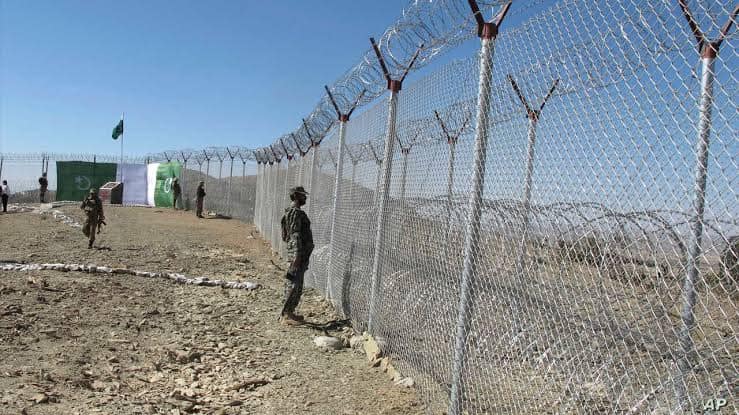
Pakistan has initiated a vicious process to fence the Gwadar Port in an effort to separate the Baloch coast from Balochistan, said Khalil Baloch, Chairman of the Baloch National Movement (BNM) in a statement on Friday.

“It is the beginning of a conspiracy to separate the coast from Baloch homeland. Baloch National Movement has been saying this since day one that Pakistan wants to increase the exploitation of the Baloch nation under the guise of euphoric slogans of development,” said Khalil Baloch. The BNM Chairman did not mince words in criticizing Pakistan and termed Gwadar Port’s fencing as Pakistan’s “vicious” attempt.

Khalil Baloch further explained that entire Balochistan, including Gwadar, has been turned into a military barrack. “Equally complicit in this exploitative process is the imperialist state of China. This fencing process is inhuman. History shows that no ruling nation has ever developed the oppressed but ambushed them in the name of development and looted its shores and other resources.”

Pakistan has begun its vicious exercise to fence the Gwadar Port. (Photo: News Intervention)

The BNM Chairman added that Pakistan’s “inhuman” act will help it to further consolidate its hold on the Baloch coast and would be followed by forcible occupation of Gwadar lands, eviction of local fishermen from the coastal areas, and formation of trailer mafia, among others.

“For a long time the Pakistani state and its followers have been propagating that the freedom seeker Baloch people are against development but today this fencing plan proves that Baloch people are not against development, rather they are against exploitation and occupation,” said Khalil Baloch.

BNM Chairman said that Pakistan is rapidly separating the Baloch coast from Balochistan to advance its imperialist ambitions. He said there is an urgent need for the Baloch nation to come together for its survival, “…the Baloch National Movement reiterates its determination to thwart any plan to forcibly occupy our land.” Khalil Baloch hoped that Pakistan’s plans could soon come to a naught and the “sun of freedom” would rise on the Baloch land.

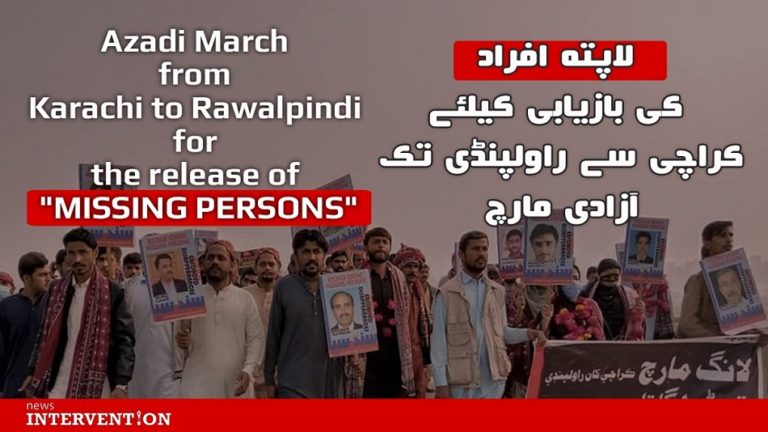
Azadi March from Karachi to Rawalpindi for ‘Missing Persons’

Women, children and elderly are walking from Karachi to Rawalpindi. This 1,450 km foot march started on November 10, 2020. Women and children who are walking on foot towards Rawalpindi expect that this long march will help in the release of their family members who have gone “Missing” from Baochistan and Sindh.

Watch our news report to understand the inside story. (voice over in Urdu)

Click on the YouTube link to watch the news report. (Urdu voice over)

Sindh Sabha has organised this 1,450 km Long March from Karachi to GHQ, Rawalpindi. General Headquarters (GHQ) is the head office of Pakistan Army. Women, children and elderly are walking towards the headquarters of Pakistan Army to press for their demand to release the Missing Persons, who have been abducted from Balochistan and Sindh.

Sindhi & Baloch people are desperate for their “Missing” family members. They have been protesting for their release but no one is listening.  Family members and friends of these “Missing Persons” are left with no option but to walk from Karachi to Rawalpindi to plead for the release of their loved ones.  

Roshni Act: Gupkar gang’s gateway to loot Kashmir land

In a significant judgment on October 9, the Jammu and Kashmir High Court declared the controversial Roshni Act as ‘illegal and unconstitutional’ and ordered a CBI probe into the Roshni land scam case. The division Bench of Chief Justice Gita Mittal and Justice Rajesh Bindal also asked the CBI to file a status report in the case every eight weeks. The court also said that J&K Chief Secretary will ensure uninterrupted investigation, which will also be directed against those officers in whose tenures the encroachments had happened. The court said “all Deputy Commissioners and Divisional Commissioners will be held for contempt of court if they do not cooperate with the investigation.”

On October 18, the High Court ordered that the investigation of the land scam be transferred to the CBI, which will file the status report within eight weeks. The CAG chief had also reported obstruction by some senior state administrative sources in providing the desired information in full.

Pandora’s Box opens

On October 21, 2020, the Divisional Commissioner, Kashmir, P K Pole chaired a meeting of Deputy Commissioners and other concerned officials and directed them to submit comprehensive details of ministers, legislators, bureaucrats, police officers, government employees, businessmen, other influential persons and their relatives who had derived any benefit under the Act, officials said. Pole directed all the Deputy Commissioners of Kashmir Division to submit the District-wise details of the State’s lands as in 2001.

On October 22, 2020, the administration of Jammu and Kashmir Union Territory ordered the submission of comprehensive details of ministers, legislators, bureaucrats, police officers, government employees, businessmen, other influential persons and their relatives, who have benefitted from the Act, reported the Deccan Herald of Oct 22, 2020.

On November 24, 2020, Ravi Shankar Prasad, the Union Law Minister, speaking in a press conference said that the former J&K Chief Minister Farooq Abdullah was among the beneficiaries in Roshni Act. The others in the list were the former Finance Minister of J&K, Haseeb Drabu, (who in a recent article in Greater Kashmir argued that the exiled Kashmiri Pandits had lost all claim to their Kashmir homeland) and Congress leader Majid Wani, former Home Minister and NC leader Sajjad Kitchloo and former JK Bank Chairman MY Khan, wrote IndiaToday of November 24, 2020.

Government’s swift action

Following media reports, the government acted fast and made public the first list of beneficiaries of the ‘Roshni Scheme’, which included several top politicians cutting across party lines, bureaucrats, police officials. It was done by the office of Divisional Commissioner, Jammu and Divisional Commissioner Kashmir in pursuance of the directions of the Jammu and Kashmir High Court in the PIL NO 19 Of 2011 Titled S.K.Bhalla Vs State And Other Connected Matters Dated Oct 9, 2020.

Interestingly, earlier, the J&K government had decided to declare all the actions taken under the Jammu and Kashmir State Land (Vesting of Ownership to the Occupants) Act, 2001, also known as the Roshni Act, under which 20 lakh kanals of land was to be transferred to existing occupants, as “null and void”, and has also initiated steps to retrieve the land within six months. 

Acting on the directions of the Jammu and Kashmir High Court, the J& K government has already directed the Principal Secretary Revenue Department to ensure that all the mutations done in furtherance of the act are annulled, encroachers are evicted and large tracts of land are retrieved within a period of six months. The orders in this regard were also issued by the Revenue Department and the concerned Tehsildars were directed to start the groundwork in order to retrieve the government land.

To attract media attention and expose the open loot the Principal Accountant General (Audit) Subash Chandra Pandey had even organized a press conference where he described the transfer of 3, 48,160 kanals of land in the State at a cost of Rs 76.24 crores (24 percent) against a demand of Rs 317.54 crores under Roshni Act, as one of the biggest scams of J&K. Originally, the Act was aimed at resource mobilization of Rs 25,448 crores for investment in the power sector.

Reportage in Media

The nationwide media and the local media took on to themselves to report the scam in their editions. In fact, it all started when on October 9, 2020, IkkJutt, a Jammu-based social organization/NGO initiated a demand for enquiry into the land scam, following which the High Court of J&K deemed the law and all allotments made since the beginning as “null and void” and “unconstitutional”. The court also said that the rules framed in 2007 by the  Ghulam Nabi Azad (Congress) government did not appear to have any legislative sanction.

The Jammu-based Firstpost of Nov. 2, 2020 elucidated the issue under the title “J&K Government declares actions under Roshni Act ‘null and void’; what you need to know”.  

In its issue of  October 14, 2020, the Indian Express uncovered  the scam titled ‘Loot to own’: J&K High Court hands Rs 25,000 crore land scam probe to CBI”. In 2009, the Jammu and Kashmir vigilance organisation had registered an FIR against public officials for “alleged criminal conspiracy to illegally possess and vest ownership of state land to occupants who didn’t satisfy the criteria under the Roshni Act”, Indian Express reported. While the then state bureaucracy called the Vigilance Organisation’s findings “motivated”, the Vigilance Organisation completed investigations in five cases by March 2015, and indicted nearly two dozen officials, including three former deputy commissioners for allegedly misusing the provisions of the scheme,” the report added.

“Actually it was repealed in 2018 after Governor Satya Pal Malik concluded that it had “not served” its purpose and was “no longer relevant in the present context”. This move was made after advocate Ankur Sharma, who had defended the accused in the Kathua rape case of January 2018, sought its repeal to “defeat the jihadi war in the form of demographic invasion of Jammu”, said Scroll.in. in its  November 1, 2020 edition.

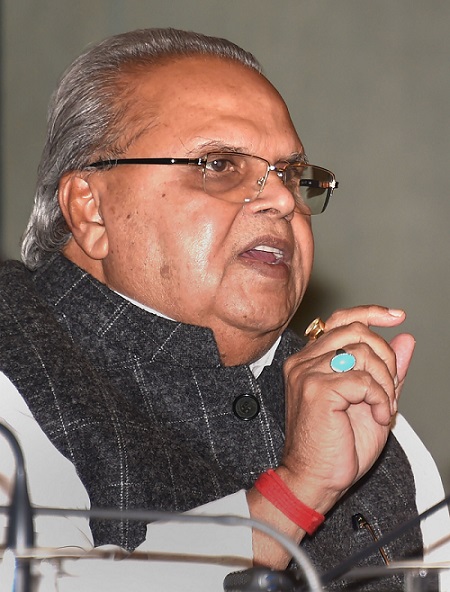
Satya Pal Malik, former Governor of Jammu and Kashmir. (Photo: PTI)

On November 1, 2020, The Hindu reasserted that the J&K UT administration declared all the actions taken under the Jammu and Kashmir State Land (Vesting of Ownership to the Occupants) Act, 2001 – also known as the Roshni Act – as “null and void”. The government said it would evict encroachers and retrieve all land distributed under the scheme within six months.

The Business Insider of October 9, 2020 wrote, “In a landmark judgment, the Jammu and Kashmir High Court on Friday declared the controversial Roshni Act “unconstitutional” and directed that investigation into the Rs 25,000 crore land allotment scheme under it be transferred to the CBI.

Background of the Roshni Act Scam

The Roshni case has been called the biggest ever land scams in the history of Jammu and Kashmir, and has allegedly caused a loss of Rs 25,000 crore to the J&K treasury. The Act, enacted by the State Legislature in November 2001, and enforced in March 2002, envisaged raising of funds for hydropower  generation in the State by transferring State land into private ownership to collect Rs 25,000 crore.

A CAG report estimated that against the targeted Rs 25,000 crore, only Rs 76 crore had been realized from the transfer of land into private ownership.

Politicians, businessmen and bureaucrats had come under severe criticism for transferring State land into their ownership and that of their favourites at arbitrarily fixed rates, which ultimately deprived the State of land worth several thousand crores and also defeated the purpose of the Act.

Irregularities and repeal

In 2014, the Comptroller and Auditor General of India (CAG) noted some serious irregularities in the implementation of the Act and in 2015 the State Vigilance organization charged over 20 government officials for misuse of the Act; no one was prosecuted, writes Suhail, Peer Ghulam Nabi in Pieces of Earth: The Politics of Land-Grabbing in Kashmir (2018). From 2015 onwards, efforts were made to get back some of the illegally-acquired land. These efforts proved a failure owing to non-cooperation of revenue functionaries. The Act was also found to be an attempt to change the demography of the entire region, investigations found. The Act was repealed in 2018 during the tenure of Governor Satya Pal Malik, who ordered the case to be taken over by the CBI.  

How the scam surfaced

While auditing the Roshni scheme in the year 2013-14, the officials stumbled upon this biggest land scam, as they noticed that gross irregularities were committed by the top bureaucrats in order to facilitate the land deals involving VVIPs in Jammu and Kashmir.

During the audit, the team of officers faced difficulties in getting full information/records. With this constraint, an audit was conducted through a test check of records of the offices of the deputy commissioner in seven out of the twenty districts in which the act was implemented. The records were test-checked in Srinagar, Jammu, Udhampur, Anantnag, Pulwama, and Budgam districts and 547 cases involving the transfer of 666 kanals of non-agricultural land were examined in detail.

The CAG report tabled in the state legislature carried exclusive details of the irregularities done from interpretation to implementation, particularly in favour of the occupants enjoying very strong political or bureaucratic clout. Political parties including the Congress and the National Conference exploited the scheme to their advantage by regularizing their unauthorized occupation of the prime lands on which they had raised the party offices besides the printing presses and the offices of their official organs-Daily Khidmat and Nawa-e-Subah.

The beneficiaries

The Congress got proprietary rights over a prime piece of 7 kanals and 15 marals close to the Residency Road in the Kothibagh area of Srinagar. It is currently valued to be a property of Rs 80 crore. Its price was fixed at Rs 8.54 crore (Rs 1.10 crore/kanal). Congress enjoyed a rebate of Rs 7.58 crore and paid a total of Rs 96 lakh to the government. The Congress-controlled Khidmat Trust operates the head office of daily Khidmat with several modern printing presses on the same premises. A multi-floor commercial complex worth over Rs 50 crore has also come upon the same land.

The National Conference (NC) too has its party headquarters in a multi-floor commercial complex on a piece of the State land, measuring 3 kanals and 16 marlas. Offices and printing presses of the NC’s Urdu and English dailies, Nawa-e-Subah, also operate from the same premises near Zero Bridge in the heart of Civil Lines in Srinagar. The land alone is currently valued at Rs 35 crore. Its price was fixed at Rs 4.56 crore (Rs 1.20 crore/kanal). The party enjoyed a rebate of Rs 4.05 crore and paid a total of Rs 51 lakh only.

Writing under the caption ‘Private residence constructed on encroached state land’ Chandra Maurya scripted in the Printers Report of 25 November 2020 as follows: National Conference President Dr. Farooq Abdullah and a sitting Member of Parliament from Srinagar, who also remained Chief Minister on several occasions between 1982 to 1996 and served as Union Minister in the cabinet of Dr. Manmohan Singh is now facing serious charges of illegally occupying state/forest land in Sunjwan village of Bahu tehsil in Jammu district. The controversial piece of land, measuring 7.7 kanals (roughly one acre) was used by the National Conference leader to construct his private mansion with 20-30 feet high boundary walls. These startling revelations were made by the office of Divisional CommissionerJammu after it made public a list of encroachers who had illegally occupied state/forest land in and around Jammu. According to the list uploaded on the website of the office of Divisional Commissioner Jammu, the names of Dr. Farooq Abdullah and his son Omar Abdullah figured on top of the list. It said, “Farooq Abdullah and his son Omar Abdullah had illegally occupied state land measuring 7 Kanals and 7 Marlas under Khasra No 4, 5, 6 in village Sunjwan of Bahu Tehsil in Jammu district”.

After the news went viral, the Twitter handle of the Jammu and Kashmir National Conference posted a written statement, “The news attributing to sources that Farooq Abdullah is a beneficiary of the Roshni Act is completely false and is being spread with a malicious intent.” In a brief statement, while speaking to a news channel Farooq Abdullah said “It is only propaganda against us. I just can’t understand what they want to do? Sunjwan colony was not raised by me…It was raised long back. Don’t we have the right to live?”

Official sources revealed that initially Dr. Abdullah had purchased only three kanals of land but at the time of taking the possession of this private land, he encroached upon more than seven kanals of nearby prime state and forest land.

Farooq Abdullah’s private mansion in Sunjwan, Jammu. (Photo: News Intervention)

Several other senior National Conference leaders and close friends of Dr. Abdullah also acquired adjoining plots in the close vicinity of his mansion and constructed their bungalows. According to the list uploaded on the website, National Conference leader, Syed Ali Akhoon, Sajjad Kitchloo, Congress leader Abdul Majid Wani, former Chairman of J&K Bank M Y Khan, Aslam Goni, a former close aide of Dr. Abdullah, Haroon Choudhary, Ashfaq Mir son of a retired Judge and hotelier Mushtaq Chaya too had encroached the state/forest land in the same locality.

Leading hotelier Mushtaq Ahmad Chaya has got ownership rights on a prime piece of the State land, measuring 5 kanals and 8 marlas on Maulana Azad Road. He has paid Rs 97.20 lakh and enjoyed a rebate of Rs 3.35 crore. He has also regularised his possession of 4 kanals and 16 kanals in Gogji Bagh. For this, Chaya has paid Rs 66.52 lakh and taken a rebate of Rs 1.27 crore. Together the two properties are currently valued at Rs 80 crore.

According to Sheikh Shakil Ahmad, the advocate pursuing the case, some former Chief Ministers, some influential politicians including Ministers, besides a number of the Police officers and over 20 serving and retired IAS officers, could be grilled for their alleged involvement or carelessness in transferring proprietary rights to the land grabbers, reported the same source as above.

According to IANS, the list also includes Mehboob Beg (son of Mirza Afzal Beg, a close associate of late Sheikh Muhammad Abdullah), influential businessmen like Mushtaq Ahmad Chaya and Krishen Amla (who is close to the top leaders of the Congress party) and former top bureaucrats such as Khurshid Ahmad Ganai and Tanveer Jahan.

The second list included names of Congress leader K K Amla and Mushtaq Ahmad Chaya, both prominent businessmen and hoteliers besides former bureaucrat Mohammad Shafi Pandit and his wife. Shafi Pandit, IAS, who served at the Centre also for some time has filed an appeal before the Supreme Court of India pleading for quashing the order of the J&K High Court that nullifies the Roshni Act.

Suriya Abdullah, sister of Farooq Abdullah, was also named among the beneficiaries, who got ownership of over three kanal plot under residential use. According to the list, the land had been approved by the authorities but she was yet to pay Rs 1 crore fees. No notice has been issued to her since the time of approving the land in her name.

In Jammu, the divisional commissioner separately released another list of 138 beneficiaries falling in Jammu south tehsil, mostly belonging to the majority community, who are in possession of over 107 acres of land which was vested to them under Roshni Act. Though majority of them are agriculturalists and farmers, there are also some influential people including the trustee of Digiana Ashram, Mahant Manjeet Singh who owns seven kanals of land.

In a separate list under encroached state land (Physically Encroached but not shown in Revenue Record) other than Roshni, it identified seven persons who are in possession of over five acres of land. The list included PDP leader Talib Choudhary (two kanals), PDP office having three kanals of land at Bahu-Sunjwan tehsil, retired IGP Nisar Ali (three kanals), retired SSP Mirza Rasheed (three kanals) and prominent businessman Haji Sultan Ali, who owns the major chunk of 30 kanals of land.

The Jammu divisional administration had on 20 November 2020 released separate lists of 541 people, almost all belonging to the majority community, in different tehsils who have availed land under the Roshni Act besides two lists of nine persons who have allegedly encroached upon the state land other than the Roshni Act, which included Farooq Abdullah and his son Omar Abdullah. In addition, it had also released two more lists of 1,237 alleged encroachers falling in two tehsils, almost all from the majority community.

History

The scam has a history. Soon after Jammu and Kashmir’s accession to India, on October 28, 1947, the first Land Reforms Act borrowed from the Constitution of  the Soviet Republic of Uzbekistan was introduced as one of the first and foremost reforms by the National Conference, which was in contrast to the land reform policy of independent India. Under the reforms, thousands of kanals of land owned by the old school landlords of the State (jagirdars) from the days of Maharajas were taken away without any compensation and were distributed among the tillers.

Seven decades later, the inheritors of the Naya Kashmir legacy bereft of constitutional, legal and moral propriety bestowed several lakh kanals of state/forest land at throw away prices to the upper-most creamy layer of Kashmiri society to “loot India in Kashmir.”  This was the largesse of the majority “populist government” of J&K to the masses of Kashmiri people from whom they extracted allegiance and political support to overthrow the benign and law-abiding rule of the Dogra rulers. Mind you, all was done in the name of democracy –- to be precise “Indian secular democracy” — because only the majority community of Kashmir became its maximal beneficiary. 

The law granted ownership of the former J&K State land to illegal encroachers with the hyped claim of raising money for power projects upon payment of a sum to be determined by the State government.  Farooq government set 1990 as the cut-off year, which, however, was relaxed in 2005 to 2004 by the then Congress-PDP coalition Government, and further relaxed to 2007 by the Government of Nabi Azad (Congress) under coalition government with PDP.  The Act came to be known as ‘Roshni Act’, with J&K government announcing to use the funds raised from this reform to fund power projects in the state. Three chief ministers- former and incumbent- were in cahoots on the deal.

How Roshni Act came into being

The Jammu and Kashmir State Lands (Vesting of Ownership to the Occupants) Act, 2001 (known as the Roshni Act) was enacted by the J&K legislature in 2001. Its objective was vesting of ownership rights to the illegal occupants against a price. The then National Conference government headed by Farooq Abdullah had claimed that the scheme would generate revenue of over Rs 25,000 crore, which would be utilized to raise new power projects. Farmers who had been occupying State land were also given ownership rights for agricultural use. The law initially set 1990 as the cut-off year for encroachment on State land, based on which ownership would be granted. Subsequent governments under Mufti Mohammad Sayeed and Ghulam Nabi Azad relaxed the deadline first to 2004 and then to 2007, of course, obviously with discreet motives. NC, PDP and Congress leadership in the valley were in complete unison for seeing the illegal Act through owing to their vested interests that were converging and not conflicting.

However, most of the transfers of the proprietary rights of the occupied lands, with drastic changes in the rules from time to time, took place in 2005-08, when Ghulam Nabi Azad was the Congress chief minister and the head of the Congress-PDP coalition.

The Roshni Act was enacted for a limited period of operation but extended by successive State governments from time to time. It was finally scrapped by the then Governor Satya Pal Malik prospectively on November 28, 2018, five months after the breakdown of the PDP-BJP government.

Tailpiece

The biggest and perhaps the only memorable achievement of Sheikh Muhammad Abdullah, the father of J&K freedom movement after assuming power was to dismantle the landlord system in the State. He ordered ownership of the tiller of the land without paying a single penny by way of compensation to the owners of the land. Ironically, his heir and descendent and the Chief Minister of the State, Farooq Abdullah wantonly reversed his father’s policy and recreated thousands of landlords, who are far more affluent than those whose lands his father snatched away. Farooq grabbed state/forest land for himself, some of his family members, kith and some close political and business partners to build his political empire. Lakhs of kanals of state land that should have been utilized for raising residential colonies for the weaker and homeless segments were diverted to rich an affluent class, the creamy layer of J&K with clout in the corridors of power or influence in one or the other way.

The Roshni Act scam is the irrefutable proof that Kashmir leadership has the least interest in the welfare of the ordinary people as they claim in the shape of Gupkar Gang. Their entire effort rotates around self-interest and hoodwinking Indian authorities through fraud, deceit and double speak. Kashmir is the one example of how democracy, secularism and egalitarianism for which a four decade long struggle against the rule of the Maharajas was waged, were subverted for self-aggrandizement. While the bigwigs were engaged in looting the state, they patronized and instigated ordinary Kashmiri youth to pelt stones at the security forces, who were protecting them. The Roshni Act episode reveals the wide gulf created between the plebeians and the privileged in Kashmir.