Home Blog Page 337

Arms smuggled through border seized near Jawahar Tunnel

0

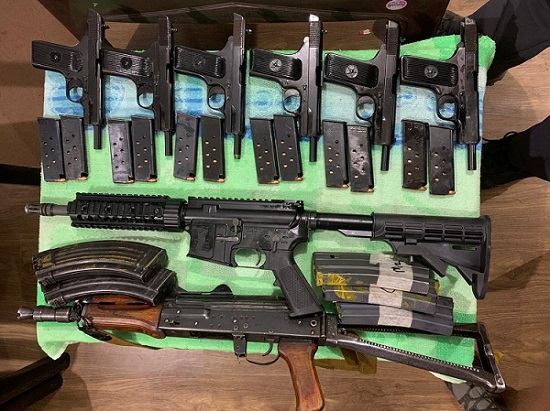
Srinagar/ September 9: In a significant development, a huge consignment of arms and ammunition being smuggled from Jammu, through the International Border has been seized by J&K Police and the Indian Army at Srinagar-Jammu highway and some people have been arrested. The J&K Police said that two persons were arrested along with arms and ammunition including M4 US Carbine and an AK rifle by joint party near Jawahar Tunnel in south Kashmir’s Kulgam district late last night.

They said the joint forces intercepted a truck (JK22B-1737) coming from Samba district, near Jawahar Tunnel and recovered one AK rifle with 2 magazines, one M4 US Carbine with 3 magazines, six Chinese pistols with 12 magazines.

Confirming it a senior J&K Police officer said that two persons onboard the truck have been arrested and their interrogation was going on.

The officer identified the duo as Bilal Ahmad (son of Ghulam Muhammad Kuttey) and Shahnwaz Ahmad Mir (son of Zahoor Ahmad Mir), both residents of Shopian.

Besides, the officer said at least three more persons were detained on the lead of Kashmir police from Ramban district in connection with the incident. “The investigations are underway and further details would be shared later,” the officer added.

Mass Man’s Madness Messengers: “The medium is the message.”

0

Christian is a Philosopher that comes from Belgium. What identifies him the most and above all is simplicity, for everything is better with “vanilla flavour.” Perhaps, for this reason, his intellectual passion is criticism and irony, in the sense of trying to reveal what “hides behind the mask,” and give birth to the true. For him, ignorance and knowledge never “cross paths.” What he likes the most in his leisure time, is to go for a walk with his wife.

Scott Douglas Jacobsen: Responsibility, obligations, rights, privileges, and reciprocity inter-relate as a common core of ethics reflective of different sides of a pentahedron for a frame morality – a golden pentagon operating as a prism on a general Golden Rule ethic. If one has rights and privileges, and if one takes the Golden Rule as an ethic implicative of an order of reciprocity among relevant operators, e.g., human beings of sufficient emotional maturity and intelligence, and if one takes into account the ideas on the opposite side of the ledger of responsibilities and obligations, then reciprocity functions as a fulcrum between rights and privileges, on the one hand, and responsibilities and obligations, on the other hand. You do not view intellectuals as having a responsibility, necessarily. Thus, if a journalist identifies as a public intellectual, then they do not by necessity have a responsibility as a category of intellectual, while a journalist. What are some obvious ethic breaches by journalists in their profession within the consideration of this gold pentahedron? When do they lose sight of providing a reality sense to the public, thus deteriorating a democratic state via a reduction in a sense of reality testing amongst the population?

Dr. Christian Sorensen: I think that the gaps that affect journalism, always affect the public’s sense of reality, nevertheless not all of them are ethically reprehensible, since they are constitutive of journalistic reality, and therefore because they do not have any answer as such, neither they represent any type of problem. In this sense, I consider that indeed there is a gap, that actually is not of journalism, but rather it is journalistic, and that has its primary cause in what I denominate the impasse of the real, which is a breaking line that due to the fact that only through the phenomenon is partialy reachable, I think that does not make impossible to know reality, though does make access to it impossible. In turn although it is describable, needs to be completed by a narrative that constructs sense through a history, therefore due to its interpretive essence, takes an inescapably relative connotation. The last is what represents, in my opinion the material substrate that journalism intends to communicate publicly. Consequently, it could be asserted that journalism, more than working with reality as an independent and available entity with its own patterns, what it actually does is to go in to chop the concrete of something from an angle and sight, on which places an eye but remains subordinated to the circumstances that govern the inner world of the observer. Therefore strictly speaking, I think that the criterion of sense of reality, lacks all sense, because there is no bodily sense that fulfills this function, nor does there exist any one alike in terms of adequacy between two things. The foregoing is determinant from my point of view, in relation to what the journalistic gap is, because it implies a communicational break in terms of inherent discrepancy regarding its natural speech. In consequence the aforementioned, since leaves the choice of options opened, carries an ethical connotational charge, and therefore properly speaking it could be said that it is a gap of which journalism must take over, insofar as it holds a debt of loyalty with an imaginary third party, with respect to whom has sealed a sort of social contract when the third entrusted its demand from disinformation. I do not believe that in the case of journalism, there is an ethical reciprocity between rights and responsibilities since the burden of proof is on one side only, to the extent that journalism socially speaking, I think that it only sustains responsibilities and not rights, while the public feels only with rights in relation to which it demands absolute fidelity that borders in utopia. In this unequal context, however I believe that there is a journalistic ideal, in the sense of an ethical must, where there’s a compromise with the search and communication of the truth no matter what consequences this might imply, which ultimately means, that the journalist must create a meaning in a linguistic framework, by combining simultaneously the signifier that represents the real phenomenon, with the rhetoric semantics of its writing, in order to give birth at the same time a response in the other symbolic register of truth, and an anewer to the demand put into play by the third, which lastly is for achieving a sort of outcome, that I will define as to be something that should makes sense, and that for me is the core gap regarding what journalism must be prepared to overcome ethically.

Jacobsen: What would be poor art of a journalist?

Sorensen: I think that the feeling of complacency for serving globalized liberalism, and the feeling that I will denominate as equidistantial which is the search for the right middle between two extremes, as the ultimate ethical goal, that in turn is a hypocritical way of using the art to disguise the truth with fallacious arguments, since by doing so the systemic rejection is avoided, insofar as it is a symptomatic mechanism that with relative success manages to deny the entropy that leads to the nihilism of meaningful communication.

Jacobsen: What would be great art of a journalist, making a great journalist?

Sorensen: The art of a journalism, that I would title as the journalism in search of meaning for man.

Jacobsen: What could be a prophylactic to this journalistic prostitution endowed with acquired exhibitionism?

Sorensen: Taking advantage of the fact that journalism is a masculine noun, I would say that it is because happens something similar to what occurs when a man who is having sex, asks his partner if she feels, and she replies that yes, that she feels the smell of burning rubber.

Jacobsen: Why is independent journalism focused on human rights the most successful journalism now?

Sorensen: Because everyone deep down knows what I say, regarding the apodiptic reality, that man never must be treated as a means, and currently what occurs in the global panorama, is quite the opposite, which represents an evident tragedy, that as such and in relation to its explanatory causes does not withstand further analysis, therefore the fact of denouncing and confronting the aforementioned, converts this type of journalism into an anonymous hero.

Jacobsen: How does journalism provide the singular junction point between an informed citizenry for an informed democracy and a misinformed population for an endured autocracy awash in lies?

Sorensen: I think that the key is mass quality education, since that is the clue for citizens to take control of themselves and their environment, to the extent that a state of conscience not sedated and reactive to any kind of ideological devices of metaphysical or populist demagogic nature, would allow them to claim their right to be duly and democratically informed.

Jacobsen: Why admire Raymond Aron and Laurent Joffrin?

Sorensen: Regarding Raymond Aron because its reformist and skeptical position seems to me remarkable, in the respective sense of considering that true progress must be contingent, partial and imperfect, and that freedom and reason are the most efficient defenses against totalitarianism and fundamentalism. In relation to Laurent Joffrin or Laurent Mouchard, it is since I find interesting that he occupies a pseudonym as a way to deny his nationalist paternal origin, and that later dedicates himself to communications.

Jacobsen: Why is Iceland so gosh darn democratic?

Sorensen: Because I suppose that being a relatively isolated ice-covered island, in the vicinity of the North Pole allows them to keep human stupidity frozen, and drink plenty of whiskey on the rocks, which produces a evident vasodilation of the cerebral sensitive homunculus, which contributes significantly to improving proprioception in order to dimensionate and promote successfully the democratic values.

Jacobsen: Thank you, Christian, pleasure!

Sorensen: You are welcome Scott!

Blasphemy laws are a tool to suppress minorities in Pakistan

You blaspheme, You must Die! Blasphemy Law (Clause, 295_C) of Pakistan Panel Court reads; “Whoever by words, either spoken or written or by visible representation or by any imputation, innuendo or insinuation, directly or indirectly, defiles the sacred name of the Holy Prophet Muhammad (PBUH) shall be punished with death or imprisonment for life and shall also be liable to Fine.” The law prescribes a fixed death penalty for all those who are found guilty the option of life imprisonment was made defunct after a 1991 Federal Shariat Court Judgment. Blasphemy law was introduced for the first time during British Rule in 1860

Pakistan where religious narrative is dominant, religious figures and maniacs control the country and they have full support of state machinery and military establishment, in their view “blasphemy” is an unpardonable offense. Every one have license to kill anyone publicly in the name of blasphemy no need of waiting for court trials and judgment. Hence a Assailant can Easily become a “Ghazi”, “Hero” or “Martyr” of the nation.

The punishment of blasphemy, “10 years imprisonment or fine will be imposed if some one found guilty of blasphemy.” Later on in 1927 with few amendments more clauses were added in the Blasphemy Law. In 1953 when Anti- Ahmadiyya riots erupted, the Jamaat-e-Islam demanded amendments in Blasphemy Law but the Government of Pakistan didn’t entertain them. Yet when in 1974 anti-Ahmadiyya riots erupted again the second amendment was passed in Constitution of Pakistan because at that time a movement was launched by all Islamist parties by name of “Tahreek-e-Khatme Nabuwwat”.

Later on in 1984 under the regime of Pakistani Dictator Zia-ul-Haq anti-Ahmadiyya ordinances were brought out that were added in the Constitution of Pakistan, which restricted the freedom of religion for Ahmadi’s. According to this law “Ahmadi’s cannot call themselves Muslim or ‘ pose as Muslim’ which is punishable by three years in prison”.

Blasphemy Laws in Pakistan are derived from Holy Book of Muslims Quran and Hadith but several Muslim schools of thought and scholars do not agree on the content as they think that these quotes or even verses are misinterpreted by the dominant Muslim sect of Pakistan, and with support from establishment they are using Blasphemy Laws as a tool to achieve their own interests and agendas. For instance this one verse from Holy Quran which directly mentions blasphemy (sabb) is 6:108.[5] The verse calls on Muslims to not blaspheme against deities of other religions, lest people of that religion retaliate by blaspheming against Allah. “And do not insult (wa la tasubbu) those they invoke other than Allah, lest they insult (fa-yasubbu) Allah in enmity without knowledge. Thus We have made pleasing to every community their deeds. Then to their Lord is their return, and He will inform them about what they used to do.” [Quran 6:108]

An other verse from Quran; “The only punishment of those who wage war against Allah and His Messenger and strive to make mischief in the land is that they should be murdered, or crucified, or their hands and their feet should be cut off on opposite sides, or they should be imprisoned. This shall be a disgrace for them in this world, and in the Hereafter they shall have a grievous chastisement. Except those who repent before you overpower them; so know that Allah is Forgiving, Merciful.” [Quran 5:33–34]

There are few Hadith also referred to as justification of blaspheme to be executed. But not everyone agrees on these quotes. Secular Muslim people in Pakistan have different thought about Blasphemy Laws as they have always demanded for an end of Blasphemy Laws but never succeeded because of strong hands behind this ideology.

Religious sentiment is a powerful tool in Pakistan and had been always used by masters of Pakistan to control people, creating pressure groups of religious parties and then staying in power as long as needed. As minorities and specially wealthy Hindus are an easy prey in Pakistan so extortion from minorities in Pakistan is a common crime rarely reported because of fear, victims pay huge amounts (Protection Money) and favors to Mosques and Madrasas if they have to save their life otherwise they have to leave business and their properties.

Zafar Sahito, Vice President Jeay Sindh Thinkers Forum, presenting his views on “South Asia Affairs”, the weekly news show by Vivek Sinha.
Click on the YouTube link to watch the conversation.

“Due to Coronavirus our temple is closed so I perform my early morning prayers (Bhajan) at home only. One day my neighbor knocked at my door and threatened our family saying that you Hindus go to your “Cow Mata” country India and sing your Bhajans there, if you want to live in Pakistan live quietly don’t chant Krishna nonsense every early morning.” One of my Hindu friend sent me this message about two months ago. “ …believe me I was not loudly chanting Lord Krishna’s Bhajan but my neighbor always looks for any opportunity or reason to suppress us so we sell our apartment to them and leave this place, while they always listen to Indian music loudly all the time. Even there is a Mosque-Madrasa in our apartments where loudspeakers are used continuously!”

Is this not a depriving situation? Is this not violation of basic human rights? Is this not a crime? I feel sad at this state of affairs!

In 2009, Aasya Noreen famous as (Asia Bibi), a Pakistani Christian was accused of blasphemy. “Why did you use my cup to drink water? You are a Non Muslim! a “kafir”. This was the argument that Noreen had with her co-workers that led to blasphemy charge on Noreen and she was arrested in 2010. She was convicted of blasphemy by a Pakistani court and sentenced to death by hanging but in 2018 Supreme Court of Pakistan in an appeal acquitted her based on insufficient evidence (in reality it was due to international pressures). Yet Asia Bibi was not released from custody because of safety concerns. A Muslim Cleric Maulana Yousaf Qureshi announced a bounty of 500,000 Pakistani Rupees to any one who would kill Asia Bibi.

Asia Bibi, a Christian, was falsely accused of blasphemy in Pakistan. Asia Bibi had to spend a decade in prison.

Minorities Minister Shahbaz Bhatti and Punjab’s Governor Salman Taseer both were assassinated for advocating on behalf of Asia Bibi and opposing the Blasphemy Laws. Finally, in 2019 Asia Bibi arrived in Canada but is still receiving life threats.

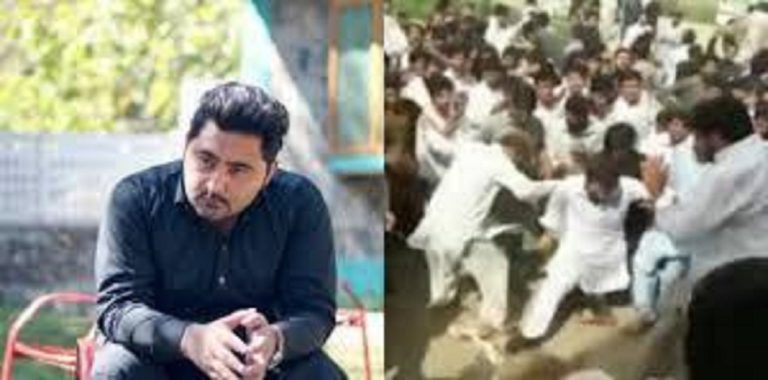
Mishal Khan a student of mass communications at Abdul Wali Khan University Mardan Pakistan, was killed in 2017 within the university premises by a angry mob over allegations of posting blasphemous content online. Later on during investigations nothing could be proved against him, only secular views, quotes and books on democracy and equality of humanity. But we had lost a beautiful soul in Mishal Khan!

Mishal Khan was in the university hostel when he was stripped naked and severely beaten by a group of students and then shot. He succumbed to his injuries, while he lay on the floor the angry mob was kicking his lifeless body and beating it with wooden planks. His body was then thrown from the second floor of the building, even they tried to burn his body while chanting “Allah-o-Akbar”. At least twenty five law enforcement officers were present on this spot but no action was taken by them to save the life of Mishal Khan.

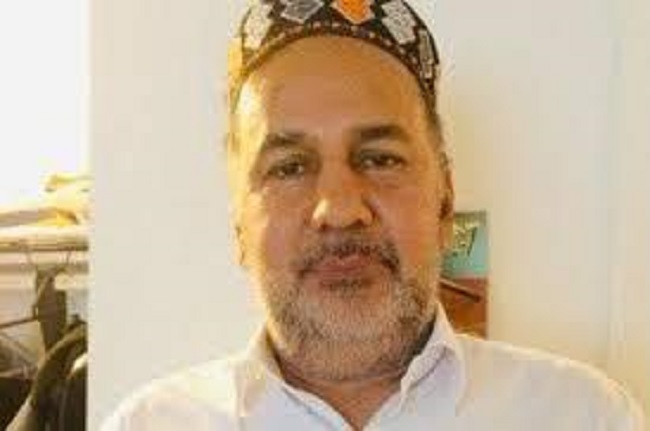
Recently on July 29, 2020 an American, Tahir Naseem, was shot and killed inside a Pakistani courtroom while on trial for alleged blasphemy. He was an Ahmadi, though my friends told me that Tahir Naseem was no longer an Ahmadi, he was just having some mental issues.

Tahir Naseem was shot inside a courtroom in Pakistan while he was on trial for alleged blasphemy. The murderer was hailed as a hero in Pakistan.

“A light appeared in my dream last night and ordered me to kill this enemy of Allah so you will be awarded with gift of heaven,” said the murderer of Tahir Naseem. The murderer was praised by a majority of people in Pakistan, even the government officials and political personnel used the murderer’s photo as their display picture (DP) on social media ID’s.

Do you think that the murder of any human being is morally legitimate on the basis of his belief, even if he is a ‘atheist’ or an infidel? Why not forgiveness is chosen over vengeance?

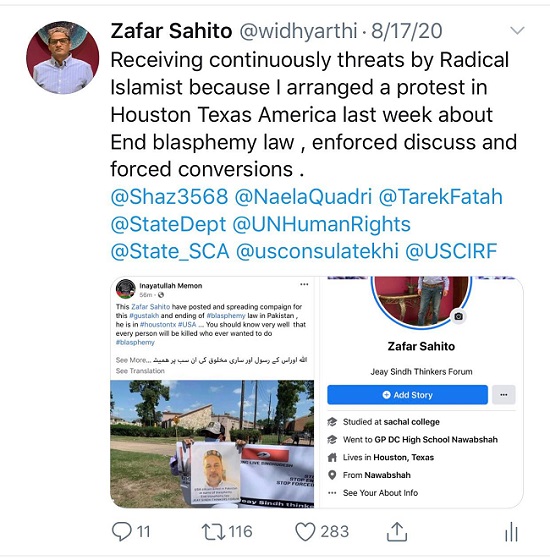
When I reported this case and announced a campaign on social media against Blasphemy Law, forced conversions and enforced disappearances in Pakistan and organized a protest at Consulate General of Pakistan at Houston, Texas I received many life threats and was targeted by unknown profiles on social media.

Screenshot of the death threats being received.

In a report of National Commission for Justice and Peace it is said that from 1987 till 2019, total number of blasphemy cases reported in Pakistan are as under: 633 — Muslims, 494 –Ahmadi’s, 187– Christians, 21–Hindus. But the actual number is much more because a lot of cases are never reported due to fear of persecution. My sources say that within the last 40 days over 42 blasphemy cases have been reported in Pakistan.

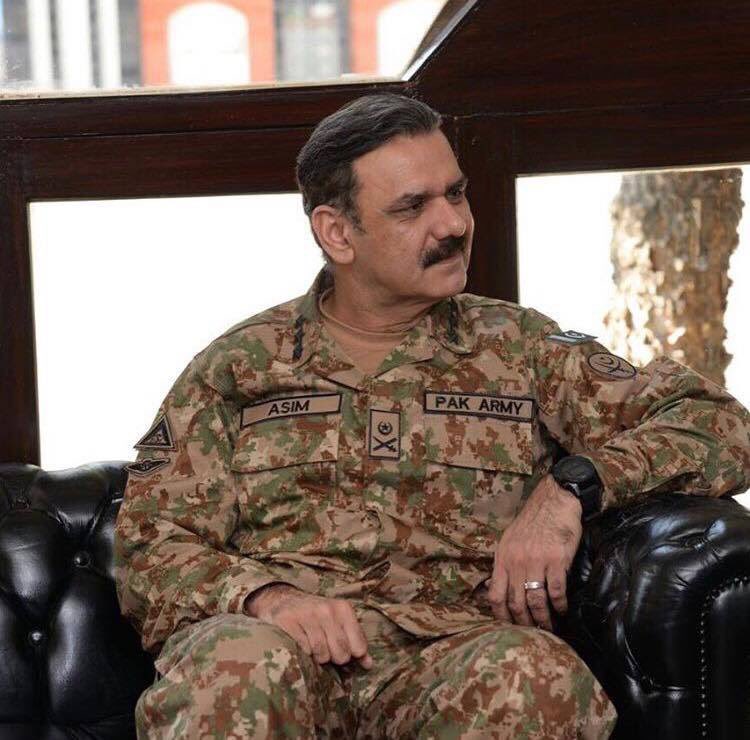
Lt. Gen. Asim Bajwa personifies the dishonesty in Pakistan Army

Lieutenant General Asim Saleem Bajwa reached a very high rank in the Pakistan Army, just one step short of being the Chief. It is mostly believed that a person reaching such heights would be dedicated to the cause of the nation. Sadly for Pakistan, Lt. Gen Asim Bajwa has exhibited no such virtues, instead, he stands exposed as a dishonest, corrupt and covetous man who has repeatedly sold the interest of his nation for the sake of money.

Lt. Gen Asim Bajwa, probably on the strength of his huge financial clout, has remained in the helm of affairs in Pakistan even after retirement. He soon became the Special Assistant to Prime Minister Imran Khan on Information and Broadcasting and also Chairman of the China Pakistan Economic Corridor (CPEC) Authority.

The exposure has come through the pen of Ahmed Noorani, a reputed investigative journalist of Pakistan who operates a well known website Factsfocus.com. The expose’ has been made through an article titled, “Bajwa family business empire grew in four countries in sync with Asim Bajwa’s rise in military,” published on August 27, 20. In his article, Noorani has given complete details of the Bajwa Empire that now spans 99 companies and massive real estate holdings under the parent Bajco Group. Of these 66 are main companies, 33 are branch companies while five companies are dead by now. The capital inlay for creating the business is estimated at US$52.2 million with real estate holding in the US alone at $14.5 million.

On the face of it the entire business has been set up by Nadeem Bajwa, a brother of Gen. Asim Bajwa who migrated to the United States in the early 1990’s and started off as a delivery boy in a Pizza outlet. Later two more of the six Bajwa brothers, Faisal and Abdul Malik, joined Nadeem in the US. Nadeem now runs 133 Pizza joints under the “Papa John’s Pizza” franchise. Interestingly, Nadeem opened his first Pizza joint in 2002, precisely the year when Lt. Gen. (then Lt. Col.) Asim Bajwa entered the inner circle of General Pervez Musharraf.

Nadeem continues to be the face of business even as Farrukh Zeba, the wife of Asim Bajwa is recorded as joint owner/shareholder of 85 of these companies including 82 foreign companies (71 in United States, seven in UAE and four in Canada). Massive investments in real estate in her name are also recorded in the US. In 2015, the sons of Gen. Bajwa joined the Bajco Group companies and also started establishing new companies independent of the Bajco Group in Pakistan and in the US. This was the exact time when the General became Director of Pakistan’s media wing, Inter Service Public Relations (ISPR) and later commander of the Southern Command of the Pakistan Army.

In his declaration of assets, Bajwa has declared his worth at Pakistani Rupees 31 lakh, including assets in the name of his wife. He also declared that he and his wife have no immovable property or business outside Pakistan. This has been exposed as a blatant lie.

Such is the clout of Gen. Bajwa that the expose was not reported by mainstream media, print or electronic in Pakistan. The public would have remained largely unaware had not the website of the Pakistan Remittance Initiative (PRI) been hacked and a picture of Bajwa and his family been put up on the home page with a call for accountability. “We will get our money back” says the headline of the message on the PRI website followed by, “This is the reality of Pakistan Army. They are thieves. petty thieves and terrorists. #AsimBajwaJawabDo.” 

Under fire from the opposition and with growing disillusionment being expressed by the Pakistani public, Gen. Bajwa probably sat down with his many friends in the media to evolve a counter strategy. Accordingly, he first issued a rebuttal in the form of a tweet. “A malicious propaganda story published on an unknown site, against me and my family, (just uploaded on social media) is strongly rebutted,” he said.

He followed it up by tendering his resignation as advisor to the prime minister but chose to retain his job as Chairman, CPEC Authority. Prime Minister Imran Khan was quick to reject the resignation. The process was, obviously, orchestrated as a face saving strategy.

The move, however, has backfired since those opposing the General are asking him to come clean with facts and figures instead of merely issuing a two line statement. Maryam Sharif has questioned the silence of Imran Khan and said that Bajwa must explain the “news about his assets.”

The Government machinery has, surprisingly, come out in support of Bajwa. “It is now a common practice that news is run without confirmation. A news should be made public once it is confirmed. The truth in this case will come to the fore soon,” said Foreign Minister Shah Mahmood Qureshi. “I have just spoken to Asim Bajwa. He will explain in detail the news about his assets in a few days,” tweeted Information Minister, Shibli Faraz.

Why is the Pakistan government bending backwards to save Gen. Bajwa, especially when eradication of corruption was the biggest election promise made by Prime Minister Imran Khan? The answer lies in one word – CPEC. Nawaz Sharif had expressed dissatisfaction at the CPEC deal for which he was unceremoniously ousted. The subsequent elections were rigged and the Imran Khan-led PTI government was installed. On coming to power, Imran Khan too sought to revisit the CPEC deal; he could not be removed so soon and hence it was decided to go for a complete takeover of the CPEC project by the Pakistan Army

On November 2019, the CPEC Authority was formed with Lt. Gen. Asim Bajwa (Retd.) as its head.

He has been installed in the government by the Pakistan Army and China to keep an eye on the prime minister and has been made Chairman CPEC Authority to ensure that the project moves in the manner that suits these two stakeholders.

It is against this backdrop that the voices are being created to support Bajwa and threaten Ahmed Noorani. On August 29, the privately owned TV broadcaster ARY News termed Noorani’s report as “fake news” and insinuated that he was acting in the interests of India and the United States. Noorani is also receiving death threats on Facebook and Twitter.

It is clear that CPEC now forms the pivot for the existence of Pakistan in the eyes of China and the Pakistan Army; and it simply cannot be questioned. Imran Khan is prime minister only in the name with his government having only a cursory role to play.

It is often said that Pakistan did not lose the 1971 war because of lack of military wherewithal or professional capability. It lost because of lack of character as witnessed by the sellout of a segment of the nation by the Army followed by atrocities of the worst kind. Something similar and at a larger scale is happening in Pakistan all over again. There would be many Generals and other army officers, serving and retired, in the country who are mired in corruption like Bajwa.

Hayat Baloch’s martyrdom is a continuum of human tragedies in Balochistan

It’s said about Balochistan that since the rise of revolutionary movement for a free Baloch nation, it has been the victim of extreme human tragedies at the hands of the ruling forces. In this regard, some quarters say that the actions of state institutions, arrests and ‘enforced disappearances’ of Baloch people from various walks of life, including students and political activists, and the recovery of tortured mutilated bodies of missing Baloch and other scenes of repression seem to negate the rulers’ claims that they have modernized Balochistan. It is said to be prosperous and has democracy and political freedom, but the situation is just the opposite.

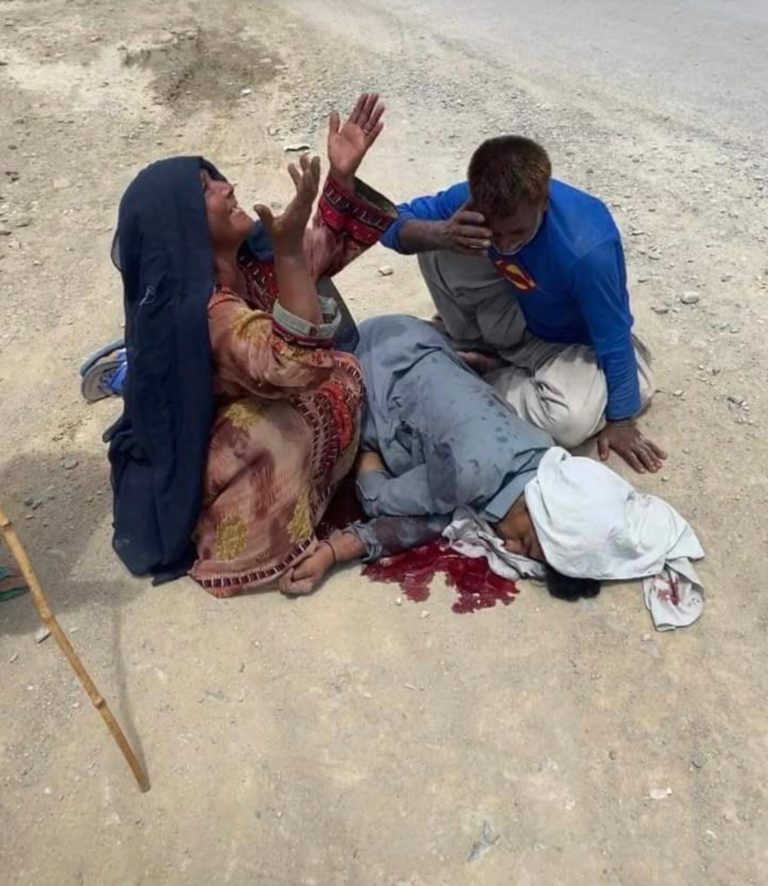
In this regard, local sources and various media reports show that being a Baloch has become a heinous crime in Balochistan. When any incident takes place anywhere, the security agencies target the ordinary Baloch population. No one’s life or property is safe. In this regard, Baloch political and public circles say that Baloch people detained by state officials are weighed in for their social standing and/or are declared as terrorists. Often they are killed on the spot, the worst and most shocking demonstration of which is evident in the brutal incident of Hayat Baloch, a student in Turbat on August 13, 2020, who was handcuffed and shot in public without any crime. As seen in the photographs this young student Hayat Baloch was martyred on the spot, while his old parents watched helplessly. Hayat Baloch’s parents felt helpless when they were forced to bury the dead body of their young son by their feeble and old arms, their son was the apple of their eyes who till a moment ago who full of dreams. It was such a painful scene that tears flew down from everybody’s eyes whoever watched the sorrow and grief of Hayat Baloch’s parents.

Thus, while the brutal human tragedy has plunged the elderly parents and relatives of Shaheed Hayat Baloch into unforgettable deep sorrow and grief, it has once again made it clear to the United States that state officials have the privilege to comply with legal and judicial requirements. Punish the Baloch without any hesitation. In this regard, the political and social circles of Balochistan say that the land of Balochistan and its shores and coasts are important to the rulers but not the Baloch people. They have been considered the biggest obstacle, and that is why the ruling forces have resorted to ruthless act of genocide of the Baloch people.

Shaheed Hayat Baloch was also an ordinary student who was studying at Karachi University and came home to spend his holidays in his hometown, which had nothing to do with any unrest or military incident. Shaheed Hayat Baloch desired to improve his future by getting higher education and he wanted to change the lives of his elderly parents and siblings, but his being a Baloch proved to be an unforgivable crime. His bright dreams were abruptly cut short by the rulers who routinely punish innocent Baloch people by imprisonment and enforced disappearances. Often the Baloch families are handed over the mutilated bodies of their near and dear ones by the government officials.

The political and social circles also say that the tragedy of Shaheed Hayat Baloch is not just a single incident and it reflects the worst human rights situation in Balochistan. Hayat Baloch was martyred during the detention and was given the name of police encounter. Similar tragedies and human tragedies are seen every day, the perpetrators of which have yet to face any legal or judicial action. Although the security personnel who brutally killed Shaheed Hayat Baloch have been arrested and there are reports of a case being registered against him, but it’s only because of the strong reaction to the tragedy from all over the world, including Balochistan. It is a show of strength, as this is the first time that Hayat Baloch’s tragic human tragedy has provoked outrage and protest from various political and social circles in Pakistan, including Punjab, which has put some pressure on the ruling party.

There cannot be any justice in the murder of Hayat Baloch because the relationship between the Baloch and the occupier is clear. However, the martyrdom of Hayat Baloch has breathed new life into the youth, their voices against slavery are being raised, and of course, these are conscious voices. Azadi (freedom) is the ultimate destination of Balochistan.

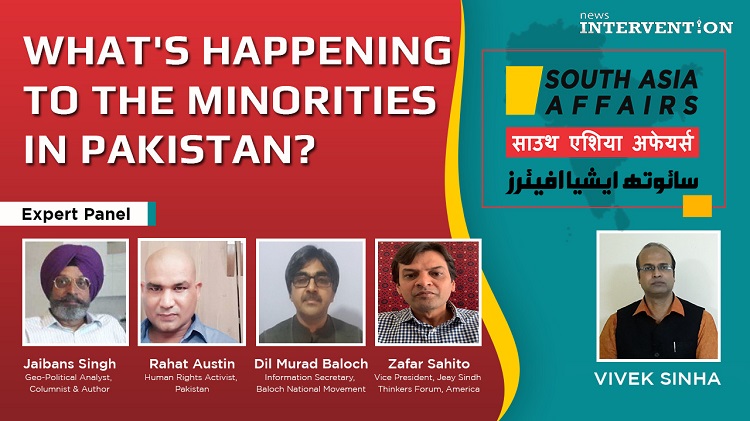
What’s happening to the minorities in Pakistan?

South Asia Affairs — the weekly news program on News Intervention.

In this first episode of South Asia Affairs, Vivek Sinha, Founder & Editor-in-Chief News Intervention is discussing about the minorities in Pakistan. The panelists include: Jaibans Singh, Geo-political Analyst, Author & Columnist Rahat Austin, Human Rights Activist, Pakistan Zafar Sahito, Vice President Jeay Sindh Thinkers Forum, America Dil Murad Baloch, Information Secretary, Baloch National Movement (BNM). Please click on the YouTube link below to watch.

Click on the YouTube link (above) to watch the 1st Episode of South Asia Affairs — “What’s happening to the Minorities in Pakistan?”


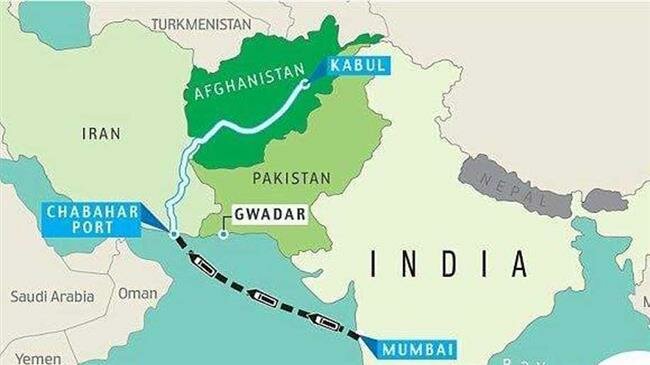
Iran’s insistence to involve Islamic Revolutionary Group firm at Chabahar has strained ties with India

Iran has not officially announced dropping of India from Chabahar’s three-fold project. The buzz emanating from The Hindu newspaper is actually attributed to two middle rank Iranian officers but not to any senior official spokespersons. Hence, till date the buzz remains only a quasi-official rumour.

Why should Iran think of punishing a third country (India) at its own cost for failure to mend fence with the US? If that is the parameter of Iranian policy then India will look for available option to meet her oil requirements. And if Iran is willing to embrace the dragon who is hanging a US$ 400 billion carrot to her for taking over Chabahar and the ancillaries, well, it is her choice.

For long years Iran has been tenaciously defending her sovereign right over the waters of the strategic Persian Gulf, which Arabs call Arabian Gulf. Ever since Iran-US spat in the aftermath of Iranian Islamic Revolution of 1979, Iran has raised her voice of protest whenever an American naval ship made even a casual appearance in Gulf area.

But now Iran is reportedly reconciling to the massive presence of Chinese navy at her doorstep. It will be a matter of concern for India no doubt given the Chinese hostility towards India but more than that Chinese naval presence will be of greater concern to the littoral states, which, by and large, are under the protective umbrella of the US. As such, Iran will be inviting the two strongest navies of the world to fight a decisive battle for winning control over the Gulf from where two-third of world’s oil requirement passes in gigantic tankers.

The real reason for India to soft paddle over Chabahar is neither the American pressure nor India’s delayed funding. In fact India has completed part one of the Chabahar project and wheat consignments for Afghanistan were also routed through it sometimes back. The real reason is that Tehran insisted on getting Khatam al-Anbiya Constructions, belonging to Iran’s Islamic Revolutionary Guard Corps involved in the project. New Delhi expressed its reluctance to expose its own entities to the US sanctions because US has designated the Revolutionary Guard Corps (Pasdaran) of Iran a terrorist organization. This has resulted in the deadlock. Even China has been cautious in getting in the crosshairs of American sanctions. The common sense is that India’s acceptance of participation of Khatam al-Anbiya would mean legitimizing the notorious Iranian terrorist organization involved in conflicts within and outside Iran. The focus of the US’ allegation that Iran is promoting terrorism is precisely the militant organization called Pasdaran-i-Inqilab (Revolutionary Guard Corps) whose commander Osman Suleimani was killed in a missile attack in Baghdad some months bank.  

India is known throughout the world as a country that is fighting terrorism in all its forms and manifestation. As such, India will never lend any kind of legitimacy to the Iranian militant organization which is fighting in some spots in West Asian conflict zones. No democratic country in the world will be prepared to make a compromise with Iran on that issue.

Another irritant in Indo-Iran relations is India’s good relationship with Israel. Iran has been openly declaring her ultimate aim of destroying Israel and restoring the land to Palestinians. This is more a propaganda stunt than any symbol of real politics. A dispassionate analysis of Iran’s animosity towards Israel shows that Iran wants to extract political mileage from an emotive issue which is devoid of a cognizable basis. Arab countries including Saudi Arabia have always avoided being harshly critical of the State of Israel, obviously for political reasons. Israel has strong support of the US Congress where the Jewish lobby is usually predominant. This is the main reason why Iran pretends to be anti-US. Iran wants to show down the Arabs asserting that it is only Iran that is trying to accomplish the scriptural commandment of destroying Israel. As such, Iran thinks she has a better claim to be the leader of the Muslim world and not the Saudis. This is the typical Iranian clerical mindset which, evidently, betrays neither pragmatism nor logic.

India has been strictly following the internationally acknowledged policy of non interference in the internal affairs of Iran. Not only that, India even tried to help mend fences between Iran and the US during Obama administration. But Iran, swayed by revolutionary fervor and assuming that she is ordained by divine dispensation to speak for “the oppressed” (mustaz’afeen), has been interfering in the internal affairs of India. For example, only some months back Supreme Iranian religious leader President Khamenei issued a statement on Kashmir in which he criticized the Indian government for what he called “mishandling” of Kashmir issue. Our foreign office had to summon the Iranian mission in-charge and hand over to him a note of protest. Iran has been covertly and overtly trying to play the role of godfather to the Indian Shia population and particularly the Shia community in Kargil, J&K. We are aware that anti-India sentiments are allowed to be vented even loudly at times in the course of an interaction between Indian Shia leadership and Iranian mission functionaries in India. Indian government did not take any preventive measures as she would not want to give any cause of unhappiness to Iran.

It will be noted that during several skirmishes between the Pakistan border force with Jundullah Sunni terrorist activists in the vanguard with the Iranian border force in Balochistan-Sistan border, India never spoke a word. But Iran has not been desisting from charging Indian security forces of “overdo” in Kashmir. Needless to remind that during India-Pakistan war of 1971, Iran had allowed Pakistani Air Force to take off from East Iranian airports with a mission of bombing Indian targets.

Chabahar and the two ancillary projects are of vital importance to India. By falling in the lap of the dragon, Iran is inviting concern of the stakeholders in the region. Iran is under the wrong notion that she has a strong navy to police the Gulf. With China in the driving seat, Iranian navy, whatever it is, will pale into insignificance and additionally other big navies will put up their presence in a strong way at the mouth of the Persian Gulf, the sea route from where two-third of the world oil requirement passes.

Iran’s dream for nuclear weapon has become her Achilles heel. Nobody denies her right to self-defence. But much before beginning a search for nuclear weapon Iran has been exporting Islamic revolution to some of the countries in the region. What is the agenda of Hamas and Hizbollah active in West Asia. What role is Iranian Pasdaran playing in Yemen, Bahrain, Syria and elsewhere? Iran may try to hide their activities but in modern technology nothing remains hidden. Osama bin Laden could be liquidated while in hiding and Osman Suleimani could be finished while travelling in a running vehicle.

Iran has three main targets against which she could think of using the nuclear bomb, the US, Saudi Arabia and Israel. Forget about the US and Israel. But before Iran decides to target Saudi Arabia, Pakistan will be forced to deter her. This is the understanding between the Saudi monarchy and Pakistan government. Iran thinks that she has won the confidence of Pakistan by writing off the Shia population of Pakistan that has become the recurring target of anti-Shia frenzy in Pak polity. Iran neither protests against the recurring massacre of the Pakistani Shia community nor demands a ban on Lashkar-e-Jhangvi, a terrorist organization of Pakistan with its declared agenda of destroying the Shias in Pakistan. Saner elements in Iran must revisit the nuclear policy of the theocratic regime. They need to be pragmatic and not emotional.

Finally, Iran the frontline non-Semitic Muslim state is a victim of split personality. No Muslim country denies her the right to be truly Islamic but no Muslim country will concede her the option of aspiring to be the leader of ummah. Even in the comity of non-Semitic Islamic nations, Iran does not enjoy the trust of other actors because of the history of factional feuds within the Islamic communities.

Indian foreign office is right in not making any comment on disquieting Indo-Iran relations. Iran is in deep turmoil and the voice of freedom is stifled in that country. Let Iranians first settle the score among themselves. Till then we need to wait and watch the saner voice prevailing in that country.

Indian Army’s Capture of Hajipir Pass is a Saga of Guts and Glory

0

Much has been spoken and written about the capture of Hajipir Pass in Pakistan-occupied Kashmir (PoK) during the 1965 Indo-Pak conflict and rightly so, because this was indeed a stupendous victory that taught Pakistan Army a lesson on the grave consequences of messing up with the Indian armed forces. In fact, the Pakistan Army was so badly humiliated in this conflict that it was forced to change its narrative that this war being waged for “liberation” of Kashmir to an apologetic reasoning of it being necessitated for the “defence of Pakistan.”

The aim of Pakistan’s unprovoked aggression in 1965 was military dictator Gen Ayub Khan’s far-fetched belief that the Pakistan Army would be able “liberate” Kashmir by a three phased war plan. The initial stage included surreptitious infiltration of heavily armed soldiers into Kashmir disguised as ‘razakars’ (civilian volunteers). In the second phase, they would mingle with the locals and incite a resurrection by appealing to religious sentiments of the majority community. In the final phase, the infiltrators with help from locals would target Indian Army posts and destroy defence installations and cut-off lines of communications, thereby forcing Indian Army to leave Kashmir. 

Pakistan Army’s stratagem envisaged use of local population to camouflage its military actions to give it an impression of a local uprising and not an unprovoked aggression. It was (from purely the theoretical point of view), a brilliant plan. The fact that it was named ‘Operation Gibraltar’ in reference to the Islamic conquest of Spain that commenced from Gibraltar in medieval ages, gives an insight into Pakistan’s utterly misplaced sense of optimism. But when executed, it turned out to be a dismal failure and also a grim reminder of Santayana’s famous aphorism that “Those who cannot remember the past are condemned to repeat it.”

Pakistan Army’s war plan of 1965 was doomed to fail because it was in essence nothing but a shoddy ‘copy-paste’ of its earlier abortive attempt to annex Kashmir through a similar military action in 1947 that was code named ‘Operation Gulmarg’. The only variation between the two was that while Pakistan Army used the ‘tribal invasion’ ploy to conceal its 1947 involvement in Kashmir, in 1965, it unsuccessfully tried to disguise its military adventurism by trying to pass it off as a local uprising.

But while evolving its 1947 and 1965 war plan to annex Kashmir, Pakistan Army made two humongous mistakes. One, it grossly overestimated the capability of its own soldiers (which is evident from its inability to overwhelm the courage and tenacity of the Indian Army, both in 1947 as well as 1965); two, it went completely wrong by underestimating the nationalistic feelings of Kashmiris and the proof of this is evident from the refusal of locals to cooperate with the so-called ‘tribals’ in 1947 and ‘razakars’ in 1965 by revolting against their own motherland.

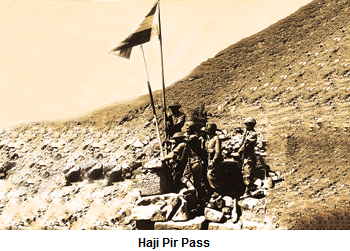
Since Hajipir Pass was the main route of infiltration that was being used by Pakistan Army to send its soldiers into Kashmir, Indian Army decided to capture it to block ingress. Located at an imposing altitude of more than 8,500 feet, this pass as well as the approaches leading to it were very well guarded by Pakistan Army units. Therefore, while the capture of this formidable pass in itself is an undoubtedly momentous military victory, this phenomenal achievement also bears testimony to Indian Army’s indomitable courage and exemplary tenacity, which on this occasion was aptly displayed by First Battalion, The Parachute Regiment (Punjab).

Commonly referred to as 1 Para, this battalion was part of 68 Infantry Brigade and was tasked to capture the forward enemy positions of Hajipir defences at Sank, Sawan Pathri and Lediwali Gali. Once these enemy positions were captured, another battalion would use the area secured by 1 Para to attack and capture Hajipir Pass. During war, while defenders are static and enjoy protection of field fortifications, the attackers have to perforce move in the open in order to close-in and either physically kill or evict the defender. Hence, troops in attacking role are much more vulnerable than the defenders and this is why they usually suffer more casualties than the latter.

The initial attack of 1 Para on Sank during the intervening night of 25/26 August 1965 was unsuccessful and resulted in 18 casualties. But rather than being demoralised, this reverse further reinforced the battalion’s determination to avenge its fallen comrades and so the very next night, 1 Para attacked Sank with such fury that convinced of complete annihilation, the enemy wisely chose to retreat. Giving the enemy no respite, the daredevils of 1 Para pressed on their attacks with full fury and captured both Sawan Pathri and Lediwali Gali.

After two nights of heavy fighting, 1 Para had achieved the task assigned and the exhausted rank and as per plans, the file of this battalion could well have rested on their laurels by staying put at the positions that had been captured. But, since enemy positions at Rustan and Badori were still holding out despite being attacked four times by other units, Major (later Lt Gen) Ranjit Singh Dayal, second-in-command of 1 Para volunteered to lead his troops and capture Hajipir Pass. 

With nothing but shakarparas (a food preparation made by frying sweetened wheat dough pieces in oil) and biscuits to sustain themselves, 1 Para moved speedily along Hyderabad nullah, but they were spotted and fired upon by the enemy. Yet, as the old saying goes that ‘fortune favours the brave’, help came to Major Dayal’s column from two rather unexpected quarters — nature and the enemy!

While an unexpected heavy shower obscured observation and hence rendered enemy firing on Maj Dayal’s column ineffective, during its approach march to Hajipir Pass, 1 Para came across a hut full of Pakistani soldiers. After disarming these soldiers, 1 Para ‘gainfully’ used them to ferry their battle loads uphill and this considerably speeded up their advance.

Needless to say, the sudden appearance of Indian soldiers took the enemy guarding Hajipir Pass by complete surprise and after a brief fight the enemy fled the scene in complete disorder. What is even more commendable is that the rank and file of 1 Para had pressed on continuously for three days, moving uphill across country under enemy fire and fighting him without any meaningful rest or proper food. 1 Para displayed nerves of steel and was rewarded by the honour of unfurling the Tricolour over Hajipir Pass — a defensive position which was considered so impregnable that the Pakistan Army even refused to acknowledge its loss till journalists visited the site and nailed Pakistan Army’s lie!

Tailpiece: India may have handed over Hajipir Pass to Pakistan under the Tashkent Agreement, but the Battle of Hajipir Pass shall continue to serve as a source of inspiration for the Indian Army and so, on the 55th anniversary of the capture of Hajipir Pass, let’s salute all those who fought and fell there!

China: Nursing a bloody nose and a terribly bruised ego

The Chinese leadership and its chief land mafia, the People’s Liberation Army (PLA) are presently nursing a bloody nose and a terribly bruised ego. Their belligerent plans in Eastern Ladakh have been demolished by the Indian Army that has proved its tactical and operational superiority. PLA stands exposed as being nothing more than a bully, full of bluster but totally shallow when push comes to shove.

In the course of the last few days, China once again attempted to implement its, by now, outdated tactics of trying to grab territory by leveraging the inherent contradictions of a tenuous Line of Actual Control (LAC), under the shadow of ongoing talks. While speaking a conciliatory language, PLA attempted to intrude further across the perceived LAC in the Pangong Tso lake sector.

The Indian Chief of Defense Staff (CDS), General Bipin Rawat, a few days earlier had said, “If dialogue does not persuade Beijing to withdraw its troops from Indian territory in Ladakh, a military option remained on the table.” The Chinese may well have planned this latest and foiled intrusion as a reaction to the strong statement made by the CDS. A bully normally reacts in this manner  when he feels that his power is being challenged.

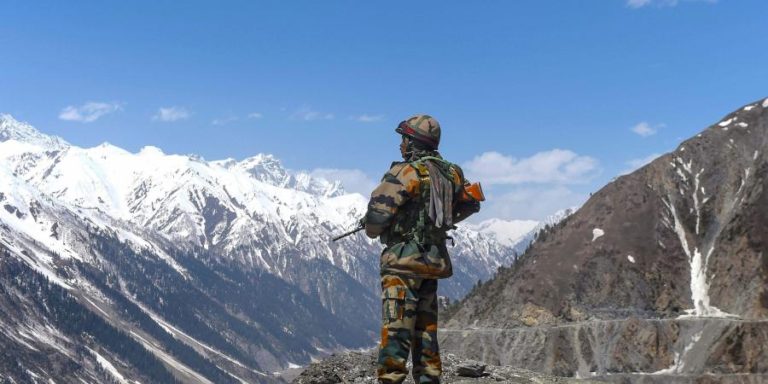
The Indian Army, this time round, had not only appreciated the Chinese perfidy but was well prepared for the same. It used a special force to gain dominating control of the mountain spurs along the southern tip of the Pangong Tso lake in a manner that has left the Chinese deployment totally vulnerable.

According to media reports, the present Indian position east of Chushul and along the southern tip of the Pangong Tso lake includes complete domination of the Thakung post and Renchin La located close to the Spanggur Gap. This position affords a clear view of the Chinese deployment in the sensitive Moldo area.

This feat has been accomplished by an elite unit of the Indo Tibetan Border Police (ITBP) called the Special Frontier Forces (SFF) or Force VIKAS. SFF comprises of troops from the Tibetan community in exile in India. The Chinese Army had deployed advanced cameras and surveillance equipment to monitor Indian movement; the SFF neutralised the sophisticated electronic equipment, removed it and occupied the heights.

This would probably be the first occasion that a VIKAS establishment has  been put into action for an operation of this magnitude since its raising in 1962. The resounding victory is a validation of both the training and high morale of the elite unit. The unit has, in the course of the operation, lost one soldier, Company Leader Myima Tenzin, who died a hero’s death while fighting for the cause of his occupied land of Tibet. The success achieved by the unit indicates the high operational value of this establishment.

Chinese despair and unrestrained anger at this absolute turning of the tables can be fathomed from its swift and vicious reaction in the information domain. The PLA Western Theater Command, which is responsible for the entire Sino-Indian border, has accused India of “illegally crossing the line.” “India has blatantly provoked and caused tension on the border and undermined the consensus reached at the diplomatic and military talks,” said the statement.

The Chinese Communist Party mouthpiece, Global Times, further adds, “India’s reckless intention is a very dangerous miscalculation. India should have a clear understanding that China is much stronger militarily than India. If New Delhi continues such provocative rhetoric, or launches large-scale attacks at the border region, it would face severe consequences.” The reality however, is that the PLA is so overwhelmed with the notion that India will not respond despite all provocation that it failed to appreciate the preparedness of the Indian Army and now it has egg on its face.

As is usual in Indian media circles, some so-called defense analysts and media houses preferred to downplay the strong move by India and instead dwelled on perceived Chinese consolidation in the northern side of the Pangong Tso Lake. They have specifically quoted occupation by China of two mountain peaks called Helmet Top and Black Top which they say facilitates “tracking of Indian movements across the Pangong lake and as far away as India’s tactically vital Chushul garrison.” One wonders as to what “tracking advantage” through physical line of sight China would require given its boast of having the best technology and satellite imagery for carrying out such tasks? Be that as it may, as this article is being written, there are reports of some Indian special troops having occupied dominating heights in the Northern side of the Pangong Tso Lake along Finger-4 also and hence, the Indian tactical advantage on ground is complete.

It is better, of course, to go with reports in foreign media. The UK-based daily, The Telegraph has stated, “on Saturday evening, around 500 Chinese troops had tried to cross into Spanggur, a narrow valley near the village of Chushul and three hours of hand-to-hand combat ensued. The attack had been repulsed and a retaliatory special operations battalion seized a Chinese camp in the surrounding hills of Pangong Tso Lake in the early hours of this morning.”

India too has acknowledged the incident. “On the night of 29/30 August, PLA troops violated the consensus arrived at during military and diplomatic engagements and carried out provocative military movements to change the status quo. Indian troops preempted this PLA activity….. and undertook measures to strengthen our positions and thwart Chinese intentions…,” said a statement from the Government of India.

Two Brigade Commander level meetings have been held to resolve the impasse but with no results. The India Army is scrupulously ensuring that the  status of the LAC remains sacrosanct and yet the Chinese are showing anger.  The PLA has been provoking the Indian troops all along the LAC with movement of vehicles and troops.  It is quite apparent that India has now chosen to pursue a proactive response to Chinese obduracy. This also reflects the impatience among the Indian soldiers to teach a lesson to the PLA. 

India has taken a stand that is righteous, justifiable and matched with more than adequate military strength on ground. Notwithstanding its bluster the Chinese military position in the region of conflict is not as strong as it wants the world to believe. In terms of manpower and weaponry both armies are evenly matched. The Indian Army has an huge advantage in terms of better tactical deployment, professionalism and most importantly the courage of the Indian soldier.  These are force multipliers that China simply cannot match.

China wants India to blink first, but, it is not feasible any more. As a result, the situation is escalating at the behest of China to a level that is very critical for world peace and stability. It is time for China to look closely at the writing on the wall and understand that it is not faced by a weak Indian political leadership or a weak Indian Army that would succumb to belligerent posturing. If it does not pursue the path of moderation, it will pay a very heavy price in the resultant conflict.

5 terrorists of Islamic State JK held in Kashmir

0

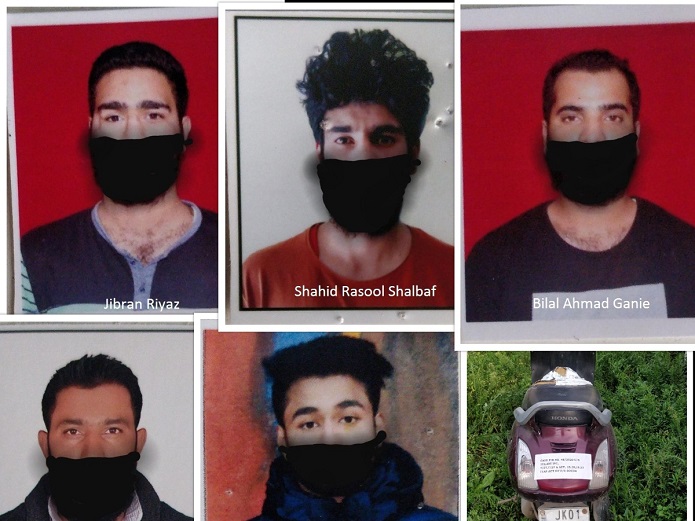
Srinagar/ September 4: Jammu and Kashmir Police on Friday said that they have arrested five “uncategorised” terrorists of Islamic State JK  (ISJK) who they said helped in the execution of Pandach terrorist attack in which two BSF personnel were killed in May this year.

The J&K Police said they have arrested five “uncategorized militants” of ISJK who helped in transporting, logistics, planning and executing the attack.

An FIR under sections 302 and 395 of the IPC, sections 7/25, 7/ 27 of the Arms Act, sections 16, 18, 19, 23 ULAP Act have been registered at Police Station Soura, Srinagar. “During further investigation, four vehicles were detained which includes two private ambulances functioning at the Srinagar Medical College, a motorbike and a scooty. Accordingly approval for seizure of the above vehicles was sought from the DGP JKP Dilbagh Singh,” the J&K Police said in a statement.

Ambulance used by the Islamic State JK terrorists in Kashmir. (Photo: News Intervention)

Following the approval from the DGP, both the vehicles were seized. “The ambulance, bearing registration number JK-01 AD 0915 was used to transport the militants from Bijbehara to Pandach, Srinagar. Bike no. JK-01 AH 2989 and Scooty bearing number JK-01 V 8288 were used to carry out the attack and escape after looting weapons from the injured jawans,” read the statement.

“Ambulance JK-01 AF 9417 was used to transport the militants back to Bijbehara from Srinagar.”

Categorized terrorists of the ISJK involved in the attack have been killed in two separate encounters at Zadibal, Srinagar and Hatigam, Bijbehara and looted weapons of BSF personnel have been recovered.