Home Blog Page 341

2 CRPF jawans, J&K Police officer martyred in Baramulla terror attack

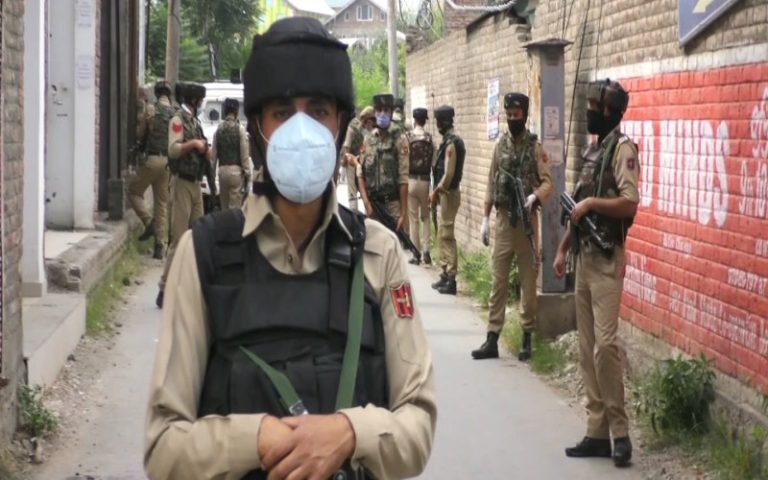
Srinagar/August 17: Terrorists on Monday attacked a joint Naka party in Kreeri area of north Kashmir’s Baramulla district, leaving a Special Police Officer (SPO) and two CRPF personnel martyred.

Officials said that the terrorists fired upon the naka party today morning. The fire, they said, was retaliated by the forces, triggering a brief exchange of fire, in which a Special Police officer (SPO) was killed and two CRPF were personnel wounded.

They said that the injured troopers were rushed to a hospital where they succumbed. The martyred SPO was identified as Muzaffar Ahmad.

Sources said that terrorist had been surrounded by the forces and that reinforcements was rushed to the area to engage terrorists.

This is the second terrorist attack in the valley in the past four days. On Friday, two policemen were killed and another wounded in a terror attack on the outskirts of Srinagar.

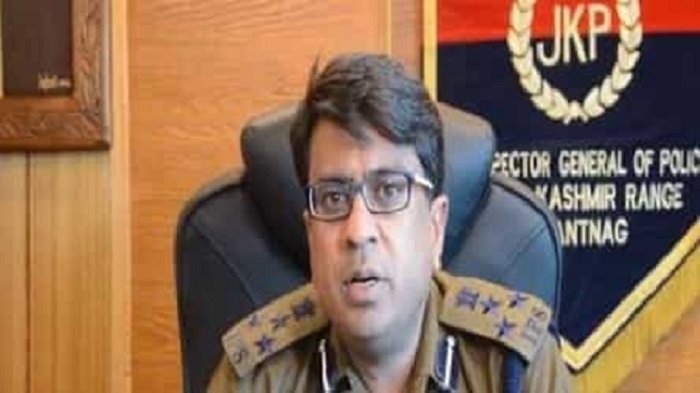
Inspector General of Police (IGP) Kashmir Vijay Kumar who visited the spot on Monday said that three Lashkar-e-Taiba terrorists came from the orchards and targeted a joint naka party of police and CRPF at Kreeri area of north Kashmir’s Baramulla district resulting in the killing of two CRPF men and a special police officer (SPO).

“After checking the statements of eye-witnesses and other technical details, it seems Lashkar men who were three in number carried out the attack near a shallow stream where a joint team was on a normal naka duty,” the Inspector General Police Vijay Kumar told reporters.

He said that police was developing the leads and the attackers will soon be neutralized. Asked about the two back to back terrorist attacks since August 15 and that the terrorists managed to escape, the IGP said the point has already been noted by the police. “At times, terrorists manage to flee. We are developing leads and will neutralize the terrorists involved in the two attacks (including Nowgam) soon,” he said.

Later in the day Indian Army’s Northern Command said in a tweet that two terrorists were killed and weapons and warlike stores were recovered. Joint operation was still in progress at the time of writing this news report.

On yesterday’s Sopore ‘attack’, the IGP said that wasn’t the attack but an operation launched on the basis of terrorist presence. “The terrorists fired few shots and after that no contact was established,” he said.

Meanwhile a major tragedy was averted after police and security forces recovered an Improvised Explosive Device (IED) in south Kashmir’s Pulwama district late late night, officials said today.

A senior police officer said that the IED was planted by terrorists under a bridge near Tujan village in Pulwama district. “This is a bridge between Tujan and Dalwan,” the officer said.

Karan Johar’s Gunjan Saxena creates fictional stereotypes in the IAF

The Indian Air Force is seething and rightly so. Here comes a film — Karan Johar’s Gunjan Saxena: The Kargil Girl — in which the producer and director had a basic theme to project — the idea of gender equality and the resistance by the environment to achieve it.

It is a great theme, especially when related to the Indian armed forces. Yet, it is so awfully researched and converted to story line and screenplay that one cringes. The story setting is on the IAF (Indian Air Force) in 1994 or so.

The IAF emerges from it as a service living in the 19th century and unwilling to change.

It is supposedly based upon a true life story of one of the first woman pilots of the IAF trying to break a male bastion and the huge resistance (both institutional and otherwise) she finds in her path.

The IAF, like the other two services, had obviously taken a very brave decision in 1991 to induct Women Officers into service. There were teething problems, many of which continue to the day, but lack of sensitivity was surely not one of them.

Let us cut to the story first.

Gunjan Saxena (Jahnvi Kapoor, better known as the late Sridevi’s daughter), the daughter of an Indian Army colonel, has a dream to be a pilot. However, society at large has resistance to the idea of seeing women in such a role.

Encouraged by her doting father, she overcomes all obstacles in the path to becoming, not a commercial pilot, which she originally set her heart on, but an Indian Air Force helicopter pilot.

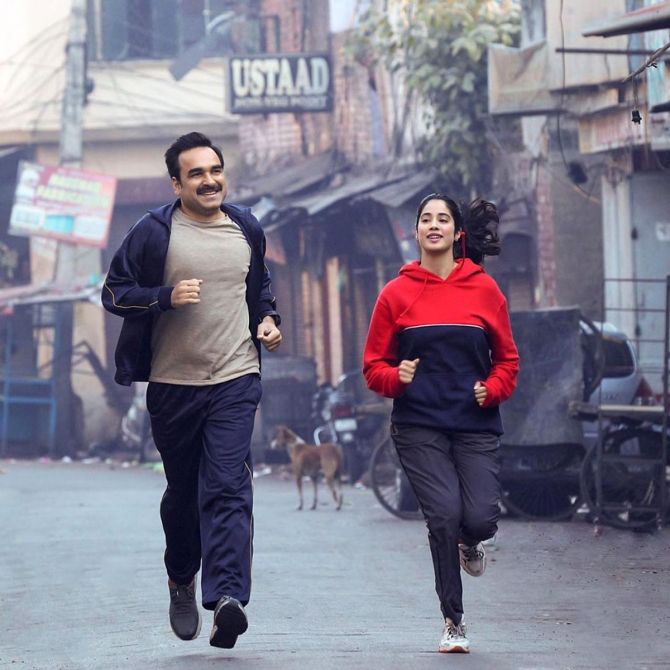
Pankaj Tripathi and Jahnvi Kapoor in a still from “Gunjan Saxena”

The IAF is correctly shown as a service which offers equal opportunities to all classes of society, unlike the world of a commercial pilot where only the financially better off can afford to pursue the dream of a pilot’s license.

It is very well handled till here; the heart breaks at being found medically unfit and overcoming that, the entry into the Air Force Academy, the hard training she undergoes and the triumphant graduation as a pilot.

It is the story thereafter which bears no resemblance to truth starting with her elder brother (Angad Bedi) from the army (Punjab Regiment), dissuading her from joining her allotted unit after her commission as an officer in the IAF because he holds the lofty perception that women just aren’t made for service in the armed forces.

His advice is virtual abetment to desertion, something which should have been known to the umpteen military advisers whose names appear in the credits at the beginning.

It is the arrival of Flying Officer Gunjan Saxena at the Udhampur Air Force base, having already earned her wings at the Air Force Academy, which creates a flutter.

The negativities begin to overwhelm the narrative.

The story writers basically wish to depict that institutionally and otherwise, the IAF was not prepared for nor willing to accept women into the ranks of those who flew the aerial war machines. It was considered a male domain where during off time, the men indulged in horseplay, women talk and such like banter.

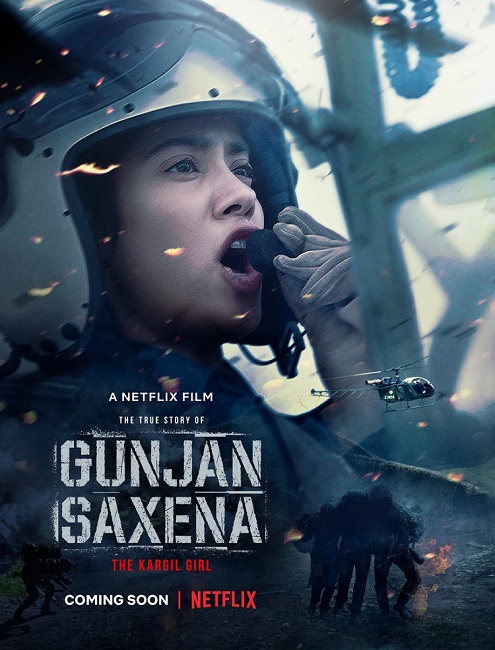
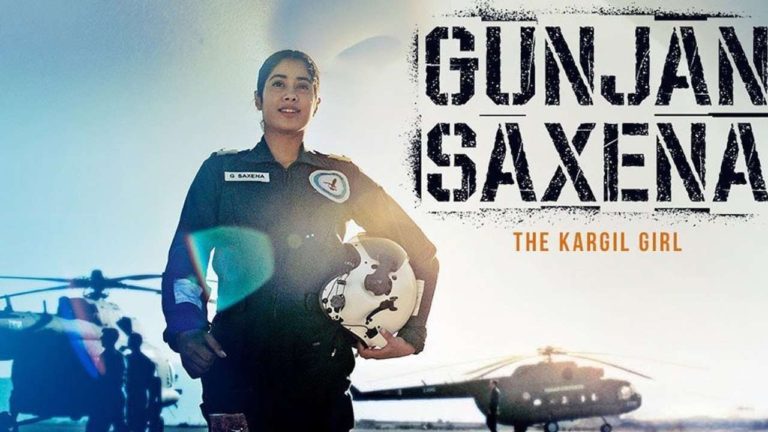
Poster of the movie Gunjan Saxena

The entry of a woman, with availability of no special facilities for basic segregation in the crew room, of course, impinges on their space and they go into raptures to deny Gunjan Saxena even her professional rights of gaining expertise and experience as a pilot.

Humiliation by ignoring her and refusal to even socially interact are hugely laughable exaggerations.

The depiction of the Udhampur Air Force base in the film appears to project a bunch of shell shocked, strait jacketed male chauvinists who had no idea about the decisions taken by their hierarchy.

Rightly understandable among some young officers and junior other ranks, but to expect even senior officers indulging in deliberate attempts at mocking the physical mismatch of women and using this as lessons for their command is only condemnable.

The officer cadre of the armed forces lives by a concept of honour.

Insulting a comrade and denying her opportunities to develop her professional expertise surely finds no place within that ambit.

Some basic observations at this point, and these fully support former Wing Commander Namrita Chandi’s very critical open letter published in a leading news magazine.

The IAF took the decision to induct Women Officers into branches other than the flying branch in 1991 and into the cadre of helicopter and transport aircraft pilots in 1994.

Momentous decisions such as these are accompanied by preparation of the environment.

There would definitely have been some misgivings at different levels, but in the armed forces, once a decision such as this is taken, you will attempt to resist it only at the risk to your own career.

Even in the Indian Army, Women Officers had to first learn the ropes under supervision, gain experience and seniority and only then were permitted to be convoy commanders, first in peace areas and later in even counter insurgency and high altitude areas.

No one attempted to embarrass them into submission to admit that they were not up to it.

Yes, there were problems such as toilets and matters of privacy, but all ranks were sensitive to it and improvisation was resorted to; who can better the ‘jugaad‘ of the armed forces when it comes to such contingencies?

What the writers and the director wanted to do with this theme was to treat it in binary terms. It appeared suitable to them to depict the IAF as an organisation inflexible in approach and completely dominated by insensitive men with no exposure to the fast changing world.

That would provide them enough stereotypes to project.

That situation could only change with contingencies which demanded operational involvement.

The real world Gunjan Saxena, on whom this story is based, had flown helicopters in a couple of missions during the Kargil War 1999. That seemed another sub story line to fit the circumstances to force a change of perception about the abilities of Women Officers.

No complaints about that, after all a director has to have some dramatic content to play upon.

It is the depiction of the terribly insensitive ways of the Udhampur Air Force base in which the story writers lost their bearings.

Instead, if they had chosen positivity to showcase how the IAF sensitively handled the challenging issues of initial induction of Women Officers (especially pilots), the extent to which their male counterparts made adjustments and their full commitment towards ensuring they would not allow any compromise in the progressive training of Women Officers, it would have given them enough anecdotal references to work upon and provide a feel good to the viewer.

As a soldier and senior officer, I can say with pride that some of the Women Officers I came across ensured by the dint of their sheer character and hard work that never did we have to think of shielding them in protected appointments.

I came across a Woman Officer, who was constructing an operational track in the dangerous Lipa Valley and was initially horrified to know that she slept on the deck of the single bulldozer available there and lived like that for three months.

The men were in awe of her personality and ability to lead by example.

As Adjutant of a Corps of Signals unit another Woman Officer commanded not just respect but the fear of her junior officers and the men. She could outrun most and put to shame others at the basketball court where she was the roughest player.

My Brigade Education Officer (a Woman Officer) accompanied me on many high altitude marches to visit troops at the LoC in the Uri sector.

The film is still watchable for some slick photography.

It is poorly acted. Jahnvi Kapoor just does not appear to have the bearing and body language of a confident military pilot, something which comes within weeks of academy training.

Angad Bedi is irritating while playing an old world elder brother, repeating his beliefs on gender capability mismatch at the drop of the hat.

What appears most surprising is that the IAF had full control on the shooting with its resources made available in abundance unless everything is through the new art of computer generation.

Surely its advisers would have had an idea of what was cooking in the pot; course correction could have then been advised.

Shooting letters now may not achieve much since there are enough disclaimers about the depiction of reality in the film.

The unfortunate thing is that the film will leave a poor impression of the IAF’s and indeed of the armed forces’s ability to handle sensitive social matters within their professional space.

As for my recommendation about watching the film, I will remain in the zone of grey.

If you have nothing to do in the evening and have worked from home the entire day, you could risk watching.

I found it to be a useful exercise in that age old army method of weapon training, called ‘fault finding’.

Sindhi Baloch Forum to protest in London for victims of ‘Enforced Disappearance’

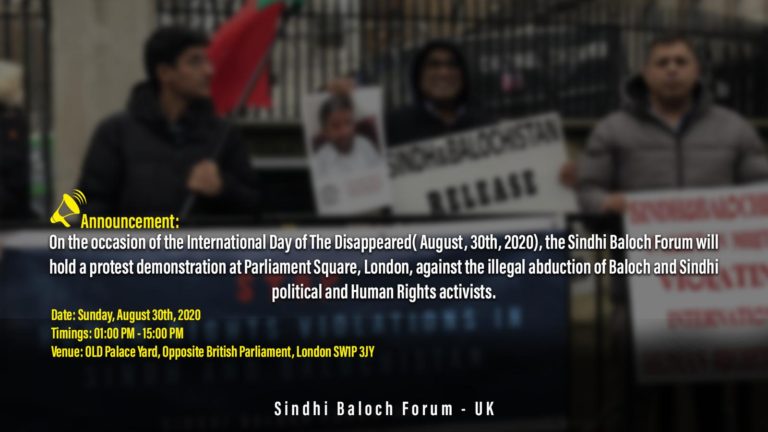
London: The Sindhi Baloch Forum (SBF) has announced to hold a protest demonstration outside the House of Parliament in London on Sunday, August 30, 2020 to mark the International Day of the Victims of Enforced Disappearances.

The announcement comes at a time when Sindh and Balochistan are witnessing a rapid increase in the forcible disappearances of Sindhi and Baloch residents from all spectrum of life by the Pakistani military and its paramilitaries to quell the national struggles of two brotherly nations for their socio-economic and political rights.

In its statement, the SBF (Sindhi Baloch Forum) denounced the reparation mechanism of the state military establishment who attempted to abduct Hani Gul Baloch and Shazia Chandio in Karachi to disrupt the peaceful protest of families of Sindhis and Baloch who have been subjected to “enforced disappearances”.

“More than 50 political activists from different areas of Sindh were subjected to enforced disappearance whose whereabouts are not known, whereas, according to the Voice for Baloch Missing Persons (VBMP), the cases of enforced disappearances in Balochistan are above 40 thousand, the mutilated dead bodies of many have been recovered in the last many years”, read the SBF statement.

The international community and the United Nations have so far failed to push the Pakistani state authorities to address the issue of enforced disappearances. The families of victims have lost faith in the Pakistani government and its state institutions. Parents of several victims have perished during these series of protests and the long wait for justice lasting for years that in many cases went on for decades. The Sindhi Baloch Forum (SBF) is compelled to convince the international community to resolve this prevalent humanitarian crisis in Sindh and Balochistan through its protest on the occasion of International Day of the Victims of Enforced Disappearances.

SBF (Sindhi Baloch Forum) has appealed everyone who champions the cause of human rights to participate in their protest to echo the demands of the families of the victims of enforced disappearances for justice and the right to the truth of the victim.

Kashmiri diaspora organizes discussion on ‘Kashmir Today’

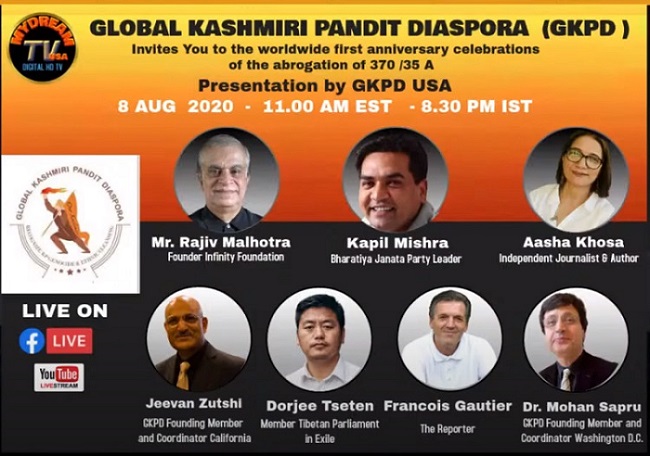
Washington DC: A panel discussion on the state of the exiled Kashmiri Hindu, Sikh and Tibetan Buddhist communities, and the geopolitical dimensions of human problems in Jammu, Kashmir and Ladakh was held by the US-based Kashmiri diaspora.

The panel featured prominent intellectuals, political representatives of the Kashmiri and Tibetan diaspora, and independent journalists. The discussion was moderated by Dr. Mohan Sapru, a founding member of GKPD (Global Kashmiri Pandit Diaspora) and its coordinator for the Washington, DC area. In his keynote address, Dr. Sapru highlighted that the recent dispossession, murder, rape and forced exodus of Kashmiri Hindus, Buddhists and Sikhs at the hands of radical Muslims is only the latest in a spasmodic series of genocidal rounds of ethnic cleansing that began in 1323 CE. He suggested that intellectuals should remove their rose-tinted glasses and confront two political forces on the rampage in the world today: The first comprises expansionist religious ideologies that want to invade and dominate others, usurping their biophysical resources. The second comprises ideological nationalism that pursues the same aggressive policy in order to maintain a status as hegemon or superpower, the best example in the region being the People’s Republic of China.

Rajiv Malhotra, founder-director of a prominent think tank, the Infinity Foundation in his address said that India’s attempts to use soft power must be balanced by the exercise of hard power. He indicated that this was especially so in the case of China, whose record over the recent decades shows that it respects only hard power as part of a pragmatic strategy and puts little store by building long term relationships based on intangibles like ‘trust’. In this regard, Rajiv Malhotra lauded, both, the US government’s as well as India’s Modi government’s initiative to use trade as a political lever to contain China, which is building a chain of ruthless, fascist allies such as Pakistan and Iran. He noted that, historically, the capture of Tibet leapfrogged Communist China into hegemonic status. Importantly, he suggested that India must declare that the status of Tibet is open to discussion and retreat from its current position of accepting Tibet’s occupation by China. Malhotra also suggested that Indian diplomacy needs to consider a ‘post-Trump’ strategy of cooperation with the US, since the Democratic Party has been completely turned into an anti-India juggernaut by Islamist lobbies in the US.

Dorjee Tseten, a US-based member of the Tibetan Parliament in Exile and executive director of Students for a Free Tibet in his address noted that this year marks 70 years of the Chinese occupation of Tibet – and 70 years of the Tibetan resistance that refuses to die. He noted that for millennia, independent Tibet and India shared mutually respectful intellectual and spiritual relations. China did not share a border with India, until the annexation of Tibet under Mao Tse Tung, who famously characterized Tibet as the ‘palm’, and regions like Ladakh, Sikkim and Arunachal Pradesh as its ‘fingers’ that could be annexed subsequently. He warned that India cannot afford to be complacent about Chinese intentions, which plays a direct role not just on the Ladakh front but also via CPEC infrastructure that it is building in Pakistan-occupied J&K. He paid tribute to Ama Adhe, a prominent leader of the Tibetan Women’s Resistance, who passed away this year. Ama Adhe had spent 27 years in Chinese prisons and finally escaped to India. Out of around 300 female prisoners like her only four could survive the torture. Ama Adhe had described the hellish repression of Tibetans under Chinese occupation. She inspired Tibetan youth to take up the cause of freedom. Since 2009, over 155 Tibetans have self-immolated to protest Chinese colonialism. Tibet today has been rated as the 2nd least free place on earth, after Syria.

Dorjee noted significantly that even after decades, Tibetan youth born under Chinese occupation continue to periodically erupt in protest, indicating that the aspirations of Tibetans (within and outside) for independence have not subsided. Reflecting Malhotra’s recommendation, Dorjee Tseten strongly urged the Indian government to recognize that Tibet is an occupied country. Many countries are now reconsidering their acceptance of the ‘One China Policy’, and India should take a leadership role to expose Chinese colonialism, said Dorjee Tseten.

French author, journalist and historian Francois Gautier was another panelist. He described his experience covering the situation in J&K during the murderous exodus of Kashmiri Hindus. He revealed that it was an ‘eye-opener’ for him as a Westerner who had been misinformed with clichés about India and Kashmir. He realized that the ground situation was quite different, and he saw the terror Hindus faced in their own country. He recalled how his journalist colleague Mark Tully, who was chief India correspondent for BBC at the time, had peddled the opinion that India was wrong that Pakistan had anything to do with Islamic terrorism in Kashmir, and other international journalists would blindly follow that line. Francois Gautier noted that this journalistic disinformation continues to this day, by otherwise respectable people. He shared his anecdotal impression that common Muslims in Kashmir nurtured an active hatred for India and a preference for Pakistan based purely on religion – and that no amount of economic development and other sops by India can change religious fanaticism. He echoed the thoughts of Sri Aurobindo, that only by reversing the partition of Indian Subcontinent on religious lines can that thorn be removed. The hypocrisy of using Human Rights tribunals against those who fight religious terrorism was another aspect he brought out in his comments. Francois Gautier agreed with previous panelists that China was the main problem, and India must support the Dalai Lama against China, allowing him to teach in Ladakh, Sikkim and Arunachal Pradesh. Tibet must be declared a disputed territory. He felt that while Narendra Modi was a welcome change for India, Indian policy was still being hampered by Nehruvian bureaucrats.

Aasha Khosa, a senior journalist and author who covered Kashmir’s insurgency for a decade during the 1990’s shared several anecdotal experiences of the terror individual Kashmiri Hindus, Sikhs and Buddhists felt even from ordinary radical Muslim civilians, who cooperated with armed terrorists in oppressing these minorities. She pointed out surveys that show the number of random killings of Kashmiri Hindus is grossly under-reported, and many unaccounted for. Many continue to suffer sexual harassment and rape at the hands of Islamic terrorists. Looking at the future, she gladly noted that after the abrogation of Article 370 and Article 35A, there has been some movement towards setting up colonies to resettle Kashmiri Hindus in their native land. She also noted that she personally witnessed many pro-India Muslims in J&K suffer and die because they stood with India. She suggested that Kashmiri Hindus should make common cause with them if possible. She disagreed with Gautier’s impression that all Kashmiri Muslims were pro-Pakistan and referred to a common slogan among even Islamists that ‘Pakistan can go to hell’. She urged the Kashmiri Hindu community to learn to build a cohesive narrative that goes beyond breast-beating and self-pity, a narrative platform that all Kashmiri Hindu organizations can subscribe to.

Jeevan Zutshi, another GKPD (Global Kashmiri Pandit Diaspora) founding member placed the J&K demographic in perspective, stating that only 60% of the population of Jammu, Kashmir and Ladakh was Muslim. It is only the Kashmir Valley where they had an overwhelming majority. Yet, even in such a demographic situation, the 40% non-Muslim population have found themselves treated like second-class citizens. He repeatedly mentioned the thousands of Hindu and Sikh Kashmiris who still live in miserable conditions in refugee camps and said that the rest of the diaspora will never forget them and continue to extend a helping hand.

Click on the YouTube link to watch this discussion

Atul Kr Goel, who arrested Davender Singh gets Police Medal

Srinagar/ August 15: Senior IPS officer and Deputy Inspector General of Police southern Kashmir, Atul Kumar Goel who arrested Deputy SP Devender Singh is one of the 81 J&K Police officials who have been awarded Police Medal for Gallantry (PMG) on this Independence Day. The CRPF personnel have been awarded 51 Police Medals.

The list of awardees was released by Union Home Ministry on Friday. Besides IPS officer, SP Cyber Cell Kashmir Tahir Ashraf, some JKPS officers, inspectors, sub inspectors and constables have also awarded with the medal.

Officials at the Ministry of Home Affairs, familiar with the medals’ selection process, said the majority of gallantry medals going to the J&K Police and the CRPF is because of the counter-insurgency operations.

As many as 80 officers from across the country have been awarded the President’s Police Medal (PPM) for distinguished services while 631 officers have received the Police Medal (PM) for meritorious services.

DIG Atul Kumar Goel is among J&K Police officers who have been awarded the Police Medals for Gallantry (PMG). Goel is the one who caught Jammu and Kashmir DSP Davinder Singh at a checkpost while he was ferrying two Hizbul Mujahideen terrorists in a vehicle on the Srinagar-Jammu National Highway in January this year.

His office had received the tip-off about the movement of a wanted Hizbul Mujahideen terrorist. The operation was carried out under Goel’s supervision which led to Davinder Singh’s arrest along with terrorists Naveed Babu and Altaf.

Inspector General Vijay Kumar and Atul Kumar Goel had played an important role in registering a case against Singh earlier this year.

Besides Goel, three IPS officers from Jammu & Kashmir Police — including Sandeep Choudhary (SSP Anantnag), Gurinderpal Singh (SP Kulgam) — have been awarded the PMG (Police Medal for Gallantry).

Two more J&K Police IPS officers, DIG Vidhi Kumar Birdi and Tejinder Singh (SSP), currently on deputation with the National Investigation Agency have received 1st and 2nd bar to PMG respectively.

Spare a thought for the people of Yemen

Man has become immune to human suffering, but the ignored tragedy of the world’s worst and biggest man-made humanitarian crisis (declared by UN) unfolding in Yemen, especially for over 12 million children, would melt the most hardened callous soul. The world and India needs to act urgently to alleviate this crisis.

Officially the Republic of Yemen (romanized: al-Jumhūrīyah al-Yamanīyah, literally “Yemeni Republic”), is a country at the southern end of the Arabian Peninsula in Western Asia. It is the second-largest Arab sovereign state in the peninsula, occupying 527,970 sq km. The coastline stretches for about 2,000 kilometres. It is bordered by Saudi Arabia to the North, the Red Sea to the West, the Gulf of Aden and Guardafui Channel to the South, and Oman to the East. Yemen’s constitutionally stated capital is the city of Sanaa, and Aden is an old and well known port. Yemen has a population of approx 30 million as of 2019. It is considered a failed state, where external nations are playing out their rivalries, and which the world has forgotten.

UN declared World’s Worst Humanitarian Crisis

The resurgence of armed conflict in 2015, has resulted in the world’s worst humanitarian crisis (declared by the UN). According to UN and other international sources (ranging from UNHCR, UNDP, Swedish International Development Agency and Yemen Data Project to name a few), more than 24 million people face food insecurity of which 10-12 million are at risk of famine (80% of population require assistance, of which 12 million are children; 8 million children have no access to education); internally displaced total nearly 5 million. Concurrently, medics have struggled to deal with the largest cholera outbreak ever recorded, which has resulted in more than 2.2 million suspected cases and thousands of dead. Across the country every group/faction without exception including the so called government have targeted civilians to air strikes, artillery bombardment, mine warfare, abduction, torture and rape of women and children, disappearances, illegal detention, forced recruitment and creation of child fighters. These factions have ironically been supported with financial aid and weapons by USA, France, UK, Saudi Arabia and Iran who are equally guilty of violence, and are complicit to war crimes and humanitarian crisis under the UN definition. As per reports of BBC on Yemen, Norway, Finland, Netherlands and Germany (UK too is reviewing it) have suspended arms sales to Saudi-led coalition, but US, Canada, France and Australia are continuing to supply weapons and military equipment.

To top this, due to Yemen’s geographic position between the Gulf of Aden and Red Sea, it becomes the ideal transit location of African migrants seeking employment opportunities in Saudi Arabia. Human Rights Watch has documented abduction, extortion, detention, physical abuse and rape of migrants by all groups. To get an idea of scale of migration: About 2,60,000 Ethiopians an average of 10,000 per month were deported by Saudi Arabia between May 2017 and Mar 2019 (one-way traffic, while traffic has been under-reported grossly, and does not include figures from other African nations). There have been restrictions on imports, movement of aid (medicines, food, water, fuel for hospital generators etc) or assistance by all parties, but mainly by Saudi Arabia which has blocked Houthi ports worsening the humanitarian situation.

These details have also been verified by the UN Group of Eminent International and Regional Experts officially appointed by the UN, who have also specifically stated that several world powers are complicit in war crimes for providing intelligence inputs to Saudi coalition and also supplying weapons and equipment. Top UN official informed the UNSC (Security Council) on July 28, 2020 that the humanitarian crisis in Yemen has never been worse, with conflict escalating, famine on the horizon, the economy in tatters and COVID-19 out of control, as they issued a fresh call for an immediate ceasefire[ii]. They also confirmed that as of July 25 2020, the total number of confirmed COVID-19 cases in Yemen stands at 1,695, with 484 deaths (due to war like conditions and negligible inputs from Houthi controlled areas there is high probability of gross under-reporting).

Genesis of Conflict and Current Situation[iii]

The conflict has its roots in the failure of a political transition supposed to bring stability to Yemen following an Arab Spring uprising that forced its longtime authoritarian president, Ali Abdullah Saleh, to hand over power to his deputy, Abdrabbuh Mansour Hadi, in 2011. As President, Mr Hadi struggled to deal with a variety of problems, including attacks by jihadists, a separatist movement in the south, the continuing loyalty of security personnel to Saleh, as well as corruption, unemployment and food insecurity. Hadi was widely considered weak and his administration corrupt. Saleh’s allies undermined the transition, set up a mini-state and hit Sanaa with ever bloodier bombings.

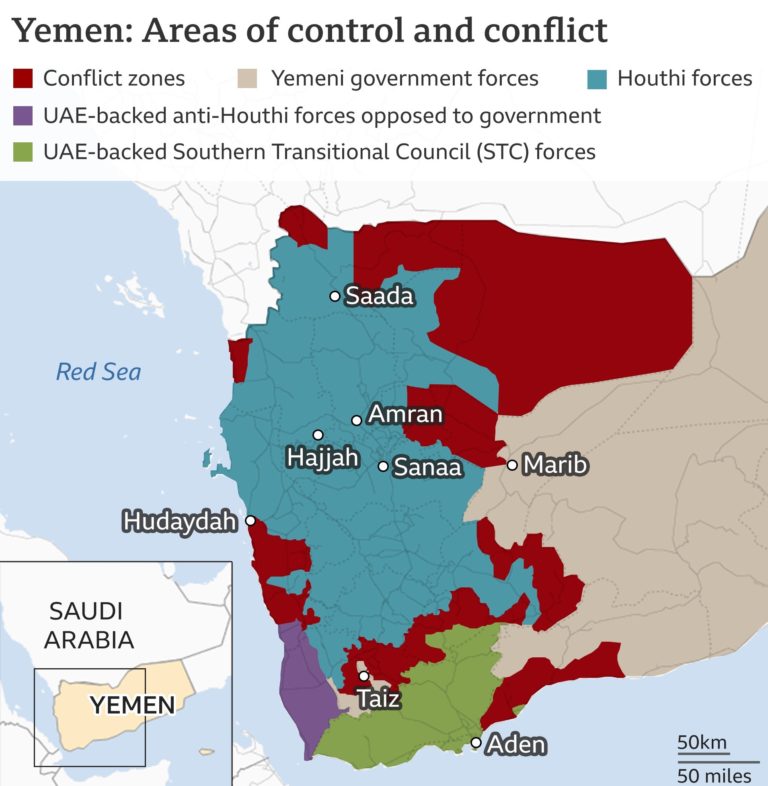
The Houthis and security forces loyal to Saleh, then attempted to take control of the entire country, forcing Mr Hadi to flee abroad in March 2015. Currently, Mr Hadi’s government has established a temporary home in Aden, but it struggles to provide basic services and security and the president continues to be based in Saudi Arabia. Alarmed by the rise of a group they believed to be backed militarily by regional Shia power Iran (Houthis are Shias though of a different Sect), Saudi Arabia and eight other mostly Sunni Arab states began an air campaign aimed at defeating the Houthis, ending Iranian influence in Yemen and restoring Mr Hadi’s government. The coalition received logistical and intelligence support from the US, UK and France. The adventure was initiated by Saudi Crown Prince Mohammed bin Salman, very unlike the cautious rulers, and was supposed to last only for a few weeks. Coalition ground troops landed in the southern port city of Aden in August 2015 and helped drive the Houthis and their allies out of much of the south over the next few months. The alliance between the Houthis and Ali Abdullah Saleh also collapsed in November 2017 following deadly clashes over control of Sanaa’s biggest mosque. Houthi fighters launched an operation to take full control of the capital and Saleh was killed.

The Houthis still control Sanaa and north-western Yemen, and been able to maintain a siege of the third city of Taiz and to launch regular ballistic missile and drone attacks on Saudi Arabia. In September 2019, Saudi Arabia’s eastern oil fields of Abqaiq and Khurais were attacked by air, disrupting nearly half the kingdom’s oil production, representing around 5% of global oil output. The Houthis claimed responsibility but Saudi Arabia and the US accused Iran of carrying out the attacks. Concurrently terrorists from al-Qaeda in the Arabian Peninsula (AQAP) and the local affiliate of the rival Islamic State group (IS) have taken advantage of the chaos by seizing territory in the South and carrying out deadly attacks, notably in Aden.

Stockholm Agreement and its Status

On December 13, 2018 an agreement between the warring parties was signed in Stockholm, Sweden referred to as ‘Stockholm Agreement’. The Stockholm Agreement required all forces to redeploy their forces from Hudaydah (port which supplies the entire Southern region), establish a prisoner exchange mechanism, and to address the situation in Taiz. While hundreds of prisoners have since been released, the full redeployment of forces from Hudaydah has not yet taken place, raising fears that the Stockholm Agreement will collapse and that the battle for Hudaydah will resume.

In July 2019, the United Arab Emirates (UAE), a key ally of Saudi Arabia in the war, facing international criticism of its conduct, announced a withdrawal of its forces from Yemen. In August, fighting erupted in the south between Saudi-backed government forces and an ostensibly allied southern separatist movement supported by the UAE, the Southern Transitional Council (STC). Forces loyal to the STC, which accused Mr Hadi of mismanagement and links to Islamists, seized control of Aden and refused to allow the cabinet to return until Saudi Arabia brokered a power-sharing deal that November. The UN hoped the agreement would clear the way for a political settlement to end the civil war, but in January 2020 there was a sudden escalation in hostilities between the Houthis and coalition-led forces, with fighting on several front lines, missile strikes and air raids. In April 2020 the STC declared self-rule in Aden, breaking a peace deal signed with the internationally recognised government, saying it would govern the port city and southern provinces. Saudi Arabia announced a unilateral ceasefire the same month due to Coronavirus pandemic but the Houthis rejected it, demanding the lifting of air and sea blockades in Sanaa and Hudaydah.

Yemen-India Connection[iv]

In 1839, Aden became part of the British and was administered by the Bombay Presidency. A garrison of 2000 Indian soldiers was established in Aden and the Indian Rupee was made the official currency. In 1855, a fortnightly steamer service with Bombay was initiated by Peninsular and Orient Line. An engineer of India, was sent by the British to Aden in 1906 to lay out an effective underground drainage system and to prepare a scheme for providing drinking water. During the 1994 Civil War, India took a neutral stand. Indian doctors and nurses were perhaps the only expatriates who stayed behind and rendered humanitarian services to the people of Yemen. An estimated 100,000 people of Indian origin are concentrated in southern Yemen around Aden, Mukalla, Shihr, Lahaj, Mokha and Hodeida. Many of them have acquired Yemeni citizenship and become part of the country’s fabric. They, however, retain ties with their families in India. Following the 2015 military intervention in Yemen led by Saudi Arabia to quell the Houthis, India undertook Operation Raahat, during which the Indian Armed Forces evacuated more than 4640 citizens along with 960 foreign nationals of 41 countries. Yahya Yahya Ghobar, Consul General of Yemen in Mumbai, told The Indian Express on August 5, 2020 “We want India to open its eyes to this crisis and intervene in a way that it sees fit. We would like the Government of India to respond to this situation in the same manner that it would if someone tried to divide India,”.

Current Situation

As mentioned, Yemen’s leading separatist group the STC which is supported by UAE, has declared self-rule in the south, complicating UN efforts to end a ruinous conflict and protect the country’s shattered health sector from the spread of COVID-19. This risks renewed fighting between nominal allies in a Saudi-led coalition that has been battling the Houthi group aligned to Iran for the past five years. The United Nations[v] is racing against time to bring about a permanent ceasefire, aware that the new Coronavirus crisis could add further misery to what is already the world’s worst humanitarian crisis. But Yemen’s problems are so complex that even a decisive outcome in the conflict-within-a-conflict between the STC and the Saudi-backed government might not help end the wider war.

Why should the World and India Care

Apart from the human tragedy which should awaken even the most hard-hearted nation or citizens of the world, the conflict in Yemen can greatly exacerbate regional tensions. It is also seen as a struggle between Shia-ruled Iran and Sunni-ruled Saudi Arabia with grave global security implications. Due to potent presence of fundamentalist Islamic terrorist groups like al-Qaeda or IS affiliates, the instability will spread around Africa and the world. The world needs to focus and find ways and means to resolve the crisis permanently and provide generously to alleviate the humanitarian crisis. For this the external players (especially the bigger powers like USA, France, China, EU) need to step back, stop interference and come together, and persuade Saudi Arabia and Iran to stop any interference in Yemen’s internal affairs.

India must take it upon itself to bring focus and thus definitive diplomatic and humanitarian surge action to alleviate the human tragedy in Yemen (this will enhance India’s status and geostrategic role). With its increasing soft power status in world affairs, enhanced role in WHO, and membership of the UN Security Council, it will be very interesting to watch how events unfold and India’s response.

Conclusion

As long as it’s a playground for power-play regionally (with the added dimension of a Sunni-Shia conflict) and internationally, the conflict will simmer on in varying tempos, with tragic and humanitarian consequences for the people. That is the tragedy of a dynamic multi-polar, multi-domain ‘real politik’ world we live in. The harsh and bitter truth is that with COVID- 19 further putting Yemen in the back burner, and diminishing political and economic power of international institutions like UN (including Security Council), WHO, UNHCR, there is little hope of alleviation for the people of Yemen in the near future.


[i] Encyclopedia Britannica

[ii] ‘Yemen: Crisis reaches new low, top UN officials tell Security Council’ UN News, 28 Jul 20, https://news.un.org/en/story/2020/07/1069161

[iii] Numerous publications from World bodies, reports of NGOs and Think Tanks; Also referred to ‘Yemen Crisis: Why is there a War?’, BBC News, 19 Jun 2020. Link- https://www.bbc.com/news/world-middle-east-29319423

[iv] MEA Portal– www.mea.gov.in

[v] ‘Yemen: Crisis reaches new low’, top UN officials tell Security Council’ UN News, 28 Jul 20, https://news.un.org/en/story/2020/07/1069161
BLF & BLA launch massive attacks against Pak Army across occupied Balochistan

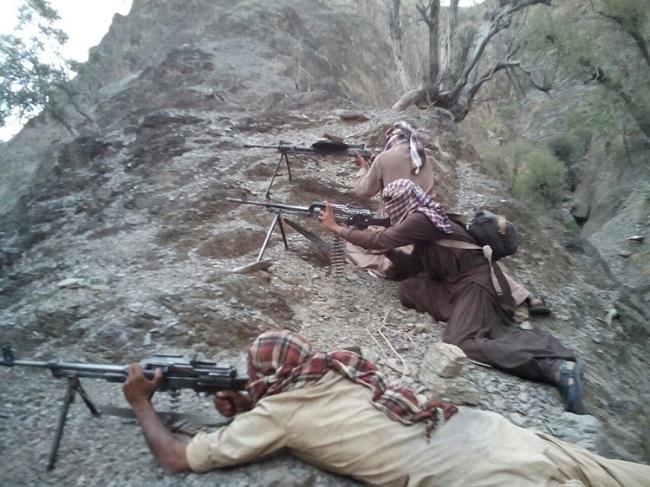
Baloch Sarmachaars (freedom fighters) launched multi-prong attacks on Pakistan Army at several locations across occupied Balochistan killing several Pakistani soldiers and injuring dozens of others.

Major Gwahram Baloch, the spokesman for Balochistan Liberation Front (BLF) claimed responsibility for attacks on the Pakistani Army in Kech, Mastung, Geeshkor, and Jhaoo on Friday. In these attacks eleven Pakistani Army personnel were killed and several others were injured, while the Sarmachaars (freedom fighters) managed to escape safely.

Just a day before, on Thursday, BLA (Baloch Liberation Army) Sarmachaars targeted convoys of Pakistan Army in IED blasts at Turbat and Noshki and then carried out a grenade attack at Mastung in occupied Balochistan. “As a result of these attacks multiple enemy soldiers (Pakistanis) were killed several others were wounded,” said Jeehand Baloch.

At 6 AM on Friday, the BLF Sarmachaars came face to face with the occupying Pakistan Army in Heekan locality of Geeshkor. In the ensuing clash that lasted for about an hour the Baloch Sarmachaars killed eleven Pakistani Army personnel and repulsed the remaining using rockets and automatic heavy weapons. BLF Sarmachaars managed to escape to safety.

Major Gwahram Baloch added that in another attack a Pak Army personnel was shot dead through a sniper rifle at a military post in Dilmurad Dumb area of ​​Jhaoo on Thursday evening. He added that BLF Sarmachaars attacked an army outpost at water supply in Kolwah, Dandar area of ​​Kech district with rockets and heavy weapons. Major Gwahram Baloch said that at 11 PM, Sarmachaars attacked the Mastung military camp with rockets and heavy weapons, inflicting heavy casualties on the Pakistani Army.

BLA spokesperson Jeehand Baloch in his press statement said that BLA Sarmachaars targeted Pakistan Army convoy in the Apsar area of Turbat in an IED attack when they were heading towards the Abdarak camp, as a result if which several enemy soldiers were killed and wounded. After this attack, the Pakistan Army personnel opened indiscriminate firing on the unarmed Baloch population in the locality. During this firefighting the Pakistani soldiers captured a young Baloch named Muhammad Hayat in front of his mother and sister and shot him dead after ruthlessly torturing him. “It has always been the modus operandi of Pakistan Army that after they are defeated by Baloch fighters; they take revenge in the form of butchering innocent Baloch citizens,” said Jeehand Baloch.

Baloch Liberation Army (BLA) and Balochistan Liberation Front (BLF) are fighting for the independence of Balochistan that has been under illegal occupation of Pakistan since March 27, 1948. Balochistan has historically been an independent nation and even during British colonial rule it had separate a treaty with the British. Balochistan attained independence from British colonial rule on August 11, 1947 but its independence was short lived as it was captured by Pakistan. Baloch revolutionaries have been fighting for their independence ever since Pakistan occupied their motherland.

11 August 1947: Balochistan’s Independence Day & Thereafter

Xi Jinping’s Mistake of the Century

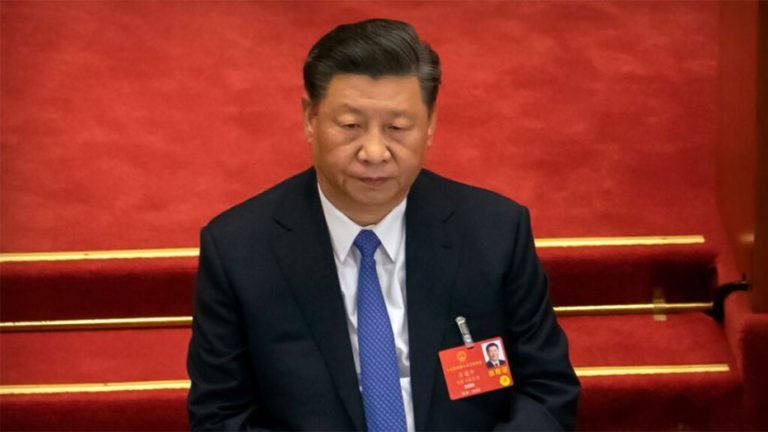
President Xi Jinping is a poor strategist. Chinese are known followers of the Art of War, an ancient Chinese military treatise written by Sun Tzu, a Chinese general and military authority in the 5th century BC. The treatise teaches all aspects of warfare and particularly how to win a War without fighting it, but today, it is clear that President Xi Jinping has not read the book properly.

Xi got the first basic wrong, “don’t take too many enemies in one go, take them one by one.”

As a result, Xi may win a few battles, but ultimately, the Chairman of the all powerful Central Military Commission is certain to lose the war; the world will not let the Middle Kingdom dominate the planet. Xi Jinping and his advisors did not take into account that China’s ‘enemies’ would react so quickly to Beijing’s aggressive expansionism.

Take India, how could the nation (and the government) ignore Chinese intrusions in Ladakh and accept a change of the status quo without taking measures to make Beijing pay a price.

Banning Chinese applications or cancelling State contracts for Chinese mining companies, Delhi has started acting. As China digs in Ladakh and prepares for the winter, retaliating actions are bound to increase and certain policies taken in the 1950s, will certainly be debated afresh, particularly the ‘One-China’ policy.

It is where President Xi and his advisors have miscalculated. India and the world can well reopen ‘unfinished’ business.

One is the Tibetan issue at the UN. On November 7, 1950 a well-drafted appeal sent from Kalimpong (as there were no postal facilities in Lhasa), pointed to the fact that “the Tibetans were racially, culturally and geographically far apart from the Chinese.” It also made a parallel with the situation in the Korean peninsula: “The attention of the world was then riveted on Korea where aggression was being resisted by an international force.

Similar happenings in Tibet were taking place with the world covering its eyes: “… [The problem is] largely the outcome of unthwarted Chinese ambitions to bring weaker nations on her periphery within her active domination,” said the Appeal, which continued: “As a people devoted to the tenets of Buddhism, Tibetans had long eschewed the art of warfare, practised peace and tolerance and for the defence of their country, relied on its geographical configuration and on non-involvement in the affairs of other nations.”

It added that the Chinese, in their natural urge for expansion, “have wholly misconstrued the significance of the ties of friendship and interdependence that existed between China and Tibet.”

Some twenty years ago, Claudia Johnston, an independent researcher in International Law at the University of Victoria, Canada, wrote a fascinating paper “Tibet: The International Mistake of the Century”.

The outcome of her research was that the Tibetan Appeal was still a pending matter in the UN …waiting to be reopened: “The UN and individual Member States, have been conducting their decisions based on the false assumption that Tibet is not a ‘State’, but ‘an internal affair’ of China. UN official records show this to be a mistake.” Tibet was then a State.

As a result, “the issue of Tibetan Statehood remains unconsidered by the United Nations. United Nations mechanisms for ‘States’ to employ peaceful solutions to ‘Disputes’ have not been utilised.”

All this was done …at the instance of India.

It is true that from the start, Delhi was pessimistic about the outcome of the UN appeal: “We doubt whether a discussion of Tibetan problem in General Assembly or in Security Council will yield any useful result,” wrote Nehru. The friendship with China was already too important to be sacrificed for the fate of a weak and peaceful neighbour like Tibet.

The Prime Minister frankly admitted that though Beijing had repeatedly expressed itself in favour of Tibetan autonomy “but of course we do NOT know what their idea of autonomy is.”

Delhi thought: “We do NOT think that legal argument will be helpful or that Assembly should attempt more than appeal to two parties to come to a peaceful settlement. Condemnation of China will NOT help Tibet; and neither Security Council nor Assembly is in any position to render physical aid to Tibet.”

As a result China was not condemned and could complete its task of entering Lhasa without hindrance; in Sun Tzu’s jargon, ‘liberating Tibet without waging war’.

In the course of the discussions at the UN in New York, most of the representatives indicated that India was the nation most concerned and that they would follow India’s lead. In a note, Nehru sadly asserted: “I think it may be taken for granted that China will take possession, in a political sense at least, of the whole of Tibet.” He further admitted that for the Tibetan people the “autonomy can obviously not be anything like the autonomy, verging on independence, which Tibet has enjoyed during the last forty years or so.” His final words were: “We cannot save Tibet, as we should have liked to do so, and our very attempts to save it might bring greater trouble to it. It would be unfair to Tibet for us to bring this trouble upon her without having the capacity to help her effectively.”

The strange argument was: If we do anything to help Tibet, it will upset the Chinese and the fate of Tibet would be worse. The case was eventually ‘put in abeyance’ at India’s demand. Let us remember that Sardar Patel was by then a dying man; nobody could stand up to Nehru.

But today, if China stubbornly continues to occupy Indian territory in Ladakh or if the Chinese Western Theatre Command generals manage to convince the new Helmsman that India should be taught more lessons, there are plenty of old issues for India to reopen. For sure, Chairman Xi has not played his cards well.

Jaish terrorists strike in Sringar, 2 cops martyred

Srinagar/ August 14: A day ahead of India’s Independence Day, Jaish-e-Muhammad terrorists struck at Srinagar and martyred two policemen. The terrorists attacked a police party at Nowgam area of Srinagar on Friday morning killing two cops and leaving another one injured.

There were two terrorists who fired indiscriminately on a police party at Nowgam area of Srinagar leaving three cops critically wounded. “All three injured were shifted to SMSH (Shri Maharaja Hari Singh) Hospital, however, two of the injured succumbed on the way. The third one is being treated at the hospital whose condition is stated as critical,” J&K police said.

Kashmir zone police tweeted: “Terrorists fired indiscriminately on police party near Nowgam Bypass. Three police personnel injured. They were shifted to hospital for treatment where two attained martyrdom. Area cordoned off. Further details shall follow.”

The tweet of J&K Police informing about terrorist attack in Srinagar, Kashmir Valley.

This attack comes a day before the independence day and when entire Kashmir is on a high alert especially Srinagar district. Inspector General of Police (IGP) Kashmir had yesterday stated that fool proof security arrangements are in place to thwart militant strikes and to conduct all Independence Day functions smoothly.

Meanwhile, the two slain cops have been identified as Ishfaq Ayoub and Fayaz Ahmed while injured one has been identified as Muhammad Ashraf.

Talking to reporters at the site of incident, IGP Kashmir said that Jaish-e-Muhammad outfit has carried the attack. “The militants have been identified and they will be neutralized soon,” the Kashmir police chief said.

China talks about Art 370, India must talk about Shaksgam Valley & CPEC

0

Now that China’s Foreign Ministry has crossed the red line by brazenly interfering in India’s internal affairs by terming abrogation of Article 370 “illegal and invalid,” it’s high time New Delhi reviewed its unduly magnanimous attitude in face of Beijing’s belligerence since such undue munificence has proved to be a humongous disaster. In fact, it won’t be a hyperbole to say that New Delhi’s historical over-solicitous diplomatic approach towards Beijing that is one of the major reasons for its uncouth behaviour towards India. That Beijing’s no friend of India is no secret- starting with its blocking moves to get Jaish-e-Mohammad (JEM) chief Masood Azhar declared a UN designated global terrorist by misusing the “technical hold” clause thrice since 2009. Just recently China violated four Sino-Indian border agreements (of 1993, 1996, 2005 and 2013) by trespassing into Indian territory in Ladakh.

In what clearly appears to be a pre-mediated act of extreme violence, People’s Liberation Army (PLA) troops not only attacked a small and unarmed group of Indian soldiers led by their Commanding Officer without any provocation, but even escalated the violence level by a murderous assault with spiked clubs and metal rods on unarmed Indian soldiers who came to rescue this small group. In this clash which occurred in the area of Galwan, the inordinately high Indian Army casualty figures (20 fatalities and more than 70 injuries) in itself leaves no room for doubts that the violence by PLA was pre-mediated. Not only this, Beijing even had the gall to blame India for this clash by saying “India’s border troops under the guise of darkness, trespassed into China’s territory and provoked the incident.”

But Beijing’s attempts to showcase Indian Army as ‘trespassers’ flopped miserably because it failed to answer a basic question that would have immediately struck even a person not conversant with matters military. This question is, which army in the world would be so puerile as to send unarmed soldiers to trespass into a neighbour’s territory? Furthermore, Beijing’s defence that “China’s troops had to take necessary measures to strengthen their response and their management of the border areas” too raises a question. If Indian Army had indeed trespassed into Chinese territory, then the PLA was well within its rights to use firepower to thwart this intrusion in order to safeguard the territorial integrity of their country. So, why did PLA use spiked clubs and rods instead?   

There have been instances of scuffles between Indian and Chinese forces along the Line of Actual Control (LAC) as well as incursions by PLA soldiers in the past, but while there was no loss of life in the affrays, incursions by PLA were temporary in nature. But the recent standoff and intrusions in Ladakh are unprecedented in that while the clashes ended in considerable casualties in terms of fatalities and injuries, Beijing is clearly dragging its feet to diffuse the prevailing tension by restoring status quo ante. So, it’s more than obvious that while China may not have officially reneged on the Sino-Indian border agreements, it has for all practical purposes, junked these agreements. This in turn rules out likelihood of an unconditional negotiated settlement in the near future and therefore to expect that dialogue could help in restoring status quo ante, may be a case of great expectations.

Beijing may be getting a bit too pushy these days, but it’s certainly not ham-headed when it comes to diplomacy. That’s why the illogical and laughable reasoning that “any unilateral change to the status quo is illegal and invalid,” put forth by Beijing in defence of its criticism regarding abrogation of Article 370 of Indian constitution by Government of India is intriguing. Article 370 was enacted by the Indian Parliament as a temporary provision, and so, its abrogation is purely an internal matter of India. So, even if we for a moment accept Beijing’s point of view that the Kashmir issue “is a dispute left over from history between Pakistan and India,” then how does abrogation of Article 370 “change the status quo”? When the United Nations Security Council (UNSC) didn’t entertain the plea made by Pakistan using this very logic, why is Beijing making a fool of itself by offering the same rationale is something that defies comprehension.

But now that Beijing has brought up the issue of Kashmir being ‘disputed territory’ and terming it an “objective fact established by the UN Charter, UN Security Council resolutions and bilateral agreements between Pakistan and India,” it’s time New Delhi pays it back in the same coin. In fact this is opportune moment for some hard talk with Beijing and applying this very ‘disputed territory’ analogy to put China in the dock. The first issue pertains to ceding of Shaksgam Valley situated in Pakistan-occupied Kashmir (POK) to China by Pakistan in 1963. The fact that this act is illegal is clear from Article 6 of the Sino-Pakistan Agreement signed on March 2, 1963 which states that “the two Parties (China and Pakistan) have agreed that after the settlement of the Kashmir dispute between Pakistan and India, the sovereign authority concerned will re-open negotiations with the Government of the People’s Republic of China.”

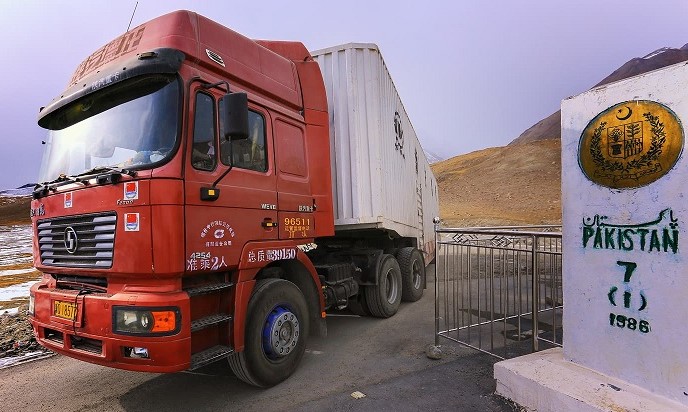
Now, if China and Pakistan both agree that J&K is ‘disputed territory’, then Chinese occupation of Shaksgam Valley is illegal since it is part of this so-called ‘disputed territory’, then Pakistan has no legal right or locus standi to cede Shaksgam Valley to China, without seeking prior approval of the UN or India (which both China and Pakistan concede is a party to this dispute). Similarly, if Beijing considers abrogation of Article 370 “illegal and invalid” since it’s an “unilateral change to status quo,” then doesn’t the same analogy apply to the construction of China Pakistan Economic Corridor (CPEC) which runs through the so-called ‘disputed territory’ of J&K? While these objections may not result in China giving up its control of Shaksgam Valley or abandoning the CPEC project, it will at least dissuade Beijing from using red herrings to defend what’s indefensible!