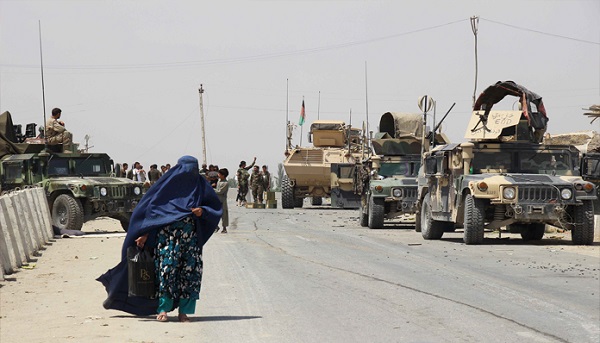
A group of ISI-backed militia attacked a jail in the Afghan city of Jalalabad and killed more than thirty people and injured another fifty people. After this attack more than a hundred inmates escaped from the Nangarhar jail most of which are Pakistan faction of the Taliban. The militia attack comes just days after a truce deal was signed between the Afghanistan government and the Taliban that had irked ISI as it wants chaos to continue on the other side of Durand Line.
Sohrab Qadri, a member of the Nangarhar Provincial Council, described the incident as “low-intensity explosions and then a car explosion outside an Afghan government-run prison in Jalalabad on Sunday”. Sohrab Qadri further added that the attackers clashed with security forces after the blasts.
Interestingly, a militant faction of the ISIS (IS-K — Islamic State in Khorasan) claimed responsibility for the Nangarhar prison attack. A statement issued by the ISIS news agency Amaq said that the attack on Sunday was carried out by ISIS fighters. The statement did not provide further details on the attack. A Taliban spokesman said his organization had no hand in the attack. It is an open secret that IS-K is backed by the Pakistan Army and ISI.
Clashes between ISI-backed militia and security forces continued for several hours after the Nangarhar prison attack during which grievous injuries were reported from both sides. Afghan sources say the number of casualties could rise further.
The Nangarhar prison attack came in on Sunday which was the last day of a three-day ceasefire between the Afghan government and the Taliban on Eid al-Adha, before which the Afghan government had already released hundreds of Taliban prisoners.
“If the Taliban had wanted more prisoners to be freed from Afghanistan government’s custody then it could have simply re-negotiated the deal or pressed for their release. The talks had been quite cordial. The Nangarhar prison attack is a clear indication that Pakistan wants to keep the pot boiling in Afghanistan,” an Afghan commander of the Special Operations Corps told News Intervention on condition of anonymity.
In fact, under a peace deal reached between the United States and the Taliban in February this year, the Afghan government is obliged to release 5,000 Taliban prisoners. The Taliban, on their part, have released around 1,000 Afghan prisoners from their custody. If the Taliban had wanted prisoners from the Nangarhar prison to be freed it simply had to add their names in the list of Taliban being freed under the peace deal.
Also, the inter-Afghan talks are set to begin after the release of prisoners under the peace deal. Afghanistan’s President Ashraf Ghani and the Taliban had hinted that inter-Afghan talks could begin after Eid al-Adha. And if this peace deal works out then Pakistan would be left to deal with Pashtun insurgency across Waziristan, which is gaining momentum by the day.
It in this backdrop that ISI put out its proxy faction of the ISIS (IS-K) to carry out attacks at the Nangarhar prison in Jalalabad. “An unstable Afghanistan and chaos on both side of the Durand Line is ISI’s way of dealing with Pashtun insurgency,” explained the Afghan commander of Special Operations Corps.
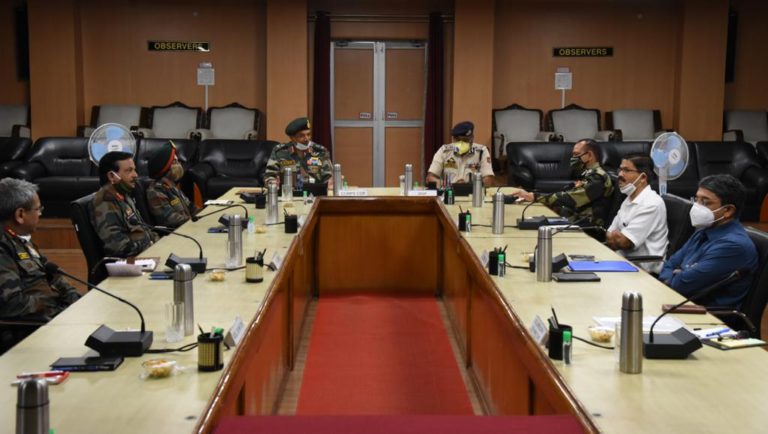
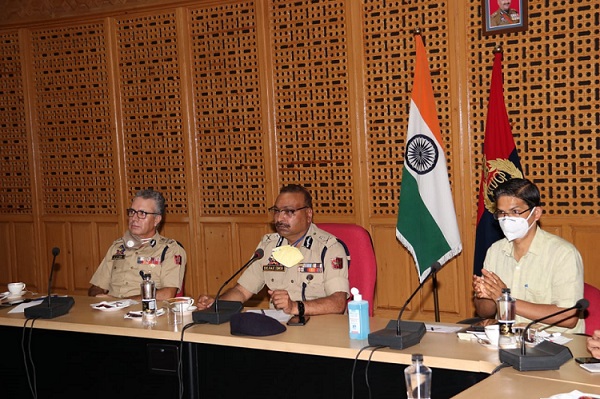
Srinagar/August 3: In the wake of security concerns on first anniversary of the abrogation of Article 370 and Article 35A, the authorities on Monday ordered curfew on August 4 and August 5 in Srinagar. And in the backdrop of prevailing situation in Jammu & Kashmir, the General Officer Commanding, Chinar Corps, Lt Gen BS Raju and Director General of Police Jammu & Kashmir, Dilbag Singh, co-chaired a meeting of a Core Group consisting of top officials of civil administration, intelligence agencies, security forces and divisional commissioner at Srinagar. The meeting was to review the security situation and ensure readiness to meet anticipated security challenges.
The Core Group reviewed the security situation in Kashmir and the progress on handling the COVID-19 challenges facing the UT. Special emphasis was given to ensure extensive security for the upcoming one year anniversary of the abrogation of Article 370.
“Senior superintendent of Srinagar has reported that a series of inputs have been received suggesting that separatists and Pakistan-sponsored groups are planning to observe August 5, 2020 as Black Day, therein apprehensions of violent action or protests are not ruled out. There are specific inputs about violent protests endangering public life and property,” reads an order issued by Deputy Commissioner Srinagar Shahid Iqbal Choudhary.
In view of restrictions aimed at COVID-19 containment is already in place, the movement and assembly of people have been prohibited to avoid spread particularly in wake of recent spike, he said. “Thus, any such mass gathering would be detrimental to efforts related to COVID-19 containment as well.”
The report has further made a case that to prevent such violence and loss of life and property, it’s imminent to impose curfew in the district, he said. “Therefore, after having considered the material facts in report and examining the situation in backdrop of prevailing factors, I, District Magistrate, Srinagar, by virtue of powers vested in me u/s 144 Cr PC hereby order complete restrictions on public movement / curfew in territorial jurisdiction of District Srinagar.”
Further, he said, medical emergencies and movement of staff on COVID-19 duty with pass or valid cards shall be exempted from above restrictions. “Additional Deputy Commissioner (Adm), Srinagar shall deploy one Magistrate each to coordinate implementation in each Police Stations jurisdictions,” he said, adding, “These restrictions shall come into force with immediate effect and shall remain in force on 4th and 5th August 2020,” the order said, adding, “Meanwhile, the restrictions previously ordered vide this office order dated 31st July 2020 on account of COVID-19 shall continue thereafter till 8th August unless revised earlier.”
Meanwhile on LoC, the recent increased infiltration attempts and ceasefire violations were discussed. Defence officials shared that the surveillance grid and counter infiltration grid in sensitive areas have been reinforced, which has led to early detection and foiling of infiltration attempts in last few weeks. Reports indicate that the launch pads in PoK are full and Pakistani establishment is keen to push in infiltrators in the next few weeks. The armed forces are ready for any border misadventure in form of BAT (Border Action Team) actions to support infiltration.
Core Group meeting in Srinagar on Monday to review the security scenario. (Photo: News Intervention)
The Core Group discussed the need for continued intelligence based anti-terror operations with a humane touch. To address the complete ecosystem of terror organisations, the efforts to identify and arrest over ground workers (OGWs) who sustain the terror organisations will continue with vigour.
Review of security indicators show that violence level has dropped in last one year. Intelligence inputs indicate desperation in Pakistani establishment and separatists to generate violence and civil casualties in the valley. The security forces have to be wary of attacks on political workers, attacks on soldiers on leave, IED attacks and attacks on isolated posts or patrols. Concurrently law and order including COVID-19 restrictions need to be enforced for safety of the common man. The officials also discussed local recruitment which though lower than last year had seen a spurt in the last few weeks. It was decided to enhance steps to prevent local youth from joining terror tanzeems. Steps would also include proactive steps in consultation with families of vulnerable youth, and identification and arrest of instigators.
The officials also deliberated on the propaganda efforts by Pakistan. The officials cautioned against the efforts to instigate violence in the UT.
The Divisional Commissioner brought out the efforts of the administration to meet the COVID-19 challenges. He also informed about the efforts to speed up developmental activities in the last few months which has resulted in completion of 14,000 projects which were languishing for 3 to 5 years. Maximum projects approved under PMDP (Prime Minister’s Development Package) in 2015 have started. Agricultural and rural economic activity is seeing revival, however tourism industry has been impacted by the security challenge and COVID-19 in 2020. He shared that ‘back to villages’ program has started showing results with empowerment of local elected representatives.
Expressing happiness on the synchronization of actions amongst various intelligence agencies, the Corps Commander and DGP also lauded the coordination amongst different security agencies.
Alex Kofi Donkor is the
Director of LGBT+ Rights Ghana & Programs Manager of Priorities
on Rights and Sexual Health.
Scott DouglasJacobsen:
So, May 17th was the International Day Against Homophobia,
Transphobia and Biphobia. We have done an extensive interview before. You are a
reasonably major figure in terms of being outspoken for the LGBTI community in
Ghana. From a Ghanaian perspective, as a relatively progressive country, what
are some of the cultural manifestations of homophobia, transphobia, and
biphobia? Why is awareness and commemoration, as per May 17th,
important when it comes to that – especially in light of the fact of
discrimination people can face disproportionately?
Alex Kofi Donkor: Thank you, Ghana is a progressive country but there is still a lot of work that needs to be done especially in the area of human rights. I feel like it is very religious. The majority of people believe in certain morals and beliefs. A significant proportion of Ghanaians are Christians, about 72%. There is Islam or Muslims, about 17% and also traditional worshipers taking other parts of the percentage and a few people none religious.
These beliefs
especially Christianity and Islam happens to condemn LGBTQ. This impacts so
many areas of life, e.g., political, social, economic, law, history etc. 90% of
the population believe in a form of religion. These are the same people who
occupy all the sectors of this country. public, private, the media, the
presidency, parliament, judiciary, police, service providers, businesses, you
name it. Almost all of these individuals in the population are religious.
When these religions have a particular stance on LGBTQ, and like we have always experienced, negative, it clearly reflects in the way their believers behave towards the community. They show hate to the community. The media constantly offers its platform for such behaviour to thrive. You realize the high possibility of LGBT persons being abused in the country as a result of these rhetorics.
So, I believe it is important to mark a day like this, an international day, that we speak up and challenge the oppression the community goes through in this country. Ghana is not an island, Ghana is part of the world and soo is its people. It is essential for LGBTQ Ghana to be safe wherever they find themselves in the county and challenge views, behaviours and laws that do not allow them to live to their full potential as citizens.
Whatever perspective one holds about other people in the country, the bottom line is that those people have equal rights as Ghanaians. Nobody is more Ghanaian than the other. Even if it is one lesbian or gay or bisexual or transgender, that individual has the same rights as any other Ghanaian. And it is important to raise such awareness.
“We as a nation, as a family, have taken a historic decision. A system due to which brothers and sisters of Jammu, Kashmir and Ladakh were deprived of many rights and which was a big obstacle to their development, that system has been done away with,” said Prime Minister Narendra Modi in his address to the Nation on August 8, 2019 post reorganization of the state of Jammu and Kashmir into two Union Territories and abrogation of the repressive Article 370 of the Constitution of India.
Much water has flown in the River Jhelum since the historic decision was taken on August 5, 2019. There is a case to carry out an appraisal of the situation to see what happened and what did not happen as predicted; what has been gained and what needs to be worked upon.
First and foremost is the security situation. The so-called leadership of Kashmir, both mainstream and separatist, had always spoken of dire security consequences if any attempt was made to remove the “special status” of the state. “We want to tell the central government that tinkering with Article 370 will be akin to setting a powder keg on fire,” said Peoples Democratic Party (PDP) president, Mehboob Mufti in end of July 2019, a few days before the constitutional provision for the change was passed. Comments on similar lines were made by other local Muslim leaders and others in India who have, for long, maintained an interest in keeping Kashmir perpetually on the boil. A lot of effort was made to psychologically maneuver the people of Kashmir towards Hartals (strikes) Bandhs (lockouts) and stone pelting . None of this happened and all predictions in this regard turned out to be wrong.
The Eid celebration held within a few days of the decision being notified went off in a peaceful manner. The security forces, while keeping an eagle’s eye, were very cooperative and courteous. Soon after Eid, government offices and primary schools were opened, attendance was low initially but it picked up with time. Landline facility was also extended even as the internet stayed restricted for a long time.
It became quite apparent that people had been exhausted by the never ending violence, turmoil and political disruption in the region and were now interested in peace more than anything else. They looked upon the change with a fair degree of relief and anticipation of some positive changes taking place. Even though the leaders of so-called mainstream parties like National Conference and PDP were detained, there were no voices raised for their quick release. Even after being released they have been unable to impact the situation in any gainful manner. This extraordinary situation exposed the hollowness of the Kashmiri leadership and claims about the “Special status” of the state being sacrosanct. They had, for decades on end, misled the people and the nation.
The “ideology of separatism” that has always been the handiwork of a few local political players in their attempt to gain power through dirty politics crumbled in no time. Thus, the so-called “stakeholders” became politically irrelevant. On coming under pressure of scrutiny for corruption, they threw ideology to the winds and have got into self preservation mode. Those screaming against India in the loudest voice suddenly became most accommodative.
The biggest impact of the decision was not in India, but in neighboring Pakistan. Caught completely by surprise, the neighbouring country took some time to get its act together and then launched an offensive. A rambling speech in the National Assembly by an obviously disconcerted Prime Minister Imran Khan became a cause of controversy due to his threat that the move would cause “more Pulwama like incidents” which was seen as an admission of supporting terrorist activity in Kashmir.
Next came a drama in the United Nations Security Council (UNSC) carried out with the assistance of China. Imran Khan in many forums parroted predictions of massive uprising the moment restrictions were lifted. This too did not happen. Totally embarrassed by the inept handling by Imran Khan, the Pakistan Army took the matter in its own hands and has since been attempting to save faces by increasing the threshold of violence in the Kashmir Valley. A bid to increase local recruitment in the terrorist fold supported by massive ceasefire violations and infiltration bids has come to a naught. Pakistan has now run out of both political and military options and is forced to remain content in its role as an irritant.
The international community was quick to term the constitutional amendment as an “internal issue” and remain neutral. Even US President, Donald Trump, realised that he had created a problem by offering to “mediate on the Kashmir issue” and immediately extricated himself.
On October 31, 2019 the state of Jammu and Kashmir emerged with a new Avatar of two Union Territories. The Union Territory of Jammu and Kashmir now comprises of 22 districts including areas of Muzaffarabad and Mirpur. The Union Territory of Ladakh comprises of two districts of Kargil and Leh and includes the Pakistan Occupied territories of Gilgit-Baltistan. With this change coming by, a historic wrong that was sticking out as an aberration to the core principles of democracy and freedom enshrined in our Constitution was set right.
Girish Chander Murmu, was placed as the first Lieutenant Governor of the Union Territory (UT) of Jammu and Kashmir. In a politically surcharged atmosphere his main focus has remained on providing a corruption free and efficiently running the administration. The effort to boost development got a considerable boost with the first budget of the UT for financial year 2020-21, wherein, all supplementary demands for grants were cleared and the budgetary allocation crossed the threshold of Rs 1 lakh crore for the first time. With structures in place the core issues are being addressed in a sustained and meaningful manner.
Grassroots empowerment is being boosted with massive grants to Panchayats. One quoted figure stands at a grant of Rs 366 crore to 4,483 Panchayats, the government is also digitally connecting all Panchayats. An objective was set to create 50,000 jobs for the youth for which security forces came forward with enhanced recruitment projects. Projects under the Prime Minister’s Awas Yojna (PMAY), Kissan Credit Card (KCC), Ayushman Bharat and scores of others are moving at a very fast pace. Ten percent of the annual budget in all departments is reserved for tribal welfare schemes. Women in the state are quite happy at the prospect of being granted the right to their property even if they are married and settled outside the state which was forbidden under the earlier dispensation. Sections of society like the Valmiki Samaj, West Pakistan refugees etc who had no rights in the state have already started getting their domicile certificates.
Also, 37 central laws including Prevention of Corruption Act, The Goods and Services Tax Act, The Insolvency and Bankruptcy Code have been made applicable in the Union Territory. These will ensure ease of doing business and help address the endemic corruption prevalent due to lack of accountability. Also empowered are establishments of the Anti-Corruption Bureau, Central Vigilance Commissioner, Central Information Commissioner and Central Administrative Tribunal (CAT) among others.
The most important exercise for Delimitation of constituencies for the Union Territory Legislature and the Union Parliament has been initiated. A Delimitation Commission headed by former Supreme Court judge Ranjana Prakash Desai has already been constituted to redraw Lok Sabha and Assembly constituencies of the Union Territory of Jammu and Kashmir among other states. Election Commissioner Sushil Chandra and state election commissioners of Jammu and Kashmir and four other affected states will be the ex-officio members. This delimitation will do justice to all the people of the Union Territory that has seen domination by one region since independence.
The youth are quite relieved. Earlier they were being held at ransom by the foreign terrorist elements and were constantly under fear of retribution, if seen as non-participant in the local Azadi (freedom) movement and were receiving no support from the local leadership. Now there is a decrease in recruitment of youth in the cult of terrorism. Pakistan, however, is still successful in indoctrinating a few through its Over Ground Workers (OGWs) with the lure of money and propagation of a false religious ideology. Concerted efforts to check this malaise are underway.
The security forces did not let down pressure on terrorist elements at any stage during the transition period. In fact due to enhanced intelligence coming in, incisive counter-terrorism operation are being conducted. Within the current year itself more than 140 terrorists have been killed which includes the entire established leadership of all operative terrorist Tanzeems (Group). This has caused a body blow to the Tanzeems that are now gasping for breath. A considered view is that very soon the Kashmir Valley will be totally free of the menace of terrorism. The security forces, however, have to remain ever vigilant against machinations of Pakistan since the country is determined to revive terrorism and disruption at least in Kashmir if not the rest of the state. In recent times it has resorted to engineering of political killings of BJP leaders. It is a challenge that will need to be considered with seriousness.
It is also obvious that the people are quite happy at the prospect of ridding themselves of the local leadership that has been, for decades now, restricted to a few families of the Kashmir region. The space now is open for new leaders. They will need to be honest, accountable and responsible if they wish to survive. The people are unlikely to repeat the mistakes of the past.
Despite diverse geographical regions and demographics, Jammu and Kashmir has forever remained rooted in a spirit of brotherhood, mutual trust and democracy. The people kept their faith in democratic tenets even in the worst of times. They have, forever, maintained that problems cannot be resolved by the gun. It is these qualities which will now help in building a new era that will see the region and its people achieving their lost glory and once again getting to the forefront as a highly cultured and prosperous civilisation.
Srinagar, July 31: A massive anti-infiltration operation is underway in the Machil Sector at the frontier border district Kupwara, Indian Army said. The army official said that a group of terrorists was intercepted by alert troops along Line of Control (LOC) in Machil Sector.
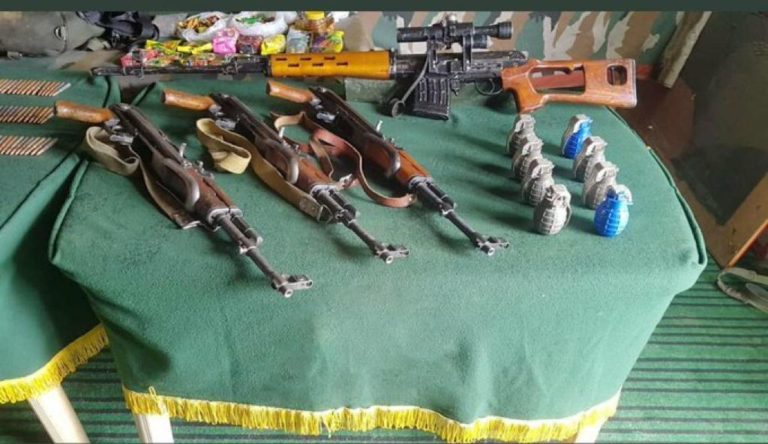
“Today early morning at about 3 AM, suspicious movement of unidentified persons was detected 600 m on own side of the LoC at Machil Sector, Kupwara,” said the Indian Army official. “Infiltrating terrorists intercepted by own troops. Firefight ensued. After the first light, search was carried out. Blood trail seen. 3 AKs, a sniper rifle, 8 grenades and other war like stores recovered. Search in progress,” the Army officer explained.
Sources in the army said that additional reinforcements have been rushed to the area to assist already deployed troops. They said that vast area is under strict cordon, and massive search operation is underway to track down the terrorists.
Sources in the Indian Army believe that Pakistan will try to push in more and more terrorists in the wake of August 5, date of the first anniversary of abrogation of Article 370 and Article 35-A.
Srinagar, July 31: After taming separatism, the J&K government is making active efforts to rein in employees found involved in ‘anti-national’ activities. The J&K government has initiated a process to act tough on such employees, which could lead to their dismissal of their services.
Officials said that J&K government has constituted a panel to scrutinize and recommend cases for dismissal of services of those employees who were involved in ‘anti-national’ activities overtly or covertly.
An order issued by the government of J&K on Thursday night announced the constitution of a committee headed by Chief Secretary BVR Subramanyam to take stock of all such cases that would be referred to it by the police and home departments, they said.
They added the action would be taken against ‘anti-state’ employees by invoking Sec 311 of the Constitution that is now applicable to J&K Union Territory.
The provision would be applicable to all those employees about whom there are cases of having taken part in the “anti-national” activities overtly or covertly. It will also apply to those who have served detention.
Pertinently, in the regime of Governor Satya Pal Malik, government employees were repeatedly warned, soon after Jama’at-e-Islami J&K (JeI) and JKLF were banned, to shun taking part in ‘anti-national’ activities.
Meanwhile one of the critical parts of the fresh order is that the employees’ cases would be dealt with by the police on the basis of their interrogation reports and the collateral evidence which will dispense with the need for any inquiry, and once the cases are examined and recommended, the General Administration Department will issue orders for their dismissal from service as also their suspension. This provision will also apply to such pending cases.
There were serious complaints in the past that the employees who were taking part in “anti-national” activities during street protests, instigating people against security forces were not booked, nor FIRs allowed to be filed against them by political governments and the administration was pressed not to act against them. All this is going to end now.
Majeed Brigade (self-sacrificing brigade) of the Baloch Liberation Army (BLA) attacked Karachi Stock Exchange on June 29, 2020. This daring attack had a high symbolic significance as it catapulted Balochistan’s freedom struggle on prime time news across the world. Basheer Zeb Baloch, BLA Chief told News Intervention in this Exclusive Interview that Baloch pro-independence groups use violence in reply to Pakistani invasion and occupation. BLA’s Karachi attack was a message to the world that Pakistan has occupied Baloch land and had been plundering the resources of Balochistan with China’s help. The Karachi Exchange attack is BLA’s third high profile attack in recent years. In November 2018 the BLA had attacked Chinese consulate in Karachi. In May 2019 BLA attacked Pearl Continental Hotel at Gwadar. The Gwadar and Karachi Stock Exchange attacks have been carried under the leadership of Basheer Zeb who was anointed as BLA Chief, after the former Chief Aslam Baloch was martyred by an ISI attack in Afghanistan.
Basheer Zeb: Every attack by BLA, whether small scale or big, is basically aimed at weakening the occupiers’ strength who has been ruling Baloch motherland by force. Every attack is a step towards achieving our ultimate objective of achieving Balochistan’s Freedom. Similarly, Karachi Stock Exchange attack was carried out with the same aim of targeting the enemy’s economy and the very symbol of the exploitation of Baloch national resources. The attack was also a message to the world that Pakistan has occupied Baloch land and plundering our resources with the help of China who provides military, economic and diplomatic support to Pakistan. Baloch will not accept the occupation of their land and will not tolerate the nexus of China and Pakistan that are involved in the plundering of Baloch resources.
Vivek Sinha: Karachi Police officials had told News Intervention that more than 30 people were killed in the BLA’s suicide attack on Karachi Stock Exchange. But the Karachi Stock Exchange was functional from the next day. Do you think BLA’s attack had attained its objective?
Basheer Zeb: The objectives of BLA Majeed Brigade’s attacks have never been to indiscriminately kill. Pakistani authorities never reveal the correct numbers of the casualties. Also, we do not measure the success of any mission with the number of casualties suffered by the enemy but we take the larger perspective and ultimate goal under consideration that what progression was achieved, how much were we able to highlight Balochistan’s issue to the world and what implications our enemy will suffer in long term. Undoubtedly, Baloch Fidayeen succeeded in reaching Pakistan’s red security zone and attacked one of the buildings which was very important for its economy. On one hand, it showed enemy that we can reach anywhere we intend to and on the other hand, the foreign investors will think twice before investing in PSX (Pakistan Stock Exchange). We consider this our success and for that Stock Exchange attack was a very successful mission.
Basheer Zeb Baloch is the former Chairman of BSO-Azad, which is Balochistan’s student organisation. Basheer Zeb became a revolutionary to fight for the independence of Balochistan. (Photo: News Intervention)
Vivek Sinha: The four Karachi attackers of the Majeed Brigade have said in their video message that they will try their best to keep the loss of innocent human lives at minimum and yet more than 30 people were killed during the Karachi attack. How can the BLA justify its attacks?
Basheer Zeb: Baloch did not start this war but we are defending ourselves against foreign invaders. We are a peaceful nation and our violence is only in retaliation and self-defense. It is counter-violence against the violence we face every day at the hands of the enemy. Balochs did not ask for this but the war was imposed upon us by an enemy state that has occupied our motherland. Therefore, to end this war and achieve freedom and peace we have no options but to fight. War is the last thing anyone would want, war is a curse, wars make orphans, they bring death, mayhem, and destruction. That’s what you can expect when a war is waged, that’s why the world should condemn and act against warmongers like Pakistan that starts war against oppressed nations instead of condemning the oppressed nations who are fighting to defend themselves. People do lose their lives in attacks like Karachi Stock Exchange but one should look closely that who were the dead men? They were either uniformed personnel of Pakistan or those who help the state strengthen and prolong her occupation on Balochistan, only such facilitators have been targeted by BLA and Baloch nation to regain their national independence. However, if one compares the guerrilla movements across the world, the loss of innocent lives due to collateral damage has been the lowest in BLA or Majeed Brigade’s attacks.
Aslam Baloch (left), former BLA Chief was martyred in a suicide attack by Pakistan’s ISI. After Aslam’s martyrdom Basheer Zeb Baloch (right) became the BLA Chief.
Vivek Sinha: Several media groups call BLA revolutionaries as “terrorists”. Your comments.
Basheer Zeb: Who is a terrorist? It depends entirely on the subjective outlook of the definer. One man’s revolutionary is a terrorist to others. If we look closely at the basic difference between a freedom fighter and a terrorist, the freedom fighter is forced to adopt counter-violence whereas the terrorist starts the violence and his violence is indiscriminate. Taking this under consideration, Baloch pro-independence groups are using violence in a reply to Pakistani invasion and occupation. Our counter-violence is not indiscriminate but targeted; the targets are Pakistani Army, military, and exploitative facilities and those who facilitate the enemy in its illegal occupation of Balochistan. On the other side, Pakistan began the violence by attacking Balochistan and to this date is killing common people in indiscriminate bombardments and military operations. So, who is the terrorist?
Vivek Sinha: How is BLA different from other armed groups in the South Asian region?
Basheer Zeb: South Asia has several ongoing indigenous movements with different armed groups active in the region. It is not possible to compare BLA against all collectively. However, there are a few movements that have a resemblance to ours, such as the freedom movement of the Sindhi nation. Other movements cannot be called indigenous as many are mere state-sponsored proxies to destabilize countries. Besides that, there are religious extremist groups. BLA is different than both, the proxies and religious extremists. BLA does not force its ideology on people and neither carries out attacks just to spread fear among masses. It is fighting to defend its motherland against foreign invaders and occupiers. It aims at regaining the freedom of secular and democratic Balochistan where everyone will have the right to practice its religion and spend a peaceful life. And unlike proxies in the region, BLA is the result of a homegrown resistance movement and it has a long history with roots deep in Baloch land. BLA never depended on foreign support and its power stems from Baloch people and Balochistan.
Every Indian citizen (very perceptive, or the nuanced) especially the security and China watchers would be able to rattle out latest situation along the LAC in East Ladakh given the plethora of inputs, barring from the government. There are a number of options discussed both by the self-styled pacifists (actually status quoists who never want to make a move, and pray and hope that the crisis will resolve itself, irrespective of outcome), the hawks and the moderates.
The background chatter is also by now well known, provide excuses or show surprise at the action of an adversary (HOW COULD HE DO IT, again and again!), talk of the woeful global economic situation in which we are equally affected and to top it all, the crisis of COVID-19 which is engaging the world. Even before analysing the strategic security situation and challenges, and its implications for the future, these people dismiss any hard or resolute actions. All because, of a mindset of how can we challenge the Chinese, will it not lead to a confrontation between two asymmetric adversaries or worse to a two-front entanglement.
We must be very clear that China has violated all the confidence building measures (CBMs), Border Defence Cooperation Agreement (BDCA), Joint Working Group, Senior Representative level understandings, protocols and mechanisms for border management, including the latest “strategic guidance to the respective militaries to strengthen communication to build mutual understanding and enhance predictability and effectiveness in managing borders” signed by President Xi Jinping and PM Modi even before the ink has dried. It is by now clear that military and political level talks and movement on ground are going on excruciatingly slowly.
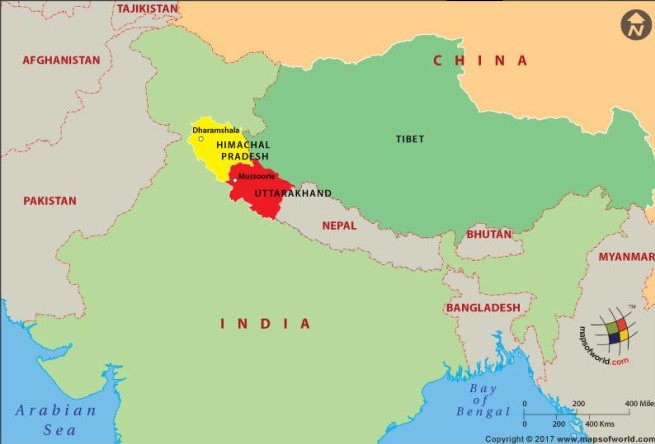
India shares boundary with Tibet and not with China
China’s Big Gamble? Immediately after China got a handle on COVID-19 internally (there are inputs of a second coming, which may actually egg it on to create multiple external crisis situations), and while the rest of the world is still battling COVID-19 and its effects in other domains, China (Chinese Communist Party to be more precise) led by Xi Jinping is changing the global status quo. From using gun boat diplomacy, border troop aggressive movements and deployments, high seas and border intimidation, wolf diplomacy, economic holdouts/threats like with Australia and conduct of high level troop exercises involving entire PLA, building new strategic alliances and friendships a la Iran, China is on the move externally in all domains.
Interestingly the low-key military approach has long been discarded and entire PLA is galvanized. The multi-service, multi-domain Armed Forces exercises in the South and East China seas and border areas especially along the LAC with India are of a much larger scale, involve interoperability and being conducted closer than normal to adversarial shores and borders. PLA Army, Navy, Air Force, Marines, Rocket Forces, Air Defence, non-kinetic hi-tech formations like cyber, space, information-surveillance & reconnaissance (ISR), amphibious, logistics supply chain units are participating, and China’s much touted three warfare strategy (public opinion, psychological, and legal warfare) is being applied around its strategic space. At last count one of the security experts spoke of China engaging 27 countries in multi-domain competition leading to confrontation!
Interpretation of “Why” by the Rest of the World Enough reasons for “why” has also been analysed. From showcasing China’s comprehensive national power (CNP) and ascent to global power status by simultaneous confrontationist actions with numerous nations, demonstrable actions to challenge USA, and teach cocky new India a lesson (with many payoffs of disrupting India’s growth story, slow down India’s infrastructure development along the Northern borders, indicate an unstable India internally where movement of industries from China is fraught with risk, warn India to lay off Aksai Chin and Gilgit-Baltistan, dissuade India not to create trouble in functioning of BRI (Belt & Road Initiative) especially CPEC (China-Pakistan Economic Corridor) which is existential for China, stop interfering or dominating the IOR (Indian Ocean Region) and Malacca Straits. BUT China continues with its normal game of salami slicing with a larger ambition of garnering real estate in multiple areas having strategic sensitivities). All the nations, security and China experts are only second guessing and China’s rationale for its actions is frankly still a mystery, which will unfold as time and events roll along. A reasonable thought would be the CCP (Chinese Communist Party) taking advantage of weakened rivals, and an international power vacuum, hubristically overestimating its own power, reacting to aggression from its adversaries or opportunists and acting out of insecurity about its own status.
Truisms Regarding China and India impacting Relationship
Wars/conflicts need a whole of nation approach, since nations fight wars/conflicts and the Armed Forces are main instruments to wage this war/conflict
There is considerable asymmetry in CNP (comprehensive national power) between the two nations including the armed forces, especially in fairly newer domains of space, cyber, psychological, niche technologies (nano, hyper velocity, artificial intelligence (AI), robotics, drones).
However close are our strategic alliances, India and its armed forces must be prepared to act alone to contest the LAC impasse. Assistance in forms of information, equipment, weapon systems, posturing and projecting a threat in China’s other areas of vital interest (Taiwan, South China Sea and East China Sea, Indian Ocean Region including Malacca Straits) will impact the overall strategy and end game of China.
Two-front scenario is a real and present danger, and armed forces have to plan and deploy their forces accordingly.
Geography and terrain impose time and quantum restraint on strategic movement of forces from one sector to another.
Both sides will require tremendous quantum of infrastructure for troops to stay during the winter.
Logistics and supply chain management is vital and will dictate the level of operations/conflict, since the main bases of supply for both countries is far away. The nation which manages it better will carry the day.
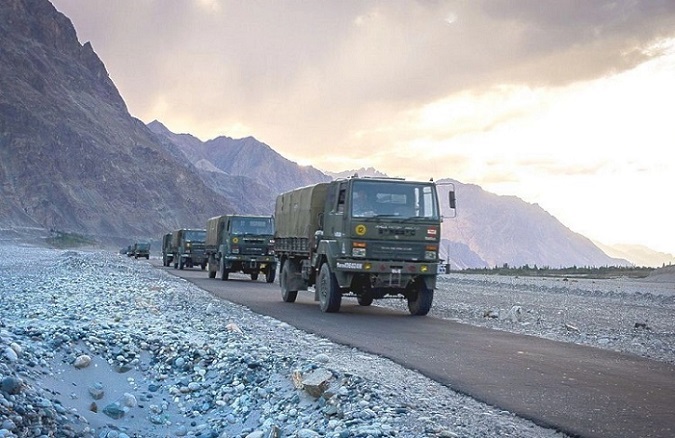
Ground Reality in East Ladakh, Chinese Game Plan and Indian Options The aim here is to focus on resolution of the LAC impasse and leave out the strategy, esoteric and higher conducts of war. China has changed the status quo ante of military and para military forces presence as of April 2020 in East Ladakh in at least four locations. While India has conveyed its intent of not accepting anything less than withdrawal to April 20 positions, the Chinese are playing hard ball. Talks and corresponding movement of troops from the standoff locations are going slow, with total lack of trust, requiring minute verification and detailing on ground and talks.
My assessment is that China is playing for time and at the ground level will follow the following methodology: Agree and withdraw at some places on a quid pro quo basis (not necessarily to April 20 positions, since it has deployed forward in all cases); stay firm but continue talks in some locations which are of strategic significance (Lake Pangong Tso); pull back to status quo positions of April 20 in one/two locations. In any case the operational status quo has been disrupted in terms of force density (Army and Air Force on both sides) by China mirrored by India.
Winter is Approaching India has signaled two aspects firmly; One, India’s intent of not backing down till status quo of April 20 is achieved; Two, and so, its armed forces including the additional formations (be it infantry, artillery, armour, mechanized, Air Defence, Army aviation and IAF) are going to buckle down for the winter. The very famous saying from the blockbuster serial Game of Thrones, that ‘Winter is Coming’ is very apt. It will require tremendous logistical and infrastructural effort but our troops have done such manoeuvres before and will willingly do so again. Logistics and infrastructure preparations are already on at full swing. History has time and again proved that our armed aorces are outstanding at crisis management, make miracles happen and fight and endure with ‘what we have’.
What is the strategic intent of the Chinese; have they already achieved it by changing the tactical status quo and manoeuvre as already discussed. Will they withdraw majority of their troops closer to winter setting in, or also continue to stay the winter? If they stay, the signature of logistic supply chains cannot be hidden and all our intelligence agencies must be focused on it. Logic dictates (logic can go wrong in crisis specially involving adversary and reading an adversary’s mind) that China would not want a conflict, as it will be very costly for it too in terms of human casualties and further sharpen world outrage and adverse disposition towards China. This is certainly not a foolproof method of arriving as a global power, annoying the world and embroiled in multi-domain confrontation with a large part of the world specially the developed world and most of Asia.
Coming back to the LAC, logistically the Chinese can master it (if we can, so can it, is a prudent assumption). The question is can the Chinese troops weather the winter, I presume so, but they are largely conscripted, not used to high altitude sustenance over long periods, let alone fighting, and inexperienced in combat. Our logistics supply chains are long no doubt, but China’s main rear is mainland China and even longer, and most importantly Indian Army has been doing winter stocking in ever increasing quantities since decades.
For the Chinese, to stay the winter may defeat its very purpose and send wrong strategic and ambiguous signals to Chinese people and internationally, that China is stuck in a quagmire of its own making.
China I believe, will try to brazen it out in talks politically, diplomatically and militarily and persuade India to hastily (much before winter sets in) accept a compromise which it will project as a win-win situation for both countries, and showcase its magnanimity and strength to Chinese people and the world. If we do reach an agreement, I hope it is because China has accepted our firm stance of returning to April 20 status quo. Than all its troops other than those who were operating there before April 20 withdraw in a phased manner and situation normalizes in time. Chinese by now would be very clear that Indian troops are prepared to spend winter in East Ladakh.
Opportunities will come its way for the Indian Armed Forces. Army must continue aggressive patrolling in East Ladakh and challenged areas, always posing a threat to the Chinese deployed forward. With synergized multi-service operations and invaluable support from IAF, we should in phases isolate and evict, or force Chinese troops to withdraw to status quo locations; or even look for quid pro quo options of occupying sensitive territory across the LAC, employing the integrated battle groups (IBGs).
India must be more than ready to trade fire to achieve its mission of eviction. India and the Indian Army know that next summer physical eviction of Chinese will get even more challenging. It will have to be hard political and diplomatic manoeuvering (again number of options like review positions on Tibet, Hong Kong, Taiwan) which is not going to be easy given the disadvantageous ground situation. The Chinese, one would say, have boxed themselves into a corner. They did not want a conflict and will avoid one at all costs. A stalemate would definitely constitute a defeat in strategic and international parlance for China, while for India it will further showcase the emergence of a resurgent, confident new India. For this to become a reality India has to buckle down, show resolve and endurance, weather the winter and Chinese storm, and most importantly show tremendous faith in its armed forces to deliver.
It is going to be a very interesting winter to come, and as I have said before it is going to be a defining moment in our history having far greater implications than tactical, and if we come out of it achieving our national and military objective, a stronger, vibrant new India will be ready to take off in the global platform. It is not going to be easy for the very reason I enumerated and Chinese will know it better than most. But while it is a great challenge for the nation and our armed forces it is doable with planning, resolve and will, as failing is not an option and will set us back strategically and we must be ready for many more similar summers, this time from both China and Pakistan. So, prevail we must.
Remember, even with requisite comprehensive national power, deterrence power may not be forthcoming automatically. For this we have to build deterrence reputation where our adversaries know that we will use our deterrence capabilities when our national interests are at stake. It is time to enhance our deterrence reputation.
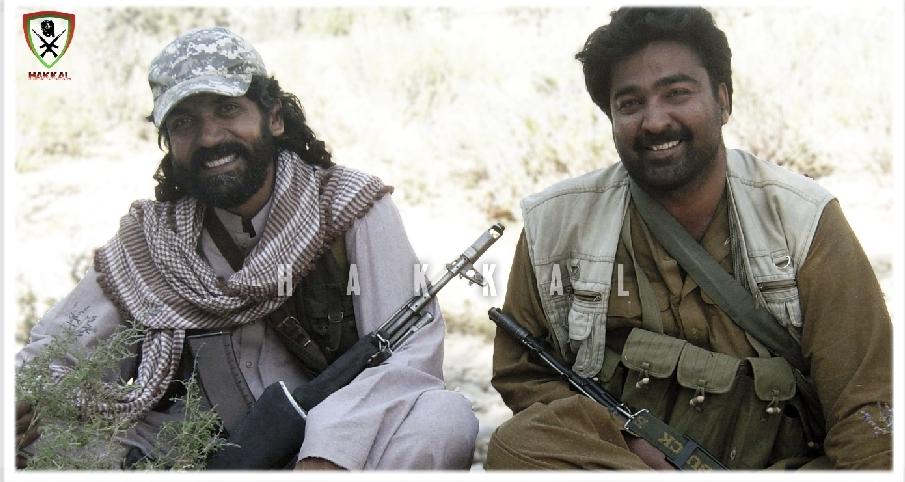
Quetta/July 31: Balochistan Liberation Front (BLF) spokesman Major Gwahram Baloch has claimed responsibility for the attacks on Pakistani military personnel in Jhaoo and Mashkay. Major Gwahram Baloch said in a statement from an undisclosed location that on Thursday night Baloch Sarmachaars (freedom fighters) attacked the Manguli check post in Mashkay Valley with sniper fire and heavy weapons, killing three personnel and injuring one.
In another attack, BLF Sarmachaars (freedom fighters) ambushed a Pakistan Army patrol team with automatic heavy weapons at the Nondara area of Jhaoo at 8 AM on Friday. The BLF attack took place when a group of ten occupying forces of the Pakistan Army were moving on foot towards the Daraj Kaur river. In the fierce ambush, four Pakistan Army personnel were killed on the spot and two others were injured.
Pakistan Army and its intelligence agency ISI has been abducting and killing innocent Baloch people for the last several years. More than 30,000 Baloch men, women and children have been forcefully disappeared and over 10,000 Baloch people have been murdered in extra judicial killings over the last 15 years by the occupying Pakistani forces. These killings and disappearances across occupied Balochistan are the result of Pakistan’s policy of “enforced disappearance” and the “kill and dump” policy.
Srinagar, July 30: Dilbag Singh, Director General of Police Jammu & Kashmir on Thursday directed security forces to remain very alert for ensuing fortnight and put into use all resources so that the religious festivals as well as the Independence Day celebrations pass off peacefully.
Chairing a high-level security meeting, the DGP said that there will be provocations by the “anti national and anti social elements during this period and as such all the nafari (police personnel) deployed on nakas, on operations, on static guards and other deployments need to be briefed on regular basis.”
“He complimented the officers and said that a lot of good work has been done during the last few months on operations as well as on the law & order front. However, the guard cannot be lowered and there is a need to consolidate the gains,” the DGP was quoted by a police spokesperson in a statement issued here.
Senior Police Officers of the J&K Police at the security review meeting in Srinagar on Thursday. (Photo: News Intervention)
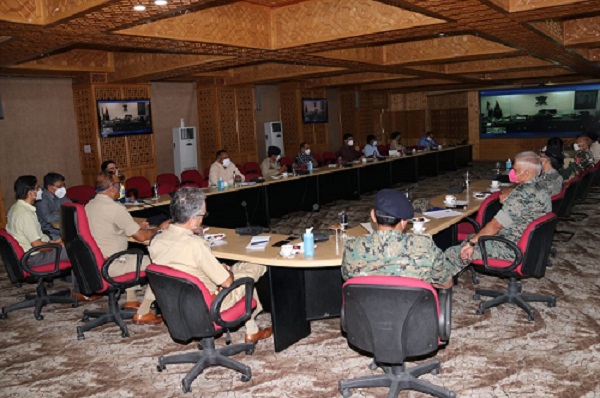
The high level security review meeting was held at Police Headquarters Srinagar in which over all security scenario of the J&K, particularly security arrangements with regard to Eid and August 15 were discussed. The efforts of collective fight against COVID-19 by the Police, CAPFs (Central Armed Police Force) and Civil Administration were also discussed, the police spokesperson said.
The meeting was attended by other senior officers of the Jammu & Kashmir Police.
Senior Police Officers from all across Jammu & Kashmir attended the security review meeting through video conference. (Photo: News Intervention)
“The DGP said that all the efforts must be put in place to enhance the security of the vulnerable people and places. He said that the officers can take the decisions keeping in view the local requirements, conditions etc,” the police spokesperson said.
The DGP also said that all the logistics such as Bullet Proof Bunkers fitted with CCTVs have been provided and advised the officers that these resources must be made good use of. “The incidents of sensitive and law & order nature must be recorded and later on analysed,” he said.
Dilbag Singh added that the supervisory officers must ensure that the jawans on duty remain alert and put on Bullet Proof patkas, jackets to safeguard themselves and also do their duties efficiently.
With regard to COVID the DGP said that we need to continue to take all precautions and all the resources which have been made available must be put to use. Police headquarters will be at the back and call of the districts and units for any requirements which they may highlight.
The DGP said that the plasma donations by the police personnel an initiative under the supervision of ADGP Coordination SJM Gillani has been appreciated by the civilians as precious lives are being saved through this attempt. He said that the units and districts must make a list of police personnel who can be screened for plasma donation. The donors must be duly rewarded.
He further advised that due precautions and COVID protocols must be followed during the celebration of the religious as well as on the national festivals.
All the officers attending the meeting briefed the DGP about the current scenario in their respective areas and assured him that all the orders and advisories will be
We use cookies on our website to give you the most relevant experience by remembering your preferences and repeat visits. By clicking “Accept All”, you consent to the use of ALL the cookies. However, you may visit "Cookie Settings" to provide a controlled consent.
This website uses cookies to improve your experience while you navigate through the website. Out of these, the cookies that are categorized as necessary are stored on your browser as they are essential for the working of basic functionalities of the website. We also use third-party cookies that help us analyze and understand how you use this website. These cookies will be stored in your browser only with your consent. You also have the option to opt-out of these cookies. But opting out of some of these cookies may affect your browsing experience.
Functional cookies help to perform certain functionalities like sharing the content of the website on social media platforms, collect feedbacks, and other third-party features.
Performance cookies are used to understand and analyze the key performance indexes of the website which helps in delivering a better user experience for the visitors.
Analytical cookies are used to understand how visitors interact with the website. These cookies help provide information on metrics the number of visitors, bounce rate, traffic source, etc.
Advertisement cookies are used to provide visitors with relevant ads and marketing campaigns. These cookies track visitors across websites and collect information to provide customized ads.
Necessary cookies are absolutely essential for the website to function properly. These cookies ensure basic functionalities and security features of the website, anonymously.
Cookie
Duration
Description
cookielawinfo-checkbox-analytics
11 months
This cookie is set by GDPR Cookie Consent plugin. The cookie is used to store the user consent for the cookies in the category "Analytics".
cookielawinfo-checkbox-functional
11 months
The cookie is set by GDPR cookie consent to record the user consent for the cookies in the category "Functional".
cookielawinfo-checkbox-necessary
11 months
This cookie is set by GDPR Cookie Consent plugin. The cookies is used to store the user consent for the cookies in the category "Necessary".
cookielawinfo-checkbox-others
11 months
This cookie is set by GDPR Cookie Consent plugin. The cookie is used to store the user consent for the cookies in the category "Other.
cookielawinfo-checkbox-performance
11 months
This cookie is set by GDPR Cookie Consent plugin. The cookie is used to store the user consent for the cookies in the category "Performance".
viewed_cookie_policy
11 months
The cookie is set by the GDPR Cookie Consent plugin and is used to store whether or not user has consented to the use of cookies. It does not store any personal data.