Home Blog Page 347

Women’s Rights in Canada, the Charter of Rights and Freedoms

Canada has been known as an augury incarnate of the future state of the world regarding the international rights of women. This seems like largely a transitionally true statement and a mostly false statement, as the fortunes for the rights of women trend towards between egalitarian standards while in the noted aims rather than the current status. We’re heading there, but we’re stiltedly doing so. It seems akin to the failure to win a UN Security Council seat for Canada.

As we saw with the loss of the United Nations Security Council seat bid for the Canadian government, we state the right things on many issues, while actively undermining some of the same statements with the actions, via outcomes of the policies, of the country. It’s the same on the rights front in a number of regards.

In my own country, there are a number of organizations dealing with the foundational women’s rights work: Abortion Rights Coalition of Canada, CARE Canada, REAL Women of Canada, Canadian Women’s Foundation, Manitoba Political Equality League, Vancouver Rape Relief & Women’s Shelter, Canadian Women’s Press Club, Vancouver Women’s Caucus, Local Council of Women of Halifax, Fédération des femmes du Québec, Almas Jiwani Foundation, National Council of Women of Canada, Canadian Association of Elizabeth Fry Societies, Canadian Women’s Suffrage Association, Equal Voice, LEAF, Department for Women and Gender Equality, Royal Commission on the Status of Women, Oxfam Canada, The MATCH International Women’s Fund, Nobel Women’s Initiative, National Action Committee on the Status of Women, and Pauktuutit.

In some of the upcoming articles, there will be some short coverage on the history of women’s rights in Canada. The values of Canadian society have been marked by racist policies and statements by leadership within government, and carrying out of some of the most egregious atrocities by formal religions. “Formal religions” held sincerely and dearly by many, most in fact, Canadians throughout the country.

When we look at this history, and as I have witnessed, there can be an open dismissal and denial of the obvious crimes of government, formal religion, faith leaders, and the like. These were Canadian values by the metrics considered to formulate “Canadian values” now, i.e., the laws, policies, and cultural ideas of proper ethics of the time. In that, here, modern Canadian values seem more akin to policies of the Liberal Party of Canada under Prime Minister Justin Trudeau as a feminist man, Margaret Atwood in feminist literary works, and the Canadian Charter of Rights and Freedoms with open statements for equality.

At the same time, I have witnessed a board member of a feminist or women’s rights organizations be smeared and then kicked out of the organizations or coerced into resignation by fiat and lies without a formal vote of the Board and mere ‘waving of the wand’ and deliberate lies of the leader of the organization. Hence, the linkage or association with the UN Security Council seat from before. The public statements of equality, fairness, and justice, on the one hand; while, on the other hand, the smearing and illegitimate showing of the door in authoritarian rather than democratic manners. Shameful stuff, this is Canada.

Indeed, I have witnessed elder Canadian religious people lie about the history of the Residential School system in this society with the atrocities carried out by the dominant faith sects in the country, by and large, with the sanction of the Government of Canada, i.e., stating this is only the government rather than approval and endorsement of government and implementation by the Christian religion. This raises many questions.

How did Canada get its reputation as a world leader in gender equality? Like many of the above, it got this through an understanding of much truth in the statements, while having a checkered history in many of the appropriate contexts here. Men and women who worked hard to fight for equality while others did the opposite.

The history told to the public presents the rosier, happier side of the story, which is necessary too. Some of the fundamental contributions to women’s equality with men in society emerged from the ability to formal democratic participation at provincial and federal levels through the ability to vote. These sorts of political moves for equality within the country. Not as bad as the contexts for many in American society dealing with fundamentalist Christians, especially Dominionists or Reconstructionists.

Dominionists or Reconstructionists harbour the following theology, as exemplified in the words of George Grant, “Christians have an obligation, a mandate, a commission, a holy responsibility to reclaim the land for Jesus Christ—to have dominion in civil structures, just as in every other aspect of life and godliness. … But it is dominion we are after. Not just a voice. … Christian politics has as its primary intent the conquest of the land—of men, families, institutions, bureaucracies, courts, and governments for the Kingdom of Christ.” It is a politically potent admixture with fundamentalist faith and the Christian religion.

Furthermore, we have made great strides in the more egalitarian values assumed as the nature of Canadian society; where, in fact, these could be temporary and must be defended vigorously in order for maintenance and upholding. One has been a cultural recognition of the right for women to vote, as noted, but, also, the status of women’s rights as something to strive for and, more subtly, as human rights – as part and parcel of the same overall aim.

The Canadian Charter of Rights and Freedoms has been a boon to the Canadian landscape of rights implementation as a legal instrument, where this means individual rights become constitutionally protected. Its two core sections for the equality of women and men are sections 15 and 28. Section 15 deals with equal protection and between of the law. Section 28 deals with the equal application of the rights in the Charter for men and women.

So, Section 15 is working more within the legalistic prevention of discrimination; whereas, Section 28 is dealing more with the rights applications or implementations with the Charter itself. A generalized legal and constitutional instrument for the protection of equality of women in this country. What is the subtext?

As before, women were not equal. Men had equality insofar as they were white and the rights became considered between men. Now, the contexts change because the generalized ethical precept was presented, rooted, displaced the old, and grew roots to the legal environments of the provinces and the territories of the nation.

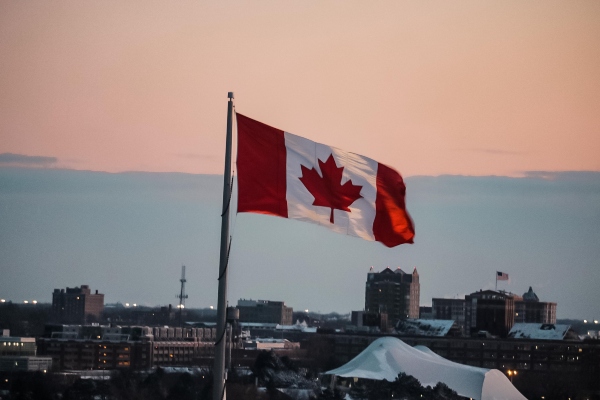
Photo by Jp Valery on Unsplash

BLF Sarmachaars attack Pakistan Army in Kech, kill 6 personnel

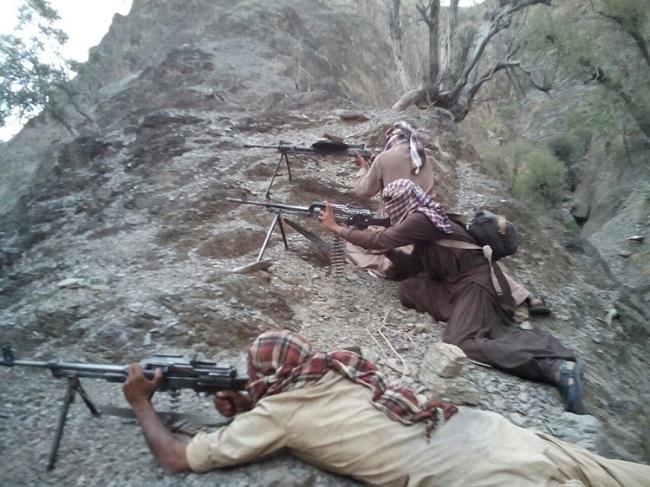
Kech/July 25: Balochistan Liberation Front (BLF) Sarmachaars (freedom fighters) on Saturday attacked a Pakistan Army convoy at Pidarak Jamak area in district Kech of occupied Balochistan and killed six personnel.

Balochistan Liberation Front (BLF) spokesperson Major Gwahram Baloch claimed responsibility for this attack and added that Baloch Sarmachaars (freedom fighters) had ambushed two Pakistan Army patrol vehicles with heavy and sophisticated weapons in district Kech of occupied Balochistan, thereby causing severe damage to both vehicles and killing six personnel. The dead included Pakistan Army’s Lance Naik Javed Kareem while others were injured.

Major Gwahram Baloch said that these attacks will continue until the independence of Balochistan. Pakistan continues to forcefully occupy Balochistan since 1948. Pakistan Army and its security forces have committed some of the worst forms of human rights abuses in occupied Balochistan, including rapes, abductions and murders. “Enforced disappearance” and the “kill and dump” policy has been the notorious human rights violation tools of Pakistan through which they have unleashed a reign of terror on the hapless Baloch population.

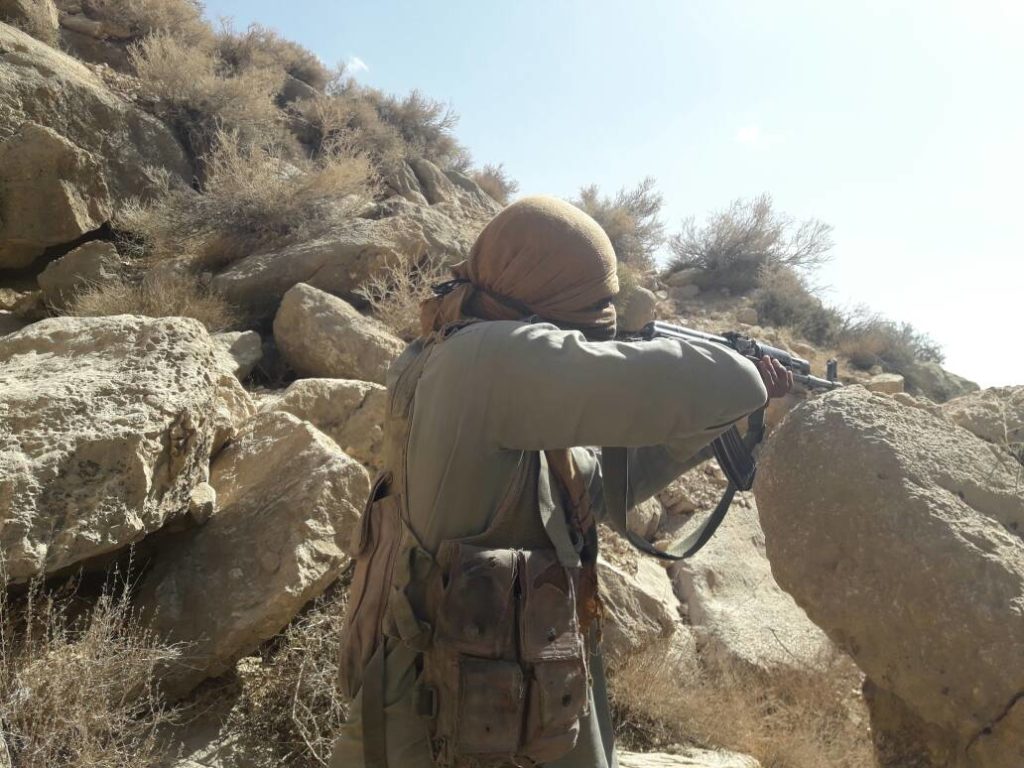
A freedom fighter of the Balochistan Liberation Front (BLF). The BLF strives to free Balochistan from Pakistan's illegal occupation.
BLF Sarmachaar (freedom fighter). The Balochistan Liberation Front (BLF) strives to free Balochistan from Pakistan’s illegal occupation.

Naya Pakistan has a Method in Madness for Abduction of Journalists

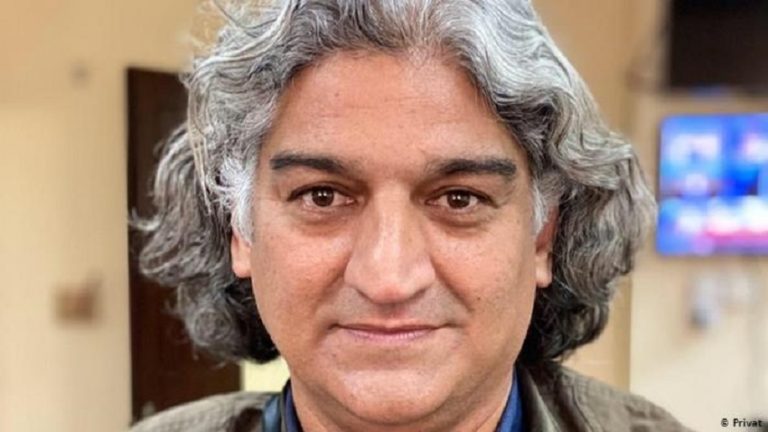
The broad daylight abduction of freelance journalist Matiullah Jan on July 21, from outside a school in Islamabad has validated Pakistan’s media watchdog Freedom Network’s observation in its ‘Pakistan Press Freedom Report 2019-20 (‘Murders, Harassment and Assault: The Tough Wages of Journalism in Pakistan- May 2019-April 2020’) that the federal capital is the “riskiest” area in Pakistan for media persons. Like all other journalists who have been abducted in the past, Jan too had a history of riling the establishment, particularly the military and its notorious spy agency, Inter Services Intelligence (ISI). So, while his abduction did come as big surprise, but it wasn’t something entirely unexpected!

Matiullah Jan was due to appear in court next week on contempt charges for having tweeted Islamabad High Court judge Shaukat Aziz Siddiqui’s controversial speech delivered at the Rawalpindi District Bar Association in which he had openly accused ISI of complicity in manipulating the judicial process by ‘fixing benches’ and lamenting that independence of judiciary had been compromised since it had been taken over by “those with guns”. But this isn’t the first time Matiullah Jan had a run-in with the military. In 2018, he was designated “anti-state” by the military for condemning the crackdown on media outlets as “a systematic attempt by the military and its intelligence agency to assert control with a facade of a democratically elected government.”

Pakistan Army (particularly the ISI) doesn’t have any stomach for criticism, and given its elephantine memory, those who incur the military’s wrath can never afford to sleep easy. It’s no secret that there are many Pakistani scribes like Hayatullah Khan, Saleem Shahzad and Sajid Hussain who paid with their lives for having antagonised the military or ISI by exposing its gross human rights violations in Balochistan and former Federally Administered Tribal Areas. But despite abundant evidence being available, no military personnel or intelligence officials have ever been brought to book for the extra-judicial killing or abduction of journalists.

Even those journalists who have been lucky enough to ‘survive’ abductions and have recounted their harrowing experiences indicting the ISI have got no justice from the courts and this gives credence to Justice Siddiqui’s claim of ISI ‘fixing benches’! For example, in his statement after an assassination attempt in 2014, Geo TV anchor Hamid Mir blamed ISI, but nothing happened even though fellow journalist Ansar Abasi went on record to reveal that ISI was extremely annoyed by Mir’s reportage about enforced disappearances of civilians in Balochistan and the army’s ‘kill and dump’ policy there.

It has also transpired that Mir had not only confided to his friends and colleagues regarding the apprehension of being targeted by ISI, but had also made a video of his testimony that was to be made public in the eventuality of his unnatural death. However, even though he revealed that intelligence officials had paid him a visit and attempted to intimidate him by saying that his name existed on a ‘hit list’ recovered from terrorists. Incidentally, this ‘hit list’ bluff bears a striking similarity with what the ISI had told journalist Saleem Shahzad three years earlier, few months before his abduction and murder!

The abduction of Gul Bukhari, 52, a British-Pakistani woman journalist in 2018 also had an uncanny likeliness to Saleem Shahzad’s abduction seven years earlier, in that just like him, she too was abducted while en route to a TV studio where she was to appear in a show. It was Ms. Bukhari’s strong criticism of Pakistan Army’s dubious role in politics and its efforts to manipulate elections that angered Rawalpindi. Her release just after four hours wasn’t an act of chivalry on the part of her abductors – it was simply because of (in Ms. Bukhari’s own words) “The pressure the entire world brought down immediately, within minutes and hours of the crime, was perhaps a unique factor in my early release.”

Gul Bukhari has been cryptic on the issue of her abductors’ identity. But her hint that “everyone seems to know who my abductors were” and the fact that she was abducted while travelling through Lahore cantonment’s high security zone does point a finger directly at the ISI. Furthermore, Ms. Bukhari’s driver confided in his colleagues that her abductors were men in plainclothes and those standing guard throughout the entire proceedings were wearing army uniforms. And by this, Ms. Bukhari’s driver has left nothing to imagination! Interestingly, her abduction came just one day after the then DGISPR Maj Gen Asif Ghafoor had warned against the rising trend of “anti-state, anti-Pakistan, anti-army, anti-forces” activities and boasted that the army has “the capability to monitor social media as to who is doing what.” Was this just a coincidence? No, says Ms. Gul Bukhari who does believe that her abduction was meant to serve as a message that “nobody is untouchable, no one is immune.”

Daniel Pearl Journalism Fellowship winner of 2007, Umar Cheema was just 32 years old in 2010 when he was abducted by a dozen men in commando fatigues at 3 AM in Islamabad when he was returning home. Taken to a house on the outskirts of the city, Cheema was beaten with a leather strap and metal rods as well as photographed while being sexually humiliated. Umar Cheema was told “This is the consequence of writing against the government,” and that “You are being punished for your reporting.” He was finally released several hours later in a village more than a hundred miles from the city, with the warning that “If you tell the media about this, you’ll be abducted again—and won’t ever be returned. And your nude pictures will be put on YouTube.”

Cheema’s only fault was that despite being warned by ISI (through his colleagues) that it was ‘unhappy’ with his work, he continued to criticise the Pakistan Army and ISI for being law unto themselves and being accountable to no one. But though Cheema decided not to keep quiet and recounted his ordeal, he still suffers from post-traumatic stress and admits that “You are haunted by fear all the time. I would wake up at midnight (thinking) somebody was beating at my back. Sometimes if there is a dog barking outside, I would be thinking somebody was scaling up the wall to get into my home and pick me up.” Cheema personifies the typical brave Pakistani journalist trying to uphold the ethics of journalism by subduing well-founded fears and apprehensions concerning personal safety in an environment controlled by the military that unfortunately has ‘zero-tolerance’ for criticism even when it is constructive.

Matiullah Jan’s safe return should have been a good reason for the journalist fraternity to rejoice. But there won’t be any celebrations, simply because this apparent act of madness is actually a grim reminder of the existence of a far bigger and sinister ‘method’ of using threat of bodily harm being rampantly used by the military and intelligence agencies in Pakistan to intimidate the media. Gul Bukhari rightly pointed out that being an “audacious” and “visible” act, abductions ensure that “If there was a sense of fear, now it is complete. Now there is not just sense of fear, it’s panic.”

Cheema too describes the after-effects of his abduction saying, “You don’t want to trust anybody. You feel suspicious of everybody. Anybody staring at you – you realise he may be after you… You feel such loneliness… When I came home, I would realize my family is already scared. How could I share these things with them? When I sat alone, I was thinking about my crisis and how dear it could cost – if something happened to me, what would be the consequences for my family?”

This is exactly what ISI wants and as such, come what may, in Pakistan, abductions of journalists who refuse to toe the army’s line will continue as hitherto fore! 

Tailpiece: The abysmal state of media independence in Pakistan with specific reference to safety of journalists has even shocked international media watchdog Reporters without Borders (RSF). In a scathing indictment in its 2020 report titled ‘Under the military establishment’s thumb’, RSF has noted that “Pakistani media, which has a long tradition of being very lively, has become a priority target for the country’s “deep state,” a euphemism for the constant manoeuvring by the military and Inter-Services Intelligence (ISI), the main military intelligence agency, to subjugate the civilian executive.”

Whereas there may be nothing new in what RSF has stated, but it’s observation that “The influence of this military “establishment,” which cannot stand independent journalism, has increased dramatically since Imran Khan became prime minister in July 2018,” does convey the sinister but candid message- there’s no place for upright journalists in Imran Khan’s “naya” (new) Pakistan!

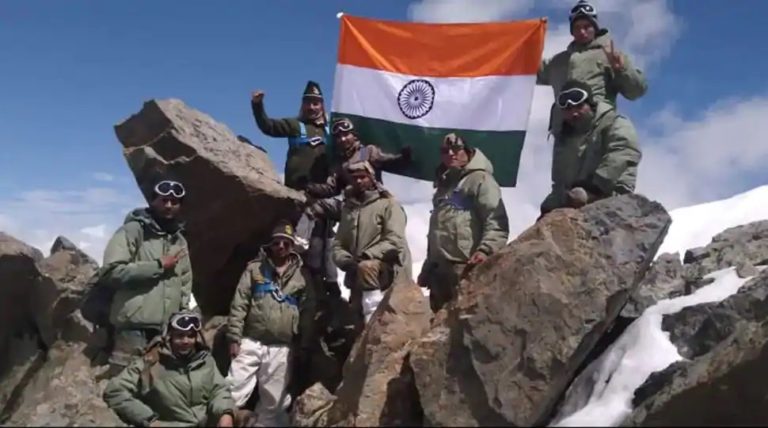
Indian security forces kill 2 terrorists, total 143 eliminated this year

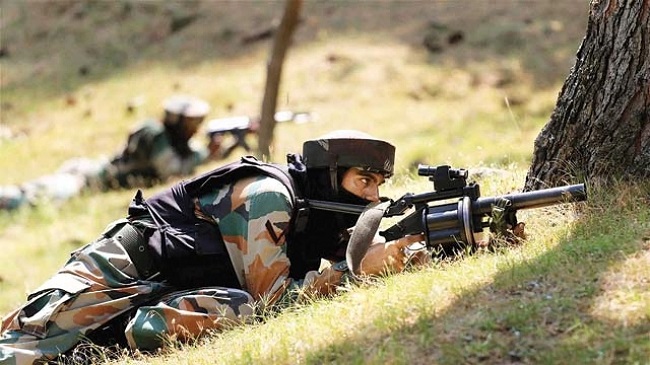
Srinagar, July 25: Security forces foiled a terrorist attack in Srinagar on Saturday as they gunned down two terrorists on the city’s outskirts. Searches operations are underway to flush out any remaining terrorists in the area.

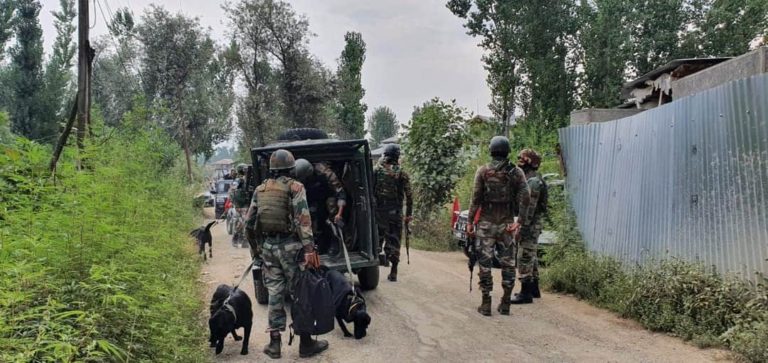
On Saturday morning, Special Operation Group (SOG) of J&K police, 29 Rashtriya Rifles and Central Reserve Police Force (CRPF) cordoned off Ranbirgarh on Srinagar-Bandipora road after they received specific inputs about the presence of terrorists.

“The joint team of SOG, RR and CRPF were fired upon by the hiding terrorists,” a senior police officer said. “The fire was returned and in ensuing gunfight two terrorists were killed.”

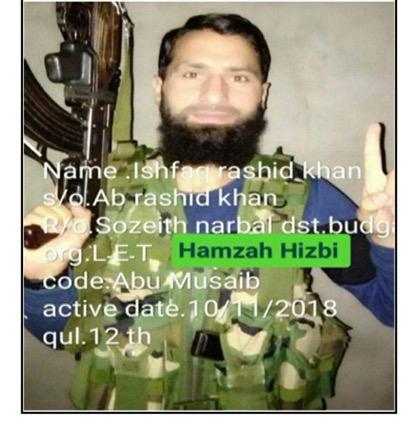
One of these terrorists eliminated on Saturday was a top LeT (Lashkar-e-Taiba) commander whom police has identified as Ishfaq Rashid resident of village Sozeith, Srinagar.

Terrorist Ishfaq Rashid who was killed in the encounter by Indian security forces on Saturday. (Photo: News Intervention)

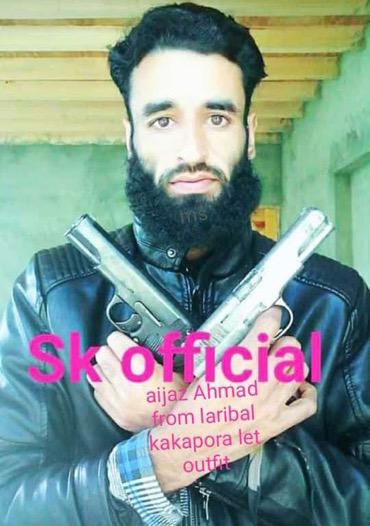
“He was one of the top LeT commanders active since 2018 and wanted in many cases of terror violence,” a senior police officer told News Intervention. He added that the other terrorist killed in the encounter was Aijaj Bhat, an important LeT (Lashkar-e-Taiba) cadre from Pulwama district of south Kashmir.

Aijaz Ahmad Bhat, LeT terrorist who was killed by Indian security forces in Saturday encounter. (Photo: News Intervention)

Inspector General of Police, Kashmir Zone Vijay Kumar confirmed the killing of two terrorists in Srinagar. He said identities and group affiliations of the slain terrorists are being ascertained. Vijay Kumar said that operation is underway to flush out the remaining terrorists, if there are any.

Police source told News Intervention that terrorists were most probably trying to enter inside the Srinagar city to carry out out an attack. However, they were killed before they could create any mayhem in the valley.

Joint team of J&K Police, 29 Rashtriya Rifles and CRPF during operation against the terrorist hideout at Ranbirgarh in Srinagar on Saturday. Two terrorists were killed and a search operation was launched to flush out any remaining terrorists. (Photo: News Intervention)

After the killing of these two terrorists, the total number of terrorists neutralised by Indian security forces in Kashmir has risen to 143.

Shaima Jaff Speaks About Experiences in “My Home is a Suitcase”

My Home is a Suitcase” is a play by Rzgar Hama about individuals who sought new lives as immigrants. It is based out of Vancouver, British Columbia, Canada. These are real stories. The next few interviews will be from some of the individual readers of their stories of beginning new lives in Canadian society. Hama is known for several plays, including “Soldierland” with some professional commentary by Dr. Marvin Westwood and Dr. George Belliveau of The University of British Columbia in “Dr. Marvin Westwood & Dr. George Belliveau on SOLDIERLAND a play Written and Directed by Rzgar Hama.” Here I speak with Shaima on “My Home is a Suitcase.”

No description available.
Sky Theatre Group, “My Home is a Suitcase”

Scott Douglas Jacobsen: How did you become involved with “My Home is a Suitcase”?

Shaima Jaff: I was trying to recruit for “My Home is a Suitcase.” Then asked a lot of questions about the project, Rzgar explained to me. I asked, “Can I attend?” Because I came here as a refugee telling my story to others.

Jacobsen: What was the experience of telling the story – without telling your story – to some of the public and peers who made a new life for themselves?

Jaff: In the first part of the project, we told our story, directly. I felt good talking about my struggles before coming to my new home, Canada, and what I achieved here. Also, my goals for the future. 

Jacobsen: What was working with a seasoned, veteran playwright and director like for you?

Jaff: Writing was not new to me. I was a journalist back home, writing a short story and poems. Writing about my real life, it was different and difficult. Because of my emotions and feelings, it was just for me, in this project, by sharing it with others; it opened a new door for me. In my culture, we keep most of the things in secret. We do not talk about our life in public. During the practice, by writing and acting, I was thinking, “What should I share? Should I tell the truth?” I wasn’t comfortable telling my story.

Jacobsen: What are you hoping some of the audience takes home with them when the final production comes out?

Jaff: Good question 🙂 How strong I am, to understand our struggles. Sometimes, I hear bad and harmful comments here in Canada about refugees and where I came from. As if I have a choice where I want to be born, what name and colour I might want, life was different. 

I have a second chance to have a country to be proud of: Canada let me live my dream. As a Kurdish, I don’t belong to anywhere. We are everywhere.

Jacobsen: Thank you for the opportunity and your time, Shaima. 

Jaff: I really appreciate your great support. Thank you for giving me the opportunity to talk about my experiences about “My Home is a Suitcase.”

Photo by Erwan Hesry on Unsplash

Image Credit: Soran Mardookhi, and Rzgar Hama/Sky Theatre Group.

Mida Maleki Talks About Participation in “My Home is a Suitcase”

My Home is a Suitcase” is a play by Rzgar Hama about individuals who sought new lives as immigrants. It is based out of Vancouver, British Columbia, Canada. These are real stories. The next few interviews will be from some of the individual readers of their stories of beginning new lives in Canadian society. Hama is known for several plays, including “Soldierland” with some professional commentary by Dr. Marvin Westwood and Dr. George Belliveau of The University of British Columbia in “Dr. Marvin Westwood & Dr. George Belliveau on SOLDIERLAND a play Written and Directed by Rzgar Hama.” Here I speak with Mida on “My Home is a Suitcase.”

No description available.
Sky Theatre Group, “My Home is a Suitcase”

Scott Douglas Jacobsen: We’ll keep this focused on an initiative by Sky Theatre Group under Rzgar, “My Home is a Suitcase.” How did you find the Sky Theatre Group?

Parmida Maleki: I actually heard about the Sky Theatre Group from Rzgar himself through the “My Home is a Suitcase” project. It has been amazing to work with the group. 

Jacobsen: How did you become involved with “My Home is a Suitcase”?

Maleki: Hila Graf, who was the Assistant Director on the project let me know about this opportunity to tell my story and I jumped on it. My story has seen many ups and downs, and I was very excited about having a chance to talk about it and bring it to life for others to see. 

Jacobsen: What was the experience of telling the story – without telling your story – to some of the public and peers who made a new life for themselves?

Maleki: It was so inspiring to hear about other people’s journeys, and humbling to talk about my own. I believe it’s very important for the world to know these stories, put a face on the “Immigrant” and the “Refugee.” Many have no clue as to what exactly is happening to people around the globe, and knowing we were able to get the word out, about our truth, is just amazing. 

Jacobsen: What was working with a seasoned, veteran playwright and director like for you?

Maleki: Oh absolutely great. It was amazing to sort through my own life events, bring them on paper and have someone else’s perspective on it. The process of fitting the story in 10 minutes, without dropping the ball on what is actually important, was brilliant.

Jacobsen: What are you hoping some of the audience takes home with them when the final production comes out?

Maleki: Perspective and context. I believe that is the most important thing in our world today. We are so used to having our perspectives being shaped by the media, seeing and realizing that people’s lives shouldn’t be a propaganda, and that everyone has the right to seek a better environment to live in.  

Jacobsen: Thank you for the opportunity and your time, Parmida.

Maleki: Of course. Thank you for your time.


Photo by Arnel Hasanovic on Unsplash

Image Credit: Soran Mardookhi, and Rzgar Hama/Sky Theatre Group.

Pakistan uses its puppets to subvert democracy in POK

The news about attack on free thinkers in Rawalkot (Pakistan-occupied Kashmir) by a tribal group is not the complete story. Simply because this is not just an attack by a tribal group, rather it’s the hand of ruling classes sitting in Muzaffarabad behind these attacking tribal group that must be looked in detail. From generation to generation occupying forces of Pakistan have been looting state resources in POK with the privileged classes playing a supporting role.

Occupying Pakistan uses its puppets to deprive the people of Occupied Kashmir of their democratic right to vote. Propagation of any ideology through peaceful means and methods is a fundamental human right and this is a universal human right across the world. It is also present in the constitution of Pakistan, but Pakistan does not take into account any principle in depriving the people of their right to vote in their occupied territories. This is Pakistan’s history from Bangladesh to Balochistan and from Sindh to Pakhtunkhwa. Occupied Kashmir has its own free thinking atmosphere.

It’s in this context that the July 19 terrorist attack on JKPP (Jammu Kashmir Peoples Party) by a tribal group during a joint peaceful protest organized by the ideologically aligned organizations such as JKNAP (Jammu Kashmir National Awami Party) and JKNSF (Jammu Kashmir National Students Federation) against the false, baseless and anti-people occupation of Pakistan is important. Since 1947, history has slapped the false mujahids and invaders in their face and proved them to be traitors of the land. In occupied Kashmir also they have resorted to high-handed tactics. But the people of occupied Kashmir are beginning to understand the difference between slavery, recognizing right and wrong and are now exposing the culprits of history.

The state of Pakistan is being exposed in front of the people of Jammu and Kashmir. The people of occupied Kashmir have understood the doublespeak of occupying Pakistan and its proxies are being exposed in front of the people of POK. And so the occupying power and its dummy rulers are fearful of the development. They want to stop this development by force and coercion, but the movement of development and progress cannot be stopped by any coercive means. Elimination of obsolete ideology and thinking and the victory of modern ideology over these occupying mindset is inevitable.

As a result of the July 19 attack on the Liberals in POK, the Liberal and Progressive forces will have to formulate a serious strategy, not only to remain united in alliance but also to form alliances with the Baloch, Pakhtunkhwa and Sindhi movements. The struggle of the subjugated classes becomes common. Given the role of the fascist and occupying state of Pakistan, engagement with friendly forces is need of the hour. And given the current situation, the responsibilities and duties of the People’s National Alliance (PNA) have increased.

In order to fulfill these duties and responsibilities effectively, the PNA will have to formulate a clear and solid policy. Our struggle must take a more mature form and move on to the next step. It’s the demand of time and it is imperative to openly support the struggles and movements of the subjugated nationalities and oppressed classes. It will be a process of strengthening our struggle externally, and internally facilitating the lost rulers and the role of the occupying state. By exposing it to the world, the solid foundation of the people’s resistance movement must be laid.

Pakistan pushing terrorists in Kashmir to disrupt Art 370 revocation anniversary

Srinagar, July 24: In less than 24 hours Pakistan has violated ceasefire at two places in north Kashmir leaving a woman injured. Indian Army says that violations are being done to push more terrorists in the Kashmir Valley in the wake of first anniversary of abrogation of Article 370.

The ceasefire violations (CFVs) took place in Nowgam and Tangdhar sectors of frontier district of Kupwara in north Kashmir. Senior Indian Army officials of the Srinagar-based 15 corps said that on the LoC, the number of ceasefire violations have gone up since last year and has remained high since.

“The Pakistan Army is keen on pushing more terrorists,” a senior Army officer told News Intervention. “First anniversary of the abrogation of Article 370 is very near and we believe they might try to disrupt the prevailing peace.”

https://twitter.com/ChinarcorpsIA/status/1286332249915314176

The figures available with the Indian Army reveal that that there have been 2,215 ceasefire violations (CFVs) recorded on the LoC till June 25 this year. A total of 3,168 ceasefire violations were recorded in 2019, and 1,629 in 2018.

During May 2020 there have been 382 ceasefire violations on the LoC and 302 in June, rising sharply from the 221 and 181 ceasefire violations recorded during these two months in 2019.

Quite recently, General Officer Commanding 15 Corps, Lt General BS Raju had told the reporters that Pakistan’s attempt to assist more terrorists to infiltrate into India are part of its efforts to disrupt normalcy in the Kashmir Valley.

“Pakistan Army facilitates these infiltration attempts,” Lt. Gen. BS Raju had said adding that Pakistan’s persistence in infiltrating terrorists, proliferating false propaganda are intended to disturb peace and its actions are unlikely to change anytime soon.

In needs to be emphasized that besides preventing infiltration, there has been a marked intensity in counter-terror operations in the Kashmir Valley.

As per official data, so far 141 terrorists have been killed in the Kashmir Valley this year. A total of 158 terrorists were killed in 2019, which was down from 254 in 2018 and 213 in 2017. This is an indication that terrorism is gradually declining in the Kashmir Valley, which is why Pakistan is desperate to facilitate infiltration of terrorists into Kashmir.

A senior Army officer posted in Srinagar added that security forces in Kashmir have been additionally proactive. “ It is a good strategy to keep the terrorists on the run,” he said adding that because of the pressure in the hinterland, the handlers in Pakistan are trying to heat up the LoC to divert attention of the Army.

Pseudo-Godmen and the game of religious conversions in Punjab

Punjab, since millenniums, has been home to a number of ethno-religious communities. The region takes pride in its diversity and has always remained open to the coexistence of different religions and faiths. This ethos and tradition continues till date. In the present context, Sikh are a majority religion while Hindu, Islam and Christianity continue to be practiced along with other smaller religions.

In the mid-19th century, Punjab became a part of the British Empire and evangelistic efforts by Christian missionaries gained momentum. The first preachers came from Europe and they quickly created a local base with translation of Christian texts, including the New Testament and the Gospel, into both Hindi and Punjabi. The conversions were, by and large, due to two reasons. First, to remove the shackles of the caste system which led to the conversion of Hindus. Second, to take benefits that entailed from being a Christian, especially in the field of education and health.

In colonial Punjab, maximum concentration of Christians was in Gujranwala, Sialkot and Sheikhupura districts. The most prominent Christian of Indian origin in the early twentieth century was Raja Sir Harnam Singh, a scion of the Kapurthala Royal family who put in a lot of effort towards spreading the word.

The Punjabis who chose to convert to Christianity continued to observe cultural affinity with Punjab to include use of Punjabi language, cuisine, dress code and other aspects. They also actively participated in the various festivals, traditions and customs of Punjab.

At the time of partition, areas with a larger concentration of Punjabi Christians went to Pakistan where they chose to stay. This was the beginning of the horror that they are witnessing till date. In Pakistan, the Christians have been reduced to menial jobs, mainly sanitation, and continue to be called “Churas” (sweepers). They have been kept in a state of poverty and lack of development since the elitist Punjabi Muslims do not want to do menial jobs and are content in having Christian serfs doing the same for them. They continue to be nothing more than bonded labour. In Pakistan Punjab an estimated 80% of the sweepers and cleaners are Christians.

Christians in Pakistan are being subjected to the most horrendous form of persecution. Apart from an impingement of their fundamental rights in terms of education, health and other facilities that the state is bound to provide to them, they are being subject to horrifying human rights violations. Hundreds of them have been killed or incarcerated under the infamous Blasphemy Law; many continue to languish in jails without any judicial support whatsoever.

International Christian organisations have been attempting to give legal support to these hapless people. There are instances, like the case of Asia Bibi, who was given a death sentence for blasphemy that was later on commuted due to pressure from western countries. She has now left Pakistan after having been granted asylum in France. Such good luck cases, however, are few and far between; most are killed for so-called Blasphemy or spend their lives in jail. By and large the Christians of Pakistan are a suppressed, exploited people who are not even allowed to seek refuge in India since they are required in their country to do all the dirty work.

Christians are settled all across Indian Punjab but are more concentrated in Gurdaspur, Amritsar, Jalandhar, Ludhiana and Firozepur districts. They too predominantly belong to the lower strata, but, due to equal opportunity being provided by the democratic Indian state, many have acquired good education and are on to jobs in different fields. There are Christians in the higher strata of society too as is seen in the large cluster of the Masih Christian community.

While the census puts the Christian population in the state at about one or two percent some senior members, pastors and social activists of the community like Imanul Rehmat Masih, Father Peter Kavumpuram, spokesperson of Jalandhar Diocese and George Soni, President of the Punjab Christian United Forum say that it stands at about 7 to 10 percent. It is on this basis that the Christian community leadership is making demands for more representation in the State Legislative Assembly by grant of minority community status and reservation under backward classes.

Successive governments have been seized with the effort to provide special impetus to the Christians. The Shromani Akali Dal-Bharatiya Janata Party coalition Government had established a Christian Welfare Board in July, 2016. It was through the proceedings of this Board, under its chairman Salamat Masih that instructions have been passed by the Government to Rural Development and Panchayat Departments to identify common village land (‘Shamlat’) and provide additional and adequate burial grounds for the community across the state. There are various concessions in education, state, employment etc. that are being given to Christians.

Christianity has a strong Church with established practices to look after the spiritual needs of the followers. The preachers take vows of the Church and become a part of the theological structure for life. They have a set hierarchy and appointments and are addressed as Father, Mother and Sister. They look after the Churches and other religious social, education institutions, conduct all religious practices and give sermons. There are negligible extra-constitutional  institutions involved in preaching practices in the Christian faith.

Surprisingly, Punjab is witnessing rapid proliferation of Christian Deras (religious sects) as is the case with other religions also. This is a deviation from established religious ethos and tradition of the Church and is also resulting in blatant exploitation of the emotions and sentiments of people in the name of name of Christianity and more critically, Jesus Christ. Normal people who have no education in Christian theology or the necessary sanction to preach, are becoming self styled “Apostles” and “Pastors” of these new age Deras. In the bargain they are earning huge amounts and have tremendous power as in the case of Dera chiefs of the Sikh and the Hindu communities.

These Christian Dera chiefs are mostly first generation converts from among Hindus and Sikhs alike and from different castes like Jats, Khatris etc. They are media savvy and have a considerable presence on various mediums of social media, especially You Tube, Face Book, Twitter and Instagram. While on stage they behave like Rock Stars complete with music, props and attendant drama.

They hold the pulse of people and speak about the problems faced by Punjabis especially in rural areas. They are adept at hitting weak spots and speak of miracles being performed in the name of Jesus Christ to remove diseases, alcohol dependency, drug abuse, marital discord, depression etc. They have managed to build their own Churches without sanction from established Christian authorities. They also have community halls and what they call open door Churches. In the process they have amassed untold wealth and are seen living in palatial houses while driving around in luxury cars.

All of this is creating trust deficit between the Christian community and the other communities of Punjab since it is perceived as a well organised system to carry out conversion to the faith, especially of those who belong to a marginalised section, are less educated and vulnerable to psychological manipulation.

The deteriorating social, economic and political situation in Punjab also has a big role to play in the ongoing religious churning being witnessed. Post the attack on Durbar Sahib in 1984 and the long period when Punjab was in the throes of debilitating militancy, there was a perceptible leadership vacuum, especially so, in the Sikh community. The leadership gap remained even when the environment changed, peace returned and normal activity started. It is this shortage of good leaders, role models, ideologues, intellectuals to guide the society which has created a space for all sorts of mavericks and pseudo Godmen to take center stage.

Punjab is today known for the proliferation of personality based Deras (religious sects) in all religions. Dera chiefs, who hold absolute authority in their Deras, are adept at influencing semi-literate, impressionable people with sweet words and a show of miracles. Many such Dera chiefs have been found to be indulging in criminal activities and are now imprisoned for the same. With the space in the Sikh and Hindu communities quite filled up these elements have hit upon Christianity as the latest cash cow. It is not without reason that the Christian self-styled “Pastors and Apostles” in Punjab are all in the 30-40 age bracket. The intention is to earn unimaginable wealth, boost followers and trigger conversion to Christianity.

Sabu Mathai Kathettu, a Christian missionary, in 2009 has published a report that lays down a well planned methodology for conversion of Sikhs to Christianity. The main among many recommendations is the need to attract Sikhs of high caste into the fold of Christianity to gain better and faster results. The emphasis was recommended to be on propagating the Gospel in the Punjabi language and through Satsang type of congregations that the Sikhs are more comfortable with. When seen in this context, the proliferation of informal Godmen and Christian Dera chiefs starts making sense. The conversion process needs to be looked upon with utmost seriousness. Any religious activity that is based on exploitation needs to be stopped.

Pak forces abduct Baloch mother, hand her to ‘Death Squad’

Mashkey/ occupied Balochistan: Pakistan’s barbarism continues in occupied Balochistan with the abduction of another Baloch woman by Pakistani forces from district Awaran. Naz Bibi, mother and a resident of Qalat area of Mashkey in district Awaran was abducted four days ago and shifted to a military camp where she has been subject to inhuman torture.

Local sources in Balochistan told News Intervention that Naz Bibi was first subjected to extreme physical and mental torture and then handed over to a state-backed ‘Death Squad’ goon named Akram Sajidi.

Baloch sources said that Pakistani forces had abducted Naz Bibi on an earlier occasion but at that time she was released after a few days torture in the Pakistani military torture cells.

Pakistan’s military barbarism and war crimes are increasing with each passing day in occupied Balochistan. Local Baloch sources asserted that this is not the first tragedy where a Baloch women has been forcibly abducted, subjected to extreme torture and later on handed over to the Death Squads’ goons. These forced abductions have been taking place in Jahoo, Koh-e-Isfeet, Ragy and other areas as well.

Baloch locals said that Mashkey completely turns into a military camp where after 7 PM nobody is allowed to step out of their homes but then the Pakistani security men forcefully enter the houses, misbehave with women and harass the Baloch men and children.

However, Pakistan Army along with its backed ‘Death Squads’ have made a complete network to spread drugs among youth across occupied Balochistan. Local sources said that Pakistani security men and their Death Squads forcibly inject drugs on children in Mashkey, district Awaran.