Experts at the Lancet Countdown, which is a coalition of 35
institutions including the World Health Organization and the World Bank, has
said that climate change will damage the health of an entire generation unless
there are immediate cuts to fossil fuel emissions, from a rise in deadly
infectious diseases to surging malnutrition.
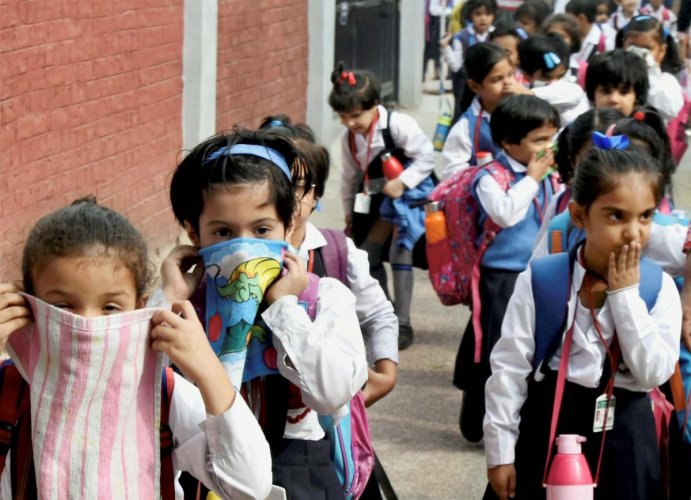
Children across the world were already suffering the ill
effects of air pollution and extreme weather events, said The Lancet Countdown
in its annual report on the impact of climate change on human health. And far
worse is to come for future generations, it warned: air-borne diseases,
malnutrition due to mass crop failures, and even mental and physical trauma
from increased flash flooding and wildfires.
Their warning comes as some of Australia’s worst wildfires
in living memory continue to burn across its eastern seaboard, and after a
global youth strike inspired by Swedish schoolgirl Greta Thunberg.
August was the hottest month ever recorded and Earth has
already warmed one degree Celsius (1.8 Farenheit) since industrialisation.
The Paris Climate treaty of 2015 enjoins nations to limit
temperature rises to 2C, or preferably to 1.5C if possible. Yet emissions
continue to rise year on year, putting Earth on a path that could lead to a 4C
temperature rise by the end of the century — bringing peril for human health. The
report said “nothing short” of a 7.4 percent year-on-year cut in CO2
emissions until 2050 would limit global warming to 1.5C.
The report, compiled by 120 experts, used the latest
available data and climate modelling to predict global health trends as the
mercury climbs throughout the decades.
In parts of the world already, the health effects from
climate change start in the first weeks of a baby’s life.
In the last 30 years, the global yield potential of staple
crops such as maize, winter wheat and rice, have all declined, putting infants
and small children at heightened risk of malnutrition. Infant malnutrition
impacts every stage of a child’s life, stunting growth, weakening the immune
system and throwing up long-term developmental problems.
More children will also be susceptible to infectious disease
outbreaks. In three just three decades, the number of days worldwide of prime
infectiousness for the Vibrio bacteria — which causes much of child diarrhoeal
disease worldwide — has doubled. This not only increases the likelihood of
children contracting diseases such as cholera in at-risk regions, it also
enlarges their spread. The report found that mosquito-borne diseases such as
dengue and malaria were also on the march, putting half of the world’s current
population at risk.
And people in cities are already suffering premature disease
and death from air pollution — coal plants alone contributed a likely one
million premature deaths worldwide in 2016.
Extreme weather events are likely to proliferate as
temperatures climb, posing increasingly frequent economic disruption. For
example, in 2018, 45 billion hours of work were lost due to extreme heat
globally compared with 2000. The study found that last year an additional 220
million over-65s were exposed to extreme heat, compared with the historical
average.
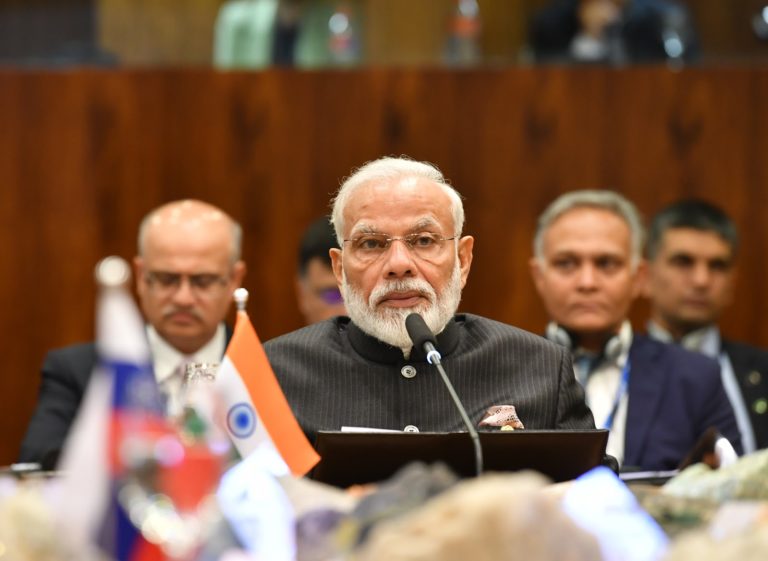
While addressing the Plenary session of XI BRICS Summit in
Brazil today Prime Minister Narendra Modi said that sustainable water
management and sanitation are important challenges in urban areas and proposed
to hold the first meeting of BRICS Water Ministers in India.
Recalling about the recent ‘Fit India Movement’ started in
India, he said that he wanted to increase contacts and exchanges between the
BRICS in the field of fitness and health.
Speaking on the occasion, Prime Minister said that the theme
of this summit – “Economic growth for an innovative future” is very apt.
He said that Innovation has become the basis of our development. He emphasized
that it is necessary for strengthening the cooperation under BRICS for
innovation.
Prime Minister said that now we have to consider the
direction of BRICS, and mutual cooperation should be more effective in the next
ten years. He highlighted that despite success in many areas, there is
considerable scope to increase efforts in some areas. PM called for paying
special attention to mutual trade and investment, as Intra-BRICS trade accounts
for just 15% of world trade, while the combined population is more than 40% of
the world’s population.
He was happy that the first Seminar on BRICS Strategies for
Countering Terrorism was organized and hoped that such efforts and activities
of the five working groups will increase strong BRICS Security Cooperation
against terrorism and other organized crimes.
PM concluded that with the mutual recognition of visas,
social security agreement and qualifications, we will give people of the five
countries a more conducive environment for mutual travel and work.
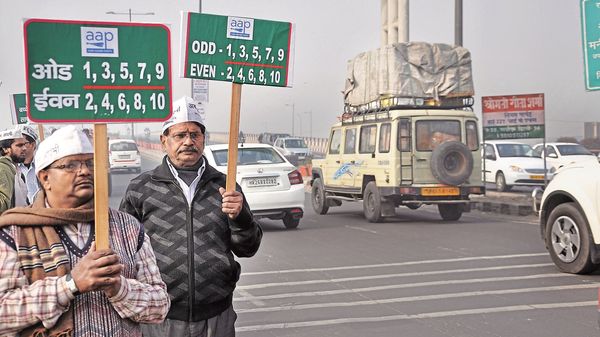
Delhi government’s ambitious “odd-even” scheme for vehicles draws to a close on November 15, even as the air quality once again plunged to “severe” category in National Capital Region (NCR). The jury is still out on the level of impact this scheme has had on controlling pollution and Dilli walas seem to be divided on its implementation.
The good news and perhaps the biggest achievement of the scheme has been to churn awareness. The debate today is about the extent of this impact. That’s for the environmentalists to study and come up with a report. Importantly, the implementation of the odd-even scheme is an acceptance of the pollution menace. For the first time a chief minister in the country has shown courage to acknowledge this problem of pollution and thrash out an out of the box formula.
Let’s also understand why the scheme may have had limited success. With several exemptions, the number of cars on Delhi roads had not reduced drastically which could have led to a massive drop in vehicular emissions. Yet, despite the limitations, the need of the hour is to tackle this menace head on and continue to think out of the box.
Air quality in Delhi and its neighbouring states is never very healthy — it is a problem which we brave throughout the year. Though burning of paddy stubble in the neighbouring states contributes the lion’s share in Delhi pollution, vehicular emission which also contributes to deterioration of the air quality needs to be curtailed as well.
The sceptics of odd-even scheme have challenged it in the Supreme Court. Questioning the efficacy of the scheme, the petition against odd-even underlines that the scheme is in violation of the fundamental rights especially when there is no restriction on two wheelers. The apex court has sought data on AQI (Air Quality Index) during the odd-even scheme from the state government. Yet we need to realise that pollution is an emergency and we need to address it on a priority basis if we want socio-economic development.
It is imperative to have clean air – not only to ensure health of our citizens but to create a conducive business environment in the country. After all New Delhi is the country’s capital city. The least the governments—both central and state—can do is to ensure that there is clean air and less pollution. This will make this country a more attractive investment destination. With economic growth slowing down, the NDA government is trying to thrash out various measures to boost demand and attract investments. But it is absolutely disheartening to see that pollution does not feature in any of these reform measures. To ensure long term sustainable growth and investments, we need to have clean air.
The ruling BJP-led NDA Government took a major political
decision of amending the Constitution by revoking Article 370 and bifurcating
the state into two Union Territories that formally came into being
on October 31. Girish Chandra Murmu
and RK Mathur have assumed the office of Lieutenant Governors of
Jammu & Kashmir and Ladakh respectively.
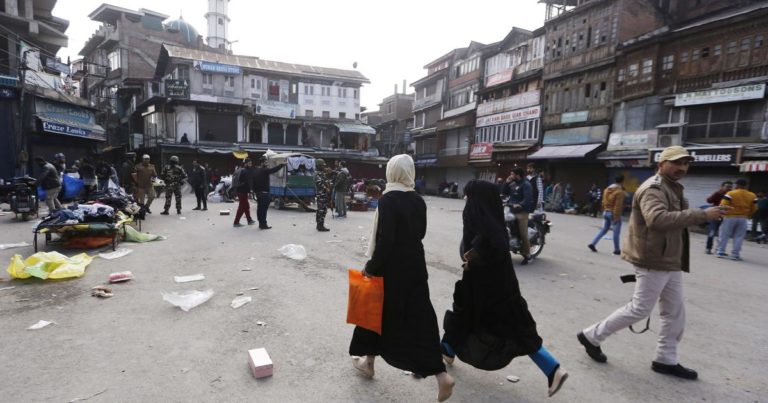
Though this momentous decision has ruffled many feathers in
political circles, it has received a ‘thumbs up’ from the public. Keeping the
region under central rule will assist in provision of good governance and speed
up the development process. New Delhi has already committed to give full
statehood to Jammu and Kashmir when things stabilise.
The credibility of J&K’s ‘mainstream’ political parties in
the state had already hit rock bottom since the key players misused the trust
that the people of Kashmir reposed on them. Irrespective of which party
came into power, corruption and misgovernance continued unabated. The lackadaisical
approach towards governance caused immense suffering to the people; even the
very basic aspirations of the people remained a distant dream.
While the mainstream political parties are making much hue and
cry over abrogation of Article 370 and bifurcation of J&K into two Union Territories,
the fact is that they themselves have forced New Delhi to take steps to break
their monopoly. Decades of dynastic rule in J&K had created an atmosphere
of sycophancy and this prevented capable and dedicated youth from finding their
rightful place as leaders of political parties.
To suit their self-serving interests, many have been exploiting
the situation by painting a doomsday picture. Inimical forces have been
portraying conditions in Kashmir to be inhuman with the locals “caged” by
security forces. Weird analogies such as the Nazi movement that resulted in
persecution of Jews are being played out.
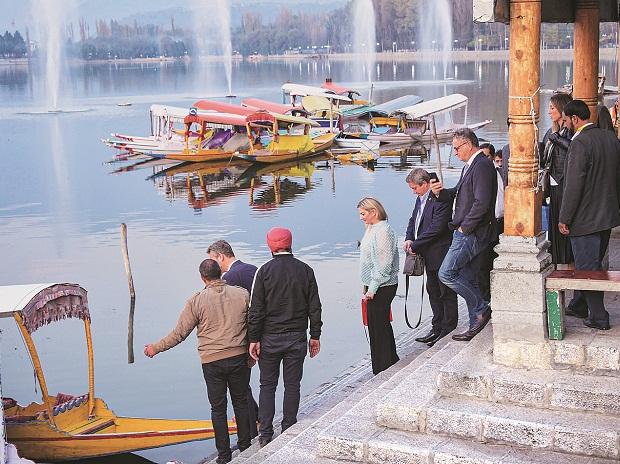
It is under these circumstances that the Government of India
invited a delegation of 27 European Union MPs from nine countries to visit
Jammu and Kashmir. This author got an opportunity to personally interact with
the members of the delegation and get their views first hand.
After meeting people belonging to different sections of the society in Kashmir the delegation realised that despite getting adequate funds, the local political parties had done nothing for the people, due to which, there had been no development and widespread corruption. While the delegates made it clear that they were not here to interfere with Indian politics, they fully understood that abrogating Article 370 is India’s internal matter. A delegate pointed out that “Kashmir is backward because of the situation. The message we got from the people we met was that there is hope that the change in status will help reverse the situation.” The delegation said that the people of Kashmir want peace and development; they want schools and hospitals and not guns and ammunition.
Expressing concern over Pakistan-sponsored militancy as it is
the major factor for instability in Kashmir and is claiming lives of innocent
people, one of the members said, “First of all, this visit in my view is of
very high importance. In Kashmir, militancy is severe and this is a global
question. Police and army have apprised us of how militants have been sent from
Pakistan.” The delegation members said that they do not want to see Kashmir
becoming another Afghanistan. One delegate said, “Terrorists can destroy a
country. I have been to Afghanistan and Syria and I have seen what terrorism
has done. We stand with India in its fight against terrorism.”
Newton Dunn from the UK described the visit as an “eye-opener”,
adding that the delegation would advocate what they had seen on ground zero.
“We belong to a place Europe which is peaceful after years of fighting. And we
want to see India becoming the most peaceful country in the world. And for that
we need to stand by India in its fight against global terrorism. The delegation
expressed hope that the change in status will improve the situation of the
state.
Kashmir is a flashpoint between two nuclear countries. Tensions
in Indo-Pak relations worry the international community and thus the visit of the
EU MPs delegation to Kashmir after New Delhi scrapped Article 370 is
timely. Business suffered an estimated loss of Rs 10,000 crore in this
current turmoil while tourism and education has been badly affected. Apple
industry, which is the main component in Kashmir’s economy, was hit the most
due to prevailing situation and has been further harmed by targeted killings of
those connected with apple trade industry by militants.
For the people of Kashmir, it’s important to get over petty
issues and look at the larger picture so that they are not left behind in their
quest for improving their economic status. If Kashmir does not open out to
India and onwards to the world, it will be left out of the development loop and
will regress by many centuries. The effort of the elected government is to
ensure that nothing of this sort happens and that’s why all energies are being
channelized towards bringing the region at par with the rest of the country.
The idea, in fact, is to see the region surging ahead on the basis of the
abundant economic possibilities that are available there.
Dr. Mir Faizal is an Adjunct Professor in Physics and Astronomy at the University of Lethbridge and a Visiting Professor in Irving K. Barber School of Arts and Sciences at the University of British Columbia – Okanagan.
Here we start the cosmology educational series on the differences between the classical and the quantum worlds.
Scott Douglas Jacobsen: We have heard terms like classical physics and quantum physics. What do these terms mean in simple words, and what is the difference between them?
Dr. Mir Faizal: We have evolved at a certain scale, and our intuitive understanding of the world is also limited to that scale. Now common sense is the expression of this intuitive understanding of the world in languages like English or French. If this intuitive understanding of the world is expressed in mathematics, we naturally will obtain a mathematical description of common sense. This mathematical description of our intuitive understanding is called classical physics. However, there is no fundamental reason why such a description will hold at a different scale. In fact, now we have known that the classical description does not hold at very small scales, and common sense seems also to break at such a scale. It is hard to accurately describe the world at such a small scale using languages like English or French, as these languages have not been evolved to describe the world at such a scale. However, it is still possible to mathematically describe the world at such a small scale, and this mathematical description of a small scale is called quantum physics. Even though it is not possible to describe the world at such a small scale in common language, it is possible to use analogies to understand physics at such small scales.
Jacobsen: We see the world
around us, and know how it behaves, and this forms a basis for our common
sense. You mentioned that ourcommon sense breaks in quantum mechanical. Can
you give some examples of such a breaking of common sense in quantum
mechanics?
Faizal: Let us start by a simple example, to understand how the common sense breaks in the quantum mechanism. If there are two paths between your home and your office, and you are travelling between them, you can take any one of these two path at one time. However, you will infer that it is impossible to take both these paths at the same time. Even if you are really tiny, you cannot take two paths at the same time. The main reason for this is that it is impossible for you to be present at two different places at the same time. This seems to be something that you know from common sense. However, this description of the world does not hold at much smaller scales. In quantum mechanics, you go to your office from both those paths. In fact, you will take all the possible paths between your home and office, and we have to mathematically sum these path to describe your behaviour of going between your home and office. This is actually how things are calculated for quantum mechanical particles. This description of quantum mechanics (where a particle takes all possible path between two points) is called the Feynman path integral approach.
Jacobsen: We have seen
people commute between their home and office. In fact, as more simple system,
we have seen a stone fall down, and it does not appear to take many paths
between two points. We have also never seen a particle present at two places at
the same time. How does the quantum mechanical fit with these observations?
Faizal: In quantum mechanics, as soon as someone makes a
measurement on some object, it instantaneously collapses to just one of those
paths. Now it is possible to calculate the chance of an object to be collapse
to a certain path in quantum mechanics. For large enough objects, this almost
coincides with the path that the object is expected to take based on classical
mechanics. However, as the objects gets smaller, the deviations between the two
paths becomes significant. It may be noted to calculate the position of an
object at any point in future, you need to know about two things. You need to
know where that object is present at a given time, and you need to know how
fast it is travelling in a certain direction. If you know both these things,
then you can know where that object will be present in future. However, in quantum
mechanics, it is impossible to measure both the position of a particle and how
fast it is travelling, at the same time. Thus, in quantum mechanics it is not
possible to accurately measure the position of a particle in future. What we
can measure is the chance for a particle to be present at a certain point in
time. So, in quantum mechanics causality is also only probabilistically true.
As it is impossible to obtain certain knowledge of cause, the effects can be
only probabilistically predicted.
Jacobsen: It is possible to exactly predict the future position of a particle by improving our technology and inventing better devices?
Faizal: Technological development cannot be used
to predict the future position of a particle beyond what is allowed by quantum
mechanics. This is because for such quantum system certain knowledge is
actually not present in nature, and so we can only get probabilistic knowledge
of such system. This is the main difference between the classical and quantum
description of the world. In classical mechanics, at least in principle, it is
possible to know the behaviour of a particle with certainty. In other world,
the world is totally deterministic in classical mechanics. It might be
difficult to exactly calculate such a behaviour, but such a knowledge exists in
nature. In fact, even in classical mechanics, we usually use probability to
describe the world. This is the basis of statistical mechanics. However, such a
use of probability is epistemological as certain knowledge exists at
an ontological level in classical physics. It is just very difficult for
us to obtain such knowledge accurately for many systems. However, in quantum
mechanics there is an ontological use probability as certain knowledge is
absent at an ontological level from nature.
Jacobsen: Can you give a
simple analogy of this difference to make it easy to understand?
Faizal: Let us again use a simple example to
understand this difference. Someone is going to a coffee shop, and he usually
likes to drink coffee but sometime orders tea. As it is a coffee shop they keep
running out of tea. Now if it is known that he takes tea about twenty times in hundred
days, then you can calculate the chance of him drinking tea of coffee. You
cannot predict accurately what he will take on a given day, as such a knowledge
is not present in this system. However, knowing what he is more likely to
order, you can predict his behaviour over a large number of visits. So, for the
next ten days you can save two tea bag for him. This is an example of an
ontological absence of knowledge, and this is how probabilities work in quantum
mechanics. Now consider another example, in a group of ten people, two of them
like tea and the rest like coffee. Also they have a rule that they will not
visit the coffee shop more than once in ten days. Now if you do not bother to
ask them who like tea and who likes coffee, and just know how they behave in a
group, you can again predict the probability of them drinking tea. However, in
this case, the knowledge exists in form a hidden variable, which you did not
bother to measure. This is an example of an epistemological absence of
knowledge, and this is how probabilities work in statistical mechanics.
Jacobsen: I can understand
that certain knowledge of the particle is not present, but where is the
particle actually present.
Faizal: The
particle is present at every possible point it can occupy, till it is measured.
However, when it is measured, it instantaneously collapses to a single point,
and we can measure the chance of it collapsing to a certain point. This is an
important feature of quantum mechanics. In classical mechanics, two different contradictions cannot
be simultaneously existing. In quantum mechanics, all possibilities
simultaneously exist, till they are measured. However, when they are measured,
only one of them is instantaneously observed, and the system ceases to exist in
the other possibilities. This principle has been illustrated by the famous
thought experiment of Schrodinger’s cat, in which a cat is killed by a quantum
mechanical process. There are two possibilities, as the cat can be dead and
alive. Now if the system is not observed, then the cat can exist in a state
being dead and alive at the same time. As soon as an observation is made, the
system instantaneously collapses to one of the two possibilities, so the
cat is actually observed to be dead or alive. However, if no observation is
made, the cat is in a state of being dead and alive at the same time.
Jacobsen:
Can these quantum effects be observed in our daily life?
Faizal: A important requirement of quantum mechanics is
that it should coincide with the classical physics at our scale, for all the
system that have been described using classical mechanics. This means these
quantum effects become so small at our scale that they can be neglected, and
cannot be observed. There are few phenomena like superconductivity and
superfluidity where quantum effects can change the behaviour of
certain system at large scale. However, most quantum mechanical effect, which
break common sense, can be neglected at our scale, and the world at our scale
can described by classical mechanics. It is possible that there are some
systems, where other quantum effects become important even at large scale, and their
behaviour is very different from the behaviour predicted
from classical mechanics.
Jacobsen: Thank you for the
opportunity and your time, Dr. Faizal.Faizal: My pleasure.
There’s certainly much more to this rather strange behaviour of our Human Rights Activists than what meets the eye.
The good thing about India is that it has an abundance of activists who appear to be an extremely committed lot. But the bad thing is that many of these self-anointed champions of human rights often lose their voice when it comes to condemning violence; and this inexplicable phenomenon is more pronounced when it concerns incidents of violence perpetuated by terrorist groups against innocent civilians as recent events have proved once again. Even though restrictions on movement and communications were imposed in Jammu and Kashmir after abrogation of Article 370 as a precautionary measure for maintaining law and order, our indefatigable activists were up in arms against the government decision and they had a point because these restrictions did impinge upon the rights of people guaranteed to them by the Constitution.
Just three weeks after Article 370 was abrogated, the
government’s decision to impose restrictions as a pre-emptive measure to
prevent violence was vindicated when a violent mob pelted stones at a truck in Bijbehara
town of South Kashmir killing its driver Noor Mohammad Dar on the spot. His
only fault was that in order to earn money for feeding his family, Dar drove a
truck, thereby violating the parallel restrictions on movement imposed by
separatists. But the human right activists who were angrily clamouring against
restrictions imposed in J&K, suddenly appeared to have lost their voice (or
nerve) because none of them dared to condemn the restrictions imposed by separatists
and ruthlessly enforced by stone pelting mobs!
Leave alone condemnation, not a word of condolence was
forthcoming from these so-called “crusaders” for human rights on a human being
stoned to death!
On August 30, a 65-year-old shopkeeper named Ghulam Mohammad Mir was shot dead by terrorists in Parimpora area at the outskirts of Srinagar. Just like Dar, Mir too paid with his life for the mistake of disobeying the shutdown call of separatists and opening his shop. But once again, while our celebrated human rights activists continued to castigate the government for its curbs, yet not one of them uttered a single word of condemnation or offer any condolence on the cold-blooded murder of a sexagenarian who was only trying to make an honest living. The blow-hot blow-cold attitude displayed by human rights groups and activists is evident from the massive hue and cry they are raising over government restrictions and their complete silence on similar restraints being enforced ruthlessly by the pro-Pakistan lobby comprising separatists, terrorists and vigilante mobs, but in India this has always been the case.
We’ve always venerated our human rights activists as a
result of which, their avowed commitment towards ensuring human rights for all
is never questioned. But there comes a time when someone has to stand up and ask
these ‘holy cows’ to come out clear on their perceptible duplicity on human
rights issue and the reasons for their silence when an innocent Kashmiri is
killed by an irate mob while another is shot dead by terrorists. But most of
all, they need to explain their stoic silence on another horrific incident that
occurred on September 7 in the Dangerpora area of Sopore district in Kashmir.
On this day, terrorists barged into the house of Haji Hamidullah Rather, an
apple grower and following their typical way of warning ‘transgressors’, the terrorist
shot him, his son and another apple grower in the leg for having “disobeyed”
their orders not to carry out apple trade. What’s even more heart wrenching is
that though the terrorists didn’t even spare Rather’s three-year-old grand-daughter
and shot her in the leg as well, it didn’t evoke any condemnation from human
rights activists!
Or are the human rights activists convinced that shooting
a poor three-year-old girl shot in the leg and maiming her for life justified
by the greater interest and noble cause of ‘azadi’ (freedom)?
While this medieval practice of terrorising the public by
maiming those whom terrorists consider to be ‘wrongdoers’ would have
traumatised even the most barbaric mind, but it seems that this horrific
incident didn’t stir the conscience or move the heart of our elite human rights
activists since they have remained absolutely silent on this issue. The irony
here is that even though we boast of a proactive civil society and a discerning
public, no one has ever sought an explanation from these activists for being so
insensitive to human suffering at the hands of terrorists!
Resultantly, since it’s considered uncouth to doubt the
commitment of those who have voluntarily taken the onerous responsibility of
ensuring human rights for all upon their shoulders and questioning the
motivation behind their selective silence on terrorist perpetuated human rights
violations amounts to sacrilege, these defenders of human rights are the lucky ones
who can have the cake as well as eat it too! (pun intended)
Tailpiece: More than 50 innocent civilians (including women and children) have been injured in grenade attacks by terrorists in Kashmir after the abrogation of Article 370 but no human rights organisation or activist has condemned the same even though this has now become a trend in Kashmir. Silence of human rights groups and activists on grenade attacks by terrorists in busy places teeming with people is inexplicable. The only logical reason which comes to mind is that this may be intentional because by condemning terrorist perpetuated violence against civilians, human right activists will only end up sabotaging their own anti-Article 370 abrogation campaign!
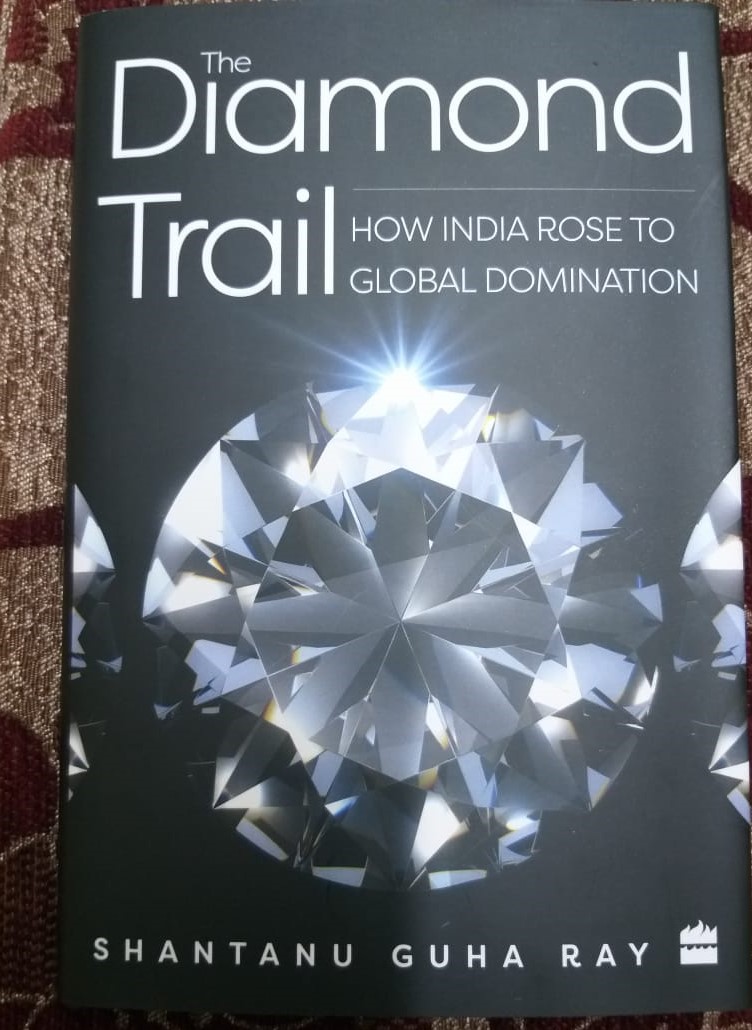
Shantanu Guha Ray, seasoned journalist and writer, has hit the markets with his latest tome, The Diamond Trail: How India Rose To Global Domination.
India’s domination in the world of diamonds is known to many but no one has penned the story of the brilliant merchants from Gujarat. And now they are worried because Nirav Modi, Mehul Choksi and Jatin Mehta – once considered as top diamond merchants – are now triggering breaking headlines for all the wrong reasons. But does that put the Indian market in a crisis of sorts, no I do not think so. The diamond market across the world is growing, it is also growing in India and neighbouring China. And what is important is that these two countries will now be shaping the world diamond markets, unlike the big, long domination of the West (read the US and Europe).
The Diamond Trail tells me everything Indians have
done to reach the pinnacle of glory and how they worked overtime in far flung
Africa – home to the world’s biggest diamond mines – and also in Antwerp,
Dubai, and Surat to shape careers for millions. I still do not understand why
the first chapter, actually the preface talks about Nirav and Mehul, but then I
think it was imperative. You cannot cut out these two if you are writing a book
on diamonds, like you cannot drop the assassination of Mohandas Karamchand
Gandhi if you are writing a book on Indian freedom struggle.
So let’s check out the diamonds markets first. At a recent forum in New York City, De Beers executives talked about their vision for the diamond industry and explained why they think the industry was now becoming more and more responsive to changing societal mores and consumer desires. The executives said more and more young consumers – mostly from Asia (read India and China) – were looking at marriage differently than in the past and seeing it not as a start of the relationship but another step in it. So what is changing? The Diamond Trail says exactly what De Beers is saying: Once, bulk of the marriages would take place within two months of engagement but now it takes a little over a year. At the forefront of this new change are Indians and Chinese, who are increasingly looking at diamonds and not expensive, gaudy gold ornaments. They are actually cohabitating couples who can even have children before marriage. These young couples are now accounting for a little over 10% of the world diamond sales. And it has happened because Indians have worked overtime to take the trade way beyond the great De Beers tagline, Diamonds Are Forever. Now, claims the author, Indians have rewritten the world rules in diamonds and make it look like Diamonds Will Now Be Forever.
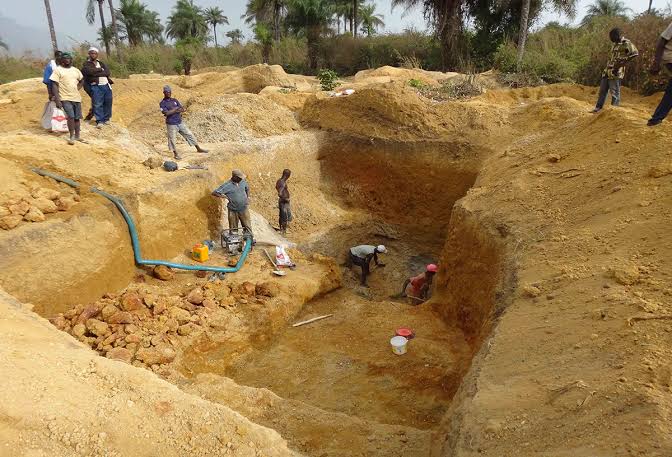
Diamond mine in Africa
In Antwerp, home to the world diamond
trade, Indians are changing trends and helping people to enrich the tradition
of weddings, offering them edgy, even creative brands. The fact that Indians
are increasingly seeking products to be in line with their values is only
because they are being told by Indian diamond merchants in Antwerp that
diamonds are no longer the domain of the rich, now it has various sizes and
comes in affordable prices. It did not happen overnight, Indians from Palanpur
and Kathiawad who travelled in ships to Antwerp learnt the trade from both
Israeli and Belgian merchants and started working first on small diamonds. And
then, claims the author, slowly the rise of Indians was felt all over the
sleepy Belgian town. And now, it’s a foregone conclusion. Indians have virtually
taken over Antwerp, top Indian companies like Rosy Blue are shaping the world trade.
The book narrates the interesting life and times of the families in Palanpur and Kathiawad and how they kept their focus on diamonds and kept on travelling in batches to Africa and Europe to shape their careers in diamonds. Today’s success is the hard work of those who worked tirelessly in small shops in Antwerp at lowly salaries, and of those who worked closely with mine owners across Africa to get great bargains to bring the diamonds home. Some of the diamonds came through Dubai – now an important hub – and some took the direct route. Those were challenging times, troubled times and disturbing times for the Indian diamond merchants and Indian diamond cutters.
Mining the Diamonds in Africa
But the global diamond trade was
not without the dangers of mining, the book recounts tales of blood diamonds –
now just one percent of the global diamond trade – and how some African nations
like Zimbabwe, Sierra Leone, Congo and Angola got into this dirty trade and
paid price through blood and lives. The timing of the book is equally important
because this year, 2019, India has been offered the chair of the Kimberly
Process, which is also known as KP and meant to altogether eradicate blood
diamonds from the market.
On
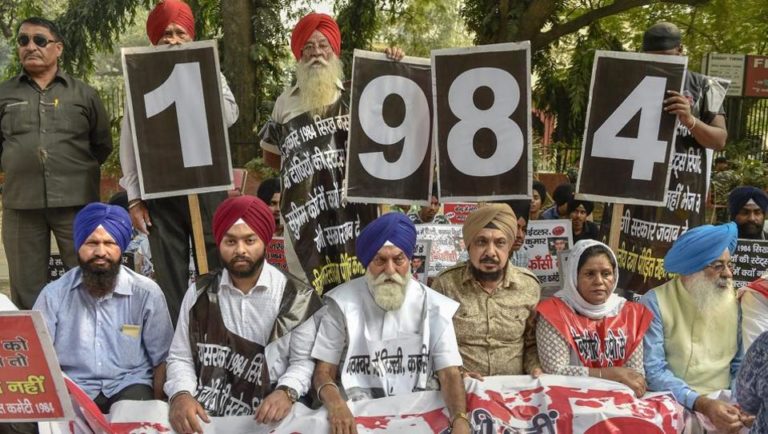
31st October 1984, the then Prime Minister of India, Smt. Indira
Gandhi was assassinated at her residence in Safdarjung Road, New Delhi. She was
killed by her bodyguards, Satwant Singh and Beant Singh who belonged to the
Sikh community. The killing was in reaction to Operation Blue Star that was
ordered by the Prime Minister and in which Sri Harmandir Sahib, the most sacred
shrine of the Sikhs was attacked by government forces to flush out Sikh
militants. The operation badly damaged the shrine and caused terrible hurt to
Sikh sentiments, which served as a trigger for the assassination of the prime
minister by her Sikh bodyguards.
Post-assassination, as the nation struggled to
come to terms with this unfortunate tragedy a catastrophe of unimaginable
proportions started building up. The very next day, on November 1st there
were widespread attacks on the members of Sikh community across the country.
The numbers killed have never been clearly recorded or made public, but various
estimates put them much above 10,000. According to
official records 2,733 Sikhs were killed in cold blood in Delhi alone, though
human rights organisations place the number nearer to 4,000. The numbers in the
remainder parts of India continue to defy documentation. This apart, Gurdwaras
(Sikh Temples) were damaged; shops and other businesses run by Sikhs were
destroyed, their houses looted and women raped.
The
killing was carried out in the most barbaric manner by use of weapons like
swords and daggers, beating the victims to death and burning them alive. The
most inhumane method used was enclosing a Sikh within a vehicle tyre and then
setting it on slow fire. The madness went on for a number of days as the law
enforcing machinery refused to intervene.
There
have been attempts to pass on this genocide as a spontaneous reaction of the
people distraught at the killing of their prime minister. A closer scrutiny
however point towards a very well conceived and coordinated plan to “teach the
Sikhs a lesson.”
The
assassination of the prime minister took place at 0920 hours on October 31st
and the sad news was broadcast by All India Radio at 1100 hours after she was
declared dead by the doctors at the All India Institute of Medical Sciences
(AIIMS), New Delhi. Rajiv Gandhi, Indira Gandhi’s son who was later on sworn as
India’s prime minister arrived in New Delhi at 1600 hours. Till then there was
no killing, even as isolated incidents of violent demonstration in the national
capital were reported. The first indication of something bigger brewing in came
when the cavalcade of President of India, Giani Zail Singh—a Sikh, was attacked
by stone throwers.
On
the night of October 31st / November 1st, organised and
equipped gangs dominated the streets of Delhi and were involved in acts of
violence and destruction of property. Sane voices within the city urged the
government to intervene but the response was merely cosmetic. The first murder
took place the next morning at about 0900 hours and then the floodgates opened.
The madness perpetuated in Delhi found resonance in other parts of the country.
On the face of it, restrictive actions like curfew were announced but they were
not implemented on ground.
In
this environment of utter depravity the only saving factor was that some people
came out to help the Sikhs despite the grave dangers involved. They gave
shelter in their houses and later provided assistance in the refugee camps
opened for those people who had lost everything in the genocide.
The complicity of the
political party in power became more visible when its leader, Rajiv Gandhi,
failed to condemn the wanton killing of Sikhs. He, on the other hand, attempted
to justify the same. “We must remember
Indira ji. We must remember why she was assassinated. We must remember
who could be the people behind it. When Indira ji was assassinated, some
riots took place in our country. We know the hearts of Indians were filled with
anger, and for some days, people felt that India was shaking. But when a big
tree falls, then the earth does shake a little,” he said in a condolence rally
organised in commemoration of his mother, the demised prime minister.
It
becomes quite apparent that the plan for attack was carefully laid out by
certain perpetrators and meticulously carried out for a specified period of
time. It was only when the desired impact was achieved, the “lesson taught” and
when international pressure started mounting that it was stopped. Surprisingly,
it stopped as quickly as it started which again points towards its
micro-management by certain powerful forces.
The
sequence of events nullifies the argument of “grave and sudden provocation”
which is being used by legal elements to lower the gravity of the criminal and
barbaric genocide committed.
No
First Information Report (FIR) was filed in the immediate aftermath or cases
registered in court, nor did any court call for action as is the trend now. In the last 35 years since
perpetration of the genocide, four commissions, nine committees have looked
into the carnage. In recent times, since 2015, two Special Investigation Teams
(SITs) have been constituted to carry out investigation.
Going back to 1984, when international pressure
became too much, the government constituted a committee under Ved Marwah,
Additional Commissioner of Police. It was constituted in November 1984 and
dissolved in 1985. The proceedings of the Marwah Committee were handed over to
the Misra Commission whose findings were made public in February 1987.
The commission stated that its term of reference was to determine “whether the
violence had happened”, and not “identify any person” or their role. It further
recommended that three more committees be set up, (1) to look into the role of
the Police, (2) for registration of cases and, (3) to determine the total
number of killings.
This sham enacted over three years was followed by a series of committees – Kapur-Mittal Committee, 1987; Jain-Banerjee Committee, 1987; Ahuja Committee, 1987; Poti-Rosha Committee, 1990; Jain-Aggarwal Committee, 1990 and Narula Committee, 1993.
The tryst for justice gained momentum once more in the year 2000, when the NDA government, under Prime Minister Atal Bihari Vajpayee, was in power. A unanimous resolution was passed in the Rajya Sabha, resulting in the formation of a new commission under retired Supreme Court Judge G.T. Nanavati. The commission issued notices to HKL Bhagat, Sajjan Kumar and Jagdish Tytler among others, all Congress leaders known to be close to Rajiv Gandhi. It also added the name of Kamal Nath in the list. Shamefully, Kamal Nath is now Congress Chief Minister of Madhya Pradesh.
The report submitted by the Nanavati Commission in May, 2005, was
damning in its observations. “The systematic manner in which the Sikhs were
thus killed indicate(s) that the attacks on them were organised,” it said. “Large
number of affidavits indicate that local Congress (I) leaders and workers had
either incited or helped the mobs in attacking the Sikhs… There is enough
material on record to show that at many places the police had taken away their
arms or other articles with which they could have defended themselves against
the attacks by mobs,” it added.
Recent times have witnessed the constitution of the Mathur Committee followed by the Central government SIT in 2015. At present matters are in the hands of an SIT constituted by the Supreme Court in 2018 that is re-investigating 186 closed cases.
In the last 35 years, justice for hapless Sikh victims of the genocide has not been forthcoming in the national capital, New Delhi, what to speak of the other states where even the process has not taken off. Every year on 1st November, media shakes out the cases from its files, a few victims whose addresses are available are approached to give statements. In their hand they hold photographs of their kin who were mercilessly killed and maimed and cry their heart out. This sentimental copy, good for TRP is played out over the day and stories are carried in Op-Ed pages of newspapers. After that, it’s back to business as usual.
This year, as the world gears up to celebrate the 550th Birth Anniversary of the First Guru of the Sikh religion, Guru Nanak Dev Ji, it would be only appropriate for the nation, its government and most importantly Prime Minister Narendra Modi, to ensure dispensation of justice to the faithful followers on the great Guru Nanak Dev ji who have being wronged in the most brutal, sadistic and inhumane manner for no fault of theirs. No bigger tribute than this can be paid to Guru Nanak Dev Ji.
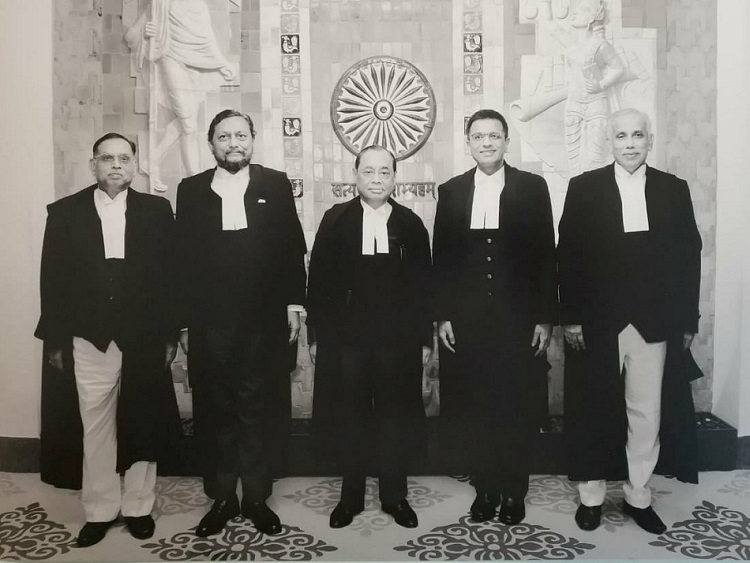
Unanimous Judgement on Ayodhya by the five-judge bench of Supreme Court corrects a historical wrong. Even as majority of Hindus and Muslims have accepted the apex court’s verdict with grace, the Left-leaning coterie is out with its dirty game to create a fear psychosis among Muslims.
The ninth day of November 2019 will be etched in the history of Indian subcontinent forever. Future generations across the subcontinent will remember this date as the day when balm was applied to a wound that had been festering for centuries.
Yes, I am talking about the unanimous verdict of a five-judge bench of the Supreme Court that ruled in favour of the Hindu community and handed them the entire Ram Janmabhoomi sthan (Ram’s birth place) at Ayodhya. The apex court in its 1045-page judgement accepted the evidence that Hindus had been worshiping the Janmasthan ever since Bhagwan Ram was born and that this 2.77 acre land is as venerable and sacrosanct as the Ram idol and his temple.
It’s after a long fight which lasted
491 years that Hindus can now dream of getting unfettered access to the Ram
Janmabhoomi sthan at Ayodhya.
The big question is why did it take this long? Archaeological excavations, reams of literature, historical proofs, numerous books and other evidence clearly pointed towards the existence of a magnificent Ram Janmabhoomi Temple at this Janmasthan site in Ayodhya. And yet it took five centuries to reclaim the revered temple land at Ayodhya. Even independent India took seven decades to come to this conclusion.
Commies and
their influence in stalling the Ayodhya resolution
Soon after independence British handed over the reins of India to Cambridge-educated Jawaharlal Nehru, who then imported and implemented the Western concepts of a nation state. The anglicized Nehru relegated all indigenous cultural richness of India into the dustbin. At that time the world was vertically split into capitalism and communism blocs and Nehru took a principled stand of not joining either of the two blocs. However, Nehru believed in Fabian Socialism—a form of socialism that relies in propagating socialist and communist thoughts through literature, art and history books. Nehru’s patronage of socialists meant that all forms of creative landscape in the country were occupied by the communists. And this was it. Even as India adopted a secular constitution and donned the secular fabric, the communist forces invaded creative fields and academia.
Creative fields and academia are soft powers that have the potential to influence an individual’s thinking. And this explains the 70-year delay by independent India in resolving the Ayodhya dispute.
A large majority of the Indian society was made to overlook country’s cultural glory, the historical wrongs committed by barbaric invaders were painted as acts of courage. As a nation we forgot to take pride in our glorious past. Simultaneously, alien role models were created and Ram was relegated to being a mythological figure who needed to be forgotten by this modern Indian society.
Yet, thanks to the collective
cultural wisdom of Indian society and strong family values where Bhagwan
Ram occupies prime importance, Hindus never forget their identity.
Immediately after India’s independence, Hindu society made its first attempt to wrest back Ram Janmabhoomi in December 1949 by placing idols of Ram Lalla inside the Ram Janmasthan at Ayodhya. Courts granted permission to the Hindus for puja (worship). Courts also declined to order the removal of Ram Lalla idols and prohibited Muslims within 200 feet of the idols.
In February 1986, courts ordered that locks at Ram Janmabhoomi must be removed. This gave full access to Hindus to worship Ram Lalla. In fact, during the reign of three Prime Ministers –V P Singh, Chandrashekhar, and Narsimha Rao several attempts were made to resolve this contentious issue. During the tenure of former Prime Minister Chandrashekhar (November 1990- June 1991) Hindus and Muslims had almost resolved the dispute, when Muslims had agreed to hand over the Ram Janmabhoomi sthan (2.77 acre) to Hindus. But then the vicious Historians (read fiction writers) such as Romila Thapar, Irfan Habib, DN Jha and their ilk started a malicious propaganda that flared up the emotions of Muslims and the talks fell apart.
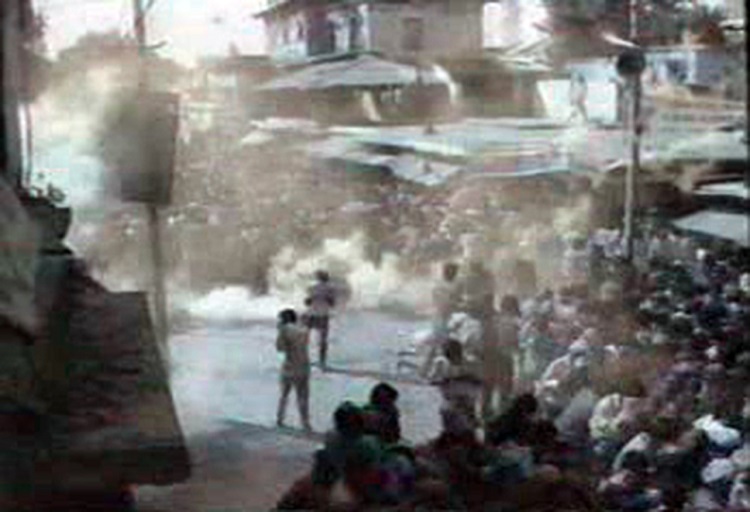
Karsevaks (temple volunteers) being fired upon by Police on 2nd November 1990. Thousands of innocent karsevaks were killed in this indiscriminate firing.
It needs to be borne in mind that even at the height of frenzy of the Ram Janmabhoomi Movement all other mosques in Ayodhya remained safe, the karsevaks demolished only the Babri Masjid.
This brings to mind the most endearing question, as to what is so special about this Ram Janmabhoomi Temple and the Ram Janmasthan at Ayodhya for Hindus? What is it in that 2.77 acre land at Ayodhya which makes Hindus so attached with this land parcel. Well, before answering I pose a counter-question: What is so special about the Mecca and Medina for Muslims? Or, what’s so special for Jews and Christians in Jerusalem? Ayodhya holds such primary importance for Hindus. Not only the Ram Janmabhoomi Temple but even the plot of land where Bhagwan Ram was born—the Ram Janmasthan, is revered by Hindus across the world.
Temple of venerable deities can be built at any place in the world but their place of birth is one such unique location that cannot be transferred. Bhagwan Ram’s birthplace is permanent, irrevocable, immutable, invariable, irreplaceable, incontrovertible, indisputable, undeniable and can never be forfeited.
After marathon arguments during the hearings in Ayodhya case, the five-judge bench of the Supreme Court was convinced about this fact and ruled in favour of the Ram Janmabhoomi sthan.
“…Faith and belief of the Hindus as depicted by the evidence on record clearly establish that the Hindus belief that at the birth place of Lord Ram, the Mosque was constructed and three-dome structure is the birth place of Lord Ram…” read the unanimous judgement of the five-judge Bench of the Supreme Court.
Hindus and a large majority of Muslims looked upon Babri Masjid as a symbol of barbarism that was thrust upon the country by Babur and his army of savages. The nation felt, and rightly so, that Babri Masjid was built only with an objective to show and prove to the then Indian society, during sixteenth century, that Mughal invaders have become the new masters who now have control on every aspect of the lives of Indians which included their revered Gods and their temples.
Babur was the victor in 1526 and to assert his victory over the indigenous Hindu population he had to inflict a deep wound on the collective psyche of the nation. And invaders choose local populace’s women and their Gods to assert their superiority. The marauding armies of Babur raped women and his commander Mir Baki demolished the Ram Janmabhoomi Temple at Ayodhya. The message from the Mughal invaders was quite clear: ‘We have your women and we have demolished the home of your God. Now subjugate’. A large portion of indigenous population did convert to Islam for fear of their lives, yet a few chose death over conversion and kept up fighting. During the four year of Babur’s rein (1526-1530) Hindus fought 4 battles to regain control of the Ram Janmasthan at Ayodhya. They lost these battles. And the Babri Masjid stood majestically reminding them of their defeat and savagery of Mughal invaders. This baton of resistance kept on passing to the subsequent Hindu generations to wrest back control of the Ram Janmbhoomi sthan. Till the year 1934, Hindus had fought 76 battles to regain control of the Janmasthan at Ayodhya.
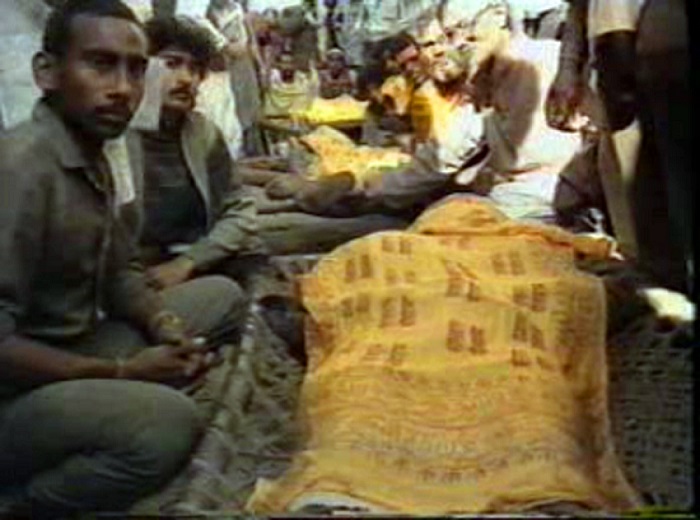
Dead bodies of innocent karsevaks (temple volunteers) lined up after they were killed in indiscriminate police firing on 2nd November 1990 on orders of the then Uttar Pradesh Chief Minister Mulayam Singh.
For Hindus, a temple at the Ram Janmabhoomi sthan
is not an issue of mere bricks and mortar. It is an issue of our cultural
resurgence and identity where Shri Rama, as maryada
purushottam, has a prime place of importance. The movement is an expression
of the collective consciousness of the Hindu ethos.
Unfortunately after India’s independence petty politicians with vested interests, a bunch of Left-leaning historians (read fiction writers) and journalists misguided Muslims into believing that Babri Masjid stood for their Islamic identity. This was utterly false. This Left-leaning coterie never told gullible Muslim masses that Babri Masjid was built against the basic Islamic tenets. Islam mandates that mosques should never be built on a land forcefully taken away or after demolishing religious structures of other faith.
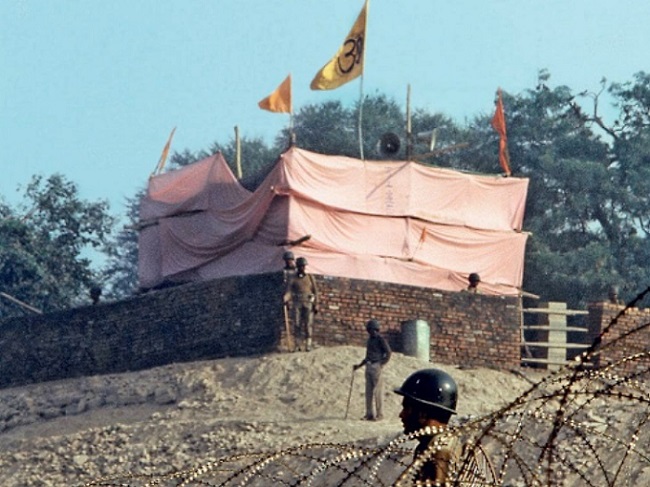
The makeshift Ram Lalla Temple at the Ram Janmabhoomi sthan in Ayodhya. This place where Bhagwan Ram was born and the adjoining land mass in equally sacrosanct and venerable for Hindus as the Ram Temple.
After unanimous verdict of the Supreme Court, learned and level-headed Muslims have said that they want to move ahead. Iqbal Ansari, one of the litigants for Muslims in Ayodhya case, said that he wholeheartedly accepts the Supreme Court verdict. “I respect the judgement of the Supreme Court,” Ansari said soon after the apex court’s unanimous verdict on the Ayodhya dispute. Iqbal Ansari is the son of Hashim Ansari who was one of the original litigants in the Ram Janmabhoomi Ayodhya case. Hashim Ansari died three years ago. “We will not challenge the court verdict. We are very happy with the decision,” Iqbal Ansari said.
Ditto for other Muslim leaders such as Tarek Fatah, eminent Islamic scholar, Syed Waseem Rizvi, chairman Shia Central Waqf Board, Zafar Sareshwala, former chancellor of Maulana Azad National Urdu University and several others who have gracefully accepted the verdict. However, as the nation is rejoicing and there appears to be a bonhomie among Hindus and Muslims this Left coterie has once again begun to raise its ugly head. Rather than accept the Supreme Court verdict with finality they have started nit-picking in the unanimous judgement. This Left cabal is now shouting that the Supreme Court verdict puts faith above facts and that gross injustice has been done to the Muslims!
Generations of Hindus have been defensive about their faith and culture. It’s time to come out of this shell and take these detractors head on with renewed vigour. Muslims need to realize that this opportunist-Leftist cabal is laying a trap for them. Rather than accept the Supreme Court’s unanimous judgement this band of fiction writers are out once again to create a fear psychosis amongst the minds of Indian Muslims. But these fissiparous forces must not succeed this time. We Hindus fought with grit to wrest back Ram Janmasthan at Ayodhya, this time we need to stand solidly with our Muslim brethren to brace against this fake communist propaganda.
It’s high time this opportunist
coterie is unmasked who have developed a knack of finding problems for every
solution.
Iran has discovered a massive new
oil field, President Hassan Rouhani said ON Sunday, a find that would boost its
proven reserves by about a third in a rare piece of “good news” for
an economy battered by US sanctions.
In a speech aired on state TV,
Rouhani said the country’s economy had stabilised despite punishing US measures
against its senior leaders, banking and finance sectors.
The vast field in the
southwestern province of Khuzestan holds an estimated 53 billion barrels of
crude, he said. The 80-metre deep reservoir stretches nearly 200 kilometres
from Khuzestan’s border with Iraq to the city of Omidiyeh.
“This is a small gift by the
government to the people of Iran,” he said in a speech from the central
city of Yazd.
“We announce to America
today that we are a rich nation, and despite your enmity and cruel sanctions,
Iranian oil industry workers and engineers discovered this great oil
field.” The find would add around 34 percent to the OPEC member’s current
proven reserves, estimated by energy giant BP at 155.6 billion barrels.
Iran, a founding member of the
Organization of the Petroleum Exporting Countries, sits on what were already
the world’s fourth-biggest oil reserves. The new reserves, if proven, would lift
it to third place, just before regional arch-rival Saudi Arabia. But it remains
to be seen how much the country can benefit from the new field.
Iran has struggled to sell its
oil since US President Donald Trump withdrew from a landmark 2015 nuclear deal
last year and reimposed unilateral sanctions.
Iran has experienced a sharp
economic downturn this year, fuelled in part by US sanctions, with a plummeting
currency sending inflation skyrocketing and hiking the prices of imports. The
IMF has said Iran’s economy will contract by a massive 9.5 percent this year,
its worst performance since 1984 when the Islamic republic was at war with
neighbouring Iraq, but notes the growth is expected to stabilise at zero next
year.
We use cookies on our website to give you the most relevant experience by remembering your preferences and repeat visits. By clicking “Accept All”, you consent to the use of ALL the cookies. However, you may visit "Cookie Settings" to provide a controlled consent.
This website uses cookies to improve your experience while you navigate through the website. Out of these, the cookies that are categorized as necessary are stored on your browser as they are essential for the working of basic functionalities of the website. We also use third-party cookies that help us analyze and understand how you use this website. These cookies will be stored in your browser only with your consent. You also have the option to opt-out of these cookies. But opting out of some of these cookies may affect your browsing experience.
Functional cookies help to perform certain functionalities like sharing the content of the website on social media platforms, collect feedbacks, and other third-party features.
Performance cookies are used to understand and analyze the key performance indexes of the website which helps in delivering a better user experience for the visitors.
Analytical cookies are used to understand how visitors interact with the website. These cookies help provide information on metrics the number of visitors, bounce rate, traffic source, etc.
Advertisement cookies are used to provide visitors with relevant ads and marketing campaigns. These cookies track visitors across websites and collect information to provide customized ads.
Necessary cookies are absolutely essential for the website to function properly. These cookies ensure basic functionalities and security features of the website, anonymously.
Cookie
Duration
Description
cookielawinfo-checkbox-analytics
11 months
This cookie is set by GDPR Cookie Consent plugin. The cookie is used to store the user consent for the cookies in the category "Analytics".
cookielawinfo-checkbox-functional
11 months
The cookie is set by GDPR cookie consent to record the user consent for the cookies in the category "Functional".
cookielawinfo-checkbox-necessary
11 months
This cookie is set by GDPR Cookie Consent plugin. The cookies is used to store the user consent for the cookies in the category "Necessary".
cookielawinfo-checkbox-others
11 months
This cookie is set by GDPR Cookie Consent plugin. The cookie is used to store the user consent for the cookies in the category "Other.
cookielawinfo-checkbox-performance
11 months
This cookie is set by GDPR Cookie Consent plugin. The cookie is used to store the user consent for the cookies in the category "Performance".
viewed_cookie_policy
11 months
The cookie is set by the GDPR Cookie Consent plugin and is used to store whether or not user has consented to the use of cookies. It does not store any personal data.