Home Blog Page 420

Can we take a Letter to PM seriously that is self-deceiving? Asks Former Special Secretary, RAW

Last week, an ensemble of 49 filmmakers, actors, authors, artists, activists, historians and professionals were in the news for writing an open letter to Indian Prime Minister Narendra Modi, expressing their concern over rise in intolerance to dissent, distorting meaning of patriotism to hound people and lynching of Muslims and Dalits. Their anguish was no surprise because the signatories had a liberal spread of those who are historically non-conformist, like to swim against the current and are inherently anti-establishment. They also have never had any connect with how criminal justice system works.

Their litany of grievances instantly took you back to 2014, when beneficiaries of national awards had echoed similar sentiments while returning their awards soon after Narendran Modi had become prime minister. They had accused him of promoting divisiveness, Hindu religious bigotry and encouraging his party workers to attack Christians and NGOs and to lynch Muslims and Dalits in the name of protecting cows. They had created so much fear that a few gullible film makers, artists and retired police officers even thought of leaving India for good and settle abroad. It is a different matter, they never left the Indian shores and continued to breathe in Modi’s alleged stifling regime. Their catcalls went on for a few more months but died their natural death in due course.

Yet, they did not lose hope. They kept badgering Modi and selling a narrative that he was breaking India on communal lines, he always lied to people about the insipid record of his government and that he was corrupt, mercenary, vengeful and a master in manipulating electorates’ mind. They made their audience believe that he was a fascist and a failed leader who was going to lose his re-election in 2019. That did not happen. Modi returned with a stronger mandate, leaving them down and out, though temporarily.

Two months after NDA-II returned to power in May 2019 was a long period for these 49 self-proclaimed guardians of India’s moral conscience to remain out of news, as they thrive on publicity and adulation by an audience that forms a minuscule section of India. Hence the open letter which really makes no sense to most Indians who toil day in and day out for food and shelter. In fact, there was no need for Prasoon Joshi (Chairman, Central Board of Film Certification) and 60 others to issue a rejoinder and try to peel off their motive. It matters little whether signatories are mouthpiece or ideologues of insurgents, terrorists and separatists and whether they are out to defame the nation. Forty nine agitated minds cannot define what will be the best for a country of billion plus people. It is for the governments elected by voters to structure policies and programmes and implement them.

There is of course nothing wrong for them to share their anguish and apprehensions. What irritates is when they talk of subjects, they are naïve of. They should have written to suggest how best to protect, preserve and develop a temper of art, history, science and literature in the country. Instead, they wrote about issues that are the sole preserve of criminal administration and judiciary. No wonder, their letter lacks conviction and raises suspicion about their intent.

There is no ambiguity that lynching of anyone is a heinous crime and perpetrators must be severely punished. It does not matter who does it and why and whether this is a bailable or a non-bailable offence. But no Prime Minister has a role in such cases. He can neither lodge an FIR nor investigate or punish offenders. It is for the police to prosecute them and, for courts to convict them. Neither of these institutions functions under the PM. Police works under the state governments and courts under judiciary. The constitution bars the central government from interfering in such matters. PM can at best express anger, frustration or issue advisories to state governments but that means nothing. If petitioners are sincere, they should put pressure on state governments, hire best lawyers for the diseased, offer them financial help and create awareness among people in sensitive areas to ensure that lynching does not take place.

Their other grouse is that chanting of “Jai Sri Ram” has become a war cry and provokes violence. The question is how can anyone stop people from raising slogans in a country that passionately swears by freedom of expression? Moreover, if the chanting leads to riots, why doesn’t the state police impose Section 144, arrest hooligans and prosecute them. Instead of endorsing the letter of the petitioners, Mamata Banerjee (West Bengal’s Chief Minister) should have acted against chanters and rid her state free of slogans hailing “Jai Sri Ram”. Does she really believe that Modi can silence zealots of Ram by just appealing and, why would anyone listen to Modi since it concerns an individual’s faith?

The other concern of the Group of 49 is that when someone criticises the government or BJP, he is branded anti-national and hounded for expressing dissent. Well, it is an oversimplified grievance. If anyone feels aggrieved on these counts or faces wrath of people for his or her creations and views, there are courts and police stations where he or she can go to get his or her grievances redressed. But the individual must understand that he/she has to be responsible for what he writes, speaks and sketches and that he has the capacity to defend himself. He cannot expect a Prime Minister to work as 24×7 vigilante for individuals with no sense of accountability and rescue them from storm troopers.

As for the dissent, no country walks the distance as aggressively as Indians do. The dissent has in fact been taken to a level where politicians abuse merrily and media misinforms with impunity. It is about time, the signatories should come forward to build a mass movement for enacting simpler and effective defamation laws so that sanity prevails in public discourses and courts promptly rescue those who are wrongly incarcerated for expressing dissent. Just writing to the Prime Minister and feeling happy about it, is merely a pathetic public relations exercise.

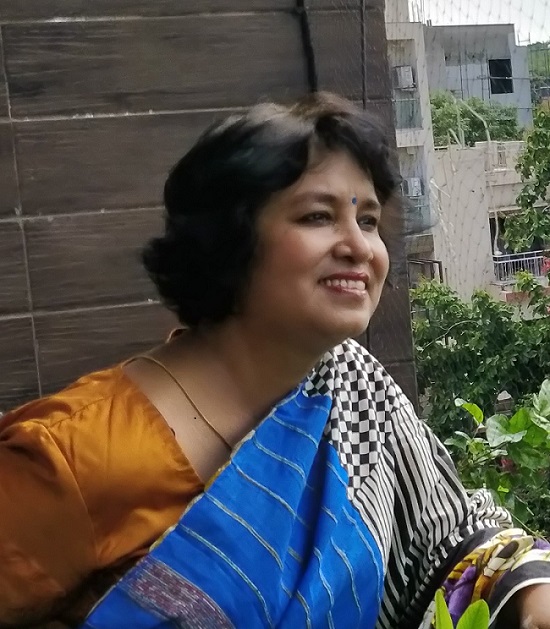
Taslima Nasreen: I never think of India as foreign land

Taslima Nasreen is a writer, free thinker and humanist, who was driven out of Bangladesh—her country of birth. Now, India is her home. In this rather emotive piece, Taslima writes how she continues to be on edge due to uncertainties in her resident permit by India.

Twenty-five years ago, the government of my country had driven me out of my home and my land. Had I committed a murder, a rape, a burglary of some kind?

No.

I had simply written books.

In those books, I had written about democracy, secularism, humanity, human rights and the equal rights of women.

In those books, I had laid bare my dreams of an equal society where all manner of discriminatory practices, injustices and oppression have been abolished.

In the past 25 years, there have been numerous changes in the government in Bangladesh — but none of them have allowed me to return home, and neither has anyone given me a reason as to why I cannot.

A significant portion of the first half of this quarter century, I spent in Europe and America. But I was desperate during those years to return to my country — and since the doors to my homeland were closed for me, I would repeatedly visit West Bengal to get some semblance of taste and smell of home.

The Bengali language is my one true home after all.  

Thus, in order to find an environment of the Bengali language and Bengali culture outside Bangladesh, I had chosen West Bengal as the closest approximate for my home. It was not possible to set up a home somewhere with a tourist visa but fortunately, one day, I did get permission to make Kolkata my permanent home. That was the day I earned a residence permit to live in India — something that can be renewed at regular intervals. I started living in India from 2004.

In the beginning, residence permit would be renewed every six months, which was changed to a year in 2008. Instead of the tedious application process every year, would it not have been easier to issue a permit for five or ten years at one go? In fact, Rajnath Singh had once promised me a 50-year visa. But that was only talk — nothing has come of it and my residence permit has remained subject to annual renewals. Although many foreign nationals have been living permanently in India with extended residence permits for a number of years, unlike mine, for many of them, their permit needs to be renewed every 5 or 10 years.

In 2007, when the CPI (M) government of West Bengal drove me out of the state in order to appease Muslim fundamentalists, the UPA government in the centre put me under house arrest in a cantonment in Delhi — and coerced me to concede leaving India in 2008.

From 2008 till the beginning of 2011, even though my residence permit was regularly renewed, I was not allowed to live in India.

Around that time, many people had told me that when the BJP would come to power, I would no longer have to worry about my residence permit, and that I would be made a citizen and allowed to live in Kolkata again. I had thought so too.

So, imagine my utter surprise when, after coming to power in 2014, the BJP government reduced the duration of my residence permit from a year to two months. And after coming back to power for the second time, they have yet again revised it from one year to three months. I don’t know why they have chosen to do so. After living in this country for 14 years, does the BJP government want to snatch away the ground beneath my feet yet again?

I don’t know what these three months signal for me.

I remember how, after I was driven out of West Bengal, Narendra Modi, who was then the Chief Minister of Gujarat had declared in a speech that if Bengal could not give security to Taslima, then they should send her to Gujarat where he would give her security. During his electoral campaigns in Kolkata, he had demanded to know why I was driven out of the state and why the Trinamool government that had replaced the CPI(M) had done nothing to help me return.

Few Indian politicians have ever spoken in favour of me in public with any authority, like Modi ji has.

Even though I have no favourites when it comes to politics, I have been grateful to him for having unhesitatingly supported a persecuted, exiled, truly secular writer such as I.

So, naturally, I assumed I was going to be free of the ordeal of having to renew my residence permit annually if he came to power, that I was finally going to be able to live in this country for real, free to live out the rest of my days and write without any worries or anxieties.

But even after Modi ji has come to power, my troubles have remained the same. Rather than worrying less, this reduction of the duration of my residence permit has only served to augment my anxieties.

I have done nothing wrong. I have just been writing. I have been trying to inspire women in our society to become educated and aware. Despite being a Swedish citizen, a resident of the European Union and a permanent resident of the US as well, I have chosen India as my home. All because I speak in an Indian language, I write, think and dream in it. India truly is my home in that sense — the only place in this subcontinent where I can think of living. People of this subcontinent are usually desperate to move to Europe or the USA — I have done the exact opposite, simply because of my love for this land. I have ignored the promise of fame and security abroad and chosen to plunge into the uncertainties of living here.

Yet, even after a quarter-century of exile and nearly fourteen years of living here, I still feel shivers crawling down my spine when I see my residence durations reduced abruptly.

I cannot help but worry if one day it will yet again come down to zero.

Many people believe that the government of India sustains me — that I am their guest. That’s absolutely not true. I live with my own money — that is how I sustain myself, and I also pay a considerable amount in taxes. I am not personally acquainted with any of the ministers, neither do I know any influential people. I am decidedly a commoner who lives a very average, regular life. I mix with the common people, they are the ones who are my daily companions. Since my own country has moved far away from me in these twenty-five years, since its doors are forever closed for me, India is my country now.

I have never thought of it as a foreign land since I truly believe that mere birth does not make a location someone’s nation — a nation is born of love.

I believe that I love India much more than many citizens of this country. I am also aware that should they get citizenship from the EU or a green card from the USA, many so-called patriots would not blink twice before emigrating.

And here I am, having chosen this land even after being offered other such options. If India values love at all, I am certain there will be no problems for me living here in the future.

Victory of Gender Justice: PM Modi on passage of Triple Talaq Bill

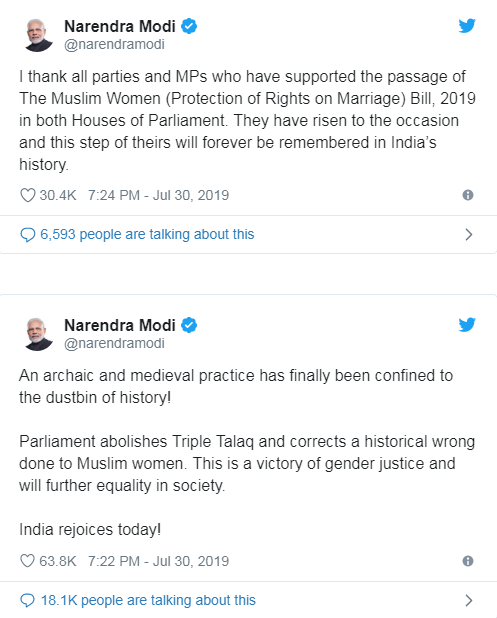
With the Parliament passing the Muslim Women (Protection of Rights on Marriage) Bill 2019, Prime Minister Narendra Modi thanked all the parties and MPs who have supported the passage of the Muslim Women (Protection of Rights on Marriage) Bill, 2019 in both Houses of Parliament. He said that they have risen to the occasion and this step of theirs will be forever remembered in India’s history.

In a series of tweets he said that “An archaic and medieval practice has finally been confined to the dustbin of history! Parliament abolishes Triple Talaq and corrects a historical wrong done to Muslim women. This is a victory of gender justice and will further equality in society. India rejoices today!”

He further tweeted that “This is an occasion to salute the remarkable courage of those Muslim women who have suffered great wrongs just due to the practice of Triple Talaq.The abolition of Triple Talaq will contribute to women empowerment and give women the dignity they deserve in our society.”

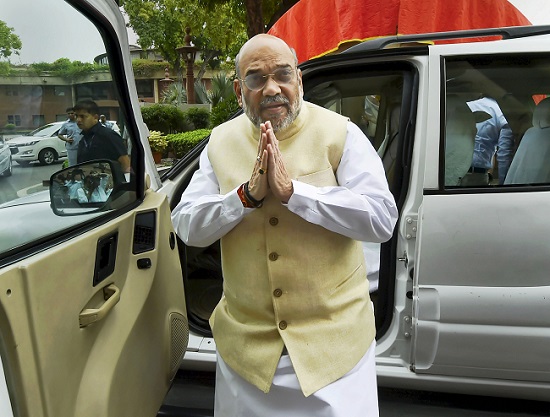
Union Minister for Home Affairs, Amit Shah congratulated Prime Minister Narendra Modi for fulfilling his commitment and ensuring that a law is made to ban Triple Talaq.

Expressing satisfaction over this landmark moment, the Home Minister also congratulated Muslim women by saying, “On the passage of this Bill, I congratulate the Muslim sisters across the country on getting rid of the Triple Talaq curse. This act will free Muslim women from the curse of this regressive practice”

Shah said that the Modi government is dedicated to protecting women’s rights and ensuring their empowerment. This bill is a historic step to protect the dignity of Muslim women and keep it intact. It will bring a new era of hope and respect in the lives of Muslim women. From now on, the door to unlimited possibilities will open for Muslim women and they would now be able to play an effective role in the creation of ‘New India’.

“Today is a great day for India’s democracy. I thank all parties who supported this historic bill”, Shri Shah said while thanking all the members of Parliament yesterday.

Tackling Loneliness in Retirement

Loneliness is a big problem at any age and in retirement with a loss of self-worth accompanied with stress related to financial security, loneliness can be a serious problem.

Social isolation and loneliness are well known as causes of depression, mental health problems and physical illness. They are conditions usually associated with older people, who may experience the profoundly isolating effects of retirement, loss of a partner and children moving away.

There have been several cases where loneliness has led to depression, high blood pressure and other psychosomatic illnesses. Those retirees who are married at least have a companion but for those retirees who have remained single or have separated or have lost their spouse, the problems of loneliness get compounded very significantly.

Loneliness is something that often creeps up on people in retirement. Loneliness can be twice as unhealthy as obesity, according to researchers who found that feelings of isolation can have a devastating impact on older people.

Even the most gregarious and sociable of people can find themselves in the unfamiliar territory of feeling lonely and isolated, and this in turn can lead to depression. Often loneliness comes from the death of a spouse, the loss of close friends, or the development of a debilitating illness – all things that we don’t want to think about, but unfortunately are inevitable as we get older.

Retirees sometimes go through multiple changes in their lives that contribute to loneliness in a relatively short period of time.

  • Adult children move out of the house and sometimes far away from home
  • Around the same time, people lose their ready-made social circle at work. Most people have not taken the trouble to create a social network outside work while they were working and to try and break into an existing social network post retirement is challenging to say the least.
  • It is not uncommon to lose a partner at some point during the later years of life. Loss of a spouse is seen as one of the top traumas a human being experiences in one’s life.

People who are socially comfortable and well-connected may easily make new friends, but if you are socially awkward and have traditionally found it difficult to make friends you need to find structured activities that will help you to create social contacts.

It only takes a little effort to make new friends and stave off those feelings of loneliness that can be so damaging to your mental health in retirement. What’s more, there is growing evidence that social isolation is connected with an increased risk of physical ill health as well, so combating loneliness may also improve your health too.

An increasing number of senior retirees have only got their television for company and this is a serious challenge that we need to address. Is there no way that we can engage with these elderly citizens so that they live the remaining years in contact with a few people?

“Human contact is my oxygen. I try to keep myself occupied but the chance of human contact is more important than anything to me. The touch of another human being is more so” said one person when he was talking to me.

“It makes me feel sad. I no longer feel of use to the society but much of the time I mask my feelings with a mindset to keep going. People tell me that I am lucky to have my memories but this doesn’t help. I want to make the most of my life now” said another.

After speaking to several very elderly retirees, I found that they missed the all-important social contact with their friends and family. As they grew older and as one or both of them slowed down and were not able to reciprocate the social niceties that had done all their lives, they could see that gradually they were dropped from their social circle and the invitations dropped off. It reached a stage where they would see no one except their domestic staff for many weeks at a time.

We have read so many cases of police finding the body of a senior citizen in their home when the neighbours complained of a “foul smell” from the apartment. Nothing could emphasize the seriousness of loneliness of an elderly retiree than a person who has died alone with no one to attend to them for possibly, several days.

Loneliness is contagious. Older adults who feel lonely are more prone to behave in ways that may cause other people to not want to be around them.

A recent survey revealed that while only 10% of Indian seniors living in joint families felt isolated, nearly 68% of those living with nuclear families reported loneliness. The survey also found that older people living in rural areas have more social interactions and feel the pain of loneliness less in comparison to the urban elderly. It was also found that older Indian men are more prone to isolation than older women.

Tackling loneliness

Based on discussions with some care givers to the elderly and infirm, the following were some of the points that came up to tackle loneliness.

  • Stay Social – Maintain long-standing relationships to combat loneliness. Reconnect with friends with whom you have lost touch and establish regular routines with friends near you. Join social networking websites to get re-acquainted with people from your past. Long-standing relationships are more beneficial in fighting loneliness than new friendships.

Senior citizens living in condominiums have managed to find a way to stay social and several resident welfare associations have provided for specific areas where the senior citizens can sit together for a cup of coffee every morning and evening.

  • Explore New Interests – As a retiree, you probably have less commitments and obligations. Take advantage of this to explore your interests, whether you are volunteering at the local school, joining a book club, playing an instrument or writing.

The activity is not as important as the meaningful interactions you will have with other people as you develop a whole new circle of friends of all ages, who like you, have a similar interest.

  • Stay Positive – Talking to yourself to challenge your pessimistic or negative thoughts has been found to be very effective. Perceived loneliness is often due to incorrect or irrational interpretations of current life situations. Identify these thoughts and argue against them, utilizing contrary evidence. If this is difficult or you need assistance, you can work with a counsellor or with a friend who you can trust.
  • Get a Pet – A dog or a cat have been known to be great companions for lonely people. If you and your spouse like a pet and are willing to take on the responsibility of looking after another living being then bring a pet into your home.

Mother Teresa had once said that “loneliness and the feeling of being unwanted is the most terrible poverty”.

While the developed economies have understood the loneliness needs of the retirees and the senior citizens, we have yet to get an appreciation of their needs in India. We assume that once a person has retired, he / she will be happy with their television sets watching “serials” and have some of their friends for company. We need to watch and listen more. Older people often claim they are fine, and they don’t want to be a burden but most people need human contact.

Older people are a treasure and should be treated as such.

Indian tourists caught stealing by hotel staff in Bali

Indonesia and India share deep and strong cultural relations build over several centuries of mutual respect and friendship. Indonesians hold Indians in high regard and treat them with utmost respect. However, a recent incident, in which an Indian family was caught stealing in a Bali hotel, could be a big spoiler for Indian tourists.

In an embarrassing incident, an Indian family was caught escaping with accessories they had stolen from a hotel in Indonesia’s Bali. A video of the incident has now gone viral on social media. The video, which is 2:20 minutes long, shows one of the hotel staff scanning the family’s luggage as they were on their way out from the hotel.

The video was originally posted on Twitter by a user named Hemanth, who wrote “this family was caught stealing hotel accessories. Such an embarrassment for India. Each of us carrying an #IndianPassport must remember that we are ambassadors of the nation and behave accordingly. India must start cancelling passports of people who erode our credibility.”

In the video, a woman can be seen arguing with the officials from the hotel who seem to be vigorously going through the suitcases. Apparently, the family had “stolen” whatever they could get their hands on – which included decorative items, toiletries, electronics, towels and so on. The security officials can be seen telling the family that they’d managed to steal ‘everything’ from the hotel room, including hangars.

She repeatedly asks the officials to let them go since they had a flight to catch. She even offers to pay for the stuff they’d stolen. “We are sorry. This is a family tour, we will pay you,” the family members can be heard saying. The staff, however, appeared to be in no mood to accept compensation for the behaviour of the family. “I know you have a lot of money, but this is no respect,” one of them responded to the family’s repeated offers to pay.

The video had Twitterati fuming who called the whole incident disgraceful. One of the user @rumilife0612, wrote, “Why do Indians do this I just can’t understand. One should maintain a certain kind of dignity and class ..What is this,” and also shared the video. The tweet has received over 90 thousand likes. As the incident came to light, many Twitter users demanded that the passports of the family be revoked.

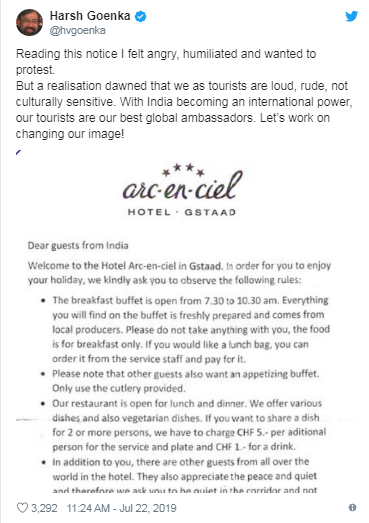
Earlier, industrialist Harsh Goenka took to Twitter to criticise a Swiss hotel for specifically issuing a “code of conduct” for Indian guests, saying he felt “angry” and “humiliated”.

Now, with the video of an Indian family being shamed by staff for allegedly stealing from a hotel going viral, it once again bring into focus why Indians need to follow a ‘code of conduct’ abroad.

Kargil Vijay Diwas celebrated in academic institutions of Gujarat

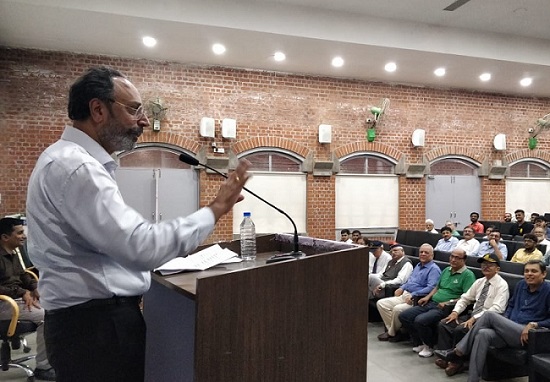
Col (Retd.) Jaibans Singh, a reputed Defence and Security Expert, addressed gatherings of students, academicians and eminent citizens at University of Gujarat in the morning of 26th July at the University Campus and a similar gathering at MS University, Vadodra, in the evening.

He described the Kargil battle as one with no comparison in the annals of military history. The courage and commitment of young Indian soldiers who fought the war under leadership of committed and professional senior officers caused an ignominious defeat to Pakistan Army who had ingressed Indian territories in a duplicitous manner.

Jaibans Singh explained that Pakistan launched the operation on the basis of a weak plan mainly to avenge the humiliation of its losing the Siachen Glacier to India. In the process it led to certain death of its soldiers from the Northern Light Infantry, who were chosen to be the cannon fodder for their misadventure. These simple soldiers of the Northern Light Infantry belong to the Gilgit-Baltistan region of Pakistan Occupied Jammu and Kashmir.

India needs to ensure that its armed forces are not found wanting in any military requirement so that the enemy remains dissuaded from planning any such misadventure in future.

While speaking on the current situation in Jammu and Kashmir, Col. Singh said that the policy of the government to boost development with zero tolerance to terror and disruptive activities is being welcomed by the common man of the region and paying good political and social dividends. Jammu and Kashmir is witnessing an unprecedented era of peace and prosperity. Terrorism is on the decline and will soon be totally eradicated.

Jammu & Kashmir’s Delimitation is the first test of Amit Shah

As new Home Minister of India, Mr. Amit Shah has generated astronomical hopes in the hearts of those crores (billions) of Indian citizens who have been waiting for a decisive end to the violence and turbulence going on in Kashmir for past over seven decades. There is no shortage of Indians who believe that Shah is the new incarnation of Sardar Patel who has returned to complete his unfinished agenda of a seamlessly unified India.

Over past few years he has acquired the image of a skilled surgeon who picks up his scalpel only after he has identified the fountainhead of the ailment. No surprise he has decided to start with a fresh delimitation of electoral constituencies of J&K.

Truly speaking, problems in Jammu & Kashmir started on the day when Jawaharlal Nehru arbitrarily appointed Mohammed Sheikh Abdullah as the ‘Prime Minister’ of J&K immediately after Maharaja Hari Singh signed the accession of his State into newly emerging Republic of India. He did so despite absence of any public mandate in favour of the Sheikh.

Sheikh Abdullah’s Arbitrary Delimitation

Even before his government appointed the first Delimitation Commission in 1952 for holding elections in India, Nehru had already delegated this job of delimitation in J&K to Sheikh Abdullah in 1951. And Sheikh, without going through a proper exercise of appointing a Delimitation Commission, arbitrarily decided to have a State Legislative Assembly with 100 members. Out of these 100 seats he assigned 43 to Kashmir Valley, 30 to Jammu region and 2 to Ladakh. He decided that remaining 25 seats would be left vacant till the day Pakistan Occupied Kashmir (POK) comes back to India.

Unlike rest of India none of the four basic factors namely population, terrain, judicious assigning of reserved seats and reservation for Scheduled Castes and Scheduled Tribes were applied. Fact being that Kashmir Valley forms about 8% of the original J&K and less than 16% of the part remaining in India. Jammu forms about 26% and Ladakh 58% of the State remaining with India.

This was a clever ploy of Sheikh to permanently keep the majority legislative power of the State Assembly in the hands of Kashmir Valley. Although mainland India has had four delimitations in 1952, 1962, 1972 and 2002, yet J&K was never asked to hold a proper delimitation in past seven decades. In 1993 the State constituencies were reorganized during Jagmohan’s Governor’s Rule but it was done without a systematic delimitation exercise. Rather, this ‘delimitation’ only helped in further perpetuating Kashmir Valley’s manipulated majority in the Assembly.

Total number of seats was increased to 111 but 24 seats were left permanently vacant in the name of lost POK areas. Out of the functional 87 seats 46 were given to Kashmir, 37 to Jammu and 4 distributed equally among the two bifurcated regions of Leh and Kargil of Ladakh. A provision of seven reserved constituencies too was made for Scheduled Castes but all of these seats have been taken from Jammu’s share while not a single reserved seat was kept in the Kashmir Valley.

Communal Social Engineering

A close scrutiny of this exercise in redrawing the new constituencies exposes a communally biased social engineering exercise which ensured that odds were heavily loaded against non-Muslim candidates wherever possible. For example in the Zanskar constituency of Kargil in Ladakh, three Muslim majority areas of Langhartse, Barsu and Bartoo which have no geographic contiguity with the Zanskar Valley but contribute 60% of total population of this constituency, were taken out of the Kargil constituency and added to it. Interestingly the Supreme Court refused to take up the case of Zanskar citizens, who challenged this reorganization, citing its limitations due to Article 370. Similar communal manipulation is quite visible and resented by non-Muslims in many constituencies of Jammu like Poonch Haveli, Kalakot and Rajouri.

Constitutional Rigging

This reorganization exercise of 1993 has lead to an anomaly which many in the Jammu and Ladakh regions term as permanent ‘constitutional rigging’.  The average voter size of a constituency in J&K was 83,053 during the last Assemble elections of 2015, but 22 constituencies of Kashmir Valley have far less voters than this average. For example Gurez has only 17,554 voters, Karnah has 32,794, Khanyar 50,849 and Habbakadal has 54,484 voters. Compare it with Jammu constituencies: Gandhi Nagar has 166,132, Jammu-West 151,311, Rajauri 112,732 and Leh has 67,736 voters. And thanks to perpetual and forcible ejection of non-Muslim population from the Valley to Jammu and other parts of India over past seven decades, the population of Jammu region is today far above that of Kashmir.

It is not surprising that Farooq Abdullah’s National Conference used its brute majority (57 out of 87 total seats) in the following elections in Sep 1996 to amend the J&K Representation of the People Act 1957 and its Section 47(3) which, strangely, provides that “until the relevant figures for the first census taken after the year 2026 have been published, it shall not be necessary to readjust the total number of seats in the Legislative Assembly for the State and the division of the State into territorial constituencies under this sub-section.” When put to practice in letter and spirit, this law means that 2032 Assembly elections can be held under a new delimitation only if the 2031 census data is ‘published’ and fresh delimitation is completed before these elections. Which only means that any new attempt to amend the ongoing ‘manipulated majority’ of Kashmir valley can be undertaken only for Assembly elections of 2038.

Impact of Manipulated Majority

It is no rocket science to understand how and what kind of political-social havocs and inhuman practices have been played in Jammu and Kashmir under this manipulated electoral democracy. The road roller majority of Kashmir Valley has been used to adopt and impose dozens of many such laws and rules which will put even Hitler’s Nazi Germy to shame.

Just a few examples: The arcane laws of J&K prohibits the following groups of people from voting in J&K Assembly, Panchayat or Cooperative elections– Migrant of Partition days (1947); POK refugees who settled or were forced to settle outside the State; Gorkha soldiers of Maharaja Hari Singh’s Army living in the State for over 100 years; Safai Karmcharis (cleaners) who were especially brought in personally by late Sheikh Abdullah from neighboring Punjab  in 1950s; even Central government officers (including IAS, IPS) who serve the state government on deputation as well as the children of all these groups, born over past 70 years. These groups of people cannot even seek admission in higher educational institutions in the state or apply for jobs in the state departments. (Unlike the migrant Kashmiri Pandits who have been given remote voting rights, the POK refugee community and its descendants, numbering over a million today, have no right to the vacant 24 Assembly seats). A law passed on the strength of Kashmiri majority bars women citizens of the State from marrying men from other parts of India. Yet another law passed by the Assembly openly invited Pakistani citizens who had migrated during Partition to return and take possession of their old properties as legal ‘State Subjects of J&K’.  It is surely this Kashmiri majority in Assembly which, instead of punishing stone pelters and attackers on Indian forces, offers them government jobs (including in police services).

No surprise that Mr. Amit Shah has identified delimitation as the real fountainhead of all political troubles in the state of J&K. This job is surely not going to be easy because he is bound to be opposed and condemned by all those forces who subscribe to a systematically built Kashmiri narrative or have deep vested interests in keeping the pot of troubles boiling in the state. But then, the job of his previous incarnation (late Sardar Patel) also was no easy either.

Oil diplomacy to strengthen India-Saudi Arabia relations

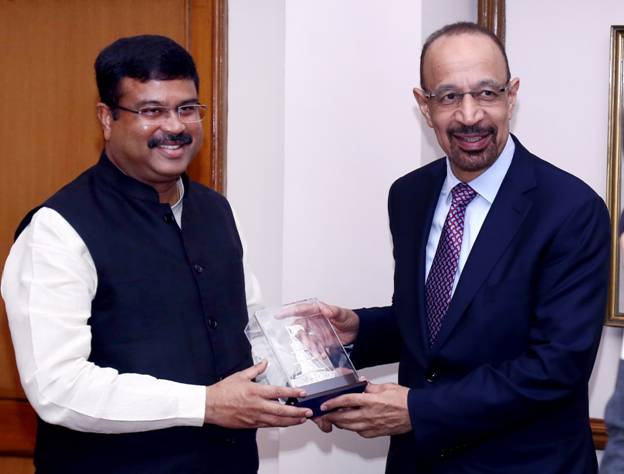
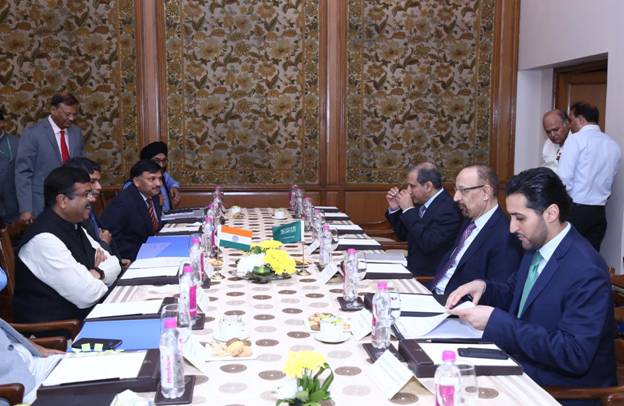
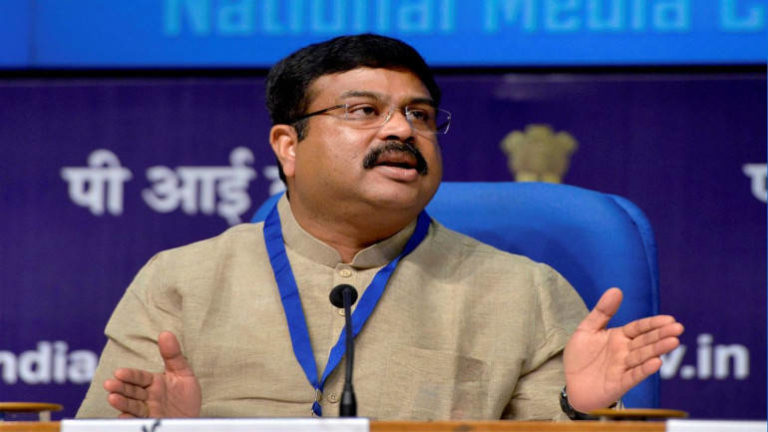
Union Minister of Petroleum & Natural Gas and Steel Dharmendra Pradhan, recently held a meeting with H.E. Khalid Al-Falih, Minister of Energy, Industry and Mineral Resources of Saudi Arabia and Chairman of Saudi Aramco. Both the Ministers discussed about further enhancing India-Saudi Arabia hydrocarbon cooperation to become a strong pillar of the existing overall strategic partnership between the two countries. Minister Al-Falih emphasized the need for capitalizing on the growing momentum in bilateral hydrocarbon cooperation.

Pradhan discussed about the current developments in the global oil & gas markets, and raised India’s concerns on the recent increase in Asian Premium, disturbances in the Strait of Hormuz impacting the movement of oil / LNG tankers and the decision of OPEC Plus members on extending production cuts, leading to oil price volatility. He also highlighted the adverse impact that these developments are having on the Indian economy. He also highlighted the need for responsible and reasonable crude pricing in the larger interest of both consuming & producing countries

Minister Pradhan highlighted the long-term energy partnership between India and Saudi Arabia and reiterated the invitation to Saudi’s state oil company ARAMCO to participate in India’s Strategic Petroleum Reserve Program.

Both the Ministers also reviewed the progress on Saudi investments in Indian oil and gas sector, including the West Coast refinery.

Showcasing former PMs legacy is ‘New India’, says Dharmendra Pradhan

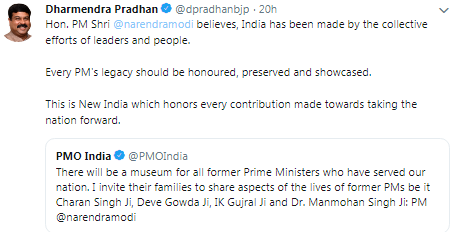
Prime Minister Narendra Modi’s pitch for a “new political culture” has been lauded by Union Minister of Petroleum & Natural Gas and Steel Dharmendra Pradhan. Praising Prime Minister Modi’s announcement to build a museum for all former Prime Ministers, he called it a ‘part of New India’. In his tweet, Pradhan writes that New India is an India which honors every contribution made towards taking the nation forward.  He also added that Prime Minister Narendra Modi believes that India has been made by collective efforts of leaders and people and every Prime Minister’s legacy should be honored, preserved and showcased.

“Hon. PM Shri @narendramodi believes, India has been made by the collective efforts of leaders and people. Every PM’s legacy should be honoured, preserved and showcased,” Pradhan, who is also the Minister for Petroleum and Natural Gas, said in a tweet.

Earlier, Prime Minister Narendra Modi pitched for a “new political culture” to get rid of “political untouchability”. He was speaking during an event to release a book on former Prime Minister Chandra Shekhar. During the occasion he announced that a grand museum dedicated to all the former Prime Ministers of the country will be built in Delhi.  He also invited families of former Prime Ministers to share aspects of the lives of former PMs. The PM added that there was an attempt in the past to diminish the legacy of some prime ministers as part of a strategy. Earlier, Prime Minister Narendra Modi had acknowledged the roles of previous Prime Ministers and Government both from the Red fort and in his Parliament speech.

The “Museum on Prime Ministers of India” will be set up in the premises of Teen Murti Estate. The museum would be a single institution where the visitors can learn about the Prime Minister’s Office, its evolution, role & centrality to governance at the Union level, and also about the individual Prime Ministers. It will provide an interactive and informative experience to the visitors and youth of India through state of the art audio-visual technology and effective modes of communication.