In a landmark achievement,
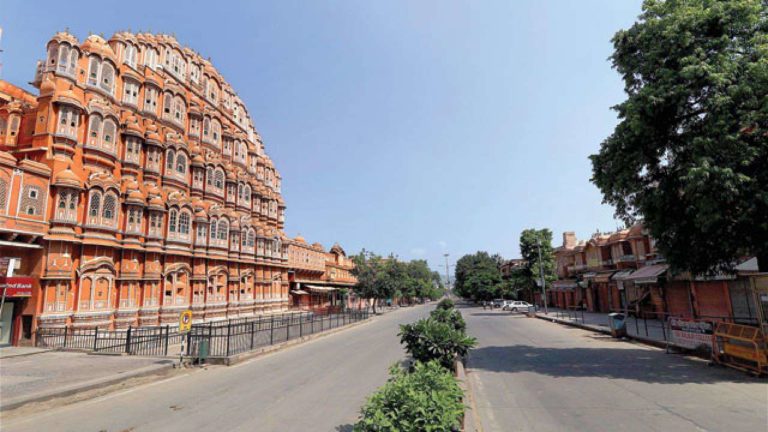
India’s nomination of the Jaipur City, has got inscribed on the World Heritage
List of UNESCO during the 43rd Session of the World Heritage Committee held at
Baku, Azerbaijan. The nomination of
Jaipur City has successfully been done by complying with the various UNESCO
guidelines of 2017. With Successful inscription of Jaipur City, India has 38
world heritage sites, that include 30 Cultural properties, 7 Natural properties
and 1 mixed site.
India’s nomination was initially
recommended by the ICOMOS (advisory body of World Heritage (WH) Centre for
cultural sites) as Deferral, but the 21 nation World Heritage Committee debated
it and after discussion decided to inscribe it on the World Heritage list.
Union Minister for Culture (IC) Prahlad
Singh Patel expressed his happiness for inclusion of Pink City Jaipur in world
heritage list and congratulated people of Jaipur for this prestigious tag. The
Minister thanked to global community for recognizing the historic and cultural
importance of Jaipur.
The countries that supported India’s
nomination were Brazil, Bahrain, Cuba, Indonesia, Azerbaijan, Kuwait,
Kyrghystan, Zimbabwe, China, Guatemala, Uganda, Tunisia, Burkina Faso, Bosnia
and Hezegovina, Angola, St. Kitts and Nevis. Australia and Norway initially
proposed referral but after the debate they agreed for Inscription of Jaipur
city.
Faisal Saeed Al Mutar is the founder of Ideas Beyond Borders and Bayt Al-Hikma 2.0, Global Secular Humanist Movement, and a columnist for Free Inquiry
Scott Douglas Jacobsen: What should a North American audience, global audience, or Indian audience, know about Bay Al-Hikma 2.0? How can they replicate its efforts in advocating for science, humanism, and enlightenment values through translation projects – Arabic, Kurdish, etc.?
Faisal Saeed Al Mutar: One of the things that we function as is a bridge. One of my friends is a Princeton professor in South Asian Studies. He has helped to identify progressive voices there.
Many people in the Arab world do not know that they exist. When people look at the stuff that we translate from English writings of authors coming from South East Asia and Asia.
People, generally, the main thing that we always need to do to continue our translation project is funding and donations to keep the translation going. Also, if people have skills that we need, there are many people who help connect us to many people, e.g., graphic designers, audiovisual editing, video editing, and so on.
If people have skills in social media marketing, all of these things; we need these to help expand our project. When it comes to South Asia, as we expand more and more, and build more successful programs across the Arab world, and we focus on there because I am from there, we have the translators and all of that.
We plan to expand to Urdu. I heard of many of my friends from Pakistan. Many Pakistanis speak English and are educated, but much is coming from the British.
At the same time, there are many people in Bangladesh that do not speak English in a professional way or in an advanced way. So, that way, the knowledge that we care about in terms of Enlightenment values and others are not available for these people who speak only one language.
So, we have had a very successful program so far, with the Arab world. I hope it will be successful as we expand to Bengali and Urdu.
Jacobsen: Thank you for the opportunity and your time, Faisal.
This budget is unique. Beyond numbers, the underlying current is an overwhelming vision to change the direction of economy, towards virtuous and qualitative economic growth.
Focus is to activate ‘virtuous-spiral’ of economic-growth –
the “shubh-labh” as stipulated in ancient Bhartiya culture, as
opposed to the domination of ‘easy-money’. This deserves the highest
commendation by one and all. And the means identified to achieve this goal, is
“entrepreneurial-drive”, which if correctly implemented, would be revolutionary
and transformational. Looking back, the first four decades of Independent India
as entrepreneur-killing license-raj (1947-1991), and the past five decades
(1970-till about 2014) as gradually corrupting society, this year’s budget
brings a fresh breeze, calling upon the nation to move towards an
honest-and-entrepreneurial-era.
What is remarkable is that the Finance Minister Nirmala
Sitharaman did not miss the importance of grass-root level initiatives. For
instance, the provision of Rs 5,000/- overdraft facility for a rural woman in
self-help-group and the plan to create 75,000 skilled rural entrepreneurs in
agro-rural industry are noteworthy. The Finance Minister (FM) has also
simultaneously referred to empowering social entrepreneurs, start-ups,
private-public partnerships and high-tech space-ventures, among others.
Moreover, the research-drive for high-tech and sustainable technologies, can
open doors for innovative talents as the way ahead.
Nurturing entrepreneurs and creativity at all stages is the
real basis to growth of virtuous-spiral of wealth creation, is the key message
from the Narayani-FM.
The implementation challenges of ground realities, however,
require strategic caution against hijacking of major initiatives by the power
brokers, speculative capital and privileges, rather than identifying and
advancing genuine entrepreneurs.
Here are a few strategic pointers, in terms of process and
systems.
● Rural/Artisan Initiatives It requires careful
designing and monitoring by professionals (both in the Organized and the
Unorganized), sensitive to local culture without compromising the reliability
of quality and delivery. This is where nation can expect double-digit growth
and large-scale employment prospects, through value-added rural economy,
arresting migration from villages to cities.
● MSME (Micro, Small and Medium Enterprises) Sector The
realpain-points are not capital alone, instead, disconnect between
old-time entrepreneurs with their new generation. A great number of second
generation MSMEs are currently engaged in employment within the larger sector. Furthermore,
most opportunities remain untapped, due to neglect in creating domain-specific
ecosystems. This is the real backbone of economy, generating maximum
employment.
● Private-Public-Partnership (PPP) It has been tried,
yet it has not fully succeeded during the past few years. It requires consideration
from two specific issues (a) method of resolving conflicts-of-interest, and
empowering an honest government officer, to exercise personal discretion in
favour of efficient and honest private entities, beyond just lowest bids (b)
avoid entry barriers for smaller enterprises having great caliber but not
enough capital prowess. These two corrections can result in major gains for
Make-in-India in defence, aviation, space, and high-tech sectors, besides
infra-structure industries. Correct implementation of strategies may even lead
to a reverse brain drain such that talented professionals living abroad may
start coming back to country, in decades ahead.
● Social-Enterprises While capital availability and
visibility are sure to increase through the SEBI, the institutional supports
are warranted in matters of marketing, professional management and availability
of high-end knowledge inputs. Attitudinal limitations towards profit making in
socially conscientious entrepreneurs require careful moderation to avoid errors
in decision making. Or else, these avenues may be hijacked by large scale
manipulators or speculators, as is currently happening in the case of tax exempted
rich farmers.
● Real-Estate Defining the affordable housing price
limit at Rs 45 lakh, misses two crucial aspects (a) speculative increase in
land prices of 1000% or even more during the 2004-2014 period across all parts
from urban to rural. The market price considered by government agencies are way
high in relation to real income levels of 95% of the population. Necessary
corrections in land price speculations would automatically make housing
affordable for all of society, provided state governments and agencies shed-off
their greed for yet another revenue source through artificially jacked-up stamp
duties. Central government needs to take lead in correcting market price
indications. This one act alone would lead to phenomenal increase in housing
economy which is a basic need for all. And, (b) affordable price of land and the
housing need are related with specific locations as per type and level of
cities or villages.
● Targeting a $5 trillion Economy & Forex-rate Setting
the goal in dollar terms reflects a leader’s conviction to compete and succeed
in global ranking. Larger purpose alone drives creative entrepreneurs to excel so
the goal of $5 trillion economy in 5 years is appropriate. However, it should
not be achieved through conventional approach of devaluing rupee to achieve
higher exports, for two reasons: (a) firstly, a strong rupee with stronger
domestic economy would anyway mean greater in dollar economy (eg. a 20%
appreciation in value of rupee in today’s exchange-rate, would appreciate our
economy by 20% in dollar terms). So, India needs to opt for forex rates to be
set through bilateral arrangements with each nation rather than leaving it to the
mercy of speculative currency markets and, (b) India needs to experiment with
fixing dual-forex rates, for imports and exports, to achieve higher exports at
competitive prices while absorbing difference values in national forex reserves
account.
The nation has given a clear mandate to the current
government in recent general elections with a hope for better times ahead.
Faith posed in honest and decisive leadership is reflected in the tone and
spirit of this budget. However, the challenge lies in building knowledge teams that
can clearly visualise nut-bolt detailing and potential pitfalls so the
implementation may actually lead society as a whole towards ascending
prosperity during the next five years.
The Modi 2.0 Budget
presented by the Finance Minister Nirmala Sitharaman, marked a significant shift
from the Nehruvian economy of promoting large public sector entities and rests
its focus on farms and villages. With a clear target of building a $3 trillion
economy in the immediate future and $5 trillion in the course of time, the new
government wants the private sector to be the driver of this rapid economic
growth.
Nirmala Sitharaman’s first budget of Rs 27.86 lakh crore has several interesting features. Through her 2 hours 17 minutes long address she presented an ambitious budget, spread across sectors widely. According to her “the soul of India is in its villages”, so the economy is set to get a boost with the empowerment of villagers, women and farmers. It sees the farms and increasing rural income as the pivot. The Pradhan Matri Awas Yojana Gramin (PMAY-G), Pradhan Mantri Gram Sadak Yojana (PMGSY), Bharatmala, Sagarmala and Udaan are designed to be engines of connectivity and rural & urban – now being called ‘rurban’ – growth. The 1.25 lakh km new roads would entail Rs 80,000 crore investment.
The Scheme of Fund for Regeneration of Traditional Industries (SURTI) will create 100 clusters for 50,000 artisans. The ASPIRE for promotion of Technology Business Incubators (TBI) in rural industry proposes another 100 clusters to develop 75,000 skilled entrepreneurs in agro-rural industry sectors. This is in addition to 10,000 new Farmer Producer Organisations (FPOs), apparently with corporate interface, to ensure economies of scale for farmers over next five years. The PM digital saksharata, Jal Shakti in 256 districts, e-nam, APMC, Swachha Bharat for rural solid waste management are designed to spur rural growth.
Many of these would
be a bridge between urban and rural growth. These are backed by many programmes
for industry. This is likely to create demand and spur the growth of the
industry and allied sectors.
However, the finance minister has thrown a spanner. Her proposal to levy additional excise duty, road and other cess of Rs 2.50 on petrol and diesel will be inflationary as it would shoot up transport expenses at all levels. This may thaw the economy. Already cess and duties are high on fuel. Tolls are at atrocious rates. It calls for a re-look and withdrawal of the proposal to keep economy on track.
Another act of raising customs duty on gold, already high at 10%, to 12.5% is questionable. Presumably, gold is mistakenly considered an item of consumption by the rich. The reality is that no marriage in poor or rural household is complete without purchase of gold. Those suggesting imposing such levies forget that during NDA-I Atal Bihari Vajpayee had taken the prudent decision of having zero duty on gold imports to stop smuggling. Higher duties are happy indicators for the smugglers, who have links with international gun, drug mafias and terrorist organisations. Though the aim is to raise revenue, it may end up increasing surveillance at multiple sectors causing revenue loss. Ideally, this needs to be rolled back as the losses outweigh gains.
Similarly, TDS on cash withdrawals of over Rs 1 crore, not large enough sum for even small businesses, may cause slowdown. The government should not be in a hurry to digitalise economy. Cash is the fastest transaction method. Linking it to black money – simply meaning untaxed – is misnomer. Let the cash lubricate and speed up economy. Digitalisation should be a normal and automatic process. There are apprehensions too for digitalization as many Aadhar-linked accounts are stated to have been defrauded. Government needs to go slow and withdraw such strange rules that make dealings and tax filing cumbersome.
It was expected that the FM would say some words on abolishing income-tax. Instead increasing rates to 42.7%, for an income over Rs 5 crore does not bode well. High taxes reduce disposable income and are dampener for the people to consume. She has still time to review it. Indian economy needs simplicity in the tax administration. More is the rigmarole, more the complication for the economy. The NDA-I had started on a good note. The FM should continue that. Besides, those who have been let off up to Rs 5 lakh income should be allowed not to file tax returns. This only burdens the tax office with more clutter and little benefit. Another correction in the system should be to allow taxes, as of now, to be calculated at Rs 5 lakh instead of forcing those who earn a rupee above it to pay from the base rate of Rs 2.5 lakh. This is dichotomy and is not a good sign for tax administration. This drains a taxpayer of huge sum to feed an oversized government at the cost of the economy. Sooner, the FM does it, would be better for all – taxpayers, tax administrators and the market. Politically too it would soothe the voters, who have, as the FM in the opening paragraph said, overwhelmingly supported the Modi government, “putting the nation first”. A small gift would have larger dividend.
Taxing the bank
deposits does not suit the welfare nature of Narendra Modi government. It may
give small revenues but it causes immense hardship to those who save. Savings,
the FM says, has to be encouraged to boost the economy. The TDS and low
interest rates dampen the enthusiasm of the savers. Her words must match the
deeds. It’s a necessity not only for the savers but for a nation that is pining
for funds. If savings are taken care of, the government would not have to look
for borrowings abroad as the FM’s speech indicate to spur growth and fiscal
management. This swadeshi move would make easy finance available to
government and save forex.
The FM may need to do some rework, to contain inflation, which after this budget, is likely to rise to 5%. For a $5 trillion economy in nine years, it would require a growth rate of at least 11% not 8% as the Economic Survey indicated. With a little vision, the budget 2019-20 can become the real growth propeller and effectively deviate from the residues of Nehruvian economy.
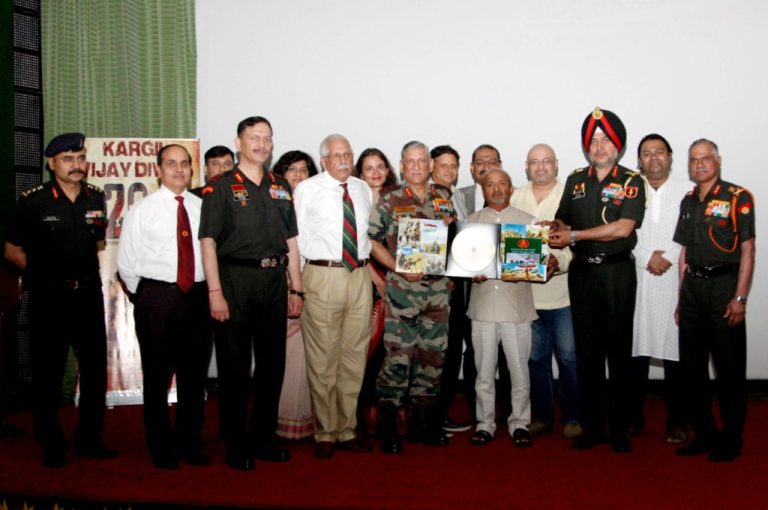
As the nation celebrates the 20th
anniversary of Kargil Vijay Diwas this year on 26 July, a grand ceremony was
organised recently at Manekshaw Centre, New Delhi, in which Gen Bipin Rawat,
Chief of the Army Staff released Kargil Tribute Song to honour, salute and pay
homage to the Kargil martyrs and war veterans.
The song, a tribute to the
soldiers has been composed by Sammer Anjaan, eminent hindi lyricist and sung by
Shatadru Kabir. The music has been
composed by Raju Singh. The 20th anniversary celebrations are aimed at
‘Remembering their sacrifice’, ‘Rejoicing in their victory’ and ‘Renewing the
pledge’ to go beyond the call of duty when called upon.
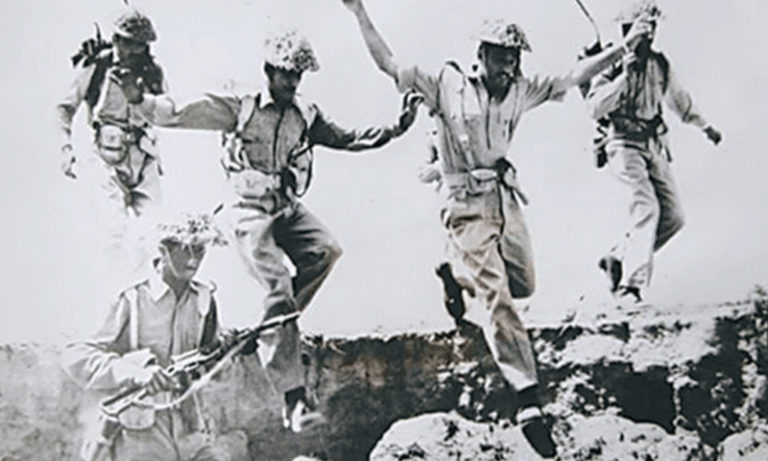
The Kargil conflict between India
and Pakistan took place between May and July 1999 in the Kargil district of
Kashmir and elsewhere along the Line of Control (LOC). It is also referred to
as Operation Vijay, which was the name of the Indian operation to clear the
Kargil sector.Operation Vijay involved major operations to evict Pakistani
intruders from Indian territory on the icy heights of Dras, Kargil, Batalik and
Turtuk and bears witness to the courage, valour and sacrifice of the soldiers
of the Indian armed forces.
The present BJP-led
NDA government has all along been accused for adopting what is being referred
to as a ‘muscular’ approach while dealing with the situation in Kashmir. But
those who are trying to insinuate that use of strong-arm tactics is a new
phenomenon in Kashmir and that it’s only New Delhi that has been resorting to ‘muscular’
policies are either not conversant with the post-partition history of Kashmir,
or are intentionally choosing to feign ignorance.
The bitter and undeniable
reality is that the very genesis of Kashmir issue in itself is the result of
‘muscular’ approach and even though undesirable, this more than seven-decade
old trend doesn’t seem to have gone out of fashion ever since, as events have
proved.
Operation
Gulmarg (1947-48)
The Maharaja of
Jammu & Kashmir entered into a ‘stand-still agreement’ with Pakistan
immediately after partition. Under this agreement, Pakistan was required to
honour all administrative arrangements that this princely state had with the
British Crown till new arrangements were made. But just nine weeks later,
Pakistan unilaterally reneged this agreement by launching a military campaign
to seize Kashmir and gave this ambitious plan the code name ‘Operation Gulmarg’.
To avoid being censured by the international community for its unprovoked act
of aggression, Pakistan camouflaged this military action by giving it an
appearance of a tribal invasion. Accordingly, armed by Pakistan Army and led by
its regulars in disguise, 20 lashkars (militias) of 1,000 tribesman each, embarked
upon their mission to conquer J&K. But the timely arrival of the Indian Army
and its gallant actions thwarted Pakistan’s plan to forcibly assimilate the
whole of Kashmir.
India had the
military capability of wresting back the areas of Kashmir which Pakistan had
occupied by force and any military action to restore its territorial integrity
was legally and morally sound and justified. However, instead of doing so India
took the matter of Pakistani aggression to UN Security Council and even agreed
to a ceasefire even though the same didn’t make it incumbent on Pakistan to
return the territory under its illegal occupation.
So, isn’t
Operation Gulmarg the first instance when ‘muscular’ approach was used in
Kashmir and doesn’t Pakistan Army rightly deserve the credit for introducing
use of ‘muscle-power’ in Kashmir!
“Operation Gibraltar”
was the second time that Pakistan used a ‘muscular’ approach in order to get
hold of Kashmir. Here again, rather than following a tough policy, New Delhi agreed
to return those parts of Kashmir that the Indian Army had captured, even though
this was legally Indian territory usurped by Pakistan in 1947-48.
‘Freedom
Struggle’ (1989 onwards)
Islamabad’s
third and most brazen attempt to realise its Kashmir dream came in the form of Islamic
terrorism in the late eighties. Thousands of local boys were taken across the
porous Line of Control (LoC) and after receiving military training were armed
and sent back to fight against security forces. Pakistani nationals were also
sent across to join what they were told was a ‘jihad’ (holy war). In his
well-researched book ‘Shadow Wars’, Arif Jamal mentions that in the early days
of militancy there could have been as many as 180 militant groups operating in
Kashmir and this gives a fair idea about the massive scale of the Pakistan Army
and ISI sponsored enterprise.
Though terrorism
in Kashmir erupted in 1988, instead of coming down on it immediately with an
iron fist, the Government of India continued to try and control the same with
standard regulations meant for maintaining law and order under normal
conditions. It was only after these laws failed to quell Pakistan-sponsored terrorism
that Armed Forces Special Powers Act (AFSPA) was invoked in J&K in 1990.
So, those who consider promulgation of AFSPA to be ‘muscular’ policy need to
realise that AFSPA came into force due to the need to counter Pakistan’s proxy
war.
Though some
nations and international bodies may occasionally air objections to AFSPA, but
none of them will initiate or support concerted action to seek its removal
since the world community sympathises with nations bearing the brunt of terrorism
and appreciates the fact that security forces dealing with terrorism do require
special provisions and safeguards to fight this menace threatening humanity.
Operation
Vijay (1999)
Pakistan Army’s
plan of large-scale intrusions across the Line of Control (LoC) in Kargil
sector and occupying posts vacated by Indian Army during winters so as to alter
alignment of the LoC was the fourth instance of ‘muscular’ approach being
applied by it in the J&K. Here again the Pakistan Army tried to deceive the
world into believing that the intruders were Kashmiri “freedom fighters” and in
order to hide the truth, stooped to a new low by disowning the dead bodies of
their own soldiers killed in action. But its bluff was soon called and the
Pakistan Army had to suffer another ignominy of being declared the aggressor
and having to withdraw to its own side of the LoC.
Despite
Pakistan’s brazen use of muscular power in Kargil, India’s reaction to these
intrusions was both measured and localised, which has been highly appreciated
by the international community since it didn’t escalate into a full-blown war
between two nuclear states. This was in sharp contrast to what Pakistan did in
1965 when it launched ‘Operation Grand Slam’ to capture Akhnoor even as its
Operation Gibraltar in Kashmir was in progress. By doing so, Pakistan enlarged
the scope of the conflict and this resulted in a full-scale war between India
and Pakistan.
Who’s to
blame?
Is Kashmir a
victim of ‘muscular’ policy? The answer is ‘Yes’. But is New Delhi responsible
for the ‘muscular’ policy in Kashmir? The answer is an emphatic ‘No’. If armed
groups fire upon security forces, then is firing back at them adopting a
‘muscular’ policy? When terrorists refuse the offer to surrender and start a
gunfight with security forces, then is retaliation ‘muscular’ approach? When
Pakistan supported terrorists indiscriminately use ‘muscular’ means in a bid to
create a state of anarchy in Kashmir, does invoking AFSPA indicate a ‘muscular’
approach?
Conversely, isn’t
the barbaric act of terrorists abducting, torturing and killing innocent
civilians ‘muscular approach’? Isn’t posting graphic ‘execution’ videos on
social media to terrorise and intimidate the people ‘muscular policy’? Doesn’t the
cowardly act of terrorists attacking unarmed policemen on traffic regulation
duties amount to ‘muscular approach’? Aren’t vigilante squads formed by youth
to enforce shutdown calls given by the All Party Hurriyat Conference (APHC) ‘muscular’
tactics? Isn’t stone pelting and acts of arson during protests the
manifestation of a ‘muscular approach’?
With terrorists openly
using guns, grenades, bombs and Hurriyat leaders inciting mob violence in order
to achieve a political objective does one still requires to be told who’s
guilty of giving resolution of the Kashmir issue a ‘muscular approach’?
A change in command of the
Pakistan Army normally gives way to a degree of romanticism that the new chief
will be different from his predecessors, will remain within the ambit of his
military domain and allow democracy to flourish. Such a thought process was
witnessed when General Ashfaq Pervez Kayani took over in what heralded the end
of a decade long dictatorship of General Pervez Musharraf. Kayani turned out to
be a quiet, behind the scenes operator who scripted the policy of Pakistan Army’s
“holding all authority with no accountability.” General Raheel Sharif was more
vocal and visible than his predecessor; he refined the Kayani doctrine to a
fine art.
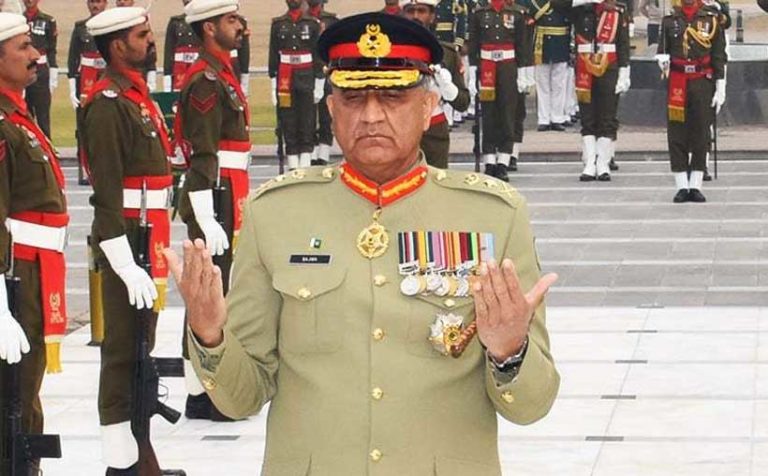
The anointment of General
Qamar Bajwa as Pak Army Chief led to another round of euphoria in the Indian
media. Bajwa took over in November 2016 with the Indian media going overboard
in projecting him as a mature
professional soldier, a votary for democracy and more interested in containing
the internal security situation of his country. It was said that for once the
Prime Minister (Nawaz Sharif) had a say in the selection process which was seen
as a positive indication of things to come.
General Bajwa was quick to
dispel the euphoria. Even as the country prepared for the elaborate ceremony
(almost similar to a coronation) that marks the change of command of the
Pakistan Army Chiefs, two terror attacks in the Jammu region demonstrated that Pakistan’s
India policy is unlikely to be tweaked under the new incumbent.
By mid-2017, within months
of taking over, Bajwa had attained a new high by putting the judiciary too in
his pocket and engineering the ouster of Prime Minister Nawaz Sharif through it.
The situation was most aptly described by a noted journalist, FS Aijazuddin,
with his fateful words, “Elected governments in Pakistan have less to fear from
the Indian Army than from their own- with good reason. For almost 60 years,
since October 1958, politicians have lost every battle to gain the higher
ground of civilian supremacy.” Within a year of the ouster of Nawaz Sharif,
Bajwa scripted defeat of the main political parties in an election that
witnessed blatant rigging with active support from his army. He placed at the
helm, Imran Khan, a political light weight who has ever since toed his line.
Thus, General Bajwa managed to take the policy of ‘holding all authority with no accountability,” to the next level.
Bajwa has recently changed the Director
General of the notorious military spy agency ISI; the new incumbent, Lt. Gen. Faiz Hameed, is a known confidante of his. He has also
empowered his Director General of
Inter-Services Public Relations (ISPR), Major General Asif Ghafoor, to speak
freely on all governance issues be they political, economic, diplomatic or on the
security affairs. On India particularly all statements emanate from the
ISPR, as was seen in the aftermath of the Pulwama and Balakot incidents.
There are, however, a number of spooks in
Bajwa’s rollercoaster ride. There is a general disenchantment in the
international community with the inability of the Pakistani state (read deep
state) in controlling terrorist activities emanating from their soil. The US
has stopped most of the aid that it used to provide and is on the verge of
imposing sanctions. The European Union was never a big donor yet it’s also
veering away. The rising stature of India has much to do in the creation of
this environment.
Internally, Pakistan is in a deep financial
crisis with no means in place to overcome the same. The insurgent movements are
gaining momentum at the agitation level with good use of social media. Good
examples are the activities of the Pashtun Tahafuz Movement (PTM) in the
frontier regions and the Balochistan Liberation Army (BLA) in Balochistan. Bajwa
is finding it a problem to convince China about the security of the flagship
China Pakistan Economic Corridor (CPEC) project on which Pakistan seems to be
hinging its economic future.
To meet the emerging
challenges, General Bajwa has come up with what is spoken of as the “Bajwa
Doctrine.” His strategy is based on temporarily normalising relations with
India in order to concentrate on the pressure that is being created by the US.
Giving a go-ahead, to the Kartarpur corridor, with a beautifully engineered
fanfare, and also speaking publically about the need to initiate dialogue with
India to resolve all pending disputes are twin prongs of his strategy.
General Bajwa has taken diplomacy in his
own hands and is busy visiting foreign countries to garner support for his
doctrine. In recent days he has visited China for some renegotiation of the
CPEC project. The more significant visit has been to the United Kingdom, the
second by him during this tenure. Experts are of the opinion that a main agenda
of this visit was to use the UK to reach out to the US and the international
community and convince them to reduce pressure exerted on Pakistan to take the
lead in improving Indo-Pakistan relations.
The General is not known to hold
discussions with the elements of civil government of his country like the
National Security Committee of the Cabinet before embarking on such visits nor
does he take with him any civilian officials. He holds the meetings and then
gives diktats on actions to be taken to the government.
It is often said that, to gain some
diplomatic traction, India should talk directly to the Pakistan Army, it being
the only decision making authority in the country. This is not feasible for a
democratic government. Also, the fundamentalist inclination of the Pakistan
Army is well known, so a dialogue, if initiated, is unlikely to accrue any
positive results. The only option left for India is to try and strengthen the
roots of democracy in the neighbouring country and break the stranglehold of
the Army before thinking of any forward movement in relations between the two
Nations.
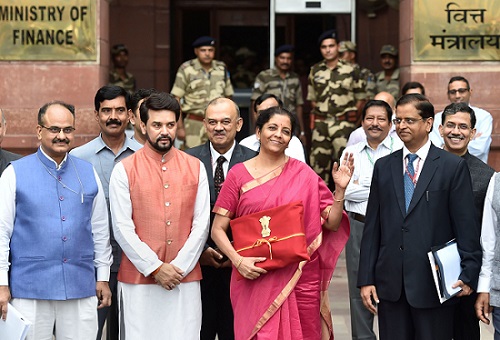
Indian Finance Minister Nirmala Sitharaman presented the country’s General Budget for financial year 2019-20. Excerpts from her speech.
“Our
economy was at approximately US$ 1.85 trillion when we formed the Government in
2014. Within 5 years it has reached US$ 2.7 trillion. Hence, it is well within
our capacity to reach the US$ 5 trillion in the next few years. In the interim
Budget of 2019-20 presented in February 2019, we gave ourselves a Vision for
the Decade. I flag here the ten points of our Vision laid before us:
Building physical and social infrastructure;
Digital India reaching every sector of the economy;
Pollution free India with green Mother Earth and Blue Skies;
Make in India with particular emphasis on MSMEs, Start-ups, defence manufacturing, automobiles, electronics, fabs and batteries, and medical devices;
Water, water management, clean Rivers;
Blue Economy;
Space programmes, Gaganyan, Chandrayan and Satellite programmes;
Self-sufficiency and export of food-grains, pulses, oilseeds, fruits and vegetables;
Healthy society – Ayushman Bharat, well-nourished women & children. Safety of citizens;
Team India with Jan Bhagidari. Minimum Government Maximum Governance.”
“The
Indian economy will grow to become a $3 trillion economy in the current year. It is now the sixth largest in the world.
Five years ago, it was at the 11th position. In Purchasing Power Parity terms,
we are in fact, the 3rd largest economy already, only next to China and the
USA.”
“Connectivity is the lifeblood of an economy. The Government has given a massive push to all forms of physical connectivity through Pradhan Mantri Gram Sadak Yojana, industrial corridors, dedicated freight corridors, Bhartamala and Sagarmala projects, Jal Marg Vikas and UDAN Schemes. While the industrial corridors would improve infrastructure availability for greater industrial investment in the catchment regions, the dedicated freight corridors would mitigate the congestion of our railway network benefitting the common man. The ambitious programme of Bharatmala would help develop national road corridors and highways, while Sagarmala would enhance port connectivity, modernization and port-linked industrialization. If Sagarmala is aimed at improving the infrastructure for external trade, equally it is the poor man’s transport too. Waterways are proven as a cheap mode of transport. The Jal Marg Vikas project for capacity augmentation of navigation on National Waterways is aimed at smoothening internal trade carried through inland water transport. These initiatives will improve logistics tremendously, reducing the cost of transportation and increasing the competitiveness of domestically produced goods.”
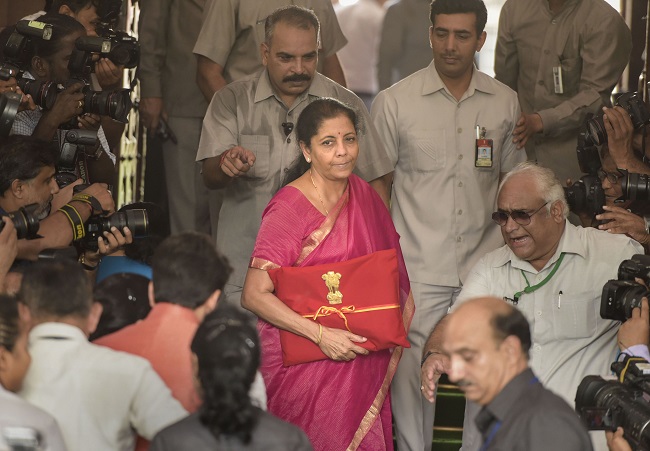
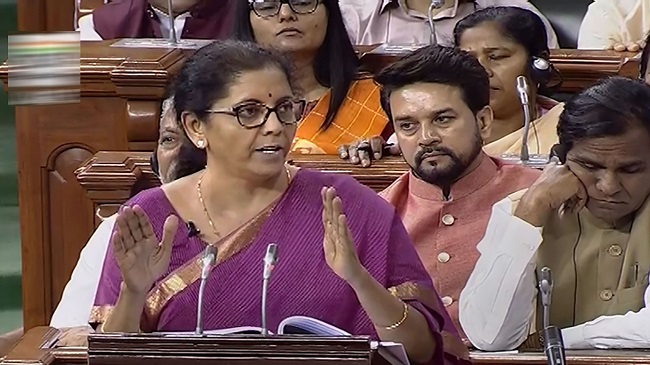
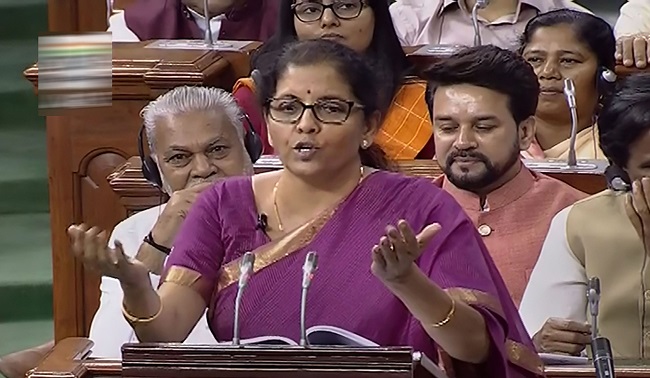
Finance Minister Nirmala Sitharaman presenting the General Budget 2019-20 in the Lok Sabha at Indian Parliament in New Delhi on Friday, July 05, 2019.
“India’s first indigenously
developed payment ecosystem for transport, based on National Common Mobility
Card (NCMC) standards, was launched by Hon’ble Prime Minister in March, 2019.
This will enable people to pay multiple kinds of transport charges, including
metro services and toll tax, across the country. This inter-operable transport
card runs on RuPay card and would allow
the holders to pay for their bus travel, toll taxes, parking charges, retail
shopping and even withdraw money.”
“Phase-II
of FAME Scheme, following approval of the Cabinet with an outlay of Rs 10,000 crore for a period of 3 years, has commenced from 1st
April, 2019. The main objective of the Scheme is to encourage faster adoption
of Electric vehicles by way of offering upfront incentive on purchase of
Electric vehicles and also by establishing the necessary charging
infrastructure for electric vehicles. Only advanced battery and registered
e-vehicles will be incentivized under the Scheme with greater emphasis on
providing affordable & environment friendly public transportation options for the common man.”
“We need to develop our
inland waterways to shift a significant portion of inland cargo movement from
road and rail. This Government envisions using the rivers for cargo
transportation, which will also help to decongest roads and railways. As part
of the Jal Marg Vikas Project for enhancing the navigational capacity of Ganga,
a multi modal terminal at Varanasi has become functional in November 2018 and
two more such terminals at Sahibganj and Haldia and a navigational lock at
Farakka would be completed in 2019-20. The movement of
cargo volume on Ganga is estimated to increase by nearly four times in the next
four years. This will make movement of freight, passenger cheaper and reduce
our import bill.”
“It is estimated that Railway Infrastructure would need an
investment of Rs 50
lakh crores between 2018-2030. Given
that the capital expenditure outlays of Railways are around Rs 1.5 to 1.6 lakh
crores per annum, completing even all sanctioned projects would take decades. It
is therefore proposed to use Public-Private Partnership to unleash faster
development and completion of tracks, rolling stock manufacturing and delivery
of passenger freight services.”
“For ease of access to credit for MSMEs, Government has introduced
providing of loans upto Rs 1 crore for MSMEs within 59 minutes through a
dedicated online portal. Under the Interest Subvention Scheme for
MSMEs, Rs 350
crore has been allocated for FY 2019-20 for 2% interest subvention for all GST
registered MSMEs, on fresh or incremental loans.
“It is right time to
consider increasing minimum public shareholding in the listed companies. I have
asked SEBI to consider raising the current threshold of 25% to 35%.”
“FDI inflows into India have remained robust despite global
headwinds. Global Foreign Direct Investment (FDI) flows slid by 13% in 2018, to
US$ 1.3 trillion from US$ 1.5 trillion the previous year – the third
consecutive annual decline, according to UNCTAD’s World Investment Report 2019.
India’s FDI inflows in 2018-19 remained strong at US$ 64.375 billion marking a
6% growth over the previous year. I propose to further consolidate the gains in
order to make India a more attractive FDI destination:
The Government will examine suggestions of further opening up of FDI in aviation, media (animation, AVGC) and insurance sectors in consultation with all stakeholders.
100% Foreign Direct Investment (FDI) will be permitted for insurance intermediaries.
Local sourcing norms will be eased for FDI in Single Brand Retail sector.”
“India has emerged as a major space power with the
technology and ability to launch satellites and other space products at
globally low cost. Time has come to harness this ability commercially. A Public
Sector Enterprise viz. New Space India Limited (NSIL) has been incorporated as
a new commercial arm of Department of Space to tap the benefits of the Research
& Development carried out by ISRO. The Company will spearhead
commercialization of various space products including production of launch
vehicles, transfer to technologies and marketing of space products.”
“Pradhan Mantri Awas Yojana – Gramin (PMAY-G) aims to achieve the objective of “Housing for All” by 2022. A total of 1.54 crore rural homes have been completed in the last five years. In the second phase of PMAY-G, during 2019-20 to 2021-22, 1.95 crore houses are proposed to be provided to the eligible beneficiaries. These houses are also being provided with amenities like toilets, electricity and LPG connections. With the use of technology, the DBT platform and technology inputs, average number of days for completion of houses has reduced from 314 days in 2015-16 to 114 days in 2017-18.”
“Ensuring
India’s water security and
providing access to safe and adequate drinking water to all Indians is a
priority of the Government. A major step in this direction has been the
constitution of the Jal Shakti Mantralaya, integrating the Ministry of Water
Resources, River Development and Ganga Rejuvenation and Ministry of Drinking
Water and Sanitation. This new Mantralaya will look at the management of our
water resources and water supply in an integrated and holistic manner, and will
work with States to ensure Har Ghar Jal (piped water supply) to all rural households by 2024 under the
Jal Jeevan Mission. This Mission, under the Department of Drinking Water and
Sanitation, will focus on integrated demand and supply side management of water
at the local level, including creation of local infrastructure for source
sustainability like rainwater harvesting, groundwater recharge and management
of household wastewater for reuse in agriculture. The Jal Jeevan Mission will
converge with other Central and State Government Schemes to achieve its
objectives of sustainable water supply management across the country.”
“Swachh Bharat Abhiyan has
touched the very conscience of the nation besides bringing enormous health and
environmental benefits. This noble Scheme, initiated in 2014, has achieved a
resounding success. 9.6 crore toilets have been constructed since Oct 2, 2014.
More than 5.6 lakh villages have become Open Defecation Free (ODF). We have to
build on this success. We must not only sustain the behavioural change seen in
people but also harness the latest technologies available to transform waste
into energy. I now propose to expand the Swachh Bharat Mission to undertake
sustainable solid waste management in every village.”
“We propose to establish a
National Research Foundation (NRF) to fund, coordinate and promote research in
the country. NRF will assimilate the research grants being given by various
Ministries independent of each other. NRF will ensure that the overall research
eco-system in the country is strengthened with focus on identified thrust areas
relevant to our national priorities and towards basic science without
duplication of effort and expenditure. We would work out a very progressive and
research oriented structure for NRF. The funds available with all Ministries
will be integrated in NRF. This would be adequately supplemented with
additional funds.”
“The Government is
proposing to streamline multiple labour laws into a set of four labour codes.
This will ensure that process of registration and filing of returns will get
standardized and streamlined. With various labour related definitions getting
standardized, it is expected that there shall be less disputes.”
“I propose to consider
issuing Aadhaar Card for Non-Resident Indians with Indian Passports after their
arrival in India without waiting for 180 days.”
“Financial gains from cleaning of the
banking system are now amply visible. NPAs of commercial banks have reduced by
over Rs 1 lakh crore over the last year, record recovery of over Rs 4 lakh crore due to IBC and other
measures has been effected over the last four years, provision coverage ratio
is now at its highest in seven years, and domestic credit growth has risen to
13.8%. Government has smoothly carried out consolidation, reducing the number
of Public Sector Banks by eight. At the same
time, as many as six Public Sector Banks have been enabled to come out of
Prompt Corrective Action framework.”
“Government has announced its intention
to invest Rs 100 lakh crore in infrastructure over the next five
years. To this end, it is proposed to set up an expert committee to study the current
situation relating to long-term finance and our past experience with
development finance institutions, and recommend the structure and required flow
of funds through development finance institutions.”
“Government is setting an
enhanced target of Rs 1,05,000 crore of disinvestment receipts for
the financial year 2019-20. The Government will undertake strategic sale of
PSUs. The Government will also continue to do consolidation of PSUs in the
non-financial space as well.”
“Let me recall and reiterate this
Government’s effort over the past five years to alleviate the tax burden on
small and medium income-earners. This includes self-employed as well as small
traders, salary earners, and senior citizens. Only when their annual taxable
income exceeds Rs
5 lakh, they are required to pay any
income tax.”
“So far as corporate tax is concerned, we continue with phased
reduction in rates. Currently, the lower rate of 25 % is only applicable to
companies having annual turnover up to Rs 250 Crore. I propose to widen this to include all companies having annual
turnover up to Rs
400 crore. This will cover 99.3% of the companies. Now
only 0.7% of companies will remain outside this rate.”
“Considering our large consumer base, we aim to leapfrog and
envision India as a global hub of manufacturing of Electric Vehicles. Inclusion
of Solar storage batteries and charging infrastructure in the above scheme will boost our efforts. Government has
already moved GST council to lower the GST rate on electric vehicles from 12%
to 5%. Also to make electric vehicle affordable to consumers, our government
will provide additional income tax deduction of Rs 1.5 lakh on the interest paid on loans taken to
purchase electric vehicles. This amounts to a benefit of around Rs 2.5 lakh over the loan period to the taxpayers
who take loans to purchase electric vehicle.”
“Start-ups in India are taking firm roots
and their continued growth needs to be encouraged. To resolve the so-called ‘angel tax’ issue,
the start-ups and their investors who file requisite declarations and provide
information in their returns will not be subjected to any kind of scrutiny in
respect of valuations of share
premiums. The issue of establishing identity of the investor and source of his
funds will be resolved by putting in place a mechanism of e-verification. With this, funds raised by start-ups will not
require any kind of scrutiny from the Income Tax Department.”
Interchangeability of PAN and Aadhaar
“Mr Speaker, Sir, more than 120 Crore Indians now have Aadhaar.
Therefore, for ease and convenience of tax payers, I propose to make PAN and
Aadhaar interchangeable and allow those who do not have PAN to file Income Tax returns
by simply quoting their Aadhaar number and also use it wherever they are
required to quote PAN.”
“Mr Speaker Sir, as I have stated earlier,
we have taken several measures in the past to alleviate the tax burden on small
and medium income-earners as those having annual income up to Rs 5 lakh are not required to pay any income-tax.
We are thankful to the taxpayers who play a major role in nation building by
paying their taxes. However, in view of rising income levels, those in the
highest income brackets, need to contribute more to the Nation’s development.
I, therefore, propose to enhance surcharge on individuals having taxable income
from Rs
2 crore to Rs 5 crore and
Rs
5 crore and above so that effective tax
rates for these two categories will increase by around 3 % and 7 %
respectively.”
“We are further simplifying the GST processes. A simplified single
monthly return is being rolled out. Taxpayer having annual turnover of less
than Rs 5 crore shall file quarterly return. Free accounting software for
return preparation has been made available to small businesses. A fully
automated GST refund module shall be implemented. Multiple tax ledgers for a taxpayer shall be
replaced by one.”
“Make in India is a cherished goal. In order to provide domestic industry a level playing field, basic
customs duty is being increased on items such as cashew kernels, PVC, Vinyl
flooring, tiles, metal fittings, mountings for furniture, auto parts, certain
kinds of synthetic rubbers, marble slabs, optical fibre cable, CCTV camera, IP
camera, digital and network video recorders etc. Also, exemptions from custom duty
on certain electronic items which are now being manufactured in India are being
withdrawn. Further, end use based exemptions on palm stearin, fatty oils, and
exemptions to various kinds of papers are also being withdrawn. To encourage
domestic publishing and printing industry, 5 % custom duty is being imposed on
imported books.”
“To further promote domestic manufacturing, customs duty reductions
are being proposed on certain raw materials and capital goods. These include
certain inputs of CRGO sheets, amorphous alloy ribbon, ethylene di-chloride,
propylene oxide, cobalt matte, naphtha, wool fibres, inputs for manufacture of
artificial kidney and disposable sterilised dialyser, and fuels for nuclear
power plants. To further incentivise e-mobility, customs duty is being exempted
on certain parts of electric vehicles. Customs duty is also being exempted on
capital goods required for manufacture of specified electronic goods.”
“Export duty is being rationalised on raw and semi-finished leather
to provide relief to this sector.”
“Crude
prices have softened from their highs. This gives me a room to review excise
duty and cess on petrol and diesel. I propose to increase Special Additional
Excise duty and Road and Infrastructure Cess each by one rupee a litre on
petrol and diesel. It is also proposed to increase custom duty on gold and
other precious metals from 10% to 12.5%.”
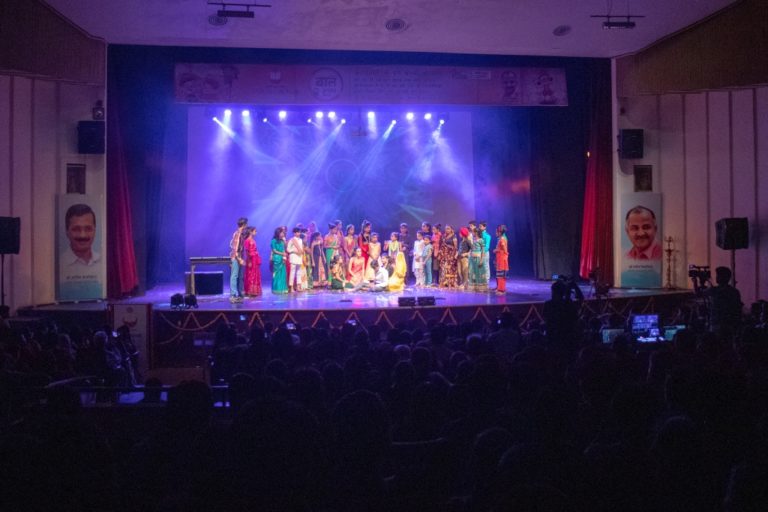
When children are given a stage,
they make sure to put their best foot forward. This was recently seen at the Bal
Utsav organized by the Hindi Academy, when hundreds of students, in the age
group of 8-16 years, from various government schools presented plays on
hard-hitting social issues and enthralled the audience with their acting and
performance skills. The festival was a welcome attempt to enrich the young
minds, and make them understand various contemporary social problems.
Inaugurated by Manish Sisodia, Deputy Chief Minister, Delhi government the six-day event was hosted at Pyarelal Bhawan Sabhagar. The students were trained in theater performance free of cost by Hindi Academy. It turned out to be a great opportunity for many underprivileged children, who can’t manage to pay the fees to participate in theatre workshops to explore their hidden talent.
The stories portrayed by children
on stage were handpicked by the Academy and allotted to the directors to train
and prepare students to perform them. It was a challenge for many directors and
their team as they had to creatively push children to come out of their comfort
zone and work together as a team to bring a story to the audience in a
sensitive way, justifying the sentiments of the author related to the story. Dr.
Jitram Bhatt, Secretary of the Hindi Academy, who also moderated the six-day
event, said, “Through these plays, the versatility of children develops.
Simultaneously, cultural consciousness ignites and it expands positivity in
students. We are trying to promote our culture and literature. The literature
can only be promoted if the young mind is nurtured and made aware of our
culture from the beginning itself.”
The six-day festival showcased
plays like “Panch Biradri” written by Lakhan Lal Pal, a story on a battle,
directed by Ashish Sharma ‘Ladai’ written by Sarveshwar Dayal Saxena and directed
by Javed Abraham. ‘Ladai’ portrays the grave situation of corruption in India. Sharing
his experience of working with children Javed says, “Adults are easy to direct as
compared to children, but I will prefer working with children any day, as they
are so enthusiastic and open to new ideas.” “These workshops help children to
polish and hone their inner talent, as they can’t afford to visit expensive
acting classes,” Jawed added.
Other plays that were performed
included “Mithaiwala” written by Bhagwati Prasad Vajpayee, “Sapno Ki Unchai”
written by Ramakant and directed by Arvind Singh, “Raja Ke Kapde Desh
Badal-Badal Kar Vikas Kia” written by Manoj Kumar Pandey and directed by
Priyanka Sharma, “Rang-Abir” written by Bhagwan Das and directed by Nilesh
Deepak. “Faisla” performed on the last day was written by Maitri Pushpa and
directed by Sandeep Rawat. On the reason behind the story, Pushpa Maitri
shares, “I’ve grown up seeing women being suppressed in my village. When one
lady from my village was elected as chief of the village, but her decisions
were made by her husband, I was astounded to see the ground reality of women
empowerment.” Sandeep Rawat, director of ‘Faisla’ asked the children in his
team to collect data and statistics on how many women have been elected as MLA
in recent elections. The children were surprised to find out that only 70
members were female out of 400 elected MLA. “Collecting the data helped them
understand the situation faced by women,” Sandeep added. Talking about the
experience of training children Sandeep said, “It’s always a pleasure to work
with young minds, they are very versatile and perform by putting their heart
out for their performance.”
One of the plays also touched
upon the issue of domestic violence. The play depicted how one vote can make a
huge difference and how Basumati was pushed to reach her freedom from an
abusive relationship. Two lead actors of the play, Ishan and Sneha, shared, “We
thought that domestic violence is history now. But when Sandeep sir gave us
assignments to research about the condition of women at the grass-root level in
the country, we realized what it is like to live in rural areas as a woman in our
country.”
While the performers were ecstatic, the audience was equally enthralled. Rahul, a 22-year-old boy was overwhelmed by watching the children perform. “I have been coming here from the first day, but I did not anticipate that the children will be so perfect at portraying the emotions and the sensitivity of the story,” he shared. Asha, a 43-year-old lady, whose child was also performing in the play was overwhelmed by her child’s performance. “I did not know that my boy could understand topics like this and then perform it in such away. I am grateful to the organizers for giving him this chance and training him,” she shared. The six-day festival concluded with an award ceremony followed by melodious Rajasthani Lok sangeet.
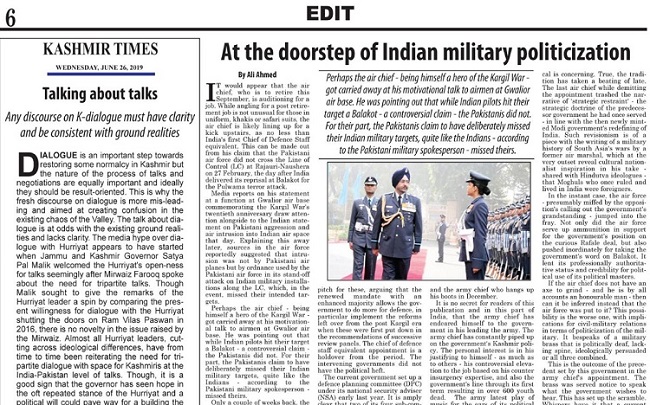
According to the author, the Indian Air Chief “rewrote
history” when he spoke about Pakistan Air Force (PAF) fighter jets not having
crossed the Line of Control (LoC) after the Balakot strike. He goes on to
mention how “The air force has gone out of its way to
bolster the ruling party head’s questionable claim that some 300 terrorists
perished in its aerial surgical strike.” What the author doesn’t realise is that since this attack
failed to cause any damage, whether the PAF did or didn’t intrude into Indian
airspace has become a non-issue and being irrelevant, even political parties
have lost interest in the same.
As far as
mentioning terrorist casualty figures are concerned, it needs to be remembered
that while the Indian Air Force (IAF) has the ability to carry out post-strike
damage assessment of the target by examining the visible impairment, it doesn’t
have the electronic and human intelligence capability to conduct internal
damage evaluation of its targets. So, since the IAF is merely repeating the
casualty figures put out in public domain by the centre, it would be unfair to
term this as a motivated act of appeasing the government. Lastly, if the author
considers the claim of some 300 terrorists being killed in Balakot airstrike
“questionable” and believes that nothing of this sort happened, then he may
like to ponder over why did the Pakistan Army delay visit of journalists to the
target area by nearly one-and-a-half-month?
The author goes
on to note that “the army chief has endeared himself to the government in his leading
the army,” and what exactly he’s hinting at initially escapes interpretation.
But things become clear when he states that the army chief’s “personal interest
is in his justifying to himself – as much as to others – his controversial
elevation to the job based on his counter insurgency expertise, and also the
government’s line through its first term resulting in over 600 youth dead.”
This complex elucidation raises concerns on whether the army chief has in any way
violated the constitutional charter of the army by its mis-employment merely to
appease the government, and if so, why hasn’t the author quoted specific
instances of the same?
The next issue concerns
the author’s view that the army chief’s bid to prove his credentials as a counter
insurgency expert and toe the government line left “over 600 youth dead.” This
is certainly a very serious allegation and that’s why it’s unfathomable why the
author has failed to corroborate the same by revealing who these 600 deceased
youth were; under what circumstances were they killed and why? Could this be an
inadvertent oversight or an intentional omission just to avoid disclosing the
fact that most of these were armed terrorists killed in gunfights with security
forces?
Passing off the Pulwama car bomb suicide
attack on a CRPF bus that claimed 40 lives as a “false flag operation” without
even providing an iota of evidence to support this bizarre claim is a highly
irresponsible act since it could further traumatize the already grieving kith
and kin of those who lost their lives in this attack. If this was indeed a
false flag operation (as the author is suggesting), then why hasn’t he
explained what made Jaish-e-Mohammad (JeM) take responsibility for the same and
end up landing in trouble with its chief Masood Azhar being designated a global
terrorist by the UNSC (United Nations Security Council)? By making his
outlandish false-flag allegation, isn’t the author overstepping established norms
of civility and showing scant regards for human sensitivities in his bid to
sensationalize this humongous human tragedy?
The way things are going, it seems that the day isn’t
far when someone will come out with the claim that JeM chief Masood Azhar is actually
an Indian ‘mole’ who had been ‘cultivated’ by Indian spy agency R&AW during
his long imprisonment in Indian jails. Then, in order to facilitate his
‘seamless insertion’ into Pakistan and avoid suspicion, R&AW setup the entire
IC 814 hijack drama that originated in Nepal and ended in Kandahar. The creator
of this ‘Kandahar conspiracy theory’ would then claim that Masood Azhar was ‘activated’
by his masters in New Delhi to organize the Pulwama suicide attack with the
help of Indian intelligence agencies so that the BJP could extract electoral
advantage from this tragedy !!
Giving wings to one’s imagination is fine, but, even
the wildest flights of fantasy must have some limits!
The author has come up with specific predictions but the
chances of him eating his own words are rather dim because he has balanced the
odds very well. Mentioning that the present air chief “is likely lining up for a kick upstairs,
as no less than India’s first Chief of Defence Staff equivalent,” he has simultaneously
also hinted that the present army chief could also get this job as “the army
latest play of music for the ears of its political master has been the
rejection of any notion that surgical strikes were also carried out by the
opposition when in government.” Similarly, while he uses this surgical strike
issue to suggest that the northern army commander is playing hard ball to
become army chief, he counter-balances this by talking of “a current
frontrunner for next army chief (who) has links with the new ruling party
working head, dating to their juvenile friendship.”
So, no matter
who becomes what in the days to come, the author’s prognosis will in one way or
the other prove to be correct- and that’s exactly what writing on military
related issues and being a ‘defence expert’ is all about!
We use cookies on our website to give you the most relevant experience by remembering your preferences and repeat visits. By clicking “Accept All”, you consent to the use of ALL the cookies. However, you may visit "Cookie Settings" to provide a controlled consent.
This website uses cookies to improve your experience while you navigate through the website. Out of these, the cookies that are categorized as necessary are stored on your browser as they are essential for the working of basic functionalities of the website. We also use third-party cookies that help us analyze and understand how you use this website. These cookies will be stored in your browser only with your consent. You also have the option to opt-out of these cookies. But opting out of some of these cookies may affect your browsing experience.
Functional cookies help to perform certain functionalities like sharing the content of the website on social media platforms, collect feedbacks, and other third-party features.
Performance cookies are used to understand and analyze the key performance indexes of the website which helps in delivering a better user experience for the visitors.
Analytical cookies are used to understand how visitors interact with the website. These cookies help provide information on metrics the number of visitors, bounce rate, traffic source, etc.
Advertisement cookies are used to provide visitors with relevant ads and marketing campaigns. These cookies track visitors across websites and collect information to provide customized ads.
Necessary cookies are absolutely essential for the website to function properly. These cookies ensure basic functionalities and security features of the website, anonymously.
Cookie
Duration
Description
cookielawinfo-checkbox-analytics
11 months
This cookie is set by GDPR Cookie Consent plugin. The cookie is used to store the user consent for the cookies in the category "Analytics".
cookielawinfo-checkbox-functional
11 months
The cookie is set by GDPR cookie consent to record the user consent for the cookies in the category "Functional".
cookielawinfo-checkbox-necessary
11 months
This cookie is set by GDPR Cookie Consent plugin. The cookies is used to store the user consent for the cookies in the category "Necessary".
cookielawinfo-checkbox-others
11 months
This cookie is set by GDPR Cookie Consent plugin. The cookie is used to store the user consent for the cookies in the category "Other.
cookielawinfo-checkbox-performance
11 months
This cookie is set by GDPR Cookie Consent plugin. The cookie is used to store the user consent for the cookies in the category "Performance".
viewed_cookie_policy
11 months
The cookie is set by the GDPR Cookie Consent plugin and is used to store whether or not user has consented to the use of cookies. It does not store any personal data.