Pakistan should desist from using the Kartarpur Sahib Corridor project for stoking fires of Sikh separatism. There is absolutely no inclination in the Sikh community for creation of a separate state like Khalistan, except for some small and insignificant foreign-based lobbies. Any devious tactic in name of the revered Gurudwara will lead to a strong backlash from Sikhs, which Pakistan will find it difficult to sustain.
Sikh community, at the time of partition of Indian subcontinent into India and Pakistan, suffered immeasurably in terms of lives lost, displacement and financial ruin. In addition to these worldly factors, the community also lost to the newly formed state of Pakistan its revered shrines and holy places, especially those associated with the first Sikh master, Guru Nanak Dev Ji.
The trauma for the Sikh community due to disassociation with these holy shrines is so much that their Ardas (holy prayer) now includes reference of getting united with the holy shrines. This fervent appeal is made by the community to the divine every time that it offers prayers.
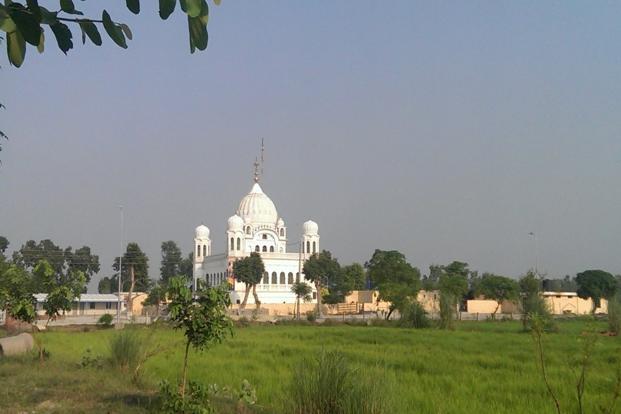
Very significant among these shrines is Gurudwara Darbar Sahib, Kartarpur that lies in the Shakargarh Tehsil of Pakistan Punjab, just a few kilometres from the international border.
Guru Nanak Dev Ji funded Kartarpur in 1504 CE and lived there till the end of his life in 1539. The Gurudwara that he built there had four doors (one in each direction) to denote the universality of the Sikh religion that he propagated. Once he left his mortal body, both Hindus and Muslims claimed him as their own and raised co-located mausoleums in his memory, in accordance with their respective religious practices. The changing course of River Ravi led to partial submersion of this location, which compelled the followers of the Guru to erect a different habitation on the left bank of River Ravi, which was named Dera Baba Nanak. Gurudwara Dera Baba Nanak now falls in the Gurdaspur Tehsil of Indian Punjab.
The distance between the two Gurudwaras’ is only a few kilometres but they fall in different countries, such has been the unfortunate fallout of a hastily conducted partition. Post partition, efforts have been made on a number of occasions to open Kartarpur Sahib for pilgrims from India but were stalled for some reason or the other.
Pakistan has, for reasons best known to the country, been stalling the Indian association with Kartarpur Sahib. On the occasion of 500th birth anniversary of Guru Nanak Dev Ji in 1969 the government of India, under the premiership of Indira Gandhi, attempted to work out a land swap with Pakistan but the idea was rejected by the neighbouring country. Once again, in 1974, Kartarpur Sahib was excluded by Pakistan from a protocol signed between the two countries for visits to each other’s religious places, even as some other Sikh shrines like Gurudwara Nankana Sahib were included. An update of this protocol in 2005, by which the number of religious places opened for visits were increased, yet again witnessed the exclusion of Kartarpur Sahib.
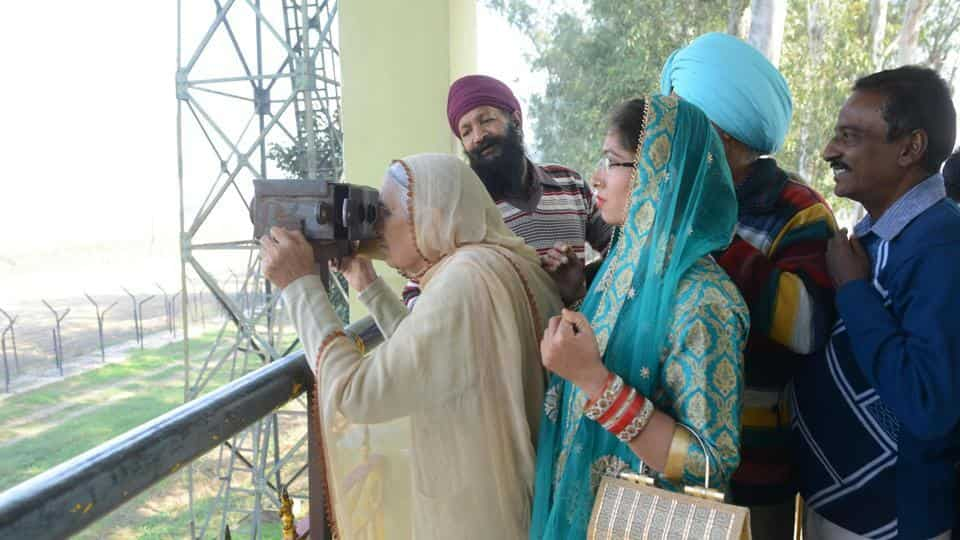
The matter came up for discussion between Prime Ministers Atal Bihari Vajpayee and Nawaz Sharif as a part of the “Bus Diplomacy” in 1999 but the Kargil War paid put to further efforts in this direction. The Gurudwara, however, was renovated and opened to view through binoculars from India by cutting down the greenery between the same and Gurudwara Dera Baba Nanak Sahib. General Pervez Musharraf, as military dictator of Pakistan, is believed to have given a go-ahead for a corridor but the matter could not be pursued.
Prime Minsiter Manmohan Singh intensified efforts and made the issue a part of the Composite Dialogue process with Pakistan. The efforts went on through both of his terms and led to the feasibility study for a visa free “peace corridor” between the two countries. The 26/11 Mumbai terrorist attack that emanated from Pakistan put a hold on these efforts but the idea was germinated.
The matter has gained momentum once again in August 2018 against the backdrop of Punjab cabinet minister Navjot Singh Sidhu’s visit to Pakistan for the swearing in of Prime Minsiter Imran Khan. During the function, Pakistan Army’s all powerful chief, General Qamar Bajwa, is said to have expressed willingness to open the corridor on the occasion of 550th birth anniversary of Guru Nanak Dev Ji in November this year. The ball was set rolling and after a series of political and social moves the Government of India agreed to set up the corridor and appealed to Pakistan to do the same.
The Pakistan government agreed and foundation stones were laid on both sides.
Politics on the issue, however, has continued! Pakistan’s Foreign Affairs Minister, Shah Mehmood Qureshi, made an immature statement by terming the initiative as a “Googly” bowled by his Prime Minsiter, Imran Khan. “Imran delivered a Googly and India sent two ministers to Pakistan,” he said. A Googly in cricket is a leg spinner’s ball that is very difficult to detect and forces the batsman to retract. Qureshi said the same in the context of having forced the Indian government into engagement with Pakistan, despite the Indian policy of not engaging in dialogue till Pakistan does not take credible steps to destroy terrorist structures operating on its soil. The Indians naturally took umbrage to this statement, an embarrassed Imran Khan disassociated with the same and Qureshi has tried to sheepishly overcome.
There were some more similar attempts to heckle India but the Indian government chose to ignore them in the larger interest of seeing the initiative move forward. It was, however, clarified by India that forward movement on the Kartarpur Corridor would not mean resumption of talks with Pakistan for which the laid down caveat of “terror and talks not going together” remained.
Even as the matters were progressing, an incident of Pakistan sponsored terror took place in Kashmir. A barbaric terrorist attack at South Kashmir’s Pulwama in mid-February led to the killing of more than 40 Indian soldiers of the Central Reserve Police Force (CRPF). Responsibility for the attack was taken by Jaish-e-Mohammad, an internationally banned terrorist organisation that is operating openly from Pakistan’s soil. The Indian riposte came in the form of an incisive air strike on terrorist modules operating deep inside Pakistani territory. Pakistan attempted to retaliate the very next day with an air strike on Indian military infrastructure along the Line of Control but the attempt was thwarted. An ensuing dog fight led to the loss of one aircraft of both India and Pakistan.
The tension created by this aforementioned face-off led to speculations about the future of the Kartarpur Corridor. The government of India has exhibited great maturity in isolating this emotional and internationally acclaimed gesture from the tensions in Kashmir and decided to keep the ball rolling so far as the project was concerned. Pakistan reciprocated in a similar manner and the initiative survived despite the apprehensions.
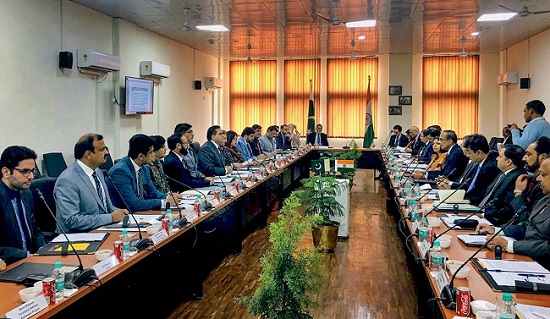
On March 14th, delegations of India and Pakistan met at Attari in India for the first time to work out modalities of the project and reach to a consensus on the draft agreement. Pakistan once again played politics by leaking out the draft agreement to its press and also blaming India of “childishness” by not allowing Pakistani journalists to cover the event and also insisting upon the talks being held on the Indian side. India, very rightly, refused to be provoked and the meeting was held in a “cordial atmosphere.” Some more meetings to chalk out the technical details like the alignment etc. are proposed in the near future.
Indian viewpoint of allowing at least 5000 pilgrims a day with the number increasing on days of religious significance, as also the need to open the door to not only Indians but also to Overseas Citizens of India (OCI) holds merit. Pakistan’s reluctance to allow more than 500 to 700 pilgrims per day is also understandable in view of the logistics involved. The neighbouring country has given an indication that it may consider the request to allow OCI’s to visit the shrine, which is a step in the positive direction. The other factors like travel documents etc. have also witnessed differences of opinion but not of a type which cannot be circumvented in case there is a will to do so.
Pakistan has not gone into the project in a spur of the moment as it would like the world to believe. It is widely believed that the meeting and conversation between General Qamar Bajwa, Chief of the Pakistan Army, and Indian politician Navjot Singh Sidhu was not “by chance” but well-orchestrated and engineered by the Pakistani side. The Pakistan Army with the government in tow, in fact, have been working out the modalities of the project much before the meeting took place and were quite ready to move forward when they did so.
It is quite apparent that Pakistan would aim at winning the goodwill of the Sikh community, especially those settled abroad who have the capacity to pump in a lot of money, something that the cash strapped country would welcome. The project will also allow Pakistan access to certain separatist tendencies that some Sikhs, mainly those living abroad, hold. It is being said that stoking fires of Sikh separatism is the prime objective of Pakistan Army in the project. This is in accordance with what is called the Bajwa Doctrine. This Doctrine, named after the present Pakistan Army chief, envisages opening a front of separatism in Indian Punjab, now that the going for Pakistan and the Jihadists that it nurtures is getting tough in Jammu and Kashmir.
India need not be overly worried of such hidden Pakistani agendas, except for being aware and slightly wary. There is absolutely no inclination in the Sikh community for creation of a separate state like Khalistan, except for some small, insignificant foreign based lobbies. The interest of the community in the project is purely religious in nature and that sentiment overrides everything else. It is from this objectivity that the Indian government should derive the confidence to go ahead with an open mind.
It is, however, for the better that the Indian government has, in the very first meeting, cautioned Pakistan against using the project for the spread of propaganda. The matter can be laid to rest albeit with a constant eye on the situation. Vigilance when dealing with Pakistan is imperative.
The international community is also viewing the development with a fair degree of interest. There is a hope that it may lead to a thaw in the India-Pakistan relationship with people to people contact paying certain dividends. Such sentiments have been expressed by international media organisations like the BBC and many foreign think tanks of repute. Here it is important to understand that India holds nothing against the neighbouring country except for the proliferation of terror activity from its soil. India will therefore stick to its “terror and talks not going hand in hand” policy while going ahead wholeheartedly with the Kartarpur Corridor project. It would, in fact, be in Pakistan’s interest to leverage the goodwill being earned by this forward movement to contain the terror activity and get on to improving relations with India. Pakistan should also realise that by raising the hopes and aspirations of the very strong and vibrant Sikh community it has set itself a greater challenge. Any let down now will lead to a backlash at the international level from the Sikhs that will be difficult for the country to sustain.
Creating the corridor is essentially a political decision made in the interest of the vast number of followers of a highly venerated Guru whose religious influence transcends many communities. It would be best for both countries to deal with the same at a highest political leadership level and not allow it to be derailed by bureaucratic myopia or petty politics. The bottom line is that despite the pin-pricks, the project should remain on course to be completed well in time before the 500th birth anniversary of Guru Nanak Dev Ji that falls on November this year.