Home Blog Page 81

Quetta: Protest continues for recovery of forcibly disappeared Zaheer Ahmed

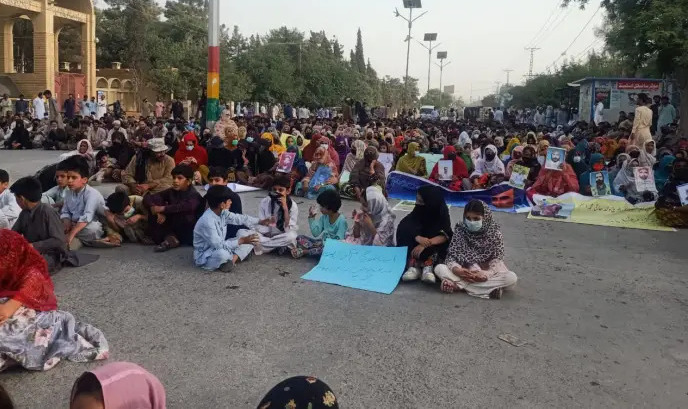
The sit-in against the forced disappearance of Zaheer Ahmed, also known as Zaheer Baloch, entered its eighth day on Saryab Road, Quetta. Family members and supporters remain steadfast in their demand for his safe recovery.

According to the family, Zaheer Ahmed was taken into illegal custody from Quetta on June 27 and subsequently disappeared. Despite a week-long protest, the family laments that no representative from the provincial puppet government has reached out to them.

Yesterday, a large protest rally was organized by Zaheer’s family. The demonstration began at the Session Court Saryab and proceeded to Balochistan University, where participants staged a sit-in to record their protest. The rally drew significant support from various segments of society, including families of other missing persons, student organizations, and political parties.

His family rightfully calls out the Counter-Terrorism Department (CTD) which is the merciless wing of Pak Army that conducts enforced disappearances.

CTD is the organization that has been involved in numerous human rights abuses, including raiding civilian homes, harassing locals, enforcing disappearances, and engaging in extrajudicial killings in fake encounters. Since 27 March 1948, the region continues to be plagued by violence against innocent Baloch community

PTM leads nationwide demonstrations against Pak Army’s militarization of Pashtun regions

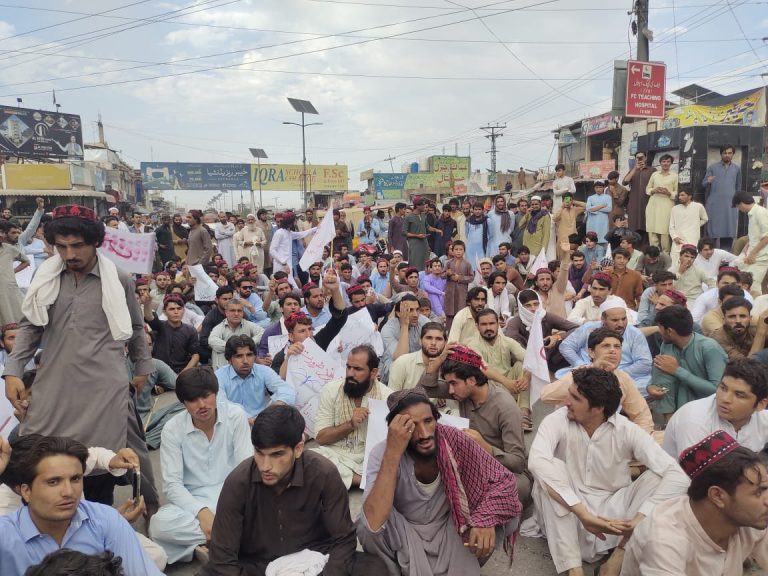
In a series of demonstrations, the Pashtun Tahafuz Movement (PTM) has vehemently opposed the Pak Army’s war policies, militarization, and the resulting unrest in the Pashtun homeland. Protests have erupted in various regions, including Khyber, where PTM members rallied against the increased military presence and ongoing violence, highlighting the community’s grievances over target killings and explosions.

The catalyst for these protests was the Pakistan Army’s launch of a new operation named Azm-e-Istihkam, which has been also condemned by PTM’s United States-Texas State chapter. This group staged a significant protest in San Antonio, denouncing the genocidal operation against the Pashtun nation. PTM America also held a protest in front of the White House in Washington DC.

Concurrently, PTM Hasan Khel in Peshawar continued its demonstrations against military operations, surveillance, and targeted campaigns that disrupt daily life and threaten the security of the Pashtun people.

The demonstrators criticized the Pakistan Army for destabilizing Pashtun regions, asserting that their presence has severely impacted the safety and way of life for local residents. Compounding these issues, the sweltering summer heat has been exacerbated by severe electricity shortages, worsening living conditions and endangering the populations.

In addition to these immediate concerns, Pashtuns are demanding the removal of barriers at the Durand Line, which hinder free movement and trade between Afghanistan and Pakistan. The community opposes the mandatory passport visas that disrupt familial and economic ties across the border.

Since 1947, the Pakistan Army has been exploiting Pashtun lands and people for their interests, often labeling Pashtuns as terrorists or TTP sympathizers to justify their actions. This exploitation includes the extraction of mineral resources and the use of terrorism to justify military presence in Pashtun territories, resulting in security checkpoints, military camps, and forced evacuations.

The militarization has led to the abduction and enforced disappearance of many innocent youths, often unconnected to any activist activities. Journalists and PTM members face violence and death despite the movement’s peaceful stance. Furthermore, the military’s practice of laying landmines in residential areas has led to tragic incidents, with children frequently being maimed or killed by explosions.

PTM leader Gilaman Pashteen critical after Pak Army attack; calls for Germany evacuation

Human rights activist and esteemed poet Gilaman Pashteen urgently needs evacuation to Germany after a severe attack in Islamabad.

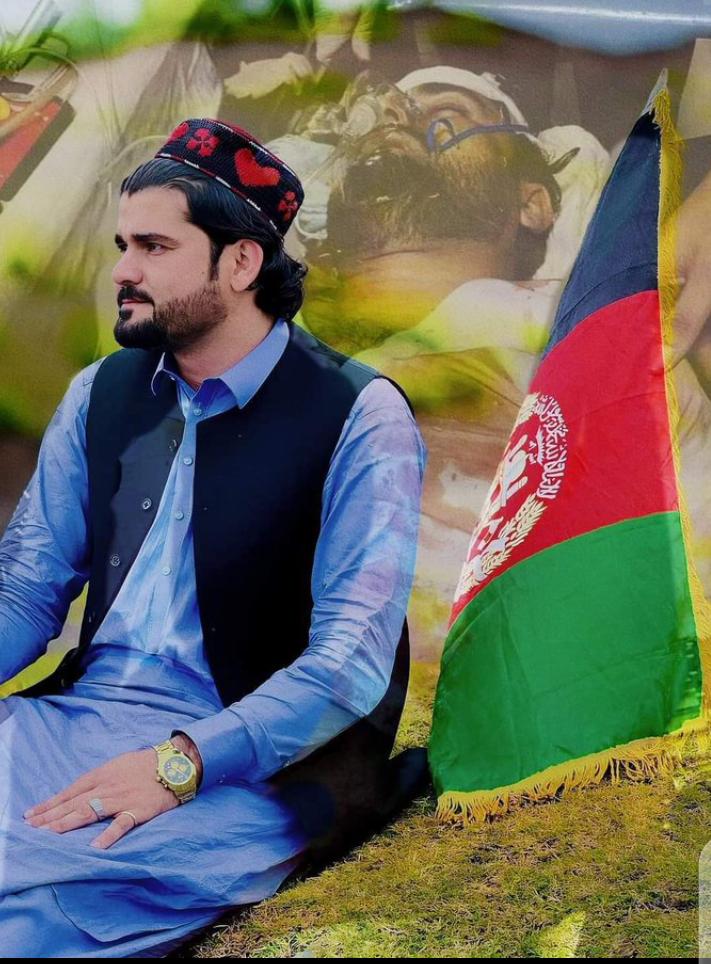
Prominent PTM member Gilaman Wazir is in critical condition after being shot and stabbed multiple times. Wazir, a key figure in the Pashtun Tahafuz Movement (PTM) and a member of its Central Committee, was attacked while traveling to Islamabad.

He sustained 13 stab wounds and is currently in critical condition at a local hospital. This attack follows a history of abductions and illegal detentions of Gilaman by intelligence and military agencies by Punjabi Pak Army.

The PTM has denounced the attack as a Army-sponsored attempt on his life. Given the severity of his injuries, PTM is urgently calling for his immediate airlifting to Germany for specialized medical treatment that is unavailable locally.

They have appealed to the German Embassy in Islamabad to expedite the visa process for Wazir.

PTM’s social media team has launched a campaign under the hashtag #EvacuateGilamanWazir2Germany, demanding the swift issuance of a medical visa and the immediate airlift of Wazir to Germany.

“We implore the German Embassy to expedite his visa process immediately. His life hangs in the balance, and timely intervention is crucial to his survival and recovery,” the PTM said.

Since 1947, the Punjabi Pakistan Army has been exploiting Pashtun lands and people for their vested interests. The movement highlights issues such as enforced disappearances, extrajudicial killings, and collective punishment inflicted upon Pashtuns in the name of counter-terrorism operations.

Wazir’s case is not an isolated one. He has previously been detained by Pak intelligence and military agencies, highlighting the vulnerability of Pashtun activists. The Punjabi Pakistan Army resorts to violence against members of PTM, despite the organization being predominantly peaceful.

Probing the surge of recent Pak-backed terrorist attacks in Jammu & Kashmir

In an unprecedented departure from fundamental diplomatic courtesies, both Pakistan’s Prime Minister Shehbaz Sharif and its Foreign Office [FO] failed to convey the customary congratulatory message to Prime Minister Narendra Modi on the victory of his National Democratic Alliance [NDA] coalition party in the general elections after the poll results were officially announced.

However, three related developments that took place a day prior to, on and a day after Modi’s oath taking ceremony on June 9 unambiguously provide a fair idea about the shape of things to come and what emerges is definitely disconcerting!  

On June 8, while answering a question on whether Islamabad had congratulated Modi, Pakistan’s FO spokesperson Mumtaz Zahra Baloch tried to wriggle out of an embarrassing situation by saying that since the new government in New Delhi hadn’t yet been officially sworn-in, it was “premature” to discuss the issue of congratulating Modi.

However, the FO spokesperson did say that “Pakistan has always desired cooperative relations with all its neighbours including India. We have consistently advocated constructive dialogue and engagement to resolve all outstanding issues, including the core dispute of J&K” and though non-committal, it was nevertheless a positive comment that gave a ray of hope of rapprochement between India and Pakistan..

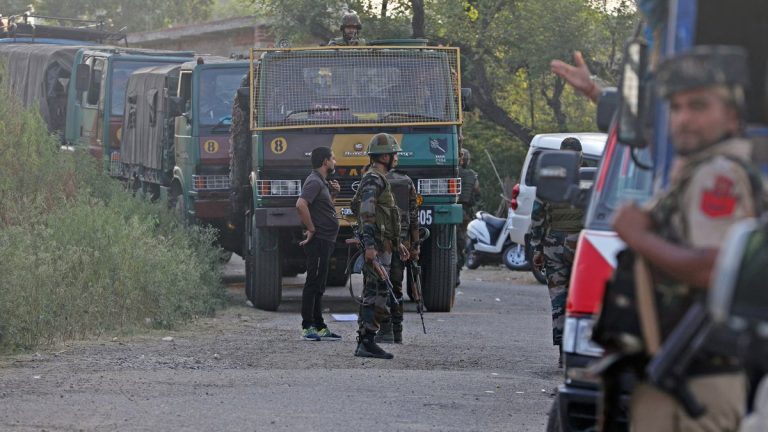
The next day however, even as Modi’s oath taking ceremony was underway, Pakistan sponsored terrorists carried out a gruesome attack on a bus carrying devotees on a pilgrimage in the Reasi area of J&K, killing nine travellers and injuring 41 others [including ladies and children]. It’s not only the timing but also the targeted killing of people belonging to a specific community that clearly indicates that this brutal act was intended to arouse communal passions and create unrest between two communities!

Curiously, despite claiming to be a victim of terrorism and suffering immensely on this account, Islamabad didn’t even care to condemn this horrific massacre of unarmed civilian pilgrims by terrorists.  The next day however, Pakistani Prime Minister Shehbaz Sharif did find the time to felicitate Modi on taking oath as Prime Minister of India through an impersonal post on X.

It’s heartening to note that unlike Pakistani media that kept insisting that the onus of commencing talking with Pakistan squarely falls on India, back home no one attached any importance to Islamabad’s uncouth diplomatic behaviour. This inconsequential occurrence caused no ripples in India would not have been mentioned here as well, had it not been for the message these puerile actions convey.

Through its message of “cooperative relations” and “constructive dialogue and engagement to resolve all outstanding issues, including the core dispute of J&K” on eve of Modi’s oath taking, Islamabad has tried to take high moral ground in an desperate attempt to conceal the proxy war that the Pakistan Army is brazenly waging in J&K.

The FO’s statement could also well be a ‘feeler’ to ascertain New Delhi’s response. With its financial condition worsening by the day, clamour for normalisation of Indo-Pak ties and resumption of trade has been gathering momentum in Pakistan. In February last year, while stressing on the need for Pakistan to reduce its defence expenditure, eminent poli­ti­cal economist Dr Per­vez Tahir had called for revival of trade with India to “decrease people’s woes”.

Readers would also recall that in April, Punjab province assembly Speaker Malik Ahmad Khan ruling Pakistan Muslim League-Nawaz [PML-N] said “… both countries need to initiate trade ties. But I want to talk straight that this enmity between Pakistan and India needs to be ended if we have to move forward. We are neighbours… We should promote trade between the two countries.” So, giving Islamabad the benefit of doubt, Islamabad’s June 8 comments could be viewed as the PML-N led Pakistan government’s outreach to mend fences with New Delhi.

Regrettably, while Islamabad had kept a window of opportunity for dialogue to normalise Indo-Pak relations open, the terrorist attack on the pilgrim bus in J&K was Rawalpindi’s characteristic way of effectively sabotaging any scope of this happening, and this assessment is not mere speculation.

The Pakistan Army did the same in 2014 by using its most trusted ally Lashkar-e-Taiba [LeT] for orchestrating the terrorist attack on the Indian consulate in Herat, Afghanistan. This attack took place just two days before Modi’s oath taking ceremony with the aim of causing casualties to the Indian consulate staff, which would fan anti-Pakistan emotions in India and thereby prevent the then Pakistani Prime Minister Nawaz Sharif from attending this event.

The spate of terrorist attacks in areas South of Pir Panjal mountain ranges in J&K give two clear indications- one, that despite Islamabad making peace overtures, Rawalpindi will continue to use its proxies to create further animosity that would not allow Pakistani lawmakers to enter into dialogue with India. As such, it would be prudent to assume that normalisation of Indo-Pak relations in the foreseeable future is unlikely.

Two, with Pakistan sponsored terrorists in Kashmir Valley being put on the back-foot by the Indian security forces with active support of civilians, Pakistan Army’s spy agency Inter Services Intelligence [ISI] has started pushing terrorists into the Jammu region of J&K in a desperate attempt to revive terrorism in J&K. Such unprovoked escalation in violence is fraught with danger of likely Indian retaliation, but Rawalpindi seems to have no choice.

It’s apparent that ‘iron brother’ Beijing, which has been providing financial assistance to Pakistan, is extracting its pound of flesh by directing Rawalpindi to redouble terrorist activities South of Pir Panjal so that the Indian army cannot shift troops from this area to the Line of Actual Control [LAC] that demarcates the unresolved Sino-Indian border and where the Indian army and Peoples’ Liberation Army [PLA] of China are locked in a face-off.

This collusive threat is a serious issue that needs to be carefully monitored.

Lastly, as long as Rawalpindi continues calling the shots, use of terrorism as state policy in Pakistan will continue unabated. A sudden swell in the number of Pakistani nationals amongst terrorists neutralised in the recent past as well as its collusivity with the PLA is a clear indication that Rawalpindi has no intention of ending its proxy war against India.

It’s been proven beyond any doubts that our security forces and intelligence agencies are not professionally competent but also enjoy tremendous public support. Hence they are fully capable of thwarting ISI’s nefarious designs and so, there’s no reason to panic or project a doomsday scenario.The planned creation of additional Central Reserve Police Force [CRPF] battalions specially trained and equipped for conducting operations against terrorists in the mountainous areas of J&K will further enhance the anti-terrorism operational capability of Indian security forces.

However, there’s no room for complacency.

Let’s not forget for a moment that since Pakistan has no credible reasons to stake claim on Kashmir, use of force has been the cornerstone of its Kashmir policy since 1947. And even though it has militarily failed to annex J&K both in 1947 and 1965, Rawalpindi has reconciled and after abandoning its Kashmir ambition, settled down for a proxy war in J&K  to bleed India ‘through a thousand cuts’.

That’s why optimists in India who still believe in the ‘aman ki asha’ [hope for peace] dream need to wake up and smell the coffee-because in Pakistan, while Islamabad proposes, it’s ultimately Rawalpindi that disposes!

BLA releases video of attacks on Pak Army across Pak-occupied Balochistan

In a bold move, the Baloch Liberation Army (BLA) has released a provocative video showcasing a series of attacks against Pak Army and infrastructure. The 21-minute footage, published on the BLA’s official media channel Hakkal, documents 25 separate operations across various locations in Pak-occupied-Balochistan.

The video, which begins with a resistance song, features a range of revolutionary activities, from bombings of Army convoys to attacks on gas pipelines and mineral transport vehicles. One significant incident depicted is a recent bomb attack on a military convoy in Kalat’s Surab area, where officials confirmed one soldier killed and four injured. The footage also includes last year’s October bombing in Quetta that killed Pakistan Mineral Development Corporation project manager Shubar Mirza.

In a display of their tactical capabilities, the BLA showcased night-vision equipped attacks on military camps, including one in Turbat’s Tejaban area where they have shot down a surveillance drone. The group also highlighted their ability to temporarily control key transportation routes by setting up checkpoints on main highways in areas such as Harnai, Margat, and Kahan.

The BLA dedicated the video to one of their fallen members, ‘Sangat Muslim Guru’, who was reportedly killed in Turbat on October 6, 2023. A BLA spokesman had previously praised Guru for his “coordinated and modern war strategies” within the organization.

The video concludes with Baloch fighters performing a Balochi dance to the tune of ‘Ma Baghi Ma Farari’, showing numerous fighters equipped with modern weapons.

POB: BLF attacks Pak Army in Khuzdar and Mashkay; kills four Pak soldiers

The Balochistan Liberation Front (BLF) has claimed responsibility for two recent attacks on Pak security forces. According to a statement released by BLF spokesman Major Gwahram Baloch, these attacks resulted in the deaths of four Pak military personnel.

The first incident reportedly occurred on July 6 at approximately 5 PM local time in Bandoki Mashkay. BLF fighters launched an hour-long assault on a military checkpoint using heavy and modern weaponry. The attack is said to have killed three personnel and injured several others.

In a separate attack later that night, at around 11 p.m., BLF fighters targeted another checkpoint in the Sarej Gresha area of Khuzdar district. This assault, carried out with automatic weapons, and resulted in the death of one more security force member.

Major Gwahram Baloch, in his statement, emphasized that these attacks are part of the BLF’s ongoing campaign against the occupying forces. He declared that such operations would continue with increasing intensity until their goal of liberating Balochistan is achieved.

Independence groups like the BLF have been engaged in a long-standing revolution against the Pakistan Army. Since 1948, the Pakistan Army has forcefully occupied the resource-rich region of Balochistan and, to exploit it indefinitely, has launched scathing attacks on the Baloch community.

BLA to execute seven Shaban captives as prisoner exchange deadline ends

The Baloch Liberation Army (BLA) has announced plans to execute seven detainees captured near Quetta after a proposed prisoner exchange failed. The group’s spokesperson, Jeeyand Baloch, said that the occupied Pak military did not engage in negotiations within the one-week deadline set by the BLA.

According to the BLA, the seven individuals were captured on June 20 during an operation near Zarghoon, Quetta by BLA’s Fateh Squad. They were reportedly tried in a Baloch national court and found guilty of collaborating with Pak military and intelligence agencies. The group said that these detainees were involved in the genocide of Baloch people.

The BLA had initially captured ten individuals but released three after finding them innocent. The remaining seven, mostly from Punjab province, now face execution following the decision of the BLA Command Council.

BLA on 26 June offered a one-week ultimatum for a prisoner exchange, adhering to international warfare principles and was willing to release the prisoners under the condition of a prisoner exchange. The BLA spokesperson pointed out that this is the fourth instance where the Army have not accepted their prisoner exchange offers, resulting in the deaths of detained personnel.

Families of the captives protested outside the Balochistan Assembly on June 29, demanding their release. In response, Pak-occupied-Balochistan’s Interior Minister Ziaullah Langove and Livestock & Dairy Development Minister Bakht Muhammad Kakar met with the families, assuring to rescue the abductees.

However, instead of negotiating, Pak forces reportedly launched a large-scale military operation in the Kalat and Bolan areas on June 30, which is still ongoing.

Since 1948, the Pakistan Army has forcefully occupied the resource-rich region of Balochistan and, to exploit it indefinitely, has launched scathing attacks on the Baloch community. Therefore, freedom fighters like the BLA have been engaged in a long-standing revolution against the Pakistan Army. 

France faces political uncertainty as left-wing alliance leads in Parliamentary election

In a surprising turn of events, France’s parliamentary election has resulted in a hung parliament, with a left-wing coalition emerging as the largest bloc but falling short of an absolute majority. The New Popular Front (NFP), a recently formed alliance of left-wing parties, secured 182 seats in the National Assembly, surpassing President Emmanuel Macron’s centrist Ensemble alliance, which won 163 seats.

The election results have dealt a significant blow to Macron’s presidency and raised questions about France’s political stability. The far-right National Rally (RN), led by Marine Le Pen, secured 143 seats, marking a substantial increase from their previous representation but falling short of earlier projections.

Prime Minister Gabriel Attal has announced his resignation, though it remains unclear whether President Macron will immediately accept it given the complex task of forming a new government. The possibility of a cohabitation arrangement, where the prime minister comes from a different political bloc than the president, is now being considered.

Jean-Luc Mélenchon, the prominent leader of the France Unbowed party within the NFP, has called for the new prime minister to be selected from their coalition. However, the lack of a clear leader within the NFP and internal divisions complicate this process.

French election

The fragmented parliament is expected to make it challenging for any single group to push through their agenda, potentially weakening France’s role both domestically and on the international stage. This political uncertainty comes at a critical time, with Paris set to host the Olympic Games in the near future.

Financial markets have reacted to the election results, with the euro falling as projections were announced. Analysts predict a period of legislative gridlock and potential instability in French politics.

Furthermore, Spanish Prime Minister Pedro Sánchez hailed the French election results as a rejection of the far right, drawing parallels with recent political shifts in Spain and the United Kingdom. Sánchez said, “This week, two of the largest countries in Europe have chosen the same path that Spain chose a year ago: rejection of the extreme right and a decisive commitment to a social left that addresses people’s problems with serious and brave policies.”

The French election closely followed the United Kingdom’s general election, where the center-left Labour Party secured a landslide victory, ending 14 years of Conservative rule. This series of left-leaning victories in major European countries could signal a broader shift in the continent’s political landscape.

Armed men kill DSP of CTD & conspirator of 2015 Gurdaspur terrorist attack Ali Raza

A deputy superintendent of police (DSP) from the Counter-Terrorism Department (CTD) was shot dead by unidentified men in Karachi on Sunday.

DSP Ali Raza was killed in the Karimabad neighborhood when two gunmen opened fire as he exited his bullet-proof vehicle near Shakeel Corporation. CTD Deputy Inspector General Asif Ijaz Shaikh confirmed that 11 shell casings from a 9mm pistol were recovered at the scene.

“Unidentified men opened indiscriminate fire on DSP Raza as soon as he came out of his bullet-proof jeep”, a police official said, adding that a private guard was also killed in the attack. The assailants reportedly fled the scene immediately after the shooting.

According to police sources, DSP Raza was shot at close range in the head and waist. He was rushed to Abbasi Saheed Hospital, where doctors pronounced him dead from his injuries.

DIG Shaikh revealed that the two assailants had been tracking DSP Raza’s movements.

Ali Raza was reportedly one of the conspirators behind the 2015 Gurdaspur terrorist attack in India, which resulted in the deaths of seven people, including four security personnel. In the name of the Counter-Terrorism Department (CTD), Pakistan not only harbors terrorists but also uses them against India.

Indian security forces execute four Hizbul terrorists hiding in secret bunker in Kulgam

Four terrorists, part of a group of six killed in recent encounters in Jammu and Kashmir’s Kulgam district, were discovered to have been living in a concealed bunker inside a cupboard in a civilian home. The hideout was located in the Chinigam Frisal area.

A video circulating on social media shows security personnel dismantling a cupboard to reveal the hidden bunker. Authorities are investigating potential local involvement in sheltering the militants.

All six terrorists eliminated in the twin operations were reportedly affiliated with Hizbul Mujahideen, including a local commander of the Pakistan-linked group. The encounters, which began on July 6, also resulted in the deaths of two Indian Army soldiers, one of whom was an elite para commando.

Jammu and Kashmir Director General of Police RR Swain called the operation a major achievement in improving the region’s security. He said, “This is an indication that the security architecture and involvement of people is leading to the flow of human intelligence, and this fight against terror will be taken to its logical conclusion.”

The encounters occurred in two villages of Kulgam district. Two terrorists were killed in Modergam, while four bodies were recovered from the Chinigam site. The terrorists killed in Chinigam have been identified as Yawar Bashir Dar, Zahid Ahmad Dar, Tawheed Ahmad Rather, and Shakeel Ahmad Wani.

These operations come amid the ongoing Amarnath Yatra in South Kashmir, highlighting the continued security challenges in the region. Authorities remain vigilant in their efforts to combat terrorism and maintain public safety.