Home Blog Page 157

Mahrang Baloch openly criticizes Pak media, calls them Pakistan’s ISI agents

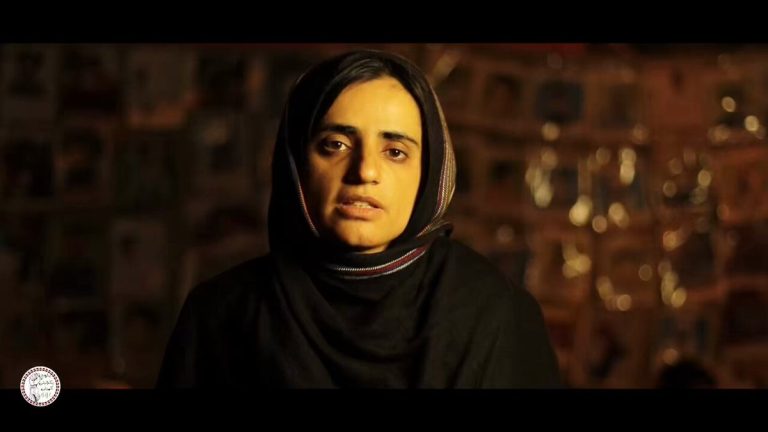
Islamabad: In a fiery speech outside the Islamabad Press Club, prominent Baloch rights activist Dr. Mahrang Baloch levelled scathing attack against Pakistan’s Inter-Services Intelligence (ISI) agency and its involvement in controlling the media narrative of Pak-occupied-Balochistan. She said ISI is sending embedded journalists to covertly control the narrative surrounding the ongoing Baloch genocide.

Dr. Baloch, leading a “Long March and Protest against Baloch Genocide,” addressed the media, stating, “You (journalists) are not here on your own. The ISI sends you without uniforms. You have never condemned the bloodshed on our land, and I challenge any media channel to come to Balochistan and witness the truth for yourselves. Our land is stained with blood due to your institutions,” Dr. Baloch declared, directly addressing the Pakistan Army.

Responding to inquiries about the journalists’ role, Dr. Mahrang Baloch claimed that these individuals were ISI agents, admonishing them for their attire. She stated, “The attire you are wearing is your reality. With that uniform, don’t raise the microphone; you have disgraced it.”

ISI News

She further criticized the media’s complicity in perpetuating the Army’s narrative, stating, “We knew who your channel was flattering, who was funding you. You broadcast the Army’s story. It would be easier if you called yourselves ISI News instead of Bol News, but we still respected you.” She asserted that instead of reporting on Baloch genocide, killings, and looting, the channel aimed to end statements with criticism.

Addressing the media’s lack of coverage on Pak-occupied-Balochistan, Dr. Mahrang emphasized that despite the ongoing bloodshed and atrocities, the media had failed to condemn these acts.

In response to accusations against major institutions like the ISI, she challenged journalists to find evidence within their own questions. Dr. Mahrang Baloch expressed disappointment in the failure of responsible journalists to address Baloch genocide, emphasizing that they preferred to conclude statements with criticism against their cause.

Highlighting the colonial treatment of Balochistan, she claimed that the Army had stained the land with blood, yet there had been no condemnation of this bloodshed.

Killing Nawab Bugti

She challenged journalists to investigate the reality on the ground, stating, “You haven’t seen Turbat, Hoshab, Awaran. You need a visa to enter Awaran. This is the Balochistan you haven’t seen, the one you portray through fabricated narratives.” Dr. Mahrang Baloch challenged journalists to condemn the firing on Nawab Bugti by Yahya Khan and their hero Musharraf, urging them to criticize the Army for its actions against innocent people.

Dr. Baloch’s call for accountability extended, urging journalists to “get condemnation from Yahya and your biggest hero Musharraf for firing on an 80-year-old Nawab Bugti.”

She concluded her address with a powerful message of defiance, stating, “The entire Baloch nation stands with us. We will not tolerate even one step of yours on our land. That gun, shooting at innocents, we are against it.” And by declaring the solidarity of the entire Baloch nation against their genocide, asserting that they would not tolerate any intrusion on their land. Dr. Mahrang Baloch firmly stood against the use of force on innocent people and urged journalists to confront the harsh realities of Pak-occupied-Balochistan. The Baloch conflict, a long-running desire for independence, has been marred by human rights abuses committed by Pak Army.

The march began in response to the extrajudicial killing of Balach Mola Bakhsh by the Pak Army, sparking concerns about enforced disappearances and human rights abuses in Pak-occupied-Balochistan. The protests and sit-ins arose from both a demand for justice for Baloch victims and a call for action against the perpetrators within the CTD, which has become a tool for the Army’s raids, abductions, and indiscriminate extrajudicial killings

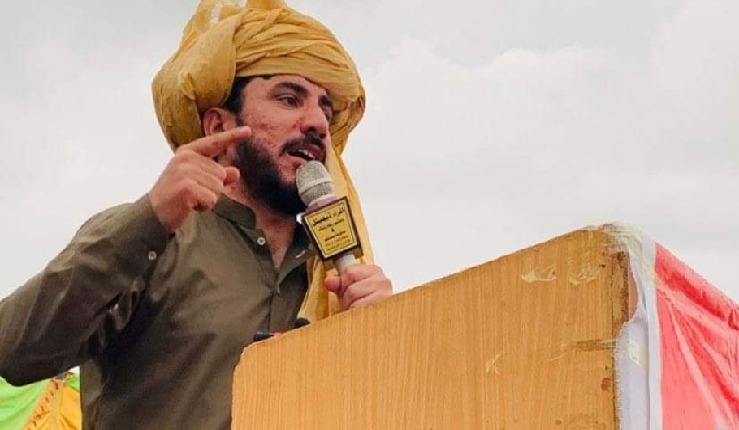
Islamabad Police re-arrests Manzoor Pashteen on fake charges shortly after bail

In the latest development Manzoor Pashteen was once again arrested by the Islamabad Police soon after he was granted bail by the ATC court.

Manzoor Pashteen’s bail application was heard by ATC judge Abul Hasnat Zulqarnain where Prosecutor Raja Naveed and Manzoor Pashteen’s lawyer held a debate around the charges put over Pashteen.

After hearing the arguments of the parties, the ATC approved the bail in both the cases filed against PTM Chief in Police Station CTD. The bail was approved for a bail bond of Pak Rs. 30,000.

However, soon after he was granted bail, Islamabad Police again pressed fresh charges and arrested him in a new case. Earlier, they arrested him illegally and took his physical remand out of mere allegations. Police knew that mere allegation is sufficient for a physical and judicial remand. To increase the incarceration period, they orchestrated another fake case to arrest him just a couple of hours after he was granted bail.

Pakistan forces’ modus operandi of declaring victim as aggressor

Notably, Manzoor Pashteen was arrested on December 3rd. Deputy Commissioner Chaman Raja Athar Abbas claimed in a statement that Manzoor Pashteen was arrested after a firing at the police from his car.

However, 4 hours before his statement, PTM released a statement that Manzoor Pashteen’s car was allegedly fired upon by law enforcement agencies while he was on his way to Turbat from Chaman, where a protest was ongoing against extrajudicial killings.

“In various instances involving the police, CTD, or even the Pakistan Army, a consistent pattern seems to emerge. They often initiate an extra-judicial event and subsequently portray the victim as the aggressor. A similar scenario unfolded with the innocent Baloch youth, whose extrajudicial killing prompted protests in Turbat, where Pashteen was going to visit. The CTD claimed that all four Baloch individuals were terrorists killed in an encounter. However, it later surfaced that these deceased individuals had been in their custody for days prior to the alleged encounter.

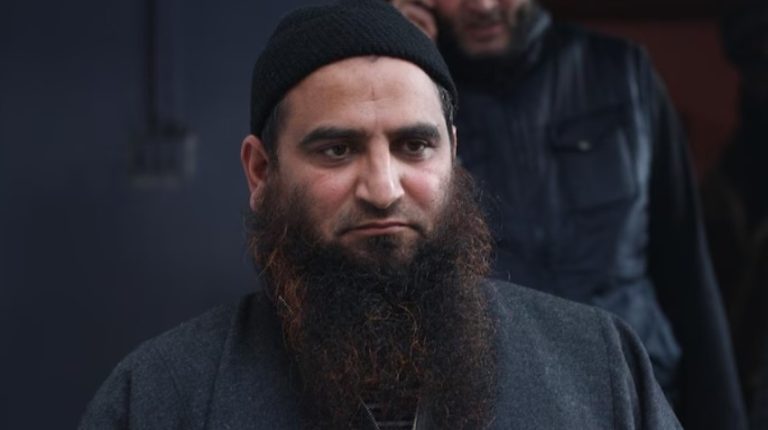
Masarat Alam’s Muslim League Jammu Kashmir is ‘Unlawful Association’

In the latest crackdown against the separatist and terror harbouring elements in the Jammu and Kashmir, the union government has taken a significant step. Union Home Minister Amit Shah has declared Muslim League Jammu Kashmir- Masarat Alam faction (MLJK-MA) an unlawful organisation under the UAPA. The decision was taken as MLJK-MA has been found involved in anti-national and separatist activities while inciting people for secession.

Taking to X (formarly Twitter), Union Home Minister Amit Shah wrote,

“The ‘Muslim League Jammu Kashmir (Masarat Alam faction)’/MLJK-MA is declared as an ‘Unlawful Association’ under UAPA. This organization and its members are involved in anti-national and secessionist activities in J&K supporting terrorist activities and inciting people to establish Islamic rule in J&K.”
He went on to say, “The PM @narendramodi government’s message is loud and clear that anyone acting against the unity, sovereignty, and integrity of our nation will not be spared and face the full wrath of the law.”

Masarat Alam, a terrorist and a separatist

Declaring Masarat Alam’s organisation as unlawful is apparently one of the much needed step as, although irrelevant, he is the head of the  All Parties Hurriyat Conference (APHC) separatist group. He assumed its chairmanship 6 days after separatist Syed Ali Shah Geelani fied in 2021. However, he has been in Tihar jail for many years now. Aged 50 years, Masarat Alam is known for his hard line separatism and staunch support for Pakistan, which makes it very clear why he acquainted with terrorists at the first place.

In fact, before joining Hurriyat under Geelani, Masarat was a local commander of Pakistan based terror group Hizbollah founded by Mushtaq Ahmad Bhat. Interestingly, Mushtaq was the person who had founded a separatist outfit called Muslim League in 1988. It is also said that it was Masarat Alam, who promoted stone pelting despite Geelani’s unwillingness, which made him a person of interest for Pakistan.

Sindh Police files FIR against Pak anti-violence protesters supporting Baloch

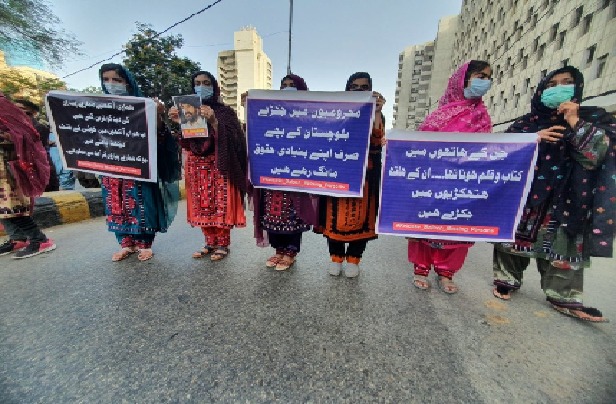
In a move sparking condemnation and raising concerns about growing suppression of dissent, the Sindh Police have registered an FIR against protestors who condemned violence against Baloch activists and the recent arrests of their leaders.

This development comes against the backdrop of the Baloch Unity Committee’s Long March from Turbat to Islamabad, demanding an end to the forceful occupation of Pak Army in Balochistan and upholding the rights of the Baloch people. The march witnessed a brutal crackdown by Pak Army, leaving many injured and scores arrested.

The march, sparked by the death of Balaach Mola Bakhsh in extrajudicial killing, calls for stop of Pak Army’s “Kill and dump” policy, release of missing persons, disarming of the Pak Army’s tools of exploitation such as Counter Terrorism Department (CTD).

The fresh FIR against Karachi protestors accuses them of inflammatory speeches and chanting slogans against Pak “establishment”. Leader Nasir Manzoor, human rights activist Saeed Baloch, Abdul Wahab Baloch, Shoaib Baloch, and others have been named in the FIR.

This move by the Sindh Police raises eyebrows, following similar tactics used against supporters of the Long March in cities like Nall, Khuzdar, Kohlu, and DI Khan, where terrorism charges were slapped against individuals welcoming the marchers.

This is another attempt by the oppressive Army to stifle dissent and suppress the Baloch struggle for self-determination. The accusations levied against protestors are made-up and aimed at silencing legitimate criticism of on-going brutality in Balochistan.

The Pakistan Army has a long history of involvement in enforced disappearances, brutal kill-and-dump policies, daily home raids, staged encounters, target killings, torture, humiliation at checkpoints, kidnappings for ransom, and uses the CTD & police as tools of oppression.

Masked men target Baloch protesters, steal communication speakers

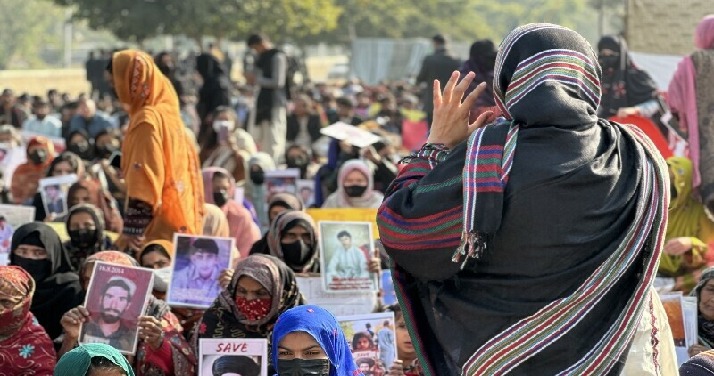
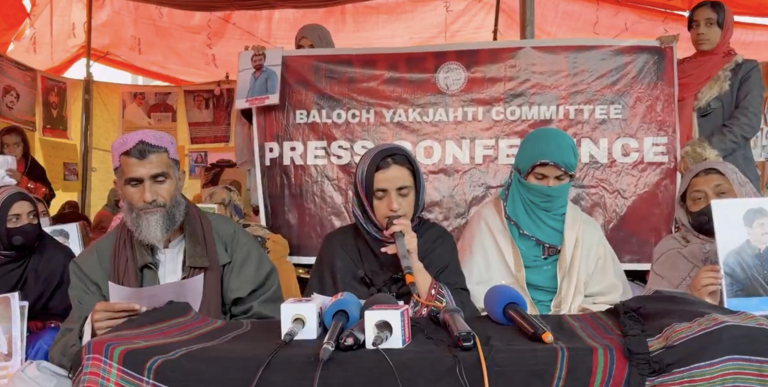
Despite facing continuous harassment, profiling, and bullying by the Islamabad Police and Pak Army, the Baloch protest against the alleged genocide and enforced disappearances in the region has entered its 33rd day with a steadfast sit-in outside the National Press Club.

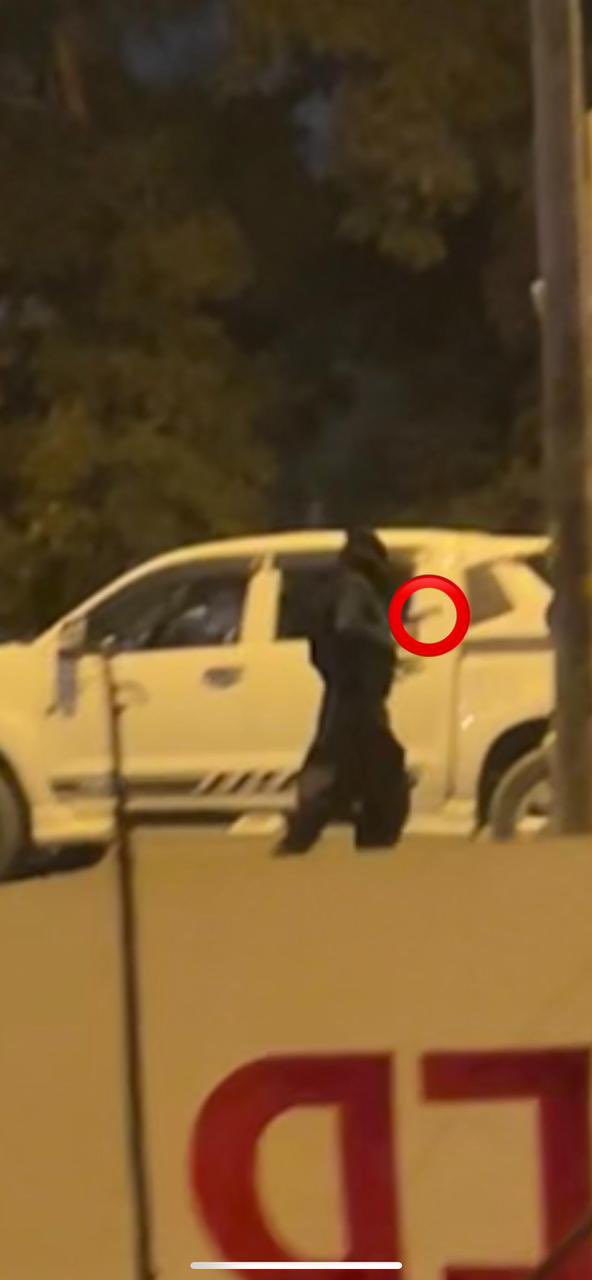
However, the peaceful protest witnessed a worrying turn of events on the night of December 25th, as masked men armed with guns arrived at the sit-in camp in a Vigo car. At approximately 3:15 am, unidentified individuals dressed in civilian clothes stole the protest’s sound system. This occurred despite the presence of multiple police officers and surveillance cameras in the vicinity of the National Press Club, where the sit-in protest is taking place.

The incident took place in the middle of the night, when most families were asleep. Reportedly, the masked individuals harassed the protesters, stole the speaker system used for communication, and fled the scene. Disturbingly, Islamabad Police were present during the entire incident, raising questions about their role and inaction.

This incident comes immediately after the police installing a surveillance camera in front of the protest camp just a day prior. These actions by Islamabad police are fueling concerns about intimidation and suppression of the peaceful protest. Baloch activists and human rights groups have strongly condemned the midnight raid and the continuous harassment of the protesters.

The incident has raised serious questions about the effectiveness of security measures at the protest and the role of the police in ensuring the safety of demonstrators. The ease with which the individuals departed the scene, despite being within camera range and with police officers present, has fueled doubts and concerns about the authorities’ commitment to protecting the protesters.

Adding to the frustration, the police responded to inquiries about the theft by claiming they were “unaware of the issue.” This response further angered and dismayed the protesters, who believe the police must have witnessed the incident or could have easily apprehended the perpetrators if they had been truly vigilant.

The ongoing protest highlights the plight of the Baloch people and the long-standing issue of enforced disappearances in the region. While the exact number remains unknown, human rights groups estimate that thousands of Baloch activists and civilians have disappeared over the years by the Army. Some victims have resurfaced but are too traumatized to even talk, and the bodies of others have been found lying across different parts of Pakistan-occupied Balochistan. The rest of the victims are still missing, reliving their worst nightmares over and over again.

The international community has also expressed concern about the situation in Balochistan and called for a transparent investigation into the enforced disappearances. However, the Pakistan Army has consistently denied any wrongdoing and accused the protesters of being involved in terrorist activities. As the protest enters its 34th day, the eyes of the world remain on Islamabad. The peaceful demonstration for justice and accountability stands as a stark reminder of the need for transparency and human rights in the region.

Detention of Baloch students & activists of the Baloch Long March by Pak Army continues

Despite the Interior Ministry’s statement announcing the release of all arrested students and activists, concerns remain regarding the whereabouts and well-being of several individuals detained during recent crackdown on the protests. Following the events of December 21st, when nearly 300 individuals were reportedly arrested near Chungi 26 and the Press Club in Islamabad, activists are demanding the release of those still in custody.

While 195 individuals have been released, the fate of 86 remains unclear. 52 are reportedly detained in Attock Jail, while 34 have been sent to Adiala Jail on judicial remand. Notably, the status and location of Dr. Zaheer Baloch, a prominent activist, remains unknown, raising concerns about his safety and well-being.

The continued detention of these individuals has sparked outrage and frustration among the Baloch community and human rights groups. Questions are being raised about the legality of the arrests and the lack of transparency surrounding the detained individuals’ status. This incident comes amidst continued tensions and ongoing long march by the Baloch community against enforced disappearances, human rights violations and disarmament of the Counter Terrorism Department.

Daring bomb attack on Pakistan Frontier Corps checkpoint in Buleda

Recently, a local bomb attack targeted a Frontier Corps (FC) checkpoint in the tehsil of Buleda, located in the Kech district of Pakistan. The incident unfolded on Sunday (24th Dec) evening, when unidentified individuals launched a daring assault on the security post.

Reportedly, the attackers utilized a locally made explosive device, directing it at the FC checkpoint with precision. The force of the explosion resulted in the significant destruction of the checkpoint. As of now, authorities have refrained from providing details regarding any casualties or injuries resulting from the attack.

In response, Pakistan Army have swiftly taken action. Following the attack, a comprehensive cordon and search operation has been initiated in the surrounding area.

Pakistan-occupied Balochistan, a resource-rich province, has been plagued by sporadic flare-ups of violence in recent years. Atrocities committed by the Pakistan Army against the Baloch community have motivated freedom fighters to take up arms against the brutal occupation.

However, no group has claimed responsibility for the attack. The longstanding grievances of the Baloch people against the Army, primarily concerning resource depletion and human rights violations, have fueled ongoing tensions in the region since the Army forcefully occupied Balochistan in 1948.

Awami Action Committee rejects surging wheat prices in Pak-occupied Gilgit-Baltistan

The joint meeting of the core committee and advisory council of Awami Action Committee in Pakistan occupied Gilgit-Baltistan vehemently rejected the newly proposed wheat prices set at Rs. 3600 per sack by the occupying government.

The committee decided to escalate the movement across Pakistan occupied Gilgit-Baltistan, aiming to intensify their stance against the occupying government’s decision. Additionally, they announced their support for a sit-in organized by the action committee in Skardu from December 26 onwards.

Kashmiris in the region are fervently demanding a rollback to the earlier wheat prices of Rs. 2200. For over seven months, the people of Pakistan-occupied Gilgit Baltistan (POGB) have been protesting against the substantial hike in wheat prices. Multiple demonstrations, including complete shutdowns and protest rallies, have been held. However, the Pakistani establishment and it’s puppet occupying government in POGB, have failed to address their concerns. Instead, they are formulating policies that undermine the rights of the native Kashmiris.

More than 200 male participants of the Baloch Long March still missing

Several students arrested by Islamabad Police, mostly Baloch, are currently held in various police stations in the capital. Following violence and arrests by Islamabad Police preventing the entry of the Baloch genocide Long March into Islamabad, female protesters were released during the night, but male protesters remain under police custody.

According to the Baloch Unity Committee in Islamabad, over 200 Baloch students, including those from other cities, are currently under police custody, including some Pashtun students. Students claim that arrested protestors are detained in various police stations in Islamabad, while none have been presented before a magistrate yet. Some students have been shifted by the police to an undisclosed location.

Despite the High Court’s order to release all detainees, no one has been released, and dozens of Baloch students are still under police custody. They are reportedly being held in harsh conditions, raising concerns of potential violence against them.

It should be noted that on 21st Dec, while attempting to block the entry into Islamabad, police used violence against Long March participants, including many children, who were injured. Later, the police transferred a large number of Long March participants into custody at various police stations.

There was also an attempt to transfer the women to Quetta from Islamabad late at night, but after strong resistance from the women, the police released the women and children under custody. On the other hand, protests continue across Pak-occupied-Balochistan against violence and arrests of Long March participants in Islamabad. Rally and protest events are also ongoing in Karachi and Lahore in solidarity with Long March participants.

EU Ambassador condemns Islamabad police’s treatment of Baloch women

The European Union (EU) Ambassador to Pakistan, Riina Kionka, has expressed strong disapproval of the Islamabad police’s treatment of Baloch protesters, particularly women, during recent demonstrations.

Taking to social media platform “X”, the EU ambassador to Pakistan expressed her concerns over the reports of Islamabad’s police action against participants of the “Baloch long-march” in the early hours of Thursday (21st Dec).

“Deeply worried by reports of mishandling at #BalochLongMarch2Islamabad. Freedoms of expression, assembly and association guaranteed in articles 19, 21 & 22, resp, of the International Covenant on Civil & and Political Rights (ICCPR), a core measure of GSP+ implementation,” she said in post on X.

https://twitter.com/RKionka/status/1738169919001477386

The EU ambassador’s condemnation comes amidst ongoing protests in Pakistan sparked by human rights abuses against the Baloch people. Recent demonstrations, including a long march against Baloch genocide, have seen a heavy police presence and reports of violence against both male and female protestors.

The march, sparked by the death of Balaach Mola Bakhsh in extrajudicial killing, calls for stop of Pak Army’s “Kill and dump” policy, release of missing persons, disarming of the Pak Army’s tools of exploitation such as Counter Terrorism Department (CTD). The protesters’ call for justice extends beyond Bakhsh’s case; they seek an end to the cycle of violence and impunity that has plagued Pak-occupied-Balochistan for decades.