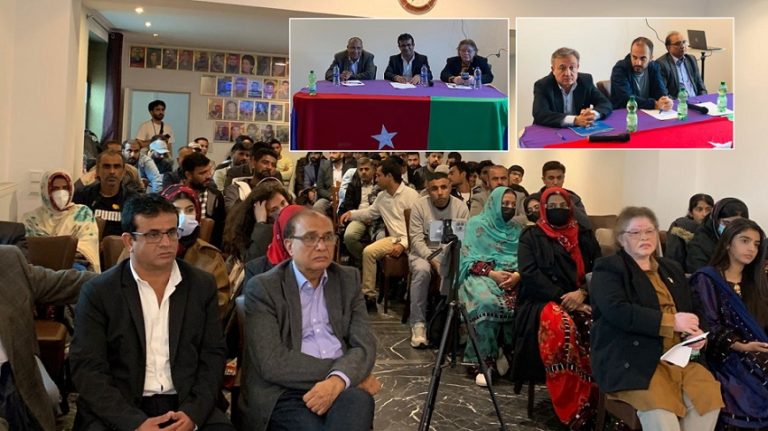
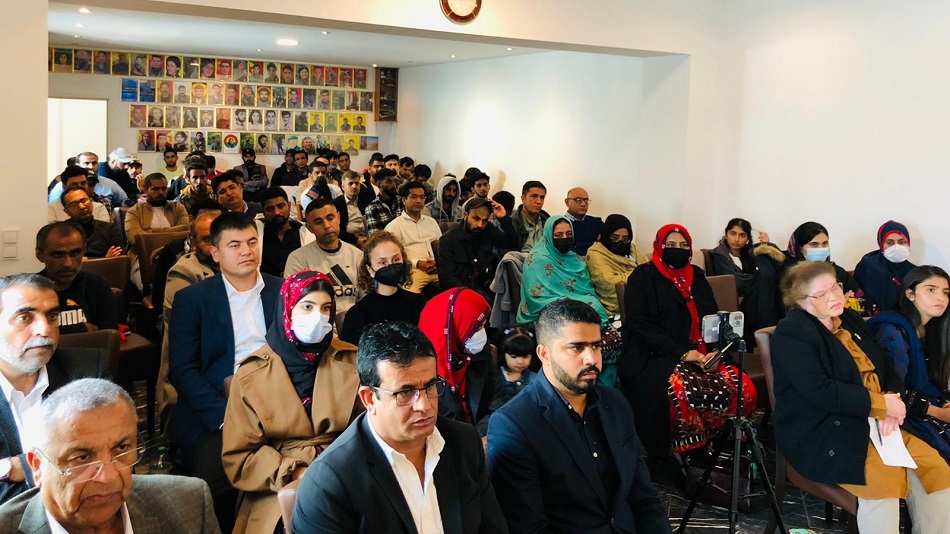
Baloch, Sindhi, Kurds and Uyghurs came together at a conference in Berlin organized by the Baloch National Movement (BNM) on September 19 to share their plight and to wake up the world regarding ongoing atrocities and systematic genocide in their respective homelands.
BNM chairman Dr. Naseem Baloch said that under forceful Pakistani occupation the most compelling issue faced by Baloch is of “enforced disappearances” and the “kill and dump policy”, including the recent fake encounters by the Pakistani regime. “…in the recent sit-in protests at Shaal (Quetta) Balochistan, we saw sisters and mothers of the enforced disappeared persons with their infant children. We saw weak and ill children without shoes, their mothers holding them in one hand and holding a mic in the other hand, crying for their loved ones,” explained Dr Naseem Baloch.
Dr. Lakho Lohana, the secretary general of the World Sindhi Congress said that Pakistan was built on the denial of nations that have identities spanning thousands of years and that evolved through thousands of years old socio-political history. Pakistan has suppressed these nations. “The Pakistan Army controls all institutions and is the sole power holder. The state of Pakistan has been looting the resources of Sindhi, Baloch and Saraiki people. The recent floods can be associated with climate change, but Pakistan has made it worse by denying them the right to live….in Sindh, people are dying of hunger and diseases; this is intentional genocide.”
In the first session at the Berlin conference Sindhi intellectuals and secretary general of the World Sindhi Congress Dr. Lakho Luhana, president of World Uyghur Congress Dolkun Isa, Kurdish political leader Mako Qoçgîrî and junior joint secretary of Baloch National Movement (BNM) Hasan Dost Baloch addressed the audience.
Baloch, Sindhi, Uyghur and Kurds at the BNM conference in Berlin, Germany on September 19, 2022. (Photo: News Intervention)
President of the World Uyghur Congress Dolkun Isa said that we are Muslims, but we are not allowed to perform our religious rituals in China. Dolkun Isa said China does not allow the Uyghurs to greet each other in an Islamic way. “We are not allowed to say “Salam” to each other and we are not allowed to keep fast. We cannot choose Islamic names for our children like Muhammad, Ahmed, etc the state of China has forced people, even more than 60 years old people to change their Islamic names.”
In the second session of the conference, the chairman of the Baloch National Movement (BNM), Dr. Naseem Baloch, renowned scholar and author Dr. Ayisha Siddiqa, historian Dr. Naseer Dasthi and Bibi Gul, the chairperson of the Human Rights Council of Balochistan, addressed the conference. BNM central committee member Faheem Baloch gave a presentation on the situation in Balochistan, while Samul Baloch, vice president of the BNM Germany chapter, moderated the session.
”We are indirectly fighting against China, the ally of Pakistan. We are fighting against its presence in Gwadar. Our success means safeguarding the interests and way of life of many other minorities who are bound to fall prey to Chinese hegemony. Apart from the exploitation of our natural resources, the Chinese presence on the Strait of Hormuz in Gwadar Port is bound to have negative economic and military effects on this region and the world. Earlier, Pakistan was alone in inflicting atrocities on the Baloch, Pashtuns, Sindhis and in Gilgit-Baltistan but now it has got an expansionist and aggressive partner in the form of China. China has joined hands to carry on the Baloch genocide. Their main purpose is to exploit the resources of Gilgit-Baltistan, Sindh and Balochistan,” explained BNM chairman Dr Naseem Baloch at the conference.
Well-known author Dr. Ayesha Siddiqa said, “We need to broaden the definition of ‘enforced disappearance’, explore its causes and objectives and identify its various forms. What is disappeared, who is disappeared. I know many of you are sitting here whose loved ones are disappeared. The state tends to silence people. No state has the right to deprive the people of their land; no state has the right to deprive people of their heritage. It is fierce. We should come together against any form of disappearance.”
Dr Ayesha Siddiqa added: “Look, an elected member of his people Ali Wazir, who had got bail but could not come out and is still in jail. This is what I mean by a form of disappearance by silencing the voice of people. Disappearances in the Pakistani state context have a broader connotation. The more extensive definition of disappearance is the criminal silencing people and shutting down what they want for their lives and lands.”
Historian Dr. Naseer Dashti said Pakistan would become bankrupt in the next two years. As soon as Pakistan becomes bankrupt, the vandalism process will accelerate, and other countries will no longer support it financially. The collapse of Pakistan is certain. That is for sure and no one can change.
Dr Naseer Dashti added that in these circumstances the role of Baloch leadership and political cadre is very important. “Even here we made a mistake like our elders who thought Britain would provide them weapons to fight against Pakistan. While the truth was that Pakistan was occupying Balochistan with the encouragement of Britain. If we repeat our mistakes, we would lose our freedom even in these situations in case Pakistan collapsed.” He explained that the British government formed the Muslim League. After World War II, the world conditions changed, and the colonies were forced to leave. “The biggest colonial power here was Britain, which liberated its colonies in such a way that the conditions have not improved.”
Dr. Naseer Dashti further explained that because the Soviet Union became a world power, the discovery of oil in the Gulf countries and the fear of the communist forces in China becoming powerful, Britain violated its Standstill Agreement with Balochistan and took away the independence of Balochistan and handed it over to Pakistan.
President of the World Uyghur Congress Dolkun Isa said millions of Uyghur children were separated from their parents to deprive them of their identity. “Since 1949, millions of people have been killed by Chinese forces and women have been raped.”
Dolkun Isa also criticized the silence of Muslim countries on Chinese atrocities on the Uyghurs. “The world’s Muslim countries are silent because their economic interests are more important than humanity. Pakistan and China have formed a league to usurp the natural resources of Uyghur and Baloch under the CPEC route.”
Kurdish political expert Mako Qoçgîrî of Sevka Azad highlighted the division of Kurdish nation between the three nation states and the problems faced by Kurds due to this division. “Our aim and goal is the democratization of the region. Today we are working with all the peoples of the region who are fighting for democracy and freedom. We see it as our responsibility to promote the struggle for democracy and freedom throughout the region. This is also the reason why today Turkey, as well as other international powers, are fighting against our movement. They see our project as a threat to their power structures.”
On this occasion, Hasan Dost Baloch, junior joint secretary of the Baloch National Movement (BNM) said that Pakistan occupied Balochistan in 1948. Until now, millions of people have been killed and forcibly disappeared. The trend of suicide has increased in Balochistan. They are committing suicide because of their treatment in torture cells. There they were treated in such a way that after their release they felt they were no longer fit to live in society.
Dr Naseem Baloch said: “China has vast experience in exploitation and genocide from Tibet to East Turkestan, from Hongkong to Taiwan, China is a country that has no respect for human rights and humanity in its own country. More than two million Uyghur Muslims suffer in their concentration camps. Our national movement is a liberation movement from Pakistani occupation. We believe our liberation movement is an inspiration for the oppressed people of the entire region. Not only because we are fighting against Pakistan the center of world terrorism but also we are fighting for the survival of cultural diversity, empowerment of nations and the rights of the oppressed ethnic minorities in the region.”
Ayesha Siddiqa said that the Baloch need to connect with other nations that are jointly suffering in the same territory that we now call Pakistan. “Pakistan was based on the old European history formula. The formula was that the identity has to be deliberately concocted, even if you are Baloch and even if I am a Saraiki. From the first day, Pakistan has been struggling to form a common national identity.”
Thirty-two years and nine months after the separatist militants imposed ‘blanket ban’ on all forms of entertainment and enforced the same with guns and grenades, the valley of Kashmir is getting the cinema back. Kashmir’s first multiplex, raised by a prominent politico-business family in collaboration with Inox, is being thrown open on Tuesday, 20 September, by Lieutenant Governor Manoj Sinha.
The multiplex with three auditoriums of 520 seats, each with the value addition of Dolby Atmos sound system and state-of-the-art celluloid screen, has come up in the Shivpora neighbourhood of Srinagar where the old famous Broadway stood for decades. Broadway, a business venture of the veteran politician and one-time Home Minister Durga Prasad Dhar’s and Lala Tirath Ram Alma’s families, was among the 14 cinema theatres shuttered down under the guerrilla diktat on 31 December 1989.
A well-concerted campaign against cinema, beauty parlours, music cassette kiosks, wine shops and everything that was perceived and labelled as “un-islamic” by the Islamists actually began after the Islamic revolution in Iran in February 1979. It was the time when the Jamaat-e-Islami backed military dictator General Zia-ul-Haq got Zulfikar Ali Bhutto executed in Pakistan. The first slogan for an “Iran-type revolution” in Kashmir came out from the founder of the Islami Jamiat Tulaba (IJT), Sheikh Tajamul Islam.
Then Chief Minister and President of the Jammu and Kashmir National Conference (NC) Sheikh Mohammad Abdullah described IJT, JeI’s student wing, as a “serious threat” to peace and harmony in Kashmir and got it banned by the Centre. The NC’s cadre didn’t cede ground to IJT or JeI. In April 1979, when Bhutto was hanged to death, NC’s Lashkar ransacked and set on fire scores of the JeI-dominated villages in South Kashmir. Tens of thousands of the apple trees in orchards were felled by the mobs.
The situation began changing after Sheikh Abdullah’s death in September 1982. Both JeI and IJT had gained substantial ground by the time Moustapha Akkad’s period film “Lion of the Desert”, a biopic on the anti-colonial Libyan guerrilla hero Omar Mukhtar was screened at Srinagar’s Regal cinema. This was the time when Sheikh, held responsible for strengthening J&K’s accession to India, was publicly demonised and labelled as a villain. This was the time when Shabir Shah of the then Peoples League orchestrated a campaign against the liquor shops in Anantnag; when Asiya Andrabi’s Dukhtaraan-e-Millat mobilized women for dismantling “all evils like cinema and fashion”; when the JeI-dominated Muslim United Front (MUF), mother of today’s ‘Hurriyat Conference’ came into existence.
On 18 August 1989, local newspapers published the Allah Tigers chief ‘Air Marshal’ Noor Khan’s diktat of blanket ban on cinema, wine shops, music cassette kiosks and other ‘evils’. However, the same could not be enforced till the Jammu and Kashmir Liberation Front (JKLF) forced VP Singh’s government to release five of its key cadres in exchange for the then Union Home Minister Mufti Mohammad Sayeed’s daughter Rubaiya Sayeed on 13 December 1989. The kidnapping proved a game changer as the celebration of victory by the separatists turned the valley population against India with the slogan of ‘Azadi”. No cinema, wine shop or beauty parlour opened after the “final deadline” of 31 December 1989.In 1990s, security forces set up their camps at Shah Cinema, Firdaus and Sheeraz and some other theatres. Later, some theatres were converted into business complexes and hospitals.
Nine years later– and two years after he returned as Chief Minister– Farooq Abdullah made several attempts to revive cinema in Kashmir. On 7 August 1998, he got Vidhu Vinod Chopra, celebrated film director and a resident of Srinagar, to screen his fresh film ‘Kareeb’ at Broadway. Heroine Neha Bajpai was among a galaxy of the guests. Later, Farooq Abdullah managed to reopen two more theatres–Regal and Neelam– in Srinagar. Even as the militants could not sabotage Broadway, which was situated yards from the main entrance of the Army’s 15 Corps at the Badami Bagh cantonment, they engaged the security forces in an encounter at Neelam. One civilian coming out in a crowd after watching a film at Regal was killed and several others left wounded in a grenade attack. All the three theatres closed down again, this time for a longer period.
Twenty-four years later, LG Sinha is inaugurating Kashmir’s first multiplex at the site of Broadway. Broadway’s owner Vijay Dhar began work on the project after Sinha’s government introduced Jammu and Kashmir’s first film policy in April 2021. The policy promises huge incentives to anybody coming forward to revive cinema, reopen the defunct cinema theatres, set up production and post-production facilities and training centres for artistes, directors and technicians.
Aamir Khan’s current release ‘Laal Singh Chhaddha’, in which the Kashmiri child artist Ahmad Ibn Umar is playing the young Laal and Aamir Khan with Kareen Kapoor is the protagonist, is being screening at the inauguration of Inox. The film has been extensively shot in Ladakh and Srinagar.
“We are eagerly waiting for the inauguration. Reopening of this theatre will take us back to the halcyon days when the educated class would prefer Broadway and the lower middle class would jostle for cheap tickets at Palladium, Naaz, Neelam and Regal”, said Mohammad Saleem Wani, a retired government official. He remembers enjoying from Hollywood film ‘Airport 1975’ to Bollywood hits ‘Kranti’, ‘Kabhi Kabhi’, ‘Roti Kapda aur Makaan’, ‘Ram Lakhan’, ‘Sindoor’, ‘Dharmatma’ and ‘Ram Teri Ganga Meli’ at the old Broadway.
“There are two motives behind this initiative. One is to provide facilities for entertainment to the children and other is to strengthen the bond between Kashmir and the Indian film industry. Kashmir’s relationship with the Indian film industry was too good in the past, so it will be a contribution towards reviving the previous relation,” Vikas Dhar from the owners’ family said last month.
In the 1990s, security forces set up their camps at Shah Cinema, Firdaus and Sheeraz and some other theatres in Srinagar. Later, some theatres were converted into business complexes and hospitals. In addition to 9 theatres in Srinagar, there were half a dozen cinema halls in Anantnag, Baramulla, Sopore, Bandipora and Handwara in Kashmir till 1990.
Kashmir used to be the outdoor shooting hub for Bollywood and other Indian films from 1940 to 1989. MG Ramachandran, J Jayalalitha, Dileep Kumar, Nargis, Shami Kapoor, Shashi Kapoor, Amitabh Bachchan, Rajesh Khanna and Dimple Kapadia were among the top Indian film celebrities who acted in a long list of the Indian movies shot in Kashmir. Even after the closure of cinema, more than 20 Indian films, including Vidhu Vinod Chopra’s ‘Mission Kashmir’ and ‘Shikara’, Vishal Bhardwaj’s ‘Haider’ and Vivek Agnihotri’s ‘Kashmir Files’, were shot in Kashmir.
Part II – Managing India’s Water Crisis expeditiously is Existential, and how can India deter China from her water hegemon actions in Tibet
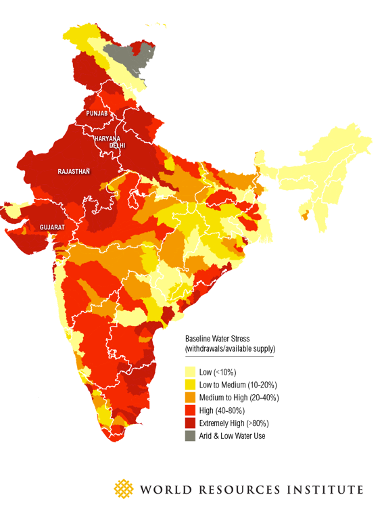
India, a water scarce country India is in the UN’s Global Drought Vulnerability Index. India’s drought-prone area has increased by 57 percent since 1997. Drought has affected nearly two-thirds of the country from 2020 to 2022. Over the last decade, one-third of India’s districts have experienced more than four droughts, and drought affects 50 million people each year. China and Nepal are upper riparian states for India, which has geo-strategic-political compulsions.
Water Management is a strategic imperative for water scarce India
Water Statistics are Truly Alarming As per Dr Rajiv Kumar, ex Vice Chairman, National Institution for Transforming India (NITI Aayog), in August 2021, the annual available water after evapotranspiration[i] is 1999 billion cubic metres (bcm), of which the utilizable water potential is estimated at 1122 bcm. India is the largest groundwater user in the world, with an estimated usage of around 251 bcm per year, more than a quarter of the global total. With more than 60 per cent of irrigated agriculture and 85 per cent of drinking water supplies dependent on it, and growing industrial/urban usage, groundwater is a vital resource. It is projected that the per capital water availability will dip to around 1400 cum in 2025, and further down to 1250 cum by 2050. A report titled “Composite Water Management Index (CWMI)”[ii], published by NITI Aayog in June 2018, mentioned that India was undergoing the worst water crisis in its history; that nearly 600 million people were facing high to extreme water stress; and about 200,000 people were dying every year due to inadequate access to safe water. The report further mentioned that India was placed at the rank of 120 amongst 122 countries in the water quality index, with nearly 70 per cent of water being contaminated. It projected the country’s water demand to be twice the available supply by 2030, implying severe scarcity for hundreds of millions of people and an eventual loss in the country’s GDP[iii]. Vitally, food security is at risk, given that large agricultural producers (states) are struggling to manage their water resources effectively. On the positive side, greater focus on water governance and increased data discipline amongst states is building a pathway for driving long-term success.
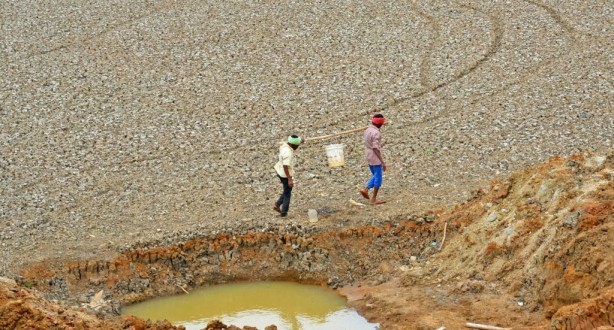
Water scarcity level in India
Even good Monsoons cannot solve India’s water crisis: About 600m Indians (more than 40% of the population), rely on agriculture for their living. A little over half of the country’s farmland is not irrigated, but are watered by the rains. Climate change has made monsoon patterns erratic; for instance, this year Kolkata went 61 days without rain, its longest stretch since 2000. Heavy rain does not penetrate and irrigate the soil, but erodes it, damaging farmland rather than helping crops to flourish. That India’s rainfall is concentrated into shorter periods also means that dry spells are lengthier. That encourages Indians to use groundwater to preserve their crops. Interestingly, a law passed in 1882 gives every landowner the right to use the water under their land as they choose. While the “Green Revolution” made the country a net food exporter, it also led to the widespread construction of tube wells. India now pumps more groundwater than America and China put together. Last year a study in Science Advances found that by 2025 large portions of north-western and southern India will have “critically low groundwater availability.” [iv]
The Government is moving but very slowly For scientific management of water ecosystem, the Ministry of Jal Shakti (by merging the Ministry of Water Resources, River Development & Ganga Rejuvenation, and Ministry of Drinking Water and Sanitation) was created in May 2019 to consolidate interrelated functions pertaining to water management. It has earmarked $45bn (INR 3.6 trillion) on the Jal Jeevan Mission (JJM) to provide safe drinking water to all rural households by 2024. JJM focuses on 1592 water-stressed blocks in 256 districts. Mission is to provide 55 litres of piped water supply per person to every household through the Functional Household Tap Connections scheme with concurrent mandatory source sustainability measures. Primary focus is on 97 lakh households in five priority states of Assam, Bihar, Tamil Nadu, Uttar Pradesh and West Bengal [due to increase in water borne diseases including Acute Encephalitis Syndrome (AES)]. By working together with the health, education, social justice and housing ministries, the Water Ministry hopes to reduce AES morbidity and mortality. JJM Highlights are at Note(v).
Other State and Non-State Measures Large number of hydroelectrical projects are being taken up in Arunachal Pradesh as run-of-river schemes and would have very negligible impact in triggering floods in downstream areas. Unfortunately, this necessary construction has got embroiled in an incorrect narrative and become a weapon of geopolitics. A mass movement engineered by the Assam-based Krishak Mukti Sangram Samiti (KMSS) has demanded a stop to all mega dam projects in the country’s sensitive Northeast. While some of their apprehensions are legitimate, the fact is that this water would not only be a power reservoir for the region, but also for the rest of India. The protest that began in Assam, led by the KMSS, against the construction of mega dams is leading to a conflict between development and environment protection. It is recommended that a feasibility study of the schemes that are being planned must be taken up for the Lohit basin by the Ministry of Environment, Forest, and Climate Change.
Meanwhile in Punjab, one of India’s leading wheat-producing states (UP is topping the chart last two years with 33% and Punjab 16%), several schemes provide farmers with cash incentives to pump less groundwater. Some states use techniques that are centuries old, harvesting run-off from monsoons and building dams to help replenish groundwater. These traditional efforts may prove more effective than sweeping national schemes, which are hampered by graft and bickering among state governments. India is ‘going digital’, with around 6,000 sensors being installed across India to gather data on lakes, reservoirs and rivers. Another 1,600 sensors will track underground water. All will be connected to the mobile phone network and will transmit real-time data, including water levels and weather conditions such as rainfall, humidity and air pressure. This data will be available on one centralised, web-based system so anyone can use it. Meanwhile software is being developed that can analyse that data and make it useful to decision makers. Marcella D’Souza from the Watershed Organisation Trust says such local projects are the key to managing India’s water resources. “The water situation is complex and no single agency can handle it alone,” she concludes “It is the responsibility of the local community and gram panchayats [village councils] to share the resources, to work together to protect their precious water resource. They need to be empowered with knowledge so as to make informed decisions.”
China-India Riparian States: Chinese actions on Tibet Autonomous Region Rivers specially Yarlung Tsangpo and Implications for India
Source: preventionweb.net
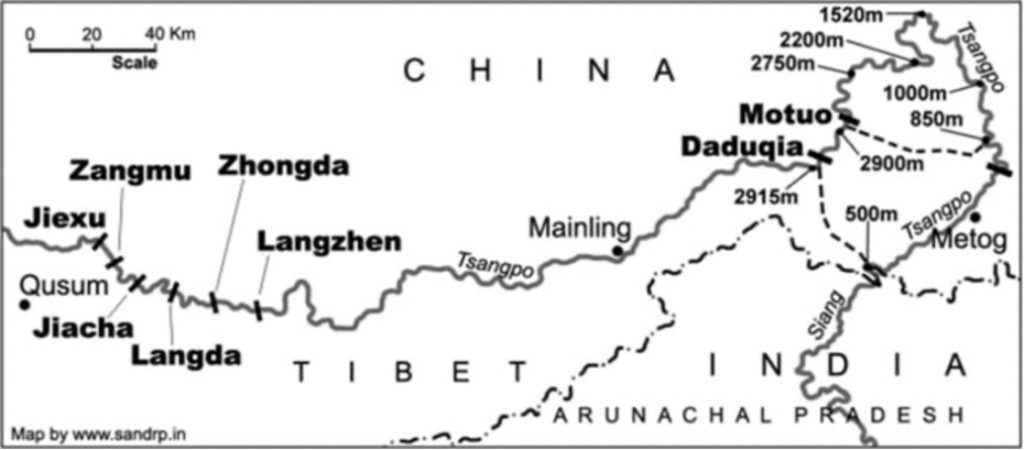
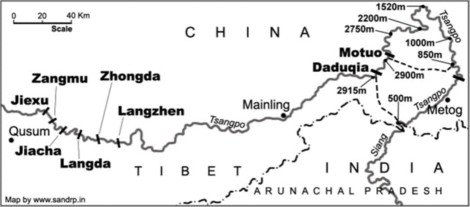
Image: A line map of the Yarlung Tsangpo Great Bend, showing previous Chinese dams constructions (in bold) and the proposed site of the newest 60-gigawatt hydropower project at Metog (Source: South Asia Network on Dams, Rivers and People)
This paragraph is a recapitulation of what was written in Part I. The damming of the Brahmaputra started during November 2010, with the 7.9 billion RMB 3260-meter Zangmu Hydropower Station 510 MW, which became fully operational on October 13, 2015. China has undertaken a huge project to construct five dams in Shannan Prefecture in the Tibet Autonomous Region (TAR). The precise locations of the project are reportedly in Gyatsa, Jieuxu, Langzhen, Zangmu, and Zhongda in the TAR. The dams are slated to divert the waters of the Brahmaputra River (Yarlung-Tsangpo in Tibet) to China’s water-scare North-western and Northern provinces. China adopted its 14th Five-Year Plan, which included a blueprint amounting to billions of dollars’ worth of projects, including controversial hydropower projects on the Brahmaputra in the TAR. China is embarking upon ambitious “dam-constructing exercises” on all its important rivers. The familiar Three Gorges Project across the Yangtze River is one such project.[vi]
Importance of River Brahmaputra to India: Apart from providing existential water to India, River Brahmaputra also provides–
Hydroelectricity. According to the Central Electricity authority, the Brahmaputra River basin possesses about 44 per cent of India’s total hydropower potential. It is assessed that the ‘exploitable hydropower potential’ of the Brahmaputra basin is 58,356 MW out of the overall hydro-electric potential of India estimated to be around 150,000 MW.
Means of Livelihood: Obvious and not being elaborated.
Inland River Waterways: It has immense potential of providing easy and cheap communication networks and accessibility within the North-eastern states and also up to Chittagong in Bangladesh.
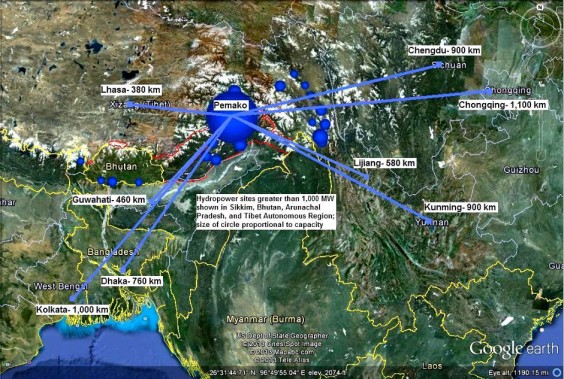
Should the lower Riparian States especially India be Worried? The plan to divert the waters of Brahmaputra would affect over 140 million people who are dependent on the river. Indeed, it would be India and Bangladesh that would have to bear the brunt of the planned damming and diversion. There is great apprehension that the diversion of the waters would affect the downstream flow in Northeast India and beyond. Li Chaoyi, the chief engineer of China Huaneng Group, which is the prime contractor of the dam project, said that the river’s flow would not be affected by the construction of the dam. Quoted in the official Chinese news agency, Xinhua, Li stated, “After it becomes operational, the river water will flow downstream through water turbines and sluices. So, the water volume downstream will not be cut.” He also stated that environmental protection would be a priority. Nevertheless, the issue of the dam remains a cause of great concern for India and has been taken up at the highest levels including the Foreign Secretary level since 2010.
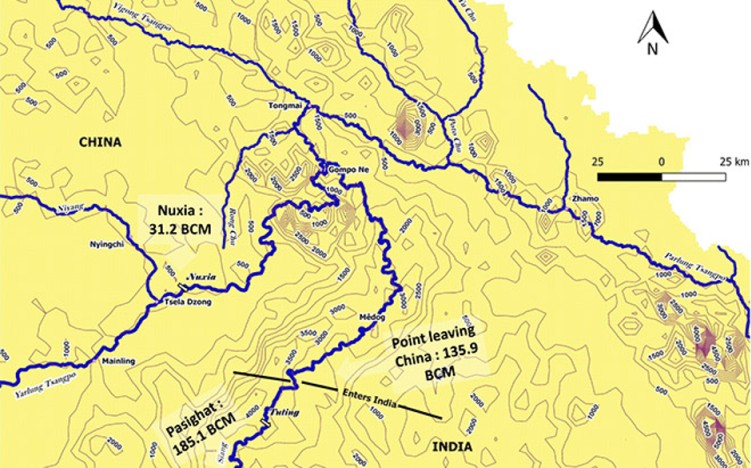
Figure: Isohyet map showing the distribution of precipitation in the Yarlung Tsangpo / Brahmaputra basin at the Great Bend and adjacent areas, and annual discharge at three points along the course of the river. [Map prepared by Ghosh et al. (2019), based on Bookhagen’s compilation of TRMM data – 1998 to 2009]
Experts have concluded that hydrology and precipitation over the Yarlung Tsangpo/Brahmaputra are highly correlated, and in fact the contribution of snow and glacial melt to the flow is substantially low in the overall stretch; however, its contribution is higher in the upper reaches of the flow which are in the rain-shadow region. Of the total 2,880 kilometres (k.m.) length of the Yarlung Tsangpo/ Brahmaputra, 1,625 k.m. flows through the Tibetan plateau with the name Yarlung Tsangpo, whereas it assumes the names of Siang, Dihang, and Brahmaputra in its 918 k.m. in India, and the rest of the 337 k.m. in Bangladesh is named the Jamuna till its confluence with the Ganges near Goalando. Though this geographical distribution of length gives an apparent impression that the maximum flow of the system occurs in the TAR (Tibet Autonomous Region) of China, it is a myth! Rather, the system becomes stronger and fatter as it flows further downstream. It needs to be noted here that the Brahmaputra is identified as the flow downstream of the confluence of three tributaries, namely the Luhit, Dibang, and Dihang, near Sadiya in the Indian state of Assam.[vii] While the peak flows at Nuxia and Tsela Dzong measuring stations at the great bend in the Tibetan plateau are about 5,000 and 10,000 cubic metres per second (cumecs), the peak flow at Guwahati in Assam is approximately 55,000 cumecs. Thus, as per one scientific interpretation; rainfall creates the flow and given the precipitation, run-off and sediment flow regimes, it is unlikely that any intervention on the Yarlung Tsangpo in the north region of the Himalaya can cause any substantial harm for downstream economies including India and Bangladesh, irrespective of Chinese intent.[viii]
However, the same cannot be stated for the present proposed project in the Medog county of Tibet Autonomous Region (TAR) Indian research suggests that the region, entailing the Great Bend at the intersection of the basins of Yigong Tsangpo, Parlung Tsangpo, and the Lower Yarlung, exhibit events like high monsoonal precipitation, strong possibilities of landslides and avalanches leading to flash floods with the average annual frequency of such hazardous events being 10 or more. Further even Medog witnesses 12-15 such incidents on an average. The biggest concern is its unpredictable tectonicity as is prevalent in large parts of Eastern Himalayan system. Therefore, any such event resulting in any form of dam burst or otherwise can have disastrous impacts on the immediate downstream particularly Arunachal Pradesh which will most likely experience sudden flooding.
What can India Do? There is no international law or mechanism where such a right can be defended against actions of upstream countries. Such a defence would be possible if there was a treaty on sharing the common rivers, like the Indus Treaty that India has with Pakistan. But no such treaty exists between India and China on any of the rivers that the two countries share. However, some strategists feel that India should refrain from any knee-jerk reaction specially in the current geo-political climate where trust levels are at its nadir. It could demolish years of progress that has been made by states in establishing mechanisms of hydro-diplomacy. A testament of this is the India-China Expert Level Mechanism (ELM) on Trans-border Rivers and the hydrological data (water level, discharge, and rainfall) sharing agreement that exists between India and China on the Yarlung/Brahmaputra and Langqen/Sutlej, which has continued despite the hostilities at the Line of Actual Control (there was lack of data for a very brief period only).
TS Mehra, a senior official in India’s federal water ministry, told the Reuters news agency, “The need of the hour is to have a big dam in Arunachal Pradesh to mitigate the adverse impact of the Chinese dam projects”. He added that this would create a large water storage capacity to offset the effect of Chinese dams on water flows. Moreover, China’s capability and, arguably, the intent to use water as a weapon when required is another aspect India has to be mindful of. India must evolve a strategic road map in concert with other lower riparian and like-minded states and international organisations to ensure that China adheres to the laid down principles, norms and rules on the sharing of trans-border rivers. It has to be ensured that China respects the interests and concerns of lower riparian nations before embarking on trans-border river projects, that have far-reaching and potentially catastrophic effects.[ix]
Conclusion
To achieve water security, there is no choice except to focus on rainwater harvesting, recharge of aquifers, proper storage, and efficient utilization. This conscious thought-process is to be developed in all stakeholders through education and awareness, working from schools and villages upwards. Apart from the JJM initiatives, NITI Aayog in October 2021 has released a compendium on the role of communities in water management, and lists out best practices on: agriculture; groundwater management; watershed development; water infrastructure; and climate risk and resilience. We also need to learn from other countries’ successes, such as Israel which has turned a water crisis into an opportunity even though it receives one-fourth of the rainfall we get in India. Israel is now water secure and its groundwater level is also increasing, due to the adoption of new techniques.
Undoubtedly, water is an existential resource, and many security and geo-political experts predict that unless fair and proper water management is ensured and agreed upon, it has the potential for confrontation between inter and intra states/nations. Apart from the border issue with China, water management in Tibet by China is likely to be a major confrontation point between the two nations. In fact, if both nations do not act responsibly and urgently to ensure water security, it could trigger conflict. For now, India needs to talk to China, coalesce support of affected nations like Bhutan, Bangladesh, Myanmar, Thailand and even Pakistan, as also draw on international support to prevent China from interfering with the flow of rivers in Tibet, which has the potential to cause man-made ecological disasters. In a country that has 18% of the world’s population but just 4% of its water, every drop counts.
[i] Evapotranspiration – the process by which water is transferred from the land to the atmosphere by evaporation from the soil and other surfaces and by transpiration from plants.
[ii] The CWMI was conceptualized as a tool to instil a sense of cooperative and competitive federalism among the states. This was a first-ever attempt at creating a pan-India set of metrics that measured different dimensions of water management and use across the lifecycle of water. The water data collection exercise was carried out in partnership with the Ministry of Jal Shakti, Ministry of Rural Development, and all the States/Union Territories (UTs). The report was widely acknowledged and provided guidance to States on their success areas, absolutely and relatively, and on recommendations to secure their water future. CWMI 2.0, released in August 2019, ranked various states for the reference year 2017–18 as against the base year 2016–17. Gujarat held on to its first rank in 2017–18, followed by Andhra Pradesh, Madhya Pradesh, Goa, Karnataka, and Tamil Nadu. Amongst North Eastern and Himalayan States, Himachal Pradesh was adjudged on top. The UTs submitted their data for the first time, with Puducherry declared the top ranker. On an average, 80 per cent of the states assessed on the Index over the last three years have improved their water management scores, with an average improvement of +5.2 points. But worryingly, 16 out of the 27 states still score less than 50 points on the Index (out of 100), and fall in the low-performing category. These states collectively account for ~48 per cent of the population, ~40 per cent of agricultural produce, and ~35 per cent of the economic output of India. Uttar Pradesh, Rajasthan, Kerala, and Delhi, 4 of the top 10 contributors to India’s economic output and accounting for over a quarter of India’s population, have scores ranging from 20 points to 47 points on the CWMI.
As per a comprehensive report released on October 2, 2021, the following are the major achievements since 2019: 1. 8.26 crore (43 per cent) rural households (in over 1.16 lakh villages and 79 districts) are getting tap water supply in their homes. 2. 5.03 crore tap water connections provided since the JJM launch. 3. Goa, Haryana, Telangana, A&N Islands, Daman & Diu, Dadra & Nagar Haveli, and Puducherry have achieved ‘Har Ghar Jal’. 4. 1.22 crore (36.09 per cent) households in socio-economically backward districts are getting tap water supply in their homes, that is, about four times increase in coverage since JJM was announced. 5. 1.15 crore (37.83 per cent) households in 60 identified JE/AES endemic districts are getting tap water supply in their homes, that is, about 15 times increase in coverage since the announcement of JJM. 6. 3.43 lakh Village Water Sanitation Committees/Pani Samitis constituted/made functional. 7. 2.86 lakh Village Adoption Programmes by the National Institute of Food Technology. 8. Entrepreneurship and Management students, prepared and approved in different villages. 9. 7.93 lakh (76.93 per cent) schools and 7.65 lakh (68.21 percent) Anganwadi Centres provided with tap water connections. Skilling JJM provides huge employment opportunities in villages, to successfully implement the Mission and ensure long-term operation and maintenance of in-village water supply systems. To meet this present and future requirement, skilling is a major component to produce a good number of masons, plumbers, electricians, pump operators, etc. Development partners are being engaged by states to prepare modules for sensitization and capacity building in villages. Also, the COVID-19 pandemic has led to reverse migration of skilled and semi-skilled human resources, which can be turned into a mutually beneficial opportunity for the programme and employment opportunities in rural areas. Among the technological interventions, a modern, public, online ‘JJM— Integrated Management Information System’ has been set up for day-to-day planning, implementation, monitoring, and reporting of the national/State/UT/district/village-level progress. Furthermore, to ensure transparency and modern fund management, a Public Finance Management System has been made compulsory under JJM.
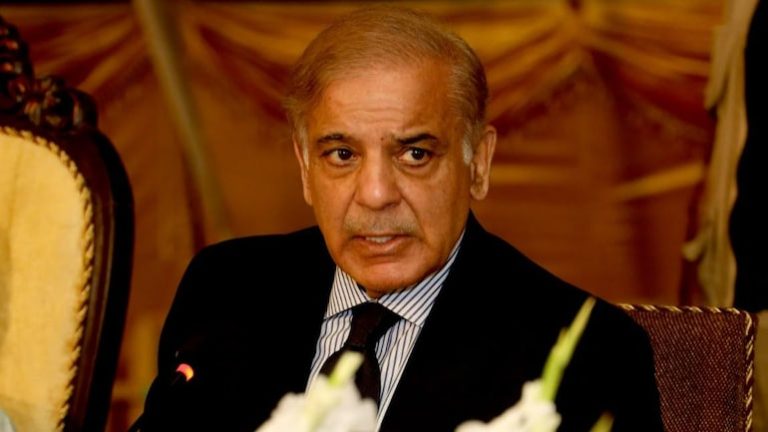
Flood hit Pakistan, which is urgently seeking international aid, has made things difficult for aid agencies as it refused to give approval to them for sourcing relief materials from India. Several organisations had urged the Shehbaz Sharif government to allow them to procure relief material from India due to the proximity. Not just that. Islamabad has now denied aid coming in from Bangladesh as well since it feels the move would damage its global image.
“Pakistan Army is reportedly averse to the proposal of aid from Bangladesh as any such relief assistance may undermine Pakistan’s global image,” she said as per local media.
It is ‘politics first’ for the Shehbaz Sharif government even at this hour.
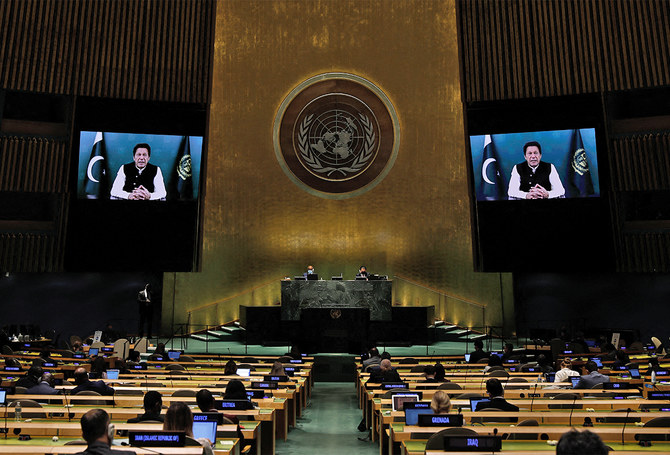
Pakistan Prime Minister Sharif has refrained from seeking any support from India. The government has also continued to vehemently oppose any move to resume imports of essential items including vegetables from India despite Pakistan’s Finance Minister Miftah Ismail’s insistence.
Sharif once again brought in the Kashmir issue even as Pakistan’s economic managers and business community underlined the immediate need to start cross-border trade to contain inflation.
Prime Minister Narendra Modi, last month, expressed concern and sympathy over the havoc caused by the floods in Pakistan. “Saddened to see the devastation caused by the floods in Pakistan. We extend our heartfelt condolences to the families of the victims, the injured and all those affected by this natural calamity and hope for an early restoration of normalcy,” Modi had tweeted.
Pakistan based Dawn said that the country could have attracted “more international assistance with an inclusive policy to manage the ongoing catastrophe.”
The floods in Pakistan, could cost more than $30 billion to the exchequer and it would be a tough task for Islamabad to restore the situation especially since it has shown scant intention of deviating from domestic politics.
While India, sources said, is ready to provide the assistance to the flood ravaged country, Islamabad is yet to take a concrete decision and also “need to shift their stand on Kashmir.”
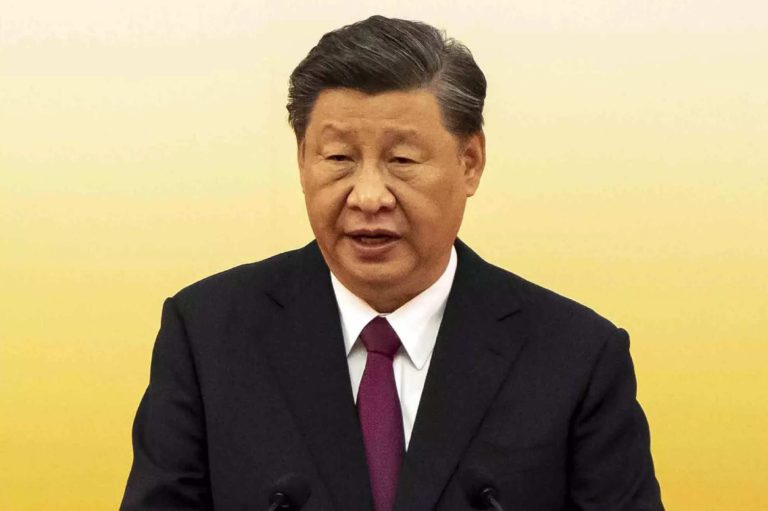
The single digit growth of 7 per cent year-on-year registered by China’s exports sector in August will cause embarrassment for Beijing which is slated to hold its 20th National Congress meet next month. Though it is almost certain that the powers of the 69 year old Xi Jinping, the country’s President will be enhanced while awarding another five year term to him, the slowing down of the exports sector, one of the pillars of the country’s economic growth, along with the battered real estate sector have led to discontent.
“Though Xi will remain in power, as anticipated, the voices of dissent are rising,” an analyst who has worked in China told India Narrative. Xi’s zero Covid approach has also come under the scanner with a large number of citizens showing their displeasure over his pandemic policies.
Covid related widespread lockdowns in several parts of the country in April and May too impacted the exports sector. In April, the sector grew only 3.9 per cent.
In August, Chinese exports to the US witnessed a decline of 3.8 per cent. In July China’s outbound shipment to the US grew by 11 per cent.
In another major blow to China, the US is looking at imposing stringent export restrictions of semiconductor, used for artificial intelligence and chip making equipment. The move will impact its manufacturing sector. Earlier this year, the Commerce Department in the US already communicated to three companies — KLA Corp., Lam Research Corp., and Applied Materials Inc. to restrict supply. But now the Biden administration is looking to come out with a new set of rules to curb exports.
China, touted as the world’s factory, has been the largest exporter of goods since 2009.
In July, China’s export sector registered an 18 per cent growth.
The South China Morning Post in a recent report said that exports have been a major anchor for China’s economic growth for years, “and their prolonged deceleration could threaten to further stymie the country’s already sputtering economy amid rising global inflation and recession risks.”
When it comes to any terrorism related issue, Pakistan insists on taking the high moral ground and never tires of repeatedly reminding the world about its participation in the most extensive war against terror in history. Thus, herein lies the paradox because ever since 2018, the name of this self-anointed crusader against terrorism continues to figure in the grey list of international terrorism financing monitoring watchdog, Financial Action Task Force [FATF].
Unfortunately, rather than taking necessary actions to address the serious concerns expressed by FATF and end the ignominy of being clubbed with countries like Syria, Myanmar, Philippines, South Sudan, Uganda and Yemen, Pakistan continues soft pedalling when it comes to curbing terror financing activities. What’s even more astonishing is that in order to mislead its own people, Islamabad merrily accuses FATF of “politicisation” and portrays itself as a hapless victim of international intrigue.
While Islamabad’s ridiculous claim of FATF being ‘politicised’ is indeed laughable, its puerile actions intended to hoodwink FATF are downright hilarious. Have you noticed that very FATF meeting in which Pakistan’s status is scheduled to be reviewed is invariably preceded by the announcement of what can aptly be described as countrywide [and of late, international] ‘terrorist hunting’ season? A few examples:
Just before its February 2020 meet, FATF was told by Islamabad that that Jaish-e-Mohammad [JeM] founder Masood Azhar living in Pakistan and had been listed as an “international terrorist” by the United Nations Security Council in May 2019, was “untraceable”.
For 27 years, Pakistan repeatedly denied that an Indian national named Dawood Ibrahim who had masterminded the gruesome 1993 Mumbai serial bomb blasts had been provided a safe sanctuary in Pakistan. However, in its 2020 list of designated terrorists released shortly before the October 2020 FATF meet, Islamabad not only included Dawood’s name but also mentioned the details of his residential address and passport. It later contended that despite his name appearing in Islamabad’s list of designated terrorists, Dawood wasn’t present in Pakistan.
Shortly before the 2022 FATF meet, Lashkar-e-Taiba [LeT] co-founder Hafiz Saeed and 26/11 Mumbai attack mastermind was purportedly interned in Lahore’s Kot Lakhpat jail after being awarded a prison term on terror funding charges. However, an inadvertent disclosure by an Inspector General of Police after a car bomb attack near Saeed’s house revealed that instead of being in jail, the Mumbai attack mastermind was present at his residence!
With FATF scheduled to meet shortly, Islamabad has once again declared ‘terrorist hunting’ season open. This time the quarry is JeM founder Masood Azhar who masterminded the 2001 Indian Parliament attack and the 2019 suicide car bombing of a bus in carrying paramilitary force personnel in Pulwama [Kashmir].
However, the then chief of Pakistan Army’s media wing Inter Services Public Relations [ISPR] Major General Asif Ghafoor outrightly denied Azhar’s presence in Pakistan in a rather curious and non-committal manner by saying that “Jaish-e-Mohammed does not exist in Pakistan. It has been proscribed by the United Nations and Pakistan also.”
Islamabad is now claiming that Azhar is hiding in Afghanistan. News reports appearing in Pakistani media have quoted “a top official privy to the development” as saying that “We have written a one-page letter to Afghan foreign ministry, asking them to locate, report and arrest Masood Azhar, as we believe that he is hiding somewhere in Afghanistan.” However, Taliban spokesperson Zabihullah Mujahid has not only outrightly rubbished Islamabad’s allegation but also confirmed that Islamabad has not made any such request with regards to the JeM chief.
One can always question the veracity of the Taliban spokesperson’s claim of Azhar not being present in Afghanistan. However, his observation that “Such organisations [JeM] can operate on Pakistan’s soil – and even under official patronage,” [Emphasis added], merits due deliberation, because the Taliban spokesperson is speaking from personal experience. After all, didn’t Rawalpindi secretly host the Afghan Taliban on its soil for nearly a decade?
Remember former US president Donald Trump’s 2018 “They [Pakistan Army] give safe haven to the terrorists we hunt in Afghanistan” tweet [Emphasis added]?
One may laugh at the unending litany of ridiculous excuses being made by Islamabad to conceal the reality that its inability to comply with FATF’s observations stems from its enduring honeymoon with terrorist groups. However, the international community’s stoic silence on Pakistan’s brazen perfidy on the issue of combating terror is certainly no laughing matter. In fact, it’s global apathy towards Pakistan’s ‘running with the hare and hunting with the hounds’ approach to terrorism that’s further emboldening Rawalpindi!
Four years ago, the office of the United Nations High Commissioner for Human Rights [OCHCR] released a “Report on the Situation of Human Rights in Kashmir: Developments in the Indian State of Jammu and Kashmir from June 2016 to April 2018.” Though it painted a dismal picture regarding the human rights situation in J&K, this document nevertheless failed to evoke any meaningful concerns from the international community, because of its near complete reliance on unsubstantiated inputs.
However, Pakistan’s Ministry of Foreign Affairs in its press release 193/2018 stated, “Pakistan welcomes the proposal by the UN High Commissioner for Human Rights to establish a Commission of Inquiry for international investigation into human rights violations in the Indian Occupied Jammu & Kashmir [IoK].” While Pakistan’s Foreign Office [FO] has all the rights to express its views, however bizarre they may be, but using rhetoric to take liberties with facts only exposes Islamabad’s puerile attempts to salvage its tottering Kashmir narrative.
So, while Pakistan’s FO has cunningly referred to J&K as “Indian Occupied Kashmir”, the fact of the matter is the very OCHRC report that it so warmly “welcomes” clearly mentions this region as the “Indian State of Jammu and Kashmir” [Emphasis added]. So, once the UN unambiguously accepts J&K as an integral part of India, isn’t it high time Islamabad realised that just shouting from rooftops won’t make J&K “Indian Occupied Jammu & Kashmir”.
Nevertheless, solely for the sake of taking this argument to its logical conclusion, let’s for a moment accept that the 2018 OCHRC report inciting New Delhi for human rights excesses in J&K is correct. While discussing this issue, everyone will unanimously agree that the universally accepted “what’s good for the goose is good for the gander” idiom should hold good both for J&K as well as Pakistan occupied Kashmir [PoK]. But the problem is that Islamabad wants to both eat the cake and have it too!
While demanding that the international community should haul New Delhi over coals for alleged human rights allegation in J&K, Islamabad has, by saying, “References to human rights concerns in Azad Jammu and Kashmir (AJK) and Gilgit-Baltistan should in no way be construed to create a false sense of equivalence with the gross and systematic human rights violations in IoK,” [sic], adroitly used its characteristic bombast to try and seek immunity from being pilloried for its human rights abuses in PoK!
On fast-forwarding to the present, one finds that Islamabad doesn’t seem to have learnt any lessons from its disastrous diplomatic post Article 370 abrogation campaign.
While it may boast of having been able to get UNSC to discuss the Kashmir issue, but the absence of any resolutions supporting Pakistan’s untenable claims on J&K is a clear indicator that its contrived Kashmir narrative has no takers. Furthermore, by boldly announcing that it would approach the International Court of Justice on the Article 370 abrogation issue and then shying away from doing so, Islamabad has wrecked its own feeble case on Kashmir!
Realising that the ‘Kashmir stick’ which it was using for seven and a half decades to beat New Delhi with, is no longer available, Shehbaz Sharif has nimbly picked up the subtle art of whipping up Islamophobia from his predecessor Imran Khan and is fully exploiting the same to divert public attention from the abysmal performance of his government.
Islamabad seems to be so disturbed by delusions of alleged “genocide” in Kashmir and about Muslims being “subjugated” in India, that for Sharif, ameliorating the hardships of the flood affected Pakistanis has become a secondary issue. However, despite the recently released UN report titled “OHCHR Assessment of human rights concerns in the Xinjiang Uyghur Autonomous Region, People’s Republic of China,” which provides undisputable evidence of religious persecution of Uyghur Muslims in China, Islamabad has still come out in support of Beijing’s state sponsored “sinicisation of Islam” pogrom.
The OHCHR report mentions of how “Religious activities are allowed only in Government-approved locations, conducted by Government-accredited personnel, and on the basis of Government-approved teachings and publications.” It also reveals that “Religious activity is strictly prohibited in “state institutions, schools of national education, public institutions and other places” and that “children are not allowed to participate in religious activities.”
Despite the UN report clearly mentioning that “The extent of arbitrary and discriminatory detention of members of Uyghur and other predominantly Muslim groups [by China] … may constitute international crimes, in particular crimes against humanity,” by stating that “Pakistan believes in the principles of the UN Charter including respect for political independence, sovereignty and non-interference in internal affairs of states,” Pakistan has not only turned a blind eye to brazen Islamophobia in China but has shamelessly come out in support of Beijing.
Islamabad may cantankerously voice its grave concerns regarding alleged ‘persecution’ of Muslims not only in Kashmir but entire India. However, by classifying institutional religious subjugation of Uyghur Muslims through China’s 2014 “Strike Hard Campaign against Violent Terrorism”, as Beijing’s internal matter, Islamabad has only further confirmed that for monetary considerations, it is more than willing to make exceptions in its global campaign against Islamophobia.
No wonder, when it comes to the issue of standing up against Islamophobia, leave alone the international community, even Islamic nations don’t take Pakistan seriously!
Though reassuring, New Delhi’s recent statement that both India and China have “agreed on disengagement in the area of Gogra-Hot Springs [PP-15]” doesn’t mean that existing perceptional differences regarding alignment of the Line of Actual Control [LAC] between the two countries has been resolved. Nor does it in any way imply that Beijing would hereafter concentrate on mending fences with New Delhi by adopting a more constructive approach rather than maintaining a belligerent stance.
There may also be varying opinions regarding the import of this “disengagement”. While some may hail it as a positive diplomatic development, there would certainly be others who would dismiss it as something inconsequential- citing the duplicitous “Hindi-Chini Bhai, Bhai” [Indians and Chinese are brothers] slogan made by Beijing before attacking India in 1962. However, analysts across the spectrum would agree that the chances of China’s People’s Liberation Army [PLA] using physical force to assert its point of view on the boundary issue with India are now indeed very slim.
However, the Indian army’s professional response proved that Beijing’s assessment was flawed. Instead of being unsettled by PLA’s confrontational actions and indulging in knee-jerk reactions, the India army instead adopted a mature strategy, aptly defined by Indian army’s former Director General of Military Operations [DGMO] Lt Gen Vinod Bhatia as one of ‘No blinking- no brinkmanship’. So, while it sagaciously opted not to escalate violence levels after the Galwan clash, by occupying strategic heights on the Kailash range, it unambiguously demonstrated a firm resolve to counter PLA’s brazen bellicosity.
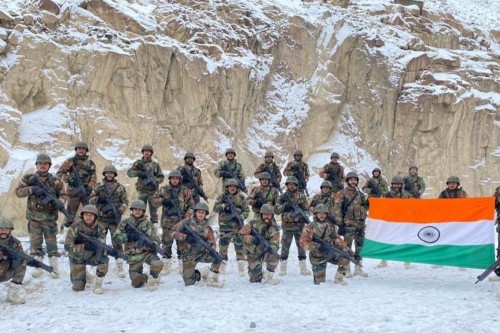
Braving the near-arctic climatic conditions prevailing in Ladakh for two years , the Indian army has not only firmly stood its ground but even inducted additional forces for stemming any misadventure by the PLA. While effecting quantum increase of field forces on the foreboding heights along the LAC is in itself a massive exercise, doing so in a compressed time frame necessitated by military considerations makes things even more difficult especially when requisite infrastructure at ‘friction points’ is non-existent. Furthermore, additional troops moved into Ladakh had to be suitably billeted and administered to withstand harsh climatic conditions and sub-zero temperatures.
The logistics branch of the Indian army has worked wonders by using ingenuity and improvisation to ensure that the additional forces inducted in Ladakh are administratively well-looked after. However, given the enormity of the task, the arrangements made are by no means ideal and it’s here that the characteristic resoluteness and resilience of the Indian army soldier has once again come to the fore. Braving all odds, its rank and file has picked up the gauntlet by maintaining an effective 24X7 all weather vigil to thwart any PLA designs to change the status quo on the LAC.
Even at the cost of repetition, it would be in order to mention once again that Beijing is known for making extremely complex but very well calculated moves. As such, the PLA’s menacing actions in Ladakh are most certainly not the result of an impulsive decision taken by some intermediary ‘hawks’ within the echelons of China’s political or military hierarchy. So, it would be fair to assume that the PLA’s aggressive actions in Ladakh were duly vetted and approved by the Central Military Commission, China’s uppermost national defence organisation. Accordingly, there’s definitely a method in what otherwise appears to an untrained eye as wanton acts of madness on the PLA’s part .
Given the secrecy surrounding decision making in China, what exactly prompted Beijing to jump the gun and adopt an antagonist view in Ladakh may never be known. However, by accepting to undertake the “disengagement process” in the PP-15 area, it has willy-nilly accepted that its territorial claims in Ladakh and allegations of Indian “intrusions” are dubious. If they weren’t, then why would Beijing agree to disengage from an area that it so vociferously asserts is its own territory?
By braving the elements and taking pre-emptive actions to prevent any ingress by the PLA in Ladakh, the Indian army has clearly demonstrated its firm resolve to safeguard India’s territorial integrity come what may. By not blinking or resorting to brinkmanship, the Indian army has effectively foreclosed Beijing’s attempts to militarily intimidate New Delhi into making any concessions and forced it to take the face-saving “disengagement” route.
So, while political and diplomatic efforts to resolve the LAC alignment issue continue, let’s not forget the crucial role played by the indomitable Indian soldier whose astounding grit and dedication it has effectually demolished the myth of PLA’s invincibility and thereby ensured that the Indian side negotiates from a position of strength!
Are Water Wars Next? If this happens, what are the Implications for India?
Part I – China is facing a monumental Water Crisis: How is China ensuring water security
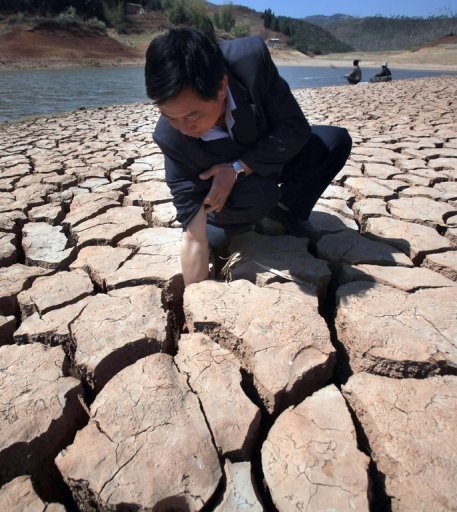
China’s Water Crisis worsened by Climate Change China is currently facing a two months heatwave of the century, a major water crisis, apart from being hit by a sluggish economy, continuing Covid crisis, and a global geo-political-economic pushback. A multiyear drought could push the country into an outright water crisis, which would not only have a significant effect on China’s grain and electricity production; it could also induce global food and industrial materials shortages on a far greater scale than those wrought by the COVID-19 pandemic and the war in Ukraine. An economic powerhouse, adverse impact on her food, energy and materials supply chain management would resonate through markets around the world and create economic and political turbulence for years to come. There is no alternative for water. It sustains life and is essential for growing food and generating energy.
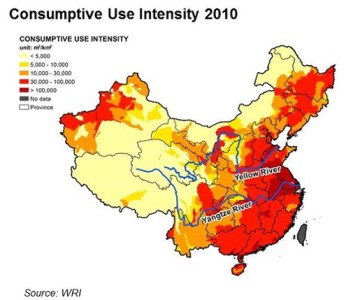
China consumes ten billion barrels of water per day—about 700 times its daily oil consumption. Half century of astronomical exponential economic growth, coupled with robust food security policies that aim at national self-sufficiency, have unfortunately pushed China’s water system (especially North China) beyond a sustainable level. As of 2020, the per capita available water supply around the North China Plain was 253 cubic meters or nearly 50 percent below the UN definition of acute water scarcity. Beijing, Shanghai, Tianjin, and other major cities are at similar or lower levels. Hong Kong has for decades used seawater to flush toilets. Water stressed Egypt for instance has per capita freshwater resources of 570 cubic meters per capita. To make matters worse, a significant portion of China’s water supply is not fit for human consumption.
A 2018 analysis of surface water by China’s Ministry of Ecology and Environment found that although the quality had improved from previous years, 19 percent was still classified as unfit for human consumption and roughly seven percent was unfit for any use at all. The quality of groundwater, which is critical for ensuring water supplies during drought was worse, with approximately 30 percent being deemed unfit for human consumption and 16 percent deemed unfit for any use. Concurrently, farm and industrial chemicals continue to contaminate the country’s groundwater, setting the stage for potentially decades of additional water supply impairments. Data from the UN Food and Agriculture Organization indicate that China uses nearly two and a half times as much fertilizer and four times as much pesticide as the United States does despite having 25 percent less arable land[i]. The over exploitation of aquifers under the Northern China Plain is a core driver of China’s looming water crisis. The most populous portion of China, lives North of the Yangtze River; an area from eastern Sichuan to southern Jilin that is home to more than a billion people, which has seen steady declines in the amount of water in the region’s lakes, rivers, and aquifers since the last decade. As is her want, the CCP (China’s Communist Party) has chosen to conceal the full extent of China’s environmental problems to limit potential public backlash. This lack of transparency suggests that an escalation to acute water distress could be far closer than most outside observers realize; the world must be ready for this hydrographic disaster.
Water scarcity level in China
Water scarcity level in India
Global Water Statistical Data Water covers about 71% of the earth’s surface; 326 million cubic miles of water on the planet; 97% of the earth’s water is found in the oceans (too salty for drinking, growing crops, and most industrial uses except cooling); 320 million cubic miles of water in the oceans. Only 3% of the earth’s water is fresh, of which 2.5% of the earth’s fresh water is unavailable: locked up in glaciers, polar ice caps, atmosphere, and soil, highly polluted, or lies too far under the earth’s surface to be extracted at an affordable cost. About half of the planet’s population (3.6 billion) lives in water-scarce regions. The consequent food and water crisis could be poised to drive up social unrest and massive migration. Such extended droughts also fuel the risk of wildfires.
Water crisis management, especially in North China The irony is that China recognizes the gravity of the crisis but internal politics and fear of public retribution often delays remedial measures. China launched the $60 billion South-to-North Water Transfer Project in 2003 which draws water from tributaries of the River Yangtze to replenish the dry north. To boost rainfall (and sometimes engineer better weather, for example, for Olympics ceremonies and party anniversary events, and now to fight intense heat and drought conditions in summer of 2022), China has also deployed aircraft and rockets to lace clouds with silver iodide or liquid nitrogen, a process known as cloud seeding. It has also relocated heavy industry away from the most water-stressed regions and is investing massively in water management infrastructure, with vice minister of Water Resources Wei Shanzhong estimating in April 2022 that annual investment in water-related projects could hit $100 billion annually. Experts opine that these efforts may be insufficient to forestall a crisis.
Adverse impact on Food Production (Famines precipitated by drought helped topple at least five of China’s 17 dynasties) For the past 20 years, Chinese government policy has offered incentives to farmers to maximize production of corn, rice, and wheat to achieve “self-sufficiency” levels that generally exceed 90 percent. Groundwater extraction played an outsize role in this achievement and transformed the dry North China Plain into the country’s breadbasket. In parts of North China, groundwater levels have declined by a meter per year, causing naturally occurring underground water storage aquifers to collapse, which has triggered land subsidence and compromised the aquifers’ potential for future recharge. Farms on the North China Plain produce approximately 60 percent of China’s wheat, 45 percent of its corn, 35 percent of its cotton, and 64 percent of its peanuts. But to sustain these harvests, farms and cities are pumping water far faster than nature can replenish it. Satellite data suggest that each year between 2003 and 2010, North China lost an amount of groundwater equal to more than twice what Beijing consumes annually. As groundwater levels fall, many farmers are struggling to find new sources. Some are digging larger, deeper wells, often at great cost; but continual overdraws may render water physically inaccessible regardless of pumpers’ willingness to spend on deeper wells and new pumping technology. Drop in North China food production by 33 percent crop loss because of water insufficiency, China would potentially need to compensate by importing approximately 20 percent of the world’s internationally traded corn and 13 percent of its traded wheat. Further, if a drought were to curtail rice yields in southern China or Heilongjiang (in China’s fertile Northeast), that could create even larger market shocks given China’s disproportionate share of rice consumption. All three major staple grains are critical for hundreds of millions of lower-income consumers worldwide, with corn as a staple in Latin America, wheat vital in the Middle East and North Africa, and rice essential across Asia.
Although China has stockpiled the world’s largest grain reserves, the country is not immune to a multiyear yield shortfall. This would likely force China’s food traders, including large state-owned enterprises such as COFCO and Sinograin, into global markets on an emergency basis to secure additional supplies. This in turn could trigger food price spikes in high-income countries, while rendering key food items economically inaccessible to hundreds of millions of people in poorer countries. The impacts of this water-driven food shortage could be far worse than the food-related unrest that swept across lower-and-middle-income countries in 2007 and 2008 and would drive migration and exacerbate political polarization already present both within nations and globally.
Water, the umbilical cord for power generation Despite major investments in renewable energy, nearly 90 percent of China’s electricity supply still requires extensive water resources, particularly hydro, coal, and even nuclear generation, which needs large and steady water supplies for steam condensers and to cool reactor cores and used fuel rods. Managing the cascading effects of a shortfall from any given power source is daunting. If China lost 15 percent of its hydropower production in a year because of low water levels behind dams, a plausible scenario based on real-world experiences in Brazil, it would have to increase electricity output by an amount equal to what Egypt generates in a year. In China’s energy system, only coal-fired plants could potentially boost output by hundreds of terawatt-hours on short notice. Unfortunately, the coal mining and preparation process is often highly water intensive, and if China were compelled to ramp up coal production, it would further strain local groundwater supplies. Seawater can be used for cooling, however, most of China’s coal-fired plants are located inland and rely on rivers, lakes, or groundwater. Analysis by Foreign Affairs magazine of approximately 2,000 utility-scale (300 megawatts or larger capacity) Chinese coal-fired power generation units and their known or likely modes of cooling suggests that about 500 gigawatts of capacity; more than the combined coal power capacity of India and the United States; face elevated risks from a prolonged drought [ii].
Vitally, China’s power shortfalls would directly affect global supply chains, as industrial facilities account for over 65 percent of electricity use in China. To minimize the immediate human impact of broad, uncontrolled blackouts, party officials have shut down industrial facilities to ease the grid load. China is also the world’s largest producer of aluminum, ferro-silicon, lead, manganese, magnesium, zinc, most rare earth metals, and many other specialty metals and materials. Power outages can impact global markets; to illustrate – curtailed magnesium smelter operations in Shaanxi Province, resulted in prices spiking to seven times their level internationally at the beginning of 2022 and European industrial consumers called for government action to ensure supplies. Resultantly, the Chinese and global transition to clean energy will certainly be impaired, once production of rare earth metals and cells reduces due to water and power shortages (polysilicon used for solar cells and the rare earth metals used in wind turbines around the world, and raw materials for cell production for electric vehicle batteries).
Desperate measures for desperate times: Control of water in Tibet, the ‘Third Pole’ The Tibetan Plateau is widely known as the ‘Third Pole’ because its ice fields contain the largest reserve of freshwater outside the polar regions and has accorded China unfettered access to perennial water sources. Asia’s ten great river systems emanate from the Tibetan Plateau and traverse eleven countries, supporting over 2 billion people. The ones of importance to China’s southern and south-eastern neighbours are the Indus (China, India, Pakistan), Brahmaputra (China, India, Bangladesh, Bhutan), Salween (China, Myanmar, Thailand), Mekong (China, Laos, Thailand, Cambodia, Vietnam) and Sutlej (China, India, Pakistan). Over 45,000 glaciers seasonally drain into these rivers. Water alone elevates TAR (Tibet Autonomous Region) to geo-strategic importance to the entire region. For India, Tibet holds the tap to three major rivers, the Indus, Sutlej, and Brahmaputra. China’s increasing activities on all of these rivers in recent past has been a matter of immense concern to India[iii].
Chinese actions on rivers of TAR (Tibet Autonomous Region) specially Yarlung Tsangpo
Source: preventionweb.net
Image: A line map of the Yarlung Tsangpo Great Bend, showing previous Chinese dams constructions (in bold) and the proposed site of the newest 60-gigawatt hydropower project at Metog (Source: South Asia Network on Dams, Rivers and People)
The damming of the River Brahmaputra started during November 2010, with the 7.9 billion RMB 3260-meter Zangmu Hydropower Station 510 MW, which became fully operational on October 13, 2015. China has undertaken a huge project to construct five dams in Shannan Prefecture in the Tibet Autonomous Region (TAR). The precise locations of the project are reportedly in Gyatsa, Jieuxu, Langzhen, Zangmu, and Zhongda in the TAR. The dams are slated to divert the waters of the Brahmaputra River (Yarlung-Tsangpo in Tibet) to China’s water-scare North-western and Northern provinces. China adopted its 14th Five-Year Plan, which included a blueprint amounting to billions of dollars’ worth of projects, including controversial hydropower projects on the Brahmaputra in the TAR. China is embarking upon ambitious “dam-constructing exercises” on all its important rivers. The familiar Three Gorges Project across the Yangtze River is one such project[iv].
From Pune, Gaurav Tingre is a popular social media influencer and car enthusiast who is known to generate quality content revolving around cars, luxury, motivation and positivity. He has attained a dedicated following of thousands of people on his Instagram page (@Gauravtingre). He has also become a famous figure in the car community of India, which wants to look at real individuals who drive national and international luxury and sports cars. He has a brilliant collection of scale Models And he enjoys collecting rare sneakers also.
Gaurav is a partner at Raojee Constructions and Ceramic Pro Pune. And he is the founder member of the Pune Supercar Club and also an active member of the Supercar Community of India.
Pune Supercars Club. This club is independently run by supercar enthusiasts and owners. The club aims to attract supercars from all houses and is dedicated to creating moments for owners that will allow you to enjoy your supercar more regularly and will comprise events and Occasions that can be enjoyed individually and others that the whole family will appreciate. Pune Supercars Club goes on regular Sunday drives to nearby destinations.
On the occasion of the 75th Independence Day of India, Pune Supercars Club organised “Independence Day Drive” in which their meeting point was Balewadi High Street, Pune. There are various supercars on this drive like- Mclaren, Lamborghini, Ferrari, Porsche, Bentley, BMW, Mercedes-Benz, and Jaguar.
They drove down to Conrad, Pune where breakfast was organised. The event was sponsored by Mercedes-Benz Silver Star Pune. They also had a photography contest where hampers were given away to 5 winners.
We use cookies on our website to give you the most relevant experience by remembering your preferences and repeat visits. By clicking “Accept All”, you consent to the use of ALL the cookies. However, you may visit "Cookie Settings" to provide a controlled consent.
This website uses cookies to improve your experience while you navigate through the website. Out of these, the cookies that are categorized as necessary are stored on your browser as they are essential for the working of basic functionalities of the website. We also use third-party cookies that help us analyze and understand how you use this website. These cookies will be stored in your browser only with your consent. You also have the option to opt-out of these cookies. But opting out of some of these cookies may affect your browsing experience.
Functional cookies help to perform certain functionalities like sharing the content of the website on social media platforms, collect feedbacks, and other third-party features.
Performance cookies are used to understand and analyze the key performance indexes of the website which helps in delivering a better user experience for the visitors.
Analytical cookies are used to understand how visitors interact with the website. These cookies help provide information on metrics the number of visitors, bounce rate, traffic source, etc.
Advertisement cookies are used to provide visitors with relevant ads and marketing campaigns. These cookies track visitors across websites and collect information to provide customized ads.
Necessary cookies are absolutely essential for the website to function properly. These cookies ensure basic functionalities and security features of the website, anonymously.
Cookie
Duration
Description
cookielawinfo-checkbox-analytics
11 months
This cookie is set by GDPR Cookie Consent plugin. The cookie is used to store the user consent for the cookies in the category "Analytics".
cookielawinfo-checkbox-functional
11 months
The cookie is set by GDPR cookie consent to record the user consent for the cookies in the category "Functional".
cookielawinfo-checkbox-necessary
11 months
This cookie is set by GDPR Cookie Consent plugin. The cookies is used to store the user consent for the cookies in the category "Necessary".
cookielawinfo-checkbox-others
11 months
This cookie is set by GDPR Cookie Consent plugin. The cookie is used to store the user consent for the cookies in the category "Other.
cookielawinfo-checkbox-performance
11 months
This cookie is set by GDPR Cookie Consent plugin. The cookie is used to store the user consent for the cookies in the category "Performance".
viewed_cookie_policy
11 months
The cookie is set by the GDPR Cookie Consent plugin and is used to store whether or not user has consented to the use of cookies. It does not store any personal data.