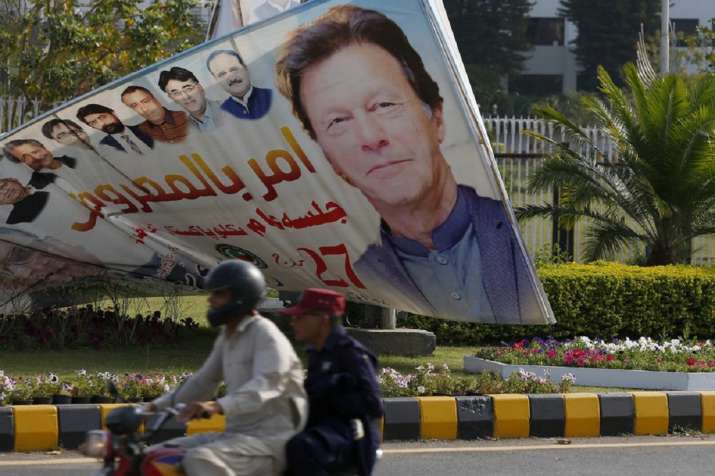
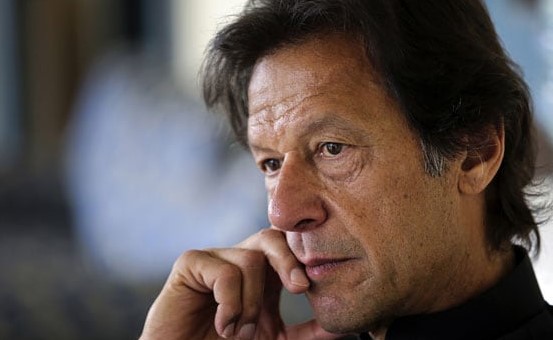
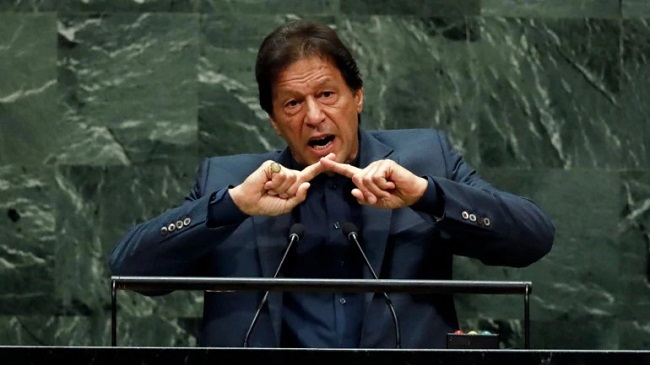
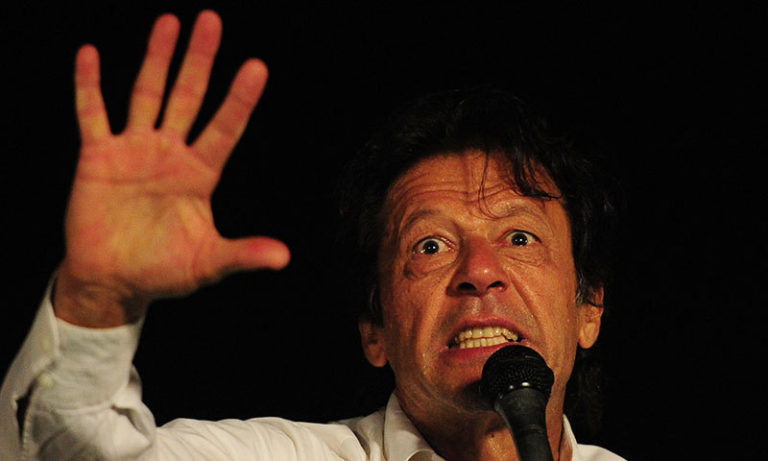
Pakistan President Arif Alvi acting on the advice of Imran Khan dissolved the National Assembly in order to save “selected PM” Imran Khan from certain defeat in the No-Confidence Motion.
The session of the National Assembly was convened under the leadership of Deputy Speaker Qasim Suri. In the beginning of the meeting, Law Minister Fawad Chaudhry termed the resolution as an attempt by a foreign country to change the government in Pakistan. In his address to the National Assembly, Fawad Chaudhry said that the no-confidence motion is presented under Article 95 of the Constitution, but Constitution’s Article 5 mentions that loyalty to the country is the responsibility of every citizen.
Article 5 (1) states that loyalty to the state is the primary duty of every citizen, Art (2) states obedience to the Constitution and the law is an obligation to every citizen, wherever he may be, and everyone who is currently in Pakistan.
“On March 7, one of our ambassadors is [ was ] summoned to an official meeting and he attended the meeting,” said Fawad Chaudhry. The meeting also had ambassadors from other countries, our ambassador was informed that the motion would not move.
He said that no confidence was presented on 8 March and that “our Ambassador told that the relationship of this country with Pakistan depends on the success of this movement. Immediately after Fawad Chaudhry’s objection, the Deputy Speaker addressed the Members of the National Assembly and said that the opposition had moved the No Confidence Motion against the Prime Minister of Pakistan on March 8, 2022.
The no-confidence motion must be in accordance with the law and rules. He said that no foreign power has the right to call down Pakistan’s elected government under conspiracy. “The points raised by the Law Minister are correct, therefore I rule that the no-confidence motion is against the constitution, national sovereignty and independence and I rule that it is against the rules and regulations.” He further said that “in exercise of the powers delegated under Article 3 of Article 54 of the Constitution of the Islamic Republic of Pakistan, I dismiss the meeting convened on Friday, 25 March 2022”. At the same time, Qasim Suri adjourned the lower house for an indefinite period. Earlier, Maryam Aurangzeb had presented figures in a tweet of 174 MLAs who were supporting the opposition in the no-confidence motion.
Pakistan’s National Assembly will vote for no confidence motion against Prime Minister Imran Khan on 3 April 2022. It will require 172 united opposition votes to form the government. The opposition votes include more than 20 members of Imran Khan’s party, including government allies MQM, BAP, Q-League and other independent members who will vote against Imran Khan.
Sources said that Imran Khan has sent provocative messages to his party workers to prevent his party’s assembly members from reaching the National Assembly under any circumstance. To which the Pakistan Army Chief General Qamar Javed sent a message to Imran Khan that inciting people would be a threat to the security situation in the country. The Attorney General has issued a statement that the motion for no confidence in the National Assembly will be peacefully conducted during the voting and there will be no disturbance.
Imran Khan in an interview to Ary TV channel said that the establishment gave him three offers from the opposition, which were: Face distrust motion, resign or hold elections. “Early elections are the best way and I will fight the no-confidence motion till the last minute,” Imran Khan said, referring to the options before him. He said he would never resign. Ironically, Imran Khan’s government in Punjab has also come to an end. Punjab Governor Chaudhry Muhammad Sarwar accepted the resignation of Chief Minister Usman Bazdar. The Punjab cabinet has also been dissolved after the resignation of the Punjab Chief Minister was accepted. The Governor of Punjab has convened a meeting on 2nd April to elect the new Leader of the House.
It may be recalled that a few days ago, Prime Minister Imran Khan had named the Speaker Punjab Assembly Pervez Elahi as chief minister in place of Chief Minister Usman Bazdar. In return, the Muslim League-Q announced its support to the government in the no-confidence motion. On the other hand, reliable sources say that President Pakistan Arif Alvi has sought opinion from legal experts on his resignation. It is believed that Arif Alvi will resign on 3rd April after Imran Khan’s removal in the no-confidence motion voting.
It should be noted that after the removal of Imran Khan, the joint front of opposition parties has planned to remove the President, then the Chairman of the Senate, and then the Speaker and Deputy Speaker of the National Assembly from their posts and bring their own people.
Imran Khan, in response to a question from a citizen, said Pakistan needs a strong army. “We should not do anything that harms the army,” he said. He rejected the impression that there were problems between him and the Pakistan Army. He said that he respects the decision of the army to remain neutral, we are with them for what maintains their reputation. Imran Khan once again described the no-confidence motion against him as a joint conspiracy by the US and the opposition.
Replying to a question by a citizen, he said that it would be a great crime to remain silent on it. Khan had said that he would win the no-confidence vote on Sunday and he had more than one plan. Imran Khan when asked that the opposition had been saying since the beginning that he is not running the economy well, that is why they had brought the no confidence motion. Imran Khan said that experts should sit down and see what we did in three and a half years and what these parties had done during their tenure.
Imran Khan pointed to the figures of how much inflation has been during the People’s Party period between 2008 and 2013 and then during his tenure. He said that at present, inflation is high globally, oil prices are skyrocketing, making electricity and other goods more expensive. The Prime Minister said that exports have increased historically since PTI government took charge while huge taxes have been collected because people are confident that Imran Khan will tax the people. He said that during the Muslim League (N) era, inflation was less than the PTI era, but it should also be seen that oil prices were less than three times that what they are today.
Pakistani Prime Minister Imran Khan’s recent claim of having irrefutable written proof that “Attempts are being made through foreign money to change the government in Pakistan,” is indeed worrisome. However, his admission that “We have been aware of this conspiracy for months,” is even more disquieting as being an issue of grave national importance with potentially perilous consequences, this issue merited immediate action. So, if what Khan is saying happens to be true, then he needs to explain why he and his government did nothing for “months” to address this serious threat to Pakistan.
According to Pakistan daily ‘The Express Tribune,’ Foreign
Minister Shah Mehmood Qureshi has stated that the “threatening
letter” [referred to by Khan in his speech] was also shared with the
military leadership. If this again is true, then army chief General Qamar Javed
Bajwa also has a lot to explain. After all, hasn’t he been saying all along that
Pakistan is a victim of ‘hybrid warfare’ and hasn’t he also has assured
his countrymen that his army will thwart any such design the moment it is
detected. Hence, the otherwise hyperactive Rawalpindi’s inaction in dealing
with what Khan claims to be a “foreign-funded plot” is rather
intriguing.
Rawalpindi has declared its neutrality on the political imbroglio that has led to the opposition moving a no-confidence motion against Khan. So, if the no-confidence motion exercise is genuinely a “foreign-funded plot” to remove the government, and the military is privy to this grand conspiracy designed to harm Pakistan [as claimed by Foreign Minister Qureshi], then its refusal to intervene is tantamount to abetment and hence unpardonable. Additionally, it’s no secret that Khan owes his prime ministership to Pakistan Army, and hence, it’s extremely unlikely that Rawalpindi would allow him to be removed thus- unless he has fallen out of favour with Gen Bajwa, which is a distinct possibility, considering his snide remarks against the army chief.
Yet, all said and done, there’s something about this “foreign funded
plot” that doesn’t gel. The cricketer turned prime minister claims that his
refusal to allow Pakistan’s foreign policy to be influenced from abroad by
foreign powers is the reason behind the sinister plot to unseat his government
through a no-confidence motion. Khan may have assured his countrymen that come
what may, he would ensure that Pakistan continues to follow an independent
foreign policy. However, despite this brave assertion, the question that arises
is- does Pakistan currently have an independent foreign policy?
One may ask, why this doubt? The answer is that it is because just three
months ago, while speaking about Islamabad’s plans concerning Afghanistan,
Pakistan’s NSA Moeed Yusuf had made an honest admission to the contrary. ‘Geo
News’ had quoted Yusuf explaining Pakistan’s situation by mentioning how
monetary loans from international financial institutions compromised “economic
sovereignty … [and] …because of this, it affects a country’s foreign policy,
and when foreign policy is affected, you cannot run the affairs, as they would
be in an ideal situation.” So, what independent foreign policy is Khan
talking about?
Even the media in Pakistan isn’t quite convinced by the prime minister’s “foreign funded plot” claim and his contention that “Attempts are being made through foreign money to change the government in Pakistan. Our people are being used. Mostly inadvertently, but some people are using money against us. We know from what places attempts are being to pressure us. We have been threatened in writing but we will not compromise on national interest.” Resultantly, despite his contention that “The letter I have is proof and I want to dare anyone who is doubting this letter…,” the media isn’t convinced.
To put things in correct perspective, “The Express Tribune’ has
sought Federal Information Minister Fawad Chaudhry’s response to the following
three questions:
1. When did the government receive the threat, when the threat was shared with the military leadership and what was their response? 2. Why PM did not convene the meeting of the National Security Committee on the issue? 3. What action [the] government has taken after the threatening letter, has any demarche been issued to the ambassador of the country which wrote that letter, or where did the threat emanate from?
Expectedly, no reply has been received, and, in all probability, Fawad
will quote the sensitive nature of the issue to avoid answering these very
basic, but extremely pertinent questions.
Khan may be attempting to project himself as a patriot who is prepared
to be martyred for standing up to preserve the sovereignty of his motherland.
However, in doing so he is portraying his political opponents as quislings
working for some foreign power, who for the sake of money and power are
betraying the country, which isn’t civil or in good taste. The prime minister
has also presented the army as a mute spectator to the undoing of Pakistan,
something which Rawalpindi will certainly take serious umbrage to.
Replying to the prime minister’s “foreign-funded plot” in
presence of PML-N Shahbaz Sharif and PPP co-chairman Asif Ali Zardari, PDM chief
Maulana Fazlur Rehman, has adroitly put the ball in the PTI chief’s court by
saying, “Khan Sahab, I will support you, if foreign intervention to topple
the incumbent government was proved.” With the opposition jointly daring
Khan to prove his allegations, what remains to be seen is whether the former
cricket captain who brought the World Cup to Pakistan can take a ‘hattrick’ or
will end up getting out by ‘hit wicket’?
Book Review: The Royal India Navy Mutiny. Pramod Kapoor breathes life into a partly forgotten event of 1946.
In an article dated February 21, 1946, New York Times reporter George E Jones said the following: “The mutiny of sailors of the Royal Indian Navy is regarded here as potentially the most disturbing in the series of riots and demonstrations among Indians, starting last November with outbreaks in Calcutta.”
“Since then, there have been other large scale civilian demonstrations, riots in Bombay and Calcutta—mostly centering on the trials of “Indian National Army” men—and hunger strikes among Royal Indian Air Force Personnel for better food and living conditions. The present clashes in Bombay and Karachi however, are the first time that Indian armed forces have actually mutinied in this violent fashion.”
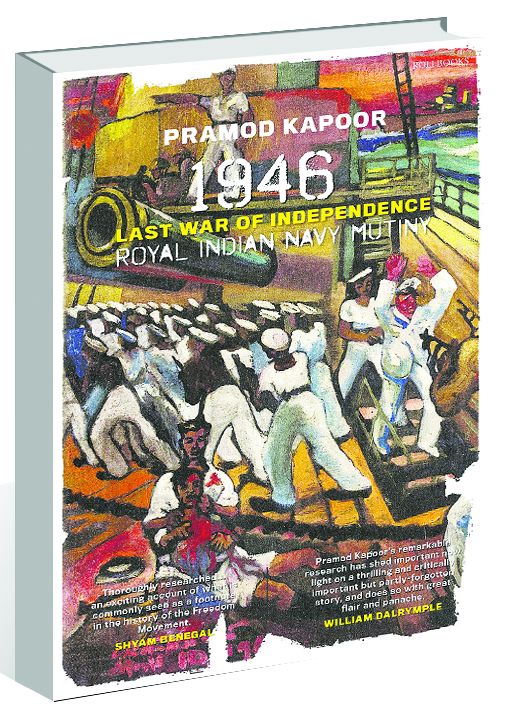
The British empire, it is now on records, was petrified and politicians in London felt the 1946 uprising could assume the proportion of the 1857 Sepoy Mutiny. But good sense prevailed and Sardar Vallabbhai Patel —also called the Iron Man—pledged his equity and negotiated peace. Publisher and author Pramod Kapoor’s brilliantly researched tome, 1946: Royal Indian Navy Mutiny (Last War of Independence)highlights this crucial piece of information that – I have a feeling – got lost in the pages of history books in India.
So how serious was the case? Clement Attlee, Britain’s post-war Prime Minister who succeeded Winston Churchill, got into the act immediately. His telegrams to India, claims the New York Times, did not get any immediate answers about the uprising but Attlee was sure that the support of Indian military—army, air force and naval personnel—could no longer be taken for granted. The book helps the readers understand another crucial fact: That in World War-I and World War-II, Indian troops had been gun fodder for the imperial power but now—around 1945-46—things were changing. So the best option for Britain was to opt for discretion and leave India, long considered the “Crown Jewel” of the Empire.
The 1946 uprising was serious. India was on fire because the British rulers were conducting trials of soldiers of the Indian National Army (INA) inside the expansive Red Fort in the Indian Capital. And then, the Naval mutiny was too hot to handle. The two incidents triggered the sending of the Cabinet Mission and the subsequent decision to grant freedom. Interestingly, two decades after India gained freedom, John Freeman, the then British High Commissioner in New Delhi, told a gathering that the 1946 mutiny had petrified London that 1857 may be repeated.
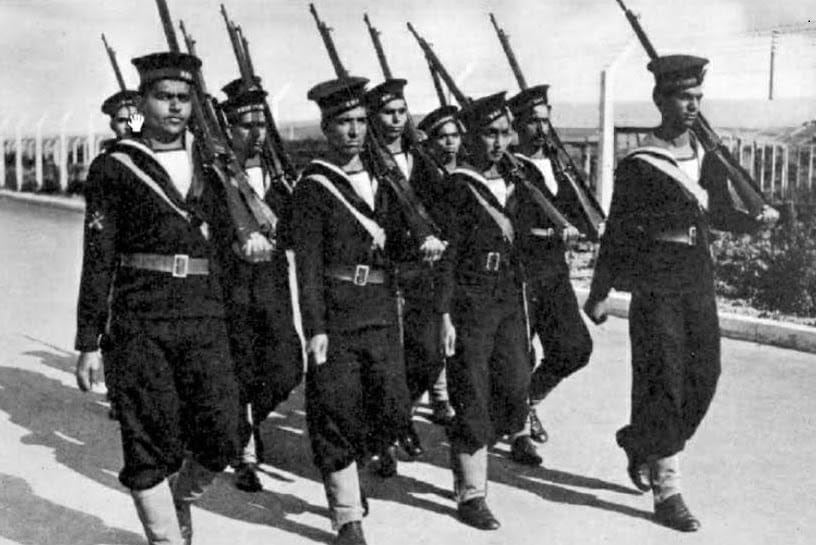
Indian sailors at the Royal Indian Navy. (Photo: News Intervention)
The Indian government saluted the 1946 mutineers by mentioning them in the Indian Navy tableaux in this year’s parade. Political cognoscenti called it a rarest of rare gesture. Incidentally, never before have the armed forces saluted the memory of those who rose up in arms against the established order.
Let’s get back to the book of these unsung heroes. Poor service conditions, racial discrimination and anger at the court martial of rebel soldiers of the Indian Nation Army (INA) were the primary reasons for the mutiny.
The first spark happened on February 18, 1946. It was a Monday, and the time was 0800 hours. A group of 1600 sailors of the RIN battleship HMIS “Talwar”, docked at Colaba in Bombay, went on strike. They had been complaining about food, which was of low quality. Only poorest quality rice, garnished with stone chips and mud pieces, was supplied. The rating’s uniform was made of cheap and coarse material. The ratings were tired of this routine insult.
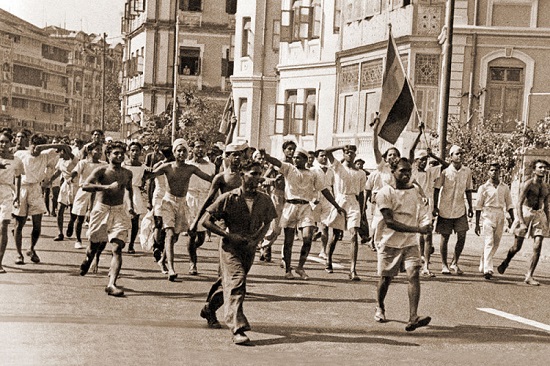
The sailors walked out of the mess hall because of inadequate food and started raising slogans: “No food, no work.” The next day another 20,000 ratings joined the strike, and over the next couple of days, rioting broke out. The Communist Party of India, which had a sizable following among the working class in Bombay, immediately extended support. Congress and Muslim League were critical. The mutineers did not discriminate, they were seen by many hoisting the tricolour of the Congress, green streamer of the Muslim League and the red flag of CPI on as many as 78 ships. The sailors urged residents of Bombay to rise in support of their revolt—the greatest in naval history—spreading to 22 units all along the Indian coastline, from Karachi to Calcutta. The strike spread like wildlife. Several processions were taken out in Bombay, Karachi, Calcutta and other places in the subsequent days. India’s harbours looked like war zones even as Indian ratings and British soldiers clashed. I read in another report how the ships’ sirens were blaring and strikers were using loudspeakers to call ordinary citizens and Indian troops to throw the British back into the sea.
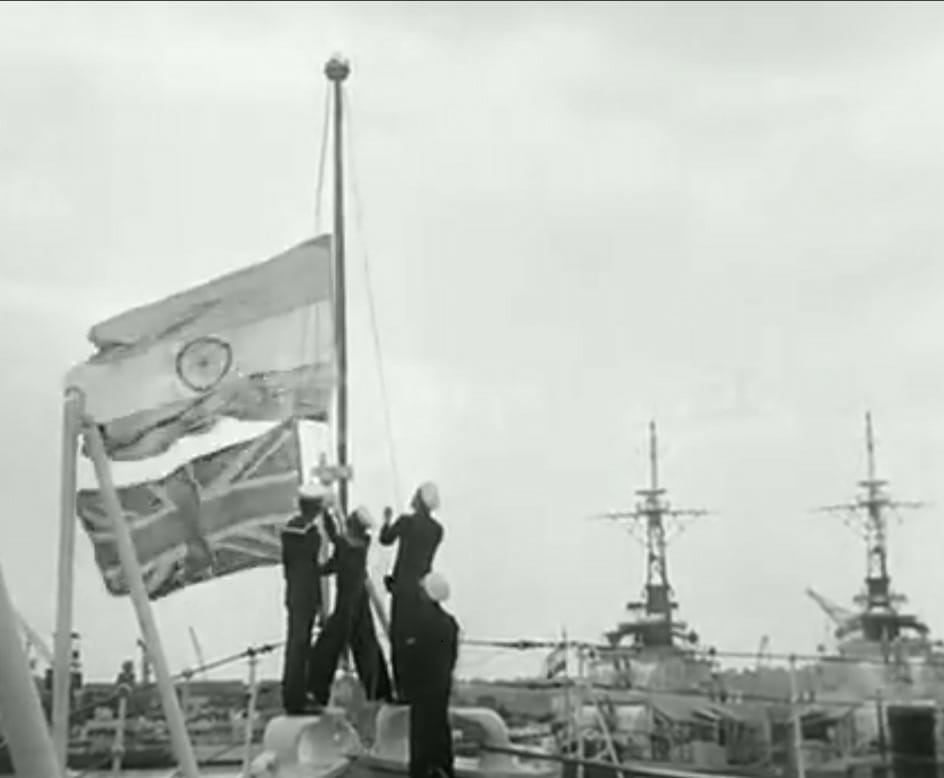
Indian soldiers take down the British Union Jack and hoist Indian Tricolour during the RIN Revolt in 1946. (Photo: News Intervention)
Some 400 Indians died of bullet wounds and 1500 suffered injuries after soldiers of the British Military and police (in cities where demonstrations took place) fired indiscriminately on the demonstrators. In a quick move, the sailors formed the Indian National Navy, on lines of Subhas Chandra Bose’s INA and saluted the British officers with their left hand as a mark of their rebellion.
Encouraged and pushed by Patel, the sailors surrendered on February 24, 1946. So what did this mutiny achieve? Kapoor says it accelerated the transfer of power. Let’s not forget that this mutiny caused public disagreements between Mahatma Gandhi and Aruna Asaf Ali, who secretly advised the naval ratings during the mutiny. Serious rift emerged between Jawaharlal Nehru and Sardar Patel. Kapoor says the naval mutiny of 1946 was among the hardest blows the British received in their 200 year rule in India.
And there were other fears for the British. Britain realized that without the support of the navy, approximately 100,000 British troops, administrators and civilians and their families were in no position to make it to Britain safely. Many could have been slaughtered, the British quit India the following year. I remember some notes from Mutiny of the Innocents, written by BC Dutta, a telegraphist who joined the RIN in the Communication Branch in 1941. Writes Dutt: “We found ourselves working alongside white servicemen from the army. In the Indian Army, British servicemen received preferential treatment. Whether at base or in a combat zone, they had better accommodation, better amenities. They were paid five to ten times more for the same jobs that Indian servicemen did. They travelled more comfortably. They could, if they wished, use Indian servicemen’s canteens, mess rooms and baths, but the Indians had no access to theirs. The British servicemen were not required to salute the viceroy’s commissioned officers. The discrimination was crude and was calculated to make the Indians feel inferior to the British.”
Writes Kapoor: “Indian ratings got a taste of what life would be like in the Royal Indian Navy from the day they joined. As a rating wrote in a letter home: Officers do not act according to printed regulations but make their own rules. Now it was not just British officers. Even Indian officers treated them the same way. Kapoor says the indiscriminate use of abusive and foul language was seen as a symbol of authority. “Bastards, baboons or swines were common phrases heard in the Navy along with bloody, behen chod, blackies and black bastards.”
Beautifully, Kapoor scripts the story of the mutiny, explaining the central characters and who started the first planning. I learnt the first planning for the mutiny took place in a flat on Marine Drive, overlooking the Arabian Sea. And the two who planned it were Pran and Kusum Nair, the last named a journalist very active in the underground freedom movement.
Now, unlike the First War of Independence in 1857, when Indian mercenaries bailed out the British by mercilessly mowing down the revolutionaries, this time Indian soldiers were not favourably disposed towards their colonial masters. For instance in Karachi, Gurkha troops refused to fire on the sailors.
The book explains how the violence started. On February 21 the British deployed their shock troops who opened fire on the sailors as they came out of their barracks in Bombay. This turned a peaceful uprising into an armed rebellion. Indian ratings and British troops fought pitched battles throughout the day in Bombay and Karachi.
The atmosphere was further poisoned by Admiral Godfrey’s order to completely destroy the Indian Navy. The British surrounded the rebel fleets with few loyal vessels. A reinforcement of battleships from Trincomalee in Sri Lanka reached the Gateway of India in Bombay. British bombers and fighter aircraft of the RIAF carried out threatening sorties over the rebellious fleet. In Karachi, the British sent in the murderous Black Watch, an infantry battalion of the Royal Regiment of Scotland.
There were other issues. Former PM Morarji Desai, who took over as Home Minister of Bombay a few months after the mutiny, displayed a total cavalier attitude towards freedom fighters. He said the sailors had no right to rebel. Desai even said INA was not the harbinger of independence and it was Gandhi who brought independence for the country.
I am told the book’s cover illustration is a painting by a Chittagong-born artist, Chittaprosad Bhattacharya, who was witness to the events in Bombay in 1946 and was present in Kamgar Maidan when residents of Bombay, especially the working class, rallied in support of the mutiny on 22 February 1946.
Unquestionably, Kapoor’s work is the most lively account of the last war of independence. Probably now the naval mutiny will no longer be consigned to a footnote in most histories. Now, it will surely find its place of pride in the history of the freedom struggle.
Time for Kapoor to pen a fascinating tome on the 1971 liberation war that gave birth to Bangladesh. I am sure he will do justice to another slice of history that remains buried in libraries because of lack of research.
Year 2013. Mehta couple, both senior healthcare professionals with two teenaged kids, induced into booking an apartment in a Golf project in Noida through incessant advertisements, broker calls & allurements. Year 2018. The doctors sought my advice. I advised them to seek a refund of their money from the builder as their home would never be made. Year 2022. Their dream house hasn’t even seen the start of construction.
Let me also highlight four incidents from March 2022 before I share reasons of my pessimism and lack of confidence in several NCR builders.
Delhi Police EoW (Economic Offences Wing) filed an FIR on another 30 builders who had scammed consumers in the name of land pooling.
Haryana Govt. orders multiple probes about structural safety and damages in a residential project on Dwarka expressway, Gurugram.
CREDAI issued a press release about their intent to ‘stop construction activity’ owing to high input cost of raw materials.
Courts monitoring real estate development of builders who’re in jail.
There is one overarching reason for most of the above issues – The builder wasn’t selling a ‘real’ estate, he collected money against a financial product.
Let’s get into the respective roles played by the stakeholders.
Inexperienced management
There were no entry barriers or regulations forbidding people from suspicious and susceptible intent and ability from becoming builders. Many planned real estate investments as some kind of ‘Chit-fund’ and sold it against future gains. Let’s compare three sectors which clock more than $100 billion turnover per annum. Real estate, automobiles, consumer products.
Nowhere is an investment solicited from end users before the product is conceived. For instance, a car is not promised after five years while consumer keeps funding the development in parts. Ownership is mistaken for management.
2. Longer the delay, more the buyer pays
Truth be told. No manufacturer would sustainably produce if the cost is higher than the selling price. Let’s do a simple mathematical calculation of the Mehta’s case. (Indicative only)
Cost of Land (per sq.ft) Rs. 800 Cost of approvals / OOP (out-of-pocket expense) Rs. 300 Cost of SAD expenses Rs. 500 (sales, administration & distribution) Cost of construction Rs.2500 TOTAL COST Rs.4100 per sq.ft
PRICE OFFER TO MEHTA Rs.2850 + 350 PLC (premium location charges)/ Other extras
The above illustration does not take into account the cost of delays and opportunity. Since more than eight years have elapsed, the said builder may not even start the construction unless he is able to sell the remaining inventory @ Rs. 7500 per sq. ft for averaging the profits.
Cost of inefficiency and delay results in debt. High cost of money is passed on to the customer.
3. Gullible buyers
Do the same individuals pay for a car, in advance, without even assessing whether the features are value for money? I know there could be a counter argument about appreciating and depreciating assets; but the asset would appreciate only if you were in physical possession of it.
Retail investors cannot absolve themselves of the blame after a high-risk capital investment without formal due diligence. They played into the hands of builders & brokers with nefarious intentions. Blaming the government OR knocking the doors of justice cannot be a perennial solution to bad investment decisions.
4. Misrepresentation & accountability by other stakeholders
Be it online aggregators or broker underwriters, none mentioned the ‘completion commitment’ in their advertisements. Their responsibility ended after they collected approx. 30% sales value.
Other service providers and vendors, especially those without professional credibility, don’t necessarily bite the hand that feeds them.
One repeat victim is the NRI community who keeps pouring dollars into Indian real estate through the overseas operation of brokers and online mediums. In most cases, due diligence is more hearsay than documentation.
Lenders and bankers haven’t distinguished themselves by lending to projects based on inflated profitability numbers. Their investors as well as retail borrowers bear the brunt of loss of delayed execution.
It doesn’t help that the approving bodies have no periodic check of delivery or quality. Most just seek completion of paperwork before issuance of Completion Certificate (CC) & Occupancy Certificate (OC); no physical inspection is undertaken. Corrupted practices perfected over time don’t protect consumer investments. Builders often complain about bureaucratic delays impacting time, effort and cost. Quite rightly so.
Real estate industry needs the mentality of a manufacturer, where products are designed with the consumer in mind, manufactured on a timebound method and sold to customers on a fair market value basis. Builders became ‘Developer’. Nomenclature changed, processes didn’t.
Allow me to reassert that projects which are delayed beyond reasonable time are unlikely to be delivered with the promised quality OR features; unless manufacturer and customer mutually agree to protect each other’s interest. Legal intervention is bound to delay Justice. In many cases, denied.
The predictable knee-jerk reactions reminds me of the adage ~ It takes a disaster for the political will to act.
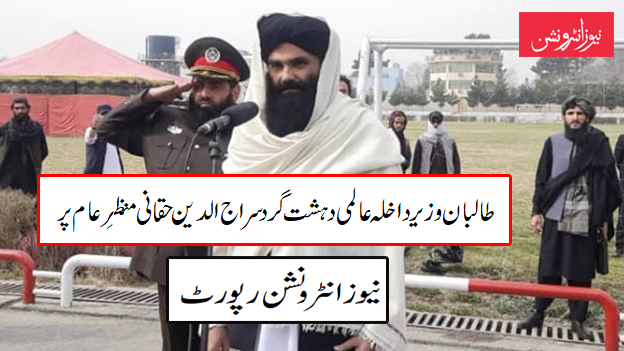
Sirajuddin Haqqani, the Taliban’s interior Minister, head of the Haqqani Network and a declared terrorist surfaced under media glare for the first time in Afghanistan. The United States has listed Sirajuddin Haqqani as one of the most wanted terrorists in the world. Sirajuddin Haqqani did not come out in the open even after Taliban took power. Haqqani is accused of being responsible for several terrorist attacks.
However, recently Sirajuddin Haqqani attended a passing out parade of the new Afghan police officers and addressed the ceremony. “I have come here for your trust and consolation,” said Haqqani. His faded photograph has been listed on America’s most wanted list. At this event of Afghan police Haqqani was clearly visible for the very first time. Diplomatic representatives of several countries, including the Pakistani ambassador, were present at the event.
Sirajuddin Haqqani took over the leadership of his group in 2018 after the death of his father. He is accused of attacking the Serena Hotel in Kabul in 2008, killing at least six people. He is also accused of plotting to assassinate former Afghan President Hamid Karzai. A statement from the US Rewards for Justice Program said he had close ties with the al-Qaeda and had been designated a global terrorist. He was repeatedly targeted by US drones in Afghanistan and Pakistan. But he managed to escape. Sirajuddin Haqqani and his network is not only a product of the Pakistani intelligence agency ISI but has also been used by the Pakistani military and ISI as a proxy in the region, including Afghanistan. Prior to the Taliban’s takeover of Afghanistan, sources said that Sirajuddin was under high security umbrella in Pakistan to protect him from NATO and the United States.
Talks were also held between Pakistan and Tehreek-e-Taliban Pakistan (TTP) in Khost province of Afghanistan under the mediation of Taliban Interior Minister Sirajuddin Haqqani. The future of TTP has become a major issue in Islamabad since the Taliban took power in Afghanistan. The Tehreek-e-Taliban Pakistan (TTP) has not yet commented on the matter, but according to Pakistani Taliban sources, contacts were made between the Pakistani government and Taliban in March.
According to the Pakistan
Institute for Peace Studies, the Tehreek-e-Taliban Pakistan (TTP) carried out
95 attacks in the country last year, killing at least 140 people, and 44 more
in the first six months of this year.
Sirajuddin Haqqani is the Taliban’s interior minister and commander of the Haqqani Network, which is headquartered in the tribal areas of eastern Afghanistan and Pakistan and is on the US’ “most wanted list”. Sirajuddin Haqqani is on a UN blacklist of terrorists, and the US State Department has offered a reward of up to US$ 500,000 for information leading to his capture, and 10 million dollars reward.
Prior to the Taliban’s return to
Kabul, Haqqani was the most senior of the three deputies of Taliban leader
Haibatullah Akhundzada. The media appearance of Haqqani also shows that since
taking power on 15 August, the Taliban have become more confident about their
grip on the country.
The Haqqani Network was founded by Jalaluddin Haqqani in the 1970s, which was supported by the CIA during the Mujahideen’s war against the Soviet occupation of Afghanistan, which was strategically operated by the ISI.
The FBI’s Rewards for Justice
program says it maintains a “close relationship” with al Qaeda, and
is a “specially designated global terrorist”. He has reportedly been
the target of several US drone strikes in the mountains between Afghanistan and
Pakistan.
The ISI is said to have played a key role in making the Haqqani network stronger and more effective, and the Pakistani intelligence agency has a hand in making Sirajuddin Haqqani Interior Minister so that it can maintain its control in Afghanistan. It should be noted that this is the first time that the Afghan government has released photos of the Interior Minister Sirajuddin Haqqani.
Despite the Afghan Taliban’s deal with the United States, links between the Taliban and the terrorist organization al-Qaeda, particularly the Haqqani network, remain intact.
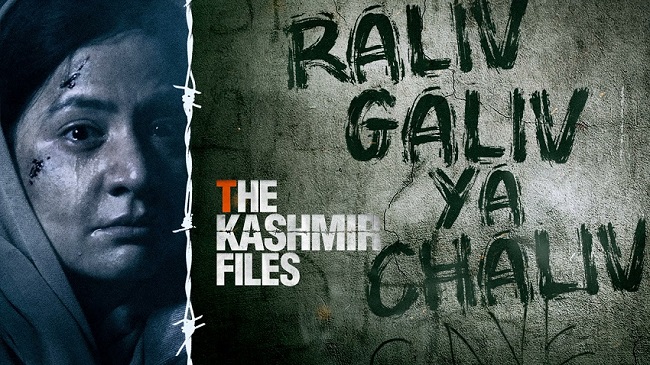
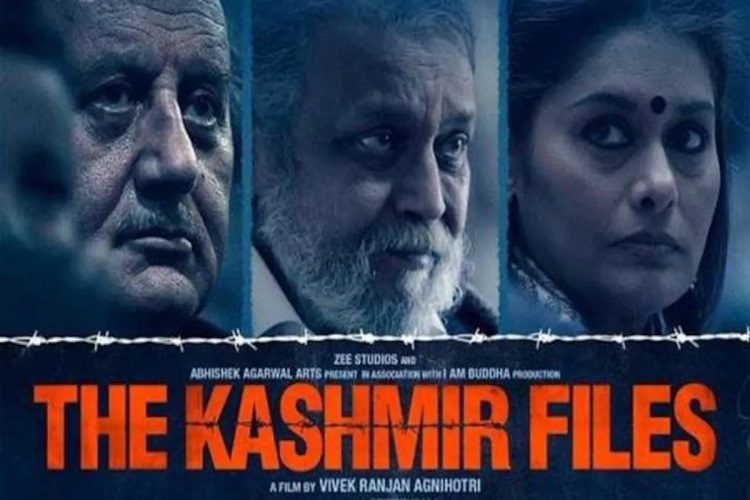
The detractors of The Kashmir Files have raised several objections. What are these complaints? Are these valid and to what extent? This should be a lively debate and we begin with it here.
The much talked about film The Kashmir Files has received unusual media hype. A large number of people have seen it and many more in the country will watch it in due course of time. It has some poignant scenes revealing some tragic events of the rise of the “theo-fascist” violent movement in Kashmir. The armed uprising was conceived, planned and executed by Pakistan’s intelligence agency.
Past failures in Pakistan’s Kashmir misadventures had taught the planners in that country that the success of their nefarious designs could be achieved only when the local youth of Kashmir were prepared to take up the gun against the Indian presence in Kashmir. But before taking up the gun, the Kashmir Valley Muslim youth had to be brainwashed. The disinformation campaign was an important component of their Kashmir mission.
In the brainwashing process, extreme hatred against India and the Hindus (Pandits) was created in the mind of the volunteers. They were told that they would be proceeding to fight a jihad against the kafirs meaning the Hindus who were idol worshippers and polytheists and hence kafirs as outlined in the holy book. As such this was a war of the Muslims against the al-kuffar meaning the kafirs. The Kashmiri Muslim youth who managed to arrive at the training camps of terrorism set up by the Pakistan Army was given the task of decimating the kafirs in the valley, fighting and throwing out the Indian armed forces through a guerrilla war and finally integrating the state of Jammu and Kashmir into the Islamic Caliphate.
A still from the movie The Kashmir Files. The box office collections have crossed Rs 170 crore and the film has been declared tax free by several states in India.
In terms of logic, the pro-Jihadi forces in Kashmir received support from the Pakistan intelligence agency in a jihad against shirk meaning plurality and infidelity. To cover up the real intentions it was given exciting names like freedom struggle, fight for self-rule or azaadi, etc. Entire Kashmir Valley, the urban as well as rural Kashmir got involved in the uprising and its impact.
What are the objections of the detractors of the film The Kashmir Files? Are these valid and to what extent? This should be a lively debate and we begin with it here.
Argument 1: One-sided. The objection is that the film reflects the pain and suffering of only one community, viz., Kashmiri Pandits whereas the Muslims have been victimized.
Well, the Kashmir Valley Muslims, especially, the youth, responded enthusiastically to the call of the Pakistani “theo-fascist handlers” to fight the jihad against the infidels. They were provided arms, ammunition, logistic support and other facilities by Pakistan. With that jihad was started in the Indian part of Kashmir. The might of the state confronted the jihadis. In the process, the Pandits had to be killed as per the tenets of the Islamic faith, but some Muslims also got killed. In the jihad that was unleashed the jihadis said that those who supported and favoured the Indian kafirs were also liable to be butchered according to the Quranic injunctions. The Pandits were killed because they were the kuffar (infidels) and the Muslims were killed because they were the informers (mukhbir) of the infidels meaning Indians.
Argument 2 The rigged election of 1986 is the root cause of armed insurgency
This is the view of many observers that the way MUF (Muslim United Front) was roughly treated became the cause for dissidents, particularly the JeI (Jamaat-e-Islami) to opt for an armed insurgency. Those who rigged were the activists of NC (National Conference) and those who were given a rough treatment were the proxies of JeI (Jamaat-e-Islami). Both were Kashmiris and both were Muslims. Granted that the election of 1986 was rigged and the Jihad movement was initiated, but then why were the Kashmiri Pandits made a victim? Why was the Pradesh BJP chief Tika Lal Taploo gunned down outside his house on 14 September? He was not a member of either the NC (National Conference) or the MUF (Muslim United Front). We can safely say that the election of 1986 was just a cover and the plan was to decimate the Hindus of the valley.
Argument 3 Kashmir had no communal violence while India-Pakistan was burning in partition
Until 26 October 1947,
J&K was under the control of Maharaja Hari Singh. State forces were running
the law and order. Violence erupted when Muslim Conference chairman Sardar Ibrahim
Khan, after returning from Srinagar in October 1947 declared the independence
of Azad Kashmir state with headquarter in Muzaffarabad. The attack of the
tribesmen, the proxies of Pakistan in 1947 in Kashmir dashed to the ground the
myth of Sheikh Abdullah’s secularism. (To understand the role of Theo-fascist
forces and Kashmir Muslim society in the tribal attack of 1947 read Diwanon par kya guzri (Urdu) by comrade Saeed
As’ad of PoK published in Lahore, 1998).
Argument 4 Terrorism had struck Punjab and JKLF rose to ask freedom (azaadi)
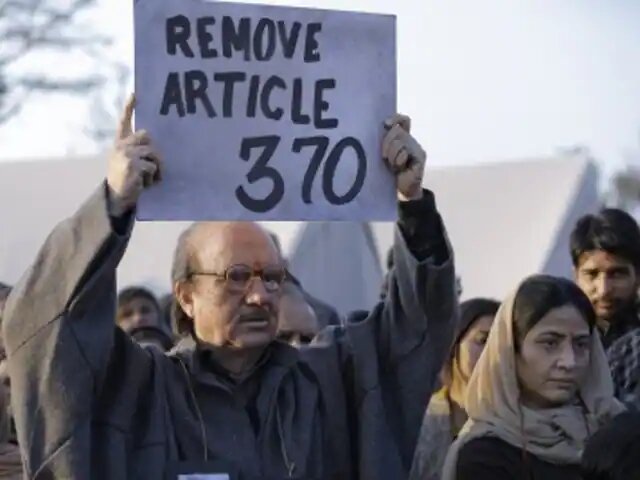
The Indian Left contends that Kashmir had an impact on the Khalistani movement. JKLF was asking azaadi. They mean to say it was not sedition. OK, agreed it was a struggle for freedom and hence not sedition or a crime which India said it was. First, “freedom” from what and from whom? Second, does national freedom mean targeting a regional minuscule religious minority community because it is co-religionist with the majority community of the Indian Union, and targeting them because the regional minority takes shelter behind Article 370? Were not the people of the valley enjoying all those rights which the secular-democratic Indian Constitution provided to all the citizens of India? Only those rights or privileges were not allowed which Article 370 did not allow. Thus, azaadi slogan, so vociferously raised by official and non official circles, meant secession from India. That would not be allowed. Thirdly, because the seekers of this azaadi targeted the religious minority, the world community said it was a separatist movement based on religion and not a freedom movement.
Argument 5 Many senior Muslim leaders were also gunned down and we can also take the names. Prominent among them were the octogenarian Maulana Masudi, Abdul Ghani Lon, Mirwaiz Muhammad Farooq and so many others, including some females.
The planners of the Kashmir armed insurgency had taken all aspects of sponsored insurgency into account and laid down the guidelines for dealing with each situation. (For insightful details on the subject read Unveiling of the Truth by Hashim Qureshi). The Kashmir Pandits were killed to wash away all traces of non-Muslim culture in Kashmir and make the land acceptable to the propagators of the Islamic Caliphate. Among the Muslims, those had to be killed who spoke either of rationality or Kashmir’s humanist tradition. Those who openly opposed them also fell to their guns. Masudi was killed because he had separated from Sheikh Abdullah and moved to the camp of Janata Dal of V.P. Singh, a pro-Indian party. Ghani Lon was gunned down because he had opposed the ISI-DG and told him in Dubai to stop dictating terms to the Kashmiris. Mirwaiz Farooq was killed because he had not liked to politicise Islam and did not want the so called freedom fighters to raise pro-Pak slogans. He had said that Kashmiris had a strong case of self-determination before the international community and the slogans they were raising would harm the cause.
The curious and rather
puzzling thing is that the son of Mirwaiz Muhammad Farooq taking no cognizance
of who were the killers of his father jumped on their bandwagon and felt proud
to be the Chairman of the Hurriyat Conference. Similarly, one of the two sons
of Abdul Ghani Lon has also joined the separatists ignoring who were the
murderers of his father. How is the Indian Left going to rationalize the “theo-fascist
movement” in Kashmir as a genuine freedom struggle?
It has to be remembered
that the Muslims have to go by the teachings of the Quran, such that Islam
shall overcome all religions of the world, anybody opposing the
universalization of Islam is to be beheaded, the kafirs meaning infidels
and idol worshippers have to be brought into Islamic fold by force or beheaded
if they don’t agree, and Sharia is the supreme law outstripping all laws
because it is sent down by God. Marxism-Leninism tried to uphold these ideas by
replacing Islam and Islamic faith with communism. What happened in Afghanistan
is a lesson for the Russians and the Americans both.
Argument 6 The Leftists have quoted some Hindu (Pandit) authors, writers or intellectuals selectively to substantiate their argument that the film speaks with an air of prejudice.
Every society has an intellectual segment that can distinguish itself from others in some sphere. Kashmiri Pandit society is not an exception. But the few names which they generally mention in support of their secularist obsession are known as part and parcel of the establishment. It is not only the genocide and exodus in which they stand outright by the side of the government. One among them has gone to the length of saying that the Pandits have gone on voluntary exile. Others say that the Pandits in exile have politicised their victimhood. We have black sheep in every society and we have perverted heads on every side. The producers of the film have met and interacted with the plebeians, the common sufferers, men, women, old and young. They have themselves wiped the tears of woe-befallen mothers and sisters. The wearers know where the shoe pinches. Once, a delegation of Kashmiri Pandits interacted with a group of parliamentarians in New Delhi. After listening to their sad story one of the senior MP said, “It is sad what is happening with you in Kashmir. Move to Srinagar and stay there. Our Air India plane lands there. You are safe in Srinagar”.
Argument 7 The argument is that if the Hindus in the valley were just 2 per cent and the Muslims were 98 per cent, it would have been very easy for the Muslims to finish the 2 per cent population in half an hour. Yet since a century, the Pandits have been living in safety.
In other words, the point to be brought home to the Pandits is that they are numerically negligible and hence expendable. This is the logic of the argument. Well, in the first place, our feeling is that these critics are ignorant of the history of Kashmir in medieval times when mass massacres, destructions and conversions took place. We would recommend two histories to them which a brilliant Kashmir scholar of Farsi has translated from Farsi into English. These are (a) Baharistan-i-Shahi (A Chronicle of Medieval Kashmir), and (b) Tohfatu’l Ahbab (A Muslim Missionary in Mediaeval Kashmir) both translated by K. N. Pandit. These two books are originally authored by Muslim writers and give us the graphic picture of forced conversions, communal killings, destruction of Hindu temples and shrines and decimation of Hindu cultural symbols.
Late Dr Niranajan Nath
Raina, the communist ideologue who traduced Marxism-Leninism to political
activists of Kashmir in the 1940s and is considered the mentor of Sadiq and
others of the Leftist group. When he read Baharistan-i-Shahi
for which he wrote the foreword, he said, “Had I read this book during my
graduation, I would never have become a communist”.
Argument 8 The Leftists absolve Dr Farooq Abdullah by arguing that he goes to Vaishno Devi, puts on a tilak and dances to the tunes of the bhajan. Hence he is a secularist.
Yes, he does antics like that. Hafiz Abru, the historian of Timur writes that before proceeding to attack a city, Timur would appear at the hospice of a renowned Sufi or dervish in the vicinity, dismount at a distance of 50 yards, walk the distance and then coming to the presence of the dervish or saint make obeisance and seek his blessings. The next day he would launch an attack on a city, Shiraz or Isfahan, where he would put to sword people by hundreds and thousands. Bhindranwale hid in the holiest place wherefrom he gave a tough fight to the security forces. On 19 January 1990, Jagmohan took the oath of office in Jammu. He was supposed to fly to Srinagar on 20th January but owing to inclement weather he had to postpone his departure till the next day, that is 21st January. But Farooq Abdullah, after he had already resigned and was staying in Jammu, arrived in Srinagar on the evening of 18th January. Just 24 hours after his arrival, the night of the holocaust happened on 19th January. Till his arrival in Srinagar, there was all calm in the city. We leave it to the readers to draw inferences. Yes, Farooq had the “secularist” card in his pocket bestowed upon him by the Indian Left and the Congress whose leadership called him a “Friend”.
Argument 9 Similarly, the Leftists have a clean chit for Mufti Saeed also.
Well, who planned the 1986 communal riots in the Anantnag district? Do these Leftists ever try to meet even a single Kashmiri Pandit who became a victim of the deep rivalry between the then Congress President Mufti and Congress C.M. Qasim? We have a parallel. In India-Pak cricket matches, if India won, the Pandit boys spectators at the stadium became the victims of the wrath of the Muslim youth. If Pakistan won, again the Pandit boys became the target of the wrath and sarcasm. This is the hatred gone deep in the blood.
Yes, Dr Rubiya Saeed, the daughter of Mufti Saeed was kidnapped. Who kidnapped her? What is the name of her kidnappers? Where did they take her? How was she released three days later? These questions have never been asked. The Left never asked and the Congress never asked. There was no kidnapping at all. She was safely and secretly taken to the house of a political activist in Sopore and the news was given out that she had been kidnapped. It was this political activist, at one time a minister in the union cabinet, who managed to get into telephonic touch with Pak PM Mian Nawaz Sharif and secured the release of Rubiya Saeed. The Indian Left needs second birth to understand the Kashmirian mind.
In conclusion, let us make
it clear to the Indian Left that by encouraging the Muslim dissent they are not
serving any sensible and reasonable cause. The one great service they can do to
human society is to convey their clear message to the “theo-fascists” that the
world will not tolerate their antics and much less the Indian society which has
shown it on the ground in two parliamentary
and assembly elections in five states only recently.
The Kashmir Files has received big hype. Millions of Indians will watch it in the days to come. Filmmakers say they had to overcome many hurdles in producing the film and there was apathy from some quarters. However, they remained undeterred by financial or other constraints. We appreciate their perseverance.
The saga of the genocide of Kashmiri
Hindus (Pandits) at the hands of Theo-fascists and finally the ethnic cleansing
of Kashmir valley of their presence is known to the leaders of mainstream
political parties in the country. Knowledgeable Indians are not unaware of the
pain and suffering inflicted on this minuscule religious minority of Kashmir. But
the cowards and sycophants that they are, with no commitment to the national
cause, will never speak the truth.
However, the true saga got submerged
in the morass of Kashmir politics. The broad masses of people were watchfully
kept ignorant of the dimensions of the holocaust because unravelling of the
truth would wreck the very foundation of a myth of inter-societal harmonious relationship.
The Indian Left and the Congress in tandem converged on the vicious plan of suppressing the Kashmir genocide and ethnic cleansing in 1990. The two political entities had found that to aspire for the ascent to political power the path was of serving the communal instinct of the Muslims of India. Long back comrade Adhikari had romped home the thesis that Kashmir should be a part of Pakistan.
Driven by vested interests, the media czars concocted stories and canards to lead astray the nation that the Kashmir crisis was a sequel to the special privileges and perquisites monopolized by the Pandits. It was to bail out the ruling apparatus at whose doorstep, sooner or later, the onus of the rise of Theo-fascism was bound to land. When in his monumental work My Frozen Turbulence in Kashmir Governor Jagmohan exposed the malevolence of political leadership of the Valley as also the monkey business of the Central leadership, the cronies propagated that the “Pandits left en masse on the behest of Governor Jagmohan and not because of the fear of the gun of the jihadists.” The falsehood became so rampant that even men like Ghulam Nabi Azad — the once chief minister of J&K — and Dr Farooq Abdullah speaking to a television channel said that the Pandits left on the behest of Governor Jagmohan. The fact is that Jagmohan took the oath of office in Jammu on 19th January and arrived in Srinagar on the 21st January 1990 while the carnage of Hindus of the valley took place on the midnight of 19 January. On 20th January 1990, when Kashmir was burning, Farooq resigned and left for London to play golf leaving his state and its people to the wolves.
The sections of more influential media, the beneficiaries of the chapters in power and the vested interests, not only spread the canard but also profiled the majority community of the valley as the victimised and deprived one struggling for their “genuine rights”. But were the Pandits who had usurped their rights and thus deserved genocide?
The Daily
Excelsior
of Jammu was the lone newspaper in the country that reflected with great
courage and equanimity the horrendous atrocities perpetrated on the Pandits. It
published scores of articles giving a graphic picture of the genocide and
ethnic cleansing. The archives of this paper are indeed valuable to rank as
part of the national repository.
Because The Kashmir Files of Vivek Agnihotri debunks the huge canard by unravelling the stunning facts of history behind the carnage in Kashmir, the spoilers are all finding themselves in a very embarrassing situation. The film has opened the can of worms.
It is not that Agnihotri is the first to disclose the truth behind the Kashmiri Pandit saga. Kashmiri Pandit intellectuals, writers and artists alive to the tragic loss of the six-thousand-years-old homeland and the severest onslaught on their cultural fund, tried in their humble way to wake up the conscience of the Indian nation to the tragedy that had befallen them and was bound to envelop the entire nation in not too distant a time. They travelled the length and breadth of the country telling people of their genocide. They knocked at the doors of prestigious international organizations claiming to be the protectors of human rights of hapless millions like the UN Human Rights Council in Geneva, the American Congress, the British Parliament and the European Parliament in Brussels. They brought out pictorial and analytical material in tons for public distribution. They organized symposia, seminars, lectures, road rallies, sit down strikes and study circles. The Kashmir Sentinel, brought out by the Panun Kashmir, the top political forum of the exiled community — though short-lived because of being profiled as a pariah by the media czars — published a good number of the rarest of rare informative and analytical articles on the Kashmir conundrum.
But all this exercise proved
ineffective firstly because the Congress government advertently stonewalled the
projection of the plight of the Kashmiri Pandits at important world platforms.
Instead, it picked up a handful of chosen people from the Kashmir majority
community and pitted them against Pakistan and its ISI to showcase Kashmir’s
secularist tendency. Secondly, it turned a deaf ear to what was being said by
the victimised people. The government of India’s lackadaisical, if not
negative, attitude sprang from the constraints of a false and contentious
ideology that if the truth behind the Kashmir carnage was divulged it would expose
the cronies at the helm of affairs. They feared that their entire fabricated superstructure
of secularism would collapse like a house of cards.
Now that the film The Kashmir Files has demolished the structure of falsehood and the victimized Pandits feel they are vindicated because no less a person than the Prime Minister of India has welcomed the unveiling of the truth behind Kashmir carnage, the film in actuality becomes a can of worms because it gives rise to so many genuine and unanswered questions germane to the entire saga from head to tail.
The big question is how are the Indian state and the Indian civil society going to react to the cancerous impact of the Himalayan lies told and the plight of the Kashmiri Pandit community suppressed for three decades and more? What the film shows is only the tip of the iceberg. The analysis, annotations, additions, attachments and clarifications that will appear in the social media in due course of time will gradually uncover the real dimensions of the genocide and ethnic cleansing. Undoubtedly, many fundamental questions will arise which will reshape the future history of this country. This will happen because 1.4 billion people of India will wake up in the new dawn after passing a night of lies and falsehood.
When Congress partitioned India based on two-nation theory, how could Kashmir Valley, an overwhelming Muslim majority region become secular? When Sheikh Abdullah consented to the accession of the State to the Indian Union, did he consult the opposition groups in Kashmir especially the Muslim Conference led by Molavi Yusuf Shah? When he assumed power, he sent Molavi into exile to PoK never to return to Kashmir. Are the governments run by sending the opposition into exile? He also sent into exile the ideologues following the ideology of radical humanism.
Indian Constituent Assembly inserted Article 370 and Article 35-A in the Indian Constitution on the plea that the Muslim majority of the Kashmir Valley felt insecure in a Hindu majority Indian Union, and hence some guarantees were called for. The point is well taken. By the same token, what safeguards did the Indian Constituent Assembly elicit from the Valley leadership by way of a safety valve for the religious minorities of Hindus and Sikhs and Shias of Kashmir? None, and more particularly, when they were not even recognized as religious minorities by the Constitution of J&K.
Why, in the light of the attack of tribesmen in 1947, and later three wars with Pakistan, the Parmeshwari episode, the theft of holy relic episode and the attack on Kashmiri Pandits in 1986, the union government did not work out special legislative and administrative measures to ensure the security to life and property of the religious minority of Kashmiri Pandits in the valley? The J&K Government installed police posts close to the Durbar move residential quarters where Muslim employees are lodged in Jammu. Why was not the central government intelligence agency alive to the dangers threatening the Kashmiri Pandit minority?
Neither the state nor the central government has so far ordered an inquiry into the rise of Theo-fascism in Kashmir after 1980. How many FIRs have been lodged in the cases of killing, rape, kidnapping, arson and other crimes against the Kashmiri Pandit minority so far? How many culprits have been given punishment for the crimes they committed? Yasin Malik, the JK Liberation Front told the BBC correspondent that he had gunned down Justice Nila Kanth Ganjoo in Maharaj Bazaar, Srinagar. The same Yasin Malik was invited by Prime Minister Manmohan Singh for a meeting at his official residence in Delhi. Bitta Karate, who confessed he had lost the count after killing 22 Kashmiri Pandits, roams as a free bird with parole from the court and attends seminars to give instructions on how to carry forward the freedom struggle. The former RAW chief writes in his book that he provided crores of rupees to Shabbir Shah one of the separatist leaders. The Shabbir Shah is now behind the bars.
Should it not be probed what role did Mufti Muhammad Saeed play as the then Home Minister in saving the Pandits from genocide; should it not be probed why the Corps Commander did not order movement of troops on a flag march in the city of Srinagar on the morning of 20th January to take control of things; should we not know why not a single soldier was moved out of Badami Bagh Cantonment on 20th January when most critical situation was developing in areas very close to Badami Bagh; should not the public know why the JK Police disappeared from their beats in the twinkling of an eye and left either for police headquarters or for their homes ignoring their duty and responsibility. Should not Farooq Abdullah be charged for releasing many militants from jail although they were under prosecution and included the diehard militants like Yasin Malik, Hamid Sheikh, Bitta Karate, Javed Nalka and others; should we not know how hundreds of Kashmiri Muslim youth could cross the border in Kupwara district to the other side and come back from the same route albeit with training in arms and arms and ammunition.
Finally, who is responsible for the eruption of armed insurgency in Kashmir? It is easy to pass the buck onto Pakistan and ISI. It is their job to bleed India. But has any Indian government ever set up a court of inquiry into the rigging of assembly elections in J&K in 1986 in which the ruling National Conference (NC) used all means to deny the right to free vote to the MUF (Muslim United Front)? What treatment was meted out to the MUF candidates needs to be probed into so that we arrive at the root of the rise of armed insurgency in Kashmir?
This movie ‘The Kashmir Files’ has given a lead. It is a whistleblower. It is not a film to be seen, enjoyed or regretted. No, it is a strict warning to the Indian civil society that it must wake up and see whom they are sending to rule over the country. It gives rise to hundreds of questions, it is a clarion call for a socio-political revolution in India, and, yes, it is a canister of worms.
We use cookies on our website to give you the most relevant experience by remembering your preferences and repeat visits. By clicking “Accept All”, you consent to the use of ALL the cookies. However, you may visit "Cookie Settings" to provide a controlled consent.
This website uses cookies to improve your experience while you navigate through the website. Out of these, the cookies that are categorized as necessary are stored on your browser as they are essential for the working of basic functionalities of the website. We also use third-party cookies that help us analyze and understand how you use this website. These cookies will be stored in your browser only with your consent. You also have the option to opt-out of these cookies. But opting out of some of these cookies may affect your browsing experience.
Functional cookies help to perform certain functionalities like sharing the content of the website on social media platforms, collect feedbacks, and other third-party features.
Performance cookies are used to understand and analyze the key performance indexes of the website which helps in delivering a better user experience for the visitors.
Analytical cookies are used to understand how visitors interact with the website. These cookies help provide information on metrics the number of visitors, bounce rate, traffic source, etc.
Advertisement cookies are used to provide visitors with relevant ads and marketing campaigns. These cookies track visitors across websites and collect information to provide customized ads.
Necessary cookies are absolutely essential for the website to function properly. These cookies ensure basic functionalities and security features of the website, anonymously.
Cookie
Duration
Description
cookielawinfo-checkbox-analytics
11 months
This cookie is set by GDPR Cookie Consent plugin. The cookie is used to store the user consent for the cookies in the category "Analytics".
cookielawinfo-checkbox-functional
11 months
The cookie is set by GDPR cookie consent to record the user consent for the cookies in the category "Functional".
cookielawinfo-checkbox-necessary
11 months
This cookie is set by GDPR Cookie Consent plugin. The cookies is used to store the user consent for the cookies in the category "Necessary".
cookielawinfo-checkbox-others
11 months
This cookie is set by GDPR Cookie Consent plugin. The cookie is used to store the user consent for the cookies in the category "Other.
cookielawinfo-checkbox-performance
11 months
This cookie is set by GDPR Cookie Consent plugin. The cookie is used to store the user consent for the cookies in the category "Performance".
viewed_cookie_policy
11 months
The cookie is set by the GDPR Cookie Consent plugin and is used to store whether or not user has consented to the use of cookies. It does not store any personal data.