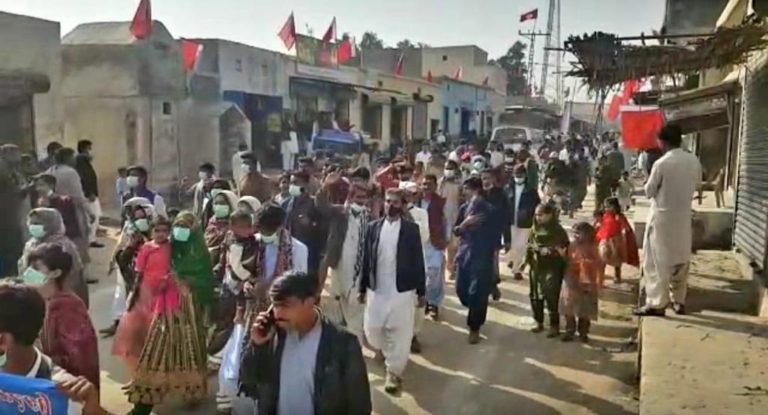
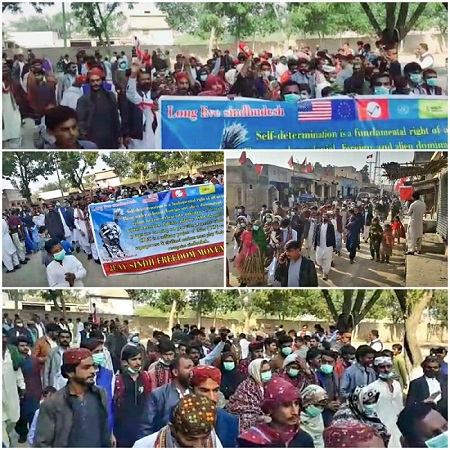
Thousands of Sindhi activists, intellectuals and political workers stood up against the Pakistani diktat and converged together on January 17 at Sann, Jamshoro district in Sindh, to celebrate the 118th birthday of Sain (pronounced Sanyeen) GM Sayed, Father of Sindhi Nation. The Pakistani regime had put up roadblocks and made every possible effort to stop people from reaching Sann, and yet the Sindhis braved all oppressive actions and took out a huge rally under the aegis of Jeay Sindh Freedom Movement (JSFM).
The Sann rally was marked by Sindhi activists raising slogans against CPEC (China-Pakistan Economic Corridor). They also demanded the release of Sindhi and Baloch ‘Missing Persons’ who have been forcefully abducted by Pakistan Army soldiers. Slogans were also raised against the illegal capture of Sindh’s land by Pakistan Army. The rally began from the Sheikh Abdul Majeed Sindhi Chowk at Sann and culminated at the grave of Sain GM Sayed. Sindhi activists demanded the Pakistan Army to end its military operations across Sindh. They raised slogans against Pak Army’s Bahria Town and rejected its illegal land capture in toto.
The Sindhi workers sang the Sindhudesh National Anthem at the grave of Sain GM Sayed and pledged to fight for Sindh’s independence as envisioned by Sain GM Sayed.
Sindhis commemorated the 118th birthday of Sain GM Sayed by taking out a rally in Sann, Jamshoro on January 17, 2022. (Photo: News Intervention)
The surge in Sindhi nationalism has turned Islamabad and Rawalpindi jittery. Pakistani regime had put up roadblocks and barriers across Sindh and Sindhis were being stopped at all locations from reaching Sann, but all these repressive actions only strengthened the resolve of Sindhis and as a result thousands converged at Sann and took out a massive rally.
JSFM workers also celebrated Sain GM Sayed’s 118th birthday at Karachi, Malir, Sachal Goth, Hyderabad, Qasimabad, Ghotki, Sukkur, Rohri, Shikarpur, Lakhi Ghulam shah, Larkana and other cities of Sindh. Jeay Sindh Freedom Movement (JSFM) Central Chairman Sohail Abro, Vice Chairman Zubair Sindhi, General Secretary Hussain Sindhi Shabrani and others leaders condemned the arrest of Jeay Sindh leaders Mehfooz Notkani, Adil Shah and twenty five other workers arrested by Jamshoro Police.
The Sann rally was led by the newly elected office bearers of JSFM such as Amar Aazadi and Pirh Sindhi. During the rally slogans were also raised against the illegal capture of Sindh’s land at Bahria Town by the Pakistan Army and loud demands were made for an independent Sinhudesh.
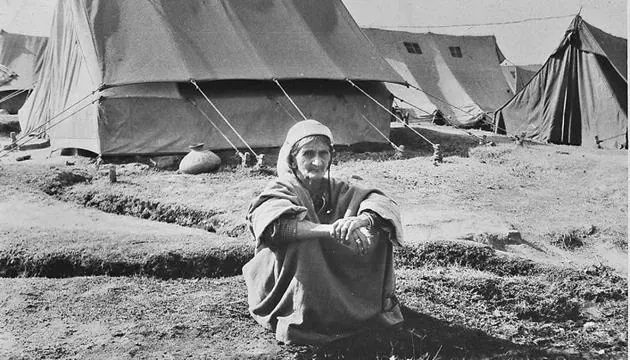
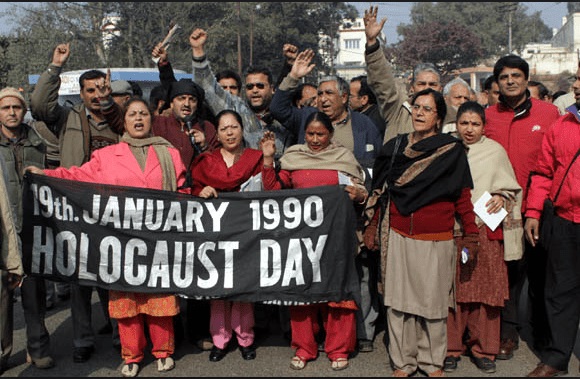
January 19, 1990 is a black day in the history of Kashmir and of Indian secularism. This day saw the beginning of the genocide of the small harmless and defenceless religious minority of Kashmiri Hindus (Pandits). The exiled community has entered the 33rd year of displacement. This article is dedicated to the memory of those sons and daughters of the soil who sacrificed their lives in defending superior values of Hindu culture. May their souls rest in peace?
Kalhan Pandit’s Rajtarangini Very few communities of great antiquity like the Kashmiri Hindus (Pandits) have borne persecution and oppression for almost seven centuries for the sin of adhering to their ancestral faith, Hinduism, and struggling against calamitous odds to preserve their pristine and colourful culture and traditions. The Hindus of Kashmir are the indigenous inhabitants of Kashmir Valley and their early history is steeped in colourful mythology. Kalhan Pandit, the celebrated historian and scholar of the 12th century wrote Rajatarangini, the versified history of ancient Kashmir in 1147 A.D. in which he traced the origin of Kashmiri Hindus to nearly six thousand years beginning with Gonanda ruling house in 3450 CE.
Kalhan Pandit authenticated his record by reference to at least six preceding histories including the historical geography, Nilamata Purana. Additionally, he had visited hundreds of ancient Hindu and Buddhist temples, shrines, viharas and stupas in the vast kingdom to trace Kashmir history in the folklore and decipher the inscriptions of immense epigraphic value. Thanks to the celebrated Hungarian scholar of Sanskrit and Indology, Aural Stein, who translated the chronicle from Sanskrit/Sharada into English and enriched it with annotations of the rarest scholarship highlighting the rulers, the people and the land of Kashmir.
Beginning of the decline of Kashmir’s Hindu Kingdom By the beginning of the 12th century A.D. five-thousand-year-old Kashmir Hindu kingdom was faced with decline essentially for two main reasons. Firstly, Kashmir trade and commerce along the fabulous Silk Road was severely hampered by the Turko-Mongol Invaders and plunderers
Secondly, the local warlords and commanders had become too powerful and defiant. And lastly, the creeping mutual rivalry and dissensions among the courtiers and administrative echelons caused great damage to the stability of the Hindu Kingdom. The elitist class became highly self-centred and treated the peasantry almost with disdain. By the beginning of the 14th century, the Kashmir Hindu kingdom had begun to show cracks. Queen Kota Rani, the last ruler of the Kashmir Hindu kingdom was deceitfully besieged and treacherously deposed by one of her commanders named Shah Mir in 1339 A.D.
Kashmir’s first Muslim dynasty Shah Mir, a fugitive Khashya Muslim chieftain from Panchghavara (present Rajouri-Budhal) region deposed Queen Kota and seized the throne of Kashmir by perfidy. He founded the first Muslim ruling dynasty of Kashmir under the title Sultans Shamsu’d-Din Shahmir in A.D. 1339. For the following seven centuries of the rule of Sultans over Kashmir, one and only one task became their passion or obsession. It was that of decimating the people of indigenous faith and destroying all of their civilizational symbols and icons. Alternately, they zealously undertook the propagation of the new faith of Islam that rose in distant Arab lands and was brought to Kashmir by the zealous Islamic missionaries from Iran and Turkistan. The propagators of faith from Iran and Central Asia, who called themselves Sufis, brought havoc to Kashmir’s ancient civilization next only to what happened to the Zoroastrian faith in Iran after the defeat of the Sasanian empire at the hands of the Arab invaders.
The foremost of Iranian missionaries whom Kashmiri Sunni Muslims adore as the founder of Islam and Islamic traditions in Kashmir was Mir Sayyid Ali Hamadani (d. A.D. 1389) from Hamadan (Ecbatana of Herodotus) in Iran. In Kashmir, he established his headquarter on the large compound of Kali Mandir, Fateh Kadal, Srinagar, built a huge platform and began delivering sermons on Islam and Sufism of which he had only a smattering for he had never gone through the traditional rigours of Sufi practices. A rabid Islamic propagator, Hamadani aimed at diverting the Kashmiri masses from their long adherence to the Shaivite School of philosophy to the Sufism and Islamic practice. Kashmir Sufism introduced through the instrumentality of proselytized Hindu Rishis is pretence of Iranian Sufism. Hamadani and his followers had to juxtapose their pseudo-Sufi tradition and practice to all-pervasive Shaivite philosophy.
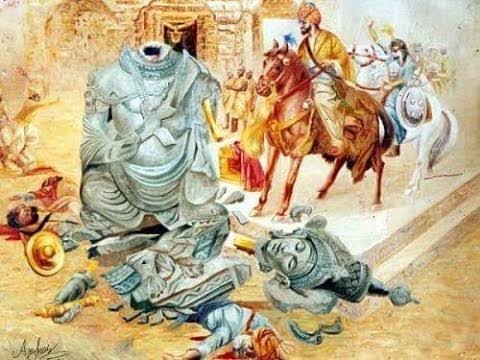
Sikandar ‘butshikan’ Sultan Sikandar (A.D 1389 -1413), the sixth in-line of Shah Mir, has received the label of ‘butshikan’ –- the iconoclast. Under the atrocious influence of an Iranian Islamic zealot Mir Muhammad Hamadani, (the son of Mir Sayyid Ali) Sikandar undertook the wicked task of decimating the traces of Hindus of Kashmir and their civilization.
Sikandar ‘butshikan’ breaking the Hindu Bhagwan murtis in Kashmir.
Describing vividly the atrocities perpetrated on the Kashmir Hindu population, their temples, shrines, traditions, culture, and life under the instructions of this Iranian missionary, Kashmir historians tell us: immediately after his (Sufi Mir Mohammad’s) arrival, Sultan Sikandar submitted to him and proved his loyalty by translating his words into deeds. He eradicated aberrant practices and infidelity. He also put an end to the various forbidden and unlawful practices throughout his kingdom.” (Baharistan-i-Shahi, tr. Dr. K.N. Pandit), Pir Ghulam Hasan (A.D. 1891) writes in his Tarikh-i-Kashmir that Sultan Sikandar obliged Sayyid Muhammad Hamadani, the Iranian missionary, “…by destroying many big Hindu temples some of which were Martandesvara near Mattan, three at Parihasapura, Maha Shri, and Tarapitha temples in Iskandarpora, Srinagar.” Details of large-scale forcible conversion of Hindus to the Islamic faith and their massacre in case they refused are vividly told by Hasan in his Tarikh (pp. 178-80). One significant detail is that three kharwars (one kharwar is approximately equal to eighty kilograms) of Hindu ceremonial thread (yagnopavita/zunnar) were burnt under the orders of Sultan Sikandar. The Hindus were asked to cast away the thread at the time of conversion.
The barbaric mission of fanatical Sultans of Kashmir of persecuting the Hindu subjects, destroying Hinduism and decimating all of its civilizational traces in Kashmir at the hands of their commanders and musclemen reached its peak during the authority of Kaji Chak (cir. A.D. 1527) and his contemporary Musa Raina on the behest of the most loathsome Iranian missionary of Nurbakhshiyya order, namely Shamsu’d-Din Araki, A.D. 1574. The author of Baharistan writes: “One of the big tasks completed by him (Kaji Chak) and one of the major commands of Amir Shamsu’d-Din Muhammad Araki carried out by him was the massacre of infidels and polytheists of this land.
It happened as follows: During the government of Malik Musa Raina, all the depraved heretics of this land had been converted to Islam. [But] with the help of some of the chiefs of this land, many had reverted to the customs of the infidels and polytheists. These apostates had resumed idolatry. Amir Shamsu’d-Din Araki summoned Malik Kaji Chak and told him to punish the infidels.
Araki’s biography Tohfatu’l Ahbab contains one full chapter on the destruction of a large number of temples and viharas besides the hair-raising story of forcible conversions of Kashmiri Hindus village after village. (My English translation of this work was published under the title Tohfatu’l Ahbab: A Muslim Missionary in Medieval Kashmir by Aditya Prakashan of 2/18 Ansari Road, New Delhi).
Kashmiri Pandits under Mughal Rule Kashmiri Hindus, known as Kashmiri Pandits since the Mughal rule over Kashmir in A.D. 1586, remained marginalized under the oppressive authority of the Mughal and Afghan subedars. Their persecution had no relent during the reign of Shahjahan and Aurangzeb (1707 A.D.) resulting in the flight of many Hindu families to the plains of India.
One erroneous impression from Indian historians and commentators needs to be clarified. It is not correct to call Babur and his ruling house the Mughals. The word ‘Mughal’ is not known to Iranian historians and they have tried to hide their ignorance about its origin behind the term ‘Maghulan-e Gorkan’. Gorkan is a Chaghatai word meaning son-in-law. Originally it was Mangolan-e-Gorkani meaning the son-in-law of the Mongols. But after some resentment from the original Mongols, the word was corrupted into Mughool or Mughal.
Babur was not a
Mongol. Ethnically he was from the clan of the people of East Turkestan or what
we today call Uighur (now in Chinese Xinjiang province). The language they
spoke was Chaghatai or Uighur. Babur wrote his memoirs (Tuzak-e Baburi) in Chaghatai/Uighuri and neither in Mongol nor
Farsi. Four generations of Babur spoke Uighur. Hence they were Uighurs and not
Mughals. Of course, the Uighurs are descendants of a mixed-race of Mongols,
Turks and other races we find in the Great Steppes.
It was only during one century of the Dogra rule, (1846-1947 A.D.) that the Pandits found some respite from long persecution. On 28 October 1947, a former community member of theirs whose family had migrated to Allahabad (now Prayagraj) during the oppressive reign of Shahjahan, and who had risen to the exalted position of the first Prime Minister of free India, snatched away Kashmir from the hands of the descendants of a ruling house that had shaped and structured the State of Jammu and Kashmir with sweat and blood and handed it over to a wily autocrat with absolute powers who reduced our historic minority community to a non-entity. He re-invented the sordid saga of discriminating against and marginalizing the Pandits under the mask of secular democracy. In a letter to Kashyapa Bandhu, a Hindu member of the NC Executive Committee, the Sheikh said that he was “first a Muslim and then a nationalist”. (See Kashmir Sentinal)
Sheikh Abdullah’s prejudice towards Kashmiri Pandits The impact of the partition and independence of India on Kashmiri Pandits was that overnight they were reduced to the status of second-rate citizens, the dhimmis. The Muslim leadership of Kashmir unjustly considered them an unfriendly lot. In his biography Aatish-e Chinar, the Sheikh calls them Indian spies. What an irony! Three generations of the Sheikh ruled over Kashmir with the patronage of New Delhi and yet the miserable Pandits are labelled as Indian spies. Who is the Indian (precisely Congress) spy?
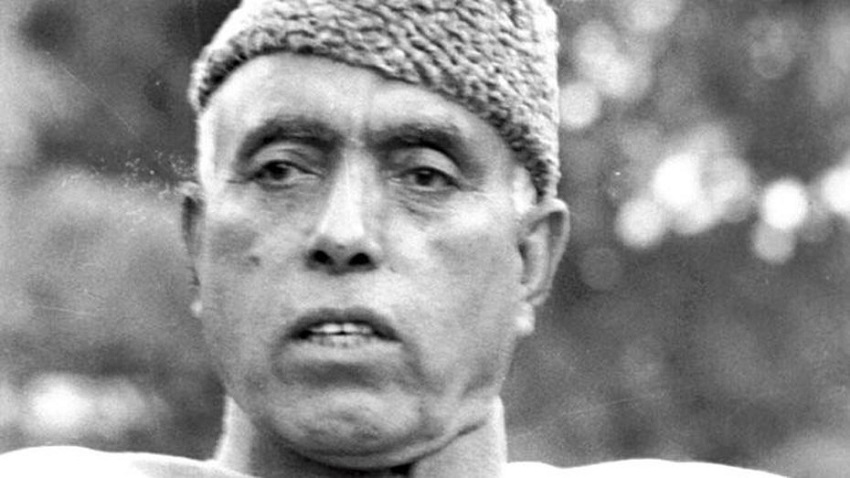
Sheikh Abdullah, founder of the political outfit National Conference that has a presence in certain pockets of the Kashmir Valley. (File Photo)
The populist constitution of J&K State did not recognize any group as a minority thereby depriving the Pandits of the privileges which the national minorities, including the Muslims of Kashmir, enjoy under the law. Sheikh Abdullah quietly accepted and enforced in the state all privileges accruing to the Muslims as the national minority but denied minority status to all minorities including the Pandits in the state. The Muslim landlords managed to shift the title of their holdings to orchards and saved these from being taken away under the Land Reform Act. They could do so because the revenue officers were Muslims with a soft corner for their co-religionists. He expelled the people from Srinagar who had supported his freedom movement but had opposed his dictatorial style of functioning. He discontinued grant-in-aid facilities to private educational institutions mostly run by the Hindu societies/trusts. They were forced to close the institutions owing to financial stringency.
The inclusion of Article 370 and Article 35A in the Indian Constitution on the Sheikh’s insistence left J&K mostly out of the administrative reach of New Delhi except for frugal but unaccountable funding. The Pandits argued that they also needed protection against the highhandedness of the majority community. The Sheikh’s dictatorial proclivity can be gleaned from the plethora of letters exchanged between Maharaja Hari Singh and Sardar Patel (Home Minister) during the period when the Sheikh functioned as the Chief Administrator and then the PM of the State. Handing over power and authority to the Sheikh by the end of October 1947 was tantamount to signing the death warrant of the religious minority of the Pandits of Kashmir.
Apprehending grave uncertainty of their future in hostile environs of Kashmir under the authoritarian regime many Pandit families were forced to leave the valley and seek a livelihood elsewhere. In this way, another exodus of the religious minority of Kashmiri, the Pandits became a regular feature.
Mufti Muhammad Saeed’s stratagems Mufti Saeed, the State Congress President in the mid-1980s, nursed rivalry against Mir Qasim, the then Chief Minister of J&K. To dislodge him, the Mufti hatched the conspiracy of an attack on Pandit temples in A.D 1986 in South Kashmir through Jamat-i-Islami goons of his patronization. Attacks on dozens of Hindu temples shocked the Hindus in South Kashmir and the threat of destruction forced many of them to leave the valley. Congress’s government did not move its finger. The inaction of the police and state authorities was discouraging. Pandits like Kurds had no friends.
President Zia’s Topac project aimed at avenging the A.D. 1971 Bangladesh defeat of the Pakistan Army by initiating a proxy war in Kashmir. Jihadists trained and indoctrinated in training camps in PoK and Pakistan initiated guerrilla attacks after infiltrating back into Kashmir in the late 1980s. Kashmir Liberation Front with headquarters in Birmingham/Luton in UK, and Rawalpindi was the engine to generate insurgency. J&K Police, border forces, some security forces and many in the bureaucracy were bribed to let Kashmiri youth ex-filtrate or infiltrate across the border.
January 19, 1990 On the night of 19 January 1990, the entire Muslim population of Srinagar rose in revolt against the authority of India. Hundreds of thousands assembled on roads, squares and streets raising anti-India and anti-Hindu slogans, yelling and rejoicing that India had been thrown out. Jama’at-i-Islami firebrands poured venom against the Hindus through loudspeakers. The Pandits huddled up in one room out of fear expecting the sword to fall at any moment. Administration collapsed. The police disappeared from the city and not a single soldier moved out of the Badami Bagh Cantonment to protect the civilians. How could they since the Home Minister, Mufti Saeed sat stoically.
The next morning, the Pandits found to their consternation that the entire vernacular press had become hostile to India and them also. Al Safa, the Urdu spokesman of the jihadists warned the Pandits to leave but without their womenfolk. The traumatized community had no option but to leave their ancestral homes en masse and go into exile to unknown places, people and environs. This is the thirty-year of their exile.
After
resigning as coalition chief minister Dr. Farooq fled to London to play golf.
Ex-ministers ran away to Jammu-occupied government bungalows and deployed the
local police to guard their families. The threatened Pandits were left to
become the prey of wild wolves pacing the streets of Srinagar.
The horrendous stories of the barbaric killing of many Pandits served a rude shock to the entire community of Hindus. Panun Kashmir, the frontline organization of displaced Pandits in Jammu, listed 1341 killings in a compilation submitted to the NHRC. A Pandit girl teacher gone to collect her salary was waylaid by the terrorists, raped and then cut under a machine saw. Nails were drawn into the forehead of another Pandit victim. One of them was tied to a jeep and dragged along the cobbled road till his bones got crushed and he bled to death. Horrendous stories of barbarism sent a shock down the spine of the Pandits. Destiny drove them to unknown places, people and environs. By the middle of summer 1990, almost 99 percent of Kashmiri Pandits had been forced to leave their homeland. The jihadists regaled at the ethnic cleansing of Kashmir. Islam had emerged victorious but over whom — the Kashmiri Pandits who did not even have a knife to cut the vegetables, not to speak of Kalashnikov.
No political party, much less the ruling Janta Dal or Congress, came to their help. Of course, the RSS and BJP combine did make some effort to provide a blanket or a bucket to the lost tribe after it arrived in Jammu and got their details documented. The unfortunate Pandits had braved seven centuries of persecution and oppression under the autocratic rule of the Sultans in Kashmir but in the secular democracy of India (Congress, to be precise), they were forced to leave their six thousand years old birthplace and live as refugees in their own country. Genocide and ethnic cleansing were the gifts which the independence of India brought to them.
Refugees in their own country Hindsight tells us that throwing the Pandits out of their ancient homeland was a calculated policy of the Jamaat-i-Islami and Congress. No political party could form a government in J&K unless it enjoyed the support of one of the two or both. The Pandits had failed to understand that Congress was the soft face of Muslim League. The partition had helped in the purge of more aggressive and explosive elements of the Muslim League. What remained behind would carry forward the Islamic agenda under Congress banner. No wonder, therefore, if today we have the Shaheen Bagh and JNU agitations being run under the national flag. One can shed tears on the naivety of the Kashmiri Pandits who thought that freedom had brought a true national government and went about eulogizing Nehru and Gandhi as the Father and the Uncle of the Indian nation.
Kashmiri Pandits protesting for their rights. (Representative image)
National media considered it a sin to trace and publicize the sordid saga of the Pandits. Some of the stalwarts of national media brought all the blame to the doorsteps of the Pandits as some of them continue to do so even today. It pays to be on the side of the oppressor in this country. The National Human Rights Commission pontificated that what was done to the Kashmiri Pandits was “akin to genocide but not genocide”. It declined to categorize them as “internally displaced persons” for which the Pandits had supplicated following the definition of the UN Human Rights Working Group’s stipulation. The State and the Union government both stuck to the nomenclature of “Migrants” as if the Pandits had migrated or would return out of their free will. Thirty-two years of exile still make no promise of their return and restitution. The rhetoric of Kashmir Valley leadership that Pandits are an inseparable part of Kashmirian society is the peculiar sadism that rubs salt into their wounds. They know that. Kashmir is now radicalized to the hilt and the new generation cannot think outside the Wahhabi Islamic frame. The Congress gave them the legitimacy of running a theocratic state within a secular union.
Notwithstanding all these atrocities, the Pandits, one and all, want to go back to Kashmir, the homeland where the ashes of their ancestors remain embedded. Nobody can predict whether conditions will change to suit their return. So far, no government has shown any interest in their return. Nobody can say whether the conversion of the state into two union territories will bring any relief to the displaced Pandits or change in their lives. BJP leaders often speak of their suffering and destitution but they do not spell out if, when and how the Pandits can return to Kashmir. Perhaps they understand the complexity of the issue. And for the Congress party, theocratic Kashmir as its vote bank is preferable to secular Kashmir.
All Pandit organizations have unanimously demanded that their return and rehabilitation in Kashmir should be along the resolutions of the UN Human Rights Working Group on IDPs. The stipulated pre-requisites are that the IDPs will (a) return and resettle in whatever way and wherever they want to, (b) they are provided crutches to stand on their feet and become economically independent, (c) they are compensated for the losses they have suffered, (d) they are provided adequate and dependable security to eschew their re-foulment, (d) they are politically empowered to voice their difficulties aspirations and expectations, and (f) they are part of the decision making apparatus in matters concerning their interest and welfare.
Pandits
believe that unlike previous governments at the Centre, the Modi government is
much better informed about their plight under the local governments. Therefore,
it is better equipped to resolve the issue without further delay. One bold
public declaration by the Prime Minister that Kashmiri Pandits will return to
the valley in whatever way and whatever form they want without any conditions
will de-freeze the three-decade-old narrative.
We
all agree that the return and restitution of the Pandits in Kashmir is a very
complicated issue. The complicacy arises from two situations. First is that the
locals have grabbed the moveable and unmoveable properties of the Pandits and
its return to the owners means a social and economic blow to the illegal
occupants whom the state government wants to protect. The second is the
outright radicalization of Kashmir Muslim society and linking it to the tenets
of Islam. The third thing is unrelenting indoctrination by Pakistan through
spreading anti-Hindu and anti-India venom.
Pakistan
has managed to influence the opinion of the world community that India is a
state inimical towards Muslims. No Muslim country counter-argues that India has
the second-largest Muslim population after Indonesia. The Muslim population in
India has increased three-fold and even more since independence. But yet the
Indian Muslim leaders and intellectuals go about trumpeting the canard that
Muslims are being oppressed in India.
In these circumstances, the return of the Pandits seems to be no less than an uphill task. Economic stability, security, minority right, representation, freedom of enjoying the culture, restoration of religious symbols and icons etc. are vital components of rehabilitation. Above all, the goodwill of the majority and the government both at the state and central level is of crucial importance. Goodwill at both levels is dismally missing. In December last (2021) Home Minister Amit Shah was on a four-day tour to Jammu. He visited border areas of Rajouri, Poonch and Kathua. He met with the Gujars, Bakarwals, and the Paharis. But out of four days, he had not even four minutes at his disposal to talk to the waiting Kashmiri Pandit delegation, leave aside giving it a few minutes of a formal meeting.
After much noise, the Delimitation Commission appointed by the Home Ministry has submitted its report. It has recommended increase of six more seats for Jammu region and one seat for Kashmir region. While it has recommended reservation of six seats for OBCs, it has not recommended any reserved seat for the internally displaced Kashmiri Pandits nor has it agreed to give the refugees from PoK their quota from 24 reserved seats
Farooq Abdullah speaks in every public meeting that Kashmiri Pandits are integral to Kashmir society and that Kashmir society is incomplete without the Kashmiri Pandits. These are sweet words. But Farooq has been in power from 1996 until 2019 in one way or the other. We would like to ask him what practical steps he had taken as Chief Minister of the State to show that he considers the Pandits as integral to Kashmir society. This rhetoric is repeated by all political stalwarts of the valley including the BJP. But in practice, there is nothing to show that they mean it. No government even demanded constituting of a Commission of Inquiry into the rise of insurgency and genocide of the Pandits in Kashmir.
Like
Kurds, the Pandits have no friends. The worst is that they have no land even.
This is a vanishing community. A few hundred Kashmiri Pandit families have
immigrated to the foreign countries particularly the US. That Diaspora may
maintain the cultural and linguistic continuity of the community for some time.
This
is not a pessimistic view; we must try to understand the ground situation. The
simple formula is that no minority can feel safe and comfortable unless it
enjoys the goodwill of the majority community. The majority community of
Kashmir being the Muslims are enjoined by their faith to decimate the
non-Muslims especially the kafirs and
the idol worshipers. Therefore there is no rationale in thinking that the two
can live a harmonious life. The Pandits are a people without a country or land.
However, some years back, when Manmohan Singh was the Prime Minister, a group of Kashmiri Pandit intellectuals with social standing had proposed a Twin City of Srinagar as the formula for rehabilitating the displaced Pandits in the valley. A new township was suggested in an area of about one lakh kanals of land somewhere in the vicinity of the present airport in Srinagar. The new township would accommodate 47 thousand Kashmiri Pandit families plus a few thousand families of local Muslims and Sikhs also to give it an inclusive outlook. With time, the people would develop friendly relations and perhaps a smooth life could be led. This would take about fifty years to complete but this is the right solution. The Padgaonkar Committee constituted by the Union Ministry of Home Affairs, too, had very strongly recommended the idea of the twin city of Srinagar.
This
is perhaps the best solution. The other solutions like the satellite townships,
clusters, homes for government servants or transit camps as these are called,
are all flawed and unviable.
With
all said and done the Pandits have had to live in fortitude. They are getting
dissolved in the vast Indian milieu. They may remain in the pages of history
for some time. This is the saga of the vanishing community of Kashmiri Pandits.
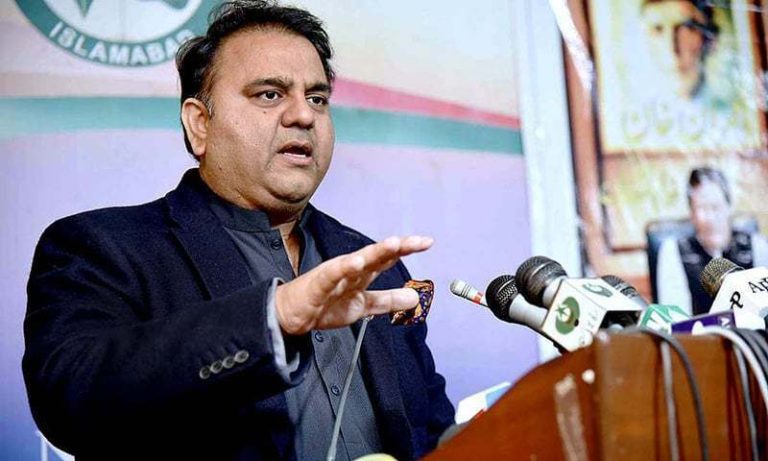
While addressing a consultative conference on terrorism in Islamabad last month, Pakistan’s Federal Minister for Information and Broadcasting [I&B] Fawad Chaudhary said, “We don’t have any potential threat from India . . . We face no danger from America . . . We face no danger from Europe. The biggest danger we face is [extremism] from within.” For a country that has consistently remained in a perpetual state of denial to acknowledge that ‘domestic extremism’ is Pakistan’s greatest threat was a welcome sign as it indicated the possibility of Islamabad’s paradigm and long overdue shift towards reality.
However, this was not
to be. Just the other day, Chaudhary seems to have suddenly realised that the
real “danger for Pakistan” comes from “two extremist
regimes [that] have cropped up on [the] right and left of Pakistan”. It
appears that what he wants the world to now believe is that whereas Pakistan
doesn’t have any serious extremism related problems, Kabul’s “retrogressive
thinking” could find resonance in Pakistan and New Delhi’s “Hindu
extremist mindset” would spawn extremist ideology within the
country. Hence, it’s amply clear that there’s no change in Islamabad’s
self-deceiving view that extremism within Pakistan is being sustained and
propelled by external forces.
One had thought that after its bitter experience with Tehreek-e-Taliban Pakistan [TTP], Islamabad would have stopped living in wonderland and revisited its unsubstantiated ‘foreign hand’ obsession. Ever since this terrorist group came into being in the early 2000s, Islamabad has branded it as India’s creation. To ‘prove’ this incredulous allegation, it even produced former TTP spokesperson Ehsanullah Ehsan before the camera to talk at length about this group’s strong links with India’s intelligence agency R&AW. However, Pakistan army’s failure to charge Ehsan and his mysterious ‘escape’ from the military’s custody let the cat out of the bag!
Yet, when India pulled
out its diplomatic staff from Afghanistan due to Taliban’s onslaught a
jubilant Chaudhary kept up the pretence, exclaiming that “We should be satisfied to know with regards to
the TTP, that for the first time the process of Indian funding [to TTP], which
had been going on for a long time, has ended and at this time they are in
disarray”. However, instead of being in a state of disarray, there was
such a quantum increase in the intensity and ferocity of TTP attacks against
Pakistan army, that Rawalpindi made Islamabad eat crow by opening negotiations
with those who perpetuated the 2014 Army Public School Peshawar carnage and has
all along been touted as India’s proxy!
So, it is apparent that the I&B Minister’s demonstrated concern of internal developments in India and Afghanistan triggering Chaudhary extremism within Pakistan is nothing but another attempt to downplay Rawalpindi’s more than four-decade old symbiotic relation with this scourge. After the Soviet invasion of Afghanistan in the 70s, it was Pakistan army’s spy agency ISI that willingly became an unquestioning and servile lackey of America’s CIA, and at its bidding created a force of highly radicalised fighters who called themselves ‘mujahideens’ and were convinced that they were not fighting America’s proxy war against the Soviets in Afghanistan but waging ‘jihad’ [holy war].
Former Pakistan
President and army chief Gen Pervez Musharraf has admitted that “In 1979,
we had introduced religious militancy in Afghanistan to benefit Pakistan and to
push Soviets out of the country. We brought Mujahideen from all over the world,
we trained them, [and] supplied weapons.” Whereas he didn’t elaborate
on what “religious militancy” meant, but there can be no two
views that this was undoubtedly the process of promoting religious
fundamentalism by contorting and misinterpreting Islamic tenets to bestow
divine sanction on violence and bloodshed! Despite Chaudhary’s prognosis
that provocative acts by “two extremist regimes” [India and
Afghanistan] could spawn extremism in Pakistan, the fact of the matter is that
if extremist ideology in Pakistan is thriving today like never before, it’s
thanks to Pakistan army exercising extra-constitutional powers
and through Faustian deals compelling the Imran Khan led government to make
comprises with politico-religious groups that brazenly promote retrogressive
thinking and propagate violent ideology. Pakistan army brokering a deal between
the government and Tehreek-e-Labbaik Pakistan [TLP] to end the 2017 Faizabad
‘sit-in’, with DG ISI and not a government representative signing the agreement
as ‘guarantor’, is a case in point.
Since Chaudhary has
insinuated that external influences are prime sources radicalising
Pakistanis, it becomes all the more necessary not only to set the record
straight, but expose his duplicity on this issue. Readers would recall that in
an interview given to Der Spiegel, Musharraf had revealed that “We
poisoned Pakistani civil society for 10 years when we fought the Soviets in
Afghanistan in the 1980s.” By acknowledging that “educational
institutions [in Pakistan] had been radicalised as teachers were hired during
the 80s and 90s as part of a plot to teach extremism”, the I&B Minister
has further endorsed what Musharraf had said. This is why Chaudhary’s
attempt to play the ‘victim card’ and portray Pakistan as a hapless
target of external machinations will fool no one!
The Afghans were not very happy with the creation of a dominion called Pakistan to the east of their country as a result of the partition of India in August 1947. They had more than one reason to be cheerless. The newly created dominion was the handiwork of the colonial power which the Afghans did not trust. The Durand Line drawn by the British meant dividing the Pukhtoon (Pashtun) community that lived on either side of the line. Afghans knew that “divide and rule” was the old game of the colonial power and the Durand Line had no other purpose for the British.
As the partition of India was becoming a reality and the province of Punjab was getting divided into two parts — the western part remaining with Pakistan and the eastern part joining India —- King Zahir Shah of Afghanistan aspired to capture the whole of NWFP (North-West Frontier Province) as part of the Afghan Kingdom with Peshawar as the capital city. He said that this was originally part of Afghan territory and ethnically, linguistically, culturally and historically the NWFP was part of the Afghan Kingdom. He asserted that the British colonialists had arbitrarily cut off the chunk of land and created a new province which they called North-West Frontier Province (NWFP). It was meant to serve as a buffer between the British Indian Territory and Afghanistan.
When the Pukhtoons (Pashtuns) of the NWFP resisted the British plan of Durand Line, the British initiated the old strategy of divide and rule as they had done in the case of Hindustan were nearly 560 semi-independent princely states were created and recognized by the Crown. The British rulers of India identified more powerful and influential sirdars meaning tribal chiefs in the NWFP (North-West Frontier Province) and negotiated a deal with them. At the time of partition of India on 15 August 1947, we are told that the British paid 7 crore rupees to the tribal chiefs for distribution among their clansmen against a commitment of not interfering or violating peaceful relations with the British Raj. This cheap strategy stands at the root of many debilities of the Afghan polity.
The practice of buying the tribal chiefs continued even after the British left. Pakistan’s government had initially accepted to offer annual cash doles to the tribal chiefs with no conditions whatsoever. Understandably, many Pukhtoon (Pashtun) tribal chiefs of various clans had accepted the suzerainty of the nascent dominion of Pakistan.
Nevertheless, the far-sighted Pukhtoon (Pashtun) leader, Khan Abdul Ghaffar Khan was much influenced by Gandhian philosophy especially that of non-violence which he thought was an effective instrument of winning freedom from the foreign rule. He became an ardent supporter and political disciple of Gandhi and was given the title of “Frontier Gandhi”. His corps of volunteers called Khudai Khidmatgar (Servants of God) discarded violence and eschewed the gun, which is no small a contribution by any far-sighted leader.
The treatment
meted out by the creators of Pakistan to the Khudai Khidmatgar made the Afghans hate the Muslim League leaders
who now ruled Pakistan. And lastly, the creation of a new state based on
religion was reprehensible to the Afghans who, though deeply religious, had
always tried to keep religion separated from politics.
The Taliban of Afghanistan are the creation of Pakistan, albeit with American approval. As lawlessness and disorder overtook Afghan polity in the aftermath of withdrawal of the Soviets in 1990, Pakistan convinced the Americans that the creation of a moralist force from among the mujahedeen would help restore law and order in war-torn Afghanistan. Washington caved in. Nobody knows how much American money flowed into Pakistan and where it went. The Taliban, headed by Mullah Omar of Kandahar was the alumni of a Karachi-based seminary. Initially, he posed as the head of a moralist force. But then he emerged as a Pakistan-controlled and Pakistan-financed force that brutally liquidated President Dr. Najibullah and captured Kabul in 1996. Their hobnobbing with Al-Qaeda and its leader Osama bin Laden dragged the US into the Afghan conundrum seeking to take revenge for the 9/11 attack and massacre in New York.
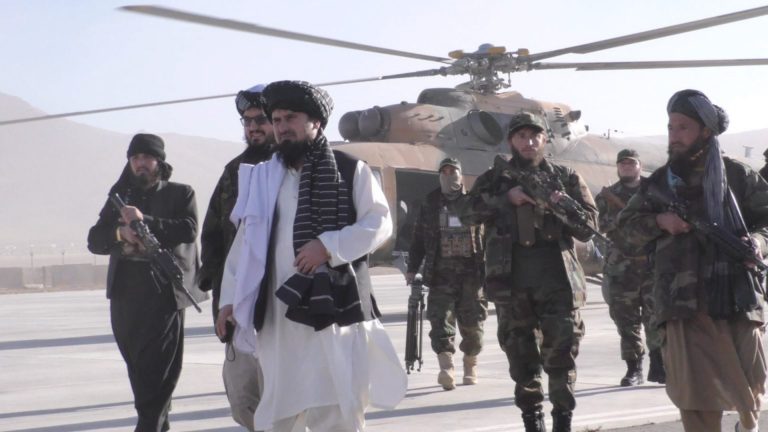
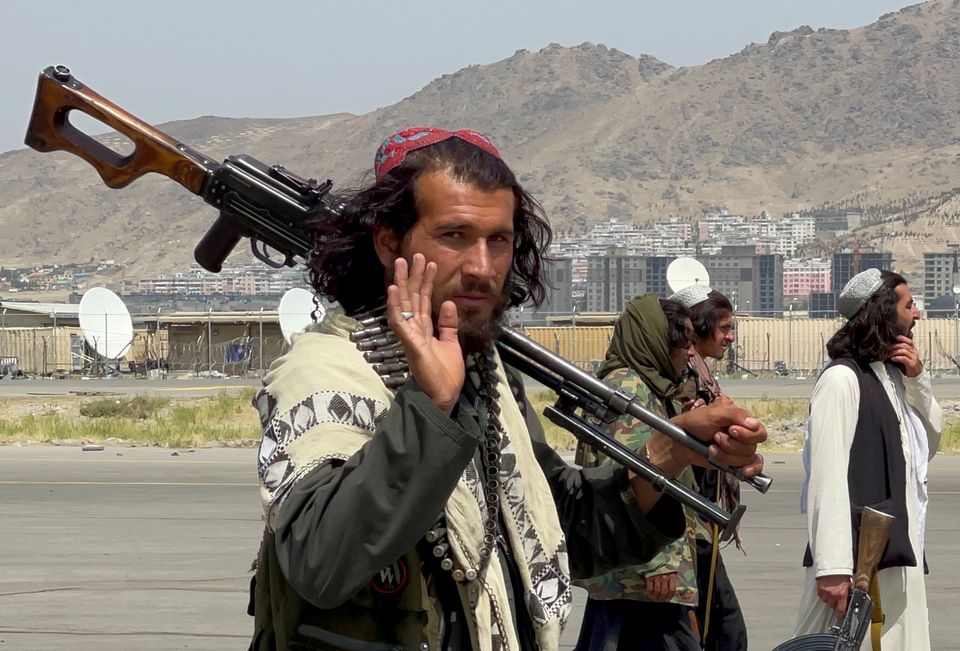
Taliban at the Hamid Karzai International Airport in Kabul, after the withdrawal of US troops. (File Photo: Reuters)
After two decades of fighting against the Afghan Taliban gorillas, the US
ignominiously withdrew from war-torn Afghanistan, once again proving the axiom
that Afghanistan is the graveyard of world empires. Pakistan, which had
committed to be on the side of Americans in the war against terror was
functioning as the main covert supporter of the Afghan Taliban in their war
against the US plus NATO troops.
Finally, on 15 August 2021 the Afghan Taliban with the national army contingents surrendering to them one after another province, and supported by Pakistani troops in civilian mufti, managed to oust the elected government of Ashraf Ghani and establish the Taliban administration for the second time.
Pakistan emerged as the biggest gainer from this complex political scenario. She succeeded in getting the elected government in Kabul ousted and replaced it by the theocratic and radical regime of the Taliban which suits her interests. Pakistan also succeeded in ousting India and India’s influence in Afghanistan as it was sore in her eye. Indian nationals, the Hindus and Sikhs of Afghan nationality were forced to leave Afghanistan. Now with their hand-picked government in Kabul Pakistani rulers and intelligence sleuths thought of prompting the victorious and heroic Taliban of Afghanistan to turn their guns on Kashmir and win Kashmir for Pakistan. Acting under the prompting of ISI, the representative of the Haqqani network even stated that after Kabul, Kashmir was their agenda. Pakistan gloated on its one-upmanship in her rivalry with India. She had come close to her long ambition of political space westward.
As the Taliban began stabilizing their regime in Kabul after early hiccups, we noted sudden escalation in terrorist-related activities in Kashmir Valley, particularly in South Kashmir. It was matched by the surcharged anti-India spite exuded by the almost defunct valley leadership that once used to be considered the regional mainstream parties. In a state of frustration, the Gupkar Alliance (nicknamed by sadists as Gupkar Gang) was forged in the name of unity by those who had been till then seeking each other’s blood. “Talk to Pakistan” was their refrain and somehow grabbing political power was their ultimate aim. In reality, Gupkar Alliance was, it still is, a pack of confused rabble-rousers that’s completely out of tune with the times.
However, astute Indian leadership took a patient and considered view of
the situation that was unfolding in the region. It was in no haste to react to
the fast-changing scene on the chessboard of Afghan politics. Indian Minister
of External Affairs silently got into touch with the more responsible Taliban
sources and their advisers. At least it became possible to elicit a simple
statement from Taliban sources that their regime wanted normal relations with
all and that the Taliban would follow the tradition of not allowing their land
to be used for attacks on a third country.
India has a good understanding of the mind of the Afghans. The Taliban
need not be told repeatedly that India, a traditionally friendly country, had
made a substantial investment in providing Afghanistan with some vital
infrastructure, roads, bridges, construction work, dams, healthcare assistance,
banking and many other services. They are aware that despite the sincere
contribution of India, some activists of the Haqqani network indulged in
anti-India acts of violence like attacks on the Indian mission in Kabul and Jalalabad
and other assets. This was done at the behest of Pakistan.
Hardly three months have passed when the Taliban assumed power in Kabul. A cursory glance of Pakistan – Afghanistan relations reveals that the bonhomie has begun to sour. The Durand Line is the bone of contention between the two countries. Afghans of all denominations, faith, sect, ethnicity, ideology, language and lifestyle etc. are united in opposing the implementation of the Durand Line in a way it has been drawn. Against this, Pakistan leaves no stone unturned to ensure that the Durand Line remains in place. Thus bone of contention is not disappearing easily and as the Taliban consolidate their position, the chances of a standoff between the two will become brighter.
The UN has appealed to the international community to save Afghanistan
from impending hunger and famine. It is about a month that India approached
Pakistan to allow Indian trucks laden with wheat to pass through its highway to
Kabul. The Taliban foreign minister Muttaqi personally visited Islamabad to
implore Pakistani authorities that the Indian trucks carrying fifty thousand
metric tons of wheat to Afghanistan be allowed to pass on humanitarian ground.
Pakistani die-hards do not budge. It shows that religion is no criterion of relationship.
In yet another act of humanism, India airlifted large consignments of
anti-Covid vaccine to Kabul. The Taliban have expressed their thanks to India
for the humanitarian gift.
There have been skirmishes between the Taliban and Pakistani troops when the Taliban discovered that Pakistanis were trying to fence the Durand Line with barbed wire. Taliban uprooted the poles and dismantled the fence line. They warned Pakistan that it should forget fencing the border along the Durand Line. Some soldiers of the Pakistan Army guarding the border are reported to have lost their lives in the melee. Pakistan has offered to sit around a table and discuss the issue. The Prime Minister’s Security Adviser is reported to be visiting Kabul to initiate the talks.
The Taliban spokesman Zabihulah Mujahid said in a press conference that
Kabul will not allow interference in the internal affairs of Afghanistan at any
cost. Hence, we see that shock aftershock is what Pakistan is receiving from
the side of the Taliban.
The ground situation in the region is fast changing. One inference that is loud and clear is that Afghanistan is not going to allow any country to use its soil for launching attacks on a third country. It is a saddening message for the self-styled stakeholders in the Afghan crisis. Moreover, India’s relations with Afghanistan will steadily revive; both sides will strive to remain allies against the rise of terrorist and barbaric forces that are patently anti-human.
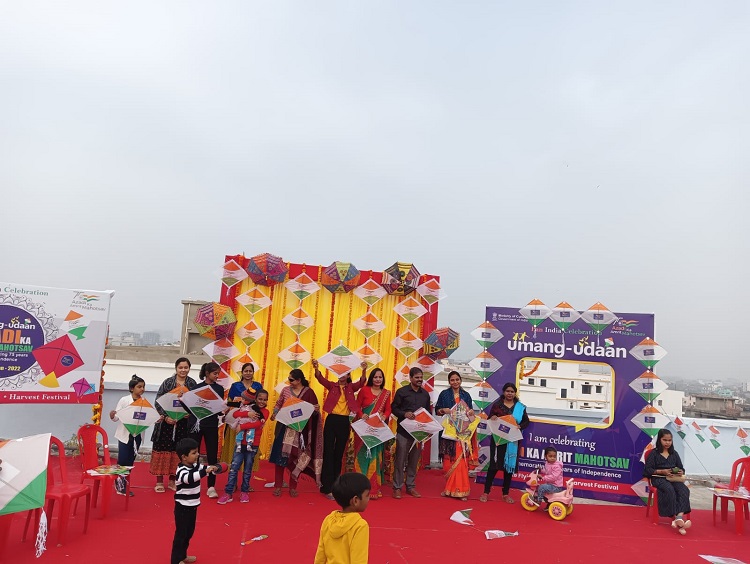
As India is celebrating the ‘Azadi Ka Amrit Mahotsav’ to commemorate the glorious 75 years of independence, the local residents of Patna, Bihar came together on Makar Sankranti brimming with nationalistic fervour and participated in rangoli making and kite flying competition on January 14.
Union Minister of State, Ministry of Culture, Meenakshi Lekhi, Union Minister of State, Ministry of Textiles, Darshan Vikram Jardosh along with the secretaries of Ministry of Culture and Ministry of Textiles joined online in the programme and interacted with the participants of the ‘Udaan Utsav’ from different locations of the country. The ministers and secretaries greeted India on ‘Makar Sankranti’ and wished for a grand success of ‘Azadi ka Amrit Mahotsav’.
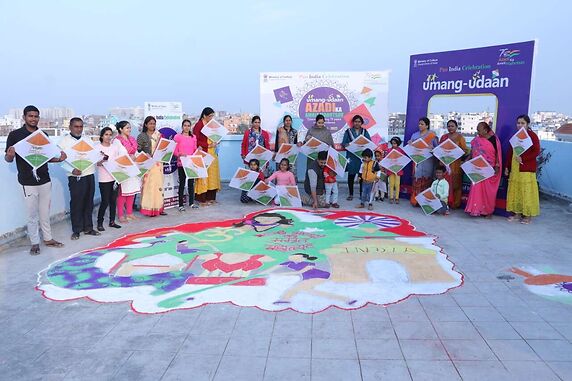
A beautiful rangoli that showcased the national bird, India Gate, Indian Army, female hockey player, Taj Mahal and Lord Shiva were made. Simultaneously kids, youngsters and beautiful ladies were all decked up and enthusiastically participated in kite flying festival.
Participants of the rangoli making competition at the Azadi Ka Amrit Mahotsav celebration in Patna on Makar Sankranti. (Photo: News Intervention)
The participants said that though they were not witness to the first rising sun of independent India in 1947, but the ongoing ‘Azadi ka Amrit Mahotsav had made them aware about the about freedom fighters from every nook and corner of India. They took pride in India’s glorious journey over the last 75 years and vowed to take it newer heights.
Canadians,
based on research published as recently as March, 2021, disaffirm or reject
non-scientific ideas or mythologies posed as literal truths vis-à-vis biology.
Most Canadians – 57% – affirm “human beings evolved from less advanced forms of
life over millions of years.”
This
statement exemplifies a scientifically educated and empirically healthy
country. The education system has worked, especially when compared to most
other countries in the world – even if simply moving across the Southern
border.
However,
or “but,” the social and political fight will continue with the fervently
religious – mostly, except for David Berlinski – wanting to introduce
creationism into the formal curriculum of the young.
Duly note, for those without a basic knowledge of scientific principles or modern scientific processes, none of this has gone through rigorous peer-review at highly educated and qualified levels. Even if so, not in a standard sense, it’s problematic.
Apparently, the spread of misinformed views has continued more into the general public, not on the scientific facts ground, more on the teaching grounds. Over the past two or so years, Canadians have incrementally moved towards wanting creationism taught in school. So, they don’t believe in it, mostly, but want it taught in the schools, generally.
The
original idea behind Intelligent Design and creationism was precisely this wish
– to innervate the school systems without scientific evidence, but with
religious ideology. There were a large number of court cases in the United
States defending scientific education in the biology classes.
It is theology masquerading as science. This has always been the case, including the most glaring case with the “Wedge Strategy” made public, which was a political and social action plan of the Discovery Institute. One is reminded of the failed International Society for Complexity, Information, and Design (ISCID) and defunctProgress in Complexity, Information, and Design.
If the world denies the reality of their reality, then they simply move to create a blanket of make-believe. This is theocratic activity and intent. No doubt about it. Canadians must remain vigilant against it.
According
to the reliable national survey, 44% of Canadians consider divine creation of
live and the universe worth teaching in the school curriculum. This makes sense
if a comparative religions course, and divine creation of the universe has no
place in an astronomy or a biology class. The 44% is up six points from
November 2019 with a similar survey.
However,
34% of Canadians would not allow teachers to discuss creationism, while 23% are
unsure. The support for the inclusion of creationism is unsurprisingly high in
Alberta at 53%, surprisingly in Quebec at 50%, unsurprisingly among those without
much historical context in general with those aged 18 to 34 at 51%, and among
men at 46%. So, women, the old, and every other province get the idea.
Mario Canseco, President of Research Co., said, “A majority of Canadians who identify as Christians (55%) are in favour of the teaching of creationism in Canada’s schools… The proportion drops dramatically among those who have no religion (22%), agnostics (15%) and atheists (12%).”
Creationism
has its highest belief in Alberta at 36%, Atlantic Canada at 33%. Then it
begins to normalize to national levels in Manitoba at 26%, Quebec at 25%,
Ontario at 24%, and British Columbia at 22%.
The
fight against theocratic incursions and ignorance continues in Canada, too.
From the belief in prayers as an efficacious form of solving infection of a virus or other physical ailments to the active social and political efforts to ram creationism down the public’s throat — primarily done through the churches and creation science organizations in the country, not all religions, honestly, mostly some of the more hardcore Christian religion in Canadian society retains a highly negative impact on all of us.
It becomes particularly pronounced in the midst of pandemic circumstances when ignorant and faith-based lack of caution create havoc for the rest of the population. If death or injurious health by the coronavirus is the personal wish, then this can a respected freedom; however, the harm to others by engagement in public activities becomes another matter entirely. Something of concern to all Canadians, including other Christians who regard scientific knowledge with a modicum of respect.
Read the headlines, examine the articles, look at the criminal cases having to be launched against communities and religious leaders, these are almost always Christian in this country. It’s shameful immorality and proud ignorance on the march to kill and harm themselves and others.
The virus doesn’t care about how many times, “Hail Mary,” is said with sincere faith. It doesn’t care about the prayers, about church service, about the Bible, even about Jesus. Your fellow Canadians care. Because you’re harming yourselves, dutifully without care, and others, unfortunately. Words are cheap in pandemics.
“Sorry,” doesn’t cut it. “Sorry,” doesn’t bring back the dead or return an individual to relative lifelong optimal health. You’re at fault and should be legally and financially liable, for one, and are being lambasted and shamed publicly, for two (rightfully).
A case in point within the most recent news, a church in Courtenay had a retreat, Consumed Youth Conference. It happened between November 19 and 21 at Northgate Church. 350 kids from Grades 6 to 12. One mother Jessica Livingstone, from Campbell River, spoke out about it. Same with Stephani Hyde who has been “indirectly impacted” by the event based on 15 exposures at her daughter’s school with some linked to the event.
Livingstone said, after having seen a video of event, “There are no masks. There are no hand-washing stations. There was no social distancing. You know it was just a bunch of youth and adults basically in a Petri dish.”
“I’ve had to keep my children home from school for the last two weeks and home school them,” Hyde said.
Hyde believes the church owes the community an apology.
It doesn’t seem to cut it, honestly. Religions are given undue privileges in this country, especially the Christian religion. This can be seen with religious exemptions, which become a sort of loop hole for public image managers of the churches.
For example, Northgate Church’s communications manager, Matt Morrison, said, “At the time, the public health order was that this would fall into the religious exemption order, which meant no vaccine mandates were required and there were no capacity limits.”
This is the problem. The churches and said church communities, in general, play, by a first-order set of rules excluding them from restrictions and requirements in a pandemic required of others at different times and places in the country. Why? Then there’s the crocodile tears apology, always.
The church posted a statement on the website, saying, in part, “There is a lot of disappointment across the valley and so for any part that Northgate might have played in that we want you to know we’re truly sorry.”
Your young, and others, were unduly affected by your irresponsibility. It carries the same insincerity in its predictability of image management as, ‘Super sorry ‘bout that, bro.’
“Sorry,” doesn’t cut it. Canadians should re-examine the role of religions in Canadian society when coming into conflict with obvious knowns about science and public health.
It has been continually like this within pandemic contexts, but it has a long history.
Inspired by true life events the movie revolves around a young nine year old girl named Chuskit in Ladakh, who like any normal kid of her age looks forward to attending school the next year after the harsh winters. However, with the turn of events an unfortunate accident takes place that renders her paraplegic and indisposed. And, this starts her journey of trials and tribulations.
Chuskit’s life changes in a split second as she is unable to carry out her day to day chores or play with her friends or attend school. More resistance comes from her grandfather who objects to Chuskit attending school as he feels that it would be burdensome for her parents to her carry her on their backs and that it would be better if she learnt to live in her limits. He even suggests that she be handed over to the monastery as it would be tough to raise a paraplegic child in the village.
As days pass by, a deconditioning factor that begins to become severe is a sense of social frustration. Chuskit feels ‘excluded’ and as film’s director Ramasubban elucidates in an interview that ‘wanting to go to school was her way of wanting to be included’.
Standing true to her name ‘Chuskit’ which means ‘eagerness, the nine year old is determined to overcome the adversaries and get back to school which now becomes her objective.
Set and shot in the beautiful and picturesque landscape of Ladakh the film ‘Chuskit’ also depicts the difficulty of easy access to mobility and the daily troubles disabled face such as access to a wheel chair in a Ladakh village. The film questions if equal opportunities are fair at all where places are not designed to be equipped with such situations. This film is also not solely intrigued in showcasing disability, but also depicts the cultural understanding of a population situated in the highest plateau in India that has had a unique heritage and cultural orientation and is undergoing a process of acculturation. This process, of course, is complex and a dynamic one in itself!
The film also depicts the idea of community living and how in the case of Chuskit the community comes in unison to help Chuskit tread the road to school. The movie caters to a diverse audience right from a child to an adult and has a very powerful social message that every child must have the right to compulsory education and that through mental strength one does overcome physical impairments. Chuskit is a beautiful film that celebrates diversity in the country.
So, you want to be an independent journalist. First lesson: Take a different point of view.
As an independent journalist living in North America, the social and political contexts, and the historical life, of an environment affect you. The narratives can come forward at seemingly random times and different opinions about events become apparent, as opinions are like cells; everyone has them.
As frequent readers of materials in a wide range of content on most continents, excluding Antarctica, by me will gather, I live in a small town called Fort Langley in the Township of Langley known for a fundamentalist Christian community.
When doing field work, I can take different points of view into account. While doing so, these can come into casual conversations. These can be formal dialogues. These can exist as informal, off-the-record discussions over food with members of community.
Trinity Western University is the most prominent university in Canada for private universities, for Christian universities, for Evangelicals. A university with a student population larger than the local community. In this context, it becomes important to analyze.
Examine the fundaments, the basics of the theological community. A community of religious individuals devout, worshipful, Evangelical, and divinely inspired by their theity, Christ Almighty as declared in the Bible. Those in whom “pretty childish” myths — to quote Albert Einstein — are taken as literal truths upon which to live one’s life. Thusly, a community of pretty childish moral stories and, therefore, morality.
At one point, a community covenant was mandatory for all faculty, staff, administration… and students.
In 2018, unfortunate — for them, they lost 7–2 in a nationally infamous court case at the highest court in the land, the Supreme Court of Canada. Upon failing to achieve law school status, they removed mandatory status of the Community Covenant. However, this was only for students, not staff, faculty, or administration.
In this sense, they didn’t remove the authority structure upon which the Community Covenant could be enforced; the students are awash in a theology against homosexual unions with only an affirmation of heterosexual unions, which was the — ahem — crux of the issue for them.
Now, the moral of the story is the morals; they aren’t truly there. In fact, as with the longest-standing president of any Canadian university, of any type, in Canadian history, there was a controversial case. It was former TWU president Neil Snider acting as president for over 30 years and then receiving — well before MeToo — a sexual harassment claim.
In the 2000s, a former employee made a formal sexual harassment complaint against Snider. The former employee did this through the B.C. Human Rights Tribunal. The student newspaper, at the time, claimed the charge was not only against Snider, but also against the university, as a whole, for failing to respond “adequately” to the filing.
Now, bear in mind, Snider lead the university from a few hundred to several thousand students. The complaint was dropped with some promises of changes to the internal systems. Now, the moral of the story isn’t the morals here. Although, the hypocrisy is glaring because this starts with the presumably highest moral exemplar within the university at the time.
In some field work, I have come across some different views on this case. Some students, probably a lot, have zero idea about this case. One current member on the pay roll stated anonymously, ‘Snider was a sexual predator.’ Another former member who knew him noted how his wife or partner had died. They went into a long harangue about the difficulties of it — no doubt. Also, no doubt excuse-making about to ensue. They claimed, “He was lonely.”
A lonely man, therefore, unimpeachable; this gives a sense of the contexts in which authority and theology combine to create a veil of excusing the inexcusable at a postsecondary institution proclaiming itself living in the image of Christ. I don’t recall that parable.
In journalism, the different points of view can give light into the statistical perspectival imagination of a community or present glaring hypocrisies in the midst of obvious truisms. If you wish to pursue a life in independent journalism, you will have more freedom of expression and more consequences; however, often, this will make your path an alone one, assiduous, and finding challenge in challenging centers of unjustifiable power.
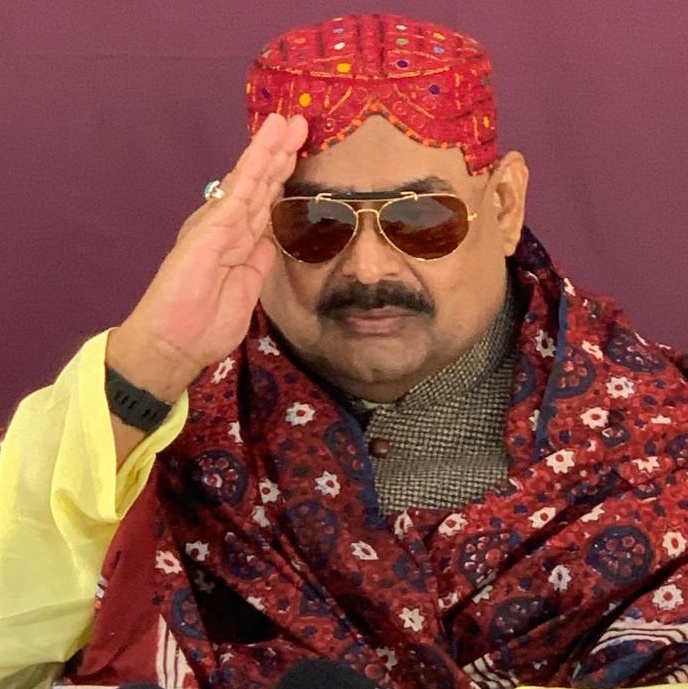
“We cannot call it true independence until India’s borders are restored to pre-partitions days, and the demography is restored to pre-British colonisation days,” Altaf Hussain said during his address to MQM (Muttahida Qaumi Movement) workers. The theme of Hussain’s lecture was “Incomplete Independence of India.”
Hussain further explained that thanks to the sacrifices of great leaders and freedom fighters, India attained independence in 1947 but this was an incomplete independence. “I ask the Indian leaders, historians, intellectuals, poets, writers, journalists, analysts and students whether all those leaders of the Indian independence movement had sacrificed their lives for complete independence of India or for a partitioned India?” Altaf Hussain asked without mincing his words.
Hussain added that Indian freedom movement was not for ‘incomplete’ independence. “The leaders of India, who called Muhammad Ali Jinnah responsible for the partition and an agent of British had also accepted India’s partition. Then what is the difference between Jinnah and them? How can those who sacrificed everything for the complete independence of India and those who have not yet recognised India’s partition till date be ignored?” queried Altaf Hussain. He went on to elaborate that the joys of India’s independence are incomplete until geographically her borders are not restored to the pre-partition regions.
Pakistan and East Pakistan (now Bangladesh) were part of India before the Indian subcontinent was partitioned on August 15, 1947. Both India and Pakistan were part of Indian subcontinent with a history spanning thousands of years and inhabited by Hindus, Muslims, Sikhs, Christians, Buddhists and followers of several other religions, sects and beliefs. “With the advent of colonial era the Britishers began to occupy other countries with the help of modern technology and military might. The British empire had spread over such a large part of earth that Sun was always shining on some part of its empire.”
“India was divided by the British, a British viceroy sat down and drew a line in the middle and that led to India’s partition. As a result of that partition not only the geography of India but also the families were divided, the heritage of families, the society, the civilisation and the culture all were divided. This is an unprecedented mockery of history in the name of freedom,” clarified Hussain.
Hussain said that India’s partition was the biggest mistake of history. This partition is a major sin and the biggest crime due to which the people of India and Pakistan are still suffering. “If there was no partition people on both sides would not had had to migrate, nor would our forefathers had to leave their homeland where they had been living for thousands of years and come to Pakistan. And we would not have been treated like strangers here in Pakistan. We would not have been treated with prejudice. We would not have needed to form the MQM.”
An emotional Altaf Hussain further explained: “Now our life is connected with Sindh, and Sindh is our homeland and we want to see Sindh as free.”
Addressing the Mohajirs he said that if a nation is not ready to break the chains of slavery and becomes accustomed to wearing the shackles of compulsion, then slavery, humiliation and disgrace will be their destiny from generation to generation.
“Therefore, you have to take off the veil of expediency, cowardice and selfishness and fight for the survival of your nation and for dignified life and for the better future of coming generations.”
We use cookies on our website to give you the most relevant experience by remembering your preferences and repeat visits. By clicking “Accept All”, you consent to the use of ALL the cookies. However, you may visit "Cookie Settings" to provide a controlled consent.
This website uses cookies to improve your experience while you navigate through the website. Out of these, the cookies that are categorized as necessary are stored on your browser as they are essential for the working of basic functionalities of the website. We also use third-party cookies that help us analyze and understand how you use this website. These cookies will be stored in your browser only with your consent. You also have the option to opt-out of these cookies. But opting out of some of these cookies may affect your browsing experience.
Functional cookies help to perform certain functionalities like sharing the content of the website on social media platforms, collect feedbacks, and other third-party features.
Performance cookies are used to understand and analyze the key performance indexes of the website which helps in delivering a better user experience for the visitors.
Analytical cookies are used to understand how visitors interact with the website. These cookies help provide information on metrics the number of visitors, bounce rate, traffic source, etc.
Advertisement cookies are used to provide visitors with relevant ads and marketing campaigns. These cookies track visitors across websites and collect information to provide customized ads.
Necessary cookies are absolutely essential for the website to function properly. These cookies ensure basic functionalities and security features of the website, anonymously.
Cookie
Duration
Description
cookielawinfo-checkbox-analytics
11 months
This cookie is set by GDPR Cookie Consent plugin. The cookie is used to store the user consent for the cookies in the category "Analytics".
cookielawinfo-checkbox-functional
11 months
The cookie is set by GDPR cookie consent to record the user consent for the cookies in the category "Functional".
cookielawinfo-checkbox-necessary
11 months
This cookie is set by GDPR Cookie Consent plugin. The cookies is used to store the user consent for the cookies in the category "Necessary".
cookielawinfo-checkbox-others
11 months
This cookie is set by GDPR Cookie Consent plugin. The cookie is used to store the user consent for the cookies in the category "Other.
cookielawinfo-checkbox-performance
11 months
This cookie is set by GDPR Cookie Consent plugin. The cookie is used to store the user consent for the cookies in the category "Performance".
viewed_cookie_policy
11 months
The cookie is set by the GDPR Cookie Consent plugin and is used to store whether or not user has consented to the use of cookies. It does not store any personal data.