It’s unlikely Narendra Modi doesn’t know India’s streets would be occupied henceforth under some pretext or other. How does Modi beat back this wolf dressed in lamb’s garb?
The Nature of Enemy Let’s first know the enemy. This enemy believes in taking over the public space. Their defence is since we are public, we don’t need permission to occupy public space. Thus begins a form of civil disobedience, howsoever minor.
It refuses to recognize the legitimacy of existing political institutions or legal order. It’s call is for Direct Action but is couched as ‘Citizenism’. The defiant insistence is acting as if one is already free. These Public Spaces soon turn into encampments.
A new slogan to create new institutions, new society, the New Democracy gets underway—even if it is inside the shell of the old. They operate as if they don’t have any internal hierarchy. That it works as a consensus-based direct democracy.
These Public Spaces become a Republic of its own, with its own kitchens, clinics, media centres, libraries, food courts, gyms and even entertainment lounges in due course. The society is polarized, social order deformed and Radical Left has gotten a new kiss of life.
It’s been over two centuries since John Adams, a founding father of the United States, uttered: “There never was a democracy which didn’t commit suicide.” This model of democracy is sold as one of Athens but in essence is one of Rome.
That is, if one was a society decided and run by the citizens, the other was one run through the representatives of the citizens.
Democracy such as ours could be sunk without a trace or rendered meaningless.
When civil disobedience occurs, the Rulers go less for batons and more for concessions which ends up abandoning their own reform agenda and alienates the majority of citizens who have elected them.
The majority wonder if the Rulers were necessary in the first place.
Soon enough, the Rulers go, their party is discredited, its business as usual, for the nation is taken over by corrupt and greedy, and colonialists resume their stranglehold on nations which they had once sucked dry.
The mode of enemy
It should be apparent to Modi by now that use of force is not an option; and relying on India’s judiciary is trusting a straw to swim across an ocean.
He also has to concede that disinformation is effective—700 dead farmers, for instance—and masses are lazy.
That refutations are seldom effective. The time lag has already conceded that advantage to disinformation monsters. You can’t be fighting a fire-emitting dragon with your squirt of truth.
That propagandists have the advantage of first impression. It’s rarely overcome. The audience is already primed. Falsehood and inconsistency has already gained traction;
He has to cede that repetition leads to familiarity and familiarity leads to acceptance and Corporate Media has perfected this art for decades;
Media plays the role of convincing people in an ideology nobody really believes exists—Equality, Freedom, Justice etc.—but most suspect that everybody else does;
It’s rapid, continuous and repetitive, and lacks commitment to consistency. Above all, it’s very responsive to events;
He has to cede that such propaganda has incredibly large volumes and is broadcast or distributed through hundreds of channels. Its text, audio, video, imagery is spread through internet, social media and traditional print and digital media.
There are paid internet trolls, online chat rooms, discussions forums and comments section in portals. Thousands of fake accounts are at work on Twitter or Facebook who work 24 hours a day and each has a quota.
The psychology literature tells us that more the surround sound around a propaganda, that is multiple channels playing it endlessly, and multiple celebrities and brands endorsing it, more is lent an unstoppable momentum.
When many endorse it leads to trust and reliance. Multiple sources make masses, lazy and indifferent, to trust the misinformation.
It’s a fact that Quantity indeed has a Quality of its own.
How does Modi tame the Beast?
So far Modi has believed that his work alone speak for him and his party. I am afraid it’s too simplistic against such a nuanced monster. It might not affect an RSS to engage in perception battle. But it would cripple BJP and this nation if this battle is not fought on the turf of enemies. And that means: * Create your own NGOs; * Don’t discourage the suffering majority—inconvenienced by the roadblocks, denied citizenship or justice—from coming to streets or occupying public spaces, as it were; * Don’t believe in refutations; be first to respond to events; second-guess the misinformation about to happen and educate the masses beforehand; speed is of essence; * Build your own information machinery; get masses, professionals, amateur journalists, media outlets involved in the evolving landscape of social media and internet; leave no stone unturned (If you have time, look for how Hungary does it against his and our nemesis George Soros). In short, overwhelm the audience.
This battle won’t be won by Modi’s shastra of constitutionality and morality.
It won’t help his reform agenda; save innocent lives in Bengal or provide citizenship to Hindu refugees; or weed out the ISI and Khalistanis who are bent upon balkanizing India.
It would keep on hold the laws he has in mind for farmers; the land and labour reforms; for his enemies wear the raincoat of deception, such as, say, environment.
During October 2021, the Balochistan Liberation Front (BLF) carried out eleven lethal attacks against the Pakistani forces, in which more than twelve Pakistani soldiers were killed and dozens injured. One attack was carried out on Pakistani military construction company, Frontier Works Organization (FWO). Seven BLF fighters embraced martyrdom defending Balochistan against the occupying forces of Pakistan.
2nd October 2021: On Saturday, Baloch Sarmachaars (freedom fighters) targeted a Pakistani military post at Bazdad Kulli in Kolwah with heavy weapons. Losses occurred to occupying forces.
3rd October 2021: On Sunday, Sarmachaars attacked Pakistan Army check post in GandKaur area of Bazdad Kolwah. It inflicted heavy losses to enemy forces.
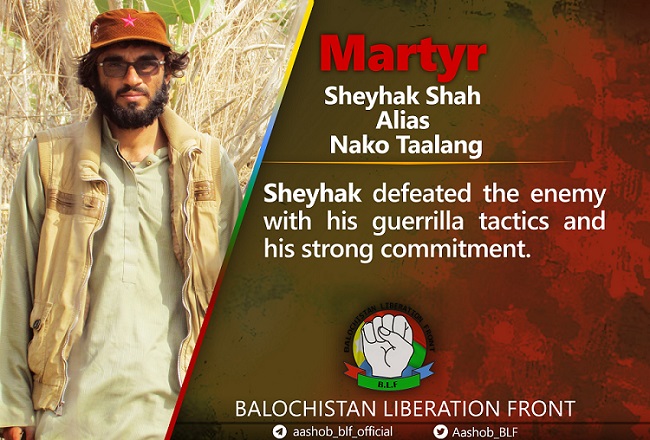
5th October 2021: Balochistan Liberation Front (BLF) spokesman Major Gahram Baloch paid homage to Shaheed Shayhak alias Nako Talang and said that he and his companions were on a routine patrol in the Nag area of Anjir Kahn, mountains of Kalbar on October 5, 2021 when at 2 PM, Pakistani regime backed Death Squad personnel opened fire on them. Thus began a long and bloody skirmish, in which Sarmachaar Second Lieutenant Shayhak alias Nako Talang fought very bravely and managed to free his comrades from the enemy’s siege. He fought to defend the Baloch land. Meanwhile, the Pakistan Army had also reached out to help the death squad.
Shaheed Shayhak Baloch had been fighting for Balochistan’s independence since 2013. He was also a very brave and a conscious revolutionary young poet. He had served on the fronts of Tump, Dasht, Balgatar, Buleda and Zamuran. With his ability, sincerity, and hard work he was promoted to the rank of Second Lieutenant. The Baloch Martyrs’ Mission “Struggle for the independence of Balochistan” will continue.
6th October 2021: A hand grenade was hurled at a Pakistani military post on Turbat Airport Road by Sarmachaars on Wednesday evening. The grenade fell inside the check post, causing casualties to the forces.
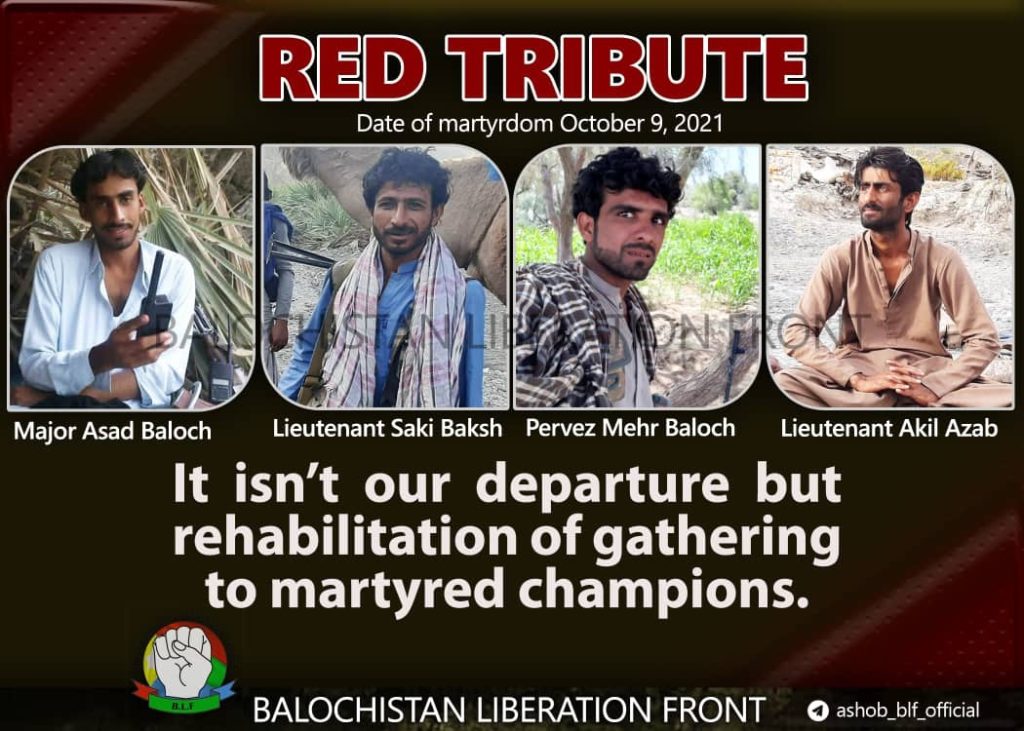
9th October 2021: BLF pays tribute to Sarmachaars Asadullah, Aqil Baloch, Sakhi Bakhsh and Pervez Baloch who were martyred in defense of Baloch land in Kolwah.
Spokesman of Balochistan Liberation Front (BLF) Major Gwahram Baloch while paying homage to Shaheed Asadullah Baloch, Shaheed Aqil Baloch, Shaheed Sakhi Bakhsh Baloch and Shaheed Pervez Baloch said that they were martyred while fighting bravely with the Pakistan Army in Kolwah.
On October 9, in the Madag Kaur area of Kolwah, the Sarmachaars and the occupying Pakistan Army came face to face, which led to a two-way clash in which the Sarmachaars inflicted heavy blows on the occupying army. In this battle, four BLF fighters were martyred while fighting valiantly for the independence of Balochistan.
Shaheed Asadullah Baloch alias Major Basit Baloch, a resident of Pasni, had been fighting against Pakistani occupation for the independence of Balochistan under BLF since 2011. His brother Sabir Baloch was forcibly disappeared by the Pakistan Army in order to force him to give up his struggle for Balochistan’s independence. When Asadullah Baloch did not come under pressure, the Pakistan Army martyred his brother Sabir in custody in November 2016 and dumped his mutilated body, claiming that he had been killed in an encounter. On March 4, 2016, his mother, Bibi Amna, was wounded by forces’ firing. Major Basit Baloch himself was injured in an attack by the Death Squad on January 3, 2016. Similarly, the Pakistani regime and its Death Squads martyred his three uncles, Lal Bakhsh on October 16, 2016, Yusuf Baloch on March 31, 2016 and Babu on August 11, 2018.
Martyr Major Basit was a talented young Sarmachaar. He was a member of BLF Makran Area Council and held the post of Major. He also wrote poetry in Balochi language. Shaheed Basit Baloch actively participated in the war against Pakistan on different fronts in Kolwah and different areas of Pasni and played a role in the activism of the organization in the said areas.
BLF salutes the Baloch martyrs who attained martyrdom while fighting the occupying Pakistan Army. (Photo: News Intervention)
Shaheed Aqil Azab Baloch alias Riaz Baloch, resident of Pasni, was associated with BLF since 2012. He was a lieutenant and a network commander. He has served in various areas of Pasni Kulanch, Kolwah, Balgatar, Zamuran, Gwarkop, and Parom. Shaheed Aqil Jan was also a good poet of Balochi language. Shaheed Abid Sawali is his brother who was martyred by the Pakistan Army in 2013. Similarly, Habib, Hanif and Yusuf from his family were martyred by Pakistan.
Lieutenant Sakhi Bakhsh Hussain son of Muhammad Hussain alias Mureed had been associated with BLF since 2013. Due to his combat skills and leadership skills, he was appointed as a lieutenant in BLF. He has been active against the enemy Pakistani regime on the battlefields of Awaran, Kolwah, Gichk, Keelkaur, Ormara and Balgatar.
Sarmachaar Pervez Mehr alias Malook joined BLF in 2014. He fought bravely in several battles against the enemy at Awaran, Kolwah, Keelkaur and Ormara. BLF extends its heartfelt condolences to the martyred Sarmachaars and vows to continue their national mission till the independence of Balochistan.
13th October 2021: On Wednesday evening, Sarmachaars attacked a Pakistan Army camp in Gaddagi, Baalgatar with snipers, rockets and heavy weapons, killing more than three soldiers and wounding several others.
At the same time, Sarmachaars fired four shells of rocket which fell inside the camp, causing loss of life and property to the Pakistan Army.
In another attack on this day, the Sarmachaars attacked the military construction company between Shand and Dar-e-Cham areas in Mand, working to set up a fence on the border.
19th October 2021: On this day at 8 PM, Sarmachaars fired rockets at a military post in Dasht, Perutag area of Kech district. The rocket landed inside the checkpoint, causing casualties to the forces.
In the Cheri Gaddagi area of Baalgatar, Sarmachaars laid a landmine in the way of the enemy army. An army personnel ran on it and was killed in the blast. Another Pakistan Army soldier was killed in a sniper rifle attack on a military post at Talaro in Jhaoo Nondara Tehsil of Awaran district.
20th October 2021: In Kech district, Sarmachaars attacked a military post in Sangistan Kandag area of Mand. Five soldiers were fetching water from a nearby river when they were shot dead by Sarmachaars. Meanwhile, a soldier standing for their security was shot dead as he came out of the front. Pakistani gunship helicopters arrived at the scene to pick up their dead and wounded after the attack.
21st October 2021: A check post set up to protect the mobile phone tower of Zong in the Chot area of Dasht was targeted by rocket-propelled grenades and automatic weapons. Two occupying Pakistan Army personnel were killed and others were injured when a rocket landed inside the check post. This mobile phone tower is located on the road built for the China-Pakistan Economic Corridor (CPEC) project. The tower was first attacked by sarmachaars who set fire to machinery and other equipment, after which a military outpost has been set up to protect it.
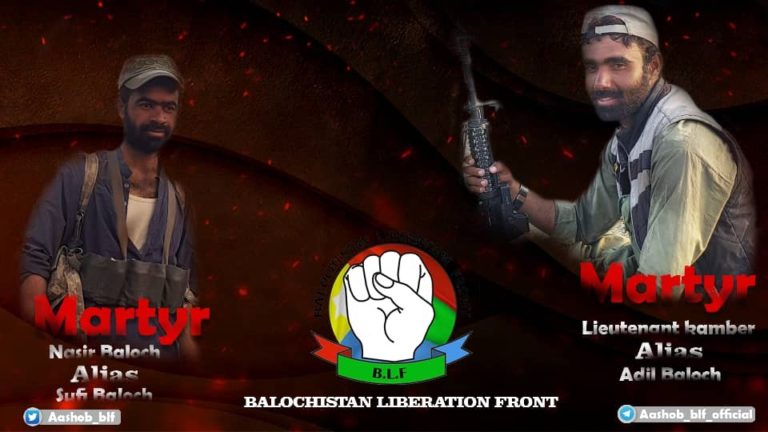
22nd October 2021: Major Gwahram Baloch, spokesman of Balochistan Liberation Front (BLF), while paying tribute to the martyrs of Panjgoor, said that there was a skirmish with the state-backed squad. The clash started at 5 AM in the morning and continued till 4:30 PM in the evening. In this clash Lieutenant Qambar Baloch alias Adil and Nasir Baloch alias Sufi fought bravely with the enemy. They killed and wounded several Pakistani personnel. They sacrificed their lives to get other comrades out safely.
Shaheed Qambar had been associated with the BLF
since 2012. He was a lieutenant in the organization. Shaheed Nasir Baloch
joined the BLF in 2013.
Shaheed Asim alias Naveed was the cousin of BLF’s Shaheed Qambar, who was martyred in 2014. Naeem Jan was also his cousin, who was martyred in 2014. His uncle Dr. Juma was martyred in 2014. His another close relative Qadeer was martyred in 2014.
24th October 2021: Sarmachaars attacked a military camp at Kuddan in the Dasht area of Kech district with rockets and heavy weapons inflicting heavy casualties on the occupying enemy forces.
The World is no longer One Family India boasts of her ancient civilizational code “Vasudhaiva Kutambakam” (world is one family). Unfortunately, today and for the foreseeable future, we will live in a multi-polar, fragmented but inter-connected world, where all nations are cooperating, competing, confronting and if required conflicting with each other in the political, diplomatic, informational, military and economic (PDIME) sphere, to establish/retain/expand their strategic space to realise their national aspirations and establish their place amongst the comity of nations.
Nations are hardly behaving like a harmonious family, with each building their comprehensive national power specially hard power and multi-domain capabilities. Every country’s destiny is dictated by its geo-political-strategic-economic environment which is no longer constant (even geography due to globalization and technology). India the ancient, proud civilization with a glorious history aspires to be and exhibits all the ingredients to be the pivotal balancing power in the World Order. We must be absolutely clear that ALL countries are in competition with India including our strategic partners, especially our known collusive adversaries China and Pakistan and immediate neighbours.
In future (two decades till 2040), it is envisaged that humans will continue to be central to the decision-making process, its character will be determined by politics, strategy, society and technology. There will be ever increasing employment of autonomous systems, disruptive technology and game changing kinetic and non-kinetic systems which are changing the nature of war/confrontation. There will be less emphasis on emotions, passion and chance. The international order is transforming with power increasingly diffused within and among states bringing fresh layers of complexities.
Why study future security trends? It provides focus to security policy makers, and Indian Armed Forces. It helps understand the future environment in which we all may find ourselves operating by 2040. The nature of ‘futures’ is such that attempting to pinpoint when particular trends or characteristics will emerge is invariably problematic. Some characteristics are likely to be similar to those apparent today, but dynamic factors (re-alignment of nations, emergence of hi-technology impacting environment, geo-pol-strategic-economic shifts) will emerge and some will become increasingly important in determining the future environment in comparison to today. By 2040, the Big Two (US and China) will have global reach, while lesser powers will try to influence regionally. China will dominate the regional security zones of Asia (East, South-East and South Asia). The probability of being in the midst of a cold war between USA and China with its attendant characteristics similar to the previous cold war is very high. India, while currently caught in the classical power play of global and regional security dynamics as its not yet a great power, should position itself as a ‘balancing power’.
An overview of Multi-Domain World (MDW) While threat of full-scale conventional wars has gone down, correspondingly the span of conflict, its complexity, unpredictability, lethality, accuracy, reach and manifesting into many domains have emerged. The physical and nonphysical domains including the cognitive have expanded. Competition is 360 degrees, 24×7, with no front, rear and flanks, and then there is no place to hide. Commonly held perception of deterrence and conflict has changed irrevocably. Specially after COVID-19, with a flux in the global power structure, nations are in a state of ‘persistent engagement’.
Warfare has already transcended the domains of soldiers, military units, and military affairs, and is increasingly becoming a matter for politicians, scientists, networks and even bankers! Four interrelated trends will define competition and conflict by 2040: Adversaries will contest all domains, with the electromagnetic spectrum (EMS) and the information environment gaining pre-eminence; smaller armies can fight on an expanded battlefield that is increasingly lethal and hyperactive; nation-states have more difficulty in imposing their will within a politically, culturally, technologically, and strategically complex environment; and states will compete below armed conflict (Pakistan’s game against India, Iran, North Korea vs USA). MDW calls for a change of thought process, ‘a transformation and not just modernisation[i]’
India is already engaged in a MDW Confrontation/conflict is a national effort and not fought by armed forces alone. Increasingly our adversaries China and Pakistan, have leveraged multi-domains to expand the battlefield in time (a blurred distinction between peace and war), in domains (space, cyberspace, information, psychological, diplomatic, legal), and in geography (now extended all India) to create strategic, operational and tactical payoffs, and achieve their objectives without resorting to armed conflict (stay below our red lines). Resorting to hybrid warfare and attempting to fracture our resolve (proxy war, salami slicing they are using ‘Three Wars’ concept. India and its armed forces must therefore commit and act to become a “full spectrum multi-domain entity”.
Evolving trends which will impact security environment and India A future security scan is incomplete without examining clearly discernible and distinct trends emerging (by 2040), which at first glance appear theoretical and esoteric, but will need careful analysis, planning, management and implementation for India to exploit/manage[ii].
Diffusion
of States: Internally and Externally. Asia
and Indo-Pacific will emerge as economic power centres, where the political and
military power of China (and to a lesser extent India), will grow, potentially
rivalling that of the USA. Other regional players EU, Russia, Iran, Turkey,
Japan, Australia, Nigeria, Brazil will remain important political actors, but their
influence is likely to diminish and the economic and soft power of the West
will reduce. Whether the current institutions, mechanisms and norms of the
international system can adapt to accommodate this shifting balance of power is
difficult to predict. If it cannot, there will be instability. Dispersed and
contested political power will make it harder to forge internationally-binding
treaties, and non-compliance and subversion of international laws are likely to
increase. The transition of power
between states is occurring alongside the diffusion of power within states.
A few multinational corporations will become bigger and more powerful,
providing vital services that states will depend on, and some will use their
power to demand concessions from the state. The sovereignty of the state will
diffuse and a more complex, potentially de-centralised, hybrid system of
governance may begin to emerge.
Ever increasing power and role of information. Processing power for the volume and variety of data, and network centric operations will continue to grow exponentially, driving the development of artificial intelligence (AI), quantum computing, big data, and the ability to solve problems of increasing complexity and difficulty, leading to improvements across all aspects of human endeavour. Digitisation, cyberspace, information is becoming pivotal to humanity, and ironically conflict. Information Influence Operations (IIO) to include social media will be pervasive creating ‘echo chamber’ effect, polarise populations, eroding trust in institutions, creating uncertainty, and fueling grievances. Difficulty in regulating cyberspace and social media will continue to be exploited by nations, corporates, global terrorist and criminal groups and other malicious actors.
Mushrooming Niche and Disruptive Technologies.The change to a significantly more automated world (4th Industrial Revolution) involving a range of new technologies that are fusing the physical, digital and biological worlds and impacting all disciplines, economies and industries, is likely to happen faster than previous transitions. Easy accessibility, quantity and quality of kinetic and non-kinetic systems is already changing the global economic and security landscape. This will be beneficial but equally disruptive. China is at the forefront in this field and will exploit her asymmetric superiority in all domains to the detriment of India.
Climate
Change and Environmental Stress, and Impact of Demographics. There will be spike in natural and man-made disasters with an enormous
impact on the economic and security environment. China and South Asia are
particularly susceptible to these developments. Disaster alleviation and
community action plans need urgent implementation. Whichever country manages
the environment better will enjoy a more stable and steady developmental
growth. There is sudden realisation of the adverse impact of poor demographics
and declining population; it can be a game changer and assist achievement of
national aspirations, or can even be the cause of a nations decline (Japan,
China, Russia).
Rising Human Empowerment. Human security, prosperity, health, awareness and empowerment will grow. The price would be more fragmented societies and increasing populism. Inequality is growing, and so is division within many countries, between those with liberal and those with traditional views; and nationalism, religious intolerance and antipathy towards immigrants are on the rise. Many governments are becoming more authoritarian, and even with some checks and balances, the rise of autocrats/dictators (Xi Jinping, Duterte, Kim Jong-un) who will be the final arbiters of a nation is growing. Knowing the mind and personality of leaders is assuming critical dimensions. In the triangular relations of China-Pakistan-India, we are looking at two illiberal nuclear weapon countries ruled by CCP/military, are collusive and believe in hybrid warfare. India must study its adversaries and their leaders thoroughly.
Manifestation of Trends impacting India Trends highlighted above can manifest in unexpected ways and complexities due to cross linkages. To illustrate; it may result in significant geopolitical shifts in alliances; major conflict (US-China; India-China; India-Pakistan); natural or man-made disasters; financial crisis; collapse of key multilateral organisations; proliferation of a disruptive technology; and 24×7 competition between nations which is already happening. Specific action plans need to be designed and activated to manage the trends; public, societal and political unrest, adversary’s IIO (influence information operations), disasters and climate change; scarce resources like water, rare earths; fair share of global commons (cyberspace, the oceans, polar regions and space). India needs to stay ahead of the loop so that our multi-domain capabilities and capacities are not impacted adversely, which could slow down our GDP growth, impact our freedom to operate in expanding strategic space, with grave consequences for our aspirations of being a regional player, and allow China along with collusive Pakistan and other countries in immediate neighbourhood (Bangladesh, Nepal, Myanmar) to exploit our vulnerabilities.
Deterrence Capabilities and Reputation Deterrence requires a national strategy that integrates PDIME (political, diplomatic, informational, military and economic) domains. India must develop strategies, plans and operations that are tailored to the perceptions, values, and interests of specific adversaries. Effective and successful deterrence warrants that our military capabilities and potential (pivotal ingredient) must be visible and known to all, and communication must be established with adversaries to generate the desired decision outcomes. In some cases, military capabilities may not be an effective tool to deter a particular adversary’s action, making other instruments of power the primary deterrent. We must constantly review our nuclear policy and capabilities in line with global trends specially of China and Pakistan. Additionally, coalition support should be integrated to enhance deterrence credibility, but deterrence must be viable as a unilateral strategy. Military options will always remain the final arbiter to achieve national objectives both proactive and reactive. Possessing adequate CNP alone is not sufficient and one must create a reputation (Israel, China, USA) for using deterrent tools when national interests/ sovereignty is at stake.
Is the answer a Grand Strategy for India? A grand strategy is a road map for how to match means with ends. It works best on predictable terrain, where policymakers enjoy a clear understanding of the distribution of power, a solid domestic consensus about national goals, and stable political and national security institutions. Economic and military power no longer yield influence as reliably as they once did. The result is an emerging world of multi-polarity and disorder, where grand strategy may not work well. For India, the answer possibly could be a mix of centralisation and decentralisation and evolving incrementally.
Conclusion Anticipating and exploiting emerging trends have the potential to position India as the world’s most influential democracy in the second half of the 21st century, giving it the ability to shape Asia, Indo-Pacific region and the dynamically evolving global order. Militarily, we need to be a complete multi-domain power. We have to play our cards carefully and deliberately, and create conditions (not just hope) for breaking out from South Asia to balance the security environment regionally, in Asia and beyond.
On the auspicious day of Prakash Purab (birth anniversary) of Guru Nanak Dev, Prime Minister Narendra Modi announced the decision of his party and his government to repeal the three farm laws. These laws, also called the Indian Agriculture Acts of 2020, were formally enacted on 27 September 2020, after having been passed by both houses of Parliament and given an assent by the President of India. The promulgation of the laws witnessed protests in many states, mainly Punjab, Uttar Pradesh, Haryana and Rajasthan.
Now, the government has submitted to the will of a small segment of the farmers who were not convinced about the benefits that would accrue from the laws. In taking this dynamic decision, Prime Minister Narendra Modi has upheld the highest traditions of democracy and exhibited his respect and love for the farmers. The prime minister has also maintained his internationally acclaimed stature of being a statesman who remains sensitive to the feelings of even the smallest segment of society.
While declaring the decision during the course of his address to the nation on the occasion of Gurpurab, the prime minister was humbleness personified in admitting that “Tapasiya Mein Kuch Kaami Reh Gayi”. What he meant was that though the farm laws would have been beneficial to a major segment of the farmers, but, he and his government failed to convince some segments of the community and hence the decision to repeal the laws altogether.
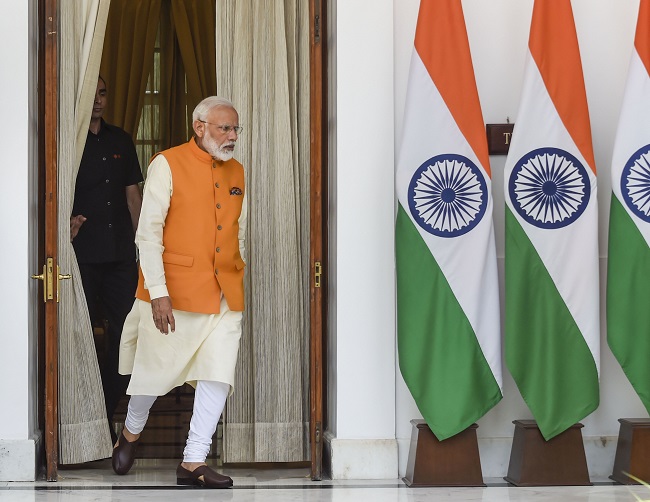
Prime Minister Narendra Modi addressing the nation on November 19, 2021 when he announced that his government would repeal the three farm laws.
On the issue of the remainder demands including a statutory legal guarantee that all farmers will receive minimum support prices for their produce and withdrawal of the electricity amendment bill, the union government has given an assurance that a committee of experts and farmer union representatives will be constituted to look into the matter and a decision taken after taking all views into consideration.
Politically speaking, in election bound Punjab and Uttar Pradesh, the decision has taken the wind out of the sails of most parties that oppose the BJP; the party is getting feelers from both the Shiromani Akali Dal (SAD) and from Captain Amarinder Singh for forging an alliance.
The Shiromani Akali Dal (SAD) is saying that the falling out of their decades old alliance with the BJP was due to the promulgation of the laws and now when the issue is no longer there, a resurrection of the alliance can be worked out. Captain Amarinder Singh, having left the Congress, is in the process of formulating a new party and needs support of the very big and powerful BJP. Apparently, both entities have realised that they have no political future without support from the BJP and are now desperate to get into an alliance.
The BJP in Punjab, however, has been working very hard over the last year or so to create a pan-Punjab signature. It has gained considerable success which will be supplemented by this latest decision of the government. Under these circumstances, to ally with the Akalis would spell disaster. Some sort of a seat sharing alliance with the new party being floated by Captain Amarinder can be worked out on the basis of like-minded views in charting a progressive future for Punjab.
While there is a wave of euphoria in Punjab at the declaration of the intent of the prime minister, many experts feel that while the farm unions have won the battle the farmers have lost the war. This situation offered an ideal opportunity to the farmers to bring about a change in the repressive agricultural practices of the “Adhathiyas” (farm produce traders) and move on to an independent course. There would have been initial hiccups but, with time, the process would have settled down to the benefit of the farmers.
This was also an opportunity to break free from the debilitating Wheat-Rice cycle that is causing unbearable damage to the soil in Punjab and will soon lead to a serious environmental disaster.
It would be best for the rice and wheat growing states like Punjab and Haryana to carry forward the process of reform albeit in a more deliberate manner. There can be a study of incentives to support farmers for switching from rice cultivation and declaration of a policy change rather than a law. In the deliberation stage care will have to be taken to ensure that rigid, obdurate positions are not taken since they can lead to breakdowns of talks.
Benefits have accrued in areas where an open view has been adopted, ‘eChoupal’ Initiative is helping farmers in procurement/planning etc and eventually to deal directly with the ultimate buyer of their produce. Fishermen are using mobile apps to check prices in various markets up and down the coast and then sailing to and selling into the market offering the highest prices. Such innovations can change the face of agriculture.
It has to be kept in mind that the farmers of Punjab succeeded in the green revolution which was backed by the government by switching their agriculture practices to cultivation of paddy and wheat in a big way. The same should now not be looked upon as a liability, instead, more remunerative and ecologically sustainable alternatives need to be put in place. This would require a dynamic leadership at the regional level working in close coordination with the centre. Creation of such a leadership model, thus, should be a priority for the people of Punjab.
Once the prime minister has given an assurance that the repeal process will be taken up in the next session of parliament, it was expected that the farm union leaders would immediately call off the agitation. The statement of the farm union leaders of waiting till the process culminates amounts to embarrassing the highest executive office in the country and increasing the woes of the farmers whom the prime minister wishes to see in their respective homes before the onset of winters. The Modi government is committed to the welfare and development of agriculture sector across the country. It is due to the efforts of the government in provision of seeds, keeping fertiliser prices in control, crop insurance, easy finance, direct benefit transfers etc. that a marked increase in agriculture produce has been witnessed in the country in the last few years. There is a need to build trust on the basis of this reality.
It’s no secret that Rawalpindi rules Pakistan through its ‘selected’ civilian proxies in Islamabad. And then there are pawns, who are bred upon extremist Wahhabi thoughts, to keep the civil proxies under check. Anything good is promptly credited to the Rawalpindi generals and everything that’s wrong slides into the account books of these proxies and pawns.
In April 2021, TLP chief Saad Hussain Rizvi was arrested for instigating riots during protests that demanded expulsion of French ambassador from Pakistan and severance of all diplomatic ties with France. Thousands of Labbaik members were arrested across Pakistan and put to jails. Saad Rizvi was brutally tortured in police custody. Imran Khan’s government was on the offensive and it seemed that Tehreek-e-Labbaik would soon be history. Come October and there was a drastic change in the landscape.
General amnesty was announced for all TLP members and over 3000 were released from various prisons of Pakistan. There are reports about generous doles being handed over to Labbaik members so that they could ‘start afresh’. Even as other Labbaik members stepped out of prison cells, Saad Hussain Rizvi continued to remain behind bars. By now he had graduated from being called a proclaimed offender to being a state guest who has been placed under ‘house arrest’. Over the last fortnight Saad Rizvi was involved in hectic backdoor negotiations with the generals of Pakistan Army.
Pakistan Army soldiers shouting Islamist slogans along with the Tehreek-e-Labbaik cadre in Islamabad in April this year.
A jittery Islamabad explained these developments as ‘peace initiative’ to contain Islamic extremism, and released Saad Rizvi only after seeking commitments from him that TLP cadre would refrain from violent activities. At least, this is the popular narrative being propagated by Islamabad.
The inside story is different, rather
murky.
The current ruling faction of
Pakistan Army led by Gen Qamar Javed Bajwa wants to continue its stranglehold
on Pakistan well beyond November 2022, when Gen Bajwa is scheduled to step
down. The ‘selected’ prime minister Imran Khan is desperate to step out of
Bajwa’s shadows with able support from another section of Pakistan Army led by
Lt. Gen Faiz Hameed, who himself dreams to be the all-powerful Army chief.
Gen. Bajwa is still smarting due to the open defiance shown by his ‘selected PM’ Imran Khan when he refused to immediately endorse Lt Gen Nadeem Anjum as the next ISI chief. Imran Khan shares bonhomie with incumbent ISI chief Lt Gen Faiz Hameed and wanted him to continue in office. Officially the ISI chief is appointed by Pakistan PM, but that’s just on paper. The diktat as to who would be the next ISI chief comes directly from Pak Army chief and civil government is expected to simply sign on the dotted lines.
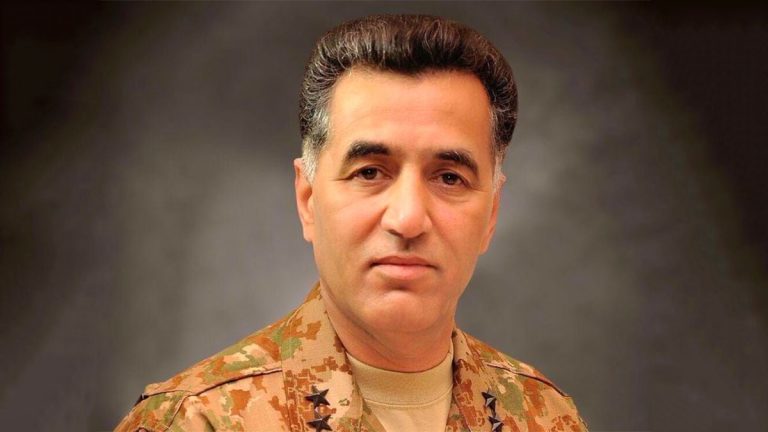
Lt Gen Faiz Hameed. He has been removed as the ISI chief by Gen Qamar Javed Bajwa.
Imran Khan ‘dared’ to delay Lt Gen Nadeem Anjum’s appointment as ISI chief by a fortnight, which was enough to send a message that Gen Bajwa is now a fading star and that the next generation within Pak Army must start their ground work to grab power.
As factionalism within Pakistan Army came to the fore, Gen Bajwa looked for a pawn to make his move. In this backdrop Tehreek-e-Labbaik Pakistan (TLP) and its chief Saad Rizvi fit the bill for Bajwa.
Akin to all other Islamic extremist
organisations in Pakistan, TLP has also been created by the ISI. However, despite
a large following Saad Rizvi is still a political novice in Pakistan’s
political landscape. Yet he nurtures big ambitions. When Bajwa faction of the Pakistan
Army reached out to him, Saad Rizvi sniffed an opportunity and willingly agreed
to play along the tunes of Gen Bajwa. At least for now.
Factionalism
within Pakistan Army
Imran Khan’s defiance to Gen Qamar Javed Bajwa has brought to fore the factionalism within Pakistan Army. Lt Gen Faiz Hameed has all along been eyeing to be the all-powerful chief of Pakistan Army. Gen Bajwa knew about Faiz Hameed’s ambitions and went ahead to sort him out, hoping that Imran Khan would play along. But Imran Khan had now switched loyalties as he too wants to cling on to power in the post-Bajwa era.
Bajwa knows quite well that the moment he steps down as Pak Army chief, corruption charges would be slapped against him and he would be forced to flee Pakistan and live in exile like Gen Pervez Musharraf.
Tehreek-e-Labbaik enters in this murky state of affairs. Adherents of radical Barelvi School of Islamic thought, TLP cadre could easily inflame passions in the name of Islam and foment trouble across Pakistan. In return, TLP gets financial backing to stay afloat.
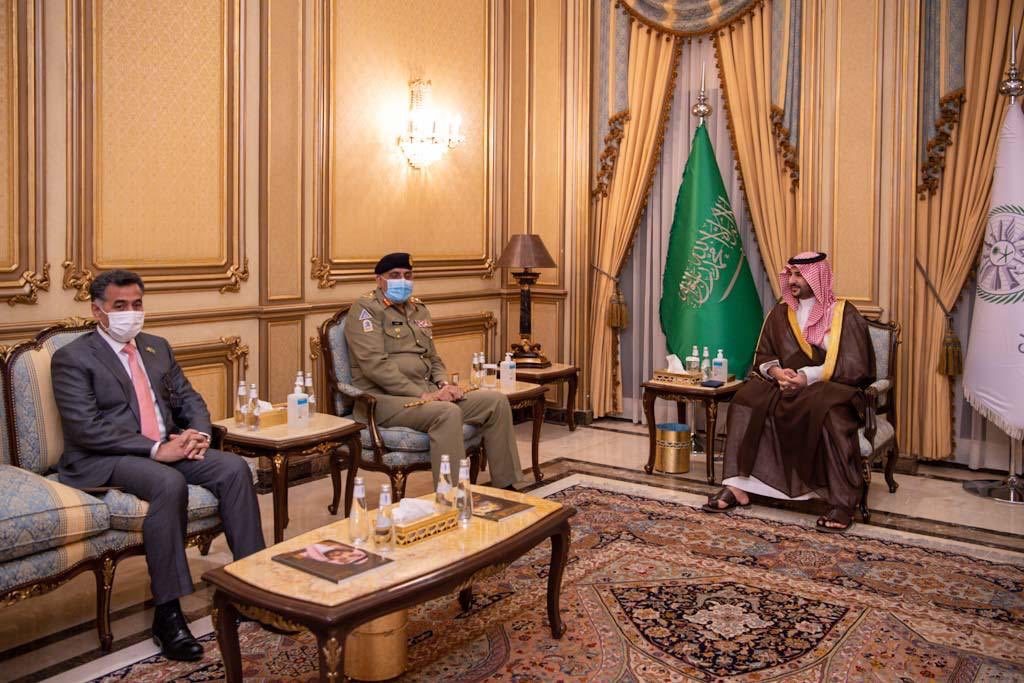
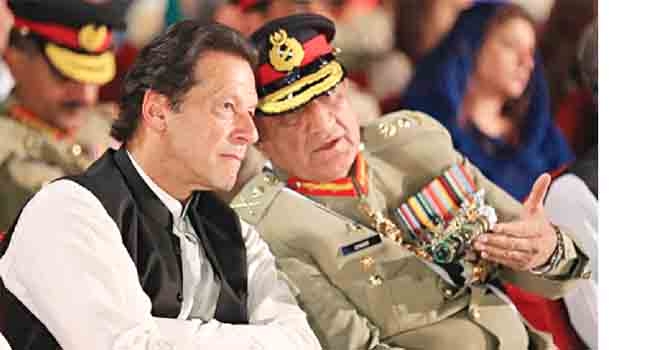
Pakistan’s Army Chief Gen. Qamar Javed Bajwa (middle) with Khalid bin Salman (right), Deputy Defence Minister Saudi Arabia during a meeting in Riyadh on August 18, 2020. Despite requests Saudi Crown Prince Mohammed bin Salman refused to meet Gen. Bajwa and he had to return back to Rawalpindi. (File photo)
Imran Khan must have understood by now that Labbaik members are no pushovers and with tacit support from GHQ Rawalpindi they will be the major disruptors across Pakistan in the near future. During the last three years TLP has taken to the streets nine times and each time the government was forced to come on its knees. Imran Khan had wanted strict action against Labbaik but the military establishment has vetoed all such plans.
Barely a couple of months ago the Labbaik members were on streets creating mayhem. Islamabad’s civil government had to dig up trenches and unleash heavily armed policemen to contain Labbaik’s hooliganism. Clashes between TLP workers and police have so far killed several policemen.
Saad Rizvi’s release and his rousing welcome means Tehreek-e-Labbaik is gearing up to foment trouble on a turn-key basis.
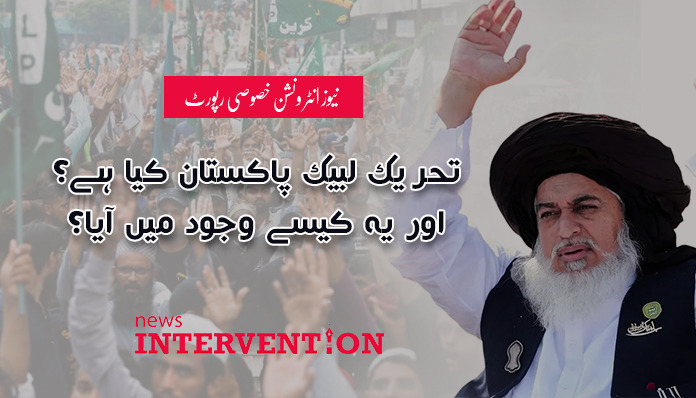
History of Tehreek-e-Labbaik
Pakistan (TLP)
Khadim Hussain Rizvi, follower of
the Barelvi school of radical Islamic thought, laid the foundation of Tehreek-e-Labbaik
Pakistan (TLP) in 2017. A preacher at Lahore mosque, Khadim Hussain Rizvi worked
in the department of endowments.
In 2011, a Punjab Police guard Mumtaz Qadri murdered Punjab Governor Salman Taseer over Taseer’s sympathizing with Asia Bibi, a Christian woman. Asia Bibi was wrongly convicted under Pakistan’s dubious blasphemy laws and Salman Taseer had expressed his concern over misuse of blasphemy laws. This was good enough reason for Mumtaz Qadri to feel offended and kill Salman Taseer.
Founder of Tehreek-e-Labbaik Khadim Hussain Rizvi died in November 2020. After Khadim Rizvi’s death, his son Saad Hussain Rizvi became the chief of Tehreek-e-Labbaik.
Khadim Hussain Rizvi openly
supported Mumtaz Qadri’s murderous act and started drumming up support for
Qadri’s release. Rizvi was fired from his job but he remained undeterred.
In January 2016, Khadim Rizvi held a
rally in favour of Mumtaz Qadri without the government’s permission. Later,
when Mumtaz Qadri was hanged Khadim Rizvi turned to Islamabad’s D-Chowk to
protest against his hanging. After Rawalpindi’s intervention Khadim Rizvi ended
the protest after four days and announced that he would form an Islamic
religious party by the name ‘Muqtah Labbaik Pakistan al-Rasoolullah’. Thereafter
this Labbaik motley held several protests across Pakistan’s Panjab province,
most notably at Islamabad in 2017 with active support from Pakistan Army and
the ISI.
The Labbaik movement helped Rawalpindi remove the then Pak Prime Minister Nawaz Sharif and install their new puppet PM—Imran Khan at Islamabad in 2018.
The Labbaik movement had grown in size and the world came to know about it as Tehreek-e-Labbaik Pakistan (TLP).
Thereafter, Tehreek-e-Labbaik contested the 2018 general elections and garnered over 2.2 million votes. Khadim Hussain Rizvi was emboldened by now and Labbaik members started thinking that Islam rests on their shoulders. When row erupted over France’s Charlie Hebdo magazine about Prophet Mohammed’s caricatures the Tehreek-e-Labbaik Pakistan (TLP) under Khadim Rizvi demanded that French ambassador be deported from Pakistan. TLP also demanded a total boycott of French products in Pakistan and severance of all diplomatic ties with France.
However, Khadim Hussain Rizvi died abruptly in November 2020 and his son Saad Rizvi was appointed as the new chief of Tehreek-e-Labbaik Pakistan. TLP continued its movement to boycott France. In April 2021 the Imran Khan government arrested Saad Hussain Rizvi along with thousands of Labbaik members.
The trajectory of Tehreek-e-Labbaik Pakistan (TLP) can be further understood by having a closer look at a similar sounding tanzeem Tehreek-e-Taliban Pakistan (TTP). Just like the Labbaik the Tehreek-e-Taliban was ISI’s pawn that carried out attacks across Pakistan killing thousands. Both Labbaik and TTP draw inspiration from Wahhabi extremism and vow to establish Islamic caliphate across the world. After the fall of Kabul, TTP shifted its base to Afghanistan and has grown bigger than the shoes provided by Pak Army and ISI. The Tehree-e-Taliban has now begun attacking Pakistani security forces with the help of Afghan Taliban, bringing huge embarrassment to GHQ Rawalpindi.
Bajwa knew his time was running fast and he cannot rely on the Tehreek-e-Taliban to further his interests. He was getting restless. After careful evaluation Labbaik was chosen. Saad Rizvi is young, restless and, most importantly, ambitious. In the coming weeks expect Tehreek-e-Labbaik to increase its activities across Pakistan. Saad Rizvi will be branded as the saviour of Islam and Tehreek-e-Labbaik will leave no opportunity to embarrass Imran Khan. As Pakistan slips into chaos General Qamar Javed Bajwa would use the opportunity to curb the wings of Imran Khan and assert his position.
One of the rarer stories coming from the ex-Muslim community known to me, as an independent journalist with an interest in research into these personalities and communities, comes in the personhood of Rishvin Ismath. As noted by Giovanni Gaetani of Humanists International, he is the “only outspoken ex-Muslim of Sri Lanka.” If not, then the only major ex-Muslim outspoken figure from Sri Lanka known to me, so should be commended, as such.
Here he writes about the differences between a Muslim, an Islamist, and a Jihadist, this comes from a Sri Lankan perspective.
By Rishvin Ismath
It was witnessed that certain media portrayed the attackers merely as Muslims while they were reporting about an attack that happened a few days ago in Stuttgart, Germany when a group of activists were commemorating the death anniversary of French school teacher Samuel Paty, who was murdered in 2020 for the allegation of displaying a picture of prophet Mohamed in the classroom. The news reporting of the Stuttgart attack was an ample example for the common ambiguity among the precise meaning of the terms Muslims, Islamists & Jihadists. The ambiguous usage of these terms can widely be witnessed on public space such as political, media and social media platforms. Improper usage of such sensitive terms can clearly lead to hatred against the innocents.
Muslims are ordinary people, just like all other ordinary people, but they accept and follow Islam as their religion. Muslims live as same as every other ordinary people other than the specific instances when they do their religious rituals. They make up the majority of those who are commonly identified as ‘Muslims’ in the censuses. Some of them pray five times a day, some others pray once or twice a day, there are still others who pray only on Fridays, while some others pray twice or thrice a year. Regardless of the interval in which they engaging religious rituals, all of them are identified as Muslims in general. According to them, their day-to-day life is not dominated by religion in toto.
There’s a small dominant group within the Muslim community that uses hegemonic powers to control the community. The small dominant group is identified as ‘Islamists’. The facts about them are still hardly exposed to the public. Islamists hold threatening and dangerous hidden ideas such as, ‘Only Islam should rule the whole world, Islam is the only solution to all the problems in the world, every activity in the world should be carried out according to the Islamic teachings, all Muslims should follow Islam in toto, Islam should be propagated to everyone in the world, Jihad should be declared against the people who do not accept Islam, sacrificing the lives for the sake of Islam is the greatest honor etc. They work in different platforms, performing different roles with long-term agendas.
It is wrong to imagine that all such people have long bushy beards and are dressed in Arabian attires. Most of them present themselves in stylish appearances and they intrude various fields and platforms methodically. They do not normally directly involve in to violence and terrorism, however, they are well capable of producing persons who can engage in direct violence and terrorism. They possess the ability to engage in violence and in terrorism, only when it is highly necessary for them to do so. They are so subtle as to use the leftists and the progressive forces which are concerned about the oppression of Muslims to achieve their own targets as well as for political lobbying.
The Islamists are well capable of subtly justifying violence, sexual discrimination, scientific contradictions and superstitious beliefs etc found in Islamic scriptures with appealing words and tactics, they believe that they do Jihad by the pen. Whenever the Jihadists carry out terrorist attacks, Islamists take a well-analyzed stand to suite to the developing circumstances and the emotions of the masses. They would design their stand in accordance with public opinion. ‘Islam has nothing to do with this’ is one of their widely used rhetorics for cover-ups. They do not hesitate to exemplify freedom struggles to justify terrorist attacks when they decide to do wise-versa. They are mostly highly skilled in carrying out the tasks they are assigned according to the long-term agenda. Their intrusion into the country’s key sectors such as education, administration, media, non-government organizations etc is a well planned and methodically executed one. Insertion of extremist and harmful materials into the school textbooks that are capable of creating hatred and spreading violence, accreditation obtained by Sri Lanka Jamathe Islami’s students wing from the government department for the residential training conducted by them under various bogus titles to establish an Islamic State in Sri Lanka and permission obtained by Sri Lanka Jamathe Islami’s student wing to use the state embalm for the above said residential trainings are some visible examples of the results of the methodical intrusion by Islamists into the key state sectors.
The third group, ‘Jihadists,’ generally evolves from among the Islamists. Jihadists are the people who use violence, terror and assault weapons to achieve what the Islamists believe and what Islamists ploy to achieve through long-term agendas. Jihadists remain to be Islamists until they are prepared to carry-out terror attacks. ‘A non-Islamist Muslim’ directly becoming a Jihadist is a very rare phenomenon. A Jihadi suicide bomber can blow himself up only one time, but every single Islamist is capable of creating a countless number of Jihadi suicide bombers
I do continue to expose Islamists and their secret ploys until this very day within my capacity, but I do not mean that they will blast bombs immediately. They, too, would buy their own time to detonate such things in their own way, they act only when the right time comes for them according to their own almanac. Therefore, it cannot be predicted to happen immediately in the broad day light. I made my first detailed statement to the intelligence about Zahran and his ISIS affiliation in July 2016, but nothing happened straightaway. It took nearly 03 years for Zahran and his bunch of terrorists to launch the suicide attacks on Easter Sunday of 2019. It is not easy to predict when Islamists of the present day would detonate their long-term plans. I am not aware of any official records that mention anyone else has made a statement to law enforcement regarding Zahran’s ISIS affiliation prior to my statement registered in July 2016. Immediately after the Easter Sunday attacks, a number of Islamists deleted their previous postings on social media platforms such as Facebook and suddenly started to share anti-Zahran posts with the idea of hoodwink the law enfocement and the public to pose that they too were oppose to Islamic terrorism. When Mohamed Thaslim was shot in Mawanella following the destruction of the Buddha statues in the area, I exposed the background of the shooters of Taslim in Facebook, but individuals connected to Sri Lanka Jamathe Islami tried to silence me.
Sri Lanka Jamathe Islami is a Jihadist as well as an Islamist Organization that operates in Sri Lanka with a long-term agenda. They are the pioneers in sending Sri Lankan Muslim youth to places such as Afghanistan, Pakistan and Kashmir for Jihad fighting and Jihad training. Most of the Islamists who are currently operating in Sri Lanka were trained and moulded by Sri Lanka Jamathe Islami. Even though the fact that the ordinary Muslims and the Islamists are not the same, the Islamists never allow the fact known by the public. The Islamists prefer to mingle and hide among the Muslims and they like to show that they are intergral part of the Muslim community. The Islamists are well experienced and very proficient in using the term ‘Islamophobia’ very effectively to silence the criticism and questions against them.
‘All the Sri Lankan Muslims discuss about Islamic State’ was part of the statement of Hajjul Akbar, former leader of Sri Lanka Jamathe Islami, before the Presidential Commission of Inquiry on 26th October 2020. Sri Lanka Jamathe Islami works with a secret long-term agenda to form an Islamic State in Sri Lanka. When Hajjul Akbar was questioned about the secret agenda of Sri Lanka Jamathe Islami, he made the above statement in response. The above statement of Hajjul Akbar can be considered as an attempt to portray their own secret agenda as the agenda of Sri Lankan Muslim community at a point when their agenda was exposed and questioned. This statement is a good example of how Islamists try to make Muslims a scapegoat for protecting themselves and their own interests. This is the main reason that the Islamists do not want the world to know that Muslims, Islamists and Jihadists are not the same. Islamists are well aware that their survival solely depends as long as they are mingled together with Muslims. Regardless of the subtle attempts of the Islamists, the Muslim Community should become strong enough to come forward to identify, expose and expel the Islamists. Otherwise Muslim Community may face hardships over and again.
A popular belief has been forming among the Sri Lankans following the Easter Sunday Suicide attacks that Sufi Muslims are peaceful people and there’s no danger to the country from them. Hence nowadays, many Islamists attempt to disguise themselves as Sufi Muslims and share the quotes of famous Sufi Saints like Moulana Rumi in social media. All parties, including Sufi Muslims, should be vigilant about this chameleon attitude of the Islamists.
As an ex-Muslim and ex-Islamist, exposing secrets about Islamists that have not yet been exposed to public is life threatening to me, but I will not become silent unless I am silenced. I will continue to expose Islamists, jihadists, terrorists, extremists and their secret agendas, plans and teachings and will continue to strive for it until my last breath. During the eras when Muslim community was led by Muslim leaders, it achieved and gained many successes and privileges in the fields such as law, education, employment, industry and sports. Many of the privileges and rights enjoyed by the Muslim community at present were bestowed during the period of Muslim leaders. Muslims were highly respected by other communities during that period. But when the Islamists began to highjack the leadership of the Muslim community from the Muslim leaders, the Muslim community has become a community looked down on by suspicion and hated by others. When it comes to the leadership of Islamists, indoctrination of extremist ideology, brainwashing Muslim youth to introduce international Islamic terrorism, exposing the Muslim youth to international terrorist organizations and creation of Islamic terrorism within them were the many harmful things Islamist leadership feed to the community. Islam was practiced as a peaceful religion until the arrival of Islamist leadership; once the Islamist leadership took control of the community, it reintroduced Islam as a fascist ideology that thinks it should rule the whole world alone by destroying all other political, religious and social ideologies. As long as Islam was practiced only as a religion in a peaceful way, things were calm, but Muslims and others lost their peace of mind from the moment when Islamists started to present Islam as a fascist ideology.
It is the responsibility of all those who love humanity to rescue Muslims from Islamists. It is unfortunate that many leftists and progressive thinkers do not understand or do not want to understand the difference between Islamists and Muslims. Because of that, the left and the progressive fronts who claim to be in support of the Muslim minority are actually joining hands together with the Islamists, the same Islamists who oppress the Muslims. Those who love Muslims should not join hands with Islamists, instead, they should try to liberate Muslims from Islamists. The time has come for the progressive fronts and the left to take a clear stand on whether they are working hand in hand with Muslims and Ex-Muslims or the oppressive Islamists. If they genuinely care about the oppressed, they should no longer do the contradictory act of joining hands with the oppressors by merely saying ‘we are with the oppressed.’
Let’s come back to the Stuttgart incident with the understanding of the differences between the said three groups for the conclusion of this article. It is appropriate to call the murderer of French school teacher Samuel Paty as a jihadi and to call those who attacked the participants of the commemoration of Samuel Paty as either jihadists or Islamists. It would be entirely wrong for generalize such people as Muslims and it would lead to the making of Muslim hatred or Muslimophobia. Therefore, it would be appropriate to use the terms jihadist and Islamist in proper context instead of generally referring to them as Muslims.
— — — — — — — —
Rishvin Ismath is an ex- Muslim and ex-Islamist.
He left Islam in 2013. He is the only public ex-Muslim in Sri Lanka.
He is the spokesperson for the Council of Ex-Muslims of Sri Lanka (CEMSL) at present.
He was one of the co-founders of CEMSL.
Police interrogations following the Easter Sunday Suicide Attacks confirmed that Islamists led by Zahran had attempted to kill him a few times for apostasy.
Rishvin appeared before the Parliamentary Select Committee on 20th June, 2019 and exposed the extremist materials in School Textbooks.
He provided his statement to the Presidential Commission of Inquiry on March 07th 2020 and May 13th, 2020.
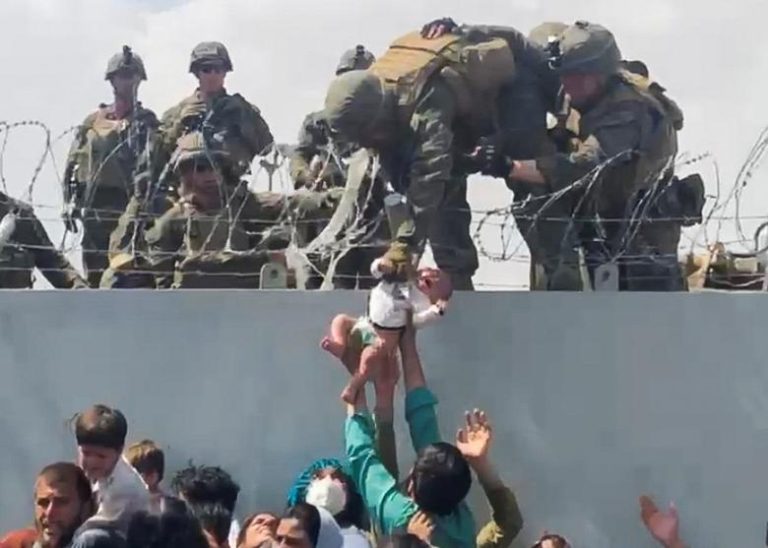
There can be no two views that the monstrous humanitarian crisis precipitated by the Taliban’s forcible takeover of Afghanistan is fast spiraling out of control. Though there is global unanimity that the hapless people of war-torn Afghanistan are in dire need of succour, the international community has not been able to arrive at any consensus on a concerted plan to provide emergency aid. Resultantly, we are seeing heart wrenching visuals and reading tear jerking reports of how scarcity of food and other essential items has become a life-threatening reality in Afghanistan.
When viewed through the prism of emotionality, it appears that the international community has abdicated moral responsibility by its failure to ameliorate the suffering of the impoverished people of Afghanistan by providing them humanitarian assistance. However, there’s a flip side too. How can any type of assistance be provided to a country whose leaders have not only usurped power through force of arms but have also outrightly rejected the international community’s reasonable demand for forming an ‘inclusive’ government in Kabul by inclusion of members of minority ethnic groups?
But things
don’t end here. Kabul has also made it abundantly clear that it’s in no mood to
accept UN resolutions and universally accepted standards on issues like gender
equality, rights or modern jurisprudence. Though it may claim otherwise, but
with visuals of surrendered Afghan National Army soldiers been murdered, a
corpse dangling from a flying helicopter, or dead bodies of alleged kidnappers
being suspended from cranes for public viewing, it’s quite apparent that
Taliban of today is much the same as it was two decades ago. This assessment is
further vindicated by credible reports of continuing extrajudicial killings of
people associated with the previous regime or coalition forces as well as the recent
incident of people listening to music [banned by Taliban] during a wedding
being shot dead.
It could
well be argued that even though the Taliban government may be despotic and
unyielding, but making humanitarian aid contingent to their acceptance of
internationally acceptable laws and conventions is tantamount to punishing the
people for the ‘sins’ of their rulers. This viewpoint has great merit and this
is the harsh reality. However, another associated ugly truth is that providing
unconditional aid to Afghanistan will in effect, actually end up strengthening
the Taliban’s hand in running its repressive writ. Moreover, with the Taliban
announcing its ‘food for work’ programme, there are bright chances that food
items provided as international aid would end up being used as ‘currency’ by
Kabul to pay its employees and fighters, thus depriving the real sufferers.
However,
despite serious shortcomings and the extremely high probability of its diversion
by Kabul, humanitarian aid can’t be held hostage to Taliban’s obduracy. Nor can
the excuse of preventing mass starvation be used by the international community
to abdicate its collective responsibility for preventing persecution of
minorities and ensuring basic human rights to the people of Afghanistan as
guaranteed by UN charter.
So, there’s a need to evolve a balanced approach that fulfills the humanitarian requirements as well as compels the Taliban to respect international laws and conventions. One such workable via media could be distribution of aid under the watch of a UN monitoring agency so as to guard against its diversion or misuse. After all, no country would like the aid it has provided being doled out to those who beat up women protesters or shoot people listening to music!
The broad
outline of this option is that the Taliban government suballocates foreign aid
received to various provinces/areas and undertake its physical distribution. UN
observers only physically monitor the latter to ensure that the needy receive
the same. Since this proposal doesn’t entail any foreign interference in the
internal aid distribution scheme within Afghanistan, the Taliban cannot cite
sovereignty issues for rejecting this plan. With fighters and not
administrators at the helm of affairs and given the Taliban’s past record of
financial impropriety while fighting the Soviets, apprehensions of aid being
siphoned off are live. So, presence of a neutral UN Monitoring agency for
ensuring judicious aid distribution is inescapable, and should be insisted
upon.
Even though it may sound insensitive, the reality is that while there is undoubtedly a massive humanitarian crisis in Afghanistan, the Taliban too is overplaying the emotional card so that it can get unconditional access to foreign aid without taking any reciprocatory actions like respecting international laws and honouring individual rights. A few days ago, news reports purportedly originating from (or sourced to) Afghanistan, mentioned of how cash strapped locals were being forced to sell off their minor daughters. Just the other day, a heart wrenching video showing such a repugnant transaction took social media by storm with people imploring the international community to act post haste so as to end this abhorrent trend.
This video deserves
special mention as it captures the entire event- from money being laid down for
the ‘purchase’, to the reluctant girl being handed over by the mother to an
aged male who is accompanied by a woman. It ends with the girl departing and being
nudged to move on as she appears to be unwilling to leave her home and parents.
While this tear-jerker video is bound to melt even the most hardened hearts,
what defies explanation is to who filmed it? Logically speaking, only three parties
could have been involved- one, the minor girl’s parents; two, the ‘buyer’ and
three, an outsider.
Even in Taliban controlled Afghanistan, sale of humans is illegal, due to which the buyer or seller of the girl certainly wouldn’t film an act that could lead to their corpses hanging from cranes at a public square. Similarly, they wouldn’t have allowed a third person to record evidence that could precipitate their extinction. So, its obvious that this video is nothing more than publicity material for emotional blackmail to secure foreign aid. (Even though there’s no evidence to conclusively prove who made this video, but it certainly has many characteristics that bear striking similarities with publicity material produced by Pakistan Army’s media wing Inter Services Public Relations [ISPR]- like shooting of the entire sequence using multiple cameras, excellent choreography and remarkable editing!)
When it comes to institutionalising expediency or overdoing things, perhaps few countries can match Pakistan’s ingenuity. In fact, credit for resurrecting thirteenth century renowned English cleric and jurist Henry de Bracton’s famous maxim- “that which is otherwise not lawful is made lawful by necessity” goes to erstwhile Chief Justice of Pakistan [CJP] Muhammad Munir.
CJP Munir used this ‘mother of all expedients’ way back in 1954 to enable the Supreme Court of Pakistan in legitimising the extra-constitutional use of emergency powers by Pakistan’s Governor General Ghulam Mohammad to unlawfully dismiss the Constituent Assembly. So, the world needs to thank Pakistan for providing an expedient principle whereby a normally criminal act is justified by the necessity of preserving something of greater utilitarian value than that lost or sacrificed.
As far as overdoing things is concerned, a classical example is the Criminal Law Amendment Bill 2020 passed by Pakistan’s National Assembly [NA] passed last year. Section 500 of Pakistan Penal Code [PPC] states: “Whoever defames another shall be punished with simple imprisonment for a term which may extend to two years, or with fine, or with both,” which unambiguously provides every Pakistani citizen protection against slander. Yet, the National Assembly still added unwarranted redundancy in PPC by inserting Section 500-A, which is an exclusive provision providing protection to the armed forces of Pakistan against ridicule, being brought to disrepute or being defamed.
Ironically while slamming the Criminal Law Amendment Bill 2020 Minister for Science and Technology Fawad Chaudhry said, “it’s absolutely ridiculous idea to criminalise criticism; respect is earned, cannot be imposed on people.” By uttering these words didn’t the Minister for Science and Technology Fawad Chaudhry himself ridicule, bring to disrepute as well as defame the armed forces of Pakistan? Chaudhary was indeed lucky that the military didn’t notice his indiscretion!
That the Pakistan Army is extremely sensitive to criticism is no secret. Readers would recall Dawn reporter Cyril Almeida’s 2016 exclusive report [“Act against militants or face international isolation, civilians tell military”]. Dubbed ‘Dawn Leaks’ this exposé led to the removal of Minister for Information and Broadcasting, Pervaiz Rasheed and Special Assistant to Pakistan’s Prime Minister on Foreign Affairs Tariq Fatemi. Almeida was placed on ‘exit control list’- which is usually reserved for economic offenders, hardened criminals involved in acts of terrorism and conspiracy.
Pakistan Army’s intense anger after ‘Dawn Leaks’ is apparent from the fact that it even disregarded basic military courtesy by allowing [or directing?] Director General [DG] of Pakistan Army’s media wing Inter Services Public Relations [ISPR] holding the rank of Maj Gen, to humiliate the Prime Minister of Pakistan and establish Rawalpindi’s writ by tweeting, “Notification on Dawn Leak is incomplete and not in line with recommendations by the Inquiry Board. Notification is rejected.”
However, this incident wasn’t an
aberration.
Two years later, while addressing a press conference, DGISPR spoke about the increasing number of Pakistani social media users who were indulging in “anti-state, anti-Pakistan, anti-army, anti-forces” activities. He also issued a not so veiled threat that “We have the capability to monitor social media as to who is doing what.” While public admission of monitoring social media by Rawalpindi, which brazenly violates the constitutional right to privacy of Pakistanis indicates that Pakistan Army is a law unto itself, no one complaining against this unlawful act or seeking legal redressal only goes to show that Pakistanis know very well that ‘taking on’ the army is fraught with danger and futile!
This is precisely why a computer engineer named Hasan Askari writing a letter in which [according to BBC Urdu] he not only criticised Pakistan Army chief Gen Qamar Javed Bajwa’s controversial extension, but even sought his resignation, is indeed bewildering. Since Hassan is the son of retired Maj Gen Mehdi Askari, he would have known the grave consequences of crossing swords with the mighty Pakistan Army and thus, many opine that his letter criticising the army chief was tantamount to a ‘self-inflicted’ injury.
One had expected that the ‘delinquent’ computer engineer would be tried by a civil court under the newly promulgated Section 500 A of PPC since his letter being critical of the Pakistan Army chief could be interpreted as an act that “intentionally ridicules, brings into disrepute or defames the Armed Forces of Pakistan or a member thereof.” However, to everyone’s shock and horror, Askari was charged under Section 131 of PPC, which relates to abetting mutiny by seducing members of armed forces from “his allegiance or his duty.”
Even more intriguing is that despite being a civilian, Askari was even tried by an army Field General Court Martial. Though surprising, it wasn’t completely unexpected as the stakes for the army were very high and an issue on which the Pakistan Army doesn’t believe in taking any chances- it was all about saving Gen Bajwa. That’s why there are no prizes for those who had prognosed beforehand that Askari would ultimately be found ‘guilty’ and handed down a five-year prison term!
The diehard activists of Lord Curzon’s “Great Game in Central Asia” of the mid-19th century, working in tandem with the new brand of Islamists in the sub-continent, focused attention on one particular objective of stonewalling India’s access to the west and north. This unfolded on them the strategic importance of Jammu and Kashmir. Months ahead of the actual withdrawal of the British on August 15, the conspiracy of leading an incursion into the princely state of Jammu and Kashmir was secretly discussed in Peshawar.
Brigadier Akbar Khan of the Pakistan Army working in close collaboration with some junior British Army officers drew the details of “Operation Gulmarg”, the code name for the invasion of Kashmir by the lashkars. The conspirators took the leaders of the pro-Pakistan J&K Muslim Conference on board.
On 17 July 1947, about a month earlier than the declaration of the independence of India, All J&K Muslim Conference (AJKMC) held a convention in Srinagar, at the residence of Sardar Muhammad Ibrahim Khan, prominent Muslim Conference leader (later on founder-President of the Azad Kashmir Government) wherein a majority of the participants decided in favour of the state’s accession to Pakistan. Only Choudhri Hamidullah Khan, the then acting President of AJKMC was in favour of the independence of J&K State.
Operation Gulmarg was Pakistan’s code for the Kashmir operations. Indian military sources say that Pakistan Army prepared a plan called Operation Gulmarg and put it into action as early as 20 August 1947, just six days after Pakistan became the newly independent state. The plan got accidentally revealed to Major O.S Kalkat, an Indian officer then serving with the Bannu Brigade as Brigade Major. He had read a ‘Top Secret’ letter written by General Frank Messervy, the Commander-in-Chief of the Pakistan Army addressed to Kalkat’s Commanding Officer Brig. C P Murray. Pakistani officials suspected Kalkat and placed him under house arrest. He escaped and made his way to New Delhi on October 18.
The story of hatching the conspiracy of Kashmir incursion has been admirably traced by the twin authors of the well-known volume Freedom at Midnight (Dominique Lapeer and Larry Collins, Vikas Publishing House, pp 436 Et seq.)
On 24 August, Jinnah told his military secretary Col William Birnie to go to Kashmir and arrange for him a two-week stay there in September to recover from exhaustion. Five days later the British officer returned with a reply that stunned Jinnah. Maharaja Hari Singh did not want Jinnah to set his foot on his soil even as a tourist. Jinnah understood that the situation in Kashmir was not evolving according to the plan he had envisioned. Forty-eight hours later Jinnah government infiltrated a secret agent into Kashmir to evaluate the situation and determine Maharaja’s real intention. The agent’s report was shocking. Hari Singh had no intention of joining his state with Pakistan.
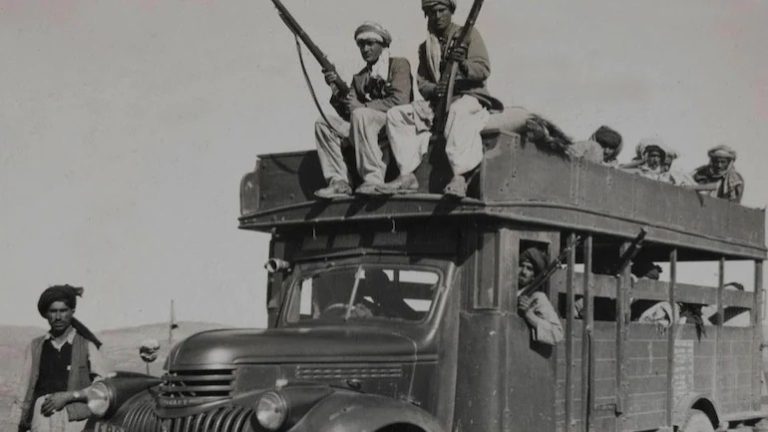
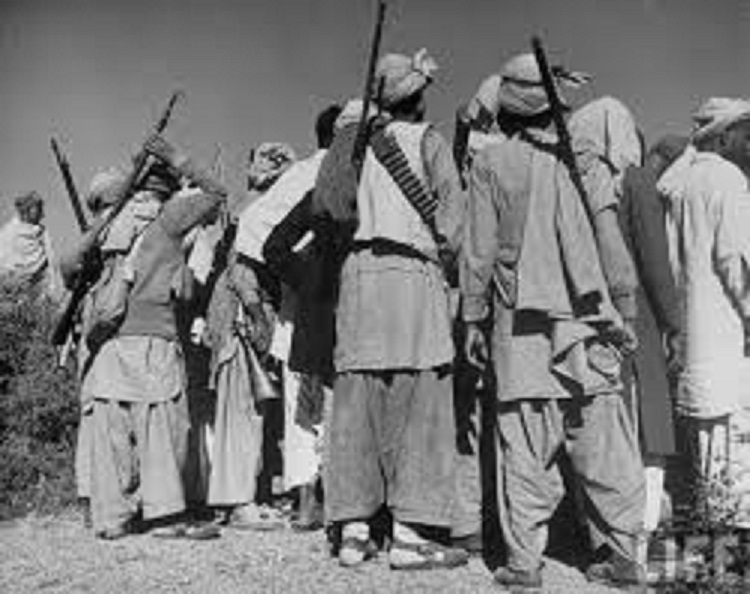
Pakistan-backed tribal raiders who launched the Kashmir attack on Oct 22, 1947.
In mid-September, PM
Liaquat Ali Khan convened a secret meeting of a select group of collaborators
in Lahore to decide how to force the Maharaja’s hands. The plan of NWFP chief
minister Qayyum Khan of deploying tribesmen for Kashmir incursion was agreed
upon. King Zahir Shah of Afghanistan was already instigating the Pathans for
rejection of the Durand Line and also the expansion of the Afghan kingdom up to
Peshawar. Sending these barbarous tribesmen to Kashmir for the twin purpose of
waging Islamic jihad in an infidel-ruled state and providing a big opportunity
to the tribesmen for general loot and rapine of infidels in Kashmir were good
enough to make the conspiracy a success.
The operation had to be complete secret and finances were to be provided from the secret fund of the Prime Minister. Neither the officers of the Pakistan Army or her civil servants nor the British officers and administrators in the service of the new state were to be given access to the secret.
Three days later in the cellar of a ramshackle building in Peshawar’s old walled city, a group of tribal leaders met the man chosen to arouse their emotions and lead them on their march to Srinagar. He was Major Khurshid Anwar. Within hours, in the mud-walled compounds of their villages in Landi Kotal along the Khyber, the Pathans passed the ancient call of Islam for war, the jihad. From one bazaar to another bazaar secret emissaries began to buy hardtack and gurh, a mixture of cornmeal, ground chickpeas and sugar. Taken twice or three times a day the mouthful could sustain a Pathan for days.
The British officers in NWFP, Governor Sir George Cunningham and Lt Gen Sir Frank Messervy, the Commander-in-Chief of the Pakistan Army were talking to each other on the telephone as this: Cunningham: I say, old boy, I have the impression that something strange is going on here. For days, trucks crowded with tribesmen chanting Allah-o-Akbar have been pouring through Peshawar. My chief minister seems to be stirring up the Pathans. Are you certain that the government is still opposed to a tribal invasion of Kashmir?” Messervy: “I can assure you I’m opposed to any such idea and the Prime Minister has personally given me his assurance he is too.” Cunningham: “You would better inform him of what is going on up here.”
Liaquat Ali Khan’s
government had arranged the departure of General Messervy to London to
synchronise with the march of the tribesmen into Kashmir. Before leaving for
London for arms negotiations, Messervy enquired of Prime Minister Liaquat Ali,
who assured him saying, “His (Messervy’s) fears were groundless. Pakistan would
not tolerate such an action. I shall immediately contact the Chief Minister of
the Province and order him to stop his outrageous action.”
This is the story of
the conspiracy of tribal invasion of Kashmir in 1947. This is also the story of
the first prime minister of Pakistan telling lies and falsehoods. We have
another source of information about the conspiracy.
Sardar Shaukat Hayat, the then President of All India Muslim League writes that he was given the command of the Kashmir invasion and he asked for the services of Brigs. Sher Khan and Akbar Khan. Gen Kiyani (formerly of INA), Col. Dara and Taj Khanadeh were also associated with the planning of the Kashmir invasion. He adds that Khurshid Anwar contacted the chiefs of about fifteen tribes of NWFP who included Afridis, Mahsud, Yusufzai, Wazir, SubhanKhel, Mohmand and Mengal etc. These tribal lashkars were led by religious leaders like Pir of Manki Sharif, Pir Sahib Lander, Pir Zakodi Sharief, Kaptan Mir Badshah Mahsud, Badshah Gul Mohmand and others
Researchers had noted
the considerable movement of Pukhtoon tribesmen during September-October 1947.
By 13 September, armed Pukhtoons drifted into Lahore and Rawalpindi. The Deputy
Commissioner of Dera Ismail Khan noted a scheme to send tribesmen from Malakand
to Sialkot in lorries provided by the Pakistan government. Preparations for
attacking Kashmir were also noted in the princely States of Swat, Dir and
Chitral. Robin James Moore (Making the
NewCommonwealth, 1982) states
that “there is little doubt that Pashtuns were involved in border raids all
along the Punjab border from the Indus to the Ravi.”
Pakistani sources deny
the existence of any plan called Operation Gulmarg. However, Shuja Nawaz, a PoK
author lists twenty-two Pushtoon tribes involved in the incursion of Kashmir on
22 October 1947. In Muzaffarabad, nearly 5,000 Sikhs and Hindus were massacred
in cold blood and about 1800 Hindu and Sikh girls were abducted and sold for
rupees two a person in the markets of Lahore, Rawalpindi and Peshawar.
On 13 October 1947 prominent leaders of the Muslim Conference had met in Paris Hotel in Rawalpindi. The meeting resolved to set up an Azad republican government. It said that Maharaja Hari Singh’s government would cease to exist from midnight of 14 October 1947.
Dr Malik Abdul Ghani Asghar writes (Kashmir ka uruj wa zawal) that the underground government of Muzaffarabad worked on a scheme of arresting Maharaja Hari Singh. The names of some Kashmiri political activists were given in code only. The task of organizing the volunteer force for the Kashmir campaign was left to one Chowhan the commander-in-chief for internal forces in Kashmir. The temporary Azad Kashmir Government made a formal announcement saying that nobody was permitted to run the administration in Azad Kashmir under the instructions of the Maharaja’s government.
There is some
controversy about the beginning of the “Azad Kashmir Government”. Some writers
say that the first President of the clandestine government was Sardar Ibrahim
Khan while others believe that Ghulam Nabi Gilkar was the real originator of
the underground rebel government announced as early as 14 April 1947. However,
it appears that in its formal composition on 24 October, Sardar Ibrahim Khan
was declared the head of the clandestine government. On that occasion, Ibrahim
is reported to have issued a declaration the text of which has been incorporated
by Prem Nath Bazaz in his work History of Freedom Movement in Kashmir (pp
622-23).
Gilgit-Baltistan On the expiry of the lease deed of 1935 and with the transfer of power, Gilgit-Baltistan would have reverted to the State of Jammu and Kashmir on August 15, 1947. However, instigated by Captain Brown, the British Commander of the Gilgit Scouts, the force rose in a rebellion. With the help of the Pakistan Army he besieged and arrested Thakur Ghansara Singh, the Governor of Gilgit appointed by the Maharaja of J&K. Captain Brown offered Gilgit to Pakistan on a platter.
Captain William Brown betrayed Maharaja Hari Singh and helped Pakistan capture Gilgit-Baltistan.
On 28 April 1949
Pakistan, through a proclamation, separated Gilgit-Baltistan from the so-called
Azad Kashmir and gave it the name of Northern Areas. In violation of relevant
clauses of the Security Council’s resolutions on J&K, a tripartite
agreement between Pakistan, Azad Jammu and Kashmir and the Muslim Conference
was signed on 28 April 1949 at Karachi. Northern Areas meaning Gilgit-Baltistan
were detached from PoK and the bogus government of PoJK was institutionalised.
No representative of Gilgit-Baltistan was included among the signatories to the
agreement. This is how an area of 72,9712 square kilometres was illegally
grabbed by Pakistan out of which, later on, she ceded nearly 5,000 sq km to
China plus 13,297 sq km of “AJK”.
Gilgit-Baltistan met
with a chequered history. It was administered by a Secretary in the Kashmir
Affairs Ministry of the Government of Pakistan. No democratic dispensation and
hence no developmental programme for the region left the people disgruntled and
dissatisfied so much so that the movement of the people for the liberation of
their land from the grip of Pakistan has turned into a national liberation
movement. The flames of dissatisfaction are stoked by inviting China to grab
the strategic territory in the name of development. The massive presence of PLA
in the region has increased the security concerns of India.
In the final analysis, we find that what Pakistan names “Azad Jammu and Kashmir” is actually an illegally occupied territory. World Watch: Human Rights Watch Report vol. 18, no 11@ September 2006 terms Azad Jammu and Kashmir “a legal anomaly”. According to the UN Resolution dating back to 1948, “Azad Kashmir” is neither a sovereign state nor a province of Pakistan rather a local authority with responsibility for the area assigned to it under a 1949 ceasefire agreement with India. It has remained in this state of legal limbo since that time. In practice, the Pakistan Army and government in Islamabad and the Pakistani intelligence service (ISI) control all aspects of political life in Azad Kashmir — though “Azad” means free, the residents of Azad Kashmir are anything but free. They face curbs on political pluralism; freedom of expression and freedom of association; a muzzled press; banned books; arbitrary arrests and detention and torture at the hands of the Pakistani military State. Singled out are Kashmiri nationalists who do not support the idea of Kashmir’s accession to Pakistan. Anyone who wants to take part in public life has to sign a pledge of loyalty to Pakistan, while anyone who publicly supports or works for an independent Kashmir is persecuted. For those expressing independent or unpopular political views, there is a pervasive fear of Pakistani military and intelligence services and militant organizations acting at their behest or independently.” (Ten Studies in Kashmir History and Politics by K.N. Pandit p.58).
This is how Pakistan
created a bogus state called “AJK” in 1947 and then illegally grabbed the
Northern Areas of Gilgit–Baltistan with the connivance of the British colonial
functionaries. India has every right to take back the areas that legally belong
to her. The people of both regions demand that they are repatriated to the
original State of Jammu and Kashmir.
*Original publication in HumanistFreedoms.Com, by HumanistFreedoms.Com Team.*
Dr. Lloyd Hawkeye Robertson is a Registered Doctoral Psychologist with expertise in Counselling Psychology, Educational Psychology, and Human Resource Development. He earned qualifications in Social Work too.Duly note, he has five postsecondary degrees, of which 3 are undergraduate level. His research interests include memes as applied to self-knowledge, the evolution of religion and spirituality, the aboriginal self’s structure, residential school syndrome, prior learning recognition and assessment, and the treatment of attention deficit disorder and suicide ideation.In addition, he works in anxiety and trauma, addictions, and psycho-educational assessment, and relationship, family, and group counselling.
Here he speaks with HumanistFreedoms.Com about “The New Enlightenment Project.”
HumanistFreedoms.Com: What is the New Enlightenment Project and why did you (the organizers) create it?
Dr. Lloyd Hawkeye Robertson: The New Enlightenment Project was established with three objectives. First, we aim to provide education on the enduring qualities of reason and compassion which define humanism. Second, we affirm that the application of humanist values that flow from a stance firmly rooted in reason and compassion will necessarily change over time. One forum for accomplishing this, for example, is provided by Humanists International and their initiative to amend the Amsterdam Declaration of 2002. This process of updating is part of the “new” in the “New Enlightenment.” Third, since there is no deity that can give us the final word, we must depend on each other honing our knowledge through open discussion and free debate. We provide that forum.
HumanistFreedoms.Com: How will NEP be different from other humanist-branded organizations? What will NEP do that others aren’t already doing?
Robertson: The NEP is inclusive. We recognize that there is a wide range of opinion within humanism and that humanists often have differences in focus. But we also believe that we need a venue where humanists can have difficult conversations about controversial topics. Humanist Canada had such an open discussion group which they shut down last year. They then engaged in discussions with the Centre for Inquiry – Canada about creating a joint open discussion forum, but they have been unable to create such a forum. In the meantime, NEP has created two such forums, one on our website and one on Facebook, and these forums are open to everyone. To our knowledge, we are the only humanist organization in Canada providing this opportunity, and we invite all humanist organizations to embrace this initiative.
HumanistFreedoms.Com: What does NEP see as the top priorities for humanism and humanists now and in the coming years? Within Canada? Globally?
Robertson: There are many contemporary issues of concern. One of our top priorities is to come to terms with indigeneityin a postcolonial world. There are those who consider themselves to be allies of the descendants of the colonized who call science and reason “Western” and who promote “other ways of knowing.” When you think about it, this position is quite racist. It is saying that science and reason belong to Europeans and their decedents. Further, it is patronizing to suggest that faith based “other ways of knowing” is somehow equivalent to the enlightenment afforded by empirically verified research. Humanists need to come to terms with how these fundamental values can relate to traditional indigenous cultures. To help accomplish this the NEP participates in an Aboriginal Circle aimed at combining aborigineity and humanism.
There are other injustices that are worth fighting against. For example, with the recent Taliban takeover of Afghanistan we are witnessing the re-imposition of Medieval practices that include beheadings and the use of amputation to enforce religiously based authoritarian laws. We are part of a coalition of humanist groups raising public awareness and lobbying for government recognition and support of humanists, atheists and apostates as refugees. While this hearkens back to the original Enlightenment that concerned itself with replacing feudal structures, we must contend with modern economic forces that can also bring injustice.
I think humanists also need to also celebrate the achievements our movement has helped produce. Secularism is on the rise. We have achieved fantastic gains in combating racism and sexism. We need to continue to fight injustice while being wary of beliefs that are anti-scientific and discourage open inquiry. Compassion, which is an essential part of humanism, must be extended to all.
HumanistFreedoms.Com: What does NEP see as the greatest threats to humanism and humanists now and in the coming years? Within Canada? Globally?
Robertson: Humanism is under attack. It was always thus. We recognize the primacy of human reason in generating knowledge about knowledge about reality. Religionists have maintained that human reason is faulty and we need guidance from a deity. Totalitarians like Martin Heidegger have argued that science and reason are faulty and we need guidance from a great leader or Fuehrer as to ultimate “truths.”
In Canada we have become quite effective in fending off the attacks of religious fundamentalists. Globally, however, we have to deal with religiously infused authoritarian regimes, particularly in the Muslim world, who harass, jail and even execute atheists. Our defence of these humanists and apostates is hampered by the attitude of some North Americans who should be our secular allies but who provide deference to Muslim authoritarianism under the notion that these authoritarians represent victims of oppression.
In Canada, humanists are facing attacks from these people who identify themselves as secularists as well as from religious fundamentalists. In an article that was published earlier by Humanist Freedoms I identified these secularists as the Woke. These Woke operate from the premise that objective knowledge is impossible and that even science and reason are “white, male ways of knowing.” We have been slow to recognize and respond to their challenge. The NEP aims to take up their challenge.
HumanistFreedoms.Com: HumanistFreedoms.com attempts to present a portrait of contemporary humanism and humanists in its articles; how does New Enlightenment Project, an organization whose name seems to be focused on the past, relate to contemporary issues and reflect a contemporary humanism?
Robertson: The Age of Reason never really ended and is responsible for the scientific explosion we still see today, but there are attempts to make it seem old, passe. But without the grounding provided by the Enlightenment, humanism ceases to be humanism. Respecting the dignity of the individual is impossible if the individual is denied. If there is no individual who can reason, then all knowledge must be granted by a deity or some analogous ideological structure. If there is no objective reality, then science, empiricism and reason are empty culturally sanctioned performances. Put succinctly, humanism is grounded on the idea that there is a reality that exists outside of ourselves and we can come to know that reality through careful observation.
The Enlightenment affirmed a capacity that was already present in the individual. In my book The Evolved Self, I trace the modern structure of the self that balances both individualism and collectivism back 3,000 years. Steven Pinker, in his new book Rationality states that the capacity to reason is much, much older than that, and while this is certainly correct, the self that did the reasoning and put meaning to the process has evolved. A new self that was volitional, continuous and uniquely felt evolved from the old, but it was almost immediately constrained by organized religions. The Enlightenment released those bonds for increasing numbers of mankind, and we have been living the Enlightenment ever since.
But social, political and cultural contexts continually change. We have problems such as global warming, overpopulation and globalization that were not present 400 years ago. While the original Enlightenment was concerned with replacing feudalism, the New Enlightenment must concern itself with recent global capitalism in the digital age and the rise of a new Woke educated aristocracy. The New Enlightenment uses the capacities that are already inherent in the self to amend and update humanism making it very contemporary. Those who would deny those capacities would return us to the Dark Ages.
The views, opinions and analyses expressed in the articles on Humanist Freedoms are those of the contributor(s) and do not necessarily reflect the views or opinions of the publishers. (Message from original publication.)
We use cookies on our website to give you the most relevant experience by remembering your preferences and repeat visits. By clicking “Accept All”, you consent to the use of ALL the cookies. However, you may visit "Cookie Settings" to provide a controlled consent.
This website uses cookies to improve your experience while you navigate through the website. Out of these, the cookies that are categorized as necessary are stored on your browser as they are essential for the working of basic functionalities of the website. We also use third-party cookies that help us analyze and understand how you use this website. These cookies will be stored in your browser only with your consent. You also have the option to opt-out of these cookies. But opting out of some of these cookies may affect your browsing experience.
Functional cookies help to perform certain functionalities like sharing the content of the website on social media platforms, collect feedbacks, and other third-party features.
Performance cookies are used to understand and analyze the key performance indexes of the website which helps in delivering a better user experience for the visitors.
Analytical cookies are used to understand how visitors interact with the website. These cookies help provide information on metrics the number of visitors, bounce rate, traffic source, etc.
Advertisement cookies are used to provide visitors with relevant ads and marketing campaigns. These cookies track visitors across websites and collect information to provide customized ads.
Necessary cookies are absolutely essential for the website to function properly. These cookies ensure basic functionalities and security features of the website, anonymously.
Cookie
Duration
Description
cookielawinfo-checkbox-analytics
11 months
This cookie is set by GDPR Cookie Consent plugin. The cookie is used to store the user consent for the cookies in the category "Analytics".
cookielawinfo-checkbox-functional
11 months
The cookie is set by GDPR cookie consent to record the user consent for the cookies in the category "Functional".
cookielawinfo-checkbox-necessary
11 months
This cookie is set by GDPR Cookie Consent plugin. The cookies is used to store the user consent for the cookies in the category "Necessary".
cookielawinfo-checkbox-others
11 months
This cookie is set by GDPR Cookie Consent plugin. The cookie is used to store the user consent for the cookies in the category "Other.
cookielawinfo-checkbox-performance
11 months
This cookie is set by GDPR Cookie Consent plugin. The cookie is used to store the user consent for the cookies in the category "Performance".
viewed_cookie_policy
11 months
The cookie is set by the GDPR Cookie Consent plugin and is used to store whether or not user has consented to the use of cookies. It does not store any personal data.