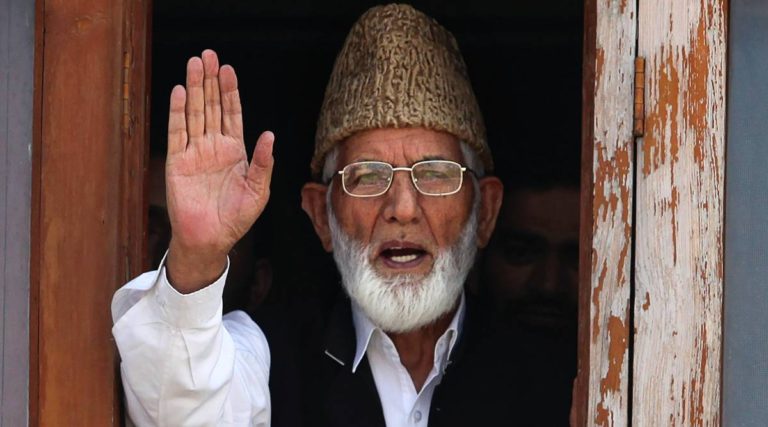
“It is a real tragedy that Geelani was buried in India and not in Pakistan.” This statement posted on Facebook by Indu Jalali, a Kashmiri Pandit lady living in Europe, aptly summarises the widespread sentiment at the demise of Kashmiri separatist, Syed Ali Shah Geelani, at age 91, on September 1, 2021.
Geelani was the kingpin of separatism in Kashmir. In order to remain relevant he chose to become a stooge of Pakistan and proverbially ‘sold his soul to the devil’. For a better part of his life he sang the tune that Pakistan’s Inter-Services Intelligence (ISI) wanted him to sing and made pro-Pakistan and anti- India statements at its behest. His open bias towards Pakistan created strong doubts within Kashmir about his political motives.
Pakistan, however, started washing its hands off him far back in 2015, when he was dumped unceremoniously due to political expediency. He boycotted the Eid Milan Party hosted by the Pakistan High Commissioner in New Delhi that year, ostensibly in protest against non-inclusion of Kashmir in the talks between Prime Minister Narendra Modi and Nawaz Sharif at Ufa in Russia. In actuality, he was expressing his frustration at being marginalised. Later, he started singing the Pakistan song all over again even though Pakistan refused to respond. It is astounding that after being used like a puppet, he continued to show servility to Pakistan. Later, in 2020 Pakistan relented and awarded him the Nishan-e-Pakistan which also heralded the culmination of the relationship.
In the late 1990s the All Party Hurriyat Conference (APHC) was not averse to a negotiated settlement of the Kashmir issue, with Pakistan as a party to the talks. It was in constant touch with New Delhi. Such a thought process was not acceptable to Pakistan’s Inter-Services Intelligence (ISI) and as a result on April 24, 1998 Geelani, with the support of ISI, wrested control of APHC from Mirwaiz Umar Farooq. Geelani then went on to become the architect of a dark, turbulent period in the history of Kashmir.
The constituents of Hurriyat realised the danger of continuing with Geelani in their fold and attempted to sideline him. However, their internal contradictions became their curse and a split within the conglomerate in 2003 put Geelani, once again, in the driving seat after the unceremonious removal of then chairman Mohammad Abbas Ansari and suspension of the seven member executive committee.
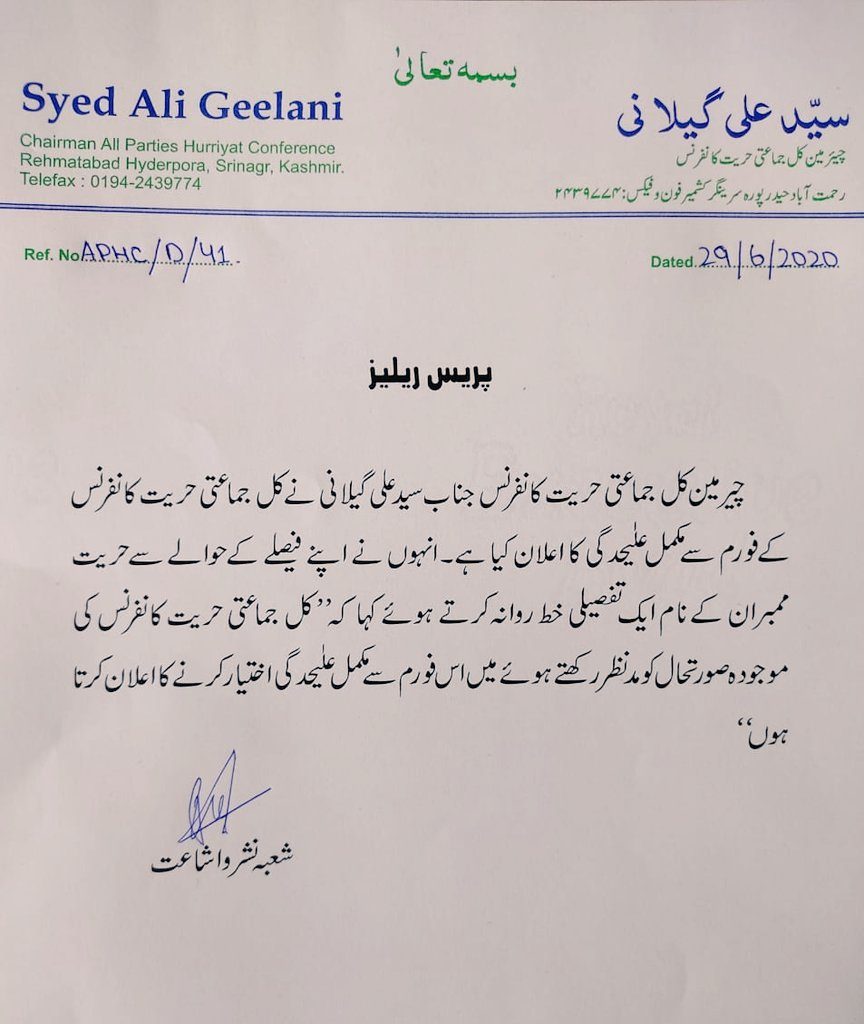
Syed Ali Shah Geelani’s resignation letter quitting from Hurriyat Conference
There are two aspects in which Geelani caused irreparable harm to Kashmir and its people in the pursuit of his unbridled ambition. The first is his alignment with Pakistan and through Pakistan with Saudi Arabia which resulted in the Saudi-sponsored Wahabi/Salafi concept of Islam replacing the enlightened Sufi culture of the Kashmir Valley. The second is the loss of childhood, education and aspirations of two generations of Kashmir’s youth who were sucked into the politics of divisiveness and disruption that he advocated. It is now quite clear that Geelani was one of the masterminds of the stone pelting era which ruined so many Kashmiri youth.
No self respecting leader who is fighting for the freedom of his people would bow before a government that he is fighting against. Revolutionaries are made of sterner stuff, they do not succumb to human frailties, Geelani sadly, was not made of such stern stuff; he had no compunction in using facilities provided by the Indian nation while castigating it openly. He was looked after, free of cost, in the best government hospitals like AIIMS. His children received the best possible education in India and are pursuing lucrative professions in Pakistan, Saudi Arabia etc. far from the miseries of Kashmir. His “selfless sacrifice” has definitely been good for his family.
In pursuance of his evil agenda, Geelani also became a very rich man. At the face of it, he maintained that a collection of Zakat (religious contribution) was his source of funds. In actuality, he got vast funds through Hawala transactions from Pakistan and other countries with the annual amount running in crores of Indian rupees. He was badly hit by demonetisation, and by National Investigation Agency (NIA)’s probe into his organisation’s illicit and criminal funding of terror and disruptive activities in Kashmir Valley.
After many decades in politics Geelani does not have anything substantial to show as an achievement. Even his children understand the futility of his cause and have moved on to other professional pursuits. His legacy will probably pass on to Masarat Alam, a man lacking in intellect and ideology and more suitable for rabble rousing politics. He has no role to play in the “New Kashmir.”
In the end Geelani was a sad, embittered and dejected man who witnessed, during his lifetime the complete dismantling of all that he stood for including his friendship with Pakistan and his association with the APHC. Though in a state of dementia he witnessed the historic changes (for the better) brought about post the abrogation of Article 370 and Article 35A.
Geelani had in him the acumen to do something for his people. After all, he fought and won three elections before treading the path of separatism. Even while holding on to his political ideology and principles he could have been of value to his people by following a moderate approach. As a moderate he would have been in a better position to present his case. Sadly it was not to be and now the times of a dogmatic, obdurate, self serving and double-faced leader has come to an end. For the Kashmiri youth his life represents a true example of what should not be done.
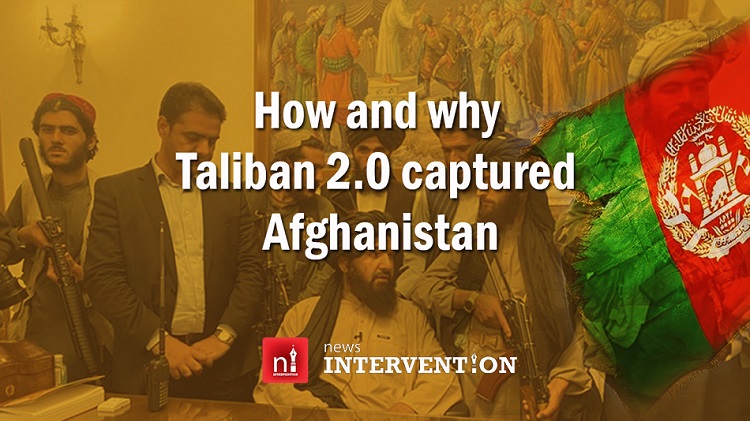
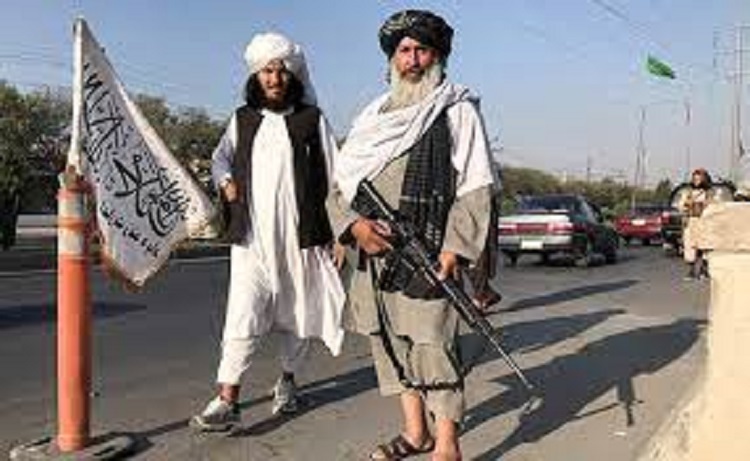
Taliban takes over Afghanistan without resistance. Is it possible for the 300,000-strong Afghan Army, equipped with latest military technology and air support to surrender in just nine days to around 50,000 Taliban who neither had modern weapons nor the air force? Taliban had access to only the land routes and yet they occupied Kabul without any resistance!!
Click on the YouTube link to watch our special report
What is the inside story? Watch News Intervention Special Report to understand How and Why Taliban 2.0 captured Afghanistan.
Health ministry officials in India are waiting with bated breath to see the much-awaited call of the Food and Drug Administration (FDA) of the United States on vaping products.
The FDA will take the much-awaited call on September 9, 2021. There are rumours that some of the vaping products could stay in the market and some could be totally pushed out of the market.
The FDA’s shakeout of e-cigarettes will have severe implications for India which had in September 2019 completely banned e-cigarettes. The decision — an ordinance — was taken to check potential health risks to India’s youth.
The ordinance came in place without any deliberations in Parliament. Tobacco experts said the government had largely ignored evidence regarding health risks and disastrous lessons from India’s previous experiences with bans.
(Representative photo)
The Health Ministry, which has Mansukh Mandaviya as the new health minister, is waiting for the FDA decision so that the Indian government can revisit the ban and find possible ways forward.
So what will happen on September 9, 2021. Experts say the decision would be significant and would have serious implications on the world vaping market, ostensibly because of a series of rulings that have already begun to reshape the industry.
The challenge lies with manufacturers of vaping products, they must demonstrate their products are in the interest of public health and push the all-powerful FDA to think about the advantage of adult cigarette smokers switching to a less harmful option.
Else, the youth will continue to get hooked on cigarettes.
Last year, the FDA allowed flavoured e-cigarette cartridges back on the market after a temporary restriction.
“We are working furiously on application review in order to move on from sort of a Wild West unregulated marketplace,” the FDA’s acting commissioner, Janet Woodcock, was quoted by the Wall Street Journal at a congressional hearing in June. “We intend to use [our] authority to protect kids and optimize public health.”
(Representative photo)
Health ministry officials in India, who had asked all e-cigarette manufacturers in 2019 to take their vaping products off the market, will now follow the FDA move seriously.
Across the United States, over 500 companies had filed 100 applications for some 6.5 million products. These companies were asked by the FDA to submit scientific evidence demonstrating that each product was less harmful than cigarettes and that cigarette smokers would be more likely to stop smoking if they used it.
What is also important is that the FDA is considering the products’ appeal to young people and to first time smokers. This is something the health ministry in India will also be seriously observing before taking any steps relating to vaping.
Some of the world’s top e-cigarette manufacturers like Juul Labs Inc., Reynolds American Inc, NJOY Holdings are waiting with bated breath to see what FDA unfolds post September 9, 2021.
India, which has always lacked data and evidence from India, will obviously take lessons from the call of the FDA and draw some meaningful lessons, claim highly placed sources in the ministry. It could, claim sources, revolve around two frameworks of harm reduction or abstinence. The one mentioned later helps the government point out risky behaviour and ensures incentives to make them stop. It may not work in India but it does not prevent the government from going ahead and imposing penalties like sin tax. And then, the harm reduction theory works by providing less risky alternatives.
The sources say health ministry officials in India are studying the impact of Electronic Nicotine Delivery Systems (ENDS) in the United States and the United Kingdom and how it had consequences in the society. Several policy changes messed the show in the US whereas in the UK, the use of ENDS as an alternative to far more dangerous traditional cigarettes worked well.
So what do the experts say? Nicotine is far from being harmless. However, one must remember that it is an extremely addictive substance that can adversely affect the heart, respiratory, and circulatory systems. But it’s definitely not the most harmful substance in a cigarette.
And it is because regular cigarettes deliver 7,000 other chemicals (arsenic, benzene, ammonia, lead, etc) to the lungs along with nicotine, and therein lies the biggest danger. In short, ENDS or e-cigarettes cut out all of the other chemicals. A shift to e-cigarettes has helped adult and youth smoking to decline, even the most popular quitting aid. Underage vaping is nearly non-existent in Britain, as against the US.
All eyes on FDA, something big will happen on September 9, 2021.
When something completely unexpected happens, we ascribe it to providence. But when there are a series of such occurrences revolving around a single event, it’s but natural to suspect that something’s amiss and in absence of any rational explanation, conspiracy and cover up theories abound. The latest such issue that’s caught the world’s attention is the crisis in Afghanistan.
An unexpected capitulation That the qualitatively and quantitatively far superior US trained and equipped Afghan National Army [ANA] would collapse like a house of cards is something that defies logical explanation. There are many hypotheses regarding this debacle. US President Joe Biden contends that ANA had lost the will to fight, and though Lt Gen Sami Sadat (who commanded ANA’s 215 Maiwand Corps in South Western Afghanistan before he was summoned to Kabul to head Afghan special forces) accepts this, he in turn blames the US led coalition forces by saying, “we ultimately stopped fighting because our partners already had!”
Then there are others who blame undue political interference by Kabul, widespread corruption within political and military circles and lack of integration within ANA due to persisting ideological differences within its rank and file. Some even believe that it was the basic human survival instinct that completely overwhelmed ANA’s sense of military responsibility and thus precipitated this inexplicable debacle. These factors have undoubtedly contributed to ANA’s capitulation, but the insinuation that it was survival instinct that compelled Afghan army officers and soldiers to give up without a fight, though a very reasonable explanation, doesn’t fit into the scheme of things in this case.
Survival instincts manifest themselves where there are some chances of getting out alive, even if it’s only a hope against hope. But in this case, there was none. Two months to the day before Kabul fell, Taliban summarily executed 22 Afghan Special Forces commandos who had surrendered after running out of ammunition in Dawlat Abad town in Faryab province near Afghanistan’s border with Turkmenistan. Graphic videos showing the unarmed commandos surrendering and thereafter being mercilessly mowed down by gunfire on the streets went viral on social media sending out a clear signal to Afghan forces that their lives wouldn’t be spared even if they surrendered like the unfortunate commandos did.
Therefore, logically speaking, since surrender by ANA was
tantamount to facing certain death at the hands of Taliban, survival instincts
should have instead spurred ANA to fight and defeat Taliban as this was their
only hope of staying alive. Furthermore, since they had the necessary
wherewithal required to do so, fight rather than flight gave them a better
chance of survival. So, it wouldn’t be too farfetched to suspect that there was
some sort of secret deal between Kabul and Taliban, or even the US and Taliban
that led to Afghan army’s sudden collapse despite numerical superiority, sophisticated
weaponry and lethal air power in the form of fighters and attack helicopters,
at its disposal.
Besides this abject surrender, what’s equally intriguing is that ANA took no action whatsoever to destroy or disable hi-tech US weapons and equipment it held something that even a greenhorn soldier would do instinctively. Moreover, since all one has to do in order to render such equipment unserviceable is to set the equipment on fire or just smash its control panels [either manually or by using grenades]; the argument that ANA didn’t have the time or expertise to do so, isn’t convincing. So, there are good reasons to believe that sophisticated weapon systems and other state-of-the-art warlike stores were intentionally left unscathed as part of some underhand deal that was linked to immunity from reprisal by Taliban. In this case, there’s an extremely high probability of Pakistan Army’s Inter Services Intelligence (ISI) involvement aimed at surreptitiously siphoning functional military hardware across the Durand Line!
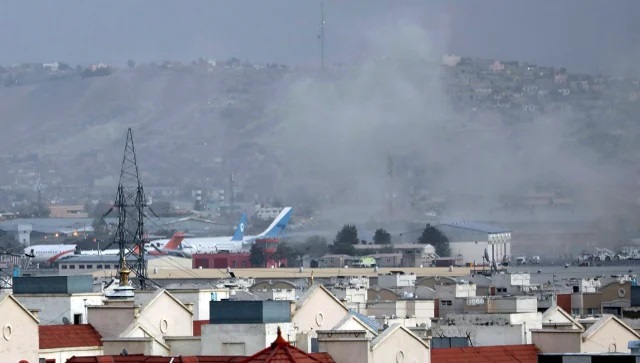
Emergence of Islamic State of Iraq and Levant- Khorasan (ISIL-K) The August 26 bomb attack at Kabul airport that left 13 US soldiers dead and 18 others wounded has once again brought ISIL-K back into limelight. The US acted with lightning speed and within 48 hours claimed to have ‘droned’ a planner and facilitator involved in the August 26 attack. While there are no reasons to doubt Pentagon’s claim but the speed with which it was able to locate and neutralise a planner and facilitator of the August 26 attack hiding in Afghanistan’s faraway Nangarhar province, which is a strictly ‘no-go’ area for both US forces and Taliban, does raise suspicions. Washington’s refusal to name the ISIL-K terrorists ‘neutralised’ makes things sound even more suspicious. So, could it be that this claim was merely made to assuage public anger in America against the killing of 13 US soldiers?
Ever since its creation in 2015, besides engaging in a long-drawn
turf war with Taliban, ISIL-K has carried out several attacks against targets
in Afghanistan which included hospitals, holy shrines and congregations of
Shi’ites, educational institutes, wedding ceremonies and aid workers. It has
also carried out a few small-scale strikes in Pakistan and has even attracted
some recruits from India. Its attempts to make inroads into India through terrorist
groups in Jammu and Kashmir are underway but haven’t made any worthwhile
headway. However, in the six years of its existence, ISIL-K has never targeted
US troops in Afghanistan before the August 26 attack and there’s a logical reason
for this.
The UN monitoring group has determined that though it “continues to pose a threat to both the country [Afghanistan] and the wider region,” ISIL-K has suffered considerable “territorial, leadership, manpower and financial losses during 2020 in Kunar and Nangarhar Provinces.” Accordingly, ISIL-K wisely chose to accord more importance to consolidation and regaining lost ground rather than dissipate its resources by attacking US troops and suffering further losses in the ensuing reprisal. With the Ashraf Ghani government now out of the scene, ISIL-K has only Taliban to contend with for supremacy and so, antagonising Uncle Sam and making one more enemy makes no sense at all. This is why the claim of ISIL-K having orchestrated the Kabul blast needs to be taken with a rather big pinch of salt.
Afghanistan-based terrorists attack Pakistan Army soldiers On August 30, Pakistan Army’s media wing Inter Services Public Relations [ISPR] announced that two soldiers were killed when terrorists from inside Afghanistan fired at a military post in Bajaur district. The ISPR statement on this incident also mentions, “Pakistan strongly condemns the use of Afghan soil by terrorists for activities against Pakistan and expects that existing and future setup in Afghanistan will not allow such activities against Pakistan.”
This unprovoked attack is indeed despicable and hence Pakistan Army’s angst is understandable. However, since Pakistan, has all along been backing Taliban to the hilt by overlooking its rampant wrongdoings and instead is singing paeans in an attempt to get the international community to approve Taliban’s military takeover of Kabul, for it to indirectly admonish Taliban, which is yet to form the government and take stock of the situation, is by any standards, overdoing it! So, could it be that this public show of fury is merely to convey the impression that Pakistan continues to be a ‘victim’ of trans-border terrorism and divert global attention from Islamabad’s devious role that created the current Afghanistan crisis?
At a time when Taliban conducting an inquiry to investigate Islamabad’s allegation of anti-Pakistan activities being carried out by Tehreek-e-Taliban Pakistan [TTP] from Afghanistan soil, wouldn’t it be suicidal for TTP to carry out a cross-border attack at this crucial juncture? It may be argued that Pakistan Army wouldn’t have sacrificed two of its soldiers just to play terror ‘victim’ or divert international attention and this argument makes sense.
However, since military posts have field defences to protect
soldiers from hostile fire, for terrorists to be able to kill two soldiers
manning the well-fortified Bajaur post and that too through a long-range ‘standoff’
attack, though possible is rather difficult to achieve. But then, there’s
always the possibility that these soldiers may have actually been shot by
terrorists elsewhere in the restive Bajaur Agency and are being shown as being
killed in the military post near the Afghanistan border?
Though this may sound outlandish, but when an army can
abandon and disown its own soldiers killed in action during the 1999 Kargil
conflict just to deny involvement of its soldiers in the intrusions, it can certainly
shift an encounter site for keeping up pretences!
Tailpiece The way US, Pakistan and Taliban are playing games in Afghanistan there are bound to be many more surprises in the days to come and the following lines of TS Eliot aptly describe the emerging situation there:
“There will be time, there will be time
To prepare a face to meet the faces that you meet;
There will be time to murder and create…
And time yet for a hundred indecisions,
And for a hundred visions and revisions
Before the taking of a toast and tea.”
Amidst high gloom of retrenchment and reduction in salaries because of the raging pandemic, a global outsourcing company has drawn up an ambitious recruitment plan for India.
UK-based QX Global, which has set up major centres across India, has plans to hire over 1200 people across all departments and experience. By May, 2022, the company has plans to have a 3000-plus workforce in India.
Experts claim India’s huge knowledge pool has helped the country continue to be the most preferred location for KPO players.
“India is one of our biggest focuses. Indians have carved a niche for themselves across the world with their brilliance, and post Covid-19, there is a larger need for such professionals to service global clients, ” said Frank Robinson, a director of QX Global, in an interview.
The pandemic led to approximately 30-35,000 job losses in the KPO and BPO sectors in India last year. An estimated 60,000 people were sent on leave without pay (or furloughs). The estimated number of job losses translates to about 0.68 percent of the 43.6 lakh employed by the Indian IT and BPO sectors.
QX Global is a bespoke knowledge process outsourcing company providing finance, accounts, recruitment, payroll, IT-software and corporate advisory services. The company has major delivery centres located in Ahmedabad, Baroda, Mumbai and Noida. Its corporate office is based in the UK with a subsidiary presence in New Jersey, US.
Robinson said what worked for the company was the fact that QX Global is the first outsourcing company in India to be GDPR Compliant. “It gives us a great advantage over other companies operating for the European Union market,” said Robinson. The GDPR is a regulation in EU law on data protection and privacy in the European Union and European Economic Area (EEA). It also addresses the transfer of personal data outside the EU and EEA.
QX Global, which has already turned into the largest Knowledge Processing Outsourcing (KPO) company in Gujarat, works with clients that include accountants, businesses, healthcare providers, local government bodies and recruitment agencies. “Our people’s growth is in line with our business growth. We are expanding across all our divisions on a global scale,” says Robinson.
Like India, the US is also a strategic growth market for QX Global with close to 70 active clients in accounting, finance and recruitment processes. The company plans to double the number of clients and add offices in New York, Austin, and Chicago, besides its existing headquarters in New Jersey.
“We are expanding across the world and India is an important part of our growth,” said Robinson. India covers over 70 percent of the KPO industry worldwide and provides a plethora of services. India’s Tier-I cities have been the torch bearers of the KPO and BPO sectors growth due to their better infrastructure, connectivity and talent.
Robinson said the exponential growth rate of the KPO sector is fuelled by the need to acquire new clients, domain knowledge and a highly competitive market.
He said his company is picking up talented freshers from leading colleges around India to come and join a bespoke training programme. “We are giving them a kick start in their career and helping the transition from college to corporate. We also source super talented people who have a wealth of experience across different industries and bring the skills that we need to provide excellent service for our global clients.”
“The outlook looks great. Loads of exciting projects & plans in place for QX. We have a healthy pipeline and lots of great new people coming to join the company,” adds Robinson.
Punjab State Power Corporation Ltd (PSPCL) is the modified version of Punjab State Electricity Board (PSEB) which was a statutory body formed on 1 February, 1959 under the Electricity Supply Act 1948. In 2010, the Government of Punjab created two separate companies, Punjab State Power Corporation Ltd (POWERCOM) and Punjab State Transmission Corporation Ltd (TRANSCO) to be a part of the PSPCL. The organisation lists its vision as “pursuing a value based customer centric approach and strive for excellent operational parameters on sound commercial principles”.
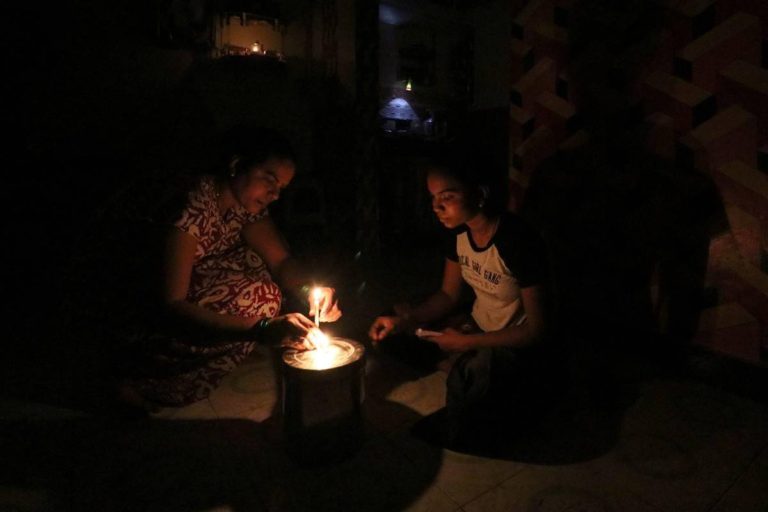
On ground the performance of the organisation leaves much to be desired. Punjab has become used to frequent disruptions in the supply of electricity. There are multiple reasons for the same; the infrastructure in terms of lines laid and availability of transmitters etc. is very old and outdated, hence, at the slightest natural disruption (even a light shower) it gets disrupted; secondly, the cost of electricity in Punjab is the highest in the entire country which leaves people under heavy financial strain, it multiplies further with municipal tax, cow cess, increased electricity duty and social security surcharge.
This apart, PSPCL is fighting a severe financial crunch owing to power subsidies, default in payment of power bills by the government and payment of coal washing charges to private power plants. Due to heavy expenditure and delay in payment of bills by government offices, the organisation is compelled to take heavy loans, which greatly adds to its financial burden. This is the condition when the government touts Punjab (PSPCL) as power surplus.
The situation became so bad recently that a cut in power supply to
high-consumption industries was carried out for two days even as working hours
in government offices were curtailed in order to provide electricity to farmers
during harvesting season.
The blame for the terrible state of affairs is being put on the Power
Purchase Agreements (PPAs) with private suppliers that were signed many years
back by the Shiromani Akali Dal (SAD) led government in Punjab. It is reported
that out of 139 PPAs signed during the SAD rule, 17 were enough to cater for
the requirement of the state, there is no logical explanation for signing the
remainder 122 for 1,314 MWs of power.
At present, of the total installed power generation capacity of 14,362 MW in the state 6,902 MW is run by private firms. There are three private thermal plants in the state with a combined capacity of 3,920 MW. Apart from this, the state can produce 1,300 MW through renewable sources of energy, hydro, solar and biomass.
Another point of concern is that the PPAs signed with major Independent Power Producers (IPPs) had a clause wherein fixed charges would be paid to if the government did not require electricity. The power plants are the biggest beneficiaries of the PPA clause which has caused a huge financial loss running into thousands of crores to the PSPCL. The then Punjab government should have taken a leaf out of the policy adopted by the Gujarat Government for purchasing power from private entities only to meet peak power demand.
The same SAD (Shiromani Akali Dal) is now voracious in protests against the government. The face saving reason being floated around is that the (IPPs) were drafted on the basis of peak power demand that exists only for four months in a year.
Under fire, the SAD maintains that the state first decided to go in for private participation in power generation during the 2002-2007 Captain Amarinder Singh government which gave clearance for private players to set up facilities with a capacity of 2,000 MW to meet the additional requirement. The SAD maintains that it merely approved the establishment of private power plants as per the guidelines of the then Dr. Manmohan Singh led government at New Delhi. These arguments do not hold merit since it was the responsibility of SAD (Shiromani Akali Dal) to revisit the contracts and reject all clauses found unsuitable for Punjab.
PSPCL has tried to cover up the amount being given to the IPPs by
attempting to keep its own plants shut and using their power optimally. This
however has not helped since the PSPCL has to pay salaries to its own power
generation staff without using it optimally.
Now, in an attempt to cover up the lapses of the organisation, the PSPCL Chairman and Managing Director (CMD) A. Venu Parsad has stated that the PSPCL aggressively sells surplus power during winter, apart from banking of power with other states in order to reduce the burden. The PSPCL is also adopting a life saving posture of claiming that termination of PPAs with IPPs will lead to a power crisis in the state. This explanation would not stand scrutiny. Punjab struggles to find buyers for its excess power since there are so many private plants coming up.
Captain Amarinder Singh-led incumbent Congress Government in Punjab had, on assuming office in 2017, promised to revisit the PPAs. During the campaigning, the Congress had accused the PSPCL of extending undue benefits to the tune of Rs. 7,500 crore to private players providing power to the state by allowing them to raise their variable costs arbitrarily, thus making power expensive for the consumers.
The government, sadly, has been unable to progress upon the word given. Now with elections looming ahead there is not much scope left to do despite a lot of noise being made.
The fact of the matter is that the PSPCL has been breaking rules not only
during the times of the Badal Government but also all through the Congress
regime. The Punjab State Electricity Regulatory Commission (PERC) (Conduct of
Business) Regulations, 2005 states that PSPCL shall not enter into a
contractual commitment of such long term power purchase till the PSERC approves
the procurement of electricity. It is reported that the organisation has not been
taking the mandatory approval of (PSERC) before signing the PPAs. There are
innumerable instances where ex-post facto approval of PPAs was taken from PSERC
in delays ranging from six months to 11 years. In more than a dozen PPAs, the
approval of PSERC remained awaited for as long as 12 years even as the purchase
of electricity carried on undeterred.
Despite the rhetoric (under duress) of revisiting the PPAs the government of Punjab seems to be determined to continue on the path of privatisation of electricity generation. There are apprehensions that government plants will remain on forced shutdown to pave way for private sector generation. This is evident from the actions being taken to redevelop and sell the 1,764-acre plot on which stands state-owned Guru Nanak Dev Thermal Power Plant in Bathinda which was shut down in January 2018 amid the state government’s efforts to phase out thermal power plants older than 25 years over emission-related concerns, in line with central government guidelines. The employees are staging protests and rightly so since the government has the land on which new a new generation set up can be constructed.
Other states like Gujarat and Uttar Pradesh are also revisiting their PPAs with private players and revising them. In some cases the matter has gone to the courts. More and more states are refraining from signing any more PPA agreements. Also, many states which are buying power are charging less than Punjab. Punjab is neither able to consume power within the state nor sell power to others outside. The burden therefore will be passed on to consumers.
The PSPCL imbroglio is a clear cut case of mismanagement for decades on end under the very nose of successive SAD as well as Congress run governments. The fact that there is hesitation to set things right gives an impression of corrupt practices being adopted. The matter calls for an independent judicial enquiry more so since the people as well as the state are paying a very heavy price for this procrastination.
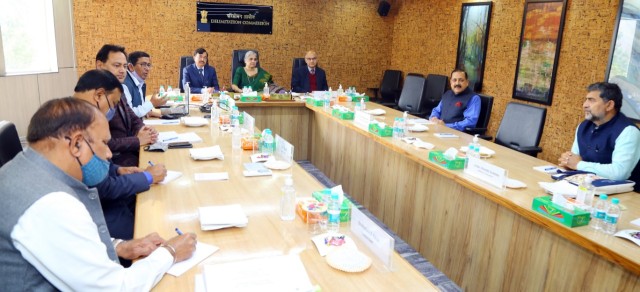
On 6 March 2020, the Union government set up a Delimitation Commission headed by a retired Supreme Court Judge, Ranjana Prakash Desai. Among its many responsibilities was the mandate to carry out a long pending delimitation exercise in the Union Territory (UT) of Jammu and Kashmir. In accordance with Jammu and Kashmir Reorganisation Bill, 2019, the number of Assembly seats in J&K will increase from 107 to 114 with seven more seats being added to the Jammu region. This was to cater for West Pakistan refugees and others who were earlier, under Article 35A, denied domicile. The right to vote would now form a part of the electorate.
New Delhi has also hinted upon its resolve to conduct elections in the UT immediately after setting up the news constituencies as per the recommendations of the Delimitation Commission. This, therefore, has become the most significant and keenly watched political exercise in the region.
It is well known that the two distinct geographical segments which comprise the UT (Jammu region and Kashmir region) vote in accordance to regional affiliations; thus, the region which has more constituencies gets to form the government. For many decades the Jammu region has had representation not commensurate with its population and territory. An arbitrary allocation done in 1957 by the then state government awarded 30 seats to Jammu region, 43 seats to Kashmir and two to Ladakh. The huge gap was allowed despite there being a population difference of less than a lakh (82,340) in 1951. The disparity remains till date even though some additional constituencies were created later; presently, Jammu and Kashmir has 87 seats, 46 for Kashmir, 37 for Jammu and 4 for Ladakh.
It has been decided that the delimitation process will be carried out in accordance with the census of 2011. Here too the people of Jammu have reservation since the population figures of the census were Kashmir (6888475), Jammu (5378538 ) and Ladakh (290494). The census suddenly showed a population disparity between the two regions at a massive 15,09,937 which is a sudden and quantum jump from earlier figures. The matter looks quite odd since Jammu had received additional population due to the displacement of Kashmiri Pandits from Kashmir.
The reason behind this sudden increase has been identified as the floating population of Gujjars and Bakerwals being shown in the Kashmir region even though it shifts between the two regions according to the weather conditions.
The census also claimed that 1,95,190 Hindus were living in Kashmir which is not easily acceptable. The scheduled castes who are basically Jammu centric are quite surprised to note that their strength has shown a decline since 1981 which goes against the established norms of population growth in the region as well as the entire country. The Gujjar-Bakerwal community claims that its actual population share is higher than suggested by the census.
Some analysts in Kashmir maintain that the existing data supports the present distribution of seats. “Even on the “one person one vote” principle, it (seat allocation) is as good as it can get with 1,49,749 voters per constituency in Kashmir and 1,45,366 voters per constituency in Jammu,” says Haseeb Drabu.
The decision to use the 2011 Census data for Delimitation will definitely
compound the difficulty of reaching a fair conclusion.
The Kashmir-based political parties are playing their cards very close to their chests. While the National Conference has, after initial hesitation, met with the representatives of the Commission, the PDP has refused to do so. “Our party has decided to stay away from this process and not be a part of some exercise, the outcome which is widely believed to be pre-planned,” said PDP General Secretary Ghulam Nabi Lone. National Conference too, in its memorandum submitted to the commission, has questioned the legal validity of the panel saying delimitation of constituencies can be undertaken after the next census.
The Delimitation Commission has hinted that while population will form the main criteria, the geography, terrain and topography, population density, ethnic composition, etc, will also be considered. This aspect has its own dynamics and may become an issue of contention in the long run.
The seats
reserved for Gilgit-Baltistan are also likely to emerge as a point for debate
since they remain with the UT of Jammu and Kashmir while the region is
territorially included in Ladakh. It may not be politically relevant at the
moment but it is something that should not be allowed to linger unnecessarily.
Ideally the Kashmir-based parties would have liked the delimitation process to remain dormant for as long as possible – preferably till 2031. The change in borders, however, has given the opportunity to the government to go ahead and it is doing so. The government is also quite determined to ensure that the reservation for Scheduled Tribes in the assembly and extension of right to vote to the West Pakistan refugees and others who have qualified for domicile in the state is ensured.
The delimitation exercise, therefore, is of a sensitive nature. On the one hand the applicability of the 2011 census is likely to create problems but then there is no choice. On the other hand, the balancing act of increasing the number of seats from 107 to 114 will not go well with the Kashmiri leadership.
If not handled with maturity and sensitivity, the delimitation process
has the potential of triggering an uprising in the region which is witnessing
peace and tranquilly after decades. Undue hurry may lead to distrust and
escalation of unrest that would linger for a long time especially so in Kashmir.
It also needs to be remembered that some vested interests in Kashmir have the
expertise and the potential to trigger an uprising at the slightest pretext. Over
and above the cautionary note it can be said that the commission is going into
great detail to ensure a fair award that is acceptable to all.
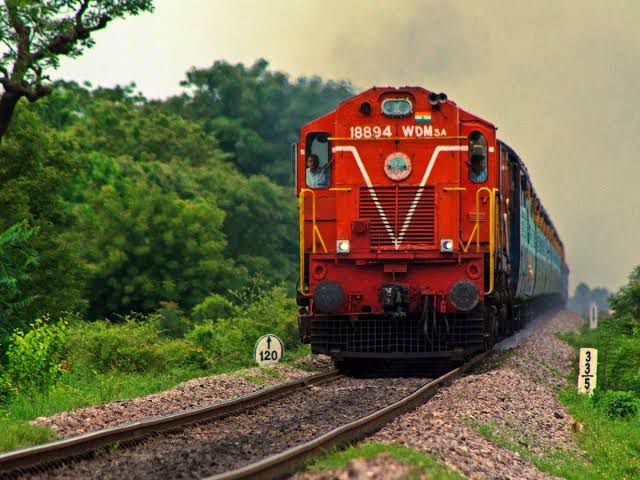
The involvement of two Kolkata-based promoters in a big buck Railway contract has snowballed into a huge controversy because of the company’s dubious past.
Investigators have found that Kolkata promoters RK Bhalotia and Prateek Bhalotia and their old company, Riddhi Siddhi Udyog and a new company Sigma Rail Systems Private Limited could be in serious trouble because of their alleged violations of Railway guidelines to seek orders.
In fact, the allegations are serious enough to have created a ruckus amongst our lawmakers with at least four MPs raising the issues in various forums including Parliament.
Helping the Bhalotias, the investigators found, were top officials of the Railway Board in the Indian Capital and also some senior officials of the Indian Railways in Kolkata.
The matter has turned serious.
Kaushalendra Kumar (JDU), Amol Kolhe (NCP) and Shatabdi Roy (AITC) have sent letters to new Railway Minister, Ashwini Vaishnaw within days of his assuming office.
(Representative photo)
This correspondent has seen all the letters which highlights issues relating to the functioning of the Railway Board and its dealings with the Bhalotias.
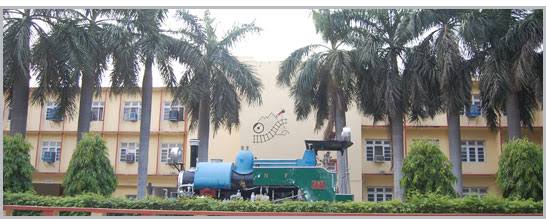
Jasvir Singh Gill (INC) has even gone ahead and submitted an unstarred question in the Lok Sabha on this matter. The MPs are in agreement that the functioning of the Research Designs and Standards Organisation (RDSO) is a matter of concern. Even more so because the companies in question deal with equipment that is vital for the safety of train operations.
So what is the crisis?
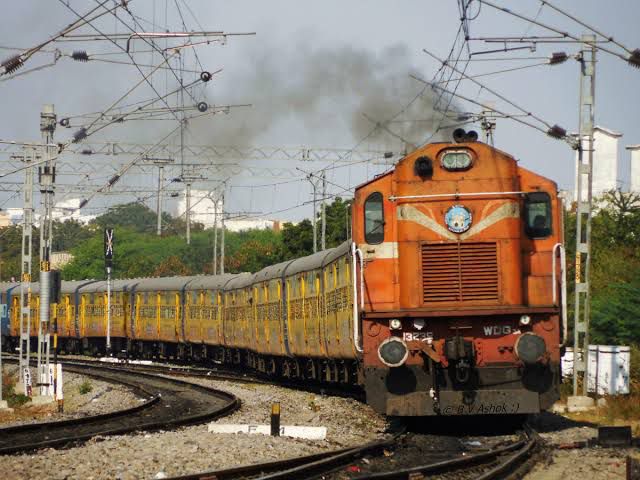
Top sources in Kolkata told this reporter that RK Bhalotia and his proprietorship concern, Riddhi Siddhi Udyog which is located at 238A, AJC Bose Road, Unit-5, Kolkata was a Category 1 single vendor for the supply of Block Brakes in the Mechanical Department of Indian Railway, for 40 years until 2014. Now what is interesting is that in 2014, both RK Bhalotia and his son were taken into custody for alleged charges of bribery and involvement of a honey trap, by the Kolkata office of the CBI. This news received wide coverage including the arrest of an Excise Commissioner in the day. An article highlighting the matter was even published in the Rail Samachar. Expectedly, the railways took stern action and the company was delisted through a letter dated 17.11.2014.
Three years later, the company and its promoters were charged U/s 120-B, 420, 468, 471, 201 IPC and section 13(2) r/w 13(1)(d) of the Prevention of Corruption Act, 1988, by the CBI.
(Representative photo)
Now, claim the sources, trouble started when the Bhalotias – realizing that their existing and old company was delisted – promptly formed a new company, M/s Sigma Rail Systems Private Limited in the year 2016 having registered office in the same address. As they were blacklisted in the mechanical department of the Railways, they started trying for a fresh registration as a Developmental Order Vendor in the Signalling & Telecommunication Department of the Railway. “They realised the high potential and prospect of the S&T products with the upcoming modernization in the signalling department of the Railways,” the sources further said.
On pen and paper, this should have been an uphill task for the Bhalotias due to the very strict existing policies as per the internal guidelines of the Railways. As per the Railway guidelines issued in 1971 vide clause 3(i) it is mentioned that every Ministry/Department/Office should maintain an up to date list of approved suppliers by taking into consideration their financial standard, capacity, past performance etc. This is not all.
If a company is banned by one ministry, it is bound to be banned by all ministries under Clause 16 of the Railway guidelines. The grounds on which such banning may be ordered are:
(ii) if the proprietor of the firm, its employee, partner or representative following prosecution by the CBI or under normal process of law for offences involving moral turpitude in relation to business dealings;
(iii) If there is strong justification for believing that the proprietor or employee or representative of the firm has been guilty of malpractices such as bribery, fraud etc.
iii) As per clause 18(ii) – A banning order shall specify the names of all the partners, directors etc. of the firm and its allied concerns.
iv) As per clause 19 – No contract of any kind whatsoever shall be placed with a banned firm, including its allied firm by all Ministries. (Internal guidelines available with the RTI application no. 7117/2010 submitted by Sunil Kumar, Chief Public Information Officer-III, Railway Board)
(Representative photo)
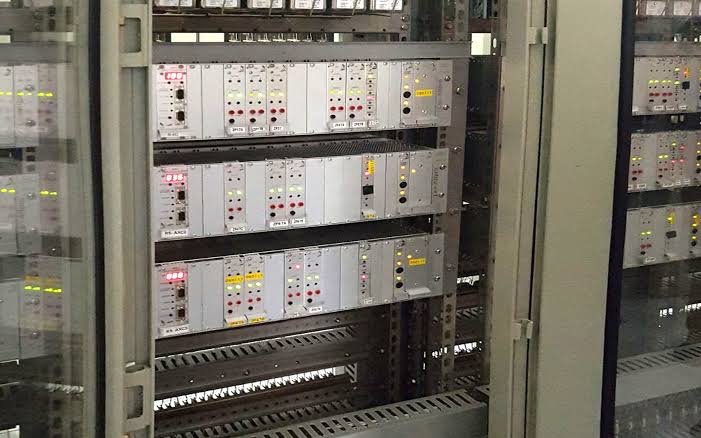
But the Bhalotias proved equal to the challenge and even after their company was delisted, they managed to get a fresh registration for their company Sigma as a vendor for developmental orders vide letter dated 26.04.2019 for the supply of MSDAC (which is an automatic axle counter and a vital part of the automated Railway Signalling systems). The sources allege that the Bhalotias managed to climb this insurmountable obstacle with the full knowledge of the chairman Railway Board, Executive Directors and other senior officers.
Sources also told this reporter that Sigma got the above registration on the basis of its MOU with Croatia based M/s ALTPRO as its OEM (Original Equipment Manufacturer).
It is noteworthy that, Sigma, where both the father & son are promoter directors, is a company with negative net worth, loss making and having minimum paid up share capital of Rs.1,00,000/- and also having nil financial standard, capacity and past performance, in the year 2019.
“How could the Indian Railways agree for a fresh registration with a company of zero net worth and zero revenue. What kind of declarations were made by the Bhalotias?” asked the sources.
Letters seeking answers from the chairman, Railway Board and other top officials from this reporter remained unanswered.
The fresh registration, claimed sources, overlooked the main clauses and points of internal guidelines of the Railways even when the tainted proprietor is director and shareholder in the new company. Also, the fact that the address of the blacklisted company and the new company is the same, was overlooked.
The matter does not end here.
Once Sigma was registered in 2019, it is alleged that the company’s main concern was to plan and create a monopoly in S&T Directorate, RDSO and also ensure that the Railways overlook the vast proven track record of existing companies like Eldyne, Siemens, Frouscher, all having more than 20 years of experience of supplying MSDAC in the Railways.
In short, Sigma was interested in an uninterrupted run with the supply of the MSDAC. In short, the Bhalotias wanted to make Sigma the sole monopoly in the S&T Directorate for the supply of its main product MSDAC, in the same manner as it was done by them in the mechanical department for the supply of Block Brakes earlier.
Letters seeking answers from the chairman, Railway Board and other top officials of the Railway Board from this reporter remained unanswered. Repeated attempts to reach the Bhalotias also proved futile.
Ever been to an entertainment park and taken the most thrilling roller-coaster ride? Well, for observers, security analysts, international relations experts, diplomats and the world watching, events in Afghanistan is the ‘mother rollercoaster ride of all’. Nobody would contest the statement ‘change is the only constant’ in the world. This overview will provide a primer to the events in Afghanistan, and some causative factors which will dictate turn of events, including national interests of players involved.
Bringing up to Date The speed and scope of the Taliban’s takeover in Afghanistan has prompted introspection the world over on what went wrong, and how, after billions of dollars spent on a 20-year war effort, it could all end so ignominiously. Few unpleasant truths: Taliban have defeated the United States and its allies. They won because they have more popular support; not because most Afghans love the Taliban, but because people felt that the American occupation was unbearably cruel and corrupt. Within USA, internally and politically, GWOT (Global War On Terrorism) has lost its flavour, and majority want exit from Afghanistan, and other countries where they have a military footprint/intervention. The greatest military power in the world has been defeated by the people of a small, desperately poor failed state. This will have an extremely adverse effect on the image of the USA the ‘superpower’.
After Iraq lies, and many other routs, the rationale of liberal democracy and empowering women sounds hollow with desperate images flashing on TV of Afghanistan. Taliban are feudal, they are neither medieval or primitive. These are people with laptops, who have been negotiating with the Americans in Qatar for the last fourteen years. They are the product of some of the worst times of the late twentieth century and early twenty-first century. They have been moulded by life under aerial bombardment, refugee camps, communism, the war on terror, enhanced interrogation, climate change, internet politics and the spiralling inequality of neoliberalism. They live, for Now.
Political Victory Apart from a military victory (Afghan resistance is emerging slowly; we need to wait and watch) it is also a political victory for the Taliban. The Afghan military and police have been losing much more personnel, than the recruitment rate, and thus shrinking (apart from fake figures). Over the last five years the Taliban have been taking control of more and more villages and some towns. This was not a lightning advance through the cities and then on to Kabul. The people who took each city had long been in the vicinity, in the villages, waiting for the moment. Crucially, across the North the Taliban had been steadily recruiting Tajiks, Uzbeks and Arabs. No guerrilla insurgency on earth can win such victories without popular support. The people of Afghanistan had to choose sides. More people chose Taliban than have chosen the American occupiers: not all of them, just more of them.
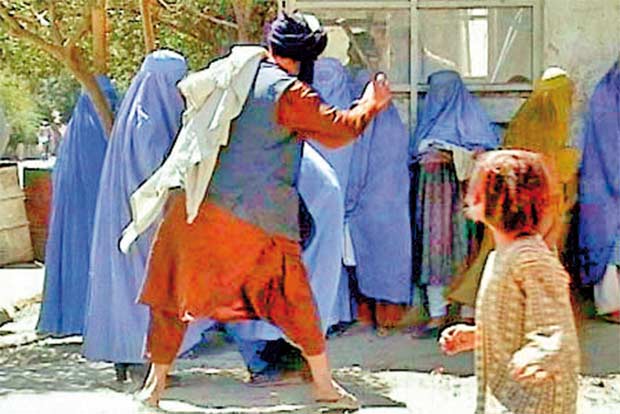
Taliban flogging the women
Similarly, more Afghans chose Taliban over President Ashraf Ghani’s government and the old warlords. The defeat of Dostum in Sheberghan and Ismail Khan in Herat is credible evidence of that. While the Taliban and its policies of 2001 were overwhelmingly Pashtuns’, today Taliban fighters of many ethnicities have taken power in Uzbek and Tajik dominated areas except in Hazara areas. This is a war against foreign invaders, but it is also a civil war as many have fought for the Americans, the government or the warlords. A nation without a government and rogue elements ruling the streets are a recipe for the entry of extraneous elements involved in transnational crime and terror. This is exactly what happened in Iraq and Syria with the rise of ISIS when the US took its eyes off the scanner in 2011. Al Qaeda-Core, Islamic State (Khorasan Province), East Turkestan Islamic Movement, Tehreek-e-Taliban Pakistan, Jaish-e-Mohammad, Lashkar-e-Taiyaba and Islamic Movement of Uzbekistan all exist in the vacated space with no US influence and capability there. This presence also spells threats to China (Xinjiang related), Russia (CARs related), Pakistan and India. The longer the instability festers, the more intense will the networks become. Pakistan may have control on some elements but largely it too will get affected.
Why so many Afghans chose the Taliban? The fact that more people have chosen the Taliban does not mean that most Afghans necessarily support the Taliban. They had limited choices, but firstly Taliban are the only important political organization fighting the American occupation, and most Afghans have come to hate that occupation. After 9/11 and the defeat of Taliban 1, the Afghan people and even some Taliban hoped for deliverance from poverty, development and a stable state. Afghans are used to corruption, but the current state of affairs was unprecedented which the people hated. But as the Afghans waited, the US delivered more violence and war, not peace.
Differentiation between Islamic State and majority Taliban (and also from Taliban-1) While a few fighters (including the Pakistan-sponsored Haqqani network) support religious extremism; support Al-Qaeda and IS and have attacked Shias, Sikhs, Hindus and Christians; the Taliban has condemned such attacks. Taliban-2 have emphasized their concerns for the rights of women. They say they welcome music, and videos, and have moderated the fiercest and most puritanical sides of their former rule. And they are now saying over and over again that they want to rule in peace, without revenge on the people of the old order. How much of this is propaganda, and how much is truth, is hard to tell. Moreover, what happens next is deeply dependent on what happens to the economy, and on the actions of foreign powers.
Latest Inputs After the desertion of President Ghani, former Afghanistan Vice President Amrullah Saleh has proclaimed himself as “legitimate caretaker president” as per the constitution. He alongside Ahmed Shah Masood and the new National Resistance Front (NRF) have sounded the defiant clarion call from Panjshir Valley to fight against the Taliban. Panjshir valley had not fallen to the Taliban even during Taliban-1. Unverified reports of fighting between both forces are emerging, but the NRF is in a tenuous position being boxed inside the forbidding Panjshir heights. Reports of soldiers from the erstwhile army and police and other tribes joining the expanding resistance forces are trickling in. Taliban undoubtedly, sent a negotiating party and Masood has also signalled readiness for talks, but the initial round of talks have reportedly failed. It will take some time for the dust to settle.
Is this the beginning of the ‘End’ of American Unipolar status? The status of the United States being a sole superpower has relied on three pillars. As the largest economy in the world, dominating the global financial system; leader of the liberal, democratic world order and global institutions as also tremendous soft power; comprehensive national power to impose and compel dissenting nations. While domination of all three aspects were being questioned for some time, this abrupt withdrawal from Afghanistan may well prove to be a ‘game changing moment’. The fact is USA never had a foreign policy, it used its CNP (comprehensive national power), mainly military to resolve/ intervene in other nations/region’s affairs for its narrow short term national interests.
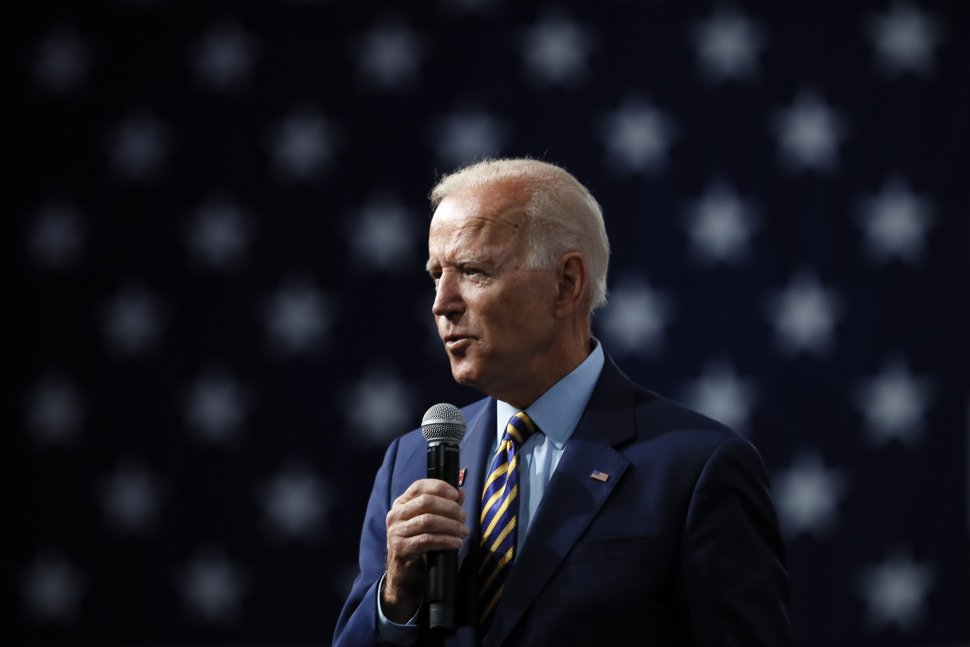
US President Joe Biden. (Photo: AP)
Complex Pieces of the Afghanistan Geo-Political Imbroglio All nations connected to Afghanistan finally want an Afghanistan which expands their strategic space and influence without adversely impacting their vulnerabilities. They would have some commons, but fault lines too would surface along the way.
Economy: The Final Arbiter While political and security equilibrium will provide stability, the permanence of Taliban will finally be Afghanistan’s economic situation. The Taliban is already aware that running an insurgency and administering a country is not quite the same thing. Contrary to world expectations, Taliban may have won the information war, but its coffers are empty. The only people unequivocally celebrating are either fanatical Islamists or Pakistanis, neither of whom are in a position to finance the state. The banking system is on the verge of collapse. The foreign exchange reserves have been frozen, as has been the assistance given to Afghanistan by multilateral financial institutions.
The Afghani (Afghan currency) is in a state of meltdown – according to a foreign journalist one US Dollar is now getting over 8600 Afghanis (it was 86 a week back!). Foreign trade which is critical for the country has been severely disrupted. Investor confidence is non-existent. The aid money that was needed to run the state and provide services has been blocked. Businessmen and entrepreneurs are looking for the first opportunity to flee the country. Educated and talented people likewise. There is no money to pay salaries. Nor any money to provide civic services in big cities. And this is just the start.
Afghanistan’s economy is critically dependent on Western aid. The revenue generated by the Afghan state was only enough to cater for around 20% of its budget, mostly from customs collections. The rest of the money came from Western countries – around $4-5 billion. Another around $3-4 billion came for the Afghan National Defence and Security Forces (ANDSF) which no longer exists, unless someone now considers the Haqqani Network, elements of Al-Qaeda, Jaish, TTP, ETIM, etc. as the new ANDSF. Even if the money for the ANDSF is taken out of the equation, where will the rest of the $4-5 billion come from? Even the $2 billion of customs revenue is likely to fall quite precipitously because of the banking collapse and disruption in operations of international payments mechanisms.
The Taliban revenue stream from narcotics, extortion, smuggling and other illegal activities was an estimated $1-1.5 billion. But these activities are fine to fund terrorism and insurgency, not to run a country. China and Pakistan (itself in an economic mess) will only throw crumbs to Taliban while focussing on exploiting Afghanistan for its BRI connection and vast mineral and rare earth resources. But all this can only be exploited once security situation and governance is stabilised. The simple fact of the matter is that Afghanistan is financially not a viable state, and Taliban can be tamed with this most powerful tool of the 21st Century.
China It is a mixed bag with mixed feelings for China, who will see it as an opportunity with some trepidation. China may have been content with its adversary stuck in a “messy and costly morass,” as Zhou[i] describes America’s time in Afghanistan. And Beijing’s economic interests may not be totally secure under Taliban rule; the US presence did provide a modicum of security. China is unlikely to fill that security vacuum in a significant way, in line with its stated strategy of fostering noninterventionist relationships with its neighbours. China will work to quietly increasing its political and economic leverages, and make Pakistan to do the dirty work. It is ready to step into the void left by the hasty US retreat to seize a golden opportunity.
China issued a statement on Aug 20, 2021, saying that it “respects the right of the Afghan people to independently determine their own destiny” and will develop “friendly and cooperative relations with Afghanistan”. Beijing has few qualms about fostering a closer relationship with the Taliban and is ready to assert itself as the most influential outside player in an Afghanistan now all but abandoned by the US (there is a rising tide of protest within China in the social media). Beijing can offer what Kabul needs most: Political impartiality and economic investment.
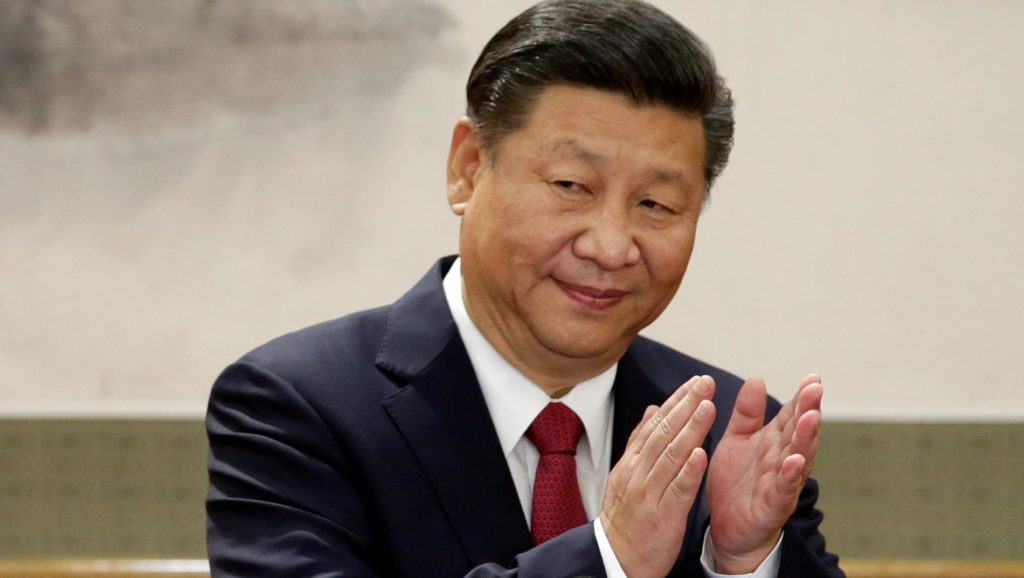
Xi Jinping, President of China. (Photo: Reuters)
Afghanistan in turn has what China prizes most: Opportunities in infrastructure and industry building, areas in which China’s capabilities are arguably unmatched, and access to $1 trillion in untapped mineral deposits, including critical industrial metals such as lithium, iron, copper and cobalt. Chinese companies have a reputation for investing in less stable countries if it means they can reap the rewards. If China were able to extend the Belt-and-Road from Pakistan through to Afghanistan with a Peshawar-to-Kabul motorway, it would open up a shorter land route to gain access to markets in the Middle East. A new route through Kabul would also make India’s resistance to joining the Belt-and-Road less consequential. Taliban has promised to protect Chinese investments in Afghanistan. Beijing is now also positioned to hold greater influence over the country’s political landscape.
China would be very reluctant to put military boots on ground, but under the UN charter, things may change. Already the largest troop contributor it could venture into security management of Afghanistan. This though is very unlikely given Afghanistan’s revulsion for foreign intervention. A primary concern of China is the East Turkestan Islamic Movement, which could be better managed with political heft.
Pakistan Enough has been written about Pakistan and its Afghan intervention since its independence. Pakistan has been interfering in Afghanistan and supporting jihadis since1973, as President Sardar Daoud was very anti-Pakistan and did not support the Durand Line and claimed large portions as part of Afghanistan. Islamabad wants a government which is amenable to Pakistan, providing leverage to exploit other powers. Provide its obsessive strategic depth against India, and ensure India does not exert any influence, while concurrently exploit the Kashmir and jihadist activism to destabilise India. Compared to the more linear relationship with Taliban-1, Pakistan will find the going difficult this time around. Taliban leadership has grown immensely, understands international geo-politics better, is more social, widely travelled, worldly wise, and understands the importance of internal cohesion and power of negotiations with different nations. They may not like to play second fiddle to Pakistan, and Pakistan may yet live to regret supporting the Taliban.
Other State Actors Anti-Americanism is the factor which has brought players like Russia, Iran, China, Turkey together. Varied and different geo-political considerations could shorten the honeymoon. Russia sees a resurgence of its influence in Afghanistan providing some leverage against jihadi extremism which could consume it immediate neighbourhood and herself (CAR). Iran is concerned about the Shia population including the Hazaras in Afghanistan, and would ensure that power be shared, which will not be detrimental to the Shias. The OIC is watching from the side-lines very quietly. KSA, UAE and Qatar are currently not in the immediate loop either.
What should India do? India has been rather slow to take off or even stay in the Afghan geo-political loop. India has to quickly adjust to ground realities, and play the long game in Afghanistan. While a contiguous border does not exist, enormous stakes prevail, especially on its borders with Pakistan, given the high probability of anti-India jihadi activities. Over the past year as the Taliban emerged as a dominant force, Indian diplomats have opened a line with the group, as per media and government reports. “We are talking to all stakeholders,” a foreign service bureaucrat stated without giving specifics. Concurrently India needs to keep investing in Afghan people and economic development; engage all neighbouring and regional players and the USA, to ensure our interests are not jeopardised. It is an opportunity for India to exploit, given its soft power and favourable perception amongst the people of Afghanistan.
Forecasting with Fingers Crossed: What Happens Now? No one knows what will happen in Afghanistan in the next year. But some genuine desires of the people can be identified; the longing for peace in the hearts of Afghans. They have now lived through forty-three years of war. Kabul, Kandahar and Mazar, the three most important cities, have all fallen without any violence. People who do not support, indeed those who oppose the Taliban, also chose not to fight. Taliban, has reiterated, that they do not want revenge, and normal life can continue under the Sharia. Economic collapse is a distinct possibility. The Taliban leaders are clearly aware they must deliver peace, followed by development. Understanding how tribes and groups deal within and with each other, the international community is hoping that some sort of a workable coalition government is formed sooner than later. What Afghanistan needs is to be left alone to sort out its own affairs the ‘Afghan way’; not the US, UK, China, Pakistan way. Will USA and UK, and immediate and affected neighbours leave Afghanistan alone; or interfere constantly as they are wont to do, to ensure events move to their aligned view. I frankly do not have hold out much hopes.
Breaking News! President Biden has hinted that US operations to pull US troops and her local friends/supporters may extend beyond August 31, 2021 much to the angst of the Taliban. Reports are filtering in that the NRF has gathered momentum, and the Taliban has suffered serious military reverses whilst engaging the NRF in Panjshir Valley. Developments of an alternate anti-Taliban power centre by large sections of the Afghan people will certainly dictate the course of events for the coming days.
The world watches with bated breath at fast
moving developments.
“The military don’t start wars. Politicians start wars.” – Gen William Westmoreland US Army Chief [1968-72]
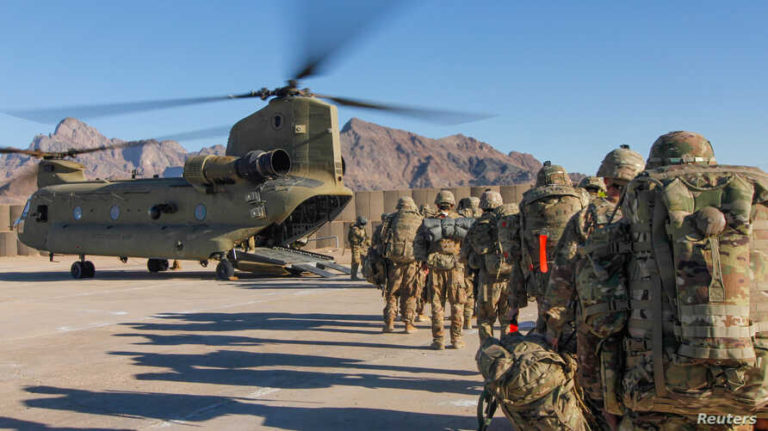
Kabul falls The speed with which Taliban managed to seize control in Afghanistan has both shocked the entire world and resulted in a lot of criticism on Washington’s inept handling of the situation. One of the biggest fears now concerns safety of those locals, who for the last two decades had in some way helped coalition forces and the government in Kabul to fight the Taliban, have now shamelessly been abandoned by the US and left to fend for themselves.
The great betrayal After the cold-blooded murder of 22 unarmed Afghan National Army commandos who had surrendered on June 16 in Dawlat Abad of Faryab province near Turkmenistan border, forsaking those Afghans whom Taliban would view as collaborators or government sympathisers, is tantamount to signing their death warrants. Thus, this is indeed a matter of serious concern, because after this massacre, it’s abundantly clear that while seeking retribution, Taliban will resort to the same savagery that it had exhibited while seizing power in Afghanistan, a quarter century ago.
Now that
its ignominious Afghanistan chapter is over, Washington has already started
absolving itself of any lapses, and seems apparently confident just like its previous
betrayals, like that of the South Vietnamese people in 1973, the world will
soon forget about how it ‘used’ and conveniently ‘discarded’ Afghans. However,
while it may have a lot explain for the Afghanistan debacle to the
international community, Washington also has the moral responsibility to enlighten
to its own people as to why it was patronising a country that was actually
sleeping with America’s nemesis in Afghanistan!
Washington’s duplicity That nearly 2,500 US troops were killed in action while more than 20,000 were wounded in Afghanistan since 2001, bears testimony to the fact that the US Army fought with exemplary grit and valour. The inordinately high casualties suffered by US troops in Afghanistan should thus logically become focus of domestic attention. Washington needs to apprise its people why it remained a passive onlooker despite being in the know that Pakistan was double crossing it by hosting Taliban that was targeting US troops in Afghanistan?
In 2016, Sartaj Aziz [who was the then Pakistani Prime
Minister’s Adviser on Foreign Affairs], admitted that “We have some
influence on them [Taliban] because their leadership is in Pakistan, and they
get some medical facilities, their families are here.” Whereas,
Aziz’s claim of Islamabad having only “some influence” over
Taliban was highly underrating Pakistan-Taliban relationship, his revelation
that Pakistan had been hosting Taliban leadership all along, while it was waxing
eloquent on its war on terror and getting US aid in return is, to say the
least, unpardonable!
Three years later, Prime Minister Imran Khan himself
admitted that “when you talk about militant groups, we still have about
30,000-40,000-armed people who have been trained and fought in some part of
Afghanistan or Kashmir.” Unfortunately, the US, which was
spearheading a global war against terror didn’t bother to ask Khan what was he doing
about this grave threat that had global implications. Nor did Washington care
to enquire as to who was providing sustenance to such a massive congregation of
armed renegades, and more importantly, what had motivated them to seek refuge
in Pakistan?
Isn’t it ironical that even though both Aziz and Khan made
these revelations during their US visit, yet these damning confessions of
sanctuaries being provided to Taliban didn’t arouse any public debate even
though they were directly jeopardising safety of US forces in Afghanistan?
Pakistan’s deceit More recently (June 27 to be precise), Pakistani Interior Minister Sheikh Rashid Ahmed admitted that “Taliban families live here in Pakistan in areas like Rawat, Loi Ber, Bara Kahu and Tarnol.” He also went on to reveal that “Sometimes their [Taliban fighters] dead bodies arrive and sometimes they come here to hospitals to get medical treatment.” While this was repetition of what Aziz and Khan had admitted earlier, but one had expected that Taliban fighters and their families would be either staying in some remote area of Pakistan bordering Afghanistan or living incognito in refugee camps to escape detection by Pakistani intelligence agencies and security forces.
In fact, this is exactly what Khan hinted at when he said, “Now, there are camps of 500,000 people, there are camps of 100,000 people. And Taliban are not some military outfits, they are normal civilians. And if there are some civilians in these camps, how is Pakistan supposed to hunt these people down? How can you call them sanctuaries?” Whereas Khan’s contention made sense, but the locations where Taliban fighters and their families are staying as mentioned by Pakistan’s Interior Minister happen to be suburbs of the country’s capital and not refugee camps.
So, it’s more than evident that Taliban has always enjoyed a ‘special status’ in Pakistan, and needless to say, this is not out of mere goodwill but the result of a quid pro quo arrangement. That’s why the Pakistan Prime Minister’s claim that “We are not responsible, neither are we spokespersons for the Taliban” is hard to believe. Furthermore, with Pakistani NSA Moeed Yusuf saying “The situation [in Afghanistan] is bad and out of Pakistan’s control” and “If a phone call [from US President to Pakistan’s Prime Minister] is a concession, if a security relationship is a concession, Pakistan has options,” Khan’s puerile attempt to distance Islamabad from Taliban stands exposed!
Soft pedalling Pakistan-Taliban link By not being specifically assertive on the issue of Islamabad maintaining close links with Taliban and merely asking it to “do more” in the war on terror and making allegorical references to the dangers of “keeping snakes in the backyard,” three US Presidents, willy-nilly gave Pakistan a carte blanche to continue romancing Taliban. It was only former US President Donald Trump who showed some spunk by mentioning in his 2018 new Year tweet that “The United States has foolishly given Pakistan more than 33 billion dollars in aid over the last 15 years, and they have given us nothing but lies & deceit… They give safe haven to the terrorists we hunt in Afghanistan…”
Washington can’t say that it wasn’t aware of this nexus and Pakistan Army’s near-complete hold over Taliban’s powerful ‘Quetta Shura’ heading the Doha US-Taliban talks for two reasons. One, when Pakistan’s National Security Advisor [NSA] went [or was summoned?] to Washington, in end July, he was accompanied by Director General [DG] of Inter Services Intelligence] General Faiz Hameed- a dead giveaway of Rawalpindi’s close links with Taliban.
Two, while the Pakistani NSA didn’t mention initially that
the situation in Afghanistan had been discussed, US NSA Jake Sullivan tweeted
that during this meeting with his Pakistani counterpart, “We discussed the urgent need for a reduction in
violence in Afghanistan and a negotiated political settlement to the conflict”! It’s hard to believe that at a time when
Islamabad was proudly telling the world how it was playing the mediator in
Afghanistan, it’s hard to believe that Pakistan’s NSA inadvertently missed out
mentioning that Afghanistan was the central focus of this discussion!
Taliban’s unofficial “spokesperson” Prime Minister Khan may say that “We are not responsible, neither are we spokespersons for the Taliban,” but by the way the Pakistani establishment has come out in defence of Taliban’s actions speaks otherwise.
Despite brazenly initiating a bloodbath in Afghanistan in a flagrant violation of the Doha Agreement, Prime Minister Imran Khan still wants the world to see them as “normal civilians.” Pakistan’s Foreign Minister maintained that “this impression that the violence is high because of the Taliban, again, that would be an exaggeration,” and even tried to shift the blame of violence perpetuated by Taliban on Daesh [Islamic State] by adding, “Aren’t there other elements over there who are playing the role of a spoiler?”
Finally, when Khan hails Taliban’s bloody takeover of Kabul as an act by which Afghans have “broken the shackles of slavery,”is any more evidence of Pakistan acting as Taliban’s “spokesperson” necessary?
Islamabad’s enduring romance with Taliban dates back to the days when Afghanistan was under Soviet occupation. Let’s not forget that it was one of the three countries that recognised the Taliban government in Afghanistan and the last to break diplomatic relations with it. However, it continued to covertly nurture Taliban as its ‘ace of spade’ for extracting aid from the US in the garb of fighting its war against terror, while simultaneously using this terrorist group to wage a proxy war in Afghanistan.
The bad guy wins Islamabad’s bold gamble that brazenly violated international law paid off and it continued to receive funds from Washington despite providing Taliban safe sanctuaries on Pakistani soil as well as military and logistical support. While this was a win-win situation for both Pakistan and Taliban, the only losers were US forces fighting in Afghanistan!
What has happened can’t be undone, but to any veteran [and I’m one], the idea of a government playing games with its own soldiers is downright revolting, especially when it’s matter of life or death. Just because a soldier lays down his life unflinchingly in the line of duty doesn’t mean that he’s expendable. So, someone from Capitol Hill must explain why “The United States has foolishly given Pakistan more than 33 billion dollars in aid over the last 15 years,” when it was giving a safe haven to the terrorists the US forces were hunting in Afghanistan?
Epilogue If the past is any indicator, then chances of Trump’s above mentioned matter-of-fact observations being seriously debated in America are indeed very slim. While President Joe Biden may not appreciate the Afghanistan debacle being equated with the Vietnam fiasco, a song written during the Vietnam war gives a very strong sense of déjà vu through a poetic but indisputable link between the two. Titled ‘The Grave’ and written by Don McLean in the 70s, this poignant song fits seamlessly into the Afghanistan scenario as an apt requiem for those US soldiers who fought and fell in Afghanistan while fighting Pakistan-hosted Taliban, particularly the lines:
“When the wars of our nation did beckon
The man barely twenty did answer the calling
Proud of the trust that he placed in our nation
He’s gone
But Eternity knows him, and it knows what we’ve done!”
We use cookies on our website to give you the most relevant experience by remembering your preferences and repeat visits. By clicking “Accept All”, you consent to the use of ALL the cookies. However, you may visit "Cookie Settings" to provide a controlled consent.
This website uses cookies to improve your experience while you navigate through the website. Out of these, the cookies that are categorized as necessary are stored on your browser as they are essential for the working of basic functionalities of the website. We also use third-party cookies that help us analyze and understand how you use this website. These cookies will be stored in your browser only with your consent. You also have the option to opt-out of these cookies. But opting out of some of these cookies may affect your browsing experience.
Functional cookies help to perform certain functionalities like sharing the content of the website on social media platforms, collect feedbacks, and other third-party features.
Performance cookies are used to understand and analyze the key performance indexes of the website which helps in delivering a better user experience for the visitors.
Analytical cookies are used to understand how visitors interact with the website. These cookies help provide information on metrics the number of visitors, bounce rate, traffic source, etc.
Advertisement cookies are used to provide visitors with relevant ads and marketing campaigns. These cookies track visitors across websites and collect information to provide customized ads.
Necessary cookies are absolutely essential for the website to function properly. These cookies ensure basic functionalities and security features of the website, anonymously.
Cookie
Duration
Description
cookielawinfo-checkbox-analytics
11 months
This cookie is set by GDPR Cookie Consent plugin. The cookie is used to store the user consent for the cookies in the category "Analytics".
cookielawinfo-checkbox-functional
11 months
The cookie is set by GDPR cookie consent to record the user consent for the cookies in the category "Functional".
cookielawinfo-checkbox-necessary
11 months
This cookie is set by GDPR Cookie Consent plugin. The cookies is used to store the user consent for the cookies in the category "Necessary".
cookielawinfo-checkbox-others
11 months
This cookie is set by GDPR Cookie Consent plugin. The cookie is used to store the user consent for the cookies in the category "Other.
cookielawinfo-checkbox-performance
11 months
This cookie is set by GDPR Cookie Consent plugin. The cookie is used to store the user consent for the cookies in the category "Performance".
viewed_cookie_policy
11 months
The cookie is set by the GDPR Cookie Consent plugin and is used to store whether or not user has consented to the use of cookies. It does not store any personal data.