Home Blog Page 321

1971 War: Remembering India’s victory over Pakistan

On the eve of 3 December, 1971, at about 5.40 P.M., fighter aircraft of the Pakistan Air force (PAF) carried out a coordinated, pre-emptive air strike on Indian Air Force bases in Amritsar, Pathankot, Srinagar, Avantipur, Utterlai, Jodhpur, Ambala and Agra. The air strikes were supported by heavy artillery shelling all along the border and a massive attack in the strategically important Chhamb sector of Jammu and Kashmir.

It became quite apparent that the Pakistani military leadership (General Yahya Khan and General Tikka Khan) and its vitriolic political leader, Zulfikar Ali Bhutto, had lost the battle of nerves and Pakistan had opted to initiate open hostilities. Quite obviously, the military objective was to garner a decisive tactical and strategic victory through the element of surprise.

Prime Minister Indira Gandhi, who was at that time in Calcutta, rushed back to Delhi and addressed the nation on radio, ‘I speak to you at a moment of grave peril to our country and our people. Some hours ago, soon after 5:30 P.M. on Dec. 3, Pakistan launched full‐scale war against us”, she said in her address. “I have no doubt that it is the united will of our people that this wanton and unprovoked aggression of Pakistan should be decisively and finally repelled. In this resolve, the Government is assured of the full and unflinching support of all political parties and every Indian citizen”, she added.

Thus started, formally, what is today known as the Indo-Pakistan War, 1971. It was to be, in the annals of military history of the sub-continent and the world, the shortest war to give such a  decisive victory, to the extent of carving out a new Nation – Bangladesh.

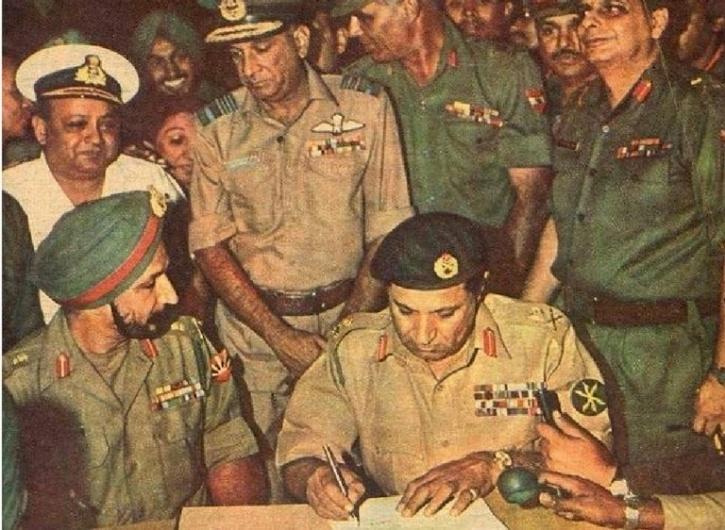
Pakistan's Lt. Gen. Amir Abdullah Khan Niazi  (right) surrenders to India after losing the 1971 Indo-Pak War. Lt Gen. Jagjit Singh Aurora (left) received command of entire Pakistan's Armed Forces in Bangladesh.
Pakistan’s Lt. Gen. Amir Abdullah Khan Niazi (right) surrenders to India after losing the 1971 Indo-Pak War. Lt Gen. Jagjit Singh Aurora (left) received command of entire Pakistan’s Armed Forces in Bangladesh.

The main reason behind the war was the horrifying persecution of the people of erstwhile East Pakistan (now Bangladesh) by the militarily more powerful West Pakistan. In the election held in Pakistan in 1970,  Sheikh Mujibur Rehman  led Awami League shocked Zulfikar Ali Bhutto and the military dictatorship of Pakistan by garnering 167 out of 169 seats in the East Pakistan Legislative Assembly and a near absolute majority in the 313 seat National Assembly. Mujibur Rehman had the mandate to govern the country, but this was not acceptable to the Punjabi centric military dictatorship and their stooge, Zulfikar Ali Bhutto.

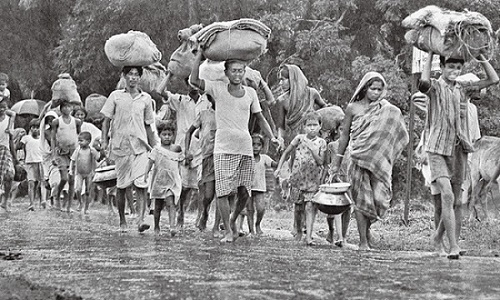
Mujibur Rehman was arrested in West Pakistan and martial law imposed in East Pakistan.  Then commenced genocide of the worst kind marked by brutal atrocities committed on civilians,  especially Bengali Hindus including wanton killing, rape and torture. These hapless people fled to India in large numbers to escape the carnage. India opened her borders to save the refugees whose number soon swelled to almost ten million.

India sought international assistance to meet the huge refugee challenge and also to pressurise Pakistan into stopping the atrocity, but it did not come by. The Government was keen to open hostilities with Pakistan in the monsoon months itself but the proposal was shot down by the then Chief of Army Staff, General SHFJ (Sam) Manekshaw. He said that the rainy season was not suitable for campaigning in East Pakistan and also that the army needed some time to prepare for war.

General (later Field Marshal) Sam Manekshaw, went on to become a folklore for his firm and brilliant planning and conduct of the war. His actions were in keeping with the highest traditions and strategic requirements and thus gave to India a resounding victory.

As soon as hostilities commenced Prime Minister Gandhi recognised East Pakistan as an independent nation called Bangladesh and India got into a war on two fronts, east and west, with the Navy and Air Force also incorporated. The Indian Navy was quick to implement a blockade which disallowed supplies from West Pakistan to East Pakistan and the Indian Air Force soon established complete air superiority  over the East Pakistan skies.

On the western front, the war witnessed many battles where the Indian soldiers exhibited courage and fortitude in the face of great odds and came out victorious, albeit after great sacrifice. Primary among the battles fought in this sector is the Battle of Chhamb, Battle of Laungewala, Battle of Shakargarh Bulge, Battle of Basantar, Battle of Fazilka among many others . The exploits of Major (later Brigadier) Kuldip Singh Chandpuri and his men of 23 Punjab in Laungewala have been depicted in an epic Indian movie “Border”.

The conduct of the war was a true example of the synergized efforts of the government and the Armed Forces with complete support of the people of the country. It was the support of the Nation that served as an elixir for the soldiers to attain success.

Bangladesh today is a proud, independent nation well on the path to development. Its rapidly improving economy and enduring democracy are its biggest assets. Its relationship with India is very good and improving rapidly. This freedom was won with great sacrifice. The role of the Indian army is providing to the people of Bangladesh the fruits of democracy and freedom is remarkable.

Due to the ignominious defeat suffered by Pakistan the evil policy to “bleeding India with a thousand cuts” was later formulated by the Pakistani Dictator, General Zia-ul-Haq, sometime in 1977. The basis of the policy lies in the conviction that Pakistan cannot beat India in a conventional war, so the best option is to resort to a Proxy War designed to weaken the fabric of Indian constitutional democracy from within.

 Jammu and Kashmir, particularly the Kashmir Valley, was chosen as the main battlefield for application of this policy. It has failed miserably. Foreign sponsored terrorism that formed the fulcrum of the policy has been decimated by the Indian Army. The political environment has been stabilised with revocation of Article 370 and re-designation of the state as a Union territory.

It is hoped that Pakistan and its stooges will read the writing on the wall and understand that it cannot break the fabric of India by any means, fair or foul. No kind of warfare, be it conventional, proxy, asymmetric, kinetic, hybrid or anything else can fructify the evil, fundamentalist ambitions of some self serving powers based in Pakistan.(

The High-IQ Rankings: or, the High-IQ Directories, Listings, Rankings

1

One of the great wildernesses of the international high-IQ communities, as delineated cells of IQ test-takers with scores on a variety of tests at a range of rarities with generalized and specialized communities, are the high-IQ directories, listings, and rankings.

With each, they tend to list from highest to lowest scores as reported on a variety of tests. In turn, this means the directories and the listings can be considered directories and listings, generically, and rankings, specifically.

Therefore, for most, the most precise terminology would be “rankings” rather than “directories” or “listings.” Although, all terms work in the patois of the high-IQ community if not considering differences in generic or specific implied meanings.

This article will explore some of them[1]. Those rankings include ESOTERIQ Society of Masaaki Yamauchi (incorporative of some of the Giga Society of Paul Cooijmans), GENIUS High IQ Network of Dr. Iakovos Koukas, GFIS IQ List/Dinghong Yao IQ Ranking List of Dinghong Yao, GIFTED High IQ Network of Dr. Iakovos Koukas, Hall of IQ Scores of Konstantinos Ntalachanis, Hall of Sophia of Guillermo Alejandro Escárcega Pliego, HRIQ Ranking List of Qiao Hansheng, Mahir Wu Ranking List of Mahir Wu, Real IQ Listing of Dr. Ivan Ivec, Svenska IQ-Listan of Hans Sjöberg and Alexi Edin, VeNuS Ranking List of Domagoj Kutle/Domagoj Domo Kutle, WIQF Listing[2] of Marco Ripà and Dr. Manahel Thabet, World Famous IQ Scores of Dr. Ivan Ivec, World Genius Directory of Jason Betts, and World Highest IQ Scores of Mislav Predavec.

For some further information with most actual or potential founding dates, and founders, and two highest score claimants at present, associated tests, scores, and standard deviations, please see further below:

ESOTERIQ Society of Masaaki Yamauchi founded in 2001 with the highest claimed scores at an IQ of 194.68 (S.D. 15) on the CIT5 by Dr. Heinrich Siemens and on RIDDLES by Yukun Wang. Its website stated:

The ESOTERIQ membership is separated into either the GIGA society members or non-the GIGA society members.  Any GIGA member is always automatically welcomed to the ESOTERIQ society.    

Non-GIGA members are required belonging to at least one of the following societies in advance and one test would be limited only per one candidate. Hence, the same tests are prohibited to be listed for the different individuals. 

A member or subscriber of the OLYMPIQ society (above IQ190.sd15 performance) 

A listed member of the World Genius Directory(above IQ190.sd15 performance) 

A non-belonging candidate of the above may also be considered on a case by case basis. 

WAIS-Ⅳ and Stanford-Binet-Ⅴ are invalid as the ESOTERIQ membership. 

The membership fee is free. 

Contact: info@esoter.iqsociety.org

These must be clerical errors, as the scores remain inclusive of IQs at 190 (S.D. 15) and, therefore, should state “at or above” rather than “above” alone.

GENIUS High IQ Network of Dr. Iakovos Koukas founded in 2014 with the highest claimed score at an IQ of 208 (S.D. 15) on MATRIQ by Iakovos Koukas (first attempt) and the second-highest score at an IQ of 194 (S.D. 15) on MATRIQ by Tor Arne Jørgensen (second attempt).

GFIS IQ List/Dinghong Yao IQ Ranking List of Dinghong Yao founded in 2017 (maybe) with the highest claimed score at an IQ of 192 (S.D. 15) on the Logicaus Strictimanus 24 (LS24) by Mislav Predavec and the second-highest claimed scores at an IQ of 190+ (S.D. 15) on the Numerus Classic by Wen-Chin Sui and Challenger by Junxie Huang.

GIFTED High IQ Network of Dr. Iakovos Koukas founded in 2014 with the highest claimed score at an IQ of 208 (S.D. 15) on MATRIQ by Iakovos Koukas (first attempt) and the second-highest score at an IQ of 194 (S.D. 15) on MATRIQ by Tor Arne Jørgensen (second attempt).

Hall of IQ Scores of Konstantinos Ntalachanis founded in 2016 with the highest score claimed at an IQ of 230 (S.D. 15) by Konstantinos Ntalachanis on the D.O.S. and a second-highest score claimed at an IQ of 216 (S.D. 15) by Ken Luo on RIDDLES.

Hall of Sophia of Guillermo Alejandro Escárcega Pliego founded in 2019 (maybe) with the highest claimed scores on a variety of tests differentiating historical and current figures, prominent and not.

HRIQ Ranking List of Qiao Hansheng with the highest claimed score at an IQ of 195+ (S.D. 15) on MATRIQ by Iakovos Koukas and the second-highest claimed score at an IQ of 191 (S.D. 15) on the Qoyman Multiple-Choice #3 by Dr. Evangelos Katsioulis.

Mahir Wu Ranking List of Mahir Wu founded in 2017 (maybe) with the highest claimed scores at an IQ of 190+ (S.D. 15) on Challenger by Junxie Huang and on Free Fall (Part II) by Jose Gonzalez Molinero.

Real IQ Listing of Dr. Ivan Ivec (also links to Jason Betts) founded in 2012 (maybe) with the highest claimed score at an IQ of 181.20 (S.D. 15) by Luca Fiorani and the second-highest claimed score at an IQ of 174.90 (S.D. 15) by Erik Hæreid.

Svenska IQ-Listan of Hans Sjöberg and Alexi Edin founded in 2016 (maybe) with the highest claimed score at an IQ of 180 (S.D. 15) on the Cogitatus Logicae by Stefan Langemalm and the second-highest claimed score at an IQ of 172 (S.D. 15) on GENE V3 by Tonny Sellen.

VeNuS Ranking List of Domagoj Kutle/Domagoj Domo Kutle founded in 2017 (maybe). It utilizes an idea of Jason Betts of TrueIQ with the Venus score as a composite of the highest scores.

Although, as noted by Darryl Miyaguchi, in previous writings, this has antecedents in title, as stated in “A Short (and Bloody) History of the High I.Q. Societies” (2000), “The method, called the Ferguson formula, after George A. Ferguson, a well-known psychometrician, involves estimating the ‘true’ I.Q. that would be required to achieve high scores on imperfectly-correlated tests, which is generally higher than the average of the scores on the tests used.”

The highest claimed Venus score is 558 of Konstantinos Ntalachanis and the second-highest claimed Venus score is 552 of Dr. Heinrich Siemens.

WIQF Listing of Marco Ripà and Dr. Manahel Thabet founded in April 2014 with the highest claimed score at an IQ of 229.44 (S.D. 24)/ 180.90 (S.D. 15) on 1 unnamed test by Varidh Katiyar and the second-highest claimed score at an IQ of 220.00 (S.D. 24)/175 (S.D. 15) on 1 unnamed test by YoungHoon Kim/YoungHoon Bryan Kim.

World Famous IQ Scores of Dr. Ivan Ivec founded in 2011 (maybe) with the highest claimed scores at an IQ of 190+ (S.D. 15) on Numerus by Dong Khac Cuong and Tianxi Yu, on Free Fall Part II by José González Molinero and Junxie Huang, and on Numerus Classic by Wen-Chin Sui.

World Genius Directory of Jason Betts founded in 2015 (maybe) with the highest claimed score at an IQ of 198 (S.D. 15) on the NVCP by Dr. Evangelos Katsioulis and the second-highest claimed score at an IQ of 195 (S.D. 15). on the CIT5 by Dr. Heinrich Siemens.

World Highest IQ Scores of Mislav Predavec[3] founded in 2007 with the highest claimed score at an IQ of 188 (S.D. 15) on the Ls 60 by Mislav Predavec and the second-highest claimed score at an IQ of 187.5 on the Logicaus strictimanus 24 by Mislav Predavec.

Based on these provisions, the founders of the rankings have a tendency to list themselves on the listings. In several, the founders rank themselves as the highest-scoring member of the ranking.

This happens with the GENIUS High IQ Network of Dr. Iakovos Koukas, GIFTED High IQ Network of Dr. Iakovos Koukas, Hall of IQ Scores of Konstantinos Ntalachanis, and World Highest IQ Scores of Mislav Predavec.

Now, a large number of rankings of the highest IQs, or the highest claimed IQs rather, exist online. Many at or above 6.00-sigma, in other words. When examining all of the above rankings, those individuals include the below names.

All, according to the rankings themselves, the scores at or above 6.00-sigma with individuals and tests if available, uncertain if all individuals themselves make these claims. Therefore, consider the below relative only to the individuated rankings in and of themselves, please:

ESOTERIQ Society of Masaaki Yamauchi

  • Dr. Heinrich Siemens (Germany) at 6.31-sigma on CIT-5 by Paul Cooijmans in 2020
  • Yukun Wang (China) at 6.31-sigma on RIDDLES by Konstantinos Ntalachanis in 2020
  • Mislav Predavec (Croatia) 6.13-sigma on LS24 by Robert Lato in 2010
  • Richard Rosner (U.S.A) 6.13-sigma on MATHEMA by Dr. Jason Betts in 2012
  • Dr. Evangelos Katsioulis (Greece) 6.06-sigma on QMC#3 by Paul Cooijmans in 2003
  • Christopher Harding (Australia) 6.06-sigma on SBIS-Oxford-Analysis-New-Zealand in 1976
  • Kenneth Ferrell (U.S.A) 6.00-sigma on HIEROGLYPHICA by Mislav Predavec in 2010
  • Dany Provost (Canada) 6.00-sigma on PIGS-1° by Paul Cooijmans in 2004
  • Junxie Huang (China) 6.00-sigma on CHALLENGER IQ TEST by Zoran Bijac in 2019
  • Jose Molinero (Spain) 6.00-sigma on FREE FALL PART-Ⅱ by Ivan Ivec in 2017
  • Wen Chin Sui (China) 6.00-sigma on NUMERUS CLASSIC by Ivan Ivec in 2017
  • Marios Prodromou (Cyprus) 6.00-sigma on MACH by Nickolas Soulios in 2018
  • Dong Khac Cuong (Vietnam) 6.00-sigma on NUMERUS by Ivan Ivec in 2019
  • Matthew Scillitani (U.S.A) 6.00-sigma on PM-QROSSWORDS by Paul Cooijmans in 2019
  • Thansie Yu (China) 6.00-sigma on N-WORLD by Mahir Wu in 2020
  • (YoungHoon Kim/YoungHoon Bryan Kim at 6.00-sigma or higher, potentially, formerly a member; no longer on the listing.)
  • (Cavan Cohoes at 6.00-sigma or higher, potentially, formerly a member; no longer on the listing.)
  • (Tanxi Yu at 6.00-sigma or higher, potentially, formerly a member; no longer on the listing.)
  • (Luca Fiorani at 6.00-sigma or higher, potentially, formerly a member; no longer on the listing.)
  • (Jose Molinero at 6.00-sigma or higher, potentially, formerly a member; no longer on the listing.)
  • (Junxie Huang at 6.00-sigma or higher, potentially, formerly a member; no longer on the listing.)
  • (Sanghyun Cho at 6.00-sigma or higher, potentially, formerly a member; no longer on the listing.)
  • (Dawid Skrzos at 6.00-sigma or higher, potentially, formerly a member; no longer on the listing.)

GENIUS High IQ Network of Dr. Iakovos Koukas

  • Iakovos Koukas at 6.93-sigma on MATRIQ
  • Tor Arne Jorgensen at 6.27-sigma on MATRIQ
  • Jose G. Molinero at 6.00-sigma on FREE Fall Part II
  • Marios Prodromou at 6.00-sigma on MACH

GFIS IQ List/Dinghong Yao IQ Ranking List of Dinghong Yao

  • Mislav Predavec at 6.13-sigma on Logicaus Strictimanus 24 (LS24)
  • Huang Junxie at 6.00+-sigma on Challenger
  • Wen-Chin Sui at 6.00-sigma on Numerus Classic

GIFTED High IQ Network of Dr. Iakovos Koukas

  • Iakovos Koukas at 6.93-sigma on MATRIQ
  • Tor Arne Jørgensen at 6.27-sigma on MATRIQ
  • Rick Rosner at 6.13-sigma on Mathema
  • Jose G. Molinero at 6.00-sigma on FREE Fall P.II
  • Marios Prodromou at 6.00-sigma on MACH
  • Wen-Chin Sui at 6.00-sigma on Numerus Classic

Hall of IQ Scores of Konstantinos Ntalachanis

  • Konstantinos Ntalachanis at 8.67-sigma on D.O.S.
  • Wen Luo at 7.73-sigma on RIDDLES
  • Yukun Wang at 6.31-sigma on RIDDLES
  • Marios Prodromou at 6.00-sigma on MACH
  • Jose Gonzalez Molinero at 6.00-sigma on FREE Fall Part II
  • Junxie Huang at 6.00-sigma on Challenger
  • Konstantinos Ntalachanis at 6.00-sigma on Monster IQ Test

Hall of Sophia of Guillermo Alejandro Escárcega Pliego[5]

  • William James Sidis at unmeasurable sigma (no test named)
  • Dr. Evangelos Katsioulis at 6.375-sigma (should be 6.53-sigma) (no test named, probably NVCP-R)
  • Thomas R. A. Wolf at or above 6.00-sigma (no test named)
  • Andreas Gunnarsson at or above 6.00-sigma (no test named)
  • Scott Ben Durgin at or above 6.00-sigma (no test named)
  • Dany Provost at or above 6.00-sigma (no test named)
  • Rolf Mifflin at or above 6.00-sigma (no test named)
  • Paul Johns at or above 6.00-sigma (no test named)
  • Dr. Evangelos G. Katsioulis at or above 6.00-sigma (no test named)
  • Rick Rosner at or above 6.00-sigma (no test named)
  • Christopher Harding at or above 6.00-sigma (no test named)
  • Kevin Langdon at or above 6.00-sigma (no test named)

HRIQ Ranking List of Qiao Hansheng

  • Iakovos Koukas at 6.93-sigma on MATRIQ
  • Dr. Evangelos Katsioulis at 6.06-sigma on Qoymans Multiple-Choice #3
  • José González Molinero at 6.00-sigma on FREE FALL (Part II)
  • Junxie Huang at 6.00-sigma on Challenger
  • Wen-Chin Sui at 6.00-sigma on Numerus Classic

Mahir Wu Ranking List of Mahir Wu

  • Junxie Huang at 6.00+-sigma on Challenger
  • José González Molinero at 6.00+-sigma on FREE FALL (Part II)
  • Mahir Wu at 6.00-sigma on Silent Numbers

Real IQ Listing of Dr. Ivan Ivec

  • None claimed at or above 6.00-sigma.

Svenska IQ-Listan of Hans Sjöberg and Alexi Edin

  • None claimed at or above 6.00-sigma.

VeNuS Ranking List of Domagoj Kutle/Domagoj Domo Kutle[6]

  • None utilize a single score for a particular sigma claim. However, before, or in others:
  • Konstantinos Ntalachanis at 8.67-sigma on D.O.S.
  • Dr. Heinrich Siemens at 6.31-sigma on CIT-5
  • Tor Arne Jørgensen at 6.27-sigma on MATRIQ
  • Konstantinos Ntalachanis at 6.00-sigma on Monster IQ Test
  • Marios Prodromou at 6.00-sigma on MACH

WIQF Listing Marco Ripà and Dr. Manahel Thabet

  • None claimed at or above 6.00-sigma.

World Famous IQ Scores of Dr. Ivan Ivec

  • Dong Khac Cuong at 6.00+-sigma on Numerus
  • José González Molinero at 6.00+-sigma on FREE FALL (Part II)
  • Junxie Huang at 6.00+-sigma on FREE FALL (Part II)
  • Tanxi Yu at 6.00+-sigma on Numerus
  • Wen-Chin Sui at 6.00-sigma on Numerus Classic

World Genius Directory of Jason Betts

  • Dr. Evangelos Katsioulis at 6.53-sigma on NVCP
  • Dr. Heinrich Siemens at 6.31-sigma on CIT-5
  • Rick Rosner at 6.13-sigma on Mathema
  • Mislav Predavec at 6.13-sigma on Logicaus Strictimanus 24 (LS24)
  • Kenneth Ferrell at 6.00-sigma on Hieroglyphica
  • Dany Provost at 6.00-sigma on PIGS1°
  • Wen-Chin Sui at 6.00-sigma on Numerus Classic
  • Marios Prodromou at 6.00-sigma on MACH
  • Cường Đồng at 6.00-sigma on Numerus

World Highest IQ Scores of Mislav Predavec

None claimed above 6.00-sigma. However, one claimed at 187.5 (S.D. 15) on the website, on the Ls 24 or the Logicaus strictimanus 24 would match the same test as the World Genius Directory with the claimed score of 192 (S.D. 15).

The same test and different scores with the World Genius Directory claimed at 6.12-sigma and the World Highest IQ Scores claimed at 5.83-sigma. Both claimed scores by Mislav Predavec; these may represent different attempts or clerical errors.

In this manner, we can produce a unified picture of the claims to scores at or above 6.00-sigma by living individuals. With the rankings, while elimination of redundancy or duplication of names with minor spelling or accent variations, we can produce a claimed score ranking.

A claimed score ranking of individuals at or above 6.00-sigma from the current crop of better-known living highest-IQ rankings (directories, listings, and rankings):

Compilation Ranking

  1. William James Sidis at unmeasurable sigma (no test named)
  2. Konstantinos Ntalachanis at 8.67-sigma on D.O.S. and at 6.00-sigma on Monster IQ Test
  3. Wen Luo at 7.73-sigma on RIDDLES
  4. Dr. Iakovos Koukas/Iakovos Koukas at 6.93-sigma on MATRIQ
  5. Dr. Evangelos Katsioulis/Evangelos Katsioulis at 6.53-sigma on NVCP-R and at 6.06-sigma on Qoymans Multiple-Choice #3
  6. Dr. Heinrich Siemens/Heinrich Siemens at 6.31-sigma on CIT-5
  7. Yukun Wang at 6.31-sigma on RIDDLES
  8. Tor Arne Jørgensen at 6.27-sigma on MATRIQ
  9. Rick Rosner at 6.13-sigma on Mathema
  10. Mislav Predavec at 6.13-sigma on Logicaus Strictimanus 24 (LS24)
  11. Dr. Christopher Harding/Dr. Christopher Philip Harding at 6.06-sigma on Stanford-Binet
  12. Junxie Huang at 6.00+-sigma on FREE FALL (Part II) and at 6.00+-sigma on Challenger
  13. Tanxi Yu at 6.00+-sigma on Numerus
  14. José González Molinero/Jose Gonzalez Molinero at 6.00+-sigma on FREE FALL (Part II)
  15. Matthew Scillitani at 6.00-sigma on Psychometric Qrosswords
  16. Mahir Wu at 6.00-sigma on Silent Numbers
  17. Kenneth Ferrell at 6.00-sigma on Hieroglyphica
  18. Dany Provost at 6.00-sigma on PIGS1°
  19. Wen-Chin Sui at 6.00-sigma on Numerus Classic
  20. Marios Prodromou at 6.00-sigma on MACH
  21. Thansie Yu at 6.00-sigma on N-World
  22. Dong Khac Cuong/Cường Đồng at 6.00-sigma on Numerus
  23. Thomas R. A. Wolf at or above 6.00-sigma (no test named)
  24. Andreas Gunnarsson at or above 6.00-sigma (no test named)
  25. Scott Ben Durgin at or above 6.00-sigma (no test named)
  26. Rolf Mifflin at or above 6.00-sigma (no test named)
  27. Paul Johns at or above 6.00-sigma (no test named)
  28. Christopher Harding at or above 6.00-sigma (no test named)
  29. Kevin Langdon at or above 6.00-sigma (no test named)

Former ESOTERIQ Members

  • (YoungHoon Kim/YoungHoon Bryan Kim at 6.00-sigma or higher, potentially, formerly a member; no longer on the listing.)
  • (Cavan Cohoes at 6.00-sigma or higher, potentially, formerly a member; no longer on the listing.)
  • (Tanxi Yu at 6.00-sigma or higher, potentially, formerly a member; no longer on the listing.)
  • (Luca Fiorani at 6.00-sigma or higher, potentially, formerly a member; no longer on the listing.)
  • (Jose Molinero at 6.00-sigma or higher, potentially, formerly a member; no longer on the listing.)
  • (Junxie Huang at 6.00-sigma or higher, potentially, formerly a member; no longer on the listing.)
  • (Sanghyun Cho at 6.00-sigma or higher, potentially, formerly a member; no longer on the listing.)
  • (Dawid Skrzos at 6.00-sigma or higher, potentially, formerly a member; no longer on the listing.)

With these 29 claimed by the rankings, while potentially only claimed by the Hall of Sophia for some, the range of sigmas would be 6.00-sigma to unmeasurable or, alternatively 6.00-sigma, to 8.67-sigma. All this on the premise of the accuracy of the testing and the claims of scores on tests connected to IQ scores.

The rarities out of the general population implied by the sigmas including and after 6.00 to, for example, 6.80-sigma would mean the following, as examples:

  • 6.00-sigma is 1 out of 1,009,976,678 people in the general population.
  • 6.07-sigma is 1 out of 1,525,765,721 people in the general population.
  • 6.13-sigma is 1 out of 2,314,980,850 people in the general population.
  • 6.20-sigma is 1 out of 3,527,693,270 people in the general population.
  • 6.27-sigma is 1 out of 5,399,067,340 people in the general population.
  • 6.33-sigma is 1 out of 8,299,126,114 people in the general population.
  • 6.40-sigma is 1 out of 12,812,462,045 people in the general population.
  • 6.47-sigma is 1 out of 19,866,426,228 people in the general population.
  • 6.53-sigma is 1 out of 30,938,221,975 people in the general population.
  • 6.60-sigma is 1 out of 48,390,420,202 people in the general population.
  • 6.67-sigma is 1 out of 76,017,176,740 people in the general population.
  • 6.73-sigma is 1 out of 119,937,672,336 people in the general population.
  • 6.80-sigma is 1 out of 190,057,377,928 people in the general population.

And so on, given the rarity past somewhere between 6.67-sigma to 6.73-sigma, and given the number of people who have lived on the planet in the history of the species, even in the present day, the scores on alternative tests compared to mainstream intelligence tests become inflated by the nature of the rarities claimed in addition to the number of individual test-takers claiming scores above or at 6-sigma.

Even with the elimination of scores claimed only on the rankings, or only the scores of individuals who themselves claim the scores on the alternative tests at or above 6-sigma, the continual issues of the rarities and the number of individuals glare forward.

In short, even if verified as accurate scores, as a premise of assuming trust in the scores claimed, the scores themselves, by individuals, can be claimed as inflated beyond the real metrics. Indeed, when on psychometric validity and reliability grounds, these remain alternative tests.

As such, these alternative tests lack the depth of reliability and validity found in the mainstream intelligence tests developed over decades and decades, even more than a century, so alternative tests compared to mainstream intelligence tests, including, as was noted to me, an alternative test (NVCP, NVCP-E, NVCP-R) made into a mainstream intelligence test.

Which is to say, as was described succinctly by one individual, the French branch of Harcourt Assessment acquired Pearson Education and made the NVCP-E, in particular, into the EPC, while the one highest-IQ claimant claims the score on the NVCP-R, not the NCVP-E. Both from Dr. Xavier Jouve; both test constructor and tested knew one another.

Indeed, Katsioulis took the NVCP-E twice and the NVCP-R twice for a first attempt and a second attempt on both tests as stated in “General information“:

IQ 205 , sd 16, NVCP-R [Rasch equated raw 49/54] • 2002
IQ 196 , sd 16, Qoymans Multiple Choice #3 [ceiling] • 2003
IQ 192 , sd 16, NVCP-E [Rasch equated raw 35/40] • 2002
IQ 186 , sd 16, NVCP-R [Fluid Intelligence Index Score] • 2002
IQ 183 , sd 16, NVCP-E [Fluid Intelligence Index Score] • 2002
IQ 183 , sd 16, Cattell Culture Fair III A+B [ceiling-1] • 2003
IQ 180+ sd 16, Bonnardel BLS4 – 2T [ceiling] • 2003
IQ 180+ sd 16, WAIS-R [extrapolated full scale] • 2002

Thusly, and if assuming a reasonable principle of first attempts resulting in lower scores, one comes to the first attempt on the NVCP-E at an IQ of 183 (S.D. 16) and on the NVCP-R at an IQ 186 (S.D. 16), and a second attempt on the NVCP-E at an IQ of 192 (S.D. 16) and on the NVCP-R at an IQ of 205 (S.D. 16).

In turn, as with the WAIS-R and the Bonnardel BLS4 – 2T scores listed above, and if assuming the seriousness in the effort of the experimental psychologist, Dr. Xavier Jouve, while ignoring relational conflict of interest between the two of them, we can come to the IQ scores from the mainstream intelligence tests at 175+ (S.D. 15), on the WAIS-R and the Bonnardel BLS4 – 2T, to 177.81 (S.D. 15) to 180.63 (S.D. 15), on the NVCP-E (first attempt) and NVCP-R (first attempt), respectively.

Since done by an experimental psychologist, this seems more serious than the MATRIQ and the score of Iakovos Koukas, though a first attempt on the MATRIQ.

One can see some of the highest claimants with WAIS, or a trusted mainstream intelligence test, score at 164 (S.D. 15), or 4.27-sigma, for Dr. Iakovos Koukas and 175 (S.D. 15), or 5.00-sigma, for Dr. Evangelos Katsioulis, while each, individually, claims a sigma of 6.93-sigma on MATRIQ and a 6.53-sigma on NVCP-R, respectively.

However, the WAIS-R scores for Katsioulis match the NVCP-E and NVCP-R first attempt scores far more than the MATRIQ first attempt and the WAIS score for Koukas.

Nonetheless, the N on all tests remains too low. Those with specific psychometric reliability and validity relate to the mainstream intelligence tests, as in aimed at measurement of the proposed scientific construct or psychological construct of general intelligence.

Thus, you see the massive differential between alternative tests and mainstream intelligence test scores for two of the highest-IQ in the world claimants.

This logic can be replicated across the spectrum for more scientific reliability and validity when making loose individual comparisons or larger contrasts, too, between alternative test scores (and scorers), seen mostly on these rankings, and mainstream intelligence tests, seen little on these rankings.

This leaves open the questions about individuals making claims about themselves or individuals assessed and claimed in history. Both more dubious, in different ways, than the rankings, though living rankings have import for individuals who wish for communal recognition of recognized test scores and claimed IQs.

Catherine Morris Cox made a ranking of 300. James Cattell made the Cattell 1,000. Jim Glenn made a list without specific IQs attached to the names. John Platt made a ranking with none at or above IQ 200, or without a specific IQ attached to the name.

Libb Thims made the ranking of 1,000 geniuses in history. The late Tony Buzan made a ranking. Same with the late Tony Buzan and Raymond Keene. Will Durant listed some without any at or above IQ 200.

Catherine Morris Cox ranked those above IQ 200 as Johann Wolfgang von Goethe (IQ 210), Gottfried Wilhelm (von) Leibniz (IQ 205), Hugo Grotius (IQ 200), and Thomas Wolsey (IQ 200).

Libb Thims made the ranking of those at or above IQ 200 with Johann Wolfgang von Goethe (IQ 225), Isaac Newton (IQ 220), Albert Einstein (IQ 215), James Clerk Maxwell (IQ 210), Willard Gibbs (IQ 210), Rudolf Clausius (IQ 205), Leonardo Da Vinci (IQ 200), and Thomas Young (IQ 200).

The late Tony Buzan included at or above IQ 200 as
Leonardo Da Vinci (IQ 220), Johann Wolfgang von Goethe (IQ 215), William Shakespeare (IQ 210), and Albert Einstein (IQ 205).

The late Tony Buzan and Raymond Keene ranked those above IQ 200 as Leonardo Da Vinci (IQ 220), Johann Wolfgang von Goethe (IQ 215), William Shakespeare (IQ 210), and Albert Einstein (IQ 205), too.

Even so, there exist self-claimed IQs or IQs claimed about some, as in media hype or inflated IQs.

In such a manner, there should be skepticism and more careful observation as to even the most minimal criteria of the type of test (alternative test versus mainstream intelligence test), the first attempt on the test or more than the first attempt on the test, and the real name or a fake name/pseudonym on the test, or, further, the financial conflicts of interest or other conflicts of interest inherent in the claimed scores or the rankings declared, as such.

Individuals have taken tests under false names, more than once, and on only alternative tests, for example. Outside of those considerations, these become increasing red flags, including if a difference between a mainstream intelligence test versus an alternative test, as can be noted by Libb Thims in a decent manner.

For example, outside of the genius listing, Libb Thims listed inflated IQs, where one needs to remain cautious: Adragon De Mello, Ainan Cawley, Michael Kearney, Maria Dos Marinos, Marnen Laibow-Koser, Evangelos Katsioulis, Avi Ben-Abraham, Rick Rosner, Marilyn Savant, Visalini Kumaraswamy, Marta Rodiguez, Gena Leung, Nathan Leopold, Christopher Langan/Christopher Michael Langan, Michael Grost, Sho Yano, Dylan Jones, Naida Camukova, Edith Stern, Christopher Harding, Daniel Simidchieva, Garry Kasparov, Philip Emeagwali, Bobby Fischer, Merrill Kenneth Wolf, Grady Towers, Pranav Veera, Judith Polgar, Jacob Barnett, Victoria Cowie, Colin Carlson, Oscar Wrigley, and Elise Tan-Roberts (link here).

Parents want their kids to be geniuses. The culture and media like the stories about genius going well and going awry. Individuals want to join the high-IQ community at the higher-IQ levels, and so on. These are motivations for lying, as happens, often, in these areas, apparently.

Although, by and large, the efforts are honest and sincere. These issues or concerns arise rather pervasively and, therefore, require a conscious attention about them.

[1] In “Christian Sorensen on Measuring and Ranking the Highly Intelligent,” it states:

There are a ton of online sources via articles including “The 40 smartest people of all time,” “30 Smartest People Alive Today,” “8 People with Higher IQs Than Einstein,” “Here Is The Highest Possible IQ And The People Who Hold The World Record,” “25 Highest IQ’s Throughout History,” “The 50 Greatest Living Geniuses,” “21 Celebrities With Surprisingly High IQs,” “World’s Most Intelligent People 2010 – Intelligent People – Highest IQ,” “Feeling accomplished yet? Here is a list of people whose IQ levels have created records time and again,” “Who has the highest recorded IQ of all time?,” “Of All Things: Which president had the highest IQ?,” “Talk About Hidden Genius: These Are The Celebrities Boasting The Highest IQs,” “24 of the smartest people who ever lived,” “Famous Historical Genius IQs,” “The Smartest and Least Brainy Presidents, by IQ Scores,” “An 11-Year-Old Just Earned the Highest IQ Score Possible,” “What Is The Highest IQ Possible You Can Achieve?,” “What is the highest IQ ever measured in a human?,” “Dr Evangelos Katsioulis has the World’s Highest IQ,” “The Time Everyone “Corrected” the World’s Smartest Woman,” “The 13 Presidents with the Highest IQ Scores,” “Who Has the Highest IQ in the World? 35 People Who Are Even Smarter Than Einstein,” “​TOP 10 PEOPLE HAVE HIGHEST IQ SCORES IN THE WORLD (P.2),” “Meet Marilyn Vos Savant, The Woman With The World’s Highest IQ,” “The World’s 50 Smartest Teenagers,” “These 26 Celebrities Have The Highest IQ In Hollywood… #17 Is Pretty Much A Genius!,” “10 People With The Highest IQ In The World,” “The Man With The Highest IQ In The World Doesn’t Think He’s Very Smart At All,” “Top 12 People with Highest IQ in the World,” “Top 10 Women with Highest IQ in the World,” “The Massive List of Genius – People With the Highest IQ,” “Highest IQ Scores in History,” “A 3-year-old boy has just become the youngest member of Mensa UK, the largest international high IQ society,” and others.  It comes down to partial and questionable listings, individual profiles, children, celebrities, and American presidents. Then it’s a smattering of probably truly more obscure materials. Outside of the straight gossip-level journalism, there are a number of listings such as GENIUS High IQ Network, Gifted High IQ Network, Hall of IQ scores, HRIQ Ranking List, Mahir Wu Ranking List, VeNuS Ranking List, World Famous IQ Scores, World Genius Directory, World Highest IQ Scores, GFIS IQ List, WIQF Listing, and Real IQ Listing.

[2] Its co-founders and co-presidents were Marco Ripà and Manahel Thabet. Its Advisory Board consisted of (the late) Tony Buzan, Raymond Keene/Raymond D. Keene, Dr. Evangelos Katsioulis, Jason Betts, YoungHoon Kim, Gabriele Tassaro, and Antonio Del Maestro.

[3] It comes with a variety of tests ranging in the type, scores, testee numbers, and the highest scores: ALGEBRICA, ANOTELEIA 44, Blue test, ESOTERICA, HIEROGLYPHICA, L.H.A.S.S.O. 31, Logical sequences assessment, Logima strictica 36, Logicaus strictimanus 24, Ls 60, Lshr Light, MATHODICA 22, Numerus, Numerus Classic, Numerus Light, Strict logic sequence examination I, VERBA 66, World intelligence test, XVLINGUA, and Zen high range IQ test.

[4] Founder and President is Domagoj Kutle. Vice President is Primoz Zagar.

[5] People listed in the same section of the site with unclear distinctions. These listed as previous members of the Guinness Book of World Records in the relevant section: Bruce Whiting, Robert Bryzman, Leta Speyer, Dr. Johaness Veldhuis, Ferris Alger, Christopher Harding, Kevin Langdon, Quiet Geniuses, Harold Finley, and David Garvey.

[6] Ed. November 17 2020: Since publication, the link went dead; however, VeNuS produced the World Genius Registry, World Genius Registry – II, and World Genius Registry – III.

Photo by Shane Rounce on Unsplash

Fencing Gwadar Port is Vicious and Inhuman: Khalil Baloch

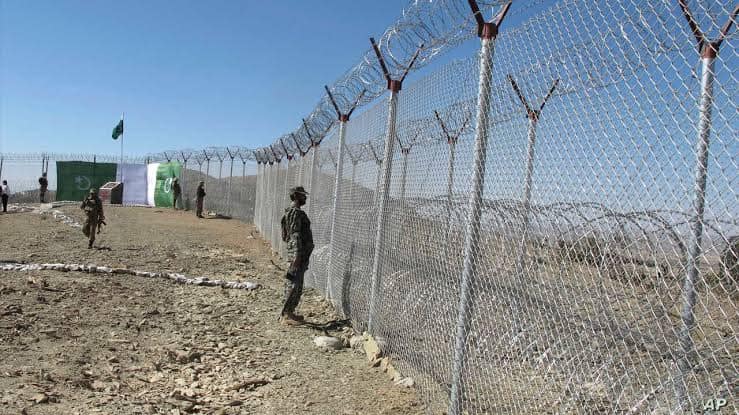
Pakistan has initiated a vicious process to fence the Gwadar Port in an effort to separate the Baloch coast from Balochistan, said Khalil Baloch, Chairman of the Baloch National Movement (BNM) in a statement on Friday.

“It is the beginning of a conspiracy to separate the coast from Baloch homeland. Baloch National Movement has been saying this since day one that Pakistan wants to increase the exploitation of the Baloch nation under the guise of euphoric slogans of development,” said Khalil Baloch. The BNM Chairman did not mince words in criticizing Pakistan and termed Gwadar Port’s fencing as Pakistan’s “vicious” attempt.

Khalil Baloch further explained that entire Balochistan, including Gwadar, has been turned into a military barrack. “Equally complicit in this exploitative process is the imperialist state of China. This fencing process is inhuman. History shows that no ruling nation has ever developed the oppressed but ambushed them in the name of development and looted its shores and other resources.”

Pakistan has begun its vicious exercise to fence the Gwadar Port. (Photo: News Intervention)

The BNM Chairman added that Pakistan’s “inhuman” act will help it to further consolidate its hold on the Baloch coast and would be followed by forcible occupation of Gwadar lands, eviction of local fishermen from the coastal areas, and formation of trailer mafia, among others.

“For a long time the Pakistani state and its followers have been propagating that the freedom seeker Baloch people are against development but today this fencing plan proves that Baloch people are not against development, rather they are against exploitation and occupation,” said Khalil Baloch.

BNM Chairman said that Pakistan is rapidly separating the Baloch coast from Balochistan to advance its imperialist ambitions. He said there is an urgent need for the Baloch nation to come together for its survival, “…the Baloch National Movement reiterates its determination to thwart any plan to forcibly occupy our land.” Khalil Baloch hoped that Pakistan’s plans could soon come to a naught and the “sun of freedom” would rise on the Baloch land.

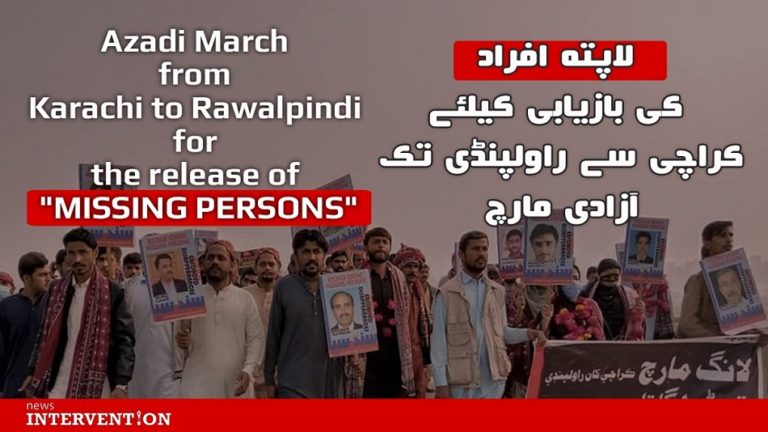
Azadi March from Karachi to Rawalpindi for ‘Missing Persons’

Women, children and elderly are walking from Karachi to Rawalpindi. This 1,450 km foot march started on November 10, 2020. Women and children who are walking on foot towards Rawalpindi expect that this long march will help in the release of their family members who have gone “Missing” from Baochistan and Sindh.

Watch our news report to understand the inside story. (voice over in Urdu)

Click on the YouTube link to watch the news report. (Urdu voice over)

Sindh Sabha has organised this 1,450 km Long March from Karachi to GHQ, Rawalpindi. General Headquarters (GHQ) is the head office of Pakistan Army. Women, children and elderly are walking towards the headquarters of Pakistan Army to press for their demand to release the Missing Persons, who have been abducted from Balochistan and Sindh.

Sindhi & Baloch people are desperate for their “Missing” family members. They have been protesting for their release but no one is listening.  Family members and friends of these “Missing Persons” are left with no option but to walk from Karachi to Rawalpindi to plead for the release of their loved ones.  

Roshni Act: Gupkar gang’s gateway to loot Kashmir land

In a significant judgment on October 9, the Jammu and Kashmir High Court declared the controversial Roshni Act as ‘illegal and unconstitutional’ and ordered a CBI probe into the Roshni land scam case. The division Bench of Chief Justice Gita Mittal and Justice Rajesh Bindal also asked the CBI to file a status report in the case every eight weeks. The court also said that J&K Chief Secretary will ensure uninterrupted investigation, which will also be directed against those officers in whose tenures the encroachments had happened. The court said “all Deputy Commissioners and Divisional Commissioners will be held for contempt of court if they do not cooperate with the investigation.”

On October 18, the High Court ordered that the investigation of the land scam be transferred to the CBI, which will file the status report within eight weeks. The CAG chief had also reported obstruction by some senior state administrative sources in providing the desired information in full.

Pandora’s Box opens

On October 21, 2020, the Divisional Commissioner, Kashmir, P K Pole chaired a meeting of Deputy Commissioners and other concerned officials and directed them to submit comprehensive details of ministers, legislators, bureaucrats, police officers, government employees, businessmen, other influential persons and their relatives who had derived any benefit under the Act, officials said. Pole directed all the Deputy Commissioners of Kashmir Division to submit the District-wise details of the State’s lands as in 2001.

On October 22, 2020, the administration of Jammu and Kashmir Union Territory ordered the submission of comprehensive details of ministers, legislators, bureaucrats, police officers, government employees, businessmen, other influential persons and their relatives, who have benefitted from the Act, reported the Deccan Herald of Oct 22, 2020.

On November 24, 2020, Ravi Shankar Prasad, the Union Law Minister, speaking in a press conference said that the former J&K Chief Minister Farooq Abdullah was among the beneficiaries in Roshni Act. The others in the list were the former Finance Minister of J&K, Haseeb Drabu, (who in a recent article in Greater Kashmir argued that the exiled Kashmiri Pandits had lost all claim to their Kashmir homeland) and Congress leader Majid Wani, former Home Minister and NC leader Sajjad Kitchloo and former JK Bank Chairman MY Khan, wrote IndiaToday of November 24, 2020.

Government’s swift action

Following media reports, the government acted fast and made public the first list of beneficiaries of the ‘Roshni Scheme’, which included several top politicians cutting across party lines, bureaucrats, police officials. It was done by the office of Divisional Commissioner, Jammu and Divisional Commissioner Kashmir in pursuance of the directions of the Jammu and Kashmir High Court in the PIL NO 19 Of 2011 Titled S.K.Bhalla Vs State And Other Connected Matters Dated Oct 9, 2020.

Interestingly, earlier, the J&K government had decided to declare all the actions taken under the Jammu and Kashmir State Land (Vesting of Ownership to the Occupants) Act, 2001, also known as the Roshni Act, under which 20 lakh kanals of land was to be transferred to existing occupants, as “null and void”, and has also initiated steps to retrieve the land within six months. 

Acting on the directions of the Jammu and Kashmir High Court, the J& K government has already directed the Principal Secretary Revenue Department to ensure that all the mutations done in furtherance of the act are annulled, encroachers are evicted and large tracts of land are retrieved within a period of six months. The orders in this regard were also issued by the Revenue Department and the concerned Tehsildars were directed to start the groundwork in order to retrieve the government land.

To attract media attention and expose the open loot the Principal Accountant General (Audit) Subash Chandra Pandey had even organized a press conference where he described the transfer of 3, 48,160 kanals of land in the State at a cost of Rs 76.24 crores (24 percent) against a demand of Rs 317.54 crores under Roshni Act, as one of the biggest scams of J&K. Originally, the Act was aimed at resource mobilization of Rs 25,448 crores for investment in the power sector.

Reportage in Media

The nationwide media and the local media took on to themselves to report the scam in their editions. In fact, it all started when on October 9, 2020, IkkJutt, a Jammu-based social organization/NGO initiated a demand for enquiry into the land scam, following which the High Court of J&K deemed the law and all allotments made since the beginning as “null and void” and “unconstitutional”. The court also said that the rules framed in 2007 by the  Ghulam Nabi Azad (Congress) government did not appear to have any legislative sanction.

The Jammu-based Firstpost of Nov. 2, 2020 elucidated the issue under the title “J&K Government declares actions under Roshni Act ‘null and void’; what you need to know”.  

In its issue of  October 14, 2020, the Indian Express uncovered  the scam titled ‘Loot to own’: J&K High Court hands Rs 25,000 crore land scam probe to CBI”. In 2009, the Jammu and Kashmir vigilance organisation had registered an FIR against public officials for “alleged criminal conspiracy to illegally possess and vest ownership of state land to occupants who didn’t satisfy the criteria under the Roshni Act”, Indian Express reported. While the then state bureaucracy called the Vigilance Organisation’s findings “motivated”, the Vigilance Organisation completed investigations in five cases by March 2015, and indicted nearly two dozen officials, including three former deputy commissioners for allegedly misusing the provisions of the scheme,” the report added.

“Actually it was repealed in 2018 after Governor Satya Pal Malik concluded that it had “not served” its purpose and was “no longer relevant in the present context”. This move was made after advocate Ankur Sharma, who had defended the accused in the Kathua rape case of January 2018, sought its repeal to “defeat the jihadi war in the form of demographic invasion of Jammu”, said Scroll.in. in its  November 1, 2020 edition.

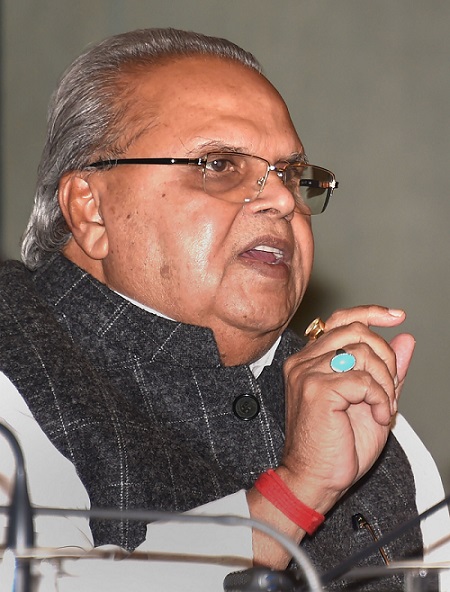
Satya Pal Malik, former Governor of Jammu and Kashmir. (Photo: PTI)

On November 1, 2020, The Hindu reasserted that the J&K UT administration declared all the actions taken under the Jammu and Kashmir State Land (Vesting of Ownership to the Occupants) Act, 2001 – also known as the Roshni Act – as “null and void”. The government said it would evict encroachers and retrieve all land distributed under the scheme within six months.

The Business Insider of October 9, 2020 wrote, “In a landmark judgment, the Jammu and Kashmir High Court on Friday declared the controversial Roshni Act “unconstitutional” and directed that investigation into the Rs 25,000 crore land allotment scheme under it be transferred to the CBI.

Background of the Roshni Act Scam

The Roshni case has been called the biggest ever land scams in the history of Jammu and Kashmir, and has allegedly caused a loss of Rs 25,000 crore to the J&K treasury. The Act, enacted by the State Legislature in November 2001, and enforced in March 2002, envisaged raising of funds for hydropower  generation in the State by transferring State land into private ownership to collect Rs 25,000 crore.

A CAG report estimated that against the targeted Rs 25,000 crore, only Rs 76 crore had been realized from the transfer of land into private ownership.

Politicians, businessmen and bureaucrats had come under severe criticism for transferring State land into their ownership and that of their favourites at arbitrarily fixed rates, which ultimately deprived the State of land worth several thousand crores and also defeated the purpose of the Act.

Irregularities and repeal

In 2014, the Comptroller and Auditor General of India (CAG) noted some serious irregularities in the implementation of the Act and in 2015 the State Vigilance organization charged over 20 government officials for misuse of the Act; no one was prosecuted, writes Suhail, Peer Ghulam Nabi in Pieces of Earth: The Politics of Land-Grabbing in Kashmir (2018). From 2015 onwards, efforts were made to get back some of the illegally-acquired land. These efforts proved a failure owing to non-cooperation of revenue functionaries. The Act was also found to be an attempt to change the demography of the entire region, investigations found. The Act was repealed in 2018 during the tenure of Governor Satya Pal Malik, who ordered the case to be taken over by the CBI.  

How the scam surfaced

While auditing the Roshni scheme in the year 2013-14, the officials stumbled upon this biggest land scam, as they noticed that gross irregularities were committed by the top bureaucrats in order to facilitate the land deals involving VVIPs in Jammu and Kashmir.

During the audit, the team of officers faced difficulties in getting full information/records. With this constraint, an audit was conducted through a test check of records of the offices of the deputy commissioner in seven out of the twenty districts in which the act was implemented. The records were test-checked in Srinagar, Jammu, Udhampur, Anantnag, Pulwama, and Budgam districts and 547 cases involving the transfer of 666 kanals of non-agricultural land were examined in detail.

The CAG report tabled in the state legislature carried exclusive details of the irregularities done from interpretation to implementation, particularly in favour of the occupants enjoying very strong political or bureaucratic clout. Political parties including the Congress and the National Conference exploited the scheme to their advantage by regularizing their unauthorized occupation of the prime lands on which they had raised the party offices besides the printing presses and the offices of their official organs-Daily Khidmat and Nawa-e-Subah.

The beneficiaries

The Congress got proprietary rights over a prime piece of 7 kanals and 15 marals close to the Residency Road in the Kothibagh area of Srinagar. It is currently valued to be a property of Rs 80 crore. Its price was fixed at Rs 8.54 crore (Rs 1.10 crore/kanal). Congress enjoyed a rebate of Rs 7.58 crore and paid a total of Rs 96 lakh to the government. The Congress-controlled Khidmat Trust operates the head office of daily Khidmat with several modern printing presses on the same premises. A multi-floor commercial complex worth over Rs 50 crore has also come upon the same land.

The National Conference (NC) too has its party headquarters in a multi-floor commercial complex on a piece of the State land, measuring 3 kanals and 16 marlas. Offices and printing presses of the NC’s Urdu and English dailies, Nawa-e-Subah, also operate from the same premises near Zero Bridge in the heart of Civil Lines in Srinagar. The land alone is currently valued at Rs 35 crore. Its price was fixed at Rs 4.56 crore (Rs 1.20 crore/kanal). The party enjoyed a rebate of Rs 4.05 crore and paid a total of Rs 51 lakh only.

Writing under the caption ‘Private residence constructed on encroached state land’ Chandra Maurya scripted in the Printers Report of 25 November 2020 as follows: National Conference President Dr. Farooq Abdullah and a sitting Member of Parliament from Srinagar, who also remained Chief Minister on several occasions between 1982 to 1996 and served as Union Minister in the cabinet of Dr. Manmohan Singh is now facing serious charges of illegally occupying state/forest land in Sunjwan village of Bahu tehsil in Jammu district. The controversial piece of land, measuring 7.7 kanals (roughly one acre) was used by the National Conference leader to construct his private mansion with 20-30 feet high boundary walls. These startling revelations were made by the office of Divisional CommissionerJammu after it made public a list of encroachers who had illegally occupied state/forest land in and around Jammu. According to the list uploaded on the website of the office of Divisional Commissioner Jammu, the names of Dr. Farooq Abdullah and his son Omar Abdullah figured on top of the list. It said, “Farooq Abdullah and his son Omar Abdullah had illegally occupied state land measuring 7 Kanals and 7 Marlas under Khasra No 4, 5, 6 in village Sunjwan of Bahu Tehsil in Jammu district”.

After the news went viral, the Twitter handle of the Jammu and Kashmir National Conference posted a written statement, “The news attributing to sources that Farooq Abdullah is a beneficiary of the Roshni Act is completely false and is being spread with a malicious intent.” In a brief statement, while speaking to a news channel Farooq Abdullah said “It is only propaganda against us. I just can’t understand what they want to do? Sunjwan colony was not raised by me…It was raised long back. Don’t we have the right to live?”

Official sources revealed that initially Dr. Abdullah had purchased only three kanals of land but at the time of taking the possession of this private land, he encroached upon more than seven kanals of nearby prime state and forest land.

Farooq Abdullah’s private mansion in Sunjwan, Jammu. (Photo: News Intervention)

Several other senior National Conference leaders and close friends of Dr. Abdullah also acquired adjoining plots in the close vicinity of his mansion and constructed their bungalows. According to the list uploaded on the website, National Conference leader, Syed Ali Akhoon, Sajjad Kitchloo, Congress leader Abdul Majid Wani, former Chairman of J&K Bank M Y Khan, Aslam Goni, a former close aide of Dr. Abdullah, Haroon Choudhary, Ashfaq Mir son of a retired Judge and hotelier Mushtaq Chaya too had encroached the state/forest land in the same locality.

Leading hotelier Mushtaq Ahmad Chaya has got ownership rights on a prime piece of the State land, measuring 5 kanals and 8 marlas on Maulana Azad Road. He has paid Rs 97.20 lakh and enjoyed a rebate of Rs 3.35 crore. He has also regularised his possession of 4 kanals and 16 kanals in Gogji Bagh. For this, Chaya has paid Rs 66.52 lakh and taken a rebate of Rs 1.27 crore. Together the two properties are currently valued at Rs 80 crore.

According to Sheikh Shakil Ahmad, the advocate pursuing the case, some former Chief Ministers, some influential politicians including Ministers, besides a number of the Police officers and over 20 serving and retired IAS officers, could be grilled for their alleged involvement or carelessness in transferring proprietary rights to the land grabbers, reported the same source as above.

According to IANS, the list also includes Mehboob Beg (son of Mirza Afzal Beg, a close associate of late Sheikh Muhammad Abdullah), influential businessmen like Mushtaq Ahmad Chaya and Krishen Amla (who is close to the top leaders of the Congress party) and former top bureaucrats such as Khurshid Ahmad Ganai and Tanveer Jahan.

The second list included names of Congress leader K K Amla and Mushtaq Ahmad Chaya, both prominent businessmen and hoteliers besides former bureaucrat Mohammad Shafi Pandit and his wife. Shafi Pandit, IAS, who served at the Centre also for some time has filed an appeal before the Supreme Court of India pleading for quashing the order of the J&K High Court that nullifies the Roshni Act.

Suriya Abdullah, sister of Farooq Abdullah, was also named among the beneficiaries, who got ownership of over three kanal plot under residential use. According to the list, the land had been approved by the authorities but she was yet to pay Rs 1 crore fees. No notice has been issued to her since the time of approving the land in her name.

In Jammu, the divisional commissioner separately released another list of 138 beneficiaries falling in Jammu south tehsil, mostly belonging to the majority community, who are in possession of over 107 acres of land which was vested to them under Roshni Act. Though majority of them are agriculturalists and farmers, there are also some influential people including the trustee of Digiana Ashram, Mahant Manjeet Singh who owns seven kanals of land.

In a separate list under encroached state land (Physically Encroached but not shown in Revenue Record) other than Roshni, it identified seven persons who are in possession of over five acres of land. The list included PDP leader Talib Choudhary (two kanals), PDP office having three kanals of land at Bahu-Sunjwan tehsil, retired IGP Nisar Ali (three kanals), retired SSP Mirza Rasheed (three kanals) and prominent businessman Haji Sultan Ali, who owns the major chunk of 30 kanals of land.

The Jammu divisional administration had on 20 November 2020 released separate lists of 541 people, almost all belonging to the majority community, in different tehsils who have availed land under the Roshni Act besides two lists of nine persons who have allegedly encroached upon the state land other than the Roshni Act, which included Farooq Abdullah and his son Omar Abdullah. In addition, it had also released two more lists of 1,237 alleged encroachers falling in two tehsils, almost all from the majority community.

History

The scam has a history. Soon after Jammu and Kashmir’s accession to India, on October 28, 1947, the first Land Reforms Act borrowed from the Constitution of  the Soviet Republic of Uzbekistan was introduced as one of the first and foremost reforms by the National Conference, which was in contrast to the land reform policy of independent India. Under the reforms, thousands of kanals of land owned by the old school landlords of the State (jagirdars) from the days of Maharajas were taken away without any compensation and were distributed among the tillers.

Seven decades later, the inheritors of the Naya Kashmir legacy bereft of constitutional, legal and moral propriety bestowed several lakh kanals of state/forest land at throw away prices to the upper-most creamy layer of Kashmiri society to “loot India in Kashmir.”  This was the largesse of the majority “populist government” of J&K to the masses of Kashmiri people from whom they extracted allegiance and political support to overthrow the benign and law-abiding rule of the Dogra rulers. Mind you, all was done in the name of democracy –- to be precise “Indian secular democracy” — because only the majority community of Kashmir became its maximal beneficiary. 

The law granted ownership of the former J&K State land to illegal encroachers with the hyped claim of raising money for power projects upon payment of a sum to be determined by the State government.  Farooq government set 1990 as the cut-off year, which, however, was relaxed in 2005 to 2004 by the then Congress-PDP coalition Government, and further relaxed to 2007 by the Government of Nabi Azad (Congress) under coalition government with PDP.  The Act came to be known as ‘Roshni Act’, with J&K government announcing to use the funds raised from this reform to fund power projects in the state. Three chief ministers- former and incumbent- were in cahoots on the deal.

How Roshni Act came into being

The Jammu and Kashmir State Lands (Vesting of Ownership to the Occupants) Act, 2001 (known as the Roshni Act) was enacted by the J&K legislature in 2001. Its objective was vesting of ownership rights to the illegal occupants against a price. The then National Conference government headed by Farooq Abdullah had claimed that the scheme would generate revenue of over Rs 25,000 crore, which would be utilized to raise new power projects. Farmers who had been occupying State land were also given ownership rights for agricultural use. The law initially set 1990 as the cut-off year for encroachment on State land, based on which ownership would be granted. Subsequent governments under Mufti Mohammad Sayeed and Ghulam Nabi Azad relaxed the deadline first to 2004 and then to 2007, of course, obviously with discreet motives. NC, PDP and Congress leadership in the valley were in complete unison for seeing the illegal Act through owing to their vested interests that were converging and not conflicting.

However, most of the transfers of the proprietary rights of the occupied lands, with drastic changes in the rules from time to time, took place in 2005-08, when Ghulam Nabi Azad was the Congress chief minister and the head of the Congress-PDP coalition.

The Roshni Act was enacted for a limited period of operation but extended by successive State governments from time to time. It was finally scrapped by the then Governor Satya Pal Malik prospectively on November 28, 2018, five months after the breakdown of the PDP-BJP government.

Tailpiece

The biggest and perhaps the only memorable achievement of Sheikh Muhammad Abdullah, the father of J&K freedom movement after assuming power was to dismantle the landlord system in the State. He ordered ownership of the tiller of the land without paying a single penny by way of compensation to the owners of the land. Ironically, his heir and descendent and the Chief Minister of the State, Farooq Abdullah wantonly reversed his father’s policy and recreated thousands of landlords, who are far more affluent than those whose lands his father snatched away. Farooq grabbed state/forest land for himself, some of his family members, kith and some close political and business partners to build his political empire. Lakhs of kanals of state land that should have been utilized for raising residential colonies for the weaker and homeless segments were diverted to rich an affluent class, the creamy layer of J&K with clout in the corridors of power or influence in one or the other way.

The Roshni Act scam is the irrefutable proof that Kashmir leadership has the least interest in the welfare of the ordinary people as they claim in the shape of Gupkar Gang. Their entire effort rotates around self-interest and hoodwinking Indian authorities through fraud, deceit and double speak. Kashmir is the one example of how democracy, secularism and egalitarianism for which a four decade long struggle against the rule of the Maharajas was waged, were subverted for self-aggrandizement. While the bigwigs were engaged in looting the state, they patronized and instigated ordinary Kashmiri youth to pelt stones at the security forces, who were protecting them. The Roshni Act episode reveals the wide gulf created between the plebeians and the privileged in Kashmir.

Baloch, Pashtun struggle similar to East Pakistan’s separation

On December 3, 1971, around 4 PM, Gen Yahya Khan left the President’s House to go to the Air Command Centre to launch the pre-emptive air strikes on India. Just then, according to Arshad Sami Khan, Yahya’s ADC, an unusually- large vulture appeared from nowhere and landed a few metres ahead of his jeep, blocking the driveway to the exit gate.

The vulture refused to move even when Gen Abdul Hamid Khan, the Chief of Staff, slowly moved up the jeep; blew the horn; or when Yahya Khan dismounted from the jeep and tried to scare it away with his baton. Instead, it just stared back with greater defiance. It was only when a nearby gardener shooed the bird with a large sickle that it finally cleared the road with an ominous gait allowing the jeep to pass. This certainly was not a propitious omen for launching a war.

The Pakistani plan of attack pivoted around pre-emptive air strikes against Indian airfields. According to Shuja Nawaz, in all, thirty-two aircraft out of an inventory of 278 fighter planes took part in the initial strike that started between 1709 hrs and 1723 hrs. The Pakistan Air Force (PAF) strikes were not successful. Only the Amritsar airfield was blocked and a radar target was destroyed.  Pathankot could not be attacked because of poor visibility.

The objective of the air strikes was to target the runways of Indian airbases. However, the platforms used for this purpose – F-86s – were inappropriate. According to Arshad Sami Khan, the F-86 was a multi-role aircraft but the one role it was not very accurate at was bombing, especially high-level bombing. The release the two 1000-pound bombs required was climbing to 10,000 feet, going into a 45 degrees dive and releasing the bombs by about 4,500 feet at speeds of 460 knots. As a result, most of the bombs did not hit the targets. Moreover, the damage to runways even from a direct hit could be repaired in a few hours.

The limited Pakistani attack surprised even the US. Admiral Thomas H Moorer, the Chairman, Joint Chiefs of Staff (CJCS), told the Washington Special Action Group (WASAG) meeting on December 3 (held just three hours after the PAF attack) that he was ‘surprised that the Paks attacked at such a low level. In 1965, they moved much more strongly.’ Henry Kissinger, the chair of the group, added: ‘These aren’t significant fields. That’s [a] helluva a way to start a war.’ Moorer filled in the details: ‘One field had only 12 helos [helicopters] and 17 Gnats [fighter aircraft]…There was a field not too far away with 82 aircraft on it, including 42 MIG-21s. They didn’t go for them.’

The confused state of higher-level decision-making in Pakistan was revealed by the fact that even the defence secretary and the head of the ISPR, the official mouthpiece of the regime, were unaware about the imminence of the war on December 3. The latter was informed via a telephone call at his residence from the defence secretary about an announcement he had heard over Radio Pakistan that India had invaded West Pakistan. The statement was so worded as to convey that it were the Indian forces that had attacked West Pakistan at ‘various points.’ According to Shuja Nawaz, ‘the thinking behind this subterfuge was to invoke US help, based, among other things, on the aide memoire of  November 6, 1962 to Ayub Khan in which US ambassador McConaughy had promised to assist Pakistan “in the event of aggression from India against Pakistan”.’

The naval chief, too found out about the air strikes from a Pakistani radio broadcast; Pak Navy ships at sea also heard about the attack from the radio. On the eastern front, Lt Gen. A A K Niazi learnt of the air strikes, while listening to the BBC world service.

A day after the war began; Brigadier Gul Mawaz went to see Yahya, his close friend. According to Hassan Abbas, the brigadier found Yahya and Gen Hamid inebriated. Yahya told Gul Mawaz that as commander he had launched his armies. Now, it was up to his generals. While they were talking, Yahya received a call from Japan from Nur Jahan, the famous Pakistani singer. After telling the brigadier whom the call was from, Yahya asked her to sing him a song.

In the context of the war in the west continuing after the fall of Dacca (Dhaka), when Roedad Khan, the then Information Secretary raised the matter with Yahya and told him that nations do not fight wars by halves, Yahya retorted that he was not going to endanger West Pakistan ‘for the sake of Bengalis’. This was very much like Ayub Khan saying at a cabinet meeting after the 1965 war that never again would Pakistan ‘risk 100 million Pakistanis for 5 million Kashmiris.’

Following Mrs Indira Gandhi’s unilateral offer of a ceasefire in the west, the Emergency Committee conveyed Pakistan’s unconditional acceptance. However, such was the unreality of the situation that according to Roedad Khan, ‘Nobody raised any objection to the substance of the draft but a heated and animated discussion followed on how the timings of the ceasefire was to be described in terms of IST, GMT, or PST; and if PST in terms of West Pakistan Standard Time or East Pakistan Standard Time. The implications in each case were discussed threadbare.’

The surrender in East Pakistan and the creation of Bangladesh was a devastating event for West Pakistan, the aftershocks of which continue till date. Along with the physical fall of Dacca, Pakistan was also defeated psychologically. The two-nation theory that Muslims of the subcontinent formed a nation was demolished. Pakistan is still searching for a rationale for its existence and for its identity.

Imran Khan wrote in his 2011 autobiography, ‘Pakistan: A Personal History’ that like others in Pakistan, he had swallowed the official propaganda of the state television that branded ‘the Bengali fighters as terrorists, militants, insurgents or Indian-backed fighters – the same terminology that is used today about those fighting in Pakistan’s tribal areas and Balochistan. Then, as now, Pakistan fought symptoms rather than addressing the root causes of the violence- our failure to address the legitimate aspirations of Pakistan’s many ethnic groups.’

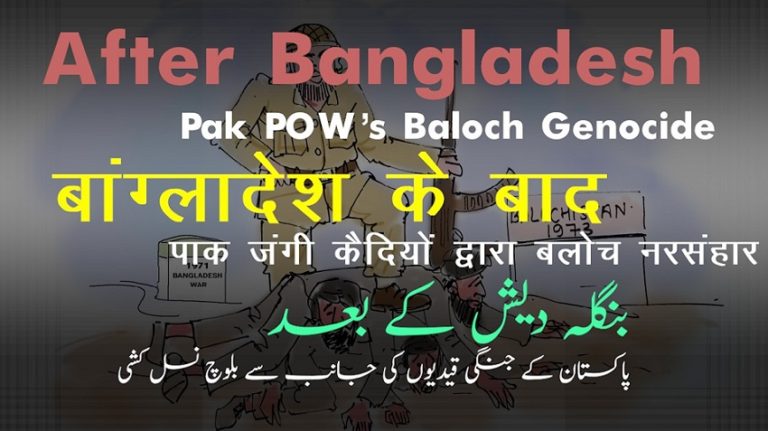
Imran Khan would do well to recall his words considering that the Pakistan army is doing to the Baloch and the Pashtuns under his watch exactly what it had done to the Bengalis in the then East Pakistan.

(This article is an extract from Tilak Devasher’s book, ‘Pakistan: At the Helm’)

World Intelligence Network Sigma 1.33 to 7.00 Addendum II – Defunct Societies

1

*Updated February 10, 2021.*

This is Addendum II to the following seven articles, links active:

A Review of the World Intelligence Network Sigma 1.33-3.07 Societies

World Intelligence Network Sigma 1.33-3.07 Societies “Second Pass”

The World Intelligence Network 3.13-4.8 Sigma Societies First Review

Second Pass of the World Intelligence Network 3.13-4.8 Sigma Societies

First Pass of the World Intelligence Network 5 to 7 Sigma Societies

Second Review of the World Intelligence Network 5 to 7 Sigma Societies

World Intelligence Network Sigma 1.33 to 7.00 Non-Defunct Societies Membership – Addendum I

The World Intelligence Network composed 84 “active” high-IQ societies.

Of those high-IQ societies found non-defunct with stagnation or activity, even high activity, please see the above articles or Addendum I, Addendum II is a complement to the articles and to Addendum I. It provides coverage of the defunct societies.

Those in existence at one time. Now, neither extant nor truly findable, except in the archives or the whispers of the historical record. This listing is based on an analysis of the 84 “active” high-IQ societies of the World Intelligence Network.

This number, at this time, is incorrect with 47 non-defunct and 37 defunct. Those 37 will be presented below. The President of the World Intelligence Network is Dr. Evangelos Katsioulis and the Vice-President is Manahel Thabet.

21 were defunct in the 1.33 to the 3.07 sigma society range. 11 were defunct in the 3.13 to 4.80 sigma range. 5 were defunct in the 5.00 to 7.00 sigma range. Let’s begin:

1.33 to 3.07 Sigma Societies

  1. UberMens Society
  2. OmIQami Society of Andrea Toffoli
  3. VinCi Society of Lloyd King
  4. Alta Capacidad Hispana (ACH) of Vicente Lopez Pena
  5. AtheistIQ Society of Robert Dawson
  6. BPIQ Society of Kelly Dorsett
  7. Gifted Artists Circle of Martin Tobias Lithner
  8. Ingenium Society of Martin Tobias Lithner
  9. IQUAL Society of Gerasimos Papaleventis
  10. Chorium Society of Paul Freeman
  11. Elateneos Society of Andrés Gómez Emilsson
  12. UNIQ Society of Martin Tobias Lithner
  13. Poetic Genius Society (PGS) of Greg A. Grove
  14. HispanIQ International Society (HIS) of Luis Enrique Pérez Ostoa
  15. Cerebrals Society of Xavier Jouve
  16. ExactIQ Society of Patrick Kreander
  17. Neurocubo of Pedro Lσpez, Thomas Hally, Cisar Tomi, Paul Laurent
  18. Artifex Mens Congregatio of Robert Mestre, Walter VanHuissteden, and Fivos Drymiotis
  19. International Society for Philosophical Enquiries (ISPE) of Christopher Harding
  20. LogIQ Society of Martin Tobias Lithner
  21. Milenija Society of Ivan Ivec and Mislav Predavec

3.13 to 4.80 Sigma Societies

  1. Ludomind Society of Albert Frank and Peter Bentley3
  2. SesquIQ Society
  3. Smart People Society
  4. sinApsa Society of Marin Filinic
  5. Coeus Society of Martin Tobias Lithner
  6. Hall Of The Ancients (HOTA) of Brennan Martin
  7. Camp Archimedes Society of Fivos Drymiotis and Lestat
  8. Ergo Society of Luis Enrique Pérez Ostoa
  9. Platinum Society of Hindemburg Melão
  10. Eximia Society of Patrick Kreander
  11. Incognia Society of Luis Enrique Pérez Ostoa

5.00 to 7.00 Sigma Societies

  1. Pars Society of Baran Yönter
  2. Unicorn Society of Hindemburg Melão
  3. Nano Society of Ivan Ivec
  4. One in Five Society of Huck Nembelton
  5. Universal Genius Society (UNIGEG) of Brennan Martin

As presented, as defunct, these do not have legitimate links, typically. If they do, they lead to dead-end websites or require more in-depth research to old mentions in writings about the various high-IQ societies.  Therefore, no links presented here.  

The founders may have membership listings from the last moments before the dissolution or simply disinterest in maintaining the high-IQ society, even the higher-IQ societies.

However, as can be surmised, the lower the sigma, the more societies; also, the more the defunct societies on the lower ends as a consequence of more societies on the lower end in the first place.

It may simply be a percent, about half or a tad less, of all societies become defunct, over time, regardless, if not active. Few make it beyond 30 years, not many.

Indeed, some may devote themselves to promoting particular personalities or theories, or worldviews, which, in turn, restricts communication. It constrains interest and can exhibit egoism to a degree.

Others, for an ideological reason, may simply never communicate to discard correspondence with opposing worldviews, as Christian and atheist high-IQ societies exist or existed, i.e., exhibit discriminatory admissions policies based on ideology, not scores alone.

If you’re looking for a first-pass of societies, then Wikipedia, before, listed, in order of rarity, Mensa International, Intertel, Triple Nine Society, Prometheus Society, and Mega Society[1].

Please see Addendum I for more information on non-defunct societies, and good luck in finding a community fit for you:

World Intelligence Network Sigma 1.33 to 7.00 Non-Defunct Societies Membership – Addendum I

As a small aside, I am aware of more listings and stated foundations, societies, and associations. The 84 societies on the World Intelligence Network appeared as if the most comprehensive.

From this, the list became a more convenient manner in which to survey some of the landscape without all of this messy terrain explored more. It was not a research project to snub anyone; it was a research project to do that which many kept asking to be done.

[1] Looking again, United Sigma Intelligence Association, formerly United Sigma Korea, has been newly listed on the Wikipedia listing for high-IQ societies.

However, the webpage link appears defunct based on the webpage being created by, and the inclusion of the United Sigma Intelligence Association or USIA on the high-IQ societies webpage by, an account associated with the United Sigma Intelligence Association: ‘Usiassociation.’

As a Conflict of Interest stated on the record, the “draft article” was removed by an ‘Arjayay.’ While, the dead link statement continues on the main high-IQ society webpage. This may have happened on Wikipedia before with others, as Wikipedia is old now.

Thus, the linked articles fairly placed on the Wikipedia listing, without a COI called out or illegitimate listing because of a conflict of interest, include, as before, Mensa International, Intertel, Triple Nine Society, Prometheus Society, and Mega Society.

Those are the safe bets.

[Ed. December 12 2020: ‘58.227.250.85’ edited the “High-IQ society” article listing on Wikipedia immediately before ‘Usiassociation’ and after the COI or Conflict of Interest claimed by ‘Arjayay.’ Given ‘58.227.250.85’ exists, and ‘Usiassociation’ was deleted immediately after the COI claim, there may be a link to ‘Usiassociation’ and ‘58.227.250.85,’ as ‘58.227.250.85’ has existed since February 4, 2020, and only edited articles including “High-IQ society,” “Prometheus Society,” “Kim Ung-Yong,” “Ronald K. Hoeflin,” “Christopher Langan,” “Youngsook Park,” and then, recently, “High-IQ society,” again. It would appear reasonable to assume a connection to ‘Usiassociation’ and, thus, USIA in this case too, or a link between ‘58.227.250.85,’ ‘Usiassociation,’ and USIA/United Sigma Intelligence Association. Furthermore, ‘58.227.250.85’ is a South Korean IP address.]

[Ed. December 26 2020: On December 21 to December 24 2020, the same pattern, in spite, of repeated COI claims continued only by the same IP Address from South Korea editing solely or purely for United Sigma Intelligence Association (USIA), formerly United Sigma Korea (USK), to force its content onto the listing. On December 21 2020, ‘202.78.236.194’ and ‘Kinu’ reverted to the original five high-IQ societies: Mensa International, Intertel, Triple Nine Society, Prometheus Society, and the Mega Society. On December 22 2020, the same ‘58.227.250.85’ reverted to add the United Sigma Intelligence Association or USIA back to the listing of “High-IQ society.” ‘Kinu,’ the same day, reverted the edits from ‘58.227.250.85.’ On December 23 2020, ‘58.227.250.85’ reverted the edits the day prior to the same additions of the United Sigma Intelligence Association or USIA. The same day, ‘Kinu’ reverted them. On December 24 2020, ‘58.227.250.85’ reverted to add the United Sigma Intelligence Association or USIA once more. ‘Nieuwsgierige Gebruiker’ reverted, so as to remove United Sigma Intelligence Association or USIA, on the same day. On December 24 2020, ‘Kinu’ blocked ‘58.227.250.85’ “with an expiration time of 1 week (anon. only, account creation blocked).”]

[Ed. February 10, 2021: on January 28 2021 ‘58.227.250.85‘ continued to attempt the same manipulations with more aggressive attempts and grandiose statements with a preface for the edits stating, “It is currently the most active and representative organization of high-intelligence organizations.” This may well be the President and Executive Director of the United Sigma Intelligence Association speaking in these terms and from this South Korean IP Address: 58.227.250.85. ‘RKLawton’ stated, “Without a valid source, we can’t use this. See wp:rs,” i.e., it’s invalid and unreliable, on January 28 2021 with deletion of the edits by ‘58.227.250.85.’ ‘Magus314’ on January 29 2021 made further edits including “Since the 1960s, Mensa has experienced increasing competition in attracting high-IQ individuals, as various new groups have emerged with even stricter and more exclusive admissions requirements.” The edits seem to incline towards hinting at the recently deleted edits mentioning a society with a newer status and a range of higher-IQ requirements for admission. Suspiciously, ’Magus314’ was deleted shortly thereafter. Thus, its edits happen one day after the inclusion of the high-praise edits on the Wikipedia page followed by the deletion of said edits for the inclusion by ’Magus314.’]

Photo by Michael Dziedzic on Unsplash

The magic in Indian ‘Jugaad’

It is an accepted fact that in India anything can be achieved by anybody as long as he/she can do some ‘jugaad’. The uniqueness of the system ensures that jugaad works. In fact, life will become miserable for most of the Indians, if the concept of jugaad is obliterated, but that’s simply impossible because to do that will require massive jugaad.

Jugaad comes in various means and ways as long it as it serves the end! So what is ‘jugaad’? It is the elixir or magic potion or USP, which ‘gets the impossible done’! It comes in various forms- as a human, currency, power/ position, clout or charm. You just have to use or approach jugaad to apply it. Sounds mysterious, isn’t it? Well, that is the charm of our ancient Indian civilization. 

Interestingly, the non-jugaadu lady/gentleman, who works according to the merit of the case without the application of any kind of jugaad, is ridiculed and seen as a loser, an aberration, and sometimes socially-ostracized.

In India, you need to have a jugaad to get your things done in almost all the sectors — from approaching a government to register a land or house, to approving plan for any infrastructure, from booking your railway tickets without hassle to getting your driving license, everywhere you need a jugaad. Even getting an invigilator for a PhD viva-voce requires jugaad, not to miss out getting a ticket from a political party to stand in an election.

Jugaad, also called adjust or adjust maadi in Kannada, in Indian culture can be compared to the famous Chakravyuh in Mahabharata, which was almost impossible to be broken. Surprisingly, Indians have accepted it wholeheartedly without any complaints.

The jugaadus have the power to make people run for their money, even surprising the foreigners of their might. A real jugaadu never gets disheartened by the obstacles that come on his/her way while getting his work done, as he has all the weapons– from saying ‘thoda adjust kar na’ to that jugaadu look- in his armour.

It’s a way of life, which spares nobody- even those offering prayers. The pundits tell us apply jugaad to God and he will do the needful. Even darshan of the Gods is denied without jugaadus, as a bigger jugaad is required to meet the Lord. God does not correspond directly in India, the pundit ji does it for you, once you ask him to adjust. It doesn’t end there: We need jugaad even after death!  A slot in the crematorium/burial ground or funeral ghats can be done without any hassles only after various jugaads.

Thanks to globalisation, India has exported jugaad all over the world. In fact, our next door Pakistan seems to be beating us in our game of jugaad. No wonder, they have pilots, who are flying aeroplanes without even a flying license!

And yes, jugaad has found a place in Oxford dictionary as well. The Oxford English dictionary jugaad refers to “the use of skill and imagination to find an easy solution to a problem or to fix or make something using cheap, basic items”. Jugaad is often celebrated as an example of the Indian spirit of resourcefulness and enterprise’.

In short, jugaad has become “the Indian way of innovation“, which management gurus advise the West to emulate. A form of law-breaking and street smartness in the face of poverty and governmental incompetence has been elevated into a management principle. It’s universally acknowledged that Indians are best at jugaad. When used positively, it becomes innovation.

However, critics of jugaads dismiss it as taking shortcuts, which at time is not legal. Unfortunately over the years, jugaad has been used brazenly to get things done illegally leading to big scams that has brought bad repute to the country’s image.

More important, the jugaadus should keep themselves away, when it comes to national interest. Quality should never be compromised or ‘adjusted’ when the sovereignty of our nation is at stake.

On a lighter note! Imagine the Trumps or Putins or Xi Jinping with the Indian jugaads. It will take them to places! That’s precisely why it’s all the more important to patent our jugaad like the Basmati rice, before others walk away with jugaad, leaving India in a bigger mess.

Book Review: Ten Studies in Kashmir History and Politics

‘Ten Studies’ is a collection of essays, which gives an insight into the history and politics of Kashmir. Though the book is silent about their exact origin, the essays reflect the time period of the political landscape of Kashmir- from 1930s to the present. It talks of the genesis of the Kashmir problem, its ramifications, the UN debate on Kashmir and the issue of Pakistan occupied Kashmir (PoK). While the collection of essays attempts to present the readers some unknown facts on Kashmir, it also disputes some known positions about the events and people. The best part of the book is that it is based on Pandit’s first-hand experience of events and people of the post-1947 history of Kashmir. The detailed narratives culled from the archives in India and Europe and written sources from all parts of the world, including Pakistan add flavour to the content.

Case in point is the detailed account of the arrival of Muslims in the Valley. The author makes two significant points: The widely accepted conversion of Rinchan to the Muslim faith because of Bulbul Shah, and the details about Shah Mir’s royal ancestry and the dream that led him to Kashmir. However, these accounts are controversial, as they were made by the Farsi historians. He also disputes the thesis put forth by many historians that conversions of the Hindus to Muslims were spontaneous and not forced, by referring the manuscripts Baharistan-i-Shahi and Tohfat’ul Ahbab. He also cites the manuscripts of the Tohfatul Ahbab in the Valley, and the torn pages that contained vital information about it. Pandit also states that the work of Alistair Lamb and Victoria Schofield is heavily tilted in favour of Pakistani viewpoint on Kashmir.

The major strands in the history of Kashmir after 1947 that emerge from the essays are: a) the Partition of India, the tribal invasion of Pakistan, and the creation of PoK; b) Kashmir’s accession to India and the role of Sheikh Abdullah in the evolving crisis in Kashmir; and c) the rise of radical Islam and the ethnic cleansing of Kashmiri Pandits.   

The announcement of the Partition of the country by Lord Mountbatten in 1947 set into motion a flurry of activity, in which the local leaders and international powers became very active. The author explains how Maharaja Hari Singh’s delay in deciding about the accession of the state to India or Pakistan frustrated the Pakistani leaders, who also felt threatened by Sheikh’s hobnobbing with the leaders of the Congress party. As a result, they engineered a rebellion against the Maharaja in Poonch. With the help of the Muslim Conference leaders and disbanded Muslim soldiers of the British Indian Army, they set up the Azad Kashmir Government in Muzaffarabad, planned and executed a raid on Kashmir to take it by force.

The author also provides a detailed account of how the raid called ‘Operation Gulmarg’ was organised by the Pakistani military and operated by the lashkars, and how they succeeded in their plans because of the complicity of the local Muslims. The raiders captured the bridge linking Muzaffarabad with Abbottabad in quick time because the Muslim Guard Platoon of Jammu and Kashmir Infantry deserted and joined the tribesman, affecting thousands of non-Muslims there. They were killed, their homes looted, and their women raped and kidnapped.  

When the raiders entered Baramulla on October 27, the DC Chowdhury Faizullah welcomed them and the local Muslims helped them move around, locating Hindu and Sikh houses for loot and plunder, and also gave them a list of prominent Pandits, who were shot dead by them. He also provides vital information about their three-day halt in Baramulla, the complex military manoeuvre of the Indian Army, which pushed back the enemy, and the circumstances in which the ceasefire was announced on December 31, 1948. 

The announcement changed a part of Kashmir into PoK. The author traces the changes that have taken place there and shows how closely they have been connected with the changes in Pakistani leadership. In spite of its democratic exterior, the region is under the control of the Pakistani Army and the ISI, and used mainly for running terror camps that are meant for creating problems in Kashmir.

The author also dwells on how the Maharaja begged Nehru for accepting his plea for the accession of the state to India and how he did not relent till he released Abdullah from jail.

Pandit also talks in detail the Maharaja’s plea for military help from India to help him fight the raiders. He reveals that the British army generals expressed their inability to send troops at a short notice and Mountbatten remained visibly indifferent to Maharaja’s pleadings. The then home minister Sardar Patel’s timely intervention saved Kashmir, because he ordered Gen Carriapa to send troops to Srinagar.

The book has dedicated few chapters to the now infamous Nehru’s decision to take Kashmir to the UN. It says, since a part of the state remained with Pakistan because of the ceasefire, Nehru took the matter to the UN. The Security Council in its Resolution of 1948 recommended that Pakistan withdraw its troops and hold a plebiscite, though the Maharajah had set no such condition. Mountbatten personally went to meet Jinnah and requested him to withdraw troops, but he refused.

KN Pandita documents the Kashmir case in the UN, analysing all the debates and resolutions, and shows how the Anglo-American block leaned heavily in favour of Pakistan helping Islamabad to change the very nature of the case putting the aggression in Kashmir to a matter on India-Pakistan. This was despite the fact that one of the fact finding missions had confirmed Pakistan’s aggression and the presence of three brigades of Pakistani Army in PoK.

Though Hari Singh signed the Instrument of Accession without any preconditions, Nehru’s faith in Abdullah made it problematic. The problems multiplied after Pakistan’s raid and India’s complaint against Pakistan in the United Nations. Abdullah went to the UN as part of the Indian delegation and was emboldened to think differently about his position after he saw that the Anglo-American block was visibly anti-India. In a way, this proved a crucial moment for Abdullah to move ahead with his plans, which the author has sketched in detail.

Because of the influence of the Pandits, who organised a movement in Lahore in the 1920s for a democratic rule in the state, Abdullah changed the Muslim Conference into National Conference and established links with the Congress leaders. He continued hobnobbing with Pakistani leaders to join them on his terms, but Jinnah did not accept them. Abdullah banished Premnath Bazaz and Kanhayalal Kaul from Kashmir because they had pleaded for an independent Kashmir. Before leaving for the UN, he entered into an understanding with Chaudhari Abbas to work on the possibility of a new arrangement. His meetings with Adlai Stevenson made him dream of becoming the head of an independent Kashmir. Because of his evasions and open threats to secede from the Indian union, he was arrested in 1953. With the help of his associate Beg, he let the Plebiscite Front consolidate its hold in the Valley.

The most stunning revelation made by the author is that after his release and visit to Pakistan, Abdullah told the intelligence chief of Pakistan in Mecca in 1965 that he would not like to go back to India but stay in Sinkiang (Xinjiang) and urge the Kashmiris to rise in revolt to support Operation Gibraltar,’ but Ayub Khan did not accept his help. The Operation met with failure in the Valley. After Pakistan launched ‘Operation Topac’ in 1970, in which it lost its eastern wing, Abdullah and Indira Gandhi signed an accord in 1975, a move, which didn’t go well with Mir Qasim. In the election of 1977, the NC openly supported the secessionists- rock salt, green kerchiefs, khan dress were visible signs of this new bonhomie between the NC and the Jamaatees.

The Jamaat infiltrated the different cadres of the government, including the police. Jhelum Valley Medical College set up with Saudi help turned into a den for money laundering. The staff was found involved in crimes. Sheikh’s speeches in 1979 and 1982 acquired a palpable communal tinge. He changed the Hindu names of 2,500 villages into new Muslim ones. In his autobiography, he called the Hindus ‘mukhbir’, which was used as an excuse by the terrorists for their selective killings.

The legacy of Abdullah was carried forward by G M Shah and Farooq Abdullah. People were encouraged to acquire guns. Literature was imported from the other side of the border to inflame passions. Abdu’r Rahim, the NC MLA, circulated a pamphlet in which he wrote of a conspiracy to change the Muslims into a minority. Ladakh was divided into two districts. A ring of Muslim colonies was set up around Jammu. In Shah’s time, two battalions of police were recruited from among the Jamaatees. The NC contributed liberally to the process of alienation of Kashmiris from the ‘Indian national mainstream and Kashmiriyaat acquired a sectarian Muslim identity.

More than 300 madrasas became centres of indoctrination. Allahwale gave a new twist to Islam in Kashmir by purging it of its indigenous links. They organised conferences and had a clout even in the central government. Jamiat-e Tulaba organised conferences asking for the implementation of the UN Security Council resolutions, and voicing slogans like ‘Islam, Quran, Jihad, and victory’. Everything collapsed in 1990. Since then, there has been a steady erosion of the secular base in the Valley.

The significance of the book lies in the fact that the author traces post-independence phase in Kashmir in a larger perspective of the changing contours of the Muslim polity in Kashmir. He argues how the upper classes in Kashmir, who were economically-rich, contributed money and effort to align themselves with the masses, who had been subjected to the growing influence of indoctrination in mosques and madrasas.

This growing menace led to the eviction of Pandits from the Valley in 1990.  Tracing its roots, the author vividly describes how the Pandits were killed by the militants in a highly charged atmosphere of fear and menace, which was compounded by the virtual absence of governance in the Valley. Threats to them became endemic; they were issued from mosques, printed in newspapers published in the Valley, and sent through notices pasted on the doors of their houses. Their exodus was ascribed to the governor of the state, a myth that was circulated in the Valley and by the political parties in the country.

The author has provided evidence from different sections of the UN documents to show how the exiled Pandits eminently qualified for the status of the IDPs, which would have entitled them to get help from the UN, but the callous governments in the state and at the centre did not let that happen. So, they were made to suffer in refugee camps, in the sweltering heat of the plains, and back home their properties were vandalized. Their return to their homes was used as a slogan by political parties at the time of elections.

With hard hitting statements, starting from the preface, where the author says, “Unscrupulous stakeholders have used unfair means to influence the views and perceptions of historians. In the process, true and hard facts of Kashmir history have been a casualty” (12), the book provides enough armour to the readers to debate.

‘Ten Studies’ is a must read for all the citizens of the country, so that they can understand how the so-called mainstream political parties and the forces of disruption in the Valley worked in tandem to create a totally non-secular polity in Kashmir and wreaked havoc with human lives for their petty gains.

BLF freedom fighters attain martyrdom fighting Pak Army in Dashtuk Hills

Balochistan Liberation Front (BLF) sarmachaars (freedom fighters) and the occupying Pakistan Army came face to face in Dashtuk Hills on December 7 resulting in a battle that lasted for two hours, said Major Gwahram Baloch, BLF spokesman. He added that this battle that took place in the Zamuran area of occupied Balochistan.

“Three BLF sarmachaars (freedom fighters) were martyred and several enemy soldiers were killed and wounded in this clash. The BLF sarmachaars were on a routine patrol when the Pakistan Army personnel tried to surround them. In the fierce battle, our other comrades managed to break through the enemy’s siege and escaped safely,” said Major Gwahram Baloch.

The BLF martyrs include Mukhtar Baloch alias Ustad Noor (resident of Malikabad Kech), Aziz Baloch alias Chakar (resident of Malikabad) and Sajid Baloch alias Asmi (resident of Sari Gadgi Balgatar). “We pay tributes to our sarmachaars for sacrificing their lives in the struggle against slavery and for the liberation of Balochistan. Their struggle and sacrifices will serve as a beacon for us,” said Major Gwahram Baloch.

Mukhtar Baloch had been fighting for Balochistan’s independence under BLF’s flag for the last fifteen years. Mukhtar was a Major in the BLF and was also the camp commander. He served in Mazanband Dasht, Mand, Tump, Bulaida and Zamuran. Sajid Baloch was the network commander and held the rank of a Lieutenant. He had served in Balgatar, Bulaida and Zamuran. Aziz Baloch was associated with BLF for the last seven years. He also wrote poetry under a pseudonym Hayat Gull. He had served in Dasht, Tump, Nasirabad, Bulaida and Zamuran. Aziz Baloch was poet and a warrior and expressed national aspirations for an independent Balochistan through his words and poetry.