Home Blog Page 323

The Unmeasurable Genius And The Infinite Jewel 1 – Head Meets Neck

Scott Douglas Jacobsen: Thank you for your attendance here today, Mrs. Sorensen, we will be focusing, as you have been informed and consented, on marriage in this series. Some can take this as advice from a married couple. Others can take this as a discussion on marriage between a young man and two married people. Still others, they formulate this as a fun little chat with different views on marriage. To make the long into the short, I am writing for a wedding magazine now. I joke about myself as the ‘Guy-in-Residence’ (also the ‘Canadian-in-Residence’). The team of writers is strong. You two have been married for some time. The title for this series is “The Unmeasurable Genius and the Infinite Jewel.” Many of the best minds in the history of philosophy have died single. Da Vinci died a bachelor; Hypatia died a bachelorette; Mencken died a bachelor; Newton died a bachelor; Sidis died a bachelor; Turing died a bachelor; Da Vinci had a funny line on marriage: “Marriage is like putting your hand into a bag of snakes in the hope of pulling out an eel.” Of course, the inimitable Socrates said, “By all means, marry. If you get a good wife, you’ll become happy; if you get a bad one, you’ll become a philosopher.” Marriage is an important topic, always has been a crucial subject. If someone is denying this, they’re simply not paying attention to current affairs or history, or their own lives. Most people consider marriage (or co-habitation) and having children one of the most important parts of life for them. According to Pew Research, these are the reasons considered important for marrying: 88% say for love. 81% say for making a lifelong commitment. 76% say for companionship. 49% say for having children. 30% say for a relationship recognized in a religious ceremony. 28% say for financial stability. 23% say for legal rights and benefits. Stereotypically, in North American culture, I assume other cultures. Men are more passive regarding marriage and weddings; women are more proactive regarding marriage and weddings. One of my colleagues, a woman, at our restaurant, joked, “The guys only have to propose, and then show up.” In fact, more than one woman held this view in a sort of ill-concealed jocular derision. As Mencken opened in In Defense of Women:

A man’s women folk, whatever their outward show of respect for his merit and authority, always regard him secretly as an ass, and with something akin to pity. His most gaudy sayings and doings seldom deceive them; they see the actual man within, and know him for a shallow and pathetic fellow. In this fact, perhaps, lies one of the best proofs of feminine intelligence, or, as the common phrase makes it, feminine intuition. The mark of that so-called intuition is simply a sharp and accurate perception of reality, an habitual immunity to emotional enchantment, a relentless capacity for distinguishing clearly between the appearance and the substance. The appearance, in the normal family circle, is a hero, magnifico, a demigod. The substance is a poor mountebank… A man’s wife labours under no such naive folly. She may envy her husband, true enough, certain of his more soothing prerogatives and sentimentalities. She may envy him his masculine liberty of movement and occupation, his impenetrable complacency, his peasant-like delight in petty vices, his capacity for hiding the harsh face of reality behind the cloak of romanticism, his general innocence and childishness. But she never envies him his puerile ego; she never envies him his shoddy and preposterous soul. This shrewd perception of masculine bombast and make-believe, this acute understanding of man as the eternal tragic comedian, is at the bottom of that compassionate irony which paces under the name of the maternal instinct. A woman wishes to mother a man simply because she sees into his helplessness, his need of an amiable environment, his touching self delusion.

There’s a lot to unpack here. So, why not unpack with people more experienced in this endeavour than myself? To those who don’t know, Christian, Dr. Sorensen, is the highest-scoring mainstream intelligence test scorer on the World Genius Directory with a claimed and certified 185+ S.D. 15 intelligence quotient on the WAIS-R. It matters a lot to some, while not at all to others, for different reasons – entirely fair. I frame him here as an “unmeasurable genius”. Mrs. Sorensen, naturally, is his wife. She is the wisest person Dr. Sorensen knows. Someone, who I have on good authority, is a stone from the Crown of God. I framed this as an “Infinite Jewel.” This explains the title of the series chosen by Dr. Sorensen from a few proposed to Dr. Sorensen by me. Dr. Sorensen and I have been writing on a wide smattering of subject matter. It was only a matter of time before coming to the topic of marriage. Who better to have than Mr. and Mrs. Sorensen to discuss this line of thought? Personal stuff first, only have to give as much as you like. How did you two meet?

Mr. Christian Sorensen and Mrs. Sorensen: We met by chance, it could be said, by something divine, since one day, we simply crossed our fates, in a Synagogue, that neither of us frequented. An anecdote, that so far, moves and surprises us, was that some time before, Christian went to that same Synagogue, for Purim, and because he had forgotten his kipa, the rabbi opened the museum’s showcase, to lend him one. What is impressive, was that inside that kipa, it was written the name of my maternal grandfather Z “L, of which we realized, long time after we had met, once that Christian, asked me, about my second last name. In fact, not only was of him, but also, it had been the kipa, of their chuppah, and happy marriage.

Jacobsen: What was the marriage ceremony for the two of you?

Mr. Sorensen and Mrs. Sorensen: We got married, in a private ceremony, under the stars and the chuppah, on a beautiful and exclusive beach, facing the sea.

Jacobsen: How many years have the two you been married? What do you count as the most important moment or variable in realizing this person was capable of the long haul?

Mr. Sorensen: For kabbalistic reasons, there are words, that I’m not going to pronounce, as a way not to overexpose my wife. Regarding the question, we have been married for almost a decade, and regarding my wife, I realized, of what before I could never have given witness, when being together, for the first time, she asked me, what am I to you? Without hesitating even a second, I replied, “My wife.”

Mrs. Sorensen: From the first day I saw him, I knew that our lives, were going to be together forever. It is something that is felt in the soul, and rationally it is difficult to explain, since in my opinion, for each person, before being born, G-d has reserved her someone special, in order to share its life and be a unity. In this sense, I consider myself fortunate, of having by my side, a husband, with an unmeasurable intelligence, who is simply complex, of whom I am lucky to learn new things every day, and who is the most wonderful man. Finding such a man, would be as difficult, as finding a person with his intelligence.

Jacobsen: For men entering into a marriage, what is important for them to consider – unique to them?

Mr. Sorensen: I think the most important qualities, are to be loyal, and to have the ability to listen.

Mrs. Sorensen:From my point of view, I think that men, should consider three fundamental points, that are love, confidence and patience, because if they manage to work on them, then they will be assured, of success in their marriages.

Jacobsen: For women thinking of marriage, what is important for them to consider – unique to them?

Mr. Sorensen: What defines all, because it is above anything, is unconditionality, and as a consequence of it, the capacity to give herself, in soul and body, without ever losing, its delicacy and femininity. I have always thought, in terms of gender, and anatomically speaking, that the man is to the head, as well as the woman, is to the neck, which leads to affirm, that the neck, is the one that allows, the head to move.

Mrs. Sorensen: I would say, the ability to keep the shalom beit, to love and understand the needs of the other, without ever losing respect for his person, and always to feel admiration, for the person who is next to you.

Jacobsen: What are important for both men and women to consider for considering marriage?

Mr. Sorensen and Mrs. Sorensen: We think that all the richness of marriage, is based on differences, and in the complement derived from these, therefore, although we are equal to each other, we are not in an absolute sense equals, but only as people, endowed with the same rights. In consequence, so that the above actually occurs, it is essential, to have the ability to think about the other, instead of thinking exclusively about ourselves, which is equivalent to say, that when you think of yourself, this thought should pass first of all, through what the other has in mind, and only then, towards the decision of something. In this sense, we could affirm, that just as equality is to symmetry, which leads to competitiveness, likewise, differences are to complementarity, which leads to uniqueness. In other words, unhealthy individualism, carries to extreme machismo and feminism, and both, as happens with symbiotic love and hate, are finally, two sides of the same mask. In practical terms, marriage, is how it happens in the chuppad, since the man puts the roof and both build a home.

Jacobsen: Thank you for the opportunity and your time, Mr. and Mrs. Sorensen. 

Mr. Sorensen: My pleasure, and I hope the evidence, leads to idealism, but not to platonic love.

Mrs. Sorensen: Thank you, for allowing me the opportunity, to speak about the man behind the genie.

Why ‘friend’ China will not save Pakistan Steel Mills?

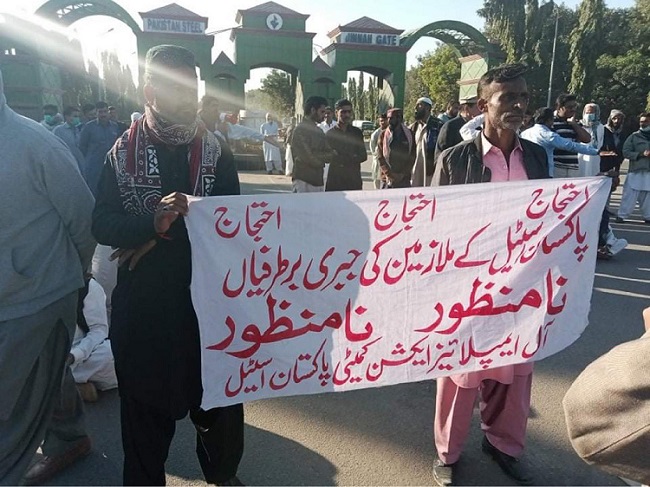
Islamabad’s decision to lay-off 4,544 employees of the debt-ridden Karachi-based Pakistan Steel Mills (PSM) has ignited a political war between the government and Pakistan Peoples’ Party (PPP). From a purely economic point of view, retrenchment on such a massive scale was inevitable since Pakistan Steel Mills has proved to be a liability with an accumulated debt of more that 200 billion rupees with no scope of graduating into a profit making venture. But laying-off such a large number of workers (and that too during Covid-19 pandemic) has raised serious concerns and given the PPP yet another good reason to attack the Imran Khan government.

Whereas Federal Minister of Industries and Production, Hammad Azhar has claimed that the laid-off employees were being paid an amount equivalent to two year’s pay, in a tweet, PPP leader Bilawal Bhutto Zardari termed this large-scale sacking of PSM employees as the handiwork of a “heartless government” and vowed that his party “will not let the PTI get away with this economic murder.” By adding that “PPP will return each and every one back to work. The land of this historical industrial asset belongs to the people of Sindh,” Bilawal has not only adroitly played the ethnic ‘Sindh card’, but also attempted to divert attention from the federal minister’s allegation that PSM had a profit of 8 billion rupees on its balance sheet when the PPP government came to power in 2008, but was left penniless when PPP was voted out in 2013.

By saying “There are valuable projects that are being neglected due to lack of resources. While we are ignoring them, we continue to spend billions on a non-operational unit [PSM] that is incurring huge losses every year,” Hammad Azar has made it clear that the government has no intention of reviving PSM and so, it will soon become history. While this approach would certainly upset those who have long associated Pakistan Steel Mills with the country’s industrial prowess, the federal minister’s reasoning that “we need to reconfigure our spending and focus on projects that need our attention,” certainly makes good sense. But there is another overriding reason, and that’s a cash strapped Pakistan can longer afford to bailout ‘sick’ units and hence, Pakistan Steel Mills would have to be put up for ‘distress sale’!

However, though the Federal Minister of Industries and Production, Hammad Azhar appears to be quite optimistic that bidding for Pakistan Steel Mills (PSM) privatization process would commence next year, but with a whopping debt of more than 200 billion rupees and more than 650 legal cases pending in courts, privatization won’t be an easy task. But, since the federal minister has hinted that some Russian and Chinese companies have evinced interest in taking over PSM, it’s apparent that despite its financial and legal woes, Pakistan’s oldest steel mill definitely holds the promise of turning into a profit-making enterprise. This is because when it comes to buying-out loss making businesses based abroad, both Moscow and Beijing are extremely wary of investing and wouldn’t risk a dime unless profitability is assured.

Sindhi employees of the Pakistan Steel Mills (PSM) protesting at the rail tracks in Karachi. (Photo: News Intervention)

So, if in Beijing’s eyes, Pakistan Steel Mills (PSM) has the potential of becoming a commercially profitable project, then the moot point is that rather than trying to buy it out, why isn’t China offering help to Islamabad to revive PMS? Let’s not forget that this factory provides sustenance to thousands of Pakistanis, and so, if Beijing genuinely considers Islamabad as its “all weather friend,” then wouldn’t it be more apt for it to extend a helping hand and assist the government of Pakistan in putting
Pakistan Steel Mills (PSM) back on track? Or is it that Pakistan’s “all weather friend” China’s rhetoric is applicable to only to grab those projects, like the China-Pakistan Economic Corridor [CPEC] and One Belt One Road [OBOR], that primarily benefits China?

In return for the extraordinary financial, diplomatic and military support it’s receiving from Beijing, Islamabad has been ‘repaying’ in equal measure by bending backwards to appease its benefactor to the extent of even going ahead and compromising its traditional stand on the Kashmir issue by granting provincial status to Gilgit-Baltistan (GB). However, the issue here is not about the philosophical or moral propriety of what Islamabad should do or avoid, but something far more mundane. Even if Beijing isn’t quite forthcoming on this issue, since Islamabad rates its relationship with Beijing as somethings that’s “higher than mountains, deeper than the ocean, stronger than steel and sweeter than honey,” couldn’t Prime Minister Imran Khan (or better still, Pakistan Army chief Gen Qamar Javed Bajwa) solicit Beijing’s financial benevolence and technical indulgence in restoring Pakistan Steel Mills (PSM) to its past glory and also save thousands of its employees from being rendered jobless? But let’s not belittle Beijing because it has walked much more than the extra mile for the sake of Pakistan.

When UNSC refused to entertain Islamabad’s request for a meeting to discuss Kashmir after abrogation of Article 370, it was Beijing who brokered a face-saving compromise through a ‘closed door’ meeting. When cash-starved Pakistan was unable return a US $1 billion loan to Saudi Arabia, it was Beijing that came to Islamabad’s rescue by lending it this amount, without any collateral. When global terror financing watchdog Financial Action Task Force (FATF) retained Pakistan on its grey-list for not doing enough to curb money laundering and terror financing, China was the only country in the world that praised Islamabad for having “made enormous efforts in improving its counter-terror financing system.”

Some may say that when Beijing has already done so much for Islamabad, expecting it to intervene an inconsequential issue like turning around Pakistan Steel Mills (PSM) is an outlandish idea, and probably it may be so. However, China’s keen interest in acquiring PSM but it’s unwillingness in helping Pakistan in revive this ailing steel mill conveys the clear message that whereas writing eulogies on friendship may work wonders in boosting the ‘feel-good’ factor, it still cannot dispel the harsh truth that when it comes to international relations, there is permanency only in interests and not in friendship!

One only wishes that the honeymoon of starry-eyed and ballad composing Islamabad with Beijing continues forever. But while hoping for the best, it may do Islamabad a lot of good to be prepared for the worst, because in todays’ world, the one certain thing is that there are no free lunches!

Il Florentine – Mind, Something & Nothing, and the Natural & Mathematical

Leonardo Da Vinci spoke on the infinite and the finite, and nothing, as well as that which exists in the mind, or not. His writings pertain to a wide subject matter while exhibiting not only mastery, but creative originality of a high calibre.

In one quote, he states, “A point is not part of a line.” As in, one must break apart the meaning of the infinite, the finite, the coterminous, the mind, the natural, the mathematical, the empirical, and more. This statement reflects the fundamental philosophy of Da Vinci, of which its remnants, as which remained as principles of thought, weave through the quoted works together as one, as in a unified framework for looking at the world, centuries ahead of his time, and now, and hidden to naked eyes, not to the mind.

He said, “It is the infinite alone that cannot be attained, for if it could it would become finite.” In this, the finitude of an existence comes in stark contrast to the infinite. The infinite of which no finite, no matter the size or the number of combinations, could ever match in magnitude.

In his natural philosophy of thought, he comprised a series of independent, unique considerations of the nature of nature, and, by derivative formulation, the nature of human nature vis-à-vis human thought. The finite in contemplation of the infinite.

Da Vinci stated, “The smallest natural point is larger than all mathematical points, and this is proved because the natural point has continuity, and any thing that is continuous is infinitely divisible; but the mathematical point is indivisible because it has no size.”

His point of a smallest “natural” point is in contrast to a smallest point because a “natural” smallest point would include the natural – the real – world of sense and experience as given by the five senses with the most important, to Da Vinci, of sight.

In some manner, in the first quote, he posits the impossibility of an infinite as something attainable, which retains a quality of impossibility for the finite to attain it, instead of the possibility of the existence of the infinite.

In this sense, he merely posits a mathematical truth in the form of the infinite never reachable through the finite. Furthermore, in the personal notebooks, or work books, Da Vinci postulated more.

His premises on a natural point is continuity, so infinity through limitless divisibility, and the “mathematical point” or non-natural point becomes indivisible “because it has no size.” This natural versus mathematical split came firmly to the grasp of the mind of Da Vinci.

He didn’t write carelessly. He was focused and sure of the word as he was in his stroke of the paint brush. The focused separation become the limit versus the limitless, and the natural versus the mathematical.

He comes as a natural philosopher or a scientist, and a mathematician, and so, in both, an empiricist-logician examining for functional relations between things of the mind and things of the sense, so, truly, a logical-operationalist or someone in search of the self-consistent, inside and out, and for functionality, operational truths about the world and the mind.

A logical operationalist, or a self-consistency-operationalist rather more precisely, as one who finds the consistencies of the mind and the world in which one inhabits the evident self-consistent operations in the natural world given by experience and the self-consistent operations of mind in the mathematical world.

He said, “Nothing is that which fills no space. If one single point placed in a circle may be the starting point of an infinite number of lines, and the termination of an infinite number of lines, there must be an infinite number of points separable from this point, and these when reunited become one again; whence it follows that the part may be equal to the whole.”

Nullity, total absence of space; to be a-spatial is to not be, to Da Vinci, where the only existence given by “to be” simply inheres in the language and represents a limit of the language, not of the intrinsic quality or valuation of the original thought of spacelessness as a fundamental premise for nothingness. That is, non-spatial upper limit, lower limit, range, contents, and existence, equate to proper no-things, nothing.

Da Vinci noted the single point in a circle may be the basis for infinity of lines and its coterminous limit with the non-infinite & non-finite, while an infinite separativity exists for the lines themselves with origin in this central point of the circle. His conclusion: the part may be equal to the whole, not is (necessarily) equal to the whole.

In this sense, he derives a principle of reflective capacities of parts to the whole via spatial relations on the premise of an infinite divisibility in actuality and the infinite divisibility permissive of an infinitude of connections from the point in the circle to the rest of the points, as such, in the circle.

On space, once more, Da Vinci, states, “The point, being indivisible, occupies no space. That which occupies no space is nothing. The limiting surface of one thing is the beginning of another.”

Thus a direction of attention to the idea of a point in space, something in a space, mentally, while occupying no space, by definition, causa mentale, becomes something of the mind, not of the world, so equal to no space as occupying no space, so being nothing, as per the derivations before.

While concluding, the limits of the surface of one becomes the beginning of a surface of the other. This raises further questions about the separation of one surface to another, one object to another, where he posits a sort of bleeding of surface to surface as being the nature of the surface of objects, hence the nature of objects derived from direct experience with a property in the object from a subject in relation to the perception of the object in Nature.

These separations of one surface into another formulate something akin to distinctions of mind and not distinctions of nature, so a distinction with a requisite operator on the other side, so Da Vinci himself.

“That which has no limitations, has no form. The limitations of two conterminous bodies are interchangeably the surface of each. All the surfaces of a body are not parts of that body,” Da Vinci continued.

Infinite in all relevant capacities creates no form; thus, form requires finites, where finites exist in the world of the natural in different ways, where limitations exist in “two coterminous bodies” with interchangeability of bodies through surfaces.

In some sense, the properties apart from the person do not reflect the boundaries as in the mind of the experiencer and theorizer, where the coterminous become the partially co-spatial in experience and in mind.

The premise of the limitless meaning no form translates into the self-limiting as that which has form. Any form becomes an intrinsic self-limit on the infinite and, therefore, a finite; finite means form, and infinite means formless.

The surfaces of the object or the “body” become co-spatially extant with the surfaces of the other object(s) or ‘bodies’ in which one becomes the other while separativity remains crucial to an experiential distinction of the objects in perception, in and of themselves.

Da Vinci stated, “The line has in itself neither matter nor substance and may rather be called an imaginary idea than a real object; and this being its nature it occupies no space. Therefore an infinite number of lines may be conceived of as intersecting each other at a point, which has no dimensions and is only of the thickness (if thickness it may be called) of one single line.”

To have neither matter nor substance, or to be “an imaginary idea” rather “than a real object” creates a unitary distinctiveness in the thinking of Da Vinci, where the mind limits the actual in conception, while perception provides strong approximations within the remit of the experience, so providing knowledge of the world through (flawed) direct perception, the objects derived from real objects or the ideas of the real objects amount to the imaginary, where by “its nature occupies no space” so equates to nothing.

An infinity of lines between points in the object conceived in potentiality. Each intersecting in all parts conceived or potentially conceived with a dimensionlessness inherent in the lines, the dots, the intersections, so the object in mind or imaginary idea, itself, as something without dimensions – so being nothing as a-spatial, because dimensionless (non-dimensionality) in mind.

He continued, “The boundaries of bodies are the least of all things. The proposition is proved to be true, because the boundary of a thing is a surface, which is not part of the body contained within that surface; nor is it part of the air surrounding that body, but is the medium interposted between the air and the body, as is proved in its place.”

The most minimal natural boundaries come from the boundaries of “bodies” or objects, such is the phenomenological fact of perception. Where, the boundary is the surface; while the surface is not part of the body “contained within that surface,” and not part of the medium between surfaces, it’s “in place.”

The objects as two spatial volumes; the surfaces as two others; the medium as a fifth separating the two surfaces, then the two surfaces further separating the objects within the direct sensory perception and conception of Da Vinci.

To him, direct experience of the world was the most important. In these quotations, he exhibits a form of experienced ratiocination taking the sensory information from the world, reasoning about it, then deriving principles about both the world and the capacity for personal observation about the world.

A separation between objects, surfaces, and mediums, and the degree of finitude and divisibility within the world of experience and then indivisibility and nothingness within the world of mind, while directing attention to the self-consistency principles in either and the operations functioning behind both and to derive both in direct experience of the world and in the mind, respectively.

Photo by Edgar Chaparro on Unsplash

Can the Pakistan Army rely on Chinese artillery?

Over more than seven decades of its creation the only thing that has remained constant in Pakistan is the anti-India strategy undertaken by its military leadership. It has fought and lost numerous wars, been humiliated in operations like the surgical strike and Balakot air raid, and yet, it is not ready to accept that nothing can be gained through this enmity. The posture is a product of the superiority complex of the Punjabi military elite that firmly believes in being better soldiers than the Indian ‘Baniyas’ (merchants) and is desperate to prove the same. Another misplaced notion is that the very existence of the Pakistan Army is dependent upon keeping the pot boiling against India. It has never occurred to these blinkered elitists that an economically strong, vibrant, democratic nation will hold out better than an impoverished one run by a civil-military cabal. 

Fate, somehow, gives to the Pakistan Army the means to carry on with its evil thought process. As a nation it is unable to procure the military wherewithal it needs to feed its inflated aspirations. The same, unfortunately, has been coming to it in the form of dole from the strongest nations of the world. Earlier, the US was providing military hardware and strategic support in order to keep its presence in the region, especially in Afghanistan, intact. Now, the US has realised its mistake and has shed Pakistan like a hot potato and China has taken on the mantle.

Stuck with a tenuous and fast deteriorating situation with regard to the China-Pakistan Economic Corridor (CPEC), China is looking towards the Pakistan Army for support. The wily Pakistani Generals have pushed for defense hardware in return.

The end result is that the Pakistan Armed Forces are being completely armed with Chinese weaponry. The situation is such that the forces can now be considered to be an extension of the People’s Liberation Army (PLA) of China.

PLA’s Pakistan Army will soon have an entirely new fleet of VT-4 Chinese Main Battle Tanks (MBTs) even as refurbishment of the existing Al Khalid and T-85 will be done by Chinese companies. The Army has already acquired ESHORAD FM-90 Air Defence System from a PLA package; it is not known whether these are new or cast-offs; also coming in are QW-18 SAM and LY-80 LOMADS missiles from China. Artillery is being built upon made in China 155mm Artillery Guns and A-100 MLRS (multi launchers).

The missile cover in the PLA’s Pakistan Army will be based on Chinese missiles and UAVs. The Pakistan Air Force has been equipped with JF-17 fighter aircraft and Z-10 Helicopters. Chinese Pakistan Navy will have Air Independent Propulsion (AIP) Submarines and Jiangwei-Il Class F-22 Frigates apart from many other equipment and weapons already in place.  Lastly, the security of CPEC will be done by China financed and kitted Special Security Divisions.

Obviously, Pakistan has no money to pay for this military bonanza. This procurement, combined with the massive payments due for CPEC, will result in a debt trap for Pakistan larger than ever seen anywhere in the world. Pakistan should be very worried about this.

The second more critical aspect that Pakistan should be very worried about is the poor quality of the Chinese equipment. In its defence industry too, China is following its well established policy of cutting cost through poor quality and mass production, little realising that weaponry is a different ball game from Diwali lights and golf sets. Mass production means looking for huge markets. The country has managed to hold the fifth place globally in sale of defence hardware but is fast losing its clientele and reputation due to frequent complaints about quality.

Jordon purchased six CH-4B unmanned combat aerial vehicles (UCAV) produced by the China Aerospace Science and Technology Corporation (CASC) in 2016. The Kingdom has already advertised for their resale and has no buyers.

Pakistan is worse off since ‘beggars can’t be choosers’. The country is probably being given stuff that is not finding buyers anywhere. For the Chinese, Pakistan’s defence build up is more an exercise to empty its storage space than anything else.

Pakistan is already bearing the brunt with two brand new Chinese JF-17 fighter aircraft having recently crashed along the Pakistan-Afghanistan border. Serviceability of these aircraft is already down to 40 percent. The Pakistani pilots call them the death traps and are hesitant to fly them. 

Of the many mistakes that the Pakistani generals have made in the past, this latest attempt to maintain strategic balance with India by equipping its men with Chinese weaponry will be the most catastrophic. Having failed consistently in the conventional warfare front and also the thousand cuts policy applied in Kashmir, it would be in the interest of the Pakistan Army to carry out a course correction in its policy.

Such course correction is also what the people are looking for, as is obvious from the voices being raised against the Pakistan Army chief. These days, in political circles of Pakistan, there is incessant talk of doing away with ‘hybrid governance’ denoting the control of the Army over the Prime Minister. Recently, in a video address at a rally in Gujranwala, former Prime Minister Nawaz Sharif was direct in naming and shaming the Army Generals, ‘Kisne nalayak Imran Niazi ko Wazir-i-Azam banaya? (Who made that fool Imran Niazi prime minister)’ he thundered. Other leaders of the Pakistan Democratic Movement (PDM) also echoed his views.

It would be in the interest of the Pakistan Army to read the writing on the wall. It should shed the irrational strategic policy of staying perpetually in a state of conflict with India and should, instead, give space to its government to pay more attention to governance and improving the lot of the people. The country is well endowed with natural resources; if there is honesty in the leadership approach, it will prosper in no time. 

In a snub to China, Bangladesh turns its back on Chinese Defence Minister

In a snub to China, Bangladesh has turned its back on Chinese defence minister, Wei Fenghe who was slated to travel to Dhaka after concluding his visit to Nepal. Wei was planning to travel in India’s neighbourhood at a time when the geopolitical tussle between New Delhi and Beijing had sharpened.

“The cancellation of Wei’s visit to Bangladesh shows how countries in South Asia are trying to balance ties between the Himalayan rivals,” a person with a knowledge of the visit, who did not wish to be named told IndiaNarrative.com.

With Pakistan already in its bag as a satellite state, especially after the flagging of the China Pakistan Economic Corridor (CPEC) that links the Pakistani coastal city of Gwadar with Kashgar in China, Beijing has stepped up its push in South Asia, including Nepal, Bangladesh and Sri Lanka—countries which have traditionally gravitated towards India.

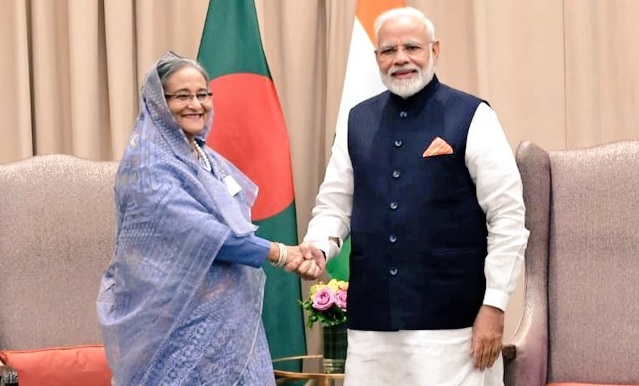
Official sources told India Narrative that India has a “reliable friend” in Sheikh Hasina, Prime Minister of Bangladesh, who has gone out of her way to bond with India’s core interests.

Meanwhile, National Security Adviser Ajit Doval has just concluded talks in the Sri Lanka, where the defence minister of Maldives was also an invitee during a trilateral maritime dialogue on the Indian Ocean. Analysts say that Sri Lankan Prime Minister Mahinda Rajapaksa, of late, has been especially receptive to India’s outreach.

The Chinese defence Minister was in Nepal to salvage some of the momentum in China-Nepal ties which India’s energetic reengagement with the Himalayan Kingdom had recently retarded. In the Great game between India and China to compete and entrench their influence in pivotal Himalayan states, China has pitched high stakes in the unity of the Nepal Communist Party, formed in 2018 after the merger to Nepal’s two communist parties – Communist Party of Nepal – United Marxist Leninist (CPN-UML) and Communist Party of Nepal (Maoist Centre).

Oli has apparently snubbed China’s controversial ambassador—Hou Yanqi, who had tried to seal a deal between the two rival factions led by the Prime Minister and his rival, Pushp Kamal Dahal. Raising the banner of national sovereignty, Oli pointed out to the Chinese envoy that Nepal did not need foreign interference to resolve its domestic political problems.

The Chinese had sensed a major opportunity to expand their influence in Nepal after New Delhi-Kathmandu ties nosedived following acute cartographic frictions between the two neighbours. Earlier this year, Nepal opposed an 80 km-border road to Lipulekh region that Kathmandu claims. Nepal responded by issuing a new map that showed Indian territories of Kalapani, Lipulekh and Limpiyadhura within the boundaries of Nepal.

India’s rearguard action to claw back influence began in October with back-to-back visits. New Delhi-Kathmandu ties were rebooted after the visit to Nepal by India’s spy chief Samant Kumar Goel, who held an extended meeting with Oli. India’s Army Chief Manoj Mukund Naravane and Foreign Secretary Harsh Vardhan Shringla followed up on Goel’s ice-breaking visit. The Hindustan Times is reporting that Nepal is keen to move forward on its relationship with India and could take a positive view on a travel air bubble with India and the Pancheshwar multi-modal project after foreign secretary Harsh Vardhan Shringla’s two-day visit. Shringla had a 50-minute one-on-one conversation with PM Oli on November 26 that saw the two countries focusing on steps to normalise relations hit hard due to the Lipu Lekh boundary row.

Nepal’s foreign minister Pradeep Kumar Gyawali is expected to be India in December for which the dates are being worked out.

Nepalese media is reporting the India and the US are trying to draw Kathmandu into the broader Indo-Pacific initiative in a bid to dilute China’s influence over Kathmandu. “[As far as I understand], the Chinese are worried about the growing American presence in South Asia, recent US-India strategic ties, its implication in the region, Nepal’s position on Indo-Pacific Strategy and Nepal’s dilemma over accepting the US’s Millennium Challenge Corporation,” said Rupak Sapkota, deputy executive director of the Institute of Foreign Affairs, a semi-government think tank under the aegis of the Foreign Ministry, and a close China watcher , as reported by The Kathmandu Post.

(This article was first published in India Narrative)

“A Savage Logic” – Albert Einstein on Anti-Semitism

The power of resistance which has enabled the Jewish people to survive for thousands of years has been based to a large extent on traditions of mutual helpfulness. In these years of affliction our readiness to help one another is being put to an especially severe test – Albert Einstein before the outbreak of WWII

Anti-Semitism has played a brutal role in human history. It continues to play one. Its manifestations vary by country, culture, and time. Yet, it’s the flavour of bitterness on the proverbial tongue, hatred in the heart, and ignorance of the brain. A sensory echo through time.

It’s something of a majority poison, as exhibited in other ethnic hatreds. Where, with some rare few, it becomes a form of transcendent hatred of ‘the (despised) Other,’ as in that which is not understood and deemed condemned by God Almighty or the all-knowing State.

Whether secular statehood or religious injunction, anti-Semitism has shown its face for millennia. Even the great geniuses of history have been struck throughout their lives to the formulations of ethnic supremacy against them, Albert Einstein famously went through numerous tribulations due to this.

Adam Richter in “Einstein faced antisemitism in his early career” reports Einstein experienced anti-Semitism, even after the publication of his theories and the garnering of international fame. He states:

Einstein continued to face criticism that focused on his Jewish heritage, particularly in his native Germany. Nazis and their sympathizers decried his “Jewish science,” with its unusual ideas about the relativity of space and time, which they believed undermined the more credible “Aryan science.” After class, a student approached me and asked a question that surprised me: Where did all this prejudice against Jews “suddenly” come from in the 1920s and 1930s? Why would the Jews be singled out in the scientific community? I ended up explaining to the student at length that the growth of antisemitism [sic] in Europe was anything but sudden. Rather, its roots extended back as least as far as the Middle Ages, when Jews were expelled from numerous European cities and regions.

Einstein was issued criticism, not for his ideas or his political stances but, his heritage, Jewish ancestry. That which he could not change and remained stuck with as an adult, as an old man, as a legacy, and as an internationally famous genius. That’s part of the poison of anti-Semitism.

Also, it reflects the common trend for century after century of hatred towards an individual because of their ethnicity, as a Jewish man, woman, or child, rather than in things in which they would have a choice. Misogyny, hatred of Arabs, anti-Asian sentiment, derision and exclusion of personhood status of black people, remain much the same.

A deep and abiding hatred of an individual for that which Nature, Necessity, God, or their parents bestowed upon them. It can become as ridiculous, unnecessary, and cruel, as a criticism of “Jewish science” as if scientific or empirical facts and mathematical principles cared about the ethnicity of the person who discovered them or posited them.

All ethnic hatreds stem from the worst of human nature and an ignorance of human nature, simultaneously. The idea of the “Jewish science” was seen, to anti-Semites, as a corruption if not an anti-thesis of “Aryan science.”

At core, a split between German Gentiles and German Jews set forth by German Gentiles, as the dominant ethnic grouping, against the minority, German Jews, though with an internationalist tinge because of its focus on the anti-Jewish sentiment as the center of the storm.

“Jewish science” and “German science,” as such, simply or merely reflect the prejudices and the ignorance of individuals about science or about human nature; where, science, as a manifestation of a plural process grounded in human experience and sense-enhancing tools, represents a universal attempt at acquisition of the true approximations of Nature’s principles and form.

Anything less than this can be considered both an affront to one’s God, oneself, or Nature, as in honest and sincere work for truth rejects parochial labels of its proper process, science, as German science, Jewish science, even Canadian science.

Canadians, Jewish peoples, and Germans do science, practice it in other words, but they do not produce Canadian science, Jewish science, or German science, as in ethnic-based truth because of an ethnicity; only the products of reality found through science as a process of sincere searching for truth – even the fleeting.

In a matter of fact, these remain, as Einstein noted, harbingers of hatred, and death, spanning a far time into the past, even to the Middle Ages “when Jews were expelled from numerous European cities and regions.”

Some make the claim of this spanning back to the foundation of Christianity with the claim of Jewish peoples, as a whole, murdering the Son of God, so the justifications for hatred and violence continue into the present theologically too.

It was not merely the Germans. Americans, too, exhibited this formulation of hatred. In “Albert Einstein’s letter denouncing antisemitism in US academia on sale,” Rossella Tercatin quoted Einstein, who said:

The hostile attitude of universities towards Jewish teaching staff and students has been increasing perilously, even though it manifests in a hypocritical manner…

Unfortunately, the current Jewish leaders do not comprehend the seriousness of the situation, similar to the German Jews in the time before Hitler. They believe that they are able to put an end to the problem by being silent and disregarding it, and they thus miss the time for creating places of support…

This is not just true for the functions of the educational system, of course, but in economic and social terms as well…

Between World War I and World War II, there were quotas in American universities, or institutions of purported higher learning, on Jewish students.

When you read Einstein’s Pacifism and World War I By Virginia Iris Holmes, she talks about how even when offered an executive board position of the Association for Combating Antisemitism (Verein zur Abwehr des Antisemitismus) in September 1920; his step-daughter and secretary, Ilse Einstein, wrote:

Prof. Einstein instructed me to inform you that in his opinion we Jews cannot contribute to combating antisemitism [sic] through a direct campaign. Since your view on this point differs from that of Prof. Einstein, I respectfully request in his name that you kindly refrain from your plan – of electing Mr. Einstein onto the board of your association.

Einstein expanded on the letter in Israelitisches Wochenblatt ten days after the rejection of the effort in terms of the direct combat of anti-Semitism. Einstein “expressed his support for the socially underprivileged East European Jews and showed a leaning toward cultural Zionism and the cultivation of pride in a positive Jewish identity.”

Stuart Clark in “Why Einstein never received a Nobel prize for relativity” argued for the role of anti-Semitism in the lack of an eventual Nobel Prize for Einstein based on Relativity (Special Relativity and/or General Relativity), even with a “decade’s worth of Nobel nominations behind him.”

The reasoning: “Antisemitism [sic] was on the rise in Germany; Jews were being scapegoated for the country’s defeat in the war. As both Jew and pacifist, Einstein was an obvious target. The complexity of relativity did not help either. Opponents such as Ernst Gehrcke and Philipp Lenard found it easy to cast doubt upon its labyrinthine mathematics.”

In 1921, nonetheless, Einstein was awarded a Nobel Prize. However, the threats of harm to self, whether livelihood or life, can make an individual weary. When based on ethnic grounds, or ethnic hatred roots, this becomes no different for these individuals.

Anti-Semitism is a poison in the vein; it can be drained from the public consciousness through a consistent moral effort to tune into the natural conscience of most of humanity in the form of the humane rather than the heavy-handed, resource-wastage of the inculcation of the inhumane.

Otherwise, as Clark notes on the outcomes of hatred in mind, wrote, “German foreign minister Walther Rathenau had been murdered by anti-Semites. In the subsequent investigation, the police had found Einstein’s name on a list of targets.”

Physics remains about reading the signs of Necessity, as supreme, in Nature, including human nature. Einstein had insights here too. In “A decade before the Nazis came to power, Albert Einstein warned of the rise of anti-Semitism,” Natasha Frost described a letter written by Einstein to Maja (his sister) as a warning about the “grave dangers” (Frost) coming to them.

Rathenau was a close friend of the Einstein family. Hitler was a minor political figure known for targeting of Jews in speeches. Einstein began to frame himself as a “free man.” Someone without tenure and disconnected to the universities.

As Aron Heller describes in “Einstein warned about rise of antisemitism more than a decade before Nazis seized power, letter shows,” the Nazis immediately began instituting anti-Semitic legislation as soon as they came into power in Germany.

Frost stated, “In 1933, the Nazis passed laws prohibiting Jews from holding any official positions, including teaching at universities.”

He had joined a League of Nations Commission, where he saw himself becoming a sort of itinerant preacher. Maja, meanwhile, lived in Italy Fewer than 20 years later, Benito Mussolini instituted anti-Semitic laws. Fascists are anti-Semites, historical lesson.

These sentiments born of hard-won experience reflect the statement about a “savage logic” stated in a letter to Jawaharlal Nehru, Prime Minister of India, in 1947, where these sentiments mark a direct discourse on the victimization of Jewish peoples “for centuries” while “bereft of all the rights and protections which even the smallest people normally has…”

“Long before the emergence of Hitler I made the cause of Zionism mine because through it I saw a means of correcting a flagrant wrong… The Jewish people alone has for centuries been in the anomalous position of being victimized and hounded as a people, though bereft of all the rights and protections which even the smallest people normally has,” Einstein stated, in full, “Zionism offered the means of ending this discrimination… The advent of Hitler underscored with a savage logic all the disastrous implications contained in the abnormal situation in which Jews found themselves. Millions of Jews perished… because there was no spot on the globe where they could find sanctuary…The Jewish survivors demand the right to dwell amid brothers, on the ancient soil of their fathers.”

To discontinue this ornery state of affairs for more than two millennia, a new way forward means a new discourse about wider humanity in the presence and form of a life lived out in a humane manner with a civilized logic, not a “savage logic,” as exhibited in even the great societies of their time, in the arts, literature, philosophy, and science; as they went from a more civilized logic to an outright savage logic, the highest, of the time, can be brought to the lowest in the darkness of the inhumane apart from the light of the humane, thus chary vigilance in perpetuity becomes a virtuous necessity – a salve to the ill of “savage logic.”

Photo by Taton Moïse on Unsplash

Stigmata of the Enigmata – or, the Catholics, and Leonardo

Christian is a Philosopher that comes from Belgium. What identifies him the most and above all is simplicity, for everything is better with “vanilla ice cream.” Perhaps, for this reason, his intellectual passion is criticism and irony, in the sense of trying to reveal what “hides behind the mask,” and give birth to the true. For him, ignorance and knowledge never “cross paths.” What he likes the most in his leisure time, is to go for a walk with his wife.

Scott Douglas Jacobsen: Insofar as some reasonably substantive historical work displays the personality of Leonardo (Da Vinci), we can stipulate some probabilities about the man: gay or male homosexual, left-handed, vegetarian, wore purple and pink tunics, polymath, wrote in reverse to the norm of culture then and now, illegitimate child, no real last name, son of a notary father and peasant mother, an empiricist-logician without formal education or schooling, and some formal training in the arts under Andrea del Verrocchio, and, of course, without equal amongst contemporaries. Any thoughts on Leonardo Da Vinci? (Personally: an eminently lovable person.)

Dr. Christian Sorensen: Along with sustaining the eminence of Leonardo da Vinci, I think that it is necessary, to reaffirm its enigmatic and progressive personality, all of which stands out overwhelmingly, with respect to the generality of his time and of our days, nevertheless, not everything can be inclusive, if of what is talking about, is its homosexuality, which from my point of view, and contrary to what Freud argued, was not a repressed desire. Indeed, it was conscious enough, to have lived it, at the same level of his other desires, and then, unlike its other qualities, it would have followed the same fate, that the one is followed currently, in the sense of going unnoticed, which is what I believe that happens, to the vast majority of men, when they put into play, their masculinity, through what I will name as heterocuriosity, that strictly speaking, it is a camouflaged bisexuality, which I consider to be structurally constitutive, both physically and psychologically, therefore ultimately represents anyway, and no matter in what context it takes place, a facet of homosexuality. In this sense, for me, and from a metaphorical perspective, Da Vinci’s kind of homosexual latency, becomes by analogy, not in what most believe as genial creativity, but in what for me has to do with a creative genius, that expresses in itself, by showing and hiding at the same time, as if it was a divinity, what I think it’s his writing with crooked lines. Due to the above, I believe that Da Vinci, was the first to have the intention, of creating an underlying mystery, foundable within the expressed message of its work, and containing as such, what I will denominate as achieved significance of the word, which is going to be related, in turn, with something external to the work itself, while the external to which it refers, will also be implicitly present in it. The aforementioned, suggests also, the fact of discovering, that his main value, from my point of view, is a sort of game of interactions, that’s being displayed between the symbol and their hidden meanings, which lastly enables to conclude, that there’s an inexhaustibility, that places Da Vinci and his work, in something equivalent to what would be the place of the universe, where the only findable limit, is the reason.

Jacobsen: Da Vinci commonly repeated himself. Prismatic lessons in orbit around the same orb. For example, compare the three quotations here:

  • These scholars strut around in a pompous way, without any thoughts of their own, equipped only with the thoughts of others, and they want to stop me from having my own thoughts. And if they despise me for being an inventor, then how much more should they be despised for not being inventors, but followers and reciters of the works of others.
  • Although I cannot quote from authors in the same way they do, I shall rely on a much worthier thing, actual experience, which is the only thing that could ever have properly guided the men that they learn from.
  • I am well aware that because I did not study the ancients, some foolish men will accuse me of being uneducated. They will say that because I did not learn from their schoolbooks, I am unqualified to express an opinion. But I would reply that my conclusions are drawn from firsthand experience, unlike the scholars who only believe what they read in books written by others.

He would make a poor academic. For the formally uneducated with unmeasurable talents, what seems like the sensibility to less capable others with prestige, title, and connections for Da Vinci?

Sorensen: I think that it causes nausea, since the nothingness of being is fully revealed, as an act of fatuous sincerity, that is to say, nothing is not present, as negation, in the sense of absence, as occurs with the immeasurable ignorance, but instead, what happens is equivalent to a doctoral ignorance, where an absent presence is produced, since something present, presents itself as such, at the same time, that it becomes an absence, by double negation, because what is shown as evidence, is actually being hidden, and therefore, it’s not presented, meanwhile on the other hand, what seems like evidence, is not perceived as such.

Jacobsen: Any favourite quotations properly attributed to Da Vinci?

Sorensen: Simplicity is the ultimate sophistication.

Jacobsen: What seems like the true philosophical stance of Da Vinci on God, the Bible, religion, theology, the sciences, Christianity, and nature, reality Itself?

Sorensen: The fact that precisely, reality in itself, is the only true thing, since from his point of view, all knowledge, should be born from experience, and from the perception of the senses, therefore, if any reality is not empirical, then it shouldn’t be assumed as existent, and in consequence, no knowledge, that doesn’t have its origin in the latter, can be either accepted as truth. Not for nothing, Da Vinci says, that when he meets God, he will claim him, for all the faults that exist within the world, which in my opinion means then, that God could not have created nothing, since then something, would not work correctly, between God and its perfection, in consequent its entity neither does exist, nor would there be any conversation between both. In more tangible terms, I think that just as Da Vinci despised metaphysics, due to its unmeaningful etherealness, in the same way, he also felt an allergy with theology, that was further projected towards the clergy, by denouncing them as corrupts, and by calling to disobey their authority, through its works.

Jacobsen: Any thoughts on the Catholic funeral for Da Vinci?

Sorensen: Regarding Da Vinci’s funeral in itself, I can only say, that many myths have been woven, and that there are more uncertainties than assurances about it, however, especially around his death, and in relation to its testament, left to the notary of Amboise, draws the attention, the fact that Da Vinci, had requested, three solemn Masses, with deacon and sub-deacon, and thirty Gregorian Masses, without chorus. Regarding its desire, plenty of things may be said, though from my perspective, what actually is emphasized, is the symbolic meaning of number three, that for me means knowledge, in the Hebrew sense of the word emet as truth, which signifies without death, and that as such, was repeated three times. Therefore, if the presence of the priest is taken into consideration, then I will propose as an interpretation, the appearance of number thirty-three, which coincides in turn, with the age that Jesus had when he died, while the masses without singing, are related with what for me, is the metaphor of the holy Grail, and not, with what is the holy Grail in itself, since it belongs to the sacred enigma, of which its secret, along with having circulated between different depositaries, has been split into parts, that individually, do not say anything about themselves, except if they are completely assembled, which then, is going to imply a certain knowledge, that is not only hidden, but also, that’s lost in time, because it refers to a lineage, already assimilated, and therefore, untraceable.

Jacobsen: Regarding the (Roman) Catholics, what are the bases for their faith?

Sorensen: I think, that the faith of Roman Catholicism, is a faith without bases, since it refers to a reality, which is not real, at the same time, that it has always tried to erase the traces of all it, that is to say, of the reality that regards Jesus and Mary Magdalene. The last, has been in that way, from the medieval crusades, through the Renaissance and modern-day with the witch hunts, among which, I believe, that Leonardo Da Vinci was a victim, and until now, where the probable current murders, who are seeking to destroy, any evidence, related to the depositaries of the sacred enigma, by carrying out, from the darkness, and with the protection of their sacramental secrecy, silencing conspiracies, that hide behind organizations, such as the Opus Dei, since in that way, they continue maintaining a hierarchical, patriarchal and anti-egalitarian power structure, which ultimately, does nothing more, than to reaffirm their intolerance, and what I am going to name, as the supposed exclusivism of their Christian faith, that’s exactly the opposite, of what it is for me, the liberating egalitarianism of the feminine principle, represented by Maria Magadalena and by the primordial pagan goddesses, to whom this Jewish woman, would somehow be assimilated.

Jacobsen: What seem like the good, the neutral, and the bad of their faith?

Sorensen: I think, that the bad thing about their faith, is that it exists, meanwhile, the neutral issue, is that it is an empty faith, because as such, it says absolutely nothing, therefore, the good news about it, would be, that this and its Roman Catholic Church, may collapse and disappear promptly, since with doing so, for the first time, they would be making something for the commonwealth of humanity.

Jacobsen: What were some close social and professional entanglements with Opus Dei and the Vatican for you? What were the lessons from the experience?

Sorensen: I did my philosophy studies, at the Ponticia Università della Santa Croce in Rome, which is physically located in the Palazzo di Sant’Apollinare, since the 14th century, and which was in practice, the old College of Cardinals, where for example, the anti-Pope Benedict XIII, the Nazi Pope Pius XII, and the Pope of the Second Vatican Council, John XXIII, studied. While I was studying, the Opus Dei, offered me to do, a second doctorate in psychology in Germany, and they wanted me to work, in Spain and the United States, with two world-renowned psychiatrists, Aquilino Polaino and Alexander Lyford Pyke, respectively. Simultaneously with the last, they gave me the possibility, of accessing to a sort of secret library, with documents and texts that belonged to the Roman Catholic Church, since the 11th century, and which have been for hundreds of years, forbidden literature for everyone, other than a select group of ecclesiastical authorities, therefore I was the exception to this rule. Indeed, regarding these readings, I had to take an oath, in front of a commission of clergy, under penalty of excommunication, in case that I dared to disclose the content of them. My stay in Rome, allowed me to maintain a physical closeness and friendship, with both the Vatican and the Opus Dei, because in fact, I lived in via Aurelia 145, which was an exclusive condominium, for the diplomatic staff of several embassies, and was located meters from the perimeter wall of the Vatican, at the same time, that I also strengthened close ties, among others, with Joaquin Navarro Valls, who was the spokesman for twenty-two years, during the pontificate of John Paul II, and with Monsignor Mariano Fazio, who is the future successor, of the current prelate of the Opus Dei. In addition to the above, I had the opportunity, to get to know the Vatican banking, since its director of finance, Piero Bagio, to whom I arrived recommended by someone of the Opus Dei, was the person who opened my personal account, in the Ambrosian bank. If I had accepted, all the chances the Opus Dei gave me, with all certainty, I would have assured my existence, from a financial and professional point of view, nevertheless as a counterpart, I would have had to be satisfied, with the will of flying like a poultry, which in concrete would have meant, to sell my soul and spirit, in exchange for wealthness, question to which, I actually was not and I am not willing to do. On the other hand, I wanted to have a training in metaphysics, and from that point of view, I think that the most optimal way to do it, was in a pontifical university with ecclesiastical orientation, that as well, is found in the crib of the Roman Catholic Church, therefore, this was for me, the most suitable place for achieving the goal, not only for all the aforementioned, but also because I think, that the best place, where a bird can take refuge, so as not to be spotted by a hawk, is by hiding under his wings.

Jacobsen: Why is Roman Catholicism one of the most dominant faith sects in the world now?

Sorensen: Because it is the only religious sect, that delivers certainties. All other religions and sects, propose the existence of a sort of silver cord, between God and man, which would allow a communication without intermediaries, though the counterpart, would be that this kind of bond, implies the fact of not knowing or to not recognize the will of God, and therefore, to be unaware, of if the soul, is worthy of enjoying the eternal beatitudes, regarding which, this sect would be its guardian executor, since represents, God on earth, and feels with the empowerment, to redeem sins, what from an underlying point of view, demonstrates, the reason of why this faith, is based on what I will denominate as double self-referentiality, due to the fact, that everything turns, in first person, around them, regardless of whether they are clergy or not. In consequence, generally, they are sort of insatiable black holes, that are waiting to be filled, with goodness, by God. Their neighbors, instead, only exists as scarlet covered steps, waiting to be trampled, for ascending towards heaven. Therefore, in my opinion, the Roman Catholic Church, is a sect, that by excellence, exalts the disordered desire for oneself, and occupies it, like a hook, for a huge majority, at the same time that exhibits, what for me is their facilitist attribute, since together with lacking any intellectual exigency, because almost all of their beliefs and precepts, are empty of any rational basis, and the few of them, which are considered by the clergy, as preambles of faith, because they would have some degree of explicability, actually what they follow, are tautological forms of reasoning, that lead them to chase their tails, just like a perturbated dog does with his. Obviously then, it is not surprising, that they make montages of realities, loaded with magical thoughts, which undoubtedly and for sure, may reach the heart of more than someone, especially if they are supported, by images full of luminous rays, that show languishing faces with blank stares. Deep down, nevertheless, they lack the most important, which is the history, a coherent story, able to account phenomenologically, of the existence of a subject within it.

Jacobsen: What was the work of the Roman Catholics in regards to fighting against anti-Semitism and fighting to further entrench and participate in anti-Semitism?

Sorensen: I think that both, are two sides of the same coin, which is the same strategy, currently followed, with their declarations of love, towards homosexual unions. Historically speaking, the Roman Catholic Church, has always been cynically anti-Semitic, since for them there is a historical crime and sin, due to the crucifixion of Jesus, with respect to which, the Jewish people is guilty, and therefore, would have to pay eternally, with the pain that rejection produces, and with the deaths, that the persecutions entail, nevertheless is in turn, another justification for punishing them, because they didn’t recognize, in the person of Jesus, the figure of the Messiah. In the same manner, according to their bizarre way of thinking, Jews would still cling to a doctrinal error, that they proudly defend, through their over-intellectualizations of the sacred scriptures, and consequently, by contributing, to maintain the world plunged into darkness, for not reaching the true faith. The aforementioned, suggests, that Jews should be silently fought, as enemies of the faith in Jesus Christ, however they forget, that the above is a kind of guiltness, that the lame man attributes to the pavement, because he is not able to walk through, since lastly what they’re preventing is that the Catholic world, gets to know the real true story, due to the fact, that this, would lead to the collapse of the Catholic Church. In conclusion, what they actually feel, is that they have no way to defend themselves, from the cornerstone that’s undermining the foundations of their feigned faith, therefore, the only thing left for them, is to use anti-Semitism as a threat for Jews, at the same time that they use Jews, as a threat for the rest of the world, nevertheless from my point of view, they lose sight, that the threat, is the weapon of who first feels threatened.

Jacobsen: What are the typical forms of argument of the Roman Catholics? What refutes to near certainty or in totality?

Sorensen: The Roman Catholic Church, sustains itself, through arguments, that have the form of apodypic certainties, which means, that they do not admit, any type of refutations, because the last would suppose, a discursive confrontation, which in turn, would give the option to reject a specific argument, and the last, does not happen with the apodictic reasoning, since it is equivalent to an absolute, that is imposed, by its querulous force, which is derived in parallel, from an authoritarianism, and not from a discursive force. Similarly, these kinds of arguments, take dichotomous forms, in order to polarize their meanings to the extreme, due to the fact, of being unable to integrate opposing elements, for forming afterwards, coherent wholes, and therefore, by the employment of a dualistic thinking, they tend to pigeonhole them, with rigid moral categories of good and evil, since they are incapable to resolve any cognitive dissonance, arising from apparent contradictory elements, due to the reason, that they’re incapable of accessing, towards what I will name as formal thinking. In consequence, they remain within a sensitive stage of thought, that at times, is only able of carrying out concrete operations, which never get to the complete abstraction of something.

Jacobsen: Thank you for the opportunity and your time, Dr. Sorensen.

Sorensen: You’re welcome, Mr. Jacobsen.

Photo by Mika Baumeister on Unsplash

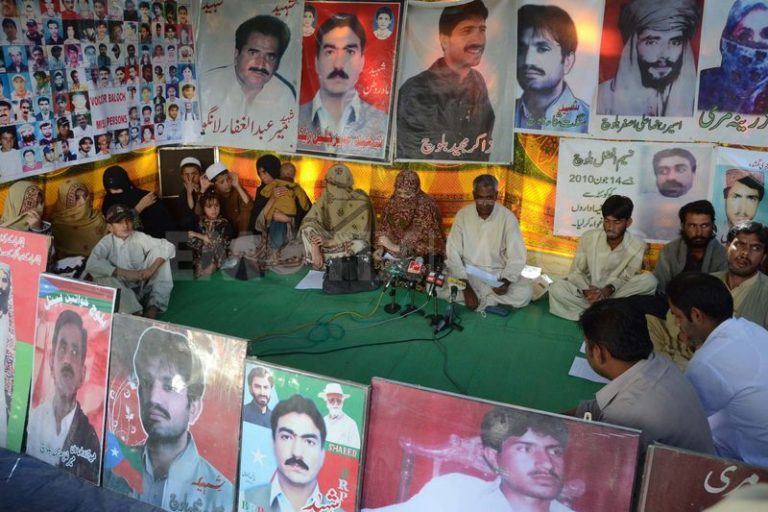
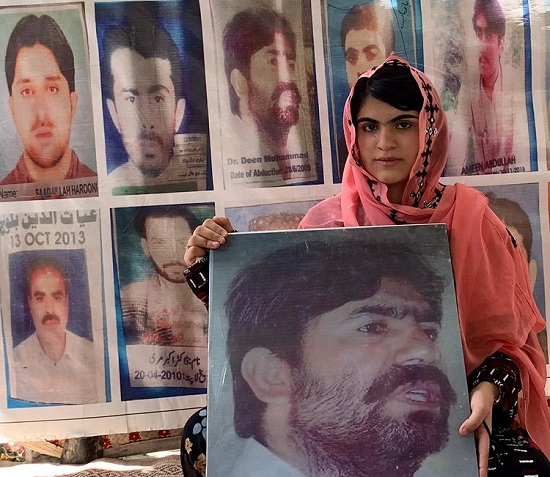
Pakistan’s abduction of Baloch intellectual Dr Liaqat Sunni is ‘Naked Aggression’

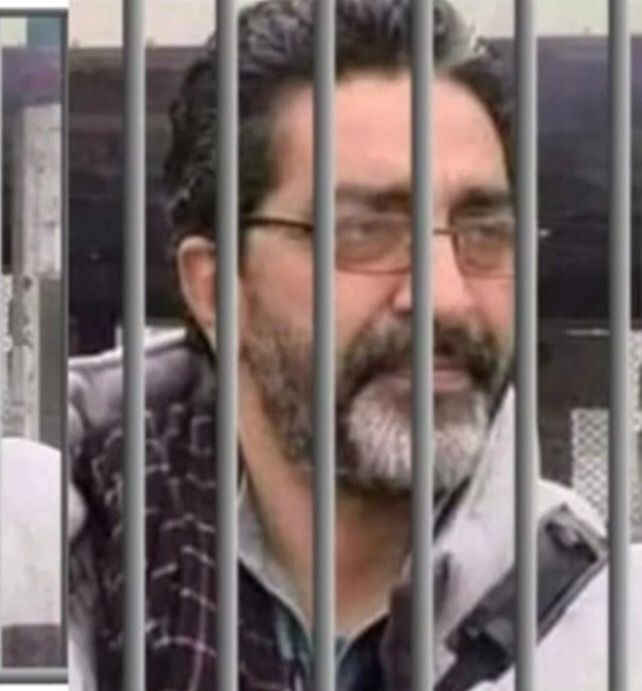
Dr Liaqat Sunni, eminent Baloch intellectual and chairman of Brahui department at the University of Balochistan joined the list of people who have been disappeared by the Pakistani security forces. Strongly condemning the “enforced disappearance” of Dr Liaqat Sunni the Baloch National Movement (BNM) spokesperson said “naked aggression” against Baloch individuals continues as usual.

Dr. Liaqat Sunni is also a poet and writer who hails from Mastung in Pakistan-occupied Balochistan.

The BNM spokesperson explained that in accordance with a new strategy, Pakistan is trying to portray the abduction of Dr. Liaquat Sunni as a kidnapping for ransom so that the image of the state is not tarnished and the sentiments of Baloch nation can easily be diverted. “But the Baloch nation is fully aware of state barbarism in all its forms. The way, in which Dr. Liaquat Sunni was abducted in broad daylight by personnel who came in three vehicles, itself exhibits the tactics used by Pakistani agencies,” added the BNM spokesperson.

Pakistan’s abduction of Dr. Liaqat Sunni is yet another attempt to deprive the Baloch society of knowledgeable personalities and intellectuals. This policy has been going on for decades in order to inhibit the growth and development of Baloch nation in the field of science and literature. The assassination of Saba Dashtyari–the fountain knowledge, at Quetta by Pakistanis security forces is another example of their tactics. Hundreds and thousands of torchbearers of knowledge including Haji Razzaq, Ustad Ali Jan, Professor Razzaq and Zahid Askani had been earlier assassinated or disappeared. “But the struggle for freedom against slavery is continuous and will continue in the future. It is determined that the abduction of teachers, students, women and children will bring disgrace to Pakistan,” the BNM spokesperson added.

BNM further added that Pakistan was pursuing a multi-dimensional strategy of socio-economic aggression against the Baloch nation. “People are being killed and abducted in military operations across Balochistan on a daily basis. Houses and possessions are being looted and burned. Death Squads consisting of the Pakistani Army personnel, intelligence agencies and criminals have now morphed into bloodthirsty beasts. No one’s life is safe. The Baloch land has been turned into a hell for the Baloch people.”

“We are convinced that Dr Liaqat Sunni has been picked up by the secret agencies of the Pakistani state. The Pakistani state is trying to cover its war crimes by depicting such enforced disappearances as kidnappings. These kidnappings for ransom have been going on for the last several years in Balochistan. For instance, Pakistan Army’s Major Naveed demand six million rupees the release of Hafeezullah Baloch who was abducted from Dalbanden. This case came to light after the Pakistan Army chief had himself accepted that their Major had kidnapped Hafeezullah for ransom.”

In fact, Balochistan is a war zone. People are being abducted despite the presence of Pakistan Army outposts and camps that are present after every kilometer. This itself is an indication that the kidnappings across occupied Balochistan are being carried out with the consent and tacit support of the Pakistani state.

Guru Nanak Dev Ji gave a message of universal brotherhood

“Sadguru Shri Guru Nanak Pargateya Mitti Dhund jag chanan hoya”
(When Shri Guru Nanak came, mist went away and the world saw light)

This widely used exposition elucidates the journey of Guru Nanak Dev Ji in this world more than 550 years ago. His teachings have as much (if not more) relevance in today’s world’s as they had when he first expounded them to bring about a socio-religious change in a society tearing apart due to dogmatism and inherent contradictions.

The Guru was born in an affluent Hindu family on 29 November 1469 (according to the Nanakshahi calendar) at Rāi Bhoi Kī Talvaṇḍī (present day Nankana Sahib in Pakistan Punjab). His father Kalyan Chand Das Bedi aka Mehta Kalu was an affluent businessman of the area who had good relations with the local Muslim chieftain Rai Bhular Bhatti. His mother was Mata Tripta. Nanak had only one sibling, a sister named Nanki who was five years elder to him. She was the one person with whom he was particularly attached.

Nanak, as a child, remained immersed in his own thoughts and this behaviour caused considerable tension to his father who, quite naturally, wanted his only son to grow up as normal and take over his thriving business. Nanak, however, exhibited a rare intellect and insight into a religious philosophy that looked at a single supreme God (monotheist). He rejected certain teachings and rituals of both Hindus and Muslims.

Nanak's father had given him twenty rupees (a large sum at that time) and asked him to make a Sacha Sauda (profitable deal). Guru Nanak Dev Dev Ji bought food with the twenty rupees for ascetics as part of Sacha Sauda (profitable deal).
Nanak’s father gave him twenty rupees (a large sum at that time) and asked him to make a Sacha Sauda (profitable deal). Guru Nanak Dev Dev Ji bought food with those twenty rupees and fed sadhus and ascetics as part of Sacha Sauda (profitable deal).

In order to maintain a modicum of harmony between father and son, Bebe Nanki, on getting married, took her brother with her, to her husband’s house in Sultanpur Lodhi and it is here that Nanak spent his growing years. He worked as a manger in the provision store of the local chieftain, Nawab Daulat Khan Lodhi. While performing his duties well, he spent his spare time in meditation and in the company of ascetics. He also started building a Sangat (following) there.

On 24 September 1487, at the age of about 18 years, Nanak was married to Sulakhani, daughter of Mul Chand and Chando Rani, residents of Batala, Punjab. The wife of Guru Nanak DevJi is now called Mata Sulakhani. Nanak did go through a family life and had two sons named Sri Chand and Lakhmi Das, however, his inner core remained attracted to spirituality.

It is said that one day Nanak went for his early morning bath in the nearby river and did not return for three days. When people had given up on him as drowned he re-emerged and recited a divine message that is recorded in the Sikh religion as the “Mool Mantra,” as follows —

Ek Oaʼnkār
(One omnipresent God)
Saṯ Nām Karṯā Purakẖ Nirbẖa­o Nirvair
(Truth is God’s name; God is the doer; God is without fear; God is without enmity or hatred)
Akāl Mūraṯ Ajūnī Saibẖaʼn
(Timeless, undying; formless, beyond birth, self created self existent)
Gur Parsāḏ.
(By Guru’s Grace)

Guru Nanak Dev Ji then declared his life’s mission as one dedicated to the service of God and started his divine journey by advocating “Na Koi Hindu Na Musalman” (There is no Hindu, no Musalman). Thus, he set out his spiritual mission of considering mankind without shackles of caste and creed and religion, dedicated to the love of a single and supreme entity.

Guru Nanak Dev Ji went out on four long journeys across distant lands which are termed as Udasis. Even though there are no authenticated accounts of these spiritual journeys, their context becomes clear from the Bani that he quoted during his interaction with various peoples.

It is believed that the four corners of his travels stand at Mount Sumer (Mount Kailash) where he held his most significant discussion with the ascetic Baba Gorakhnath and his 84 Siddhas; then onto to Assam in the East, Mecca-Medina in the West and Sri Lanka in the South. In the context of modern India, his signature in the form of some historical monument of fables are to be found in Himachal Pradesh, Jammu and Kashmir, Uttar Pradesh, Sikkim, Ladakh and even Nepal and Tibet and, of course, in Punjab. What is significant is the Gurdwara Pathar Sahib in Ladakh; the imprint of his sandals in Nepal and reference to “Nanak Lama” in Bhutan.

Guru Nanak Dev Ji wandered across many places in those days of limited transportation, possibly on foot with his faithful Bhai Mardana. It is said that Bhai Bala also accompanied him in his travels but this is refuted in some historical quarters. In every place he was known to sit outside the city, accept invitations from followers and devotees and confer with the poorest of the poor and Kings alike.

Guru Nanak Dev Ji, thus, delivered his message of the entire mankind being one under the spiritual umbrella of a single creator – “Manas Ki Jaat Sabhe Ekay Pehechani Bo” (Human Beings should be recognised as one) far and wide. He never took any pretension of divinity, instead, he looked upon himself as the most humble servant of the supreme being whose definition he had given in his divine inspiration of the Mool Mantra. He advocated the concept of meditation and praise of the creator while staying connected with the world, unlike the meditative seclusion followed by Siddhas and Sadhus.

It is through the debates during his Udasis that his Bani crystalised into a spiritual message that was later recorded in the Guru Granth Sahib by subsequent Gurus and his devout Sikh disciples. The recording is in the form of nearly 1000 hymns set in superb poetry capable of being rendered by divine classical music. His essential message was “Kirat Kar, Wand Chak, Naam Jap” (Work with honesty, share what you have and take the name of the creator).

Twenty years after crisscrossing the land Baba Nanak finally decided to settle in one place and spread his message. For this purpose he chose a piece of land astride River Ravi that had been donated to him by Dhuni Chand, an important Governor in Punjab. He named this as Kartarpur (place of God). The Guru took to the practice farming and was soon joined by his wife and other family members. Thus, Kartarpur became the first commune of the Sikh religion.

Gurudwara Darbar Sahib, Kartarpur. The Gurudwara is located in the Shakargarh Tehsil of Pakistan's Punjab province and is just a few kilometres from the India-Pakistan international border. It is highly revered by Sikhs across the world.
Gurudwara Darbar Sahib, Kartarpur. The Gurudwara is located in the Shakargarh Tehsil of Pakistan’s Punjab province and is just a few kilometre from the India-Pakistan international border. It is highly revered by Sikhs across the world.

Within his community Guru Nanak Dev Ji initiated the concept of Sangat and Pangat. Sangat means congregation of people and Pangat implies sitting in rows and eating Langar (community food) together. The mornings and evening were spent in the recitation of Gurbani (holy verses),Kirtan (spiritual Hymns) and finally partaking food together in the Langar.

Guru Nanak Dev Ji appointed his devout follower Bhai Lehna as his successor and gave him the name Angad, denoting that he was a part of the Guru himself. Guru Nanak Dev Ji left his physical form on 22 September 1539 in Kartarpur, at the age of 70.

Making a Buck as a Mountebank – Astrologers, Mediums, and Psychics

1

British Columbia has a highly educated population. However, it doesn’t prevent the delusions of old and New Age filter into the communities and professions.

Freethought for the Small Towns: A Case Study“[1] gives a decent idea of this on a wide smattering of issues, including naturopathy and naturopaths who, by definition, claim medical doctor or doctor status while not being doctors in the local town here.

It’s province-wide, though. They’re fraudulent and found throughout the province. Astrologers, mediums, numerologists, and psychics, are much the same: frauds, or mountebanks, who make a living off lies.

Those who feed on the pain and/or gullibility of others, who have been termed “Psychic Vampires,” as in the cases of mediums who claim to speak to the dead of living loved ones. These are bad people claiming to know the outcomes and to speak for the dead of those who are alive and love them.

One of the most prominent self-proclaimed supernaturalists, self-claimed ‘astrologer,’ in British Columbia is Georgia Nicols. Someone who has chosen a profession based on a lie, while garnering some prominence within the Lower Mainland. In Langley, British Columbia, we have ‘psychics’ Linnea Pearson, Carole Serene, Courtney Dawson, and Christine Marie.

What is a psychic, though? Good question, RationalWiki states, “A psychic is a person purporting to have some sort of supernatural or paranormal ability to receive or interpret information in a way that normal people cannot and that empirical evidence cannot detect,” with claimed abilities ranging as follows:

If they wish to put them to a test, then the James Randi Educational Foundation has the right test for them with a $1,000,000 (USD) price tag attached to it. If they were serious, they would, as others, put up the gumption for the test to win some serious cash, or simply give up the act.

Powers affect the natural world, so can be tested under proper conditions if truly believed. If not, what exactly is the purpose of practicing it? It’s quite clear in the latter case, fraud; it’s also clear in the former, delusion or misunderstanding of the basics of how the world works to a modern person.

These people are professional frauds because psychic powers do not exist, as in they are ‘psychic powers.’ I know the economy has gone through a dip of sorts, but I find this absurd play-acting of the fantastical idiotic.

In the wider area, there’s Psychic Jade, the Golden Spirit Centre of Excellence (Maple Ridge), the Mystic Eye Tarot, Psychic Visions 152, Psychic Readings by Sister Fatima, Tamara Hawk, the Yogi’s One Stop Psychic Shop, Sara Psychic Reader, Sasha Psychic Reader Fortune Teller, Raphael The World’s Medium, Parice Dawn, Salma Kassam, Linnea Psychic Medium & Spiritual Counsellor, Juan the Psychic (one of the few men), Kelly Chapman, and VS Spiritualist.

It attracts the worst gullibility in people, and so the worst traits reflected in the people who practice it. These aren’t good people; these people practice a charlatan’s art. If they believe their own nonsense, they’re delusional mountebanks, so stupid as well as vice-ridden.

Still the list continues, alas: Christine Marie, Psychic Amari, Acharya Rajesh, Indian Astrologer in Vancouver – Black Magic Specialist, 3rd Eye Designs & Visions, Bianca Psychic Reader, The Tarot Room, Andrea Zonnis, Psychic Reader Kathleen, ‘World Famous Indian Astrologer and Psychic’ (so “World Famous” as to not have a name or a review), Grayce and Gratitude – Psychic Medium, even the Paisley Town Psychic Fairs and Events.

The award for most grandiose and strangely amorphous title goes to… “Messages from a Star Traveler: Reiki, Energy Healing in North America, Psychic Readings, Past Life Regression, Soul Retrieval.” And don’t you forget it.

The buzzards line-up continues: “The Psychic Dr,” Maria Melo, Astrologer Nakulas, Psychic Readings-Astrology and Spiritual Healing, “Astrologer & psychic reader, Black Magic Removal, Love Spell, psychic” earned a rather amusing review, “The staff are very friendly [sic] and knowledgeable.” What, exactly, are these individuals knowledgeable about, now?

On and on, it goes: Courtney Carnrite, Cassandra McLeane, Dragonfly Essence, Chantelle Danielle, Sri Hanuman, Linda Pynaker, The Balanced Soul, Psychic Revelations, Psychick Healing Studio (clever title, actually), Soul Ascendency Psychic, Madame M. Live Psychics, Zljka Bosnjak Melody Rose Psychic, Cheri22, Siri The Intuitive… at this point, they’re MCs and DJs from the 80s, with far less talent.

One can feel hopeless in the mire of misanthropy exhibited in the cynicism of those who know they practice a charlatan’s art for a living. Other names include Lady of the Mists, Norma Cowie, Zais Heather, Skull Farm, Psychic Readings by Kristen – In the presence of Angels, Vanessa Corazon, Sacred Shamanism, Maureen Freeman, Hotno, Beyond Belief Psychic Entertainment, Gastown Psychic, Psychic Mama Sita, Kim Pellerin, Natasha Rosewood, Charmaine Accurate Psychic (I beg to differ), Cheryl Cole, Lynda Jane, Sukira Healing, Nipun Joshia (nShivoham), Ruth Hart, Cranbrook Clairvoyant, “Anne Clear Le Bihan,” and more.

The more I see, the more I see the pervasive ignorance and/or desperation for answers in an educational system not providing adequate answers; a culture discouraging questioning of the standard answers given in the society, as well as the mountebanks flourishing without many other skills as they have resorted to the lowest arts, charlatanry.

The only true creativity is that manifested in their names and company titles, while their names and company title aren’t that good. The names proliferate and simply become part of the fabric of the ignorance of the provincial culture in one of its many manifest ways.

The collection continued, consisting of Addi Strasser, Tarot Readings by Tegan, Signature Readings with a Twist, Oracle Emporium, Diane Daniels, T&T Spiritual & Wellness Connections, Indigo Awakenings, Speak for Me, Tarot & Psychic Reading Hotline Kelowna, Anna Babchuk, Grateful Medium, Conscious Quantum Energy Healing Services, Gypsy Moon, Spiritualist Alliance, Pivotal Hypnotherapy, Melissa Frisby, School of Intuition, Amethyst Books & Essence, Westcoast Reiki Centre, The Universal Brotherhood Spiritualist Church, West Coast Institute of Mystic Arts, Danielle Blackwood (the astrologer part), Kimberly Leslie, Airisa, The Oracle at Whistler, and Oracle at Sechelt.

In short, there’s a huge number of individuals practicing a mountebanks profession, making something of a living, while somewhere between believing their lies or knowingly lying to the public, for a buck.

A critical culture could more directly pummel this phenomenon of fraudulence with examples given in the aforementioned, whether primarily in psychics, but also astrologers, mediums, numerologists, Reiki practitioners, and the like.

[1] “Freethought for the Small Towns: A Case Study,” (2020), in part, states:

…Another issue practice is reflexology, as seen in Health Roots & Reflexology [Ed. Lisa Kako, Alison Legge.]. Quackwatch concludes, “Reflexology is based on an absurd theory and has not been demonstrated to influence the course of any illness… Claims that reflexology is effective for diagnosing or treating disease should be ignored…” …As Dr. Harriet Hall in “Modern Reflexology: Still As Bogus As Pre-Modern Reflexology“ said, “Reflexology is an alternative medicine system that claims to treat internal organs by pressing on designated spots on the feet and hands; there is no anatomical connection between those organs and those spots. Systematic reviews in 2009 and 2011 found no convincing evidence that reflexology is an effective treatment for any medical condition. Quackwatch and the NCAHF agree that reflexology is a form of massage that may help patients relax and feel better temporarily, but that has no other health benefits…”

…A larger concoction of bad science and medicine comes from the Integrated Health Clinic [Ed. Kaiden Maxwell, Gurdev Parmar, Karen Parmar, Michelle Willis, Karen McGee, Erik Boudreau, Adam Davison, Nicole Duffee, Erin Rurak, Alyssa Fruson, Alanna Rinas, Sarah Soles, Wayne Phimister, and Alfred Man. Many, not all, in part or in whole, trained in and practicing pseudosciences – pseudomedicine – found in acupuncture, naturopathy, traditional Chinese medicine, homeopathy, craniosacral therapy, the Bowen technique, and so on. One can integrate several pseudosciences to formulate a clinic for ‘medicine.’ However, all this amounts to an elaborate integration of pseudosciences, an integrated pseudoscience clinic, whether in a quaint fundamentalist religious community village or not.] devoted, largely, to naturopathy/naturopathic medicine (based on a large number of naturopaths on staff) and traditional Chinese medicine with manifestations in IV/chelation therapy, neural therapy, detox, hormone balancing & thermography, anthroposophical medicine, LRHT/hyperthermia, Bowen technique, among others. We’ll run through those first two, as the references to them are available in the resources, in the manner before. Scott Gavura in “Naturopathy vs. Science: Facts edition” stated:

Naturopaths claim that they practice based on scientific principles. Yet examinations of naturopathic literature, practices and statements suggest a more ambivalent attitude. NDhealthfacts.org neatly illustrates the problem with naturopathy itself: Open antagonism to science-based medicine, and the risk of harm from “integrating” these practices into the practice of medicine… Because good medicine isn’t based on invented facts and pre-scientific beliefs – it must be grounded in science. And naturopathy, despite the claims, is anything but scientific.

The Skeptic’s Dictionary stated:

Naturopathy is often, if not always, practiced in combination with other forms of “alternative” health practices... Claims that these and practices such as colonic irrigation or coffee enemas “detoxify” the body or enhance the immune system or promote “homeostasis,” “harmony,” “balance,” “vitality,” and the like are exaggerated and not backed up by sound research.

As Dr. David Gorski, as quoted in RationalWiki, stated, “Naturopathy is a cornucopia of almost every quackery you can think of. Be it homeopathytraditional Chinese medicineAyurvedic medicineapplied kinesiologyanthroposophical medicinereflexologycraniosacral therapy, Bowen Technique, and pretty much any other form of unscientific or prescientific medicine that you can imagine, it’s hard to think of a single form of pseudoscientific medicine and quackery that naturopathy doesn’t embrace or at least tolerate.” The Massachusetts Medical Society stated similar terms, “Naturopathic medical school is not a medical school in anything but the appropriation of the word medical. Naturopathy is not a branch of medicine…”

…Now, onto Traditional Chinese Medicine or TCM, or Chinese Medicine or CM, also coming out of the Integrated Health Clinic, RationalWiki notes some of the dangerous, if not disgusting to a North American and Western European palette, ingredients:

CM ingredients can range from common plants, such as dandelion, persimmon, and mint, to weird or even dangerous stuff. Some of the more revolting (from a Western standpoint) things found in TCM include genitals of various animals (including dogs, tigers, seals, oxen, goats, and deer), bear bile (commonly obtained by means of slow, inhumane extraction methods), and (genuine) snake oil… Urinefecesplacenta and other human-derived medicines were traditionally used but some may no longer be in use.

Some of the dangerous ingredients include lead, calomel (mercurous chloride), cinnabar (red mercuric sulfide), asbestos (including asbestiform actinolite, sometimes erroneously called aconite) realgar (arsenic), and birthwort (Aristolochia spp.). Bloodletting is also practiced. Bizarrely, lead oxide, cinnabar, and calomel are said to be good for detoxification. Lead oxide is also supposed to help with ringworms, skin rashes, rosacea, eczema, sores, ulcers, and intestinal parasites, cinnabar allegedly helps you live longer, and asbestos…

Dr. Arthur Grollman, a professor of pharmacological science and medicine at Stony Brook University in New York, in an article entitled “Chinese medicine gains WHO acceptance but it has many critics” is quoted, on the case of TCM or CM acceptance at the World Health Organization, saying, “It will confer legitimacy on unproven therapies and add considerably to the costs of health care… Widespread consumption of Chinese herbals of unknown efficacy and potential toxicity will jeopardize the health of unsuspecting consumers worldwide.”  On case after case, we can find individual practices or collections of practices of dubious effect if not ill-effect in the town.

Photo by Scott Rodgerson on Unsplash